Article

Influence of Long Jetties on Coastal and Estuarine Hydro-Sedimentological Patterns in a Microtidal Region: Potential for Mud Deposit Formation


by
Monique Franzen
1,
Eduardo Siegle
2,*,
Aldo Sottolichio
3 and
Elisa H. L. Fernandes
1
1
Laboratório de Oceanografia Costeira e Estuarina, Universidade Federal do Rio Grande, Av. Itália, CP 474, Rio Grande 96201-900, RS, Brazil
2
Instituto Oceanográfico da Universidade de São Paulo, Praça do Oceanográfico, 191, Cidade Universitária, São Paulo 05508-120, SP, Brazil
3
Environnements et Paléoenvironnements Océaniques et Continentaux, Bordeaux INP, EPOC, UMR 5805, Universitè de Bordeaux, F-33600 Pessac, France
*
Author to whom correspondence should be addressed.
Coasts 2026, 6(2), 17; https://doi.org/10.3390/coasts6020017
Submission received: 18 December 2025 / Revised: 19 March 2026 / Accepted: 1 April 2026 / Published: 15 April 2026

Abstract

Given the continuous expansion of global trade, coastal and estuarine environments have been increasingly modified by anthropogenic pressures associated with port development, particularly through inlet stabilization by jetties, which often causes unintended environmental changes. This study evaluates alterations in estuarine and coastal hydro-sedimentological dynamics resulting from the construction of jetties (1911–1915) in the Patos Lagoon estuary, Brazil. A calibrated and validated numerical model (TELEMAC-3D) was used to compare pre-jetties and present conditions. Results showed that the morphological changes induced by the jetties altered estuarine circulation and sediment retention mechanisms. The reduction in current velocities within the channel increased sediment trapping, decreasing sediment transport capacity towards the adjacent coast. In contrast, along the plume jet, flow acceleration enhanced offshore export of fine suspended sediments, shifting deposition from nearshore areas to deeper offshore zones. Under northeastern wind conditions, a higher potential for mud deposition near the western jetty was observed in the post-construction scenario, reflecting a change in local deposition trends. These human-induced modifications not only reorganize sediment pathways but also influence habitat distribution and deposition patterns, highlighting the importance of considering engineering structures in sustainable coastal and estuarine management strategies.

1. Introduction

Coastal and estuarine environments have major social, economic and ecological importance [1,2] due to their strategic location between the ocean and the continent, providing ecosystem services worldwide [3,4]. These important environments have been extensively modified over the last few centuries, especially to accommodate human structures and activities, such as port facilities, shoreline-hardening structures, and other services [3].
Given the continuous expansion of global trade and the growing demand for port structures around the world [5], port activities are considered essential socioeconomic activities in these environments [1,6,7,8,9]. Important ports in the world (Shanghai, Rotterdam, Antwerp, Hamburg, Los Angeles and New York) are inside or near estuarine or coastal zones and port development and expansion [10,11]; normally involve inlet stabilization by the construction of jetties [11,12]; resulting in inevitable environmental changes.
Estuaries are considered preferential routes of sediment exchange between land and the adjacent coast, playing a fundamental role in regional sediment balance and transport [13]. Coastal areas are reservoirs of fine sediments, which reach the inner platform by estuary flushing, fluvial discharge and/or meteorological forcing [14], and in specific conditions, they form sediment deposits, such as mud banks, in the adjacent coastal zone [15]. Nearshore mud concentrations are a worldwide phenomenon with important ecological implications, as observed in the Amazon River system [16], the Yangtze estuary [17], the Gironde estuary [18], Cassino Beach [19] and the La Plata River [20].
Anthropogenic changes imposed by jetties can alter fine sediment dynamics, including sediment erosion/depositional patterns and the delivery of suspended sediments to the open coast [21,22,23]. Therefore, knowledge of fine suspended sediment dynamics is of major importance in this type of environment and can be used to infer the dynamics of pollutants in estuaries and coastal waters [24]. In this sense, this knowledge helps to establish or develop an integrated coastal management approach and support stakeholders.
Over the last few decades, there has been an increasing need to fully understand these anthropogenic impacts, and some studies have focused on the impacts of jetties construction in coastal environments worldwide [12,25,26] observed changes in erosion/deposition patterns and a decrease in the tidal delta at Ribadeo Port, Spain, due to engineering works to support port development. After the implementation of jetties in the Guadiana estuary, ref. [27] found changes in the shoal’s position near the adjacent coast.
Several studies have assessed the effects of jetty construction on morphological changes and morphodynamic processes in coastal zones and estuaries [12,26,28,29,30,31,32]. In this sense, the present study will contribute to this understanding and is based on a calibrated and validated three-dimensional hydrodynamic numerical model (TELEMAC-3D) applied to the southernmost part of Brazil in the Patos Lagoon system [33].
This microtidal region underwent drastic morphological changes with the construction of two parallel jetties at the inlet (1911–1915) which were further extended in 2010. Most studies up to now have been developed to understand different aspects related to hydrodynamics, sediment dynamics and ecological processes considering the last modification of the jetties in 2010. More recently, ref. [33] showed the impacts of the original construction of jetties on the hydrodynamics of this region.
This system has a natural potential to export fine suspended sediments to the adjacent shelf through the Patos Lagoon coastal plume [34,35], and some of these sediments are deposited in the southern parts of the jetties, in front of Cassino Beach. These sediments feed the inner-shelf mud deposits [36,37] and are sporadically remobilized towards the beach during high-energy events, changing the type of sediment from sand to mud, with drastic consequences on activities such as tourism and fishing [35]. This periodic issue is one of the motivations of this study.
This study is a step forward towards a better understanding of the impact of this centenary coastal engineering structure on the coastal and estuarine dynamics of the studied region. Unlike most previous studies, which mainly focused on recent modifications of the jetties (e.g., the 2010 extension [38]) or short-term hydrodynamic responses [33], this work investigates the long-term effects of the original jetty construction (1911–1915) on fine suspended sediment dynamics using a three-dimensional, calibrated and validated TELEMAC-3D model applied to historical and present-day morphological scenarios.
More specifically, our aim is to investigate how the original construction of jetties changed fine suspended sediment transport, especially regarding the current velocities, suspended sediment patterns, plume dispersion and potential to feed coastal fine suspended sediment deposits. The main scientific questions addressed are: (i) how the jetties modified estuarine circulation and sediment retention mechanisms inside the channel; (ii) how they altered plume dynamics and offshore sediment export; and (iii) how these changes shifted deposition trends along the adjacent coast and inner shelf.
By comparing the pre-jetty and present configurations under different wind and discharge conditions, this study advances previous research by explicitly linking morphological alteration, hydrodynamic response, and sediment pathways at a centennial temporal scale. In addition, it can provide important guidelines for an adequate coastal management plan that considers significant coastal work under a hydro-sedimentological view.

2. Materials and Methods

2.1. Study Area and Port Development

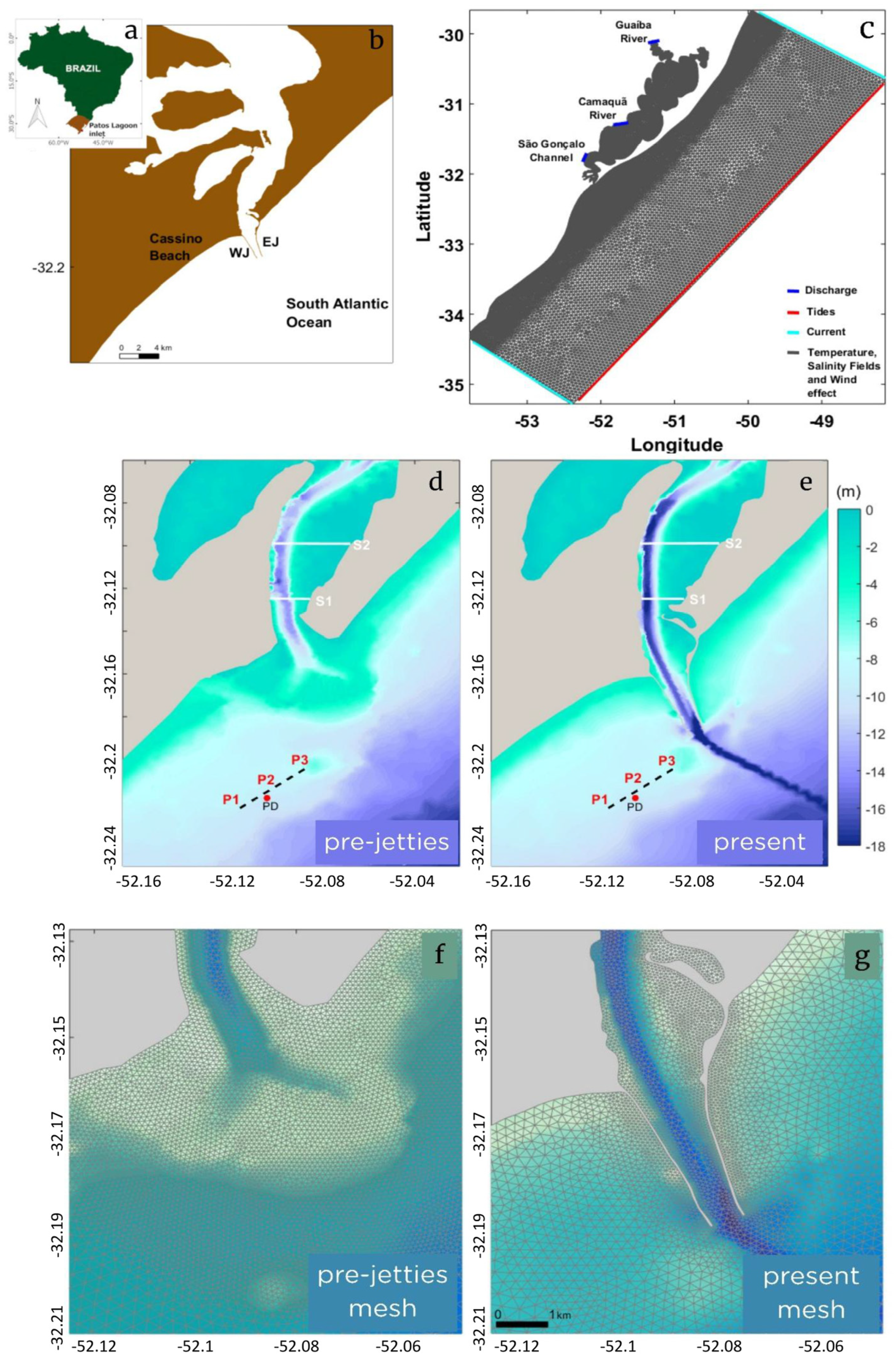
The Patos Lagoon, in southern subtropical Brazil (between 30° S and 32° S), is the largest choked coastal lagoon in the world [39], with a surface area of 10.360 km2 and a length of 240 km (Figure 1). This lagoon and its adjacent coast have great economic and ecological importance [33,37] and are connected to the Atlantic Ocean through its estuarine portion (approximately 10% of the total area). Its connection is through a 20 km single narrow channel (~550 m wide) stabilized by long jetties [40].
The Patos Lagoon drainage basin (approximately 200,000 km2) provides suspended sediment for transport throughout the lagoon. Rivers Guaíba and Camaquã are the main tributaries in the northern and central portions of the lagoon, respectively, and the São Gonçalo Channel is in the estuarine portion; they have a combined mean annual discharge of 2400 m3·s−1 [41], although the discharge can reach peaks of 12,000 m3·s−1 during El Niño periods [42]. These rivers present high discharge in late winter and early spring, followed by moderate to low discharge through summer and autumn [40].
The dynamics of the system are controlled by wind action and river discharge [35,40,43]. The main driver of the system is fluvial discharge when it is above average (>2000 m3·s−1), sometimes preventing seawater intrusion within the lagoon [43]. However, during periods of low to moderate river discharge (<2000 m3·s−1), remote and local wind effects become more important [44].
Winds shift from northeast (NE) to southwest (SW) on a timescale of days due to the passage of cold fronts [42], being more frequent during Austral autumn and winter [45]. The influence of the Atlantic Anticyclone causes the dominant NE winds throughout the year [40].
The combination of these drivers promotes the exchange of water and suspended sediment between the estuary and the adjacent ocean [35,36], influencing species behaviour through physico-chemical processes [46]. Suspended sediment concentrations in the system are related to fluvial inputs, with the predominance of fine sediments, which are carried towards the coast [23,35,36]. NE winds result in water and suspended sediments leaving the estuary; on the other hand, SW winds promote the entry of water and sediment in the estuary. This mechanism relies on Ekman transport, which creates a depression or elevation in coastal waters. This process drives a bidirectional exchange: when NE winds blow, water flows seaward from the estuary, and when SW winds blow, it flows landward into the estuary [47].
This region has a typical microtidal pattern [48] under a mixed tidal regime with diurnal predominance and a mean tidal range of 0.3 m, which is restricted to the coastal and lower estuarine zones, being filtered and attenuated along the channel [23].
In the past, before the construction of the jetties, the inlet had an ebb-tidal delta with a typical half-moon shape and clockwise migration [49]. This original morphology represented unsafe navigation conditions and restrictions to port development in the region. Therefore, two jetties were constructed at the Patos Lagoon mouth between 1911 and 1915 [23], consolidating the expansion of the Port of Rio Grande (http://www.portosrs.com.br).
This significant coastal work is considered the largest engineering work ever performed in Brazil [50]. More recently (in 2010), to increase the depth of the navigation channel, these structures were further extended by 350 m (east jetty) and 700 m (west jetty), totalling 4800 m and 3500 m in length, respectively [23]. The inlet mouth width was reduced to ∼550 m [33], aiming to promote stronger flushing flows. Therefore, the original morphology of the system has been drastically modified by the jetties, with further channel lengthening and deepening, which has extinguished the ebb-tidal delta [51], leading to hydrodynamic changes in the water flow; this modification likely had impacts on the suspended sediment exchanges between the lagoon and ocean.

2.2. Numerical Model

The TELEMAC-3D version V7P0 (www.opentelemac.org), developed by the TELEMAC-MASCARET Consortium, was used to model the hydrodynamics and fine suspended sediment dynamics in the area of interest. To investigate the fine sediment transport changes imposed by jetties construction at the mouth of the Patos Lagoon estuary, numerical simulations were carried out through the coupling between the hydrodynamic and suspended sediment transport modules (SEDI-3D).
The model is based on the finite element technique, allowing a high refinement of the numerical mesh at locations of interest in the domain. TELEMAC-3D solves the Reynolds-Averaged Navier–Stokes equations and considers the Boussinesq and Hydrostatic approximations [52]. The sigma coordinates are used for vertical discretization, enabling an accurate representation of complex bathymetric gradients and morphology. Therefore, the TELEMAC-3D numerical model is suitable for application in complex areas, such as shallow seas, coastal areas, estuaries, and lagoons, and has been used in several studies of the Patos Lagoon and its estuary dynamics [9,23,33,38].
Concerning the suspended sediment transport processes, the SEDI-3D model solves the mass conservation equation, which simulates the temporal and spatial variations in active tracers, such as salinity, temperature, and suspended sediment. The model incorporates the flocculation process, which is based on the [53] formula, using a flocculation coefficient of 0.3 and a coefficient relative to floc destruction of 0.09. Erosion and deposition rates are also represented by the model through the [54,55] formulas, respectively.
The sediment class used in this study was fine silt, as indicated by [23,56], as suspended sediments in the Patos Lagoon estuary are essentially composed of silt and clay [35,57].
The year 2013 was selected for the numerical simulations because it is classified as a neutral year in terms of the El Niño–Southern Oscillation (ENSO), with no strong El Niño or La Niña events recorded [58]. ENSO cycles exert a significant influence on hydrodynamics and sediment transport in the Patos Lagoon estuary and adjacent coastal region, mainly by modulating precipitation patterns, river discharge, wind regimes, and estuarine circulation [59]. El Niño events are typically associated with increased freshwater discharge and enhanced sediment export, while La Niña events tend to promote reduced river inflow and stronger marine influence [60,61]. Therefore, the selection of a neutral year allows the analysis of sedimentary dynamics under average climatic conditions, reducing the influence of extreme interannual variability and facilitating a more representative comparison between the morphological scenarios. Besides this year, an additional spin-up period of one month has been included in the simulations.
The numerical experiments consider two morphological scenarios: (1) before jetties construction, based on the 1885 bathymetry and morphology [62], and (2) the present morphological configuration (after 2010), hereafter called the pre-jetties and present scenarios (Figure 1c,d), respectively. For this purpose, high-resolution meshes were elaborated from interpolated bathymetric data, with the same model domain including the Patos Lagoon and adjacent coastal waters, from 29 to 35.5° S and 48 to 54° W. The present scenario mesh considered bathymetric data digitized from nautical charts of the Brazilian Navy and complemented with data from the Rio Grande Port Authority. The historical mesh was built from this validated mesh, modifying its bathymetry in areas where historical data are available. The historical bathymetric data were digitized from the 1885 nautical chart. The main difference between the two meshes is at the Patos Lagoon inlet and channel (Figure 1e–g).
The numerical domain is composed by 81,389 (present scenario)/91,216 (pre-jetty scenario) finite elements, 42,427 (present mesh)/47,153 (pre-jetty mesh) nodes and 10 equally spaced sigma levels in the vertical direction. The location and type of the initial and boundary conditions considered in these numerical experiments are summarized in Figure 1. The same settings were used for the simulations in both scenarios. At offshore boundaries, tides and currents were prescribed based on sea-surface elevation information from the OSU Tidal Inversion System [63] from the TOPEX-POSEIDON altimeter data internally coupled in TELEMAC-3D. At this same boundary, three-dimensional temperature and salinity fields from the HYCOM Model (Hybrid Coordinate Ocean Model, https://hycom.org/, accessed on 11 September 2025) were also included, with spatial and temporal resolutions of 0.08° and 3 h intervals, respectively. At the surface boundary, wind data from the ERA-Interim reanalysis from ECMWF (European Centre for Medium-Range Weather Forecast, http://www.ecmwf.int/, accessed on 11 September 2025) were imposed, with 0.75° and 6 h spatial and temporal resolutions, respectively. These data were interpolated temporally and spatially for every node of both meshes.
At the continental boundaries, mean daily river discharge data from the main tributaries (Guaíba and Camaquã Rivers) were applied based on data from the Brazilian National Water Agency (ANA, https://www.snirh.gov.br/hidroweb/, accessed on 11 September 2025). At the São Gonçalo Channel, water levels have been obtained from the Mirim Lagoon Agency (ALM, https://wp.ufpel.edu.br/alm/, accessed on 11 September 2025) and converted into daily freshwater discharges through a rating curve method. Suspended sediment concentrations (SSCs) of the river boundaries were considered constant due to the lack of measured data; therefore, values of 200 mg/L, 100 mg/L, and 150 mg/L were assigned to the Guaíba River, Camaquã River, and São Gonçalo Channel, respectively. These selected constant values were based on [56,64], and also applied by [37], and represent a simplification that may introduce uncertainties, particularly by underrepresenting short-term variability associated with extreme discharge events or seasonal changes. However, this approach is commonly adopted in data-scarce environments and is considered adequate for assessing relative differences between morphological scenarios, which is the main goal of this study.

2.3. Calibration and Validation

TELEMAC-3D has been extensively calibrated and validated for the Patos Lagoon in previous studies [23,37]. Nevertheless, specific calibration and validation have been conducted for this study and are described in detail by [33]. The model’s ability to correctly reproduce hydrodynamic processes was assessed through the comparison between observed and modelled data based on statistical parameters such as the relative mean absolute error (RMAE) and root mean square error (RMSE) [37]. In the hydrodynamic model calibration exercise, modelled and measured current velocities at the same point and depth were compared for January 2006 [33].
Even with some differences in magnitude, the model’s reproduction was classified as excellent, with an RMAE of 0.02 [65] and an RMSE of 0.25 m/s. The best set of physical parameters obtained from the calibration exercise was used in the validation experiment. For the model validation, modelled and measured salinity time series at the same depth were compared for January 2017 [33]. According to the classification proposed by [66], the model was considered good, with an RMAE of 0.38 and an RMSE of 10 (in a range from 0 to 35).
The calculated and measured SSC time series at the Guaíba River for February 2013 were compared to calibrate the sedimentary module (Figure S1—Supplementary Materials) due to the available SSC measurements for calibration. Statistical analyses of the best results from the calibration exercise showed excellent model reproduction (RMAE = 0.11). The RMSE value was 6.65 mg/L (in a range from 5 to 33 mg/L). The best set of parameters obtained in the calibration exercises was used in the validation experiment, as shown in Table 1.
The validation exercise was based on the analysis of the Patos Lagoon coastal plume behaviour from the comparison between the modelled plume and remote sensing data from MODIS-Aqua (https://oceancolor.gsfc.nasa.gov/, accessed on 11 September 2025) (Figure S2—Supplementary Materials). The same method was used in this study considering satellite images for 19 August and 18 December 2013, and 18 February 2014. These scenes were selected based on available images (cloud-free) and plume presence.
The comparison between the modelled results and satellite images (Figure S3—Supplementary Materials) shows that in the first scene (19 August 2013), there is a preferential spreading of a large plume to the southwest with concentrations of approximately 30 mg/L for both methods, probably due to the incidence of NE winds. Later, on 18 December 2013), a small plume was formed with the same displacement direction as the previous plume (southwest) but with less scattering and concentration of suspended sediment (Figure S3—Supplementary Materials). In the last scene that was analyzed (18 February 2014), lower concentrations of suspended sediment and the same trend of spreading to the southwest (Figure S3—Supplementary Materials) were observed. Overall, the numerical model was able to reproduce the occurrence and preferential displacement of the Patos Lagoon coastal plume.
To further analyze the ability of the numerical model to reproduce the SSC behaviour, seven stations were defined along a transect transverse to the plume direction. Therefore, data were extracted from the satellite images and model results and statistically compared (see Supplementary Materials). The comparison resulted in skill scores of 0.60 (19 August 2013), 0.66 (18 December 2013) and 0.77 (18 February 2014). These results indicate a good relationship between the remote sensing results and those calculated by the numerical model, highlighting the model’s ability to reproduce the SSC patterns of the Patos Lagoon coastal plume.

2.4. Data Analysis

Based on the validated numerical model, numerical experiments covering a typical neutral year (2013) were conducted for both morphological scenarios (Figure 1). Therefore, qualitative and quantitative differences between these scenarios were comparatively analyzed, allowing the assessment of changes in estuarine and coastal processes due to inlet stabilization. The analysis of modelled results assesses the changes in: (i) the calculated surface and bottom mean current velocities and SSC fields, (ii) the cumulative mean flux of the suspended sediment, (iii) the influence of the prevailing NE winds on the suspended sediment dynamics towards the fine sediment deposits, and (iv) the fine sediment deposit behaviour in the maximum deposition region throughout the studied year (Figure 1c,d).

3. Results

3.1. Coastal and Estuarine Hydro-Sedimentary Dynamics

An overall ebb dominance was observed throughout the one-year simulation carried out for 2013 due to the predominance of northeast (NE) winds during this period (Figure S4—Supplementary Materials). Given that the main goal of this study is to investigate sediment deposition patterns and their response to morphological changes, the analysis focused primarily on periods dominated by NE winds, which promotes ebb flows in the system. This condition was chosen to better understand the deposition behaviour, since these mechanisms control sediment transport and accumulation in the study area, allowing a more consistent assessment of depositional behaviour under the prevailing atmospheric forcing regime.
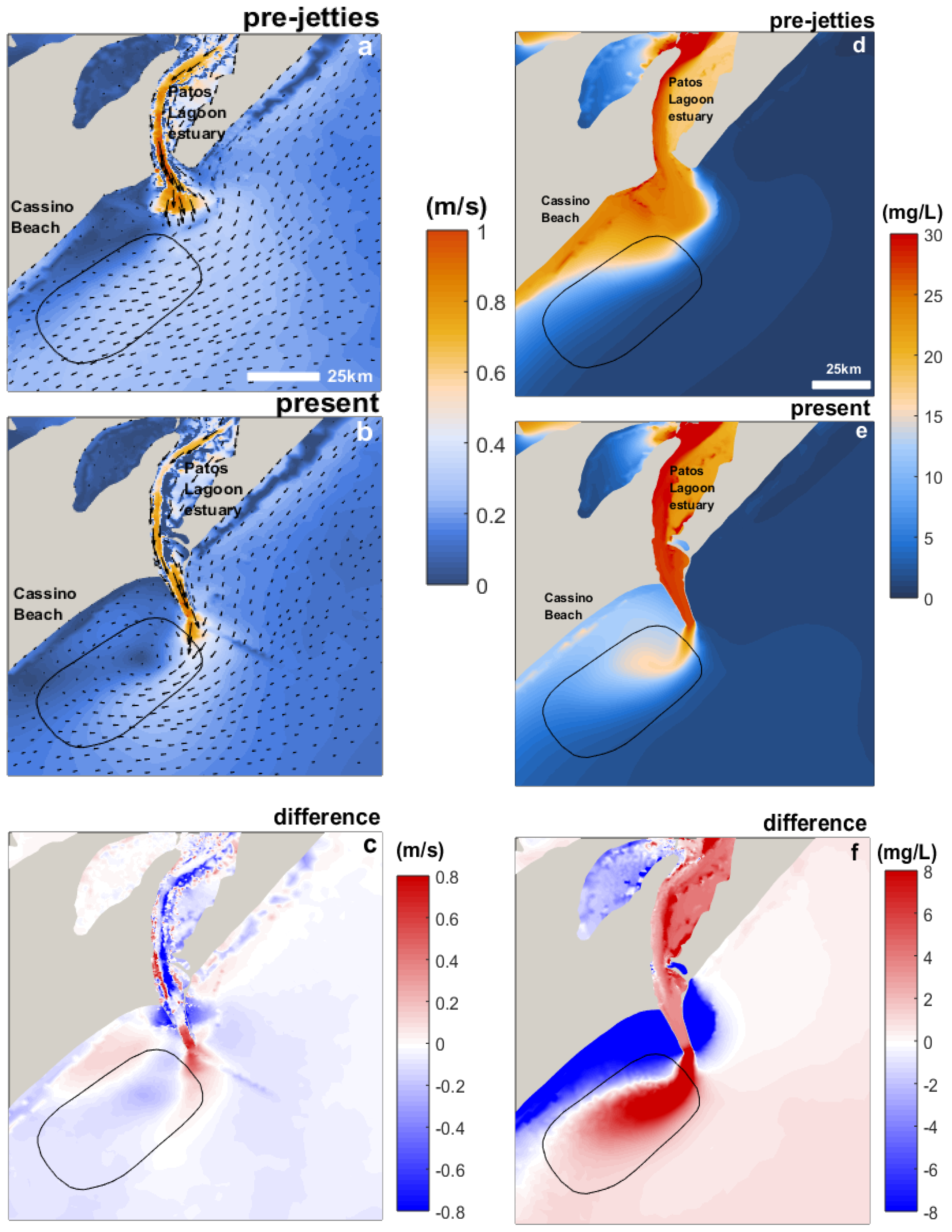
The predominant meteoceanographic condition of the simulated period (NE wind and ebb flows) is further investigated in a controlled 3-day simulation with NE winds of different intensities acting in the system. Figure 2 presents the calculated bottom mean current velocities and bottom SSCs after three days of NE winds for the investigated configurations.
When observing the calculated mean current velocity results at the bottom in the pre-jetty scenario, the maximum ebb currents peaked inside the channel (reaching 1.2 m/s), decreasing landwards (Figure 2a). In the present scenario, however, the maximum currents occur near the entrance (plume jet), with a mean ebb current velocity of approximately 1.0 m/s (Figure 2b). Analyzing the pre-jetty and present scenarios (Figure 2a,b) in a comparative way, it is evident that the current velocities, in general, are currently weaker (Figure 2c), matching the regions with higher concentrations of suspended sediments (Figure 2f).
As expected, weaker currents within the channel in the present scenario result in higher SSCs near the bottom, with differences of approximately 4 mg/L (Figure 2f). On the other hand, the SSC is higher in the plume jet, approximately 25 mg/L (Figure 2e), due to more intense currents, matching the preferential deposition zone (Figure 2e). Nowadays, the coastal plume presents a well-defined jet further away from the inlet, promoting the recirculation zones occurring near the west jetty, moving southwest as a response to the NE wind (Figure 2b,e). These zones coincide with the preferential region of fine sediment deposits with an increase of approximately 45% in suspended sediment concentrations after the construction of the jetties, indicating the retention of suspended sediment coming from the Patos Lagoon (Figure 2f).

3.2. Changes in the Suspended Sediment Flux in the Channel

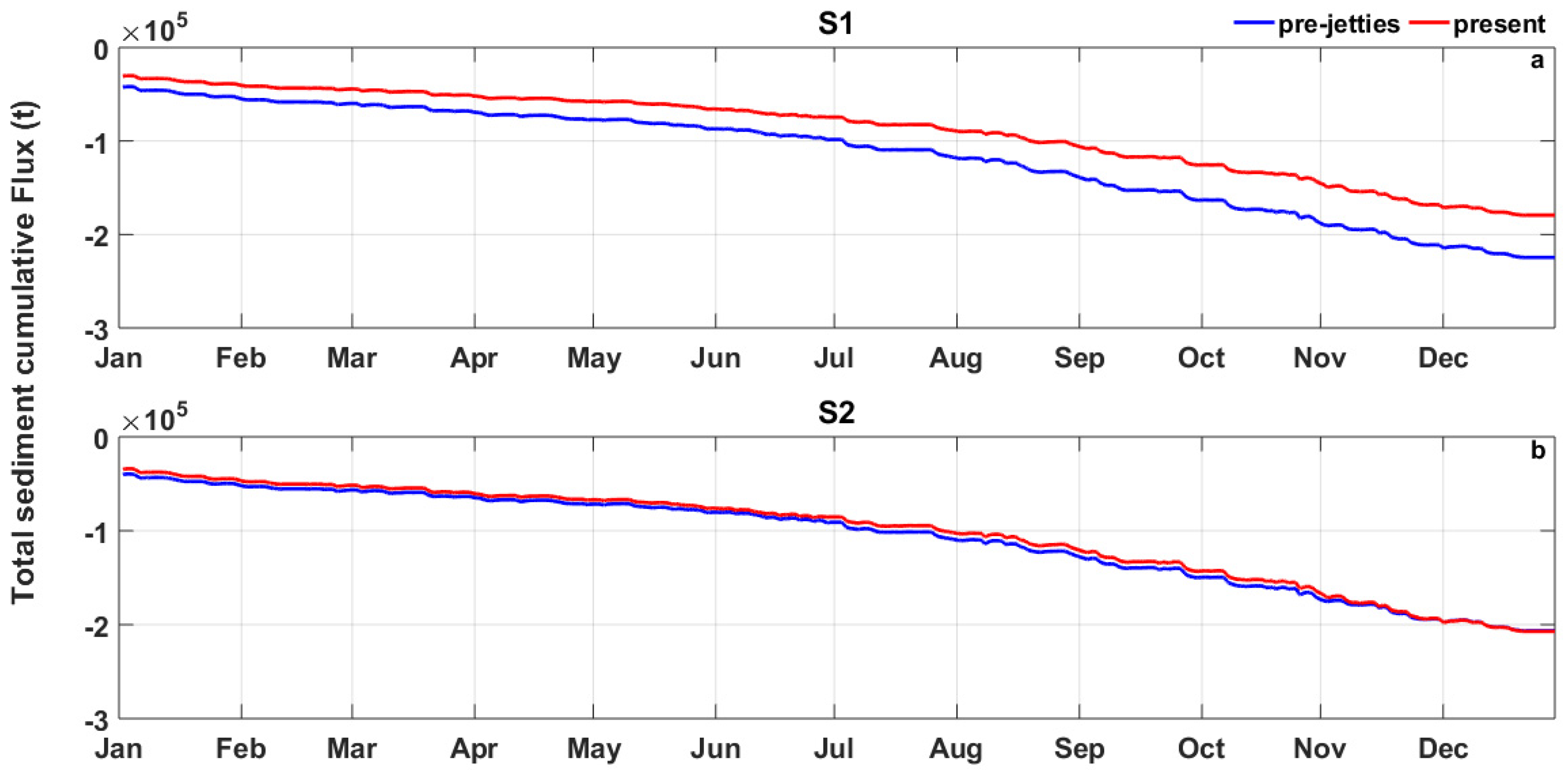
The cumulative flux in and out of the estuary is estimated based on the results of the 1-year long simulation, calculated for cross-sections S1 and S2 for both morphological scenarios (Figure 1c,d). The total sediment flux is always negative, indicating an export of suspended sediments out of the estuary (Figure 3a,b) in both scenarios. The construction of the jetties, however, reduced the residual cumulative flux of suspended sediment in both cross-sections, with larger differences between scenarios at the end of the simulation (in December) at S1 (reaching 0.5 × 10⁵ t). At S2, larger differences are found between July and October (reaching up to 0.1 × 10⁵ t) (Figure 3a,b).
Differences between the scenarios are higher in S1, which is closer to the area subject to modifications induced by the jetties (Figure 3a). Therefore, currently, there are fewer suspended sediments exported to the coast, with a value of approximately 1.8 × 10⁵ t (reaching up to 21% at S1). As we move away from the modifications, however, these differences decrease, as observed in S2 (Figure 3b), due to the reduction in the current velocity fields (Figure 3b).
In both cross-sections more pronounced differences were observed from late winter onwards (August–November). This divergence coincides with periods of increased river discharge and more frequent NE wind events, which enhance seaward flows and sediment resuspension near the inlet. Besides that, the stronger channel confinement in the present configuration is likely to intensify current velocities and export efficiency under these forcing conditions (see Figure 3), resulting in a progressive amplification of cumulative sediment export.

3.3. Contribution of Suspended Sediments in Coastal Plumes to Mud Deposit Formation

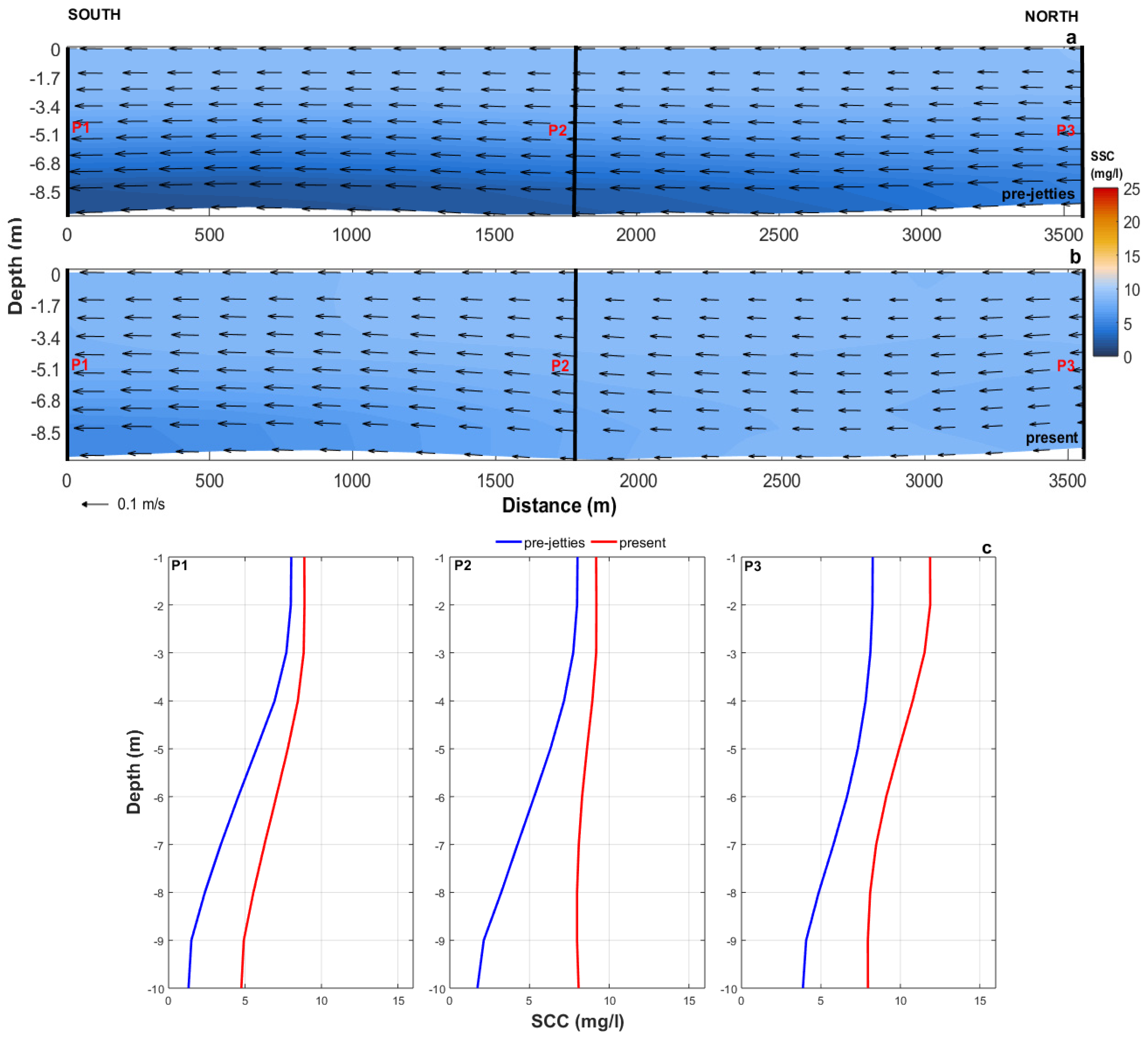
The contribution of suspended sediments in the coastal plume for mud deposit formation at Cassino Beach has been analyzed through the extraction of longitudinal profiles from model results along the preferential zone of fine suspended sediment deposition (Figure 1c,d). From NE winds with different strength conditions: weak (4 m/s), moderate (7 m/s) and high (10 m/s) intensities, with 3-day durations (Figure 4, Figure 5 and Figure 6). These analyses are important to understand the depositional pattern for both morphological scenarios.
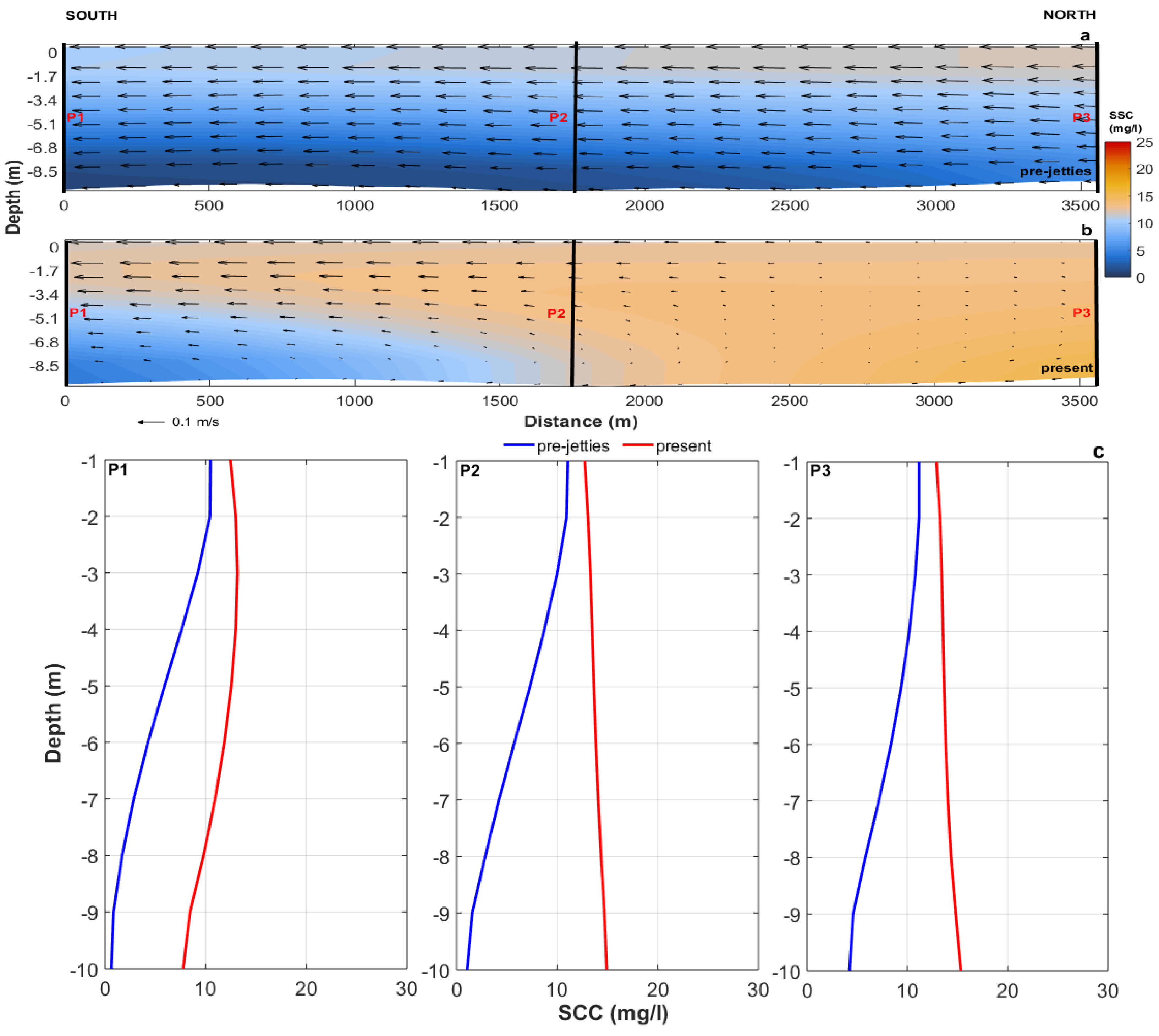
The first NE wind condition (4 m/s) promotes SW displacement of the coastal plume along the water column for both scenarios (Figure 4a,b). The SSC in the pre-jetty configuration (Figure 4a) is slightly stratified, characterized by typical features of river plume areas (difference of approximately 8 mg/L between the bottom and surface), while less stratification of the SSC distribution (10 mg/L) is observed in the present scenario (Figure 4b). These results are detailed in the vertical profiles, where under such wind conditions, it is possible to observe a slight increase in the current velocity, especially in the present scenario, with a mean velocity of 0.1 m/s, and a decrease towards the bottom (Figure 4b). In addition, a higher SSC after the construction of the jetties is observed at all extracted points, which is more evident at P3 (nearest to the west jetty) (Figure 4c), matching eddy circulation (Figure 2b).
Under 7 m/s NE wind condition, the SSC pattern throughout the water column is different between scenarios (Figure 5a,b). Before the construction of the jetties, the current velocities are higher along the water column (approximately 0.2 m/s) (Figure 5a) and the SSC is higher at the surface (approximately 11 mg/L), coincident with the plume and smaller SSC at the bottom (approximately 2 mg/L). On the other hand, in the present scenario (Figure 5b), it is evident that the SSC in the water column is homogeneous (approximately 16 mg/L) when the current is weak close to the jetties (approximately 0.05 m/s), but is concentrated close to the surface when moving towards the south (P1) under stronger currents (approximately 0.2 m/s). This comparative analysis indicates the existence of a trapping mechanism as the result of jetty construction associated with the occurrence of a recirculation zone and fine suspended sediment deposits. This is also evident when looking at the vertical distribution of the SSC (Figure 5c).
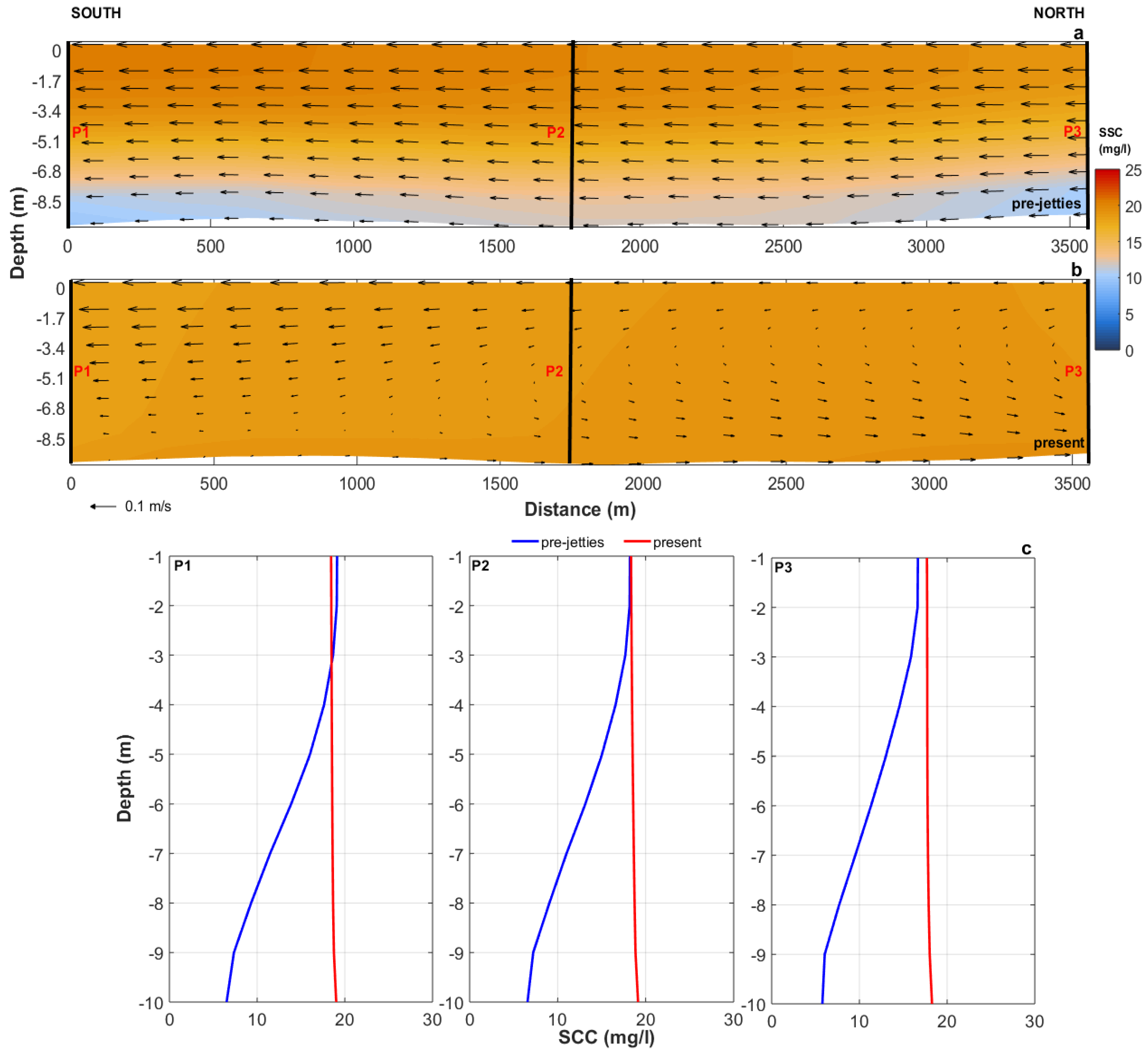
During the intense NE wind conditions (10 m/s), higher SSCs (approximately 20 mg/L) were observed in both scenarios, with stratification tendencies before the construction of the jetties (Figure 6a) and homogeneous water columns in the present configuration (Figure 6b). Once again, the trapping mechanism is evident after jetty construction, with the presence of low-velocity zones, induced by the recirculation cell that formed south of the jetties. On the other hand, the pre-jetty scenario does not present this behaviour (Figure 6a), which has approximately 60% less SSC than the present scenario (Figure 6c).
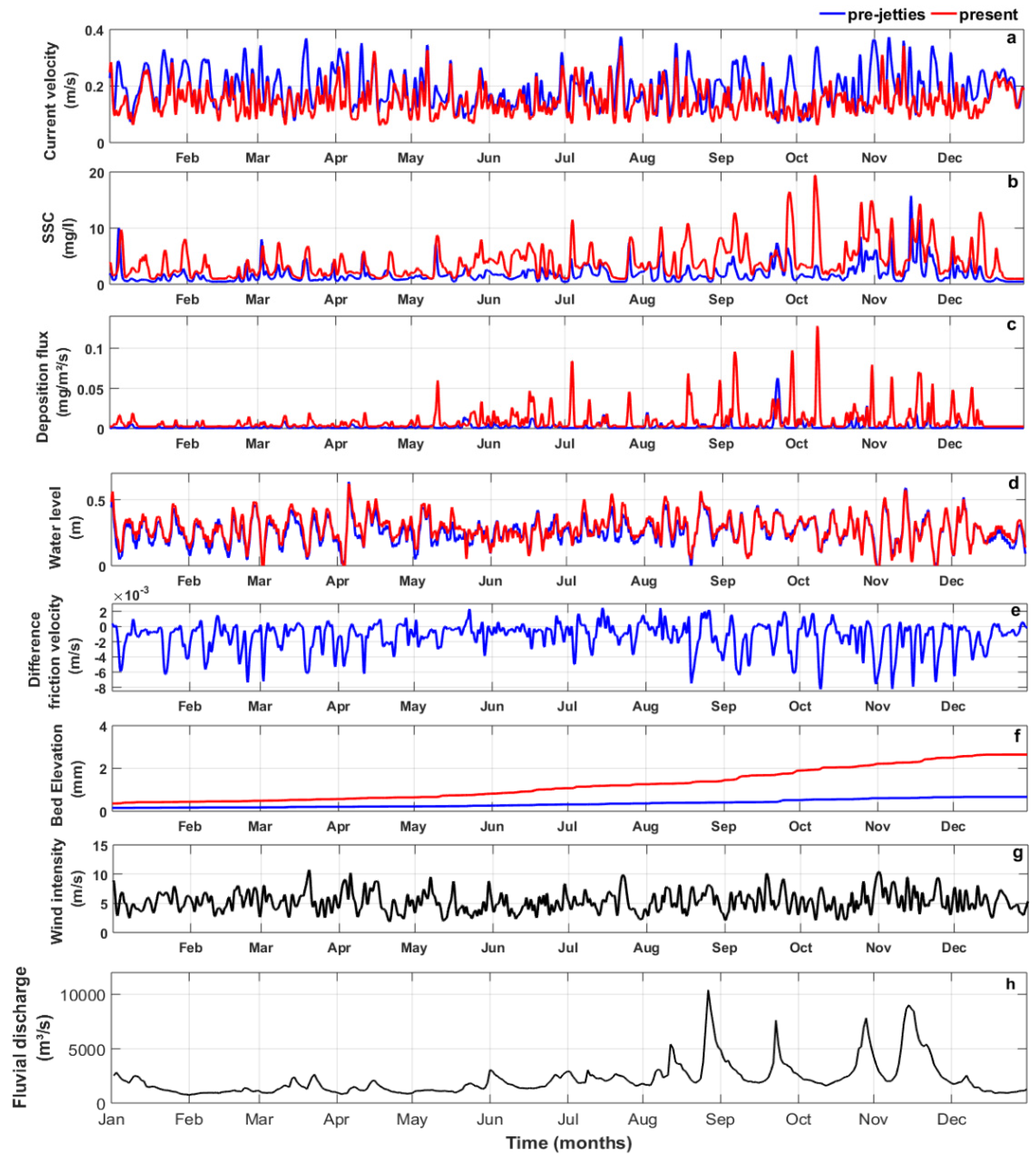
For a detailed analysis, time series of suspended sediment deposition over the one-year simulation were extracted at the bottom (Figure 7), at the point of the maximum bed elevation (PD in Figure 1) within the preferential deposition zone. When comparing the properties of this area for both scenarios, a reduction in current velocities is observed, with a mean reduction of approximately 0.2 m/s (Figure 7a). The main observed differences are between August and November, and these differences are probably induced by an increase in the mean fluvial discharge of approximately 49.4% (Figure 7h).
Overall, the main changes after the construction of the jetties are: (1) an increase in suspended sediment, reaching a difference of approximately 17 mg/L (Figure 7b); (2) a higher deposition flux, with a maximum of approximately 0.12 mg/m2/s (Figure 7c); and (3) a lower friction velocity at the bottom, reaching a difference of approximately 8 m/s (Figure 7e). It is important to highlight that the construction of jetties had a significant impact on the depositional patterns in the contemporary fine sediment deposition area. At the end of the simulation (as shown in Figure 7f), there is a notable 76% increase in the bed elevation. There are no discernible differences in water levels between the different scenarios.
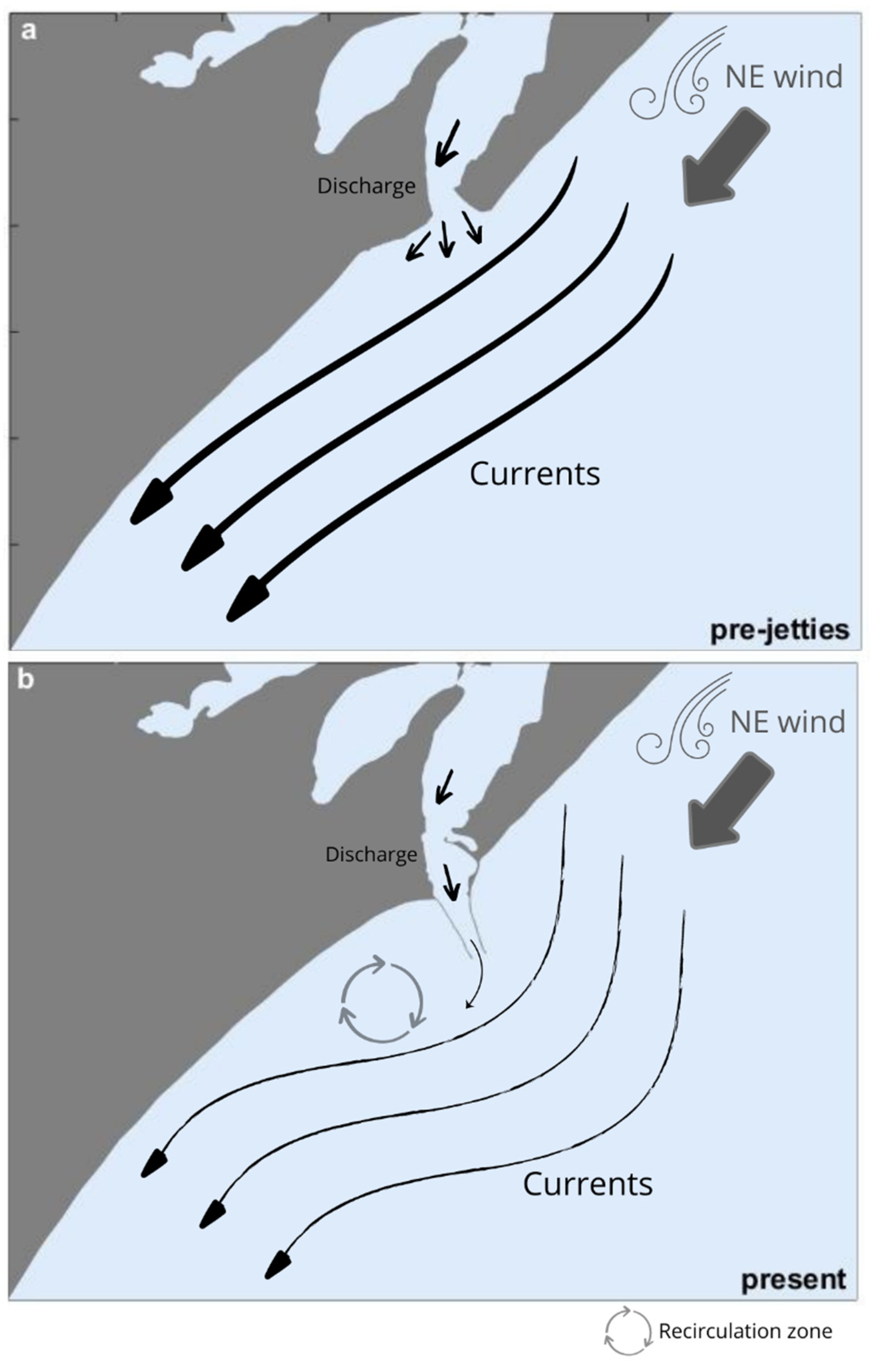
Based on the interpretation of the hydro-sedimentological dynamic behaviour, in response to NE wind conditions, conceptual models were developed by considering the two modelled morphological scenarios (Figure 8). Before the construction of the jetties, longitudinal currents flowed directly to the southwest, bypassing the existing ebb delta. Therefore, the circulation pattern promoted sediment deposition in the shallower areas in front of the Lagoa dos Patos inlet, caused by lower intensity currents (Figure 8a), inducing ebb delta formation.
On the other hand, currently, there is an increase in fine suspended sediment deposition from the Patos Lagoon plume towards the southern part of the jetties, and the fine suspended sediment flows to deeper regions than those in the pre-jetty scenario. In addition, the fine sediment retention in this area is associated with currents to the southwest and the Patos Lagoon discharge; once joined, they are deflected close to the west jetty, promoting the formation of cyclonic vortices (recirculation zone) with low velocities (Figure 8b). This behaviour is even more evident in moderate- to high-intensity NE wind events.

4. Discussion

Consistent with other anthropogenic interventions caused by severe hardening of coastlines, the construction of jetties shows clear changes in coastal and estuarine sediment dynamics [12,27,28,38,67,68]. More recently, ref. [3] studied the impact of the modification that occurred in 2010 on estuarine hydrodynamics, and ref. [33] studied the same approach but analyzed the impact of jetty construction. This study is an advance in this topic, applying the TELEMAC-3D model coupled with the SED-3D sediment transport module to assess the impacts of the construction of jetties at the Patos Lagoon inlet.
Ebb flow predominance was shown during the simulated period in both scenarios (Figure 2). Flow direction was not impacted by jetty construction, which is consistent with earlier studies that used numerical modelling in the same region [23,33,38], considering the present scenario.
Results of both morphological scenarios suggest that the construction of the jetties at the Patos Lagoon inlet caused changes in the depositional pattern at the coast and inside the estuary: in coastal suspended sediment distribution, in the fine suspended sediment deposition area in the adjacent inner shelf, and in the suspended sediment flux between the estuary and the adjacent coastal zone.
Similar morphodynamic responses as hydrodynamic patterns and sediment transport pathway changes were observed in the Yangtze (Changjiang) Estuary due to large-scale engineering works, including jetty extensions and channel deepening associated with the Deep Waterway Project [26,69]. Previous studies also report that structural confinement of the inlet altered current velocities, reduced bed shear stress, and promoted retention of sediment near the mouth due to eddy formation [70,71]. However, while the Yangtze system is primarily controlled by tidal dynamics and high sediment discharge [72,73], the Patos Lagoon response is strongly modulated by wind-driven circulation and seasonal fluvial variability. Thus, although the physical mechanisms associated with structural confinement appear to be consistent across systems, the relative importance of wind forcing versus tidal control represents a key distinction.
Differences in the sedimentary dynamics near the bottom were also observed, mainly close to the morphological modifications at the inlet and adjacent coast, in both scenarios (Figure 2d–f). They were probably induced by the narrower and longer modified channel, which changed the current velocity patterns and the coastal plume behaviour (Figure 2c), as also observed by [70] in the Changjiang estuary, [74] for the Hamana Lake estuary, and at Newark Bay by [75].
After the construction of the jetties, a new distribution of suspended sediment concentration at the bottom was observed, promoting more deposition inside the channel (increased by ~18%) (Figure 2c). Clearly, this behaviour was induced by reduced local hydrodynamics [33] related to channel deepening (Figure 2f), similar to that observed by [76] in the Changjiang estuary, in which more sedimentation was promoted inside the structures along the channel.
The suspended sediment export through the coastal plume (Figure 2d,e) also had its behaviour modified after jetty construction. Currently, under NE wind conditions, the calculated plume at the bottom promotes a well-defined jet further away from the inlet and cyclonic eddies to the south of the jetties (recirculation zone) (Figure 2e), as also observed by [23,36]. Such features are directly related to jetties [70], being mainly induced by local geometry and bathymetry and in response to the NE wind, distributing suspended sediments towards the preferential zone of deposition (Figure 2e), which feeds an extensive mud deposit called the Patos Facies [35,36,77]. On the other hand, in the pre-jetty scenario, a radial spreading distribution of suspended sediments is observed in front of the inlet (ebb delta) that does not reach the present deposition zone (Figure 2d).
Ref. [49] inferred that the jetties displaced the suspended sediments from the estuary further away from the coast, induced by stronger ebb flows, corroborating the results of this study for the present scenario (Figure 2f). The jetties relocated the inlet opening to a position approximately four kilometres away from the coast in deeper waters where no ebb delta was formed. Consistent with that, ref. [27] observed that the construction of the jetties in the Guadiana estuary mouth stabilized the main channel but promoted the collapse of the ebb delta. Ref. [3] concluded that channel deepening promoted lower current velocities and reduced bed stresses, leading to more mud deposition inside the channel of the Coos Bay estuary. The extension of the jetties seaward in the Changjiang estuary also provided SSC displacement far away from the coast [26].
The comparison between the modelled results for the pre-jetty and present scenarios showed changes in the calculated suspended sediment cumulative flux analyzed in two different sections along the channel. Both sections showed the predominance of suspended sediment export over the 1-year simulation (Figure 3), but the construction of the Patos Lagoon jetties is decisive in the cumulative fluxes in and out of the estuary, reducing the residual cumulative flux along the channel (Figure 3). This reduction was mainly observed at S1 (near the modifications) and from August to December (Figure 3a); it was probably associated with higher freshwater discharge (Figure 7h). Ref. [37] also observed, through the total mass flux inside the Patos Lagoon channel, that the maximum discharge occurred at the same time as the higher fluvial discharge.
The maximum reduction in the cumulative sediment flux observed in the present scenario was approximately 0.5 × 10⁵ t (Figure 3a). This condition can change the suspended sediment load, influencing the estuarine and coastal morphology and affecting the suspended sediment balance between estuarine and coastal zones. Anthropogenic perturbations can compromise the net export of suspended sediment from coastal bays and further impact bed morphology, as observed by [78].
Another example is the Gironde Estuary, where human interventions and navigation channel adjustments have been altering sediment exchange between the estuary and the adjacent shelf, modifying the balance between export and retention processes [79,80]. While both systems exhibit similarity in structural control on sediment redistribution and flux modification, the forcing mechanisms governing these responses differ substantially, highlighting the combined universality of engineering impacts and the uniqueness of local hydrodynamic regimes. Based on this, we can infer that the Patos Lagoon Estuary is a unique environment, and the results from this study can be used to understand the hydro-sedimentary dynamics of other microtidal systems around the world.
Our results showed that NE winds, and consequently ebb flow dominance over the study region, resulted in southwestward coastal plume displacement in both scenarios (Figure 2, Figure 4a, Figure 5a and Figure 6a). However, sediment deposition associated with cyclonic eddy formation (recirculation zone) towards the south of the jetties was observed only in the present scenario (Figure 7b). Refs. [23,37,81] showed the direct influence of this recirculation pattern on bottom deposition in the adjacent coastal region. Refs. [19,35,36] evidenced the presence of fine suspended sediment deposits along Cassino Beach, immediately to the south of the Patos Lagoon inlet. Therefore, deposition is expected to occur when the current velocity decreases after the NE wind occurs in the present scenario (Figure 4b, Figure 5a and Figure 6a).
Thus, higher SSC throughout the water column and approximately six times more at the bottom in the present scenario indicate how this recirculation pattern induces the depositional processes in this area, as illustrated in the moderate-intensity NE wind (Figure 5b,c). This pattern was not observed before the construction of the jetties, showing a low suspended sediment concentration at the bottom (of about 2 mg/L) (Figure 5a,c), which was associated with higher current velocities (Figure 5a). Ref. [31] also commented on the importance of the jetties in providing areas of suspended sediment deposition inside the channel, induced by a weakening of the local hydrodynamics, preventing the development of the operational structure of ports in Quanzhou Bay.
This tendency of suspended sediment deposition is directly related to the lower current velocities inside the recirculation zone near the western jetty [33]; this deposition decreases towards the south, explaining the presence of fine sediment deposits mainly in that location (Figure 2b, Figure 5b and Figure 6b), as was also concluded by [37,59]. Therefore, it is possible to infer that morphological changes induced by the jetties are the cause of the formation of this new depositional pattern in the adjacent coastal region, which was previously observed by [35]. In the pre-jetty scenario, the coastal plume could not reach this fine suspended sediment depositional area. The presence of the jetties increased the potential for sedimentation in this region by approximately 60% (Figure 4c, Figure 5c and Figure 6c).
Ref. [82] concluded that the estuarine morphology, and wind and fluvial discharge, combined with coastal dynamics are the main conditions that contribute to the distribution of suspended sediment in the inner shelf. According to [71], after the implementation of hard structures in the Changjiang estuary, there is a higher tendency to trap sediments near the mouth, which corresponds to the area with eddy formation.
Analyzing these fine suspended sediment deposits specifically, it is also possible to observe that the current velocities are weaker after the construction of the jetties, being directly related to the near-bottom higher suspended sediment concentrations, consequently with higher deposition flux values (Figure 7a–c). These results suggest that the present scenario has the potential to induce sedimentation in this region. Ref. [81] also found the highest deposition flux values near the Patos Lagoon inlet, in the shallow areas of the inner shelf, associated with deposition. According to [9], the deposition flux results were consistent with the changes in the mean depth-averaged current velocities.
Associated with this, a lower friction velocity (Figure 7e) allows greater sedimentation potential (Figure 7c) due to decreased transport capacity, as also observed by [3] in the Coos Bay estuary. The sediment accumulation is 84% higher due to the presence of the jetties, reaching almost 3 mm after one year of simulation, which is also more evident between August and December (increased fluvial discharge) (Figure 7f).
Ref. [37] found positive bed evolution values near the western jetty, varying from 0.1 to 10 mm, as a result of the deposition of fine suspended sediments from the Patos Lagoon estuary. The period of increase in the fluvial discharge (Figure 7h) is related to sediment accumulation, suspended sediment concentration and deposition fluxes (Figure 7b,c,f). Therefore, the results from the present study show that river discharge clearly amplifies the differences between the analyzed scenarios. Refs. [23,37,56] also observed the importance of fluvial discharge to the distribution of suspended sediments and consequently to depositional patterns.
It is noteworthy that changes in the suspended sediment load from the rivers have changed over time, and it can influence the distribution of the suspended sediments on the adjacent coast. Ref. [83] observed that an overall decrease in the sedimentation rate could be the result of the reduction in the suspended sediment load from rivers and correlated that with human activities. Ref. [84] concluded that the suspended particulate material in the Patos lagoon is highly variable on a decadal scale. Therefore, this is a good point to consider in future work, in order to better understand these long-term differences.
Our results considered the fine suspended sediments from the tributaries of the Patos Lagoon, focusing on isolating the effects of the morphological changes induced by jetty construction. Therefore, other possible suspended sediment sources (such as dredging activities) to the deposit were not considered because the idea was to present the differences in suspended sediment transport and depositional patterns induced by the jetty construction and to investigate whether the mud deposition in front of Cassino Beach results from the jetty-induced coastal circulation. Once deposited, this fine sediment can be reworked by high-energy wave events being transported towards the beach by the action of currents, causing impacts on the beach use and benthic organisms.
Thus, our results need to be carefully analyzed in relation to more detailed information about the local suspended sediment characteristics, and future research considering the influence of waves on sediment transport and deposition is recommended. Waves can result in changes in the suspended sediment deposition rates, which is out of the scope of this study.

5. Conclusions

Based on the presented results, it is possible to conclude that morphological changes induced by the construction of the jetties at the Patos Lagoon inlet changed water and sediment dynamics in the estuary and adjacent coastal regions. Our results represent an important step forward, improving: (i) the knowledge about other expected consequences due to the jetties construction, as in ecological processes; (ii) coastal management planning, reducing future environmental impacts; and (iii) the use of sustainable alternatives for the development of other port regions worldwide.
The main consequences of the Patos Lagoon jetty construction are:
(i)
depositional trends at the bottom and near the bottom at the coast, induced by lower ebb current velocities;
(ii)
intensified current velocities in the plume jet, displacing the fine suspended sediment plume to deeper regions at the coast, promoting more deposition;
(iii)
a decrease in water and sediment transport during ebb flow inside the channel, caused by lower current velocities;
(iv)
and a higher potential for mud deposit formation along the coast near the western jetty, induced by the recirculation zone (low current velocity zone) and NE wind conditions.

Supplementary Materials

The following supporting information can be downloaded at: https://www.mdpi.com/article/10.3390/coasts6020017/s1, Figure S1: Calibration of the SSC in the Guaíba River. Comparison between SSCs (red dots) and measured data (blue dots) between 30 January and 28 February 2013; Figure S2: Suspended sediment concentrations (SSCs) on the surface calculated by the numerical model (on the left) and by remote sensing (on the right) for (a) 19 August 2013; (b) 18 December 2013; and (c) 18 February 2014. The colour scale represents the SSC in mg/l; Figure S3: Comparison of SSC values calculated by the numerical model (red line) and measured by remote sensing (MODIS-Aqua) (blue line) for (a) 19 August 2013; (b) 18 December 2013; and (c) 18 February 2014; Figure S4: Wind intensity (m/s) and direction during the simulation period (2013 year). Positive values represent southerly winds, and negative values represent northerly winds.

Author Contributions

M.F.: Conceptualization, methodology, investigation, software, formal analysis, writing—original draft, writing—reviewing. E.S.: Conceptualization, writing—reviewing and editing, supervision. A.S.: Conceptualization, reviewing and editing. E.H.L.F.: Conceptualization, writing—reviewing and editing, supervision. All authors have read and agreed to the published version of the manuscript.

Funding

This study was sponsored by the SUNSET Project—South Brazilian Shelf sediment transport: sources and consequences (CAPES/COFECUB, Process 88887.192855/2018-00).

Data Availability Statement

The original contributions presented in this study are included in the article. Further inquiries can be directed to the corresponding author.

Acknowledgments

All the authors are grateful to CAPES (Coordination for Personal Improvement of Personnel) for granting the doctoral scholarship of the first author (MOF) through the Graduate Program in Oceanography (PPGO)—Finance code 001. ES (307741/2018-4) and EHF (304684/2022-8) are CNPq research fellows.

Conflicts of Interest

The authors declare no conflicts of interest.

References

  1. Burke, L.; Kura, Y.; Kassem, K.; Revenga, C.; Spalding, M.; McAllister, D. Coastal Ecosystems; World Resources Institute: Washington, DC, USA, 2001; Available online: https://pdf.wri.org/page_coastal.pdf (accessed on 27 October 2025).
  2. Martínez, M.L.; Intralawan Vazquez, G.; Perez-Maqueo, O.; Sutton, P.; Land-grave, R. The coasts of our world: Ecological, economic and social importance. Ecol. Econ. 2007, 63, 254–272. [Google Scholar] [CrossRef]
  3. Eidam, E.F.; Sutherland, D.A.; Ralston, D.K.; Conroy, T.; Dye, B. Shifting Sediment Dynamics in the Coos Bay Estuary in Response to 150 Years of Modification. J. Geophys. Res. Ocean. 2021, 126, e2020JC016771. [Google Scholar] [CrossRef]
  4. Tanner, E.L.; Steinberg, P.D.; Soares-Gomes, A.; Leung, K.M. Introduction to the World Harbour Project Special Issue Part II—Global harbours and ports: Different locations, similar problems? Reg. Stud. Mar. Sci. 2020, 33, 100904. [Google Scholar] [CrossRef]
  5. Wang, X.H.; Andutta, F.P. Sediment Transport Dynamics in Ports, Estuaries and Other Coastal Environments. In Sediment Transport—Processes and Their Modelling Applications; InTech: Hannover, Germany, 2013. [Google Scholar] [CrossRef]
  6. Mann, R.B. Ten trends in the continuing renaissance of urban waterfronts. Landsc. Urban Plan. 1988, 16, 177–199. [Google Scholar] [CrossRef]
  7. Suchanek, T.H. Temperate coastal marine communities: Biodiversity and threats. Am. Zool. 1994, 34, 110–114. [Google Scholar] [CrossRef]
  8. Cunha, P.P.; Pinto, J.; Dinis, J.L. Evolução da fisiografia e ocupação antrópica na área estuarina do Rio Mondego e região envolvente (Portugal centro-oeste), desde 1947. Territorium 1997, 4, 93–99. (In Portuguese) [Google Scholar] [CrossRef] [PubMed]
  9. Da Silva, P.D.; Fernandes, E.H.; Gonçalves, G.A. Sustainable development of coastal areas: Port expansion with small impacts on estuarine hydrodynamics and sediment transport pattern. Water 2022, 14, 3300. [Google Scholar] [CrossRef]
  10. Wang, P.; Beck, T.M. Morphodynamics of an anthropogenically altered dual-inlet system: John’s pass and blind pass, west-central Florida, USA. Mar. Geol. 2012, 291–294, 162–175. [Google Scholar] [CrossRef]
  11. Nassar, K.; Masria, A.; Mahmod, W.E.; Negm, A.; Fath, H. Hydro-morphological modeling to characterize the adequacy of jetties and subsidiary alternatives in sedimentary stock rationalization within tidal inlets of marine Lagoons. Appl. Ocean Res. 2019, 84, 92–110. [Google Scholar] [CrossRef]
  12. Prumm, M.; Iglesias, G. Impacts of port development on estuarine morphodynamics: Ribadeo (Spain). Ocean Coast. Manag. 2016, 130, 58–72. [Google Scholar] [CrossRef]
  13. Dyer, K.R.; Gong, W.K.; Ong, J.E. The cross sectional salt balance in a tropical estuary during a lunar tide and a discharge event. Estuar. Coast. Shelf Sci. 1992, 34, 579–591. [Google Scholar] [CrossRef]
  14. Shubel, J.R.; Carter, H.H. The estuary as a filter for fine-grained suspended sediment. In The Estuary as a Filter; Kennedy, V., Ed.; Academic Press: New York, NY, USA, 1984; pp. 81–105. [Google Scholar]
  15. Wang, P.; Ebersole, B.A.; Smith, E.R.; Johnson, B.D. Temporal and spatial variations of surf-zone currents and suspended sediment concentration. Coast. Eng. 2002, 46, 175–211. [Google Scholar] [CrossRef]
  16. Gabioux, M.; Vinzon, S.B.; Paiva, A.M. Tidal propagation over fluid mud layers on the Amazon shelf. Cont. Shelf Res. 2005, 25, 113–125. [Google Scholar] [CrossRef]
  17. Wan, Y.; Gu, F.; Wu, H.; Roelvink, D. Hydrodynamic evolutions at the Yangtze estuary from 1998 to 2009. Appl. Ocean Res. 2014, 47, 291–302. [Google Scholar] [CrossRef]
  18. Diaz, M.; Grasso, F.; Le Hir, P.; Sottolichio, A.; Caillaud, M.; Thouvenin, B. Modeling mud and sand transfers between a macrotidal estuary and the continental shelf: Influence of the sediment transport parameterization. J. Geophys. Res. Oceans 2020, 125, e2019JC015643. [Google Scholar] [CrossRef]
  19. Holland, K.T.; Vinzon, S.B.; Calliari, L.J. A field study of coastal dynamics on a muddy coast offshore of Cassino beach, Brazil. Cont. Shelf Res. 2009, 29, 503–514. [Google Scholar] [CrossRef]
  20. Perez, L.; García-Rodríguez, F.; Hanebuth, T.J.J. Variability in terrigenous sediment supply offshore of the Río de la Plata (Uruguay) recording the continental climatic history over the past 1200 years. Clim. Past 2016, 12, 623–634. [Google Scholar] [CrossRef]
  21. Oost, A.P.; Hoekstra, P.; Wiersma, A.; Flemming, B.; Lammerts, E.J.; Pejrup, M.; Hofstede, J.; Van Der Valk, B.; Kiden, P.; Bartholdy, J.; et al. Barrier island management: Lessons from the past and directions for the future. Ocean Coast. Manag. 2012, 68, 18–38. [Google Scholar] [CrossRef]
  22. Panda, U.S.; Mohanty, P.K.; Samal, R.N. Impact of tidal inlet and its geomorphological changes on Lagoon environment: A numerical model study. Estuar. Coast. Shelf Sci. 2013, 116, 29–40. [Google Scholar]
  23. Fernandes, E.H.; Da Silva, P.D.; Gonçalves, G.A.; Möller, O.O. Dispersion plumes in open ocean disposal sites of dredged sediment. Water 2021, 13, 808. [Google Scholar] [CrossRef]
  24. Dyer, K.R. Estuaries: A Physical Introduction; John Wiley and Sons: New York, NY, USA, 1997. [Google Scholar]
  25. Pranzini, E.; Wetzel, L.; Williams, A.T. Aspects of coastal erosion and protection in Europe. J. Coast. Conserv. 2015, 19, 445–459. [Google Scholar] [CrossRef]
  26. Guo, L.; Zhu, C.; Xie, W.; Xu, F.; Wu, H.; Wan, Y.; Wang, Z.; Zhang, W.; Shen, J.; Wang, Z.B.; et al. Changjiang delta in the anthropocene: Multi-scale hydro-morphodynamics and management challenges. Earth-Sci. Rev. 2021, 223, 103850. [Google Scholar] [CrossRef]
  27. Garel, E.; Sousa, C.; Ferreira, Ó. Sand bypass and updrift beach evolution after jetty construction at an ebb-tidal delta. Estuar. Coast. Shelf Sci. 2015, 167, 4–13. [Google Scholar] [CrossRef]
  28. Tanaka, H.; Lee, H.S. Influence of Jetty construction on morphology and wave set-up at a river mouth. Coast. Eng. J. 2003, 45, 659–683. [Google Scholar] [CrossRef]
  29. Van Rijn, L.C. Basic of Channel Deposition/Siltation. 2013. Available online: http://www.leovanrijn-sediment.com (accessed on 27 October 2025).
  30. Shaeri, S.; Tomlinson, R.; Etemad-Shahidi, A.; Strauss, D. Numerical modelling to assess maintenance strategy management options for a small tidal inlet. Estuar. Coast. Shelf Sci. 2017, 187, 273–292. [Google Scholar] [CrossRef]
  31. Wu, C.; Cai, F.; Zhao, G.; Zheng, Y.; Lu, H. Impact of coastal engineering constructions on the topographic and morphological evolution of Quanzhou Bay, Fujian, China. Ocean Coast. Manag. 2011, 54, 544–555. [Google Scholar] [CrossRef]
  32. Anh, V.T.; Trung, P.B.; Nguyen, K.A.; Liou, Y.A.; Phan, M.T. Human impacts on estuarine erosion-deposition in southern central Vietnam: Observation and hydrodynamic simulation. Sustainability 2021, 13, 8303. [Google Scholar] [CrossRef]
  33. Franzen, M.O.; Silva, P.; Siegle, E.; Fernandes, E.H.L. Influence of long jetties on estuarine and coastal hydrodynamics in a microtidal estuary. Reg. Stud. Mar. Sci. 2023, 59, 102809. [Google Scholar] [CrossRef]
  34. Calliari, L.J.; Speranski, N.S.; Torronteguy, M.; Oliveira, M.B. The Mud banks of cassino beach, southern Brazil: Characteristics, processes and effects. J. Coast. Res. 2000, 34, 318–325. [Google Scholar]
  35. Calliari, L.J.; Winterwerp, J.C.; Fernandes, E.; Cuchiara, D.; Vinzon, S.B.; Sperle, M.; Holland, K.T. Fine grain sediment transport and deposition in the Patos Lagoon–Cassino beach sedimentary system. Cont. Shelf Res. 2009, 29, 515–529. [Google Scholar] [CrossRef]
  36. Vinzon, S.B.; Calliari, L.J.; Holland, K.T.; Winterwerp, J.C. On the dynamics of mud deposits in coastal areas. Cont. Shelf Res. 2009, 29, 501–502. [Google Scholar] [CrossRef]
  37. Marques, W.C.; Fernandes, E.H.L.; Moller, O.O. Straining and advection contributions to the mixing process of the Patos Lagoon coastal plume, Brazil. J. Geophys. Res. Oceans 2010, 115, C06019. [Google Scholar] [CrossRef]
  38. António, M.H.; Fernandes, E.H.; Muelbert, J.H. Impact of jetty configuration changes on the hydrodynamics of the subtropical Patos Lagoon estuary, Brazil. Water 2020, 12, 3197. [Google Scholar] [CrossRef]
  39. Kjerfve, B. Comparative oceanography of coastal Lagoons. In Estuarine Variability; Wolfe, D.A., Ed.; Academic Press: New York, NY, USA, 1986; pp. 63–81. [Google Scholar]
  40. Möller, O.O.; Castaing, P.; Salomon, J.C.; Lazure, P. The influence of local and non-local forcing effects on the subtidal circulation of Patos Lagoon. Estuaries 2001, 24, 297–311. [Google Scholar] [CrossRef]
  41. Vaz, A.C.; Möller, O.O.; De Almeida, T.L. Análise quantitativa da descarga dos rios afluentes da Lagoa dos Patos. Atlântica 2006, 28, 13–23. (In Portuguese) [Google Scholar]
  42. Möller, O.O.; Lorenzzentti, J.A.; Stech, J.; Mata, M.M. The Patos Lagoon summertime circulation and dynamics. Cont. Shelf Res. 1996, 16, 335–351. [Google Scholar] [CrossRef]
  43. Marques, W.C.; Stringari, C.E.; Eidt, R.T. The exchange processes of the Patos Lagoon estuary—Brazil: A typical El Niño year versus a normal meteorological conditions year. Adv. Water Resour. 2014, 63, 113–131. [Google Scholar]
  44. Möller, O.O.; Castaing, P. Hydrographical characteristics of the estuarine area of Patos Lagoon (30°S, Brazil). In Estuaries of South America: Their Geomorphology and Dynamics; Perillo, G.M.E., Piccolo, M.C., Pino-Quivira, M., Eds.; Springer: Berlin/Heidelberg, Germany, 1999; pp. 83–100. [Google Scholar]
  45. Tomazelli, L.J. O regime de ventos e a taxa de migração das dunas eólicas costeiras do Rio Grande do Sul, Brasil. Pesquisas 1993, 20, 18–26. (In Portuguese) [Google Scholar] [CrossRef]
  46. Seeliger, U. The Patos Lagoon estuary Brazil. In Coastal Marine Ecosystems of Latin America; Seeliger, U., Kjerfve, B., Eds.; Springer: Berlin/Heidelberg, Germany, 2001; pp. 167–183. [Google Scholar]
  47. Castelão, R.M.; Moller, O.O. Sobre a circulação tridimensional forçada por ventos na Lagoa dos Patos. Rev. Atl. 2003, 25, 91–106. (In Portuguese) [Google Scholar]
  48. De Barros, G.P.; Marques, W.C.; De Paula Kirinus, E. Influence of the freshwater discharge on the hydrodynamics of Patos Lagoon, Brazil. Int. J. Geosci. 2014, 5, 925–942. [Google Scholar] [CrossRef]
  49. Cunha, R.M.P.; Calliari, L.J. Natural and anthropic geomorphological changes in the inlet of Patos Lagoon before and after its fixation. J. Coast. Res. SI 2009, 56, 708–712. [Google Scholar]
  50. Bicalho, H. Relatório da Comissão de Melhoramento da Barra do Rio Grande; Obras do Porto e da Barra do Rio Grande do Sul; Oficinas Gráficas da Federação: Porto Alegre, Brazil, 1983. [Google Scholar]
  51. Malaval, M.B. Travaux du Port et de la Barre de Rio Grande, Brésil; Eyrolles Editeurs: Paris, France, 1922. [Google Scholar]
  52. Hervouet, J.M. Hydrodynamics of Free Surface Flows: Modeling with the Finite Element Method; Wiley: Chichester, UK, 2007. [Google Scholar]
  53. Van Leussen, W. The variability of settling velocities of suspended fine-grained sediment in the Ems estuary. J. Sea Res. 1999, 41, 109–118. [Google Scholar] [CrossRef]
  54. Partheniades, E. Erosion and deposition of cohesive soils. J. Hydraul. Div. 1965, 91, 105–139. [Google Scholar] [CrossRef]
  55. Krone, R.B. Flume Studies of the Transport of Sediment in Estuarial Processes; Final Report Hydraul; University of California: Berkeley, CA, USA, 1962. [Google Scholar]
  56. Bitencourt, L.P.; Fernandes, E.; Möller, O.; Ross, L. The contribution of ENSO cycles to the salinity spatio-temporal variability in a bar-built microtidal estuary. Reg. Stud. Mar. Sci. 2020, 40, 101496. [Google Scholar] [CrossRef]
  57. Toldo, E.E.; Corrêa, I.C.S.; Almeida, L.E.S.B.; Weschenfelder, J.; Gruber, N.L.S. Sedimentação de Longo e Curto Período na Lagoa dos Patos. Pesqui. Geociênc. 2006, 33, 79–86. (In Portuguese) [Google Scholar] [CrossRef]
  58. NOAA (National Oceanic and Atmospheric Administration). ENSO: Recent Evolution, Current Status and Predictions; Climate Prediction Center: College Park, MD, USA, 2014. Available online: https://www.cpc.ncep.noaa.gov/products/analysis_monitoring/enso_advisory/ (accessed on 11 September 2025).
  59. Távora, J.; Fernandes, E.H.L.; Bitencourt, L.P.; Orozco, P.M.S. El-Niño Southern Oscillation (ENSO) effects on the variability of Patos Lagoon suspended particulate matter. Reg. Stud. Mar. Sci. 2020, 40, 101495. [Google Scholar] [CrossRef]
  60. Grimm, A.M.; Ferraz, S.E.T.; Gomes, J. Precipitation anomalies in southern Brazil associated with El Niño and La Niña events. J. Clim. 1998, 11, 2863–2880. [Google Scholar] [CrossRef]
  61. Grimm, A.M.; Tedeschi, R.G. ENSO and extreme rainfall events in South America. J. Clim. 2009, 22, 1589–1609. [Google Scholar] [CrossRef]
  62. Vassão, C.M. Planta da barra do rio grande. In Anos de 1883 a 1956 e 1814, 1849, 1866, 1875 e 1881 do Ministério da Viação e Obras Públicas do Departamento Nacional de Portos Rios e Canais—18; DEPREC: Rio Grande, Brazil, 1959. (In Portuguese) [Google Scholar]
  63. Egbert, G.D.; Erofeeva, S.Y. Efficient inverse modeling of barotropic ocean tides. J. Atmos. Ocean. Technol. 2002, 19, 183–204. [Google Scholar] [CrossRef]
  64. Neto, J.A.; Rigon, L.; Toldo, E.; Schettini, C. Descarga sólida em suspensão do sistema fluvial do Guaíba, RS, e sua variabilidade temporal. Pesqui. Geociênc. 2012, 39, 161–171. (In Portuguese) [Google Scholar] [CrossRef]
  65. Van Rijn, L.C.; Walstra, D.J.R.; Grasmeijer, B.; Sutherland, J.; Pan, S.; Sierra, J.P. The predictability of cross-shore bed evolution of sandy beaches at the time scale of storms and seasons using process-based profile models. Coast. Eng. 2003, 47, 295–327. [Google Scholar] [CrossRef]
  66. Walstra, L.; Van Rijn, L.; Blogg, H.; Van Ormondt, M. Evaluation of a Hydrodynamic Area Model Based on the COAST3D Data at Teignmouth 1999; Report TR121-EC MAST Project No. MAS3-CT97-0086; HR: Wallinford, UK, 2001; pp. D4.1–D4.4. [Google Scholar]
  67. Airoldi, L.; Abbiati, M.; Beck, M.W.; Hawkins, S.J.; Jonsson, P.R.; Martin, D.; Moschella, P.S.; Sundelöf, A.; Thompson, R.C.; Åberg, P. An ecological perspective on the deployment and design of low-crested and other hard coastal defence structures. Coast. Eng. 2005, 52, 1073–1087. [Google Scholar] [CrossRef]
  68. Dugan, J.E.; Airoldi, L.; Chapman, M.G.; Walker, S.J.; Schlacher, T. Estuarine and coastal structures: Environmental effects, a focus on shore and nearshore structures. In Treatise on Estuarine and Coastal Science; Wolanski, E., McLusky, D., Eds.; Academic Press: Waltham, MA, USA, 2012; pp. 17–41. [Google Scholar]
  69. Dai, Z.; Liu, J.T.; Wei, W.; Chen, J. Detection of the Three Gorges Dam influence on the Changjiang (Yangtze River) submerged delta. Sci. Rep. 2013, 3, 6600. [Google Scholar] [CrossRef] [PubMed]
  70. Ma, G.; Shi, F.; Qi, D.; Liu, S. Hydrodynamic modeling of Changjiang Estuary: Model skill assessment and large-scale structure impacts. Appl. Ocean Res. 2011, 33, 69–78. [Google Scholar] [CrossRef]
  71. Zhu, L.; He, Q.; Shen, J.; Wang, Y. The influence of human activities on morphodynamics and alteration of sediment source and sink in the Changjiang estuary. Geomorphology 2016, 273, 52–62. [Google Scholar] [CrossRef]
  72. Milliman, J.D.; Shen, H.; Yang, Z.; Meade, R.H. Transport and deposition of river sediment in the Changjiang estuary and adjacent continental shelf. Cont. Shelf Res. 1985, 4, 37–45. [Google Scholar] [CrossRef]
  73. Yang, S.L.; Zhang, J.; Zhu, J.; Smith, J.P.; Dai, S.B.; Gao, A.; Li, P. Impact of dams on Yangtze River sediment supply to the sea and delta intertidal wetland response. J. Geophys. Res. 2006, 111, F03006. [Google Scholar] [CrossRef]
  74. Yuk, J.H.; Aoki, S. Impact of jetty construction on the current and ecological systems in an Estuary with a narrow inlet. J. Coast. Res. SI 2007, 50, 784–788. [Google Scholar] [CrossRef]
  75. Chant, R.J.; Sommerfield, C.K.; Talke, S.A. Impact of channel deepening on tidal and gravitational circulation in a highly engineered estuarine basin. Estuar. Coasts 2018, 41, 1587–1600. [Google Scholar] [CrossRef]
  76. Ma, G.; Shi, F.; Liu, S.; Qi, D. Migration of sediment deposition due to the construction of large-scale structures in Changjiang Estuary. Appl. Ocean Res. 2013, 43, 148–156. [Google Scholar] [CrossRef]
  77. Martins, L.R.; Martins, I.R.; Villwock, J.A.; Calliari, L.J. Ocorrência de lama na praia do Cassino, (RS). An. Hidrogr. 1978, 35, 159–170. (In Portuguese) [Google Scholar]
  78. Zhang, R.; Chen, L.; Liu, S.; Zhang, H.; Gong, W.; Lin, G. Shoreline evolution in an embayed beach adjacent to tidal inlet: The impact of anthropogenic activities. Geomorphology 2019, 346, 106856. [Google Scholar] [CrossRef]
  79. Castaing, P.; Allen, G.P. Mechanisms controlling seaward escape of suspended sediment from the Gironde: A macrotidal estuary in France. Mar. Geol. 1981, 40, 101–118. [Google Scholar] [CrossRef]
  80. Lesourd, S.; Lesueur, P.; Brun-Cottan, J.C.; Garnaud, S.; Poupinet, N. Seasonal variations in the characteristics of superficial sediments in a macrotidal estuary (the Seine estuary, France). Estuar. Coast. Shelf Sci. 2003, 58, 3–16. [Google Scholar] [CrossRef]
  81. Lisboa, P.; Fernandes, E.H.L.; Sottolichio, A.; Huybrechts, N.; Bendô, A.; Costi, J. Bottom evolution patterns driven by hydrodynamic forcing in the Southwest Atlantic Inner Continental Shelf, off Río de la Plata and Patos Lagoon. Cont. Shelf Res. 2023, 255, 104934. [Google Scholar] [CrossRef]
  82. Moreira, D.; Simionato, C.G. Modeling the suspended sediment transport in a very wide, shallow, and microtidal estuary, the Río de la Plata, Argentina. J. Adv. Model. Earth Syst. 2019, 11, 3284–3304. [Google Scholar] [CrossRef]
  83. Jiang, A.W.; Ranasinghe, R.; Cowell, P. Contemporary hydrodynamics and morphological change of a microtidal estuary: A numerical modelling study. Ocean Dyn. 2012, 63, 21–41. [Google Scholar] [CrossRef]
  84. Bortolin, E.C.; Távora, J.; Fernandes, E.H.L. Long-term variability on suspended particulate matter loads from the tributaries of the world’s largest choked Lagoon. Front. Mar. Sci. 2022, 9, 836739. [Google Scholar] [CrossRef]
Figure 1. (a) The Patos Lagoon estuary in the southernmost part of Brazil. (b) Magnified view indicating the estuarine zone with double jetty at the Patos Lagoon mouth and Cassino Beach (WJ: west jetty and EJ: east jetty). (c) Numerical mesh of finite elements encompassing the model domain, highlighting regions that represent the open boundaries, as well as the type of boundary conditions applied to the TELEMAC-3D model, and the locations of the Patos Lagoon’s three main tributaries (Guaíba and Camaquã rivers and São Gonçalo Channel). (d) Bathymetric maps of the Patos Lagoon estuary in the pre-jetty and (e) present scenarios: within the white lines (S1 and S2), the cumulative sediment flux inside the channel was calculated); dotted black lines represent the longitudinal profiles in each scenario along the preferential zone of the modern mud deposits and the red point (PD) indicates the maximum bottom evolution inside the preferential zone of deposition. Magnified view of the numerical meshes at the Patos Lagoon estuary inlet considering the (f) pre-jetty and (g) present scenarios.
Coasts 06 00017 g001
Figure 2. Calculated near-bed mean current velocities (left-hand panel) and SSCs (right-hand panel) during three days of NE wind incidence. (ad) Pre-jetties (be) and present scenarios; (cf) the upper row (a,d) shows the pre-jetty scenario; the middle row (b,e) represents the present scenario; and the lower row (c,f) displays the difference between the two scenarios (present minus pre-jetties). Current vectors indicate flow direction and intensity. Positive (negative) values in the “difference” panels indicate increases (decreases) in current velocity and SSC in the present scenario. The outlined area indicates the approximate location of fine sediment (mud) deposits [19].
Coasts 06 00017 g002
Figure 3. Calculated time series of the cumulative mean suspended sediment flux integrated over cross-sections (a, top panel) and (b, bottom panel). Positive (negative) fluxes indicate sediment import towards the estuary (export towards the continental shelf). Cross-section positions are shown in Figure 1c,d.
Coasts 06 00017 g003
Figure 4. Longitudinal profiles representing the SSC dispersion plume throughout the water column in the direction of the preferential mud deposit area after 3 days of weak-intensity NE wind occurrence. SSCs are shown for the (a) pre-jetty and (b) present scenarios. The colour scale indicates SSC in mg/L; black arrows are the current and direction of the velocity intensity; the P1, P2 and P3 are the vertical profiles extracted along the longitudinal profile (c). Blue (red) lines correspond to the pre-jetty (present) scenario. The P1, P2 and P3 positions are shown in Figure 1.
Coasts 06 00017 g004
Figure 5. Longitudinal profiles representing the SSC dispersion plume throughout the water column in the direction of the preferential mud deposit area after 3 days of moderate-intensity NE wind occurrence. SSCs are shown in the (a) pre-jetty and (b) present scenarios. The colour scale indicates SSC in mg/L; black arrows are the current and direction of the velocity intensity; the P1, P2 and P3 are the vertical profiles extracted along the longitudinal profile (c). Blue (red) lines correspond to the pre-jetty (present) scenario. The P1, P2 and P3 positions are shown in Figure 1.
Coasts 06 00017 g005
Figure 6. Longitudinal profiles representing the SSC dispersion plume throughout the water column in the direction of the preferential mud deposit area after 3 days of strong-intensity NE wind occurrence. SSCs are shown in the (a) pre-jetty and (b) present scenarios. The colour scale indicates SSCs in mg/L; black arrows are the current and direction of the velocity intensity; the P1, P2 and P3 are the vertical profiles extracted along the longitudinal profile (c). Blue (red) lines correspond to the pre-jetty (present) scenario. The P1, P2 and P3 positions are shown in Figure 1.
Coasts 06 00017 g006
Figure 7. Time series of hydrodynamic, sedimentary, and forcing variables extracted at the location of maximum bed elevation within the preferential mud deposition zone (see Figure 1) for the whole analyzed period (2013 year). Blue and red lines represent the pre-jetty and present scenarios, respectively. Panels (ac) show the primary hydrodynamic and sedimentary variables near the bed, including (a) current velocity, (b) suspended sediment concentration (SSC), and (c) depositional flux. Panel (d) shows the water level values. Panel (e) presents the difference in friction velocity between scenarios (present minus pre-jetty), highlighting changes in bed shear conditions. Panel (f) shows the cumulative bottom evolution, indicating net deposition or erosion over time. Panels (g,h) display the main external forcing mechanisms, namely wind intensity and fluvial discharge, respectively. Negative (positive) values of friction velocity indicate a decrease (increase) in the present scenario relative to the pre-jetty configuration.
Coasts 06 00017 g007
Figure 8. Conceptual model developed for the circulation pattern inducing the SSC behaviour (from the Patos Lagoon inlet) in the adjacent coastal zone for each morphological scenario: (a) pre-jetty and (b) present scenarios.
Coasts 06 00017 g008
Table 1. Best set of physical parameters used in the calibration exercise of the sedimentary module.
Parameters
Time step90 s
Coriolis coefficient−7.70 × 10⁻⁵ Nm−1·s−1
Horizontal turbulence modelSmagorinski
Vertical turbulence modelMixing length
Law of bottom frictionNikuradse
Sediment settling velocity0.00001 m/s
Law of bottom frictionNikuradse
Mixing length scale10 m
Critical shear stress for deposition0.01 Nm−2
Critical erosion shear stress of the mud layers0.5 Nm−2
Coefficient of wind influence1.8 × 10−6 Nm−1·s−1
Suspended sediment classFine silt
Disclaimer/Publisher’s Note: The statements, opinions and data contained in all publications are solely those of the individual author(s) and contributor(s) and not of MDPI and/or the editor(s). MDPI and/or the editor(s) disclaim responsibility for any injury to people or property resulting from any ideas, methods, instructions or products referred to in the content.