

Investigation of the Influential Attributes on Subjective Economic Status and Life Satisfaction of Korean Middle-Aged Using the Korean Longitudinal Study of Elderly Employment (KLoEE) Data


Abstract
1. Introduction
2. Literature Review and Hypothesis Development
2.1. Life Satisfaction
2.2. Subjective Economic Status
2.3. Eating Out and Clothing Expense
2.4. Employment and Physical Exercise
3. Method
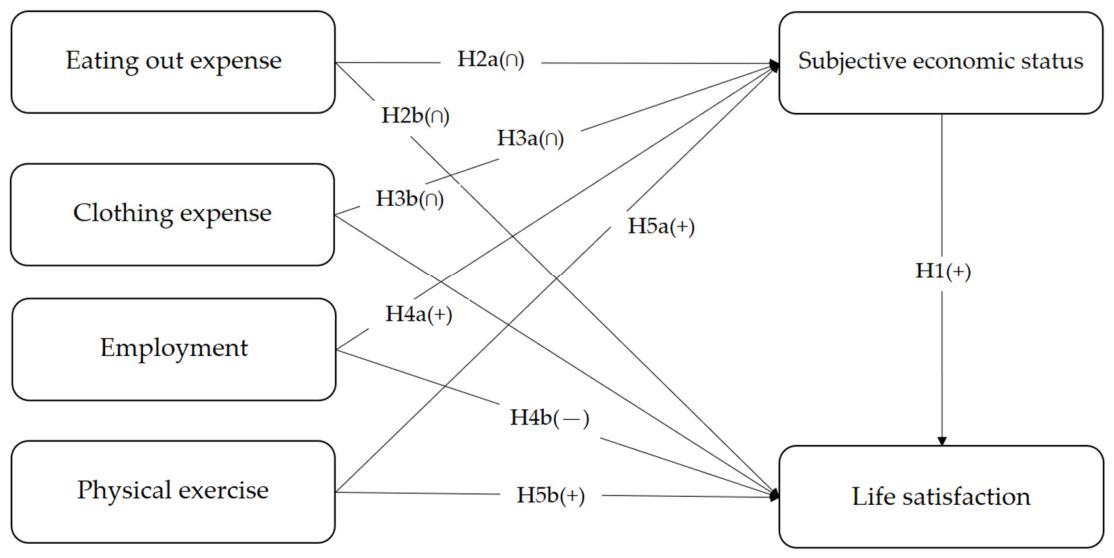
3.1. Research Model
3.2. Data Collection and Measurement Description
3.3. Data Analysis
4. Results
4.1. Descriptive Statistics and Correlation Matrix
4.2. Results of Hypothesis Testing
5. Discussion
6. Conclusions
6.1. Theoretical and Policy Implications
6.2. Limitations and Directions for Future Research
Author Contributions
Funding
Institutional Review Board Statement
Informed Consent Statement
Data Availability Statement
Conflicts of Interest
References
- Statistics Korea. Aging Index. 2025. Available online: https://www.index.go.kr/unify/idx-info.do?idxCd=5064 (accessed on 15 March 2026).
- Yaden, D.; Batz-Barbarich, C.; Ng, V.; Vaziri, H.; Gladstone, J.N.; Pawelski, J.; Tay, L. A meta-analysis of religion/spirituality and life satisfaction. J. Happiness Stud. 2022, 23, 4147–4163. [Google Scholar] [CrossRef]
- He, X.; Zhou, Y.; Yuan, X.; Zhu, M. The coordination relationship between urban development and urban life satisfaction in Chinese cities-An empirical analysis based on multi-source data. Cities 2024, 150, 105016. [Google Scholar] [CrossRef]
- Kim, E.; Delaney, S.; Tay, L.; Chen, Y.; Diener, E.; Vanderweele, T. Life satisfaction and subsequent physical, behavioral, and psychosocial health in older adults. Milbank Q. 2021, 99, 209–239. [Google Scholar] [CrossRef]
- Tavares, A.I. Health and life satisfaction factors of Portuguese older adults. Arch. Gerontol. Geriatr. 2022, 99, 104600. [Google Scholar] [CrossRef]
- Kim, B.J.; Chen, L.; Xu, L.; Lee, Y. Self-rated health and subjective economic status in life satisfaction among older Chinese immigrants: A cross-sectional study. Healthcare 2021, 9, 342. [Google Scholar] [CrossRef] [PubMed]
- Hsu, H.C. Trajectory of life satisfaction and its relationship with subjective economic status and successful aging. Soc. Indic. Res. 2010, 99, 455–468. [Google Scholar] [CrossRef]
- Powdthavee, N. Feeling Richer or Poorer than Others: A Cross-section and Panel Analysis of Subjective Economic Status in Indonesia. Asia Econ. J. 2007, 21, 169–194. [Google Scholar] [CrossRef]
- Howell, R.; Howell, C.J. The relation of economic status to subjective well-being in developing countries: A meta-analysis. Psychol. Bul. 2008, 134, 536. [Google Scholar] [CrossRef]
- Ren, Z.; Yue, G.; Xiao, W.; Fan, Q. The influence of subjective socioeconomic status on life satisfaction: The chain mediating role of social equity and social trust. Int. J. Environ. Res. Public Health 2022, 19, 15652. [Google Scholar] [CrossRef] [PubMed]
- Mastrokoukou, S.; Longobardi, C.; Fabris, M.; Lin, S. Subjective socioeconomic status and life satisfaction among high school students: The role of teacher-student relationships. Soc. Psychol. Educ. 2025, 28, 11. [Google Scholar] [CrossRef]
- Grant, I.; Stephen, G. Buying behaviour of “tweenage” girls and key societal communicating factors influencing their purchasing of fashion clothing. J. Fash. Mark. Manag. Int. J. 2005, 9, 450–467. [Google Scholar] [CrossRef]
- Atik, D.; Ozdamar Ertekin, Z. The restless desire for the new versus sustainability: The pressing need for social marketing in fashion industry. J. Soc. Mark. 2023, 13, 1–19. [Google Scholar] [CrossRef]
- Ferrant, C.; Giacoman, C.; Lhuissier, A.; Bórquez, I. Social varieties of eating out: Evidence from Santiago and Paris. Food Cult. Soc. 2024, 27, 775–791. [Google Scholar] [CrossRef]
- Liu, Y.; Li, X.; Yuen, K. Revenge buying: The role of negative emotions caused by lockdowns. J. Retail. Consum. Serv. 2023, 75, 103523. [Google Scholar] [CrossRef]
- Le, H.; Park, J. Drives of in-store revenge consumption in the post-pandemic: A study in China. J. Retail. Consum. Serv. 2024, 79, 103844. [Google Scholar] [CrossRef]
- Dittmer, T. Diminishing marginal utility in economics textbooks. J. Econ. Educ. 2005, 36, 391–399. [Google Scholar] [CrossRef]
- Huh, W.; Li, H. Optimal pricing under multiple-discrete customer choices and diminishing return of consumption. Oper. Res. 2022, 70, 905–917. [Google Scholar] [CrossRef]
- Pinto, E.P. The influence of wage on motivation and satisfaction. Int. Bus. Econ. Res. J. 2011, 10, 81. [Google Scholar] [CrossRef][Green Version]
- Mamycheva, D.; Melnichuk, A.; Taranova, I.; Chernykh, A.; Gadzhieva, E.; Ratiev, V. Instrumentation organizational and economic support of labor motivation of employees. Int. Rev. Manag. Mark. 2016, 6, 142–147. [Google Scholar]
- Pasupuleti, S.; Allen, R.; Lambert, E.; Cluse-Tolar, T. The impact of work stressors on the life satisfaction of social service workers: A preliminary study. Adm. Soc. Work. 2009, 33, 319–339. [Google Scholar] [CrossRef]
- Singh, S. Life satisfaction and stress level among working and non-working women. Int. J. Indian Psychol. 2014, 1, 121–128. [Google Scholar] [CrossRef]
- Nicholl, J.; Coleman, P.; Brazier, J. Health and health care costs and benefits of exercise. Pharmacoeconomics 1994, 5, 109–122. [Google Scholar] [CrossRef] [PubMed]
- Salmon, P. Effects of physical exercise on anxiety, depression, and sensitivity to stress: A unifying theory. Clin. Psychol. Rev. 2001, 21, 33–61. [Google Scholar] [CrossRef] [PubMed]
- Moreno-Murcia, J.; Belando, N.; Huéscar, E.; Torres, M. Social support, physical exercise and life satisfaction in women. Rev. Latinoam. Psicol. 2017, 49, 194–202. [Google Scholar] [CrossRef]
- Wang, F.; McDonald, T.; Champagne, L.J.; Edington, D. Relationship of body mass index and physical activity to health care costs among employees. J. Occup. Environ. Med. 2004, 46, 428–436. [Google Scholar] [CrossRef][Green Version]
- Teixeira, D.; Rodrigues, F.; Cid, L.; Monteiro, D. Enjoyment as a predictor of exercise habit, intention to continue exercising, and exercise frequency: The intensity traits discrepancy moderation role. Front. Psychol. 2022, 13, 780059. [Google Scholar] [CrossRef]
- Yang, H.; Zhao, X.; Ma, E. A dual-path model of work-family conflict and hospitality employees’ job and life satisfaction. J. Hosp. Tour. Manag. 2024, 58, 154–163. [Google Scholar] [CrossRef]
- Pai, C.K.; Chen, H.; Lee, T.; Hyun, S.; Liu, Y.; Zheng, Y. The impacts of under-tourism and place attachment on residents’ life satisfaction. J. Vacat. Mark. 2024, 30, 694–712. [Google Scholar] [CrossRef]
- Clair, R.; Gordon, M.; Kroon, M.; Reilly, C. The effects of social isolation on well-being and life satisfaction during pandemic. Humanit. Soc. Sci. Commun. 2021, 8, 28. [Google Scholar] [CrossRef]
- Cavioni, V.; Grazzani, I.; Ornaghi, V.; Agliati, A.; Pepe, A. Adolescents’ mental health at school: The mediating role of life satisfaction. Front. Psychol. 2021, 12, 720628. [Google Scholar] [CrossRef]
- Feng, D.; Ji, L.; Xu, L. Effect of subjective economic status on psychological distress among farmers and non-farmers of rural China. Aust. J. Rural. Health 2015, 23, 215–220. [Google Scholar] [CrossRef]
- Wang, C.; Shen, J. How subjective economic status matters: The reference-group effect on migrants’ settlement intention in urban China. Asian Popul. Stud. 2023, 19, 105–123. [Google Scholar] [CrossRef]
- Han, J.M.; Song, H. Effect of subjective economic status during the COVID-19 pandemic on depressive symptoms and suicidal ideation among South Korean adolescents. Psychol. Res. Behav. Manag. 2021, 14, 2035–2043. [Google Scholar] [CrossRef]
- Homocianu, D. Life satisfaction: Insights from the world values survey. Societies 2024, 14, 119. [Google Scholar] [CrossRef]
- Edwards, J.S. The foodservice industry: Eating out is more than just a meal. Food Qual. Prefer. 2013, 27, 223–229. [Google Scholar] [CrossRef]
- Zhong, Y.; Oh, S.; Moon, H. What can drive consumers’ dining-out behavior in China and Korea during the COVID-19 pandemic? Sustainability 2021, 13, 1724. [Google Scholar] [CrossRef]
- McKinney, L.; Legette-Traylor, D.; Kincade, D.; Holloman, L. Selected social factors and the clothing buying behaviour patterns of black college consumers. Int. Rev. Retail. Distrib. Consum. Res. 2004, 14, 389–406. [Google Scholar] [CrossRef]
- Chen-Yu, J.; Seock, Y.K. Adolescents’ clothing purchase motivations, information sources, and store selection criteria: A comparison of male/female and impulse/nonimpulse shoppers. Fam. Consum. Sci. Res. J. 2002, 31, 50–77. [Google Scholar] [CrossRef]
- Yost, E.; Cheng, Y. Customers’ risk perception and dine-out motivation during a pandemic: Insight for the restaurant industry. Int. J. Hosp. Manag. 2021, 95, 102889. [Google Scholar] [CrossRef]
- Acland, D.; Greenberg, D.H. The elasticity of marginal utility of income for distributional weighting and social discounting: A meta-analysis. J. Benefit-Cost. Anal. 2023, 14, 386–405. [Google Scholar] [CrossRef]
- Li, X.; Hsee, C. The psychology of marginal utility. J. Consum. Res. 2021, 48, 169–188. [Google Scholar] [CrossRef]
- Kim, M.J. Relationship between BMI and the dining out behavior of university students in the Seoul area. Korean J. Food Cook. Sci. 2010, 26, 450–457. Available online: https://www.dbpia.co.kr/journal/articleDetail?nodeId=NODE09919759 (accessed on 15 March 2026).
- Choi, M.K. An analysis of groups with diet problems associated with dining out. Korean J. Food Nutr. 2008, 21, 536–544. [Google Scholar]
- O’Donoghue, C.; Morrissey, K.; Hayes, P.; Loughrey, J.; Banks, J.; Hynes, S. The spatial distribution of household disposable income. In Spatial Microsimulation for Rural Policy Analysis; Springer: Berlin/Heidelberg, Germany, 2013; pp. 193–211. [Google Scholar]
- Scholderer, J.; Grunert, K. Consumers, food and convenience: The long way from resource constraints to actual consumption patterns. J. Econ. Psychol. 2005, 26, 105–128. [Google Scholar] [CrossRef]
- Dunifon, R.; Duncan, G.J. Long-run effects of motivation on labor-market success. Soc. Psychol. Q. 1998, 61, 33–48. [Google Scholar] [CrossRef]
- Xu, X.; Chen, L.; Yuan, Y.; Xu, M.; Tian, X.; Lu, F.; Wang, Z. Perceived stress and life satisfaction among Chinese clinical nursing teachers: A moderated mediation model of burnout and emotion regulation. Front. Psychiatry 2021, 12, 548339. [Google Scholar] [CrossRef]
- Heyns, M.; Kerr, M. Generational differences in workplace motivation. J. Hum. Resour. Manag. 2018, 16, 1–10. [Google Scholar] [CrossRef]
- Mahmoud, A.; Reisel, W.; Grigoriou, N.; Fuxman, L.; Mohr, I. The reincarnation of work motivation: Millennials vs older generations. Int. Sociol. 2020, 35, 393–414. [Google Scholar] [CrossRef]
- Rodrigues, F.; Faustino, T.; Santos, A.; Teixeira, E.; Cid, L.; Monteiro, D. How does exercising make you feel? The associations between positive and negative affect, life satisfaction, self-esteem, and vitality. Int. J. Sport Exerc. Psychol. 2022, 20, 813–827. [Google Scholar] [CrossRef]
- Yang, M.; Si, S.; Zhang, K.; Xi, M.; Zhang, W. Bridging the relationship between physical exercise and mental health in adolescents based on network analysis. PsyCh J. 2024, 13, 835–848. [Google Scholar] [CrossRef]
- Stanton, R.; Happell, B.; Reaburn, P. The mental health benefits of regular physical activity, and its role in preventing future depressive illness. Nurs. Res. Rev. 2014, 4, 45–53. [Google Scholar] [CrossRef]
- Ackermann, R.; Williams, B.; Nguyen, H.; Berke, E.; Maciejewski, M.; LoGerfo, J. Healthcare cost differences with participation in a community-based group physical activity benefit for medicare managed care health plan members. J. Am. Geriatr. Soc. 2008, 56, 1459–1465. [Google Scholar] [CrossRef]
- Katzmarzyk, P.; Friedenreich, C.; Shiroma, E.; Lee, I. Physical inactivity and non-communicable disease burden in low-income, middle-income and high-income countries. Br. J. Sports Med. 2022, 56, 101–106. [Google Scholar] [CrossRef]
- Gujarati, D.; Porter, D. Basic Econometrics; McGraw-Hill: New York, NY, USA, 2009. [Google Scholar]
- Wooldridge, J. Introductory Econometrics: A Modern Approach; South-Western College Publishing: Cincinnati, OH, USA, 2009. [Google Scholar]


| Variable | Measurement |
|---|---|
| Life satisfaction (LSA) | Life satisfaction score (range: 0–100) |
| Subjective economic status (SES) | Subjective economic status score (range: 0–100) |
| Eating out expense (EOE) | Monthly eating out expense |
| Clothing expense (CLE) | Monthly clothing expense |
| Employment (EMP) | (0 = no, 1 = yes) |
| Physical exercise (PEX) | (0 = no, 1 = yes) |
| Age (AGE) | Legal age of the participants |
| Sex (SEX) | (0 = female, 1 = male) |
| Household assets (HAS) | Household assets of the survey participant |
| Household debt (HDE) | Household debt of the survey participant |
| Variable | Mean | SD | Minimum | Maximum |
|---|---|---|---|---|
| LSA | 64.00 | 17.09 | 0 | 100 |
| SES | 58.88 | 17.53 | 0 | 100 |
| EOE | 19.99 | 16.57 | 0 | 300 |
| CLE | 12.91 | 10.47 | 0 | 200 |
| EMP | 0.96 | 0.18 | 0 | 1 |
| PEX | 0.48 | 0.49 | 0 | 1 |
| AGE | 51.18 | 3.66 | 45 | 57 |
| SEX | 0.47 | 0.49 | 0 | 1 |
| HAS | 42,386.05 | 49,226.17 | 10 | 1,000,000 |
| HDE | 4978.83 | 11,813.55 | 0 | 200,000 |
| Variable | 1 | 2 | 3 | 4 | 5 | 6 | 7 | 8 | 9 |
|---|---|---|---|---|---|---|---|---|---|
| 1. LSA | 1 | ||||||||
| 2. SES | 0.76 * | 1 | |||||||
| 3. EOE | 0.25 * | 0.24 * | 1 | ||||||
| 4. CLE | 0.31 * | 0.30 * | 0.43 * | 1 | |||||
| 5. EMP | 0.02 | 0.05 * | 0.05 * | 0.02 | 1 | ||||
| 6. PEX | 0.19 * | 0.15 * | 0.12 * | 0.12 * | 0.01 | 1 | |||
| 7. AGE | −0.02 * | −0.03 * | −0.06 * | −0.05 * | 0.01 | 0.01 | 1 | ||
| 8. SEX | −0.05 * | −0.02 * | 0.01 | −0.06 * | 0.03 * | −0.05 * | 0.04 * | 1 | |
| 9. HAS | 0.31 * | 0.33 * | 0.32 * | 0.33 * | 0.01 | 0.16 * | −0.01 | −0.01 | 1 |
| 10. HDE | 0.12 * | 0.09 * | 0.16 * | 0.19 * | −0.01 | 0.05 * | −0.04 * | 0.03 * | 0.463 * |
| Variable | Model 1 DV (SES) β(t-Value) | Model 2 DV (SES) β(t-Value) | Model 3 DV (LSA) β(t-Value) | Model 4 DV (LSA) β(t-Value) |
|---|---|---|---|---|
| Intercept | 46.78 (36.12) * | 53.92 (15.66) * | 22.31 (22.07) * | 20.20 (8.09) * |
| SES | - | - | 0.67 (65.46) * | 0.67 (63.17) * |
| EOE | 0.13 (4.91) * | 0.09 (3.47) * | 0.03 (1.78) | 0.03 (2.03) * |
| EOE2 | −5.03 × 10⁻⁴ (−2.14) * | −5.16 × 10⁻⁴ (−2.27) * | −6.25 × 10⁻⁵ (−0.39) | −1.17 × 10⁻⁴ (−0.73) |
| CLE | 0.48 (10.91) * | 0.39 (9.08) * | 0.20 (6.55) * | 0.18 (6.10) * |
| CLE2 | −3.51 × 10⁻³ (−4.78) * | −3.33 × 10⁻³ (−4.69) * | −1.90 × 10⁻³ (−3.78) * | −1.89 × 10⁻³ (−3.76) * |
| EMP | 3.29 (2.67) * | 3.22 (2.70) * | −2.38 (−2.83) * | −2.30 (−2.73) * |
| PEX | 3.75 (7.92) * | 2.89 (6.26) * | 2.26 (6.92) * | 2.21 (6.75) * |
| AGE | −0.14 (−2.34) * | 0.05 (1.19) | ||
| SEX | −1.09 (−2.39) * | −1.19 (−3.70) * | ||
| HAS | 9.34 × 10⁻⁵ (16.55) * | 1.01 × 10⁻⁶ (0.24) | ||
| HDE | −1.03 × 10⁻⁴ (−4.65) * | 5.20 × 10⁻⁵ (3.30) * | ||
| F-value | 74.34 * | 77.41 * | 766.77 * | 493.44 * |
| R2 | 0.0911 | 0.1502 | 0.5504 | 0.5534 |
| Variable | Model 5 DV (SES) β(t-Value) | Model 6 DV (SES) β(t-Value) | Model 7 DV (LSA) β(t-Value) | Model 8 DV (LSA) β(t-Value) |
|---|---|---|---|---|
| Intercept | 46.78 (36.12) * | 53.92 (15.66) * | 22.31 (22.07) * | 20.20 (8.09) * |
| SES | - | - | 0.67 (65.46) * | 0.67 (63.17) * |
| EOE | 0.13 (4.91) * | 0.09 (3.47) * | 0.03 (1.78) | 0.03 (2.03) * |
| EOE2 | −5.03 × 10⁻⁴ (−2.14) * | −5.16 × 10⁻⁴ (−2.27) * | −6.25 × 10⁻⁵ (−0.39) | −1.17 × 10⁻⁴ (−0.73) |
| CLE | 0.48 (10.91) * | 0.39 (9.08) * | 0.20 (6.55) * | 0.18 (6.10) * |
| CLE2 | −3.51 × 10⁻³ (−4.78) * | −3.33 × 10⁻³ (−4.69) * | −1.90 × 10⁻³ (−3.78) * | −1.89 × 10⁻³ (−3.76) * |
| EMP | 3.29 (2.67) * | 3.22 (2.70) * | −2.38 (−2.83) * | −2.30 (−2.73) * |
| PEX | 3.75 (7.92) * | 2.89 (6.26) * | 2.26 (6.92) * | 2.21 (6.75) * |
| AGE | −0.14 (−2.34) * | 0.05 (1.19) | ||
| SEX | −1.09 (−2.39) * | −1.19 (−3.70) * | ||
| HAS | 9.34 × 10⁻⁵ (16.55) * | 1.01 × 10⁻⁶ (0.24) | ||
| HDE | −1.03 × 10⁻⁴ (−4.65) * | 5.20 × 10⁻⁵ (3.30) * | ||
| F-value | 74.34 * | 77.41 * | 766.77 * | 493.44 * |
| R2 | 0.0911 | 0.1502 | 0.5504 | 0.5534 |
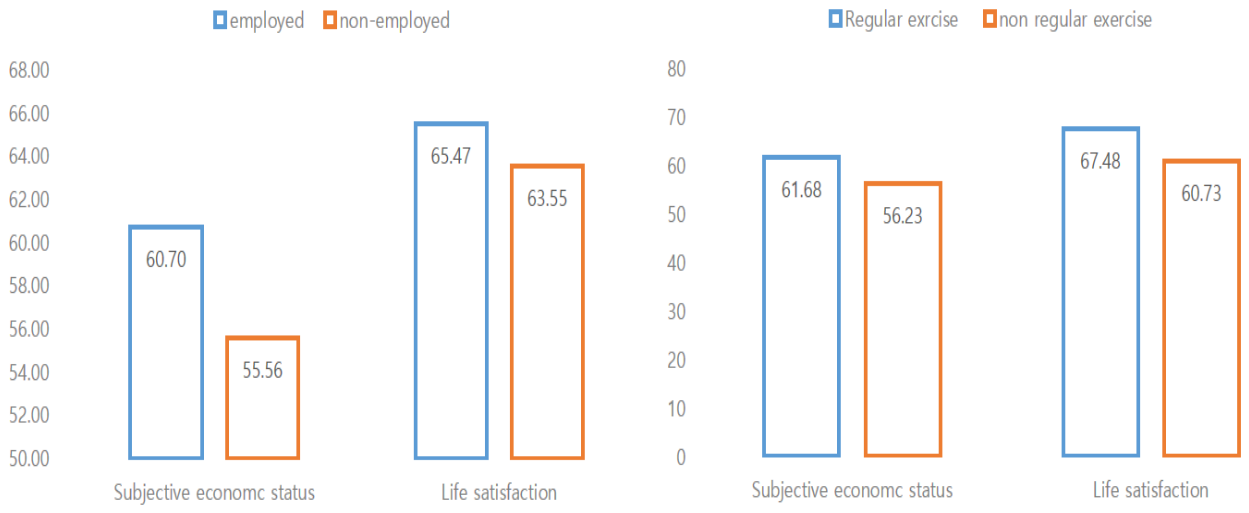
| Variable | DV (SES) Mean (SD) | DV (LSA) Mean (SD) |
|---|---|---|
| EMP | t-value: 4.66 * | t-value: 1.79 |
| Yes | 60.70 (15.70) | 65.47 (15.25) |
| No | 55.56 (19.17) | 63.55 (18.44) |
| PEX | t-value: 14.38 * | t-value: 18.40 * |
| Yes | 61.68 (17.18) | 67.48 (16.06) |
| No | 56.23 (17.44) | 60.73 (17.37) |
Disclaimer/Publisher’s Note: The statements, opinions and data contained in all publications are solely those of the individual author(s) and contributor(s) and not of MDPI and/or the editor(s). MDPI and/or the editor(s) disclaim responsibility for any injury to people or property resulting from any ideas, methods, instructions or products referred to in the content. |
© 2026 by the authors. Licensee MDPI, Basel, Switzerland. This article is an open access article distributed under the terms and conditions of the Creative Commons Attribution (CC BY) license.
Share and Cite
Kim, M.G.; Moon, J. Investigation of the Influential Attributes on Subjective Economic Status and Life Satisfaction of Korean Middle-Aged Using the Korean Longitudinal Study of Elderly Employment (KLoEE) Data. J. Ageing Longev. 2026, 6, 40. https://doi.org/10.3390/jal6020040
Kim MG, Moon J. Investigation of the Influential Attributes on Subjective Economic Status and Life Satisfaction of Korean Middle-Aged Using the Korean Longitudinal Study of Elderly Employment (KLoEE) Data. Journal of Ageing and Longevity. 2026; 6(2):40. https://doi.org/10.3390/jal6020040
Chicago/Turabian StyleKim, Min Gyung, and Joonho Moon. 2026. "Investigation of the Influential Attributes on Subjective Economic Status and Life Satisfaction of Korean Middle-Aged Using the Korean Longitudinal Study of Elderly Employment (KLoEE) Data" Journal of Ageing and Longevity 6, no. 2: 40. https://doi.org/10.3390/jal6020040
APA StyleKim, M. G., & Moon, J. (2026). Investigation of the Influential Attributes on Subjective Economic Status and Life Satisfaction of Korean Middle-Aged Using the Korean Longitudinal Study of Elderly Employment (KLoEE) Data. Journal of Ageing and Longevity, 6(2), 40. https://doi.org/10.3390/jal6020040