Article

Harmonisation-Oriented Monitoring of Microplastics in Reclaimed Water for Agricultural Irrigation: Loads and Polymer Composition


by
Jose Javier Flores
1,
Laura Cortés-Corrales
1,
Adrián Rosa García
1,
Alfredo Alcayde
2,
Amadeo R. Fernández-Alba
1 and
Maria Jesús Martínez Bueno
1,*
1
Research Group “Pesticide Residues”, Department of Chemistry and Physics, Research Centre for Mediterranean Intensive Agrosystems and Agri-Food Biotechnology (CIAMBITAL), University of Almería, 04120 Almería, Spain
2
Department of Rural Engineering, University of Almeria, 04120 Almería, Spain
*
Author to whom correspondence should be addressed.
Microplastics 2026, 5(2), 88; https://doi.org/10.3390/microplastics5020088 (registering DOI)
Submission received: 10 February 2026 / Revised: 13 March 2026 / Accepted: 7 May 2026 / Published: 11 May 2026

Abstract

Microplastics (MPs) in water treatment plants (WTPs) represent a critical environmental concern, particularly when treated effluent is reused for agricultural irrigation. This study investigates the occurrence, removal efficiency, and characterization of MPs in tertiary-treated wastewater destined for agricultural reuse in water-scarce regions. Additionally, the study examines the influence of sample volume on extrapolated MP concentrations. Despite advanced treatment processes including ultrafiltration achieving removal efficiencies of 89%, substantial quantities of MPs remain in final effluents at concentrations ranging from 89 to 399 MPs/m3 (equivalent to 0.1–0.4 MPs/L) with a mass load of 2 µg/L at the outlet. Morphological analysis revealed a shift from fragment-dominated influent (~50%) to film-dominated effluent (~51%), with blue particles being most prevalent. Size distribution analysis showed distinct peaks: 50–100 µm for fragments, 100–250 µm for films, and 250–500 µm for fibres. Polytetrafluoroethylene (PTFE) emerged as the dominant polymer across all morphotypes. Finally, converting particle counts to mass loads indicated an average decrease from ~11 µg/L at the inlet to ~2 µg/L at the outlet, underscoring that number- and mass-based metrics provide complementary information for risk assessment.

1. Introduction

The widespread use of plastic products, combined with physical and chemical processes such as erosion, weathering, and abrasion, has substantially increased the release of microplastics (MPs) into multiple environmental compartments, including water, soil, and air [1]. Their persistence, small size, and potential to adsorb or release hazardous chemicals raise significant concerns regarding ecological risks and human exposure, underscoring the urgent need for comprehensive monitoring and assessment of MPs across environmental compartments [2].
MPs in aquatic environments often originate from terrestrial sources and are transported via hydrological pathways such as surface runoff, stormwater discharge, and riverine systems [1]. Rivers deliver an estimated 70–80% of plastic residues in letting the oceans, largely due to poorly managed effluents from industry, agriculture, urban runoff, and wastewater treatment plants (WWTPs) [3]. Among these sources, WWTPs represent a major contributor of MPs to freshwater systems, acting as critical convergence points where MPs from diverse anthropogenic activities accumulate.
Treatment processes in WWTPs are effective at removing contaminants and larger debris, but they are not entirely efficacious in the elimination of MPs. Overall removal efficiencies range from 57% to 99% depending on the treatment configuration [4]. Primary treatment stages (screening, sedimentation) show limited removal efficiency of 25–72%, while secondary biological treatment achieves 54–88% removal [5]. Advanced tertiary treatment technologies demonstrate the highest performance, with membrane bioreactors (MBRs) 99% removal efficiency, and combinations of sand filtration, ozonation, and ultrafiltration reaching 86–95% removal [6,7]. Despite these removal rates, WWTPs still discharge substantial quantities of MPs into receiving water bodies. Recent analyses report that between 50,000 and 15,000,000 particles could be released into WWTP effluent each day from individual treatment plants. Final effluent concentrations typically range from 0.0007 to 125 MPs/L, with fibres constituting 56–89.6% of particles and predominant polymer types including polyethylene (PE), polypropylene (PP), polyethylene terephthalate (PET), and polyamide (PA) [8,9].
Tertiary treated wastewater from WWTPs is increasingly utilized as reclaimed water for agricultural irrigation, particularly in water-scarce regions, as a sustainable alternative to conventional water resources in response to rising agricultural water demands and declining freshwater availability. However, exposure to advanced treatment processes such as ultraviolet (UV) radiation, chlorination, ultrafiltration (UF), and reverse osmosis can further fragment larger plastic particles, producing increased numbers of smaller MPs and potentially nanoplastics (NPs) [10,11]. Therefore, agricultural soils receiving reclaimed water act as major reservoirs of MPs and potential secondary sources to other environmental compartments [1,12].
The reuse of urban-origin water for irrigation is promoted in the European Union (EU) as a circular economy strategy to increase resource availability and reduce effluent discharge to the environment [13]. Spain is the European leader in implementing these practices, and the Almería region is one of the largest consumers of reclaimed water in agriculture, with annual reuse volumes exceeding 100 hm3 [14]. Despite this growing evidence of MP presence in reclaimed water and accumulating evidence of soil contamination, the potential implications of MPs in agricultural reuse systems remain poorly understood, and no regulatory limits currently exist for MPs in WWTP effluents [15]. In EU, the agricultural use of reclaimed water is governed by Regulation (EU) 2020/741, which establishes minimum requirements for water quality but does not include MP monitoring or limits [13]. Additionally, Directive (EU) 2024/3019 mandates monitoring of MPs as emerging pollutants in influent, effluent, and sludge of urban WWTPs starting 1 January 2025, requiring Member States to regularly monitor and report on these substances for evidence-based decision-making [16].
Current methodological challenges include the lack of universal accepted protocols, variability in size-dependent detection limits, inconsistencies in polymer identification techniques, and inadequate contamination control measures. The recently published ISO 5667-27:2025 standard provides baseline guidance for sampling suspended microplastics in domestic waters, fresh and marine waters, and treated and untreated wastewater, representing an important step toward harmonization [17]. Nevertheless, the growing evidence highlights the urgent need for standardized procedures to ensure reliable sampling, analytical reproducibility, and the generation of comparable data to support decision-making across EU Member States, particularly in the context of reclaimed water use for crop irrigation.
The main objective of this study was to evaluate the occurrence and concentrations of MPs in reclaimed water produced by regeneration plants in southeastern Spain. MP morphology, size, colour, and polymer composition were characterized by stereomicroscopy and µFTIR spectroscopy. In addition, the potential contribution of reclaimed water as a source of MPs to agroecosystems was examined, with implications for environmental monitoring, regulatory development, and the safe reuse of water in intensive agricultural systems. Finally, the removal efficiency of different treatment stages, particularly tertiary processes, was assessed and MP levels were compared across plants.

2. Materials and Methods

2.1. Field Study and Sample Collection

The three water treatment plants (WTPs) investigated in this study show notable differences in treatment configuration and operational capacity. WTP-A and WTP-B function as advanced reclamation facilities designed to deliver reclaimed water suitable for irrigation, whereas WTP-C operates as a general municipal wastewater treatment plant. The WTP-C predominantly treats urban wastewater, with an influent equivalent to ~256,600 population equivalents. Following conventional secondary treatment, a fraction of the effluent is transferred to the water regeneration plant (WTP-A). At WTP-A, the water is subjected to successive filtration and sodium hypochlorite disinfection process, followed by an advanced ultrafiltration step (20 µm). In contrast, WTP-B treats a substantially smaller flow (~21,100 population equivalents) and applies tertiary treatment comprising sand filtration (0.5–1 mm) and subsequent ozonation.
At WTP-A, samples were collected over a seven-month period (from October 2024 to April 2025) at two locations: the inlet (I), corresponding to the storage tanks containing a mixture of secondary effluent and desalinated seawater, and the outlet (O), corresponding to the final regenerated water after ultrafiltration. At the WTPs (B/C), spot samples were taken in June 2025 from both the influent and the final effluent. In all cases, water samples (50 L for effluent and 5 L for influent) were collected at each point by triplicate using a stainless-steel filtration set (47 mm Pressure Filter Holder, 340 mL; EMD Millipore Corporation, Darmstadt, Germany) connected to an EZ StreamTM vacuum pump (Merck Millipore, Darmstadt, Germany). Stainless-steel wire meshes (47 mm Ø, 25 µm pore size) were used for microplastic (MP) retention.

2.2. Sample Extraction

MPs retained on the meshes were extracted as follows. Each mesh was placed in a glass jar, to which 20 mL of distilled water was added. The jars were sealed and subjected to three 10 min cycles in an ultrasonic bath (Digital Ultrasonic Cleaner 30 L, Vevor, Shanghai, China). The resulting supernatant was filtered through cellulose ester filters (S-Pak filters, 1.2 µm pore size, 47 mm Ø; Merck Millipore, Milford, MA, USA). The filters were stored in glass Petri dishes to minimize airborne contamination.

2.3. Sample Analysis

Filters were examined under a Leica S9i stereomicroscope (Leica Microsystems, Wetzlar, Germany) equipped with a 10 MP digital camera and LAS-X 3.7 software. All particles visually suspected to be synthetic polymers and <5 mm in their longest dimension were counted and morphologically classified by size, shape, and colour. Each particle was photographed using two optical settings: a 1× objective (6×–55× magnification, 9:1 zoom) and a 2× objective (12×–110× magnification). Image analysis with LAS-X 3.7 was used to determine length, area, and roundness; roundness values approaching 1 indicate nearly spherical particles. All isolated particles were transferred to a macroporous silicone membrane filter (MakroPor P12M5-500, SmartMembranes GmbH, Halle, Germany). Chemical identification was performed by Fourier-transform infrared microspectroscopy (µFTIR, Nicolet iN10; Thermo Fisher Scientific, Waltham, MA, USA) in transmission mode across 4000–650 cm−1, with 8 cm−1 resolution and 16 scans. The mercury cadmium telluride (MCT) detector was cooled with liquid nitrogen. Background calibration accounted for atmospheric CO2 and H2O interference. Each spectrum was manually verified using the OMNIC polymer spectral library (Thermo Fisher Scientific) and a proprietary reference database. Spectra with >65% similarity were accepted as positive polymer identifications; spectra below this threshold were discarded. Natural and semi-synthetic fibres (e.g., cotton, cellulose, and rayon; RY) were excluded from the reported data.

2.4. Prevention of Procedural Contamination

Strict contamination-control measures were implemented throughout sampling and analysis. Field personnel wore non-synthetic clothing and nitrile gloves. For each sampling event, a blank mesh identical to those used for real samples was handled and stored in a 100 mL glass jar under identical conditions, serving as a procedural control.
In the laboratory, all glassware and stainless-steel tweezers were cleaned with ultrapure water and filtered methanol, wrapped in aluminium foil, and baked at 250 °C for 6 h. All solvents were pre-filtered (0.45 µm) at least twice. Sample processing was conducted under a closed laminar-flow hood (vertical airflow 0.6 m/s). Personnel wore white cotton lab coats and nitrile gloves throughout. Daily laboratory blanks were analysed, including solvent blanks and all materials used, and MP counts were corrected by subtracting values detected in corresponding blanks.

3. Results and Discussion

3.1. Validation Process of Sampling Volumes

The quantification of MPs in aquatic environments remains a significant analytical challenge. The selection of the volume of sample to be taken represents a critical methodological decision that directly affects the estimated concentration and the data reliability. This is particularly pertinent when microparticles are distributed heterogeneously and the number recovered per sample may be low. This study examined the impact of different sample volumes (10 L, 30 L, and 50 L) on extrapolated MP concentrations per cubic metre (see Figure S1) and assessed the temporal variability of MP concentrations over a five-day period (see Figure S2) in reclaimed water samples intended for agricultural irrigation that underwent advanced ultrafiltration treatment. Samples were collected in triplicate, and data were primarily evaluated using descriptive statistics (mean, median, minimum–maximum, and interquartile range).
For the sampling-volume comparison (Figure S1), standard errors were calculated from triplicate determinations and were 609, 19, and 29 MPs/m3 for 10, 30, and 50 L, respectively. A clear inverse relationship between sample volume and extrapolated MP concentrations was observed (see Figure S1). When extrapolating to 1 m3, the smallest sample volume (10 L) yielded a median concentration of 1167 MPs/m3, with a substantial interquartile range of ~500 to ~1700 MPs/m3 (min. 300 MPs/m3; max. 2400 MPs/m3). By contrast, the 30 L sample volume produced a median concentration of only 111 MPs/m3 (min. 67 MPs/m3; max. 133 MPs/m3), and the 50 L volume yielded a median of 93 MPs/m3 (min. 40 MPs/m3; max. 140 MPs/m3). These results show a difference of approximately 10–12-fold between the smallest and largest sample volumes, which cannot be attributed to random sampling variation alone. In a recent study, Cross et al., 2025 [18] developed a Representative Sample Volume Predictor (RSVP) tool based on Poisson distribution modelling, which provides a statistical framework for determining appropriate sample volumes based on target particle numbers and desired confidence levels. According to their framework, achieving 95% confidence intervals within ±30% of the total concentration requires capturing at least 50 particles. However, the pronounced variability observed for the 10 L-based extrapolations suggests that, in this matrix, uncertainty is not driven solely by Poisson counting error. Although the particle count was close to or exceeded the nominal threshold proposed by RSVP on some occasions, the concentration estimates remained unstable. Consequently, it can be deduced that the randomness and spatial/temporal homogeneity of particle occurrence may be attributable to other additional sources of variability (e.g., short-term fluctuations in effluent composition, particle clustering, or procedural heterogeneity) resulting in overdispersion that exceeds the predictions of a Poisson model. This interpretation is consistent with ISO 5667-27:2025, which emphasizes that inadequate sampling volumes and non-homogeneous particle distributions can compromise representativeness and increase uncertainty in MP measurements.
In contrast, the reduced variability observed when processing larger volumes (30 L and 50 L) supports improved representativeness. The 50 L dataset showed a markedly narrower interquartile range (~70–120 MPs/m3) compared with that obtained from 10 L extrapolations (~500–1700 MPs/m3), underscoring the importance of sufficient sample volume to mitigate both distributional heterogeneity (patchiness) and constitutional heterogeneity (differences in particle-type composition captured between subsamples). The order-of-magnitude differences observed across volumes indicate that 10 L is inadequate to capture representative MP concentrations in this setting, leading to systematic bias rather than purely random uncertainty. The 100-fold extrapolation from 10 L to 1 m3 represents a particularly problematic approach. Any counting imprecision, sporadic contamination, or localized enrichment/depletion within such a small subsample is amplified proportionally during extrapolation, increasing the likelihood of gross overestimation of true concentrations. In line with this, Cross et al., 2025 [18], reported that a non-negligible fraction of freshwater studies used sample volumes that could yield false-negative error rates above 5%, highlighting the broader risk of underpowered sampling designs when particle abundances are low or heterogeneous. Finally, although larger volumes clearly improved robustness, the residual dispersion observed even at 50 L suggests that representativeness depends not only on processed volume but also on temporal integration and operational stability. Variations in hydraulic conditions, discrete plant events (e.g., backwashing, peak loads), resuspension phenomena, and changes in suspended solids may all contribute to short-term variability and should be accounted for through replicated sampling strategies and careful documentation of operational conditions.
Accordingly, short-term temporal variability in MP concentrations was evaluated over five consecutive days. Figure S2 shows marked day-to-day fluctuations, with values ranging from 44 MPs/m3 (Day 2) to 644 MPs/m3 (Day 3), corresponding to an approximately 14-fold difference. The daily means were 167 (Day 1), 44 (Day 2), 644 (Day 3), 400 (Day 4), and 256 MPs/m3 (Day 5), yielding an overall average of approximately 300 MPs/m3 across the sampling period. This magnitude of temporal variability has important implications for both sampling design and interpretation of “typical” concentrations in reclaimed-water systems. The pronounced spike on Day 3, more than double the five-day average, confirms other sources of random variability associated with sampling, such as specific loading events, changes in hydraulic residence time, or operating conditions affecting solids removal (e.g., filtration performance and backwash cycles). The temporal variability documented here underscores that even with adequate sample volumes and particle count are consistent to nominal threshold proposed by RSVP proposed by Cross et al., 2025, single-timepoint sampling can produce highly misleading concentration estimates [18]. Notably, the multi-day mean (~300 MPs/m3) provides a more stable estimate than any individual day, reinforcing the view that temporal variability can be a dominant source of uncertainty in reclaimed water plants. In this context, reclaimed-water MP distributions should be considered inherently irregular and temporally heterogeneous. Consequently, a robust characterisation of this type of sample requires temporal replication in line with ISO 5667-27:2025 [17], which states that the frequency, duration and timing of sampling should be adjusted to the purpose of the study and that weekly or monthly sampling may be necessary when analyses show widely dispersed values.

3.2. Microplastic Abundance in Reclaimed Water for Agricultural Irrigation

3.2.1. Temporal Distribution: Occurrence and Removal Efficiency

Table 1 summarises MP concentrations measured at the inlet (I) and outlet (O) of the reclaimed-water treatment plant over seven months (October 2024–April 2025). Total MP concentrations at the inlet ranged from 601 MPs/m3 (December 2024) to 2934 MPs/m3 (April 2025), with an average inlet concentration of 1611 MPs/m3 across the monitoring period. At the outlet, concentrations were consistently lower, ranging from 89 MPs/m3 (December 2024) to 399 MPs/m3 (February 2025), with an average outlet concentration of 180 MPs/m3. These values correspond to an overall average removal efficiency of approximately 89% across the monitoring period (based on inlet and outlet period means). Detailed examination of monthly data reveals substantial temporal variability in both absolute MP concentrations and removal efficiency. Removal efficiency ranged from a high of 92% in October 2024 (inlet: 867 MPs/m3, outlet: 155 MPs/m3) to a low of 69% in February 2025 (inlet: 1267 MPs/m3, outlet: 399 MPs/m3). The average removal efficiency across all seven months was 89%, which falls within the range reported for conventional tertiary treatment systems but is lower than the >95% efficiencies achieved by advanced membrane-based systems [5].
Expressed in volumetric units commonly reported in the literature, the inlet range (601 to 2934 MPs/m3) corresponds to 0.60–2.93 MPs/L, whereas the outlet range (89–399 MPs/m3) corresponds to 0.09–0.39 MPs/L. The inlet concentrations were within the same order of magnitude as values reported for influents in several municipal WWTPs. For instance, concentrations of 2–3 MPs/L have been documented in some European WWTPs [8,19], although these values are lower than those reported in other studies, such as 926 ± 438 items/L at an urban WWTP in Tenerife, Spain [7], and 12.0 ± 1.29 items/L in influent from China’s largest water reclamation plant [20]. This broad variability among studies likely reflects differences in catchment characteristics (population density, industrial contributions), hydrological conditions, and local waste-management practices, as well as methodological factors including size cut-offs, sample volume, and identification criteria [9,20].
The outlet concentrations observed here (≤0.4 MPs/L) indicate substantial MP reduction through the regeneration train and were comparable to effluent values reported in several recent investigations of advanced wastewater treatment systems. Bayo et al., 2023 [8] reported final effluent concentrations of 0.9 ± 0.2 items/L and 1.1 ± 0.3 items/L for effluents treated by membrane bioreactor (MBR) and by advanced tertiary treatment with three rapid gravity sand filters (RSF), respectively, whereas Tadsuwan and Babel, 2022 [21] reported 2.33 ± 1.53 particles/L following an ultrafiltration polishing step. Yang et al., 2019 [20] reported final effluent concentrations of 0.59 ± 0.22 items/L in municipal sewage from China’s largest water reclamation plant. Afonso-Álvarez et al., 2025 [7], found 42 items/L and 43 items/L in final effluents of an urban WWTP in Tenerife (Spain) equipped with a membrane bioreactor (MBR) and reverse electrodialysis (RED), respectively, for producing reclaimed water for banana farm irrigation.
Temporal variability was pronounced throughout the monitoring period, with both inlet and outlet concentrations fluctuating substantially between months (see Table 1 and Figure S3). The highest inlet concentration was recorded in April 2025 (2934 MPs/m3), representing an increase of approx. 5 times the minimum value observed in December 2024 (601 MPs/m3). Similarly, outlet concentrations varied over a similar range, with a minimum in December (89 MPs/m3) and a maximum in February (399 MPs/m3). Such month-to-month variability is consistent with long-term monitoring studies showing that MP loads and apparent removal efficiencies are influenced by seasonal changes, flow and solids dynamics, and operational parameters such as filtration performance, backwash cycles, and transient loading events [8,22]. However, although the continuous monitoring campaign at WTP-A did not include the full summer period, this does not necessarily imply exclusion of the period of highest irrigation demand in the specific case of Almería, since greenhouse horticulture is commonly interrupted during summer for soil solarization, disinfection, and preparation for the following production cycle. Thus, based on the results obtained, it can be concluded that a robust assessment of MP occurrence in reclaimed water intended for irrigation requires long-term monitoring, as measurements from a single month may not reflect representative concentrations. Representative examples of microplastics observed in the analysed reclaimed water samples are provided in the Supplementary Data (see Figure S4).

3.2.2. Shape Distribution

The morphological analysis revealed that fragments constituted the dominant MP category at both the inlet and outlet of the treatment plant throughout the monitoring period (see Table 1). At the plant inlet, fragments averaged 811 MPs/m3, representing approximately 50% of total MPs, followed by films (622 MPs/m3, 39%) and fibres (178 MPs/m3, 11%). At the outlet, fragments averaged 64 MPs/m3 (36% of total MPs), films 92 MPs/m3 (51%), and fibres 24 MPs/m3 (13%). This morphological distribution pattern contrasts notably with most published studies on MPs in WWTPs, where fibres typically dominate both influent and effluent samples. This may be partly explained by the fact that some studies include microfibres of both natural (e.g., linen or cotton) and semi-synthetic (e.g., cellulose acetate or viscose) origin in the reported counts. For example, Afonso-Álvarez et al., 2025 [7] reported that fibres accounted for more than 60% of the items at all sampling stages (influent and effluent) in an urban WWTP, and that over half of the items were cellulosic (57% in influent and 76% in effluent). Bayo et al., 2023 [8] found that microfibers represented ~80% of MPs in tertiary-treated effluent in Southeast Spain, with fragments comprising only ~10% and films ~11%. Tadsuwan and Babel, 2022 [21] and Yang et al., 2019 [20] both reported fibres as the predominant morphotype (>60%) throughout their respective WWTPs in Thailand and China. The dominance of fibres in most wastewater systems is typically attributed to textile washing and laundry activities, which represent a major source of fibrous MPs in domestic wastewater.
The fragment-dominated profile observed in the present study may reflect specific characteristics of the catchment area, such as a higher proportion of industrial/commercial inputs, or contributions from plastic packaging. Yahyanezhad et al., 2021 [23] reported a more balanced morphotype distribution in an Iranian WWTP, with influent comprising 35% fibres, 39% pellets, and 22% fragments, demonstrating that catchment-specific factors can substantially alter morphological profiles. The relatively high proportion of films (39% at inlet, 51% at outlet) in the present study is particularly noteworthy, as films are less commonly reported as dominant morphotypes in wastewater literature. This may indicate significant inputs from plastic bags, packaging materials, or agricultural sources from degraded agricultural mulching films or greenhouse coverings.
Analysis of morphotype-specific removal efficiencies reveals differential treatment performance across MP categories. Fibres exhibited the highest average removal efficiency at 86% (from 178 MPs/m3 at inlet to 24 MPs/m3 at outlet), followed by fragments at 92% (from 811 to 64 MPs/m3) and films at 85% (from 622 to 92 MPs/m3). Bayo et al., 2023 [8] reported similar differential removal patterns in a tertiary WWTP, with particulate microplastics achieving 90% removal compared to only 56% for fibres, demonstrating that fibres are inherently more difficult to remove through conventional treatment processes due to their elongated morphology and lower settling velocities. The increase in the relative proportion of films at the outlet (from 39% to 51% of total MPs) despite an absolute reduction in film concentration is noteworthy and suggests that films may be removed less efficiently than fragments in the specific treatment system employed. This pattern has been less commonly reported in the literature and warrants further investigation into the physical and hydrodynamic properties influencing film retention in treatment processes.

3.2.3. Colour Distribution

The colour distribution analysis revealed blue as the dominant colour across all morphotypes at both inlet and outlet sampling points (see Table 1). At the plant inlet, blue-coloured MPs represented the majority of all three morphotype categories: blue fragments averaged (72% of total fragments), blue films (85% of total films), and blue fibres (62% of total fibres). Other colours detected at the inlet were red (17% of total fibres and 6% of total fragments), green (2% of total fibres and 14% of total fragments), black (4% of total fibres, 5% of total fragments and 15% of total films), brown (7% of total fibres and 3% of total fragments), and translucent particles (7% of total fibres).
At the plant outlet, the colour distribution pattern remained similar to the inlet, with blue remaining the dominant colour across all morphotypes. Blue fragments accounted for an average of 78% of all fragments, blue fibres for 43% of all fibres, and blue films for 100% of films. The prevalence of blue MPs is consistent with findings from several recent studies. Blue MPs are frequently reported among the most abundant colours in wastewater and receiving waters. This pattern is commonly linked to the extensive use of highly stable blue pigments (notably copper-phthalocyanines, e.g., PB15) in plastics (and related applications such as inks/paints and some textiles), whose high lightfastness and chemical stability can favour colour persistence during environmental weathering [7,24,25].

3.2.4. Size Distribution

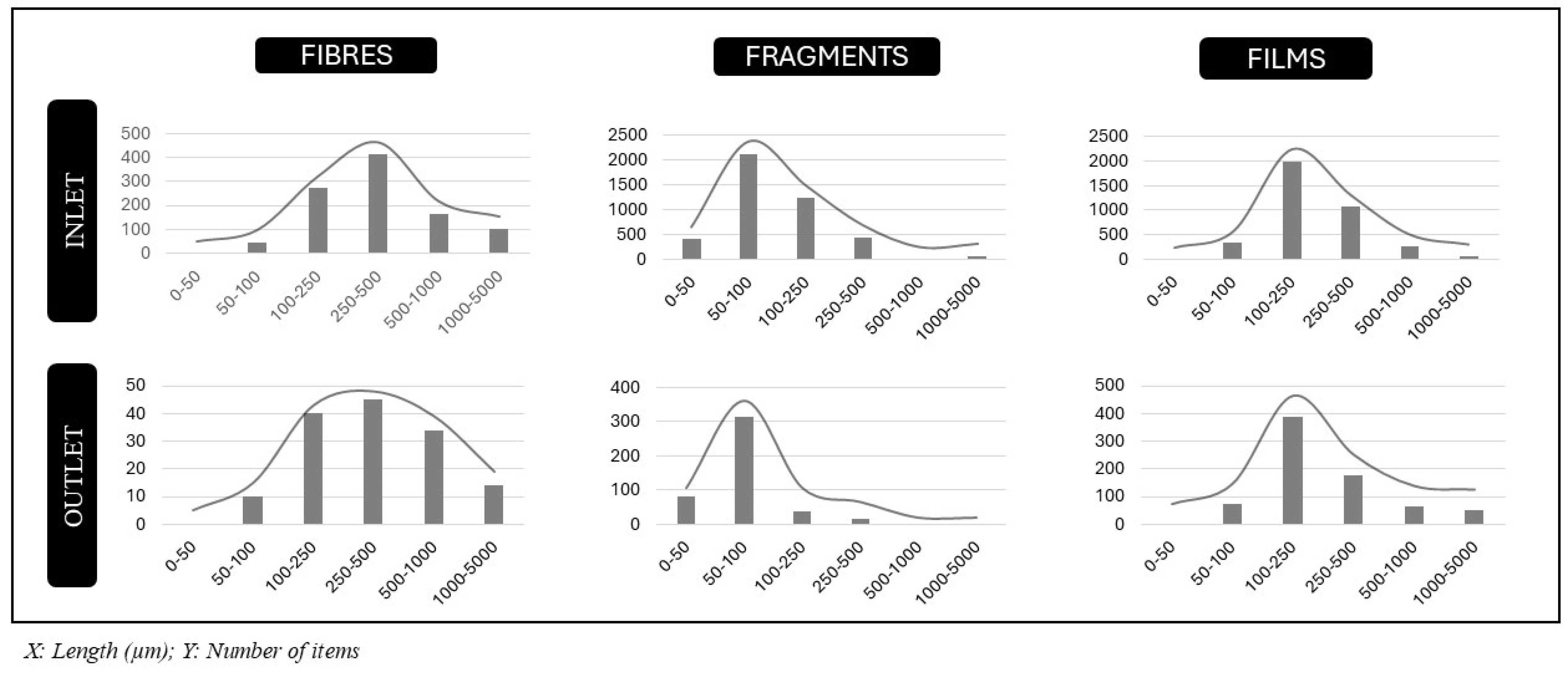
Figure 1 presents the size distribution of MPs detected during the sampling period in reclaimed water, categorized by morphotype (fibres, fragments, and films) at both inlet and outlet sampling points. The size distribution analysis revealed distinct patterns for each morphotype, with notable differences in dominant size classes. Fibres showed at the inlet, a predominantly unimodal size distribution with a clear maximum in the 250–500 µm class, followed by 100–250 µm, 500–1000 µm and 1000–5000 µm, while the <50 µm fraction was negligible. Overall, inlet fibres were mainly concentrated in the 100–500 µm range (~68% of the total). This pattern is consistent with previous wastewater and reclaimed-water studies reporting broad fibre length distributions spanning several hundred µm to mm, largely attributed to textile-derived inputs [8,20]. The outlet distribution retained the same general size domain but showed a weaker, bimodal tendency with peaks in 100–250 µm and 250–500 µm. The increased relative contribution of smaller fibres at the outlet suggests preferential removal of larger fibres (>500 µm) during treatment, consistent with size-dependent physical separation mechanisms.
Fragments exhibited a strongly right-skewed size distribution at the inlet, with a pronounced maximum in the 50–100 µm class, followed by 100–250 µm and much lower abundances in larger classes (above 250 µm). The 0–50 µm bin still contributed a noticeable fraction. This predominance of small fragments is consistent with progressive fragmentation processes that generate increasing numbers of smaller particles, and suggests a shift toward finer size fractions compared with studies reporting fragment/microparticle maxima closer to a few hundred µm [20] or dominance around 400–600 µm in Spanish WWTP samples [8]. At the outlet, the distribution retained the same overall shape, and the 50–100 µm class remained the dominant fraction. Larger fragments showed proportionally higher removal (~95% for >250 µm sets), whereas the smallest dominant class (50–100 µm) decreased less (~86%), indicating size-dependent retention with reduced removal efficiency for the smallest fragments.
On the other hand, films displayed a unimodal distribution both at the inlet and outlet, with a pronounced maximum in the 100–250 µm class, followed by 250–500 µm, and much lower counts in larger classes (above 500 µm). The persistence of 100–250 µm films is consistent with their low settling velocity and high deformability and is particularly relevant given that films increased in relative importance after treatment (as indicated by the shape-distribution results), identifying this fraction as a key residual MP component in reclaimed irrigation water. The 0–50 µm bin was negligible (see Figure 1).

3.2.5. Polymeric Composition

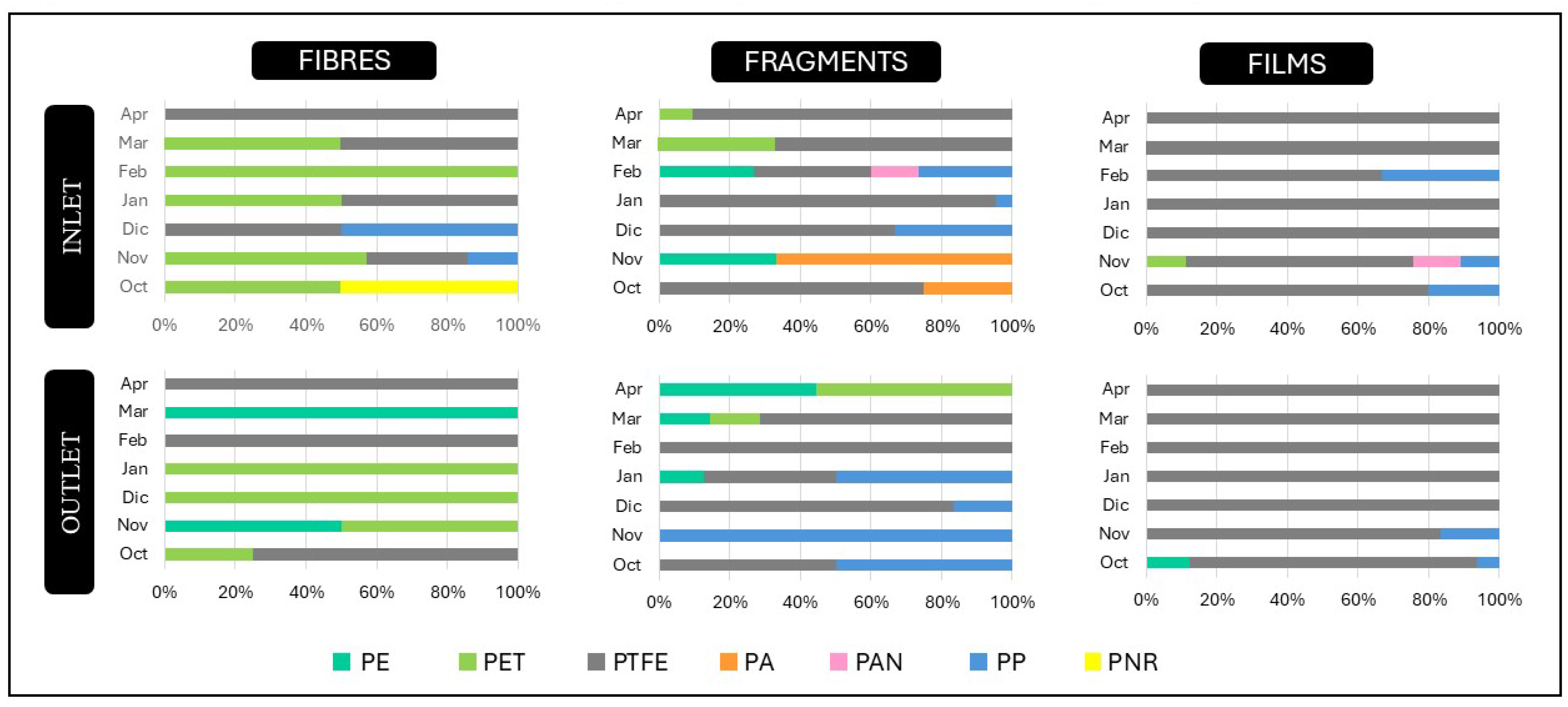
Figure 2 summarises the polymeric composition of the identified MPs by morphotype (fibres, fragments, films) at the plant inlet and outlet over seven consecutive months (October 2024–April 2025). Up to seven polymer types were detected: PE (polyethylene), PET (polyethylene terephthalate), PTFE (polytetrafluoroethylene), PA (polyamide), PAN (polyacrylonitrile), PP (polypropylene), and PNR (polynorbornene rubber). The polymer composition exhibited marked differences among shape, with PTFE emerging as the dominant polymer across all three shape categories.
At the inlet, fibre composition exhibited pronounced temporal variability, with PET and PTFE alternating as the dominant polymer types (each representing ~40% of total synthetic fibres on average). This alternating pattern suggests persistent inputs from distinct sources: PET primarily from textile materials and PTFE from technical applications including filter media, gaskets, and seals commonly employed in industrial processes. PP fibres constituted a consistent secondary component throughout the sampling period (~10% of all synthetic fibres), reflecting inputs from both domestic and industrial sources. Trace quantities of PNR (~7% of all synthetic fibres) were detected exclusively in October. At the outlet, fibre composition displayed a comparable PET–PTFE alternation pattern (~40% each), with PET predominating during October–January and PTFE during February–April. A distinctive feature of outlet samples was the sporadic detection of PE fibres (~20% of all synthetic fibres), which were absent from inlet samples. The outlet-specific occurrence of PE may indicate (i) polymer-selective retention and/or removal during treatment, (ii) in-system inputs associated with infrastructure materials or operational practices, and/or (iii) hydraulic residence-time effects, whereby the outlet reflects a temporally lagged signal relative to the inlet and therefore may not correspond to the same water parcel sampled at the influent.
Fragment composition at the inlet was consistently dominated by PTFE throughout the sampling campaign (35–90% of total synthetic fragments). Secondary polymers exhibited substantial temporal variability: PET, PE, and PP were detected at average relative abundances of 7%, 8%, and 9%, respectively. PAN was detected exclusively in February (~13%), while PA fragments were notably present in October–November, potentially indicating either the breakdown of PA-based materials into particulate debris or seasonally variable industrial discharge patterns. At the outlet, PTFE generally remained the dominant fragment type (~49% of all synthetic fragments) across most months. However, two pronounced compositional anomalies were observed. In November, outlet fragments consisted almost entirely of PP (~100%), with PTFE nearly absent representing a marked departure from inlet composition during the same period. In April, PET and PE fragments collectively comprised ~50% of outlet samples, again diverging substantially from inlet patterns. These deviations suggest potential mechanisms including (i) polymer-specific retention or preferential removal during treatment, (ii) episodic release from accumulated material within the system, or (iii) operational variables influencing selective polymer passage. Overall, PP exhibited an elevated average relative abundance at the outlet (~30%) compared to inlet levels.
Films represented the most compositionally stable morphotype. At the inlet, PTFE dominated film particles (87%), with minor contributions from PET (1%), PP (9%), and PAN (2%). At the outlet, films were almost exclusively composed of PTFE (96%), with residual contributions from PP (3%) and PE (1%).
The observed PET-PTFE alternation pattern (~40% each) at both inlet and outlet contrasts markedly with reported literature, where PET/polyesters and PP/PE typically predominate in WWTPs. For instance, in a large water-reclamation facility in China, Yang et al., 2019 [20] reported that PET (42%), polyester (19%), and PP (13%) accounted for over 70% of the total MPs, attributing the dominance of PET/polyester primarily to textile-derived microfibres released during domestic laundering. Similarly, Magni et al., 2019 [19] found that in an Italian WWTP, fibres were predominantly composed of polyesters (60%), while PE was the main polymer in fragments (35%), and films consisted mainly of PP (15%) and PE (14%), with PTFE contributing only approximately 3%.
On the other hand, the dominance of PTFE and co-prevalence of PET and PTFE observed in the present study represent a distinctive polymeric signature, indicating persistent upstream inputs likely linked to both textile sources and specialized industrial materials. PTFE is classified as a per- and polyfluoroalkyl substance (PFAS) due to its characteristic carbon-fluorine (–CF2–) backbone structure [26]. Recent research has demonstrated that end-of-life PTFE products generate PFAS by-products, with degradation profiles often exhibiting a comparatively higher contribution of short-chain species [27]. Despite these environmental concerns, PTFE remains indispensable in numerous industrial applications, including protective coatings for pipes and storage tanks, as well as membranes and filter components in water treatment systems [28,29], contributing to PTFE presence in treated effluent. These widespread industrial uses contribute significantly to PTFE presence in treated effluent, highlighting the complex trade-off between industrial utility and environmental impact.
Finally, particle counts and morphometric descriptors (size/area) were combined with polymer-specific densities to derive approximate MP mass concentrations (µg/L) (see Tables S1 and S2). To express MP concentrations on a mass basis (µg/L), facilitating direct comparison with ecotoxicological literature, which predominantly reports exposure levels as mass per volume [30]. Following established geometric conversion approaches, wherein fibres are approximated as cylinders and fragments as spheres or volume-equivalent entities, the mean total MP load at the plant inlet was estimated at ~11 µg/L, decreasing to ~2 µg/L at the outlet. This corresponds to an overall mass-based removal efficiency of ~82%. These estimates should be interpreted with caution, since they rely on simplified geometric assumptions and do not represent direct gravimetric or thermo-analytical quantification. Moreover, our analytical workflow was based on 25 µm mesh retention and particle-resolved µFTIR analysis and therefore does not adequately capture the smallest size fractions, particularly MPs <10 µm, which may contribute substantially to total mass. Consequently, the reported mass loads are best considered as complementary, order-of-magnitude indicators rather than absolute concentrations. Direct mass-based techniques such as Py-GC/MS are better suited for this purpose, as demonstrated by Xu et al. [31], who reported mass concentrations of MPs/NPs in WWTPs using pyrolysis-GC/MS. Our estimated MP concentrations (µg/L) align with those reported by Xu et al., 2023 [31] using Py-GC/MS, who observed concentrations decreasing from 26.2 to 1.7 µg/L (sand filtration) and from 11.3 to 0.7 µg/L (membrane filtration) in WWTPs with tertiary treatment. Notably, the mass-based reduction was lower than the corresponding number-based removal (from 1612 to 180 MPs/m3; ~89% removal), indicating that residual MPs in the treated effluent were not only fewer in number but also compositionally and physically distinct from inlet particles. This discrepancy is attributable to the density-weighted polymer profiles, which reveal pronounced enrichment of high-density polymers, particularly PTFE fragments and PTFE films at both sampling points (e.g., films: ∑ρ ≈ 2.05 g/cm3 at inlet; 2.14 g/cm3 at outlet). Such density enrichment sustains a substantial mass signal in the final effluent despite marked reductions in particle counts.
In conclusion, advanced wastewater treatment substantially reduced MP loads in reclaimed water, and mass-based metrics provide essential complementary information to particle counts by integrating particle size and polymer density, thereby offering more relevant benchmarks for comparison with dose-dependent toxicity thresholds. Nevertheless, conversion from counts to mass necessarily relies on simplified geometric assumptions and the selection of representative size descriptors. Accordingly, mass estimates should be interpreted as approximate indicators of MP burden rather than absolute quantifications and should be further validated through advanced analytical approaches. These observations are consistent with growing evidence that conventional methodologies may underestimate the total MP burden, largely due to size-dependent detection limitations. Studies using advanced detection techniques capable of detecting particles in the 1–10 µm range have reported MP concentrations in the hundreds per litre in treated wastewater, whereas analyses restricted to particles >20 µm typically yield only a few particles per litre [31]. This detection bias implies that substantial numbers of “sub-visible” MPs can evade routine monitoring, and that reported concentrations may vary by orders of magnitude depending on the applied lower size threshold.

3.3. Comparative Analysis of the Presence of MPs Between Different Treatment Plants

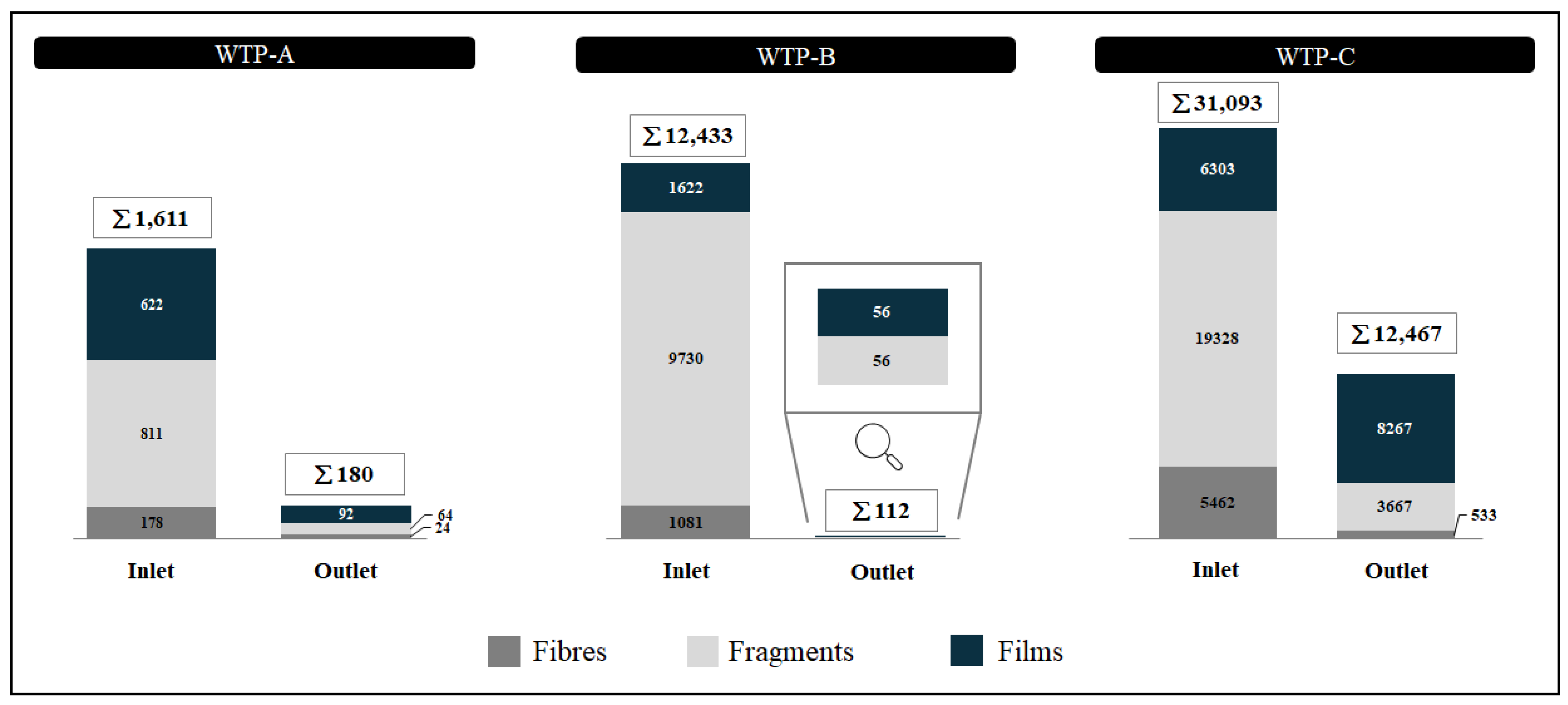
Figure 3 shows pronounced treatment-dependent differences in MP abundance and morphotype profiles across the three WTPs. WTP-C (secondary treatment: ~256,600 population equivalents) had the highest inlet load (Σ 31,093 MPs/m3), dominated by fragments, and still discharged a substantial effluent burden (Σ 12,467 MPs/m3) with a shift toward film dominance. In contrast, WTP-B (rapid sand filtration + ozonation: ~21,100 population equivalents) reduced MPs from Σ 12,433 to Σ 112 MPs/m3, evidencing strong tertiary polishing. WTP-A (reclamation of WTP-C effluent blended with desalinated seawater-hypochlorite disinfection + advanced ultrafiltration) operated at much lower influent levels (Σ 1611 MPs/m3) and further decreased MPs to Σ 180 MPs/m3, with consistent reductions across morphotypes.
Blue was a dominant colour at the inlet of both WTP-B and WTP-C (see Table S3), especially in films (100% and ~60%, respectively), and contributed substantially to fibres and fragments. Compared with WTP-A, the broader inlet colour diversity at WTP-B/C is consistent with a stronger direct urban signature, whereas WTP-A receives a blend of secondary effluent and desalinated seawater. At the outlets, the relative contribution of blue increased, most notably in WTP-C (to ~50% of fragments and ~82% of films) and remained exclusive in WTP-B films (100%), with no fibres detected.
Regarding size distribution, the dominant size classes were consistent between inlet and outlet across all three WTPs. For fibres, the highest concentrations were observed in the 250–500 μm fraction, whereas fragments were predominantly in the 50–100 μm range. Films were mainly associated with the 100–250 μm range (see Figure S5). Overall, treatment did not markedly shift the modal size distribution within each morphotype, indicating that the relative size profile was largely preserved from inlet to outlet.
The most abundant synthetic polymer at the inlet still be PET in fibres (100% in WTP-B and 67% in WTP-C), with presence of PP at WTP-C as the second polymer found (33%). Fragments in both plants comprised four polymers (PE, PET, PTFE, PP), with PP most abundant in WTP-B (35%) and PTFE in WTP-C (37%). Films were 100% PTFE in WTP-B, while WTP-C showed a mixed polymer profile. At the outlet, fragments shifted to 50% PE and 50% PP, and films remained 100% PTFE in WTP-B. In WTP-C, additional polymers appeared at the outlet (PA and PAN), and fragments were dominated by PTFE (70%) with minor PET (10%), PA (10%), and PE/PP (5% each). Films were mainly PTFE (85%) with PP (15%) (see Figure S6). Overall, the data indicate that advanced tertiary treatment (WTP-B) markedly reduces polymer diversity and residual MPs, whereas secondary treatment alone (WTP-C) is associated with a more heterogeneous polymer signature in the final effluent.
In terms of removal performance, WTP-A achieved an overall MP abatement of ~89% following the tertiary train described above. WTP-B, which applies tertiary polishing based on rapid sand filtration followed by ozonation, exhibited the highest removal efficiency (~99%), whereas WTP-C, operating with conventional secondary treatment only, achieved a markedly lower reduction (~60%). These values are in line with ranges reported in the literature and collectively indicate that the absence of tertiary polishing is associated with substantially diminished MP removal (see Table S4).
Finally, particle abundance and morphometric descriptors (size/area) were combined with polymer-specific densities (see Tables S5 and S6), following the same approach applied to WTP-A, to estimate the total MP mass concentration at the outlets of the three WTPs (expressed as µg/L). Using the geometric mass-conversion framework described above, the mean total MP load in the final effluent was estimated at 0.4 µg/L for WTP-B and 54.1 µg/L for WTP-C. This strong contrast is consistent with the different wastewater burdens of the facilities, suggesting that effluent MP mass scales with the magnitude of the upstream urban contribution (i.e., higher population-equivalent influent generally entails higher MP input and residual discharge). Our mass-based MP concentrations (µg/L) are consistent with values reported by Lambropoulou et al., 2026 using Py–GC/MS [32]. In Northern Greece, WWTPs operated with conventional secondary treatment showed a decrease from 155.6 to 392.3 µg/L in influent to 27.8–74.3 µg/L in effluent, corresponding to an overall removal efficiency of 81–87.5%.

4. Conclusions

The present work provides field-based evidence that reclaimed water used for irrigation in southeastern Spain is a consistent pathway for microplastics (MPs) to agroecosystems, even when advanced tertiary treatment is applied. A seven-month influent–effluent monitoring campaign (October 2024–April 2025) at a water regeneration plant recorded inlet concentrations of 601–2934 MPs/m3 (mean 1612 MPs/m3) and outlet concentrations of 89–399 MPs/m3 (mean 179 MPs/m3), indicating an average removal of ~89% and confirming that ultrafiltration-based tertiary treatment markedly reduces microplastic loads but does not fully eliminate emissions.
A key methodological outcome is that sampling strategy strongly controls the robustness of MP estimates in reclaimed water. Extrapolation from 10 L produced systematically higher and more dispersed concentrations (~10× relative to 50 L), while short-term monitoring revealed marked day-to-day variability (44–644 MPs/m3). Together, these findings demonstrate that single time-point, small-volume sampling can generate biased and non-representative results, and they support long-term, large-volume monitoring designs aligned with emerging standardization efforts.
Morphological and dimensional profiling indicated a shift across the treatment train. Fragments dominated at the inlet (~50%), whereas films increased in relative importance at the outlet (~51%), suggesting differential retention among morphotypes. Size distributions were consistently dominated by smaller particles, with peaks at 50–100 µm for fragments, 100–250 µm for films, and 250–500 µm for fibres, highlighting the relevance of fine MP fractions in reclaimed effluents. Polymeric identification by µFTIR revealed a distinctive signature dominated by PTFE across morphotypes, pointing to persistent upstream sources and/or potential contributions from technical materials used in treatment infrastructure.
These results are particularly timely in the context of Directive (EU) 2024/3019, which strengthens requirements for systematic MPs monitoring, with specific relevance to agricultural reuse, and mandates the development of harmonised EU methodologies for measuring, estimating and modelling MPs in urban wastewater by July 2027. The findings underscore the necessity for large-volume, temporally replicated monitoring to generate reliable estimates of MPs for the management of water reuse and the development of future regulatory frameworks.

Supplementary Materials

The following supporting information can be downloaded at: https://www.mdpi.com/article/10.3390/microplastics5020088/s1, Figure S1. Comparation of sampling volumes in terms of MPs/m3; Figure S2. Average of MPs/m3 over five consecutive days (50 L of reclaimed water outlet); Figure S3. Variability in long-term monitoring of MP concentrations; Figure S4. Examples of microplastics observed in the analysed reclaimed water samples; Figure S5. Size distribution of the MPs detected WTP-B and WTP-C according to the shape; Figure S6. Chemical characterization of the MPs detected in WTP-B and WTP-C in reclaimed water according to the shape; Table S1. Average density values used to calculate the weighted average MP concentration (μg/L); Table S2. Area values of MPs at the “inlet” and “outlet” of WTP-A; Table S3. MPs concentration (MPs/m3) according to type, colour, sampling point and sampling date at WTP-B and WTP-C: I (inlet), O (outlet); Table S4. Research of the removal efficiency after tertiary treatment; Table S5. Average density values used to calculate the weighted average MP concentration (μg/L) at the “outlet” of WTP-b and WTP-C; Table S6. Area values of MPs at the “outlet” of WTP-B and WTP-C.

Author Contributions

Conceptualization, M.J.M.B., A.R.F.-A. and A.A.; methodology, A.A., J.J.F. and A.R.G.; software, A.A.; validation, J.J.F. and L.C.-C.; formal analysis, J.J.F., A.R.G. and L.C.-C.; investigation, M.J.M.B. and A.R.F.-A.; resources, M.J.M.B. and A.R.F.-A.; data curation, M.J.M.B. and J.J.F.; writing—original draft preparation, J.J.F.; writing—review and editing, M.J.M.B. and A.R.F.-A.; visualization, J.J.F. and M.J.M.B.; supervision, M.J.M.B.; project administration, M.J.M.B.; funding acquisition, M.J.M.B., A.A. and A.R.F.-A. All authors have read and agreed to the published version of the manuscript.

Funding

This work was funded by the Ministry of Science, Innovation and Universities through Project MATRIZ (Ref. PID2023-147846OB-C21). The authors also acknowledge financial support for the RECUPERA research contract (Ref. 001806) from UALtransfierE-2023, the Junta de Andalucía–ERDF 2021–2027 programme, Aguas del Almanzora S.A., FERAL, and JCUAPA. Jose Javier Flores Morales acknowledges funding from the Junta de Andalucía (CUII) through grant DGP_PRED_2024_01973, co-funded by the European Union (FSE+).

Data Availability Statement

The original contributions presented in this study are included in the article/Supplementary Material. Further inquiries can be directed to the corresponding author(s).

Acknowledgments

The authors are grateful to the staff of the WTPs (A/B/C), for their assistance with wastewater sample collection.

Conflicts of Interest

The authors declare that they have no known competing financial interests or personal relationships that could have appeared to influence the work reported in this paper.

Abbreviations

CO2Carbon dioxide
EUEuropean Union
FTIRFourier-transform infrared spectroscopy
H2OWater
IInlet
ISOInternational Organization for Standardization
LAS-XLeica Application Suite X (image analysis software)
MBRMembrane bioreactor
MCTMercury cadmium telluride (detector)
MPMicroplastic
MPsMicroplastics
NPsNanoplastics
OECDOrganisation for Economic Co-operation and Development
OOutlet
PAPolyamide
PANPolyacrylonitrile
PEPolyethylene
PETPolyethylene terephthalate
PFASPer- and polyfluoroalkyl substances
PNRPolynorbornene rubber
PPPolypropylene
PTFEPolytetrafluoroethylene
Py-GC/MSPyrolysis gas chromatography–mass spectrometry
REDReverse electrodialysis
RSFRapid gravity sand filter(s)
RSVPRepresentative Sample Volume Predictor
RYRayon
UFUltrafiltration
UVUltraviolet
WWTP(s)Wastewater treatment plant(s)
WTP(s)Water treatment plant(s)

References

  1. Horton, A.A.; Walton, A.; Spurgeon, D.J.; Lahive, E.; Svendsen, C. Microplastics in freshwater and terrestrial environments: Evaluating the current understanding to identify the knowledge gaps and future research priorities. Sci. Total Environ. 2017, 586, 127–141. [Google Scholar] [CrossRef] [PubMed]
  2. Lv, L.; Zhou, F.; Wang, Z.; Wu, K.; Li, X.; Liao, W. The current state and future opportunities of micro- and nano-plastics removal in wastewater treatment plants. J. Water Process Eng. 2024, 63, 105462. [Google Scholar] [CrossRef]
  3. Obermaier, N.; Pistocchi, A. A Preliminary European-Scale Assessment of Microplastics in Urban Wastewater. Front. Environ. Sci. 2022, 10, 912323. [Google Scholar] [CrossRef]
  4. Carnevale, M.; Galafassi, S.; Zullo, R.; Torretta, V.; Rada, C. Microplastics removal in wastewater treatment plants: A review of the different approaches to limit their release in the environment. Sci. Total Environ. 2024, 930, 172675. [Google Scholar] [CrossRef]
  5. Iyare, P.U.; Ouki, S.K.; Bond, T. Microplastics removal in wastewater treatment plants: A critical review. Environ. Sci. Water Res. Technol. 2020, 6, 2664–2675. [Google Scholar] [CrossRef]
  6. Yuan, F.; Zhao, H.; Sun, H.; Zhao, J.; Sun, Y. Abundance, morphology, and removal efficiency of microplastics in two wastewater treatment plants in Nanjing, China. Environ. Sci. Pollut. Res. 2021, 28, 9327–9337. [Google Scholar] [CrossRef]
  7. Afonso-Álvarez, A.M.; Álvarez-Méndez, S.J.; Ugrina, M.; Vera, L.; Hernández-Borges, J. Retention of anthropogenic microparticles in a wastewater treatment and reclamation plant combining membrane bioreactor and reverse electrodialysis treatments. J. Hazard. Mater. 2025, 499, 140286. [Google Scholar] [CrossRef]
  8. Bayo, J.; López-Castellanos, J.; Olmos, S.; Rojo, D. Characterization and removal efficiencies of microplastics discharged from sewage treatment plants in Southeast Spain. Water Res. 2023, 244, 120479. [Google Scholar] [CrossRef] [PubMed]
  9. Komorowska-Kaufman, M.; Marciniak, W. Removal of microplastic particles during municipal wastewater treatment—A current review. Desalin. Water Treat. 2024, 317, 100006. [Google Scholar] [CrossRef]
  10. Enfrin, M.; Lee, J.; Gibert, Y.; Basheer, F.; Kong, L.; Dumée, L.F. Release of hazardous nanoplastic contaminants due to microplastics fragmentation under shear stress forces. J. Hazard. Mater. 2020, 384, 121393. [Google Scholar] [CrossRef]
  11. Carpanez, T.G.; Maira, L.; Castro, C.; Cristina, M.; Amaral, S.; Moreira, V.R. Occurrence and environmental consequences of microplastics and nanoplastics from agricultural reuse of wastewater and biosolids in the soil ecosystem: A review. Sci. Total Environ. 2025, 980, 179538. [Google Scholar] [CrossRef] [PubMed]
  12. Corradini, F.; Meza, P.; Eguiluz, R.; Casado, F.; Huerta-lwanga, E.; Geissen, V. Evidence of microplastic accumulation in agricultural soils from sewage sludge disposal. Sci. Total Environ. 2019, 671, 411–420. [Google Scholar] [CrossRef] [PubMed]
  13. European Union. Regulation (EU) 2020/741, Regulation (EU) 2020/741 of the European Parliament and of the Council of 25 May 2020 on minimum requirements for water reuse. Off. J. Eur. Union 2020, 177, 32–55. [Google Scholar]
  14. Aznar-Sánchez, J.A. Identification of Opportunities for Applying the Circular Economy to Intensive Agriculture in Almería (South-East Spain). Agronomy 2020, 10, 1499. [Google Scholar] [CrossRef]
  15. Aydin, S.; Mucevher, O.; Ulvi, A.; Beduk, F.; Emin, M.; Ozen, A.; Cihan, M. Effects of long—Term wastewater irrigation on microplastics pollution in agricultural soil. Environ. Sci. Pollut. Res. 2025, 32, 12340–12359. [Google Scholar] [CrossRef]
  16. European Union. Directive (EU) 2024/3019, Directive (EU) 2024/3019 of the European Parliament and of the Council concerning urban wastewater treatment. Off. J. Eur. Union 2024, 3019, 1–59. [Google Scholar]
  17. ISO 5667-27; Water Quality—Sampling—Part 27: Guidance on Sampling for Microplastics in Water First Edition. ISO: Geneva, Switzerland, 2025; Volume 2025.
  18. Cross, R.K.; Roberts, S.L.; Jürgens, M.D.; Johnson, A.C.; Davis, C.W.; Gouin, T. Ensuring representative sample volume predictions in microplastic monitoring. Microplast. Nanoplast. 2025, 5, 5. [Google Scholar] [CrossRef]
  19. Magni, S.; Binelli, A.; Pittura, L.; Avio, C.G.; Della Torre, C.; Parenti, C.C.; Gorbi, S.; Regoli, F. The fate of microplastics in an Italian Wastewater Treatment Plant. Sci. Total Environ. 2019, 652, 602–610. [Google Scholar] [CrossRef]
  20. Yang, L.; Li, K.; Cui, S.; Kang, Y.; An, L.; Lei, K. Removal of microplastics in municipal sewage from China’ s largest water reclamation plant. Water Res. 2019, 155, 175–181. [Google Scholar] [CrossRef]
  21. Tadsuwan, K.; Babel, S. Microplastic abundance and removal via an ultrafiltration system coupled to a conventional municipal wastewater treatment plant in Thailand. J. Environ. Chem. Eng. 2022, 10, 107142. [Google Scholar] [CrossRef]
  22. Menéndez-Manjón, A.; Martínez-Díez, R.; Sol, D.; Laca, A.; Laca, A.; Rancaño, A.; Díaz, M. Long-Term Occurrence and Fate of Microplastics in WWTPs: A Case Study in Southwest Europe. Appl. Sci. 2022, 12, 2133. [Google Scholar] [CrossRef]
  23. Yahyanezhad, N.; Bardi, M.J.; Aminirad, H. An evaluation of microplastics fate in the wastewater treatment plants: Frequency and removal of microplastics by microfiltration membrane. Water Pract. Technol. 2021, 16, 782–792. [Google Scholar] [CrossRef]
  24. Ormaniec, P. Occurrence and analysis of microplastics in municipal wastewater, Poland. Environ. Sci. Pollut. Res. 2024, 31, 49646–49655. [Google Scholar] [CrossRef]
  25. Cârdan, I.; Nesterovschi, I.; Barbu-Tudoran, L.; Pînzaru, S.C. Blue micro-/nanoplastics abundance in the environment: A double threat as a Trojan horse for a plastic-Cu-phthalocyanine pigment and an opportunity for nanoplastic detection via micro-Raman spectroscopy. Environ. Sci. Nano 2025, 12, 2357–2370. [Google Scholar] [CrossRef]
  26. Wang, Z.; Buser, A.M.; Cousins, I.T.; Demattio, S.; Drost, W.; Johansson, O.; Ohno, K.; Patlewicz, G.; Richard, A.M.; Walker, G.W.; et al. A New OECD Definition for Per- And Polyfluoroalkyl Substances. Environ. Sci. Technol. 2021, 55, 15575–15578. [Google Scholar] [CrossRef] [PubMed]
  27. Fujimori, T.; Saido, A.; Murakami, T.; Mine, T.; Okamoto, H. Comparative evaluation of quantifiable PFAS generated as byproducts from polytetrafluoroethylene (PTFE) incineration. J. Fluor. Chem. 2026, 289, 110523. [Google Scholar] [CrossRef]
  28. Zhang, B.; Huang, D.; Shen, Y.; Yin, W.; Gao, X.; Zhang, B.; Shi, W. Treatment of alkali/surfactant/polymer flooding oilfield wastewater with polytetrafluoroethylene microfiltration membrane: Performance and membrane fouling. J. Environ. Chem. Eng. 2020, 8, 104462. [Google Scholar] [CrossRef]
  29. Lee, J.H.; Cheon, S.J.; Kim, C.S.; Joo, S.H.; Choi, K.I.; Jeong, D.H.; Lee, S.H.; Yoon, J.K. Nationwide evaluation of microplastic properties in municipal wastewater treatment plants in South Korea. Environ. Pollut. 2024, 358, 124433. [Google Scholar] [CrossRef]
  30. Leusch, F.D.L.; Ziajahromi, S. Converting mg/L to Particles/L: Reconciling the Occurrence and Toxicity Literature on Microplastics. Environ. Sci. Technol. 2021, 55, 2025. [Google Scholar] [CrossRef] [PubMed]
  31. Xu, Y.; Ou, Q.; Wang, X.; Hou, F.; Li, P.; van der Hoek, J.P.; Liu, G. Assessing the Mass Concentration of Microplastics and Nanoplastics in Wastewater Treatment Plants by Pyrolysis Gas Chromatography-Mass Spectrometry. Environ. Sci. Technol. 2023, 57, 3114–3123. [Google Scholar] [CrossRef]
  32. Ainali, N.M.; Bikiaris, D.N.; Lambropoulou, D.A. Microplastics Across Interconnected Aquatic Matrices: A Comparative Study of Marine, Riverine, and Wastewater Matrices in Northern Greece. Appl. Sci. 2026, 16, 772. [Google Scholar] [CrossRef]
Figure 1. Size distribution of the MPs detected during the sampling months in reclaimed water according to the shape.
Microplastics 05 00088 g001
Figure 2. Chemical characterization of the MPs detected during the sampling months in reclaimed water according to the shape.
Microplastics 05 00088 g002
Figure 3. Comparative graphs across treatment plants (∑MPs/m3): WTP-A: ultrafiltration; WTP-B: ozonization; WTP-C: secondary treatment.
Microplastics 05 00088 g003
Table 1. MPs concentration (MPs/m3) according to type, colour, sampling point and sampling date at the RWP-A: I (inlet), O (outlet).
OCTOBERNOVEMBERDECEMBERJANUARYFEBRAUARYMARCHAPRILAVERAGE
IOIOIOIOIOIOIOIO
FIBRES
Black006700110220020110017824
Blue13344200067067067226706722
Green006700000000000
Red/Pink6706722006700044000
Brown67000000110047000
Translucent000067000000000
Fibres/m3267444002213411134336722178116722
FRAGMENTS
Black022006700000-00081164
Blue26711167111336714005673313337078126714
Green00267000673367024101330
Red/Pink0067000001330133000
Brown0113300000670670011
Translucent00000000000000
Fragments/m3267445341120067146789100013381178140025
FILMS
Black001330000067028900062292
Blue33367467672671186744133244333221467189
Green00000000000000
Red/Pink00000000000000
Brown00000000000000
Translucent00000000000000
Films/m333367600672671186744200244622221467189
MPs/m386715515341006018924681661267399161111129342361612179
Disclaimer/Publisher’s Note: The statements, opinions and data contained in all publications are solely those of the individual author(s) and contributor(s) and not of MDPI and/or the editor(s). MDPI and/or the editor(s) disclaim responsibility for any injury to people or property resulting from any ideas, methods, instructions or products referred to in the content.