Review

A Comprehensive Review of Microplastic Pollution in Qatar and the Arabian Gulf

1
Center for Advanced Materials (CAM), Qatar University, Doha P.O. Box 2713, Qatar
2
Qatar Technical Secondary School for Girls, Doha P.O. Box 123456, Qatar
*
Author to whom correspondence should be addressed.
Microplastics 2026, 5(2), 72; https://doi.org/10.3390/microplastics5020072
Submission received: 3 March 2026 / Revised: 4 April 2026 / Accepted: 8 April 2026 / Published: 13 April 2026

Abstract

Microplastic (MP) pollution has emerged as a significant environmental crisis across the Arabian Gulf, driven by rapid urbanization, industrialization, and infrastructure challenges in waste management. Studies indicate that MPs are ubiquitous in nature and are present in different environmental compartments, including coastal waters, sediments, marine biota, and the atmosphere. The region is characterized by high salinity, high UV index, and frequent dust storms that can affect the physical and chemical behavior of plastic debris. A consistent finding across regional studies highlights the fibrous polyethylene (PE) and polypropylene (PP) polymer types as dominant microplastic particles. This prevalence of fibrous MPs highlights the role of secondary microplastics that are derived from the fragmentation of larger plastic items and textile-derived materials as a major contaminant source. Ecological impacts are increasingly observed, with studies reporting MP ingestion in commercially important fish species and the potential for biomagnification into the human food web. However, there exist key knowledge gaps regarding the long-term toxicological impacts on human health. This review synthesizes existing data to improve the understanding of microplastic distribution in Qatar and the Arabian Gulf while highlighting the need for standardized monitoring approaches and appropriate waste management strategies.

1. Introduction

Plastics have become essential materials in modern society, with production and consumption increasing dramatically over the past few decades, reaching approximately 445.25 million metric tons globally in 2025 [1]. The ever-increasing population, coupled with rapid urbanization, has skyrocketed the demand for plastic-based products. It is estimated that over 8.3 billion metric tons of plastic have been produced since the 1950s, with annual production reaching approximately 400 million tons [2]. Their widespread use is due to the outstanding properties, including durability, versatility, scalability, lightweight, corrosion resistance, and low production costs. As a result, plastic materials are extensively used in various industrial sectors such as packaging, electrical and electronics, automotive, healthcare, construction, and textiles. With the rising demand for plastic materials, a subsequent increase in plastic waste generation has been widely reported. Despite significant technological advancements in the field of science and engineering, waste management systems in many regions still remain largely ineffective and insufficient to efficiently manage the tremendous amounts of plastic waste generated annually. A large majority of this waste is disposed of in landfills and oceans or incinerated, while the rest is recycled and reused. Once released into the environmental compartments, large plastic debris turns into thousands of tiny microplastic (MP) particles due to the action of physical and chemical weathering over time [3].
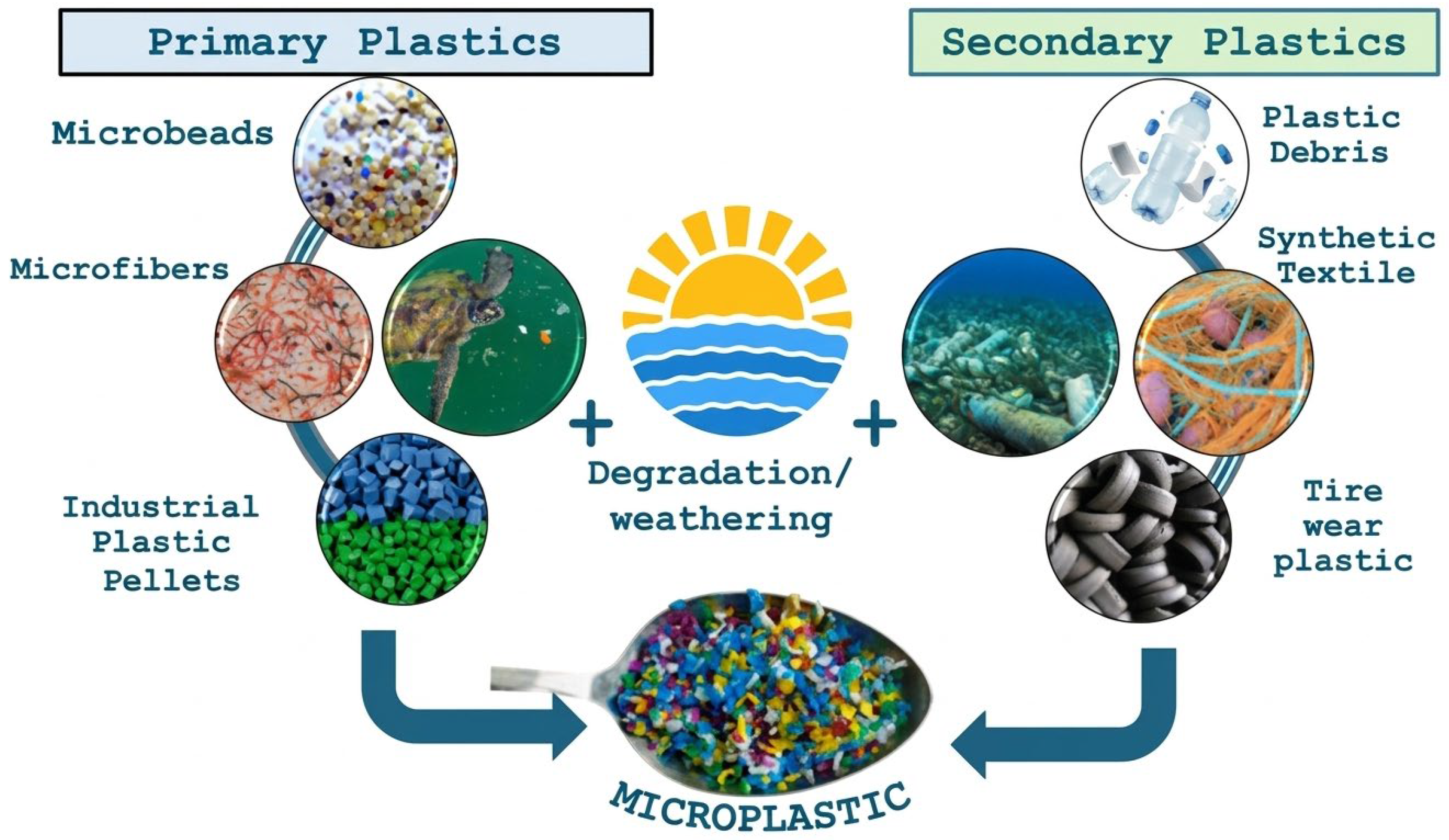
Microplastics (MPs) are plastic particles that are smaller than 5 mm in size. They are categorized as primary and secondary MPs in nature. Primary MPs are intentionally manufactured in small sizes for specific uses, such as in cosmetics and personal care products. On the other hand, secondary MPs are far more abundant and form as a result of the fragmentation of large plastic debris due to environmental weathering processes. These particles are ubiquitous in nature and are found in significant amounts in aquatic, atmospheric, and terrestrial environments. In addition to this, MPs have been identified to bio-accumulate and travel up the food chain via bio-magnification as they are ingested over time by marine organisms. This has led to the detection of MPs in animals and even humans, which could be responsible for unexpected health implications, as these particles can act as vectors of toxic pollutants. Various findings have confirmed the detection of MPs in different environmental media, food, water, and human stool samples [4,5,6,7,8]. For instance, disposable paper cups have been found to release significant amounts of MP particles into hot beverages within a short amount of contact. Such paper-based packaging often contains a hydrophobic plastic lining that degrades at high temperatures, leading to the release of MPs in food and beverages [9].
The Arabian Gulf is an environmentally sensitive marine system that is vulnerable to the accumulation of plastic debris and MPs due to restricted water circulation and intense anthropogenic activities related to oil–gas exploration. It is a heavily water-stressed region with an extremely hot and arid climate. The water bodies experience elevated temperatures and high salinity. Such harsh conditions could potentially influence the fate, transport, and degradation of MP particles in the region. In recent decades, the Arabian Gulf countries have increasingly pursued urbanization and tourism to position the region as a global economic hub. Qatar is a small coastal state along the western Arabian Gulf. It has hosted a global mega-sports event, the FIFA World Cup Qatar 2022, which attracted an estimated 1.4 million international visitors. Such large-scale events, coupled with the aftershocks of the COVID-19 outbreak, have significantly contributed to plastic use and waste generation [10]. As a result, increased pressure is placed on the existing inadequate waste management systems. Due to high population density in smaller areas, the potential risks from MP contamination increase significantly, and its impact has to be taken with great consideration.
Although MP contamination has been increasingly reported across various compartments in the Arabian Gulf, existing studies remain fragmented, compartment-specific, and methodologically inconsistent. To date, limited efforts have attempted to synthesize MP occurrence across marine waters, coastal sediments, atmospheric systems, food products, and human exposure pathways within Qatar and the broader Arabian Gulf region. Most studies focus on single-country case studies, with a lack of focus on different compartments, which limits regional comparability.
This review provides a regionally-focused synthesis of MPs in various environmental compartments in Qatar and the Arabian Gulf. In addition to summarizing occurrence patterns, it examines methodological variations in sampling, extraction, and identification approaches. By considering marine, atmospheric, wastewater, and food-related pathways, this review highlights potential exposure routes and identifies gaps that require further investigation, while emphasizing the need for more standardized monitoring and assessment techniques.

2. Methodology

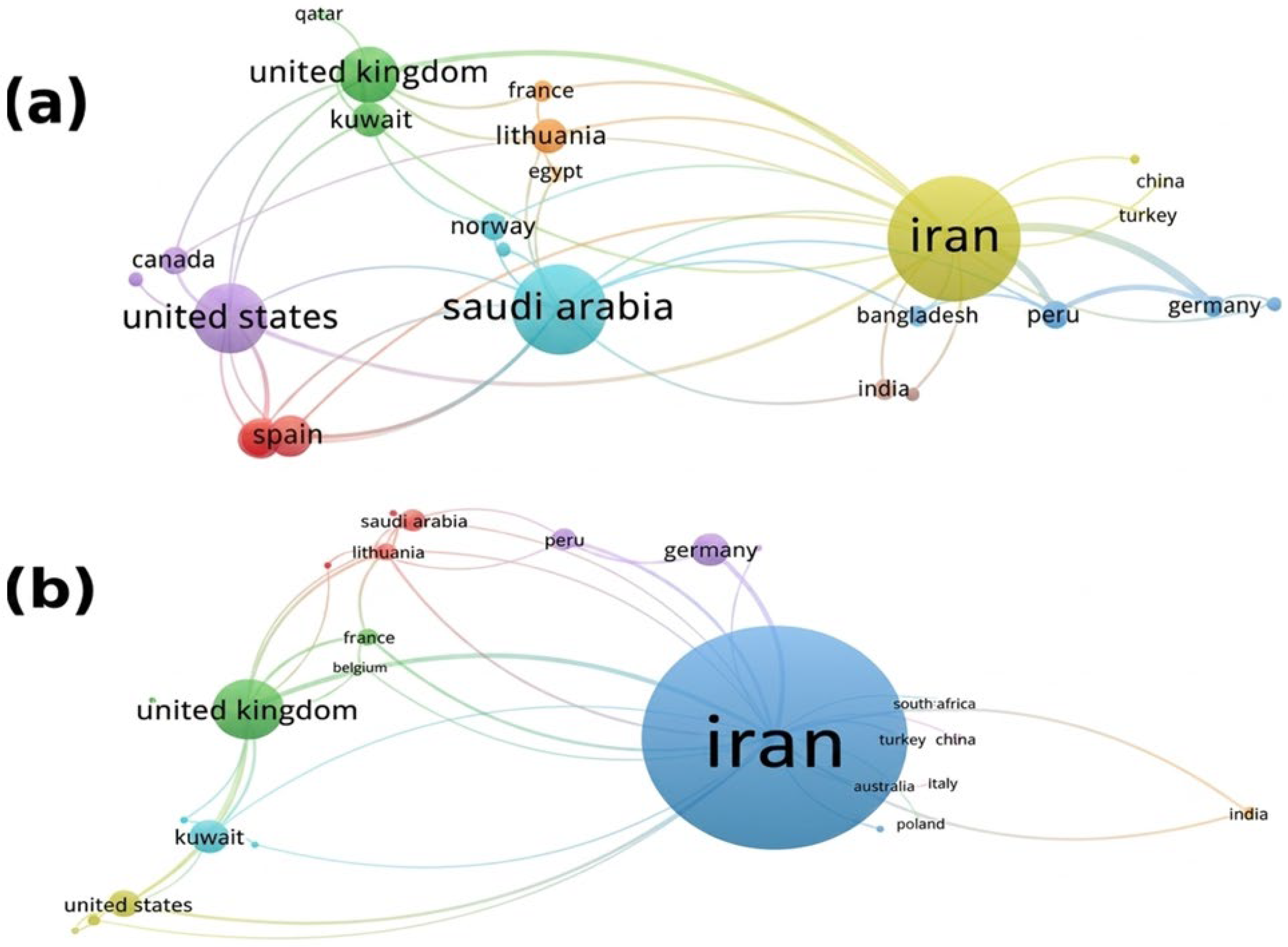
A structured literature review was conducted to synthesize published research on microplastics (MPs) across marine, atmospheric, and food systems in Qatar and the Arabian Gulf. Major scientific databases, including Scopus (Elsevier, Amsterdam, The Netherlands), ScienceDirect (Elsevier, Amsterdam, The Netherlands), and Google Scholar (Google LLC, Mountain View, CA, USA), were systematically searched using combinations of keywords such as “microplastic,” “microplastic pollution,” “Qatar,” “Arabian Gulf,” “Persian Gulf,” and “Gulf Cooperation Council.” Searches were limited to publications from 2020 to 2026 and targeted article titles, abstracts, and keywords. Bibliometric analysis was performed using VOSviewer software (Version 1.6.20, Centre for Science and Technology Studies, Leiden University; https://www.vosviewer.com) to evaluate the distribution of research outputs (Figure 1). A total of 28,097 global records related to microplastics were identified, while region-specific searches yielded only 7 records for Qatar, 53 for the Arabian Gulf (Figure 1a), and 55 for the Persian Gulf (Figure 1b). As illustrated in Figure 1, the majority of studies originate from Persian Gulf datasets, predominantly from Iranian coastal waters, highlighting a significant geographical imbalance in the available literature. This disparity indicates that current knowledge of microplastic pollution in the Arabian Gulf is disproportionately based on data from specific regions, with limited representation from Qatar and other Gulf Cooperation Council (GCC) countries.
Following bibliometric screening, relevant studies were further filtered and refined based on scope, methodology, environmental compartment, and analytical approach to ensure comprehensive coverage and methodological consistency. Particular attention was given to identifying region-specific studies; however, the limited availability of data from certain Gulf countries necessitated cautious interpretation of regional trends.

3. Trends, Drivers, and Implications of Microplastic Pollution

3.1. Population and Socio-Economic Trends

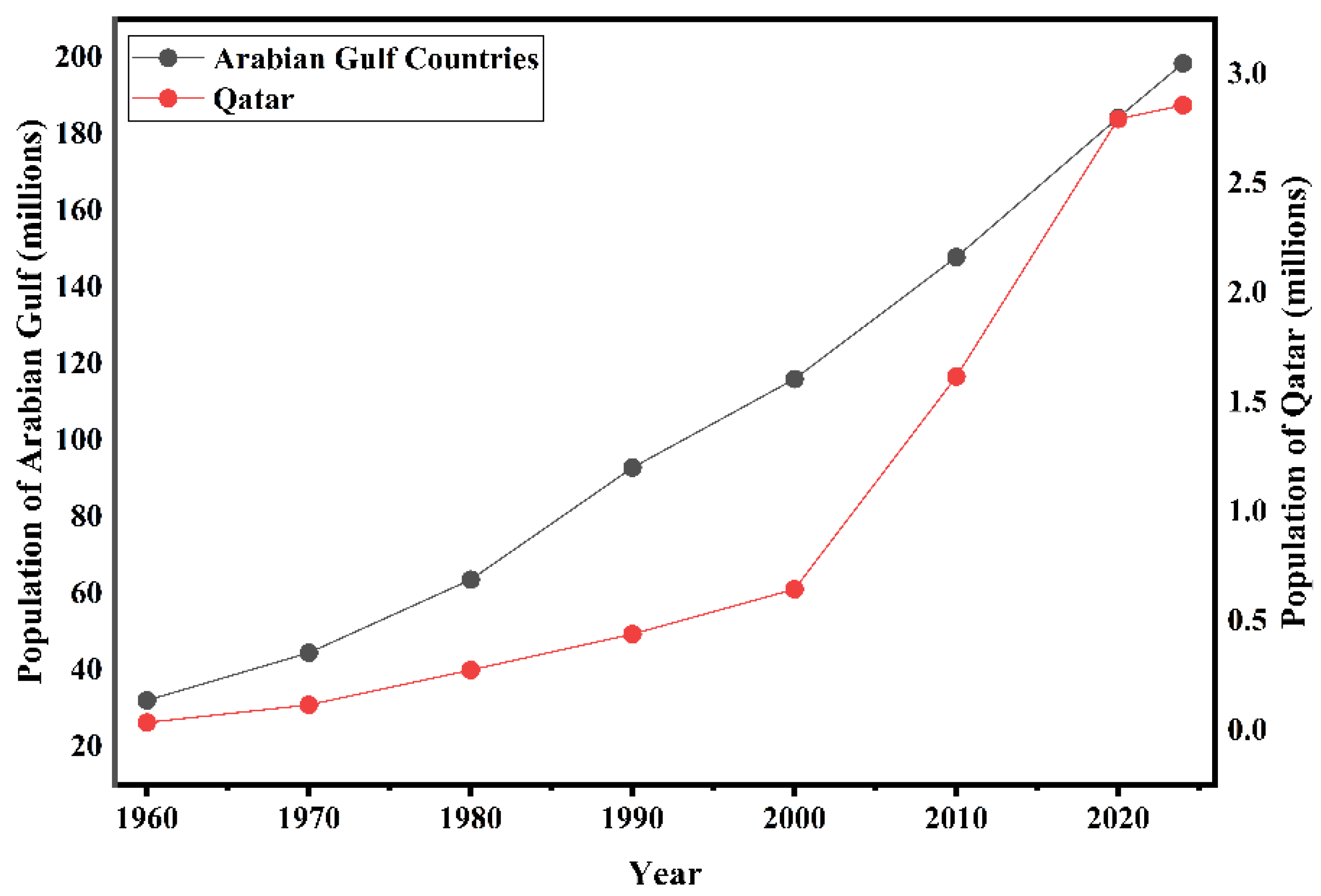
Despite declining birth rates in many developed countries, the global population has continued to increase over recent decades. Population growth is directly related to high solid waste generation, particularly plastic waste, due to increased consumption of packaged goods and synthetic materials. Figure 2 highlights the population trend of the Arabian Gulf countries since the 1960s, showing rapid growth in recent decades due to infrastructural and economic development. Qatar, in particular, experienced a large surge of migrant workers between the years 2000 and 2020, moving from a small country of 644,989 people to over 2,794,148 [11].
Economic growth in the Gulf countries has resulted in an increase in municipal solid waste (MSW) generation. The average MSW generation in the region is approximately 1.5 kg/person/day, with high-GDP countries such as Qatar, Bahrain, Saudi Arabia, and the United Arab Emirates among the largest MSW per capita [12]. The waste generated from household and commercial sources is classified as MSW. These include food waste, plastics, paper, metals, glass, and textiles. Plastics typically account for approximately 8–15% of the total MSW in high-income countries, while in Qatar, the plastic proportion has been reported at approximately 13–14% of MSW. Despite advances in waste management infrastructure, landfill disposal remains the dominant treatment pathway in Qatar (Umm Al-Afai, Rawda Rashed, and Al-Krana), with limited material recovery [12,13]. The remaining waste is incinerated or ends up in marine environments through transport. This contributes negatively to the global climate due to greenhouse gas emissions and contamination of water bodies. Consequently, increasing MSW generation in rapidly developing Gulf states corresponds to an expanding plastic waste stream and a greater potential for environmental leakage into terrestrial and marine systems.

3.2. Microplastic Challenge

MP pollution has emerged as a significant environmental challenge in the Arabian Gulf, with increasing evidence demonstrating its presence across multiple environmental compartments, including seawater, sediments, marine biota, and the atmosphere. However, despite growing research efforts, the current understanding of microplastic distribution in the region remains fragmented and inconsistent. Reported concentrations vary widely due to differences in sampling approaches, particle size thresholds, and analytical methodologies, making direct comparison between studies difficult and limiting the reliability of regional assessments [14,15,16,17,18,19,20].
The Arabian Gulf is characterized by unique environmental conditions that influence the behavior, transport, and fate of microplastics. As a semi-enclosed marine system with restricted water exchange through the Strait of Hormuz, the Gulf exhibits long residence times that can enhance the retention and accumulation of contaminants [21,22]. In addition, extreme climatic conditions, including high temperatures, elevated salinity, intense solar radiation, and frequent dust events, may accelerate the weathering and fragmentation of plastic debris while also influencing particle transport pathways [23,24]. These factors collectively contribute to a complex and region-specific microplastic dynamic that differs from open ocean systems.
Anthropogenic pressures further intensify the microplastic challenge in the region. Rapid population growth, urban expansion, high plastic consumption rates, and inadequate waste management practices contribute to the continuous input of plastic debris into the environment. The Gulf countries are among the highest per capita waste generators globally, with plastic materials constituting a significant fraction of municipal solid waste [25]. A large portion of this waste is mismanaged or inadequately treated, increasing the likelihood of environmental leakage and subsequent microplastic formation [26,27].
In addition to environmental accumulation, concerns regarding ecological and human health impacts are increasing. Microplastics have been detected in commercially important fish species and food products, indicating potential transfer through the food chain to humans [28]. Experimental studies suggest that MPs may induce oxidative stress, inflammation, and act as vectors for chemical contaminants, although the long-term implications of chronic exposure remain uncertain [29,30,31,32]. In the context of the Arabian Gulf, these risks may be further amplified by environmental factors, such as high temperatures and salinity, which can alter degradation processes and contaminant interactions. The microplastic challenge in the Arabian Gulf is shaped by the interplay between environmental conditions, anthropogenic activities, and methodological limitations. Addressing this challenge requires a comprehensive understanding of region-specific processes, improved data consistency, and the development of standardized monitoring approaches [33].

3.3. Sources of Microplastics in the Arabian Gulf and Qatar

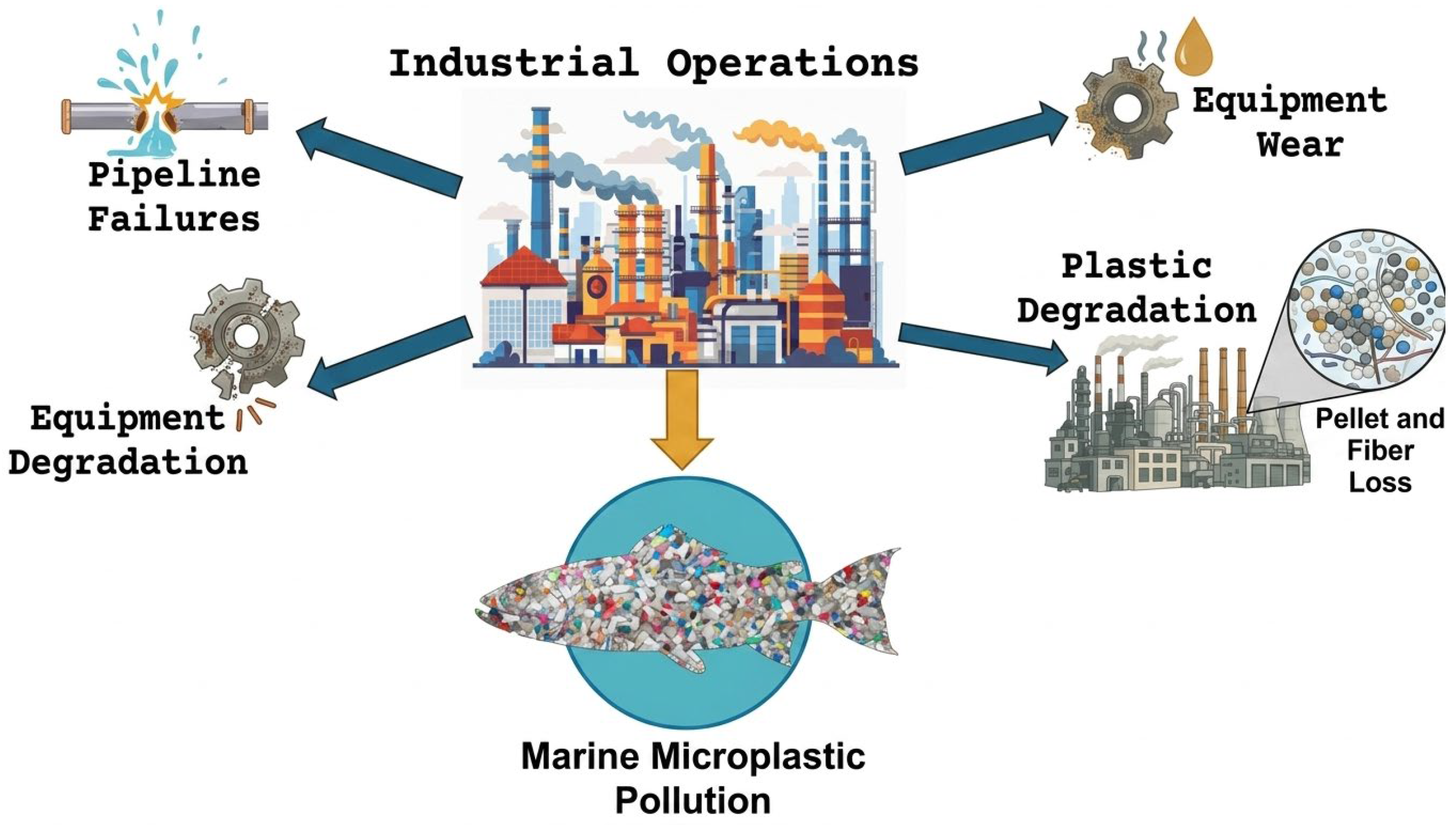
The Arabian Gulf presents distinctive environmental, industrial, and socio-economic conditions that generate region-specific MP sources that differ from global patterns. Among these, oil and gas activities represent one of the most significant and pervasive industrial sectors across the region [34]. Petroleum extraction, refining, and offshore operations may contribute to microplastic pollution through equipment degradation, pipeline failures, and the breakdown of plastic-based industrial materials, although their quantitative contribution remains largely unassessed [34,35]. Qatar, as a major liquefied natural gas exporter, maintains extensive offshore and onshore infrastructure, yet no studies have specifically quantified microplastic emissions from these activities. Maritime transport and port operations constitute another major source of MPs in the Arabian Gulf. The region functions as a critical global shipping corridor, with high vessel density contributing to microplastic release through ballast water discharge, hull coating degradation, operational waste, and cargo loss [36,37,38]. A study investigating ballast water in the Persian Gulf reported microplastic concentrations comparable to ambient seawater levels, highlighting the potential importance of maritime pathways in regional contamination [38]. In addition, fishing activities contribute to microplastic generation through the degradation of nets, ropes, and other plastic gear, particularly in coastal and nearshore environments [39].
Wastewater discharge represents a well-established pathway for microplastic release into marine systems. Wastewater treatment plants (WWTPs) in the region are estimated to release substantial quantities of microplastics annually, with treated effluent still containing particles despite removal efficiencies ranging from 40 to 95% [40,41]. Reported concentrations in treated wastewater can reach up to 106 particles per liter, indicating that WWTPs act as continuous point sources of MPs to coastal waters. In parallel, the Arabian Gulf region relies heavily on desalination, with production exceeding 26.4 billion m3 annually [42,43]. Although desalination brine itself may not contain high microplastic concentrations, the infrastructure associated with desalination systems, including membranes, pipelines, and plastic components, may contribute indirectly to microplastic release. However, systematic studies evaluating the combined effects of wastewater discharge and desalination activities on microplastic accumulation in the Gulf remain scarce [44,45].
Rapid coastal urbanization and tourism further amplify microplastic inputs in the region. Over the past decades, extensive land reclamation, infrastructure development, and population growth have significantly increased plastic consumption and waste generation along the Gulf coastlines [46]. These processes contribute to microplastic pollution through the degradation of construction materials, increased vehicular emissions, and intensified consumer activity [47,48,49]. In Qatar, large-scale urban expansion and tourism-related activities, including mega-events and coastal recreation, may represent additional but poorly quantified sources of MPs.
Industrial zones and land reclamation projects constitute another important category of region-specific sources. The Arabian Gulf hosts numerous petrochemical complexes, power plants, and coastal industrial facilities that generate microplastics through material degradation, operational emissions, and infrastructure wear [34]. Land reclamation activities, widely implemented across the region, may also contribute to microplastic release through sediment disturbance and construction processes [46]. For example, industrial areas such as Mesaieed Industrial City in Qatar have been associated with elevated levels of conventional pollutants, yet microplastic-specific assessments in these zones remain limited [50].
Despite these identified sources, substantial uncertainties persist in understanding microplastic generation and distribution in the Arabian Gulf. Existing studies exhibit strong geographic bias, with the majority conducted in limited coastal areas, restricting regional representativeness [51]. Furthermore, inconsistencies in sampling, extraction, and quantification methodologies hinder direct comparison of results and limit the ability to quantify source contributions [52]. The influence of extreme environmental conditions characteristic of the Gulf, such as high temperatures, hypersalinity, shallow bathymetry, and restricted water circulation, on microplastic generation, fragmentation, and transport also remains poorly understood. Addressing these gaps is essential for developing accurate source apportionment models and effective mitigation strategies tailored to the region.

4. Distribution of Microplastics in Marine Environments

MPs have been widely reported across multiple environmental compartments in the Arabian Gulf, including seawater, coastal sediments, and marine biota. Existing studies confirm their ubiquitous presence; however, reported concentrations vary considerably across locations and environmental matrices. This variability reflects not only differences in environmental conditions and anthropogenic pressures but also substantial inconsistencies in sampling methodologies, particle size thresholds, and analytical techniques. A synthesis of available studies reveals both common distribution patterns and critical uncertainties that must be considered when interpreting regional microplastic data. It should be noted that reported microplastic concentrations across studies are expressed using different units (e.g., particles/m3 for seawater, particles/kg for sediments, and items per individual for biota), which complicates direct quantitative comparisons across environmental compartments. Therefore, comparisons between studies should be interpreted with caution and are primarily qualitative. A synthesis of available studies reveals both common distribution patterns and critical uncertainties that must be considered when interpreting regional microplastic data. Across all environmental compartments in the Arabian Gulf, a consistent pattern emerges in which polyethylene (PE) and polypropylene (PP), predominantly in fibrous form, represent the most abundant microplastic types. This cross-matrix consistency suggests common sources, particularly wastewater-derived textile fibers and the fragmentation of widely used plastic materials, and highlights strong connectivity between environmental contamination and biological uptake pathways.

4.1. Sampling, Extraction, and Detection Methods

Reported MP concentrations in Qatar and the Arabian Gulf are strongly influenced by methodological variability, which remains a major limitation for data comparability across studies. The region’s unique environmental conditions, including high salinity, elevated temperatures, carbonate-rich sediments, and frequent dust events, pose additional analytical challenges for particle recovery and identification. High salinity can affect the efficiency of density-based separation, while airborne fibers and mineral particles increase the risk of contamination and false identification. Consequently, rigorous protocols for sampling, digestion, density separation, contamination control, and spectroscopic confirmation are essential to ensure data reliability in the region.
Sampling methodologies vary considerably across studies, reflecting the absence of standardized regional protocols. In seawater investigations, net-based sampling using neuston or plankton nets remains the most common approach, with mesh sizes typically ranging from approximately 50 to 333 μm [38,53,54]. While smaller mesh sizes (60–100 μm) are recommended to improve capture of fine particles, most studies in Qatar and the wider Arabian Gulf employ mesh sizes between 150 and 300 μm, which may underestimate smaller microplastics [55,56,57,58,59]. In addition, most seawater sampling focuses on surface layers, potentially overlooking subsurface particle distributions. Discrete grab sampling followed by laboratory filtration has also been applied in nearshore environments, enabling better control of sampled volumes and contamination [53,54].
Sediment sampling typically involves intertidal or coastal surface collection, although some studies employ Van Veen grab samplers or gravity corers to obtain depth-resolved samples, usually within the upper 5 cm of sediment [60,61]. Sediment samples are generally dried, sieved, and processed for density separation. Spatial variability in sediment sampling strategies, including differences in grain size selection and sampling depth, further contributes to variability in reported MP concentrations. For marine biota, sampling often relies on commercially available species obtained from local fish markets, followed by dissection and isolation of gastrointestinal tracts to minimize contamination [61,62,63,64].
Extraction and separation methodologies in the Arabian Gulf largely rely on density separation following the removal of organic matter. Chemical digestion using hydrogen peroxide (H2O2) or alkaline solutions is widely employed to eliminate biogenic material prior to microplastic isolation [65,66]. In some cases, Fenton’s reagent is used to enhance digestion efficiency, although standardized protocols remain lacking [67]. Density separation is commonly conducted using saturated sodium chloride (NaCl) solutions for the recovery of low-density polymers such as polyethylene (PE) and polypropylene (PP), while higher-density solutions such as zinc chloride (ZnCl2) or sodium iodide (NaI) are applied to improve recovery of denser polymers, including polyethylene terephthalate (PET) and polyvinyl chloride (PVC) [67,68,69]. However, variations in solution density and separation efficiency can lead to underestimation of certain polymer types.
Polymer identification in Qatar and the Arabian Gulf is primarily conducted using Fourier transform infrared (FTIR) spectroscopy, particularly attenuated total reflectance (ATR-FTIR), which enables identification of polymer composition through spectral matching [70]. Raman spectroscopy has also been increasingly applied for the analysis of smaller or weathered particles, providing complementary identification capabilities [64]. In addition, scanning electron microscopy coupled with energy-dispersive X-ray spectroscopy (SEM-EDS) is occasionally used for detailed morphological and elemental characterization, although its application remains limited in regional studies [71]. Despite these advances, visual identification under stereomicroscopy remains widely used as a preliminary screening method, which may introduce subjectivity and misclassification, particularly in environments with high background contamination such as carbonate-rich sediments and airborne fibers.
Quantification and reporting practices represent another major source of inconsistency. Microplastic concentrations are reported using a variety of units, including items per liter (items/L), items per cubic meter (items/m3), or items per square kilometer for seawater; particles per kilogram dry weight (items/kg dw) for sediments; and items per individual or per gram of tissue for biota [63,72,73]. Differences in size thresholds, reporting formats, and confirmation rates further complicate comparisons between studies. As a result, methodological variability often obscures true environmental trends and contributes significantly to the wide range of reported MP concentrations across the region. Consequently, comparisons between studies are primarily qualitative, as direct numerical comparisons may be misleading due to differences in methodology and reporting.
The lack of standardized sampling, extraction, and analytical methodologies remains a critical barrier to accurate assessment of microplastic pollution in Qatar and the Arabian Gulf. Harmonization of protocols, including mesh size selection, digestion procedures, density separation media, spectroscopic identification, and reporting units, is essential to improve data comparability, reduce uncertainty, and support robust regional monitoring and management strategies.

4.2. Microplastics in Seawater

MPs have been widely detected in seawater across the Arabian Gulf, reflecting both regional anthropogenic pressures and the influence of hydrodynamic and environmental processes. Their distribution is highly heterogeneous, varying across spatial scales, sampling depths, and environmental conditions [74]. Table 1 summarizes reported MP abundances in seawater from different Arabian Gulf countries, highlighting the variability in concentrations across the region.
Reported concentrations in the Persian/Arabian Gulf range from as low as 0–3 particles/m3 in Qatari waters to approximately 3–15 items/L in other parts of the Gulf, indicating differences of several orders of magnitude depending on location and methodology [28,75,76,77,78,79,80]. For example, seawater samples collected within Qatar’s Exclusive Economic Zone (EEZ) showed relatively low concentrations, with an average of approximately 0.71 particles/m3, while other studies reported values between 8.76 × 10⁻³ and 2.92 × 10⁻¹ particles/m3 [75]. In contrast, studies conducted in other regions of the Persian Gulf have reported higher concentrations, ranging from 3 to 15 items/L, reflecting localized pollution sources and hydrodynamic variability [28]. Such discrepancies illustrate the challenges associated with the direct comparison of datasets across the region. In particular, differences in reporting units (e.g., particles/m3 versus items/L), sampling approaches, and analytical methods further complicate direct comparisons across studies.
Spatial variability in seawater microplastic distribution is strongly influenced by anthropogenic sources and coastal activities, which are conceptually illustrated in Figure 3. Higher concentrations are typically observed in nearshore environments adjacent to urban centers, industrial zones, desalination plants, and wastewater discharge points, whereas offshore areas generally exhibit lower MP abundances. The Arabian Gulf, bordered by rapidly developing coastal cities and intensive industrial activities, including oil and gas operations, is particularly vulnerable to plastic pollution inputs [74]. Seasonal changes in hydrodynamic conditions, including wind-driven circulation and tidal mixing, further influence the transport and redistribution of MPs within the water column. Polymer composition and particle characteristics provide additional insight into microplastic sources and transport mechanisms. Across most studies in Qatar and neighboring Gulf countries, PE and PP are consistently identified as the dominant polymer types, in line with the overall pattern observed across environmental compartments [76,77,78,79,80]. These polymers tend to remain buoyant and are therefore prevalent in surface waters. In terms of morphology, fibers represent the most abundant form of microplastics, often accounting for a substantial proportion of total particles, followed by fragments, films, and pellets [28]. The dominance of fibrous particles is consistent with global observations and is commonly associated with wastewater-derived inputs, particularly from synthetic textiles.
Vertical distribution patterns of microplastics in the water column reflect the influence of physical and chemical processes. Low-density polymers, such as PE and PP, tend to accumulate in surface waters, while higher-density polymers are more likely to settle into sediments unless modified by biofouling or aggregation processes [81]. Consequently, surface waters and nearshore zones typically exhibit higher MP concentrations compared to deeper offshore regions. However, the extent of vertical mixing and particle redistribution is influenced by local hydrodynamic conditions, including wave action, currents, and water column stratification. Despite the growing body of data, the interpretation of seawater microplastic concentrations remains challenging due to significant methodological inconsistencies. Differences in sampling approaches, including mesh size, sampling depth, and collection techniques, can strongly influence the number and size distribution of detected particles. In addition, studies report concentrations using different units (e.g., particles/m3, items/L), which complicates direct comparison across datasets [52]. These methodological differences, combined with spatial heterogeneity, contribute to the wide range of reported values and highlight the need for standardized monitoring protocols. Seawater microplastic distribution in the Arabian Gulf reflects a combination of regional environmental conditions, anthropogenic inputs, and methodological variability. While existing studies confirm the widespread presence of MPs in surface waters, improved harmonization of sampling and analytical methods is essential to accurately assess spatial patterns, identify dominant sources, and evaluate temporal trends across the region.
Table 1. Microplastics in surface seawater samples for the Arabian Gulf countries.
Sampling LocationWater CompartmentIdentification TechniqueMP AbundanceDominant Polymer *Dominant TypeRef.
Qatar (EEZ)Surface SeawaterATR-FTIR Spectroscopy0–3 particles/m3PPGranules, Fibers[53]
Qatar (Doha Bay)Surface SeawaterFTIR/FT-NIR Spectroscopy8.76 × 10−3–2.92 × 10⁻¹ particles/m3PE, PPFibers[54]
Gulf of OmanSurface SeawaterATR-FTIR Spectroscopy0.07–1.14 particles/m3PE, PPFibers[56]
KuwaitSurface SeawaterRaman Spectroscopy0–12 particles/stationPP, PEFilaments, Fragments[77]
Northern IranSurface SeawaterRaman Spectroscopy0.17–4.13 particles/m3PAFibers, Fragments[76]
Arabian GulfSurface SeawaterATR-FTIR Spectroscopy1.5 × 103–4.6 × 10⁴ particles/km2PE, PPFibers[57]
Arabian GulfSurface SeawaterMicro-Raman Spectroscopy8.4 × 102–8.5 × 10² particles/m3 PESFibers[78]
Bushehr Province, IranSurface SeawaterFTIR Spectroscopy7.8 × 103–3.74 × 10⁴ particles/km2PE, PPFibers[79]
Chabahar Bay, Southeastern IranSurface SeawaterFTIR Spectroscopy0.20–0.24 particle/m3PE, PETFibers, Fragments[80]
Aras River, Northwestern IranSurface SeawaterFTIR Spectroscopy1–43 particles/m3PEFibers[82]
Southwest Caspian Sea, IranSurface SeawaterATR-FTIR Spectroscopy0.19–2.85 particles/m3 (January)
0.40–4.41 particles/m3 (June)
PP, PESFibers[83]
Mazandaran Province, IranSurface SeawaterBinocular Optical Microscopy200–1500 particles/m3PET, NYL, PSFibers[84]
Oman Sea, Arabian GulfSurface SeawaterMicro-Raman Spectroscopy3.7 × 103–6.9 × 10³ particles/m3PE, PPFibers[85]
Southeastern Arabian SeaSurface SeawaterATR-FTIR Spectroscopy0–5.99 × 10³ particles/m3PPFragments[86]
* Abbreviations: PP, Polypropylene; PE, Polyethylene; PA, Polyamide; PES, Polyethersulfone; PET, Polyethylene terephthalate; NYL, Nylon; PS, Polystyrene.

4.3. Microplastics in Coastal Sediments

Coastal sediments and beach environments in the Arabian Gulf act as major sinks for MPs, accumulating particles derived from both direct land-based inputs and secondary transport from the water column. Due to their role as depositional environments, sediments provide an integrated record of microplastic contamination over time. Table 2 summarizes reported MP abundances in sediment samples across Qatar and other Arabian Gulf countries, highlighting substantial spatial variability in concentrations.
In Qatar, microplastics have been detected in all sampled intertidal and beach sediments, with reported concentrations ranging from approximately 6 to 38 particles/kg and surface densities between 36 and 228 particles/m2 [54]. A more detailed investigation across twelve beach sites reported a mean abundance of 34.88 particles/kg (dry weight), with a total recovery of 1915 particles [60]. Notably, approximately 85.48% of the total microplastic load was concentrated within the upper 0–5 cm of sediment, indicating recent accumulation and suggesting that surface sediments represent the most active zone for microplastic deposition and interaction with benthic organisms [60].
Across the broader Arabian Gulf region, sediment microplastic concentrations typically range between 10 and 35 particles/kg, although significantly higher values have been reported in certain locations, such as Iran, where concentrations can reach up to 1258 particles/kg [28,58,77,87,88]. This wide variability reflects differences in local pollution sources, coastal morphology, and hydrodynamic conditions. Areas adjacent to urban centers, industrial zones, and regions with inadequate waste management practices tend to exhibit higher microplastic accumulation, as observed in heavily littered beaches such as Al-Ruwais in Qatar [54]. Similarly, studies across Kuwait, Oman, and the UAE show consistent detection of MPs in coastal sediments, with polymer distributions dominated by PE and PP, consistent with the cross-matrix distribution pattern discussed earlier [28,58,87].
The composition and morphology of microplastics in sediments provide insight into their sources and transport pathways. In Qatar, pellets have been identified as a dominant morphological form in some locations, suggesting primary microplastic inputs associated with industrial activities and plastic handling losses [60]. In contrast, other studies report fibers, films, and fragments as the predominant forms, with fibers accounting for a substantial proportion of particles (e.g., 43.8%), followed by films (40.7%) and fragments (14.2%). Across the region, fibers, fragments, films, and pellets are consistently observed, reflecting a combination of primary and secondary microplastic sources (Figure 4) [51]. The widespread presence of fibers is particularly indicative of wastewater-derived inputs, while fragments and films are associated with the breakdown of larger plastic debris.
Polymer composition in sediments is relatively consistent across the Arabian Gulf, with PE and PP representing the dominant polymer types, often accounting for more than 60% of total microplastics [51,60]. This distribution reflects the widespread use of these polymers in packaging materials, consumer products, and industrial applications. In Qatar, polyethylene alone has been reported to constitute approximately 27.4% of recovered particles, with a large proportion (approximately 76%) showing signs of chemical degradation, as indicated by carbonyl functional groups associated with environmental weathering [89]. These findings highlight the influence of the Gulf’s harsh environmental conditions, including high temperatures, intense solar radiation, and salinity, on polymer degradation processes.
Sediment microplastic distribution is strongly influenced by both physical and environmental factors. Low-density polymers such as PE and PP may initially remain buoyant but eventually settle due to biofouling, aggregation, or attachment to mineral particles, while higher-density polymers such as PVC and ABS are more likely to sink directly and accumulate in sediments. As a result, sediments act as long-term reservoirs for microplastics, with limited resuspension except under high-energy conditions such as storms or coastal erosion. This accumulation has important implications for benthic ecosystems, as sediments represent a primary exposure pathway for bottom-dwelling organisms. Long-term accumulation patterns further emphasize the role of sediments as environmental sinks. Sediment core studies from mangrove ecosystems along the Arabian Gulf have demonstrated an exponential increase in plastic burial rates since the mid-20th century, with an estimated 110 ± 80 metric tons of plastic buried in mangrove sediments since the 1930s [90]. These findings highlight the persistence of microplastics in sedimentary records and their potential use as indicators of historical pollution trends.
Despite these insights, the interpretation of sediment microplastic data remains complicated by methodological variability. Differences in sampling depth, sediment type, density separation techniques, and reporting units (e.g., particles/kg versus particles/m2) significantly influence reported concentrations and hinder direct comparison across studies [52]. Consequently, part of the observed variability reflects methodological inconsistencies rather than true environmental differences. Coastal sediments in the Arabian Gulf function as major sinks for microplastics, exhibiting higher accumulation levels than seawater and reflecting both current inputs and long-term deposition processes. However, improved standardization of sampling and analytical methods is essential to accurately quantify sediment contamination, identify dominant sources, and assess spatial and temporal trends across the region.
Table 2. Microplastics in sediment samples for the Arabian Gulf countries.
CountrySampling TypeIdentification TechniqueMP ParticlesDominant Polymer *Dominant TypeRef.
QatarIntertidal sedimentsFT-IR/FT-NIR spectroscopy6–38 particles/kg (dry)LDPE, PPFibers, films[54]
Beach sedimentsATR-FTIR spectroscopy0–6.6 × 10² particles/kg (dry)PE, PPPellets[91]
Beach sedimentsMicro-Raman Spectroscopy0–8.6 × 10² particles/kg (dry)PP, PEPellets[60]
IranIntertidal sedimentsFT-IR spectroscopy1–1.5 × 10³ particles/kg (dry)PET, PE, NylonFibers[87]
KuwaitIntertidal sedimentsRaman spectroscopy37 particles absolutePPFilms, fragments[77]
OmanIntertidal sedimentsMicro-Raman spectroscopy182–717 particles/kg (dry)PPFragments, fibers[58]
UAEBeach sedimentsFT-IR spectroscopy59.71 particles/kg (dry) (mean)PE, PPFibers[88]
* Abbreviations: LDPE, Low-density polyethylene; PP, Polypropylene; PE, Polyethylene; PET, Polyethylene terephthalate.

4.4. Microplastics in Marine Biota

MP contamination in marine organisms across the Arabian Gulf represents a critical pathway for bioaccumulation and potential transfer through marine food webs, with direct implications for ecosystem health and human exposure. Microplastics have been detected in a wide range of marine species globally, including fish, crustaceans, mollusks, seabirds, and turtles, confirming their pervasive presence in aquatic environments [92,93,94,95,96,97,98,99]. Within the Arabian Gulf, available studies indicate that MPs are consistently present in commercially and ecologically important species, although reported concentrations remain highly variable due to both environmental and methodological factors. A summary of reported microplastic occurrence in marine biota across the Arabian Gulf is presented in Table 3, highlighting variations in abundance, dominant polymer types, and particle morphology.
In fish species from the Persian/Arabian Gulf, microplastic ingestion has been widely documented. For example, MP abundances ranging from 4 to 18 items per 10 g (fresh weight) have been reported in Pennahia anea, indicating significant ingestion across piscine fauna [28]. Other regional studies have reported average ingestion rates of approximately 2.46–2.85 particles per individual across multiple fish species, although variability in reporting units complicates direct comparison [100,101]. A broader meta-analysis of microplastic occurrence in fish suggests a global mean of approximately 1.11 particles per individual (95% confidence interval: 0.3–1.92), highlighting substantial heterogeneity in ingestion rates across species and regions [102]. This variability reflects differences in feeding behavior, habitat, and environmental exposure. The composition and morphology of microplastics in marine biota show consistent patterns across the Arabian Gulf.
Fibers represent the dominant morphological type, accounting for up to 87.5% of detected particles in some studies, with typical lengths below 250 μm [28]. Although fibrous microplastics are frequently reported as the dominant morphological type in the Arabian Gulf, this reflects both their high environmental abundance, primarily associated with wastewater-derived textile fibers, and potential methodological biases favoring the detection of elongated particles. Importantly, other forms such as fragments, films, and pellets also contribute significantly to environmental contamination and may exhibit different transport behaviors, degradation pathways, and ecological impacts. This dominance of fibrous MPs is consistent with observations in seawater and sediments and is largely attributed to wastewater-derived inputs, particularly from synthetic textiles. However, this pattern should be interpreted with caution, as sampling and analytical approaches may preferentially detect fibrous particles. In terms of polymer composition, PE, PP, and PET are the most frequently identified polymers, consistent with the overall distribution pattern observed across environmental compartments [100,101,103,104,105,106]. The consistency of polymer types across environmental matrices suggests a strong linkage between environmental contamination and biological uptake.
Microplastic ingestion in marine organisms is strongly influenced by feeding strategies and habitat. Benthic and demersal species, as well as filter-feeding organisms such as bivalves, are particularly susceptible to microplastic ingestion due to their interaction with sediment-associated particles. Studies from the Persian Gulf have shown that bivalve species contain MPs predominantly composed of fibers with sizes between 100 and 250 μm, with PET and PP identified as dominant polymers [106]. Crustaceans, particularly benthic species such as the flathead lobster (Thenus orientalis), have been reported to contain significantly higher microplastic loads, with concentrations reaching up to 460.2 particles per individual [102]. This elevated contamination reflects their direct exposure to sediments, which act as major sinks for MPs. The relationship between environmental contamination and biological uptake is further supported by evidence of strong correlations between microplastic concentrations in environmental matrices and marine organisms. A spatial study across multiple Persian Gulf locations reported a strong positive correlation between microplastic concentrations in seawater and fish (r = 0.932, p = 0.001), as well as between sediments and fish (r = 0.730, p = 0.040), indicating that environmental availability plays a key role in determining ingestion rates [28]. These findings suggest that microplastic contamination in biota is closely linked to local environmental conditions and source inputs. However, evidence for biomagnification of microplastics through trophic levels remains inconclusive. Most field studies report microplastics primarily within gastrointestinal tracts rather than in edible tissues, suggesting limited translocation across biological membranes under natural conditions. Experimental studies indicate that trophic transfer may enhance microplastic uptake, with prey-mediated exposure resulting in 3–11 times higher particle transfer compared to direct ingestion from the water column [107]. Nevertheless, the extent to which such processes occur under natural environmental conditions remains uncertain.
Beyond ingestion, microplastics may also exert biological effects on marine organisms. Although ingestion rarely results in immediate mortality, MPs have been associated with a range of sublethal impacts, including intestinal blockage, reduced feeding efficiency, inhibition of enzyme activity, and alterations in reproductive and endocrine functions [92,93]. These effects, combined with the potential for MPs to act as vectors for chemical contaminants, raise concerns regarding long-term ecological impacts and food safety. Despite increasing evidence of microplastic contamination in marine biota, studies in Qatar and the wider Arabian Gulf remain limited and geographically uneven. Most available data originate from specific coastal regions, with a strong bias toward Iranian waters, resulting in limited regional representativeness [51]. In addition, inconsistencies in sampling methods, analytical protocols, and reporting units (e.g., particles per individual, per gram, or per organ) hinder direct comparisons across studies and complicate regional assessments. Microplastic contamination in marine biota within the Arabian Gulf reflects a combination of environmental exposure, species-specific characteristics, and methodological variability. While existing studies confirm the presence of MPs in multiple trophic levels, further standardized and regionally coordinated investigations are required to accurately assess ecological risks, understand exposure pathways, and evaluate potential implications for human health.
Table 3. Microplastics in marine biota samples for the Arabian Gulf countries.
LocationSpeciesIdentification TechniqueMicroplastic
Abundance
Dominant Polymer *Dominant ShapeRef.
QatarFish (4 species)Micro-Raman Spectroscopy0–109 particles/individualPP, PEFibers[108]
QatarFish (4 species)Micro-Raman Spectroscopy0–3.14 particles/g (gut)PE, PPFibers[62]
IranFish (14 species)-0.5–5.67 particles/individual-Fibers[100]
IranFishMicro-Raman Spectroscopy2–9 particles/individualPP, PETFibers[101]
KuwaitFish (8 species)Micro-Raman/ATR-FTIR Spectroscopy0–1 particles/individualPEFragments[103]
Saudi ArabiaFish (9 species)FTIR Spectroscopy0.038–0.076 particles/individualPE, PPFibers, Fragments[104]
Saudi ArabiaFish (26 species)FTIR Spectroscopy0–2 particles/individualPP, PEFibers[105]
UAESea snakes (6 species)ATR-FTIR Spectroscopy7.7–10.6 particles/g (gut)PPFibers[109]
UAESeabirds (17 species)ATR-FTIR Spectroscopy0.12–14.93 particles/g (fibers), 0.05–11.11 particles/g (fragments, films)PP, PAFibers, Fragments[110]
IranFish (2 species)Micro-Raman Spectroscopy34.9–51.4 particles/individual (tigertooth croaker), 27.2–32.6 particles/individual (yellowfin seabream)PP, PEFibers, Fragments[111]
Gulf of OmanFish (8 species)Micro-Raman Spectroscopy0–11 particles/individualPE, PPFragments, Fibers[112]
* Abbreviations: PP, Polypropylene; PE, Polyethylene; PET, Polyethylene terephthalate; PA, Polyamide.

5. Microplastics in Terrestrial Environments

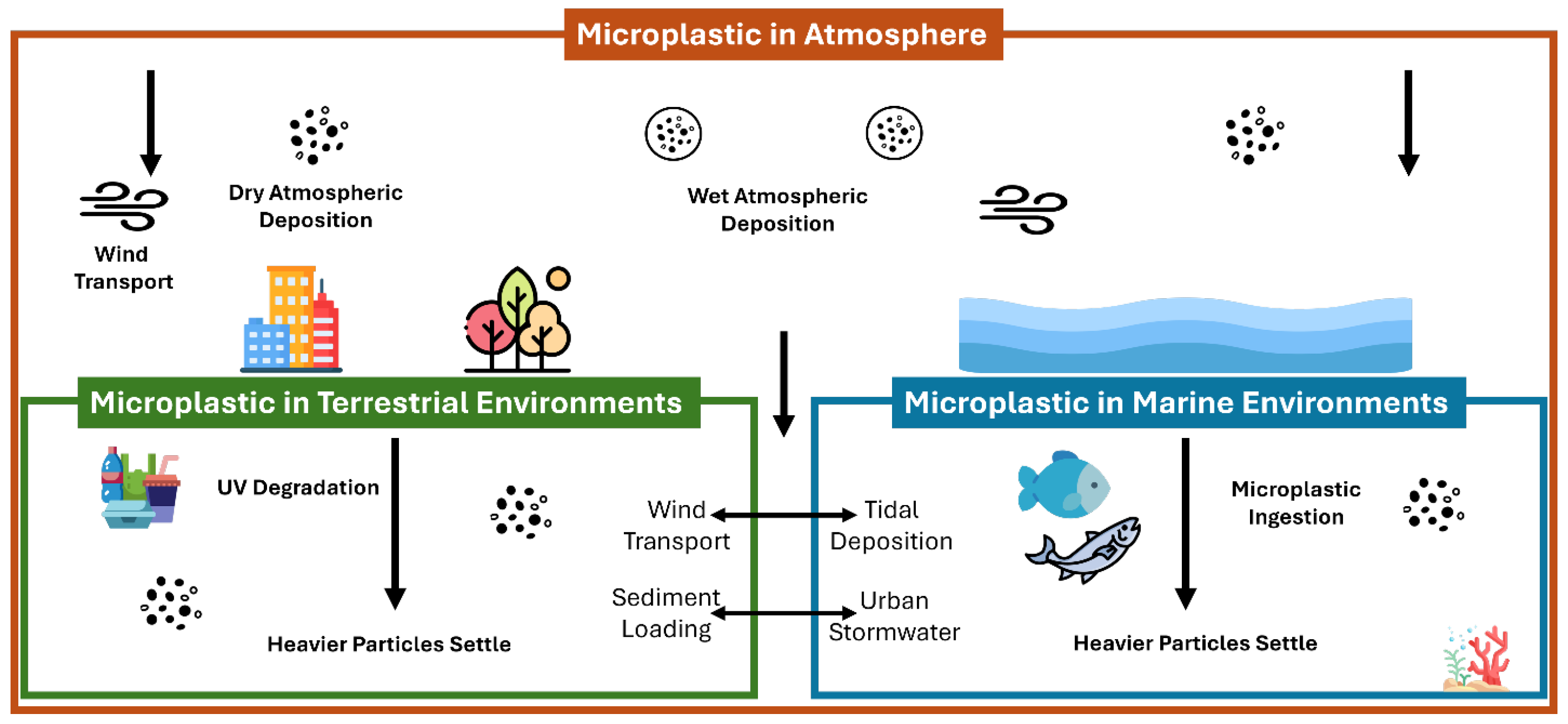
Since the 1950s, plastics have been produced in large quantities; today, about 400 million tons are produced worldwide [2]. The distribution and sale of cosmetics containing tiny particles of plastics are prohibited in a number of nations, such as Canada and the USA, due to their harmful impact on the environment. When plastic is exposed to ultraviolet (UV) light, it undergoes photo-oxidation, which breaks it down into small fragments known as MPs. The heat, natural light, and aerated temperatures are excellent for producing MPs through recurrent fragmentation processes, especially in the dry and hot region of the Arabian Gulf. Within aquatic places and sediments, cold, anoxic circumstances may lead to a very slow breakdown of plastic particles for decades. Through everyday activities like driving a car (tire wear), washing clothes, and the use of cosmetics, personal care products, and plastic packaging, a significant amount of MPs is released into the atmosphere and becomes airborne. These particles deposit onto terrestrial and aquatic surfaces through various mechanisms, such as atmospheric transport, precipitation, and dry deposition. Furthermore, recent research has shown that air fallout has transported a significant number of fibers, especially in heavily populated regions. Winds have the ability to carry these atmospheric particles towards the oceans or simply deposit them on land. Thus, physical processes like breezes, waves, surface runoff, and floods, which are influenced by climatic variables, impact the placement of MPs among different ecosystems [113]. The graphical overview in Figure 5 shows the sources, sinks, and routes of MP movement across freshwater, aquatic, and terrestrial habitats [114,115].
The Arabian Peninsula, with an area of 3,237,500 km2 housing over 95,000,000 people, is one of the largest desert areas in the world with extreme arid conditions. Dust storms are a common occurrence, especially during the summer, with strong winds from the northwest Shamal region of Iraq, Saudi Arabia, and Kuwait [116]. According to Al-Senafi and Anis (2015) [117], an average of 13 dust storm events takes place annually, with the majority in the summer season. Seasonal changes and anthropogenic activities result in a varying composition of dust that is deposited onto this region [116]. While there has been some research investigating the metal geochemistry of dust samples in Qatar and the Arabian Gulf region, there are limited studies on the presence of MPs in the atmospheric samples.
Coastal areas may experience higher concentrations of airborne microplastics due to their proximity to marine environments. Research conducted in urban environments has found varying concentrations of airborne microplastics. For example, a study in Paris, France, estimated atmospheric microplastic deposition rates ranging from 2 to 355 particles/m2/day [118]. Weather conditions, such as wind speed and direction, precipitation, and temperature, can affect the transport and deposition of airborne microplastics. For example, windy conditions can enhance the dispersal of microplastics over long distances, while precipitation events can lead to their deposition onto land or water surfaces [119]. A large majority of human activities occur in the vicinity of a building or an indoor environment [120]. Hence, evaluating the abundance of microplastics in different indoor settings is crucial to understanding the risk of exposure to humans. Previously, studies have found significantly higher levels of microplastics in indoor environments than outdoors [121]. There has been extensive research conducted to evaluate the presence of microplastics in the indoor and outdoor environments, on land and over sea bodies.
Microplastics with different polymer types, shapes, sizes, and colors have been detected in the atmosphere. For the Arabian Gulf region, the majority of the studies on atmospheric microplastics have been conducted in Iran, with one conducted in Kuwait. Table 4 summarizes the MP concentrations in the atmosphere of the Arabian Gulf region and the rest of the world. The findings show a 3.2–27.1 particle/m3 abundance of microplastics in indoor aerosols in Kuwait [121], and an abundance of 0–0.017 particles/m3 as was found in airborne particulate matter in Ahvaz, Iran [122]. According to Dehghani et al. (2017) [123], 2649 microplastic particles were detected in the street dust of Tehran, Iran, using the fluorescence microscope technique. From the street dust samples, a range of 2.9–20.2 particles/g of dry dust was obtained for microplastics. These findings explain the ubiquitous nature and the consequent danger posed to humans and animals at all times from the surroundings. Fibers were the most dominant shape of microplastics. Additionally, the predominant polymer types included PET, PP, and PE in the collected samples. A similar study conducted over the Northeast Arabian Sea evaluated the atmospheric deposition of microplastic particles on the coastal zone. Their findings report microplastic concentrations ranging from 1.16–1.44 particles/m3 in 2016 to 1.34 ± 1.58 particles/m3 in 2020 [124]. As observed in Table 4, there are multiple units used to present the results. A lack of consensus in the units makes it difficult to perform correlations, evaluate outcomes, or make comparisons. Hence, this issue needs to be addressed with more studies focusing on the levels of microplastics in the atmosphere and their effects on humans through inhalation or ingestion, especially in the Arabian Peninsula.

6. Environmental and Human Health Impacts

6.1. Impacts on Marine Organisms

Microplastic ingestion by marine organisms represents a pervasive threat across diverse taxa and ecosystem compartments. Laboratory and field studies consistently document physical effects from direct ingestion, with particles causing mechanical obstruction of the gastrointestinal tract and physical damage to intestinal epithelium [127]. Research on fish species has shown that ingested microplastics can reduce feeding efficiency, deplete energy reserves, and compromise nutrient absorption [128]. For mollusks and crustaceans, particularly filter-feeding bivalves such as mussels and oysters, microplastics accumulate in digestive tissues, resulting in inflammatory responses and reduced filtration capacity [129]. In the Arabian Gulf region, preliminary investigations on commercial fish species identified microplastics in approximately 44% of sampled fish, with polyethylene and polystyrene being predominant polymer types [130].
Impacts extend beyond mere physical obstruction to broader physiological impairment. Fish exposed to microplastics under controlled laboratory conditions exhibit reduced growth rates, impaired reproductive success, and altered swimming behavior [131]. However, a critical distinction emerges when comparing laboratory and field observations. Laboratory studies typically employ high, unrealistic concentrations of virgin microplastics, whereas field studies detect lower ingestion rates in naturally exposed organisms [132]. For benthic organisms in sediment-rich environments, the exposure is particularly acute; holothurians (sea cucumbers) and benthic amphipods that feed on sediments show elevated microplastic burdens correlating with sediment contamination [133]. In the Arabian/Persian Gulf, benthic fauna demonstrated species-specific variations in microplastic loads, with fish containing significantly higher particle numbers than polychaetes, mollusks, or echinoderms [134,135]. The highest concentrations were documented in the Northern Gulf, particularly off the Iranian coast [134]. These regional patterns reflect localized sources, including shipping lanes, wastewater discharge, and fishing activities. Effects on reproduction and development have been particularly concerning in early life stages; fish larvae exposed to microplastics display increased mortality, developmental abnormalities, and enhanced DNA damage when exposed to environmental samples collected from microplastic-contaminated ocean gyres [131].

6.2. Bioaccumulation and Trophic Transfer

The movement of microplastics across trophic levels represents a critical knowledge domain, yet findings remain inconsistent across studies. Field evidence for trophic transfer in marine food webs is clearer than evidence for biomagnification. Studies tracking polystyrene microplastics through a freshwater food chain from snails to fish confirmed substantial accumulation in the snail tissues and subsequent transfer to fish predators, with notable translocation from the gastrointestinal tract to muscle tissue [136]. Conversely, investigations of larger microplastics (100–5000 μm) in coastal marine food webs found no evidence of biomagnification with increasing trophic position [137]. The Persian Gulf studies by Akhbarizadeh et al. [138] reported that commercial seafood species, including penaeids (prawns) and groupers, displayed trophic dilution rather than magnification when examined for microplastic burden. This discrepancy suggests that particle size is a critical determinant; smaller particles (<10 μm), including nanoplastics, may translocate more readily across biological barriers than larger microplastics [129].
A crucial distinction exists between gastrointestinal presence and tissue translocation. While most field studies document microplastics predominantly within digestive tracts of wild-caught organisms, laboratory investigations reveal that smaller particles cross intestinal epithelia and accumulate in liver, muscle, and reproductive tissues [136]. However, depuration (excretion) rates in field populations may be rapid, limiting the ecological significance of ingested particles [137]. Studies comparing laboratory exposure conditions (using high concentrations of pristine microspheres) with environmentally realistic scenarios reveal substantial methodological variability. For instance, field studies on adult fish showed minimal translocation of 10–300 μm particles despite high gastrointestinal burdens, suggesting that fibers and irregular particles behave differently from uniform microspheres [139]. Furthermore, ecological traits strongly influence microplastic accumulation; suspension feeders and planktivorous fish ingest more microplastics per unit body weight than predatory species, yet predators may show greater diversity of ingested particle types [140]. The food web analysis using stable isotope methods demonstrated that microplastic concentrations were more strongly associated with feeding ecology and habitat use than with trophic position, indicating that exposure is not primarily determined by feeding on contaminated prey [141].

6.3. Microplastics as Vectors of Pollutants and Pathogens

Microplastics function as effective vectors for both exogenous environmental contaminants and endogenous plastic-derived chemicals. The adsorption capacity of microplastic surfaces for persistent organic pollutants (POPs) and heavy metals is substantial, with measured concentrations on microplastic surfaces exceeding those in surrounding waters by factors up to six-fold [142]. Polycyclic aromatic hydrocarbons (PAHs), hexachlorocyclohexane (HCH), and perfluoroalkyl substances (PFAS) represent the most commonly detected sorbed compounds, their adsorption facilitated by the hydrophobic character of polymeric surfaces [142]. In estuarine environments, tire-derived additives demonstrated significant bioaccumulation and biomagnification potential, with diphenylamine (DPPD) and related compounds showing prioritization for monitoring in marine ecosystems [143]. The mechanisms of contaminant sorption, van der Waals forces, electrostatic interactions, and hydrogen bonding are modulated by environmental pH, salinity, and dissolved organic matter concentration [144].
The plastisphere concept, describing microbial ecosystems colonizing microplastic surfaces, has emerged as a critical concern for pathogen transport. A single 5 mm microplastic particle can host thousands of distinct microbial species [145], including potentially pathogenic bacteria and antibiotic-resistant strains. Studies have demonstrated that microplastics enhance horizontal gene transfer among bacterial populations [142], potentially amplifying antibiotic resistance in marine environments. Biofilms on microplastic surfaces may protect microorganisms from environmental stressors and antimicrobial compounds, facilitating pathogen survival during transport [146]. Chemical leaching from plastic additives, including bisphenol A, phthalates, and organotins, occurs both in the environment and within organisms’ digestive tracts [147]. These additives interfere with endocrine signaling pathways even at low environmental concentrations, compounding the direct toxic effects of microplastics themselves [148]. The interaction between microplastics and co-contaminants often produces synergistic effects; the co-occurrence of microplastics and cadmium in food chain experiments elevated the trophic transfer factor significantly above the effects of either contaminant alone [149].

6.4. Human Exposure Pathways

Human exposure to microplastics occurs through multiple, interconnected pathways, with ingestion of contaminated food and water representing the primary routes. Seafood consumption constitutes a major exposure vector; oysters and mussels, as filter feeders, accumulate microplastics from seawater, with field studies documenting microplastics in 70% of analyzed bivalves [150]. Fish consumption also contributes to human exposure, though the risk depends critically on consumption patterns; eating fish muscle tissue poses lower risks than consuming whole organisms or cephalopods, since microplastics predominantly localize to digestive organs [129]. Drinking water represents a quantitatively significant exposure source, with bottled water containing 118–325 particles per liter, suggesting that individuals consuming exclusively bottled water may ingest 90,000 microplastics annually [151,152]. Tap water generally contains lower microplastic concentrations, though considerable geographic variation exists [151]. A study conducted in Qatar reported MP contamination in disposable cups under typical consumption conditions [153]. Desalination systems commonly employed in the Arabian Gulf region may represent both a water quality advantage and a potential exposure concern; reverse osmosis processes typically achieve >99% microplastic removal, while the microplastic removal efficiency of multi-effect distillation remains unquantified in peer-reviewed literature [154,155]. Salt and other food commodities (honey, sugar, and milk) contribute additively to dietary exposure [156]. Airborne microplastic inhalation represents an emerging concern, with estimated annual intake ranging from 13,731 to 68,415 particles per year (approximately 37–187 particles per day) depending on indoor ventilation, indoor furnishings with synthetic textiles, and lifestyle factors [70,157].
Meta-analyses synthesizing dietary exposure data estimate total annual human microplastic intake between 39,000 and 52,000 particles under typical exposure scenarios, with considerable uncertainty attributable to methodological heterogeneity across studies [70]. Gulf region populations likely experience elevated seafood-derived exposure due to high consumption of shrimp, fish, and shellfish; preliminary investigations in the Persian Gulf documented microplastics in edible tissues of commercial species [138]. However, standardized exposure assessment methodologies remain lacking, and many studies employ detection limits that exclude smaller particles that are potentially more bioavailable to human tissues [152].

7. Solutions for the Microplastic Pollution Problem

7.1. Microplastic Treatment Technologies

A range of biological, physicochemical, and hybrid treatment technologies has been investigated for the removal or transformation of microplastics (MPs) from aquatic systems. However, their effectiveness in the Arabian Gulf must be evaluated in the context of the region’s intense wastewater reuse, high salinity, elevated temperatures, and strong solar radiation. These Gulf-specific conditions may enhance some treatment pathways while limiting others, making regional applicability a key consideration. In addition, the practical implementation of these technologies must also consider energy consumption, operational costs, and scalability, particularly for large-scale applications in desalination and wastewater treatment systems prevalent in the Arabian Gulf [158]. Advanced treatment processes often show high removal performance under controlled conditions, but their large-scale adoption is frequently constrained by energy demand, fouling, maintenance requirements, and cost [158,159,160,161].
One of the most environmentally attractive approaches for MP transformation is biodegradation. During this process, microorganisms colonize polymer surfaces and release extracellular enzymes that cleave polymer chains, reducing molecular weight and ultimately converting polymers into inorganic residues, CO2, CH4, and water [162]. Laboratory studies have reported the degradation of polyethylene, polypropylene, and polyethylene terephthalate by microbial species such as Bacillus, Pseudomonas aeruginosa, Rhodococcus, Fusarium, and Penicillium. The process generally begins with biofilm formation, during which microorganisms attach to hydrophobic polymer surfaces. However, the inherent hydrophobicity and high crystallinity of many plastics restrict microbial adhesion, while preliminary oxidation by ultraviolet (UV) radiation can introduce hydroxyl (–OH) and carbonyl (C=O) functional groups that enhance surface hydrophilicity and enzymatic accessibility [163]. In the Arabian Gulf, elevated sea-surface temperatures frequently exceed 30–35 °C, and intense solar irradiation may accelerate photo-oxidative weathering, potentially facilitating subsequent microbial attack. Nevertheless, hypersaline conditions and limited nutrient availability may suppress microbial metabolism and biofilm development. Therefore, although biodegradation is promising, its actual efficiency under Gulf conditions remains insufficiently characterized and requires region-specific validation through studies [162,163]. Furthermore, the scalability of biodegradation processes may be limited by relatively slow degradation rates and the need for controlled operating conditions, which can reduce their practicality for high-throughput treatment applications [164].
Adsorption-based technologies have also emerged as promising methods for the physical removal of MPs from wastewater. Advanced adsorbents, including graphene oxide-based composites, have demonstrated removal efficiencies of approximately 70–90% under controlled conditions [165]. Their performance is attributed to electrostatic attraction, hydrogen bonding, π–π stacking interactions, and surface complexation, with graphene oxide showing particular effectiveness because of its abundant oxygen-containing functional groups [165]. However, adsorption efficiency is strongly affected by pH and ionic strength; under alkaline conditions, competitive interactions with hydroxide ions can reduce removal performance [166]. This limitation is especially relevant in the Arabian Gulf, where saline wastewater and desalination-associated brines contain high ionic loads that may substantially alter adsorption performance and particle-surface interactions. Magnetically recoverable nanocomposite adsorbents have also been explored. For example, Misra et al. (2020) [167] reported complete removal of 1 μm polystyrene particles using a superparamagnetic Fe2O3/SiO2 core–shell composite functionalized with a polyoxometalate ionic liquid. While such materials are attractive because they can be recovered after treatment, their cost, scalability, and long-term stability under saline Gulf conditions remain uncertain [167]. In addition, the use of advanced sorbents and engineered nanomaterials may increase material and regeneration costs, which could limit economic feasibility at larger treatment scales [168].
Photocatalytic degradation constitutes another advanced treatment pathway and relies on semiconductor materials such as TiO2, ZnO, and g-C3N4. Upon irradiation with photons of sufficient energy, electrons are excited from the valence band to the conduction band, generating electron–hole pairs that react with oxygen and water to produce reactive oxygen species such as hydroxyl radicals (•OH) and superoxide radicals (O2) [169,170]. These reactive species can oxidize polymer chains, leading to chain scission and partial mineralization. TiO2 has been particularly studied because of its chemical stability, non-toxicity, and relatively low cost [171]. The Arabian Gulf offers a potentially favorable environment for solar-driven photocatalysis because of its high solar irradiance. However, realistic application remains constrained by slow degradation kinetics, incomplete mineralization, and the possibility of generating smaller secondary plastic fragments rather than achieving full degradation. In addition, high salinity and turbidity may reduce catalyst performance and light penetration, while the long-term stability of photocatalytic materials in hypersaline waters remains insufficiently understood [169,170,171]. Thus, although photocatalysis is promising, its practical feasibility in Gulf marine and wastewater systems still requires pilot-scale assessment. Moreover, photocatalytic systems are often challenged by scale-up constraints, and techno-economic assessments indicate that energy demand and reactor design remain key barriers to cost-effective implementation at a large scale [161,172].
Conventional coagulation–flocculation processes, already widely used in wastewater treatment plants (WWTPs), may also contribute to MP removal by promoting aggregation and sedimentation. Aluminum- and iron-based coagulants enhance charge neutralization and ligand exchange, facilitating floc formation and particle separation [173]. Skaf et al. (2020) [174] demonstrated substantial turbidity reduction following alum treatment, while comparative analyses suggested that aluminum salts may outperform iron salts for the removal of floating microplastics. Electrocoagulation can further enhance removal by generating coagulants in situ through anodic dissolution while hydrogen evolution at the cathode assists flotation of aggregated particles [175,176]. These approaches are particularly relevant in the Gulf because treated wastewater is widely reused for irrigation and landscaping. Optimizing coagulation-based tertiary treatment for MP removal could therefore reduce discharge into coastal waters [173,174,175,176]. However, the effectiveness of these methods under Gulf-specific wastewater chemistry, especially under high salinity and variable organic loads, remains insufficiently assessed. Compared with more advanced oxidation or membrane-based systems, these methods may offer lower energy requirements and potentially lower operational costs, although their efficiency for very small particles may remain limited [158,177].
Membrane-based systems, particularly membrane bioreactors (MBRs), have demonstrated very high MP removal efficiencies, often exceeding 99% [178]. Dynamic membrane systems and integrated membrane technologies have also been proposed as more energy-efficient and cost-effective alternatives [179,180]. Such systems are especially relevant for Qatar and other Gulf countries, where advanced wastewater treatment and desalination infrastructure already depend heavily on membrane processes. However, their practical performance under Gulf conditions must be assessed carefully. High salinity, elevated temperatures, and suspended solids can intensify membrane fouling, increase transmembrane pressure, and raise operational and maintenance costs. Therefore, although membrane systems are highly effective in principle, their long-term economic and technical viability for MP control in Gulf water systems requires further site-specific optimization [178,179,180]. In addition, membrane-based technologies are associated with significant energy demand, especially in pressure-driven systems, while fouling control, membrane replacement, and cleaning further increase life-cycle cost [159,160,181,182,183].
While these technologies demonstrate promising removal efficiencies under controlled conditions, their large-scale implementation in the Arabian Gulf must account not only for treatment performance but also for energy consumption, operational cost, material durability, and scalability. High salinity, elevated temperatures, and complex water chemistry may increase energy demand, accelerate material degradation, and intensify fouling, thereby affecting overall process efficiency and economic feasibility [160,177]. Therefore, future studies should integrate techno-economic analysis and life-cycle assessment to evaluate the feasibility and sustainability of microplastic treatment technologies under Gulf-specific conditions [160,161,177,184].

7.2. Mitigation of the Microplastic Problem

7.2.1. Improve Policy and Regulations

Microplastic pollution poses a significant threat to the Arabian Gulf region and the world, but efforts to mitigate this issue face challenges due to uneven regulations and pre-existing air pollution concerns. Developed nations have stricter policies in place to regulate plastic production and consumption compared to developing nations. For instance, a United Nations Environment Programme (UNEP) report from 2018 highlighted that over 127 countries, primarily European nations, passed legislation to control plastic bags. Qatar introduced a ban on single-use plastic bags through legislation (decision no. 143 of 2022) [185]. However, news outlets report uneven enforcement of this ban, with small businesses still utilizing these bags. To make matters worse, Qatar already experiences significant air pollution. As per the 2014 Ambient Air Pollution statistics from the World Health Organization (WHO), Doha ranks as the 12th most polluted city in the world. A more recent study by Zhai et al., 2020 [186] found that the PM2.5 levels in the sampling location of Education City, Qatar, consistently exceeded the guideline of 25 µg/m3 by the WHO. However, the problem is not only limited to Qatar, but the Arabian Gulf region struggles with this problem due to excessive exploitation of oil and gas reserves. Five Arabian Gulf nations, including Iraq, the United Arab Emirates, Kuwait, Bahrain, and Qatar, are in the top 15 most polluted countries in the world (IQAir, 2023) [187]. An immediate action is necessary to address plastic and microplastic pollution in the Arabian Gulf region and beyond. Implementing stricter regulations on plastic production and consumption across all nations, combined with improved enforcement mechanisms, is crucial.

7.2.2. Reduce Plastic Consumption

However, there has been extensive research on plastic pollution and a recent surge in microplastic pollution due to their harmful effects on the environment, animals, and humans too [1]. Some countries, including the Netherlands, Australia, Canada, Italy, South Korea, New Zealand, Sweden, the UK, and US, have banned microbeads (primary MP) in cosmetics and personal care products in order to contain the MP problem. However, there is a lack of action from the majority of the Arabian Gulf countries. Fragmentation of large plastic debris over time is another source of (secondary) MP pollution. A study conducted by Alagha et al. (2022) [188] reports that PP (44%), High-density polyethylene (HDPE) (30%), and LDPE (17%) are the most common types of plastics produced in the GCC region. Their common applications include plastic bags, bottles, food packaging, and other consumer goods. To tackle the problem of plastic and microplastic pollution, the GCC has to focus on reducing its dependence on plastic products and opt for alternatives.

7.2.3. Appropriate Waste Management

Global plastic production crossed 400 million metric tons in 2022, and the Middle East North Africa (MENA) region is responsible for 9% of the total [189]. With global production crossing the 400 million mark, it is now more important than ever to focus on and improve the existing plastic waste management methods employed by the nations. According to Geyer et al. (2017) [2], over 79% of the total global plastic waste finds its way into the natural ecosystems, 12% is incinerated, and 9% is recycled. The World Economic Forum (2016) states that plastic waste will outweigh all the fish in the oceans by 2050 if current patterns persist [190]. The Gulf nations are some of the highest waste-generating countries, with an average municipal solid waste (MSW) generation per capita per day of 1.5 kg/person/day in GCC and of 1.4 kg/person/day in Qatar, with plastics accounting for approximately 13–14% of the total MSW [12]. Furthermore, a study by Alagha et al. (2022) [188] shows that the majority of the plastic waste collected in the Arabian Gulf region is mismanaged and accumulated in open dumpsites. This suggests that appropriate waste management practices with higher recycling rates are critically important. Additionally, strict legislation is of dire need in the region for a safer and healthier population in Qatar and the Arabian Gulf region.

8. Future Research Priorities for Qatar and the Arabian Gulf

Despite the growing body of evidence demonstrating the widespread presence of MPs in Qatar and the Arabian Gulf, significant knowledge gaps and methodological limitations continue to hinder accurate environmental assessment, risk evaluation, and policy development [189]. As summarized in Table 5 and illustrated in Figure 6, these gaps span multiple environmental compartments and require coordinated, region-specific research strategies. A major limitation across existing studies is the lack of standardized sampling, extraction, and analytical methodologies. Variations in mesh size, sampling depth, density separation techniques, and spectroscopic identification methods result in inconsistent reporting units and limit comparability across studies. This methodological heterogeneity prevents reliable spatial and temporal assessments of MP pollution in the region. Therefore, the development and implementation of harmonized monitoring frameworks, including standardized protocols for sampling, contamination control, and reporting, are critical priorities for advancing regional datasets and enabling cross-study comparisons [189].
In addition to methodological inconsistencies, several environmental compartments remain underexplored. Atmospheric microplastics, for example, have received limited attention in the Arabian Gulf despite the region’s frequent dust storms and arid climate, which may significantly influence airborne transport and inhalation exposure pathways. Long-term monitoring of atmospheric deposition, as well as systematic investigations of wastewater treatment plants and desalination systems, is essential to evaluate removal efficiencies, identify emission pathways, and assess the potential recirculation of MPs within water reuse systems. These considerations are particularly important given the region’s heavy reliance on desalination and treated wastewater for freshwater supply.
Nanoplastics represent another critical research frontier. Due to their small size and analytical challenges, nanoplastics remain largely undetected in most environmental studies, despite evidence suggesting that their size-dependent properties may enhance bioavailability, cellular uptake, and toxicity. Advanced analytical techniques capable of detecting sub-micron particles, along with transparent reporting of detection limits and quality assurance/quality control procedures, are necessary to bridge this gap and improve understanding of nanoplastic behavior in environmental and biological systems [191]. Human exposure and health risk assessment also remain poorly understood, particularly in the context of the Arabian Gulf. Experimental studies indicate that microplastics can induce oxidative stress, inflammation, and endocrine disruption at the cellular level; however, the relevance of these effects at environmentally realistic exposure concentrations remains uncertain [29,30,31,32]. Furthermore, the absence of standardized methods for detecting microplastics in human tissues and the lack of dose–response studies limit the interpretation of potential health impacts [192]. Epidemiological data linking chronic microplastic exposure to specific health outcomes are currently lacking, and region-specific exposure pathways, such as seafood consumption, desalinated water, and airborne dust, require further investigation [193].
Importantly, long-term environmental monitoring programs are urgently needed across the Arabian Gulf to assess temporal trends, seasonal variability, and cumulative accumulation of microplastics in seawater, sediments, marine biota, and the atmosphere. Establishing permanent monitoring stations and integrating field observations with hydrodynamic modeling and sediment core analysis will enable reconstruction of historical pollution trends and improve predictions of microplastic transport and fate in this semi-enclosed system. Finally, translating scientific findings into effective policy and mitigation strategies remains a key challenge. While some Gulf countries have implemented plastic reduction initiatives, the absence of microplastic-specific regulatory frameworks and standardized monitoring guidelines limits the effectiveness of these efforts. A coordinated regional approach that integrates scientific research, environmental monitoring, engineering solutions, and policy development is essential to address microplastic pollution in the Arabian Gulf. Such an approach should prioritize data harmonization, interdisciplinary collaboration, and the development of targeted mitigation strategies that account for the region’s unique environmental conditions, including high salinity, elevated temperatures, and restricted water exchange.

9. Conclusions

Microplastic (MP) particles have become an increasingly recognized environmental concern across Qatar and the broader Arabian Gulf, driven by high plastic consumption rates, rapid urbanization, and evolving waste management infrastructure. As highlighted in this review, MPs are present across multiple environmental compartments, including coastal waters, sediments, the atmosphere, and food products. Recent studies in the Arabian Gulf region consistently identify polyethylene (PE) and polypropylene (PP) as the dominant polymer types, with fibers representing the most common morphological form. However, current research presents several significant limitations, including the lack of standardized sampling, extraction, and reporting methodologies, which complicates direct comparison of MP concentrations across studies. Although ingestion and inhalation pathways are recognized, the long-term toxicological impacts of chronic microplastic exposure on human health remain poorly understood. It is also important to note that current knowledge of microplastic pollution in the Arabian Gulf is geographically imbalanced, with a substantial proportion of available data originating from Iranian coastal waters. This limits the regional representativeness of existing assessments and highlights the need for more comprehensive studies in Qatar and other Gulf Cooperation Council (GCC) countries. The unique environmental conditions of the Arabian Gulf, characterized by extreme temperatures, high salinity, and intense ultraviolet radiation, further influence the behavior, degradation, and transport of MPs. In addition, the semi-enclosed nature of the Gulf affects circulation patterns and may enhance the accumulation of plastic debris, although these processes remain insufficiently understood. To address these challenges, there is a clear need for region-specific research on microplastic sources, exposure pathways, and associated risks, alongside efforts to standardize monitoring and analytical protocols. A research-informed approach that integrates targeted environmental monitoring with appropriate policy and management strategies is essential to mitigate microplastic pollution and protect both marine ecosystems and public health in Qatar and the wider Arabian Gulf region.

Author Contributions

Conceptualization, K.B.-M. and U.J.; methodology, U.J., H.A. and A.A.; software, U.J.; validation, K.B.-M., M.A. and F.A.; formal analysis, K.B.-M. and F.A.; investigation, H.A. and A.A.; resources, K.B.-M.; data curation, U.J., H.A. and A.A.; writing—original draft preparation, U.J. and K.B.-M.; writing—review and editing, M.A.; visualization, M.A.; supervision, K.B.-M. and F.A.; project administration, K.B.-M.; funding acquisition, K.B.-M. All authors have read and agreed to the published version of the manuscript.

Funding

This research was funded by Qatar Research, Development and Innovation Council (QRDI) through the High School Research Experience Program (Grant No. HSREP06-0504-240036).

Data Availability Statement

No new primary data were generated. All information was extracted from published sources.

Acknowledgments

The authors gratefully acknowledge the financial support provided by the Qatar Research, Development and Innovation Council (QRDI) through the High School Research Experience Program (Grant No. HSREP06-0504-240036). The authors used ChatGPT (GPT-5.3, OpenAI) for language polishing and grammatical improvement only. After using this tool/service, the authors reviewed and edited the content as needed and take full responsibility for the content of the manuscript. The scientific content, analysis, interpretation, and conclusions were fully developed by the authors.

Conflicts of Interest

The authors declare no conflicts of interest.

Abbreviations

The following abbreviations are used in this manuscript:
EEZExclusive Economic Zone
GCCGulf Cooperation Council
HDPEHigh-density polyethylene
LDPELow-density polyethylene
MPsMicroplastics
NYLNylon
PAPolyamide
PCPolycarbonate
PEPolyethylene
PESPolyethersulfone
PETPolyethylene terephthalate
PMMAPolymethylmethacrylate
PPPolypropylene
PSPolystyrene
PVCPolyvinyl chloride

References

  1. Joo, S.H. Emerging Challenges from Plastics-Driven Climate Change and Microplastics. Microplastics 2026, 5, 37. [Google Scholar] [CrossRef]
  2. Geyer, R.; Jambeck, J.R.; Law, K.L. Production, Use, and Fate of All Plastics Ever Made. Sci. Adv. 2017, 3, e1700782. [Google Scholar] [CrossRef]
  3. Jambeck, J.R.; Geyer, R.; Wilcox, C.; Siegler, T.R.; Perryman, M.; Andrady, A.; Narayan, R.; Law, K.L. Marine Pollution. Plastic Waste Inputs from Land into the Ocean. Science 2015, 347, 768–771. [Google Scholar] [CrossRef] [PubMed]
  4. Wang, Y.L.; Lin, Y.C.; Liu, W.C.; Lee, Y.H.; Chiu, H.W. Air Pollution and Its Impacts on Health: Focus on Microplastics and Nanoplastics. Ecotoxicol. Environ. Saf. 2025, 299, 118402. [Google Scholar] [CrossRef] [PubMed]
  5. Herzke, D.; Schmidt, N.; Lervik, A.E.; Schulze, D.; Celentano, S.; Eckhardt, S.; Arp, H.P.H.; Evangeliou, N. Airborne Microplastics on the Move: Urban Europe as a Source to Remote Regions. Environ. Pollut. 2026, 388, 127380. [Google Scholar] [CrossRef]
  6. Hayder, M.; Laan, M.M.; van Wezel, A.P. Exposure to Microplastics from Food: Comparative Analysis of Food Types and Quantification Techniques. J. Hazard. Mater. 2026, 501, 140657. [Google Scholar] [CrossRef]
  7. Khu, S.T.; Li, F.; Zhao, W. Microplastics in Drinking Water Distribution Systems: Occurrence, Environmental Behavior, and Human Health Concerns. Environ. Pollut. 2025, 382, 126666. [Google Scholar] [CrossRef]
  8. Li, D.; Li, P.; Shi, Y.; Sheerin, E.D.; Zhang, Z.; Yang, L.; Xiao, L.; Hill, C.; Gordon, C.; Ruether, M.; et al. Stress-Induced Phase Separation in Plastics Drives the Release of Amorphous Polymer Micropollutants into Water. Nat. Commun. 2025, 161, 3814. [Google Scholar] [CrossRef]
  9. Mitchell, J.; Vandeperre, L.; Dvorak, R.; Kosior, E.; Tarverdi, K.; Cheeseman, C. Recycling Disposable Cups into Paper Plastic Composites. Waste Manag. 2014, 34, 2113–2119. [Google Scholar] [CrossRef] [PubMed]
  10. Safa, V.K. COVID19-Plastic Waste Management Towards Sustainable Circular Economy: Focus on Qatar & Kingdom of Saudi Arabia. Qatar J. Public Health 2023, 2023, 5. [Google Scholar] [CrossRef]
  11. World Bank Group. Population, Total—Qatar. 2024. Available online: https://data.worldbank.org/indicator/SP.POP.TOTL?lang=en-gb&locations=QA (accessed on 3 March 2026).
  12. Hahladakis, J.N.; Aljabri, H.M.S.J. Delineating the Plastic Waste Status in the State of Qatar: Potential Opportunities, Recovery and Recycling Routes. Sci. Total Environ. 2019, 653, 294–299. [Google Scholar] [CrossRef]
  13. Mariyam, S.; Cochrane, L.; Zuhara, S.; McKay, G. Waste Management in Qatar: A Systematic Literature Review and Recommendations for System Strengthening. Sustainability 2022, 14, 8991. [Google Scholar] [CrossRef]
  14. Pal, D.; Prabhakar, R.; Barua, V.B.; Zekker, I.; Burlakovs, J.; Krauklis, A.; Hogland, W.; Vincevica-Gaile, Z. Microplastics in Aquatic Systems: A Comprehensive Review of Its Distribution, Environmental Interactions, and Health Risks. Environ. Sci. Pollut. Res. 2024, 32, 56–88. [Google Scholar] [CrossRef]
  15. Ma, M.; Liu, X. The Control of Microplastic Pollution in Semi-Closed Seas: Good-Faith Cooperation and Regional Practice. Sustainability 2023, 15, 12412. [Google Scholar] [CrossRef]
  16. Davison, P.; Asch, R.G. Plastic Ingestion by Mesopelagic Fishes in the North Pacific Subtropical Gyre. Mar. Ecol. Prog. Ser. 2011, 432, 173–180. [Google Scholar] [CrossRef]
  17. Sharma, S.; Sharma, V.; Chatterjee, S. Microplastics in the Mediterranean Sea: Sources, Pollution Intensity, Sea Health, and Regulatory Policies. Front. Mar. Sci. 2021, 8, 634934. [Google Scholar] [CrossRef]
  18. Weiss, L.; Estournel, C.; Marsaleix, P.; Mikolajczak, G.; Constant, M.; Ludwig, W. From Source to Sink: Part 1—Characterization and Lagrangian Tracking of Riverine Microplastics in the Mediterranean Basin. Environ. Sci. Pollut. Res. 2024, 32, 10081–10104. [Google Scholar] [CrossRef]
  19. Yang, J.; Li, H.; Ling, W.; Li, Y.; Zhang, K.; Zhang, P. Sources, Status, and Potential Risks of Microplastics in Marine Organisms of the Bohai Sea: A Systematic Review. Toxics 2025, 13, 400. [Google Scholar] [CrossRef]
  20. Esiukova, E. Plastic Pollution on the Baltic Beaches of Kaliningrad Region, Russia. Mar. Pollut. Bull. 2017, 114, 1072–1080. [Google Scholar] [CrossRef]
  21. Mussa, A.A.; Aboobacker, V.M.; Abdulla, C.P.; Hasna, V.M.; Al-Ansari, E.M.A.S.; Vethamony, P. A Climatological Overview of Surface Currents in the Arabian Gulf with Special Reference to the Exclusive Economic Zone of Qatar. Int. J. Climatol. 2024, 44, 4677–4693. [Google Scholar] [CrossRef]
  22. Pous, S.; Lazure, P.; Carton, X. A Model of the General Circulation in the Persian Gulf and in the Strait of Hormuz: Intraseasonal to Interannual Variability. Cont. Shelf Res. 2015, 94, 55–70. [Google Scholar] [CrossRef]
  23. Lachkar, Z.; Pauluis, O.; Paparella, F.; Khan, B.; Burt, J.A. Local and Remote Climatic Drivers of Extreme Summer Sea Surface Temperatures in the Arabian Gulf. Ocean Sci. 2025, 21, 3241–3263. [Google Scholar] [CrossRef]
  24. Menon, K.K.; Yousif, O.M. Climate Change Impact: Implications of Shortening Winters and Rising Sea Water Temperatures on Captive Marine Fish Brood Stock Management in Abu Al Abyad Island Fish Hatchery, Abu Dhabi, United Arab Emirates. World J. Adv. Res. Rev. 2025, 26, 2732–2740. [Google Scholar] [CrossRef]
  25. Zhao, S.; Kvale, K.F.; Zhu, L.; Zettler, E.R.; Egger, M.; Mincer, T.J.; Amaral-Zettler, L.A.; Lebreton, L.; Niemann, H.; Nakajima, R.; et al. The Distribution of Subsurface Microplastics in the Ocean. Nature 2025, 641, 51–61. [Google Scholar] [CrossRef]
  26. Zhou, Q.; Tu, C.; Fu, C.; Li, Y.; Zhang, H.; Xiong, K.; Zhao, X.; Li, L.; Waniek, J.J.; Luo, Y. Characteristics and Distribution of Microplastics in the Coastal Mangrove Sediments of China. Sci. Total Environ. 2020, 703, 134807. [Google Scholar] [CrossRef]
  27. Wu, Y.; Wang, S.; Wu, L.; Yang, Y.; Yu, X.; Liu, Q.; Liu, X.; Li, Y.; Wang, X. Vertical Distribution and River-Sea Transport of Microplastics with Tidal Fluctuation in a Subtropical Estuary, China. Sci. Total Environ. 2022, 822, 153603. [Google Scholar] [CrossRef]
  28. Jaafarzadeh, N.; Ravanbakhsh, M.; Talepour, N.; Jahedi, F.; Feizi, R.; Reyshahri, A. Spatial Distribution of Microplastics in Persian Gulf Marine Environments. Sci. Rep. 2025, 16, 2165. [Google Scholar] [CrossRef]
  29. Kovacs, K.; Bodis, J.; Vass, R.A. Microplastics, Endocrine Disruptors, and Oxidative Stress: Mechanisms and Health Implications. Int. J. Mol. Sci. 2025, 27, 399. [Google Scholar] [CrossRef]
  30. Beyzaei, Z.; Geramizadeh, B.; Bagheri, Z.; Karimzadeh, S.; Weiskirchen, R. Microplastics in Focus: A Silent Disruptor of Liver Health—A Systematic Review. Front. Pharmacol. 2025, 16, 1721644. [Google Scholar] [CrossRef] [PubMed]
  31. Del Piano, F.; Lama, A.; Piccolo, G.; Addeo, N.F.; Iaccarino, D.; Fusco, G.; Riccio, L.; De Biase, D.; Mattace Raso, G.; Meli, R.; et al. Impact of Polystyrene Microplastic Exposure on Gilthead Seabream (Sparus aurata Linnaeus, 1758): Differential Inflammatory and Immune Response between Anterior and Posterior Intestine. Sci. Total Environ. 2023, 879, 163201. [Google Scholar] [CrossRef] [PubMed]
  32. Ririe, A.K.; Fatema, N.; Dina, T.J.; Kuchipudi, J.D.; Tamanna, P.; Libriansyah, L.; Akter, T.; Kaderi, N. Impact of Microplastic Exposure on Human Health: A Systematic Review of Mechanisms, Biomarkers, and Clinical Outcomes. Cureus 2025, 17, e100295. [Google Scholar] [CrossRef]
  33. Napper, I.E.; Baroth, A.; Barrett, A.C.; Bhola, S.; Chowdhury, G.W.; Davies, B.F.R.; Duncan, E.M.; Kumar, S.; Nelms, S.E.; Niloy, M.N.H.; et al. The Distribution and Characterisation of Microplastics in Air, Surface Water and Sediment within a Major River System. Sci. Total Environ. 2023, 901, 166640. [Google Scholar] [CrossRef] [PubMed]
  34. Al-Mutairi, K.A. Anthropocene imprints on the Persian gulf (Arabian gulf): A comprehensive review of pollution and conservation challenges. Appl. Ecol. Environ. Res. 2025, 23, 9167–9196. [Google Scholar] [CrossRef]
  35. Pfannerstill, E.Y.; Wang, N.; Edtbauer, A.; Bourtsoukidis, E.; Crowley, J.N.; Dienhart, D.; Eger, P.G.; Ernle, L.; Fischer, H.; Hottmann, B.; et al. Shipborne Measurements of Total OH Reactivity around the Arabian Peninsula and Its Role in Ozone Chemistry. Atmos. Chem. Phys. 2019, 19, 11501–11523. [Google Scholar] [CrossRef]
  36. Torres, F.G.; Dioses-Salinas, D.C.; Pizarro-Ortega, C.I.; De-la-Torre, G.E. Sorption of Chemical Contaminants on Degradable and Non-Degradable Microplastics: Recent Progress and Research Trends. Sci. Total Environ. 2021, 757, 143875. [Google Scholar] [CrossRef]
  37. Naik, R.K.; Naik, M.M.; D’Costa, P.M.; Shaikh, F. Microplastics in Ballast Water as an Emerging Source and Vector for Harmful Chemicals, Antibiotics, Metals, Bacterial Pathogens and HAB Species: A Potential Risk to the Marine Environment and Human Health. Mar. Pollut. Bull. 2019, 149, 110525. [Google Scholar] [CrossRef] [PubMed]
  38. Zendehboudi, A.; Mohammadi, A.; Dobaradaran, S.; De-la-Torre, G.E.; Ramavandi, B.; Hashemi, S.E.; Saeedi, R.; Tayebi, E.M.; Vafaee, A.; Darabi, A.H. Analysis of Microplastics in Ships Ballast Water and Its Ecological Risk Assessment Studies from the Persian Gulf. Mar. Pollut. Bull. 2024, 198, 115825. [Google Scholar] [CrossRef] [PubMed]
  39. Han, G.H.; Kim, S.L.; Kang, S.M.; Lee, H.G.; Yu, O.H. Attached Macroinvertebrates Inhabiting Marine Plastic Debris from the Beach and Port Areas of the Southern Sea of Korea. J. Mar. Sci. Eng. 2023, 11, 252. [Google Scholar] [CrossRef]
  40. Uddin, S.; Fowler, S.W.; Behbehani, M. An Assessment of Microplastic Inputs into the Aquatic Environment from Wastewater Streams. Mar. Pollut. Bull. 2020, 160, 111538. [Google Scholar] [CrossRef]
  41. Gündoğdu, S.; Köşker, A.R.; Akarsu, C.; Aydoğan, B.; Aydoğan, B.; Blettler, M.; Büyükdeveci, F.; Cvijanović, D.; Despina, C.; Gallitelli, L. Micro- and Nanoplastic Pollution in Urban Influenced Aquatic Environments: Sources, Pathways, and Remediation Strategies. Mar. Pollut. Bull. 2026, 223, 119048. [Google Scholar] [CrossRef]
  42. Zaidi, S.J.; Saleem, H.; Siddiqui, H.R. Emerging Brine Management Approaches for Sustainable Desalination in the GCC Countries. In Proceedings of the International Conference on Civil Infrastructure and Construction (CIC), Doha, Qatar, 5–8 February 2023; pp. 1300–1308. [Google Scholar] [CrossRef]
  43. Sherif, M.; Liaqat, M.U.; Baig, F.; Al-Rashed, M. Water Resources Availability, Sustainability and Challenges in the GCC Countries: An Overview. Heliyon 2023, 9, e20543. [Google Scholar] [CrossRef]
  44. Gündoğdu, S.; Çevik, C.; Güzel, E.; Kilercioğlu, S. Microplastics in Municipal Wastewater Treatment Plants in Turkey: A Comparison of the Influent and Secondary Effluent Concentrations. Environ. Monit. Assess. 2018, 190, 626. [Google Scholar] [CrossRef] [PubMed]
  45. Acarer, S. Microplastics in Wastewater Treatment Plants: Sources, Properties, Removal Efficiency, Removal Mechanisms, and Interactions with Pollutants. Water Sci. Technol. 2023, 87, 685–710. [Google Scholar] [CrossRef] [PubMed]
  46. Dahy, B.; Al-Memari, M.; Al-Gergawi, A.; Burt, J.A. Remote Sensing of 50 Years of Coastal Urbanization and Environmental Change in the Arabian Gulf: A Systematic Review. Front. Remote Sens. 2024, 5, 1422910. [Google Scholar] [CrossRef]
  47. Jolaosho, T.L.; Rasaq, M.F.; Omotoye, E.V.; Araomo, O.V.; Adekoya, O.S.; Abolaji, O.Y.; Hungbo, J.J. Microplastics in Freshwater and Marine Ecosystems: Occurrence, Characterization, Sources, Distribution Dynamics, Fate, Transport Processes, Potential Mitigation Strategies, and Policy Interventions. Ecotoxicol. Environ. Saf. 2025, 294, 118036. [Google Scholar] [CrossRef]
  48. Yurtsever, A.; Öngen, A.; Kiriş, B. Sectoral Sources, Industrial Use and Environmental Management of Microplastics: A Holistic Assessment. Eur. J. Eng. Appl. Sci. 2025, 8, 28–35. [Google Scholar] [CrossRef]
  49. Agarwal, P.; Prakash, S.; Saini, G.; Noor, I.S.M. Recent Advances in Research from Plastic Materials to Microplastics. Mater. Prot. 2024, 65, 595–611. [Google Scholar] [CrossRef]
  50. Atta, A.; Gad, M.; Elsayed, S.; Fattah, M.K.; El-Fadaly, E. Environmental Impact Assessment Study Associated with Heavy Metals in Aquatic Life at Arabian Gulf Region. Int. J. Environ. Stud. Res. 2024, 3, 185–206. [Google Scholar] [CrossRef]
  51. Veerasingam, S.; Ranjani, M.; Ali, E.A.M.; Ahmed, S.; Kallamullathil, R.; Mohamed, N.; Mohamed, R.O.A.; Mahfouz, M.; Sadooni, F.N. Risk Assessment of Microplastics in the Arabian Gulf: A Meta-Data Analysis. J. Coast. Res. 2024, 113, 6–10. [Google Scholar] [CrossRef]
  52. Akhbarizadeh, R.; Nabipour, I.; Dobaradaran, S. Microplastics in the Persian Gulf. Iran. South Med. J. 2022, 25, 179–197. [Google Scholar] [CrossRef]
  53. Castillo, A.B.; Al-Maslamani, I.; Obbard, J.P. Prevalence of Microplastics in the Marine Waters of Qatar. Mar. Pollut. Bull. 2016, 111, 260–267. [Google Scholar] [CrossRef]
  54. Abayomi, O.A.; Range, P.; Al-Ghouti, M.A.; Obbard, J.P.; Almeer, S.H.; Ben-Hamadou, R. Microplastics in Coastal Environments of the Arabian Gulf. Mar. Pollut. Bull. 2017, 124, 181–188. [Google Scholar] [CrossRef] [PubMed]
  55. Uddin, S.; Fowler, S.W.; Saeed, T. Microplastic Particles in the Persian/Arabian Gulf—A Review on Sampling and Identification. Mar. Pollut. Bull. 2020, 154, 111100. [Google Scholar] [CrossRef] [PubMed]
  56. Aliabad, M.K.; Nassiri, M.; Kor, K. Microplastics in the Surface Seawaters of Chabahar Bay, Gulf of Oman (Makran Coasts). Mar. Pollut. Bull. 2019, 143, 125–133. [Google Scholar] [CrossRef] [PubMed]
  57. Kor, K.; Mehdinia, A. Neustonic Microplastic Pollution in the Persian Gulf. Mar. Pollut. Bull. 2020, 150, 110665. [Google Scholar] [CrossRef]
  58. Rigi, N.; Zare, R.; Kor, K. Occurrence and Spatial Distribution of Microplastics in the Intertidal Sediments along the Oman Sea. Mar. Pollut. Bull. 2023, 194, 115360. [Google Scholar] [CrossRef]
  59. Liu, K.; Courtene-Jones, W.; Wang, X.; Song, Z.; Wei, N.; Li, D. Elucidating the Vertical Transport of Microplastics in the Water Column: A Review of Sampling Methodologies and Distributions. Water Res. 2020, 186, 116403. [Google Scholar] [CrossRef]
  60. Dib, S.; Veerasingam, S.; Aboobacker, V.M.; Al-Khayat, J.A.; Sadooni, F.N.; Al-Kuwari, H.A.; Vethamony, P. Horizontal and Vertical Distribution of Microplastics in the Beach Sediments of Qatar. J. Coast. Res. 2024, 113, 468–472. [Google Scholar] [CrossRef]
  61. Gabriel, A.D.; Bacosa, H.P. Microplastic Abundance and Distribution in the Sediment of Cagayan de Oro River, Philippines. Soil Sediment Contam. 2024, 33, 1252–1268. [Google Scholar] [CrossRef]
  62. Dib, S.; Mohamed, A.; Al-Khayat, F.A.; Veerasingam, S.; Aboobacker, V.M.; Al-Khayat, J.A.; Vethamony, P. Distinguishing Microplastics from Microplastic-like Particles in the Marine Fish from Qatar. Sci. Rep. 2026, 16, 5981. [Google Scholar] [CrossRef] [PubMed]
  63. Nanlohy, W.A.; Setiawan, R.Y.; Adharini, R.I.; Wicaksono, E.A.; Wardana, A.K. Characteristics and Abundance of Microplastics Pollution in Water and Sediment in the Bogowonto River. Ecol. Eng. Environ. Technol. 2024, 25, 40–54. [Google Scholar] [CrossRef]
  64. Iemelianov, V.O.; Nasiedkin, Y.I.; Fedoronchuk, N.O.; Kukovska, T.S. Identification of microplastics in seafloor sediment samples—Practical experience and problem issues of research methodology. Odesa Natl. Univ. Herald. Geogr. Geol. 2025, 30, 262–275. [Google Scholar] [CrossRef]
  65. Pfeiffer, F.; Fischer, E.K. Various Digestion Protocols Within Microplastic Sample Processing—Evaluating the Resistance of Different Synthetic Polymers and the Efficiency of Biogenic Organic Matter Destruction. Front. Environ. Sci. 2020, 8, 572424. [Google Scholar] [CrossRef]
  66. Radford, F.; Zapata-Restrepo, L.M.; Horton, A.A.; Hudson, M.D.; Shaw, P.J.; Williams, I.D. Developing a Systematic Method for Extraction of Microplastics in Soils. Anal. Methods 2021, 13, 1695–1705. [Google Scholar] [CrossRef] [PubMed]
  67. Li, J.; Liu, Y.; Gao, Y.; Li, X.; Gong, Y. Study on the Extraction Method of Microplastic System in Textile Wastewater. Polymers 2023, 15, 1394. [Google Scholar] [CrossRef] [PubMed]
  68. Nakajima, R.; Tsuchiya, M.; Lindsay, D.J.; Kitahashi, T.; Fujikura, K.; Fukushima, T. A New Small Device Made of Glass for Separating Microplastics from Marine and Freshwater Sediments. PeerJ 2019, 7, e7915. [Google Scholar] [CrossRef]
  69. Mattsson, K.; Ekstrand, E.; Granberg, M.; Hassellöv, M.; Magnusson, K. Comparison of Pre-Treatment Methods and Heavy Density Liquids to Optimize Microplastic Extraction from Natural Marine Sediments. Sci. Rep. 2022, 12, 15459. [Google Scholar] [CrossRef] [PubMed]
  70. Schwabl, P.; Koppel, S.; Konigshofer, P.; Bucsics, T.; Trauner, M.; Reiberger, T.; Liebmann, B. Detection of Various Microplastics in Human Stool. Ann. Intern. Med. 2019, 171, 453–457. [Google Scholar] [CrossRef] [PubMed]
  71. Fries, E.; Dekiff, J.H.; Willmeyer, J.; Nuelle, M.T.; Ebert, M.; Remy, D. Identification of Polymer Types and Additives in Marine Microplastic Particles Using Pyrolysis-GC/MS and Scanning Electron Microscopy. Environ. Sci. Process. Impacts 2013, 15, 1949–1956. [Google Scholar] [CrossRef]
  72. Rasta, M.; Khodadoust, A.; Taleshi, M.S.; Lashkaryan, N.S.; Shi, X. Potential Use of Gammarus (Pontogammarus maeoticus) and Shrimp (Palaemon elegans) as Biomonitors of Microplastics Pollution in Coastal Environments. Environ. Pollut. 2024, 362, 124959. [Google Scholar] [CrossRef] [PubMed]
  73. Izlal, S.; Ruhad, F.M.; Islam, T.; Rahman, M.H.; Tania, H.A. Characterization and Spatial Distribution of Microplastics in Surma River, Bangladesh: Assessing Water and Sediment Dynamics. Water Environ. Res. 2024, 96, e11130. [Google Scholar] [CrossRef] [PubMed]
  74. Browne, M.A.; Galloway, T.; Thompson, R. Microplastic—An Emerging Contaminant of Potential Concern? Integr. Environ. Assess. Manag. 2007, 3, 559–561. [Google Scholar] [CrossRef]
  75. Lusher, A.L.; Burke, A.; O’Connor, I.; Officer, R. Microplastic Pollution in the Northeast Atlantic Ocean: Validated and Opportunistic Sampling. Mar. Pollut. Bull. 2014, 88, 325–333. [Google Scholar] [CrossRef] [PubMed]
  76. Nejat, N.; Sattari, M.; Mohsenpour, R.; Shi, X.; Rasta, M. Microplastics Abundance, Distribution and Composition in Surface Waters, Sediments and Fish Species from Amir-Kalayeh Wetland, Northern Iran. Environ. Sci. Pollut. Res. 2024, 31, 22024–22037. [Google Scholar] [CrossRef]
  77. Saeed, T.; Al-Jandal, N.; Al-Mutairi, A.; Taqi, H. Microplastics in Kuwait Marine Environment: Results of First Survey. Mar. Pollut. Bull. 2020, 152, 110880. [Google Scholar] [CrossRef]
  78. Saemi-Komsari, M.; Abbasi, S.; Turner, A. Microplastic Partitioning in the Coastal Waters and Atmosphere of the Persian Gulf, Iran. J. Hazard. Mater. Adv. 2026, 21, 101001. [Google Scholar] [CrossRef]
  79. Gholizadeh, M.; Shadi, A.; Abadi, A.; Nemati, M.; Senapathi, V.; Karthikeyan, S.; Kulandaisamy, P. Exploring the Microplastic Pollution: Unveiling Origins and Varieties in Coastal Sediments and Waters of the Bushehr Province, Persian Gulf, Iran. Mar. Pollut. Bull. 2024, 198, 115939. [Google Scholar] [CrossRef]
  80. Hosseini, R.; Sayadi, M.H.; Aazami, J.; Savabieasfehani, M. Accumulation and Distribution of Microplastics in the Sediment and Coastal Water Samples of Chabahar Bay in the Oman Sea, Iran. Mar. Pollut. Bull. 2020, 160, 111682. [Google Scholar] [CrossRef]
  81. Ding, Y.; Yu, M.; Huang, X.; Chen, H.; Yuan, F.; Fang, W.; Yang, Y.; Wu, J.; Wang, Q.; Li, S.; et al. Vertical Stratification and Driving Factors of Microplastics in the South China Sea: Distributions, Mechanisms, and Ecological Risks. Environ. Sci. Technol. 2026, 60, 1298–1308. [Google Scholar] [CrossRef]
  82. Vayghan, A.H.; Rasta, M.; Zakeri, M.; Kelly, F.J. Spatial Distribution of Microplastics Pollution in Sediments and Surface Waters of the Aras River and Reservoir: An International River in Northwestern Iran. Sci. Total Environ. 2022, 843, 156894. [Google Scholar] [CrossRef]
  83. Rasta, M.; Sattari, M.; Taleshi, M.S.; Namin, J.I. Identification and Distribution of Microplastics in the Sediments and Surface Waters of Anzali Wetland in the Southwest Caspian Sea, Northern Iran. Mar. Pollut. Bull. 2020, 160, 111541. [Google Scholar] [CrossRef]
  84. Nematollahi, M.J.; Moore, F.; Keshavarzi, B.; Vogt, R.D.; Nasrollahzadeh Saravi, H.; Busquets, R. Microplastic Particles in Sediments and Waters, South of Caspian Sea: Frequency, Distribution, Characteristics, and Chemical Composition. Ecotoxicol. Environ. Saf. 2020, 206, 111137. [Google Scholar] [CrossRef]
  85. Abbasi, S.; Turner, A. Characteristics, Behaviour and Fluxes of Microplastics in the Coastal Boundary Zones of the Persian Gulf and Oman Sea. Environ. Pollut. 2025, 375, 126305. [Google Scholar] [CrossRef]
  86. Tamrakar, A.; Warrier, A.K.; Mariya, A.; Valsan, G.; Nandakumar, K.; Borker, S.G.; Borkar, M.; Bhujbal, N.; Damodar Shenoy, M.; Buitrago, N.R.; et al. Microplastic Contamination in Water and Organs of Deveximentum Insidiator (Ponyfish) from a Potential Fishing Zone off Mangalore, Southeastern Arabian Sea. Mar. Pollut. Bull. 2026, 222, 118863. [Google Scholar] [CrossRef]
  87. Naji, A.; Esmaili, Z.; Khan, F.R. Plastic Debris and Microplastics along the Beaches of the Strait of Hormuz, Persian Gulf. Mar. Pollut. Bull. 2017, 114, 1057–1062. [Google Scholar] [CrossRef] [PubMed]
  88. Aslam, H.; Ali, T.; Mortula, M.M.; Attaelmanan, A.G. Evaluation of Microplastics in Beach Sediments along the Coast of Dubai, UAE. Mar. Pollut. Bull. 2020, 150, 110739. [Google Scholar] [CrossRef]
  89. Castillo, A.B.; El-Azhary, M.; Sorino, C.; LeVay, L. Potential Ecological Risk Assessment of Microplastics in Coastal Sediments: Their Metal Accumulation and Interaction with Sedimentary Metal Concentration. Sci. Total Environ. 2024, 906, 167473. [Google Scholar] [CrossRef] [PubMed]
  90. Martin, C.; Baalkhuyur, F.; Valluzzi, L.; Saderne, V.; Cusack, M.; Almahasheer, H.; Krishnakumar, P.K.; Rabaoui, L.; Qurban, M.A.; Arias-Ortiz, A.; et al. Exponential Increase of Plastic Burial in Mangrove Sediments as a Major Plastic Sink. Sci. Adv. 2020, 6, eaaz5593. [Google Scholar] [CrossRef]
  91. Veerasingam, S.; Vethamony, P.; Aboobacker, V.M.; Giraldes, A.E.; Dib, S.; Al-Khayat, J.A. Factors Influencing the Vertical Distribution of Microplastics in the Beach Sediments around the Ras Rakan Island, Qatar. Environ. Sci. Pollut. Res. 2021, 28, 34259–34268. [Google Scholar] [CrossRef] [PubMed]
  92. Wright, S.L.; Thompson, R.C.; Galloway, T.S. The Physical Impacts of Microplastics on Marine Organisms: A Review. Environ. Pollut. 2013, 178, 483–492. [Google Scholar] [CrossRef] [PubMed]
  93. Sharma, S.; Chatterjee, S. Microplastic Pollution, a Threat to Marine Ecosystem and Human Health: A Short Review. Environ. Sci. Pollut. Res. Int. 2017, 24, 21530–21547. [Google Scholar] [CrossRef] [PubMed]
  94. Romeo, T.; Pietro, B.; Pedà, C.; Consoli, P.; Andaloro, F.; Fossi, M.C. First Evidence of Presence of Plastic Debris in Stomach of Large Pelagic Fish in the Mediterranean Sea. Mar. Pollut. Bull. 2015, 95, 358–361. [Google Scholar] [CrossRef] [PubMed]
  95. Jantz, L.A.; Morishige, C.L.; Bruland, G.L.; Lepczyk, C.A. Ingestion of Plastic Marine Debris by Longnose Lancetfish (Alepisaurus ferox) in the North Pacific Ocean. Mar. Pollut. Bull. 2013, 69, 97–104. [Google Scholar] [CrossRef]
  96. Boerger, C.M.; Lattin, G.L.; Moore, S.L.; Moore, C.J. Plastic Ingestion by Planktivorous Fishes in the North Pacific Central Gyre. Mar. Pollut. Bull. 2010, 60, 2275–2278. [Google Scholar] [CrossRef]
  97. Bothma, F.; Uren, R.C.; Iordachescu, L.; van der Lingen, C.D.; Bouwman, H. Microplastics in the Indian and South Atlantic Oceans Translocate to Gills, Digestive Glands, and Muscle of the Chokka Squid Loligo Reynaudii. Mar. Pollut. Bull. 2024, 202, 116371. [Google Scholar] [CrossRef] [PubMed]
  98. Foekema, E.M.; De Gruijter, C.; Mergia, M.T.; Van Franeker, J.A.; Murk, A.J.; Koelmans, A.A. Plastic in North Sea Fish. Environ. Sci. Technol. 2013, 47, 8818–8824. [Google Scholar] [CrossRef]
  99. Hermsen, E.; Pompe, R.; Besseling, E.; Koelmans, A.A. Detection of Low Numbers of Microplastics in North Sea Fish Using Strict Quality Assurance Criteria. Mar. Pollut. Bull. 2017, 122, 253–258. [Google Scholar] [CrossRef]
  100. Hosseinpour, A.; Chamani, A.; Mirzaei, R.; Mohebbi-Nozar, S.L. Occurrence, Abundance and Characteristics of Microplastics in Some Commercial Fish of Northern Coasts of the Persian Gulf. Mar. Pollut. Bull. 2021, 171, 112693. [Google Scholar] [CrossRef] [PubMed]
  101. Bahrehmand, M.R.; Tabatabaie, T.; Hashemi, S.E.; Amiri, F.; Pazira, A.R. Occurrence and Spatial Distribution of Microplastics in Sediment and Fish along the Persian Gulf-a Case Study: Bushehr Province, Iran. Environ. Geochem. Health 2023, 45, 4425–4437. [Google Scholar] [CrossRef]
  102. Woh, P.Y.; Shiu, H.Y.; Fang, J.K.H. Microplastics in Seafood: Navigating the Silent Health Threat and Intestinal Implications through a One Health Food Safety Lens. J. Hazard. Mater. 2024, 480, 136350. [Google Scholar] [CrossRef]
  103. Al-Salem, S.M.; Uddin, S.; Lyons, B. Evidence of Microplastics (MP) in Gut Content of Major Consumed Marine Fish Species in the State of Kuwait (of the Arabian/Persian Gulf). Mar. Pollut. Bull. 2020, 154, 111052. [Google Scholar] [CrossRef]
  104. Baalkhuyur, F.M.; Qurban, M.A.; Panickan, P.; Duarte, C.M. Microplastics in Fishes of Commercial and Ecological Importance from the Western Arabian Gulf. Mar. Pollut. Bull. 2020, 152, 110920. [Google Scholar] [CrossRef]
  105. Baalkhuyur, F.M.; Bin Dohaish, E.J.A.; Elhalwagy, M.E.A.; Alikunhi, N.M.; AlSuwailem, A.M.; Røstad, A.; Coker, D.J.; Berumen, M.L.; Duarte, C.M. Microplastic in the Gastrointestinal Tract of Fishes along the Saudi Arabian Red Sea Coast. Mar. Pollut. Bull. 2018, 131, 407–415. [Google Scholar] [CrossRef]
  106. Auta, H.S.; Emenike, C.U.; Fauziah, S.H. Distribution and Importance of Microplastics in the Marine Environment: A Review of the Sources, Fate, Effects, and Potential Solutions. Environ. Int. 2017, 102, 165–176. [Google Scholar] [CrossRef]
  107. Hasegawa, T.; Nakaoka, M. Trophic Transfer of Microplastics from Mysids to Fish Greatly Exceeds Direct Ingestion from the Water Column. Environ. Pollut. 2021, 273, 116468. [Google Scholar] [CrossRef] [PubMed]
  108. Mohamed, A.; Dib, S.; Al-Khayat, F.A.; Mohammed, A.; Subramanian, V.; Al-Khayat, J.A.; Vethamony, P. Accumulation of Microplastics in the Gastrointestinal Tracts of Commercial Fish Species from the Waters of Qatar, Arabian Gulf. J. Coast. Res. 2024, 113, 880–884. [Google Scholar] [CrossRef]
  109. Yaghmour, F.; Dronjak, L.; Knuteson, S.L.; Kanan, S.; Mohammed, A.; AlHammadi, M.; Alzaabi, A.; Maio, E.; Philip, S.; Budd, J.; et al. Microplastic Ingestion in Sea Snakes: Examining Age-Related Exposure and Regional Differences. J. Hazard. Mater. Plast. 2026, 2, 100015. [Google Scholar] [CrossRef]
  110. Yaghmour, F.; Al Naqbi, M.J.; Kanan, S.; Dronjak, L.; Knuteson, S.; Mohammed, A.; Almazrouei, S.; Alqaydi, M.; Alzaabi, A.; Al Bousi, M.; et al. Seabirds in a Flap: The Ingestion of Meso/Macro Marine Debris, Microplastics and Oil/Tar by Marine and Coastal Birds in the United Arab Emirates. Mar. Pollut. Bull. 2025, 217, 118063. [Google Scholar] [CrossRef] [PubMed]
  111. Abbasi, A.; Sadeghi, P.; Taghizadeh Rahmat Abadi, Z. Characterization of Microplastics in Digestive Tract of Commercial Fish Species from the Oman Sea. Mar. Pollut. Bull. 2023, 197, 115769. [Google Scholar] [CrossRef]
  112. Kor, K.; Jannat, B.; Ershadifar, H.; Ghazilou, A. Microplastic Occurrence in Finfish and Shellfish from the Mangroves of the Northern Gulf of Oman. Mar. Pollut. Bull. 2023, 189, 114788. [Google Scholar] [CrossRef]
  113. Zhang, H. Transport of Microplastics in Coastal Seas. Estuar. Coast. Shelf Sci. 2017, 199, 74–86. [Google Scholar] [CrossRef]
  114. Akdogan, Z.; Guven, B. Microplastics in the Environment: A Critical Review of Current Understanding and Identification of Future Research Needs. Environ. Pollut. 2019, 254, 113011. [Google Scholar] [CrossRef]
  115. Ziani, K.; Ioniță-Mîndrican, C.B.; Mititelu, M.; Neacșu, S.M.; Negrei, C.; Moroșan, E.; Drăgănescu, D.; Preda, O.T. Microplastics: A Real Global Threat for Environment and Food Safety: A State of the Art Review. Nutrients 2023, 15, 617. [Google Scholar] [CrossRef] [PubMed]
  116. Yigiterhan, O.; Alfoldy, B.Z.; Giamberini, M.; Turner, J.C.; Al-Ansari, E.S.; Abdel-Moati, M.A.; Al-Maslamani, I.A.; Kotb, M.M.; Elobaid, E.A.; Hassan, H.M.; et al. Geochemical Composition of Aeolian Dust and Surface Deposits from the Qatar Peninsula. Chem. Geol. 2018, 476, 24–45. [Google Scholar] [CrossRef]
  117. Al Senafi, F.; Anis, A. Shamals and Climate Variability in the Northern Arabian/Persian Gulf from 1973 to 2012. Int. J. Climatol. 2015, 35, 4509–4528. [Google Scholar] [CrossRef]
  118. Dris, R.; Gasperi, J.; Saad, M.; Mirande, C.; Tassin, B. Synthetic Fibers in Atmospheric Fallout: A Source of Microplastics in the Environment? Mar. Pollut. Bull. 2016, 104, 290–293. [Google Scholar] [CrossRef]
  119. Klepeis, N.E.; Nelson, W.C.; Ott, W.R.; Robinson, J.P.; Tsang, A.M.; Switzer, P.; Behar, J.V.; Hern, S.C.; Engelmann, W.H. The National Human Activity Pattern Survey (NHAPS): A Resource for Assessing Exposure to Environmental Pollutants. J. Expo. Sci. Environ. Epidemiol. 2001, 11, 231–252. [Google Scholar] [CrossRef]
  120. Dris, R.; Gasperi, J.; Mirande, C.; Mandin, C.; Guerrouache, M.; Langlois, V.; Tassin, B. A First Overview of Textile Fibers, Including Microplastics, in Indoor and Outdoor Environments. Environ. Pollut. 2017, 221, 453–458. [Google Scholar] [CrossRef]
  121. Uddin, S.; Fowler, S.W.; Habibi, N.; Sajid, S.; Dupont, S.; Behbehani, M. A Preliminary Assessment of Size-Fractionated Microplastics in Indoor Aerosol—Kuwait’s Baseline. Toxics 2022, 10, 71. [Google Scholar] [CrossRef]
  122. Abbasi, S.; Jaafarzadeh, N.; Zahedi, A.; Ravanbakhsh, M.; Abbaszadeh, S.; Turner, A. Microplastics in the Atmosphere of Ahvaz City, Iran. J. Environ. Sci. 2023, 126, 95–102. [Google Scholar] [CrossRef]
  123. Dehghani, S.; Moore, F.; Akhbarizadeh, R. Microplastic Pollution in Deposited Urban Dust, Tehran Metropolis, Iran. Environ. Sci. Pollut. Res. Int. 2017, 24, 20360–20371. [Google Scholar] [CrossRef]
  124. Kaushik, A.; Gupta, P.; Kumar, A.; Saha, M.; Varghese, E.; Shukla, G.; Suresh, K.; Gunthe, S.S. Identification and Physico-Chemical Characterization of Microplastics in Marine Aerosols over the Northeast Arabian Sea. Sci. Total Environ. 2024, 912, 168705. [Google Scholar] [CrossRef]
  125. Kashfi, F.S.; Ramavandi, B.; Arfaeinia, H.; Mohammadi, A.; Saeedi, R.; De-la-Torre, G.E.; Dobaradaran, S. Occurrence and Exposure Assessment of Microplastics in Indoor Dusts of Buildings with Different Applications in Bushehr and Shiraz Cities, Iran. Sci. Total Environ. 2022, 829, 154651. [Google Scholar] [CrossRef]
  126. Nematollahi, M.J.; Zarei, F.; Keshavarzi, B.; Zarei, M.; Moore, F.; Busquets, R.; Kelly, F.J. Microplastic Occurrence in Settled Indoor Dust in Schools. Sci. Total Environ. 2022, 807, 150984. [Google Scholar] [CrossRef] [PubMed]
  127. Mithun, M.H.; Shaikat, M.F.B.; Sazzad, S.A.; Billah, M.; Salehin, S.; Foysal, A.M.; Jubayer, A.; Islam, R.; Anzum, A.; Sunny, A.R. Microplastics in Aquatic Ecosystems: Sources, Impacts, and Challenges for Biodiversity, Food Security, and Human Health—A Meta Analysis. J. Angiother. 2024, 8, 1–12. [Google Scholar] [CrossRef]
  128. Ozturk, R.C.; Altinok, I. Interaction of Plastics with Marine Species. Turk. J. Fish. Aquat. Sci. 2020, 20, 647–658. [Google Scholar] [CrossRef] [PubMed]
  129. Zhang, X. Microplastic Particle Size Effects in Fish and Shellfish: A Review on Feeding, Digestion, Bioaccumulation, and Seafood Safety Risks. Sci. Technol. Eng. Chem. Environ. Prot. 2025, 1, 1–7. [Google Scholar] [CrossRef]
  130. Khattab, Y.; Mohammadein, A.; Al Malki, J.S.; Hussien, N.A.; Tantawy, E.M. Preliminary Screening of Microplastic Contamination in Different Marine Fish Species of Taif Market, Saudi Arabia. Open Life Sci. 2022, 17, 333–343. [Google Scholar] [CrossRef]
  131. Pannetier, P.; Morin, B.; Le Bihanic, F.; Dubreil, L.; Clérandeau, C.; Chouvellon, F.; Van Arkel, K.; Danion, M.; Cachot, J. Environmental Samples of Microplastics Induce Significant Toxic Effects in Fish Larvae. Environ. Int. 2020, 134, 105047. [Google Scholar] [CrossRef]
  132. Critchell, K.; Hoogenboom, M.O. Effects of Microplastic Exposure on the Body Condition and Behaviour of Planktivorous Reef Fish (Acanthochromis polyacanthus). PLoS ONE 2018, 13, e0193308. [Google Scholar] [CrossRef]
  133. Hiki, K.; Nakajima, F. Microplastic Ingestion by a Benthic Amphipod in Different Feeding Modes. J. Water Environ. Technol. 2022, 20, 137–144. [Google Scholar] [CrossRef]
  134. Habib, R.Z.; Thiemann, T.; Habib, R.Z.; Thiemann, T. Microplastic in Commercial Fish in the Mediterranean Sea, the Red Sea and the Arabian/Persian Gulf. Part 3. The Arabian/Persian Gulf. J. Water Resour. Prot. 2022, 14, 474–500. [Google Scholar] [CrossRef]
  135. Zhang, K.; Zheng, S.; Liang, J.; Zhao, Y.; Li, Q.; Zhu, M.; Dai, S.; Sun, X. Microplastic Load of Benthic Fauna in Jiaozhou Bay, China. Environ. Pollut. 2023, 320, 121073. [Google Scholar] [CrossRef]
  136. Zhang, M.; Jin, Y.; Fan, C.; Xu, Y.; Li, J.; Pan, W.; Lou, Z.; Chen, H.; Jin, B. Exploring the Trophic Transfer and Effects of Microplastics in Freshwater Ecosystems: A Focus on Bellamya aeruginosa to Mylopharyngodon piceus. Environ. Pollut. 2024, 357, 124426. [Google Scholar] [CrossRef] [PubMed]
  137. Covernton, G.A.; Cox, K.D.; Fleming, W.L.; Buirs, B.M.; Davies, H.L.; Juanes, F.; Dudas, S.E.; Dower, J.F. Large Size (>100-Μm) Microplastics Are Not Biomagnifying in Coastal Marine Food Webs of British Columbia, Canada. Ecol. Appl. 2022, 32, e2654. [Google Scholar] [CrossRef]
  138. Akhbarizadeh, R.; Moore, F.; Keshavarzi, B. Investigating Microplastics Bioaccumulation and Biomagnification in Seafood from the Persian Gulf: A Threat to Human Health? Food Addit. Contam. Part A Chem. Anal. Control Expo. Risk Assess. 2019, 36, 1696–1708. [Google Scholar] [CrossRef]
  139. Kim, J.; Poirier, D.G.; Helm, P.A.; Bayoumi, M.; Rochman, C.M. No Evidence of Spherical Microplastics (10–300 Μm) Translocation in Adult Rainbow Trout (Oncorhynchus mykiss) after a Two-Week Dietary Exposure. PLoS ONE 2020, 15, e0239128. [Google Scholar] [CrossRef] [PubMed]
  140. McHale, M.E.; Sheehan, K.L. Bioaccumulation, Transfer, and Impacts of Microplastics in Aquatic Food Chains. J. Environ. Expo. Assess. 2024, 3, 15. [Google Scholar] [CrossRef]
  141. Gao, S.; Li, Z.; Zhang, S. Trophic Transfer and Biomagnification of Microplastics through Food Webs in Coastal Waters: A New Perspective from a Mass Balance Model. Mar. Pollut. Bull. 2024, 200, 116082. [Google Scholar] [CrossRef]
  142. Tumwesigye, E.; Felicitas Nnadozie, C.; Akamagwuna, F.C.; Siwe Noundou, X.; William Nyakairu, G.; Odume, O.N. Microplastics as Vectors of Chemical Contaminants and Biological Agents in Freshwater Ecosystems: Current Knowledge Status and Future Perspectives. Environ. Pollut. 2023, 330, 121829. [Google Scholar] [CrossRef]
  143. Wei, L.N.; Wu, N.N.; Xu, R.; Liu, S.; Li, H.X.; Lin, L.; Hou, R.; Xu, X.R.; Zhao, J.L.; Ying, G.G. First Evidence of the Bioaccumulation and Trophic Transfer of Tire Additives and Their Transformation Products in an Estuarine Food Web. Environ. Sci. Technol. 2024, 58, 6370–6380. [Google Scholar] [CrossRef] [PubMed]
  144. Avazzadeh Samani, F.; Meunier, L. Interactions of Microplastics with Contaminants in Freshwater Systems: A Review of Characteristics, Bioaccessibility, and Environmental Factors Affecting Sorption. J. Environ. Sci. Health Part A 2023, 58, 222–235. [Google Scholar] [CrossRef]
  145. Rana, S.V.S. Plastosphere of Anthropocoene—A Real Threat to Ecosystem Health? J. Environ. Biol. 2025, 46, i–iii. [Google Scholar] [CrossRef]
  146. Dey, S.; Rout, A.K.; Behera, B.K.; Ghosh, K. Plastisphere Community Assemblage of Aquatic Environment: Plastic-Microbe Interaction, Role in Degradation and Characterization Technologies. Environ. Microbiome 2022, 17, 32. [Google Scholar] [CrossRef] [PubMed]
  147. Zhang, Q.; Wang, Q.; Xu, J.; Liu, J. Detection and Fate of Microplastics and Nanoplastics and Technologies for Their Removal. Molecules 2026, 31, 613. [Google Scholar] [CrossRef]
  148. Alijagic, A.; Suljević, D.; Fočak, M.; Sulejmanović, J.; Šehović, E.; Särndahl, E.; Engwall, M. The Triple Exposure Nexus of Microplastic Particles, Plastic-Associated Chemicals, and Environmental Pollutants from a Human Health Perspective. Environ. Int. 2024, 188, 108736. [Google Scholar] [CrossRef] [PubMed]
  149. Wang, Y.; Qian, X.; Chen, J.; Yuan, X.; Zhu, N.; Chen, Y.; Fan, T.; Li, M.; Toland, H.; Feng, Z. Co-Exposure of Polystyrene Microplastics Influence Cadmium Trophic Transfer along the “Lettuce-Snail” Food Chain: Focus on Leaf Age and the Chemical Fractionations of Cd in Lettuce. Sci. Total Environ. 2023, 892, 164799. [Google Scholar] [CrossRef]
  150. Lorenzoni, G.; Melillo, R.; Mudadu, A.G.; Piras, G.; Cau, S.; Usai, K.; Corda, L.; Salza, S.; Tedde, T.; Vodret, B.; et al. Identification and Quantification of Potential Microplastics in Shellfish Harvested in Sardinia (Italy) by Using Transillumination Stereomicroscopy. Ital. J. Food Saf. 2022, 11, 10738. [Google Scholar] [CrossRef]
  151. Paul, A.; Rony, P.K.; Tanvir, M.A.; Naiema, N. Microplastics in Water: Occurrence, Detection, and Impacts—A Comprehensive Review of Multiple Studies. Water Pract. Technol. 2026, 21, 123–144. [Google Scholar] [CrossRef]
  152. Cox, K.D.; Covernton, G.A.; Davies, H.L.; Dower, J.F.; Juanes, F.; Dudas, S.E. Human Consumption of Microplastics. Environ. Sci. Technol. 2019, 53, 7068–7074. [Google Scholar] [CrossRef]
  153. Al-Ani, M.; Al-Ardah, A.; Al-Baker, S.; Mohamed, A.; Mohamed, R.; Al-Hamdan, N.; Sliem, M.H.; Al-Qahtani, N. The Illusion of Safety: Microplastic Leaching from Disposable Paper Cups and Public Health Implications in Qatar. In International Conference Water and Food Security in the Face of Climate Change: Challenges and Opportunities for Resilience; Springer Nature: Cham, Switzerland, 2025; pp. 703–711. [Google Scholar] [CrossRef]
  154. Burke, M.; Wells, E.; Larison, C.; Rao, G.; Bentley, M.J.; Linden, Y.S.; Smeets, P.; DeFrance, J.; Brown, J.; Linden, K.G. Systematic Review of Microorganism Removal Performance by Physiochemical Water Treatment Technologies. Environ. Sci. Technol. 2025, 59, 21763–21775. [Google Scholar] [CrossRef]
  155. Chang, Y.; Yang, J. Novel Materials for the Removal of Microplastics and Nanoplastics in Drinking Water Treatment: A Comprehensive Review. Water Environ. Res. 2026, 98, e70237. [Google Scholar] [CrossRef] [PubMed]
  156. Heo, S.J.; Moon, N.; Kim, J.H. A Systematic Review and Quality Assessment of Estimated Daily Intake of Microplastics through Food. Rev. Environ. Health 2024, 40, 371–392. [Google Scholar] [CrossRef]
  157. Jin, M.; Wang, X.; Ren, T.; Wang, J.; Shan, J. Microplastics Contamination in Food and Beverages: Direct Exposure to Humans. J. Food Sci. 2021, 86, 2816–2837. [Google Scholar] [CrossRef]
  158. Carnevale Miino, M.; Galafassi, S.; Zullo, R.; Torretta, V.; Rada, E.C. Microplastics Removal in Wastewater Treatment Plants: A Review of the Different Approaches to Limit Their Release in the Environment. Sci. Total Environ. 2024, 930, 172675. [Google Scholar] [CrossRef]
  159. Zhan, H.; Ma, L.; Pan, Z.; Liu, S.; Ke, L.; Liu, Y.; Yang, B.; Zhou, Q.; Lai, B. Membrane Bioreactor Strategies for Enhanced Microplastic Removal in Wastewater: A Review. J. Environ. Chem. Eng. 2025, 13, 119999. [Google Scholar] [CrossRef]
  160. He, J.; Zhang, Z.; Cui, F.; Tan, X.; Zheng, X.; Cheng, R. Global Techno-Economic Analysis of MBR for Hospital Wastewater Treatment. Sci. Total Environ. 2024, 956, 177172. [Google Scholar] [CrossRef] [PubMed]
  161. Cunha, I.L.C.; de Assis, G.C.; Metolina, P.; Palharim, P.H.; Gusmão, C.d.A.; Kulay, L.; Teixeira, A.C.S.C.; Ramos, B. Is Photocatalysis Ready for Scale Yet? Processes 2025, 14, 102. [Google Scholar] [CrossRef]
  162. Rummel, C.D.; Jahnke, A.; Gorokhova, E.; Kühnel, D.; Schmitt-Jansen, M. Impacts of Biofilm Formation on the Fate and Potential Effects of Microplastic in the Aquatic Environment. Environ. Sci. Technol. Lett. 2017, 4, 258–267. [Google Scholar] [CrossRef]
  163. Park, S.Y.; Kim, C.G. Biodegradation of Micro-Polyethylene Particles by Bacterial Colonization of a Mixed Microbial Consortium Isolated from a Landfill Site. Chemosphere 2019, 222, 527–533. [Google Scholar] [CrossRef] [PubMed]
  164. Jiao, H.; Al-Tohamy, R.; Xiong, M.; Schagerl, M.; Reinthaler, T.; Al-Zahrani, M.; Sun, J.; Ali, S.S. Microplastic Biodegradation and Environmental Safety: From Microbial Mechanisms to Engineered Systems and Circular Bio-Based Implementation. Ecotoxicol. Environ. Saf. 2026, 313, 120016. [Google Scholar] [CrossRef] [PubMed]
  165. Sun, C.; Wang, Z.; Chen, L.; Li, F. Fabrication of Robust and Compressive Chitin and Graphene Oxide Sponges for Removal of Microplastics with Different Functional Groups. Chem. Eng. J. 2020, 393, 124796. [Google Scholar] [CrossRef]
  166. Choudhary, M.; Kumar, R.; Neogi, S. Activated Biochar Derived from Opuntia Ficus-Indica for the Efficient Adsorption of Malachite Green Dye, Cu+2 and Ni+2 from Water. J. Hazard. Mater. 2020, 392, 122441. [Google Scholar] [CrossRef] [PubMed]
  167. Misra, A.; Zambrzycki, C.; Kloker, G.; Kotyrba, A.; Anjass, M.H.; Franco Castillo, I.; Mitchell, S.G.; Güttel, R.; Streb, C. Water Purification and Microplastics Removal Using Magnetic Polyoxometalate-Supported Ionic Liquid Phases (MagPOM-SILPs). Angew. Chem. Int. Ed. Engl. 2020, 59, 1601–1605. [Google Scholar] [CrossRef]
  168. Mohsenzadeh, A.; Persson, M.; Pettersson, A.; Frandsen, F.J. Biochar for the Removal of Microplastics from Water: A Comprehensive Scoping Review. Microplastics 2025, 4, 99. [Google Scholar] [CrossRef]
  169. Sharma, S.; Basu, S. Highly Reusable Visible Light Active Hierarchical Porous WO3/SiO2 Monolith in Centimeter Length Scale for Enhanced Photocatalytic Degradation of Toxic Pollutants. Sep. Purif. Technol. 2020, 231, 115916. [Google Scholar] [CrossRef]
  170. Aanchal; Barman, S.; Basu, S. Complete Removal of Endocrine Disrupting Compound and Toxic Dye by Visible Light Active Porous G-C3N4/H-ZSM-5 Nanocomposite. Chemosphere 2020, 241, 124981. [Google Scholar] [CrossRef]
  171. Reddy, C.V.; Reddy, I.N.; Harish, V.V.N.; Reddy, K.R.; Shetti, N.P.; Shim, J.; Aminabhavi, T.M. Efficient Removal of Toxic Organic Dyes and Photoelectrochemical Properties of Iron-Doped Zirconia Nanoparticles. Chemosphere 2020, 239, 124766. [Google Scholar] [CrossRef]
  172. Díez, A.M.; Licciardello, N.; Kolen’ko, Y.V. Photocatalytic Processes as a Potential Solution for Plastic Waste Management. Polym. Degrad. Stab. 2023, 215, 110459. [Google Scholar] [CrossRef]
  173. Ma, B.; Xue, W.; Hu, C.; Liu, H.; Qu, J.; Li, L. Characteristics of Microplastic Removal via Coagulation and Ultrafiltration during Drinking Water Treatment. Chem. Eng. J. 2019, 359, 159–167. [Google Scholar] [CrossRef]
  174. Skaf, D.W.; Punzi, V.L.; Rolle, J.T.; Kleinberg, K.A. Removal of Micron-Sized Microplastic Particles from Simulated Drinking Water via Alum Coagulation. Chem. Eng. J. 2020, 386, 123807. [Google Scholar] [CrossRef]
  175. Akansha, J.; Nidheesh, P.V.; Gopinath, A.; Anupama, K.V.; Suresh Kumar, M. Treatment of Dairy Industry Wastewater by Combined Aerated Electrocoagulation and Phytoremediation Process. Chemosphere 2020, 253, 126652. [Google Scholar] [CrossRef]
  176. Perren, W.; Wojtasik, A.; Cai, Q. Removal of Microbeads from Wastewater Using Electrocoagulation. ACS Omega 2018, 3, 3357–3364. [Google Scholar] [CrossRef] [PubMed]
  177. da Silva, C.P.; da Silva, N.S.R.; Matos, D.G.d.S.; de Campos, S.X. Emerging Pathways for Sustainable Wastewater Treatment: A Systematic Review Integrating High-Efficiency Processes, Resource Recovery, and Digital Management. Total Environ. Eng. 2025, 5, 100056. [Google Scholar] [CrossRef]
  178. Lares, M.; Ncibi, M.C.; Sillanpää, M.; Sillanpää, M. Occurrence, Identification and Removal of Microplastic Particles and Fibers in Conventional Activated Sludge Process and Advanced MBR Technology. Water Res. 2018, 133, 236–246. [Google Scholar] [CrossRef]
  179. Xu, C.; Gao, B.; Cao, B.; Cheng, D.; Yue, Q. Evaluation of Dynamic Membrane Formation and Filtration Models at Constant Pressure in a Combined Coagulation/Dynamic Membrane Process in Treating Polluted River Water. Water Supply 2013, 13, 286–293. [Google Scholar] [CrossRef]
  180. Huang, B.C.; Guan, Y.F.; Chen, W.; Yu, H.Q. Membrane Fouling Characteristics and Mitigation in a Coagulation-Assisted Microfiltration Process for Municipal Wastewater Pretreatment. Water Res. 2017, 123, 216–223. [Google Scholar] [CrossRef] [PubMed]
  181. Asante-Sackey, D.; Rathilal, S.; Tetteh, E.K.; Armah, E.K. Membrane Bioreactors for Produced Water Treatment: A Mini-Review. Membranes 2022, 12, 275. [Google Scholar] [CrossRef]
  182. Liu, Z.; Liu, W.; Zhou, Z.; Liu, G.; Li, Y.; Zhang, S.; Wang, J.; Chen, L.; Xie, K. Effect of Polypropylene Microplastics on the Performance of Membrane Bioreactors in Wastewater Treatment. Environ. Res. 2025, 269, 120837. [Google Scholar] [CrossRef] [PubMed]
  183. Ko, J.H.; Kim, H.; Cha, H.; Kim, S.; Oh, H.S. Effect of Microplastic Size on Biofouling in Membrane Bioreactors. J. Water Process Eng. 2025, 69, 106664. [Google Scholar] [CrossRef]
  184. Hafyan, R.H.; Indrakumar, V.; Lee, J.; Gadkari, S. Life Cycle Assessment of Microplastic Fouling Mitigation Strategies in Membrane Filtration. Membranes 2026, 16, 136. [Google Scholar] [CrossRef]
  185. Qatar News Agency. Ministry of Municipality Embarks on Applying Ministerial Decision Concerning Regulations of Plastic Bags Utilization. Available online: https://qna.org.qa/en/news/news-details?id=0087-ministry-of-municipality-embarks-on-applying-ministerial-decision-concerning-regulations-of-plastic-bags-utilization&date=15/11/2022 (accessed on 3 March 2026).
  186. Zhai, K.; Bhatti, M.; Khalil, O.; Khalil, L.; Al-Hail, M.; Yousef, M.S. Real-Time Air Pollution (PM2.5) Measurements in Education City, Doha, Qatar: Evaluating Data from Two Different Photometric Monitors. QSci. Connect 2020, 2020, 5. [Google Scholar] [CrossRef]
  187. IQAir. 2023 IQAir World Air Quality Report. Available online: https://www.iqair.com/newsroom/waqr-2023-pr (accessed on 3 March 2026).
  188. Alagha, D.I.; Hahladakis, J.N.; Sayadi, S.; Al-Ghouti, M.A. Material Flow Analysis of Plastic Waste in the Gulf Co-Operation Countries (GCC) and the Arabian Gulf: Focusing on Qatar. Sci. Total Environ. 2022, 830, 154745. [Google Scholar] [CrossRef]
  189. Nyadjro, E.S.; Cebrian, J.; Cox, T.E.; Wang, Z.; Lau, Y.H.; Konefal, A.M.; Turnage, G.; Offner, T.; Gilpin, R.; Boyer, T.; et al. Gaps and Pathways Towards Standardized, FAIR Microplastics Data Harmonization: A Systematic Review. Microplastics 2026, 5, 11. [Google Scholar] [CrossRef]
  190. Word Economic Forum. More Plastic than Fish in the Ocean by 2050: Report Offers Blueprint for Change. Available online: https://www.weforum.org/press/2016/01/more-plastic-than-fish-in-the-ocean-by-2050-report-offers-blueprint-for-change (accessed on 3 March 2026).
  191. Chmielewska, A.J.; Klepe, A.; Špilak, A.; Leiningen-Westerburg, M.-T.; Sudheer, M.M.; Bekhit, S.; Friedl, H.-P.; Fragouli, D.; Brachner, A.; Neuhaus, W. Size- and Surface Charge-Depending Effects of Polystyrene Nanoplastics on Cells of the Neurovascular Unit. Microplastics 2026, 5, 35. [Google Scholar] [CrossRef]
  192. Hoang, H.G.; Nguyen, N.S.H.; Zhang, T.; Tran, H.T.; Mukherjee, S.; Naidu, R. A Review of Microplastic Pollution and Human Health Risk Assessment: Current Knowledge and Future Outlook. Front. Environ. Sci. 2025, 13, 1606332. [Google Scholar] [CrossRef]
  193. Andonotopo, W.; Bachnas, M.A.; Dewantiningrum, J.; Pramono, M.B.A.; Sanjaya, I.N.H.; Stanojevic, M.; Kurjak, A. Microplastics in the Perinatal Period: Emerging Evidence on Maternal Exposure, Placental Transfer, and Fetal Health Outcomes. Sarvodaya Int. J. Med. 2025, 1, 82–94. [Google Scholar] [CrossRef]
Figure 1. Research on MPs in the Web of Science database from 2020 to 2026 visualized by VOSviewer software (Version 1.6.20): (a) MPs in the Arabian Gulf and (b) MPs in the Persian Gulf.
Microplastics 05 00072 g001
Figure 2. Population growth for Arabian Gulf countries and Qatar over decades [11].
Microplastics 05 00072 g002
Figure 3. Conceptual diagram of anthropogenic sources and pathways of microplastics (<5 mm), including industrial activities, infrastructure degradation, and wastewater discharge, leading to environmental accumulation and associated ecological impacts.
Microplastics 05 00072 g003
Figure 4. Conceptual illustration of primary and secondary plastics contributing to microplastic formation.
Microplastics 05 00072 g004
Figure 5. Transport pathways for microplastics in terrestrial, atmospheric, and marine environments.
Microplastics 05 00072 g005
Figure 6. Research priorities for MPs in Qatar and the Arabian Gulf.
Microplastics 05 00072 g006
Table 4. Microplastics contamination in atmospheres of the Arabian Gulf countries.
Sampling LocationSampleSampling TechniqueMP AbundanceDominant Polymer *Dominant TypeRef.
KuwaitIndoor aerosolMicro-Raman spectroscopy3.2–27.1 particle/m3PE, Nylon, PAFibers[121]
Tehran, IranStreet dustFluorescence microscope2.9–20.2 particles/g dry dust-Fibers, granules[123]
Southwest IranAirborne particulate matterMicro-Raman spectroscopy0–0.017 particles/m3PET, nylon, PPFiber[122]
Bushehr & Shiraz, IranIndoor dustMicro-Raman spectroscopy48.7–139 particles/mg dry dustPE, PCFiber[125]
Shiraz, IranIndoor dustRaman microscopy9.8–635 particles/g dustPET, PPFiber[126]
Northeast Arabian SeaAtmospheric depositionMicro-FTIR Spectroscopy1.16–1.44 particles/m3 (2016), 1.34–1.58 particles/m3PVC, PMMA2016—Fibers, fragments, films
2020—Fibers, fragments, films
[124]
* Abbreviations: PE, Polyethylene; PA, Polyamide; PET, Polyethylene terephthalate; PP, Polypropylene; PC, Polycarbonate; PVC, Polyvinyl chloride; PMMA, Polymethylmethacrylate.
Table 5. Research gap summary of MPS pollution for Qatar and the Arabian Gulf.
Environmental DomainCurrent Status in Qatar & Arabian GulfKey Research GapsScientific ImplicationPriority Action
Surface SeawaterLimited spatial coverage; variable mesh sizes (150–333 µm); inconsistent units (items/m3, items/km2)Lack of harmonized sampling protocols; limited subsurface and seasonal dataPrevents reliable spatiotemporal comparisonStandardize mesh size, sampling depth, and reporting units; implement long-term monitoring stations
Coastal SedimentsIntertidal and beach sediments studied; depth profiling limitedLimited vertical distribution studies; no sediment core chronologiesInability to assess historical accumulation trendsConduct sediment core analysis and standardized kg-dry weight reporting
Marine BiotaMPs detected in commercial fish; mostly gastrointestinal analysisLack of trophic transfer studies; no muscle tissue assessment; limited biomagnification evaluationUnderestimation of human exposure riskExpand to edible tissues; conduct food-web transfer studies
Atmospheric MicroplasticsVery limited studies in the Gulf; no comprehensive studies on QatarAbsence of long-term atmospheric deposition data; lack of standardized collection methodsUnknown inhalation exposure burdenEstablish an atmospheric monitoring network; harmonize deposition and concentration units
Wastewater & Reuse SystemsLimited regional data; heavy reliance on treated wastewater reuseNo systematic assessment of WWTP removal efficiency for MPs; no reuse pathway risk evaluationPotential circular reintroduction into the environmentEvaluate MP removal in tertiary treatment and irrigation reuse systems
Desalination SystemsGulf is highly dependent on desalination; minimal MP assessmentLack of studies on MP presence in desalinated water and brine dischargeUnknown contribution to marine recontaminationMonitor desalinated water and brine effluents for MPs
Polymer Identification & QA/QCPredominantly ATR-FTIR; inconsistent confirmation ratesLimited reporting of contamination control, recovery rates, and validation proceduresRisk of over/underestimationAdopt standardized QA/QC protocols and polymer confirmation thresholds
NanoplasticsNo regional studiesComplete absence of detection and quantification studiesUnknown toxicological implicationsDevelop nanoplastic detection capability (e.g., Py-GC/MS, AFM-based methods)
Human BiomonitoringIndirect exposure inferred; no local biomonitoringNo data on MPs in human stool, blood, or tissues in Qatar/GulfUncertain chronic health riskInitiate controlled biomonitoring studies
Toxicological AssessmentRelies on international literatureNo Gulf-specific toxicology considering high UV-aged plasticsRegional aging conditions may alter toxicityInvestigate the toxicity of environmentally weathered Gulf plastics
Standardization & Reporting UnitsHigh variability across studiesNo regional harmonized frameworkLimits meta-analysis and policymakingDevelop Gulf-wide standardized monitoring guidelines
Policy IntegrationPlastic bans exist, but uneven enforcementNo MP-specific regulatory frameworkWeak translation of science to policyDevelop microplastic-specific regulations and monitoring methods
Disclaimer/Publisher’s Note: The statements, opinions and data contained in all publications are solely those of the individual author(s) and contributor(s) and not of MDPI and/or the editor(s). MDPI and/or the editor(s) disclaim responsibility for any injury to people or property resulting from any ideas, methods, instructions or products referred to in the content.