Article

Effective Complementary Islands (ECIs) for Multiplex Room-Temperature DNA Probe Design—A Practical Topology Heuristic and 39-Target HPV Specificity Benchmark


1
Lady Davis Institute for Medical Research, McGill University, Montreal, QC H3T 1E2, Canada
2
CHU Sainte-Justine Research Azrieli Cancer, University of Montreal, Montreal, QC H3T 1J4, Canada
3
Department of Pediatrics, Faculty of Medicine, University of Montreal, Montreal, QC H3T 1J4, Canada
4
Department of Pharmacology and Physiology, Faculty of Medicine, University of Montreal, Montreal, QC H3T 1J4, Canada
*
Author to whom correspondence should be addressed.
Submission received: 23 March 2026 / Revised: 20 May 2026 / Accepted: 27 May 2026 / Published: 2 June 2026

Abstract

Background/Objectives: Multiplex and point-of-care (POC) diagnostics require each probe to detect one intended target while rejecting many closely related sequences under shared room-temperature conditions. The conventional focus on mismatch count is incomplete: two alignments with the same number of matches and mismatches can have very different off-target risks depending on whether mismatches are clustered or distributed. We introduce a simple visual heuristic that scores mismatch placement rather than mismatch count alone. Methods: Effective complementary island (ECI) score retained matched continuity after subtracting one base for each mismatch- or gap-exposed edge. The score is S_ECI = Σ_i ECI_i^2, and the design margin is ΔS_ECI = S_ECI (intended) − S_ECI (highest-scoring non-intended alignment by ECI). ECI is not a thermodynamic model; thermodynamics (ΔG37) is used separately to verify an adequate sensitivity floor. We retrospectively applied ECI to a fixed 39-target HPV capture-probe benchmark and to a public Affymetrix dataset contrasting clustered versus distributed mismatches at identical or near-identical mismatch counts. Results: In the HPV benchmark, ECI separated intended from off-target in 32/39 panels; ΔG37 favored the intended duplex in 31/39 panels; both layers were concordant in 36/39 panels. In the Affymetrix dataset (n = 8 probes, 2–4 mismatches), S_ECI correlated with reported log2 hybridization intensity (Pearson r = 0.92, p = 0.0014). Within the strict three-mismatch subset (n = 5), S_ECI remained correlated with intensity (r = 0.96; p = 0.010), while ΔG37 was uncorrelated (r = −0.04; p = 0.95), supporting the narrower claim that mismatch placement can affect signal even when mismatch count is fixed. Conclusions: ECI is not a replacement for thermodynamics, BLAST, target-accessibility analysis, empirical optimization, or machine-learning prediction. It adds one actionable readout: where to shift, shorten, or place a limited intentional mismatch so that intended retained continuity stays above the assay floor while the highest-scoring off-target island by ECI is fragmented. We provide a bench-ready workflow for multiplex, room-temperature, and POC probe design.

1. Introduction: The Diagnostic Need for Practical Specificity Tools

Molecular diagnostic panels rarely ask a probe to recognize one isolated sequence. They ask it to recognize one motif while ignoring many similar motifs under one set of assay conditions. HPV typing, allele discrimination, 16S-based assays, and POC panels all share this constraint. In these settings, the designer often has to choose one probe sequence per target, not a separate optimized protocol for every target.
The conventional starting rule is simple: choose the exact Watson–Crick complement of the intended target, then adjust length, melting temperature, GC content, and secondary structure. This rule is useful, but incomplete for similar-target discrimination. Closely related sequences may retain long uninterrupted matched runs even when they contain several mismatches. The result is the affinity–specificity paradox: increasing intended-target affinity can also preserve off-target binding [1].
Deliberately imperfect probes and primers have long been used to improve discrimination among closely related sequences, including in vitro probe selection, HPV typing, allele-specific amplification, and microarray probe design [2,3,4,5,6,7,8,9,10,11,12]. The contribution here is not the general idea that mismatches can improve specificity. The contribution is a retained-island scoring framework that makes mismatch placement explicit, auditable, and useful as a first-pass design rule. Related primer-extension, primer-specificity, 16S-primer, and recent mismatch/strand-displacement studies define constraints beyond this probe-focused heuristic [13,14,15,16,17,18,19,20,21].
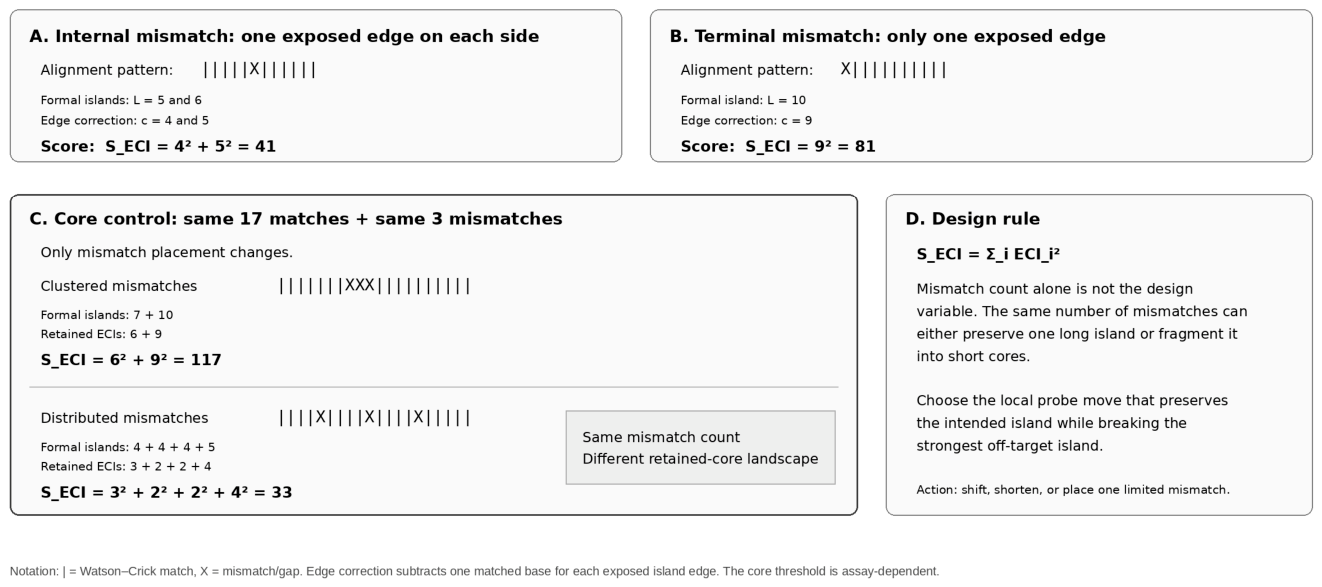
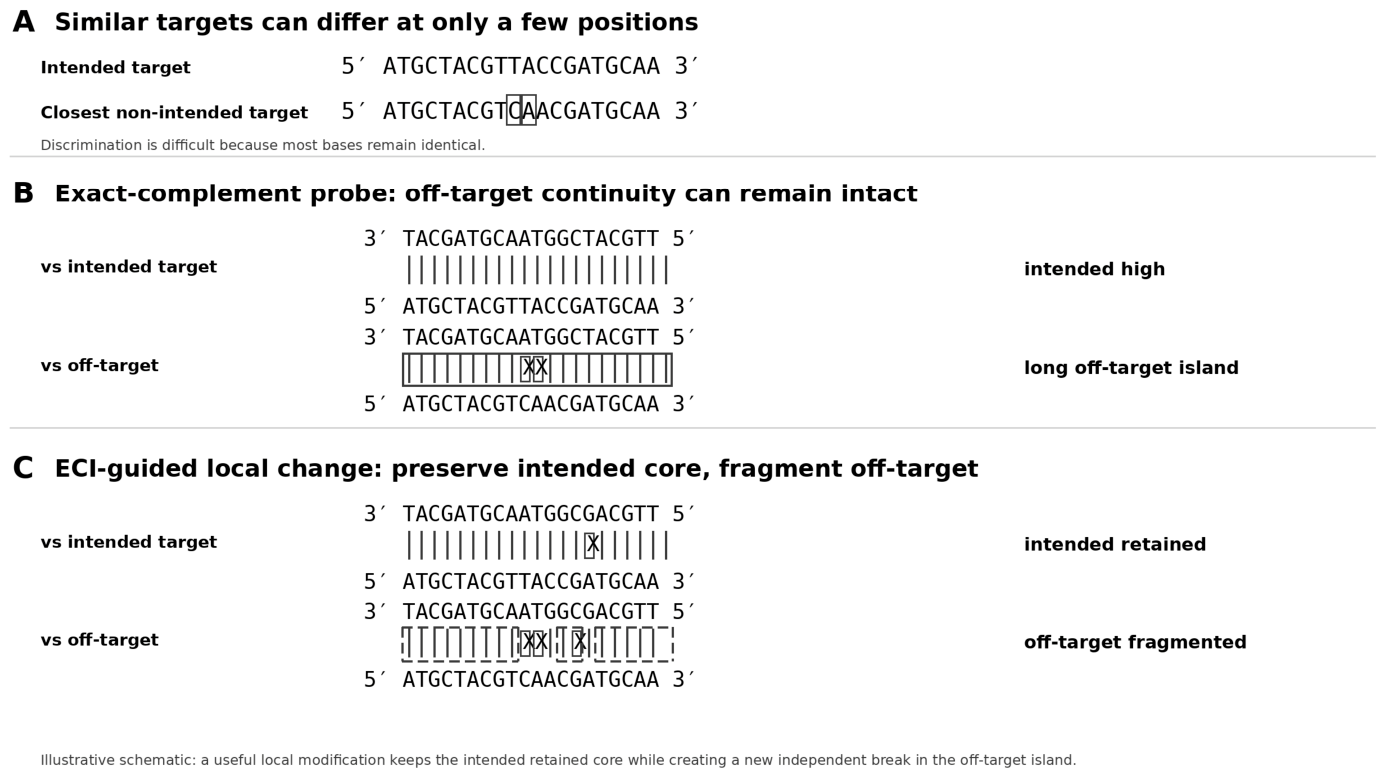
Here, topology refers exclusively to the linear arrangement of matches, mismatches, gaps, and alignment termini along the probe–target alignment, not to higher-order structure. Figure 1 summarizes the practical specificity problem: an exact-complement probe can preserve high intended-target binding while leaving a long retained off-target island, whereas a limited local modification can preserve intended continuity and create a new independent break in that off-target island. The cleanest way to isolate the ECI logic is to hold mismatch burden constant. Figure 2C shows two alignments with the same 17 matches and 3 mismatches. One preserves a long continuous off-target island; the other fragments the same total number of matches into shorter cores. That controlled contrast—same mismatch count, different topology—is the central logic of ECI. Mismatch count alone is not the design variable; mismatch placement is.
Current machine-learning models for nucleic-acid design can learn context-dependent sequence effects from large datasets and may outperform additive nearest-neighbor models for prediction. However, many high-performing models return a candidate score without mapping that score to a discrete experimental action. ECI addresses a different need: it provides a visible topology map that suggests whether to shift the probe, shorten one end, or introduce a limited intentional mismatch for experimental testing.
Here we present ECI as a practical design lens for multiplex, room-temperature, and POC probe design. The framework does not replace nearest-neighbor thermodynamics, BLAST, target-accessibility analysis, machine learning, or empirical optimization. It adds one topological readout: whether a candidate preserves retained matched continuity in the intended target while fragmenting retained continuity in the highest-scoring non-intended target by ECI.

2. Materials and Methods: ECI Scoring as a Fast, Transparent Topology Rule

2.1. Definitions and Retained-Core Correction

A complementary island is an uninterrupted run of Watson–Crick matched bases in a probe–target alignment. An effective complementary island (ECI) is the retained core of that run after local disruption at mismatch- or gap-exposed edges is considered. This is a scoring convention for design and ranking; it is not a claim that an ECI is a new molecular species.
For each formal island of length L_i, the retained core is calculated as:
c_i = max(0, L_i − e_i)
where e_i is the number of mismatch- or gap-exposed edges (0, 1, or 2). An internal mismatch exposes two edges, one on each adjacent island; a terminal mismatch or a mismatch at the alignment end exposes one edge; and a gap is treated like a mismatch for edge exposure. Retained cores meeting the assay-dependent threshold are counted as ECI_i. For the ambient-temperature HPV benchmark, the default threshold is two bases. For higher-stringency settings, a longer threshold should be calibrated (design-action notes in Supplementary Material S1).
The continuity score is:
S_ECI = Σ_i ECI_i^2
The square is a deliberately convex ranking choice. It distinguishes one long retained island from several fragments with the same total number of matched bases. It does not imply that hybridization free energy scales quadratically with island length. Other convex forms could be used; the square is used here for simplicity and definiteness.
For each candidate probe, the operational specificity margin is:
ΔS_ECI = S_ECI (intended) − S_ECI (highest-scoring non-intended alignment by ECI)
The highest-scoring non-intended alignment by ECI is the off-target alignment with the largest S_ECI value. If two off-targets have the same S_ECI, both should be inspected, and the one with the lower ΔG37 or higher empirical cross-signal should drive the conservative design decision. A positive margin means the intended alignment retains more continuity than the highest-scoring non-intended alignment by ECI. A candidate is useful only if S_ECI (intended), ΔG37 (intended), or the empirical signal remains above the assay-specific sensitivity floor. The complete scoring sequence is summarized in Algorithm 1. ECI scoring was implemented with author scripts and spreadsheet tabulation; versioned executable scripts should be supplied with the supplementary or repository package.
Algorithm 1. Minimal reproducible ECI scoring workflow
Input: probe sequence, intended target window, off-target panel, retained-core threshold.
1. Align the candidate probe to the intended target and all off-target windows.
2. Convert each alignment to a match/mismatch string.
3. Identify formal matched islands.
4. For each island, subtract one base for each mismatch- or gap-exposed edge.
5. Keep retained cores that meet the assay-dependent threshold.
6. Compute S_ECI = Σ_i ECI_i^2 for intended and all off-target windows.
7. Calculate ΔS_ECI using the highest-scoring non-intended alignment by ECI.
8. If the margin is weak, redesign locally by shifting, shortening, or placing one limited mismatch that creates a new break in the longest retained off-target island.

2.2. Thermodynamic Comparator

ΔG37 values were calculated using the SantaLucia/Hicks nearest-neighbor model [22] with full capture-probe and HPV motif sequences and available mismatch tables. The subscript 37 denotes 37 °C, the conventional reference temperature for reporting DNA nearest-neighbor free-energy parameters; it does not mean that the HPV assay was performed at 37 °C. Positive ΔΔG37 indicates that the intended duplex is predicted to be thermodynamically favored. Important: ΔG37 is used only to verify a minimum stability floor for sensitivity. It is not used to validate ECI as a thermodynamic proxy. The two metrics ask different questions: ECI asks where matches and mismatches lie; ΔG asks how strongly the probe binds under the reference model.

2.3. Independent Affymetrix Mismatch-Topology Reanalysis

A literature-based subset was assembled from public Affymetrix U133A/U133 Plus 2.0 mismatch-probe reports [9,10] to illustrate the same-count/different-topology principle in a different experimental setting. This analysis is retrospective and limited (n = 8 probes meeting predefined criteria); it is intended as an independent consistency check, not as definitive validation. Inclusion criteria were defined before scoring: (i) identical or ±1 mismatch count between clustered and distributed variants, (ii) same intended target context, and (iii) reported log2 intensity available in the source table. No probes meeting these criteria were excluded.

3. Results: Two Retrospective Tests of the Topology Rule

3.1. 39-Target HPV Ambient-Temperature Benchmark

The primary benchmark is a fixed 39-target HPV capture-probe panel from prior ambient-temperature HPV typing work [4]. Each capture probe is 21–23 nt and must recognize one intended HPV motif while avoiding 38 related motifs under shared, non-denaturing, PCR-compatible hybridization conditions. This is a practical stress test for multiplex and POC-compatible probe design because assay stringency cannot be tuned separately for every probe–target pair.
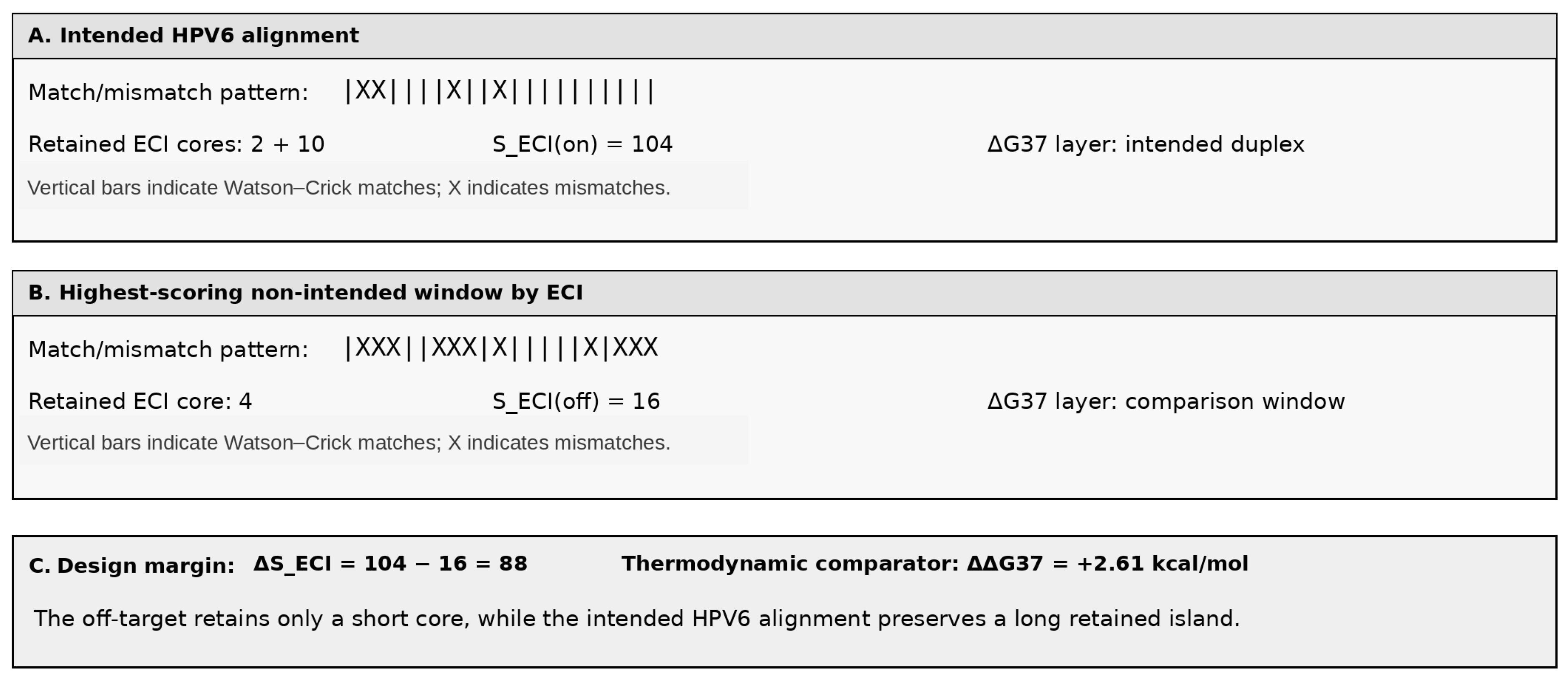
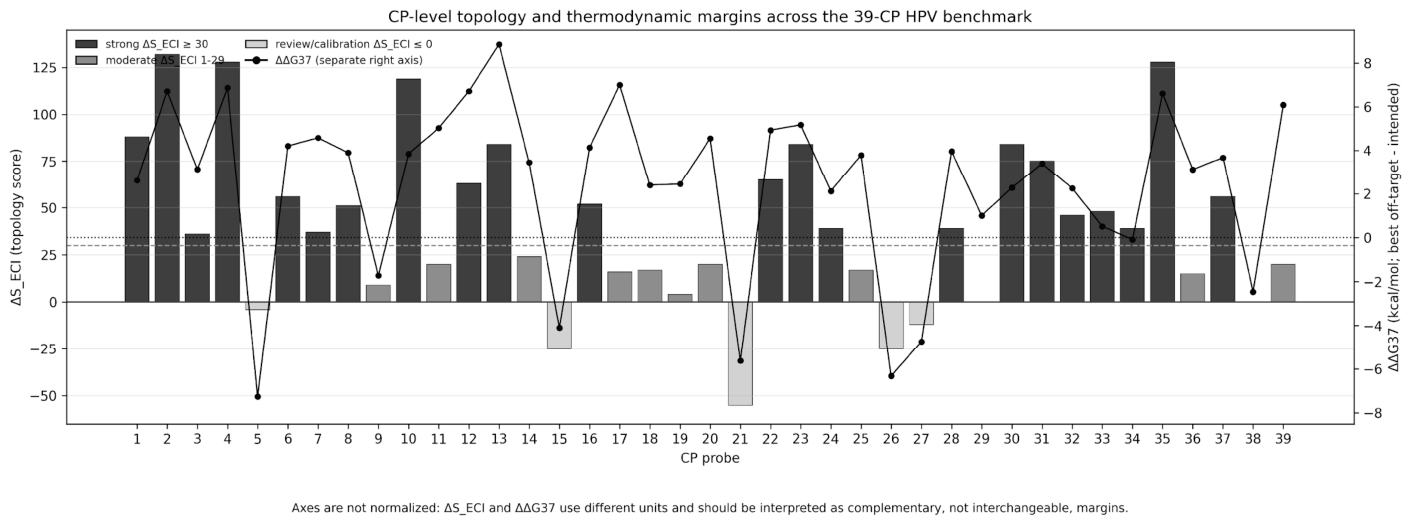
Using the default retained-core threshold, the 39 panels produced 22 strong cases (ΔS_ECI ≥ 30), 10 moderate cases (ΔS_ECI = 1–29), and 7 review/calibration cases (ΔS_ECI ≤ 0). ECI separated the intended target from the highest-scoring non-intended alignment by ECI in 32/39 panels; ΔG37 favored the intended duplex in 31/39 panels; and the two layers were concordant in 36/39 panels. Because all 39 CP probes were empirically functional in the original study [4], this benchmark tests ECI’s ability to rank acceptable designs, not its ability to discriminate successful from unsuccessful designs. A prospective test using deliberately poor probes is needed. Full data are provided in Supplementary Tables S2–S6. Representative strong cases are summarized in Table 1, and the CP1/HPV6 worked example is shown in Figure 3.

3.2. Discordant Cases Identify Redesign or Calibration Actions

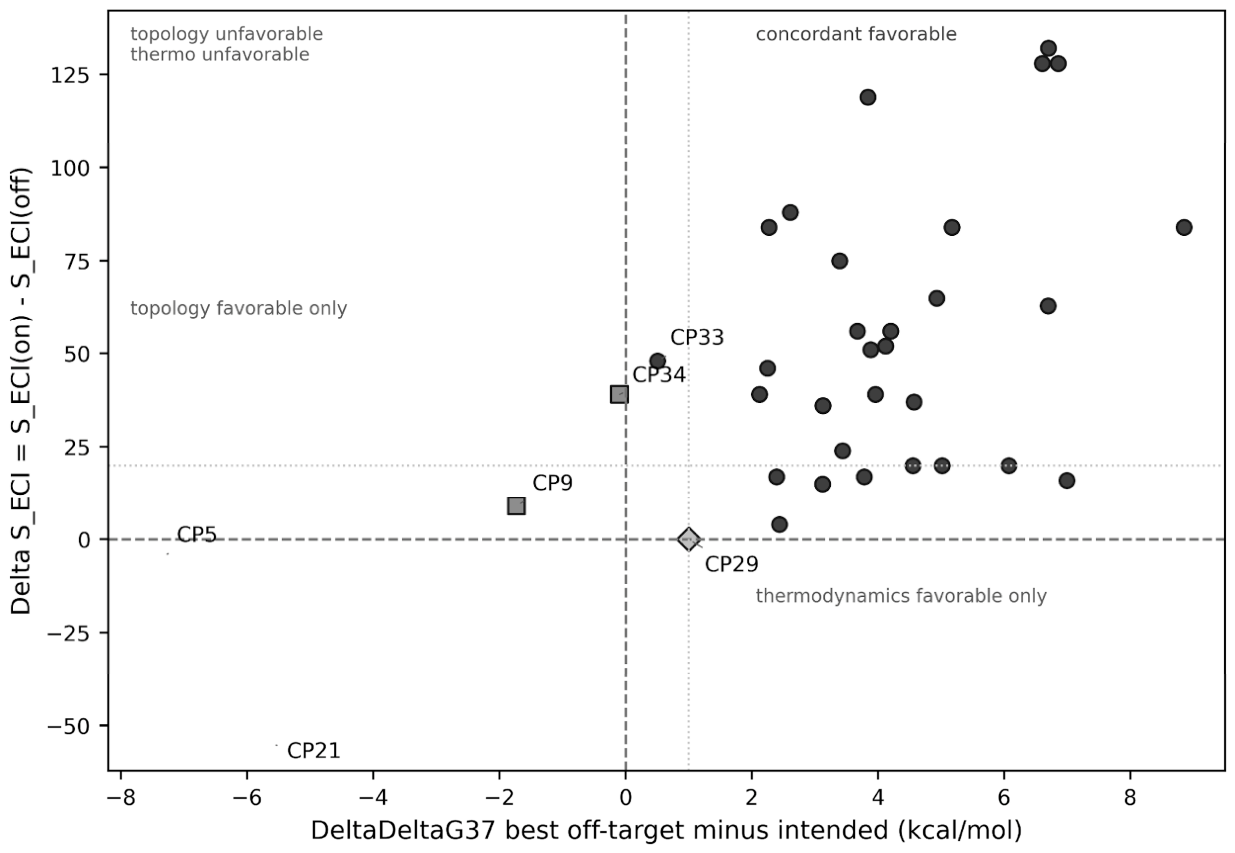
The most useful cases are not only those where every metric agrees. They are the calibration cases where topology and thermodynamics emphasize different risks. CP33/HPV70 has a weak thermodynamic margin but a strong topology margin, suggesting that off-target fragmentation may explain discrimination despite a narrow stability margin. CP29/HPV66 is thermodynamically favorable but topology-neutral, so it should be reviewed rather than automatically accepted. CP5/HPV18 and CP21/HPV54 deserve special attention. Both ECI and ΔG37 flag these as high-risk, yet the original empirical assay did not identify HPV18 or HPV54 among the clones requiring additional subtractive selection [4]. In a prediction setting, these would be conservative false-risk flags. Their value is that they expose the boundary of an alignment-only screen. Possible explanations include probe self-structure, target secondary or higher-order structure, local accessibility, surface or matrix effects, and assay-specific kinetics. These cases should be treated as calibration exceptions for the current screen, not as automatic rejections. These calibration cases are summarized in Table 2, the panel-level margins are shown in Figure 4, and the relationship between topology and thermodynamics is shown in Figure 5.

3.3. Independent Affymetrix Fixed-Mismatch Reanalysis as Illustrative Support

To illustrate the same-count/different-topology principle outside the HPV benchmark, we reanalyzed a public Affymetrix mismatch-probe subset [9,10]. The design variable was mismatch placement: probes shared the same target and identical or near-identical mismatch counts, but the mismatches were clustered or distributed. This mirrors Figure 2C, where the same number of mismatches can either preserve a retained island or fragment it into short cores.
Because the sample size is limited (n = 8 for the 2–4 mismatch subset; n = 5 for the strict three-mismatch subset), these results are presented as illustrative consistency checks, not as definitive statistical validation. Within the 2–4 mismatch subset, S_ECI was associated with reported log2 hybridization intensity (Pearson r = 0.92, p = 0.0014). In the strict three-mismatch subset, where mismatch count is exactly fixed, S_ECI remained associated with intensity (r = 0.96; p = 0.010), while ΔG37 did not track the topology-driven signal differences (r = −0.04; p = 0.95). Full values are provided in Supplementary Table S7a,b, Figure S1, and the accompanying CSV file. Table 3 summarizes the independent Affymetrix fixed-mismatch reanalysis.

4. Discussion

4.1. Practical Diagnostic Workflow: Step-by-Step ECI-Guided Probe Selection

The workflow below is the operational core of the method. It is intended for diagnostic developers who must select one probe motif per target under shared multiplex, room-temperature, or POC-compatible conditions. It uses ECI as an interpretable first-pass filter before synthesis, not as a final diagnostic acceptance test. Additional design-action notes and caveats are provided in design-action notes. Table 4 provides the bench-ready workflow.
Primer applications require an additional 3′ terminal gate before interpreting ECI margins, because polymerase extension depends on terminal complementarity and enzyme-specific mismatch tolerance. The present benchmark is probe-based and should not be read as a complete primer-extension model.

4.2. Integration, Limits, and Future Diagnostic Use

ECI should be integrated as an interpretable topology pre-filter within a broader assay-development workflow. Candidate probes that pass the ECI screen still require thermodynamic review, target-accessibility checks, empirical cross-hybridization testing, and platform-specific calibration. Conversely, candidates flagged by ECI should be treated as redesign priorities rather than automatic failures when structure, accessibility, surface effects, or assay kinetics may explain specificity.

4.3. ECI Complements Thermodynamics Rather than Replacing It

The message is deliberately narrow. ECI is a starting design rule for similar-target probe selection, not a test of whether S_ECI should match ΔG37. ΔG37 estimates stability and helps set the sensitivity floor. ECI supplies the topology map that shows whether a local candidate preserves the intended island while fragmenting the highest-scoring off-target island by ECI. Both layers should be used together but for different purposes.
This distinction is especially important for multiplex and room-temperature/POC assays. In a singleplex, high-stringency assay, temperature or wash conditions may be tuned to rescue a marginal probe. In a multiplex POC format, many probes must function under one condition. Weak off-target interactions can accumulate into false-positive type calls. The first-pass design objective is therefore robustness under common conditions, not maximum affinity alone.

4.4. Why Topology Can Matter: Cooperative Melting as a Physical Rationale

Base stacking is a major stabilizing contribution to DNA duplex stability, and its sequence-context dependence is captured by nearest-neighbor thermodynamics [5,22]. Cooperative melting and nucleation studies show that disruption of one base pair can affect neighboring pairs and that continuous segments may behave differently from fragmented segments of the same total length [23,24,25,26,27].
ECI is not derived from stacking energetics. However, the observation that continuous matched runs behave differently from fragmented runs is consistent with cooperative melting phenomena. This intuition is already present in earlier probe-design studies: Letowski et al. showed that, for a fixed mismatch count, probes with mismatches distributed across their length were more specific in microarray hybridizations than probes with mismatches clustered at either end, and Deng et al. similarly found evenly distributed mismatches superior for long-oligonucleotide mismatch-probe discrimination [28,29]. ECI formalizes this retained-island topology principle, turning an empirical guideline into an auditable, redesign-actionable map.

4.5. Interpretability Beyond Predictive Accuracy

Deep learning and ensemble models can learn sequence–performance relationships from large datasets [30,31,32,33], and such models may eventually outperform simple heuristics for prediction. ECI occupies a different niche. It does not attempt to compete with black-box models on raw accuracy. It provides a design-action map: when a candidate fails, the user can inspect which off-target island remains too long and choose a local modification that creates a new independent break.
This makes ECI useful as a pre-filter, an interpretable constraint for generative design, or a feature layer for future machine-learning models. A combined workflow—ECI for transparent first-pass topology and thermodynamics or AI for fine calibration—may be more useful than any single score alone.

4.6. Limitations and Next Tests

  • The HPV benchmark and Affymetrix reanalysis are retrospective. The HPV benchmark tests ranking of empirically successful probes, not discrimination from failed probes. The Affymetrix dataset is limited and should be viewed as illustrative. Prospective redesign studies are the decisive next step.
  • S_ECI is a heuristic ranking score, not a measured free energy or universal physical law.
  • The retained-core threshold and S_ECI(on) sensitivity floor must be calibrated for each temperature, salt condition, Mg2+ concentration, probe chemistry, target class, and readout platform (Supplementary Note S9).
  • The highest-scoring non-intended alignment by ECI and the most stable off-target by ΔG37 may differ; both should be inspected in screening reports.
  • ECI does not account for probe self-dimer or hairpin formation, target secondary or higher-order structure, local target accessibility, or surface/matrix effects, any of which can dominate specificity failures even with favorable ΔS_ECI margins. Primer applications require separate 3′ gating and polymerase-specific extension rules.
Prospective synthesis and testing of ECI-guided redesigns, especially CP5/HPV18, CP21/HPV54, and CP29/HPV66, under the original ambient conditions and while holding mismatch count constant where possible, is the decisive validation step. Such experiments should compare exact and ECI-guided redesign candidates for intended signal and cross-signal, and should also include measurements or models of probe self-structure, target secondary or higher-order structure, local target accessibility, and surface/matrix effects.

5. Conclusions and Bench-Ready Checklist

Specificity among closely related DNA targets is a motif-selection problem. In multiplex room-temperature diagnostics, the useful probe is not simply the strongest exact complement or the candidate with the fewest mismatches. The decisive feature can be topology: with the same mismatch count, one alignment may retain a long off-target island whereas another fragments the same matches into short cores.
ECI makes this distinction visible and actionable. It turns an alignment into a design map, ranks local candidates, and identifies the next modification when the first candidate fails. The practical rule is simple: preserve intended retained-island continuity above the assay floor, fragment the strongest off-target island, and then use thermodynamics and empirical testing to set final acceptance thresholds.
Bench checklist: start from the exact complement; align against all similar off-targets; compute S_ECI(on) and ΔS_ECI; verify the assay-specific on-target floor; apply one local fix if needed; re-score; synthesize; test signal and cross-signal; iterate once.
The 39-target HPV benchmark and the independent fixed-mismatch reanalysis support ECI as a practical, auditable first-pass filter for multiplex, room-temperature, and POC probe design. The framework is valuable precisely because it is not a black-box predictor: it shows the designer where the next experimental move should be made, while thermodynamics and empirical testing set final acceptance thresholds. The next decisive test is prospective synthesis of ECI-guided redesigns that hold mismatch count constant while changing mismatch placement.

Supplementary Materials

The following supporting information can be downloaded at: https://www.mdpi.com/article/10.3390/dna6020027/s1, Supplementary Material S1: Scoring definitions and same-mismatch-count topology control (Notes S1 and S2), fixed historical HPV benchmark validation design (Supplementary Table S1), full CP/intended-HPV ECI atlas (Supplementary Table S2), retained-core threshold sensitivity (Supplementary Table S3), conventional-metric comparison (Supplementary Table S4), CP/intended-HPV-level topology/thermodynamics atlas (Supplementary Table S5), benchmark summary statistics (Supplementary Table S6), and Affymetrix mismatch-topology validation summary and dataset (Supplementary Table S7a,b), Figure S1: Independent Affymetrix mismatch-topology validation, and design-action notes (Supplementary Note S9). References [9,10,22,34] are cited in the Supplementary Materials and are included in the main reference list.

Author Contributions

Conceptualization, I.B. and M.K.; methodology, I.B.; formal analysis, I.B.; investigation, I.B.; data curation, I.B.; visualization, I.B.; writing—original draft preparation, I.B.; writing—review and editing, I.B. and M.K.; supervision, M.K.; funding acquisition, M.K. All authors have read and agreed to the published version of the manuscript.

Funding

The legacy work discussed in this article was supported by the Canadian Institutes of Health Research (NTA-71859) and the Research Center of Sainte-Justine Hospital. M.K. is a scholar of the Fonds de la Recherche en Santé du Québec. The sponsors had no role in the design, execution, interpretation, or writing of the study.

Institutional Review Board Statement

Not applicable.

Informed Consent Statement

Not applicable.

Data Availability Statement

The original contributions presented in this study are included in the article and Supplementary Materials. Further inquiries can be directed to the corresponding author.

Acknowledgments

This article is presented in recognition of the scientific legacy built through the mentorship and leadership of André Dascal and Damian Labuda, and through support from the Canadian Institutes of Health Research. The author gratefully acknowledges Vince Forgetta (Montreal) for the development of differential 16S rRNA gene operon amplification primers using 8–15-mer design principles aimed at minimizing mitochondrial DNA amplification. qPCR results demonstrated highly selective and differential amplification of bacterial genomes from human fluids. Primer sequences are available upon request for further NGS validation.

Conflicts of Interest

The authors declare no conflicts of interest.

References

  1. Demidov, V.V.; Frank-Kamenetskii, M.D. Two sides of the coin: Affinity and specificity of nucleic acid interactions. Trends Biochem. Sci. 2004, 29, 62–71. [Google Scholar] [CrossRef]
  2. Brukner, I.; El-Ramahi, R.; Gorska-Flipot, I.; Krajinovic, M.; Labuda, D. An in vitro selection scheme for oligonucleotide probes to discriminate between closely related DNA sequences. Nucleic Acids Res. 2007, 35, e66. [Google Scholar] [CrossRef]
  3. Brukner, I.; Krajinovic, M.; Dascal, A.; Labuda, D. A protocol for the in vitro selection of specific oligonucleotide probes for high-resolution DNA typing. Nat. Protoc. 2007, 2, 2806–2819. [Google Scholar] [CrossRef]
  4. Brukner, I.; El-Ramahi, R.; Sawicki, J.; Gorska-Flipot, I.; Krajinovic, M.; Labuda, D. Hybridization assay performed at ambient temperature for typing high-risk human papillomaviruses. J. Clin. Virol. 2007, 39, 113–118. [Google Scholar] [CrossRef]
  5. Yakovchuk, P.; Protozanova, E.; Frank-Kamenetskii, M.D. Base-stacking and base-pairing contributions into thermal stability of the DNA double helix. Nucleic Acids Res. 2006, 34, 564–574. [Google Scholar] [CrossRef]
  6. Hadiwikarta, W.W.; Walter, J.C.; Hooyberghs, J.; Carlon, E. Probing hybridization parameters from microarray experiments: Nearest-neighbor model and beyond. Nucleic Acids Res. 2012, 40, e138. [Google Scholar] [CrossRef] [PubMed]
  7. Suzuki, S.; Ono, N.; Furusawa, C.; Kashiwagi, A.; Yomo, T. Experimental optimization of probe length to increase the sequence specificity of high-density oligonucleotide microarrays. BMC Genom. 2007, 8, 373. [Google Scholar] [CrossRef] [PubMed]
  8. Lee, I.; Dombkowski, A.A.; Athey, B.D. Guidelines for incorporating non-perfectly matched oligonucleotides into target-specific hybridization probes for a DNA microarray. Nucleic Acids Res. 2004, 32, 681–690. [Google Scholar] [CrossRef]
  9. Harbig, J.; Sprinkle, R.; Enkemann, S.A. A sequence-based identification of the genes detected by probesets on the Affymetrix U133 plus 2.0 array. Nucleic Acids Res. 2005, 33, e31. [Google Scholar] [CrossRef] [PubMed]
  10. Wang, Y.; Miao, Z.H.; Pommier, Y.; Kawasaki, E.S.; Player, A. Characterization of mismatch and high-signal intensity probes associated with Affymetrix GeneChips. Bioinformatics 2007, 23, 2088–2095. [Google Scholar] [CrossRef]
  11. Hertel, S.; Spinney, R.E.; Xu, S.Y.; Ouldridge, T.E.; Morris, R.G.; Lee, L.K. The stability and number of nucleating interactions determine DNA hybridization rates in the absence of secondary structure. Nucleic Acids Res. 2022, 50, 7829–7841. [Google Scholar] [CrossRef] [PubMed]
  12. Majlessi, M.; Becker, M.M. Formation of the double helix: A mutational study. Nucleic Acids Res. 2008, 36, 2981–2989. [Google Scholar] [CrossRef] [PubMed][Green Version]
  13. Rejali, N.A.; Moric, E.; Wittwer, C.T. The effect of single mismatches on primer extension. Clin. Chem. 2018, 64, 801–809. [Google Scholar] [CrossRef]
  14. Ayyadevara, S.; Thaden, J.J.; Shmookler Reis, R.J. Discrimination of primer 3′-nucleotide mismatch by Taq DNA polymerase during PCR. Anal. Biochem. 2000, 284, 11–18. [Google Scholar] [CrossRef] [PubMed]
  15. Lefever, S.; Rihani, A.; Van der Meulen, J.; Pattyn, F.; Van Maerken, T.; Van Dorpe, J.; Hellemans, J.; Vandesompele, J. Cost-effective and robust genotyping using double-mismatch allele-specific quantitative PCR. Sci. Rep. 2019, 9, 2150. [Google Scholar] [CrossRef]
  16. Miura, F.; Uematsu, C.; Sakaki, Y.; Ito, T. A strategy to design highly specific PCR primers based on the stability and uniqueness of 3′-end subsequences. Bioinformatics 2005, 21, 4363–4370. [Google Scholar] [CrossRef]
  17. Qu, W.; Shen, Z.; Zhao, D.; Yang, Y.; Zhang, C. MFEprimer: Multiple factor evaluation of the specificity of PCR primers. Bioinformatics 2009, 25, 276–278. [Google Scholar] [CrossRef]
  18. Todisco, M.; Ding, D.; Szostak, J.W. Transient states during the annealing of mismatched and bulged oligonucleotides. Nucleic Acids Res. 2024, 52, 2174–2187. [Google Scholar] [CrossRef]
  19. Yu, H.; Han, X.; Zhang, L.; Yin, N.; Wang, L.; Lv, K.; Wu, Y.; Bai, D.; Wang, W.; Huang, Y.; et al. Design of mismatch closure for enhanced specificity in DNA strand displacement reactions. Nucleic Acids Res. 2025, 53, gkaf660. [Google Scholar] [CrossRef]
  20. Baker, G.C.; Smith, J.J.; Cowan, D.A. Review and re-analysis of domain-specific 16S primers. J. Microbiol. Methods 2003, 55, 541–555. [Google Scholar] [CrossRef]
  21. Klindworth, A.; Pruesse, E.; Schweer, T.; Peplies, J.; Quast, C.; Horn, M.; Glockner, F.O. Evaluation of general 16S ribosomal RNA gene PCR primers for classical and next-generation sequencing-based diversity studies. Nucleic Acids Res. 2013, 41, e1. [Google Scholar] [CrossRef]
  22. SantaLucia, J., Jr.; Hicks, D. The thermodynamics of DNA structural motifs. Annu. Rev. Biophys. Biomol. Struct. 2004, 33, 415–440. [Google Scholar] [CrossRef]
  23. Crothers, D.M.; Kallenbach, N.R. On the mechanism of DNA melting. J. Chem. Phys. 1966, 45, 917–927. [Google Scholar] [CrossRef]
  24. Wartell, R.M.; Benight, A.S. Thermal denaturation of DNA molecules: A comparison of theory with experiment. Phys. Rep. 1985, 126, 67–107. [Google Scholar] [CrossRef]
  25. Woodside, M.T.; Behnke-Parks, W.M.; Larizadeh, K.; Travers, K.; Herschlag, D.; Block, S.M. Nanomechanical measurements of the sequence-dependent folding landscapes of single nucleic acid hairpins. Proc. Natl. Acad. Sci. USA 2006, 103, 6190–6195. [Google Scholar] [CrossRef] [PubMed]
  26. Hyeon, C.; Thirumalai, D. Cooperativity and allostery in RNA folding. J. Phys. Condens. Matter 2007, 19, 113101. [Google Scholar] [CrossRef]
  27. Rouzina, I.; Bloomfield, V.A. Cooperative melting of long DNA molecules in the presence of an intercalator. Biophys. J. 1999, 77, 3242–3251. [Google Scholar] [CrossRef]
  28. Letowski, J.; Brousseau, R.; Masson, L. Designing better probes: Effect of probe size, mismatch position and number on hybridization in DNA oligonucleotide microarrays. J. Microbiol. Methods 2004, 57, 269–278. [Google Scholar] [CrossRef] [PubMed]
  29. Deng, Y.; He, Z.; Van Nostrand, J.D.; Zhou, J. Design and analysis of mismatch probes for long oligonucleotide microarrays. BMC Genom. 2008, 9, 491. [Google Scholar] [CrossRef]
  30. Alipanahi, B.; Delong, A.; Weirauch, M.T.; Frey, B.J. Predicting the sequence specificities of DNA- and RNA-binding proteins by deep learning. Nat. Biotechnol. 2015, 33, 831–838. [Google Scholar] [CrossRef]
  31. Eraslan, G.; Avsec, Z.; Gagneur, J.; Theis, F.J. Deep learning: New computational modelling techniques for genomics. Nat. Rev. Genet. 2019, 20, 389–403. [Google Scholar] [CrossRef] [PubMed]
  32. Novakovsky, G.; Dexter, N.; Libbrecht, M.W.; Wasserman, W.W.; Mostafavi, S. Obtaining genetics insights from deep learning via explainable artificial intelligence. Nat. Rev. Genet. 2023, 24, 125–137. [Google Scholar] [CrossRef]
  33. Buterez, D. Scaling up DNA digital data storage by efficiently predicting DNA hybridisation using deep learning. Sci. Rep. 2021, 11, 20517. [Google Scholar] [CrossRef] [PubMed]
  34. Owczarzy, R.; Moreira, B.G.; You, Y.; Behlke, M.A.; Walder, J.A. Predicting stability of DNA duplexes in solutions containing magnesium and monovalent cations. Biochemistry 2008, 47, 5336–5353. [Google Scholar] [CrossRef]
Figure 1. Specificity-aware probe design and local ECI redesign logic. (A) Closely related targets may differ at only a few positions, so long matched regions can remain after mismatches. (B) An exact-complement probe preserves high intended-target continuity but may also leave a long retained island in the strongest off-target. (C) A limited ECI-guided local modification can preserve intended retained continuity while introducing a new independent break in the off-target island. Vertical bars indicate Watson–Crick matches and X indicates mismatches. Sequences are illustrative and the schematic is original to this manuscript.
Dna 06 00027 g001
Figure 2. Same mismatch count, different topology. (A) An internal mismatch exposes one edge of each neighboring formal island. (B) A terminal mismatch exposes only one edge. (C) The core control holds mismatch burden constant: both examples have 17 Watson–Crick matches and 3 mismatches. Only mismatch placement changes. Clustered mismatches retain longer corrected cores and score S_ECI = 117, whereas distributed mismatches fragment the retained-core landscape and score S_ECI = 33. (D) The practical design rule is to preserve intended retained continuity while introducing a new independent break in the strongest off-target island. Notation: | indicates a Watson–Crick match and X indicates a mismatch or gap.
Dna 06 00027 g002
Figure 3. CP1/HPV6 worked example. The intended alignment retains ECIs of 2 and 10 (S_ECI = 104), whereas the highest-scoring non-intended window by ECI retains one length-4 core (S_ECI = 16). Thus ΔS_ECI = 88. The thermodynamic comparator is also favorable (ΔΔG37 = +2.61 kcal/mol). (A) Intended HPV6 alignment. (B) Highest-scoring non-intended window by ECI. (C) Design margin and thermodynamic comparator.
Dna 06 00027 g003
Figure 4. Panel-level topology and thermodynamic margins across the 39-CP HPV benchmark. Bars show ΔS_ECI and points show ΔΔG37 on a separate axis. The purpose is pattern overview, not unit conversion. Dotted horizontal and vertical lines mark zero topology and thermodynamic margins; faint boundary lines indicate review thresholds used for visual classification.
Dna 06 00027 g004
Figure 5. Topology and thermodynamics are concordant but not redundant. Upper-right cases are favorable in both layers; off-diagonal cases identify where topology or thermodynamics emphasizes a different risk. This figure supports the use of both layers together.
Dna 06 00027 g005
Table 1. Representative strong HPV benchmark cases.
CaseRetained ECI Cores (Intended)S_ECI (On)S_ECI (Off)ΔS_ECIΔΔG37 (kcal/mol)Design Interpretation
CP2/HPV111419664132+6.70Strong; accept
CP4/HPV161214416128+6.86Strong; accept
CP35/HPV731214416128+6.60Strong; accept
CP10/HPV341214425119+3.84Strong; accept
CP1/HPV62 + 101041688+2.61Strong; off-target fragmented
CP13/HPV40101001684+8.85Strong; accept
Table 2. Calibration cases where topology and thermodynamics guide different decisions.
CaseΔS_ECIΔΔG37 (kcal/mol)Layer EmphasizedDesign Action
CP33/HPV70+48+0.51Topology strengthens weak thermodynamic marginMeasure ΔG37 or empirical signal; accept only if above a predefined assay threshold.
CP34/HPV72+39−0.09Topology favorable onlySynthesize and test cross-hybridization against the panel; reject if off-target signal exceeds the assay limit.
CP29/HPV660+1.00Thermodynamics favorable onlyReview alignment; consider shifting by 2–3 bases to create an off-target break while preserving intended core.
CP9/HPV33+9−1.73Weak topology margin and unfavorable thermodynamicsEmpirical stringency testing required; do not use without experimental validation.
CP5/HPV18−4−7.26Retrospective risk flag; empirical exceptionDo not reject solely by ECI/ΔG. Test the original probe; if it works, evaluate structure/accessibility before redesign.
CP21/HPV54−55−5.62Strong retrospective risk flag; empirical exceptionSame as CP5/HPV18; use as a prospective boundary-condition test case.
Table 3. Independent Affymetrix fixed-mismatch reanalysis summary.
Validation ElementResult Used in Manuscript
Dataset contextPublic Affymetrix U133A/U133 Plus 2.0 mismatch-probe literature [9,10]; independent of the HPV benchmark.
Topology controlClustered and distributed mismatch patterns compared at identical or near-identical mismatch counts.
2–4 mismatch subsetS_ECI correlated with log2 intensity (Pearson r = 0.92; p = 0.0014; n = 8).
Fixed three-mismatch subsetWithin the cleanest topology-control subset, S_ECI correlated with intensity (r = 0.96; p = 0.010; n = 5), while ΔG37 did not (r = −0.04; p = 0.95).
Evidence levelIllustrative retrospective consistency check; not definitive validation. Prospective ECI-guided synthesis remains the decisive test.
Data locationFull numerical values are provided in Supplementary Table S7a,b and as a CSV file.
Table 4. Bench-ready ECI workflow for multiplex room-temperature probe design.
StepActionPractical Instruction
1Define the panelList the intended motif and all realistic off-targets, such as related HPV types, close alleles, or nearest 16S variants.
2Generate local candidatesStart from the exact complement, then generate shifted, shortened, and limited-mismatch variants around it.
3Apply standard filtersCheck GC content (40–60%), Tm range (within approximately 5 °C of assay temperature), self-structure, synthesis constraints, and target accessibility.
4Align and scoreCompute S_ECI for intended and off-target windows; identify the highest-scoring off-target by ECI.
5ClassifyΔS_ECI ≥ 30 and S_ECI(on) above the assay floor: strong. ΔS_ECI 1–29: moderate. ΔS_ECI ≤ 0: review/calibrate; redesign only after intended-signal and structure/accessibility checks.
6Make one local moveExample: if the highest-scoring off-target has an 8-base retained island, place one limited mismatch near the middle of that island or shift the probe so that the island is split into smaller cores.
7Verify and testRe-score; verify ΔG37 or empirical signal floor; synthesize and measure intended signal, cross-signal, Ct shift, or LOD.
Disclaimer/Publisher’s Note: The statements, opinions and data contained in all publications are solely those of the individual author(s) and contributor(s) and not of MDPI and/or the editor(s). MDPI and/or the editor(s) disclaim responsibility for any injury to people or property resulting from any ideas, methods, instructions or products referred to in the content.