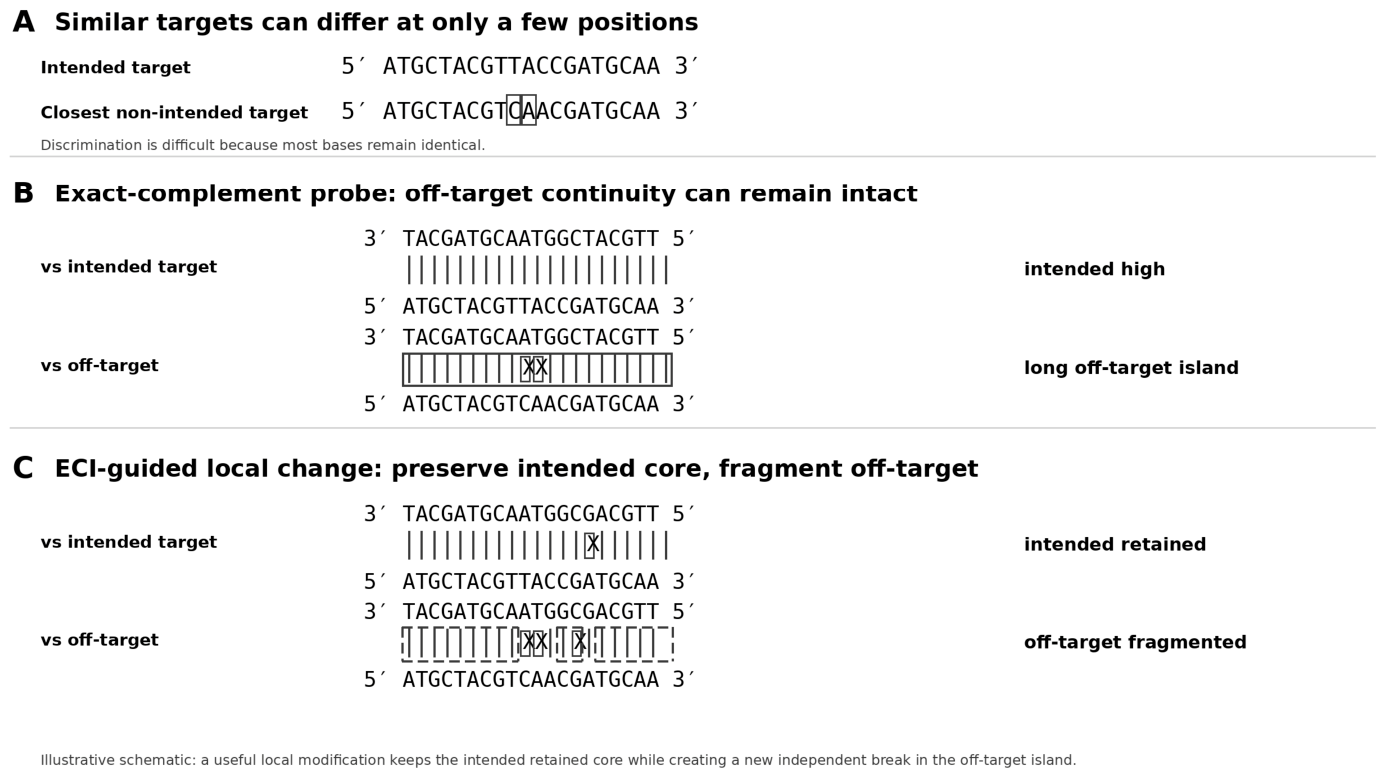

Effective Complementary Islands (ECIs) for Multiplex Room-Temperature DNA Probe Design—A Practical Topology Heuristic and 39-Target HPV Specificity Benchmark



Abstract
1. Introduction: The Diagnostic Need for Practical Specificity Tools
2. Materials and Methods: ECI Scoring as a Fast, Transparent Topology Rule
2.1. Definitions and Retained-Core Correction
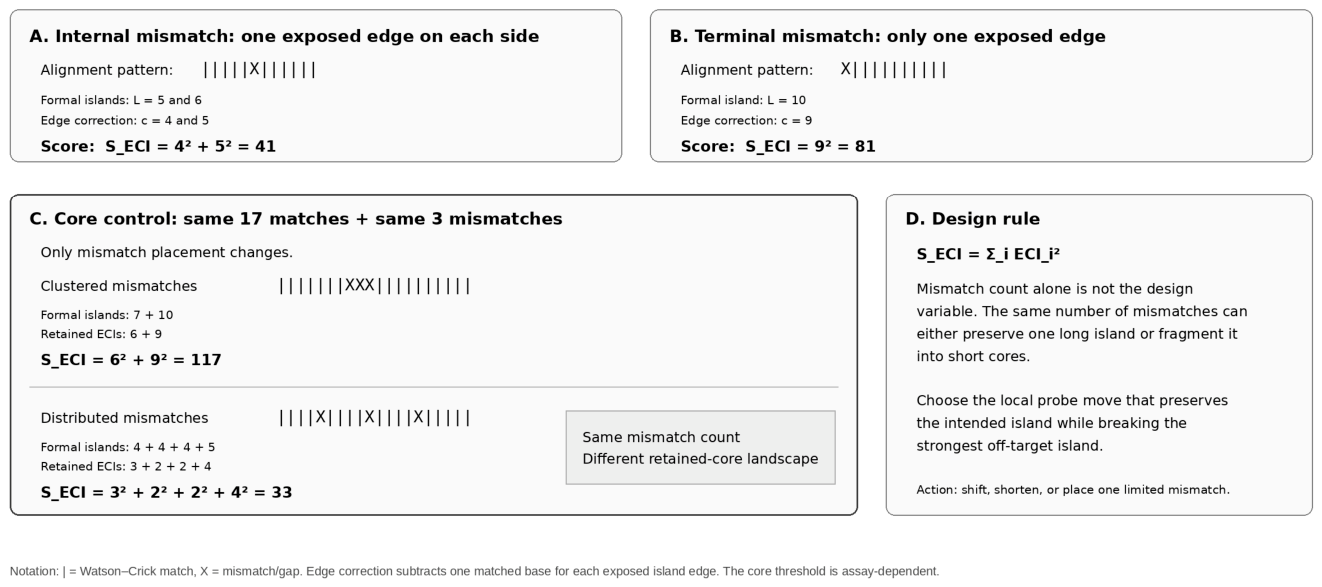
| Algorithm 1. Minimal reproducible ECI scoring workflow |
| Input: probe sequence, intended target window, off-target panel, retained-core threshold. 1. Align the candidate probe to the intended target and all off-target windows. 2. Convert each alignment to a match/mismatch string. 3. Identify formal matched islands. 4. For each island, subtract one base for each mismatch- or gap-exposed edge. 5. Keep retained cores that meet the assay-dependent threshold. 6. Compute S_ECI = Σ_i ECI_i^2 for intended and all off-target windows. 7. Calculate ΔS_ECI using the highest-scoring non-intended alignment by ECI. 8. If the margin is weak, redesign locally by shifting, shortening, or placing one limited mismatch that creates a new break in the longest retained off-target island. |
2.2. Thermodynamic Comparator
2.3. Independent Affymetrix Mismatch-Topology Reanalysis
3. Results: Two Retrospective Tests of the Topology Rule
3.1. 39-Target HPV Ambient-Temperature Benchmark
3.2. Discordant Cases Identify Redesign or Calibration Actions
3.3. Independent Affymetrix Fixed-Mismatch Reanalysis as Illustrative Support
4. Discussion
4.1. Practical Diagnostic Workflow: Step-by-Step ECI-Guided Probe Selection
4.2. Integration, Limits, and Future Diagnostic Use
4.3. ECI Complements Thermodynamics Rather than Replacing It
4.4. Why Topology Can Matter: Cooperative Melting as a Physical Rationale
4.5. Interpretability Beyond Predictive Accuracy
4.6. Limitations and Next Tests
- The HPV benchmark and Affymetrix reanalysis are retrospective. The HPV benchmark tests ranking of empirically successful probes, not discrimination from failed probes. The Affymetrix dataset is limited and should be viewed as illustrative. Prospective redesign studies are the decisive next step.
- S_ECI is a heuristic ranking score, not a measured free energy or universal physical law.
- The retained-core threshold and S_ECI(on) sensitivity floor must be calibrated for each temperature, salt condition, Mg2+ concentration, probe chemistry, target class, and readout platform (Supplementary Note S9).
- The highest-scoring non-intended alignment by ECI and the most stable off-target by ΔG37 may differ; both should be inspected in screening reports.
- ECI does not account for probe self-dimer or hairpin formation, target secondary or higher-order structure, local target accessibility, or surface/matrix effects, any of which can dominate specificity failures even with favorable ΔS_ECI margins. Primer applications require separate 3′ gating and polymerase-specific extension rules.
5. Conclusions and Bench-Ready Checklist
Supplementary Materials
Author Contributions
Funding
Institutional Review Board Statement
Informed Consent Statement
Data Availability Statement
Acknowledgments
Conflicts of Interest
References
- Demidov, V.V.; Frank-Kamenetskii, M.D. Two sides of the coin: Affinity and specificity of nucleic acid interactions. Trends Biochem. Sci. 2004, 29, 62–71. [Google Scholar] [CrossRef]
- Brukner, I.; El-Ramahi, R.; Gorska-Flipot, I.; Krajinovic, M.; Labuda, D. An in vitro selection scheme for oligonucleotide probes to discriminate between closely related DNA sequences. Nucleic Acids Res. 2007, 35, e66. [Google Scholar] [CrossRef]
- Brukner, I.; Krajinovic, M.; Dascal, A.; Labuda, D. A protocol for the in vitro selection of specific oligonucleotide probes for high-resolution DNA typing. Nat. Protoc. 2007, 2, 2806–2819. [Google Scholar] [CrossRef]
- Brukner, I.; El-Ramahi, R.; Sawicki, J.; Gorska-Flipot, I.; Krajinovic, M.; Labuda, D. Hybridization assay performed at ambient temperature for typing high-risk human papillomaviruses. J. Clin. Virol. 2007, 39, 113–118. [Google Scholar] [CrossRef]
- Yakovchuk, P.; Protozanova, E.; Frank-Kamenetskii, M.D. Base-stacking and base-pairing contributions into thermal stability of the DNA double helix. Nucleic Acids Res. 2006, 34, 564–574. [Google Scholar] [CrossRef]
- Hadiwikarta, W.W.; Walter, J.C.; Hooyberghs, J.; Carlon, E. Probing hybridization parameters from microarray experiments: Nearest-neighbor model and beyond. Nucleic Acids Res. 2012, 40, e138. [Google Scholar] [CrossRef] [PubMed]
- Suzuki, S.; Ono, N.; Furusawa, C.; Kashiwagi, A.; Yomo, T. Experimental optimization of probe length to increase the sequence specificity of high-density oligonucleotide microarrays. BMC Genom. 2007, 8, 373. [Google Scholar] [CrossRef] [PubMed]
- Lee, I.; Dombkowski, A.A.; Athey, B.D. Guidelines for incorporating non-perfectly matched oligonucleotides into target-specific hybridization probes for a DNA microarray. Nucleic Acids Res. 2004, 32, 681–690. [Google Scholar] [CrossRef]
- Harbig, J.; Sprinkle, R.; Enkemann, S.A. A sequence-based identification of the genes detected by probesets on the Affymetrix U133 plus 2.0 array. Nucleic Acids Res. 2005, 33, e31. [Google Scholar] [CrossRef] [PubMed]
- Wang, Y.; Miao, Z.H.; Pommier, Y.; Kawasaki, E.S.; Player, A. Characterization of mismatch and high-signal intensity probes associated with Affymetrix GeneChips. Bioinformatics 2007, 23, 2088–2095. [Google Scholar] [CrossRef]
- Hertel, S.; Spinney, R.E.; Xu, S.Y.; Ouldridge, T.E.; Morris, R.G.; Lee, L.K. The stability and number of nucleating interactions determine DNA hybridization rates in the absence of secondary structure. Nucleic Acids Res. 2022, 50, 7829–7841. [Google Scholar] [CrossRef] [PubMed]
- Majlessi, M.; Becker, M.M. Formation of the double helix: A mutational study. Nucleic Acids Res. 2008, 36, 2981–2989. [Google Scholar] [CrossRef] [PubMed][Green Version]
- Rejali, N.A.; Moric, E.; Wittwer, C.T. The effect of single mismatches on primer extension. Clin. Chem. 2018, 64, 801–809. [Google Scholar] [CrossRef]
- Ayyadevara, S.; Thaden, J.J.; Shmookler Reis, R.J. Discrimination of primer 3′-nucleotide mismatch by Taq DNA polymerase during PCR. Anal. Biochem. 2000, 284, 11–18. [Google Scholar] [CrossRef] [PubMed]
- Lefever, S.; Rihani, A.; Van der Meulen, J.; Pattyn, F.; Van Maerken, T.; Van Dorpe, J.; Hellemans, J.; Vandesompele, J. Cost-effective and robust genotyping using double-mismatch allele-specific quantitative PCR. Sci. Rep. 2019, 9, 2150. [Google Scholar] [CrossRef]
- Miura, F.; Uematsu, C.; Sakaki, Y.; Ito, T. A strategy to design highly specific PCR primers based on the stability and uniqueness of 3′-end subsequences. Bioinformatics 2005, 21, 4363–4370. [Google Scholar] [CrossRef]
- Qu, W.; Shen, Z.; Zhao, D.; Yang, Y.; Zhang, C. MFEprimer: Multiple factor evaluation of the specificity of PCR primers. Bioinformatics 2009, 25, 276–278. [Google Scholar] [CrossRef]
- Todisco, M.; Ding, D.; Szostak, J.W. Transient states during the annealing of mismatched and bulged oligonucleotides. Nucleic Acids Res. 2024, 52, 2174–2187. [Google Scholar] [CrossRef]
- Yu, H.; Han, X.; Zhang, L.; Yin, N.; Wang, L.; Lv, K.; Wu, Y.; Bai, D.; Wang, W.; Huang, Y.; et al. Design of mismatch closure for enhanced specificity in DNA strand displacement reactions. Nucleic Acids Res. 2025, 53, gkaf660. [Google Scholar] [CrossRef]
- Baker, G.C.; Smith, J.J.; Cowan, D.A. Review and re-analysis of domain-specific 16S primers. J. Microbiol. Methods 2003, 55, 541–555. [Google Scholar] [CrossRef]
- Klindworth, A.; Pruesse, E.; Schweer, T.; Peplies, J.; Quast, C.; Horn, M.; Glockner, F.O. Evaluation of general 16S ribosomal RNA gene PCR primers for classical and next-generation sequencing-based diversity studies. Nucleic Acids Res. 2013, 41, e1. [Google Scholar] [CrossRef]
- SantaLucia, J., Jr.; Hicks, D. The thermodynamics of DNA structural motifs. Annu. Rev. Biophys. Biomol. Struct. 2004, 33, 415–440. [Google Scholar] [CrossRef]
- Crothers, D.M.; Kallenbach, N.R. On the mechanism of DNA melting. J. Chem. Phys. 1966, 45, 917–927. [Google Scholar] [CrossRef]
- Wartell, R.M.; Benight, A.S. Thermal denaturation of DNA molecules: A comparison of theory with experiment. Phys. Rep. 1985, 126, 67–107. [Google Scholar] [CrossRef]
- Woodside, M.T.; Behnke-Parks, W.M.; Larizadeh, K.; Travers, K.; Herschlag, D.; Block, S.M. Nanomechanical measurements of the sequence-dependent folding landscapes of single nucleic acid hairpins. Proc. Natl. Acad. Sci. USA 2006, 103, 6190–6195. [Google Scholar] [CrossRef] [PubMed]
- Hyeon, C.; Thirumalai, D. Cooperativity and allostery in RNA folding. J. Phys. Condens. Matter 2007, 19, 113101. [Google Scholar] [CrossRef]
- Rouzina, I.; Bloomfield, V.A. Cooperative melting of long DNA molecules in the presence of an intercalator. Biophys. J. 1999, 77, 3242–3251. [Google Scholar] [CrossRef]
- Letowski, J.; Brousseau, R.; Masson, L. Designing better probes: Effect of probe size, mismatch position and number on hybridization in DNA oligonucleotide microarrays. J. Microbiol. Methods 2004, 57, 269–278. [Google Scholar] [CrossRef] [PubMed]
- Deng, Y.; He, Z.; Van Nostrand, J.D.; Zhou, J. Design and analysis of mismatch probes for long oligonucleotide microarrays. BMC Genom. 2008, 9, 491. [Google Scholar] [CrossRef]
- Alipanahi, B.; Delong, A.; Weirauch, M.T.; Frey, B.J. Predicting the sequence specificities of DNA- and RNA-binding proteins by deep learning. Nat. Biotechnol. 2015, 33, 831–838. [Google Scholar] [CrossRef]
- Eraslan, G.; Avsec, Z.; Gagneur, J.; Theis, F.J. Deep learning: New computational modelling techniques for genomics. Nat. Rev. Genet. 2019, 20, 389–403. [Google Scholar] [CrossRef] [PubMed]
- Novakovsky, G.; Dexter, N.; Libbrecht, M.W.; Wasserman, W.W.; Mostafavi, S. Obtaining genetics insights from deep learning via explainable artificial intelligence. Nat. Rev. Genet. 2023, 24, 125–137. [Google Scholar] [CrossRef]
- Buterez, D. Scaling up DNA digital data storage by efficiently predicting DNA hybridisation using deep learning. Sci. Rep. 2021, 11, 20517. [Google Scholar] [CrossRef] [PubMed]
- Owczarzy, R.; Moreira, B.G.; You, Y.; Behlke, M.A.; Walder, J.A. Predicting stability of DNA duplexes in solutions containing magnesium and monovalent cations. Biochemistry 2008, 47, 5336–5353. [Google Scholar] [CrossRef]




| Case | Retained ECI Cores (Intended) | S_ECI (On) | S_ECI (Off) | ΔS_ECI | ΔΔG37 (kcal/mol) | Design Interpretation |
|---|---|---|---|---|---|---|
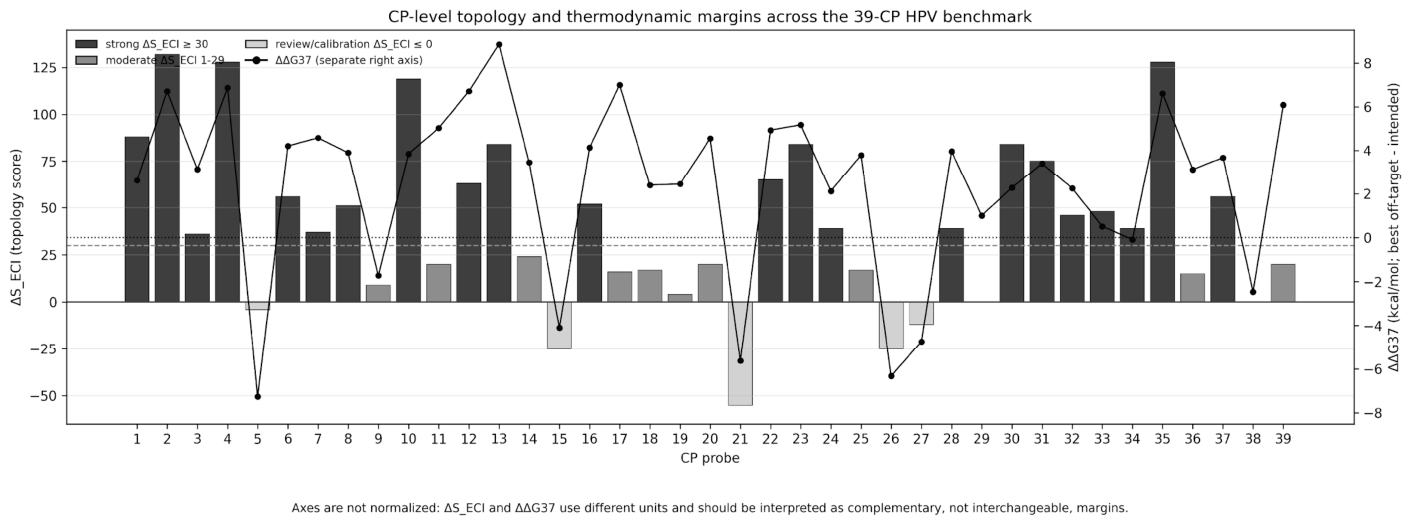
| CP2/HPV11 | 14 | 196 | 64 | 132 | +6.70 | Strong; accept |
| CP4/HPV16 | 12 | 144 | 16 | 128 | +6.86 | Strong; accept |
| CP35/HPV73 | 12 | 144 | 16 | 128 | +6.60 | Strong; accept |
| CP10/HPV34 | 12 | 144 | 25 | 119 | +3.84 | Strong; accept |
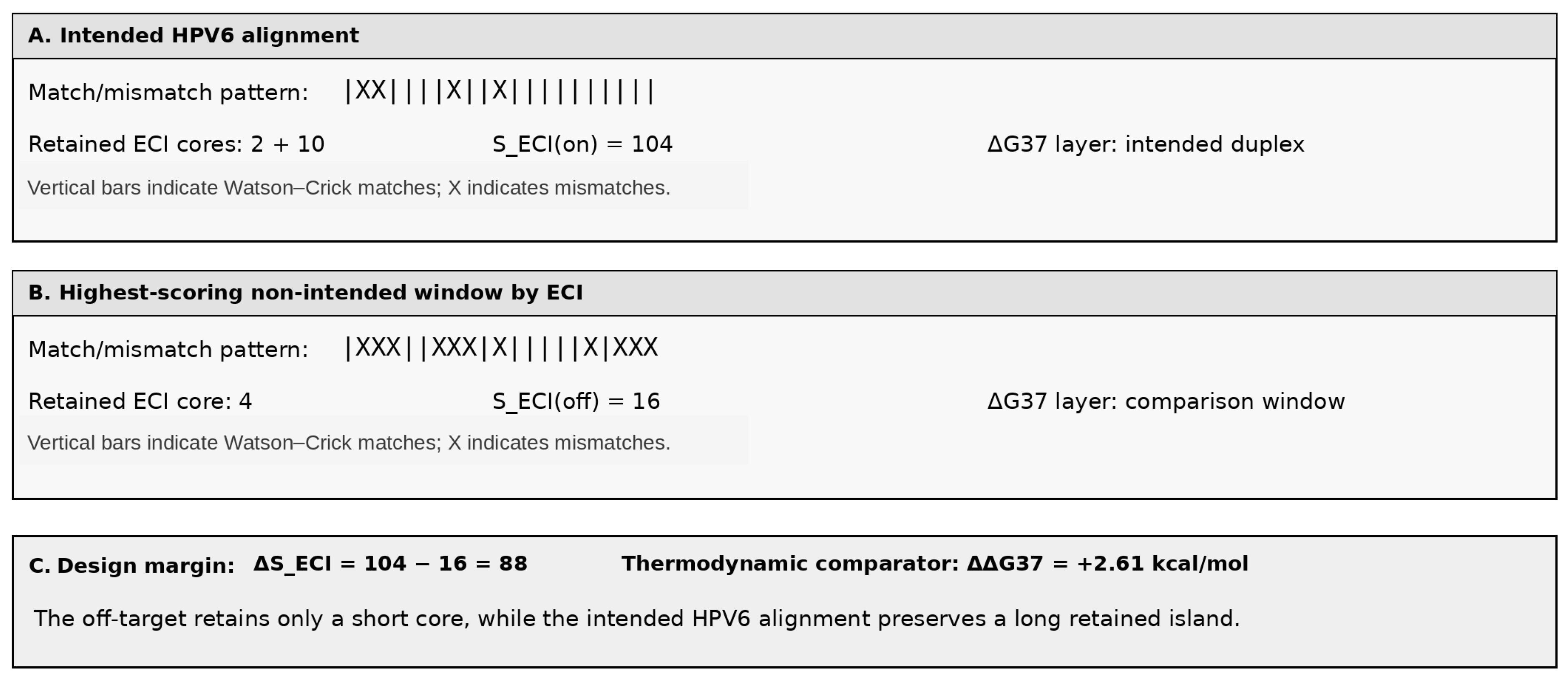
| CP1/HPV6 | 2 + 10 | 104 | 16 | 88 | +2.61 | Strong; off-target fragmented |
| CP13/HPV40 | 10 | 100 | 16 | 84 | +8.85 | Strong; accept |
| Case | ΔS_ECI | ΔΔG37 (kcal/mol) | Layer Emphasized | Design Action |
|---|---|---|---|---|
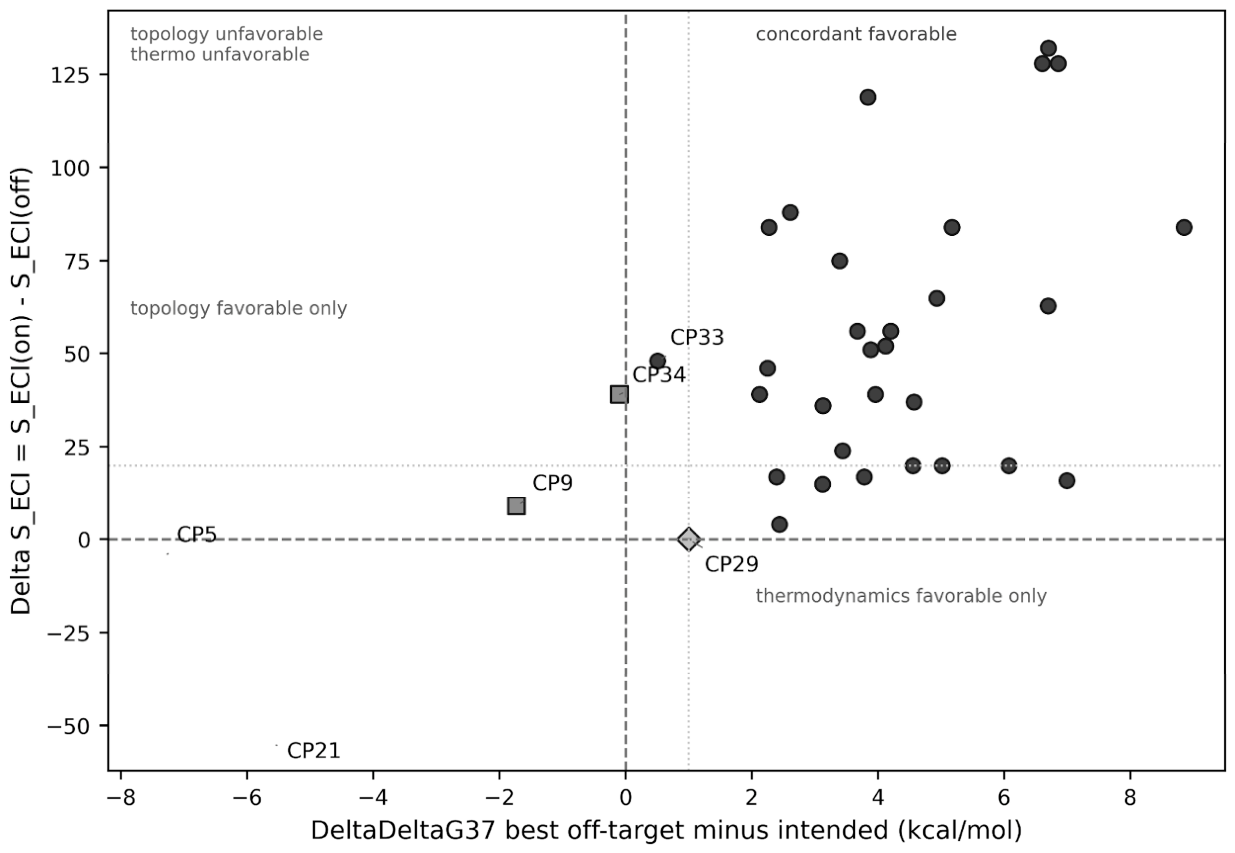
| CP33/HPV70 | +48 | +0.51 | Topology strengthens weak thermodynamic margin | Measure ΔG37 or empirical signal; accept only if above a predefined assay threshold. |
| CP34/HPV72 | +39 | −0.09 | Topology favorable only | Synthesize and test cross-hybridization against the panel; reject if off-target signal exceeds the assay limit. |
| CP29/HPV66 | 0 | +1.00 | Thermodynamics favorable only | Review alignment; consider shifting by 2–3 bases to create an off-target break while preserving intended core. |
| CP9/HPV33 | +9 | −1.73 | Weak topology margin and unfavorable thermodynamics | Empirical stringency testing required; do not use without experimental validation. |
| CP5/HPV18 | −4 | −7.26 | Retrospective risk flag; empirical exception | Do not reject solely by ECI/ΔG. Test the original probe; if it works, evaluate structure/accessibility before redesign. |
| CP21/HPV54 | −55 | −5.62 | Strong retrospective risk flag; empirical exception | Same as CP5/HPV18; use as a prospective boundary-condition test case. |
| Validation Element | Result Used in Manuscript |
|---|---|
| Dataset context | Public Affymetrix U133A/U133 Plus 2.0 mismatch-probe literature [9,10]; independent of the HPV benchmark. |
| Topology control | Clustered and distributed mismatch patterns compared at identical or near-identical mismatch counts. |
| 2–4 mismatch subset | S_ECI correlated with log2 intensity (Pearson r = 0.92; p = 0.0014; n = 8). |
| Fixed three-mismatch subset | Within the cleanest topology-control subset, S_ECI correlated with intensity (r = 0.96; p = 0.010; n = 5), while ΔG37 did not (r = −0.04; p = 0.95). |
| Evidence level | Illustrative retrospective consistency check; not definitive validation. Prospective ECI-guided synthesis remains the decisive test. |
| Data location | Full numerical values are provided in Supplementary Table S7a,b and as a CSV file. |
| Step | Action | Practical Instruction |
|---|---|---|
| 1 | Define the panel | List the intended motif and all realistic off-targets, such as related HPV types, close alleles, or nearest 16S variants. |
| 2 | Generate local candidates | Start from the exact complement, then generate shifted, shortened, and limited-mismatch variants around it. |
| 3 | Apply standard filters | Check GC content (40–60%), Tm range (within approximately 5 °C of assay temperature), self-structure, synthesis constraints, and target accessibility. |
| 4 | Align and score | Compute S_ECI for intended and off-target windows; identify the highest-scoring off-target by ECI. |
| 5 | Classify | ΔS_ECI ≥ 30 and S_ECI(on) above the assay floor: strong. ΔS_ECI 1–29: moderate. ΔS_ECI ≤ 0: review/calibrate; redesign only after intended-signal and structure/accessibility checks. |
| 6 | Make one local move | Example: if the highest-scoring off-target has an 8-base retained island, place one limited mismatch near the middle of that island or shift the probe so that the island is split into smaller cores. |
| 7 | Verify and test | Re-score; verify ΔG37 or empirical signal floor; synthesize and measure intended signal, cross-signal, Ct shift, or LOD. |
Disclaimer/Publisher’s Note: The statements, opinions and data contained in all publications are solely those of the individual author(s) and contributor(s) and not of MDPI and/or the editor(s). MDPI and/or the editor(s) disclaim responsibility for any injury to people or property resulting from any ideas, methods, instructions or products referred to in the content. |
© 2026 by the authors. Licensee MDPI, Basel, Switzerland. This article is an open access article distributed under the terms and conditions of the Creative Commons Attribution (CC BY) license.
Share and Cite
Brukner, I.; Krajinovic, M. Effective Complementary Islands (ECIs) for Multiplex Room-Temperature DNA Probe Design—A Practical Topology Heuristic and 39-Target HPV Specificity Benchmark. DNA 2026, 6, 27. https://doi.org/10.3390/dna6020027
Brukner I, Krajinovic M. Effective Complementary Islands (ECIs) for Multiplex Room-Temperature DNA Probe Design—A Practical Topology Heuristic and 39-Target HPV Specificity Benchmark. DNA. 2026; 6(2):27. https://doi.org/10.3390/dna6020027
Chicago/Turabian StyleBrukner, Ivan, and Maja Krajinovic. 2026. "Effective Complementary Islands (ECIs) for Multiplex Room-Temperature DNA Probe Design—A Practical Topology Heuristic and 39-Target HPV Specificity Benchmark" DNA 6, no. 2: 27. https://doi.org/10.3390/dna6020027
APA StyleBrukner, I., & Krajinovic, M. (2026). Effective Complementary Islands (ECIs) for Multiplex Room-Temperature DNA Probe Design—A Practical Topology Heuristic and 39-Target HPV Specificity Benchmark. DNA, 6(2), 27. https://doi.org/10.3390/dna6020027