Review

Diagnostic Challenges in Nodal T-Follicular Helper (TFH) Cell Lymphoma

1
Department of Pathology and Laboratory Medicine, North Shore University Hospital and Long Island Jewish Medical Center, Donald and Barbara Zucker School of Medicine at Hofstra/Northwell, New York, NY 11040, USA
2
Vanderbilt University Medical Center, Nashville, TN 37232, USA
*
Author to whom correspondence should be addressed.
BioMed 2026, 6(2), 12; https://doi.org/10.3390/biomed6020012
Submission received: 31 December 2025 / Revised: 31 March 2026 / Accepted: 27 April 2026 / Published: 2 May 2026

Abstract

Nodal T-follicular helper cell lymphomas comprise a biologically similar but morphologically diverse family of T-cell neoplasms, including angioimmunoblastic T-cell lymphoma, nodal T-follicular helper cell lymphoma, follicular-type, and nodal TFH lymphoma, not otherwise specified. Despite recurrent molecular alterations involving RHOA, IDH2, TET2, and DNMT3A, the diagnosis of TFH lymphomas remains challenging because of their mimicry of other lymphoid neoplasms and reactive lymphadenopathy. A key pitfall is confusion with classical Hodgkin lymphoma, as admixed Epstein–Barr virus-positive large B-cells with Reed–Sternberg cell-like morphology and immunophenotype can be found in TFH lymphomas. Similarly, follicular-type TFH lymphoma is often misclassified as follicular B-cell lymphoma unless T-cell lineage is investigated by immunophenotyping and the absence of BCL2 or BCL6 rearrangement is established. The ‘not otherwise specified’ category should be reserved for cases with proven T-follicular helper immunophenotype but lacks definitive angioimmunoblastic or follicular architecture. Comparing current frameworks, 5th edition of the World Health Organization classification permits rare CD4/CD8 double negative cases, while International Consensus Classification requires CD4 positivity. Some of these distinctions may appear taxonomic as all T-follicular helper T-cell lymphoma subtypes share molecular alterations, prognosis, and treatment approach. However, these classifications are meaningful from the perspective of a histopathologic diagnosis as a wrong diagnosis may lead to ineffective treatment approach. Accurate recognition of these lymphomas prevents misclassification, avoids inappropriate regimens, and ensures eligibility for proper clinical trials. A structured approach integrating morphology, multiparameter immunohistochemistry, flow cytometry, and molecular testing provides the best safeguard against diagnostic pitfalls and refines classification across subtypes.

1. Introduction

Nodal T-follicular helper (TFH) cell lymphomas are a family of mature CD4+ T-cell neoplasms that arise from, or phenotypically mirror, germinal-center TFH cells [1,2,3,4,5,6]. Historically, these neoplasms were scattered across peripheral T-cell lymphoma, not otherwise specified (PTCL-NOS), and related categories. But as our biological understanding and therapeutic approach advanced, successive classifications have consolidated these neoplasms into distinct and coherent groups [7,8]. The 2022 5th edition of the WHO classification (WHO-HAEM5) defines nodal TFH cell lymphomas as a unified category with three subtypes: (1) angioimmunoblastic-type (AITL), (2) follicular-type (FTCL), and (3) Not otherwise specified (NOS). International consensus classification (ICC) has adopted similar nomenclature and three similar categories under the common TFH lymphoma group [9,10]. Both classification systems prescribe demonstration of a TFH phenotype (typically ≥ 2–3 markers among PD-1, ICOS, CXCL13, CD10, and BCL6). Their differences are subtle as WHO permits rare CD4/CD8 cases, whereas ICC requires CD4 positivity. Molecularly, these tumors are characterized by a specific molecular landscape. RHOA G17V (present in approximately half to two-thirds of cases) and IDH2 R172 (highly specific for AITL) are postulated to be driver mutations of these neoplasms [11,12,13,14,15,16]. Other frequent mutations in TET2 and DNMT3A are likely early clonal events that are necessary, but not sufficient by themselves, for the pathogenesis of TFH lymphoma. It should be noted that genetic alteration in TET2 and DNMT3A but may also reflect age-related clonal hematopoiesis and therefore require contextual interpretation. Clinically, nodal TFH lymphomas predominantly affect older adults and exhibit a polymorphous microenvironment rich in EBV-positive B-cell immunoblasts, adding further diagnostic complexity.
The principal diagnostic challenge of TFH lymphomas lies in their ability to mimic a wide spectrum of reactive and neoplastic conditions (Summarized in Table 1). They may resemble classical Hodgkin lymphoma (cHL) due to the presence of EBV-positive Hodgkin/Reed–Sternberg (HRS)-like B-cells, follicular B-cell lymphoma (FL) due to nodular architecture with CD10 and BCL-6 expression or may be misclassified as PTCL-NOS when TFH markers are not adequately assessed. Each of these scenarios carries significant therapeutic implications [17,18].
Despite advances in classification and molecular characterization, a practical, pathology-centered framework for recognizing and avoiding real-world diagnostic pitfalls in TFH lymphomas remains insufficiently emphasized in the literature. By integrating morphology with broad immunophenotyping, flow cytometry (including TRBC1-based clonality assessment), and targeted molecular testing, we aim to outline a structured approach to improve diagnostic accuracy. Illustrative cases from our institutional experience are included to highlight real-world challenges, particularly in distinguishing EBV-driven B-cell proliferations from true composite lymphomas.

2. Case Presentations

At our center, we reviewed 12 cases of nodal TFH cell lymphoma diagnosed between July 2022 and July 2024 (Table 2). These cases were identified from routine diagnostic practice at our institution, and all cases diagnosed during the study period were included. No retrospective reclassification was performed. The majority of patients were elderly (median age in the eighth decade) with a slight male predominance, and angioimmunoblastic-type TFH lymphoma represented the most common subtype. Bone marrow involvement was frequent, observed in nearly all cases in which it was assessed, underscoring the systemic nature of this disease at presentation. Cytogenetic abnormalities were identified in a subset of cases, including trisomy 12, abnormalities involving chromosome 6q, and complex karyotypes involving chromosome 14, although several cases demonstrated a normal karyotype. Two representative cases are shown below to illustrate key diagnostic challenges:
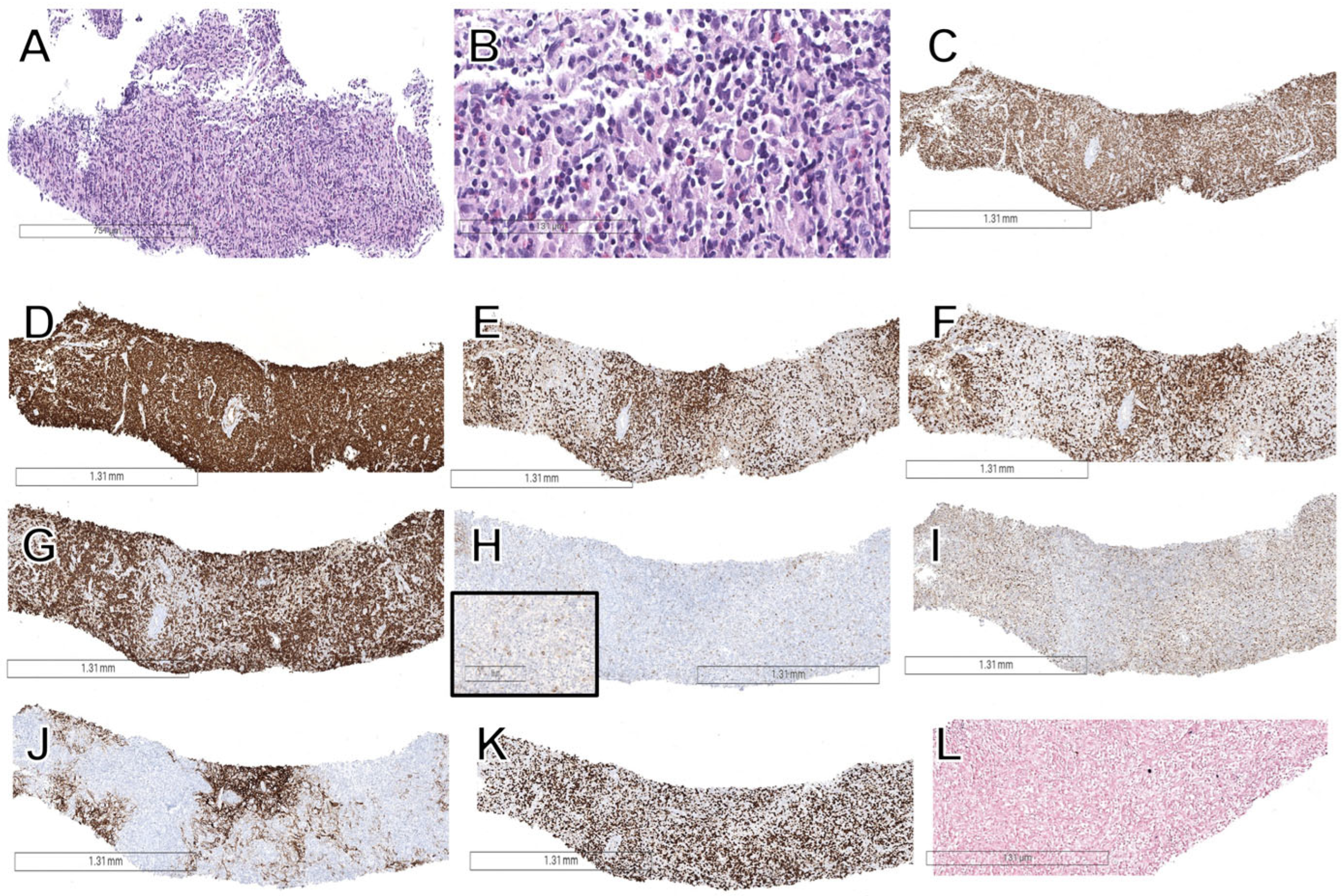
Case 1: A 71-year-old woman presented with inguinal lymphadenopathy, weight loss, night sweats, itchy skin, and arthritis. She was previously diagnosed with EBV-positive diffuse large B-cell lymphoma (DLBCL) nine years ago and the primary concern was relapsed disease. Inguinal lymph node biopsy was performed which showed effaced architecture with polymorphous infiltrate comprising small to medium sized atypical T-cell population, eosinophils, plasma cells, and a few immunoblasts. The atypical T-cells show expressions of PD-1, CD10, and BCL-6. A few admixed B-cells positive for EBER in situ hybridization are also noted (Figure 1). Molecular testing was performed which showed positive T-cell clonality, whereas B-cell clonality was negative. Mutational studies showed RHOA G17V, IDH2 R172S, and biallelic TET2 mutations. These findings were consistent with a diagnosis of AITL. Notably, T-cell clonality was negative in the biopsy of patient’s EBV-positive DLBCL diagnosis, while B-cell clonality was positive in that original biopsy. Diagnosis of EBV-positive DLBCL following an antecedent AITL has been previously reported; however, AITL following an EBV-positive DLBCL is rare.
Following her diagnosis, the patient received dose adjusted EPOCH (Etoposide, Prednisone, Vincristine, Cyclophosphamide, Doxorubicin) and has been in remission since.
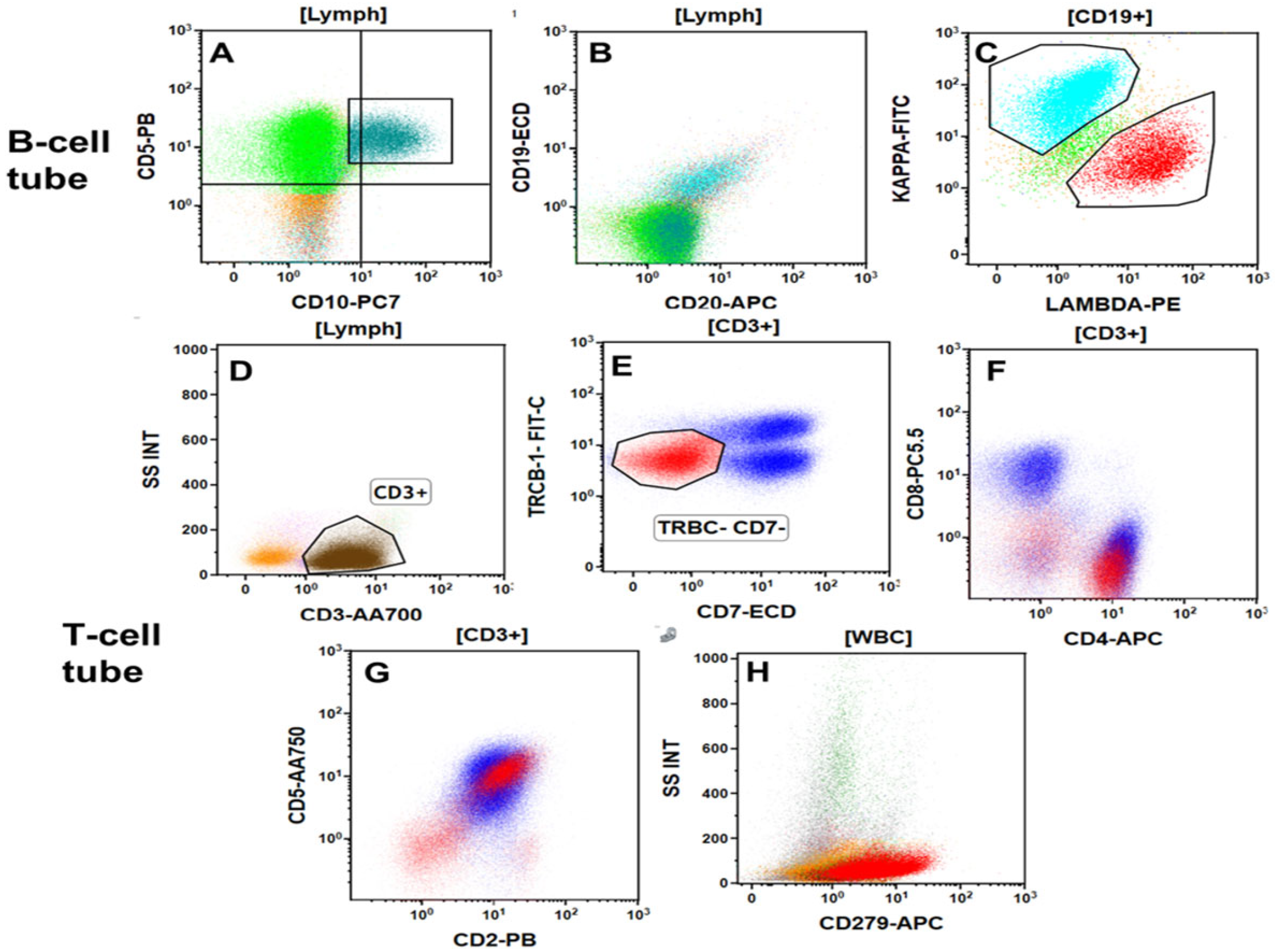
Case 2: A 66-year-old man who had presented with cervical lymphadenopathy, whole body itchiness for 2–3 months, and significant weight loss. Flow cytometry of the lymph node revealed lymphocytes with bright CD45 expression. Within the B-cell tube, polytypic B-cells were identified; however, an aberrant CD5+CD10+ population lacking CD19 and CD20 was noted, indicating a T-cell rather than B-cell phenotype. In the T-cell tube, an expanded CD7 population was identified. This subset expressed CD4, CD10, and PD-1 (CD279) but lacked TRBC1, confirming clonality and suggesting a T-follicular helper (TFH) phenotype (Figure 2).
Excisional biopsy of the cervical lymph node showed complete effacement of nodal architecture with prominent arborizing high endothelial venules and proliferation of atypical lymphoid cells in a polymorphous background of epithelioid histiocytes, dendritic cells, eosinophils, immunoblasts, and plasma cells. Immunohistochemistry highlighted residual follicles with CD20, interfollicular T-cell expansion with CD3, and an expanded follicular dendritic cell meshwork highlighted by CD21. The atypical T-cell population demonstrated CD4 predominance over CD8, loss of CD7, and strong expression of PD-1, CXCL13, and ICOS, along with positivity for CD10 and weak BCL-6. Scattered EBER-positive immunoblasts were also observed. These findings were consistent with a diagnosis of AITL.

3. Diagnostic Challenges

3.1. Misdiagnosing TFH Lymphomas as Classical Hodgkin Lymphoma

Nodal TFH cell lymphomas are frequently mistaken for cHL [19]. The trap is the presence of large EBV-positive B-immunoblasts that adopt HRS-like morphology and phenotype (CD30-positive, sometimes CD15-positive) within a polymorphous background. EBV-positive large B-cells, identified in up to 85–95% of AITL, frequently appear as scattered large blasts or HRS-like cells [20]. Unlike HRS cells, these large cells in TFH settings often retain more of the B-cell program as manifested by retained expression of CD45 and CD20, brighter OCT2, and PAX5 expression. These findings should prompt a deliberate search for an underlying TFH neoplasm [21,22]. Since this misdiagnosis has high clinical consequence, keeping this working differential in mind while making any diagnosis of EBV-positive cHL is essential.
A few histological and immunophenotypic features may help resolve the mimicry. First, in cHL, the rosetting T-cells are reactive, whereas in TFH lymphomas, the rosetting T-cells are neoplastic. In TFH lymphomas, the neoplastic TFH cells, tightly rosetting the HRS-like B-cells, co-express multiple TFH markers (PD-1, ICOS, CD10, CXCL13). Dual immunostains (e.g., CD3/PD-1 or CD3/CD10) can help make this distinction. Secondly, TFH lymphomas typically show numerous small and large EBER-positive B-cells throughout the node, whereas in cHL, EBER positivity is usually limited to the HRS cells. Lastly, cHL HRS cells are classically CD45-negative with characteristic weak expression of PAX5, whereas EBV-positive immunoblasts accompanying TFH tumors are often CD45-positive with stronger B-cell transcription factors including PAX5. Flow cytometry often supplies the decisive clue. In TFH lymphomas, an aberrant CD4+ T-cell population with pan-T antigen aberrancy (CD3 dim/negative and/or CD7 loss) and TRBC1 restriction supporting clonality are often seen. These features are absent in cHL. Hence, a concurrent adequate flow cytometry specimen is highly important for this distinction.
When morphology and immunophenotype are equivocal, molecular testing can serve as a helpful clue: RHOA G17V strongly supports TFH lineage, and IDH2 R172 alterations points to nodal TFH lymphomas [11,12,13,14,15,16]. TET2 and DNMT3A alterations, although common, should be interpreted cautiously because of age-related clonal hematopoiesis [23].
The final nuance is of diagnostic nomenclature. In TFH lymphomas, even when large B-cells adopt an HRS-like phenotype, these are typically EBV-positive immunoblasts arising within and rosetted by the tumor TFH cells. Although they can be clonal, they do not represent typical neoplastic HRS cells and hence do not justify “composite AITL + cHL” diagnosis. In fact, transformation of this clonal B-cell population to EBV + DLBCL can often be seen [24,25]. A misdiagnosis of “composite AITL + cHL” will further hinder documenting this transformation.

3.2. Misclassifying Follicular-Type Nodal TFH Lymphoma as Follicular B-Cell Lymphoma

One of the most frequent diagnostic pitfalls is confusing follicular-type TFH lymphoma (FTCL) with follicular B-cell lymphoma (FL). The challenge arises because both entities can present with a nodular architecture and share expression of markers such as CD10 and BCL-6 [26]. The commonplace nature of FL and the rarity of FTCL also plays a significant part in this confusion. Historically, before recognition of the TFH lineage, many FTCLs were misdiagnosed as FL or reactive follicular hyperplasia [27,28]. Unlike AITL, FTCL often lacks a polymorphous inflammatory background and prominent high endothelial venules, producing a deceptively bland nodular pattern, often indistinguishable from FL [29]. In this context, the overlap of TFH and germinal center B-cell markers can easily lead to misclassification. In FTCL, the CD10+/BCL-6+ cells are CD3+CD4+ T-cells, whereas in FL, they are CD20+/PAX5+ B-cells forming true germinal centers. Dual immunostains or side-by-side panels are essential in demonstrating that the nodules are T-cell-rich with only scattered B-cells, distinguishing FTCL from FL [30]. Another reliable clue is the pattern of PD-1 staining [31]. In reactive follicles and FL, PD-1-positive TFH cells are predominantly confined to the light zone of germinal centers. In FTCL, PD-1 expression is diffuse and strong across entire abnormal follicles forming abnormal confluent staining pattern. When evaluating follicular dendritic cell (FDC) meshworks with CD21 or CD23, looking for abnormal pseudofollicles colonized by T-cells rather than true germinal centers can be a helpful clue. Flow cytometry provides an additional safeguard. FTCL typically demonstrates an aberrant clonal T-cell population with loss or dim expression of pan-T antigens, whereas FL shows a clonal B-cell population with light-chain restrictions and unremarkable T-cells. B- and T-cell clonality testing may also be helpful, keeping in mind that B-cell clonality in FL may often be negative due to high somatic hypermutation rate, while T-cell clonality in FL can be falsely positive due to the paucity of background T-cells. In limited specimens such as needle core biopsy, architecture and immunohistochemistry can be ambiguous. Hence, all tools may be applied for lineage determination. Additional red flags for FTCL include the presence of EBV-positive immunoblasts or HRS-like B-cells rosetted by PD-1-positive T-cells within nodules, as described in AITL [22]. Similarly, attenuated mantle zones, subtle proliferation of high endothelial venules, and interfollicular plasma cells or eosinophils should prompt an effort to rule out FTCL [22].
The diagnostic safeguard is to apply a comprehensive immunohistochemical panel whenever atypical follicular or nodular proliferations are encountered. Stopping at CD10 and BCL-6 without confirming lineage risks misclassification. In practice, any nodular proliferation in which CD10+ cells cannot be definitively shown to be B lineage should raise suspicion for FTCL, and immunohistochemical stains specific for TFH cells, preferably PD-1, should be employed.

3.3. Mistaking TFH Lymphomas for PTCL-NOS

With expansion of specific subcategorization in T-cell lymphomas, PTCL-NOS is a shrinking category. With the advent of TFH immunophenotyping, many cases once labeled as PTCL-NOS have been reclassified as nodal TFH cell lymphomas in retrospective studies [32,33]. Yet, even today, a common diagnostic pitfall is failing to recognize TFH lineage in T-cell lymphoma when the classic features of AITL or FTCL are absent, leading to its misdiagnosis as PTCL-NOS [34,35,36]. Such tumors may present as tumor-rich phases of TFH lymphomas in which the lymph node is diffusely effaced by atypical T-cells, yet the characteristic microenvironmental changes including high endothelial venule proliferation, disrupted follicular dendritic cell meshwork, and admixed EBV-positive B-cells are minimal or absent. For the category of nodal TFH lymphoma, NOS has been created to solve this problem. By definition, this variant of TFH lymphoma lacks the distinctive architecture of the other subtypes and may appear deceptively as a relatively undifferentiated T-cell lymphoma. In these scenarios, the default label of PTCL-NOS is tempting, but this risks misclassification.
The key safeguard is routine evaluation for a TFH phenotype. Utilizing all five TFH markers (PD-1, ICOS, CXCL13, CD10, or BCL-6) is usually sufficient to establish TFH derivation once other entities are excluded [34]. Reliance on a single marker can be problematic. Although isolated strong PD-1 expression could hint towards a TFH phenotype, this can reflect reactive T-cells rather than a neoplastic TFH population. Hence a comprehensive panel is highly recommended [34].
Importantly, WHO-HAEM5 recognizes three histologic patterns of AITL, with pattern 1 being subtle and easily overlooked: the nodal architecture may remain partially intact with only faint mantle blurring and minimal stromal proliferation [37]. Awareness of this early pattern is essential to avoid overuse of the PTCL-NOS category. A minor nuance is the difference between WHO and ICC criteria [9,10]. WHO permits classification of rare CD4CD8 lymphomas as TFH if other features are present, whereas ICC requires CD4 positivity. This means that identical cases may be assigned differently depending on the system used.
Molecular testing can provide important ancillary diagnostic evidence. The most specific genetic alteration is the RHOA G17V mutation, found in approximately 60–70% of angioimmunoblastic-type and a substantial fraction of other TFH lymphomas but absent in PTCL-NOS [35]. Similarly, IDH2 R172 is highly associated with AITL diagnosis and less common in nodal TFH lymphoma, NOS. DNMT3A and TET2 mutations are common and often co-occur, but they are less specific since they can also represent clonal hematopoiesis. Thus, the combined detection of TET2 and/or DNMT3A with RHOA and/or IDH2 mutations strongly favors TFH lymphoma over PTCL-NOS [22,23,38].
One of the important differential diagnostic considerations is the lymphoepithelioid variant of PTCL-NOS (historically known as Lennert lymphoma). Originally described as a variant of Hodgkin’s disease [39], this entity was later recognized as a morphological variant of T-cell lymphoma and was incorporated into the Kiel classification [40,41]. This morphological variant of PTCL-NOS is characterized by clusters of epithelioid histiocytes, scattered RS-like cells, and monoclonal TCR rearrangements [42]. By modern classification, these variants usually fall in the PTCL-NOS with TBX21 alteration category [43], although a lot of historically described Lennert lymphoma will fall in the nodal TFH lymphoma category. In their 2016 study, Kurita and colleagues found that a subset of T-cell lymphoma with characteristic Lenner lymphoma-like histomorphology show positivity for a few TFH markers, while lacking AITL-like morphological characteristics [42]. By the current classification system, these neoplasms are better characterized as TFH lymphoma, NOS subcategory. Performing molecular studies to look for the TFH lymphoma signature and absence of PTCL-NOS (with either TBX21 or GATA3 alteration) can be helpful.

3.4. Mistaking TFH Lymphoma for Reactive Conditions

One of the most well-known pitfalls of TFH lymphoma is its mimicry and misdiagnosis as a reactive condition. In the first documented description of AITL, this entity was reported as a reactive rather than neoplastic entity [44]. Although the neoplastic nature of AITL is established beyond any doubt, its morphological proximity to reactive paracortical hyperplasia can create diagnostic confusion, especially in a needle core biopsy sample. Early stage AITL, showing predominantly pattern 1 morphological feature with hyperplastic follicles with neoplastic T-cells localized predominantly at the outer border of the follicles, can often be difficult to diagnose. However, it should be noted that most AITL do not present with pure pattern 1 morphology and at the time of biopsy, when the disease is clinically significant, more advanced patterns emerge.
Utilizing multiple immunophenotypic and molecular assays might be helpful in these scenarios. Presence of EBV-positive immunoblasts should prompt better assessment of the T-cell compartment. Strong PD-1 expressions outside of the follicle should raise one’s suspicion [31]. CD10 expression in TFH cells, although highly specific for underscoring neoplastic nature, has low sensitivity and may not be useful in most of these scenarios. Immunohistochemical stains that can be used as a surrogate for IDH2 R172 mutations, can be employed [45]. T-cell clonality testing can be helpful to at least establish the atypical nature of lymphoid proliferation. A low threshold should be maintained to ask for excisional biopsy (in case of a needle core biopsy work-up) whenever early stage AITL is a clinicopathologic diagnostic consideration.

3.5. Composite and Mimicking B-Cell Neoplasms

As previously described, nodal TFH lymphomas almost invariably harbor associated B-cell proliferations [46]. These B-cell populations are often EBV-positive immunoblasts that reflect the immunologic milieu of the tumor rather than a true second lymphoma [47]. Molecular studies have found similar CH-like mutations in the B-cells present in the AITL milieu, indicating a possible common hematopoietic stem cell origin as with the neoplastic T-cell lymphoma [48]. Additional mutation involving Notch1 was also found in these admixed B-cells, indicating an underlying clonal process and further complicating the understanding of their true nature [49]. However, for practical purposes, in conjunction to the existing TFH lymphoma, a second B-cell neoplasm should only be diagnosed when the B-cell proliferation meets independent morphologic and phenotypic criteria for lymphoma, typically DLBCL. These features include diffuse sheets of atypical CD20-posititve large cells with architectural effacement, clonal immunoglobulin rearrangement, and possible presence of MYC rearrangement [50,51,52]. In contrast, polymorphous EBV-positive immunoblasts or focal clusters of large B-cells, even when numerous, should be interpreted as part of the TFH lymphoma microenvironment. This approach prevents unnecessary escalation to B-cell-directed therapy in patients whose B-cell proliferations are secondary and not autonomous. Predominantly EBV-positive B-cell populations indicate a reactive expansion, whereas a purely EBV-negative, clonal large B-cell proliferation raises legitimate concern for a composite lymphoma [53]. It is noteworthy that EBV-driven proliferations may occasionally appear oligoclonal. Hence, clonality studies should be interpreted cautiously.
Although rare, emergence of EBV-positive DLBCL after successful treatment of AITL has been reported [54]. Hence, keeping vigilant on the follow-up biopsy assessment of AITL for an emerging DLBCL is important. It is also important to miss a true composite AITL and DLBCL diagnosis, as rituximab can be added to the treatment regimen [55].
In summary, nodal TFH lymphomas almost always contain B-cell proliferations, but only rarely represent a true composite lymphoma. Pathologists should apply strict morphologic, immunophenotypic, and molecular criteria before assigning a composite diagnosis. Otherwise, these B-cell expansions should be considered/reported as an integral feature of the TFH lymphoma spectrum, thus minimizing both under- and over-diagnosis.

3.6. Immunophenotypic Challenges in TFH Lymphomas

The immunophenotypic diagnosis of nodal TFH cell lymphomas is often complex because of variability in marker expression, overlapping features with other T-cell and B-cell lymphomas, and frequent antigen loss. In most AITLs, two to three TFH-associated markers are expressed, most consistently PD-1 and CXCL13, while CD10 and BCL-6 are more variable. CD10 is most specific but least sensitive marker. Follicular-type TFH lymphomas frequently show strong CD10 positivity, whereas follicular TFH lymphoma, NOS may retain only PD-1 or ICOS. This heterogeneity means that limited immunohistochemical panels or assays of suboptimal sensitivity can yield false-negative results. Basha and colleagues demonstrated that a five-marker panel (CD10, PD-1, CXCL13, ICOS, BCL-6) substantially increases diagnostic sensitivity and reproducibility in routine practice [34].
A second challenge is the aberrant loss of pan-T-cell antigens, a feature shared with other peripheral T-cell lymphomas. TFH lymphomas frequently downregulate CD3, CD5, or CD7, and in some cases CD3 expression is markedly dim or absent by flow cytometry [56,57]. Histologically, this can manifest as an apparent excess of CD4+ cells compared to CD3+ cells, potentially misleading interpretation if epitope loss is not recognized. Awareness of these aberrancies and use of confirmatory T-cell lineage markers are essential to avoid misclassification. Importantly, TFH lymphomas are typically non-cytotoxic helper T-cells, and strong expression of cytotoxic proteins (granzyme B, TIA-1) should argue against this diagnosis [58].
A related pitfall is the overinterpretation of reactive PD-1+ T-cells. In cHL or T-cell/histiocyte-rich large B-cell lymphoma (THRLBCL), scattered PD-1+ cells may mimic a TFH infiltrate but lack the concerted expression of multiple TFH markers or the characteristic rosetting pattern around B-cells [31]. Accurate interpretation therefore requires evaluation of staining pattern and marker combination, not reliance on a single immunohistochemical stain.
While the tissue biopsy remains the cornerstone of diagnosis, flow cytometry has emerged as a critical adjunct for both recognition and staging of TFH lymphomas. One of the largest studies, by Tembhare and colleagues, highlighted that AITL was the most frequently identified T/NK-cell lymphoma by flow cytometry and simultaneously one of the most frequently misdiagnosed on morphology alone [59]. Flow cytometric evaluation was able to help correct numerous misclassifications, including cases originally diagnosed as B-cell non-Hodgkin lymphoma, Hodgkin lymphoma, and even acute leukemias. Characteristic flow cytometric features include an aberrant CD4+ T-cell population with loss of pan-T markers (most commonly dim/absent CD3 and CD7), variable CD10 expression, and expression of TFH-associated markers such as PD-1 (CD279), CXCR5 (CD185), and ICOS [56,59,60]. When present, TRBC1 restriction provides additional evidence of clonality. Together, these findings complement histopathology and IHC and can be decisive in clarifying ambiguous cases.

3.7. Molecular Features: Diagnostic Utility and Limitations

Molecular profiling has become an indispensable adjunct in the diagnosis of nodal TFH cell lymphomas, helping to resolve cases where morphology and immunophenotype are ambiguous. In our institutional experience (Table 2), recurrent driver mutations were identified in most tested cases, consistent with prior studies. Among these, TET2 mutations were the most frequent, often occurring as multiple distinct variants within the same patient. DNMT3A mutations were also commonly identified, and frequently co-occurred with TET2, highlighting the role of early epigenetic dysregulation in disease pathogenesis. However, both alterations are also characteristic of age-related clonal hematopoiesis and therefore require careful interpretation in the appropriate clinical and pathologic context. Notably, RHOA G17V mutations, though not identified in every patient, remain the most specific molecular hallmark of TFH lineage and were detected in roughly half of the cohort. Similarly, IDH2 R172 mutations, detected in a subset of cases, anchor the diagnosis of AITL. These findings are consistent with published data demonstrating RHOA mutations in 50–70% of TFH lymphomas and IDH2 mutations in approximately 20–30% of AITL cases [10,11,12,13,14,15,16].
Additional mutations identified in our cohort, including PLCG1, NF1, TP53, ASXL1, and B2M, further highlight the molecular heterogeneity of these neoplasms. While these alterations may contribute to disease biology, they are not specific for TFH lineage and currently have limited diagnostic utility.
From a practical diagnostic perspective, the greatest utility of molecular testing lies in its ability to support TFH lineage in challenging cases. The presence of RHOA G17V and/or IDH2 R172 mutations strongly favor TFH lymphoma over PTCL-NOS. In contrast, isolated TET2 or DNMT3A mutations should not be overinterpreted in the absence of supporting morphologic and immunophenotypic findings.

4. Treatment Modalities of TFH Lymphoma

The treatment of TFH lymphoma is evolving. Since TFH lymphomas share similar cell markers and genetic features as some other subtypes of mature T-cell lymphomas, such as PTCL, NOS, and anaplastic large-cell lymphomas, they are generally managed similarly. Referral for clinical trials is generally a preferred option for these rare neoplasms. If clinical trial is not available or patient is not a candidate, then 6 cycles of multiagent chemotherapy with restaging done after 3–4 cycles can be offered. In younger patients, definitive curative approach with more aggressive chemotherapeutic regimen followed by autologous bone marrow transplant is favored. In older individuals, disease control with combination of chemotherapy and immunosuppressive treatment can be targeted.
Guidelines recommended referral to clinical trials or using multiagent frontline chemotherapy with cyclophosphamide, doxorubicin, vincristine, and prednisone (CHOP) or cyclophosphamide, doxorubicin, vincristine, etoposide, and prednisone (CHOEP) for CD30-negative diseases, or brentuximab vedotin plus cyclophosphamide, doxorubicin, and prednisone (CHP) for CD30-positive diseases [61]. This should be followed by consolidation with autologous stem cell transplant if patients are transplant candidates. For nodal TFH lymphoma, NOS, and follicular subtypes, other regimens such as HyperCVAD (Cyclophosphamide, Vincristine, Doxorubicin, and Dexamethasone) alternating with high-dose Methotrexate and Cytarabine can be considered; however, this regimen is generally more toxic and not superior to aforementioned regimens. If treating with palliative intent, then less intensive therapy should be considered based on performance status and goals of care.
Treatment of relapsed/refractory TFH lymphoma is very limited, and one should seek clinical trial options whenever possible. Other second-line options to consider include single-agent Belinostat and histone deacetylase inhibitor [62]. Brentuximab vedotin-based therapy can be considered if the neoplastic T-cells express CD30 [63]. Duvelisib with or without Romidepsin has also shown efficacy [64].
Additionally, salvage therapies commonly used in aggressive B-cell lymphomas—such as DHAP (Dexamethasone, High-dose Ara-C, and Platinum), Gemcitabine with Oxaliplatin, and ICE (Ifosfamide, carboplatin, and etoposide)—can be considered salvage therapy or palliation, though their efficacy in TFH lymphomas remains unclear.

5. Conclusions

In conclusion, the diagnosis of nodal TFH cell lymphomas requires a deliberate, systematic approach and must be actively established rather than defaulted to PTCL-NOS. Recognition of TFH lineage is essential, as misclassification can lead to inappropriate therapeutic decisions and missed opportunities for targeted management and clinical trial enrollment.
Immunohistochemical assay for multiple TFH markers should be applied to every nodal CD4-positive T-cell lymphoma or atypical follicular proliferation, alongside flow cytometric evaluation, with assessment of clonality (such as TRBC1), and where appropriate, molecular testing. Attention should be paid to common diagnostic pitfalls, including confusion with cHL, FL, reactive conditions, and overinterpretation of associated B-cell proliferations.
Certain genetic alterations should be sought: RHOA G17V confirms TFH lineage, IDH2 R172 mutations define angioimmunoblastic subtype, while TET2 and DNMT3A require contextual interpretation. No single modality is sufficient in isolation, and a multiparametric approach remains the cornerstone of accurate classification.
Looking forward, standardization of TFH immunophenotypic panels, integration of digital pathology tools for pattern recognition, and incorporation of multi-omics approaches may further refine diagnostic accuracy, particularly within the heterogeneous TFH lymphoma, NOS category. Ultimately, accurate recognition of TFH lineage transforms a challenging morphologic diagnosis into a clinically meaningful classification.

Author Contributions

Writing—original draft preparation: N.S. and P.T.N.; writing—review and editing, P.Q.D. All authors have read and agreed to the published version of the manuscript.

Funding

This research received no external funding.

Institutional Review Board Statement

The study was conducted in accordance with the Declaration of Helsinki, and approved by the Institutional Review Board of Northwell Health (protocol code 25-0471 and date of approval: 15 July 2025). for studies involving humans.

Informed Consent Statement

Patient consent was waived due to retrospective and observational/non-interventional nature of the investigation.

Data Availability Statement

No new data were created or analyzed in this study. Data sharing is not applicable to this article.

Conflicts of Interest

The authors declare no conflicts of interest.

Abbreviations

The following abbreviations are used in this manuscript:
TFHT-follicular helper cell
AITLAngioimmunoblastic T-cell lymphoma
cHLClassic Hodgkin lymphoma
FTCLFollicular T-cell lymphoma

References

  1. de Leval, L.; Rickman, D.S.; Thielen, C.; Reynies, A.; Huang, Y.L.; Delsol, G.; Lamant, L.; Leroy, K.; Brière, J.; Molina, T.; et al. The gene expression profile of nodal peripheral T-cell lymphoma demonstrates a molecular link between angioimmunoblastic T-cell lymphoma (AITL) and follicular helper T (TFH) cells. Blood 2007, 109, 4952–4963. [Google Scholar] [CrossRef]
  2. Krenacs, L.; Schaerli, P.; Kis, G.; Bagdi, E. Phenotype of neoplastic cells in angioimmunoblastic T-cell lymphoma is consistent with activated follicular B helper T cells. Blood 2006, 108, 1110–1111. [Google Scholar] [CrossRef]
  3. Grogg, K.L.; Attygalle, A.D.; Macon, W.R.; Remstein, E.D.; Kurtin, P.J.; Dogan, A. Expression of CXCL13, a chemokine highly upregulated in germinal center T-helper cells, distinguishes angioimmunoblastic T-cell lymphoma from peripheral T-cell lymphoma, unspecified. Mod. Pathol. 2006, 19, 1101–1107. [Google Scholar] [CrossRef] [PubMed]
  4. Dupuis, J.; Boye, K.; Martin, N.; Copie-Bergman, C.; Plonquet, A.; Fabiani, B.; Baglin, A.C.; Haioun, C.; Delfau-Larue, M.H.; Gaulard, P. Expression of CXCL13 by neoplastic cells in angioimmunoblastic T-cell lymphoma (AITL): A new diagnostic marker providing evidence that AITL derives from follicular helper T cells. Am. J. Surg. Pathol. 2006, 30, 490–494. [Google Scholar] [CrossRef] [PubMed]
  5. Vinuesa, C.G.; Tangye, S.G.; Moser, B.; Mackay, C.R. Follicular B helper T cells in antibody responses and autoimmunity. Nat. Rev. Immunol. 2005, 5, 853–865. [Google Scholar] [CrossRef]
  6. Attygalle, A.; Al-Jehani, R.; Diss, T.C.; Munson, P.; Liu, H.; Du, M.Q.; Isaacson, P.G.; Dogan, A. Neoplastic T cells in angioimmunoblastic T-cell lymphoma express CD10. Blood 2002, 99, 627–633. [Google Scholar] [CrossRef]
  7. Swerdlow, S.H.; Campo, E.; Harris, N.L.; Jaffe, E.S.; Pileri, S.A.; Stein, H.; Thiele, J.; Vardiman, J.W. WHO Classification of Tumours of Haematopoietic and Lymphoid Tissues; International Agency for Research on Cancer: Lyon, France, 2008; Volume 2. [Google Scholar]
  8. Swerdlow, S.H.; Campo, E.; Pileri, S.A.; Harris, N.L.; Stein, H.; Siebert, R.; Advani, R.; Ghielmini, M.; Salles, G.A.; Zelenetz, A.D.; et al. The 2016 revision of the World Health Organization classification of lymphoid neoplasms. Blood 2016, 127, 2375–2390. [Google Scholar] [CrossRef] [PubMed]
  9. Khoury, J.D.; Solary, E.; Abla, O.; Akkari, Y.; Alaggio, R.; Apperley, J.F.; Bejar, R.; Berti, E.; Busque, L.; Chan, J.K.C.; et al. The 5th edition of the World Health Organization Classification of Haematolymphoid Tumours: Myeloid and Histiocytic/Dendritic Neoplasms. Leukemia 2022, 36, 1703–1719. [Google Scholar] [CrossRef]
  10. Campo, E.; Jaffe, E.S.; Cook, J.R.; Quintanilla-Martinez, L.; Swerdlow, S.H.; Anderson, K.C.; Brousset, P.; Cerroni, L.; de Leval, L.; Dirnhofer, S. The international consensus classification of mature lymphoid neoplasms: A report from the clinical advisory committee. Blood J. Am. Soc. Hematol. 2022, 140, 1229–1253. [Google Scholar] [CrossRef]
  11. Dobson, R.; Du, P.Y.; Rásó-Barnett, L.; Yao, W.Q.; Chen, Z.; Casa, C.; Ei-Daly, H.; Farkas, L.; Soilleux, E.; Wright, P.; et al. Early detection of T-cell lymphoma with T follicular helper phenotype by RHOA mutation analysis. Haematologica 2022, 107, 489–499. [Google Scholar] [CrossRef]
  12. Steinhilber, J.; Mederake, M.; Bonzheim, I.; Serinsöz-Linke, E.; Müller, I.; Fallier-Becker, P.; Lemonnier, F.; Gaulard, P.; Fend, F.; Quintanilla-Martinez, L. The pathological features of angioimmunoblastic T-cell lymphomas with IDH2R172 mutations. Mod. Pathol. 2019, 32, 1123–1134. [Google Scholar] [CrossRef]
  13. Dupuy, A.; Lemonnier, F.; Fataccioli, V.; Martin-Garcia, N.; Robe, C.; Pelletier, R.; Poullot, E.; Moktefi, A.; Mokhtari, K.; Rousselet, M.C.; et al. Multiple Ways to Detect IDH2 Mutations in Angioimmunoblastic T-Cell Lymphoma from Immunohistochemistry to Next-Generation Sequencing. J. Mol. Diagn. 2018, 20, 677–685. [Google Scholar] [CrossRef]
  14. Ondrejka, S.L.; Grzywacz, B.; Bodo, J.; Makishima, H.; Polprasert, C.; Said, J.W.; Przychodzen, B.; Maciejewski, J.P.; Hsi, E.D. Angioimmunoblastic T-cell Lymphomas With the RHOA p.Gly17Val Mutation Have Classic Clinical and Pathologic Features. Am. J. Surg. Pathol. 2016, 40, 335–341. [Google Scholar] [CrossRef]
  15. Nagao, R.; Kikuti, Y.Y.; Carreras, J.; Kikuchi, T.; Miyaoka, M.; Matsushita, H.; Kojima, M.; Ando, K.; Sakata-Yanagimoto, M.; Chiba, S.; et al. Clinicopathologic Analysis of Angioimmunoblastic T-cell Lymphoma With or Without RHOA G17V Mutation Using Formalin-fixed Paraffin-embedded Sections. Am. J. Surg. Pathol. 2016, 40, 1041–1050. [Google Scholar] [CrossRef]
  16. Wang, C.; McKeithan, T.W.; Gong, Q.; Zhang, W.; Bouska, A.; Rosenwald, A.; Gascoyne, R.D.; Wu, X.; Wang, J.; Muhammad, Z.; et al. IDH2R172 mutations define a unique subgroup of patients with angioimmunoblastic T-cell lymphoma. Blood 2015, 126, 1741–1752. [Google Scholar] [CrossRef]
  17. Ellin, F.; Landström, J.; Jerkeman, M.; Relander, T. Real-world data on prognostic factors and treatment in peripheral T-cell lymphomas: A study from the Swedish Lymphoma Registry. Blood 2014, 124, 1570–1577. [Google Scholar] [CrossRef] [PubMed]
  18. Schmitz, N.; Trümper, L.; Ziepert, M.; Nickelsen, M.; Ho, A.D.; Metzner, B.; Peter, N.; Loeffler, M.; Rosenwald, A.; Pfreundschuh, M. Treatment and prognosis of mature T-cell and NK-cell lymphoma: An analysis of patients with T-cell lymphoma treated in studies of the German High-Grade Non-Hodgkin Lymphoma Study Group. Blood 2010, 116, 3418–3425. [Google Scholar] [CrossRef]
  19. Moroch, J.; Copie-Bergman, C.; de Leval, L.; Plonquet, A.; Martin-Garcia, N.; Delfau-Larue, M.H.; Molinier-Frenkel, V.; Belhadj, K.; Haioun, C.; Audouin, J.; et al. Follicular peripheral T-cell lymphoma expands the spectrum of classical Hodgkin lymphoma mimics. Am. J. Surg. Pathol. 2012, 36, 1636–1646. [Google Scholar] [CrossRef] [PubMed]
  20. Nakamura, N.; Mori, N.; Ohshima, K.; Kuze, T.; Hashimoto, Y.; Sasaki, Y.; Shirakawa, A.; Sato, M.; Abe, M. Epstein-Barr virus-positive Hodgkin/Reed-Sternberg-like B cell in non-hodgkin lymphoma: Nucleotide sequence of the amplified immunoglobulin heavy-chain variable region gene by the single-cell polymerase chain reaction technique. Diagn. Mol. Pathol. 2002, 11, 83–89. [Google Scholar] [CrossRef]
  21. Cheng, C.L.; Connor, S. T cell-rich lymphoid infiltrates with large B cells: A review of key entities and diagnostic approach. J. Clin. Pathol. 2017, 70, 187. [Google Scholar] [CrossRef] [PubMed]
  22. Xie, Y.; Jaffe, E.S. How I Diagnose Angioimmunoblastic T-Cell Lymphoma. Am. J. Clin. Pathol. 2021, 156, 1–14. [Google Scholar] [CrossRef]
  23. Cortes, J.R.; Ambesi-Impiombato, A.; Couronné, L.; Quinn, S.A.; Kim, C.S.; da Silva Almeida, A.C.; West, Z.; Belver, L.; Martin, M.S.; Scourzic, L.; et al. RHOA G17V Induces T Follicular Helper Cell Specification and Promotes Lymphomagenesis. Cancer Cell 2018, 33, 259–273.e7. [Google Scholar] [CrossRef] [PubMed]
  24. Huppmann, A.R.; Roullet, M.R.; Raffeld, M.; Jaffe, E.S. Angioimmunoblastic T-Cell Lymphoma Partially Obscured by an Epstein-Barr Virus–Negative Clonal Plasma Cell Proliferation. J. Clin. Oncol. 2012, 31, e28. [Google Scholar] [CrossRef]
  25. Kaffenberger, B.; Haverkos, B.; Tyler, K.; Wong, H.K.; Porcu, P.; Gru, A.A. Extranodal Marginal Zone Lymphoma–like Presentations of Angioimmunoblastic T-Cell Lymphoma: A T-Cell Lymphoma Masquerading as a B-Cell Lymphoproliferative Disorder. Am. J. Dermatopathol. 2015, 37, 604–613. [Google Scholar]
  26. Choi, S.M.; Betz, B.L.; Perry, A.M. Follicular Lymphoma Diagnostic Caveats and Updates. Arch. Pathol. Lab. Med. 2018, 142, 1330–1340. [Google Scholar] [CrossRef]
  27. Laurent, C.; Fazilleau, N.; Brousset, P. A novel subset of T-helper cells: Follicular T-helper cells and their markers. Haematologica 2010, 95, 356–358. [Google Scholar]
  28. Van den Oord, J.J.; de Wolf-Peeters, C.; O'Connor, N.T.; De Vos, R.; Tricot, G.; Desmet, V.J. Nodular T-cell lymphoma. Report of a case studied with morphologic, immunohistochemical, and DNA hybridization techniques. Arch. Pathol. Lab. Med. 1988, 112, 133–138. [Google Scholar] [PubMed]
  29. Huang, Y.; Moreau, A.; Dupuis, J.; Streubel, B.; Petit, B.; Le Gouill, S.; Martin-Garcia, N.; Copie-Bergman, C.; Gaillard, F.; Qubaja, M.; et al. Peripheral T-cell lymphomas with a follicular growth pattern are derived from follicular helper T cells (TFH) and may show overlapping features with angioimmunoblastic T-cell lymphomas. Am. J. Surg. Pathol. 2009, 33, 682–690. [Google Scholar]
  30. Abukhiran, I.; Syrbu, S.I.; Holman, C.J. Markers of Follicular Helper T Cells Are Occasionally Expressed in T-Cell or Histiocyte-Rich Large B-Cell Lymphoma, Classic Hodgkin Lymphoma, and Atypical Paracortical HyperplasiaA Diagnostic Pitfall For T-Cell Lymphomas of T Follicular Helper Origin. Am. J. Clin. Pathol. 2021, 156, 409–426. [Google Scholar] [PubMed]
  31. Krishnan, C.; Warnke, R.A.; Arber, D.A.; Natkunam, Y. PD-1 expression in T-cell lymphomas and reactive lymphoid entities: Potential overlap in staining patterns between lymphoma and viral lymphadenitis. Am. J. Surg. Pathol. 2010, 34, 178–189. [Google Scholar] [CrossRef]
  32. de Leval, L.; Parrens, M.; Le Bras, F.; Jais, J.P.; Fataccioli, V.; Martin, A.; Lamant, L.; Delarue, R.; Berger, F.; Arbion, F.; et al. Angioimmunoblastic T-cell lymphoma is the most common T-cell lymphoma in two distinct French information data sets. Haematologica 2015, 100, e361–e364. [Google Scholar] [CrossRef] [PubMed]
  33. Iqbal, J.; Weisenburger, D.D.; Greiner, T.C.; Vose, J.M.; McKeithan, T.; Kucuk, C.; Geng, H.; Deffenbacher, K.; Smith, L.; Dybkaer, K.; et al. Molecular signatures to improve diagnosis in peripheral T-cell lymphoma and prognostication in angioimmunoblastic T-cell lymphoma. Blood 2010, 115, 1026–1036. [Google Scholar] [CrossRef] [PubMed]
  34. Basha, B.M.; Bryant, S.C.; Rech, K.L.; Feldman, A.L.; Vrana, J.A.; Shi, M.; Reed, K.A.; King, R.L. Application of a 5 Marker Panel to the Routine Diagnosis of Peripheral T-Cell Lymphoma With T-Follicular Helper Phenotype. Am. J. Surg. Pathol. 2019, 43, 1282–1290. [Google Scholar] [CrossRef] [PubMed]
  35. Dobay, M.P.; Lemonnier, F.; Missiaglia, E.; Bastard, C.; Vallois, D.; Jais, J.P.; Scourzic, L.; Dupuy, A.; Fataccioli, V.; Pujals, A.; et al. Integrative clinicopathological and molecular analyses of angioimmunoblastic T-cell lymphoma and other nodal lymphomas of follicular helper T-cell origin. Haematologica 2017, 102, e148–e151. [Google Scholar] [CrossRef]
  36. Manso, R.; González-Rincón, J.; Rodríguez-Justo, M.; Roncador, G.; Gómez, S.; Sánchez-Beato, M.; Piris, M.A.; Rodríguez-Pinilla, S.M. Overlap at the molecular and immunohistochemical levels between angioimmunoblastic T-cell lymphoma and a subgroup of peripheral T-cell lymphomas without specific morphological features. Oncotarget 2018, 9, 16124–16133. [Google Scholar] [CrossRef]
  37. Rodriguez-Justo, M.; Attygalle, A.D.; Munson, P.; Roncador, G.; Marafioti, T.; Piris, M.A. Angioimmunoblastic T-cell lymphoma with hyperplastic germinal centres: A neoplasia with origin in the outer zone of the germinal centre? Clinicopathological and immunohistochemical study of 10 cases with follicular T-cell markers. Mod. Pathol. 2009, 22, 753–761. [Google Scholar] [CrossRef]
  38. Marques-Piubelli, M.L.; Amador, C.; Vega, F. Pathologic and molecular insights in nodal T-follicular helper cell lymphomas. Front. Oncol. 2023, 13, 1105651. [Google Scholar] [CrossRef]
  39. Lennert, K.; Mestdagh, J. Lymphogranulomatosen mit konstant hohem Epitheloidzellgehalt. Virchows Arch. A 1968, 344, 1–20. [Google Scholar] [CrossRef]
  40. Feller, A.C.; Griesser, G.H.; Mak, T.W.; Lennert, K. Lymphoepithelioid lymphoma (Lennert’s lymphoma) is a monoclonal proliferation of helper/inducer T cells. Blood 1986, 68, 663–667. [Google Scholar]
  41. Patsouris, E.; Noël, H.; Lennert, K. Histological and immunohistological findings in lymphoepithelioid cell lymphoma (Lennert’s lymphoma). Am. J. Surg. Pathol. 1988, 12, 341–350. [Google Scholar]
  42. Kurita, D.; Miyoshi, H.; Yoshida, N.; Sasaki, Y.; Kato, S.; Niino, D.; Sugita, Y.; Hatta, Y.; Takei, M.; Makishima, M.; et al. A Clinicopathologic Study of Lennert Lymphoma and Possible Prognostic Factors: The Importance of Follicular Helper T-cell Markers and the Association With Angioimmunoblastic T-cell Lymphoma. Am. J. Surg. Pathol. 2016, 40, 1249–1260. [Google Scholar]
  43. Amador, C.; Greiner, T.C.; Heavican, T.B.; Smith, L.M.; Galvis, K.T.; Lone, W.; Bouska, A.; D'Amore, F.; Pedersen, M.B.; Pileri, S.; et al. Reproducing the molecular subclassification of peripheral T-cell lymphoma-NOS by immunohistochemistry. Blood 2019, 134, 2159–2170. [Google Scholar] [PubMed]
  44. Frizzera, G.; Moran, E.M.; Rappaport, H. Angio-immunoblastic lymphadenopathy with dysproteinaemia. Lancet 1974, 1, 1070–1073. [Google Scholar] [CrossRef]
  45. Dogan, S.; Frosina, D.; Geronimo, J.A.; Hernandez, E.; Mohanty, A.; Bale, T.; Hechtman, J.F.; Arcila, M.E.; Hameed, M.R.; Jungbluth, A.A. Molecular epidemiology of IDH2 hotspot mutations in cancer and immunohistochemical detection of R172K, R172G, and R172M variants. Hum. Pathol. 2020, 106, 45–53. [Google Scholar] [CrossRef] [PubMed]
  46. Zettl, A.; Lee, S.S.; Rüdiger, T.; Starostik, P.; Marino, M.; Kirchner, T.; Ott, M.; Müller-Hermelink, H.K.; Ott, G. Epstein-Barr virus-associated B-cell lymphoproliferative disorders in angloimmunoblastic T-cell lymphoma and peripheral T-cell lymphoma, unspecified. Am. J. Clin. Pathol. 2002, 117, 368–379. [Google Scholar] [CrossRef] [PubMed]
  47. Weiss, L.M.; Jaffe, E.S.; Liu, X.F.; Chen, Y.Y.; Shibata, D.; Medeiros, L.J. Detection and localization of Epstein-Barr viral genomes in angioimmunoblastic lymphadenopathy and angioimmunoblastic lymphadenopathy-like lymphoma. Blood 1992, 79, 1789–1795. [Google Scholar]
  48. Lewis, N.E.; Petrova-Drus, K.; Huet, S.; Epstein-Peterson, Z.D.; Gao, Q.; Sigler, A.E.; Baik, J.; Ozkaya, N.; Moskowitz, A.J.; Kumar, A.; et al. Clonal hematopoiesis in angioimmunoblastic T-cell lymphoma with divergent evolution to myeloid neoplasms. Blood Adv. 2020, 4, 2261–2271. [Google Scholar] [CrossRef]
  49. Nguyen, T.B.; Sakata-Yanagimoto, M.; Asabe, Y.; Matsubara, D.; Kano, J.; Yoshida, K.; Shiraishi, Y.; Chiba, K.; Tanaka, H.; Miyano, S.; et al. Identification of cell-type-specific mutations in nodal T-cell lymphomas. Blood Cancer J. 2017, 7, e516. [Google Scholar]
  50. Hoffmann, J.C.; Chisholm, K.M.; Cherry, A.; Chen, J.; Arber, D.A.; Natkunam, Y.; Warnke, R.A.; Ohgami, R.S. An analysis of MYC and EBV in diffuse large B-cell lymphomas associated with angioimmunoblastic T-cell lymphoma and peripheral T-cell lymphoma not otherwise specified. Hum. Pathol. 2016, 48, 9–17. [Google Scholar] [CrossRef]
  51. Delfau-Larue, M.H.; de Leval, L.; Joly, B.; Plonquet, A.; Challine, D.; Parrens, M.; Delmer, A.; Salles, G.; Morschhauser, F.; Delarue, R.; et al. Targeting intratumoral B cells with rituximab in addition to CHOP in angioimmunoblastic T-cell lymphoma. A clinicobiological study of the GELA. Haematologica 2012, 97, 1594–1602. [Google Scholar] [CrossRef]
  52. Xu, Y.; McKenna, R.W.; Hoang, M.P.; Collins, R.H.; Kroft, S.H. Composite angioimmunoblastic T-cell lymphoma and diffuse large B-cell lymphoma: A case report and review of the literature. Am. J. Clin. Pathol. 2002, 118, 848–854. [Google Scholar] [CrossRef] [PubMed][Green Version]
  53. Dojcinov, S.D.; Quintanilla-Martinez, L. How I Diagnose EBV-Positive B- and T-Cell Lymphoproliferative Disorders. Am. J. Clin. Pathol. 2022, 159, 14–33. [Google Scholar] [CrossRef] [PubMed]
  54. Zhou, Y.; Rosenblum, M.K.; Dogan, A.; Jungbluth, A.A.; Chiu, A. Cerebellar EBV-associated diffuse large B cell lymphoma following angioimmunoblastic T cell lymphoma. J. Hematop. 2015, 8, 235–241. [Google Scholar] [CrossRef] [PubMed]
  55. Meeuwes, F.O.; Brink, M.; van der Poel, M.W.M.; Kersten, M.J.; Wondergem, M.; Mutsaers, P.; Böhmer, L.; Woei, A.J.S.; Visser, O.; Oostvogels, R.; et al. Impact of rituximab on treatment outcomes of patients with angioimmunoblastic T-cell lymphoma; a population-based analysis. Eur. J. Cancer 2022, 176, 100–109. [Google Scholar] [CrossRef]
  56. Gorczyca, W.; Weisberger, J.; Liu, Z.; Tsang, P.; Hossein, M.; Wu, C.D.; Dong, H.; Wong, J.Y.L.; Tugulea, S.; Dee, S.; et al. An approach to diagnosis of T-cell lymphoproliferative disorders by flow cytometry. Cytometry 2002, 50, 177–190. [Google Scholar] [CrossRef]
  57. Pu, Q.; Qiao, J.; Liu, Y.; Cao, X.; Tan, R.; Yan, D.; Wang, X.; Li, J.; Yue, B. Differential diagnosis and identification of prognostic markers for peripheral T-cell lymphoma subtypes based on flow cytometry immunophenotype profiles. Front. Immunol. 2022, 13, 1008695. [Google Scholar] [CrossRef]
  58. Vega, F.; Medeiros, L.J. A suggested immunohistochemical algorithm for the classification of T-cell lymphomas involving lymph nodes. Hum. Pathol. 2020, 102, 104–116. [Google Scholar] [CrossRef]
  59. Tembhare, P.R.; Chatterjee, G.; Chaturvedi, A.; Dasgupta, N.; Khanka, T.; Verma, S.; Ghogale, S.G.; Deshpande, N.; Girase, K.; Sengar, M.; et al. Critical Role of Flow Cytometric Immunophenotyping in the Diagnosis, Subtyping, and Staging of T-Cell/NK-Cell Non-Hodgkin’s Lymphoma in Real-World Practice: A Study of 232 Cases From a Tertiary Cancer Center in India. Front. Oncol. 2022, 12, 779230. [Google Scholar] [CrossRef]
  60. Loghavi, S.; Wang, S.A.; Medeiros, L.J.; Jorgensen, J.L.; Li, X.; Xu-Monette, Z.Y.; Miranda, R.N.; Young, K.H. Immunophenotypic and diagnostic characterization of angioimmunoblastic T-cell lymphoma by advanced flow cytometric technology. Leuk. Lymphoma 2016, 57, 2804–2812. [Google Scholar] [CrossRef]
  61. Horwitz, S.M.; Ansell, S.; Ai, W.Z.; Barnes, J.; Barta, S.K.; Brammer, J.; Clemens, M.W.; Dogan, A.; Foss, F.; Ghione, P.; et al. T-Cell Lymphomas, Version 2.2022, NCCN Clinical Practice Guidelines in Oncology. J. Natl. Compr. Cancer Netw. 2022, 20, 285–308. [Google Scholar] [CrossRef]
  62. Cwynarski, K.; Domenech, E.D.; Sidransky, D.; Bentur, O.S.; Zinzani, P.L. A Multicenter, Open-Label, Phase 3, Randomized Controlled Trial of Duvelisib Versus Investigator’s Choice of Gemcitabine or Bendamustine in Patients with Relapsed/Refractory Nodal T Cell Lymphoma with T Follicular Helper Phenotype. Blood 2024, 144, 3074.1. [Google Scholar] [CrossRef]
  63. Li, J.; Tang, S.; Liu, J.; Huang, R.; Rao, J.; Gao, L.; Wang, X.; Zhang, X. The efficacy and safety of brentuximab vedotin for peripheral T-cell lymphoma: A systemic review and meta-analysis. J. Investig. Med. 2025, 73, 156–171. [Google Scholar] [CrossRef]
  64. Ford, J.G.; Koh, M.J.; Lenart, A.W.; MacVicar, C.; Chopra, K.; Meharwal, A.; Sorial, M.N.; Merrill, M.; Rider, A.B.; Sohani, A.R. Real-world evidence of duvelisib and romidepsin in relapsed/refractory peripheral and cutaneous T-cell lymphomas. Blood Adv. 2025, 9, 4286–4305. [Google Scholar] [CrossRef]
Figure 1. Histomorphological and immunohistochemical features of nodal T-follicular helper cell lymphoma, angioimmunoblastic-type. (A,B) Photomicrograph showing lymph node biopsy with effaced architecture by a polymorphous infiltrate (H&E, 40×, 200×). (C) CD3 confirms T-cell predominance with (D) CD4 and (E) CD8 IHC demonstrating majority of T-cells to be CD4-positive. (F) CD7 shows partial loss. (G) PD1 shows marked increase in TFH cells showing abundant distribution beyond follicles. (H) CD10 (inset showing higher magnification)and (I) BCL-6 highlights the increased TFH cells. (J) CD21 shows disrupted follicular dendritic cell meshwork. (K) Ki67 proliferation index is markedly increased outside of the germinal center, highlighting the neoplastic cells and showing characteristic pattern. (L) EBER in situ hybridization highlights a few scattered EBV-positive cells. (IHC, 100×, 400×).
Biomed 06 00012 g001
Figure 2. Flow cytometric features of T-follicular helper cell lymphoma. (AC) B-cell tube: Mature B-cells showing co-expression of CD19 and CD20 are polytypic by kappa and lambda surface light chain expression. Population marked in dark green is positive for CD5 and CD10 and negative for CD19 and CD20. (DH) T-cell tube: red population shows normal expression of CD3, CD2, and CD5 but loss of CD7 and absent TRBC1 staining, indicating clonality. The same population shows bright CD279 expression indicating TFH phenotype. The phenotype of CD4+, CD10+, CD279+ is consistent with T-follicular helper cell phenotype.
Biomed 06 00012 g002
Table 1. Comparative diagnostic framework: Nodal TFH Lymphomas vs. Mimics.
FeatureTFH Lymphoma (AITL/FTCL/NOS)Classical Hodgkin Lymphoma (cHL)Follicular B-Cell Lymphoma (FL)Peripheral T-Cell Lymphoma (PTCL), NOS
Architecture/MicroenvironmentPolymorphous background; HEV proliferation and FDC meshwork expansion (prominent in AITL; patchy in FTCL/NOS); eosinophils and plasma cells commonNodular sclerosis or mixed cellularity; scattered HRS cells in inflammatory milieu; no TFH-type HEV/FDC expansionBack-to-back germinal centers with neat mantle zones; lacks HEV prominence, lacks TFH-type polymorphous backgroundDiffuse/monotonous T-cell proliferation; no consistent HEV/FDC expansion; microenvironment less EBV-rich
EBV/EBER PatternNumerous small and large EBER+ B-immunoblasts; HRS-like cells often EBV+EBER typically confined to HRS cellsUsually EBER-negativeEBV variable but not pervasive
Large-Cell PhenotypeLarge B-cells often CD45+ with stronger CD20/OCT2/PAX5; frequent CD30+/±CD15+ HRS-like cells → trigger TFH searchHRS cells: CD45, weak PAX5, CD30+, often CD15+Centroblasts retain B-cell program; CD30 usually negativeNo HRS-like B-cell proliferation expected
TFH Immunophenotype≥2–3 markers among PD-1, ICOS, CXCL13, CD10, BCL-6; PD-1 diffuse meshwork in abnormal follicles/interfollicular zones; rosetting around large B-cellsScattered PD-1+ reactive T-cells; no coordinated TFH co-expression or rosettingPD-1 confined to light zones in germinal centers; CD10/BCL-6 reflect B-cell lineage (CD20/PAX5+)No consistent TFH panel; may show isolated PD-1 but not full signature
Flow CytometryAberrant CD4+ T-cells with pan-T antigen loss (CD3 dim/–, CD7 loss); variable CD10; TFH markers (PD-1/CD279, CD185 increased; TRBC1 restriction supports clonalityNo clonal aberrant T-cells; reactive T-cells only; Rare HRS cells; CD30+/CD15+/CD40+/CD71+/CD95+, CD45 dim, CD20; subset rosetted vs. unrosettedClonal B-cell population with light-chain restriction; intact T-cellsAberrant T-cells, but no TFH signature
Molecular AnchorsRHOA G17V (specific); IDH2 R172 (AITL-specific); frequent TET2/DNMT3A (context dependent)AbsentAbsentTypically RHOA–/IDH2–; other TCR-signaling mutations possible but not TFH-defining
TFH: T-follicular helper cells, AITL: nodal TFH lymphoma, angioimmunoblastic-type, FTCL: nodal TFH lymphoma, follicular-type, HEV: High endothelial venule, EBV: Epstein–Barr virus, HRS: Hodgkin Reed–Sternberg.
Table 2. Institutional experience for nTFH cell lymphoma cases: July 2022–July 2024.
Patient No:TissueAgeGenderBM InvolvementKaryotypeMolecular
1Axillary LN82FInvolvedNormalN/A
2Axillary LN63MN/A46,XY,t(2;9)(q31;p22)[10]/47,XY,+18[4]/46,XY[6]RHOA G17V
3Axillary LN71FInvolvedNormalDNMT3A R635Q; IDH2 R172S; TET2 T1372I, Q1529Sfs*42
4Axillary LN75FN/ANot doneTET2 V841Tfs*6, Y1608*
5Tonsil86FInvolvedNormalTET2 p.Phe1300Ser, TET2 p.Leu1311Pro, IDH2 R172N
6Cervical node66MN/A48,XY,+3,add(6)(q21),+8,der(14)t(14;14)(p?11.2;q?11.2)[2]/46,XY[18] B2M splice site c.346+3_346+6del CTNNB1 S45F; PLCG1 R48W
TET2 Q1545Sfs*26
7Subcarinal & right level 4 LN82MInvolvedNormalN/A
8Inguinal LN82MN/ANot doneTET2 p.Thr1251LysfsTer, IDH2 R172S
9Pelvic mass biopsy78MNot Involved47,XY,+12[2]/46,XY[15]DNMT3A p.(Arg792AlafsTer10)
TET2 p.(Pro517ValfsTer11)
TET2 p.(Gln769Ter)
10Right neck LN80MInvolvedNormalTP53 p.Tyr327Ter
ASXL1 p.Glu635ArgfsTer15
NF1 p.Asn734LysfsTer3
TET2 p.Thr1251LysfsTer
11Axillary LN87FNot involvedFailureTET2 N1347Ifs*16
TET2 E1728* IDH2 R172K
12Inguinal LN71FNot involvedFailureRHOA G17V, IDH2 R172S, TET2 Q1053*, TET2 K1208*
LN = Lymph node, BM = Bone marrow.
Disclaimer/Publisher’s Note: The statements, opinions and data contained in all publications are solely those of the individual author(s) and contributor(s) and not of MDPI and/or the editor(s). MDPI and/or the editor(s) disclaim responsibility for any injury to people or property resulting from any ideas, methods, instructions or products referred to in the content.