
Prosignification in Art Education: Project-Based and Meaningful Learning Towards Active Learning


Definition
1. Introduction
- To present the concept of prosignification as an emerging theoretical category within art education.
- To analyze its relationship with meaningful learning and PBL, exploring the constructivist and experiential foundations that sustain them.
- To reflect on the role of art and artistic projects in generating deep, transformative, and contextualized learning.
2. Theoretical Framework
2.1. Meaningful Learning
- That the teaching material be potentially meaningful;
- That the learner exhibits an intentional disposition to learn; and
- That substantive interaction occurs between new and prior knowledge [11].
2.2. Project-Based Learning (PBL)
- Learning is active and situated: it is built upon real problems and meaningful contexts.
- The student is the protagonist of their own process, while the teacher acts as a guide and mediator [20].
- Knowledge is integrated through interdisciplinarity, fostering connections between theory and practice.
- The final product and its public presentation enhance motivation, as well as individual and group responsibility [21].
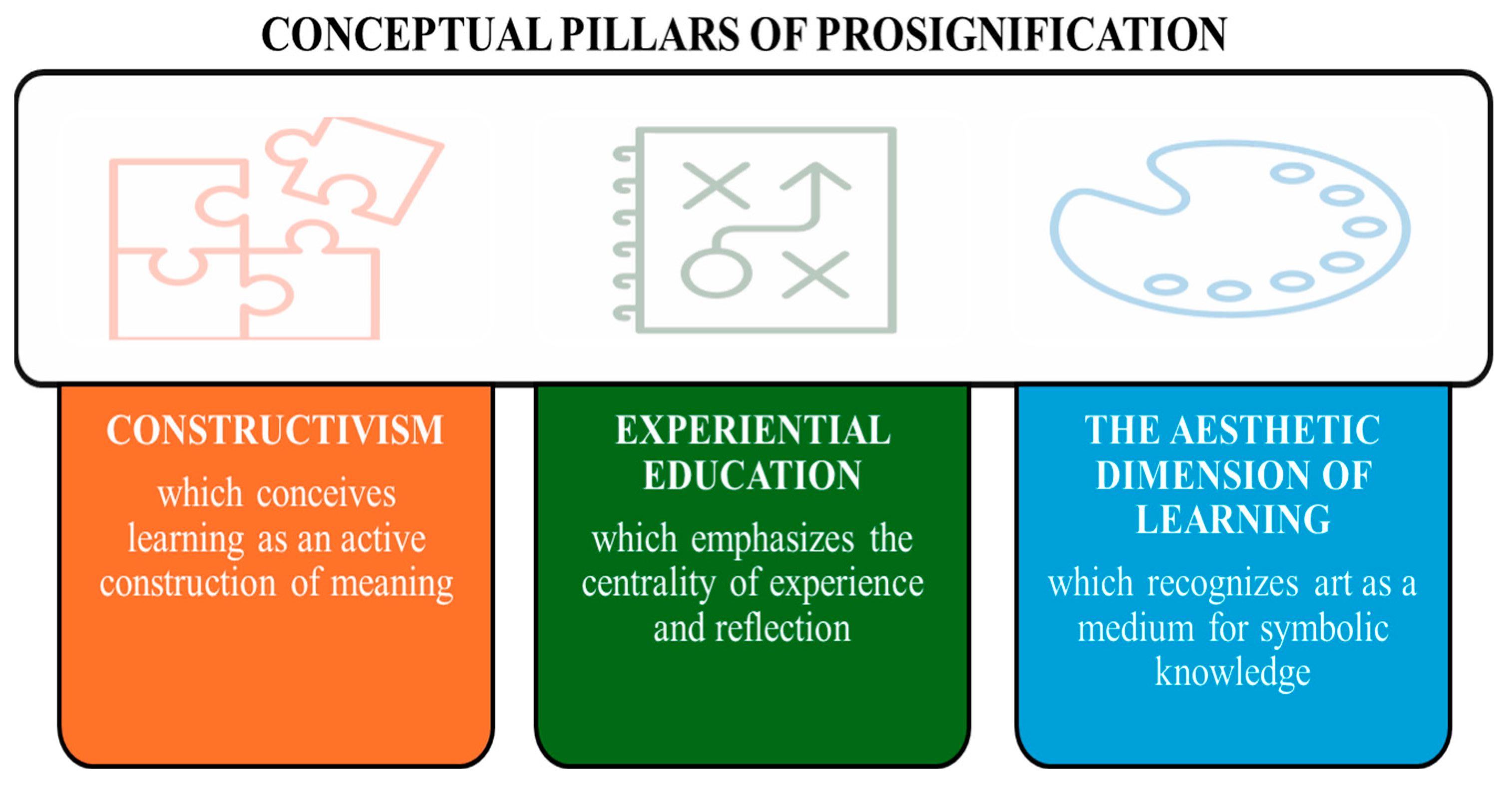
2.3. Prosignification
3. Art Education as a Space for Prosignification
3.1. Aesthetic Experience as a Generator of Meaning
3.2. The Artistic Project as a Learning Device
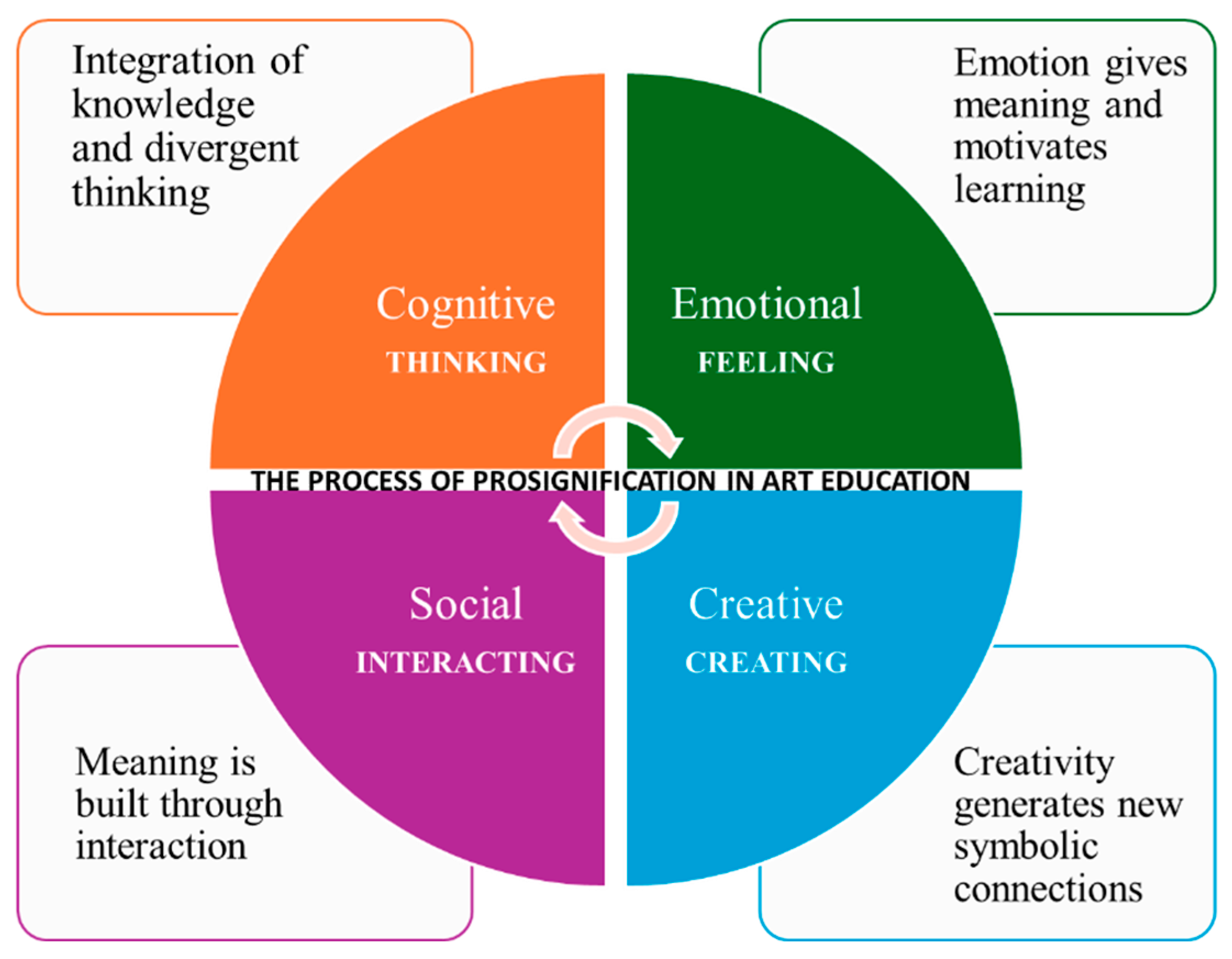
3.3. Dimensions of Prosignification in Art Education
- Emotional dimension: the student’s affective engagement is essential for learning to acquire personal meaning. Emotions mediate between experience and knowledge, facilitating memory and motivation [39].
- Social dimension: prosignification is strengthened through dialogue and collaboration. In collective artistic projects, learning is socially constructed through interaction, negotiation of meanings, and shared construction of sense [13].
- Creative dimension: creativity is understood as the capacity to produce new symbolic connections. In education, this not only implies originality but also the ability to transform reality through expression [40].
4. Discussion
5. Conclusions
Author Contributions
Funding
Institutional Review Board Statement
Informed Consent Statement
Data Availability Statement
Acknowledgments
Conflicts of Interest
References
- Ausubel, D.P. The Psychology of Meaningful Verbal Learning; Grune & Stratton: New York, NY, USA, 1963. [Google Scholar]
- Ausubel, D.P. Psicología Educativa: Un Punto de Vista Cognoscitivo; Trillas: Mexico City, Mexico, 1980. [Google Scholar]
- Novak, J.D. Learning How to Learn; Cambridge University Press: Cambridge, UK, 1981. [Google Scholar]
- Eisner, E. Educar la Visión Artística; Paidós: Barcelona, Spain, 1995. [Google Scholar]
- Read, H. Education Through Art; Faber & Faber: London, UK, 1977. [Google Scholar]
- Dewey, J. Art as Experience; Minton, Balch & Company: New York, NY, USA, 1934. [Google Scholar]
- Ausubel, D.P.; Novak, J.D.; Hanesian, H. Psicología Educativa: Un Punto de Vista Cognoscitivo, 2nd ed.; Trillas: Mexico City, Mexico, 1991. [Google Scholar]
- Sexton, S.S. Meaningful Learning—David P. Ausubel. In Science Education in Theory and Practice: An Introductory Guide to Learning Theory; Springer Nature: Cham, Switzerland, 2025; pp. 157–171. [Google Scholar]
- Coll, C. Aprendizaje Escolar y Construcción del Conocimiento; Paidós: Barcelona, Spain, 1990. [Google Scholar]
- Moreira, M.A. Aprendizaje Significativo: Teoría y Práctica; Universidad Federal de Río Grande do Sul: Porto Alegre, Brazil, 2000. [Google Scholar]
- Novak, J.D. Meaningful learning: The essential factor for conceptual change in limited or inappropriate propositional hierarchies leading to empowerment of learners. Sci. Educ. 2013, 92, 548–564. [Google Scholar] [CrossRef]
- Piaget, J. Main Trends in Psychology; George Allen & Unwin: Sydney, Australia, 1973. [Google Scholar]
- Vygotsky, L.S. Mind in Society: The Development of Higher Psychological Processes; Harvard University Press: Cambridge, MA, USA, 1978. [Google Scholar]
- Bruner, J. Desarrollo Cognitivo y Educación; Morata: Madrid, Spain, 1988. [Google Scholar]
- Dewey, J. Experience and Education; Macmillan: London, UK, 1949. [Google Scholar]
- Kilpatrick, W. The Project Method: The Use of the Purposeful Act in the Educative Process; Teachers College Press: New York, NY, USA, 1918. [Google Scholar]
- Novalia, R.; Marini, A.; Bintoro, T.; Muawanah, U. Project-based learning: For higher education students’ learning independence. Soc. Sci. Humanit. Open 2025, 11, 101530. [Google Scholar] [CrossRef]
- Rahman, I.; Kaema, M.T.; Nurhapipah, N.; Nelwati, S.; Sabri, A.; Rahmanda, R. Systematic Literature Review: Analysis of Project-based Learning Models from Elementary to High School. Al-Ashri Ilmu-Ilmu Keislam. 2024, 9, 53–66. [Google Scholar]
- Matahari, D.B.; Nurohman, S.; Jumadi, J.; Astuti, S.R.D. Research trends in project-based learning models in facilitating 21st century skills: Systematic literature review. J. Penelit. Pendidik. IPA 2023, 9, 1607–1614. [Google Scholar] [CrossRef]
- Hernández, F. Educación y Cultura Visual; Octaedro: Barcelona, Spain, 2000. [Google Scholar]
- Bobek, V.; Colarič-Jakše, L.M.; Horvat, T. Motivation and Group Dynamics. In Organizational Behavior: Current Science, Models, and Applications; Springer Nature: Cham, Switzerland, 2025; p. 109. [Google Scholar]
- Manera, L. Art and aesthetic education in the Reggio Emilia Approach. Educ. 3-13 2022, 50, 483–493. [Google Scholar] [CrossRef]
- Sriarun, A.; Srikao, S.; Jantharajit, N. An Experiential Learning Management Model (ELMM) for Early Childhood Based on the Reggio Emilia Approach and Constructivist Theory. J. Educ. Learn. 2025, 14, 298–306. [Google Scholar] [CrossRef]
- Ordoñez Reino, B.K.; Fernández Sánchez, L.; Sancho Aguilera, D. Efectividad del Aprendizaje Basado en Proyectos para la adquisición de habilidades sociales en los niños: Una revisión sistemática. Rev. InveCom 2026, 6, 1–12. [Google Scholar] [CrossRef]
- Li, H.; Xiao, R.; Nieu, H.; Tseng, Y.J.; Liao, G. From Unseen Needs to Classroom Solutions: Exploring AI Literacy Challenges & Opportunities with Project-Based Learning Toolkit in K-12 Education. Proc. AAAI Conf. Artif. Intell. 2025, 39, 29145–29152. [Google Scholar] [CrossRef]
- Fuad, D.R.S.M.; Musa, K.; Hashim, Z. Innovation culture in education: A systematic review of the literature. Manag. Educ. 2022, 36, 135–149. [Google Scholar] [CrossRef]
- Isabirye, A.K.; Moloi, K.C.; Lebelo, R.S.; Khan, S. Cultivating Creativity and Innovation in the School Curriculum for the 21st Century: Opportunities and Challenges. J. Ecohumanism 2025, 4, 334–348. [Google Scholar] [CrossRef]
- Kolb, D. Experiential Learning: Experience as the Source of Learning and Development; Prentice Hall: Upper Saddle River, NJ, USA; Paidós: Barcelona, Spain, 1984. [Google Scholar]
- Freire, P. Pedagogía del Oprimido; Siglo XXI: Mexico City, Mexico, 1970. [Google Scholar]
- Parsons, M.J. Cómo Entendemos el Arte: Una Perspectiva Cognitivo-Evolutiva de la Experiencia Estética; Paidós: Barcelona, Spain, 2002. [Google Scholar]
- Thomson, P. Why bother with arts education in schools? Aust. Educ. Res. 2025, 52, 781–801. [Google Scholar] [CrossRef]
- Agamben, G. ¿Qué es un Dispositivo? Anagrama: Barcelona, Spain, 2015. [Google Scholar]
- Deleuze, G. ¿Qué es un Dispositivo? In Michel Foucault, Filósofo; Gedisa: Barselona, Spain, 1989. [Google Scholar]
- Foucault, M. Vigilar y Castigar; Siglo XXI: Mexico City, Mexico, 1978. [Google Scholar]
- Soto Calderón, A. La Performatividad de las Imágenes; Metales Pesados: Santiago, Chile, 2020. [Google Scholar]
- Cartagena, M.F. Arte, educación y transformación social. Index Rev. Arte Contemp. 2015, 00, 44–61. [Google Scholar] [CrossRef]
- Ramos-Vallecillo, N.; Murillo-Ligorred, V. Imagen, materia y objeto, una experiencia pedagógica en torno al dispositivo-artístico-didáctico para la construcción de espacios de aprendizaje en el grado de primaria. REXE Rev. Estud. Exp. Educ. 2024, 23, 372–390. [Google Scholar] [CrossRef]
- Efland, A. Art and Cognition: Integrating the Visual Arts in the Curriculum; Teachers College Press: New York, NY, USA, 2002. [Google Scholar]
- Immordino-Yang, M.H.; Damasio, A. We feel, therefore we learn: The relevance of affective and social neuroscience to education. Mind Brain Educ. 2007, 1, 3–10. [Google Scholar] [CrossRef]
- Craft, A. Creativity in Schools: Tensions and Dilemmas; Routledge: London, UK, 2005. [Google Scholar]
- Banks, M. Los Datos Visuales en Investigación Cualitativa; Morata: Madrid, Spain, 2010. [Google Scholar]
- Bolaños-Motta, J.I.; Pérez-Rodríguez, M.A. Propuestas para la investigación cualitativa en educación artística. Educ. Educ. 2019, 22, 51–63. [Google Scholar] [CrossRef]
- Domínguez, J. De la investigación científica a la investigación cualitativa en educación. Rev. Superv. 2015, 21, 1–22. [Google Scholar]
- Flick, U. El Diseño de Investigación Cualitativa; Morata: Madrid, Spain, 2015. [Google Scholar]
- Löser, J.; Rabenstein, K. The Relevance of Qualitative Research Approaches in Inclusive Education. In Bildung für Alle Stärken–Improve Education for All; Verlag Julius Klinkhardt: Bad Heilbrunn, Germany, 2025; p. 45. [Google Scholar]
- Martínez-Barragán, C. Metodología cualitativa aplicada a las Bellas Artes. Rev. Electrónica Investig. Docencia Creat. 2011, 1, 46–62. [Google Scholar]
- Kumar, N.; Bombale, G.R.; Ali, K.F.S.; Nagaballi, S.; Shinde, S.D. Research Methodology; RK Publication: Delhi, India, 2025. [Google Scholar]
- Irwin, R.L.; García Sierra, D. La práctica de la a/r/tografía. Rev. Educ. Pedagog. 2013, 25, 106–113. Available online: https://revistas.udea.edu.co/index.php/revistaeyp/article/view/328771 (accessed on 21 March 2026).
- Irwin, R.L.; de Cosson, A. A/r/tography: Rendering Self Through Arts-Based Living Inquiry; Pacific Educational Press: Vancouver, BC, Canada, 2004. [Google Scholar]
- Irwin, R.; Golparian, S.; Barney, D. A/R/Tografía Como Metodología Para la Investigación Visual. In Ideas Visuales: Investigación Basada en Artes e Investigación Artística; Marín-Viadel, D.R., Roldán, J., Eds.; Universidad de Granada: Granada, Spain, 2017. [Google Scholar]
- Marín-Viadel, R.; Roldán, J. A/r/tografía e Investigación Educativa Basada en Artes Visuales en el panorama de las metodologías de investigación en Educación Artística. Arte Individuo Soc. 2019, 31, 881–895. [Google Scholar] [CrossRef]
- Bolívar, C.R. Instrumentos y Técnicas de Investigación Educativa. Un Enfoque Cuantitativo y Cualitativo para la Recolección y Análisis de Datos; DANAGA: Houston, TX, USA, 2013. [Google Scholar]
- Hartas, D. Educational Research and Inquiry: Qualitative and Quantitative Approaches; Bloomsbury Publishing: London, UK, 2025. [Google Scholar]
- Tabron, L.A.; Thomas, A.K. Deeper than wordplay: A systematic review of critical quantitative approaches in education research (2007–2021). Rev. Educ. Res. 2023, 5, 756–786. [Google Scholar] [CrossRef]
- Trigwell, K. Approaches to teaching design subjects: A quantitative analysis. Art Des. Commun. High. Educ. 2002, 2, 69–80. [Google Scholar] [CrossRef]
- Boss, S.; Larmer, J. Project-Based Teaching; ASCD: Alexandria, VA, USA, 2015. [Google Scholar]
- Larmer, J. Getting Started with Project-Based Learning; ASCD: Alexandria, VA, USA, 2017. [Google Scholar]
- Larmer, J.; Ross, D.; Mergendoller, J.R. Project-Based Learning (PBL) Starter Kit; Buck Institute for Education: Novato, CA, USA, 2017. [Google Scholar]
- Mohd Hawari, A.D.; Mohd Noor, A.I. Project-Based Learning Pedagogical Design in STEAM Art Education. Asian J. Univ. Educ. 2020, 16, 102–111. [Google Scholar] [CrossRef]
- Turgut, H. Prospective Science Teachers’ Conceptualizations about Project-Based Learning. Online Submiss. Int. J. Instr. 2008, 1, 61–79. [Google Scholar]
- Finley, S. Critical arts-based inquiry. Collect. Interpret. Qual. Mater. 2013, 4, 85–117. [Google Scholar]
- Simons, H.; McCormack, B. Integrating arts-based inquiry in evaluation methodology: Opportunities and challenges. Qual. Inq. 2007, 13, 292–311. [Google Scholar] [CrossRef]
- Ryan, M.E. Reflective Practice in the Arts. In Literacy in the Arts: Retheorising Learning and Teaching; Springer International Publishing: Cham, Switzerland, 2014; pp. 77–90. [Google Scholar]
- Adeoye, M.A.; Baharun, H.; Munawwaroh, I. Transformational Leadership in Education: Harmonising Accountability, Innovation and Global Citizenship. Kharisma J. Adm. Dan Manaj. Pendidik. 2025, 4, 14–30. [Google Scholar] [CrossRef]
- Kovari, A. Ethical use of ChatGPT in education—Best practices to combat AI-induced plagiarism. Front. Educ. 2025, 9, 1465703. [Google Scholar] [CrossRef]
- Iloka, P.C. Teaching Integrity: Strategies for Fostering Ethical Behavior in Students. UNIZIK J. Educ. Res. Policy Stud. 2025, 19, 161–174. [Google Scholar]
- Wahi, R.; Chuah, K.M.; Junaini, S.N. Leveraging AI for Nurturing Learners with Empathy, Ethics, and Social Responsibility. In Digital Transformation and Sustainability in Higher Education; IGI Global Scientific Publishing: Hershey, PA, USA, 2026; pp. 205–236. [Google Scholar]



| Aspect | Meaning Making | Transformative Learning | Prosignification |
|---|---|---|---|
| Focus | Interpretation of experience | Transformation of perspectives | Projection and generation of new meanings |
| Temporal orientation | Present-oriented | Retrospective and reflective | Future-oriented |
| Learner’s role | Interpreter | Critical reflector | Proactive creator of meaning |
| Nature of meaning | Constructed and stabilized | Critically reconfigured | Dynamic and expansive |
| Arts education | Understanding artistic meaning | Transformative aesthetic experience | Exploration and creation of new significations |
Disclaimer/Publisher’s Note: The statements, opinions and data contained in all publications are solely those of the individual author(s) and contributor(s) and not of MDPI and/or the editor(s). MDPI and/or the editor(s) disclaim responsibility for any injury to people or property resulting from any ideas, methods, instructions or products referred to in the content. |
© 2026 by the authors. Licensee MDPI, Basel, Switzerland. This article is an open access article distributed under the terms and conditions of the Creative Commons Attribution (CC BY) license.
Share and Cite
Ramos-Vallecillo, N.; Murillo-Ligorred, V. Prosignification in Art Education: Project-Based and Meaningful Learning Towards Active Learning. Encyclopedia 2026, 6, 86. https://doi.org/10.3390/encyclopedia6040086
Ramos-Vallecillo N, Murillo-Ligorred V. Prosignification in Art Education: Project-Based and Meaningful Learning Towards Active Learning. Encyclopedia. 2026; 6(4):86. https://doi.org/10.3390/encyclopedia6040086
Chicago/Turabian StyleRamos-Vallecillo, Nora, and Víctor Murillo-Ligorred. 2026. "Prosignification in Art Education: Project-Based and Meaningful Learning Towards Active Learning" Encyclopedia 6, no. 4: 86. https://doi.org/10.3390/encyclopedia6040086
APA StyleRamos-Vallecillo, N., & Murillo-Ligorred, V. (2026). Prosignification in Art Education: Project-Based and Meaningful Learning Towards Active Learning. Encyclopedia, 6(4), 86. https://doi.org/10.3390/encyclopedia6040086