1. Introduction
Whispering gallery mode (WGM) microresonators provide a powerful platform for optical sensing and for probing light–matter interactions due to their strong sensitivity to refractive index and geometry [
1,
2,
3,
4,
5]. In spherical cavities, this sensitivity is fundamentally governed by the optical path length
, which determines the free spectral range (FSR,
) of the resonance comb. Accurate extraction of this quantity from experimental spectra is therefore central to quantitative WGM-based metrology.
In practice, however, retrieving the FSR from experimental spectra remains challenging, particularly in soft photonic microcavities such as liquid microdroplets and porous silica microcapsules. These systems often exhibit strong fluorescence backgrounds, overlapping mode families, and spectral complexity arising from background emission and modal overlap that hinder direct peak-by-peak analysis and mode indexing [
6,
7,
8,
9,
10,
11]. As a result, conventional approaches based on individual peak identification become unreliable, limiting the quantitative use of WGM spectroscopy in complex soft-matter systems.
To address this limitation, we introduce a Fourier-transform (FT)-based framework that treats the WGM spectrum as a quasi-periodic signal and extracts its characteristic periodicity directly in the frequency domain. In this representation, the FSR appears as a dominant peak, enabling robust determination of the optical path length through
without requiring explicit peak identification [
12,
13,
14]. This approach transforms a complex, background-contaminated spectrum into a single primary measurand, providing a simplified and noise-resilient route to quantitative analysis.
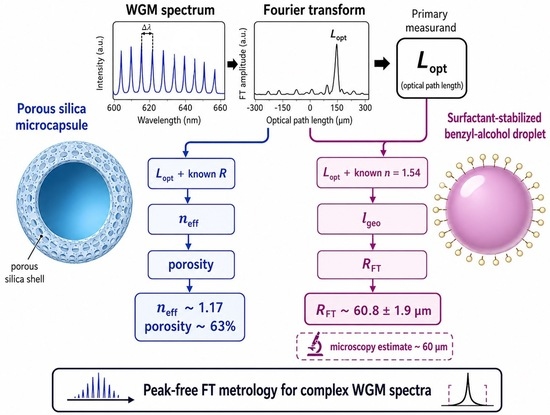
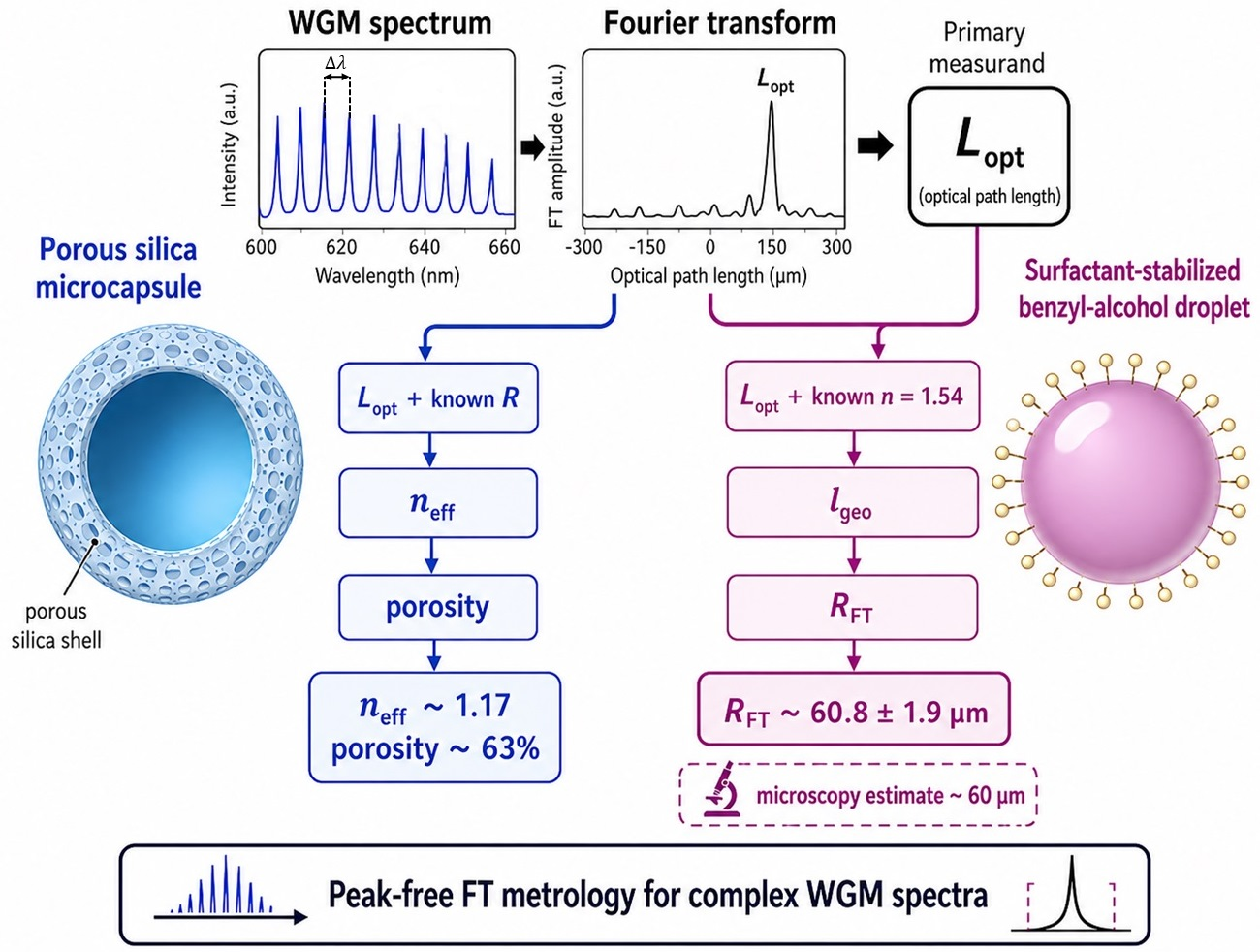
In this work, the optical path length is established as the primary measurand extracted from WGM spectra, from which two complementary measurement models are defined, providing a unified framework for quantitative analysis across different microcavity systems.
Recent advances have also highlighted the potential of noise-assisted and noise-enhanced sensing strategies, where structured noise or complex spectral backgrounds can improve sensitivity rather than degrade it. In this context, Fourier-domain approaches provide a natural framework for extracting robust periodic features from noisy signals, complementing emerging paradigms in optical and acoustic sensing [
15]. In particular, the present FT-based framework leverages this property by transforming complex spectral fluctuations into a well-defined periodic signature, enabling reliable extraction of the optical path length even in the presence of overlapping modes and background emission.
Conventional approaches to WGM analysis often rely on peak-finding and mode-tracking algorithms, which can involve complex fitting procedures, mode indexing, and sensitivity to noise and background signals. Such methods may become computationally demanding and error-prone in the presence of overlapping mode families. In contrast, the FT-based approach reduces the problem to the extraction of a dominant periodicity, offering improved robustness to spectral complexity and a natural compatibility with automated, high-throughput analysis pipelines [
16].
Beyond signal processing, this work establishes FT-based WGM analysis as a metrological framework. By combining the extracted optical path length with independently known parameters, two complementary measurement models can be defined: (i) determination of the effective refractive index when the cavity geometry is known, and (ii) inference of a geometric path length when the refractive index is known. This unified formulation enables consistent uncertainty propagation and quantitative comparison across different types of soft photonic systems.
In this work, we establish a metrological framework for FT-based analysis of WGM spectra following the Guide to the Expression of Uncertainty in Measurement (GUM) [
17]. The objective is not to introduce new physical observables, but to formalize a robust methodology for extracting quantitative parameters from WGM spectra when conventional peak-based analysis becomes unreliable. To this end, we define the measurement models, evaluate the uncertainty budget, and apply the framework to two representative soft photonic systems previously investigated for other physical purposes. First, for Rhodamine B-doped mesoporous silica microcapsules of known radius, we extract the effective refractive index and convert it to porosity using effective medium theory, with validation against independent BET measurements [
14]. Second, for surfactant-stabilized Rhodamine 640-doped benzyl alcohol microdroplets of known refractive index, we show that the same FT-based framework identifies multiple Fourier-domain periodicities and yields inferred geometric path lengths consistent with near-equatorial mode propagation [
8].
The two systems considered here serve as complementary test cases under distinct measurement conditions: mesoporous silica microcapsules enable refractive index determination when geometry is known, while microdroplets provide a geometric path-length consistency test when the refractive index is known. This dual approach demonstrates the applicability of the proposed framework across different classes of soft photonic microcavities.
It is important to note that the experimental dataset for the silica microcapsule used in this work is not newly acquired but reprocessed from a previously published study [
14]. The objective of the present work is not to reproduce those results, but to demonstrate how a unified Fourier-transform-based metrological framework can be applied to extract quantitative measurands and associated uncertainties from such spectra.
While the spectrum itself originates from Ref. [
14], the present manuscript addresses a different objective. Rather than focusing on the physical interpretation of WGM emission, it develops a metrological treatment based on Fourier-domain analysis, explicit measurement models, and uncertainty quantification following the GUM framework. These aspects were not developed in a systematic metrological form in the prior work and are the main contribution of the present study.
2. Theoretical Background
2.1. Measurement Principle: WGM Resonance Condition
For a spherical cavity of radius
R and effective refractive index
, the WGM resonance wavelengths
satisfy [
1,
3,
18,
19]:
where
m is the azimuthal mode number and
for the cavity sizes considered here (
).
It should be noted that the effective radius may differ slightly from the geometric radius R, particularly for higher-order radial or polarization mode families. These deviations arise from the spatial distribution of the electromagnetic field and its evanescent extension outside the cavity boundary. In the present work, this effect is neglected as a first-order approximation, but it may contribute to systematic deviations in high-precision measurements. More specifically, different radial mode families exhibit distinct spatial field distributions, leading to slightly different effective optical path lengths. As a result, the extracted FSR may represent a weighted contribution of multiple mode families when spectral overlap occurs. While a full modal decomposition would require numerical simulations of the electromagnetic field distribution, the present FT-based approach captures the dominant periodicity associated with the most strongly excited modes. This approximation is sufficient for the metrological objectives of this work, where the primary goal is robust estimation of the optical path length rather than precise mode identification. These variations may lead to small differences in the extracted free spectral range depending on the dominant mode family (e.g., TE/TM or higher-order radial modes), which are implicitly averaged in the Fourier-domain analysis.
The free spectral range (FSR) between consecutive modes of the same family is then approximated by
where
is the optical path length. Over the narrow spectral windows used here, chromatic dispersion is neglected.
2.2. Fourier-Transform Extraction as a Metrological Tool
In soft photonic systems, direct peak-by-peak determination of
is often hindered by fluorescence background, spectral overlap, and noise. FT analysis provides a more robust alternative: the quasi-periodic WGM comb appears as a peak in the Fourier domain at spatial frequency
[
12,
14].
To extract the quasi-periodic spacing of the WGM comb, the preprocessed spectrum is mapped from wavelength space into the Fourier domain using a discrete Fourier transform. In this representation, periodic modulations in the spectrum give rise to peaks whose positions are directly related to the inverse free spectral range. The dominant Fourier peak therefore provides a robust estimate of the characteristic spectral periodicity even when individual resonances are partially obscured by background emission or overlap. For a preprocessed spectrum
, the FT amplitude is written as
where
are Hanning window coefficients and
.
In practice, denotes the normalized and background-corrected spectral intensity sampled at wavelength , while is a Hanning apodization coefficient used to reduce spectral leakage due to the finite window size. The modulus of the transform is taken so that the analysis is based on the amplitude of the periodic components.
Using a first-order approximation around the centroid wavelength
, the optical path length is obtained from the measured FSR as
This optical path length is the primary measurand used throughout the paper. In the following, this measurand is used to define two complementary measurement models, which are then implemented and validated on representative soft photonic systems.
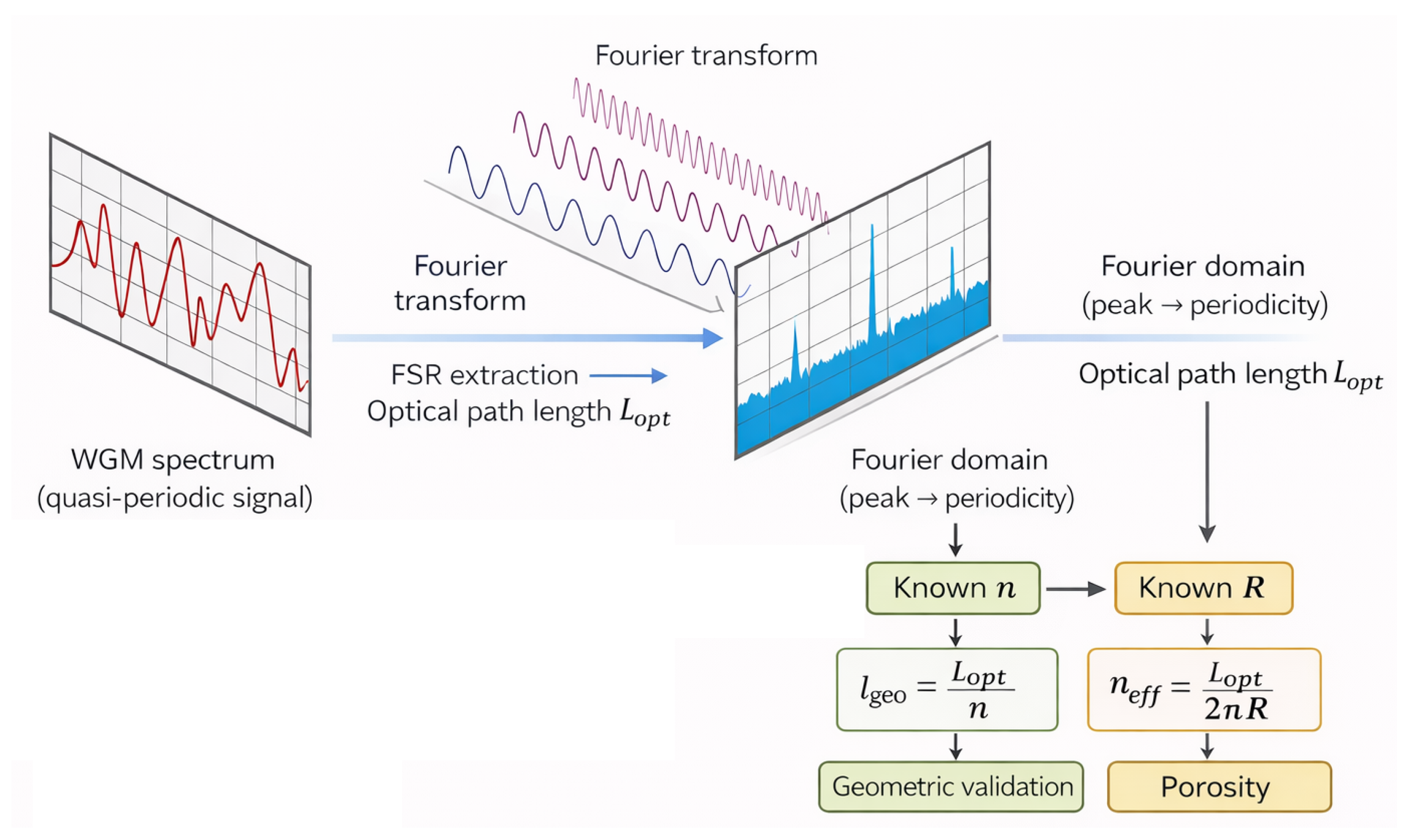
The overall FT-based metrological workflow is summarized in
Figure 1. Starting from a quasi-periodic WGM emission spectrum, Fourier-domain analysis extracts the characteristic spectral periodicity, which is converted into the optical path length
. This primary measurand then feeds two complementary measurement models: refractive-index extraction when the cavity radius is known, and geometric path-length inference when the refractive index is known.
2.3. Measurement Models for Derived Quantities
From the primary measurand , two distinct measurement models yield different derived quantities depending on prior knowledge of the cavity:
Model 1: Refractive index measurement. When the cavity radius
R is known independently, the effective refractive index is obtained as:
This model applies to the mesoporous silica capsules, where R is measured by optical microscopy and is the unknown quantity of interest.
Model 2: Inferred geometric path length measurement. When the refractive index
n of the cavity medium is known from bulk properties, an inferred geometric path length is obtained as:
Comparing to the independently estimated physical perimeter provides a consistency check that supports equatorial mode propagation and helps assess potential geometric deviations. This model applies to the microdroplets, where for benzyl alcohol.
Both models share the same primary measurand and differ only in the auxiliary quantities (R or n) that must be known. This common structure enables consistent uncertainty propagation across both validation studies.
2.4. Uncertainty Propagation Framework
Following the Guide to the Expression of Uncertainty in Measurement (GUM) [
17], the combined standard uncertainty for each derived quantity is obtained by propagating the uncertainties of the input quantities through the measurement model. The input quantities are assumed to be uncorrelated, so covariance terms are neglected. For
, which depends on
,
, and
R, the propagation formula is:
with sensitivity coefficients derived from Equation (
5):
In relative terms, Equation (
7) simplifies to:
For the geometric path length , an analogous expression holds with R replaced by n and the appropriate sensitivity coefficients. This relative form clearly shows how each input uncertainty contributes to the final measurement uncertainty, allowing identification of the dominant components.
The individual uncertainty contributions
,
, and
or
are evaluated in
Section 3 based on the instrumental characteristics and experimental procedures.
In the case of microdroplets, the evanescent field of WGMs extends into the surrounding medium, making the effective refractive index sensitive to interfacial conditions. Variations in local composition, surfactant concentration, or dye distribution may therefore introduce additional systematic uncertainty not captured by the bulk refractive index value. While a quantitative estimation of this contribution would require detailed modeling of the evanescent field penetration depth, its magnitude is expected to remain smaller than the dominant uncertainty associated with FSR determination. This effect is therefore acknowledged as a secondary source of systematic uncertainty.
For the inferred geometric path length
, the combined standard uncertainty is obtained as
Using Equation (
6), the corresponding sensitivity coefficients are
In relative form, this becomes
2.5. Validation Framework: Effective Medium Theory
To validate the refractive index obtained from Model 1, we compare the porosity
derived from
with independent BET measurements. For a silica/air composite with
and
, we consider three classical effective medium models [
20,
21]:
Maxwell–Garnett
with
,
m the silica matrix, and
i the air inclusions.
These models are used only as external validation tools by comparing the optically inferred porosity with the BET reference.
3. Materials and Methods
This section describes representative material systems, fabrication approaches, and experimental protocols used to illustrate the FT-based metrological framework. The emphasis is placed on the definition and traceability of input quantities, as well as on the characterization of their associated uncertainties, in accordance with the GUM framework [
17]. These systems are subsequently used to implement and validate the FT-based metrological framework under different experimental conditions.
3.1. Mesoporous Silica Microcapsules: Reference System for Refractive Index Metrology
Mesoporous hollow silica microcapsules can be prepared using droplet-based microfluidic sol–gel approaches following established protocols [
14,
22,
23]. In such systems, a flow-focusing PDMS device generates microdroplets from a precursor solution typically composed of tetraethyl orthosilicate (TEOS), ethanol/water mixtures, acid catalyst, and a block-copolymer template (e.g., Pluronic
® P123). The droplets are subsequently subjected to gelation and controlled drying, yielding hollow capsules with high sphericity and narrow size distribution, as confirmed by electron microscopy.
These microcapsules provide a convenient reference system for applying the refractive index measurement model (Equation (
5)), as their geometry can be independently characterized. It is important to note that the characteristic pore size in mesoporous silica (typically a few nanometers) is much smaller than the optical wavelength used in this study (hundreds of nanometers). This ensures that scattering losses remain negligible and that high-Q WGM resonances are preserved. Typical capsule diameters are on the order of
, with shell thickness in the micrometer range. The outer radius
R, obtained from calibrated optical or electron micrographs, constitutes a key input quantity for the metrological model.
Fluorescent dyes such as Rhodamine B can be introduced by post-synthesis loading, for instance via immersion in dilute aqueous solutions [
24]. This approach minimizes self-quenching effects and promotes emission localized within the porous shell, enabling efficient excitation of WGM resonances without altering the measurement model.
Independent characterization of the internal structure can be performed using nitrogen adsorption–desorption measurements at 77 K, providing a reference porosity via BET analysis. For silica-based systems, the porosity
can be estimated from the measured pore volume
and the skeletal density of silica
as:
In Equation (
14), both terms in the denominator are expressed as specific volumes. The quantity
is the pore volume per unit mass, while
is the specific skeletal volume of silica. Their sum is therefore dimensionally consistent, and the resulting ratio yields a dimensionless porosity. This independent characterization serves as an external benchmark for validating refractive index values obtained from the FT-based analysis.
3.2. Surfactant-Stabilized Microdroplets: Reference System for Geometric Path Length Analysis
Liquid microdroplets generated in microfluidic systems provide a complementary reference platform for applying the geometric path length measurement model (Equation (
6)). Such droplets can be produced using flow-focusing devices in which an organic phase (e.g., benzyl alcohol) is dispersed into a fluorinated oil continuous phase [
25,
26,
27]. The refractive index of the droplet phase is typically known from bulk measurements, making it suitable as an input parameter for the metrological model.
Fluorescent dyes (e.g., Rhodamine 640) can be dissolved in the dispersed phase to enable optical excitation of WGMs. The addition of surfactants (such as Krytox-based amphiphiles) stabilizes the droplets against coalescence and can induce preferential alignment of dye molecules at the interface [
9,
28]. While such interfacial effects are relevant for physical interpretation of the emission, they do not directly enter the uncertainty budget of the geometric path length, which depends primarily on the extracted optical path length and the known refractive index.
To preserve near-spherical geometry during optical interrogation, droplets can be confined in microfabricated trapping chambers or microwell arrays [
29,
30]. Maintaining sphericity is essential, as geometric deviations would introduce systematic discrepancies when comparing inferred path lengths to the expected perimeter
.
3.3. Optical Setup and Spectroscopic Acquisition
WGM spectra can be acquired using either free-space or integrated optical configurations, depending on the microcavity system under investigation. Excitation is typically provided by a pulsed or continuous-wave laser source in the visible range (e.g., ), focused onto the microcavity through a microscope objective. The excitation conditions are chosen to enhance WGM visibility while minimizing thermal or nonlinear effects.
The excitation conditions may influence the relative excitation of different mode families. In the present work, no explicit control or discrimination between these families is performed, and the analysis focuses on the dominant periodicity extracted from the spectrum.
Emission is collected in the equatorial plane, coupled into an optical fiber, and analyzed with a grating spectrometer equipped with a CCD detector. Spectral calibration can be performed using reference emission lines (e.g., neon), yielding wavelength uncertainties on the order of . The instrumental spectral resolution typically lies in the range, and multiple excitation pulses can be integrated to improve signal-to-noise ratio.
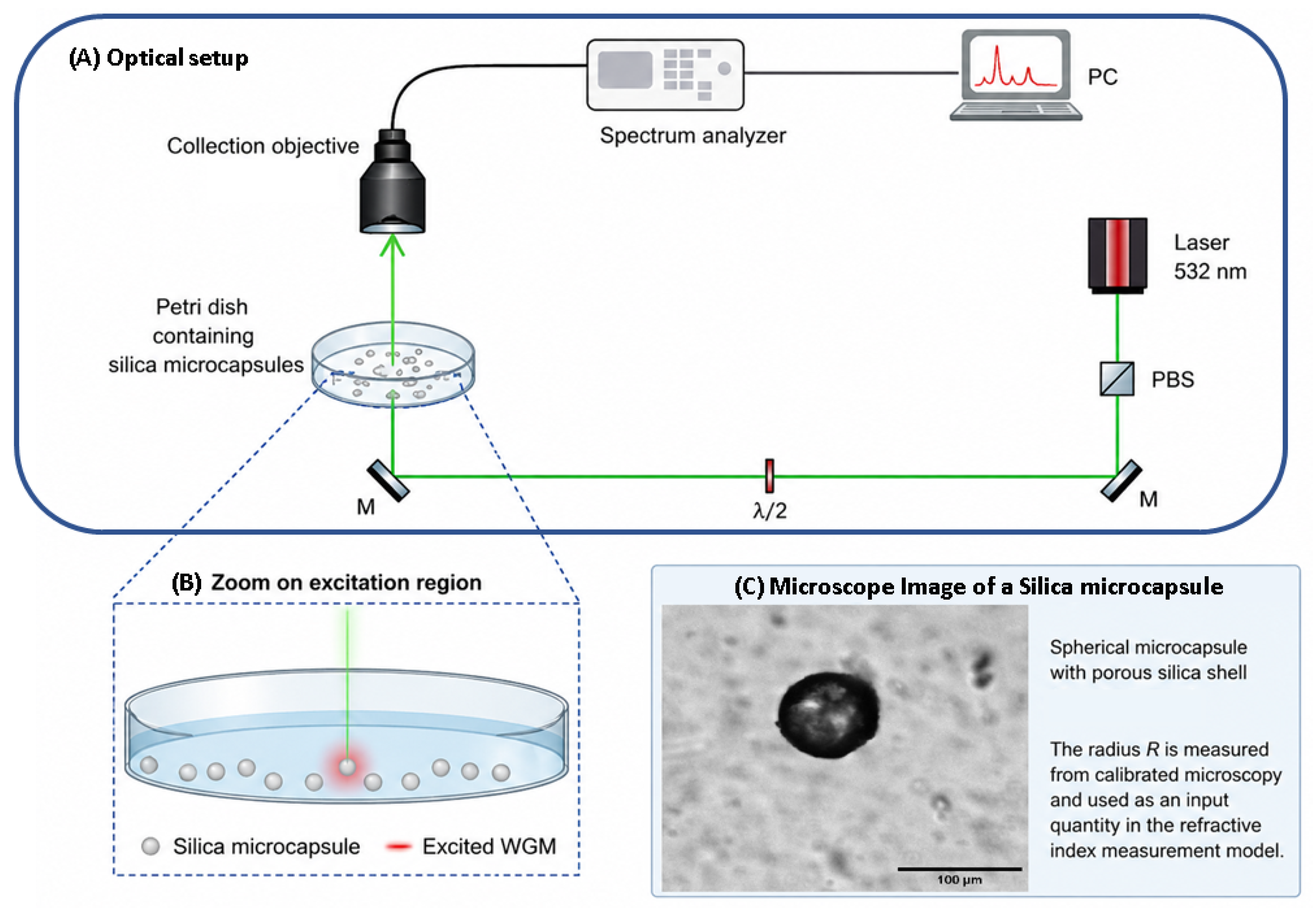
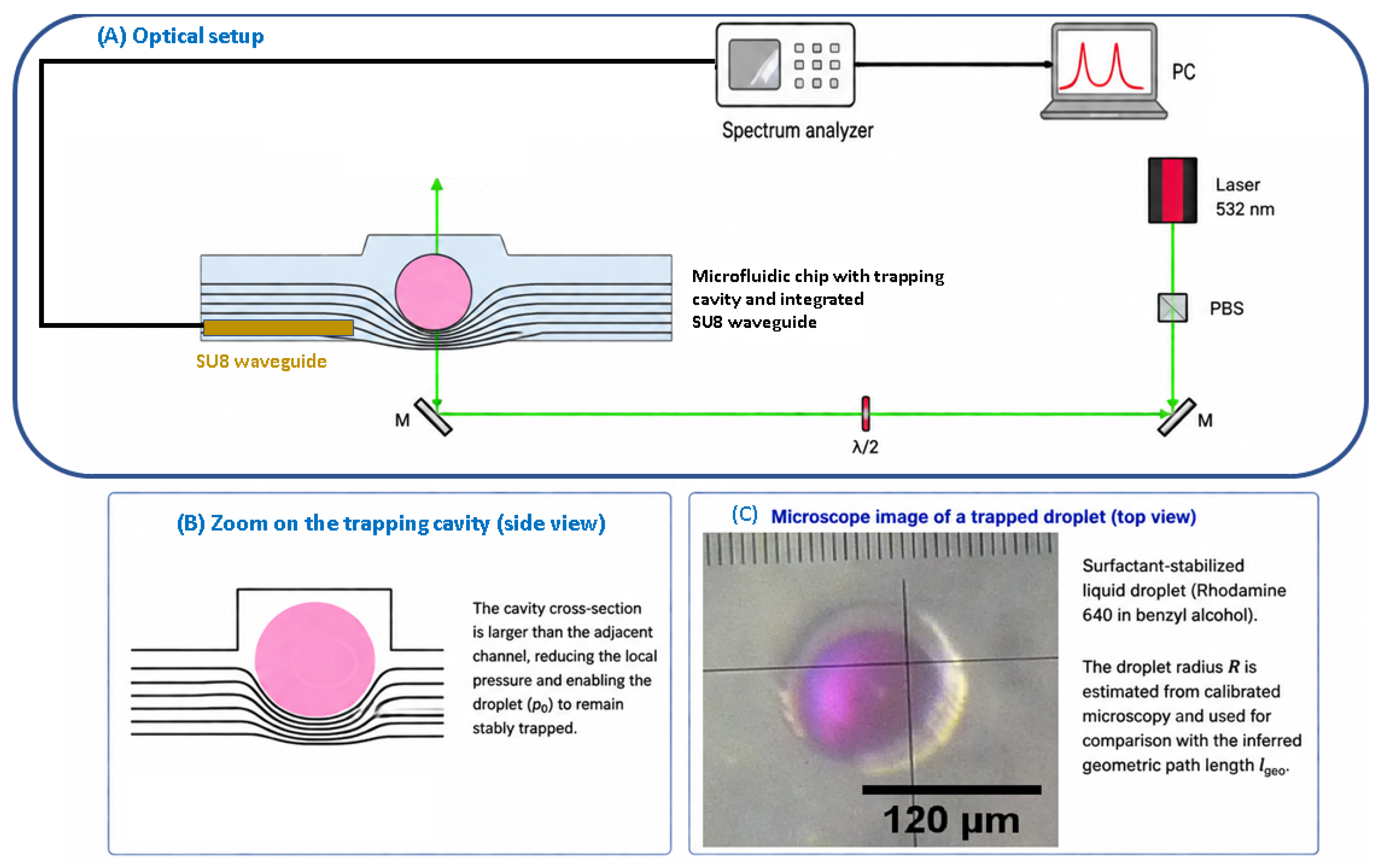
Two distinct experimental configurations were employed in this work, corresponding to the two measurement models considered. For the mesoporous silica microcapsules, a free-space excitation and collection geometry was used, as illustrated in
Figure 2. In this configuration, the WGM emission is collected through a microscope objective and directed to the spectrometer. In contrast, the microdroplet experiments were performed using an integrated optofluidic platform, as shown in
Figure 3. The droplets are trapped within a microfluidic cavity, and the WGM emission is coupled evanescently into integrated SU-8 waveguides, which guide the signal directly to the spectrometer. This configuration enables efficient and stable signal collection without the need for free-space detection.
3.4. Standardized Fourier-Transform Analysis Protocol
All spectra were processed using a custom MATLAB R2025b routine that implements the FT method described in
Section 2.2. The protocol is designed to minimize operator influence and ensure reproducibility of the extracted measurands. The steps are:
Normalization: Raw intensity normalized to to suppress detector offset variations between measurements.
Mode-group selection: The operator selects spectral regions containing quasi-periodic WGM peaks dominated by a single mode family. Selection criteria require visible periodicity and exclusion of regions where multiple families strongly overlap. This step introduces a subjective component whose influence on uncertainty is evaluated through repeated selections on the same spectrum (
Section 3.5). This contribution is implicitly included in the adopted uncertainty
. The choice of a 15–30 nm window represents a compromise between spectral resolution and stationarity of the mode spacing. Tests performed with ±2–3 nm shifts in the window boundaries resulted in variations of
within the estimated uncertainty range, confirming robustness of the method. The selected window width (15–30 nm) is chosen to ensure a sufficient number of quasi-periodic oscillations for reliable Fourier-domain resolution, while remaining narrow enough to preserve local stationarity of the mode spacing and to limit the influence of dispersion and multi-family overlap.
In the present implementation, the admissible window width depends on the spectral complexity of the considered system. For the silica microcapsule spectrum, where a single dominant WGM family is observed, windows of approximately are sufficient to provide a well-resolved Fourier peak while preserving local stationarity of the FSR. For the droplet spectra, where several mode groups coexist, narrower windows of approximately are used to isolate individual quasi-periodic families. The spectral window is therefore not a free parameter chosen to minimize the uncertainty. It is constrained by the requirement of a locally stationary WGM comb, the absence of additional dominant mode families, limited background variation, and the validity of the first-order approximation . Increasing the window width may sharpen the Fourier peak, but it can simultaneously introduce systematic bias through mode-family mixing, dispersion, or background nonstationarity.
Background subtraction: The local mean intensity is subtracted to remove the zero-frequency component (fluorescence pedestal). This operation is linear and does not introduce additional uncertainty.
Hanning windowing: Applied to reduce spectral leakage from the finite acquisition window [
31]. The window coefficients are deterministic and do not contribute to uncertainty.
FFT and symmetrization: The fast Fourier transform is computed, and the amplitude is symmetrized to suppress numerical artifacts. The frequency axis is , where N is the number of points in the selected region and is the wavelength spacing.
Axis transformation: Using the intensity-weighted centroid wavelength
of the selected region, the FT peak position is converted to optical path length according to Equation (
4). The centroid
is computed from the normalized spectrum and has associated uncertainty
.
Peak identification: The dominant FT peak is identified within the admissible Fourier-domain range, either manually for representative spectra or automatically in the robustness and batch analyses. The peak position gives the measured optical path length
. The uncertainty in peak location is estimated from the peak width and operator reproducibility (
Section 3.5). In cases where multiple peaks are present in the FT spectrum (e.g., overlapping mode families in droplets), the selection of the relevant peak is guided by consistency with the expected geometric scale of the system. In particular, the extracted optical path length is compared to the independently estimated perimeter
, and the peak yielding physically consistent values is retained. This approach reduces ambiguity in peak assignment while maintaining a metrological interpretation of the result. This criterion effectively selects the mode family corresponding to near-equatorial WGMs, which dominate the optical path length and provide the most physically meaningful interpretation.
Parameter extraction:
For capsules: , with R measured independently.
For droplets: (with ); the inferred geometric path length is compared to the geometric perimeter estimated from calibrated optical micrographs.
All extracted values, together with metadata (spectral window boundaries, centroid wavelength, number of points, resolution), are exported to CSV files for transparency and subsequent analysis.
3.5. Uncertainty Evaluation
Following the GUM framework [
17], the combined standard uncertainty for each derived quantity is obtained by propagating the uncertainties of the input quantities through the measurement model (Equation (
8)). The individual contributions are evaluated as follows:
Wavelength calibration : The spectrometer calibration was assessed using neon emission lines and provides a wavelength tolerance of
. Assuming a rectangular distribution, this corresponds to a standard uncertainty of
. The finite spectral resolution
is likewise treated as a rectangular distribution, giving a standard uncertainty of
. Combining these quadratically gives:
A conservative value of is adopted in the final uncertainty budget to account for possible unmodeled drift and centroid-selection variability. The adopted value of 0.10 nm corresponds to a conservative upper bound obtained from repeated FT peak extractions and is consistent with the full width at half maximum of the dominant FT peak under typical experimental signal-to-noise conditions.
FSR determination : The uncertainty in
arises from the finite width of the FT peak. For a spectral window of width
, the theoretical resolution in spatial frequency is
. For
,
. Propagating to
via
and noting that
gives:
With
, this yields
. However, a more conservative estimate of
is adopted for all calculations to account for potential systematic effects and to be consistent with the FWHM of the FT peak observed in the actual spectra. This value is used in
Table 1. This adopted value should therefore be interpreted as an upper-bound standard uncertainty rather than as a value determined only by the nominal spectral-window width. To explicitly test the influence of the user-defined spectral window, a dedicated robustness analysis was performed by repeating the FT extraction for shifted and resized admissible windows, as reported in
Section 4.2.
Radius measurement : The capsule radius
was determined from calibrated optical micrographs. The calibration uncertainty of the CCD pixel size contributes
(Type B). The finite depth of field introduces an additional systematic error estimated at
for capsules (rigid solid) and
for droplets (soft, deformable). Combining these quadratically gives:
A conservative relative standard uncertainty of is adopted for capsules in the final budget.
Refractive index of benzyl alcohol : The manufacturer-specified refractive index of benzyl alcohol is at 589 nm. Assuming a rectangular distribution, the standard uncertainty is , giving a relative contribution . This is negligible compared to other uncertainty sources.
These values are inserted into Equation (
8) to obtain the combined relative uncertainty for each measurand. The resulting uncertainty budget for the capsule-based refractive index measurement is presented in
Table 1 in
Section 3. For the droplet case, the uncertainty on the inferred geometric path length is evaluated using Equation (
10). In this model, the dominant contribution remains the FT-based determination of
, while the uncertainty associated with the bulk refractive index
n of benzyl alcohol is comparatively small.
4. Results
4.1. Validation of Model 1: Refractive Index Metrology in Mesoporous Silica Microcapsules
The FT-based refractive index measurement model (Equation (
5)) is first applied to a previously reported dataset of mesoporous silica microcapsules [
14]. This dataset is used here as a reference case to validate the proposed metrological framework, rather than to present new experimental results. The cavity radius
is taken from the original study.
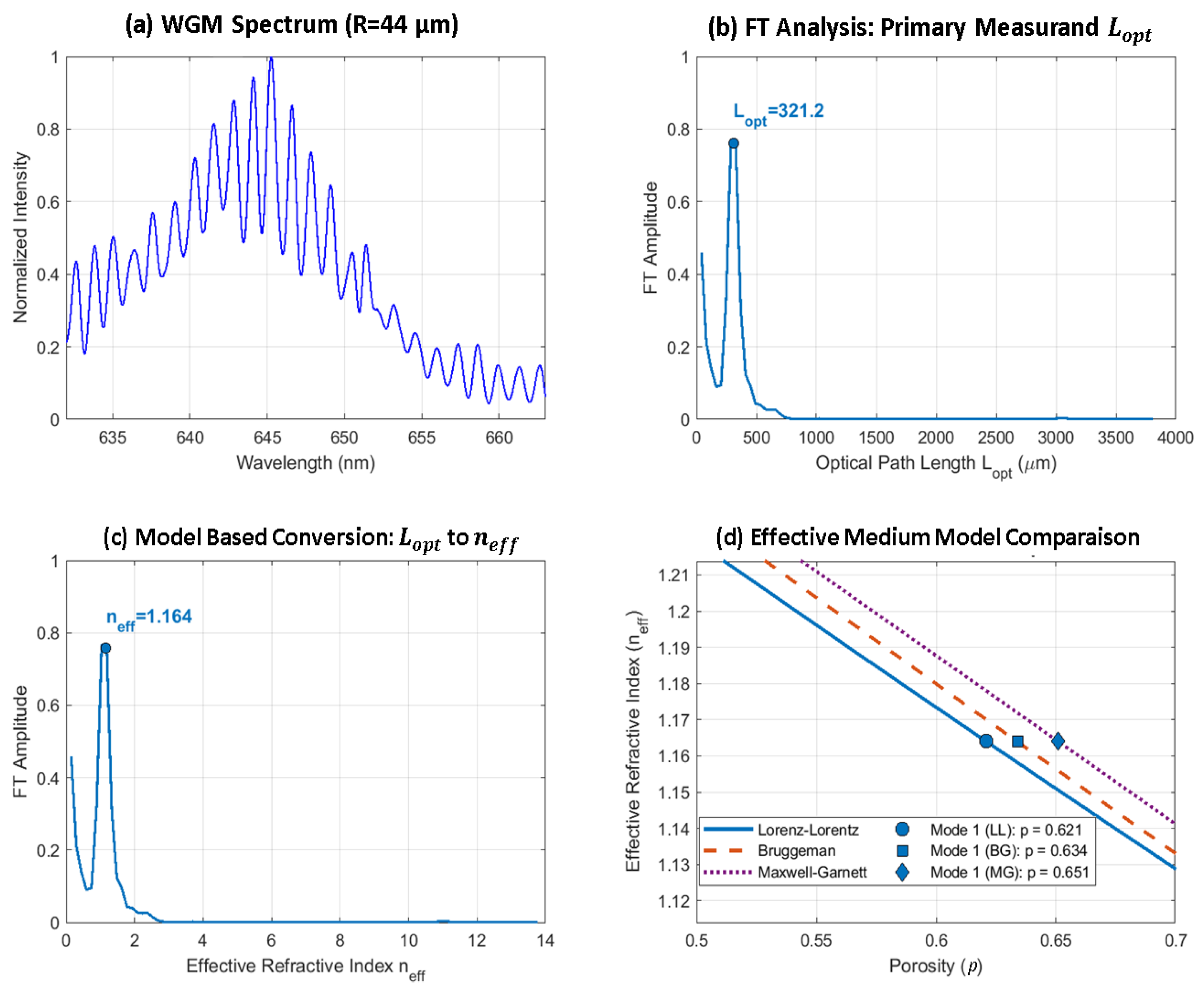
Figure 4a shows the fluorescence emission spectrum of a Rhodamine B-loaded capsule under 532 nm excitation reproduced from Ref. [
14]. The quasi-periodic WGM comb is most clearly resolved in the
region selected for FT analysis.
The corresponding FT spectrum (
Figure 4b) exhibits a single dominant peak, from which the optical path length is directly obtained as
using
.
The effective refractive index is then derived from Equation (
5), as shown in
Figure 4c:
The combined standard uncertainty is
, corresponding to a relative uncertainty of
. This uncertainty is dominated by the FT-based determination of
(
), with smaller contributions from radius measurement (
) and negligible wavelength uncertainty (
Table 1).
For validation, the measured
is converted to porosity using effective medium models (
Figure 4d). All models yield values consistent with the BET reference within uncertainty (
Table 2). The Bruggeman model shows the closest agreement with the BET reference, with a deviation of
, although differences between models remain statistically insignificant at the present uncertainty level.
The Bruggeman model shows the closest agreement with the BET reference (deviation ), within the combined uncertainty. This confirms that the FT-based measurement yields quantitatively reliable refractive indices and provides sufficient consistency to compare different effective medium models within the uncertainty range.
Given the current uncertainty level (approximately 10% absolute in porosity), the differences between effective medium models cannot be considered statistically significant. The agreement observed with the Bruggeman model should therefore be interpreted as indicative rather than conclusive.
4.2. Spectral-Window Robustness Analysis
Because the FSR determination represents the dominant contribution to the uncertainty budget, the influence of the user-defined spectral window was explicitly evaluated. Starting from the reference WGM region of the silica microcapsule spectrum, the FT extraction was repeated for systematically shifted and resized admissible windows. These windows were required to contain the same dominant quasi-periodic WGM family and to avoid spectral regions dominated by background variations or additional modal components.
The extracted FSR remains stable under these admissible window perturbations. Across all tested windows, the standard deviation of the extracted FSR is , and the maximum deviation from the reference value is . Both values are substantially smaller than the adopted uncertainty . This confirms that the uncertainty budget is not artificially reduced by operator selection of the spectral window. Instead, the adopted value provides a conservative bound that includes FT-peak localization, finite spectral resolution, and possible residual systematic effects.
The reference value in
Table 3 differs slightly from the value reported in
Table 1 because the robustness analysis was performed on a slightly different admissible reference interval. This does not affect the metrological conclusion, since all extracted values remain within the combined uncertainty of the refractive-index measurement.
4.3. Application of Model 2: Inferred Geometric Path Length Analysis in Surfactant-Stabilized Microdroplets
We next apply the second measurement model (Equation (
6)), in which the refractive index
of benzyl alcohol is known and the inferred geometric path length
is the measurand, using surfactant-stabilized microdroplets as a consistency test for droplet-based WGM interrogation [
8,
32]. In this configuration, the extracted optical path length
is converted into
, and then into an FT-inferred radius
. The resulting radius is compared with the microscopy-estimated droplet radius to assess whether the extracted WGM periodicity is consistent with near-equatorial propagation.
For the droplet case, the inferred geometric path length
is treated as the measurand and its uncertainty is evaluated according to Equation (
10). Using
,
, and
, the relative uncertainty is dominated by the FT-based determination of
, whereas the refractive-index contribution remains below 1%. This enables a quantitative comparison between the extracted path lengths and the geometrical perimeter
. Because the droplet analysis uses shorter windows to isolate locally quasi-periodic WGM regions, the resulting path-length values are interpreted as a consistency check of the geometric scale rather than as a high-precision statistical size measurement. The uncertainty value
is therefore retained as an effective upper-bound estimate for comparing the extracted path lengths with the independently estimated perimeter.
Monodisperse Rhodamine 640-doped benzyl alcohol droplets were generated in HFE-7500 oil containing 2 wt% Krytox-BTA surfactant and trapped in microwells of height
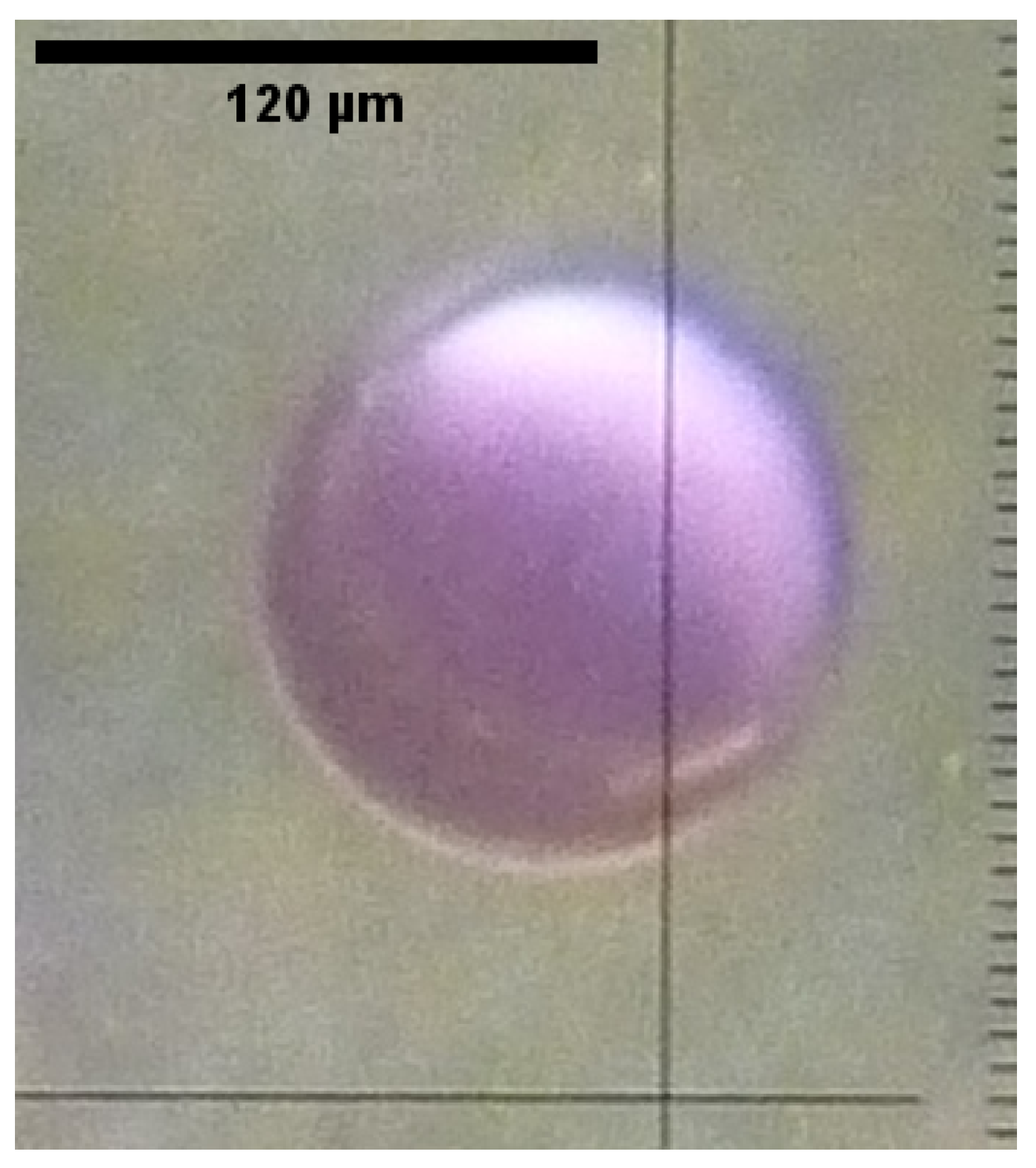
to preserve near-spherical geometry. Integrated SU-8 waveguides adjacent to the trapping wells improved signal collection and enhanced the visibility of the WGM spectra. A representative microscopy image of a trapped droplet is shown in
Figure 5. The observed droplet diameter is approximately
, corresponding to
and an expected equatorial perimeter
.
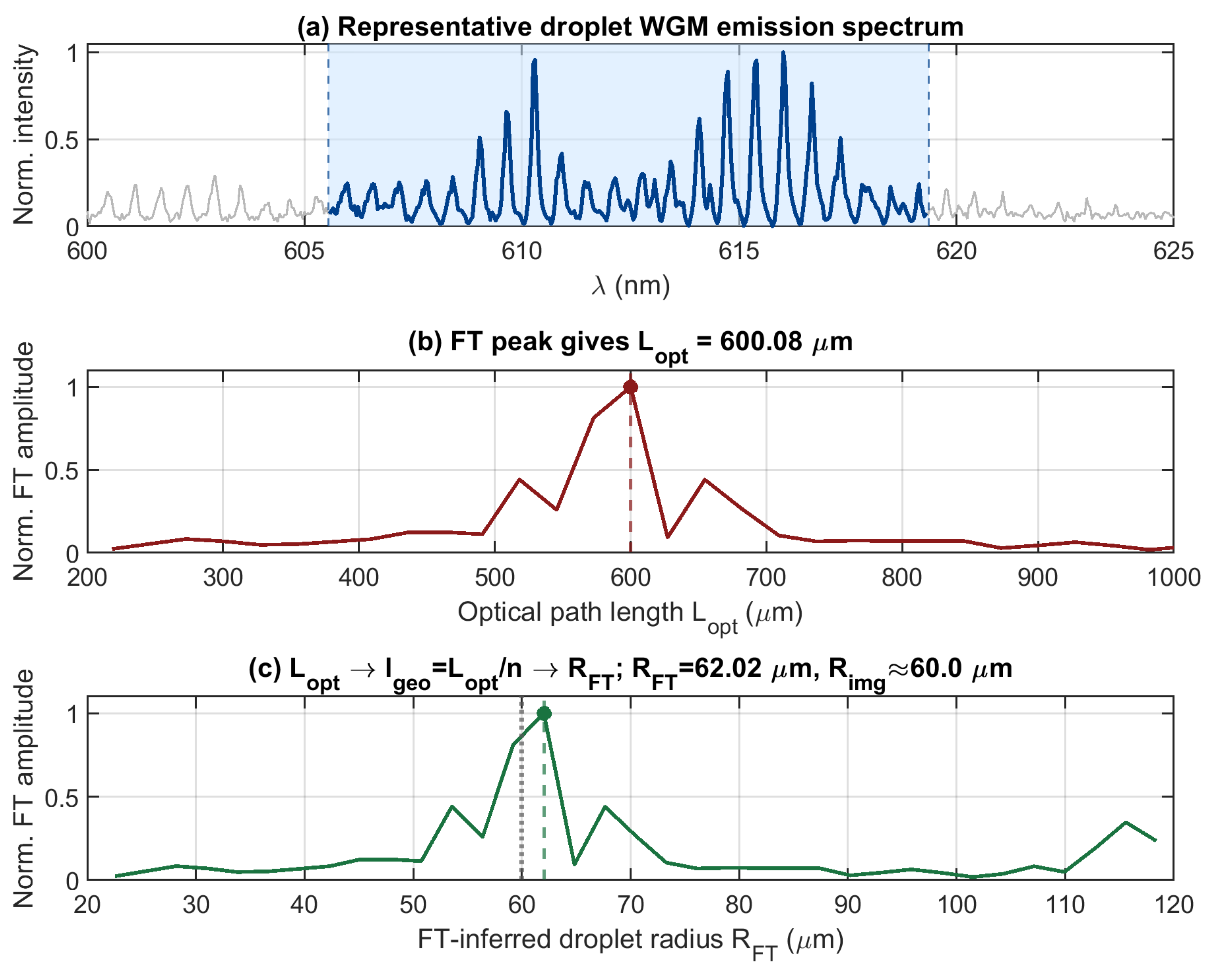
Figure 6 illustrates the FT-based extraction procedure for one representative droplet spectrum. The selected WGM region extends from
to
, with a centroid wavelength
. The corresponding Fourier-domain spectrum exhibits a dominant peak at
, yielding an optical path length
. Using
, this value gives
and
. The inferred radius differs from the microscopy-estimated radius of
by
, confirming consistency between the FT-derived geometric scale and the observed droplet size.
To further address the distribution-level consistency of the droplet measurement model, the FT-based extraction was repeated on
trapped benzyl-alcohol droplets showing clear quasi-periodic WGM regions, as summarized in
Table 4. For each droplet, an admissible spectral window was selected around a dominant WGM family according to the criteria defined in
Section 3.4, and the dominant FT peak within that window was extracted automatically in the Fourier domain. The inferred geometric path length was then converted into an FT-equivalent radius according to
.
Across the 14 droplets, the FT-inferred radius distribution gave , corresponding to a coefficient of variation of . The corresponding inferred path length was . These values are in close agreement with the microscopy-estimated droplet diameter of approximately , i.e., and . The mean FT-inferred radius differs from the microscopy-estimated radius by only , corresponding to a relative deviation of approximately .
The full droplet-by-droplet extraction results, including the selected spectral windows, extracted FSR values, FT-inferred path lengths, and FT-inferred radii, are provided in
Supplementary Table S2. The corresponding graphical summaries and representative individual FT extractions are shown in
Supplementary Figures S2 and S3.
Taken together, the representative single-droplet extraction and the droplet analysis show that FT analysis can recover physically meaningful geometric path-length information from trapped soft microcavities, while providing a distribution-level consistency check against the microscopy-estimated droplet size.
5. Discussion
The main outcome of this work is methodological rather than phenomenological. Specifically, the results show that FT analysis can be formulated as a reproducible metrological framework for extracting quantitative information from WGM spectra that are difficult to interpret directly in the wavelength domain. The two experimental systems serve here as complementary tests of the framework rather than exhaustive validation datasets. In the capsule case, the method yields an effective refractive index consistent with independent BET-based porosity measurements, supporting the validity of the refractometric model. In the droplet case, the same FT-based procedure identifies multiple coexisting Fourier-domain periodicities and yields inferred geometric path lengths consistent with independently estimated droplet perimeters, showing that meaningful path-length information can still be recovered from overlapping spectra. Although the droplet analysis provides a distribution-level consistency check against the microscopy-estimated droplet size, it should still be interpreted as a validation of the geometric scale rather than as a complete high-precision droplet-sizing protocol.
A key outcome of the uncertainty analysis is that the dominant contribution for the capsule system arises from the determination of the free spectral range, whereas the wavelength calibration contributes negligibly and the radius measurement plays a secondary role. This indicates that further gains in accuracy would come primarily from improving spectral-window selection and FT peak localization rather than from refining wavelength calibration.
More generally, the droplet results illustrate that the main limitation in soft cavities is often not the FT extraction itself but the geometric characterization of the object under study. Variability in droplet size, shape, and local refractive index distribution can broaden the interpretation of the extracted path lengths, even when the periodicities are clearly resolved in the Fourier domain.
The present assessment has several limitations. The analysis assumes near-spherical cavities, negligible dispersion over the selected spectral window, and manual mode-group selection. Strong departures from sphericity, broader spectral windows, or highly congested spectra would require more advanced modeling and automated analysis strategies. Even so, within these bounds, the FT approach remains robust, simple to implement, and well suited to soft photonic systems where conventional peak fitting becomes unreliable.
Overall, this work establishes FT spectral analysis as a useful metrological tool for single-particle characterization in soft matter. Its combination of background robustness, compatibility with uncertainty propagation, and ability to resolve overlapping periodicities makes it promising for future dynamic, multiplexed, and automated WGM measurements [
10,
33].
6. Conclusions
This work establishes Fourier-transform spectral analysis as a metrological framework for the quantitative interpretation of whispering gallery mode spectra in soft photonic microcavities. By recasting the WGM spectrum as a quasi-periodic signal in the Fourier domain, the method provides direct access to the optical path length , which serves as a primary measurand for subsequent parameter extraction.
Within this framework, two complementary measurement models are defined depending on the known auxiliary quantity: effective refractive index determination when the cavity radius is known, and inferred geometric path length determination when the refractive index is known. The explicit formulation of these models, together with uncertainty propagation following the GUM approach, transforms FT-WGM analysis from a spectral-processing step into a reproducible quantitative methodology.
The main metrological outcome of this study is the identification of the dominant uncertainty sources associated with FT-based WGM analysis, showing that determination of the free spectral range governs the overall uncertainty, whereas wavelength calibration contributes negligibly under the present experimental conditions. More broadly, the framework demonstrates how reliable quantitative information can be extracted from spectra affected by fluorescence background, mode overlap, and complex modal structure.
The contribution of this work is therefore methodological: it consolidates FT-based analysis into a generalizable framework for single-particle metrology in soft photonic systems, particularly in situations where conventional peak-based analysis becomes difficult or unreliable. This approach should be readily transferable to other WGM platforms requiring robust and traceable spectral interpretation.