
Review

Socioeconomic Status and Kidney Disease
1
Renal Unit, University Hospital of Ferrara, 44124 Ferrara, Italy
2
Department of Medical, Movement and Wellbeing Sciences, University of Naples Parthenope, 80133 Naples, Italy
3
Department of Medical Sciences, University of Ferrara, 44121 Ferrara, Italy
*
Author to whom correspondence should be addressed.
Kidney Dial. 2026, 6(2), 25; https://doi.org/10.3390/kidneydial6020025
Submission received: 14 December 2025 / Revised: 18 March 2026 / Accepted: 7 April 2026 / Published: 10 April 2026

Abstract

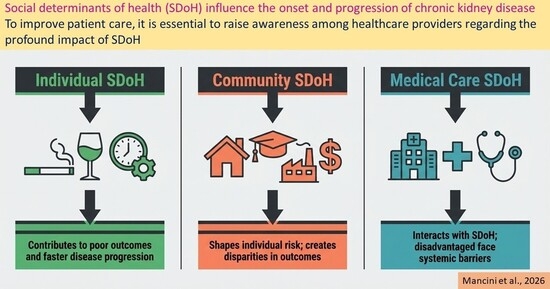
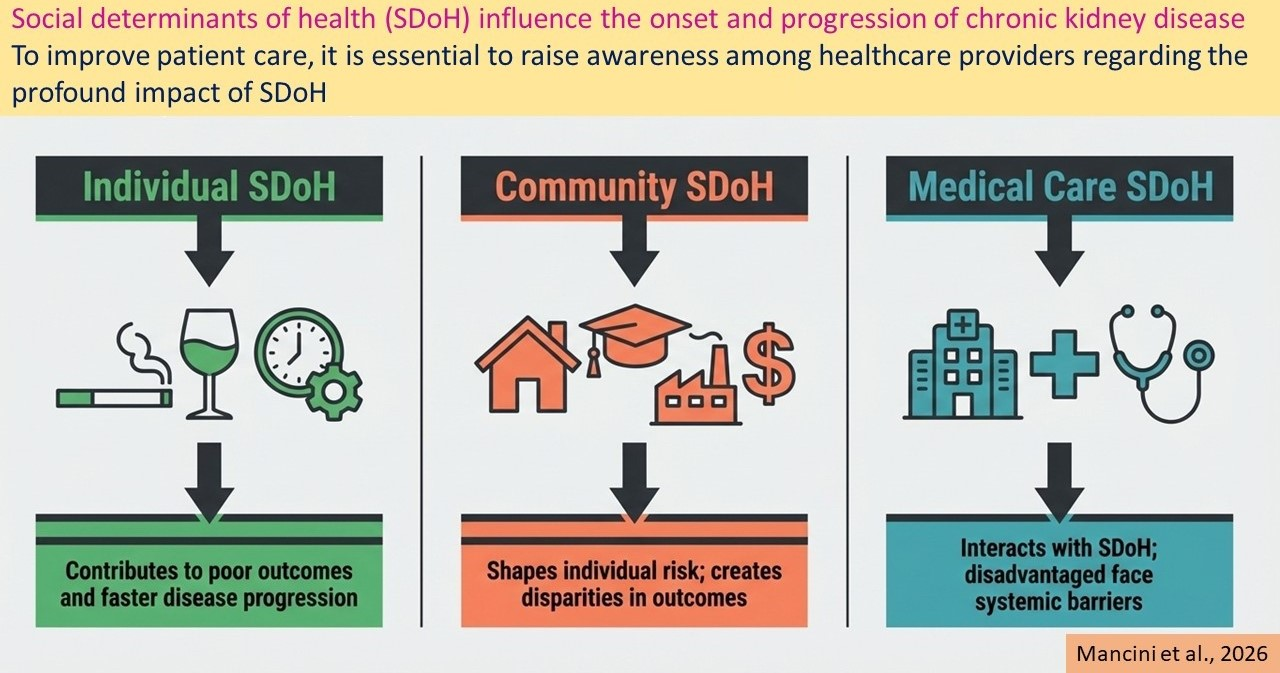
Social determinants of health (SDoH) are non-medical factors shaped by the socioeconomic status of individuals or communities that influence the onset and progression of diseases and affect their outcomes. We have narratively analyzed the most important findings relating chronic kidney disease (CKD) and SDoH, evaluating the following items: (i) medical care and social determinants of health, (ii) socioeconomic risk for kidney disease at the individual level and (iii) socioeconomic risk for kidney disease at the population level. SDoH can be categorized by how they influence a person’s daily life. Individual factors include personal lifestyle choices such as smoking habits, alcohol consumption, and how a patient spends their non-working time. Community factors include structural elements such as average household income, educational attainment, employment rates, and the quality of the surrounding physical environment. Research consistently shows that a low socioeconomic status is a primary driver of poor clinical outcomes. While healthcare systems vary globally, the negative impact of socioeconomic deprivation on CKD patients remains a constant. Disadvantaged patients experience a faster loss of renal function, and there is a significantly higher incidence of cardiovascular events and mortality compared to those with financial stability. Financial hardship often leads to a “double burden,” where the struggle to afford care triggers a decline in both physical health and mental well-being. To improve patient care, it is essential to raise awareness among healthcare providers regarding the profound impact of these social factors. More precise data and thorough research are needed to fully understand these associations and develop targeted interventions.

Graphical Abstract

1. Introduction

The prevalence of chronic kidney disease (CKD) is rising globally, and it is expected to be the fifth most common chronic disease by 2040 [1]. CKD impacts patients’ well-being due to frequent hospitalizations [2]. CKD is an existential crisis as much as a clinical one. Moving from independence to hemodialysis forces a total life recalibration. As noted by Ramírez-Perdomo [3], the disease fundamentally alters a patient’s relationship with their body (Corporeality), their time (Temporality), their finances (Materiality), their social bonds (Relationality), and their emotional landscape (Spatiality). Socioeconomic factors should also be considered (and then addressed) to fully understand and face the problem of kidney diseases [4]. People with new onset of kidney diseases living in the most deprived areas reported worse health status and greater limitation in daily activities, especially if they were of working age [5].
The World Health Organization (WHO) defines the social determinants of health (SDoH) as the non-medical circumstances, the conditions in which we are born, grow, live, work, and age, that shape our overall health outcomes. These factors are influenced by both individual behaviors and broader socioeconomic policies [6]. To understand health inequalities within a country and between different countries, it is essential to take SDoH into account, as lower socioeconomic status is known to be associated with poorer health outcomes.
In our actual complex society, access to adequate healthcare can no longer be considered the primary solution to improving citizens’ health; several non-medical factors must be considered [7]. SDoH such as poverty, unemployment, social isolation, and low income increase the risk of death and adverse cardiac events [8]. Awareness of the social context in which patients live can help physicians to formulate more accurate diagnoses and nurses to develop more appropriate care plans involving social workers. Furthermore, it has been suggested that addressing and understanding SDoH and health disparities may be associated with greater satisfaction for both healthcare professionals and patients [9]. However, it has been reported that the general population’s consciousness about SDoH is low [10].
The actions that health professionals need to take to improve the integration of SDoH into the clinical care pathways include understanding culturally and linguistically diverse attitudes when prescribing care, eliminating bias, and strengthening health equity [11]. Tackling discrimination in healthcare is imperative, and to achieve this, it must rely on key collaborators to adopt a multisectoral approach aimed at improving treatment outcomes while prioritizing public health and social services. However, such initiatives are hindered by inadequate funding and resources [12]. In other words, understanding SDoH—and therefore developing, implementing, and aligning effective strategies and policies—requires familiarity with multiple disciplines [13]. For these reasons, we decided to narratively analyze the most important findings relating CKD and SDoH, evaluating the following items: (i) medical care and social determinants of health, (ii) socioeconomic risk for kidney disease at the individual level and (iii) socioeconomic risk for kidney disease at the population level.

2. Medical Care and Social Determinants of Health

Healthcare must address all the factors that influence the health and well-being of communities and individuals [7]. Healthcare systems today are aware of the impact of SDoH; however, the effectiveness of related interventions is still under investigation [14]. Addressing SDoH is part of an evolution in care in which social and healthcare services are integrated to provide equitable, culturally, and linguistically appropriate solutions, while eliminating bias and diversifying the medical workforce [10].
Developed by Göran Dahlgren and Margaret Whitehead in 1991, the Dahlgren-Whitehead Model (often called the “Rainbow Model”) is a fundamental public health framework. It illustrates that a person’s health is not merely the result of biology or personal “lifestyle” choices, but is instead shaped by several layers of influence [15]. Connecting the Dahlgren-Whitehead “Rainbow” to the CKD experience shows that a patient’s health is not just about their kidneys—it is about their entire life structure. When we layer the biopsychosocial dimensions (like Temporality and Spatiality) onto this model, it appears as a much fuller picture of the patient’s journey.

Financial Hardship

SDoH, particularly poverty, environmental stressors, and psychological factors, are increasingly recognized as significant determinants of kidney disease and its outcomes. A recent study examined the psychological and economic strain caused by medical costs also known as financial toxicity (FT), among 238 Italian patients undergoing different forms of renal replacement therapy. The PROFFIT questionnaire was used to measure distress on a scale of 0 to 100% (where 100% represents maximum toxicity). The study identified four primary drivers of financial toxicity across the entire patient group: (i) medical Expenses, (ii) general financial distress, (iii) transportation costs, and (iv) health system support (lack thereof). Hemodialysis patients experienced the highest overall financial burden and toxicity levels. Peritoneal dialysis patients reported feeling better supported and cared for by healthcare professionals compared to other groups, and kidney transplanted individuals showed the best ability to manage monthly expenses compared to the hemodialysis group. The study highlights that managing chronic kidney disease is a significant financial burden, particularly for those on hemodialysis. The authors argue that healthcare professionals must go beyond clinical care to discuss financial and social challenges, as these factors directly impact a patient’s overall health and ability to sustain treatment [16].
Patients experience financial toxicity in three domains: economic hardship affecting material conditions, psychological distress, and health-related coping behaviors [17]. The financial impact may be mediated by:
  • direct costs of care;
  • indirect effects on the patient’s ability to earn income [18].
A recent review identified financial toxicity as a common burden for patients with different kidney diseases, including pediatric and adult CKD, nephrolithiasis, and renal tumors. This burden stems from both the direct costs of disease management and the indirect costs of lost income, transportation, and accommodation. Furthermore, the study highlighted that patients with kidney disease in various countries often struggle to obtain health insurance coverage [19].

3. Socioeconomic Risk for Kidney Disease at the Individual Level

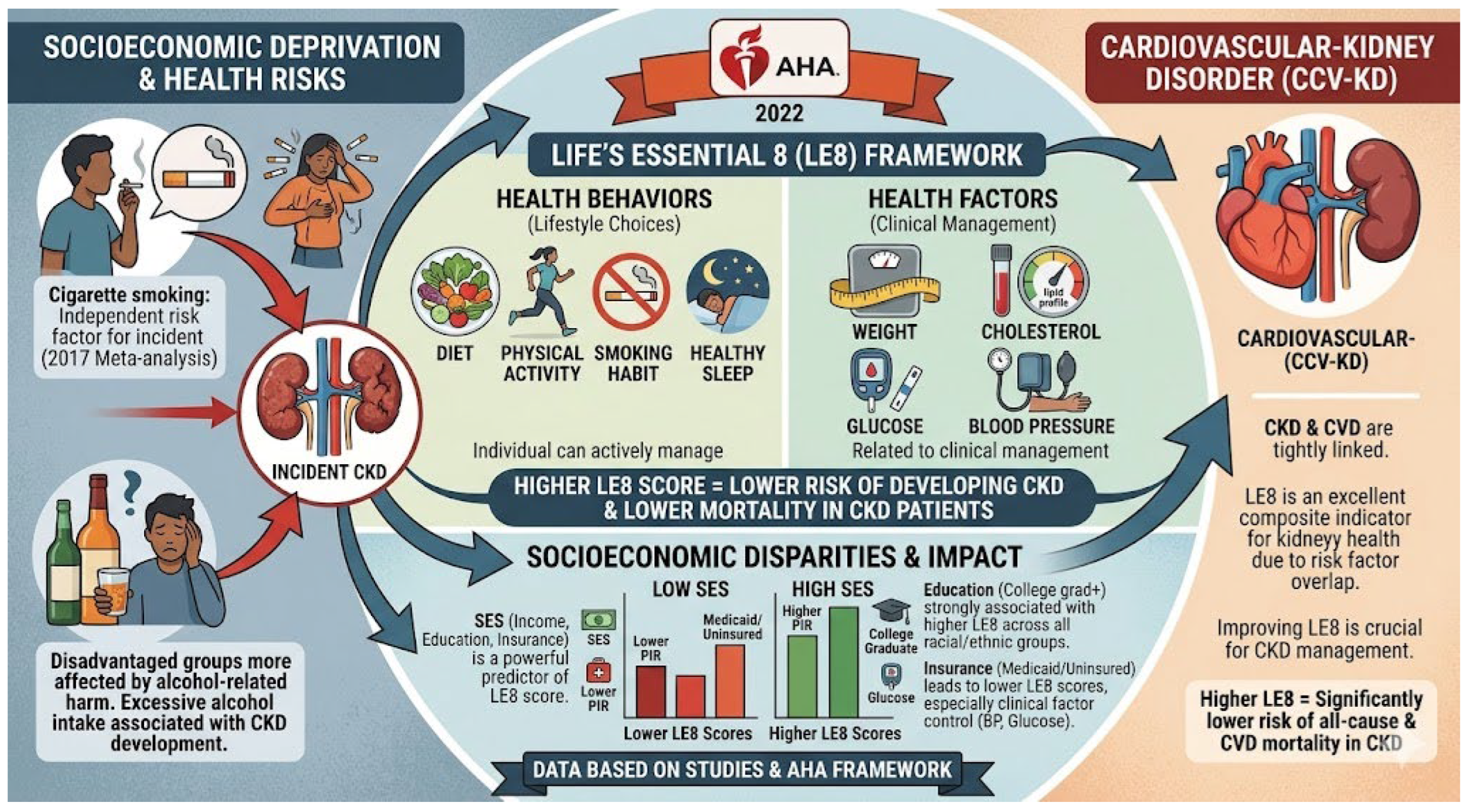
Socioeconomic deprivation is associated with smoking habits, increasing the frequency of negative outcomes [20]. In 2017, a meta-analysis suggested that cigarette smoking was an independent risk factor for incident CKD. The authors calculated the summary relative risks by evaluating 15 prospective cohort studies and found that compared with never-smokers, the risk of incident CKD was 1.27 for ever-smokers, 1.34 for current smokers and 1.15 for former smokers [21]. A recent study confirmed the association between CKD and smoking initiation, earlier age at initiation, cigarettes smoked per day, and lifetime smoking, while smoking cessation had a protective effect against CKD [22]. An observational study involving more than 9000 individuals with CKD who were followed-up for 4.9 years found that smokers had higher vascular event rates, higher cancer diagnoses, especially involving the lung and the upper aero or digestive tract, and higher all-cause mortality. On the contrary, the incidence of uremia did not differ significantly between current and never-smokers [23].
Socioeconomically disadvantaged groups were more frequently affected by alcohol-related harm [24], and excessive alcohol intake was associated with the development of CKD [25]. In 1999, a study based on self-report alcohol consumption suggested that the risk for uremia was higher among people who consumed an average of >2 alcoholic drinks per day [26]. A meta-analysis of 15 prospective cohort studies involving more than 268,000 cases reported that severe alcohol drinking (≥60 g/d) insignificantly increased the risk of chronic kidney damage, while low (<13 g/d), moderate (13 to 26 g/d), and high (26 to 60 g/d) doses of alcohol reduced the risk of chronic kidney damage compared with the reference group of non- or occasional drinkers [27]. On the contrary, a Chinese study evaluating more than 65,000 men aged 40 years and older found an inverse association between alcohol consumption and uremia even after adjustment for systolic blood pressure and history of diabetes and cardiovascular disease [28]. Fan et al. suggested that alcohol intake could be considered a “Double-Edged Sword” in people suffering CKD [29].
Life’s Essential 8 (LE8) is a relatively new framework that was introduced by the American Heart Association (AHA) in 2022 and comprises two major areas: health behaviors and health factors [30]. Health behaviors are included in lifestyle choices that an individual can actively manage, and they are diet, physical activity, smoking habit and healthy sleep. On the contrary, healthy factors are related to the management of weight, cholesterol plasma level, glucose plasma level and blood pressure [30]. The LE8 framework is significantly associated with socioeconomic and demographic disparities in cardiovascular health (CVH) scores, highlighting where targeted public health interventions are most needed [31].
Disparities are generally observed across race/ethnicity, socioeconomic status (SES) indicators, and sex. Studies in the United States show clear differences in the overall mean LE8 score, reflecting a lower prevalence of ideal cardiovascular health in specific minority groups [32].
SES, measured by education, income, and insurance, is a powerful predictor of LE8 score, emphasizing the role of SDoH [31].
Individuals with a lower income-to-poverty ratio (PIR) consistently have lower mean LE8 scores than those with higher incomes. Financial resources directly impact the ability to afford high-quality foods, access safe places for physical activity, and obtain timely medical care and medications [31]. Higher levels of education (college graduate or more) are strongly associated with higher LE8 scores across all racial and ethnic groups. Education provides greater health literacy and access to better-paying jobs, which correlates with better health insurance and resources [31].
People with Medicaid or who are uninsured generally have lower LE8 scores compared to those with private insurance, particularly due to challenges in controlling clinical factors (e.g., blood pressure, blood glucose), which require regular medical monitoring [31].
The relationship between CKD and LE8 is a strong and inverse one: higher LE8 scores are associated with a significantly lower risk of developing CKD and lower mortality rates in patients who already have CKD. CKD and cardiovascular disease (CVD) are tightly linked in what is often termed cardiovascular–kidney disorder (CCV-KD). The LE8, originally designed for heart health, serves as an excellent composite indicator for kidney health due to the overlap in major risk factors [33].
Higher overall LE8 scores are consistently associated with reduced odds of having CKD. One study showed that for every 10-point increase in the LE8 score, the odds of having CKD decreased by approximately 21% [34].
Among individuals who already have CKD, a higher LE8 score is associated with a significantly lower risk of all-cause mortality and CVD-specific mortality. Improving LE8 metrics should be crucial in the management strategy for CKD patients [35]. The socioeconomic risk for kidney disease at the individual level is summarized in Figure 1.

4. Socioeconomic Risk for Kidney Disease at the Population Level

In a Scottish study, social deprivation was a strong, independent predictor of all-cause mortality in CKD patients [36]. The social adaptability index (SAI), based on employment, education, income, marital status and substance abuse, was associated with mortality in a study from the US involving 13,400 subjects with a mean age of 50.6 years and with an average number of co-morbid conditions of 2.7. In this study, lower SAI was associated with decreasing kidney function [37]. A systematic review (9 million participants, 10 countries) confirmed that social factors were strongly linked to poor cardiovascular outcomes. Low income, no home ownership, low education, and geographic remoteness were all associated with higher cardiovascular event rates and mortality. Furthermore, these factors created barriers to care. People with no health insurance or home ownership had worse access to healthcare. This was especially true for dialysis patients, where women, ethnic minorities, and other disadvantaged groups were significantly less likely to receive cardiovascular care than their more advantaged counterparts [38].
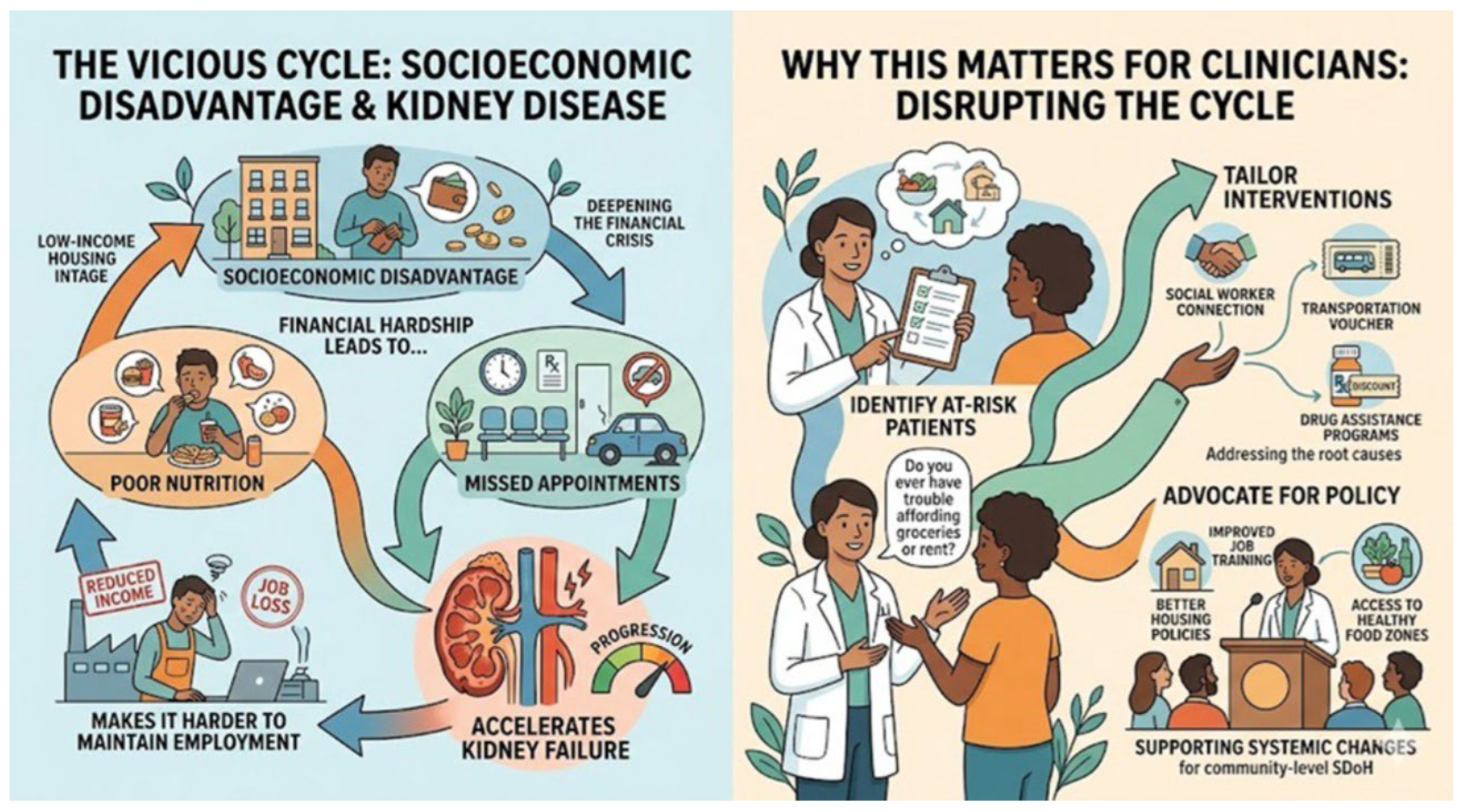
The relationship between SES and CKD is clearly multifactorial, and efforts to understand these health disparities must account for biological, individual, and neighborhood-level factors, potentially through a biopsychosocial model. When people face socioeconomic disadvantage, a “vicious cycle” often forms. Financial hardship leads to poor nutrition or missed appointments, which accelerates kidney failure, which in turn makes it harder to maintain employment—further deepening the financial crisis. Understanding these disparities allows healthcare providers to identify at-risk people, tailor interventions connecting patients with social workers, transportation vouchers, or drug assistance programs, and advocate for policy, i.e., supporting systemic changes that address the “community-level” SDoH (Figure 2).
A strong body of evidence confirms an inverse relationship between SES and progressive kidney disease. British people with non-dialysis-dependent CKD, living in the deprived areas and facing unemployment, poor educational attainment and lower household income had poor outcomes [39]. Higher income, pension coverage, education, marital stability, and insurance reduced the risk of developing CKD [40]. Low SES not only modified well-known risk factors but also stands as an independent predictor of CKD and its progression [41,42]. Research highlighted that low-income individuals may face 59% greater odds of CKD, independent of demographics, insurance, or comorbidities [43]. Living in the lowest SES-quartile neighborhood was associated with a 50% increased risk of progressive CKD [44]. This disparity also persisted across different ethnic groups. The ARIC study [45] found that working-class status increased the probability of CKD for both White and African American participants. Conversely, the Jackson Heart Study found that affluent African Americans had a 41% lower prevalence of CKD than their less-affluent counterparts. Furthermore, low SES was linked to higher mortality [46]. Bruce et al. demonstrated a 58% increased hazard of all-cause mortality for low-income participants, a risk that was elevated for both Black and White individuals [47]. A large-scale meta-analysis corroborated these findings, linking low SES to increased probability of low eGFR, high albuminuria, and renal failure [48]. A meta-analysis of 43 articles showed that CKD prevalence was associated with lower income, lower education, and lower combined SES. In addition, progression to end-stage renal disease was associated with lower levels of income, occupation and combined SES [49].
Dansero et al. [50] studied more than 1,000,000 Italian individuals aged 60–80 residing in the Piedmont region between January 2013 and December 2018. They identified 31,299 incident cases of CKD during follow-up. CKD patients who were older, mostly males, and had lower socioeconomic position suffered an increased risk for cardiovascular events. Stratification by SES showed high risk for CKD in individuals with the lowest socioeconomic position. A 10-year retrospective study in Italy tracked 715 patients with mild-to-moderate chronic kidney disease (CKD) who had received at least one year of nephrology care. Researchers categorized participants using census-based socioeconomic indicators—such as education, employment, and housing—to determine if social deprivation influenced disease progression. In this cohort, socioeconomic deprivation showed no significant association with CKD progression or uremia. However, the study only included patients already adherent to 12 months of specialist care and likely excluded more marginalized individuals who may face greater barriers to treatment. Moreover, SES was based on 2001 census data, despite the study running until 2018. This time gap introduces the risk of misclassification, as participants’ wealth or living situations may have shifted over two decades. These methodological hurdles, specifically the exclusion of non-adherent patients and the use of outdated census data, may have masked the true impact of social disadvantage on health outcomes [51].
A recent study evaluated the 2005–2018 NHANES data, selecting 11,367 participants, in whom SES was quantified by the family poverty-income ratio (PIR). High socioeconomic status was associated with a lower probability of advanced cardiometabolic kidney syndrome, and increasing PIR was associated with a lower probability of depression [52]. Norris et al. [53] randomized 1095 participants with stage 2–4 CKD to assess the impact of income on cardiovascular outcomes (defined as a composite outcome of cardiac death, myocardial infarction, stroke, and heart failure) and concluded that an annual income below USD 15,000 was associated with an almost twofold increased risk of adverse cardiovascular outcomes. The authors also provided unadjusted incident rate ratios comparing participants based on an annual income threshold of $15,000. Those earning below this amount showed a modestly higher risk for end-stage kidney disease, composite cardiovascular events and all-cause mortality.
Morton et al. [54] prospectively evaluated more than 9000 adults with moderate-to-severe CKD without a history of myocardial infarction or coronary revascularization recruited in Europe, North America, Asia, Australia, and New Zealand. Individuals with higher levels of education had a lower risk of vascular events compared with participants with no formal education. Moreover, in the group of patients not receiving dialysis at baseline, education level was not related to progression to uremia or doubling of creatinine level [54].
Dansero et al. [55] performed a longitudinal study investigating the relationship between socioeconomic position (SEP) measured as educational level, CKD, end-stage kidney disease and CVD. The authors enrolled 44,220 CKD subjects and 4021 end-stage kidney disease individuals in the cohort. The association of CKD, low educational level and incident of cardiovascular disease was associated with increased all-cause mortality and emergency room admissions compared with those with higher education. On the contrary, the association of end-stage kidney disease, incident CVD and high educational level had the highest increase in mortality [55].
Older age, minority status, low educational level, lack of insurance, and multimorbidity have been associated with delayed referral of CKD patients to nephrology services [56].
Chronic Interstitial Nephritis in Agricultural Communities (CINAC), also known as CKDu (CKD of unknown etiology), is a global health phenomenon primarily affecting rural, farming populations in tropical and subtropical regions. Unlike “traditional” kidney disease, CINAC is uniquely defined by geographic specificity, atypical risk profile, pathological focus and environmental link. Geographic specificity is identified by regional names such as Mesoamerican Nephropathy (Central America), Sri Lankan Nephropathy, and Uddanam Nephropathy (India), but it also persists across Egypt, China, and parts of South America. Atypical risk profile occurs in patients without the standard precursors of renal failure, such as hypertension or diabetes. Pathological focus manifests specifically as interstitial nephritis, i.e., inflammation and scarring of the kidney’s connective tissue rather than its primary filters (glomeruli). Environmental link is closely tied to agricultural labor, where factors like extreme heat, dehydration, and exposure to agrochemicals or toxins are suspected drivers [57]. The danger of CINAC lies in its “invisible” nature. Because these agricultural workers often lack access to the routine screening that would detect early-stage kidney decline, the disease often progresses to a late stage before symptoms appear. This creates a massive socioeconomic burden on the very communities least equipped to handle the costs of dialysis or transplant.

5. Conclusions

The relationship between SDoH and CKD is clear, but it needs to be further investigated, not only during health care activities, but also by involving the professionals dealing with socioeconomic parameters, such as social workers. Xiao et al. revealed a trade-off in activity types based on neighborhood deprivation. Residents of more deprived areas were engaged in less leisure-time exercise but spent more time on essential physical activities like household chores and walking for transport. This active time was offset, however, by a higher likelihood of prolonged TV viewing [58]. Moreover, residents of disadvantaged areas frequently have poor access to green spaces and fewer opportunities for regular physical activity. The constant, chronic stress associated with socioeconomic deprivation is a powerful demotivator for exercise [59]. When a person is operating in “survival mode”—worried about paying rent, food insecurity, or personal safety—exercise and a healthy lifestyle are not priorities. The mental and emotional exhaustion from this stress makes it incredibly difficult to muster the energy to be active. Additionally, low-wage jobs are often more physically demanding, leading to physical exhaustion or chronic fatigue. They are also less likely to be flexible about their leisure time, with unconventional schedules (e.g., shift work, night work), or to be able to accommodate a regular exercise program [60]. Moreover, living in neighborhoods categorized as very poor reduces the likelihood of being referred for a transplant during pre-end-stage kidney disease nephrology care [61].
Socioeconomically disadvantaged CKD patients may experience faster disease progression and a higher risk of CVD and premature mortality. This appears to result from the combined and often mutually reinforcing effects of socioeconomic factors and individual lifestyle behaviors. A comparison of the specific health outcomes for high-stability versus low-stability patient groups is reported in Table 1.
The difficulty of isolating the role of each factor may partly explain the scarcity of research in this field. Existing studies are limited by retrospective designs, short follow-up periods, static definitions of socioeconomic variables (which are usually assessed only at baseline), and significant underrepresentation of the highest-risk individuals, such as the poorest. The latter is perhaps the most challenging population to reach and engage in health research, yet it is likely the one most in need of targeted interventions to improve health outcomes. It should be underlined that to address these issues effectively, it is necessary to employ a comprehensive approach that considers SDoH as a means of identifying the need for multidisciplinary interventions, including those provided by social workers, key figures for effectively educating the population. A major limitation in this field is the lack of generalizability of results from one center or region to societies with different and potentially more complex healthcare systems. The disproportionate impact of deprivation in CKD patients calls for a thorough understanding of the problem to develop economically sustainable solutions. Early intervention is likely to yield both health and economic benefits, but this requires first acknowledging the problem. It should be underlined that to address these issues effectively, a comprehensive approach that considers SDoH as a means of identifying the need for multidisciplinary interventions, including those provided by social workers, is necessary.

Author Contributions

Conceptualization, R.M. and F.F.; methodology, E.D.S. and F.F.; validation, A.D.M., L.M.S., E.G. and F.T.; investigation, R.M., E.D.S., A.D.M., L.M.S., E.G., F.T. and F.F.; resources, F.F.; data curation, R.M., E.D.S., A.D.M., L.M.S., E.G., F.T. and F.F.; writing—original draft preparation, R.M., E.D.S. and F.F.; writing—review and editing, R.M., E.D.S., A.D.M. and F.F.; visualization, R.M., E.D.S., A.D.M., L.M.S., E.G., F.T. and F.F.; supervision, F.F.; project administration, F.F.; funding acquisition, F.F. All authors have read and agreed to the published version of the manuscript.

Funding

The writing and preparation of this paper were funded in part by the research grant “Fondo di ateneo per la ricerca” (FAR) 2024 (2024-FAR.L_SCIMED_FF) by the University of Ferrara, Ferrara, Italy (Fabio Fabbian).

Institutional Review Board Statement

Not applicable.

Informed Consent Statement

Not applicable.

Data Availability Statement

No new data were created or analyzed in this study. Data sharing is not applicable to this article.

Acknowledgments

We thank Claudia Righini and Donato Bragatto of the Biblioteca Interaziendale di Scienze della Salute, Ferrara, Italy, for their valuable support.

Conflicts of Interest

The authors declare no conflicts of interest.

Abbreviations

The following abbreviations are used in this manuscript:
SDoHsocial determinants of health
CKDchronic kidney disease
RRTrenal replacement therapy
eGFRestimated glomerular filtration rate
LE8Life’s Essential 8
SESsocioeconomic status
CVDcardiovascular disease
CCV-KDcardiovascular–kidney disorder
SAIsocial adaptability index
PIRincome-to-poverty ratio
SEPsocioeconomic position

References

  1. Foreman, K.J.; Marquez, N.; Dolgert, A.; Fukutaki, K.; Fullman, N.; McGaughey, M.; Pletcher, M.A.; Smith, A.E.; Tang, K.; Yuan, C.W.; et al. Forecasting life expectancy, years of life lost, and all-cause and cause-specific mortality for 250 causes of death: Reference and alternative scenarios for 2016-40 for 195 countries and territories. Lancet 2018, 392, 2052–2090. [Google Scholar] [CrossRef] [PubMed]
  2. Schrauben, S.J.; Chen, H.Y.; Lin, E.; Jepson, C.; Yang, W.; Scialla, J.J.; Fischer, M.J.; Lash, J.P.; Fink, J.C.; Hamm, L.L.; et al. Hospitalizations among adults with chronic kidney disease in the United States: A cohort study. PLoS Med. 2020, 17, e1003470. [Google Scholar] [CrossRef]
  3. Ramírez-Perdomo, C.A. The experience of living with chronic kidney disease. New Trends Qual. Res. 2020, 1, 122–138. [Google Scholar] [CrossRef]
  4. Zhang, L.; Santos, A.C.S., Jr.; Anandh, U.; Saran, R.; Zhao, M.H. Effects of social determinants of health on the landscape of kidney disease. Nat. Rev. Nephrol. 2026. [Google Scholar] [CrossRef]
  5. Cowan, E.; Bell, S.; Black, C.; Blakeman, T.; Fraser, S.; Hughes, A.; Keskindag, B.; Methven, S.; Nath, M.; Nitsch, D.; et al. Deprivation and limitations in daily life in new onset kidney disease: A population study. Clin. Kidney J. 2025, 17, sfaf397. [Google Scholar] [CrossRef]
  6. World Report on Social Determinants of Health Equity, 2025. Available online: https://www.who.int/teams/social-determinants-of-health/equity-and-health/world-report-on-social-determinants-of-health-equity (accessed on 13 November 2025).
  7. Butkus, R.; Rapp, K.; Cooney, T.G.; Engel, L.S.; Health and Public Policy Committee of the American College of Physicians. Envisioning a Better U.S. Health Care System for All: Reducing Barriers to Care and Addressing Social Determinants of Health. Ann. Intern. Med. 2020, 172, S50–S59. [Google Scholar] [CrossRef]
  8. Simoni, A.H.; Bucci, T.; Romiti, G.F.; Frydenlund, J.; Johnsen, S.P.; Abdul-Rahim, A.H.; Lip, G.Y.H. Social determinants of health and clinical outcomes among patients with atrial fibrillation: Evidence from a global federated health research network. QJM 2024, 117, 353–359. [Google Scholar] [CrossRef]
  9. Kung, A.; Cheung, T.; Knox, M.; Willard-Grace, R.; Halpern, J.; Olayiwola, J.N.; Gottlieb, L. Capacity to Address Social Needs Affects Primary Care Clinician Burnout. Ann. Fam. Med. 2019, 17, 487–494. [Google Scholar] [CrossRef]
  10. Di Simone, E.; Panattoni, N.; Dionisi, S.; Giannetta, N.; Renzi, E.; Massimi, A.; Di Muzio, M.; Fabbian, F. Social determinants of Health and Google Trends: A worldwide infodemiological report. Eur. Rev. Med. Pharmacol. Sci. 2024, 28, 3658–3668. [Google Scholar] [CrossRef] [PubMed]
  11. Koh, H.K.; Gracia, J.N.; Alvarez, M.E. Culturally and Linguistically Appropriate Services–advancing health with CLAS. N. Engl. J. Med. 2014, 371, 198–201. [Google Scholar] [CrossRef] [PubMed]
  12. DeSalvo, K.; Parekh, A.; Hoagland, G.W.; Dilley, A.; Kaiman, S.; Hines, M.; Levi, J. Developing a Financing System to Support Public Health Infrastructure. Am. J. Public Health 2019, 109, 1358–1361. [Google Scholar] [CrossRef]
  13. Auerbach, J. Social Determinants of Health Can Only Be Addressed by a Multisector Spectrum of Activities. J. Public Health Manag. Pract. 2019, 25, 525–528. [Google Scholar] [CrossRef]
  14. Gottlieb, L.M.; Wing, H.; Adler, N.E. A systematic review of interventions on patients’ social and economic needs. Am. J. Prev. Med. 2017, 53, 719–729. [Google Scholar] [CrossRef]
  15. Dahlgren, G.; Whitehead, M. Policies and Strategies to Promote Social Equity in Health. Background Document to WHO–Strategy Paper for Europe. Available online: https://www.researchgate.net/publication/5095964_Policies_and_strategies_to_promote_social_equity_in_health_Background_document_to_WHO_-_Strategy_paper_for_Europe (accessed on 13 November 2025).
  16. Di Maria, A.; Capone, M.; Mancini, R.; De Giorgi, A.; Gavazzoli, E.; Scichilone, L.M.; Veronesi, M.; Nicoletti, S.; Fabbian, F. Detection of Financial Toxicity in Italian Uremic Patients: A Single Center Cross-Sectional Study. Int. J. Nephrol. Renov. Dis. 2025, 15, 361–371. [Google Scholar] [CrossRef]
  17. Liang, M.I.; Harrison, R.; Aviki, E.M.; Esselen, K.M.; Nitecki, R.; Meyer, L. Financial toxicity: A practical review for gynecologic oncology teams to understand and address patient-level financial burdens. Gynecol. Oncol. 2023, 170, 317–327. [Google Scholar] [CrossRef]
  18. Dobkin, C.; Finkelstein, A.; Kluender, R.; Notowidigdo, M.J. The Economic Consequences of Hospital Admissions. Am. Econ. Rev. 2018, 108, 308–352. [Google Scholar] [CrossRef] [PubMed]
  19. Siligato, R.; Gembillo, G.; De Giorgi, A.; Di Maria, A.; Scichilone, L.M.; Capone, M.; Vinci, F.M.; Nicoletti, S.; Bondanelli, M.; Malaventura, C.; et al. Financial Toxicity and Kidney Disease in Children and Adults: A Scoping Review. Int. J. Nephrol. Renov. Dis. 2025, 18, 13–25. [Google Scholar] [CrossRef] [PubMed]
  20. Sharma, A.; Lewis, S.; Szatkowski, L. Insights into social disparities in smoking prevalence using Mosaic, a novel measure of socioeconomic status: An analysis using a large primary care dataset. BMC Public Health 2010, 10, 755. [Google Scholar] [CrossRef] [PubMed]
  21. Xia, J.; Wang, L.; Ma, Z.; Zhong, L.; Wang, Y.; Gao, Y.; He, L.; Su, X. Cigarette smoking and chronic kidney disease in the general population: A systematic review and meta-analysis of prospective cohort studies. Nephrol. Dial. Transplant. 2017, 32, 475–487. [Google Scholar] [CrossRef] [PubMed]
  22. Yang, Y.; Zhang, Z.; Lu, H.-T.; Xu, Q.-Q.; Zhuo, L.; Li, W.G. Smoking as a causative factor in chronic kidney disease: A two-sample Mendelian randomization study. Ren. Fail. 2025, 47, 2453014. [Google Scholar] [CrossRef]
  23. Staplin, N.; Haynes, R.; Herrington, W.G.; Reith, C.; Cass, A.; Fellström, B.; Jiang, L.; Kasiske, B.L.; Krane, V.; Levin, A.; et al. Smoking and Adverse Outcomes in Patients with CKD: The Study of Heart and Renal Protection (SHARP). Am. J. Kidney Dis. 2016, 68, 371–380. [Google Scholar] [CrossRef]
  24. Katikireddi, S.V.; Whitley, E.; Lewsey, J.; Gray, L.; Leyland, A.H. Socioeconomic status as an effect modifier of alcohol consumption and harm: Analysis of linked cohort data. Lancet Public Health 2017, 2, e267–e276. [Google Scholar] [CrossRef]
  25. Pan, C.S.; Ju, T.R.; Lee, C.C.; Chen, Y.P.; Hsu, C.Y.; Hung, D.Z.; Chen, W.K.; Wang, I.K. Alcohol use disorder tied to development of chronic kidney disease: A nationwide database analysis. PLoS ONE 2018, 13, e0203410. [Google Scholar] [CrossRef]
  26. Perneger, T.V.; Whelton, P.K.; Puddey, I.B.; Klag, M.J. Risk of end-stage renal disease associated with alcohol consumption. Am. J. Epidemiol. 1999, 150, 1275–1281. [Google Scholar] [CrossRef]
  27. Li, D.; Xu, J.; Liu, F.; Wang, X.; Yang, H.; Li, X. Alcohol Drinking and the Risk of Chronic Kidney Damage: A Meta-Analysis of 15 Prospective Cohort Studies. Alcohol. Clin. Exp. Res. 2019, 43, 1360–1372. [Google Scholar] [CrossRef]
  28. Reynolds, K.; Gu, D.; Chen, J.; Tang, X.; Yau, C.L.; Yu, L.; Chen, C.S.; Wu, X.; Hamm, L.L.; He, J. Alcohol consumption and the risk of end-stage renal disease among Chinese men. Kidney Int. 2008, 73, 870–876. [Google Scholar] [CrossRef] [PubMed]
  29. Fan, Z.; Yun, J.; Yu, S.; Yang, Q.; Song, L. Alcohol Consumption Can be a “Double-Edged Sword” for Chronic Kidney Disease Patients. Med. Sci. Monit. 2019, 25, 7059–7072. [Google Scholar] [CrossRef]
  30. Life’s Essential 8 Comprises Two Major Areas: Health Behaviors and Health Factors. Available online: https://www.heart.org/en/healthy-living/healthy-lifestyle/lifes-essential-8 (accessed on 30 November 2025).
  31. Williams, A.; Nolan, T.S.; Brock, G.; Garner, J.; Brewer, L.C.; Sanchez, E.J.; Joseph, J.J. Association of Socioeconomic Status with Life’s Essential 8 Varies by Race and Ethnicity. J. Am. Heart Assoc. 2023, 12, e029254. [Google Scholar] [CrossRef] [PubMed]
  32. Shetty, N.S.; Parcha, V.; Patel, N.; Yadav, I.; Basetty, C.; Li, C.; Pandey, A.; Kalra, R.; Li, P.; Arora, G.; et al. AHA Life’s essential 8 and ideal cardiovascular health among young adults. Am. J. Prev. Cardiol. 2022, 13, 100452. [Google Scholar] [CrossRef]
  33. Huang, X.; Liang, J.; Zhang, J.; Fu, J.; Deng, S.; Xie, W.; Zheng, F. Association of life’s essential 8 with chronic cardiovascular-kidney disorder: A prospective cohort study. BMC Public Health 2024, 24, 2448. [Google Scholar] [CrossRef] [PubMed]
  34. Ren, Y.; Cai, Z.; Guo, C.; Zhang, Y.; Xu, H.; Liu, L.; Wang, L.; Ba, Y.; Liu, S.; Zhang, G.; et al. Associations Between Life’s Essential 8 and Chronic Kidney Disease. J. Am. Heart Assoc. 2023, 12, e030564. [Google Scholar] [CrossRef]
  35. Huo, Z.; Li, J.; Zhang, S.; Li, L.; Zhang, J.; Xu, Y.; Wang, A.; Chen, S.; Feng, J.; Chen, Z.; et al. Association of Life’s Essential 8 with risk of incident cardiovascular disease and mortality among adults with chronic kidney disease. Am. J. Prev. Cardiol. 2025, 22, 100994. [Google Scholar] [CrossRef]
  36. Solbu, M.D.; Thomson, P.C.; Macpherson, S.; Findlay, M.D.; Stevens, K.K.; Patel, R.K.; Padmanabhan, S.; Jardine, A.G.; Mark, P.B. Serum phosphate and social deprivation independently predict all-cause mortality in chronic kidney disease. BMC Nephrol. 2015, 16, 194. [Google Scholar] [CrossRef]
  37. Goldfarb-Rumyantzev, A.S.; Rout, P.; Sandhu, G.S.; Khattak, M.; Tang, H.; Barenbaum, A. Association between social adaptability index and survival of patients with chronic kidney disease. Nephrol. Dial. Transplant. 2010, 25, 3672–3681. [Google Scholar] [CrossRef]
  38. Morton, R.L.; Schlackow, I.; Mihaylova, B.; Staplin, N.D.; Gray, A.; Cass, A. The impact of social disadvantage in moderate-to-severe chronic kidney disease: An equity-focused systematic review. Nephrol. Dial. Transplant. 2016, 31, 46–56. [Google Scholar] [CrossRef] [PubMed]
  39. Al-Chalabi, S.; Parkinson, E.; Chinnadurai, R.; Kalra, P.A.; Sinha, S. Association of deprivation and its individual domains on outcomes in people with chronic kidney disease. Clin. Kidney J. 2024, 17, sfae086. [Google Scholar] [CrossRef]
  40. Li, K.; Chen, X.; Chen, L.; Liu, Y.; Huang, J.; Li, P.; Liang, D.; Chen, J. The impact of social determinants of health on chronic kidney disease risk: Evidence from the CHARLS study. Front. Public Health 2025, 13, 1532372. [Google Scholar] [CrossRef]
  41. Merkin, S.S.; Coresh, J.; Diez Roux, A.V.; Taylor, H.A.; Powe, N.R. Area socioeconomic status and progressive CKD: The Atherosclerosis Risk in Communities (ARIC) Study. Am. J. Kidney Dis. 2005, 46, 203–213. [Google Scholar] [CrossRef] [PubMed]
  42. Shoham, D.A.; Vupputuri, S.; Kshirsagar, A.V. Chronic kidney disease and life course socioeconomic status: A review. Adv. Chronic Kidney Dis. 2005, 12, 56–63. [Google Scholar] [CrossRef]
  43. Crews, D.C.; Charles, R.F.; Evans, M.K.; Zonderman, A.B.; Powe, N.R. Poverty, race, and CKD in a racially and socioeconomically diverse urban population. Am. J. Kidney Dis. 2010, 55, 992–1000. [Google Scholar] [CrossRef] [PubMed]
  44. Merkin, S.S.; Diez Roux, A.V.; Coresh, J.; Fried, L.F.; Jackson, S.A.; Powe, N.R. Individual and neighborhood socioeconomic status and progressive chronic kidney disease in an elderly population: The Cardiovascular Health Study. Soc. Sci. Med. 2007, 65, 809–821. [Google Scholar] [CrossRef]
  45. Shoham, D.A.; Vupputuri, S.; Diez Roux, A.V.; Kaufman, J.S.; Coresh, J.; Kshirsagar, A.V.; Zeng, D.; Heiss, G. Kidney disease in life-course socioeconomic context: The Atherosclerosis Risk in Communities (ARIC) Study. Am. J. Kidney Dis. 2007, 49, 217–226. [Google Scholar] [CrossRef]
  46. Fedewa, S.A.; McClellan, W.M.; Judd, S.; Gutiérrez, O.M.; Crews, D.C. The association between race and income on risk of mortality in patients with moderate chronic kidney disease. BMC Nephrol. 2014, 15, 136. [Google Scholar] [CrossRef]
  47. Bruce, M.A.; Beech, B.M.; Crook, E.D.; Sims, M.; Wyatt, S.B.; Flessner, M.F.; Taylor, H.A.; Williams, D.R.; Akylbekova, E.L.; Ikizler, T.A. Association of socioeconomic status and CKD among African Americans: The Jackson Heart Study. Am. J. Kidney Dis. 2010, 55, 1001–1008. [Google Scholar] [CrossRef]
  48. Vart, P.; Gansevoort, R.T.; Joosten, M.M.; Bültmann, U.; Reijneveld, S.A. Socioeconomic disparities in chronic kidney disease: A systematic review and meta-analysis. Am. J. Prev. Med. 2015, 48, 580–592. [Google Scholar] [CrossRef] [PubMed]
  49. Zeng, X.; Liu, J.; Tao, S.; Hong, H.G.; Li, Y.; Fu, P. Associations between socioeconomic status and chronic kidney disease: A meta-analysis. J. Epidemiol. Community Health 2018, 72, 270–279. [Google Scholar] [CrossRef]
  50. Dansero, L.; Catalano, A.; Gnavi, R.; Turatto, F.; Ricceri, F.; Sciascia, S. Chronic kidney disease and cardiovascular disease risk: Exploring the role of socioeconomic position in a large cohort from Northwest Italy. Minerva Urol. Nephrol. 2025, 77, 553–560. [Google Scholar] [CrossRef]
  51. Borrelli, S.; Chiodini, P.; Caranci, N.; Provenzano, M.; Andreucci, M.; Simeon, V.; Panico, S.; De Stefano, T.; De Nicola, L.; Minutolo, R.; et al. Area Deprivation and Risk of Death and CKD Progression: Long-Term Cohort Study in Patients under Unrestricted Nephrology Care. Nephron 2020, 144, 488–497. [Google Scholar] [CrossRef]
  52. Li, Y.; Luo, Z.; Zhang, Z.; Huang, N.; Xiao, L.; Zou, K. Socioeconomic status, depressive symptoms and cardiometabolic kidney syndrome: An analysis based on national representative data. BMC Public Health 2025, 25, 3916. [Google Scholar] [CrossRef] [PubMed]
  53. Norris, K.; Bourgoigne, J.; Gassman, J.; Hebert, L.; Middleton, J.; Phillips, R.A.; Randall, O.; Rostand, S.; Sherer, S.; Toto, R.D.; et al. Cardiovascular outcomes in the African American Study of Kidney Disease and Hypertension (AASK) Trial. Am. J. Kidney Dis. 2006, 48, 739–751. [Google Scholar] [CrossRef] [PubMed]
  54. Morton, R.L.; Schlackow, I.; Staplin, N.; Gray, A.; Cass, A.; Haynes, R.; Emberson, J.; Herrington, W.; Landray, M.J.; Baigent, C.; et al. Impact of Educational Attainment on Health Outcomes in Moderate to Severe CKD. Am. J. Kidney Dis. 2016, 67, 31–39. [Google Scholar] [CrossRef]
  55. Dansero, L.; Milani, L.; Gnavi, R.; Macciotta, A.; Destefanis, C.; Gilcrease, W.; Sciascia, S.; Ricceri, F. Syndemic approach to chronic kidney disease, cardiovascular disease and educational level: A longitudinal cohort study in northwest Italy. J. Epidemiol. Community Health 2025, 79, 366–372. [Google Scholar] [CrossRef]
  56. Navaneethan, S.D.; Aloudat, S.; Singh, S. A systematic review of patient and health system characteristics associated with late referral in chronic kidney disease. BMC Nephrol. 2008, 9, 3. [Google Scholar] [CrossRef]
  57. Holliday, M.W., Jr.; Majeti, R.N.; Sheikh-Hamad, D. Chronic Interstitial Nephritis in Agricultural Communities: Observational and Mechanistic Evidence Supporting the Role of Nephrotoxic Agrochemicals. Clin. J. Am. Soc. Nephrol. 2024, 19, 538–545. [Google Scholar] [CrossRef]
  58. Xiao, Q.; Keadle, S.K.; Berrigan, D.; Matthews, C.E. A prospective investigation of neighborhood socioeconomic deprivation and physical activity and sedentary behavior in older adults. Prev. Med. 2018, 111, 14–20. [Google Scholar] [CrossRef] [PubMed]
  59. Salem, M.; Robenson, J. The Impact of Socioeconomic Factors on Mental Health: A Conceptual Framework. Cureus 2025, 17, e88244. [Google Scholar] [CrossRef] [PubMed]
  60. Cunningham, T.R.; Guerin, R.J.; Ferguson, J.; Cavallari, J. Work-related fatigue: A hazard for workers experiencing disproportionate occupational risks. Am. J. Ind. Med. 2022, 65, 913–925. [Google Scholar] [CrossRef]
  61. McPherson, L.; Plantinga, L.C.; Howards, P.P.; Kramer, M.; Patzer, R.E. Effect of pre-end-stage kidney disease nephrology care on the association between neighborhood poverty and referral for kidney transplantation among patients with end-stage kidney disease. J. Clin. Epidemiol. 2025, 185, 111878. [Google Scholar] [CrossRef] [PubMed]
Figure 1. The figure summarizes the socioeconomic risk for kidney disease at the individual level; SES: socioeconomic status; 2017 Meta-analysis [21].
Kidneydial 06 00025 g001
Figure 2. The vicious circle of socioeconomic disadvantage and kidney disease.
Kidneydial 06 00025 g002
Table 1. Comparison of the specific health outcomes for high-stability versus low-stability patient groups.
Outcome MeasurePatients with High Economic StabilityPatients with Socioeconomic Deprivation
Renal FunctionSlower, more manageable decline.Rapid decline in kidney function.
Cardiovascular HealthStandard risk profile.Increased risk of heart attacks, strokes, and other events.
Mortality RatesLower/Expected for age/stage.Higher mortality (shorter life expectancy).
Mental Well-beingGenerally higher; less financial stress.Lower; significant psychological distress due to hardship.
Treatment AccessConsistent; able to afford meds/transport.Inconsistent; prone to financial toxicity and “trade-offs.”
Disclaimer/Publisher’s Note: The statements, opinions and data contained in all publications are solely those of the individual author(s) and contributor(s) and not of MDPI and/or the editor(s). MDPI and/or the editor(s) disclaim responsibility for any injury to people or property resulting from any ideas, methods, instructions or products referred to in the content.