
Article

Carbonaceous Composites of Eco-Friendly Alginic Acid–Calcium (II) Beads for Cleaning Herbicides from Water

1
Department of Food Engineering, Faculty of Engineering, Istanbul Aydin University, Florya Halit Aydin Campus, 34153 Istanbul, Turkey
2
Department of Bioengineering, Civil Engineering, and Environmental Engineering, U.A. Whitaker College of Engineering, Florida Gulf Coast University, Fort Myers, FL 33965, USA
3
Department of Chemical Engineering, Faculty of Engineering, Canakkale Onsekiz Mart University, Terzioglu Campus, 17100 Canakkale, Turkey
*
Author to whom correspondence should be addressed.
Micro 2026, 6(2), 27; https://doi.org/10.3390/micro6020027
Submission received: 12 March 2026 / Revised: 12 April 2026 / Accepted: 17 April 2026 / Published: 21 April 2026
(This article belongs to the Section Microscale Materials Science)

Abstract

The widespread use of herbicides such as paraquat and glyphosate is a serious environmental and health concern due to their persistence, mobility, and toxicity in aquatic ecosystems. Composites of alginic acid (Alg) are prepared with carbonaceous materials such as graphene oxide (GO), carbon particles (CPs), porous carbon particles (PCPs), carbon black (CB), and carbon nanotubes (CNTs) were synthesized and evaluated as sorbents for the removal of cationic herbicide paraquat and the anionic herbicide glyphosate. The resulting Alg-based beads are environmentally safe because of the materials used during their preparation, such as a biopolymer, Alg, carbonaceous substances (GO, CPs, PCPs, and CB) as composite moieties, and Ca(II) ions as cross-linkers. The Alg–bead composite possessed strong swelling ability ranging from 1700% to 2500%, which led to swollen beads of spherical shape and an average diameter of 3 mm, each containing 20% of carbonaceous materials. Amongst all Alg-based beads prepared for paraquat and glyphosate removal from the aquatic environment, the highest adsorption capacity was attained for Alg–porous carbon particle (Alg-PCP) composites. The Alg-PCP beads were capable of adsorbing 85.7 ± 2.9 mg/g and 31.6 ± 2.2 mg/g from 50 mL of 250 ppm solutions of paraquat and glyphosate, respectively. In contrast, bare Alg beads adsorbed only 39.7 ± 1.8 mg/g and 12.9 ± 1.7 mg/g, respectively. A 250 mg Alg-PCP bead composite achieved a 91% removal of paraquat from a 50 mL solution containing 250 ppm of paraquat. These results show that Alg–PCP can be used to mitigate herbicide contamination in water, protecting aquatic ecosystems and addressing associated environmental and health risks.

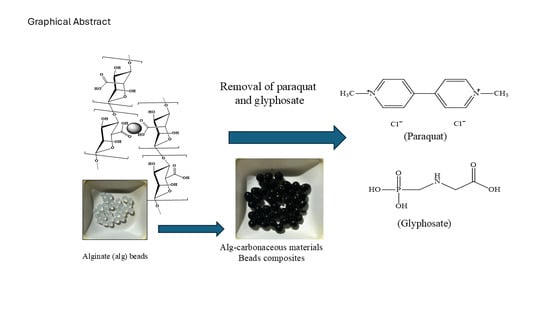
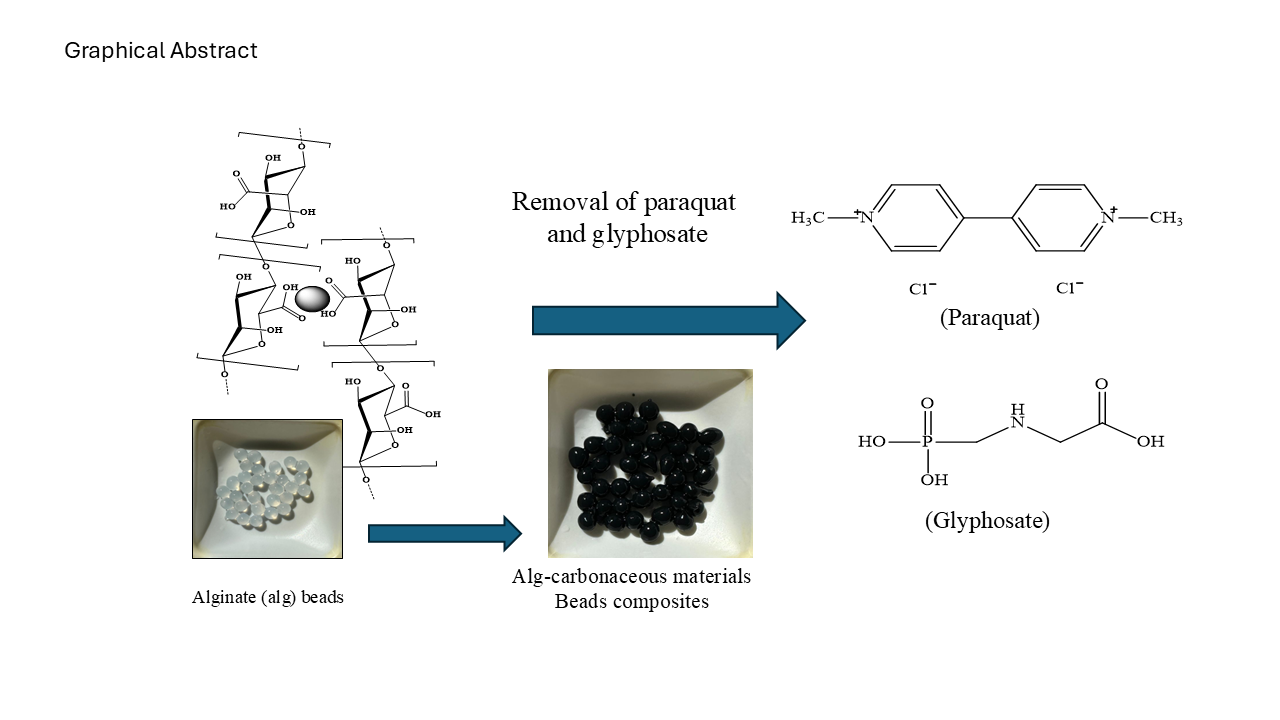
Graphical Abstract

1. Introduction

Herbicides, which are commonly utilized in agriculture to control undesirable plant growth, pose considerable threats to the environment and human health [1,2]. These chemical substances have the potential to infiltrate soil and water systems, resulting in contamination that adversely impacts non-target plant species, aquatic ecosystems, soil microbiomes, and the human population [3,4,5]. The permanence of certain herbicides in the environment can disturb local biodiversity as sensitive species may struggle to endure chemical exposure, leading to diminished populations or even local extinctions [2,3]. Furthermore, runoff from treated agricultural fields can carry these chemicals into adjacent waterways, where they may accumulate and affect aquatic organisms, including fish and amphibians, which are especially susceptible to chemical pollutants [6,7,8]. The long-term ecological consequences of herbicide usage extend beyond immediate toxicity as they can alter habitat structures, disrupt food webs, and contribute to the emergence of herbicide-resistant weed species, establishing a cycle of heightened chemical reliance that exacerbates environmental degradation [9,10,11]. Moreover, herbicides have raised undoubtedly significant concerns regarding their potential adverse effects on human health [1,2,4]. These chemicals, although designed to target specific plant species, can inadvertently affect non-target organisms, including humans, through various exposure pathways, including inhalation, dermal contact, and ingestion of contaminated foods and water [12,13,14]. Many investigations have indicated that certain herbicides may be linked to a range of health issues, including respiratory problems, skin irritations, and more severe conditions, such as endocrine disruption and carcinogenic effects [15,16,17]. The persistence of these chemicals in the environment further aggravates the risk, as they can accumulate in the environment, e.g., soil and water, leading to prolonged exposure for living species in agricultural areas [13,15,18,19]. Moreover, vulnerable populations, including children and pregnant women, may be at heightened risk due to their developing systems. As the use of herbicides continues to be a cornerstone of modern agriculture, it is imperative to conduct further studies to fully recognize their long-term health implications and to explore safer alternatives that minimize risks to human health and the environment [15,20,21,22,23].
Paraquat is a highly effective herbicide that is commonly used in agriculture to manage various types of weeds and grasses [24]. Due to its chemical structure, which is a bipyridyl compound, Paraquat acts rapidly upon contact with plant foliage, leading to the disruption of photosynthesis and ultimately resulting in the death of the plant [25]. However, despite its effectiveness, paraquat poses significant health risks, particularly in cases of accidental ingestion or inhalation, as it is extremely toxic to both humans and animals [26]. The compound has been associated with severe respiratory distress, organ failure, and even death, which has led to strict regulations in many countries regarding its use and handling. Furthermore, the environmental impact of paraquat is a growing concern, as its persistence in soil and potential to contaminate water sources can result in harmful effects on ecosystems [27,28].
Glyphosate is also a broad-spectrum systemic herbicide extensively used in agriculture for the control of weeds, particularly in genetically modified crops that are engineered to be resistant to its effects [29,30]. Discovered in the 1970s, glyphosate functions by inhibiting a specific enzyme pathway known as the shikimic acid pathway, which is essential for the growth of plants and some microorganisms [31,32,33]. This mechanism of action has made glyphosate a popular choice among farmers, as it allows for effective weed management while minimizing damage to the crops themselves. However, the widespread use of glyphosate has raised significant environmental and health concerns, leading to ongoing debates regarding its safety [34,35,36]. Studies have suggested potential links between glyphosate exposure and various human health issues, including cancer, prompting regulatory agencies to establish guidelines for safe application [37,38,39].
Recent research has demonstrated that the synergistic structural and chemical properties of composites consisting of carbon and alginate materials make them particularly effective adsorbents for the removal of herbicides. For instance, substantial research on composites based on sodium alginate and graphene oxide (GO) has shown superior adsorption capacities through increased mechanical stability, a diversity of functional groups, and a larger surface area [40]. It was reported that the GO/alginate/algal biomass composites successfully eliminated the 2,4-D herbicide in batch and column systems, with Freundlich-type isotherms and heterogeneous surface interactions influencing the adsorption process [41]. Similarly, by reducing particle loss and enhancing structural integrity, the addition of modified activated carbon to alginate matrices has been shown to greatly increase removal efficiency and reusability for herbicides like atrazine [42]. Beyond alginate-specific systems, new carbon-based composites, like activated carbon/GO hybrids with a large surface area, ~960 m2/g, have demonstrated exceptional adsorption capacities and reusability for herbicide removal, highlighting the importance of porosity and surface functionality [43]. Herbicides like paraquat can be effectively removed by encasing adsorbents in alginate hydrogel beads, which both preserves the materials’ natural reactivity and makes it easier to use them in continuous systems [44]. Notably, recent studies on hybrid beads based on alginate, such as alginate–montmorillonite systems, demonstrated that diffusion and electrostatic interactions within the bead’s architecture significantly influence the adsorption of paraquat, highlighting the crucial role of internal porosity and the composite’s composition [45]. Therefore, these studies indicate that combining alginate matrices with different carbon materials is a viable strategy for developing effective, reusable, and structurally flexible adsorbents for herbicide-contaminated water.
Because of the serious health and environmental concerns, the removal of paraquat and glyphosate from aquatic environments is critical to prevent their harm to any living organisms. Therefore, in this study, a natural polymer, alginic acid (Alg), was used to prepare the corresponding beads via physical cross-linking with Ca(II) ions. During the synthesis process, carbonaceous materials such as graphene oxide (GO), carbon particles (CPs), porous carbon particles (PCPs), carbon black (CB), and carbon nanotubes (CNTs) were included into the medium to obtain Alg–carbonaceous bead composites to be used in the removal of herbicides, i.e., paraquat and glyphosate, from their aqueous solutions. The surface area, pore volume, and pore size values of the used carbonaceous materials were determined with N2 adsorption/desorption curves via the Brunauer–Emmett–Teller (BET) and Barret–Joyner–Halenda (BJH) methodologies. Moreover, the prepared Alg-based bead composites were characterized using a Fourier-transform infrared spectrometer (FT-IR), a thermogravimetric analyzer (TGA), and swelling studies of the materials. The details of the adsorption parameters of paraquat from aqueous solutions were investigated by adsorption kinetics and isotherms, signifying that it followed pseudo-first-order adsorption kinetics and fitted the Freundlich isotherm. The effects of carbonaceous materials, adsorbent dosage, and herbicide concentration on adsorption capability were investigated. Furthermore, the adsorption kinetics and the types of adsorption isotherms were also determined. The comparison of five distinct carbon materials embedded inside Alg beads enables a direct assessment of their contributions to adsorption efficacy. Furthermore, this study provides some new insights into the connections between structure and adsorption by connecting textural features, such as surface area and porosity, to the adsorption behavior while simultaneously examining two chemically different herbicides, e.g., paraquat and glyphosate.

2. Materials and Methods

2.1. Materials

Alginic acid (Alg, from brown alg, 98%, Sigma-Aldrich, Milwaukee, WI, USA) and calcium chloride dihydrate (CaCl2·2H2O, 98%, Carlo Erba, Milan, Italy) were used to prepare Alg-based beads. Graphene oxide (GO, synthesized by our research group [46]), carbon particles (CPs, synthesized by our research group [47]), porous carbon particles (PCPs, synthesized by our research group [47]), carbon black (Care tire recycling, Nanografi, Ankara, Turkey), and carbon nanotubes (CNTs, 98%, O.D × I.D × L 10 ± 1 nm × 4.5 ± 0.5 nm × 3–6 µm TEM, Sigma Aldrich, Milwaukee, WI, USA) were used as carbonaceous materials to prepare Alg–carbonaceous composite beads. Paraquat (48%, Cansa, a local company, Ankara, Turkey) and glyphosate (48%, Cansa, Ankara, Turkey) were used as herbicide sources.

2.2. Synthesis of Alg and Carbonaceous Structure Containing Composites Beads

The synthesis of Alg beads was performed in an aqueous medium by using the following procedure. Initially, a 25 mL aliquot of a 10 mg/mL Alg solution was incrementally added to a freshly prepared 250 mL solution of calcium ions (Ca(II)) at a concentration of 30 mg/mL. A pastor pipette was utilized to drop the Alg solution into the Ca(II) solution, which was maintained under continuous stirring at room temperature at a rate of 500 rpm. Subsequent to the complete addition of the Alg, the resultant beads were further stirred in the Ca(II) solution at the same stirring speed for an additional 2 h. The beads were then filtered through a strainer and transferred to 500 mL of distilled water, with the water being refreshed every thirty minutes, and they underwent five washing cycles before being dried in a freeze-dryer.
In the synthesis of carbonaceous composites of Alg beads, GO, CPs, PCPs, CB, and CNTs were separately incorporated into 25 mL of an Alg solution at a concentration of 10 mg/mL, representing 20% by weight with respect to the used Alg. These mixtures underwent an extensive mixing process lasting for 6 h at 500 rpm at room temperature, during which they were subjected to sonication for 10 min every hour. After achieving a homogeneous dispersion of the carbonaceous components within the Alg solutions, the resultant mixtures were meticulously introduced dropwise into 250 mL of a Ca(II) solution at a concentration of 30 mg/mL, using a Pasteur pipette. Upon the completion of the solution, the outlined washing and drying protocols above were repeated. The final products were labeled as Alg beads, Alg-GO, Alg-CP, Alg-PCP, Alg-CB, and Alg-CNT bead composites. Furthermore, both the neat and composite beads were stored in closed containers for further use.

2.3. Characterization of Alg-Based Beads

The structural properties of the Alg-based beads were analyzed using Fourier-transform infrared (FT-IR, Nicolet iS10 spectrometer, Thermo, Buffalo, NY, USA), with the spectrum recorded in the 4000–650 cm−1 range at a resolution of 4 cm−1, utilizing the attenuated total reflectance (ATR) technique. The thermal stability was assessed using a thermogravimetric analyzer (TGA, SII TG/DTA 6300 Exstar system, Tokyo, Japan). The samples were initially heated at 100 °C to remove moisture while maintaining a nitrogen gas flow rate of 100 mL/min. The weight loss of the Alg-based beads was then recorded as a function of temperature up to 500 °C, at a heating rate of 20 °C/min under identical nitrogen flow conditions.
The pore size analyzer (Micromeritics TriStar II, Atlanta, GA, USA) was employed to assess the surface area, pore volume, and average pore width of the carbonaceous materials utilizing the Brunauer–Emmett–Teller (BET) and Barret–Joyner–Halenda (BJH) methodologies. Before conducting the measurements, all samples underwent a degassing process for 12 h at a temperature of 80 °C while subjected to a flow of N2 gas.
The swelling behavior of the Alg-based beads was also investigated in double-distilled water using the following Equation (1):
Swelling% = ((ms − md)/md) × 100
where “md” is the weight of beads in the dry state, and “ms” is the weight of beads in the swollen state at 8 h.

2.4. Adsorption Studies

2.4.1. Batch Type Adsorption of Herbicides

For both paraquat and glyphosate, the effectiveness of the Alg-based beads and their composites as adsorbents was investigated through a series of experiments. First, the focus was placed on identifying the most effective carbonaceous materials that had the maximum adsorption capacity of the synthesized Alg-based beads and composites for the targeted herbicide. Before the experiments, a herbicide solution was prepared at a concentration of 250 ppm. Following this preparation, 50 mL of the herbicide solution was added to a 100 mL glass beaker already containing 50 mg of the Alg-based beads and composites and stirred at a 250 rpm mixing rate at room temperature. The amount of adsorbed herbicide as a function of time was quantified to assess the adsorption kinetics and the adsorption capacity of the Alg-based materials. Next, utilizing the Alg-based beads exhibiting the highest adsorption capacity for the corresponding adsorbed herbicide, the influence of various factors on the adsorption process was examined, including the initial concentrations of the herbicide in the 50 to 1000 ppm range and the quantity of adsorbent utilized spanning from 10 to 250 mg. A UV–Vis spectrometer was used to determine the amount of adsorbed herbicide at the related wavelength, 257 nm for paraquat and 210 nm for glyphosate. All measurements were performed in triplicate, and the results were given as averages with standard deviations.

2.4.2. Adsorption Kinetics

A variety of adsorption kinetic models are commonly utilized to analyze experimental data in adsorption research. For this purpose, 50 mL of a 250 ppm herbicide solution and 50 mg of adsorbents were used and stirred at 250 ppm and room temperature for 12 h. The amount of herbicide adsorbed by the adsorbents was recorded at various time intervals up to 12 h and used to determine the kinetic parameters. In this investigation, the pseudo-first-order and pseudo-second-order kinetics models were applied to the adsorption data pertaining to herbicides present in the aqueous solutions. The equations governing these models are given in Equations (2) and (3) [48]:
log (qe − qt) = log qt − (k1/2.303) t
t/qt = 1/k2 qe2 + t/qe
where “qe” denotes the quantity of herbicide adsorbed at equilibrium (mg/g), while “qt” signifies the amount adsorbed at time t. The parameters k1 and k2, measured in 1/min, correspond to the rate constants for the pseudo-first- and pseudo-second-order models, respectively.

2.4.3. Adsorption Isotherms

The Langmuir and Freundlich isotherm models were applied to affiliate with the experimental findings regarding herbicide adsorption by Alg-based beads. For this goal, 50 mL of herbicide solutions at certain concentrations, e.g., 50, 100, 250, 500, and 1000 ppm, were used for 50 mg of adsorbent, under a 250 rpm mixing rate and room temperature. The mathematical formulations for the linear representations of the Langmuir and Freundlich isotherm models are articulated in Equations (4) and (5) [48]. In addition, Equation (6) was also used to calculate theoretical qm values from the Freundlich isotherms.
1/qe = 1/qmKLCe + 1/qm
log qe = log KF + 1/n log Ce
qm = KF × C1/n
where “qe” is the quantity of herbicide per unit weight of adsorbent (mg/g) at equilibrium, “Ce” represents the equilibrium concentration of the solute in the bulk solution (mg/L), “qm” indicates the maximum adsorption capacity of the adsorbent (mg/g), KL is the Langmuir constant (L/mg), “KF” denotes the Freundlich constant that reflects the relative adsorption capacity of the adsorbent (mg1−(1/n)L1/n/g), and “n” is a constant that illustrates the intensity of adsorption.

3. Results and Discussion

3.1. Synthesis of Alg-Based Beads

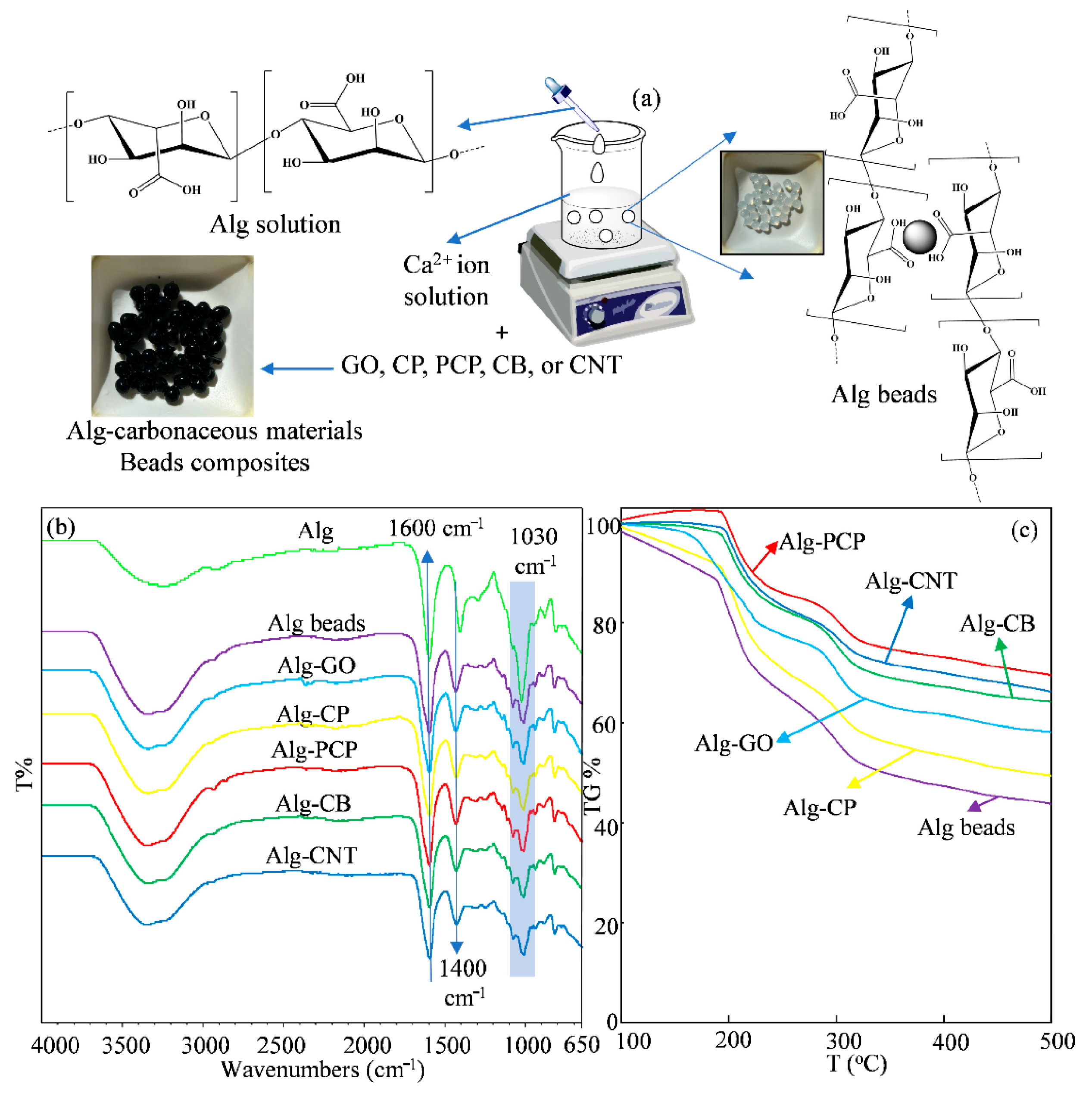
Alg-based beads were formed through a process known as internal gelation, which involves the use of Ca(II) ions as a cross-linking agent. The schematic presentation of Alg-based beads and the corresponding carbonaceous composites is given in Figure 1a. This method capitalizes on the unique properties of Alg, a biopolymer derived from brown seaweed, which forms gels in the presence of divalent cations. During the synthesis, a solution of Alg is mixed with a Ca(II) ion solution, allowing the Ca(II) ions to interact with carboxylic acid groups of Alg. This interaction leads to the formation of a three-dimensional network, resulting in the creation of stable beads. The gelation technique allows controlled formation of beads with a uniform size and shape that can be tailored for various applications, including drug delivery systems and food technology [49,50]. The attained Alg beads via Ca(II) cross-linking exhibit desirable characteristics, such as biocompatibility, biodegradability, and the ability to encapsulate a wide range of bioactive compounds, making them a valuable material in both pharmaceutical and nutritional fields [51,52,53].
In this study, Alg–carbonaceous material composite beads were synthesized to leverage the adsorptive properties of both Alg and the carbonaceous materials utilized in composite formation. The FT-IR and TGA spectra, along with the thermograms of the synthesized Alg and Alg–carbonaceous material composite beads, are illustrated in Figure 1b and Figure 1c, respectively. Figure 1b illustrates the FT-IR spectra of alginic acid alongside dry Alg-based beads. The FT-IR spectrum of alginic acid revealed several notable peaks, consistent with the literature [54,55]. The O-H stretching vibrations of alginic acid were observed at approximately 3270 cm−1. The stretching vibrations associated with aliphatic C-H were seen at 2908 cm−1. The COO stretching is divided into asymmetric and symmetric C=O vibrations, with the former occurring at 1603 cm−1 and the latter at 1410 cm−1. The bands observed at 1298 cm−1 were associated with the C-O stretching vibrations. The subsequent peak, located around 1085 cm−1, pertains to C-O, C-C, and C-O-C stretching vibrations. Additionally, the pronounced and sharp peak at 1030 cm−1 is also attributed to C-C and C-O-C vibrations. Similar peaks were identified in Alg-based beads and composites as well. In comparison with the FT-IR spectrum of alginic acid, the dry Alg-based beads and composites exhibited no significant differences in band patterns. Conversely, the transmission region of the stretching vibration of hydroxyl bonds in alginic acid appeared narrower than that of Alg-based beads. Furthermore, the peak intensities of COO in Alg-based beads and composites were lower than those in alginic acid due to electrostatic interaction involvement of carboxylate groups of alginic acid with calcium ions [56,57].
The thermal stability and degradation profiles of Alg beads and their corresponding carbonaceous material composites were compared and presented in Figure 1c. It was clearly observed that all types of prepared Alg-based beads revealed similar degradation profiles, though with varying degrees of weight loss, which are also in accordance with reported Alg-based beads in the literature [58,59,60]. The bare Alg beads exhibited 29.5% weight loss at 190–240 °C, and 48.2% cumulative weight loss was observed at 280–325 °C, and the total weight loss of 56.1% was observed up to heating at 500 °C. Very similar thermal degradation steps in the same temperature ranges were observed for the Alg–carbonaceous material composites. The cumulative weight losses were observed as 19.6%, 34.8%, and 41.9% for Alg-GO; 25.1%, 42.1%, and 50.5% for Alg-CP; 13.3%, 23.9%, and 30.4% for Alg-PCP; 16.3%, 29.3%, and 35.8% for Alg-CB; and 15.3, 26.3, and 33.8% for Alg-CNT bead composites in the related temperature ranges, respectively. Meanwhile, there was no weight loss observed up to 180 °C for Alg-PCP, Alg-CB, and Alg-CNT bead composites. In summary, it is clearly seen that the carbonaceous materials used for preparation of Alg-based composite beads increased the thermal stability of Alg beads.
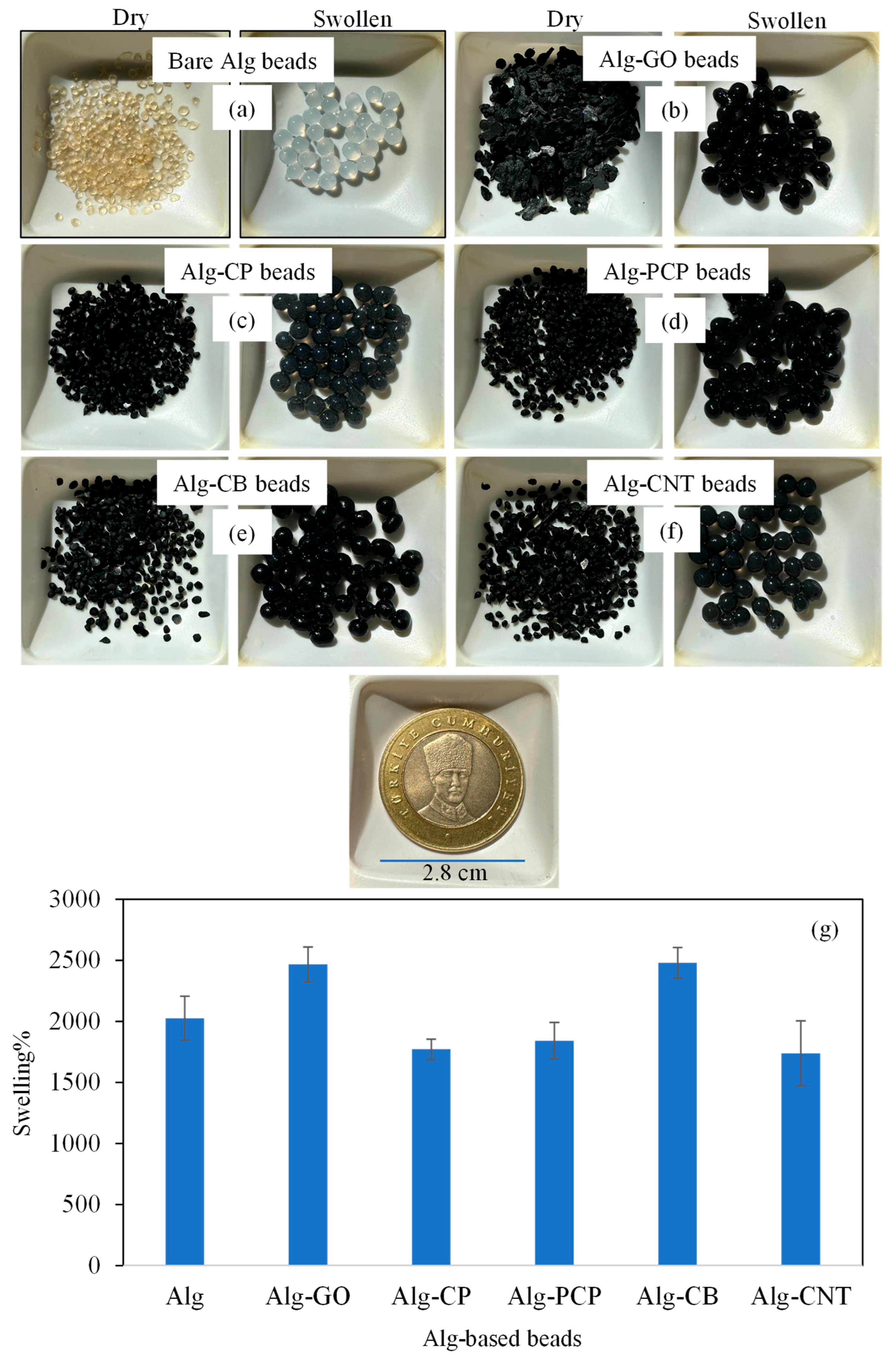
The digital camera images of both dry and swollen states of Alg-based beads are also given in Figure 2a–f. The color of the bare Alg beads is yellowish in the dry state and opaque in the swollen state. Meanwhile, all of the Alg–carbonaceous material composites are black-colored in both dry and swollen states. The size of swollen Alg-based beads was about 3 mm.
Moreover, the swelling ratio (%) of the prepared Alg-based beads was also determined in water, and the corresponding graph is given in Figure 2g. It was observed that the neat Alg beads exhibited 2025 ± 180% swelling and showed significant differences in swelling behavior depending on the content of carbonaceous materials, e.g., 2466 ± 143% for Alg-GO, 1771 ± 82% for Alg-CP, 1841 ± 149% for Alg-PCP, 2479 ± 125% for Alg-CB, and 1737 ± 266% swellings for Alg-CNG bead composites.
Moreover, the specific surface area (SBET, m2/g), pore volume (cm3/g), and average pore sizes (nm) of the used carbonaceous materials were also determined via N2 adsorption/desorption measurements. The corresponding N2 adsorption/desorption curves are given in Figure S1. All carbonaceous materials utilized, with the exception of PCPs, showed type V isotherms characterized by H3 loops in their N2 adsorption/desorption profiles, indicating the presence of slit-like mesoporous structures [61]. Conversely, PCPs showed a type II isotherm with an H3 loop in their N2 adsorption/desorption curves, illustrating the occurrence of multilayer adsorption, where the adsorption capacity continues increasing even as the relative pressure nears unity [62]. In addition, the calculated SBET, pore volume, and average pore sizes for carbonaceous materials are summarized and compared with each other in Table S1. The SBET values for GO, CPs, PCPs, CB, and CNTs were determined as 0.87, 62.8, 460, 85.7, and 0.12 m2/g, respectively. Moreover, the pore volume and pore size values were also determined using the BJH method. The pore volume values for GO, CPs, PCPs, CB, and CNTs were determined as 0.336 ± 0.01, 0.197 ± 0.03, 0.037 ± 0.007, 0.402 ± 0.02, and 0.236 ± 0.01 cm3/g, respectively. Lower average pore sizes were observed for PCPs, with 2.9 ± 0.4 nm, whereas the pore sizes for CPs and CB were calculated to be between 10 and 15 nm, and pore sizes of around 22 nm were determined for GO and CNTs.

3.2. Studies of Herbicide Adsorption by Alg-Based Beads from Aqueous Solution

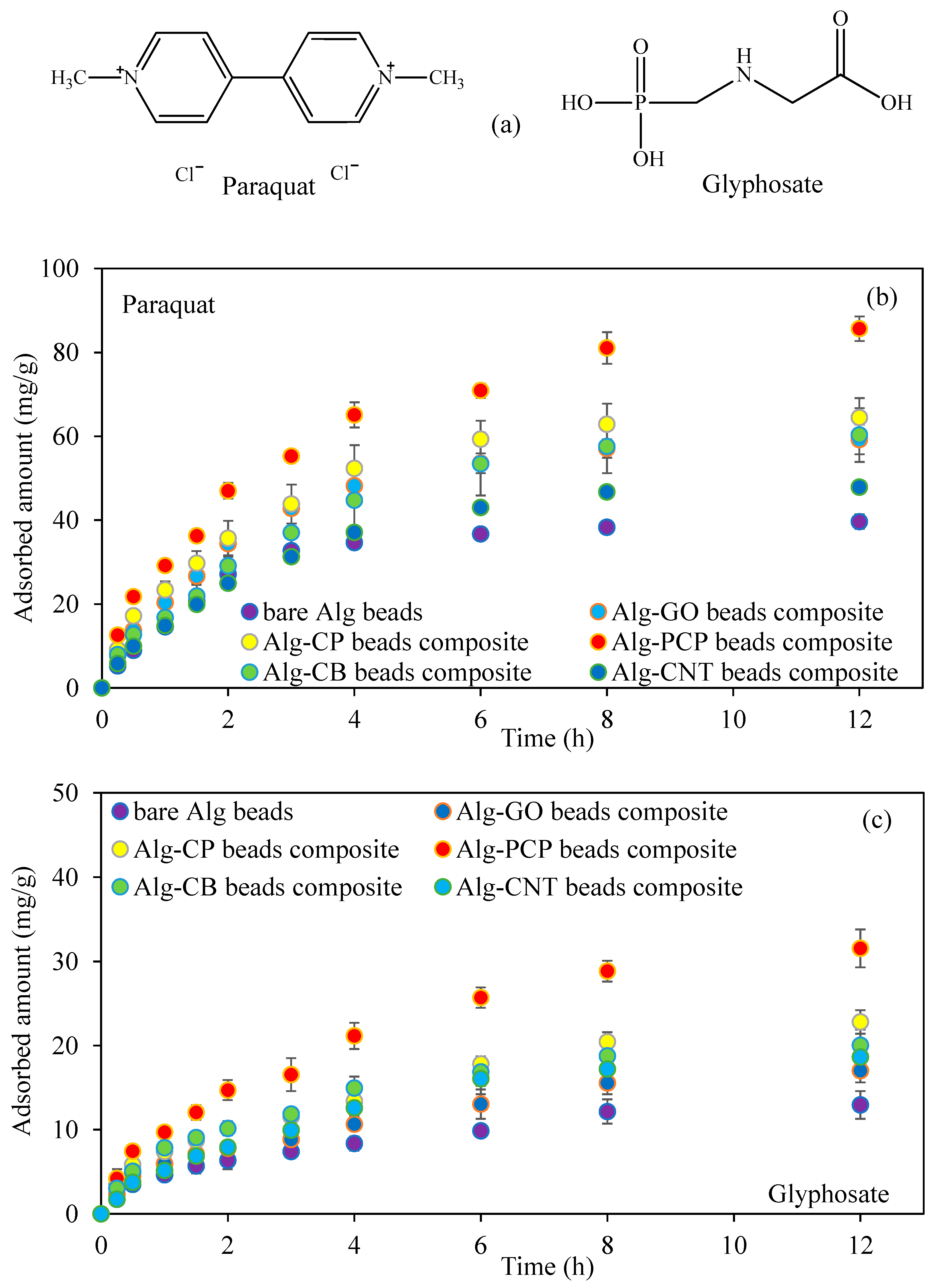
Carbonaceous materials present multiple benefits for pollutant adsorption, rendering them exceptionally effective in environmental remediation efforts [63,64,65]. Their inherently nontoxic, high surface area, and even sometimes porous structure affords a substantial material to capture a wide range of contaminants, such as heavy metal ions, organic substances, and gases [66,67,68]. The adaptability of carbonaceous materials, including activated carbon, biochar, and carbon nanotubes, facilitates specific modifications aimed at enhancing their adsorption capabilities for targeted pollutants [69,70,71]. Furthermore, many of these materials are sourced from renewable resources, promoting sustainability and minimizing environmental repercussions [72]. The chemical durability and robustness of carbonaceous adsorbents under diverse environmental conditions further augment their applicability in practical circumstances [73,74,75,76]. Additionally, the potential for regeneration of these materials enables their repeated utilization, establishing them as economically feasible options to endure pollutant management. Therefore, the distinctive properties of carbonaceous materials make them highly capable candidates for effective strategies in pollutant treatment. Meanwhile, the accumulation of unbound carbonaceous materials following the adsorption process presents considerable difficulties and leads to increased costs [73,74,75,76]. As a result, the development of composites that integrate carbonaceous materials within other materials, such as Alg, a natural polymer, can be a reasonable approach. This study assessed the effectiveness of these composites in the removal of herbicides, focusing on paraquat and glyphosate, which are commonly used herbicides distinguished by one having a positive charge and the other a negative charge, respectively. The chemical structures of these herbicides are depicted in Figure 3a. Paraquat has a positively charged biphenolic structure, whereas glyphosate is a negatively charged molecule. In Figure 3b,c, the adsorption capabilities of Alg-based beads for the herbicides paraquat and glyphosate are given over time. For the experiments, 50 mg of Alg-based beads was submerged in 50 mL of a 250 ppm aqueous solution of the herbicide, and the adsorbed quantities were monitored over time via a UV–Vis spectrometer at the maximum absorption wavelength, 257 nm for paraquat and 210 nm for glyphosate.
The findings related to paraquat removal, as depicted in Figure 3b, demonstrated that adsorption equilibrium was reached within a 12-h period by the alginate-based beads. The measured quantities of paraquat adsorbed by the different bead composites for this time frame were bare Alg beads at 39.7 ± 1.8 mg/g, Alg-GO at 59.2 ± 3.5 mg/g, Alg-CP at 64.4 ± 4.7 mg/g, Alg-PCP at 85.7 ± 2.9 mg/g, Alg-CB at 60.3 ± 6.4 mg/g, and Alg-CNT at 47.9 ± 1.1 mg/g. In contrast, the ability of Alg-based beads to adsorb glyphosate over time, examined in a 50 mL solution at a concentration of 250 ppm, was lower, and the results are illustrated in Figure 3c. The findings revealed that the adsorption equilibrium was reached within 12 h. The adsorbed amounts of glyphosate measured were 12.9 ± 1.7, 17.0 ± 1.4, 22.8 ± 1.4, 31.6 ± 2.2, 20.1 ± 1.8, and 18.6 ± 1.1 mg/g for the bare Alg beads, and the composites of Alg-GO, Alg-CP, Alg-PCP, Alg-CB, and Alg-CNT beads, respectively.
By analyzing the pore characteristics of carbonaceous materials as well as the chemical structures of the adsorbates, the adsorption mechanism of paraquat and glyphosate on Alg-based composites can reasonably be realized. In experimental pH environments, Algs’ abundant numbers of carboxylate (–COO) groups generate negatively charged chains. A high specific surface area and heterogeneous adsorption sites, such as π-electron-rich domains, defects, and oxygen-containing functional groups, are produced by the presence of carbon-based fillers, particularly PCPs. Thus, the synergistic effect of (i) an increased accessible surface area and pore volume, which eases the diffusion and site availability, and (ii) greater surface heterogeneity is responsible for the enhanced adsorption capacity seen for Alg–PCP beads. Meanwhile, electrostatic and π-related interactions are the primary factors influencing paraquat’s preferred adsorption over glyphosate. As a dicationic molecule, paraquat exhibits both potential π–π interactions with the graphitic domains of the carbon fillers and a significant electrostatic attraction to negatively charged alginate matrices. In contrast, glyphosate has a lesser electrostatic attraction and may be repelled from the alginate backbone since it mostly resides in anionic or zwitterionic forms, depending on the pH of the environment. The much higher absorption of paraquat can be explained by this difference. Moreover, the differences in adsorption capacities amongst Alg-based composites depend on the type of carbonaceous material employed, which affects porosity as well as the surface area and the functional groups present on these materials. Table S1 presents the pore characteristics of both synthesized and commercially sourced carbonaceous materials, revealing that PCPs have the highest porosity and lower pore sizes among those used for composite synthesis.
The Alg-PCP bead composite exhibited superior adsorption rates for both paraquat and glyphosate herbicides. Furthermore, the enhanced capacity of the Alg-PCP composite beads to adsorb paraquat may also be linked to the treatment of PCPs with NaOH, which removes the SiO2 particles from the structure to obtain PCPs that augment their activity and ability to capture more cationic paraquat.

3.2.1. Kinetics for Herbicides’ Adsorption by Alg-Based Beads

The pseudo-first-order and pseudo-second-order kinetic models are among the most prevalent system models utilized in adsorption research, particularly in the context of herbicide adsorption onto Alg-based beads, where they serve to elucidate the rate and mechanism of adsorption. The kinetic parameters, such as qe, k1, and k2, were derived from the respective equations of these models, with the relevant graphical representations given in the Supplementary Materials, Figures S2 and S3, respectively. These parameters play a critical role in understanding the adsorption kinetics of paraquat and glyphosate onto Alg-based beads, with the calculated values summarized in Table 1. Notably, the adsorption of paraquat onto Alg-based beads demonstrated a superior alignment with both kinetic models, achieving correlation coefficients (R2) exceeding 0.98 across all bead types. For comparison, the theoretical qe values for paraquat adsorption on neat Alg beads and composite variants, Alg-GO, Alg-CP, Alg-PCP, Alg-CB, and Alg-CNT, were determined to be 34.8, 57.8, 66.0, 8.5, 63.1, and 52.2 mg/g, respectively, aligning with the experimentally observed qe values. Meanwhile, glyphosate adsorption was found to conform more closely to the pseudo-first-order model, also yielding correlation coefficients (R2) greater than 0.98 for all Alg-based beads. In conclusion, the pseudo-first-order kinetic model more accurately characterizes the adsorption dynamics of paraquat and glyphosate herbicides on Alg-based beads, as evidenced by the higher correlation coefficients. This model indicates that the adsorption process occurs at a single active site at any given time, with external mass transfer processes playing a significant role in governing the herbicide adsorption mechanism [77,78]. The pseudo-first-order model of adsorption kinetics suggests that the rate-limiting factor is associated with diffusion-controlled physical adsorption onto readily accessible active sites instead of chemisorption [79,80]. This finding is consistent with the Alg-based bead composites’ porous properties, where most adsorption occurs on exterior and near-surface regions [79,80,81].

3.2.2. Isotherms of Herbicide Adsorption by Alg-Based Beads

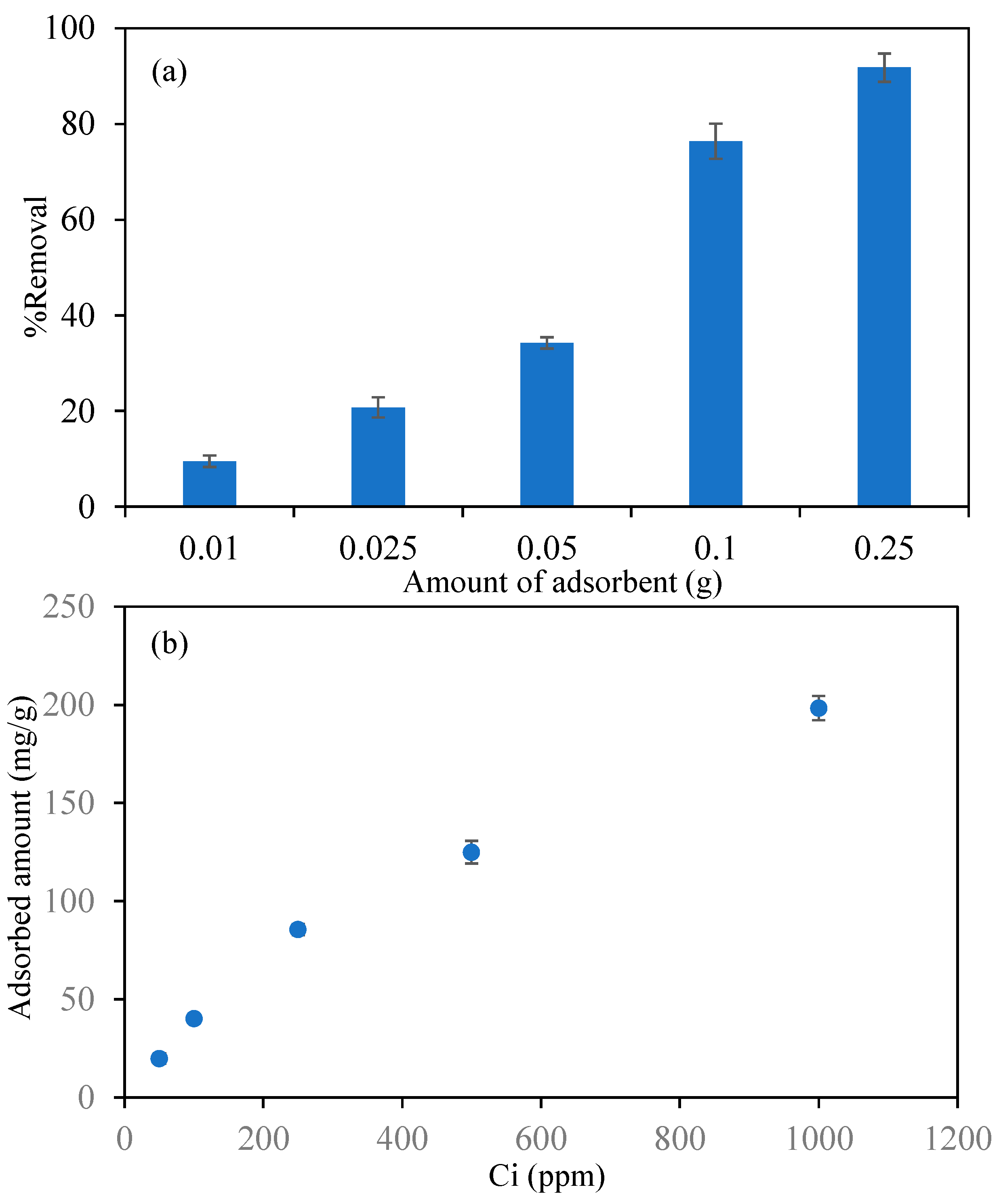
We investigated the adsorption characteristics of paraquat on Alg-PCP bead composites, revealing a significantly higher adsorption capacity for paraquat compared with glyphosate among various derivatives. The impact of varying adsorbent dosages and paraquat concentrations in an aqueous medium on the adsorption efficacy of these composites is illustrated in Figure 4a,b, respectively. The analysis revealed that, with the inclusion of 50 mg of Alg-PCP bead composite, only 34.3 ± 1.2% of paraquat could be removed from a 50 mL solution containing 250 ppm of paraquat. As illustrated in Figure 4a, the impact of the adsorbent dosage demonstrates a clear correlation between the increased dosage of Alg-PCP composite beads and the enhanced paraquat removal% from the 50 mL 250 ppm solutions. As the dosage of Alg-PCP bead composites was reduced to 10 mg, the removal rate of paraquat dropped significantly to just 9.5 ± 1.2% from the 50 mL 250 ppm solution. Conversely, elevating the adsorbent quantity to 100 mg and 250 mg resulted in paraquat removal rates of 76.4 ± 3.7% and 91.7 ± 2.9%, respectively, from the same 50 mL 250 ppm solutions.
Meanwhile, the graph presented in Figure 4b indicates that the quantity of paraquat adsorbed by the Alg-PCP beads increased from 19.8 ± 2.7 mg/g to 198.4 ± 36.1 mg/g as the concentration of paraquat rose from 50 to 1000 ppm in a 50 mL solution. Interestingly, despite the increase in the amount of paraquat adsorbed with higher concentrations, as seen in Figure 4b, the paraquat removal% exhibited an inverse trend (not shown). Specifically, a removal of 39.6 ± 5.4% was observed at a concentration of 50 ppm, while only 19.8 ± 0.6% removal was accomplished at 1000 ppm, indicating a complex relationship between concentration and removal efficiency. The rise in the paraquat concentration within solutions leads to an anticipated increase in herbicide adsorption, which aligns with the existing literature [82,83]. This phenomenon can be attributed to the enhanced molecular interactions between the herbicides and the adsorbents, resulting from the elevated concentration of herbicides in the solutions, thereby facilitating higher adsorption amounts. Nevertheless, it is noteworthy that the absorption yields, as indicated by the removal% values, tend to decrease at higher concentrations (not shown in Figure 4b).
The utilization of adsorption isotherms is crucial, akin to kinetic models, for realizing the mechanisms underlying the adsorption process. In this context, both the Langmuir and Freundlich models were employed to analyze the adsorption of paraquat onto the Alg-PCP bead composite. The relevant graphical representations are illustrated in Figure S4a,b. Furthermore, the significant parameters derived from the Langmuir and Freundlich models regarding paraquat adsorption by the Alg-PCP bead composite are given in Table 2. Particularly, the Langmuir isotherm exhibits a notably high correlation coefficient (R2) of 0.98 for the Alg-PCP bead composite; however, the significantly high theoretical qm value of 303.1 mg/g seems to be at odds with the experimentally determined value of 85.7 ± 2.9 mg/g.
In contrast, the adsorption of paraquat onto the Alg-PCP bead composite exhibited a superior fit with the Freundlich model, as evidenced by the higher correlation coefficients presented in Table 2. Additionally, the theoretical qm value calculated from the Freundlich isotherm equation, which was determined to be 97.2 mg/g, was found to be consistent with the experimental qm value. The n-value for the Alg-PCP bead composite, derived from the Freundlich model, was determined to be 1.46, while the KF value was calculated to be 2.23 (L/g)1/n for the same composite. A heterogeneous adsorption surface displaying multilayer adsorption behavior is suggested by the strong correlation with the Freundlich isotherm model [84,85,86]. This is due to the structural diversity of the composite, which includes differences in pore size distribution and the presence of different functional groups.
Furthermore, the adsorption capacity of paraquat by the prepared Alg-PCP bead composite developed here, 85.7 ± 2.9 mg/g, is better or about the same range compared with the values found in the existing literature [87,88,89,90,91,92]. The paraquat adsorption amount was reported for graphene oxide with mesoporous silica as 29.15 mg/g [87], cotton cord coated with 5% cyclodextrin polymers as 29.6 mg/g [88], poly(vinyl alcohol)–cyclodextrin nanosponges as 65.5 mg/g [89], a biopolymeric membrane as 77.8 mg/g [90], mineral clay as 96.4 mg/g [91], cyclodextrin nanosponges cross-linked with 1,2,3,4-butanetetracarboxylic acid and poly(vinyl alcohol) as 112.9 mg/g [92], and beads of alginate montmorillonite as 71.5 mg/g [93].

3.3. Reusability of Alg-PCP Beads in Adsorption of Paraquat

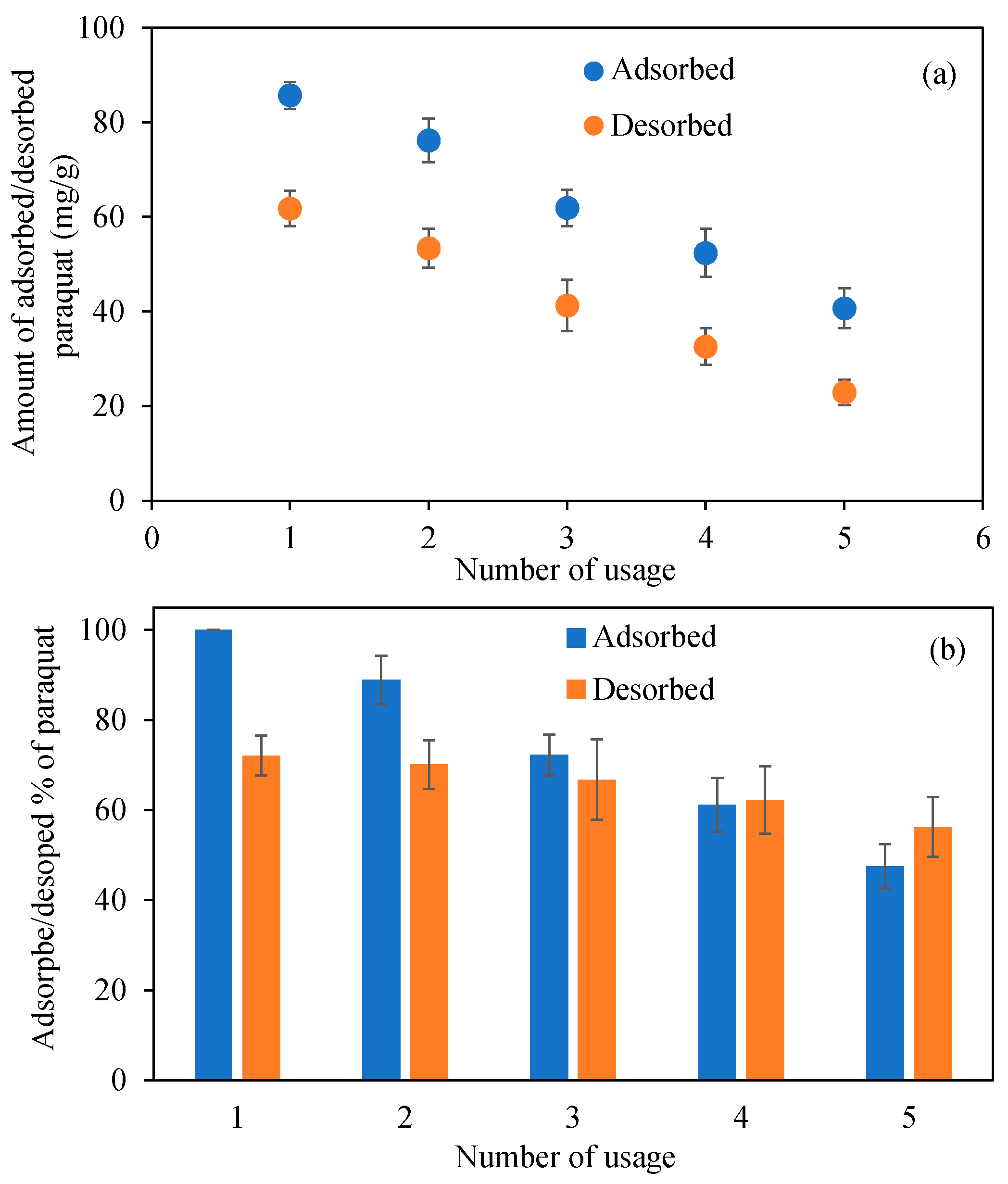
The reuse of Alg-PCP beads for the adsorption of paraquat was done. In this context, 50 mg of Alg-PCP beads for paraquat adsorption was immersed in 50 mL of a 2500 ppm paraquat solution and stirred for 12 h for paraquat adsorption and placed in 50 mL of a 1 M NaCl solution at room temperature for a duration of 6 h for desorption of the adsorbed paraquat, maintaining a stirring speed of 250 rpm. This procedure was categorized as one adsorption/desorption cycle, which was subsequently repeated five times. Between each cycle of adsorption and desorption, the Alg-PCP beads underwent a washing process with pure DI water for a period of 2 h at a 250 rpm mixing rate. The results of the paraquat adsorption and desorption study are illustrated in Figure 5a. Specifically, the Alg-PCP beads that adsorbed 85.7 ± 2.9 mg/g of paraquat were put in 50 mL of a 1 M NaCl solution for 6 h, resulting in the desorption of 61.8 ± 3.8 mg/g of paraquat into the aqueous phase. Following this, the same Alg-PCP beads were introduced into 50 mL of a 250 ppm paraquat solution, and mixed for 12 h, and the quantity of paraquat adsorbed during this second application was determined to be 76.2 ± 4.6 mg/g. The amount of desorbed paraquat after being mixed in 50 mL of a 1 M NaCl solution for 6 h was recorded as 53.4 ± 4.1 mg/g. After the third reuse, the quantity of paraquat adsorbed from 50 mL of a 250 ppm paraquat solution was assessed to be 61.9 ± 3.9 mg/g, while the amount desorbed in 50 mL of a 1 M NaCl solution after 6 h was calculated to be 41.3 ± 5.5 mg/g. In the fifth adsorption/desorption cycle, the adsorbed amount of paraquat from a 50 mL 250 ppm solution was determined as 40.7 ± 4.2 mg/g, while the desorbed amount was determined as 22.9 ± 2.7 mg/g. It is apparent that at every adsorption/desorption cycle, there is a gradual decrease in the amount of paraquats.
As illustrated in Figure 5b, the % of paraquat that was adsorbed in relation to the initial adsorption quantity, as well as the % of paraquat that was desorbed based on the amount adsorbed during each cycle of adsorption/desorption, is almost linearly decreased. As the quantity of paraquat adsorbed during the first adsorption is regarded as 100%, it was found that 72.1 ± 4.4% of the adsorbed paraquat was released through the desorption process. During the second use of Alg-PCP beads, the amount of paraquat adsorbed reduced by roughly 10%, calculated at 88.9 ± 5.4%, while 70.1 ± 5.4% of the adsorbed paraquat was desorbed. By the fifth usage, around 40% of the initial paraquat adsorption value was retained, with 56.3 ± 6.6% of the adsorbed paraquat being desorbed. This observation indicates that the paraquat adsorbed% by the Alg-PCP beads from a 50 mL solution of 250 ppm paraquat diminished with each successive use, leading to a corresponding decrease in the paraquat desorbed% in relation to the amount that was adsorbed. The reduction in the paraquat adsorption and desorption with each cycle could be due to the loss of alginate chains that are linked by Ca2+ ions, which eventually leads to the loss of some carbonaceous materials due to the treatment of NaCl as the desorption agent.

4. Conclusions

This study demonstrates that Alg–carbonaceous composite beads are effective adsorbents for the removal of herbicides from aqueous solutions, highlighting their potential for water treatment and ecosystem protection. The content of carbonaceous materials (GO, CPs, PCPs, CB, and CNTs) within the composites was 20% by weight with respect to alginic acid. Among these materials, Alg-PCP bead composites were recognized as the most efficient adsorbent for the removal of cationic paraquat and anionic glyphosate herbicides from water. Specifically, Alg-PCP bead composites adsorbed 85.7 ± 2.9 mg/g and 31.6 ± 2.2 mg/g of herbicide upon being subjected to 50 mL of 250 ppm paraquat and glyphosate solutions, respectively. The adsorption of paraquat and glyphosate by bare Alg beads was further improved by the addition of carbonaceous materials. The enhanced adsorption capacity observed with PCP composites was attributed to their higher porosity, surface area, and functionality. Alg beads played a vital role as a support medium for the inclusion of carbonaceous materials into the bead structure. The produced materials are environmentally benign, easily accessible, more manageable and can be easily separated from the separation medium. The experimental results from this investigation suggest that Alg–carbonaceous bead composites are effective for the adsorption of cationic herbicides such as paraquat from aqueous solutions. Furthermore, Alg-based beads offer significant advantages in various environmental applications due to their natural non-toxicity, biocompatibility and biodegradability. These properties make them very effective, especially in contaminated water treatment, as they can adsorb toxic organic pollutants and heavy metal ions while inducing no environmental harm, thereby improving the efficiency of wastewater treatment processes. Additionally, their natural origin reduces ecological disruption, making them a sustainable option in environmental remediation. Additionally, the versatility of Alg-based composite beads also includes their use in encapsulating nutrients and other fertilizers, which can facilitate controlled release for agricultural applications. Overall, Alg-carbonaceous bead composites provide a practical and eco-friendly approach for herbicide removal and could also serve as a sustainable option for broader nutrient management, helping to improve water quality and protect aquatic ecosystems.

Supplementary Materials

The following supporting information can be downloaded at https://www.mdpi.com/article/10.3390/micro6020027/s1: Figure S1: The comparison of N2 adsorption/desorption curves of carbon-based materials used for preparation of Alg-based beads composites.; Figure S2: The (a) pseudo-first-order and (b) pseudo-second-order kinetic plots for paraquat adsorption by Alg-based beads.; Figure S3: The (a) pseudo-first-order and (b) pseudo-second-order kinetic plots for glyphosate adsorption by Alg-based beads.; Figure S4: The (a) Langmuir and (b) Freundlich isotherm plots for paraquat adsorption by Alg-PCP bead composites.; Table S1: The comparison of porosity properties of carbon-based materials used for preparation of Alg-based beads composites.

Author Contributions

Conceptualization, N.S.; methodology, S.D. and N.S.; validation, S.D., J.H.T. and S.T.; formal analysis, S.D., J.H.T., S.T. and N.S.; investigation, S.D., J.H.T., S.T. and N.S.; resources, N.S.; writing—original draft preparation, S.D.; writing—review and editing, J.H.T., S.T. and N.S.; visualization, N.S.; supervision, N.S.; project administration, N.S.; funding acquisition, N.S. All authors have read and agreed to the published version of the manuscript.

Funding

This research received no external funding.

Institutional Review Board Statement

Not applicable.

Informed Consent Statement

Not applicable.

Data Availability Statement

No new data were created or analyzed in this study. Data sharing is not applicable to this article.

Acknowledgments

Financial support from U.A. Whitaker College of Engineering, the Startup Fund (N. Sahiner), is greatly acknowledged.

Conflicts of Interest

The authors declare no conflicts of interest.

References

  1. Saud AL-Ahmadi, M. Pesticides, Anthropogenic Activities, and the Health of Our Environment Safety. In Pesticides—Use and Misuse and Their Impact in the Environment; IntechOpen: London, UK, 2019. [Google Scholar][Green Version]
  2. Rashid, B.; Husnain, T.; Riazuddin, S. Herbicides and Pesticides as Potential Pollutants: A Global Problem. In Plant Adaptation and Phytoremediation; Ashraf, M., Ozturk, M., Ahmad, M., Eds.; Springer: Dordrecht, The Netherlands, 2010. [Google Scholar] [CrossRef]
  3. Walder, F.; Schmid, M.W.; Riedo, J.; Valzano-Held, A.Y.; Banerjee, S.; Büchi, L.; Bucheli, T.D.; van der Heijden, M.G.A. Soil Microbiome Signatures Are Associated with Pesticide Residues in Arable Landscapes. Soil Biol. Biochem. 2022, 174, 108830. [Google Scholar] [CrossRef]
  4. Wang, F.; Xiang, L.; Sze-Yin Leung, K.; Elsner, M.; Zhang, Y.; Guo, Y.; Pan, B.; Sun, H.; An, T.; Ying, G.; et al. Emerging Contaminants: A One Health Perspective. Innovation 2024, 5, 100612. [Google Scholar] [CrossRef]
  5. Bijlsma, L.; Campos-Mañas, M.; Hernández, F.; de Rijke, E.; de Voogt, P.; van Wezel, A.; Fabregat-Safont, D. Wastewater Surveillance for Assessing Human Exposure to Pesticides: Investigating Populations Living near Flower Bulb Fields. J. Environ. Chem. Eng. 2025, 13, 117090. [Google Scholar] [CrossRef]
  6. Liu, X.; Sathishkumar, K.; Zhang, H.; Saxena, K.K.; Zhang, F.; Naraginti, S.; K, A.; Rajendiran, R.; Rajasekar, A.; Guo, X. Frontiers in Environmental Cleanup: Recent Advances in Remediation of Emerging Pollutants from Soil and Water. J. Hazard. Mater. Adv. 2024, 16, 100461. [Google Scholar] [CrossRef]
  7. Rad, S.M.; Ray, A.K.; Barghi, S. Water Pollution and Agriculture Pesticide. Clean Technol. 2022, 4, 1088–1102. [Google Scholar] [CrossRef]
  8. Farah, I.F.; dos Santos, C.R.; Pinto, M.C.F.; Araújo, C.R.; Amaral, M.C.S. Pesticides in Aquatic Environment: Occurrence, Ecological Implications and Legal Framework. J. Environ. Chem. Eng. 2024, 12, 114072. [Google Scholar] [CrossRef]
  9. Punniyakotti, P.; Vinayagam, S.; Rajamohan, R.; Priya, S.; Moovendhan, M.; Sundaram, T. Environmental Fate and Ecotoxicological Behaviour of Pesticides and Insecticides in Non-Target Environments: Nanotechnology-Based Mitigation Strategies. J. Environ. Chem. Eng. 2024, 12, 113349. [Google Scholar] [CrossRef]
  10. Baćmaga, M.; Wyszkowska, J.; Kucharski, J. Environmental Implication of Herbicide Use. Molecules 2024, 29, 5965. [Google Scholar] [CrossRef] [PubMed]
  11. Dauer, J.T.; Luschei, E.C.; Mortensen, D.A. Effects of Landscape Composition on Spread of an Herbicide-Resistant Weed. Landsc. Ecol. 2009, 24, 735–747. [Google Scholar] [CrossRef]
  12. Damalas, C.; Koutroubas, S. Farmers’ Exposure to Pesticides: Toxicity Types and Ways of Prevention. Toxics 2016, 4, 1. [Google Scholar] [CrossRef] [PubMed]
  13. Hassaan, M.A.; El Nemr, A. Pesticides Pollution: Classifications, Human Health Impact, Extraction and Treatment Techniques. Egypt. J. Aquat. Res. 2020, 46, 207–220. [Google Scholar] [CrossRef]
  14. Brühl, C.A.; Zaller, J.G. Indirect Herbicide Effects on Biodiversity, Ecosystem Functions, and Interactions with Global Changes. In Herbicides; Elsevier: Amsterdam, The Netherlands, 2021; pp. 231–272. [Google Scholar]
  15. Mohd Ghazi, R.; Nik Yusoff, N.R.; Abdul Halim, N.S.; Wahab, I.R.A.; Ab Latif, N.; Hasmoni, S.H.; Ahmad Zaini, M.A.; Zakaria, Z.A. Health Effects of Herbicides and Its Current Removal Strategies. Bioengineered 2023, 14, 2259526. [Google Scholar] [CrossRef]
  16. Shekhar, C.; Khosya, R.; Thakur, K.; Mahajan, D.; Kumar, R.; Kumar, S.; Sharma, A.K. A Systematic Review of Pesticide Exposure, Associated Risks, and Long-Term Human Health Impacts. Toxicol. Rep. 2024, 13, 101840. [Google Scholar] [CrossRef]
  17. Kim, K.-H.; Kabir, E.; Jahan, S.A. Exposure to Pesticides and the Associated Human Health Effects. Sci. Total Environ. 2017, 575, 525–535. [Google Scholar] [CrossRef]
  18. Pathak, V.M.; Verma, V.K.; Rawat, B.S.; Kaur, B.; Babu, N.; Sharma, A.; Dewali, S.; Yadav, M.; Kumari, R.; Singh, S.; et al. Current Status of Pesticide Effects on Environment, Human Health and It’s Eco-Friendly Management as Bioremediation: A Comprehensive Review. Front. Microbiol. 2022, 13, 962619. [Google Scholar] [CrossRef]
  19. Feng, Y.; Li, Z.; Li, W. Polycyclic Aromatic Hydrocarbons (PAHs): Environmental Persistence and Human Health Risks. Nat. Prod. Commun. 2025, 20, 1–8. [Google Scholar] [CrossRef]
  20. Tudi, M.; Daniel Ruan, H.; Wang, L.; Lyu, J.; Sadler, R.; Connell, D.; Chu, C.; Phung, D.T. Agriculture Development, Pesticide Application and Its Impact on the Environment. Int. J. Environ. Res. Public Health 2021, 18, 1112. [Google Scholar] [CrossRef]
  21. Vikas; Ranjan, R. Agroecological Approaches to Sustainable Development. Front. Sustain. Food Syst. 2024, 8, 1405409. [Google Scholar] [CrossRef]
  22. Parven, A.; Meftaul, I.M.; Venkateswarlu, K.; Megharaj, M. Herbicides in Modern Sustainable Agriculture: Environmental Fate, Ecological Implications, and Human Health Concerns. Int. J. Environ. Sci. Technol. 2025, 22, 1181–1202. [Google Scholar] [CrossRef]
  23. Tahat, M.M.; Alananbeh, K.M.; Othman, Y.A.; Leskovar, D.I. Soil Health and Sustainable Agriculture. Sustainability 2020, 12, 4859. [Google Scholar] [CrossRef]
  24. Stuart, A.M.; Merfield, C.N.; Horgan, F.G.; Willis, S.; Watts, M.A.; Ramírez-Muñoz, F.; U, J.S.; Utyasheva, L.; Eddleston, M.; Davis, M.L.; et al. Agriculture without Paraquat Is Feasible without Loss of Productivity—Lessons Learned from Phasing out a Highly Hazardous Herbicide. Environ. Sci. Pollut. Res. 2023, 30, 16984–17008. [Google Scholar] [CrossRef] [PubMed]
  25. Lehoczki, E.; Laskay, G.; Gaal, I.; Szigeti, Z. Mode of Action of Paraquat in Leaves of Paraquat-resistant Conyza canadensis (L.) Cronq. Plant Cell Environ. 1992, 15, 531–539. [Google Scholar] [CrossRef]
  26. Kim, J.-W.; Kim, D.-S. Paraquat: Toxicology and Impacts of Its Ban on Human Health and Agriculture. Weed Sci. 2020, 68, 208–213. [Google Scholar] [CrossRef]
  27. Suanoi, P.; Kaewman, N.; Pekkoh, J.; Charoenkwan, P.; Pumas, C. A Novel System for Assessing Paraquat Toxicity Using Desmodesmus Maximus as a Potential Bio-Indicator and Deep Learning-Based Approach. Algal Res. 2024, 77, 103370. [Google Scholar] [CrossRef]
  28. Huang, Y.; Zhan, H.; Bhatt, P.; Chen, S. Paraquat Degradation from Contaminated Environments: Current Achievements and Perspectives. Front. Microbiol. 2019, 10, 1754. [Google Scholar] [CrossRef] [PubMed]
  29. Baylis, A.D. Why Glyphosate Is a Global Herbicide: Strengths, Weaknesses and Prospects. Pest Manag. Sci. 2000, 56, 299–308. [Google Scholar] [CrossRef]
  30. Martinez, D.A.; Loening, U.E.; Graham, M.C. Impacts of Glyphosate-Based Herbicides on Disease Resistance and Health of Crops: A Review. Environ. Sci. Eur. 2018, 30, 2. [Google Scholar] [CrossRef]
  31. Kőmíves, T.; Schröder, P. On Glyphosate. Ecocycles 2016, 2, 1–8. [Google Scholar] [CrossRef][Green Version]
  32. Zulet-González, A.; Barco-Antoñanzas, M.; Gil-Monreal, M.; Royuela, M.; Zabalza, A. Increased Glyphosate-Induced Gene Expression in the Shikimate Pathway Is Abolished in the Presence of Aromatic Amino Acids and Mimicked by Shikimate. Front. Plant Sci. 2020, 11, 459. [Google Scholar] [CrossRef]
  33. Mertens, M.; Höss, S.; Neumann, G.; Afzal, J.; Reichenbecher, W. Glyphosate, a Chelating Agent—Relevant for Ecological Risk Assessment? Environ. Sci. Pollut. Res. 2018, 25, 5298–5317. [Google Scholar] [CrossRef]
  34. Myers, J.P.; Antoniou, M.N.; Blumberg, B.; Carroll, L.; Colborn, T.; Everett, L.G.; Hansen, M.; Landrigan, P.J.; Lanphear, B.P.; Mesnage, R.; et al. Concerns over Use of Glyphosate-Based Herbicides and Risks Associated with Exposures: A Consensus Statement. Environ. Health 2016, 15, 19. [Google Scholar] [CrossRef]
  35. Singh, R.; Shukla, A.; Kaur, G.; Girdhar, M.; Malik, T.; Mohan, A. Systemic Analysis of Glyphosate Impact on Environment and Human Health. ACS Omega 2024, 9, 6165–6183. [Google Scholar] [CrossRef] [PubMed]
  36. Gandhi, K.; Khan, S.; Patrikar, M.; Markad, A.; Kumar, N.; Choudhari, A.; Sagar, P.; Indurkar, S. Exposure Risk and Environmental Impacts of Glyphosate: Highlights on the Toxicity of Herbicide Co-Formulants. Environ. Chall. 2021, 4, 100149. [Google Scholar] [CrossRef]
  37. Boretti, A. Comprehensive Risk-Benefit Assessment of Chemicals: A Case Study on Glyphosate. Toxicol. Rep. 2024, 13, 101803. [Google Scholar] [CrossRef]
  38. Bou-Mitri, C.; Dagher, S.; Makkawi, A.; Khreyss, Z.; Hassan, H.F. Glyphosate in Food: A Narrative Review. J. Agric. Food Res. 2025, 19, 101643. [Google Scholar] [CrossRef]
  39. Weisenburger, D.D. A Review and Update with Perspective of Evidence That the Herbicide Glyphosate (Roundup) Is a Cause of Non-Hodgkin Lymphoma. Clin. Lymphoma Myeloma Leuk. 2021, 21, 621–630. [Google Scholar] [CrossRef] [PubMed]
  40. Li, H.; Zhu, X.; Zhao, J.; Ling, G.; Zhang, P. Emerging Adsorbents: Applications of Sodium Alginate/Graphene Oxide Composite Materials in Wastewater Treatment. J. Water Process Eng. 2024, 59, 105100. [Google Scholar] [CrossRef]
  41. Mustafa, S.; Bhatti, H.N.; Maqbool, M.; Khan, A.; Alraih, A.M.; Iqbal, M. Renewable Functional Composites of Algal Biomass with Graphene Oxide and Na-Alginate for the Adsorptive Removal of 2,4-D Herbicide. Sustain. Chem. Pharm. 2024, 39, 101577. [Google Scholar] [CrossRef]
  42. Tang, Y.; Liu, D.; He, H.; Zou, J.; Wang, D.; Yang, X.; Zhang, L.; Yang, C. Immobilization of Zirconium-Modified Activated Carbon in an Alginate Matrix for the Removal of Atrazine: Preparation, Performances and Mechanisms. Environ. Technol. Innov. 2024, 35, 103699. [Google Scholar] [CrossRef]
  43. Longchar, I.T.; Kumar, S.; Umdor, R.S.; Sharma, S.; Bora, P.; Sinha, D. Evaluation of a Novel Activated Carbon/Graphene Oxide as an Efficient Composite Adsorbent for the Removal of Herbicide 2,4-Dichlorophenoxyacetic Acid: Adsorption Isotherm and Kinetics Study. J. Mol. Liq. 2024, 415, 126406. [Google Scholar] [CrossRef]
  44. Orduz, A.E.; Silva do Nascimento, D.; Acebal, C.; Zanini, G. Adsorption Behavior of Solids Incorporated in Alginate Hydrogel Beads Using Herbicides 2,4-D and Paraquat as Test Molecules. Colloids Surf. A Physicochem. Eng. Asp. 2024, 703, 135213. [Google Scholar] [CrossRef]
  45. Etcheverry, M.; Zanini, G.P. Kinetic Study of Paraquat Adsorption on Alginate Beads Loaded with Montmorillonite Using Shrinking Core Model. Int. J. Biol. Macromol. 2024, 281, 136515. [Google Scholar] [CrossRef]
  46. Sahiner, N.; Yildiz, S.; Sagbas, S. Graphene Oxide Embedded P(4-VP) Cryogel Composites for Fast Dye Removal/Separations. Polym. Compos. 2018, 39, 1694–1703. [Google Scholar] [CrossRef]
  47. Ari, B.; Sunol, A.K.; Sahiner, N. Highly Re-Usable Porous Carbon-Based Particles as Adsorbents for the Development of CO2 Capture Technologies. J. CO2 Util. 2024, 82, 102767. [Google Scholar] [CrossRef]
  48. Suner, S.S.; Demirci, S.; Sutekin, D.S.; Yilmaz, S.; Sahiner, N. Thiourea-Isocyanate-Based Covalent Organic Frameworks with Tunable Surface Charge and Surface Area for Methylene Blue and Methyl Orange Removal from Aqueous Media. Micromachines 2022, 13, 938. [Google Scholar] [CrossRef]
  49. Paques, J.P.; Sagis, L.M.C.; van Rijn, C.J.M.; van der Linden, E. Nanospheres of Alginate Prepared Through w/o Emulsification and Internal Gelation with Nanoparticles of CaCO3. Food Hydrocoll. 2014, 40, 182–188. [Google Scholar] [CrossRef]
  50. Poncelet, D.; Poncelet De Smet, B.; Beaulieu, C.; Huguet, M.L.; Fournier, A.; Neufeld, R.J. Production of Alginate Beads by Emulsification/Internal Gelation. II. Physicochemistry. Appl. Microbiol. Biotechnol. 1995, 43, 644–650. [Google Scholar] [CrossRef]
  51. Algarni, S.; Tirth, V.; Alqahtani, T.; Alshehery, S.; Kshirsagar, P. Contribution of Renewable Energy Sources to the Environmental Impacts and Economic Benefits for Sustainable Development. Sustain. Energy Technol. Assess. 2023, 56, 103098. [Google Scholar] [CrossRef]
  52. Cao, L.; Li, J.; Parakhonskiy, B.; Skirtach, A.G. Intestinal-Specific Oral Delivery of Lactoferrin with Alginate-Based Composite and Hybrid CaCO3-Hydrogel Beads. Food Chem. 2024, 451, 139205. [Google Scholar] [CrossRef]
  53. Zhang, Z.; Zhang, R.; Zou, L.; McClements, D.J. Protein Encapsulation in Alginate Hydrogel Beads: Effect of PH on Microgel Stability, Protein Retention and Protein Release. Food Hydrocoll. 2016, 58, 308–315. [Google Scholar] [CrossRef]
  54. Helmiyati; Aprilliza, M. Characterization and Properties of Sodium Alginate from Brown Algae Used as an Ecofriendly Superabsorbent. IOP Conf. Ser. Mater. Sci. Eng. 2017, 188, 012019. [Google Scholar] [CrossRef]
  55. Nastaj, J.; Przewłocka, A.; Rajkowska-Myśliwiec, M. Biosorption of Ni(II), Pb(II) and Zn(II) on Calcium Alginate Beads: Equilibrium, Kinetic and Mechanism Studies. Pol. J. Chem. Technol. 2016, 18, 81–87. [Google Scholar] [CrossRef]
  56. Torres, E.; Mata, Y.N.; Blázquez, M.L.; Muñoz, J.A.; González, F.; Ballester, A. Gold and Silver Uptake and Nanoprecipitation on Calcium Alginate Beads. Langmuir 2005, 21, 7951–7958. [Google Scholar] [CrossRef] [PubMed]
  57. Pan, X.; Wang, J.; Zhang, D. Biosorption of Pb(II) by Pleurotus Ostreatus Immobilized in Calcium Alginate Gel. Process Biochem. 2005, 40, 2799–2803. [Google Scholar] [CrossRef]
  58. Ciarleglio, G.; Cinti, F.; Toto, E.; Santonicola, M.G. Synthesis and Characterization of Alginate Gel Beads with Embedded Zeolite Structures as Carriers of Hydrophobic Curcumin. Gels 2023, 9, 714. [Google Scholar] [CrossRef]
  59. Pathak, T.S.; Kim, J.S.; Lee, S.-J.; Baek, D.-J.; Paeng, K.-J. Preparation of Alginic Acid and Metal Alginate from Algae and Their Comparative Study. J. Polym. Environ. 2008, 16, 198–204. [Google Scholar] [CrossRef]
  60. Kusuktham, B.; Prasertgul, J.; Srinun, P. Morphology and Property of Calcium Silicate Encapsulated with Alginate Beads. Silicon 2014, 6, 191–197. [Google Scholar] [CrossRef]
  61. ALOthman, Z.A. A Review: Fundamental Aspects of Silicate Mesoporous Materials. Materials 2012, 5, 2874–2902. [Google Scholar] [CrossRef]
  62. Muttakin, M.; Mitra, S.; Thu, K.; Ito, K.; Saha, B.B. Theoretical Framework to Evaluate Minimum Desorption Temperature for IUPAC Classified Adsorption Isotherms. Int. J. Heat Mass Transf. 2018, 122, 795–805. [Google Scholar] [CrossRef]
  63. Scaria, J.; Gopinath, A.; Ranjith, N.; Ravindran, V.; Ummar, S.; Nidheesh, P.V.; Kumar, M.S. Carbonaceous Materials as Effective Adsorbents and Catalysts for the Removal of Emerging Contaminants from Water. J. Clean. Prod. 2022, 350, 131319. [Google Scholar] [CrossRef]
  64. Soffian, M.S.; Abdul Halim, F.Z.; Aziz, F.; Rahman, M.A.; Mohamed Amin, M.A.; Awang Chee, D.N. Carbon-Based Material Derived from Biomass Waste for Wastewater Treatment. Environ. Adv. 2022, 9, 100259. [Google Scholar] [CrossRef]
  65. González Fernández, L.A.; Medellín Castillo, N.A.; Sánchez Polo, M.; Navarro Frómeta, A.E.; Vilasó Cadre, J.E. Algal-Based Carbonaceous Materials for Environmental Remediation: Advances in Wastewater Treatment, Carbon Sequestration, and Biofuel Applications. Processes 2025, 13, 556. [Google Scholar] [CrossRef]
  66. Mohanrasu, K.; Manivannan, A.C.; Rengarajan, H.J.R.; Kandaiah, R.; Ravindran, A.; Panneerselvan, L.; Palanisami, T.; Sathish, C.I. Eco-Friendly Biopolymers and Composites: A Sustainable Development of Adsorbents for the Removal of Pollutants from Wastewater. npj Mater. Sustain. 2025, 3, 13. [Google Scholar] [CrossRef]
  67. El Mahdaoui, A.; Radi, S.; Elidrissi, A.; Faustino, M.A.F.; Neves, M.G.P.M.S.; Moura, N.M.M. Progress in the Modification of Cellulose-Based Adsorbents for the Removal of Toxic Heavy Metal Ions. J. Environ. Chem. Eng. 2024, 12, 113870. [Google Scholar] [CrossRef]
  68. Mane, P.V.; Rego, R.M.; Yap, P.L.; Losic, D.; Kurkuri, M.D. Unveiling Cutting-Edge Advances in High Surface Area Porous Materials for the Efficient Removal of Toxic Metal Ions from Water. Prog. Mater. Sci. 2024, 146, 101314. [Google Scholar] [CrossRef]
  69. Yang, X.; Wan, Y.; Zheng, Y.; He, F.; Yu, Z.; Huang, J.; Wang, H.; Ok, Y.S.; Jiang, Y.; Gao, B. Surface Functional Groups of Carbon-Based Adsorbents and Their Roles in the Removal of Heavy Metals from Aqueous Solutions: A Critical Review. Chem. Eng. J. 2019, 366, 608–621. [Google Scholar] [CrossRef]
  70. Yin, C.; Aroua, M.; Daud, W. Review of Modifications of Activated Carbon for Enhancing Contaminant Uptakes from Aqueous Solutions. Sep. Purif. Technol. 2007, 52, 403–415. [Google Scholar] [CrossRef]
  71. Laishram, D.; Kim, S.; Lee, S.; Park, S. Advancements in Biochar as a Sustainable Adsorbent for Water Pollution Mitigation. Adv. Sci. 2025, 12, 2410383. [Google Scholar] [CrossRef]
  72. Popescu, C.; Dissanayake, H.; Mansi, E.; Stancu, A. Eco Breakthroughs: Sustainable Materials Transforming the Future of Our Planet. Sustainability 2024, 16, 10790. [Google Scholar] [CrossRef]
  73. Jadhav, A.C.; Jadhav, N.C. Treatment of Textile Wastewater Using Adsorption and Adsorbents. In Sustainable Technologies for Textile Wastewater Treatments; Elsevier: Amsterdam, The Netherlands, 2021; pp. 235–273. [Google Scholar]
  74. Florek, J.; Negoro, M.; Hu, Y.; Kanamori, K.; Nakanishi, K.; Kleitz, F. The Role of Nanoporous Adsorbents in the Circular Economy—Closing the Loop of Critical Materials Recovery. Adv. Funct. Mater. 2025, 35, 2409462. [Google Scholar] [CrossRef]
  75. Sadegh, H.; Ali, G.A.M. Potential Applications of Nanomaterials in Wastewater Treatment. In Advanced Treatment Techniques for Industrial Wastewater; Springer: Cham, Switzerland, 2019; pp. 51–61. [Google Scholar]
  76. Malbenia John, M.; Benettayeb, A.; Belkacem, M.; Ruvimbo Mitchel, C.; Hadj Brahim, M.; Benettayeb, I.; Haddou, B.; Al-Farraj, S.; Alkahtane, A.A.; Ghosh, S.; et al. An Overview on the Key Advantages and Limitations of Batch and Dynamic Modes of Biosorption of Metal Ions. Chemosphere 2024, 357, 142051. [Google Scholar] [CrossRef] [PubMed]
  77. Wang, H.; Shen, H.; Shen, C.; Li, Y.; Ying, Z.; Duan, Y. Kinetics and Mechanism Study of Mercury Adsorption by Activated Carbon in Wet Oxy-Fuel Conditions. Energy Fuels 2019, 33, 1344–1353. [Google Scholar] [CrossRef]
  78. Wang, L.; Xu, Z.; Fu, Y.; Chen, Y.; Pan, Z.; Wang, R.; Tan, Z. Comparative Analysis on Adsorption Properties and Mechanisms of Nitrate and Phosphate by Modified Corn Stalks. RSC Adv. 2018, 8, 36468–36476. [Google Scholar] [CrossRef] [PubMed]
  79. Vashishtha, M.; Kumar, K.V. Insights into Solid–Liquid Adsorption Kinetics: Theory, Mechanisms, and Practical Guidelines. ACS EST Water 2026. [Google Scholar] [CrossRef]
  80. Zhang, J. Physical Insights into Kinetic Models of Adsorption. Sep. Purif. Technol. 2019, 229, 115832. [Google Scholar] [CrossRef]
  81. Mohamed Nasser, S.; Abbas, M.; Trari, M. Understanding the Rate-Limiting Step Adsorption Kinetics onto Biomaterials for Mechanism Adsorption Control. Prog. React. Kinet. Mech. 2024, 49, 1–26. [Google Scholar] [CrossRef]
  82. Obulapuram, P.K.; Arfin, T.; Mohammad, F.; Khiste, S.K.; Chavali, M.; Albalawi, A.N.; Al-Lohedan, H.A. Adsorption, Equilibrium Isotherm, and Thermodynamic Studies towards the Removal of Reactive Orange 16 Dye Using Cu(I)-Polyaninile Composite. Polymers 2021, 13, 3490. [Google Scholar] [CrossRef]
  83. Di, J.; Ruan, Z.; Zhang, S.; Dong, Y.; Fu, S.; Li, H.; Jiang, G. Adsorption Behaviors and Mechanisms of Cu2+, Zn2+ and Pb2+ by Magnetically Modified Lignite. Sci. Rep. 2022, 12, 1394. [Google Scholar] [CrossRef]
  84. Danat, B.T.; Wuana, R.A.; Chahul, H.F.; Iorungwa, M.S. Review of Adsorption Isotherms Models. Appl. Water Sci. 2026, 16, 72. [Google Scholar] [CrossRef]
  85. Murphy, O.P.; Vashishtha, M.; Palanisamy, P.; Kumar, K.V. A Review on the Adsorption Isotherms and Design Calculations for the Optimization of Adsorbent Mass and Contact Time. ACS Omega 2023, 8, 17407–17430. [Google Scholar] [CrossRef]
  86. Acharya, A.; Jeppu, G.; Girish, C.R.; Prabhu, B.; Murty, V.R.; Martis, A.S.; Ramesh, S. Adsorption of Arsenic and Fluoride: Modeling of Single and Competitive Adsorption Systems. Heliyon 2024, 10, e31967. [Google Scholar] [CrossRef] [PubMed]
  87. Dehgani, Z.; Sedghi asl, M.; Ghaedi, M.; Sabzehmeidani, M.M.; Adhami, E. Removal of Paraquat from Aqueous Solutions by a Bentonite Modified Zero-Valent Iron Adsorbent. New J. Chem. 2020, 44, 13368–13376. [Google Scholar] [CrossRef]
  88. Martwong, E.; Sukhawipat, N.; Junthip, J. Cotton Cord Coated with Cyclodextrin Polymers for Paraquat Removal from Water. Polymers 2022, 14, 2199. [Google Scholar] [CrossRef]
  89. Martwong, E.; Chuetor, S.; Junthip, J. Adsorption of Paraquat by Poly(Vinyl Alcohol)-Cyclodextrin Nanosponges. Polymers 2021, 13, 4110. [Google Scholar] [CrossRef]
  90. Cocenza, D.S.; de Moraes, M.A.; Beppu, M.M.; Fraceto, L.F. Use of Biopolymeric Membranes for Adsorption of Paraquat Herbicide from Water. Water Air Soil Pollut. 2012, 223, 3093–3104. [Google Scholar] [CrossRef]
  91. Tsai, W.-T.; Lai, C.-W. Adsorption of Herbicide Paraquat by Clay Mineral Regenerated from Spent Bleaching Earth. J. Hazard. Mater. 2006, 134, 144–148. [Google Scholar] [CrossRef] [PubMed]
  92. Martwong, E.; Chuetor, S.; Junthip, J. Adsorption of Cationic Contaminants by Cyclodextrin Nanosponges Cross-Linked with 1,2,3,4-Butanetetracarboxylic Acid and Poly(Vinyl Alcohol). Polymers 2022, 14, 342. [Google Scholar] [CrossRef] [PubMed]
  93. Etcheverry, M.; Cappa, V.; Trelles, J.; Zanini, G. Montmorillonite-Alginate Beads: Natural Mineral and Biopolymers Based Sorbent of Paraquat Herbicides. J. Environ. Chem. Eng. 2017, 5, 5868–5875. [Google Scholar] [CrossRef]
Figure 1. (a) Schematic presentation of preparation, (b) FT-IR spectra, and (c) TGA thermograms of Alg-based beads.
Micro 06 00027 g001
Figure 2. The digital camera images of (a) Alg beads, (b) Alg-GO, (c) Alg-CP, (d) Alg-PCP, (e) Alg-CB, and (f) Alg-CNT composite beads in dry and swollen states, and (g) comparisons of swelling% of Alg-based beads in distilled water.
Micro 06 00027 g002
Figure 3. (a) Chemical structures of paraquat and glyphosate, (b) the adsorbed amount of paraquat, and (c) glyphosate herbicides from 50 mL 250 ppm solutions by Alg-based beads [adsorption conditions: 50 mg of adsorbent, 50 mL solution, room temperature, and 500 rpm mixing rate].
Micro 06 00027 g003
Figure 4. Effect of (a) adsorbent dosage and (b) initial concentration of herbicide (paraquat) on adsorption from aqueous solution.
Micro 06 00027 g004
Figure 5. (a) The amount and (b) adsorbed/desorbed % of paraquat by Alg-PCP beads with repetitive usage.
Micro 06 00027 g005
Table 1. Adsorption kinetics of paraquat and glyphosate herbicide absorption by Alg-based beads.
Carbon 
 Materials
* Exp. qe
(mg/g)
Paraquat
Pseudo-First OrderPseudo-Second Order
qe
(mg/g)
k1
(h−1)
R2qe
(mg/g)
** k2R2
-39.634.80.430.979546.70.0120.9923
GO59.257.50.400.997871.40.0060.9932
CPs64.466.00.440.979976.90.0060.9936
PCPs85.780.50.330.9921101.00.0040.9830
CB60.363.10.370.976776.30.0040.9964
CNTs47.952.20.430.992359.90.0060.9950
Carbon MaterialsExp. qe
(mg/g)
Glyphosate
Pseudo-First OrderPseudo-Second Order
qe
(mg/g)
k1
(h−1)
R2qe
(mg/g)
** k2R2
-12.912.30.290.973815.20.030.9903
GO17.015.90.270.988219.90.020.9769
CPs22.821.40.250.989727.00.010.9551
PCPs31.630.40.280.936538.30.010.9838
CB20.118.60.320.988023.50.020.9667
CNTs18.619.10.320.961924.30.010.9768
* Experimental qe values of related composites of carbon materials in Alg beads. ** the unit of k2 is (g mg−1 h−1).
Table 2. Adsorption isotherms of paraquat absorption by Alg-based beads.
Adsorbent
Bead Composite
LangmuirFreundlich
qm
(mg/g)
KL
(L mg−1)
R2qm
(mg/g)
nKF
(L g−1)1/n
R2
Alg-PCP303.10.0020.981297.21.462.230.9965
Disclaimer/Publisher’s Note: The statements, opinions and data contained in all publications are solely those of the individual author(s) and contributor(s) and not of MDPI and/or the editor(s). MDPI and/or the editor(s) disclaim responsibility for any injury to people or property resulting from any ideas, methods, instructions or products referred to in the content.