You are currently viewing a new version of our website. To view the old version click .
Crops
  • Article
  • Open Access

5 December 2025

Effect of Cold Plasma Seed Treatment on Growth and Nitrogen Fixation Traits in Field Pea (Pisum sativum L.) and Soybean (Glycine max L.) Under Cold Stress


,
,
,
and
Department of Agricultural, Food and Nutritional Science, University of Alberta, Edmonton, AB T6G 2P5, Canada
*
Author to whom correspondence should be addressed.
Crops2025, 5(6), 89;https://doi.org/10.3390/crops5060089 
(registering DOI)

Abstract

Cold stress during early growth can severely impact nodulation, growth, and yield in legumes. This study evaluated cold plasma (CP) seed treatment as a strategy to enhance growth and symbiotic nitrogen fixation (SNF) in field pea (Pisum sativum L.) and soybean (Glycine max L.) under cold stress during early growth. CP-treated and non-treated seeds were grown at 8 °C (cold) or 15 °C (control) for 5 weeks, after which half of the plants were harvested for nodulation and growth assessments. The remainder were transferred to greenhouse conditions until maturity. The cold stress suppressed nodulation and reduced biomass in both legumes. Soybean recovered under greenhouse conditions; however, pea yield remained suppressed. At maturity, SNF traits in both legumes were not significantly affected by early cold stress. CP seed treatment showed little effect under severe cold (8 °C) but at 15 °C, improved root growth in pea and enhanced root and shoot biomass and pod and seed yield in soybean. These findings suggest that CP seed treatment can improve legume performance under moderate cold. However, the current CP seed treatment conditions did not improve the stress resistance of both crops under severe cold stress.

1. Introduction

Pea and soybean are two nitrogen-fixing, high-protein-yielding legume crops cultivated for food, feed, and industrial applications. Cold temperature is one of the most determining abiotic stress factors of legume growth and yield production [1,2], especially in temperate regions. The last spring frost in these regions can occur during early to late spring [3] and, therefore, even with seeding on ideal seeding dates, a risk of crop damage due to cold temperature exposure persists. The extent of the cold stress damage to a legume depends on the cold stress tolerance of that particular legume crop. Some legume crops can recover well after being exposed to cold, while others can completely fail. As examples, field pea is a cool-season crop [4] and is known for its ability to tolerate chilling spring temperatures [5]. In contrast, soybeans and common beans tend to become irreversibly damaged by the cold temperatures, leading to low yield and even crop failure [1]. Therefore, identifying strategies to enhance cold stress tolerance in legume crops is essential to reducing yield losses.
Legume plants assimilate the required nitrogen for growth primarily through symbiotic nitrogen fixation (SNF) [6], and, therefore, synthetic nitrogen fertilizer application to legumes under field conditions is either minimal or null. Nodulation and subsequent SNF can be negatively affected by abiotic stress factors like cold soil temperatures. As an example, low soil temperatures below 20 °C delayed nodule appearance in lentils, beans [7], and reduced nodule numbers and SNF in winter legume cover crops when temperatures were below 10 °C [8]. As a result of the suppressed SNF, the subsequent legume growth and yield can be markedly reduced. A previous study reported that soybean seeds germinated at 10 °C for 2 days produced fewer pods than soybean seeds germinated at 15 °C or 25 °C, indicating the adverse effects on soybean yield even after a brief cold temperature exposure [9]. These findings highlight the importance of identifying effective and practical strategies to mitigate cold stress impairment by improving the cold stress tolerance in legume crops.
In recent years, cold plasma (CP) has emerged as a promising green technology with potential applications in agriculture [10,11,12]. CP seed treatments are known to be rapid, cost-effective, and environmentally friendly [13,14]. Plasma, often described as the fourth state of matter, comprises excited atoms, molecules, ions, and reactive species, including electrons, free radicals, and gas molecules [13]. When biological materials such as seeds are exposed to cold plasma, certain modifications within the biological materials can be initiated [11]. Changes in the enzyme activity, hormone balance, and modifications in DNA [15] are some of the outcomes reported after seeds were exposed to cold plasma. These changes can lead to further modifications in the cellular components, signaling pathways, gene expression, and even altered seed surface properties such as wettability, roughness, and chemical composition [11,12,13,15]. Recent studies report enhanced seed germination, plant growth, plant tolerance to abiotic stresses [10,11,16,17,18], regulation of carbon and nitrogen metabolism, and SNF [18,19,20,21] after cold plasma treatment of seeds.
Our recent work showed that CP, applied as a seed treatment, improved nodulation and SNF in field pea under greenhouse conditions by increasing the total nodule number and nodule dry weight [19,20]. However, the ability of a CP seed treatment to enhance the legume root nodulation and SNF in plants under cold stress is not known. A few recent studies reported improved chilling resistance in tomato [17] and rice [22] plants after applying CP seed treatments. To the best of our knowledge, studies that investigated the effect of CP seed treatments on SNF traits, growth, and yield of legume plants exposed to cold temperatures have not been reported to date. Therefore, the objective of this study was to examine the impact of cold stress exposure during early seedling development on nodulation, growth, SNF, and yield in field pea and soybean, and to assess whether CP seed treatment has the potential to enhance the plant responses to cold stress.

2. Materials and Methods

2.1. Pea and Soybean Seeds

The yellow pea cultivar CDC Meadow and the soybean cultivar Maple Presto were selected for this study. CDC Meadow [23] is the most widely grown pea cultivar in the province of Alberta, Canada, and Maple Presto [24] is an earlier maturing Canadian soybean cultivar.

2.2. CP Seed Treatment

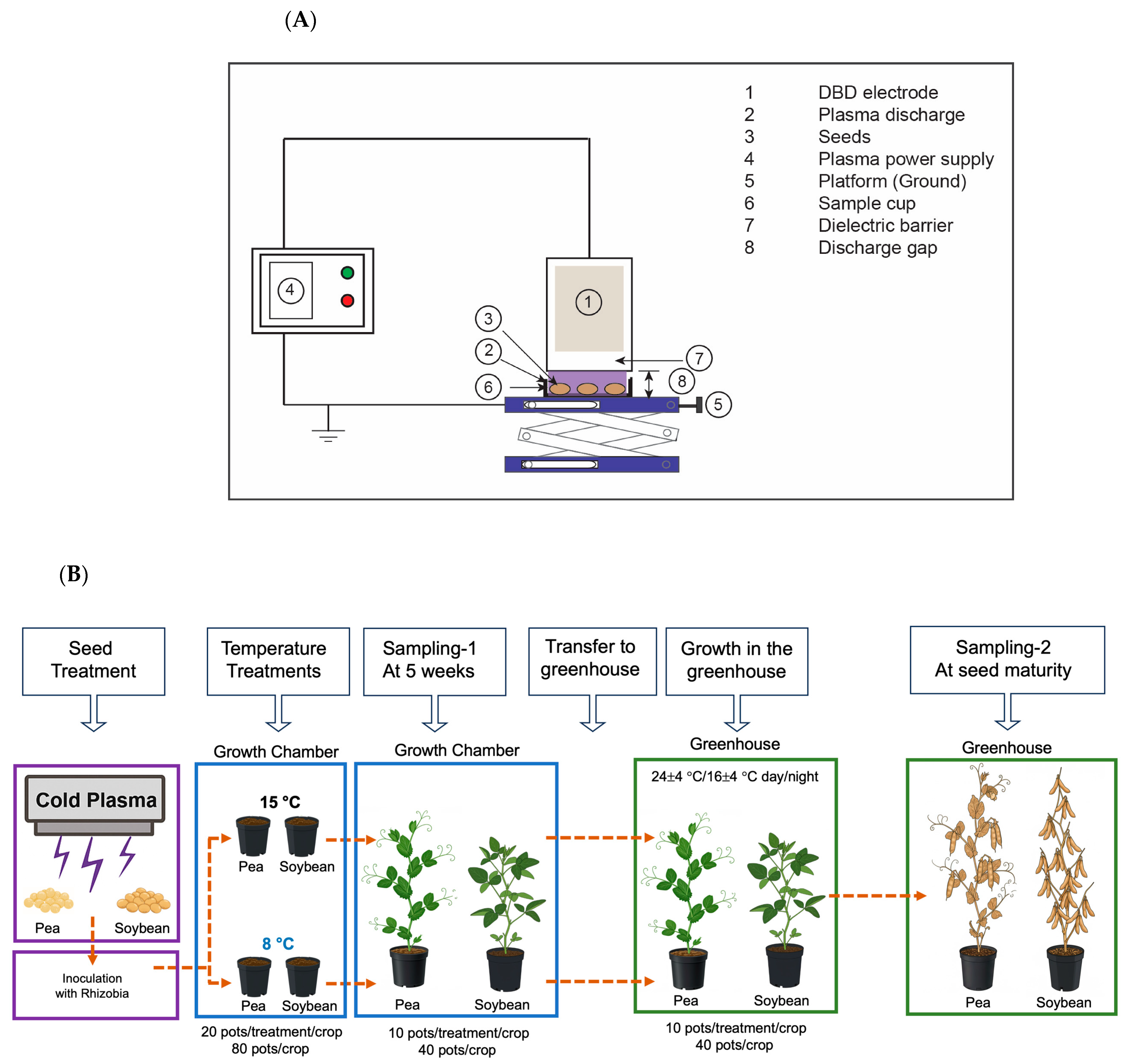
All the experiments were carried out under controlled environmental conditions at the University of Alberta, Canada. The CP seed treatment applied to field pea and soybean followed the protocol described in Abeysingha et al. [25] with slight modifications. The DBD system (Advanced Plasma Solutions in Malvern, PA, USA) consisted of a high-voltage electrode connected to a high-voltage generator (voltage: 0 to 34 kV, power: approximately 300 W) and was operated at the following parameters: an output frequency of 3.5 kHz, a duty cycle of 70%, and an output pulse width of 10 μs. A group of 10 uniformly sized seeds was placed in a Petri dish and was treated with CP for a total of 6 min (Figure 1A). To ensure even plasma exposure across the surfaces, the seeds were gently shaken for ~5 sec after the first 3 min of CP exposure. The treatment distance between the plasma source and the seeds was consistently maintained at 2–3 mm, while the distance separating the electrodes was maintained at 4–5 mm. Ambient air was used as the carrier gas.
Figure 1. Schematic diagrams of the (A) dielectric barrier discharge (DBD) plasma generation system (adapted from Abeysingha et al. 2024 [20]) and (B) experimental procedure.

2.3. Seed Inoculation

Immediately after the CP-seed treatment, the treated and non-treated seeds were planted in 3.8 L plastic pots filled with 1600 g of a 2:1 (v:v) mixture of Sunshine #4 potting mix (Sun Gro Horticulture, Abbotsford, BC, Canada) and sand (Quikrete Premium Play Sand, Target products, Abbotsford, BC, Canada). The homogeneity of the mixture was ensured by thoroughly mixing a soil mixture for ~10 min. To prevent water from leaching and to retain the filled growing medium, each pot was lined with low-density polyethylene pot liners prior to adding the soil mixture. Pea and soybean seeds were planted in pots and subsequently inoculated with 1 mL of Rhizobium leguminosarum biovar viciae 3841 and Bradyrhizobium japonicum USDA 110, respectively. The rhizobia densities were adjusted to OD600 = 0.1 prior to application [26]. Two seeds were sown in each pot, and ~ 1 week after germination, thinned to one seedling per pot.

2.4. Temperature Treatment

Similar experimental protocols were followed for both field peas and soybeans, and the experiments were carried out sequentially (Figure 1B). Two temperatures, 8 °C (cold stress temperature) and 15 °C (control temperature), were applied to both field peas and soybeans with and without the CP treatment (total number of treatments = 4). In brief, 20 pots with the planted seeds were allocated for each treatment (total number of pots/legume crop = 80). After planting the seeds, 40 pots with and without the CP treatment (20 pots/treatment) were placed in a controlled temperature growth chamber, maintaining the temperature at 8 °C. The remaining 40 pots were placed in a separate growth chamber, maintaining the temperature at 15 °C. The plants in both growth chambers were under a 16 h day-time and 8 h night-time photoperiod, and the supplemental lighting was at 250 μmol m−2s−1. All plants were fertilized twice weekly with 50 mL of quarter-strength N-free Hoagland’s nutrient solution (Caisson Labs, Smithfield, UT, USA) and were watered as required. Additionally, a non-nodulating pea [Frisson P56 (nod-) (John Innes Institute, Norwich, UK)] and soybean (non-nodulating mutant Maple Presto) were grown using the same growing media at 15 °C along with the nitrogen-fixing plants, and used as reference plants for calculating SNF. Plants were maintained in the temperature-controlled growth chambers for 5 weeks. Then, 10 pots from each treatment in each growth chamber were destructively sampled. The remaining 20 pots in each growth chamber (10 pots from each treatment) were transferred to the greenhouse, where the day-time and night-time temperatures were 24 ± 4 °C and 16 ± 4 °C, respectively, with a 16 h photoperiod and 500 μmol m−2s−1 light intensity. All plants were fertilized twice weekly with 100 mL of quarter-strength N-free Hoagland’s nutrient solution and were watered to maintain soil moisture at approximately 80% field capacity until harvested at maturity.

2.5. Evaluation of Plant Growth and Nodulation at the 5-Week Growth Stage

Plant growth and nodulation parameters, including root dry weight, root length, root surface area, root volume, shoot dry weight, nodule number, and nodule dry weight, were assessed from the plants harvested at 5 weeks after seeding (n = 10) as previously described [20]. Briefly, plants were harvested, and their roots were carefully washed to remove planting media. Cleaned root systems were scanned using an Epson Expression 1640 scanner (Epson Canada Ltd., Markham, ON, Canada), and morphological traits, including total root length, root volume, and root surface area, were quantified using WinRHIZO Pro 2022 software (Regent Instruments Inc., Québec, QC, Canada). Root nodules were manually extracted from the clean root systems and counted. Root, shoot, and nodule dry weights were measured after drying each plant material in a hot air oven at 60 °C for three days.

2.6. Evaluation of Yield Parameters at Maturity

Plants in each treatment group (n = 10) were harvested at the BBCH 89 growth stage (fully ripe: all pods dry and brown, seeds dry and hard). Pods were harvested and dried in a hot air oven at 60 °C for three days, and data on pod number, pod dry weight, seed number, and seed dry weight were recorded.

2.7. Evaluation of Seed Total Nitrogen, Carbon Isotope Discrimination (CID), and Symbiotic Nitrogen Fixation

The plant samples were processed and analyzed according to methods described previously to evaluate SNF parameters, including the seed total nitrogen, the percentage of nitrogen derived from the atmosphere (%Ndfa), and the water use efficiency by assessing carbon isotope discrimination (CID) [20]. Finely ground oven-dried tissue samples (5 mg from each replicate in each treatment) were encapsulated into tin capsules (8 mm × 5 mm, D1008, Isomass Scientific Inc., Calgary, AB, Canada) and 15N, 14N, 13C, 12C, total N%, and total C% were analyzed at the Stable Isotope Facility, Agriculture and Agri-Food Canada’s Lethbridge Research and Development Centre. The deviation between the isotopic composition of the PeeDee Belemnite (PDB, a calcareous fossil) standard and the carbon isotope of the samples was determined using the following formula [27].
δ [ ] = R p R s R s
where, Rp represents the isotopic abundance in the seed sample, and Rs represents the abundance ratio 13C/12C of the reference standard, which was based on a fossil from the Pee Dee Formation (Pee Dee Belemnite, PDB).
The carbon isotope discrimination (CID) was calculated as below:
C I D = δ a δ p 1 + δ p × 1000
where, δa refers to the atmospheric isotopic composition (approximately −8‰) and δp refers to the isotopic composition of the seed sample [27].
The percentage of nitrogen derived from the atmosphere (%Ndfa) in seeds was determined using the isotope dilution technique as shown in the formula below [28].
% N d f a = 1 a t o m %   N 15   e x c e s s N i t r o g e n   f i x i n g a t o m %   N 15   e x c e s s N i t r o g e n   n o n - f i x i n g × 100
where, ‘atom% 15N excess’ is the atom% 15N in the seed in excess of the natural abundance level (0.3663). The calculation is given below:
atom% 15N excess(seed) = atom% 15N(seed) − 0.3663
The fixed nitrogen amount in the seeds was determined based on the total aboveground nitrogen content and %Ndfa as given below:
T o t a l   n i t r o g e n   f i x e d = t o t a l   t i s s u e   n i t r o g e n   c o n t e n t × % N d f a 100

2.8. Statistical Analysis

In all experiments, the normality and homogeneity of variance for each data parameter were assessed using the Shapiro–Wilk and Levene’s tests, respectively. Data for each parameter were analyzed using a two-way analysis of variance (ANOVA) to assess the main effects of temperature and seed treatment and their interaction (temperature × seed treatment). Data were initially analyzed by fitting a full model that included both main effects and their interaction effect. When the interaction effect was not statistically significant (p > 0.05), the data were re-analyzed by fitting a ‘main effects only’ model. The type I error was maintained at 0.05. When the main effects and/or the interaction effect were significant, multiple means comparisons were conducted using Fisher’s LSD post-test. Statistical significance for all the analyses was declared at p < 0.05. All statistical analyses were performed using GraphPad Prism (Version 10, GraphPad Software LLC, Boston, MA, USA).

3. Results

3.1. Effects of Cold Stress and CP Seed Treatment on Nodulation and Plant Growth of Pea and Soybean

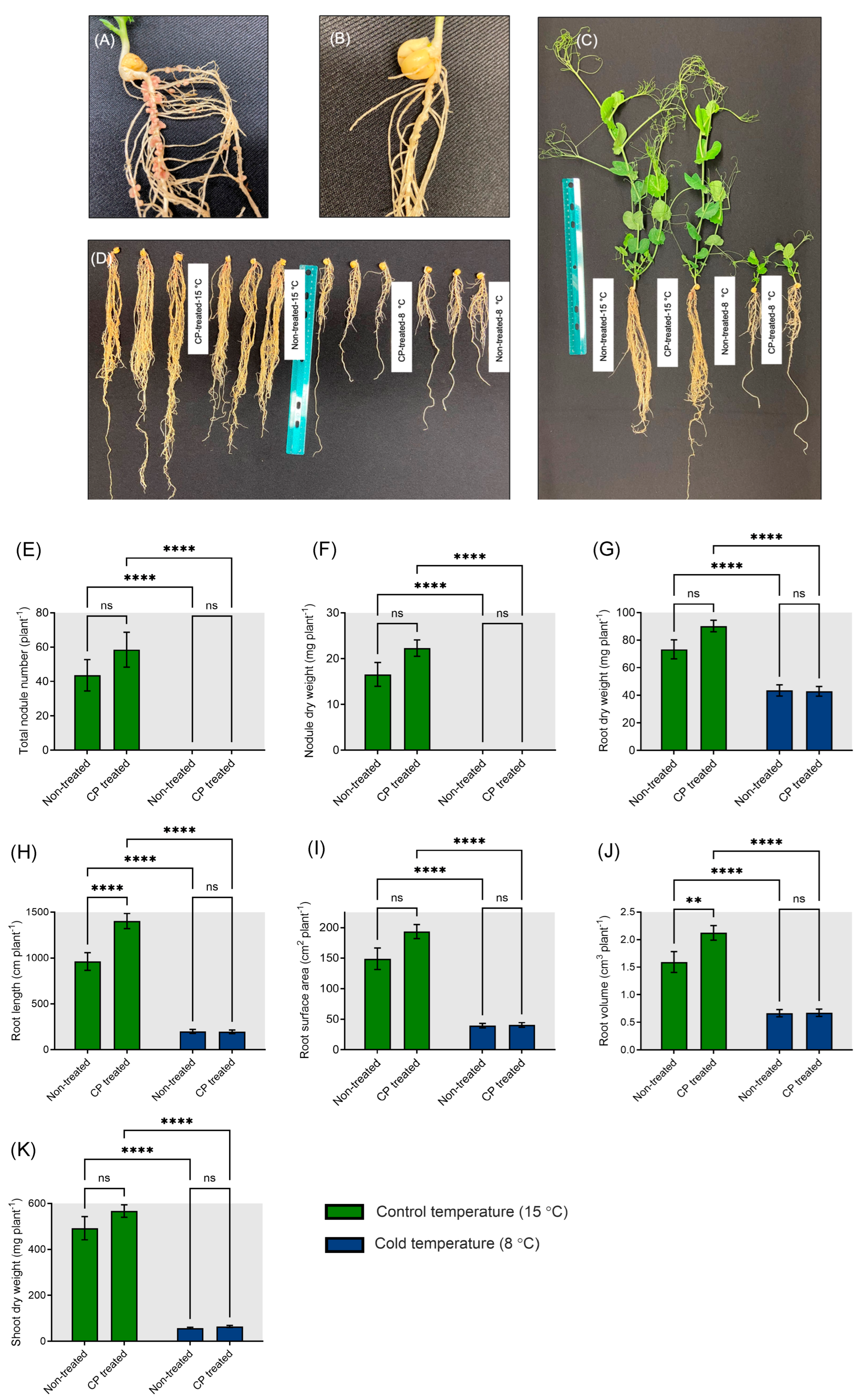
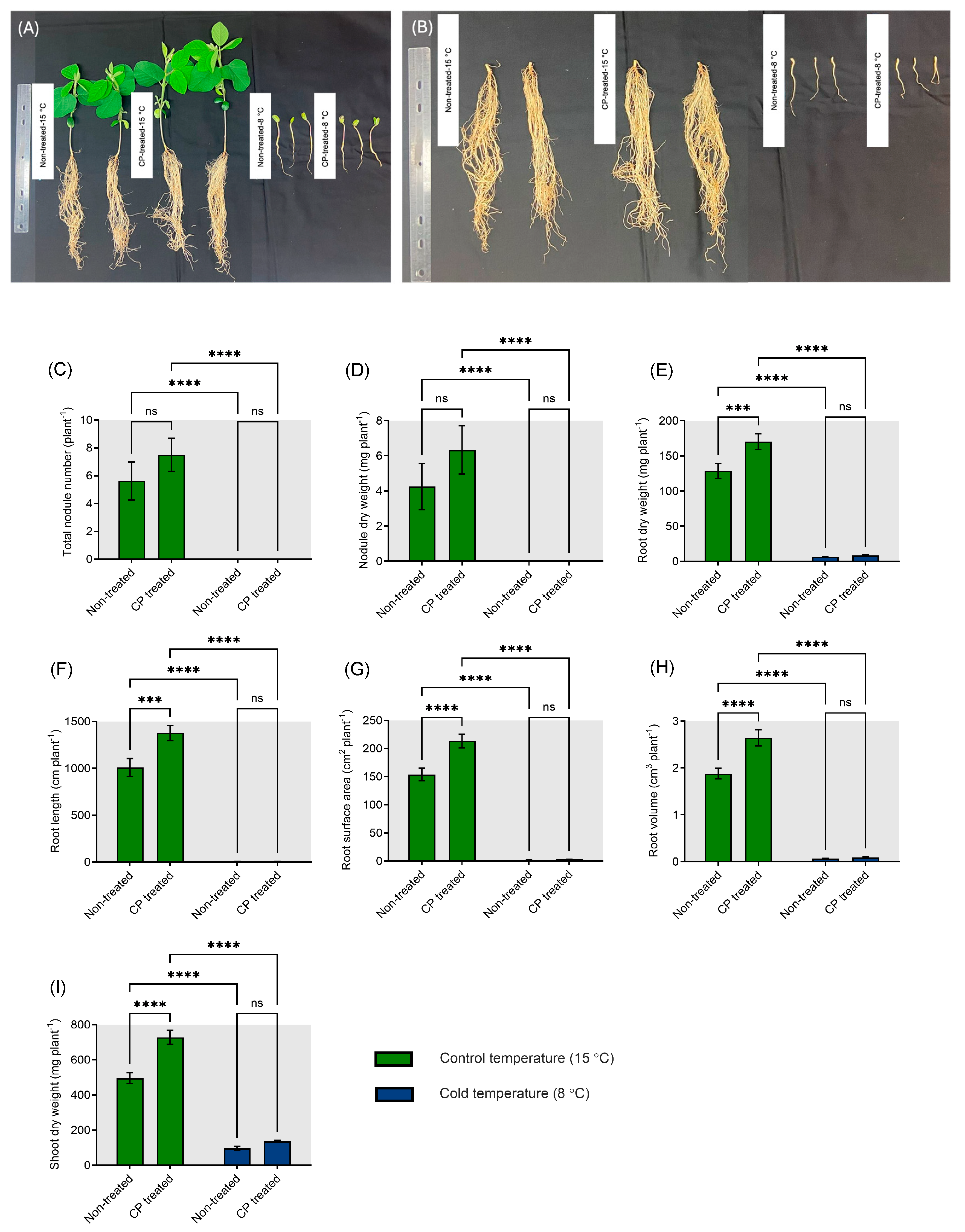
Field pea and soybean seeds treated and not treated with CP seed treatment were grown at 15 °C and 8 °C for the first 5 weeks, and the nodulation, root, and shoot growth were evaluated. The exposure to cold temperature during the early stage of plant development negatively affected the vegetative growth of pea and soybean compared to the control plants at 15 °C (Table 1 and Table 2, Figure 2). Root nodules were observed only in plants grown at 15 °C, and the plants that grew under 8 °C showed complete nodule inhibition in both crops. This led to significantly higher nodule dry weight in pea and soybean plants grown at 15 °C compared to the plants grown at 8 °C. CP seed treatment did not have a significant effect on the nodulation parameters of pea or soybean at the early growth stage (Table 1 and Table 2).
Table 1. Analysis of variance results for the effect of temperature at early growth and cold plasma seed treatment on field pea plant growth, yield, and nitrogen fixation.
Table 2. Analysis of variance results for the effect of temperature at early growth and cold plasma seed treatment on soybean plant growth, yield, and nitrogen fixation.
Figure 2. The effect of temperature during early growth and CP seed treatment on nodule and growth parameters of field pea. Parameters were measured at the 5-week seedling stage. (A) Active (pink) nodules on pea roots at 15 °C, (B) lack of active nodules in pea roots at 8 °C, (C) shoot and root growth of pea plants, (D) root growth of pea plants, (E) total nodule number per plant, (F) nodule dry weight per plant (mg), (G) root dry weight per plant (mg), (H) root length per plant (cm), (I) root surface area per plant (cm2), (J) root volume per plant (cm3), and (K) shoot dry weight per plant (mg). Significant treatment differences are denoted by an ‘*’. ** p ≤ 0.001, **** p ≤ 0.0001, ns: not significant.
In general, root growth parameters of pea plants, including root dry weight (Figure 2G), root length (Figure 2H), root surface area (Figure 2I), and root volume (Figure 2J), were reduced by ~40–80% due to cold stress. Although temperature and seed treatment independently affected pea root dry weight and root surface area (Table 1), the CP seed treatment effect was not statistically significant according to multiple means comparisons (Figure 2G, I). There was a significant interaction effect of the temperature during early growth and the seed treatment on root length and volume in field pea (Table 1). In general, pea root length and volume increased by ~46% and ~33%, respectively, in CP-treated plants at the control temperature compared to the non-treated control (Figure 2H,J). The CP treatment effect on root length or volume was not significant at the cold temperature.
The negative effect of cold stress on root growth was more pronounced in soybeans than in peas, as the soybean root dry weight (Figure 3E), root length (Figure 3F), root surface area (Figure 3G), and root volume (Figure 3H) were suppressed by >95% due to cold stress (Figure 3E–H). The interaction effect between temperature and seed treatment on all of the soybean root growth parameters was significant (Table 2). Specifically, a significant increase in the root growth parameters (root dry weight, length, surface area, volume) was observed in CP-treated soybean plants that grew at 15 °C, but not at 8 °C (Figure 3E–H).
Figure 3. The effect of temperature during early growth and CP seed treatment on nodule and growth parameters of soybean. Parameters were measured at the 5-week seedling stage. (A) Shoot and root growth of soybean plants, (B) root growth of soybean plants, (C) total nodule number per plant, (D) nodule dry weight per plant (mg), (E) root dry weight per plant (mg), (F) root length per plant (cm), (G) root surface area per plant (cm2), (H) root volume per plant (cm3), and (I) shoot dry weight per plant (mg). Significant treatment differences are denoted by an ‘*’. *** p: 0.0001–0.001, **** p ≤ 0.0001, ns: not significant.
Pea shoot growth, as indicated by the shoot dry weight, was significantly reduced due to cold stress exposure, and the CP seed treatment had no significant effect on pea shoot growth at either temperature (Table 1, Figure 2K). In contrast, a significant interaction between the temperature and seed treatment was observed for soybean shoot growth (Table 2). The cold stress significantly reduced soybean shoot growth, whereas the CP seed treatment improved shoot growth at 15 °C but not 8 °C (Figure 3I).

3.2. Effects of Cold Stress and CP Seed Treatment on Yield Parameters

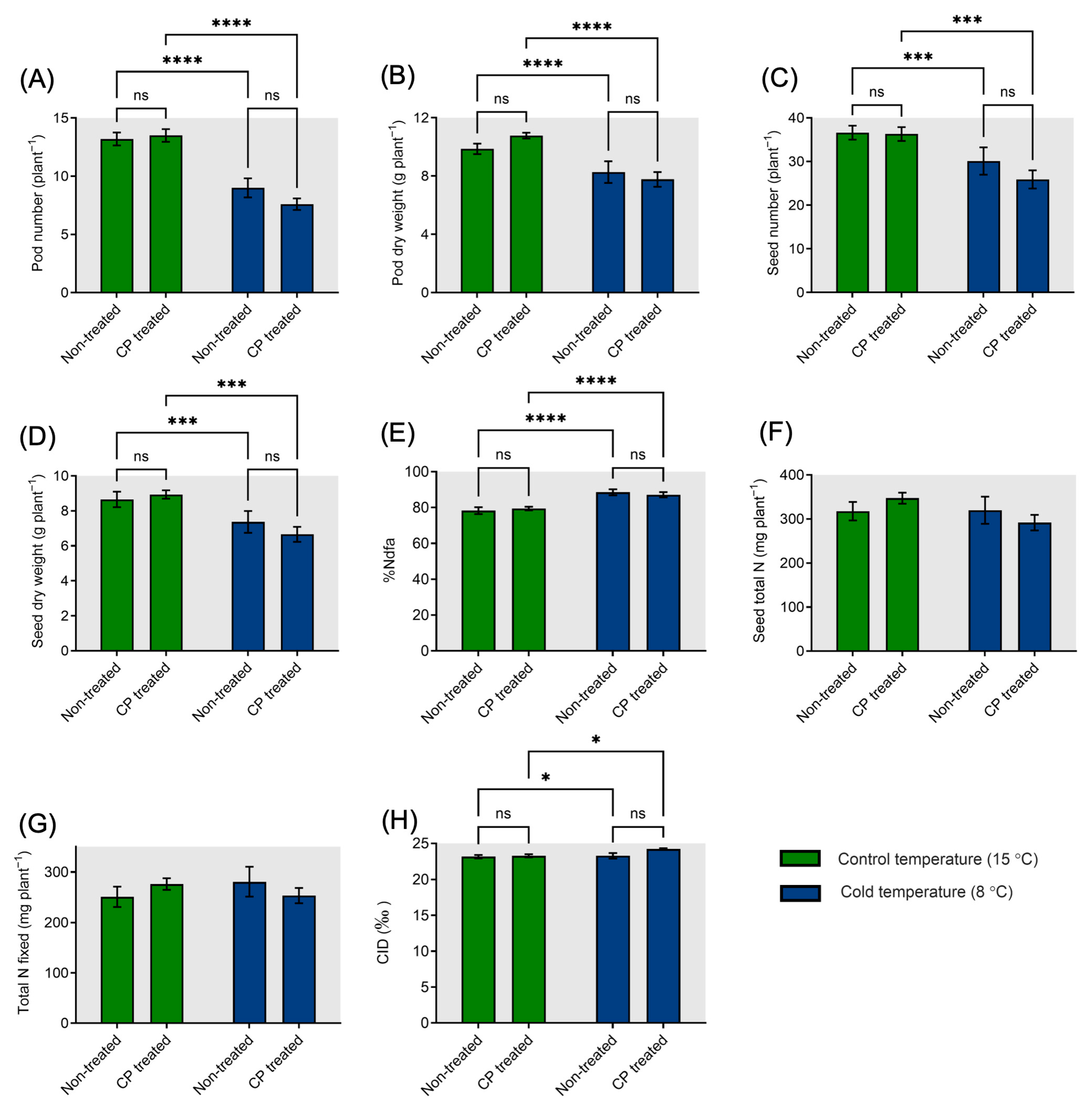
Field pea and soybean yield parameters were assessed at seed maturity. The cold stress during the early growth significantly reduced all the yield parameters in field pea (Table 1), including pod number (Figure 4A), pod dry weight (Figure 4B), seed number (Figure 4C), and seed dry weight (Figure 5D), suggesting that field pea did not completely recover from cold stress damage at early growth. The CP seed treatment had no significant effect on any of the yield parameters of field pea at either temperature (Table 1).
Figure 4. The effect of temperature during early growth and CP seed treatment on nitrogen fixation and yield parameters of field pea. All parameters were measured and analyzed at the seed maturity stage. (A) Pod number per plant, (B) pod dry weight per plant (g), (C) seed number per plant, (D) seed dry weight per plant (g), (E) percentage nitrogen derived from the atmosphere (%Ndfa), (F) seed total nitrogen per plant (mg), (G) total nitrogen fixed per plant (mg), and (H) carbon isotope discrimination (CID ‰). Significant treatment differences are denoted by an ‘*’. * p ≤ 0.05, *** p: 0.0001–0.001, **** p ≤ 0.0001, ns: not significant. Pairwise comparisons are not displayed when none of the comparisons are statistically significant.
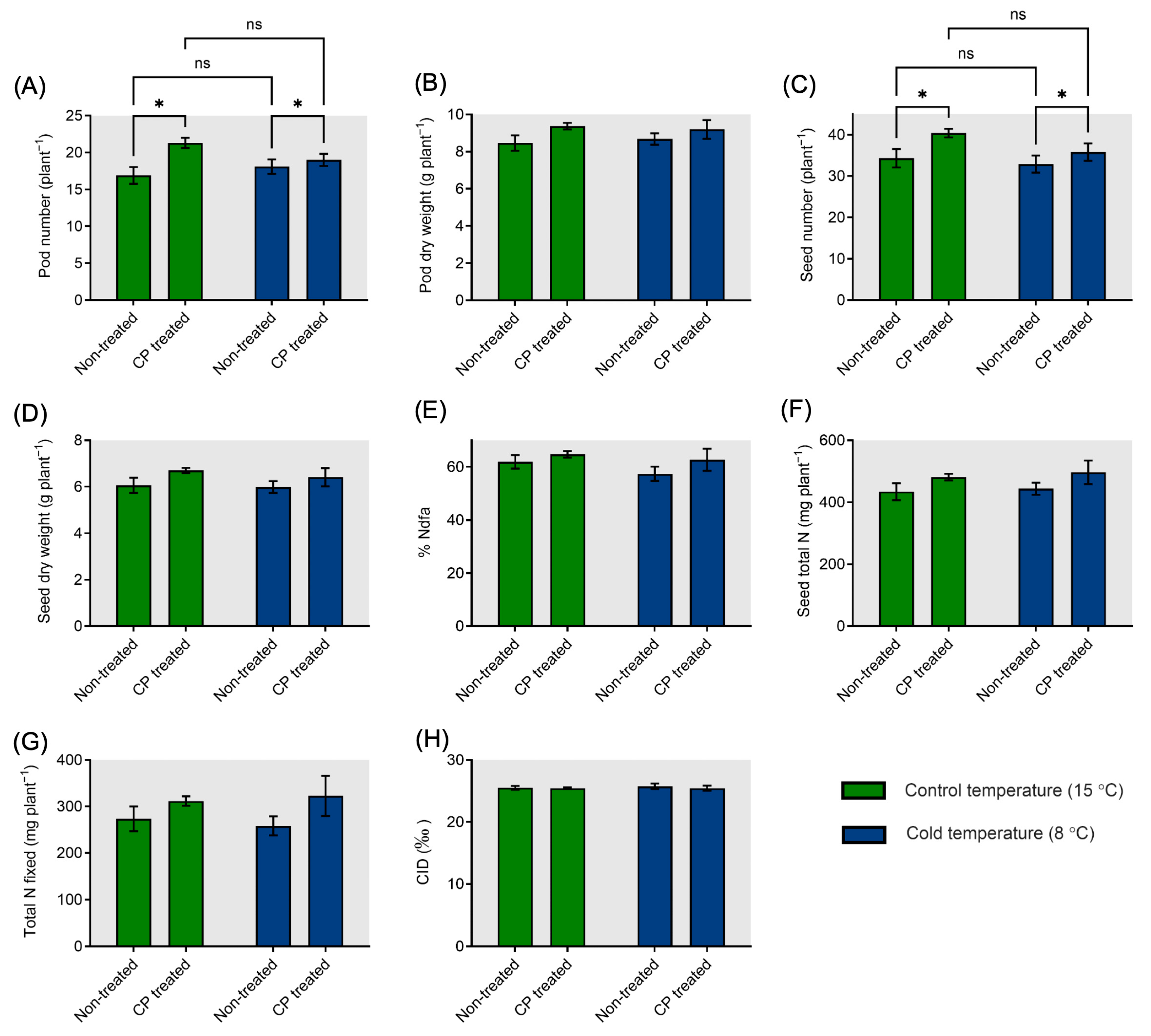
Figure 5. The effect of temperature during early growth and CP seed treatment on nitrogen fixation and yield parameters of soybean. All parameters were measured and analyzed at the seed maturity stage. (A) Pod number per plant, (B) pod dry weight per plant (g), (C) seed number per plant, (D) seed dry weight per plant (g), (E) percentage nitrogen derived from atmosphere (%Ndfa), (F) seed total nitrogen per plant (mg), (G) total nitrogen fixed per plant (mg), (H) carbon isotope discrimination (CID ‰). Significant treatment differences are denoted by an ‘*’. * p ≤ 0.05, ns: not significant. Pairwise comparisons are not displayed when none of the comparisons are statistically significant.
In contrast, the cold temperature exposure during early growth did not significantly affect the yield parameters of soybean (Table 2), indicating better recovery. The CP seed treatment significantly increased the soybean pod and seed numbers under both temperatures; however, the increments were greater at 15 °C (26% compared to non-treated) compared to 8 °C (18% compared to non-treated) (Table 2, Figure 5A,C). The growth temperature or the CP seed treatment did not significantly affect the soybean pod or seed dry weights (Table 2, Figure 5B,D).

3.3. Effects of Cold Stress and CP Seed Treatment on Nitrogen Fixation Parameters and CID at Seed Maturity

Seed total nitrogen, %Ndfa, total seed nitrogen fixed, and CID were assessed after a 5-week exposure to cold or control temperatures, followed by further plant growth under greenhouse conditions until seed maturity. The pea plants exposed to cold stress had a higher %Ndfa compared to the plants at the control temperature (Table 1, Figure 4E) (non-treated: ~13% higher at cold vs. control temperature, CP seed treated: ~10% higher at cold vs. control temperatures). However, the seed total nitrogen and the total fixed nitrogen in field pea were not affected by the cold stress (Table 1, Figure 4F,G). The CP seed treatment had no significant effect on any of the SNF-related parameters (%Ndfa, seed total nitrogen, and total fixed nitrogen) assessed in field pea (Table 1, Figure 4E–G). Both temperature and the CP seed treatment independently affected CID in field pea (Table 1). In general, CID was significantly higher in pea plants under cold stress and CP seed treatment.
Cold temperature or the CP seed treatment did not have any significant effect on %Ndfa, seed total nitrogen, total fixed nitrogen, and CID in soybean (Table 2, Figure 5E–H). However, there was a trend towards higher seed total nitrogen (Figure 5F, p = 0.0619) and total fixed nitrogen (Figure 5G, p = 0.0733) for CP-treated soybean compared to the untreated control under both cold and control temperatures.

4. Discussion

Cold temperatures are known to negatively affect the vegetative and generative development of plants [29]. Cold temperature exposure during the early growth phase can delay seed germination, increase the susceptibility to soil-borne diseases, and lead to poor crop establishment [30]. Legume root nodulation, a critical symbiotic and developmental process in legumes for nitrogen assimilation, can also be severely affected by cold soil temperatures [7,8]. In the current study, the root and shoot growth, and yield of both field pea and soybean were significantly reduced, and nodulation in both legumes was completely inhibited when exposed to 8 °C for 5 weeks after seeding. Our findings are in agreement with previous studies that reported cold soil temperatures leading to poor nodulation and SNF in legumes. Delayed nodule initiation was reported in annual legume cover crops such as crimson clover, Austrian winter pea, and hairy vetch at 5 °C compared to 10 °C, 15 °C, and 20 °C [8]. Similarly, slower root nodulation in common bean and lentil was reported at soil temperatures below 20 °C and in pea at soil temperatures below 10 °C [7]. Root nodulation was completely inhibited in common bean at 10 °C [7]. The time taken for initial nodule appearance in pea was doubled when soil temperature was 10 °C vs. ~20 °C (~30 days at 10 °C vs. ~15 days at 20 °C, respectively), and the largest pea root nodules appeared at 20 °C [7]. The poor nodulation and SNF in legumes due to cold temperature exposure have been linked to reduced root exudation of flavonoids, decreased rhizobia abundance in soil, and the reduced secretion of nod factors [31,32]. Furthermore, the cold soil temperatures reduced the activity of rhizobia strains [31], prolonged root infection [33], and impeded nodule respiration [34]. Nitrogenase enzyme activity and the production of leghaemoglobin in alfalfa root nodules were completely inhibited at a soil temperature of 8 °C [35].
We recently reported significant improvements in nodulation traits (136% increase in nodule number/plant and 140% increase in nodule dry weight/plant) after treating field pea seeds with CP and growing under greenhouse conditions [20]. Although the same CP treatment conditions were used as previously [20], a significant improvement in nodulation traits was not observed for pea or soybean in the present study. However, a trend towards an increased nodule number and dry weight for CP-treated pea and soybean at 15 °C was observed. The CP treatment conditions were not effective at improving nodulation parameters at 8 °C. On the other hand, the root and shoot growth of pea and soybean were improved after the CP seed treatment and subsequent growth at 15 °C. Similarly, enhanced growth and development after treating seeds with CP seed treatments were previously reported for field pea [20,25,36], lentils [20], and soybean [18]. The underperformance of the CP seed treatment at 8 °C is not clearly understood. It is possible that the treatment conditions were optimal for subsequent plant growth at moderate temperatures, i.e., 15–25 °C, rather than severe cold temperatures, i.e., ≤8 °C. In previous studies, the effectiveness of certain CP treatment conditions was less than anticipated, and some even had negative outcomes on the tested stress or growth responses [18,20,22]. Therefore, optimization of the CP seed treatment conditions to result in optimal cold stress responses is required in future studies.
Most plants tend to recover from less severe cold stress exposures once optimal growing temperatures are reached. Field pea and soybean plants showed contrasting and unexpected recovery patterns after transfer to greenhouse conditions. In general, all yield parameters in pea were significantly reduced after cold temperature exposure. Being a cool-season crop, this poor recovery of field pea following cold temperature exposure was unanticipated. Although the early growth of soybeans was severely affected by cold stress, the plants recovered well after the greenhouse transfer. Despite soybeans being a heat-loving crop, none of the yield parameters were affected by cold stress. These differences in cold stress responses observed for field pea and soybean may be explained by the sensitivity of early-stage rhizobia–host interactions to chilling. In pea, infection-thread formation and early nodule initiation may have been more severely impaired, while soybean, despite initial suppression of growth, could resume nodulation and symbiotic nitrogen fixation more efficiently. Consistent with our findings, previous studies have reported chilling sensitivity in pea [4]. Despite early suppression of growth and nodulation, total seed nitrogen and total fixed nitrogen at maturity were unaffected in both legume species, indicating resumption of symbiotic nitrogen fixation during recovery. The time of nodule initiation after cold stress recovery in the current study is not known, as sequential destructive sampling was not performed. This is a limitation, as the time of nodule initiation could potentially explain the observed yield responses in field pea and soybean.
The effects of CP seed treatments on abiotic stress tolerance, including drought [11,13] and salinity [11], have been demonstrated in legumes and non-legumes, yet their influence on cold tolerance remains poorly explored. Recent studies in rice [18] and tomato [17] have shown that CP seed treatment can improve cold tolerance, enhancing seedling growth and upregulating stress-related genes. To our knowledge, no prior studies have investigated CP treatments for improving cold stress resilience in legume species. The present study is, therefore, the first to report on SNF, growth, and yield responses in field pea and soybean exposed to cold stress following a CP seed treatment. Our findings indicate a consistent tendency toward greater nodulation and enhanced SNF under moderate cold conditions (e.g., 15 °C) in CP-treated seeds. These observations suggest that further optimization of the CP seed treatment is required for improved stress responses at temperatures below 15 °C.
CP seed treatment is known to induce early seed germination [16,18,37,38], which can directly relate to later plant growth and yield. Changes in the germination rate of plasma-treated seeds may result from altered water absorption, surface modifications caused by reactive species, physical energy deposition, shifts in biological processes, variations in key metabolites, protein structural changes, or stimulation of natural signaling pathways. Additionally, oxygen radicals and low-energy ion bombardment may erode the seed coat and influence germination. However, the effect of plasma treatment time on seed germination rate and other parameters is not linear, i.e., longer treatment time may not necessarily improve germination properties [37,38]. Previous studies noted that germination parameters depend on other plasma generation parameters and seed type, in addition to plasma treatment time, underscoring the need to optimize the treatments to obtain maximum germination and plant growth. Praditwanich et al. [39] reported that a one-minute short DBD plasma treatment produced considerable reactive oxygen species and increased seed surface temperature. Optical emission spectroscopy analysis confirmed the production of highly oxidative OH radicals, capable of forming hydrogen bonds, leading to surface degradation as observed by scanning electron microscopy [37,38]. Our previous studies [37,38] reported the presence of OH radicals and other reactive oxygen species, as detected by optical emission spectroscopy, which may alter the surface characteristics of the seeds. Also, it is essential to note that the DBD or corona plasma systems and the plasma treatment parameters used in the reported studies by other researchers were different from those used in the current study, which can significantly impact the comparison of the results.
Although the specific physiological mechanisms underlying legume responses to CP treatment under cold conditions remain unclear, prior studies offer potential explanations that merit further investigation. For instance, CP-induced increases in root flavonoid exudation have been shown to enhance rhizobial signaling in red clover [34], which may be relevant for nodulation under cold soil conditions. Other studies have reported increases in soluble sugars, soluble proteins, and the activity of antioxidant enzymes, including superoxide dismutase, catalase, and peroxidase, following CP treatment under low temperatures [18,32]. These compounds and enzymes are broadly recognized for their roles in osmo-protection and the mitigation of oxidative stress during cold exposure. While such mechanisms were not measured in the present study, they provide plausible hypotheses for future work aimed at clarifying the physiological basis of CP-induced cold tolerance in legumes. Further research is required to clarify these pathways and to develop practical CP-based strategies for improving cold tolerance in legume crops.

5. Conclusions

This study investigated the effect of CP seed treatment as a potential method to enhance the cold stress tolerance of field pea and soybean during the early growth by evaluating plant growth, SNF traits, and yield. Cold stress exposure during early growth significantly reduced root and shoot growth and delayed nodule formation in both pea and soybean. Being a heat-loving crop, the initial growth of soybeans was affected by cold temperatures more than that of peas. However, cold temperature exposure during early growth did not affect overall nitrogen fixation in soybean despite delayed nodule formation. The nitrogen fixation efficiency (%Ndfa) was higher in cold temperature-exposed pea plants compared to the control plants. Unexpectedly, recovery following cold stress was better in soybean compared to pea when considering the yield parameters of both plants. The CP seed treatment was effective at improving growth and nodulation under the control temperature (15 °C) but not at the cold temperature (8 °C). Further studies are warranted to understand the physiological processes involved in the recovery of these plants following cold stress and to investigate the optimal CP seed treatment conditions for achieving better SNF, growth, and yield following cold temperature exposure.

Author Contributions

Conceptualization, M.S.R. and M.S.T.; methodology, D.N.A., M.S.R., S.D. and M.S.T.; validation, D.N.A., S.H.T., M.S.R. and M.S.T.; formal analysis, D.N.A. and S.H.T.; investigation, D.N.A., M.S.R. and M.S.T.; resources, M.S.R. and M.S.T.; data curation, D.N.A.; writing—original draft preparation, S.H.T.; writing—review and editing, D.N.A., S.H.T., S.D., M.S.R. and M.S.T.; visualization, S.H.T.; supervision, M.S.R. and M.S.T.; project administration, M.S.R. and M.S.T.; funding acquisition, M.S.R. and M.S.T. All authors have read and agreed to the published version of the manuscript.

Funding

This project was supported by the New Frontiers in Research Fund grant (NFRFE-2021-00528).

Data Availability Statement

The data that support the findings of this study are available from the corresponding author upon reasonable request.

Acknowledgments

We thank Thomas Warkentin at the University of Saskatchewan, Canada, for providing pea seeds, and Parthiba Balasubramanian and Brett Hill at Lethbridge Research and Development Centre, Agriculture and Agri-Food Canada, for assistance with isotope analysis. We also thank the John Innes Centre, UK, for providing the non-nodulating pea mutant Frisson P56 seeds for this study.

Conflicts of Interest

The authors have no conflicts of interest to declare.

Abbreviations

The following abbreviations are used in this manuscript:
ANOVAAnalysis of variance
CIDCarbon isotope discrimination
CPCold plasma
NNitrogen
NdfaNitrogen derived from atmosphere
NSNot significant
SNFSymbiotic nitrogen fixation

References

  1. Bhandari, K.; Sharma, K.D.; Hanumantha Rao, B.; Siddique, K.H.M.; Gaur, P.; Agrawal, S.K.; Nair, R.M.; Nayyar, H. Temperature Sensitivity of Food Legumes: A Physiological Insight. Acta Physiol. Plant 2017, 39, 68. [Google Scholar] [CrossRef]
  2. Araújo, S.S.; Beebe, S.; Crespi, M.; Delbreil, B.; González, E.M.; Gruber, V.; Lejeune-Henaut, I.; Link, W.; Monteros, M.J.; Prats, E.; et al. Abiotic Stress Responses in Legumes: Strategies Used to Cope with Environmental Challenges. CRC Crit. Rev. Plant Sci. 2015, 34, 237–280. [Google Scholar] [CrossRef]
  3. Government of Alberta. Agri-Facts, Freezing Date Possibilities; Government of Alberta, Agriculture and Forestry: Edmonton, AB, Canada, 1998.
  4. Stoddard, F.L.; Balko, C.; Erskine, W.; Khan, H.R.; Link, W.; Sarker, A. Screening Techniques and Sources of Resistance to Abiotic Stresses in Cool-Season Food Legumes. Euphytica 2006, 147, 167–186. [Google Scholar] [CrossRef]
  5. Raveneau, M.P.; Coste, F.; Moreau-Valancogne, P.; Lejeune-Hénaut, I.; Durr, C. Pea and Bean Germination and Seedling Responses to Temperature and Water Potential. Seed Sci. Res. 2011, 21, 205–213. [Google Scholar] [CrossRef]
  6. Mylona, P.; Pawlowski, K.; Bisseling’, T. Symbiotic Nitrogen Fixation. Plant Cell 1995, 7, 869–885. [Google Scholar] [CrossRef] [PubMed]
  7. Lira Junior, M.D.A.; Lima, A.S.T.; Arruda, J.R.F.; Smith, D.L. Effect of Root Temperature on Nodule Development of Bean, Lentil and Pea. Soil Biol. Biochem. 2005, 37, 235–239. [Google Scholar] [CrossRef]
  8. Thurston, C.L.; Grossman, J.M.; Fudge, R.; Maul, J.E.; Mirsky, S.; Wiering, N. Cold Stress Reduces Nodulation and Symbiotic Nitrogen Fixation in Winter Annual Legume Cover Crops. Plant Soil 2022, 481, 661–676. [Google Scholar] [CrossRef]
  9. Szczerba, A.; Płażek, A.; Pastuszak, J.; Kopeć, P.; Hornyák, M.; Dubert, F. Effect of Low Temperature on Germination, Growth, and Seed Yield of Four Soybean (Glycine max L.) Cultivars. Agronomy 2021, 11, 800. [Google Scholar] [CrossRef]
  10. Gao, Y.; Francis, K.; Zhang, X. Review on Formation of Cold Plasma Activated Water (PAW) and the Applications in Food and Agriculture. Food Res. Int. 2022, 157, 111246. [Google Scholar] [CrossRef]
  11. Konchekov, E.M.; Gusein-zade, N.; Burmistrov, D.E.; Kolik, L.V.; Dorokhov, A.S.; Izmailov, A.Y.; Shokri, B.; Gudkov, S.V. Advancements in Plasma Agriculture: A Review of Recent Studies. Int. J. Mol. Sci. 2023, 24, 15093. [Google Scholar] [CrossRef]
  12. Ahmed, N.; Yong, L.X.; Yang, J.H.C.; Siow, K.S. Review of Non-Thermal Plasma Technology and Its Potential Impact on Food Crop Seed Types in Plasma Agriculture. Plasma Chem. Plasma Process. 2024, 45, 421–462. [Google Scholar] [CrossRef]
  13. Šerá, B.; Scholtz, V.; Jirešová, J.; Khun, J.; Julák, J.; Šerý, M. Effects of Non-Thermal Plasma Treatment on Seed Germination and Early Growth of Leguminous Plants—A Review. Plants 2021, 10, 1616. [Google Scholar] [CrossRef]
  14. Song, J.S.; Kim, S.B.; Ryu, S.; Oh, J.; Kim, D.S. Emerging Plasma Technology That Alleviates Crop Stress During the Early Growth Stages of Plants: A Review. Front. Plant Sci. 2020, 11, 988. [Google Scholar] [CrossRef]
  15. Starič, P.; Vogel-Mikuš, K.; Mozetič, M.; Junkar, I. Effects of Nonthermal Plasma on Morphology, Genetics and Physiology of Seeds: A Review. Plants 2020, 9, 1736. [Google Scholar] [CrossRef] [PubMed]
  16. Ling, L.; Jiangang, L.; Minchong, S.; Chunlei, Z.; Yuanhua, D. Cold Plasma Treatment Enhances Oilseed Rape Seed Germination under Drought Stress. Sci. Rep. 2015, 5, 13033. [Google Scholar] [CrossRef]
  17. Li, K.; Zhong, C.; Shi, Q.; Bi, H.; Gong, B. Cold Plasma Seed Treatment Improves Chilling Resistance of Tomato Plants through Hydrogen Peroxide and Abscisic Acid Signaling Pathway. Free Radic. Biol. Med. 2021, 172, 286–297. [Google Scholar] [CrossRef]
  18. Li, L.; Jiang, J.; Li, J.; Shen, M.; He, X.; Shao, H.; Dong, Y. Effects of Cold Plasma Treatment on Seed Germination and Seedling Growth of Soybean. Sci. Rep. 2014, 4, 5859. [Google Scholar] [CrossRef]
  19. Abeysingha, D.N.; Dhaliwal, H.K.; Du, L.; De Silva, C.; Szczyglowski, K.; Roopesh, M.S.; Thilakarathna, M.S. The Potential of Cold Plasma-Based Seed Treatments in Legume–Rhizobia Symbiotic Nitrogen Fixation: A Review. Crops 2024, 4, 95–114. [Google Scholar] [CrossRef]
  20. Abeysingha, D.N.; Dinesh, S.; Roopesh, M.S.; Warkentin, T.D.; Thilakarathna, M.S. The Effect of Cold Plasma Seed Treatments on Nodulation and Plant Growth in Pea (Pisum sativum) and Lentil (Lens culinaris). Plasma Process. Polym. 2024, 21, 2400015. [Google Scholar] [CrossRef]
  21. Mildaziene, V.; Ivankov, A.; Pauzaite, G.; Naucienė, Z.; Zukiene, R.; Degutyte-Fomins, L.; Pukalskas, A.; Venskutonis, P.R.; Filatova, I.; Lyushkevich, V. Seed Treatment with Cold Plasma and Electromagnetic Field Induces Changes in Red Clover Root Growth Dynamics, Flavonoid Exudation, and Activates Nodulation. Plasma Process. Polym. 2020, 18, 2000160. [Google Scholar] [CrossRef]
  22. Bian, J.Y.; Guo, X.Y.; Lee, D.H.; Sun, X.R.; Liu, L.S.; Shao, K.; Liu, K.; Sun, H.N.; Kwon, T. Non-Thermal Plasma Enhances Rice Seed Germination, Seedling Development, and Root Growth under Low-Temperature Stress. Appl. Biol. Chem. 2024, 67, 2. [Google Scholar] [CrossRef]
  23. Warkentin, T.; Vandenberg, A.; Tar’an, B.; Banniza, S.; Barlow, B.; Ife, S. CDC Meadow Field Pea. Can. J. Plant Sci. 2007, 87, 909–910. [Google Scholar] [CrossRef]
  24. Agricultural Institute of Canada. Maple Presto Soybeans. Can. J. Plant Sci. 1982, 62, 501–503. [Google Scholar] [CrossRef]
  25. Abeysingha, D.N.; Dinesh, S.; Kottage, S.M.; Chen, L.; Roopesh, M.S.; Thilakarathna, M.S. Effects of Cold Plasma Seed Treatment on Pea (Pisum sativum L.) Plant Performance under Drought and Well-Watered Conditions. PLoS ONE 2025, 20, e0322108. [Google Scholar] [CrossRef]
  26. Thilakarathna, M.S.; Raizada, M.N. A Meta-Analysis of the Effectiveness of Diverse Rhizobia Inoculants on Soybean Traits under Field Conditions. Soil. Biol. Biochem. 2017, 105, 177–196. [Google Scholar] [CrossRef]
  27. Mutanda, M.; Chaplot, V.; Shimelis, H.; Shamuyarira, K.W.; Figlan, S. Determinants of the Accuracy of Using Carbon Isotopes in Estimating Water Use Efficiency of Selected Cereal and Legume Crops: A Global Perspective. Food Energy Secur. 2024, 13, e522. [Google Scholar] [CrossRef]
  28. Thilakarathna, M.S.; Torkamaneh, D.; Bruce, R.W.; Rajcan, I.; Chu, G.; Grainger, C.M.; Szczyglowski, K.; Hill, B.; Raizada, M.N. Testing Whether Pre-Pod-Fill Symbiotic Nitrogen Fixation in Soybean Is Subject to Drift or Selection Over 100 Years of Soybean Breeding. Front. Agron. 2021, 3, 725813. [Google Scholar] [CrossRef]
  29. Płażek, A.; Dubert, F.; Kopeć, P.; Dziurka, M.; Kalandyk, A.; Pastuszak, J.; Waligórski, P.; Wolko, B. Long-Term Effects of Cold on Growth, Development and Yield of Narrow-Leaf Lupine May Be Alleviated by Seed Hydropriming or Butenolide. Int. J. Mol. Sci. 2018, 19, 2416. [Google Scholar] [CrossRef] [PubMed]
  30. Bhat, K.A.; Mahajan, R.; Pakhtoon, M.M.; Urwat, U.; Bashir, Z.; Shah, A.A.; Agrawal, A.; Bhat, B.; Sofi, P.A.; Masi, A.; et al. Low Temperature Stress Tolerance: An Insight Into the Omics Approaches for Legume Crops. Front. Plant Sci. 2022, 13, 888710. [Google Scholar] [CrossRef]
  31. Duzan, H.M.; Mabood, F.; Souleimanov, A.; Smith, D.L. Nod Bj-V (C18:1, MeFuc) Production by Bradyrhizobium Japonicum (USDA110, 532C) at Suboptimal Growth Temperatures. J. Plant Physiol. 2006, 163, 107–111. [Google Scholar] [CrossRef]
  32. Lira, M.A.; Nascimento, L.R.S.; Fracetto, G.G.M. Legume-Rhizobia Signal Exchange: Promiscuity and Environmental Effects. Front. Microbiol. 2015, 6, 945. [Google Scholar] [CrossRef]
  33. Drouin, P.; Prévost, D.; Antoun, H. Physiological Adaptation to Low Temperatures of Strains of Rhizobium Leguminosarum Bv. Viciae Associated with Lathyrus Spp.1. FEMS Microbiol. Ecol. 2000, 32, 111–120. [Google Scholar] [CrossRef]
  34. Van Heerden, P.D.R.; Kiddle, G.; Pellny, T.K.; Mokwala, P.W.; Jordaan, A.; Strauss, A.J.; De Beer, M.; Schlüter, U.; Kunert, K.J.; Foyer, C.H. Regulation of Respiration and the Oxygen Diffusion Barrier in Soybean Protect Symbiotic Nitrogen Fixation from Chilling-Induced Inhibition and Shoots from Premature Senescence. Plant Physiol. 2008, 148, 316–327. [Google Scholar] [CrossRef] [PubMed]
  35. Rice, W.A.; Olsen, P.E. Root-Temperature Effects on Competition for Nodule Occupancy between Two Rhizobium Meliloti Strains. Biol. Fertil. Soils 1988, 6, 137–140. [Google Scholar] [CrossRef]
  36. Khatami, S.; Ahmadinia, A. Increased Germination and Growth Rates of Pea and Zucchini Seed by FSG Plasma. J. Theor. Appl. Phys. 2018, 12, 33–38. [Google Scholar] [CrossRef]
  37. Iqdiam, B.M.; Feizollahi, E.; Arif, M.F.; Jeganathan, B.; Vasanthan, T.; Thilakarathna, M.S.; Roopesh, M.S. Reduction of T-2 and HT-2 Mycotoxins by Atmospheric Cold Plasma and Its Impact on Quality Changes and Germination of Wheat Grains. J. Food Sci. 2021, 86, 1354–1371. [Google Scholar] [CrossRef]
  38. Feizollahi, E.; Iqdiam, B.; Vasanthan, T.; Thilakarathna, M.S.; Roopesh, M.S. Effects of Atmospheric-Pressure Cold Plasma Treatment on Deoxynivalenol Degradation, Quality Parameters, and Germination of Barley Grains. Appl. Sci. 2020, 10, 3530. [Google Scholar] [CrossRef]
  39. Praditwanich, J.; Chimupala, Y.; Thapanapongworakul, P.; Sawangrat, C.; Boonyawan, D.; Sawadeemit, C.; Thanapornpoonpong, S.N. Improving Rice Seed Quality Through the Combined Application of DBD Plasma and CuO NPs. Agriculture 2025, 15, 2280. [Google Scholar] [CrossRef]
Disclaimer/Publisher’s Note: The statements, opinions and data contained in all publications are solely those of the individual author(s) and contributor(s) and not of MDPI and/or the editor(s). MDPI and/or the editor(s) disclaim responsibility for any injury to people or property resulting from any ideas, methods, instructions or products referred to in the content.

Article Metrics

Citations

Article Access Statistics

Multiple requests from the same IP address are counted as one view.