Optimal Design of Highway Traffic Counting Stations for OD Matrix Estimation: A Case Study in Thailand


Abstract
1. Introduction
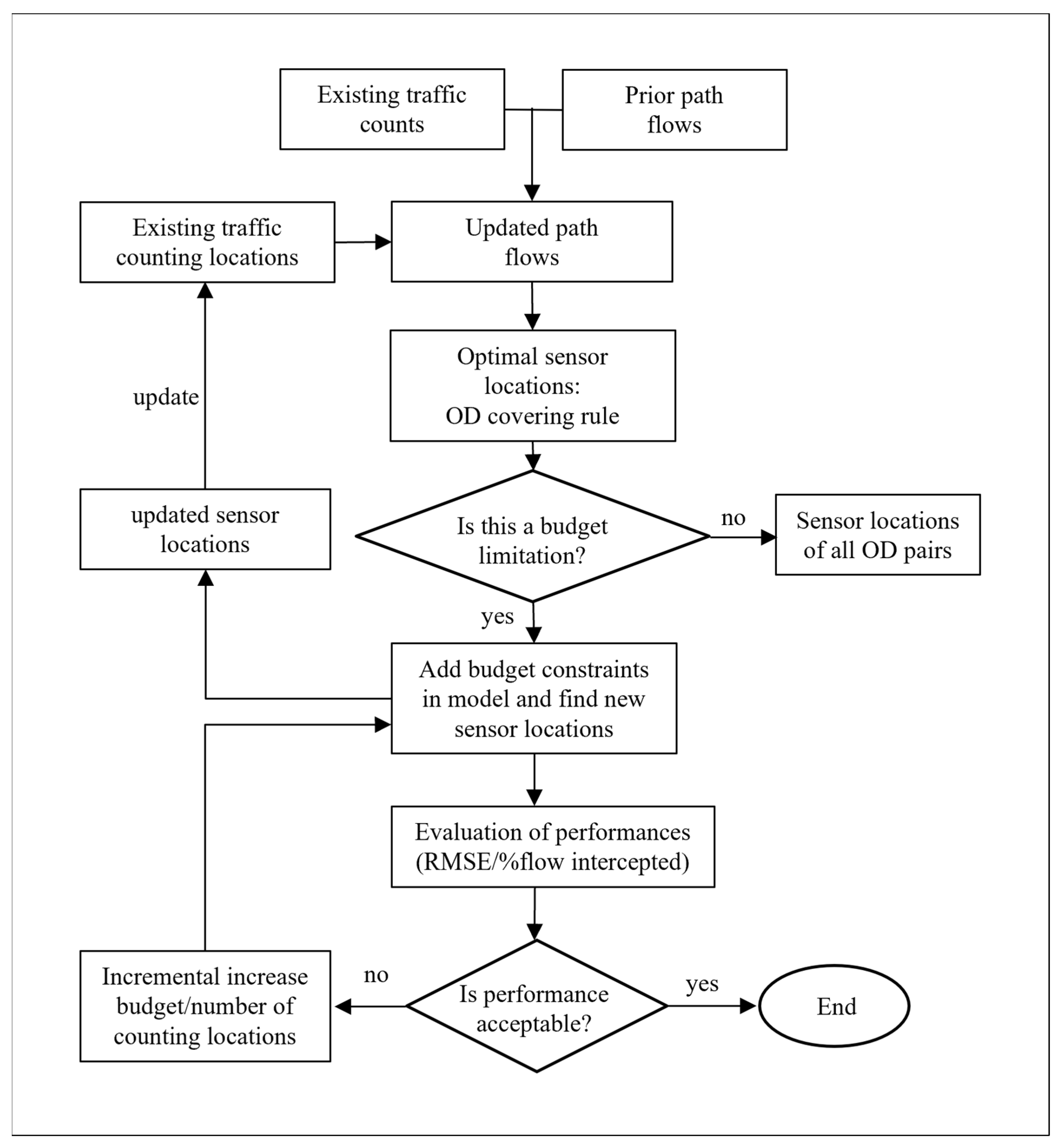
- OD covering flow rule—Link counting locations on a road network should be located so that a certain portion of trips between any OD pair will be observed.
- Maximal flow fraction rule—Under a certain number of OD pairs, chosen links should maximize the summation of the traffic flows on these links.
- Maximal flow-intercepting rule—For all OD pairs, the traffic counting locations should be located at the links so that the flow proportions in each OD pair are as large as possible.
- Link independency rule—The link counting locations should be located on the network so that all chosen links are linearly independent.
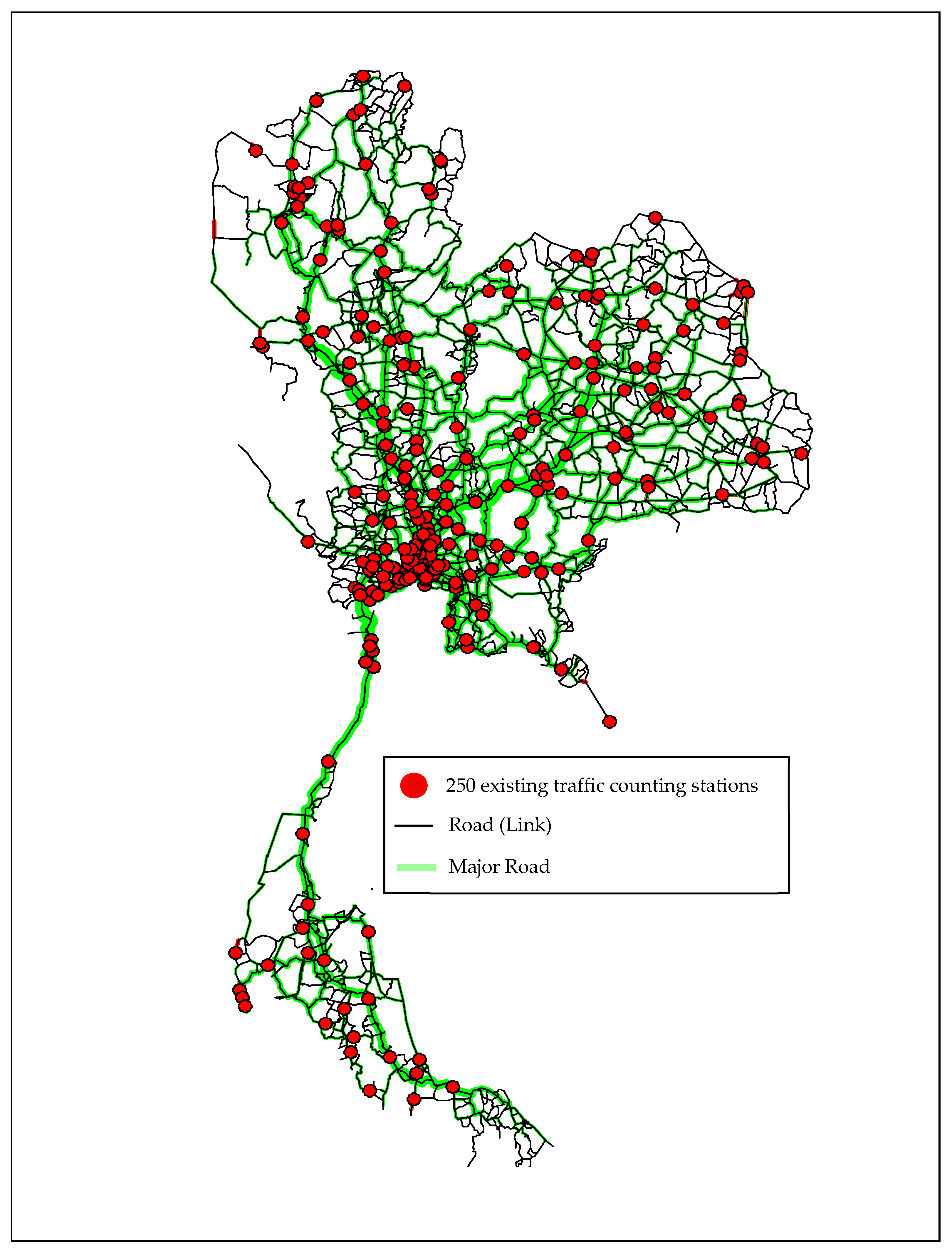
- Practical Integration of Infrastructure: Unlike existing models based on a clean-slate approach, the proposed BIP-4 model explicitly incorporates the existing 250 permanent microwave radar stations, providing a realistic incremental investment strategy for transport authorities. This integration ensures that the resulting sensor network is operationally feasible and fully aligned with the current physical constraints of the national highway system.
- Methodological Scalability: A robust Mixed-Integer Linear Programming (MILP) framework that handles large-scale networks (over 13,000 links and 10,000 OD pairs) is developed. As summarized in Table 1, most studies focus on small networks; this study is one of the few that tackle a real-world national network such as Thailand’s.
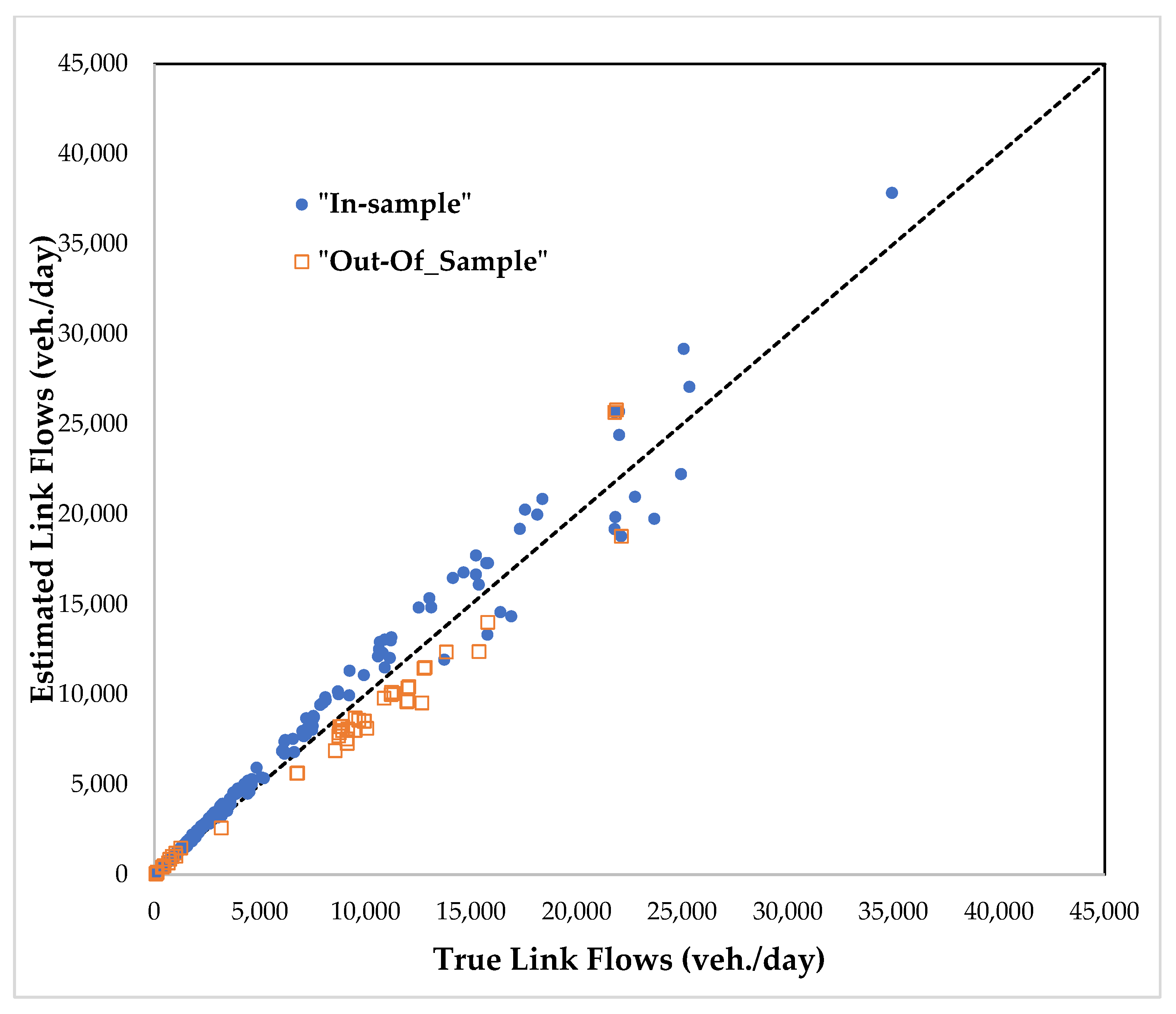
- Multi-Dimensional Validation: Beyond mathematical optimization, this study provides a comprehensive validation of the results across spatial distribution, functional road classification, traffic characteristics, and traffic measurement errors, ensuring that the selected locations are statistically representative of the entire national system. The robustness of the selected sites is further confirmed through sensitivity analysis and out-of-sample “blind tests,” demonstrating that the model maintains high predictive accuracy (R-squared of 0.95) at unobserved locations.
2. Route Flow Estimations Based on Traffic Counts
3. Design Scheme for Optimal Traffic Counting Locations
3.1. No Budget Limitations
3.2. Budget Limitations
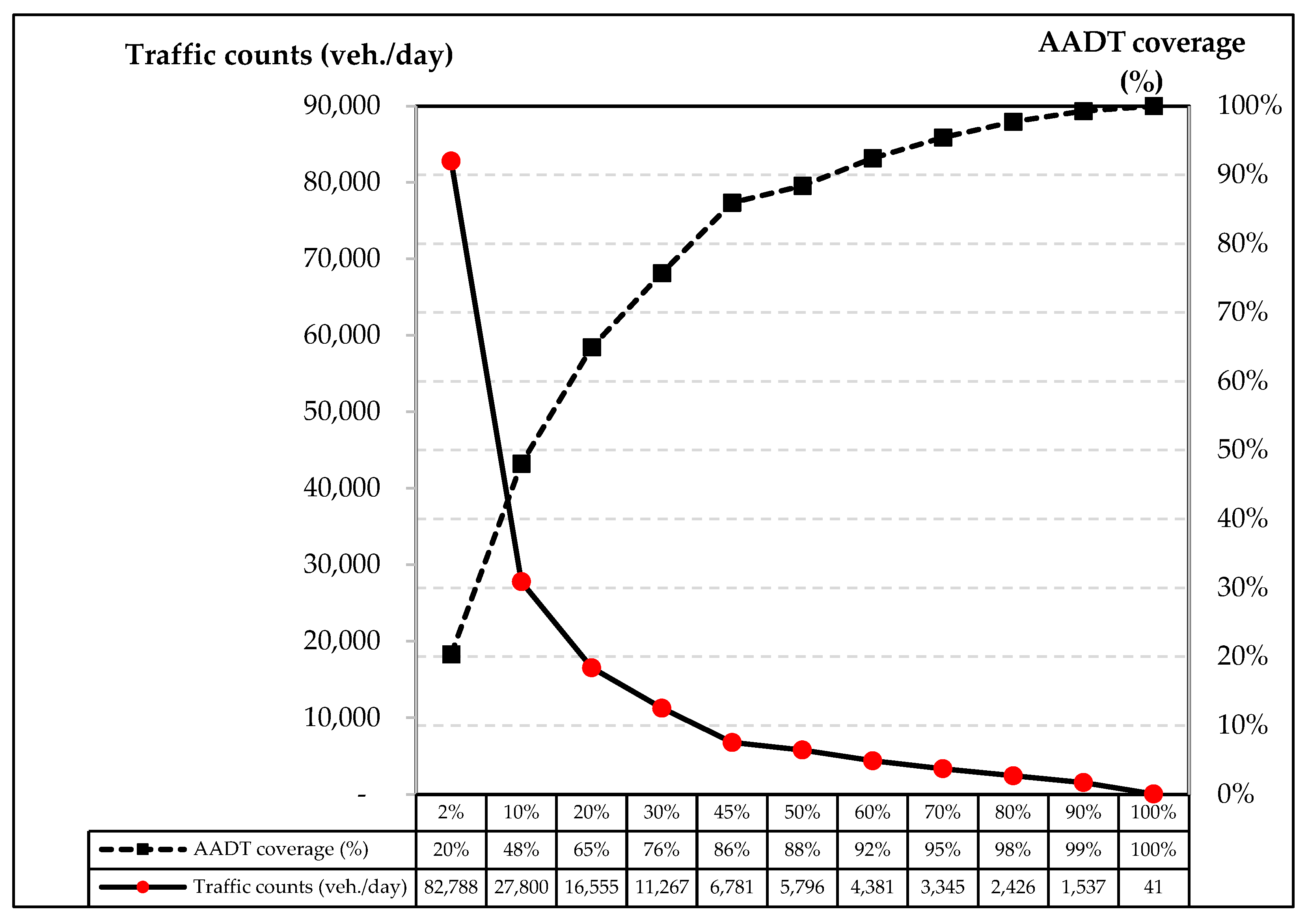
4. Empirical Example
Performance Evaluation
5. Empirical Results and Discussion
5.1. Comparison with Benchmark Methods
Sufficiency of Comparison Methods
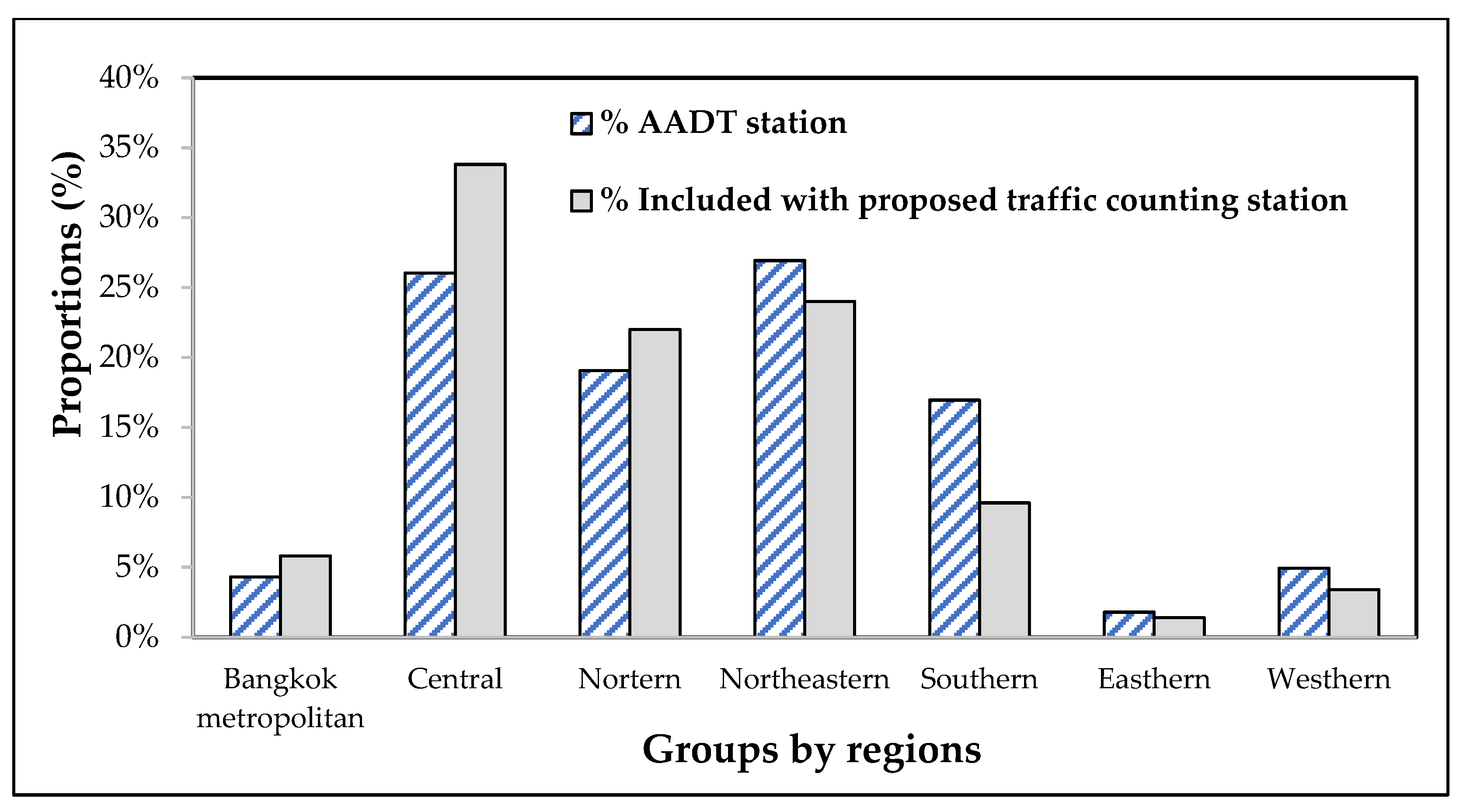
5.2. Representativeness of Spatial Distribution
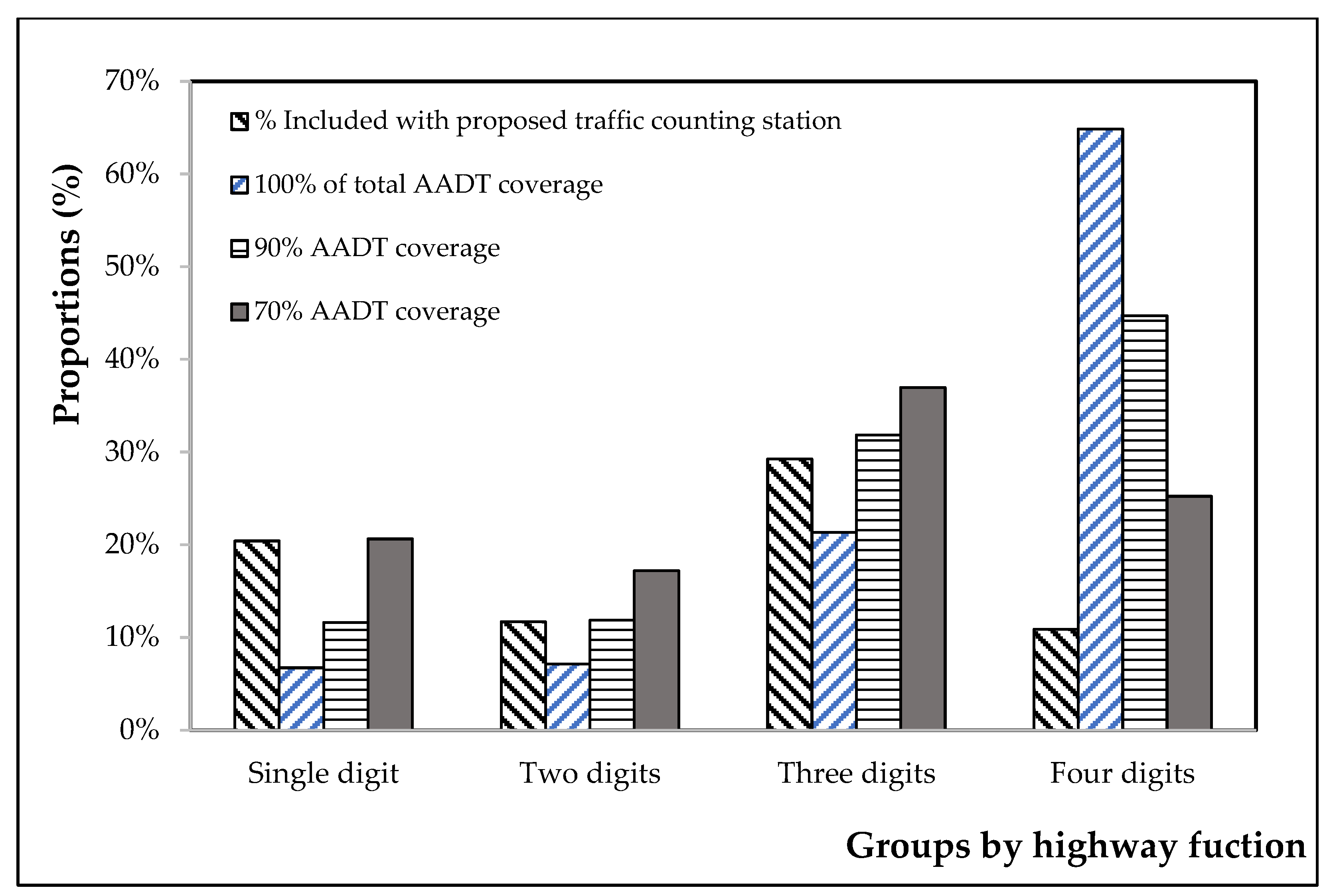
5.3. Representativeness of Highway Function
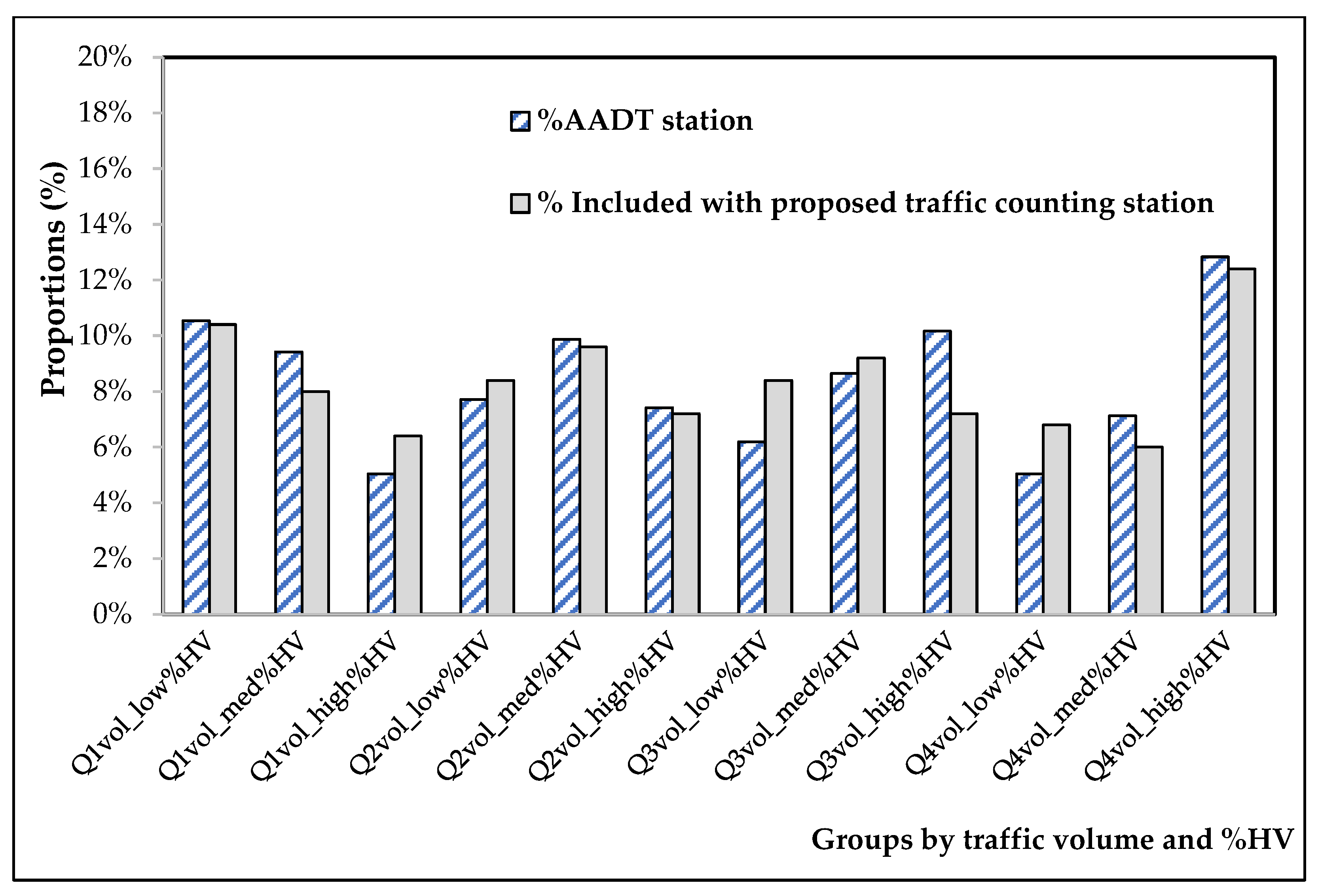
5.4. Representativeness of Traffic Characteristics
5.5. Sensitivity and Robustness Analysis
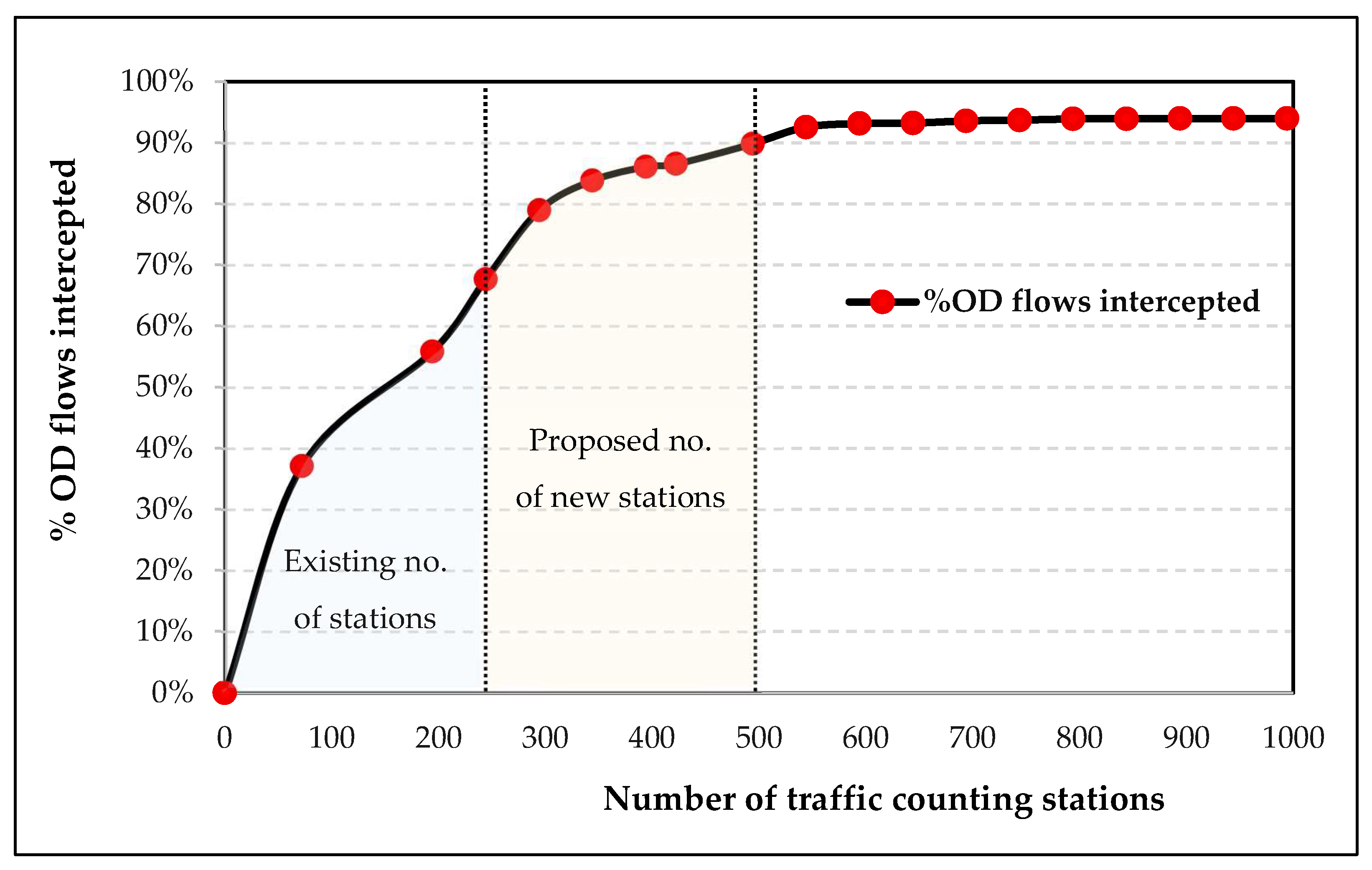
- Measurement Noise: We introduced stochastic errors (varying levels of Gaussian noise) ranging from 2% to 15% into the observed link flows. The statistical results (in Table 6) indicate that the MAPE and NMAE increased by only 5.1% and 4.2%, respectively, under a 10% noise level, suggesting that the maximization of OD flow interception (93%) provides a sufficient data cushion to mitigate localized sensor inaccuracies.
- Prior Matrix Reliability: When perturbing the prior OD matrix by ±20%, over 85% of the optimal sensor locations are observed to remain consistent. These results (in Table 7) confirm that the framework identifies strategic “critical links” based on network topology and major flow corridors rather than being overly sensitive to minor fluctuations in prior demand estimates.
5.6. Out-of-Sample Validation
5.6.1. Validation Design
- Training set (80%): Here, 200 stations were used within the BIP-4 optimization framework to determine the optimal placement of the 250 new additional sensors.
- Validation set (20%): Here, 50 stations were completely excluded from the optimization process. These “unobserved” points served as the ground truth to evaluate how well the estimated OD matrix (derived from the training set and new optimized locations) could predict flows at independent locations.
5.6.2. Validation Results
- Scenario 1: Traffic counts and prior OD flows with no perturbations.
- Scenario 2: Both traffic counts and prior OD flows contain 10% noise.
6. Conclusions
- Robustness to Data Inconsistencies: The sensitivity analysis confirms that the framework is resilient to practical uncertainties. Even with a 10% Gaussian noise level in traffic counts, the estimation errors (MAPE and NMAE) only marginally increased (5.1% and 4.2%, respectively). Furthermore, the stability of the selected “critical links” remained high (over 85% consistency) despite significant perturbations in the prior OD matrix, proving that the model identifies strategic locations based on network topology rather than being sensitive to minor data fluctuations.
- High Generalizability Through Out-of-Sample Validation: The robust “blind test” validation proves that the model does not simply “overfit” to known sensor locations. The results demonstrate that the estimated OD matrix can accurately predict traffic flows at unobserved independent locations, maintaining an NMAE under 15% even in scenarios with 10% noise. This small performance gap between in-sample and out-of-sample data provides strong empirical evidence that the optimized configuration offers sufficient spatial coverage to infer traffic patterns across the entire national highway network.
- Information Efficiency: The study proves that strategic sensor placement based on network observability is far superior to traditional high-volume-based selection.
- Resource Optimization: The BIP-4 model offers a practical tool for incremental budget allocation, allowing authorities to expand their monitoring capabilities systematically.
- Representativeness: The optimized locations maintain high goodness of fit across regional, functional, and traffic-weighted dimensions, ensuring that the collected data is not biased toward specific road types.
7. Policy Implications and Future Research
Author Contributions
Funding
Institutional Review Board Statement
Informed Consent Statement
Data Availability Statement
Acknowledgments
Conflicts of Interest
Abbreviations
| AADT | Annual average daily traffic |
| GPS | Global positioning system |
| LC | Link count survey |
| MAPE | Absolute percentage error |
| MILP | Mixed-integer linear programming |
| NMAE | Normalized mean absolute error |
| OD | Origin–destination |
| PS | License plate recognition/scanning survey |
| RMSE | Root mean square error |
| SUE | Stochastic user equilibrium |
References
- Bianco, L.; Confessore, G.; Reverberi, P. A Network Based Model for Traffic Sensor Location with Implications on O/D Matrix Estimates. Transp. Sci. 2001, 35, 50–60. [Google Scholar] [CrossRef]
- Yang, H.; Zhou, J. Optimal Traffic Counting Locations for Origin–Destination Matrix Estimation. Transp. Res. Part B Methodol. 1998, 32, 109–126. [Google Scholar] [CrossRef]
- Chen, A.; Pravinvongvuth, S.; Chootinan, P.; Lee, M.; Recker, W. Strategies for Selecting Additional Traffic Counts for Improving O-D Trip Table Estimation. Transportmetrica 2007, 3, 191–211. [Google Scholar] [CrossRef]
- Chootinan, P.; Chen, A.; Yang, H. A Bi-Objective Traffic Counting Location Problem for Origin-Destination Trip Table Estimation. Transportmetrica 2005, 1, 65–80. [Google Scholar] [CrossRef]
- Oh, J.H. Estimation of Trip Matrics from Traffic Counts: An Equilibrium Approach. Ph.D. Thesis, Transport Studies Group, University College London, London, UK, 1991. [Google Scholar]
- Gan, L.; Yang, H.; Wong, S.C. Traffic Counting Location and Error Bound in Origin-Destination Matrix Estimation Problems. J. Transp. Eng. 2005, 131, 524–534. [Google Scholar] [CrossRef]
- Gentili, M.; Mirchandani, P.B. Locating Active Sensors on Traffic Networks. Ann. Oper. Res. 2005, 136, 229–257. [Google Scholar] [CrossRef]
- Gentili, M.; Mirchandani, P.B. Locating Sensors on Traffic Networks: Models, Challenges and Research Opportunities. Transp. Res. Part C Emerg. Technol. 2012, 24, 227–255. [Google Scholar] [CrossRef]
- Salari, M.; Kattan, L.; Lam, W.H.K.; Lo, H.P.; Esfeh, M.A. Optimization of Traffic Sensor Location for Complete Link Flow Observability in Traffic Network Considering Sensor Failure. Transp. Res. Part B Methodol. 2019, 121, 216–251. [Google Scholar] [CrossRef]
- Shao, M.; Xie, C.; Sun, L. Optimization of Network Sensor Location for Full Link Flow Observability Considering Sensor Measurement Error. Transp. Res. Part C Emerg. Technol. 2021, 133, 103460. [Google Scholar] [CrossRef]
- Simonelli, F.; Marzano, V.; Papola, A.; Vitiello, I. A Network Sensor Location Procedure Accounting for o–d Matrix Estimate Variability. Transp. Res. Part B Methodol. 2012, 46, 1624–1638. [Google Scholar] [CrossRef]
- Castillo, E.; Gallego, I.; Sanchez-Cambronero, S.; Rivas, A. Matrix Tools for General Observability Analysis in Traffic Networks. IEEE Trans. Intell. Transp. Syst. 2010, 11, 799–813. [Google Scholar] [CrossRef]
- Yim, P.K.N.; Lam, W.H.K. Evaluation of Count Location Selection Methods for Estimation of O-D Matrices. J. Transp. Eng. 1998, 124, 376–383. [Google Scholar] [CrossRef]
- Cipriani, E.; Fusco, G.; Gori, S.; Petrelli, M. Heuristic Methods for the Optimal Location of Road Traffic Monitoring. In Proceedings of the 2006 IEEE Intelligent Transportation Systems Conference, Toronto, ON, Canada, 17–20 September 2006; IEEE: New York, NY, USA, 2006. [Google Scholar]
- Burgalat, J.; Pallares, G.; Foucras, M.; Dupuis, Y. A Literature Review of Public Transport OD Matrix Estimation. Future Transp. 2026, 6, 45. [Google Scholar] [CrossRef]
- Krishnakumari, P.; van Lint, H.; Djukic, T.; Cats, O. A Data Driven Method for OD Matrix Estimation. Transp. Res. Part C Emerg. Technol. 2020, 113, 38–56. [Google Scholar] [CrossRef]
- Sherali, H.D.; Sivanandan, R.; Hobeika, A.G. A Linear Programming Approach for Synthesizing Origin-Destination Trip Tables from Link Traffic Volumes. Transp. Res. Part B Methodol. 1994, 28, 213–233. [Google Scholar] [CrossRef]
- Abrahamsson, T. Estimation of Origin-Destination Matrices Using Traffic Counts—A Literature Survey; IIASA: Laxenburg, Austria, 1998; pp. 1–27. [Google Scholar]
- Bera, S.; Rao, K.V.K. Estimation of Origin-Destination Matrix from Traffic Counts: The State of the Art. Eur. Transp. Trasp. Eur. 2011, 49, 2–23. [Google Scholar]
- Yang, H.; Yang, C.; Gan, L. Models and Algorithms for the Screen Line-Based Traffic-Counting Location Problems. Comput. Oper. Res. 2006, 33, 836–858. [Google Scholar] [CrossRef]
- Ehlert, A.; Bell, M.G.H.; Grosso, S. The Optimisation of Traffic Count Locations in Road Networks. Transp. Res. Part B Methodol. 2006, 40, 460–479. [Google Scholar] [CrossRef]
- Castillo, E.; Menéndez, J.M.; Jiménez, P. Trip Matrix and Path Flow Reconstruction and Estimation Based on Plate Scanning and Link Observations. Transp. Res. Part B Methodol. 2008, 42, 455–481. [Google Scholar] [CrossRef]
- Owais, M.; Moussa, G.S.; Hussain, K.F. Sensor Location Model for O/D Estimation: Multi-Criteria Meta-Heuristics Approach. Oper. Res. Perspect. 2019, 6, 100100. [Google Scholar] [CrossRef]
- Hu, S.-R.; Peeta, S.; Chu, C.-H. Identification of Vehicle Sensor Locations for Link-Based Network Traffic Applications. Transp. Res. Part B Methodol. 2009, 43, 873–894. [Google Scholar] [CrossRef]
- Fu, C.; Zhu, N.; Ling, S.; Ma, S.; Huang, Y. Heterogeneous Sensor Location Model for Path Reconstruction. Transp. Res. Part B Methodol. 2016, 91, 77–97. [Google Scholar] [CrossRef]
- Hu, S.-R.; Liou, H.-T. A Generalized Sensor Location Model for the Estimation of Network Origin–Destination Matrices. Transp. Res. Part C Emerg. Technol. 2014, 40, 93–110. [Google Scholar] [CrossRef]
- Sun, W.; Shao, H.; Wu, T.; Shao, F.; Fainman, E.Z. Reliable Location of Automatic Vehicle Identification Sensors to Recognize Origin-Destination Demands Considering Sensor Failure. Transp. Res. Part C Emerg. Technol. 2022, 136, 103551. [Google Scholar] [CrossRef]
- Gecchele, G.; Ceccato, R.; Rossi, R.; Gastaldi, M. A Flexible Approach to Select Road Traffic Counting Locations: System Design and Application of a Fuzzy Delphi Analytic Hierarchy Process. Transp. Eng. 2023, 12, 100167. [Google Scholar] [CrossRef]
- Gagliardi, G.; Casavola, A.; D’Angelo, V. Traffic Sensors Selection for Complete Link Flow Observability through Simulated Annealing. IFAC-Pap. 2023, 56, 10540–10545. [Google Scholar] [CrossRef]
- Koch, T.; van der Mei, R.; Dugundji, E. The Optimization of Traffic Count Locations in Multi-Modal Networks. Procedia Comput. Sci. 2018, 130, 287–293. [Google Scholar] [CrossRef]
- Yang, H.; Iida, Y.; Sasaki, T. An Analysis of the Reliability of an Origin-Destination Trip Matrix Estimated from Traffic Counts. Transp. Res. Part B Methodol. 1991, 25, 351–363. [Google Scholar] [CrossRef]
- Mínguez, R.; Sánchez-Cambronero, S.; Castillo, E.; Jiménez, P. Optimal Traffic Plate Scanning Location for OD Trip Matrix and Route Estimation in Road Networks. Transp. Res. Part B Methodol. 2010, 44, 282–298. [Google Scholar] [CrossRef]
- Siripirote, T.; Sumalee, A.; Watling, D.P.; Shao, H. Updating of Travel Behavior Model Parameters and Estimation of Vehicle Trip Chain Based on Plate Scanning. J. Intell. Transp. Syst. 2014, 18, 393–409. [Google Scholar] [CrossRef]
- He, S. A Graphical Approach to Identify Sensor Locations for Link Flow Inference. Transp. Res. Part B Methodol. 2013, 51, 65–76. [Google Scholar] [CrossRef]
- Ng, M. Synergistic Sensor Location for Link Flow Inference without Path Enumeration: A Node-Based Approach. Transp. Res. Part B Methodol. 2012, 46, 781–788. [Google Scholar] [CrossRef]
- Wang, N.; Gentili, M.; Mirchandani, P. Model to Locate Sensors for Estimation of Static Origin–Destination Volumes Given Prior Flow Information. Transp. Res. Rec. 2012, 2283, 67–73. [Google Scholar] [CrossRef]
- Castillo, E.; Jimenez, P.; Menendez, J.M.; Conejo, A.J. The Observability Problem in Traffic Models: Algebraic and Topological Methods. IEEE Trans. Intell. Transp. Syst. 2008, 9, 275–287. [Google Scholar] [CrossRef]
- Castillo, E.; Menéndez, J.M.; Sánchez-Cambronero, S. Traffic Estimation and Optimal Counting Location Without Path Enumeration Using Bayesian Networks. Comput. Civ. Infrastruct. Eng. 2008, 23, 189–207. [Google Scholar] [CrossRef]
- Zhou, X.; List, G.F. An Information-Theoretic Sensor Location Model for Traffic Origin-Destination Demand Estimation Applications. Transp. Sci. 2010, 44, 254–273. [Google Scholar] [CrossRef]
- Zhou, X.; Mahmassani, H.S. Dynamic Origin–Destination Demand Estimation Using Automatic Vehicle Identification Data. IEEE Trans. Intell. Transp. Syst. 2006, 7, 105–114. [Google Scholar] [CrossRef]
- Dixon, M.P.; Rilett, L.R. Real-Time OD Estimation Using Automatic Vehicle Identification and Traffic Count Data. Comput. Civ. Infrastruct. Eng. 2002, 17, 7–21. [Google Scholar] [CrossRef]
- Danczyk, A.; Liu, H.X. A Mixed-Integer Linear Program for Optimizing Sensor Locations along Freeway Corridors. Transp. Res. Part B Methodol. 2011, 45, 208–217. [Google Scholar] [CrossRef]
- Achterberg, T. SCIP: Solving Constraint Integer Programs. Math. Program. Comput. 2009, 1, 1–41. [Google Scholar] [CrossRef]
- Chang, D.K.; Saito, M.; Schultz, G.G.; Eggett, D.L. Use of Hi-Resolution Data for Evaluating Accuracy of Traffic Volume Counts Collected by Microwave Sensors. J. Traffic Transp. Eng. (Engl. Ed.) 2017, 4, 423–435. [Google Scholar] [CrossRef]
- Virtanen, P.; Gommers, R.; Oliphant, T.E.; Haberland, M.; Reddy, T.; Cournapeau, D.; Burovski, E.; Peterson, P.; Weckesser, W.; Bright, J.; et al. SciPy 1.0: Fundamental Algorithms for Scientific Computing in Python. Nat. Methods 2020, 17, 261–272. [Google Scholar] [CrossRef]
- Leduc, G. Road Traffic Data: Collection Methods and Applications; Working Papers on Energy, Transport and Climate Change; Office for Official Publications of the European Communities: Luxembourg, 2008.
- Tadi, R.R.; Balbach, P. Truck Trip Generation Characteristics of Nonresidential Land Uses. ITE J. 1994, 64, 43–47. [Google Scholar]
- Holguín-Veras, J.; Jaller, M.; Destro, L.; Ban, X.; Lawson, C.; Levinson, H.S. Freight Trip Generation and Land Use; NCHRP Report 739; Transportation Research Board of the National Academies: Washington, DC, USA, 2012. [Google Scholar]
- Siripirote, T.; Sumalee, A.; Ho, H.W. Statistical Estimation of Freight Activity Analytics from Global Positioning System Data of Trucks. Transp. Res. Part E Logist. Transp. Rev. 2020, 140, 101986. [Google Scholar] [CrossRef]
- Afandizadeh Zargari, S.; Memarnejad, A.; Mirzahossein, H. Hourly Origin–Destination Matrix Estimation Using Intelligent Transportation Systems Data and Deep Learning. Sensors 2021, 21, 7080. [Google Scholar] [CrossRef]



| No | Authors | Network Name | Observation Type | Sensor Location Scheme/Rule |
|---|---|---|---|---|
| 1 | Bianco et al. [1] | Hypothetical network | LC | Turning-based flow conservative |
| 2 | Yang et al. [2,31] | Sioux Falls | LC1 | OD cover, maximal flow fraction, maximal flow-intercept, link independency |
| 3 | Chootinan et al. [4] | Modified Sioux Falls | LC | OD cover with bi-objectives |
| 4 | Gan et al. [6] | Hypothetical network | LC | OD cover |
| 5 | Gentili et al. [7,8] | Hypothetical network | LC | Path cover |
| 6 | Shao et al. [10] | Sioux Falls | LC | Bi-objectives considering error measurement |
| 7 | Yang et al. [20] | Sioux Falls | LC | ScreenLine-based |
| 8 | Ehlert et al. [21] | GatesHead-Network | LC | OD cover with budget limitations |
| 9 | Castillo et al. [22] | Nguyen-Dupuis | PS2 | Route identification (no budget limit) |
| 10 | Sun et al. [27] | Nguyen-Dupuis | PS | Route identification considering sensor failure |
| 11 | Gecchele et al. [28] | Città Metropolitana di Venezia (Italy) | LC | Ranking of traffic count locations with multi objectives using FDAHP |
| 12 | Koch et al. [30] | Amsterdam network | LC | OD cover with multi-modal network |
| 13 | Mínguez et al. [32] | Nguyen-Dupuis | PS | Route identification (budget limit) |
| 14 | Siripirote et al. [33] | Modified Sioux Falls | PS | Cordon-line based (no budget limit) |
| Method | RMSE | MAPE (%) | NMAE (%) | OD Flows Intercepted (%) |
|---|---|---|---|---|
| Random Selection | 26.65 | 29.0 | 29.2 | 86% |
| High-flow Selection | 12.65 | 22.4 | 20.3 | 90% |
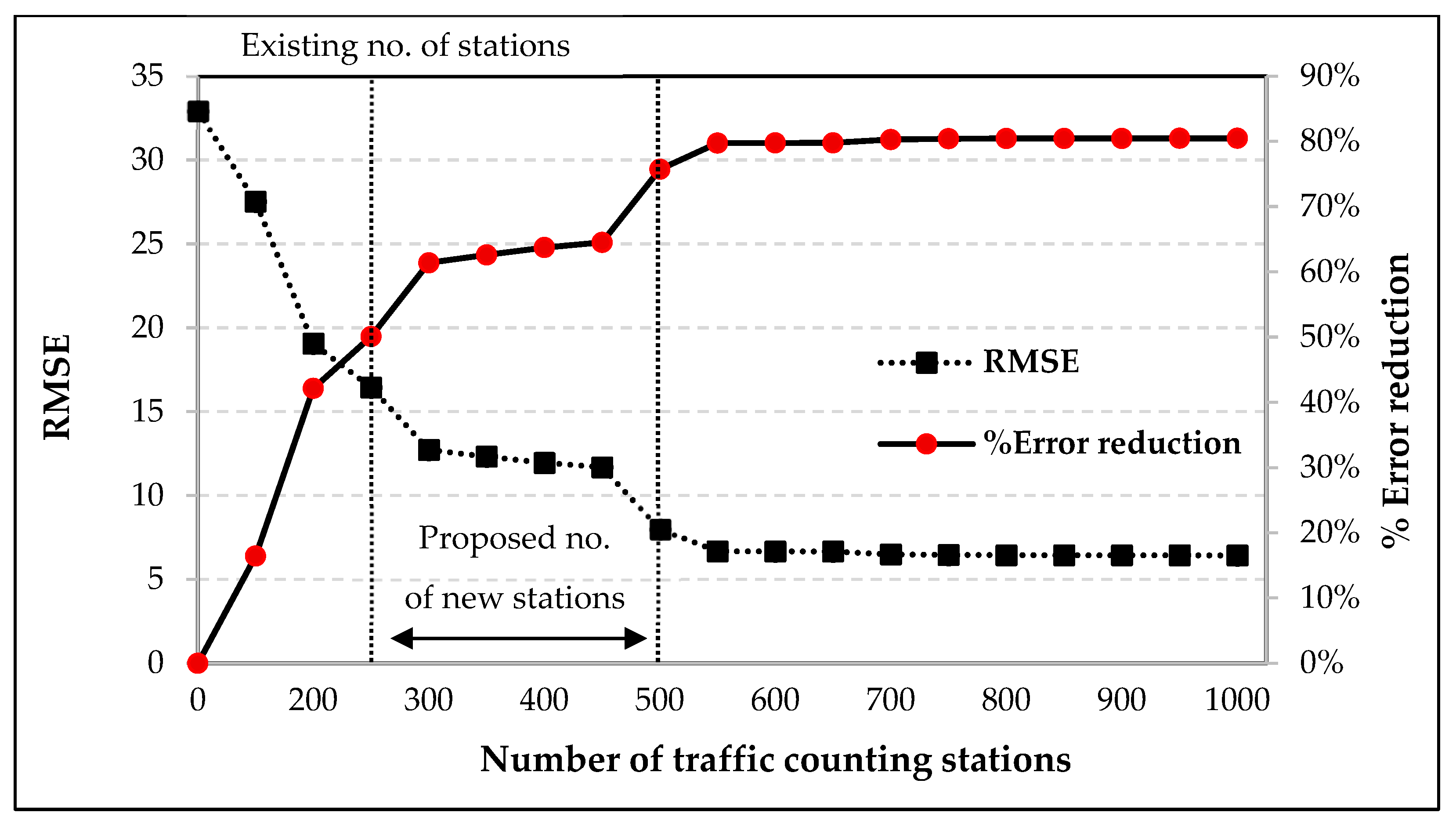
| Proposed model | 8.00 | 10.3 | 10.0 | 93% |
| Statistics | Classifications by Region |
|---|---|
| Kolmogorov–Smir. | |
| 0.2857 |
| 0.9627 |
| Cramer–von Mises | |
| 0.077 |
| 0.851 |
| Anderson–Darling | |
| −0.719 |
| >0.250 |
| No. of categories | 6 |
| Classifications by Function | ||||
|---|---|---|---|---|
| Statistics | 100% of Total AADT Coverage | 90% of Total AADT Coverage | 80% of Total AADT Coverage | 70% of Total AADT Coverage |
| Kolmogorov–Smir. | ||||
| 0.75 | 0.75 | 0.75 | 0.75 |
| 0.2286 | 0.2286 | 0.2286 | 0.2286 |
| Cramer–von Mises | ||||
| 0.375 | 0.375 | 0.375 | 0.3125 |
| 0.114 | 0.114 | 0.114 | 0.2286 |
| Anderson–Darling | ||||
| 1.528 | 1.528 | 1.528 | 0.9138 |
| 0.0761 | 0.0761 | 0.0761 | 0.1375 |
| No. of categories | 4 | 4 | 4 | 4 |
| Statistics | Classifications by Traffic Volume and Percentage of Heavy Vehicle |
|---|---|
| Kolmogorov–Smir. | |
| 0.250 |
| 0.869 |
| Cramer–von Mises | |
| 0.059 |
| 0.864 |
| Anderson–Darling | |
| −1.017 |
| >0.250 |
| No. of categories | 12 |
| Levels of Gaussian Noise in Traffic Counts | RMSE | MAPE (%) | NMAE (%) |
|---|---|---|---|
| 0% | 8.00 | 10.31 | 9.99 |
| 2% | 8.25 | 10.39 | 10.01 |
| 5% | 8.37 | 12.13 | 11.36 |
| 8% | 8.98 | 15.08 | 13.05 |
| 10% | 9.60 | 15.42 | 14.18 |
| 12% | 9.79 | 16.24 | 15.58 |
| 15% | 11.43 | 22.59 | 20.79 |
| Levels of Gaussian Noise in Prior OD Matrix | % Sensor Locations Remained | % OD Flows Intercepted |
|---|---|---|
| 0% | 100.0% | 93% |
| 5% | 87.8% | 92% |
| 10% | 87.6% | 90% |
| 15% | 87.2% | 88% |
| 20% | 86.4% | 87% |
| 25% | 85.4% | 86% |
| Evaluation Metric | In-Sample Data (N = 450) | Out-of-Sample Data (N = 50) | Percentage Difference (%) |
|---|---|---|---|
| scenario 1: traffic counts and prior OD flows with no perturbations. | |||
| RMSE | 672.8 | 1129.0 | 67.8 |
| MAPE (%) | 9.4 | 10.4 | 1.0 |
| NMAE (%) | 9.5 | 11.0 | 1.5 |
| R-squared (R2) | 0.99 | 0.98 | −0.9 |
| scenario 2: both traffic counts and prior OD flows contain 10% noise. | |||
| RMSE | 962.7 | 2221.6 | 130.8 |
| MAPE (%) | 13.2 | 13.8 | 0.6 |
| NMAE (%) | 13.5 | 14.1 | 0.6 |
| R-squared (R2) | 0.98 | 0.95 | −2.8 |
Disclaimer/Publisher’s Note: The statements, opinions and data contained in all publications are solely those of the individual author(s) and contributor(s) and not of MDPI and/or the editor(s). MDPI and/or the editor(s) disclaim responsibility for any injury to people or property resulting from any ideas, methods, instructions or products referred to in the content. |
© 2026 by the authors. Licensee MDPI, Basel, Switzerland. This article is an open access article distributed under the terms and conditions of the Creative Commons Attribution (CC BY) license.
Share and Cite
Siripirote, T.; Jotisankasa, A. Optimal Design of Highway Traffic Counting Stations for OD Matrix Estimation: A Case Study in Thailand. Future Transp. 2026, 6, 98. https://doi.org/10.3390/futuretransp6030098
Siripirote T, Jotisankasa A. Optimal Design of Highway Traffic Counting Stations for OD Matrix Estimation: A Case Study in Thailand. Future Transportation. 2026; 6(3):98. https://doi.org/10.3390/futuretransp6030098
Chicago/Turabian StyleSiripirote, Treerapot, and Apivat Jotisankasa. 2026. "Optimal Design of Highway Traffic Counting Stations for OD Matrix Estimation: A Case Study in Thailand" Future Transportation 6, no. 3: 98. https://doi.org/10.3390/futuretransp6030098
APA StyleSiripirote, T., & Jotisankasa, A. (2026). Optimal Design of Highway Traffic Counting Stations for OD Matrix Estimation: A Case Study in Thailand. Future Transportation, 6(3), 98. https://doi.org/10.3390/futuretransp6030098