Article

Optimal Design of Highway Traffic Counting Stations for OD Matrix Estimation: A Case Study in Thailand


by
Treerapot Siripirote
1,* and
Apivat Jotisankasa
2
1
Department of Civil and Environmental Engineering, Faculty of Engineering, Srinakharinwirot University, Nakhonnayok 26120, Thailand
2
Bureau of Highway Safety, Department of Highways, Ministry of Transport, Bangkok 10400, Thailand
*
Author to whom correspondence should be addressed.
Future Transp. 2026, 6(3), 98; https://doi.org/10.3390/futuretransp6030098
Submission received: 29 March 2026 / Revised: 22 April 2026 / Accepted: 26 April 2026 / Published: 29 April 2026

Abstract

This study proposes a rigorous optimization framework for the design of traffic counting station locations in large-scale highway networks, with specific application to Thailand’s national highway system. A mixed-integer linear programming (MILP) model is developed to determine the optimal sensor placement under budget-constrained scenarios while explicitly incorporating existing infrastructure. The model aims to maximize origin–destination (OD) flow observability and minimize estimation error, measured by the percentage of OD flows intercepted and root mean square error (RMSE). The proposed framework is validated using a real-world network. The results demonstrate that the optimized design significantly outperforms conventional approaches, including random and high-flow-based selection methods, achieving over 70% reduction in estimation error and 93% of OD flows intercepted with a feasible number of stations. Furthermore, the statistical representativeness of the selected locations is validated across spatial, functional, and traffic characteristics and traffic measurement errors. The findings provide a scalable and cost-effective decision-support tool for transport authorities in developing countries seeking to modernize transportation planning, traffic management, and infrastructure development under limited resources.

1. Introduction

Origin–destination (OD) matrices are essential inputs for transportation planning, traffic management, and infrastructure development. They are typically estimated or updated using traffic count data. The spatial configuration of link counting locations strongly influences the reliability of OD trip estimation results. It is typically treated as a sub-problem rather than an independent problem in OD trip estimation—e.g., [1,2,3,4,5,6,7,8,9,10,11,12,13,14,15,16,17,18,19]. For instance, Bianco et al. [1] used turning flow proportions at each network node/junction obtained from the traffic assignment of prior (out-of-date) OD trips associated with the flow conservation rule to estimate the unobserved link flows in the network.
This approach, however, relies heavily on the reliability of prior OD trips to predict the turning flow proportions. For other approaches, Yang and Zhou [2] suggested four rules for selecting the link counting locations: the OD covering flow rule, maximal flow fraction rule, maximal flow-intercepting rule, and link independency rule.
  • OD covering flow rule—Link counting locations on a road network should be located so that a certain portion of trips between any OD pair will be observed.
  • Maximal flow fraction rule—Under a certain number of OD pairs, chosen links should maximize the summation of the traffic flows on these links.
  • Maximal flow-intercepting rule—For all OD pairs, the traffic counting locations should be located at the links so that the flow proportions in each OD pair are as large as possible.
  • Link independency rule—The link counting locations should be located on the network so that all chosen links are linearly independent.
These rules relate to the selection of the locations of link counts based on the maximum possible relative error (MPRE). Yang and Zhou [2] formulated an integer-programming model and heuristic algorithms to determine the set of links that satisfy these rules. By considering other schemes, Yang et al. [20] suggested an optimal sensor-location selection model by separating as many OD pairs as possible. In practice, when applying such a selection model, the optimal number of traffic counting locations is also restricted by budget constraints. To integrate the problem of optimizing link counting locations with other constraints, Ehlert et al. [21] added the cost of installing detectors to the model formulation with one of the two following criteria: (i) budget minimization subject to complete OD coverage, and (ii) maximization of OD coverage subject to budget limitations. In addition, Chootinan et al. [4] developed a bi-objective traffic counting location framework for simultaneous optimization based on two such criteria for the OD matrix estimation problem.
Alternatively, traffic plate scanning data (collected by license plate scanning (PS) techniques) is more informative than data based on traditional link count information. Plate scanning (PS) data could be used as a source of highly efficient information for OD trip table estimations. For instance, Castillo et al. [22] suggest the selection of links for the installation of plate scanning (PS) sensors (i.e., scanned links) based on route identification. According to the route identification conditions, the set of scanned links (i.e., links installed with plate scanning sensors), as estimated by the mixed-integer linear program (MIP), can sufficiently distinguish between all routes for each OD pair. However, OD flows are typically regarded as unobservable across all sensor types owing to budgetary constraints. Locating a mix of traffic sensor types is also investigated in the heterogeneous location problem [23,24,25,26]. To deal with measurement error in observations, Shao et al. [10] introduced the bi-objective function, which attempts to minimize the propagation of such errors on the inference of unobserved link flows. In the case of automatic vehicle identification (AVI) sensors, Sun et al. [27] developed a sensor location model for OD estimations considering failure and budget constraints. To design sensor locations for multiple objectives, Gecchele et al. [28] applied a Fuzzy Delphi Analytic Hierarchy Process (FDAHP) to select the set of locations for a fixed number of permanent count stations. Previous studies relating to traffic observation locations for OD matrix estimation are summarized in Table 1. However, some case studies were only tested on small networks, e.g., [29], and the practical distribution of measurement errors (made by many types of sensors) can be uncertain. In practice, a real city-sized network was investigated to optimize the placement and number of traffic counters in multi-modal transportation analysis, despite limitations in representing spatial distribution or traffic characteristics, as in [30].
In general, the accuracy of OD estimation is significantly influenced by the spatial configuration of traffic counting sensors. Despite extensive research, most existing studies focus on small or hypothetical networks, limiting their applicability to large-scale real-world systems.
While previous studies have established various rules for sensor placement, they are often limited to small or hypothetical networks, restricting their practical application. This study addresses this gap by offering an optimization-based framework specifically designed for a national-scale highway network. Unlike previous studies, the proposed approach explicitly integrates existing counting stations and considers practical budget constraints. The main contributions and distinguishing features of this paper are as follows:
  • Practical Integration of Infrastructure: Unlike existing models based on a clean-slate approach, the proposed BIP-4 model explicitly incorporates the existing 250 permanent microwave radar stations, providing a realistic incremental investment strategy for transport authorities. This integration ensures that the resulting sensor network is operationally feasible and fully aligned with the current physical constraints of the national highway system.
  • Methodological Scalability: A robust Mixed-Integer Linear Programming (MILP) framework that handles large-scale networks (over 13,000 links and 10,000 OD pairs) is developed. As summarized in Table 1, most studies focus on small networks; this study is one of the few that tackle a real-world national network such as Thailand’s.
  • Multi-Dimensional Validation: Beyond mathematical optimization, this study provides a comprehensive validation of the results across spatial distribution, functional road classification, traffic characteristics, and traffic measurement errors, ensuring that the selected locations are statistically representative of the entire national system. The robustness of the selected sites is further confirmed through sensitivity analysis and out-of-sample “blind tests,” demonstrating that the model maintains high predictive accuracy (R-squared of 0.95) at unobserved locations.
By addressing these points, this research provides both a theoretical advancement in the sensor location problem and a scalable, cost-effective tool for transportation planning in developing countries.
The remainder of this paper is organized as follows. Section 2 presents the mathematical formulation of route flow estimations based on traffic counts. Section 3 details the optimization models for traffic counting location design under various conditions. Section 4 introduces a case study focusing on the highway network in Thailand. The empirical results and a comprehensive discussion are presented in Section 5. Section 6 provides the conclusions of the study. Finally, Section 7 discusses policy implications and suggests potential directions for future research.

2. Route Flow Estimations Based on Traffic Counts

To estimate route flows based on traffic counts, the set of traffic counting links can be expressed as follows:
( O b s e r v e d )   l i n k   f l o w s :   v ^ l ;   l ,   l O I
where v ^ l represents the traffic counts on link l and O I is the set of observed links from the traffic counting process.
Let R be the set of all possible paths, where any path   r R . For traffic counting location design purposes, a historical OD matrix or path flow matrix is assumed to be given. The existence of such a matrix is a common assumption in the literature, e.g., [1,22,24,32,34,35,36,37,38,39,40,41]. Due to the high precision of recent technologies, the traffic counting process is often assumed to be error-free, e.g., [22,32]. As a result, the path flow estimation problem can be formulated as follows:
F 1   =   Minimise f r   r 1 R r 2 R f r 1 f r 1 0 γ r 1 r 2 f r 2 f r 2 0 ,
s u b j e c t   t o :   v ^ l = r R Δ l r f r ;   l ,   l O I ,   Δ l r = 1 if   link   l   is   on   path   r . 0 otherwise .
where f r 0 are the prior flows on route r, γ are the weights, including the elements of the inverse of the variance–covariance matrix, and Δ is the link-path incidence indicator, in which Δ l r is equal to 1 if link l is on path r, and equal to 0 otherwise.

3. Design Scheme for Optimal Traffic Counting Locations

3.1. No Budget Limitations

To choose the optimal traffic counting locations that could cover all OD pairs within the network studied, the following binary linear programming problem [31] was adopted:
BIP-1   Minimise   a l a ,
s u b j e c t   t o : A l l   O D   c o v e r a g e :   a δ a w l a 1 ;   for   all   OD   pair   w
b i n a r y   v a l u e s :   l a 0,1
where l a is a binary value, taking a value of 1 when a traffic counting sensor is installed on link a, and 0 otherwise. The elements of the incident matrix ( δ ) are defined by
δ a w = 1 if   OD   pair   w   contains   link   a , 0 otherwise ,
Since the accuracy of OD estimations depends on the amount of traffic flows (path flows) captured by traffic counts, capturing high path flows through link counts tends to improve estimation accuracy. To maximize path flows intercepted for a given number of counting links, a second BIP problem is formulated, as follows:
BIP-2   Maximise   r f r y r ,
s u b j e c t   t o :   a l a = l ;
a l a y r ;   f o r   a l l   p a t h   r
a δ a w l a 1 ;   for   all   OD   pair   w
l a , y r 0,1
where
y r is a binary value that takes a value of 1 when path r is observed by a traffic counting sensor, and 0 otherwise.
l is the given number of traffic counting stations.
To achieve a sensor location design that satisfies the OD covering flow rule, l must be at least equal to the number of traffic counting stations obtained from model BIP-1.

3.2. Budget Limitations

In the previous section, the optimal traffic counting locations were designed without budget considerations. However, in the case in which a number of sensors (B) is limited, only some OD pairs or some paths can be covered. To estimate the OD trips under this condition, the design for traffic counting sensor locations with a limited number of observations (B) is described as follows.
Yang et al. [31] proposed a link counting location scheme to minimize the maximal possible relative error (MPRE), which represents the maximum possible relative deviation of the estimated OD matrix from the target values (prior OD flows). Consequently, the problem of sensor location selections based on the maximization of OD pairs which are coverable can be expressed by:
BIP-3   Maximise   w z w m w ,
s u b j e c t   t o   O D   c o v e r a g e :   a δ a w l a m w ;   f o r   a l l   O D   p a i r s   w
b u d g e t   c o n s t r a i n t s :   a c a l a B ;   for   all   OD   pairs   w
b i n a r y   c o n s t r a i n t s :   l a , m w { 0,1 }
where
c a is the cost of installing traffic count stations on link a.
z w is the weight representing the selected OD pair w to be covered by traffic count stations in order of importance.
m w is the binary value, representing one for the OD pair w covered by traffic count stations, and zero otherwise.
To deal with applications in which the traffic counting stations are already installed in the network, the sensor location problems associated with existing traffic counts are presented in (17).
BIP-4   Maximise   w z w m w ,
s u b j e c t   t o   O D   c o v e r a g e :   a δ a w l a m w ;   for   some   OD   pair   w UC
b u d g e t   c o n s t r a i n t s :   a c a l a B ;   for   all   OD   pair   w
b i n a r y   c o n s t r a i n t s :   l a , m w { 0,1 }
where UC represents the remaining OD pairs that are not covered in the chosen traffic counting stations.

4. Empirical Example

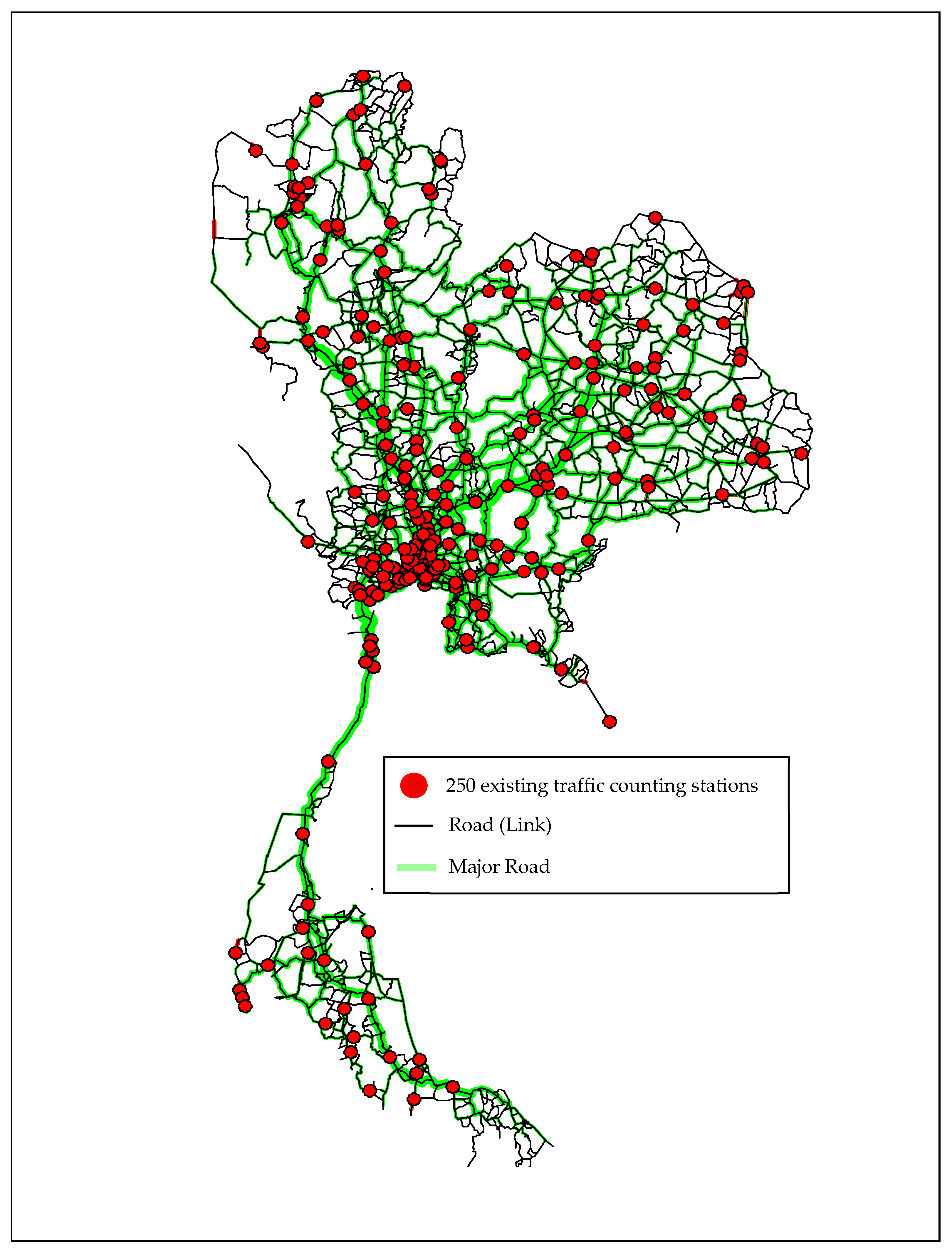
To determine the optimal traffic counting locations, a highway network comprising 926 zones (at the district level) and 13,302 links is adopted. In this practical network, 10,022 OD pairs are considered; their origin and destination nodes are shown in Figure 1. To obtain true path flows and true link flows, the corresponding user equilibrium (UE) problem is solved from the given one-day true OD flows (obtained from the national travel demand model (NAM) from the Office of Transport and Traffic Policy and Planning, Thailand). Additionally, prior OD flows were estimated and expanded based on previous observations obtained from roadside interview surveys on major highways. Given prior OD flows, prior path flows were then obtained from SUE manners. The Stochastic User Equilibrium (SUE) model was adopted instead of the deterministic UE because it more accurately reflects real-world conditions in which travelers do not have perfect information regarding travel times. In a highway context, drivers’ route choices are often influenced by factors beyond just distance, such as varying speed limits, real-time congestion levels, and weather conditions, which lead to subjective perceptions of the ‘fastest’ route. This allows for a more realistic explanation of drivers’ route choices.
Since there are already some permanent traffic counting stations inclusively installed in Thailand’s highway network, (see Figure 1), a design for sensor location problems associated with existing traffic counts and simultaneously considering budget constraints would be appropriate for use in Thailand (BIP-4 model). In this study, all links—excluding those with existing traffic counting stations—are considered potential locations for new sensor placement.

Performance Evaluation

Statistical performance can be determined from the prediction errors of the path flow estimations (model F1) based on the sensor location results of the model (BIP-4). The total estimation error (measured by RMSE, e.g., [17,42]) is defined as follows.
RMSE = [ r = 1 R ( f r f r t r u e ) 2 / R ] 0.5
In addition, the percentage error reduction (RMSE%) can thus be formulated as follows:
RMSE % = ( RMSE 0 RMSE ) RMSE 0 × 100 %
RMSE 0 = [ r = 1 R ( f r 0 f r t r u e ) 2 / R ] 0.5
and   RMSE = [ r = 1 R ( f r f r t r u e ) 2 / R ] 0.5
where
RMSE 0 is the error (RMSE) of prior path flows (f0), compared with true path flows (ftrue).
RMSE is the error (RMSE) of path flows (f*) estimated using given traffic counts compared with true path flows (ftrue).
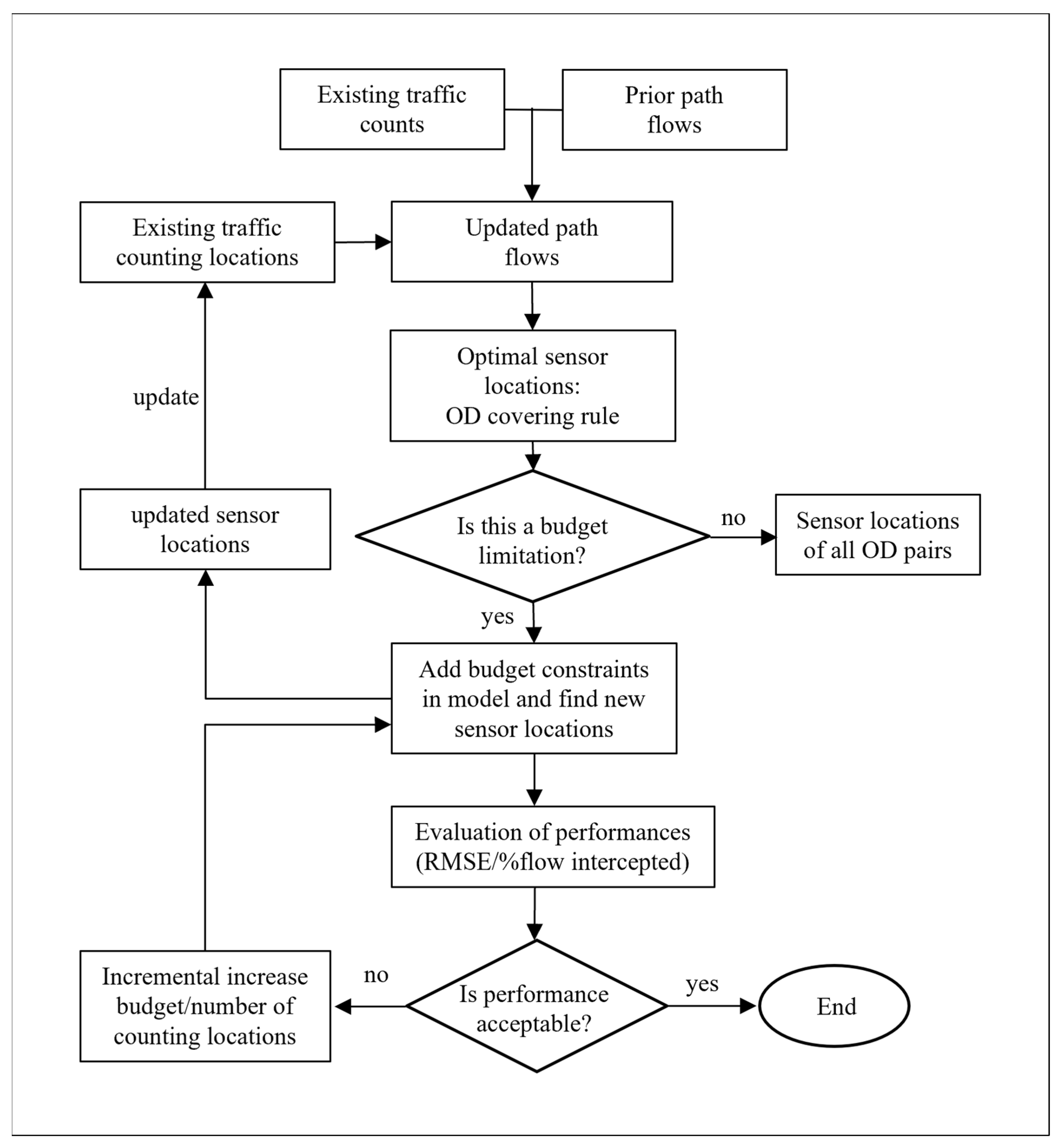
Since several permanent traffic counting stations already exist (Figure 1), the Department of Highways in Thailand plans to allocate a budget to install additional sensors incrementally. Consequently, Figure 2 illustrates the framework for determining optimal sensor locations as the number of counting stations increases under budget constraints.

5. Empirical Results and Discussion

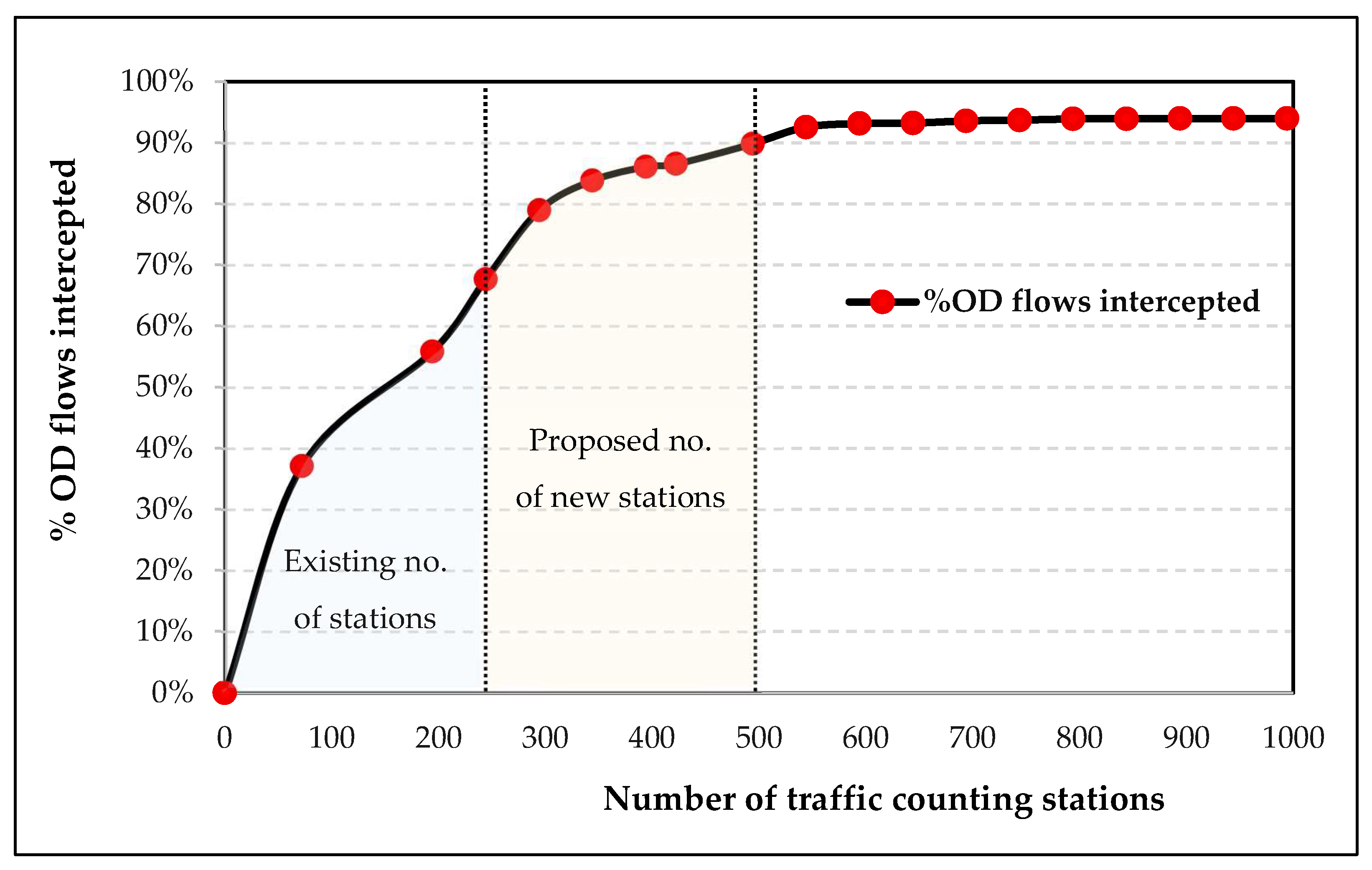
For existing installations of permanent traffic counts (250 stations), 70% of OD flows of all OD pairs can be intercepted, as shown in Figure 3. The proposed model is applied to Thailand’s national highway network, and the results indicate that 500 stations (including 250 existing stations) can capture 93% of OD flows while reducing RMSE by more than 70%.
The sensitivity analysis confirms that increasing the number of stations improves estimation accuracy, with diminishing returns beyond a certain threshold. The results presented in Figure 4 indicate that increasing the number of sensors (B) leads to a higher proportion of origin–destination (OD) pairs being covered by traffic counting links. This provides valuable insight for cost-effective infrastructure investment decisions.
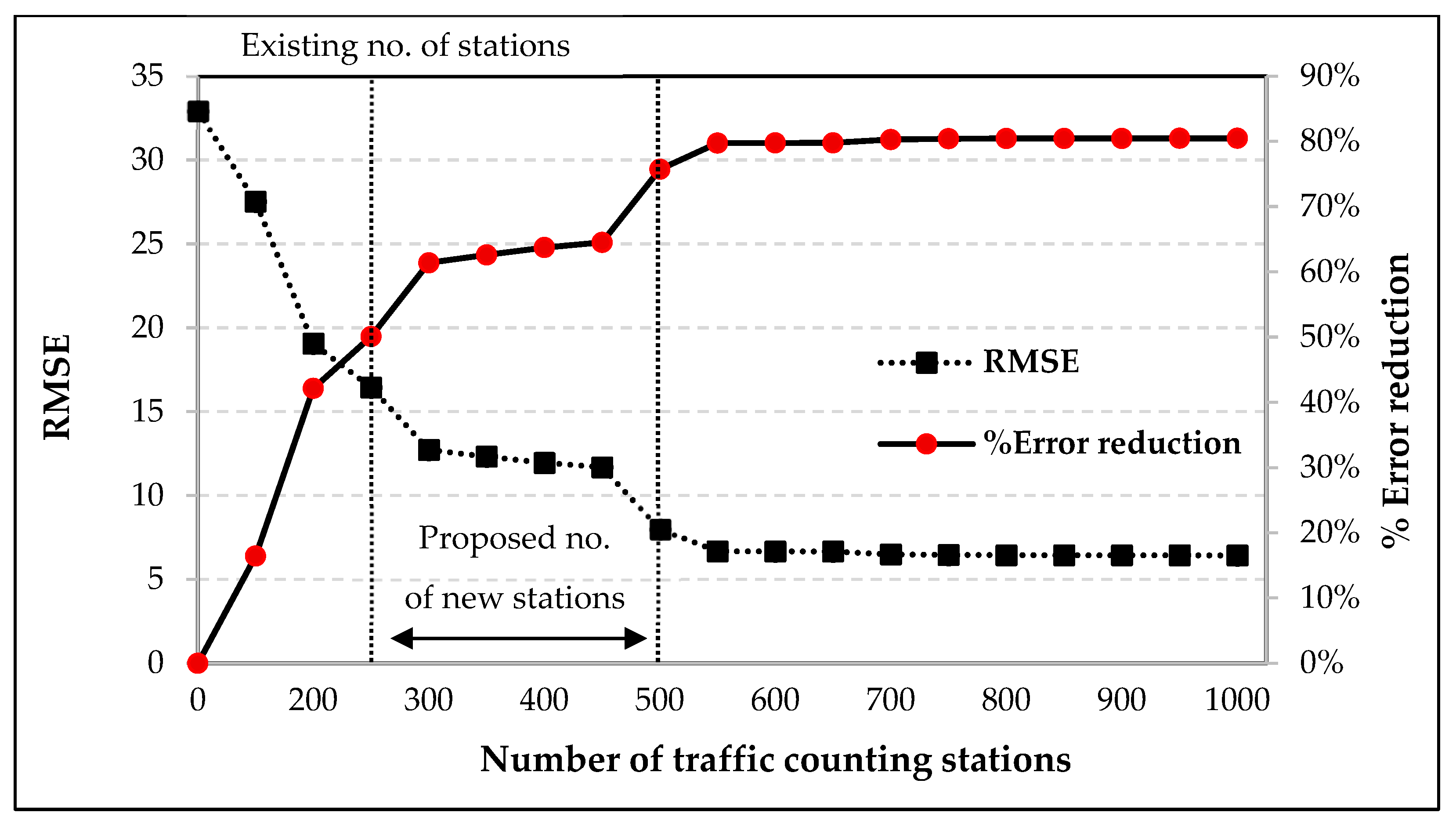
Additionally, the estimation errors of OD trips tend to decrease as the number of links equipped with traffic counting sensors (B) increases. In this study, the estimation errors (RMSE) of path flow estimations from various amounts of traffic counting stations are plotted in Figure 4. To investigate the suitable number of stations, the error reductions (RMSE%) are also presented. A significant reduction in error indicates that the path flow estimations derived from traffic counts yield a substantially lower RMSE compared to those based on prior OD flows.
In Figure 4, it can also be seen that the estimation error (RMSE) based on the sensor location model with the existence of traffic stations and budget constraints (BIP-4) decreases sharply as the total number of sensors (B) increases from 200 to 500. While the number of sensors is high (B = 500), the link counts used in the model (BIP-4) significantly reduce estimation errors (RMSE% > 70%) due to the high possibility of updating suitable sensor locations such that the estimated link flows can reproduce the link counts. With this evidence, 250 new proposed traffic stations can be analyzed from the model (BIP-4).
In this empirical example, constraint integer programming (SCIP) in MATLAB R2018a software [43] was adopted to solve the proposed method. To ensure tractability in a large-scale network, a constrained K-shortest path algorithm combined with a distance-based threshold was employed to keep the path set computationally manageable while ensuring that likely travel routes are covered. The computation time required for this method is less than 30 min with a personal computer (i.e., CPU i7-14700 up to 5.40 GHz and Ram 32 GB) for each dataset. While the Thai highway network traditionally relies on 2696 manual stations for AADT calculation, 250 sites have transitioned to permanent microwave radar systems. These sensors offer high robustness and accuracy (98.7–99.8% for typical multi-lane traffic monitoring [44]) regardless of weather conditions. Furthermore, due to the uniform nature of installation costs across various sites, the overall project budget is primarily governed by the total quantity of sensors.

5.1. Comparison with Benchmark Methods

To evaluate the effectiveness of the proposed sensor location framework, its performance was compared with two commonly used benchmark approaches: (1) random selection of traffic counting locations, and (2) high-flow-based selection, in which links with the highest traffic volumes are prioritized for sensor installation. The random selection method represents a baseline scenario where traffic counting stations are placed without considering the network structure or OD coverage. The high-flow-based method reflects a commonly adopted practical approach where sensors are installed on links with the largest observed traffic volumes to maximize flow capture.
For each benchmark method, the same number of sensor locations (B = 500), including the existing installations of 250 permanent stations, was used to ensure a fair comparison with the proposed model (see Table 2). The OD matrix estimation performance was evaluated using the Root Mean Square Error (RMSE) between estimated and true path flows. The results indicate that the proposed optimization model significantly outperforms both benchmark methods. Compared with the random selection approach, the proposed model achieves substantially lower RMSE values due to its ability to strategically capture critical OD flows across the network. In comparison with the high-flow-based method, the proposed model demonstrates improved performance by considering network-wide observability rather than focusing solely on high-volume links.
These findings highlight the importance of incorporating OD coverage and network structure into the design of traffic counting locations. While high-flow-based approaches may capture a large proportion of traffic volumes, they may fail to adequately distinguish between OD pairs, resulting in higher estimation errors. Overall, the comparison results confirm that the proposed model provides a more efficient and reliable framework for traffic sensor placement in large-scale highway networks.
Furthermore, the performance of the OD matrix is intrinsically linked to the behavioral consistency of the traffic assignment process. A low-performance matrix, often resulting from non-strategic sensor placement (e.g., random or high-flow selection), leads to ‘path ambiguity,’ where the model fails to differentiate between competing routes. This causes an artificial concentration of flows on specific links, distorting the perceived bottleneck locations. By contrast, the proposed MILP framework ensures that the selected counting stations act as critical ‘checkpoints’ that cover 93% of OD flows. This high level of observability stabilizes the model’s behavior, ensuring that the estimated traffic patterns remain representative of actual highway usage even under significant spatial constraints.

Sufficiency of Comparison Methods

The selection of random and high-flow-based selection methods as benchmarks is considered sufficient for validating the proposed model for several reasons. First, high-flow-based selection represents the conventional practice of many transportation authorities, where sensors are prioritized for high-volume corridors to maximize data volume. Demonstrating the proposed model’s superiority over this method provides a direct ‘proof-of-concept’ for agencies looking to modernize their counting networks. Second, random selection serves as a necessary baseline to ensure that the performance gains are derived from the optimization logic rather than mere chance. While more complex meta-heuristics exist, they often face scalability issues in large-scale networks like Thailand’s national highway system (13,302 links). Thus, the contrast between the proposed MILP framework and these two benchmarks is sufficient to highlight the significant improvements in OD flow observability and RMSE reduction.
To evaluate the representativeness of all highway categories, the spatial distribution, functional classification and traffic characteristics of the proposed sensor locations (250 stations) are analyzed as follows.

5.2. Representativeness of Spatial Distribution

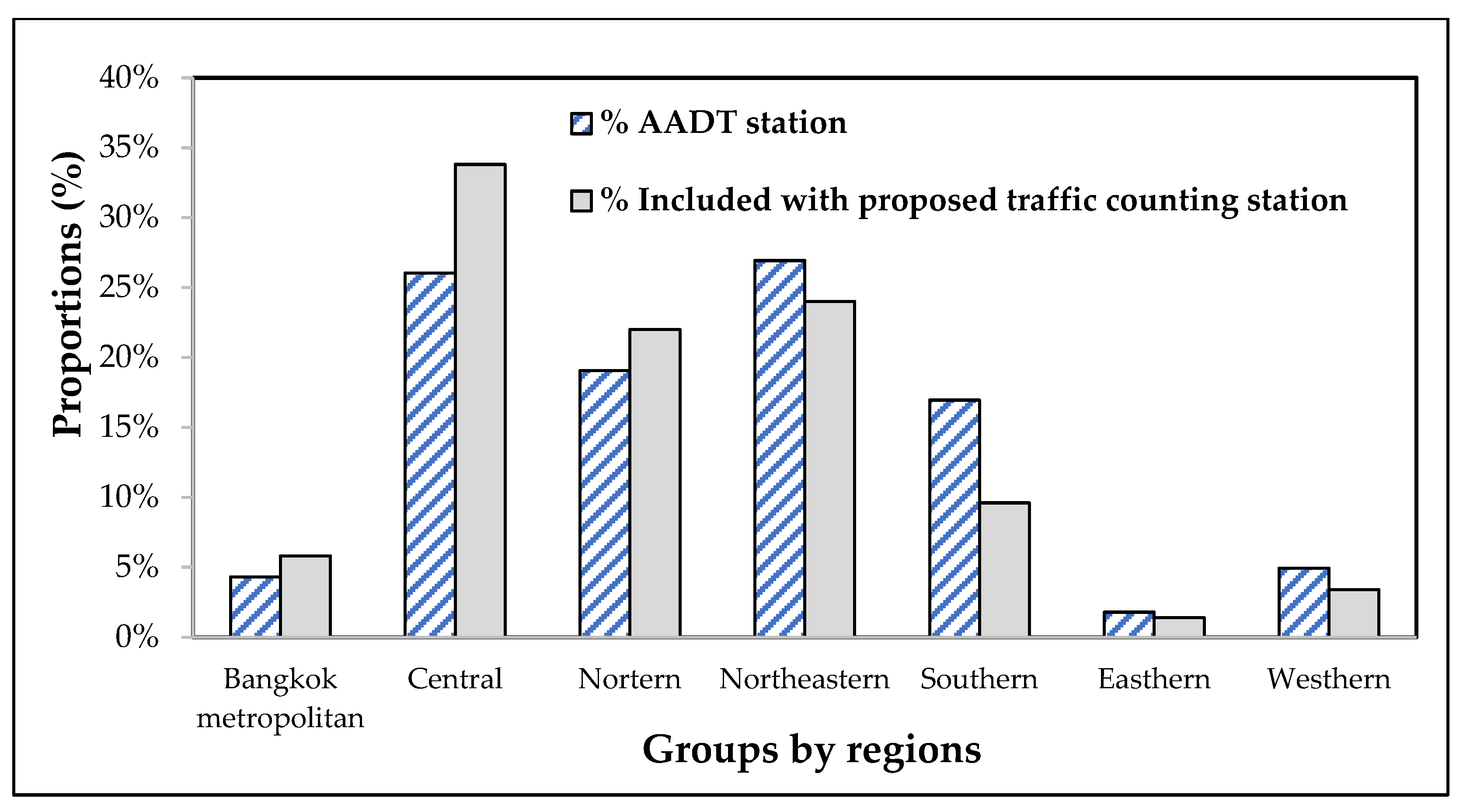
The distributions of proposed traffic counting stations, including existing permanent stations (grouped by seven regions in Thailand), are presented in Figure 5. The division of the area into seven regions is based on geographical principles. The goodness-of-fit statistics with this distribution type are evaluated with other distribution types (AADT stations). In comparison with other distribution fittings analyzed via the SciPy library (Virtanen et al. [45]), we also used a two-sample test to identify distribution differences. The results show (Table 3) that the proposed traffic counting stations provide a good fit (p-value > 0.1) to the reference distribution.

5.3. Representativeness of Highway Function

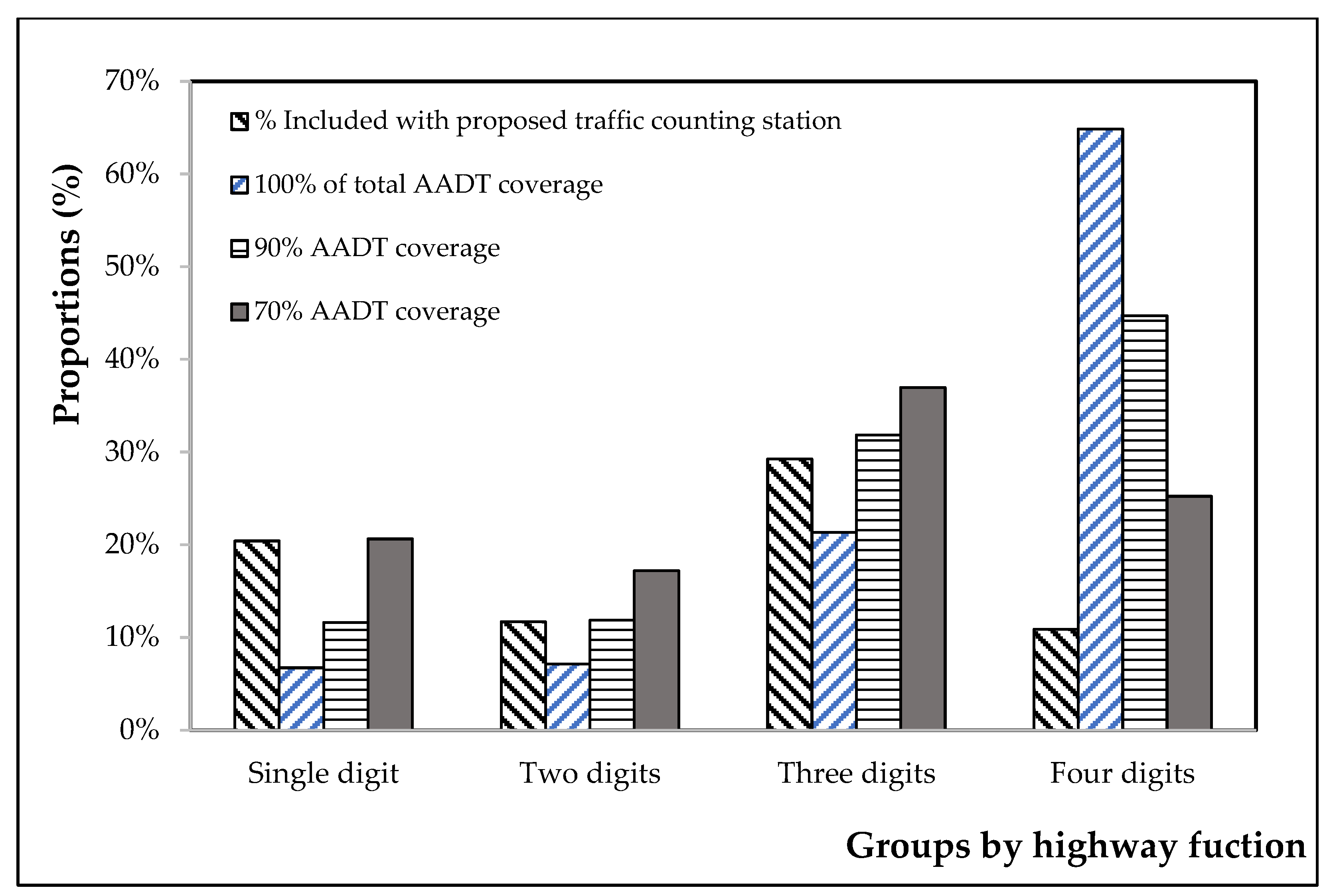
The road hierarchy in Thailand is classified by functional class. The highway numbering system uses one to four digits to categorize roads into four levels: (1) single-digit numbers for major highways connecting Bangkok to different regions; (2) two-digit numbers for principal highways within a region; (3) three-digit numbers for secondary regional highways; and (4) four-digit numbers for intra-provincial highways connecting provincial capitals to districts or key locations. The distributions of proposed traffic counting stations included with existing permanent stations (grouped into four functional classes in Thailand) are presented in Figure 6.
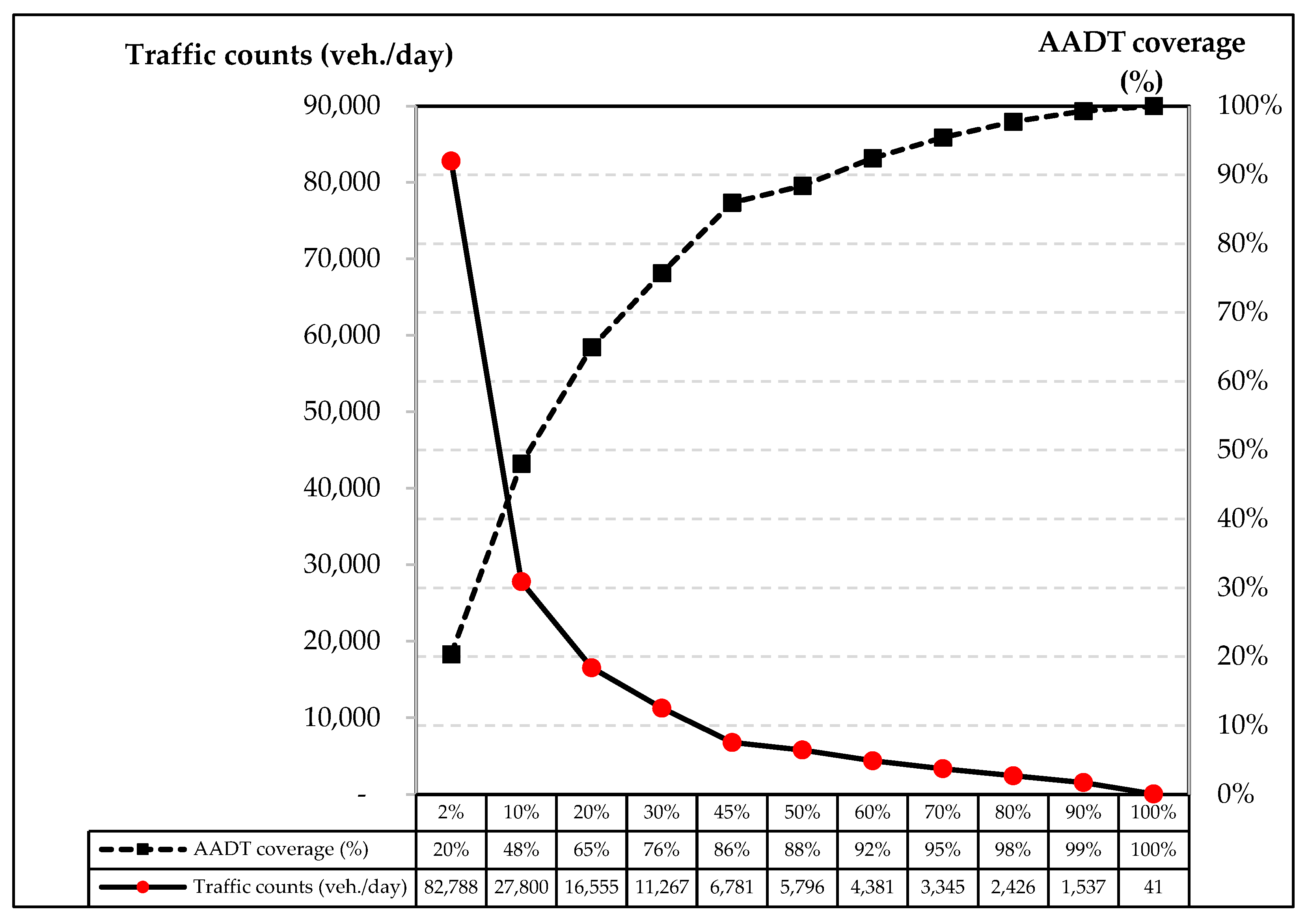
The results from Figure 6 show that the proportion of four-digit highways selected as the observation points accounts for over 60% of AADT stations. In total, 2696 traffic counting stations can cover all traffic flows on the highway network if all AADT stations are observed (100% AADT coverage), since most of this highway type has quite low traffic volumes (AADT < 7500 veh./day) compared with other functional classes. As a result, in order to maximize the percentage of OD flows intercepted, traffic counting stations should ideally be located on a major road type (single-to-triple-digit highways) with significant traffic volume. In addition, the 25th percentile threshold covers AADT stations with at least 13,000 veh./day, representing 70% of total AADT coverage (see Figure 7).
Compared with other distribution fittings analyzed using SciPy functions in Python version 3.8 (Virtanen et al. [45]), a two-sample test for distribution difference was also employed. The results (in Table 4) show that the proposed traffic counting stations do not achieve a sufficient goodness of fit with all AADT stations covered (p-value < 0.1 under the Anderson–Darling test) due to the high proportions of four-digit highways with low traffic volumes. However, the proposed traffic counting stations can provide a good fit (p-value > 0.1) for all tests with a reference distribution at 70% of total AADT coverage.

5.4. Representativeness of Traffic Characteristics

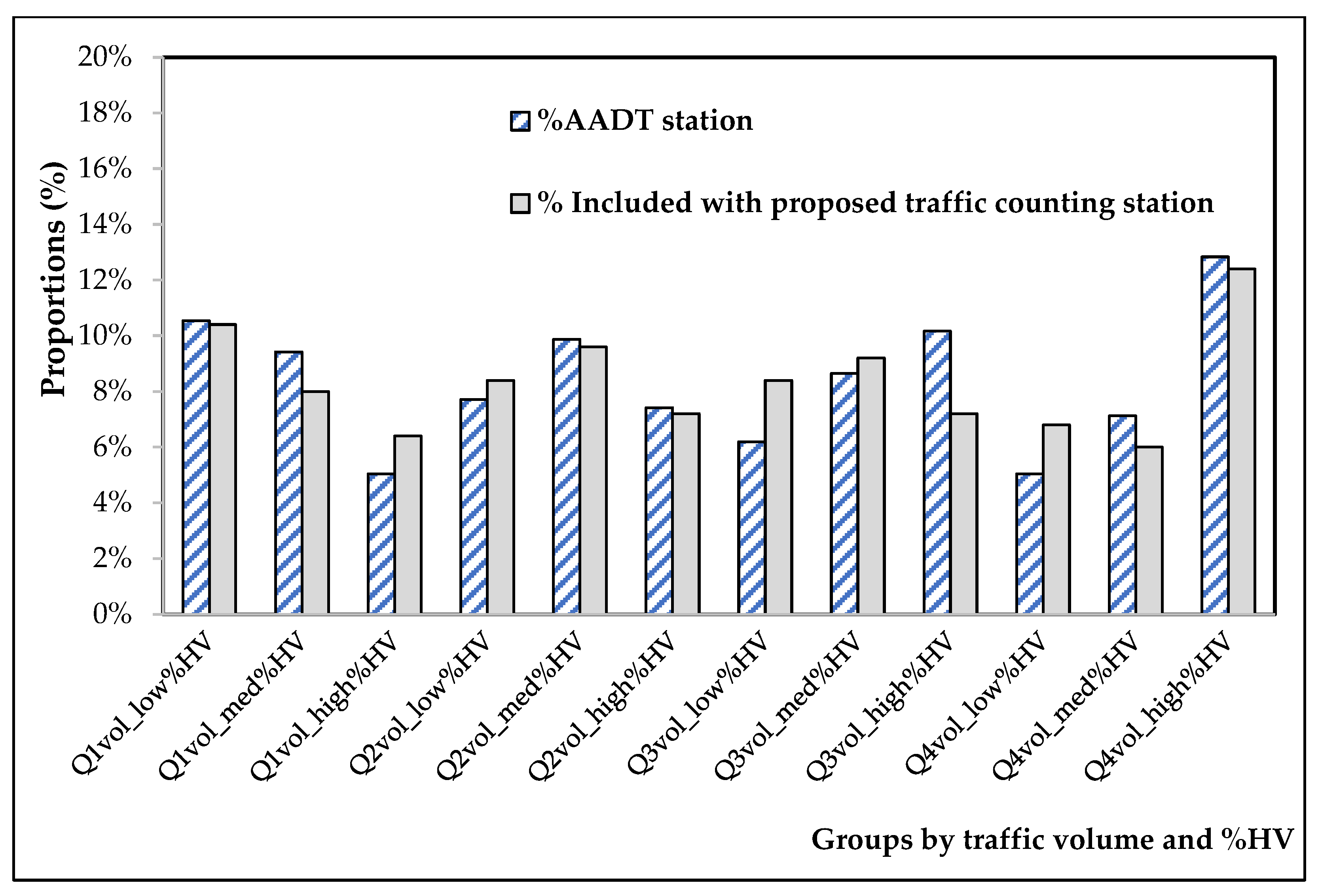
To ensure the representativeness of traffic characteristics across the network, the annual average daily traffic (AADT) stations were categorized into distinct groups based on two primary metrics. First, stations were classified into four groups according to their traffic volumes, using quartile distributions: Q1 (0–2904 veh./day), Q2 (2904–5796 veh./day), Q3 (5796–13,600 veh./day), and Q4 (>13,600 veh./day). Furthermore, they were subdivided into three groups based on the percentage of heavy vehicles (%HV), partitioned by the 33rd and 66th percentiles: low (0–9%), medium (9–18%), and high (>18%). This cross-classification approach allows for a comprehensive analysis of various traffic patterns, from low-volume local roads to high-capacity corridors with heavy freight movement. The distribution of the proposed traffic counting stations, including existing permanent stations categorized by these 12 traffic characteristics, is presented in Figure 8. The results in Figure 8 indicate that light-traffic highways (in the lower quartile) tend to have a low percentage of heavy vehicles because most of the traffic on these routes is local.
Furthermore, this correlation suggests that the functional classification of a highway significantly dictates its traffic composition. Routes in the lower quartile typically serve as collector or local roads, where the demand is driven by short-distance commuting and service deliveries, resulting in a minimal presence of heavy axles. In contrast, high-traffic highways correlate with a high percentage of heavy vehicles because most heavy vehicles mainly use such highways for intercity freight movements. This pattern is consistent with previous findings indicating that heavy vehicle distributions are strongly linked to the functional importance of the link within the national logistics spine [46]. Furthermore, the concentration of freight traffic on primary arterial roads is a well-documented phenomenon in developing economies, where freight hubs are typically connected by high-capacity corridors to minimize operational costs [47]. The concentration of heavy vehicles on high-traffic corridors underscores their role as the backbone of regional logistics [48]. Compared with other distribution fittings analyzed by SciPy function in the Python program (Virtanen et al. [45]), a two-sample test for distribution difference was also used. The results (in Table 5) show that the proposed traffic counting stations can obtain a good fit with the distribution of all AADT stations categorized by traffic characteristics.

5.5. Sensitivity and Robustness Analysis

To evaluate the reliability of the proposed MILP framework under uncertain conditions, a sensitivity analysis of link flows and the prior OD matrix was performed, focusing on two key factors.
  • Measurement Noise: We introduced stochastic errors (varying levels of Gaussian noise) ranging from 2% to 15% into the observed link flows. The statistical results (in Table 6) indicate that the MAPE and NMAE increased by only 5.1% and 4.2%, respectively, under a 10% noise level, suggesting that the maximization of OD flow interception (93%) provides a sufficient data cushion to mitigate localized sensor inaccuracies.
  • Prior Matrix Reliability: When perturbing the prior OD matrix by ±20%, over 85% of the optimal sensor locations are observed to remain consistent. These results (in Table 7) confirm that the framework identifies strategic “critical links” based on network topology and major flow corridors rather than being overly sensitive to minor fluctuations in prior demand estimates.

5.6. Out-of-Sample Validation

To address the potential risk of circular validation—where the model is evaluated using the same data it was optimized for—this study implemented a robust out-of-sample validation procedure. A subset of the available traffic data was withheld to serve as a “blind test” for the proposed framework, as follows.

5.6.1. Validation Design

The 250 existing permanent traffic counting stations were randomly partitioned into two sets:
  • Training set (80%): Here, 200 stations were used within the BIP-4 optimization framework to determine the optimal placement of the 250 new additional sensors.
  • Validation set (20%): Here, 50 stations were completely excluded from the optimization process. These “unobserved” points served as the ground truth to evaluate how well the estimated OD matrix (derived from the training set and new optimized locations) could predict flows at independent locations.

5.6.2. Validation Results

The performance on the validation set was measured using RMSE, MAPE, NMAE and R-squared. Two scenarios were tested, as follows:
  • Scenario 1: Traffic counts and prior OD flows with no perturbations.
  • Scenario 2: Both traffic counts and prior OD flows contain 10% noise.
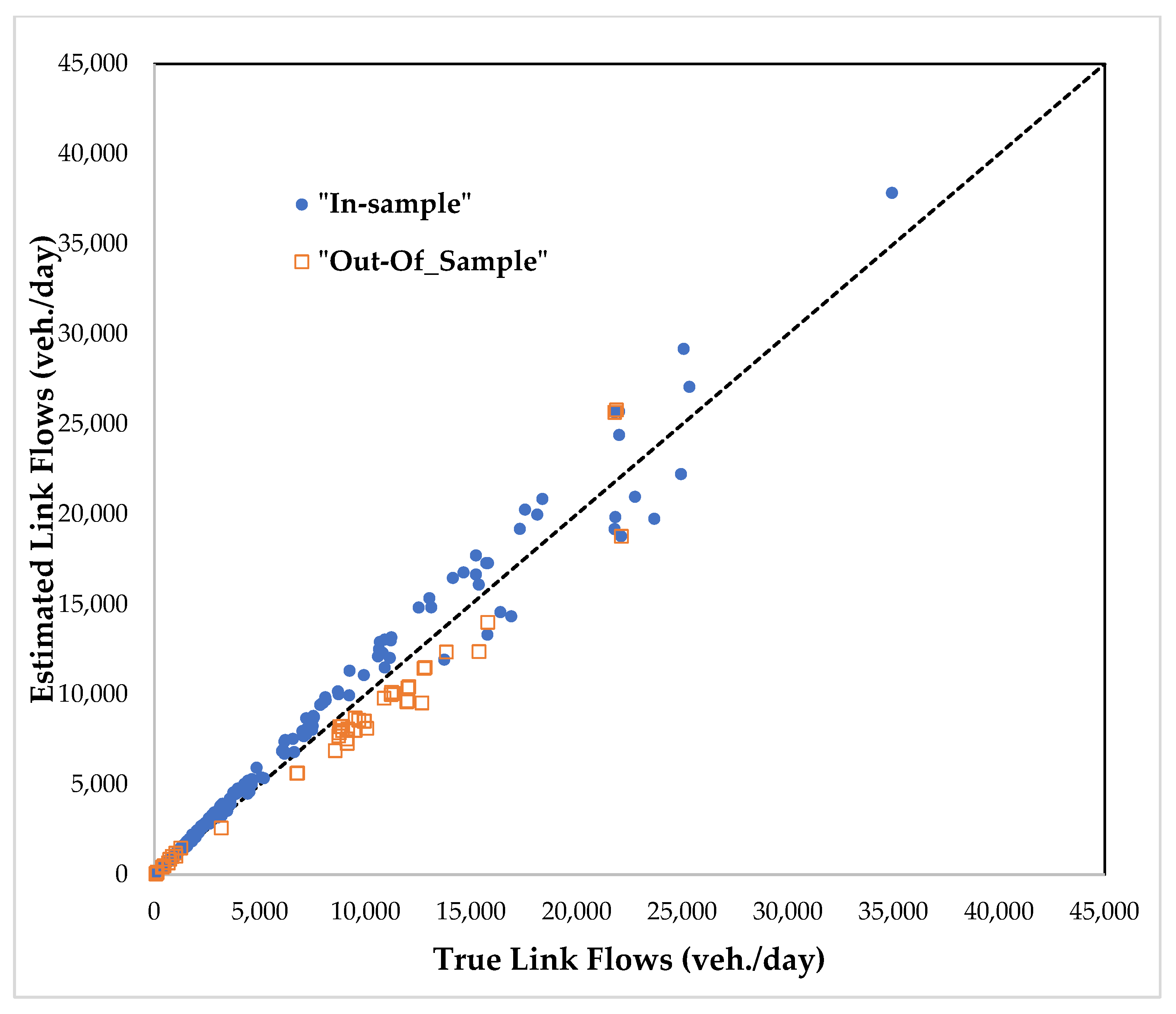
As shown in Table 8, the model demonstrates high generalizability. The results indicate that the increase in error for the out-of-sample data at a practical level (10% noise) is marginal, with MAPE and NMAE increasing by only 0.6% and 0.6%, respectively. This small gap confirms that the MILP framework does not simply “overfit” to the known sensor locations. Instead, it successfully captures the underlying network-wide travel patterns. To rigorously evaluate the model’s predictive performance and ensure it is not overfitted to the training data, an out-of-sample validation was conducted. Figure 9 presents a scatter plot comparing the observed and estimated traffic flows for both the in-sample (training) and out-of-sample (blind test) datasets under a 10% noise scenario. The visualization reveals that both datasets closely align with the 45-degree identity line, indicating high estimation accuracy. Quantitatively, the difference in Mean Absolute Percentage Error (MAPE) between the two sets is marginal, with the out-of-sample MAPE at 13.8% compared to 13.2% for the in-sample data. The high R-squared value of 0.95 for the validation set further confirms that the optimized sensor placement effectively captures the systemic traffic patterns across the highway network. This demonstrates the model’s robust generalization capability when applied to unobserved locations.
Furthermore, the ability to maintain an NMAE under 15% on unobserved links provides acceptable empirical evidence that the optimized sensor configuration offers sufficient spatial coverage to acceptably infer traffic flows across the entire national highway network.

6. Conclusions

This study developed an optimization framework using mixed-integer linear programming (MILP) to design an efficient traffic counting network for national highways in Thailand. By integrating 250 existing permanent stations into the optimization process, the model revealed that adding 250 strategic locations can result in a 93% intercept rate of total OD flows and reduce estimation errors (RMSE) by over 70%.
In addition, the OD matrix estimation results were generally satisfactory, showing the ability to significantly reduce errors in the trip tables estimated from proposed traffic counting locations when link counts and prior path flows are available. To obtain reliable OD flow estimation results, link counting locations are selected on the basis of the OD coverage rule—e.g., [1,2,12,22,32]. In fact, without considering this OD flow coverage rule, the location of link count observations cannot yield reliable OD matrix estimation results.
To evaluate the effectiveness of the proposed sensor location framework, its performance was compared against two commonly used benchmark approaches. The results confirm that the proposed model provides a more efficient and reliable framework for traffic sensor placement in large-scale highway networks.
Furthermore, the representativeness of all highway categories, including spatial distribution, functional classification, and traffic characteristics, was also analyzed using two-sample tests for distributional differences. The goodness of fit of the proposed distribution was compared against other distribution types (AADT stations). The results show that the proposed traffic counting stations provide a good fit (p-value > 0.1) to the reference distributions.
Beyond the primary optimization results, the study further underscores the reliability and generalizability of the proposed MILP framework through rigorous testing.
  • Robustness to Data Inconsistencies: The sensitivity analysis confirms that the framework is resilient to practical uncertainties. Even with a 10% Gaussian noise level in traffic counts, the estimation errors (MAPE and NMAE) only marginally increased (5.1% and 4.2%, respectively). Furthermore, the stability of the selected “critical links” remained high (over 85% consistency) despite significant perturbations in the prior OD matrix, proving that the model identifies strategic locations based on network topology rather than being sensitive to minor data fluctuations.
  • High Generalizability Through Out-of-Sample Validation: The robust “blind test” validation proves that the model does not simply “overfit” to known sensor locations. The results demonstrate that the estimated OD matrix can accurately predict traffic flows at unobserved independent locations, maintaining an NMAE under 15% even in scenarios with 10% noise. This small performance gap between in-sample and out-of-sample data provides strong empirical evidence that the optimized configuration offers sufficient spatial coverage to infer traffic patterns across the entire national highway network.
In summary, these empirical results provide several key insights for transportation authorities:
  • Information Efficiency: The study proves that strategic sensor placement based on network observability is far superior to traditional high-volume-based selection.
  • Resource Optimization: The BIP-4 model offers a practical tool for incremental budget allocation, allowing authorities to expand their monitoring capabilities systematically.
  • Representativeness: The optimized locations maintain high goodness of fit across regional, functional, and traffic-weighted dimensions, ensuring that the collected data is not biased toward specific road types.

7. Policy Implications and Future Research

The findings of this research offer significant practical utility for government agencies, particularly in developing countries, where the modernization of traffic monitoring systems often faces severe financial and infrastructural constraints. Traditionally, these agencies rely on labor-intensive manual counts or high-volume-based sensor placement, which may overlook critical connectivity and route-choice information. The proposed framework supports the transition toward “Data-Driven Infrastructure Management.” By improving the accuracy of OD matrices, transport planners can better predict traffic growth, optimize freight logistics, and develop more effective carbon reduction strategies.
While traffic counts are assumed to be error-free—a common baseline in the sensor location literature to ensure model tractability—it is important to recognize that practical observations may contain noise. In the context of Thailand’s highway network, the transition to permanent microwave radar sensors—with accuracy exceeding 98% [44]—further minimizes initial data discrepancies. Crucially, the out-of-sample validation (blind test) results, yielding an R-squared of 0.95 and maintaining NMAE under 15% at unobserved locations, provide strong empirical evidence that the optimized configuration effectively captures systemic travel patterns. This high level of observability (93% OD flow interception) creates a ‘data cushion’ that mitigates the propagation of localized measurement errors, ensuring that the framework remains a reliable decision-support tool for real-world national highway management. Future studies should explore the integration of error-weighted objective functions to further enhance the system’s resilience to sensor failure or data inconsistencies. The integration of emerging data sources, such as floating car data (FCD), GPS data or cellular signaling, with the physical sensor network should also be considered, e.g., [49,50], to further enhance the resilience of the estimation process under sensor failure scenarios.

Author Contributions

Conceptualization, T.S. and A.J.; methodology, T.S.; software, T.S.; validation, T.S.; formal analysis, T.S.; investigation, T.S.; resources T.S. and A.J.; data curation, T.S.; writing, T.S.; original draft preparation, T.S.; reviewing and editing, T.S.; visualization, T.S. All authors have read and agreed to the published version of the manuscript.

Funding

The research was funded by Bureau of Highway Safety at the Department of Highways (Thailand).

Institutional Review Board Statement

Not applicable.

Informed Consent Statement

Not applicable.

Data Availability Statement

The data presented in this study are available on request from the corresponding author due to privacy.

Acknowledgments

The authors would like to thank Bureau of Highway Safety, Department of Highways, Ministry of Transport, Thailand, for providing traffic data and sensor locations.

Conflicts of Interest

The authors declare no conflicts of interest.

Abbreviations

The following abbreviations are used in this manuscript:
AADTAnnual average daily traffic
GPSGlobal positioning system
LCLink count survey
MAPEAbsolute percentage error
MILPMixed-integer linear programming
NMAENormalized mean absolute error
ODOrigin–destination
PSLicense plate recognition/scanning survey
RMSERoot mean square error
SUEStochastic user equilibrium

References

  1. Bianco, L.; Confessore, G.; Reverberi, P. A Network Based Model for Traffic Sensor Location with Implications on O/D Matrix Estimates. Transp. Sci. 2001, 35, 50–60. [Google Scholar] [CrossRef]
  2. Yang, H.; Zhou, J. Optimal Traffic Counting Locations for Origin–Destination Matrix Estimation. Transp. Res. Part B Methodol. 1998, 32, 109–126. [Google Scholar] [CrossRef]
  3. Chen, A.; Pravinvongvuth, S.; Chootinan, P.; Lee, M.; Recker, W. Strategies for Selecting Additional Traffic Counts for Improving O-D Trip Table Estimation. Transportmetrica 2007, 3, 191–211. [Google Scholar] [CrossRef]
  4. Chootinan, P.; Chen, A.; Yang, H. A Bi-Objective Traffic Counting Location Problem for Origin-Destination Trip Table Estimation. Transportmetrica 2005, 1, 65–80. [Google Scholar] [CrossRef]
  5. Oh, J.H. Estimation of Trip Matrics from Traffic Counts: An Equilibrium Approach. Ph.D. Thesis, Transport Studies Group, University College London, London, UK, 1991. [Google Scholar]
  6. Gan, L.; Yang, H.; Wong, S.C. Traffic Counting Location and Error Bound in Origin-Destination Matrix Estimation Problems. J. Transp. Eng. 2005, 131, 524–534. [Google Scholar] [CrossRef]
  7. Gentili, M.; Mirchandani, P.B. Locating Active Sensors on Traffic Networks. Ann. Oper. Res. 2005, 136, 229–257. [Google Scholar] [CrossRef]
  8. Gentili, M.; Mirchandani, P.B. Locating Sensors on Traffic Networks: Models, Challenges and Research Opportunities. Transp. Res. Part C Emerg. Technol. 2012, 24, 227–255. [Google Scholar] [CrossRef]
  9. Salari, M.; Kattan, L.; Lam, W.H.K.; Lo, H.P.; Esfeh, M.A. Optimization of Traffic Sensor Location for Complete Link Flow Observability in Traffic Network Considering Sensor Failure. Transp. Res. Part B Methodol. 2019, 121, 216–251. [Google Scholar] [CrossRef]
  10. Shao, M.; Xie, C.; Sun, L. Optimization of Network Sensor Location for Full Link Flow Observability Considering Sensor Measurement Error. Transp. Res. Part C Emerg. Technol. 2021, 133, 103460. [Google Scholar] [CrossRef]
  11. Simonelli, F.; Marzano, V.; Papola, A.; Vitiello, I. A Network Sensor Location Procedure Accounting for o–d Matrix Estimate Variability. Transp. Res. Part B Methodol. 2012, 46, 1624–1638. [Google Scholar] [CrossRef]
  12. Castillo, E.; Gallego, I.; Sanchez-Cambronero, S.; Rivas, A. Matrix Tools for General Observability Analysis in Traffic Networks. IEEE Trans. Intell. Transp. Syst. 2010, 11, 799–813. [Google Scholar] [CrossRef]
  13. Yim, P.K.N.; Lam, W.H.K. Evaluation of Count Location Selection Methods for Estimation of O-D Matrices. J. Transp. Eng. 1998, 124, 376–383. [Google Scholar] [CrossRef]
  14. Cipriani, E.; Fusco, G.; Gori, S.; Petrelli, M. Heuristic Methods for the Optimal Location of Road Traffic Monitoring. In Proceedings of the 2006 IEEE Intelligent Transportation Systems Conference, Toronto, ON, Canada, 17–20 September 2006; IEEE: New York, NY, USA, 2006. [Google Scholar]
  15. Burgalat, J.; Pallares, G.; Foucras, M.; Dupuis, Y. A Literature Review of Public Transport OD Matrix Estimation. Future Transp. 2026, 6, 45. [Google Scholar] [CrossRef]
  16. Krishnakumari, P.; van Lint, H.; Djukic, T.; Cats, O. A Data Driven Method for OD Matrix Estimation. Transp. Res. Part C Emerg. Technol. 2020, 113, 38–56. [Google Scholar] [CrossRef]
  17. Sherali, H.D.; Sivanandan, R.; Hobeika, A.G. A Linear Programming Approach for Synthesizing Origin-Destination Trip Tables from Link Traffic Volumes. Transp. Res. Part B Methodol. 1994, 28, 213–233. [Google Scholar] [CrossRef]
  18. Abrahamsson, T. Estimation of Origin-Destination Matrices Using Traffic Counts—A Literature Survey; IIASA: Laxenburg, Austria, 1998; pp. 1–27. [Google Scholar]
  19. Bera, S.; Rao, K.V.K. Estimation of Origin-Destination Matrix from Traffic Counts: The State of the Art. Eur. Transp. Trasp. Eur. 2011, 49, 2–23. [Google Scholar]
  20. Yang, H.; Yang, C.; Gan, L. Models and Algorithms for the Screen Line-Based Traffic-Counting Location Problems. Comput. Oper. Res. 2006, 33, 836–858. [Google Scholar] [CrossRef]
  21. Ehlert, A.; Bell, M.G.H.; Grosso, S. The Optimisation of Traffic Count Locations in Road Networks. Transp. Res. Part B Methodol. 2006, 40, 460–479. [Google Scholar] [CrossRef]
  22. Castillo, E.; Menéndez, J.M.; Jiménez, P. Trip Matrix and Path Flow Reconstruction and Estimation Based on Plate Scanning and Link Observations. Transp. Res. Part B Methodol. 2008, 42, 455–481. [Google Scholar] [CrossRef]
  23. Owais, M.; Moussa, G.S.; Hussain, K.F. Sensor Location Model for O/D Estimation: Multi-Criteria Meta-Heuristics Approach. Oper. Res. Perspect. 2019, 6, 100100. [Google Scholar] [CrossRef]
  24. Hu, S.-R.; Peeta, S.; Chu, C.-H. Identification of Vehicle Sensor Locations for Link-Based Network Traffic Applications. Transp. Res. Part B Methodol. 2009, 43, 873–894. [Google Scholar] [CrossRef]
  25. Fu, C.; Zhu, N.; Ling, S.; Ma, S.; Huang, Y. Heterogeneous Sensor Location Model for Path Reconstruction. Transp. Res. Part B Methodol. 2016, 91, 77–97. [Google Scholar] [CrossRef]
  26. Hu, S.-R.; Liou, H.-T. A Generalized Sensor Location Model for the Estimation of Network Origin–Destination Matrices. Transp. Res. Part C Emerg. Technol. 2014, 40, 93–110. [Google Scholar] [CrossRef]
  27. Sun, W.; Shao, H.; Wu, T.; Shao, F.; Fainman, E.Z. Reliable Location of Automatic Vehicle Identification Sensors to Recognize Origin-Destination Demands Considering Sensor Failure. Transp. Res. Part C Emerg. Technol. 2022, 136, 103551. [Google Scholar] [CrossRef]
  28. Gecchele, G.; Ceccato, R.; Rossi, R.; Gastaldi, M. A Flexible Approach to Select Road Traffic Counting Locations: System Design and Application of a Fuzzy Delphi Analytic Hierarchy Process. Transp. Eng. 2023, 12, 100167. [Google Scholar] [CrossRef]
  29. Gagliardi, G.; Casavola, A.; D’Angelo, V. Traffic Sensors Selection for Complete Link Flow Observability through Simulated Annealing. IFAC-Pap. 2023, 56, 10540–10545. [Google Scholar] [CrossRef]
  30. Koch, T.; van der Mei, R.; Dugundji, E. The Optimization of Traffic Count Locations in Multi-Modal Networks. Procedia Comput. Sci. 2018, 130, 287–293. [Google Scholar] [CrossRef]
  31. Yang, H.; Iida, Y.; Sasaki, T. An Analysis of the Reliability of an Origin-Destination Trip Matrix Estimated from Traffic Counts. Transp. Res. Part B Methodol. 1991, 25, 351–363. [Google Scholar] [CrossRef]
  32. Mínguez, R.; Sánchez-Cambronero, S.; Castillo, E.; Jiménez, P. Optimal Traffic Plate Scanning Location for OD Trip Matrix and Route Estimation in Road Networks. Transp. Res. Part B Methodol. 2010, 44, 282–298. [Google Scholar] [CrossRef]
  33. Siripirote, T.; Sumalee, A.; Watling, D.P.; Shao, H. Updating of Travel Behavior Model Parameters and Estimation of Vehicle Trip Chain Based on Plate Scanning. J. Intell. Transp. Syst. 2014, 18, 393–409. [Google Scholar] [CrossRef]
  34. He, S. A Graphical Approach to Identify Sensor Locations for Link Flow Inference. Transp. Res. Part B Methodol. 2013, 51, 65–76. [Google Scholar] [CrossRef]
  35. Ng, M. Synergistic Sensor Location for Link Flow Inference without Path Enumeration: A Node-Based Approach. Transp. Res. Part B Methodol. 2012, 46, 781–788. [Google Scholar] [CrossRef]
  36. Wang, N.; Gentili, M.; Mirchandani, P. Model to Locate Sensors for Estimation of Static Origin–Destination Volumes Given Prior Flow Information. Transp. Res. Rec. 2012, 2283, 67–73. [Google Scholar] [CrossRef]
  37. Castillo, E.; Jimenez, P.; Menendez, J.M.; Conejo, A.J. The Observability Problem in Traffic Models: Algebraic and Topological Methods. IEEE Trans. Intell. Transp. Syst. 2008, 9, 275–287. [Google Scholar] [CrossRef]
  38. Castillo, E.; Menéndez, J.M.; Sánchez-Cambronero, S. Traffic Estimation and Optimal Counting Location Without Path Enumeration Using Bayesian Networks. Comput. Civ. Infrastruct. Eng. 2008, 23, 189–207. [Google Scholar] [CrossRef]
  39. Zhou, X.; List, G.F. An Information-Theoretic Sensor Location Model for Traffic Origin-Destination Demand Estimation Applications. Transp. Sci. 2010, 44, 254–273. [Google Scholar] [CrossRef]
  40. Zhou, X.; Mahmassani, H.S. Dynamic Origin–Destination Demand Estimation Using Automatic Vehicle Identification Data. IEEE Trans. Intell. Transp. Syst. 2006, 7, 105–114. [Google Scholar] [CrossRef]
  41. Dixon, M.P.; Rilett, L.R. Real-Time OD Estimation Using Automatic Vehicle Identification and Traffic Count Data. Comput. Civ. Infrastruct. Eng. 2002, 17, 7–21. [Google Scholar] [CrossRef]
  42. Danczyk, A.; Liu, H.X. A Mixed-Integer Linear Program for Optimizing Sensor Locations along Freeway Corridors. Transp. Res. Part B Methodol. 2011, 45, 208–217. [Google Scholar] [CrossRef]
  43. Achterberg, T. SCIP: Solving Constraint Integer Programs. Math. Program. Comput. 2009, 1, 1–41. [Google Scholar] [CrossRef]
  44. Chang, D.K.; Saito, M.; Schultz, G.G.; Eggett, D.L. Use of Hi-Resolution Data for Evaluating Accuracy of Traffic Volume Counts Collected by Microwave Sensors. J. Traffic Transp. Eng. (Engl. Ed.) 2017, 4, 423–435. [Google Scholar] [CrossRef]
  45. Virtanen, P.; Gommers, R.; Oliphant, T.E.; Haberland, M.; Reddy, T.; Cournapeau, D.; Burovski, E.; Peterson, P.; Weckesser, W.; Bright, J.; et al. SciPy 1.0: Fundamental Algorithms for Scientific Computing in Python. Nat. Methods 2020, 17, 261–272. [Google Scholar] [CrossRef]
  46. Leduc, G. Road Traffic Data: Collection Methods and Applications; Working Papers on Energy, Transport and Climate Change; Office for Official Publications of the European Communities: Luxembourg, 2008.
  47. Tadi, R.R.; Balbach, P. Truck Trip Generation Characteristics of Nonresidential Land Uses. ITE J. 1994, 64, 43–47. [Google Scholar]
  48. Holguín-Veras, J.; Jaller, M.; Destro, L.; Ban, X.; Lawson, C.; Levinson, H.S. Freight Trip Generation and Land Use; NCHRP Report 739; Transportation Research Board of the National Academies: Washington, DC, USA, 2012. [Google Scholar]
  49. Siripirote, T.; Sumalee, A.; Ho, H.W. Statistical Estimation of Freight Activity Analytics from Global Positioning System Data of Trucks. Transp. Res. Part E Logist. Transp. Rev. 2020, 140, 101986. [Google Scholar] [CrossRef]
  50. Afandizadeh Zargari, S.; Memarnejad, A.; Mirzahossein, H. Hourly Origin–Destination Matrix Estimation Using Intelligent Transportation Systems Data and Deep Learning. Sensors 2021, 21, 7080. [Google Scholar] [CrossRef]
Figure 1. The existing installations of permanent traffic counts (250 stations).
Futuretransp 06 00098 g001
Figure 2. The framework for determining optimal sensor locations as the number of counting stations increases under budget constraints.
Futuretransp 06 00098 g002
Figure 3. Percentage of OD flows intercepted from various amounts of traffic counting stations.
Futuretransp 06 00098 g003
Figure 4. Estimation errors from various amounts of traffic counting stations.
Futuretransp 06 00098 g004
Figure 5. Spatial distributions of AADT stations and proposed traffic counting stations, including existing permanent stations categorized by region.
Futuretransp 06 00098 g005
Figure 6. The distribution of AADT stations and proposed traffic counting stations, including existing permanent stations categorized by highway function.
Futuretransp 06 00098 g006
Figure 7. Percentile distributions of annual average daily traffic (AADT) and total AADT coverage (%).
Futuretransp 06 00098 g007
Figure 8. The distributions of AADT stations and proposed traffic counting stations, including existing permanent stations categorized by traffic characteristics.
Futuretransp 06 00098 g008
Figure 9. Comparison of observed versus estimated traffic link flows for in-sample and out-of-sample stations under Scenario 2 (10% noise level).
Futuretransp 06 00098 g009
Table 1. Summary of the studies on traffic observation locations.
NoAuthorsNetwork NameObservation TypeSensor Location
Scheme/Rule
1Bianco et al. [1]Hypothetical networkLCTurning-based flow conservative
2Yang et al. [2,31]Sioux FallsLC1OD cover, maximal flow fraction, maximal flow-intercept, link independency
3Chootinan et al. [4]Modified Sioux FallsLCOD cover with bi-objectives
4Gan et al. [6]Hypothetical networkLCOD cover
5Gentili et al. [7,8]Hypothetical networkLCPath cover
6Shao et al. [10]Sioux FallsLCBi-objectives considering error measurement
7Yang et al. [20]Sioux FallsLCScreenLine-based
8Ehlert et al. [21]GatesHead-NetworkLCOD cover with budget limitations
9Castillo et al. [22]Nguyen-DupuisPS2Route identification
(no budget limit)
10Sun et al. [27]Nguyen-DupuisPSRoute identification considering sensor failure
11Gecchele et al. [28]Città Metropolitana di Venezia (Italy)LCRanking of traffic count locations with multi objectives using FDAHP
12Koch et al. [30]Amsterdam networkLCOD cover with multi-modal network
13Mínguez et al. [32]Nguyen-DupuisPSRoute identification
(budget limit)
14Siripirote et al. [33]Modified Sioux FallsPSCordon-line based
(no budget limit)
LC1: Link count survey. PS2: License plate recognition/scanning survey.
Table 2. Comparison of estimation errors across methods.
MethodRMSEMAPE (%)NMAE (%)OD Flows Intercepted (%)
Random Selection26.6529.029.286%
High-flow Selection12.6522.420.390%
Proposed model8.0010.310.093%
Table 3. Goodness-of-fit statistics of proposed sensor locations drawn from the same underlying distributions, with reference distribution fittings categorized by region.
StatisticsClassifications by Region
Kolmogorov–Smir.
-
statistic
0.2857
-
p-value
0.9627
Cramer–von Mises
-
statistic
0.077
-
p-value
0.851
Anderson–Darling
-
statistic
−0.719
-
p-value
>0.250
No. of categories6
Table 4. Goodness-of-fit statistics of proposed sensor locations drawn from the same underlying distributions with reference distribution fittings categorized by highway function.
Classifications by Function
Statistics100% of
Total AADT Coverage
90% of Total AADT Coverage80% of Total AADT Coverage70% of Total AADT Coverage
Kolmogorov–Smir.
-
statistic
0.750.750.750.75
-
p-value
0.22860.22860.22860.2286
Cramer–von Mises
-
statistic
0.3750.3750.3750.3125
-
p-value
0.1140.1140.1140.2286
Anderson–Darling
-
statistic
1.5281.5281.5280.9138
-
p-value
0.07610.07610.07610.1375
No. of categories4444
Table 5. Goodness-of-fit statistics of proposed sensor locations drawn from the same underlying distributions, with reference distribution fittings categorized by traffic volume and percentage of heavy vehicles (%HV).
StatisticsClassifications by Traffic Volume and Percentage of Heavy Vehicle
Kolmogorov–Smir.
-
statistic
0.250
-
p-value
0.869
Cramer–von Mises
-
statistic
0.059
-
p-value
0.864
Anderson–Darling
-
statistic
−1.017
-
p-value
>0.250
No. of categories12
Table 6. Statistical performances of OD estimations varied across levels of Gaussian noise in traffic counts (N = 500).
Levels of Gaussian Noise in
Traffic Counts
RMSEMAPE (%)NMAE (%)
0%8.0010.319.99
2%8.2510.3910.01
5%8.3712.1311.36
8%8.9815.0813.05
10%9.6015.4214.18
12%9.7916.2415.58
15%11.4322.5920.79
Table 7. Statistical performances varied across levels of Gaussian noise in prior OD matrix.
Levels of Gaussian Noise in Prior OD Matrix% Sensor Locations
Remained
% OD Flows Intercepted
0%100.0%93%
5%87.8%92%
10%87.6%90%
15%87.2%88%
20%86.4%87%
25%85.4%86%
Table 8. Statistical performances of estimated link flows (conducted by the proposed MILP framework) on in-sample and out-of-sample (blind test) datasets.
Evaluation MetricIn-Sample Data (N = 450)Out-of-Sample Data (N = 50)Percentage Difference (%)
scenario 1: traffic counts and prior OD flows with no perturbations.
RMSE 672.81129.067.8
MAPE (%)9.410.41.0
NMAE (%)9.511.01.5
R-squared (R2)0.990.98−0.9
scenario 2: both traffic counts and prior OD flows contain 10% noise.
RMSE 962.72221.6130.8
MAPE (%)13.213.80.6
NMAE (%)13.514.10.6
R-squared (R2)0.980.95−2.8
Disclaimer/Publisher’s Note: The statements, opinions and data contained in all publications are solely those of the individual author(s) and contributor(s) and not of MDPI and/or the editor(s). MDPI and/or the editor(s) disclaim responsibility for any injury to people or property resulting from any ideas, methods, instructions or products referred to in the content.