Article

Evaluating the Robustness of PPP and GNSS Reference Frame Solutions Across Scientific and Legacy Commercial Software


Department of Engineering (DI), Università degli Studi di Palermo, 90128 Palermo, Italy
*
Author to whom correspondence should be addressed.
Geomatics 2026, 6(3), 40; https://doi.org/10.3390/geomatics6030040
Submission received: 19 March 2026 / Revised: 17 April 2026 / Accepted: 22 April 2026 / Published: 25 April 2026

Highlights

What are the main findings?
  • Legacy commercial GNSS software, such as Topcon Tools, provides stable and consistent coordinate solutions, approaching the performance of NDA Professional scientific processing.
  • The CSRS-PPP solution shows a clear temporal trend, but once corrected, its behavior aligns with the most reliable static software.
What are the implications of the main findings?
  • Some commercial legacy GNSS software could effectively support preliminary geodetic network framing, offering a preliminary alternative to scientific tools.
  • PPP solutions become operationally useful when temporal trends are removed and reference-frame consistency is ensured.

Abstract

This study evaluates the robustness and time consistency of GNSS coordinate solutions obtained from a suite of scientific and legacy commercial software packages, with the aim of assessing their suitability for rapid preliminary framing of institutional geodetic networks. The analysis includes Pinnacle 1.0, Topcon Tools v.8, TGOffice 1.63, Leica Geo Office Combined 7.0, NDA Lite, and the scientific-grade NDA Professional, together with PPP solutions generated through the CSRS service. A one-year dataset from the UNIPA GNSS CORS network was processed to derive monthly coordinate estimates, which were compared in terms of geocentric (ΔXYZ), horizontal (ΔEN), and vertical (ΔUp) deviations, as well as temporal behavior and statistical significance (Welch’s t-test). The results show that NDA Professional provides the most stable and time-consistent solutions, with mean horizontal and vertical dispersions typically below 2–3 mm. Topcon Tools and Pinnacle also exhibit good performance, with average ΔEN values of approximately 3–4 mm and ΔH values generally within 5–7 mm. In contrast, Leica LGO and NDA Lite display larger variability, particularly in the vertical component, where monthly deviations may exceed 10 mm. The CSRS solution, due to its PPP-based intrinsic nature, reveals a statistically significant temporal trend (on the order of 5–8 mm/year), which prevents direct comparison with static network solutions; however, once detrended, its dispersion becomes comparable to the best-performing static software, with ΔEN and ΔUp values of 2–4 mm.

1. Introduction

The processing of institutional GNSS geodetic networks for the purpose of estimating coordinates for framing in an assigned global or local datum is normally performed using scientific software, with all the benefits that this entails: efficiency and reliability of the algorithms used (particularly in bias modeling); a high degree of flexibility in setting processing parameters; the output of highly comprehensive information (e.g., complete variance–covariance matrices) that allows for effective post hoc statistical analysis; and, finally, the possibility of automation and routine execution of calculations using appropriate scripts (useful for continuous network monitoring and the creation of time series).
As is evident from the study of permanent station networks, this calculation is typically performed by the most widely used scientific software programs, including Bernese, GAMIT/GLOBK, and GIPSY.
Bernese is scientific software for processing data from multi-GNSS satellite constellations, designed and implemented by the Astronomical Institute of the University of Bern (AIUB, Switzerland). It is used by the Centre for Orbit Determination in Europe (CODE) for its international (IGS) and European (EUREF/EPN) activities, and more than 800 institutions from around the world are registered in the Bernese GNSS software user database. The current version of the Bernese GNSS Software is “5.4”, with the release date of “11 November 2024” [1]. In this regard, several networks have been computed using this software: examples using Bernese include the paper of Martín et al. in which comparisons were performed between the PPP technique of online software with IGS products and processing with a dual GPS+GLONASS constellation [2]; the work of Braga and Dal Poz who examined the potential of PPP in the Brazilian Network for Continuous Monitoring of GNSS Systems, and in the PPP service [3]; or in the work of Ŝtêpánek et al., with the results of processing based on Bernese GPS software at the analysis center of the Pecný Geodetic Observatory (GOP), with the complete period 1993-2009 [4]. Another interesting paper is that of Aydin et al. on detecting horizontal deformations relative to the Continuously Operating Reference Stations (CORS-TR) in Turkey and verifying online PPP services as an alternative to GNSS network solutions [5]. Other valid and interesting papers are Rosado et al., in the SPINA region (South of the Iberian Peninsula, North of Africa), and Rabah et al. in Egypt and in the Kuwaiti CORS network, in which PPP solutions are compared with Bernese [6,7].
GAMIT and GLOBK, on the other hand, were developed by the Department of Earth, Atmospheric, and Planetary Sciences, Massachusetts Institute of Technology (MIT), the Scripps Institution of Oceanography, and Harvard University with support from the National Science Foundation. They constitute a complete suite of programs for analyzing GNSS measurements, used primarily for the study of crustal deformation. Unlike Bernese (which is fee-based), the software can be obtained by universities and research institutions for educational, non-commercial purposes. Specifically, GAMIT (“GNSS at MIT”) is a suite of programs for processing phase data to estimate the relative three-dimensional positions of ground stations, while GLOBK (“Global Kalman filter”) is a Kalman filter whose main goal is to combine various geodetic solutions such as GPS, VLBI and SLR experiments. The current version is 10.71 [8]. Similar to the PPP experiments with Bernese, Wang et al. achieved a fast and accurate solution using GNSS data from the National Datum Engineering of China from tens of thousands of national CORS stations in each province or municipality; this is a very important aspect for swiftly rebuilding the national coordinate system in areas affected by natural disasters such as landslides [9]. On the other hand, Berber et al. investigated both long-term static and short-term kinematic GNSS survey data, also using the processing of time series from NGS sites that manage a network of GNSS CORS of over a thousand sites [10], using GAMIT [11], while Ouassou et al. evaluated the variance characteristics of noise in configured GNSS stations, revealing that the choice of geodetic GNSS processing software (GAMIT vs. Bernese) has a minimal impact on variance characteristics, with differences of less than 5% [12]. Similar to GAMIT, GIPSY has a license issued to academia free of charge and they have received numerous awards from industry and NASA, and it was designed by the Jet Propulsion Laboratory (JPL) at California Institute of Technology (Caltech), which has a long history in space geodesy and precision orbit determination (POD) for Earth-orbiting satellites; now, GipsyX/RTGx is the fourth major redesign of JPL’s GNSS data analysis software [13]. Among the most notable contributions to this software, which we do not claim to be an exhaustive list, are those of Bogusz and Klos, for example, utilizing the time series of 180 stations from the International GNSS Service collected over more than 22 years at the JPL using GIPSY-OASIS software in PPP for evaluation of the deterministic GPS component [14]. The article by Gandolfi et al. is also noteworthy, where the characteristics of PPP for static positioning were assessed with observations at variable times, using data from 14 European GNSS stations, to evaluate solutions that presented large coordinate discrepancies [15]. Also, García-Armenteros analyzed GPS data from the Topo–Iberia network in Spain for the period 2008–2020, for which data quality checks were carried out and phase residuals derived from both GAMIT and GipsyX were compared [16]. To summarize this section, we also feel it is important to mention the work of Łyszkowicz et al. that explored, for the first time in Poland, the feasibility of detecting crustal movements based on continuous observations carried out at selected permanent stations using GipsyX software over 8 years (2011–2018) in the ITRF2014 reference system [17].
Recently, Kushwaha et al. conducted an in-depth comparative review of various widely used offline and web-based software packages, including Bernese, GAMIT/GLOBK, GipsyX, AUSPOS, and Online Positioning Users Services (OPUS)-Static, using the newly established Indian CORS subnetwork. The study looks at the models used by software, which are key to getting precise coordinates [18].
In recent years, the Geodetic Survey Division of Natural Resources Canada has provided an online service granting easy access to the Canadian Spatial Reference System (CSRS), known as CSRS-PPP. This service allows GPS users worldwide to obtain accurate positioning by submitting GPS observation data online. It processes observations from single- or dual-frequency GPS receivers operating in either static or kinematic mode. One of the main advantages is the use of precise GNSS orbits and clock products generated through international collaborations [19,20,21]. The top commercial software currently available is also characterized by advanced processing algorithms (with the possibility of using standard antenna calibration data) and a reasonable degree of freedom in selecting processing strategies. Thus, the potential use of commercial software for geodetic network framing of local institutional networks, such as those of the Italian regions, deserves further investigation in order to assess the reliability and cost-effectiveness of such solutions.
Based on these considerations about the available software, the different processing strategies, and the various network configurations that can be adopted (e.g., single-baseline solutions, network adjustments with selected permanent stations constrained, or PPP approaches), the authors aim to assess the reliability of GNSS solutions obtained over a defined time interval. This is achieved through a temporal analysis of the results, highlighting both the strengths and any potential critical issues emerging from the comparison of the different processing methodologies. Finally, the research attempts to provide a useful framework that may support even non-specialist users in performing geodetic network framing for civil engineering works of varying levels of complexity. The analyses were carried out using various commercial GNSS software, in particular, Leica Geo Office Combined 7.0, Pinnacle 1.0, Topcon Tools v.8, TGOffice 1.63, and NDA Lite, together with the scientific-grade NDA Professional (for the sake of simplicity referred as Leica LGO, Pinnacle, Topcon Tools, Trimble TGO, NDA Lite and NDA Pro, respectively, hereinafter). Certainly, the most widely used commercial software in the scientific field and internationally cited is that linked to LGO; as shown in the main scientific databases (e.g., Scopus); however, more recently Leica Infinity is certainly a much more powerful software than LGO, as it also integrates data from BIM and photogrammetry [22,23]. In the work of Caldera et al., the monitoring of different types of deformations through a network of GNSS geodetic receivers has been studied with reference to both a completely low-cost monitoring system and the hardware and software involved. Three different software applications were used in the experiment—Bernese GPS 5.2 software, LGO 8.0, and goGPS v0.4.2—with data from stations belonging to the EUREF Permanent GNSS Network (EPN) included in the network. The mean and standard deviation of the baseline components estimated by the three software applications showed the same order of magnitude (mm) [24]. Cina et al., instead, demonstrated full compatibility between the results obtained using Leica LGO in static mode and those obtained using RTKLIB, with additional corrections from CORS via NRTK mode, with geodetic and mass market receivers [25]. Almeida and Dal Poz evaluated the results obtained from the data collected by the stations of the Brazilian Network for Continuous Monitoring of GNSS Systems (RBMC), by comparing the PPP analysis with the free IBGE-PPP online service and comparing it with the results from the static survey with LGO. Based on the results, it was concluded that, at present, the relative positioning method continues to provide the most accurate results, regardless of the length of the baseline [26]. Two studies, on the other hand, involve comparisons between GAMIT and LGO: in the first, Kalaycı et al. compared GPS data processing for different baseline lengths in terms of accuracy and, for differences in height between stations. The stations of the European permanent reference network (EUREF) were used for processing, with distances ranging from 131 km to 495 km, and no significant differences in horizontal accuracy were observed between the two softwares, but the horizontal accuracy obtained by the scientific software was slightly better than that of the commercial software [27]. In contrast, in the work of Joo et al., unlike previous work which always worked on different baseline lengths, they obtained better RMSEs than the academic software, with results of less than 1 cm compared to 3–10 cm for commercial software [28]. Among the earliest commercial and academic GNSS processing tools, several historical packages deserve a mention for their pioneering role in geodetic computation. TOPAS [29] represented one of the first GPS adjustment systems for multistation positioning and orbit determination, laying the groundwork for later scientific software such as Bernese and GAMIT. SKI, developed by Leica Geosystems, was the predecessor of Leica Geo Office and provided baseline processing and network adjustment capabilities widely used in the 1990s [30]. GPSSurvey, produced by Trimble Navigation, was among the first integrated environments for static and kinematic GPS data processing, later evolving into Trimble Geomatics Office and subsequently Trimble Business Center [31]. These programs marked important stages in the evolution of GNSS data processing. However, in this study we focused on more recent and still operational legacy software, Pinnacle 1.0, Topcon Tools v.8, TGOffice 1.63, Leica Geo Office Combined 7.0, NDA Lite, and the scientific-grade NDA Professional, together with PPP solutions generated through the CSRS service, to ensure the comparability and reproducibility of the results.
Pinnacle commercial software by Topcon was used in the paper of Lycourghiotis and Kariotou for route determination on ships in the coastal area of the Gulf of Patras and the southern Ionian Sea (Greece, Europe), while four terrestrial GPS stations located at the University of Patras and the villages of Valmi, Lefkada and Kefalonia were also used to apply the D-GPS/GNSS method [32]; in the paper of Kryński and Zanimonskiy using data from the EPN stations processed with both PIN and scientific Bernese software packages, the results show that the dispersion of GPS solutions obtained using the Bernese software is larger than that from the Pinnacle software, when short sessions were processed, and in any case, it is of the same order of magnitude (internal and external accuracy) [33].
Instead, Topcon Tools has been used in many technical-scientific papers, as for example in the paper of Baiocchi et al. which reports the results of the heights measured in kinematic mode obtained from processing in comparison with different software (RTKlib) [34].
Uradzinski and Bakula checked the accuracy of low-cost smartphone GNSS devices with a fixed reference point position at different static sessions; the results showed centimeter-order-of-magnitude accuracy (1–4 cm) [35]. Dawidowicz et al. used commercial software to evaluate the accuracy of relative GPS/GLONASS coordinates’ determination in urban areas, using data from ASG-EUPOS (Polish Active Geodetic Network) observations; the results showed the best solution with a double constellation and short session [36]. Šarlah et al. evaluated the coordinate differences of a reference station, with a comparison from Topcon Tools and professional (Bernese) GNSS data-processing software [37].
In geomatic applications, the most used software was also that by Trimble, Trimble Business Center (TBC): Elmezayen and El-Rabbany, in a research milestone, used this program to evaluate the GNSS PPP accuracy of a smartphone, with a short baseline, from the nearest reference station to the observation site [38]. Another interesting paper is that of Hatem et al., in which the authors compare the results obtained from different sources of free online GPS data processing (AUSPOS, OPUS, CenterPoint RTX, APPS, MagicGNSS, CSRS-PPP, GAPS, and SCOUT), also with free GPS processing software (gLAB and RTKLIB), and finally with commercial software (TBC). The results show that online processing services are more accurate than offline processing software, and the CSRS-PPP online service had the best results [39]. Rabah et al. showed the comparison between TBC, Bernese, and PPP for the precise determination of the reference station of the Kuwaiti CORS network in the latest terrestrial geodetic frame, and the comparison proved a high level of agreement between the coordinates, which confirms that the PPP approach can be applied for the establishment of the CORS network [6].
In conclusion, from a scientific point of view, two comparative studies of the different commercial software analyzed stand out: in the first, Andritsanos et al. present a comparison of various GPS processing solutions, to validate the Hellenic vertical network named the ELEVATION (Evaluation of the HelLEnic Vertical Network in the FrAme of the European SysTems and Control Networks InterconnectiON-Application in the Areas of Attica and Thessaloniki) project. The software used included Bernese, Geomax GGO, GrafNet by NovAtel, TBC, and Topcon Tools; the conclusion is different for all baseline or problematic baselines and is reported in [40]. The second paper, by Mageed, presented a comparison between three GPS commercial software packages, namely TBC, LGO, and Topcon Magnet MGT (a new version of Topcon Tools), for processing GPS static baselines up to 30 km. The results showed that the difference is always of a centimeter order of magnitude from the software [41]. For more than 15 years, Italian researchers at Galileian Plus Ltd. and the Italian Space Agency (ASI) have designed and developed a new GPS data processing software called Network Deformation Analysis (NDA), version Professional, which is easier to use than the Bernese software, even if it uses the same calculation methods. Panza et al. used this software as part of a project called SISMA, with both GNSS and Synthetic Aperture Radar (SAR) techniques integrating Earth Observation (EO) data with geophysical and seismological models, from the regional scale of the entire Italian peninsula to the local scale of a single seismogenic area, with an automatic update of seismic hazard maps used by the Protezione Civile (Italian Civil Protection Department) [42], in which the GNSS coordinate time series coming from NDA was automatically processed. Based on this software, in 2014, Dardanelli et al. first used an innovative method monitoring displacements of an earthen dam using GNSS and remote sensing, with accuracy positioning of around 1–5 mm for the deformations; with a first calibration of the results obtained by NDA by comparing them with those of the Bernese GNSS software, on a dataset reduced to a few months [43]. Successively, Pipitone et al., a few years later, studied and monitored the water surface and level of a reservoir using different remote sensing approaches and comparison with dam displacements evaluated via GNSS, from a dataset of one year; this paper is, nowadays, one of the most cited in the literature in this field [44].
Across the commercial GNSS post-processing software packages examined, the diagnostic capabilities of Topcon Tools, Pinnacle, Trimble Geomatics Office (TGO) and Leica Geo Office (LGO), NDA Lite and NDA Professional vary substantially in depth, flexibility, and analytical sophistication (Table 1).
Topcon Tools provides a clear but operationally oriented diagnostic environment, offering essential baseline metrics (RMS, epochs, FIX/FLOAT status) and basic satellite and network checks. Pinnacle expands these capabilities with detailed vector diagnostics, FIX/FLOAT percentage analysis, tau values, and comprehensive satellite visibility tools, making it particularly effective for evaluating baseline quality. TGO stands out as the most advanced platform, integrating the WAVE baseline processor, configurable weighting strategies, rigorous network adjustment routines, and a rich suite of graphical diagnostics (skyplots, timelines, residual plots). LGO offers a similarly high-end diagnostic framework, including ratio tests, multipath and SNR analysis, detailed residual inspection, and robust 3D network adjustment. Overall, TGO and LGO provide the most flexible and comprehensive diagnostic toolsets, Pinnacle offers strong baseline-focused analytics, and Topcon Tools remains effective for routine operational workflows.
In parallel, the NDA Lite and NDA Professional environments, developed by Galileian Plus s.r.l., extend the diagnostic spectrum beyond conventional commercial workflows. NDA Lite focuses on data-quality evaluation (DQE), providing pre-processing diagnostics such as acquisition completeness, cycle-slip detection, multipath and noise analysis, and per-satellite performance tracking. Its statistical indicators allow identifying problematic sessions and ensuring input data integrity. NDA Professional, conversely, represents a scientific-grade adjustment engine, implementing rigorous stochastic and deterministic models, full covariance propagation, multi-frequency ambiguity fixing, tropospheric and ionospheric modeling, and constrained or unconstrained least-squares network compensation. Its diagnostic framework encompasses baseline residuals, variance-factor estimation, and error ellipses, offering analytical depth comparable to or exceeding that of TGO and LGO.
Thus, despite the widespread use of scientific GNSS software for reference frame realization, many networks rely on legacy commercial tools whose long-term stability and temporal consistency remain poorly quantified. The research problem addressed in this study is to determine whether such legacy software can produce coordinate solutions that are robust and time-consistent enough to serve as reliable alternatives for preliminary network framing, particularly when scientific processing is impractical due to cost or operational constraints.
Accordingly, the study addresses the following scientific question: “Can legacy commercial GNSS processing software provide coordinate solutions that are statistically and temporally consistent with scientific-grade software, thereby supporting rapid preliminary framing of geodetic networks?
The paper is organized as follows. A description of the UNIPA GNSS CORS network and the materials and methods used in the comparative study are discussed in Section 2. The results are presented and discussed in Section 3; finally, concluding remarks and future applications are reported in Section 4.

2. Materials and Methods

2.1. GNSS CORS Application

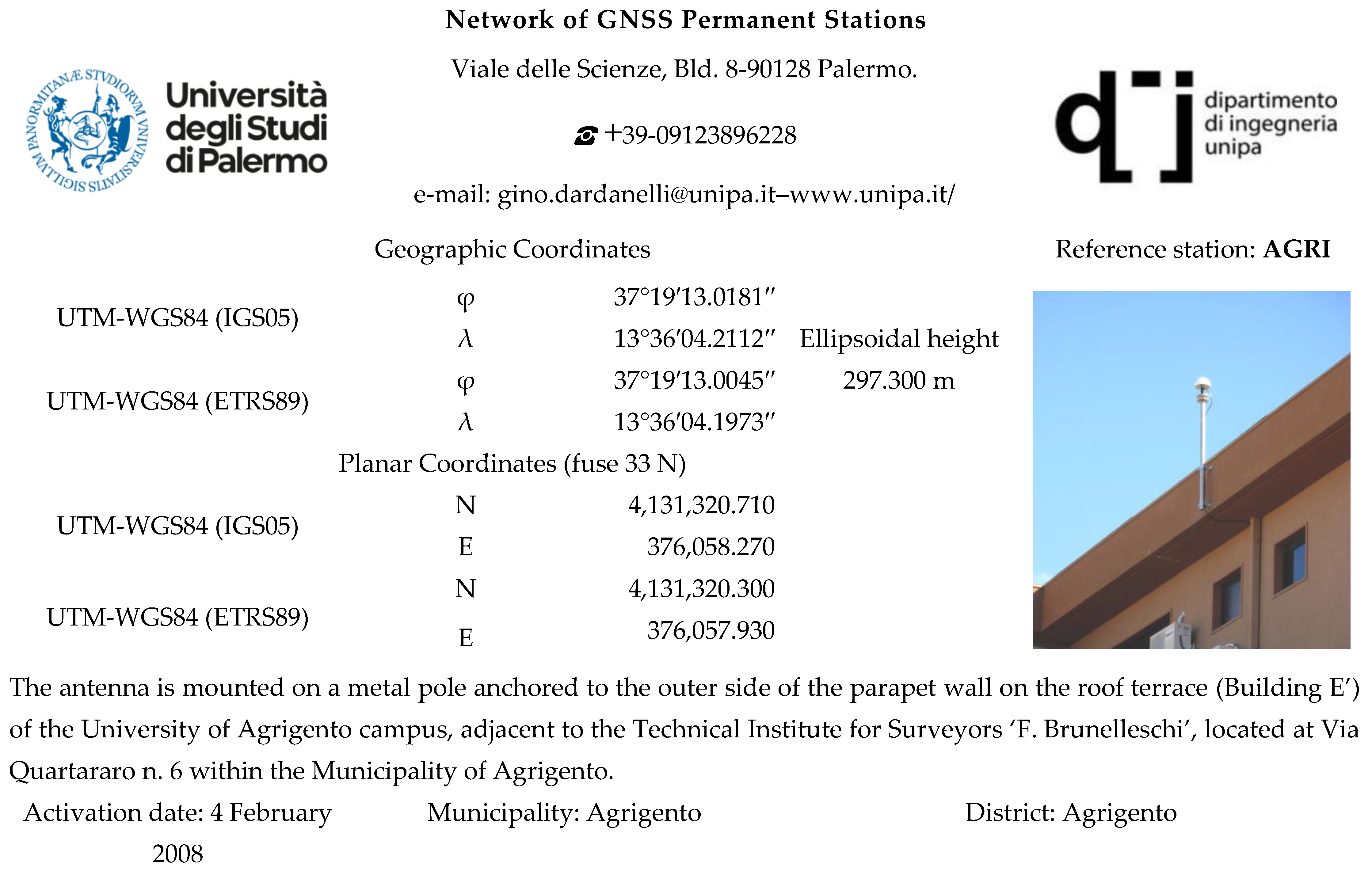
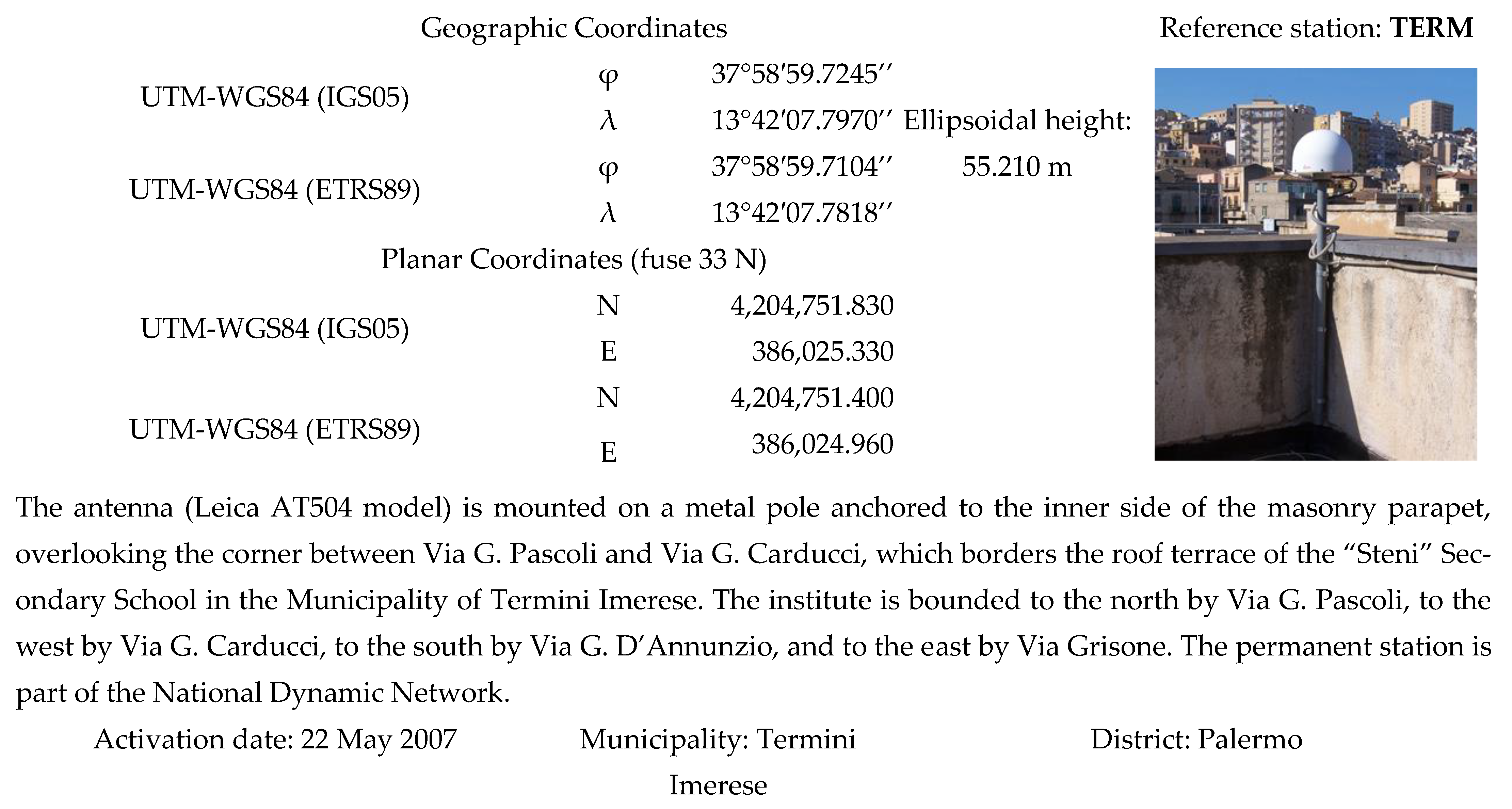
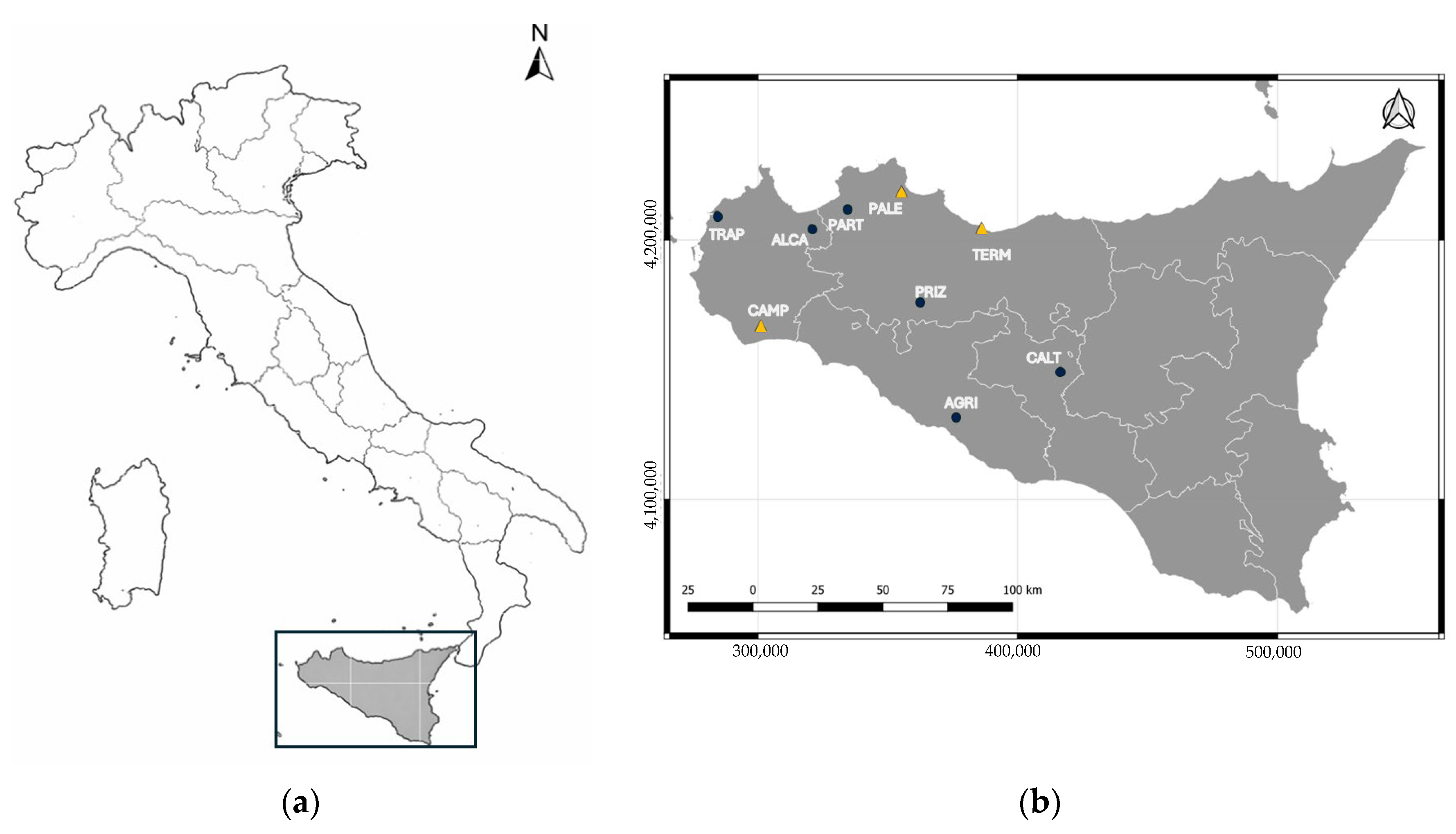
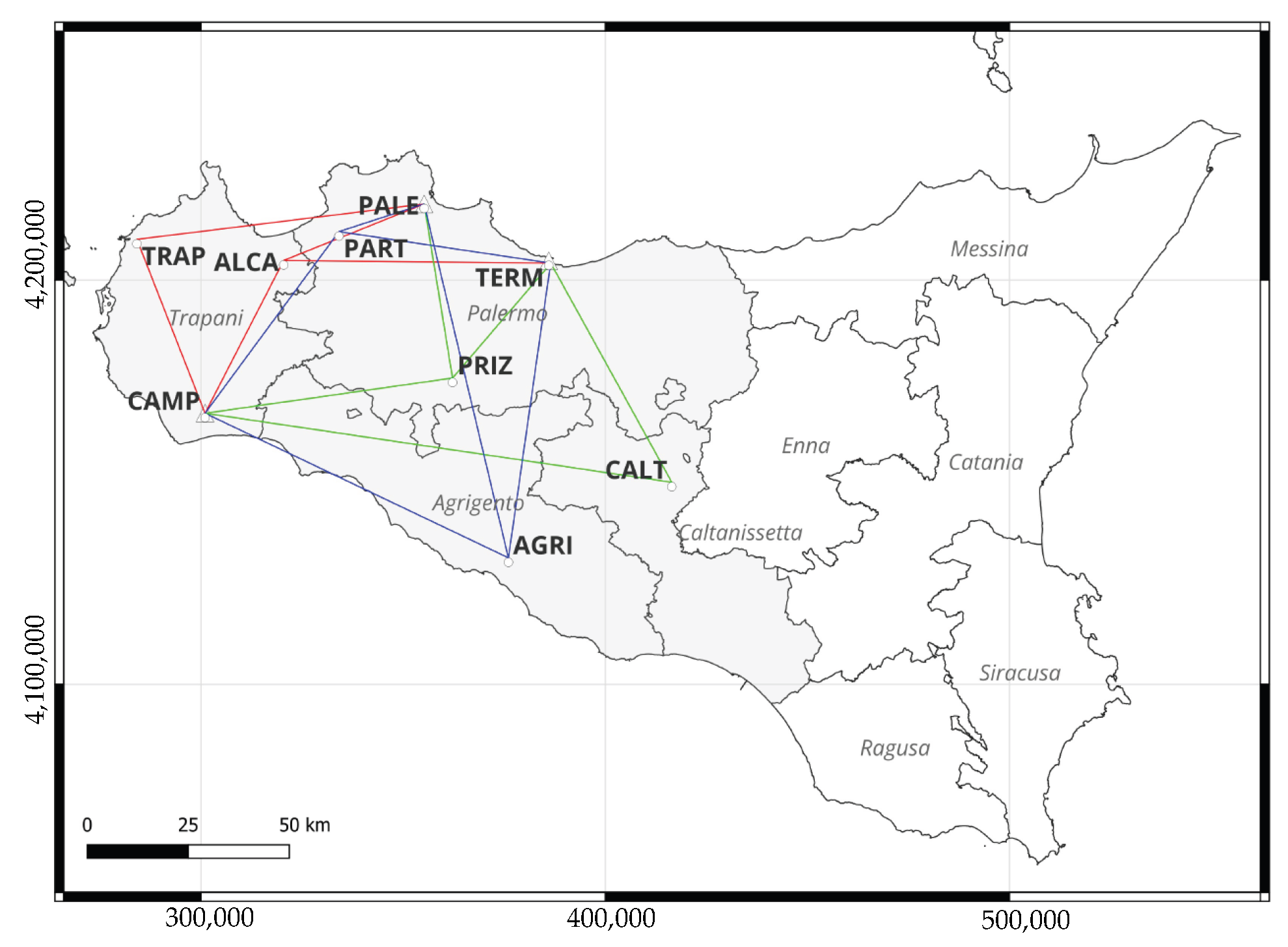
As reported in Dardanelli et al., the UNIPA GNSS CORS network has been made in recent years for scientific applications by researchers of the Department of Engineering, University of Palermo [45]. Originally, the network was composed of eight CORSs located in Sicily, in the provinces of Palermo, Trapani, and Caltanissetta (Figure 1) whose detailed information are reported in Appendix A; subsequently, other stations were installed throughout the island directly by the Topcon national TopNET live network. This network is composed of more than 200 stations equipped with multi-constellation receivers with quadri-constellation (Beidou, Galileo, GLONASS, and GPS). Station data processed with TopNET software allows users to provide real-time differential corrections (Network-RTK or NRTK) and RINEX data for post-processing. Corrections are available in NET (Virtual Reference Station or VRS network solution), RTK (correction from nearest station), and DGNSS (code-only correction service) formats for GIS applications. The protocols used for transmitting real-time corrections via NTRIP are: RTCM 3 MSM, RTCM 3.0, RTCM 2.3, CMR, and CMR+. RINEX data are available with 1, 5, and 30 s sampling intervals. The GNSS network is part of the ETRF2000 National Geodetic System (era 2008.0)-RDN with a report certified by the Military Geographic Institute [46]. The services provided are available for geodetic topographic (GEO), agricultural vehicle guidance (AG), earthmoving vehicles (MC), and Earth Observation (EO) applications [47,48,49].
Also, the horizontal accuracy of GNSS positioning is becoming increasingly important in high-precision territorial applications, where sub-decimetric accuracy must now be ensured [50,51]. UNIPA GNSS CORS has been operational for more than 20 years and has been used in many scientific applications: in particular, its data has been used by Kenyeres et al. within a European regional integration of long-term national dense network solutions for the evaluation of velocities of more than 3000 stations on the continent [52]. Pipitone et al. showed a review of selected applications of UNIPA GNSS CORS [53]; they mainly concern experiences in different application fields such as electromagnetic pollution monitoring, Mobile Mapping System (MMS), dams monitoring with integrated geomatic techniques (as such as InSAR and GNSS), geodetic measurements, use of unmanned aerial vehicles (UAV), positioning and guidance of agricultural machines, monitoring of active faulting, positioning analysis by the NRTK method also including multimodal distribution of positioning errors, and cadastral application [54,55,56,57,58,59,60,61,62,63,64,65,66,67,68,69,70,71].

2.2. Software Processing

The following research aims to frame the permanent stations of the UNIPA network in the IGS05 dynamic network with the use of different software, to verify both the achievable accuracy and the simplified computational procedures used by commercial software compared to scientific software. In the creation of a network of permanent stations, the phase relating to the geodetic framework is of great scientific interest, since the networks of permanent service stations materialize a reference system and distribute it to their users; in fact, every user who uses the data and coordinates distributed by the network (in real time or in post-processing) implicitly positions themself in the system materialized by the network itself [42]. The problem of geodetic classification is mainly linked to the presence of different global reference systems and their variations over time. The topic has been addressed and dealt with exhaustively by the scientific community, and, at present, the most reasonable choice at the national level is to use the IGS reference system and periodically estimate the parameters to switch to the ETRF89 static system. The IGS05 system is a “dynamic” system in that the values of the coordinates vary over time as a function of the deformations of the earth’s crust and are associated with a velocity field; the determination of the coordinates in this system must therefore be referred to a given instant of time [72,73]. For an initial calculation of the coordinates in the IGS05 system of the GNSS NRTK network of the University of Palermo, the data for the month of October 2007 were taken as a reference and only six stations were considered (Palermo, Termini Imerese, Prizzi, Campobello di Mazara, Trapani and Partinico), as data from the Agrigento and Caltanissetta stations were not available because they were installed later and the Alcamo station is currently active. The calculation was performed at the time by colleagues at the University of Cagliari using the Bernese scientific software version 5.0 and processing the monthly data relating to the GPS weeks from 1447 to 1451. For the framework, the permanent IGS stations of Noto, Cagliari, Matera and Lampedusa were taken as a reference. For these stations, a different a priori precision was established for the planimetry and for the altimetry, respectively, of 2 mm and 4 mm. The data obtained from the calculation were considered in accordance with the provisions of the standard IGS requirements, obtaining the weekly results starting from the daily solutions, for which it is possible to carry out network compensations for double differences. Of the nine stations (Alcamo, Agrigento, Caltanissetta, Campobello di Mazara, Palermo, Partinico, Prizzi, Termini Imerese and Trapani), the three stations of Campobello di Mazara, Palermo and Termini Imerese were used as reference points of known coordinates as they were already framed in the National Dynamic Network (RDN) and their geocentric coordinates were already known in the IGS05 system. Starting with these three points, all of the others were classified by calculating the three components of the baselines that connect each unknown point with the three known coordinate points, with the final result being the estimate of the three coordinates (X, Y, Z) of the unknown points. The work began with the collection of RINEX files belonging to a time interval of one year. This is because, for the research, it was considered useful to carry out one compensation per month for twelve months with each software. Data belonging to the months ranging from March 2010 to March 2011 were chosen, discarding the month of August 2010, a month in which some stations were not active; therefore, it was not possible to have the starting data of all nine stations for any day (Figure 2).
There were eighteen bases to be processed, three for each point to be framed; since the number of available receivers is nine, the number of linearly independent bases will be eight (NR – 1). To process the eighteen bases, three different sessions are then required, for each of which six bases are processed. In the first session, the bases concerning the stations of Caltanissetta and Prizzi were processed; in the second, those concerning the stations of Agrigento and Partinico; and finally, in the third, the bases concerning the stations of Alcamo and Trapani. Therefore, considering the adopted scheme, 18 baselines were created, which were processed in groups of six. In fact, unlike commercial software with which the three sessions (i.e., the data for the three days relating to a month) were processed simultaneously, with NDA Pro it was necessary to process each session individually; thus, 36 processes were performed, three per month. NDA Pro has the characteristics of scientific software, since it applies simplified tropospheric corrections involving the Saastamoinen and Niell mapping functions [74,75], while the ionospheric error was determined according to the Klobuchar model [76], which used the ocean loading corrections based on Schwiderski’s model [77]. Other parameters used were shown in Pipitone et al. [44]. Also, Leica LGO offers a choice of various tropospheric models—Hopfield, Simplified Hopfield, or Saastamoinen—while the ionospheric model used is always Klobuchar. Trimble TGO and Pinnacle do not give precise indications regarding the models, while NDA Lite use Euler and Goad [69]; finally, Topcon Tools uses Goad and Goodman, Niell or UNBabc (tropospheric model).

2.3. Comparison with Bernese Solution

The comparison between the coordinates produced by the legacy software and those obtained through CSRS was first conducted with respect to the Bernese reference solution by analyzing the three-dimensional vector of the planometric differences ΔXYZ. The differences are computed at each epoch between the Cartesian geocentric coordinates (XYZ) of the given solution and the corresponding geocentric coordinates estimated by Bernese. For each processing strategy, coordinate discrepancies were computed independently for the three stations, and a network-level indicator was derived by averaging the differences across all stations. The evaluation relied on a single coordinate value per station, defined as the difference between the annual mean coordinate and the coordinate at a fixed reference epoch. Although this approach provides a quantitative measure of agreement between solutions, its interpretability is inherently constrained by the choice of reference epoch. It therefore does not fully capture the temporal variability of the coordinate differences.

2.4. Temporal Analysis

The purpose of the following analysis was to examine the temporal evolution of the horizontal and vertical displacement components, ΔEN(t) and ΔUp(t), and the behavior of ΔEN(t) vs. ΔUp(t) produced by different GNSS processing software packages. For each software solution, monthly coordinate estimates were generated for all available stations over a one-year observation period. The horizontal and vertical displacements for each epoch were computed with respect to the initial position to allow comparison with the coordinates over time of different stations. The resulting ΔEN values from the individual stations were then averaged to obtain a single representative time series for each software package. Regarding ΔEN and ΔUp over time, the time variable was parameterized as a normalized value ranging from 0 to 1, corresponding to the initial and final months of the time series. All software packages were processed using the same workflow. All epochs, including those with anomalous values, were retained and incorporated into the averaging procedure without additional filtering, ensuring methodological uniformity across processing strategies.

2.5. Statistical Analysis (Welch’s t-Test)

To assess whether the differences among the mean values obtained from the seven software packages were statistically significant, Welch’s t-test was employed [78,79]. Although all software solutions share the same sample size (n = 12), their standard deviations are heterogeneous. Under these conditions, the classical Student’s t-test, which assumes homogeneity of variances, may yield biased estimates of variability and degrees of freedom. In contrast, Welch’s t-test does not require the assumption of equal variances and provides a more robust evaluation of statistical significance by adjusting the degrees of freedom according to the observed variance structure. For each pair of software packages A and B, the t statistic was computed as (1):
t = E ˉ N A E ˉ N B σ A 2 n A + σ B 2 n B
where
-
E ˉ N A and E ˉ N B   are the sample means of ΔEN of two software solutions;
-
σ A and σ B are the standard deviation;
-
n A = n B denotes the sample size.
The effective degrees of freedom (df) were estimated using Welch’s Formula (2):
d f = σ A 2 n A σ B 2 n B 2 σ A 2 / n A ) 2 n A 1 + σ B 2 / n B ) 2 n B 1
The two-tailed p-value was obtained by evaluating (3):
p = 2 · [ 1 T ( t ,   d f ) ]
where T t , d f is the cumulative distribution function of the Student’s t distribution with the degrees of freedom computed above. The application of Welch’s t-test enabled an accurate quantification of the statistical significance of the differences among software solutions.

2.6. Trend Estimation and Detrending

Regarding the residual projection and EN– Up integration following temporal detrending, after applying the temporal detrending to E N ( t ) and U p ( t ) , the slope m was estimated by minimizing the residuals under the assumption that the errors of the time values t are negligible. The residuals were then projected along the direction of the trend line and subsequently combined to obtain the detrended EN component with respect to Up.

2.7. Spatial Variance and Confidence Ellipse Analysis

The bidimensional variance, Var E N   H , has been calculated to quantify the spread of the point E N i ,   U p i   from the centroid, E N ¯ , U p ¯ that represents the mean of the squared distances from the centroid, thus providing a measure of dispersion in the E N   U p   plane (4):
Var E N   U p = 1 n i = 1 n ( E N i E N ¯ ) 2 + ( U p i U p ¯ ) 2
The value of n   represents the number of monthly observations ( n = 12 ) . The mean Euclidean distance of E N i ,   U p i   from the centroid is also reported, ¯ E N   U p , that, given its units, provides an intuitive measure of dispersion that complements the bidimensional variance (5).
¯ E N   U p = 1 n i = 1 n ( E N i E N ¯ ) 2 + ( U p i U p ¯ ) 2

3. Results and Discussion

The objective of this research is to compare and quantitatively assess the reliability of solutions obtained using different GNSS software packages based on various processing strategies and network configurations (e.g., single-baseline solutions, network adjustments involving one or more permanent reference stations, and precise point positioning, PPP) for geodetic network framing in civil engineering applications.

3.1. Comparison with Bernese Solution

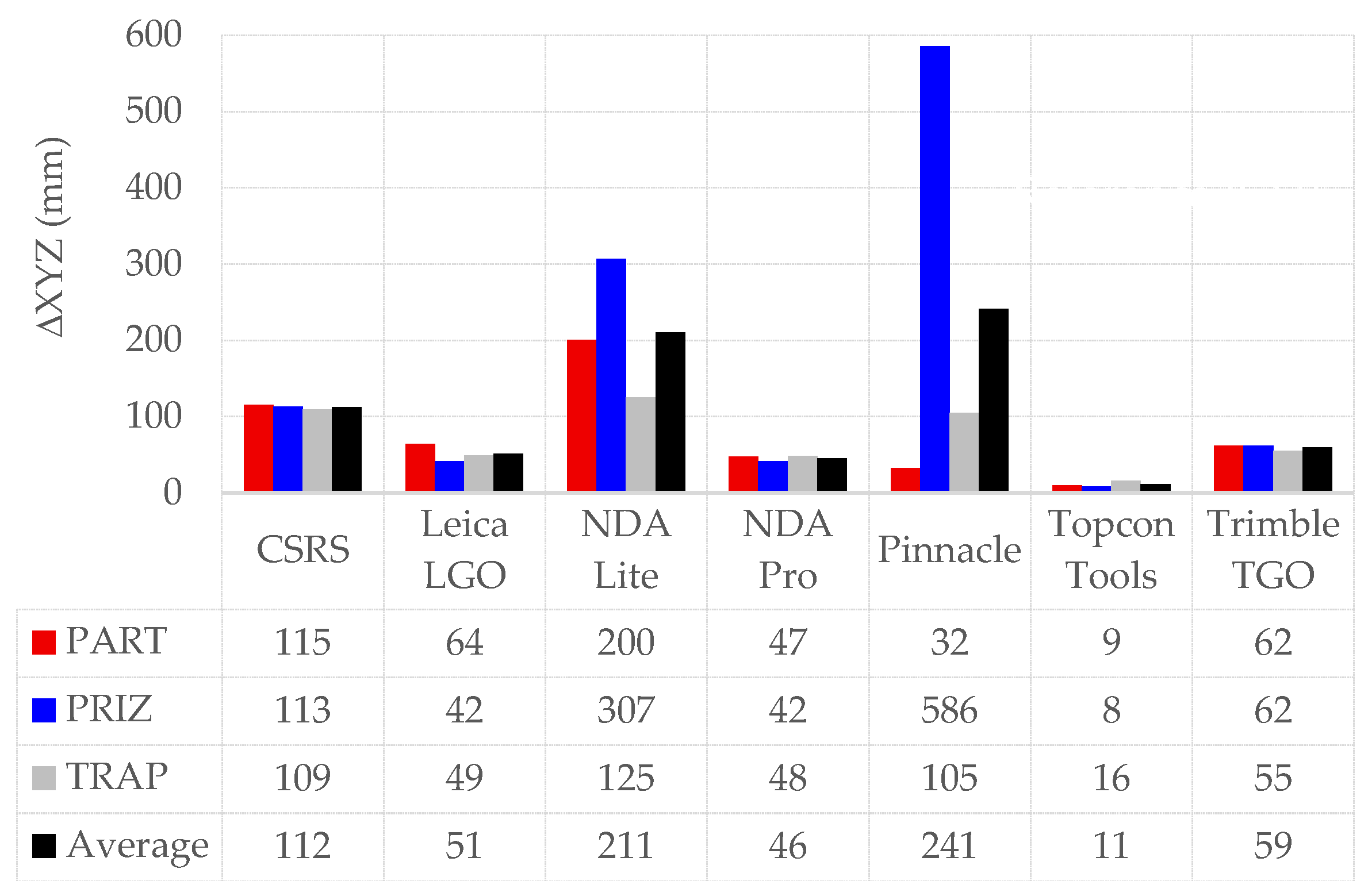
As a preliminary step, the time series solutions derived from the analyzed legacy software packages (Leica LGO, NDA Lite, NDA Pro, Pinnacle, Topcon Tools, and Trimble TGO) and from the CSRS online service were compared with a reference solution computed using Bernese v. 5.0, a scientific software package widely adopted in the GNSS community. Because homogeneous datasets were not available for the same time span, the mean of the monthly solutions from March 2010 to March 2011 was used for the legacy software and CSRS, whereas the available station coordinates referred to October 2007 were used for the Bernese solution [43]. The analyzed permanent stations belong to the UNIPA GNSS CORS network, specifically Partinico (PART), Prizzi (PRIZ), and Trapani (TRAP). The remaining stations belonging to the National Dynamic Network (Rete Dinamica Nazionale, RDN)—Palermo (PALE), Termini Imerese (TERM), and Campobello di Mazara (CAMP), whose coordinates were also computed with Bernese—were not used because of their adoption as reference stations for network adjustment when processing with legacy software. The comparison was performed by evaluating the differences in geocentric coordinates (X, Y, Z), expressed in the same reference frame. Assuming that the expected accuracy for GNSS network framing is on the order of a few millimeters, the comparison between the legacy software and CSRS indicates that Topcon Tools provides the smallest differences in all components (X, Y, Z), comparable with the precision requirements of geodetic network adjustment. This is followed by Leica LGO, NDA Pro, and Trimble TGO, which show comparable orders of magnitude, although not for all components. A more general comparison based on the magnitude of coordinate differences confirms that these four software packages exhibit limited deviations from the Bernese reference solution and, in any case, smaller discrepancies than the remaining software included in the analysis (Pinnacle, NDA Lite, and CSRS). The latter, in fact, consistently show differences on the order of centimeters and, in some cases, even larger values, indicating significant deviations from the Bernese solution. By combining the three coordinate components, the analysis was extended to the three-dimensional differences between the solutions obtained from the legacy software and CSRS and the Bernese reference solution (ΔXYZ), following the same approach as the previous analysis (Figure 3). The figure shows the differences for the individual stations—PART (red), PRIZ (blue), and TRAP (gray)—as well as the mean difference across the three stations (black); the numerical values are summarized in the panel below the figure. As for the analysis of the individual X, Y, and Z components, the smallest three-dimensional differences were obtained for Topcon Tools, NDA Pro, Leica LGO, and Trimble TGO, with values ranging from 0.011 m to 0.059 m. Conversely, the largest discrepancies were observed for CSRS, with an average value of 0.112 m, followed by NDA Lite and Pinnacle, whose results are strongly influenced by the solution obtained for the station PRIZ (0.211 m and 0.241 m, respectively).
The previous analysis was performed using a single coordinate value, computed as the difference between the annual mean coordinate of each station and the coordinates at a fixed reference epoch derived from Bernese processing. This comparison provides a quantitative assessment of the results; however, it is valid only with respect to the selected reference epoch.

3.2. Temporal Analysis

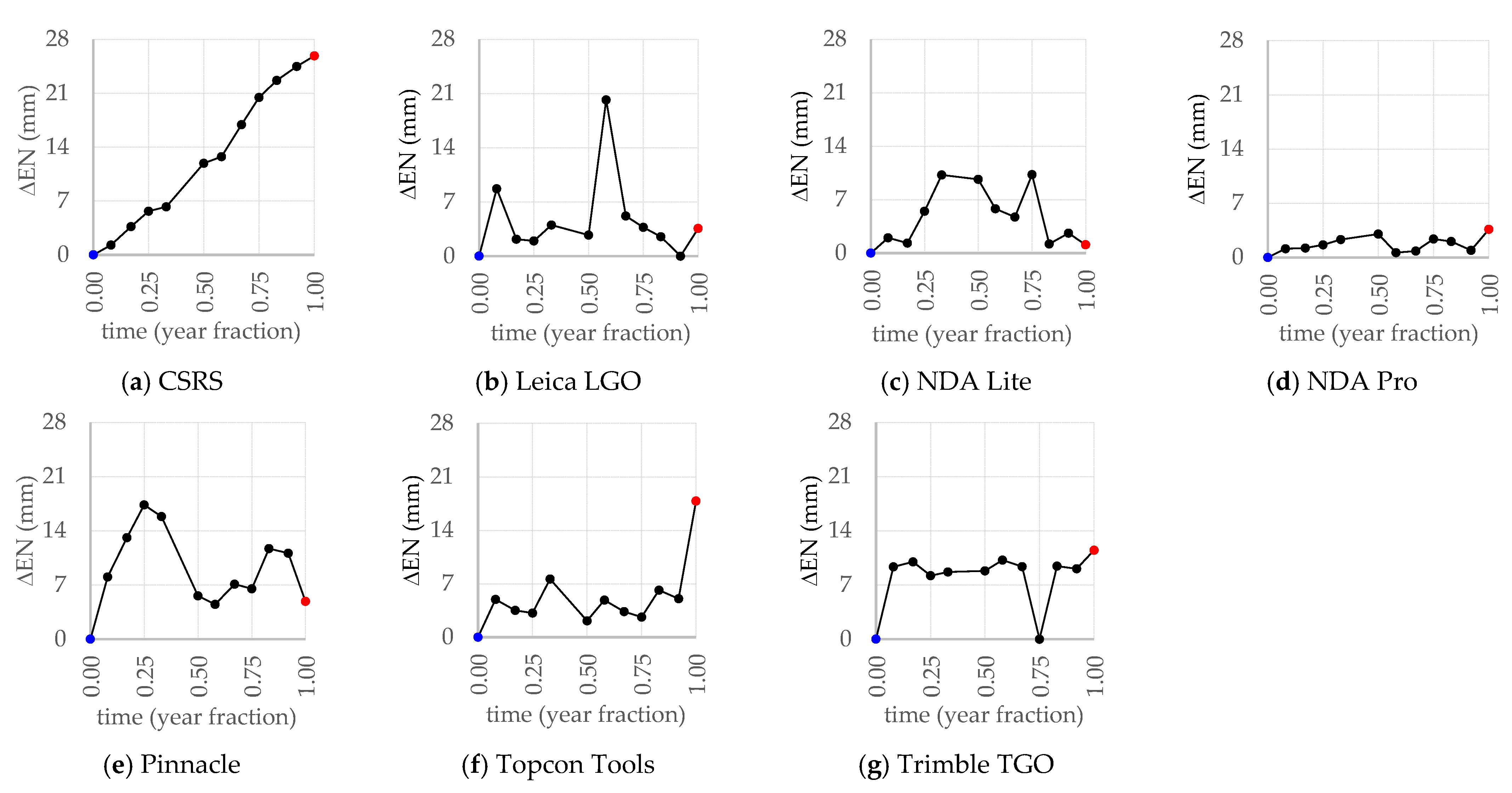
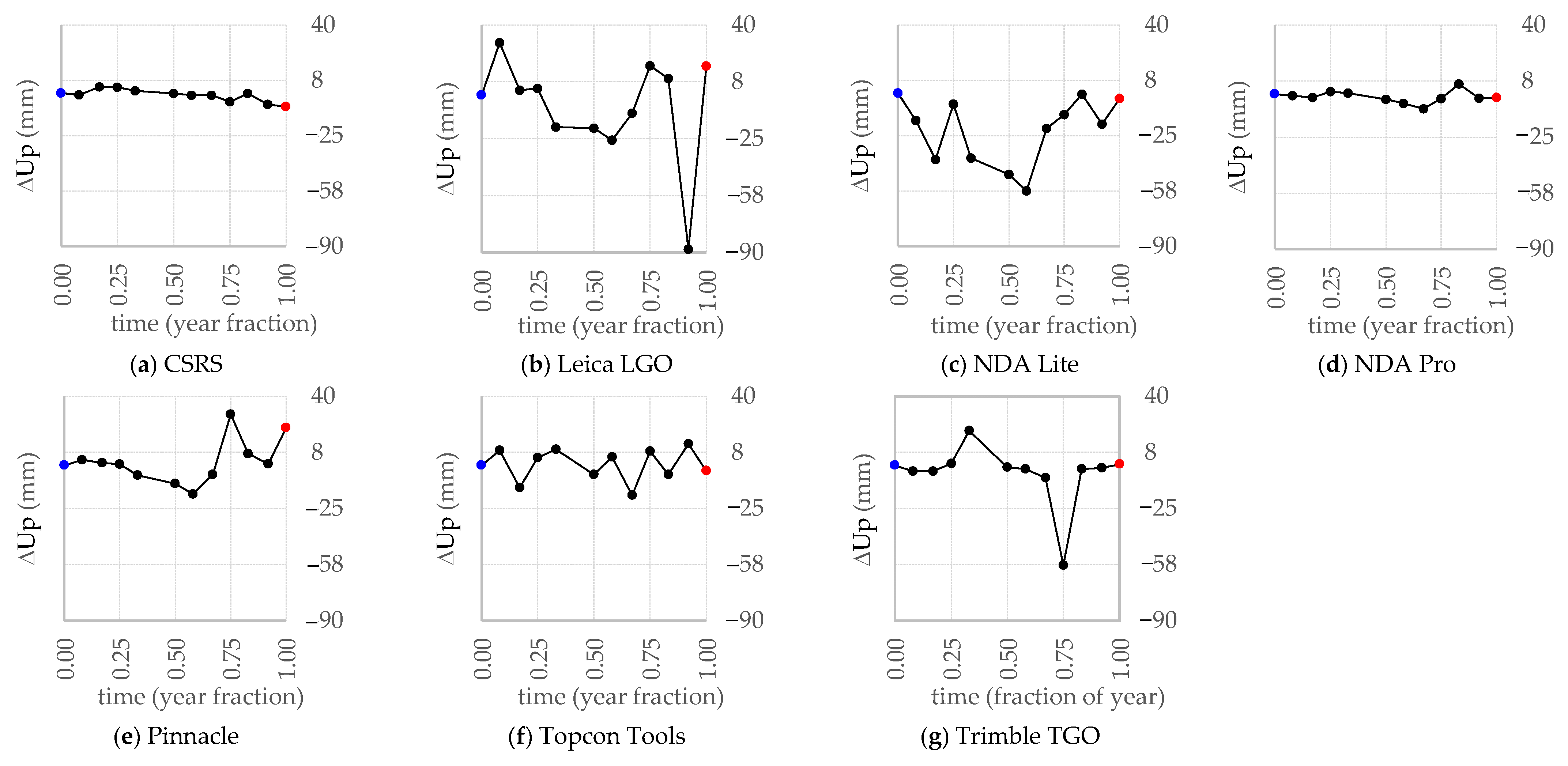
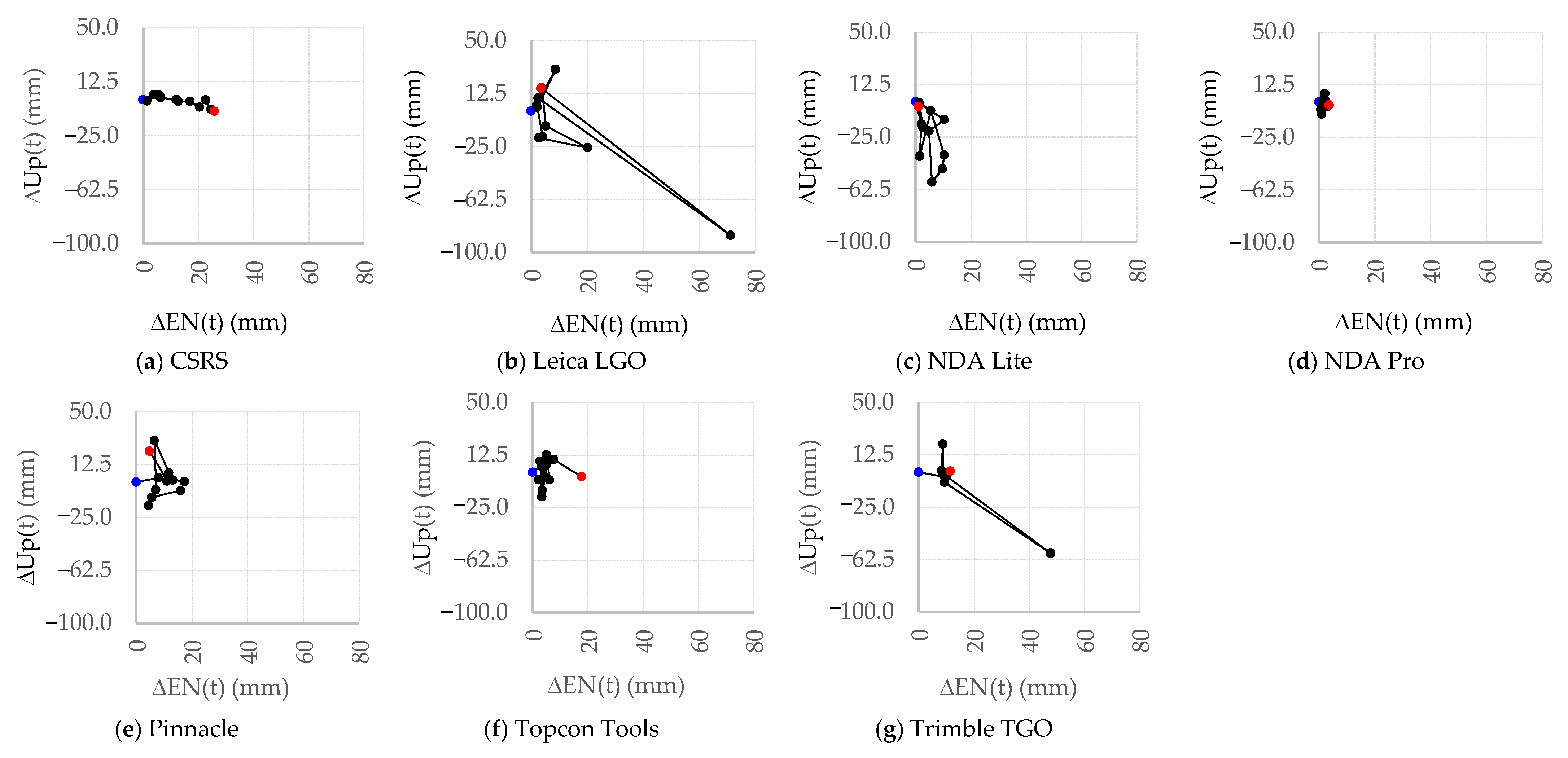
Because a larger number of stations were processed with the legacy software packages and CSRS than those included in the previous plots, namely Agrigento (AGRI), Alcamo (ALCA), and Caltanissetta (CALT), resulting in a total of six stations, a temporal analysis was also carried out. The analysis considered the variability of both horizontal and vertical coordinates over one year. The compared coordinates correspond to the mean of the monthly solutions from all available stations (12 values), assuming homogeneous station behavior. This approach reduces the impact of individual stations exhibiting anomalous trends (e.g., PRIZ in the previous plots) and provides a more stable representation of the overall software performance. Figure 4 and Figure 5 illustrate the temporal evolution of the horizontal component (ΔEN) and the vertical component (ΔUp), respectively, while Figure 6 shows the relationship between the two components (ΔEN(t) vs. ΔUp(t)). Time is expressed as a fraction of a year, ranging from 0 (March 2010) to 1 (March 2011). The blue marker represents the initial reference solution and the red marker the final one. Intermediate black markers indicate the mean value of the relative deviations with respect to the preceding epoch, computed for all six stations.
Figure 4 shows the temporal evolution of the mean ΔEN with respect to the initial position for each GNSS processing software considered. A preliminary investigation reveals significant differences among the processing solutions. In particular, CSRS software exhibits a relatively regular curve, characterized by a gradual variation from the initial to the final position. The drift is moderate but nearly constant, suggesting a non-negligible temporal trend (approximately 25.9 mm over one year) (panel a). This behavior is likely related to the use of a PPP algorithm, in which the individual station is not constrained to a network solution, resulting in a shift consistent with tectonic plate motion. Some software packages display a generally stable behavior over time, excluding isolated anomalous values. This is the case for Leica LGO (panel b), where a single intermediate outlier breaks an otherwise regular trend, and Trimble TGO (panel g), where two values (referred to the initial and to one intermediate epochs) influence the temporal evolution of the solution. NDA Pro (panel d) shows a more stable behavior over time compared to the Lite version (panel c). The drift is limited and the curve appears more compact, indicating greater internal consistency of the solution. The solution obtained with Pinnacle (panel e), on the other hand, exhibits an apparently bimodal pattern, suggesting variability that cannot be attributed only to random noise. Following the same approach adopted for the horizontal component, the temporal variability of the vertical coordinate (ΔUp vs. t) was then analyzed to assess the stability of the solutions provided by each software package and to determine whether this stability depends on the component considered. The corresponding results are summarized in Figure 5.
The assessment of the vertical component over time shows a slightly decreasing trend for CSRS (panel a); however, the overall behavior of this software appears relatively stable. Stable temporal solutions are also observed for NDA Pro (panel d) and Trimble TGO (panel g), although for the latter an intermediate value identified as an outlier must be excluded from the analysis to obtain a uniform behavior. The solutions provided by Pinnacle (panel e), Leica LGO (panel b), and NDA Lite (panel c) exhibit the highest instability, followed by Topcon Tools (panel f). In the latter case, a fluctuating pattern is observed, characterized by alternating positive and negative values with no evident long-term trend. When considering the comparison between the horizontal (x-axis) and vertical (y-axis) solutions (ΔEN(t) vs. ΔUp(t)), significant differences among the legacy software are again evident (Figure 6). In particular, two distinct anomalous solutions emerge for Leica LGO and Trimble TGO, associated with values acquired in February and December, respectively. The most prominent result, however, is the presence of two contrasting behaviors: the slightly decreasing trend of the CSRS solution, confirming the pattern previously observed, and the clear stability of the NDA Pro solution, highlighted by the clustering of points within the analyzed time interval.

3.3. Statistical Analysis (Welch’s t-Test)

To quantify the differences among the solutions provided by the various software packages, a Welch’s t-test statistical analysis was performed. The results reported below refer to the horizontal component (ΔEN(t)), the vertical component (ΔUp(t)), and their combined solution (ΔENUp(t)), according to the results previously presented. For all analyzed solutions, considering the single mean value averaged across all stations (12 values in total), results were considered statistically significant when the p-value was lower than the conventional threshold of 0.05 (highlighted in bold in the tables below) associated with high t-statistic (absolute values). Analyzing the horizontal component ΔEN(t) (Table 2), several software pairs exhibit statistically significant differences, as indicated by the Welch t-statistic and the corresponding p-values.
For instance, CSRS differs significantly from almost all other software packages, with high t-values and p-values below 0.05, except for Pinnacle and Trimble TGO, for which the p-values are 0.291 and 0.118, respectively. Similarly, NDA Lite shows significant differences with respect to NDA Pro, Pinnacle, and Trimble TGO, with p-values consistently below 0.04. NDA Pro exhibits even more pronounced differences, particularly when compared to Pinnacle (t = 3.8290, p = 0.0010) and Trimble TGO (t = 3.6461, p = 0.0014). Conversely, many other software pairs present very low t-values, close to zero, and p-values well above 0.05, confirming the absence of statistically significant differences in their mean horizontal solutions.
Overall, the results outline a coherent pattern: CSRS, NDA Lite, and especially NDA Pro tend to differ significantly from several other software packages, whereas many of the remaining pairs exhibit only minor differences, not supported by statistical evidence. Considering the vertical component ΔUp(t) (Table 3), the most pronounced differences are associated with NDA Lite, which appears to be significantly different from all other software packages, apart from Pinnacle (t = 1.773, p-value = 0.102). These findings indicate that NDA Lite exhibits a ΔUp parameter dynamic that is systematically different from that of several other software solutions, with more pronounced mean deviations.
The comparison between NDA Pro and CSRS confirms the behavior previously observed in Figure 5, where both solutions exhibited a relatively stable trend. For the ΔUp parameter, no statistically significant differences emerge between the two software packages, indicating that they produce comparable results. In statistical terms, the t-value is very close to zero (t = 0.240) and the p-value is high (0.815), confirming that the observed difference between the solutions is coherent with random variability. The pairs Leica LGO, Pinnacle, Topcon Tools, and Trimble TGO do not show statistically significant differences, demonstrating a high level of consistency in the estimation of the ΔUp parameter, with very small mean deviations. Finally, the analysis was repeated for the combined component ΔENUp(t) (Table 4), revealing similarities with the analysis of the horizontal component (ΔEN(t)). In particular, the behavior of NDA Pro is again confirmed, as it shows statistically significant differences with respect to all other software packages, with high absolute t-values ranging between 3.33 and 4.46 and p-values consistently below 0.01. NDA Lite appears significantly different from Topcon Tools and Trimble TGO, with t-values between 2.14 and 2.21 and p-values below 0.05. The comparison between NDA Pro and NDA Lite is especially significant (t = 3.2890, p = 0.005). For the remaining software pairs, including CSRS, which previously exhibited a distinct behavior, no statistically significant differences are observed, as the t-values are close to zero and the corresponding p-values are well above the conventional 0.05 threshold.
Based on these evaluations, it is evident that the software packages exhibiting the largest differences, specifically for the horizontal component ΔEN(t), are CSRS and NDA Pro, with two nearly opposite behaviors. While CSRS shows a pronounced temporal trend in the horizontal component, which is also reflected in the combined component ΔENUp(t), NDA Pro demonstrates a more stable temporal behavior and stronger internal consistency of the solution, characterized by a more limited trend and a more compact curve. This behavior is further emphasized in the ΔENUp(t) vector composition, supporting the interpretation of NDA Pro as providing the most stable solution. However, the clearly defined trend observed for CSRS, mainly related to the PPP processing strategy and the absence of constraints with other stations that would allow the solution to be framed within a local reference context, results in a marked differentiation from all other software packages. This characteristic compromises a fully objective comparison with the remaining solutions. For this reason, a temporal detrending of the CSRS solution was performed.

3.4. Trend Estimation and Detrending

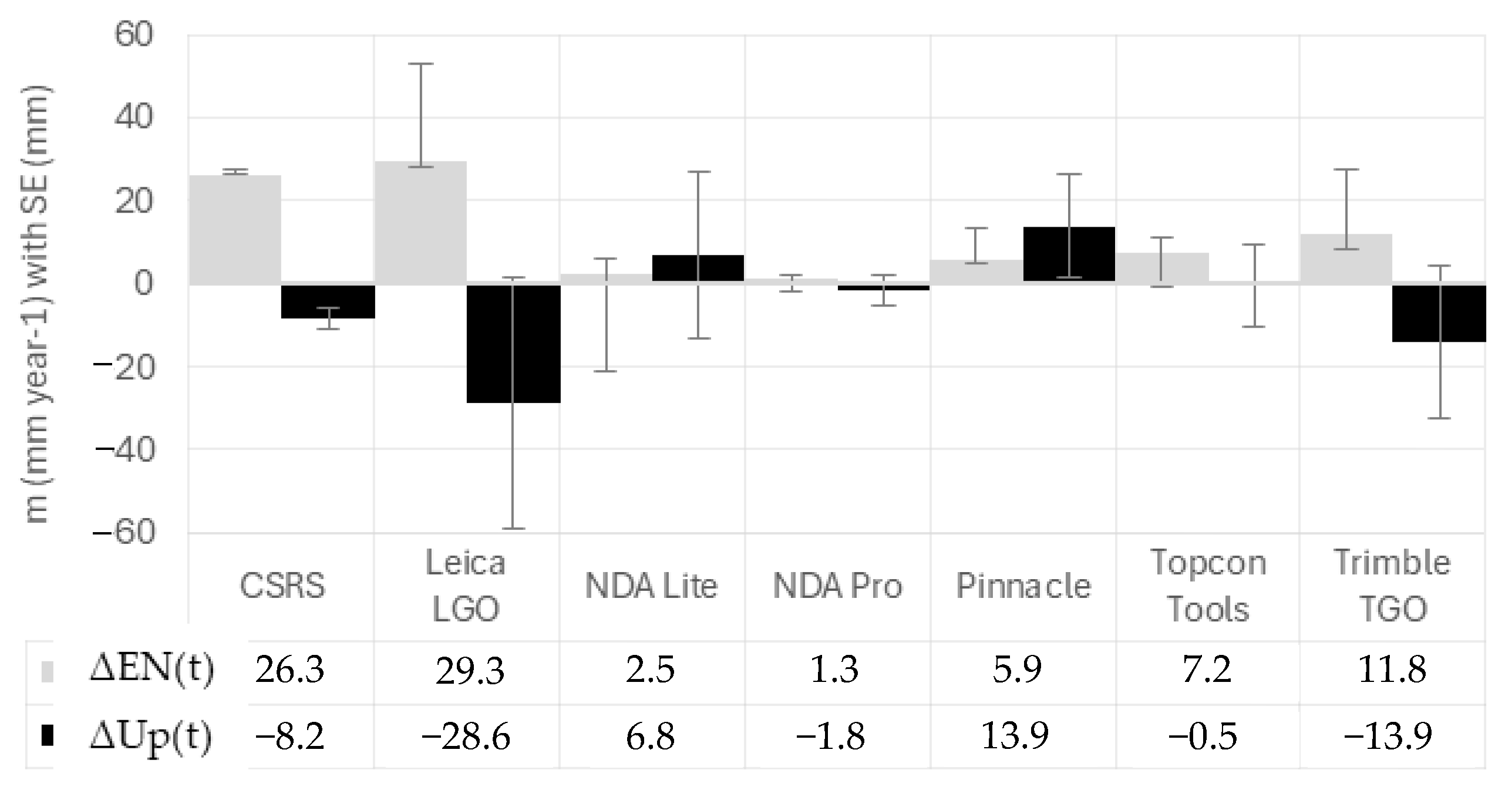
To this end, the slope (m), expressed in mm/year, was estimated from the temporal evolution of the horizontal (ΔEN vs. t) and vertical (ΔUp vs. t) components represented in the previous analyses in Figure 4 and Figure 5, respectively, together with the corresponding standard error, which quantifies the statistical significance of the identified trend (Figure 7). In this figure, the histograms are proportional to the estimated slope, and thus to the magnitude of the trend for each solution; the numerical values of the slopes (mm) for ΔEN(t) and ΔUp(t) are reported directly within the plot, below the histogram. Error bars represent the standard error associated with each trend estimate, also summarized in Table 5 for each component (ΔEN(t) and ΔUp(t)) and for each software package.
The plot indicates that the largest slopes (greater than 20 mm/year) are obtained for CSRS and Leica LGO. However, the statistical significance of the trend for each component must also be evaluated in relation to the associated standard error. A trend can be considered meaningful only when the standard error is sufficiently small. For that reason, the trends estimated for CSRS (equal to 26.3 mm/year for ΔEN(t) and −8.2 mm/year for ΔUp(t)) are statistically significant, as expected, given their relatively small standard errors (1 mm for ΔEN and 2 mm for ΔUp). In contrast, the slope values obtained for Leica LGO, although comparatively large, are associated with higher standard errors (23 mm for ΔEN(t) and 30 mm for ΔUp(t)), which reduces their statistical significance. On the contrary, the very low slope values and corresponding standard errors obtained for NDA Lite, NDA Pro, and Topcon Tools confirm the compact dispersion of the solutions. Thus, the estimated trends for these software packages are not statistically significant. Based on these considerations, since the only statistically significant temporal trend is associated with the PPP solution computed with CSRS, a detrending procedure was applied to this solution. The detrending was performed using, as a reference trend line, not the one derived from the mean of the values of the six analyzed stations (Figure 4 and Figure 5), but rather the trend estimated from three independent stations, PALE, TERM, and CAMP, already used as constraints in the static processing performed with the legacy software. This approach ensures greater consistency with the results obtained from the other software packages. The monthly data for the three reference stations, covering the same time interval as the other stations, were processed using CSRS in PPP mode, obtaining 12 monthly solutions for each station. A monthly mean of the three stations was then computed, following the same procedure previously adopted for the six-station average. The corresponding results are presented in Figure 8.
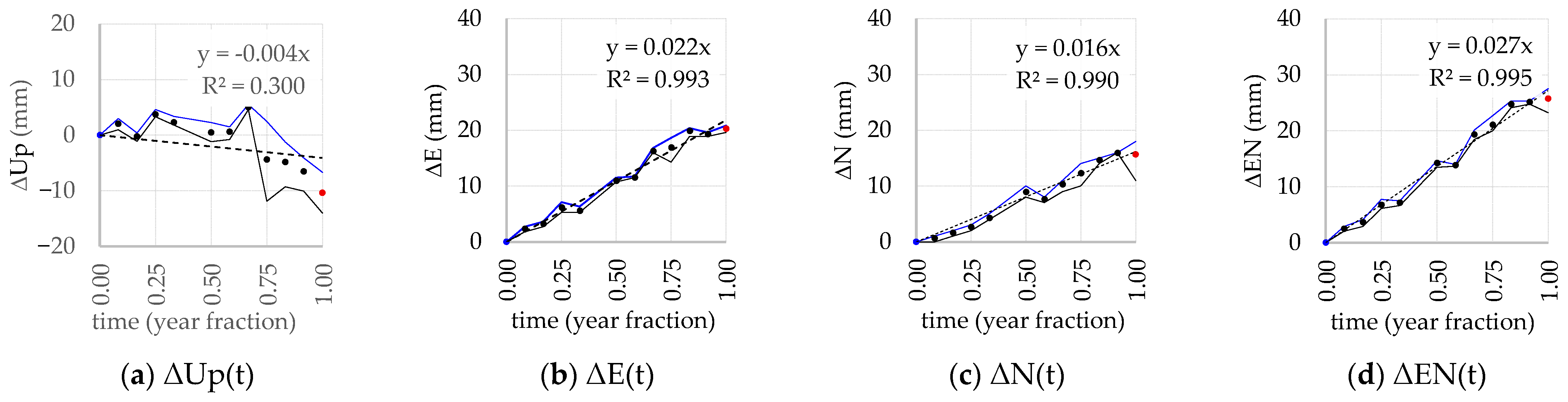
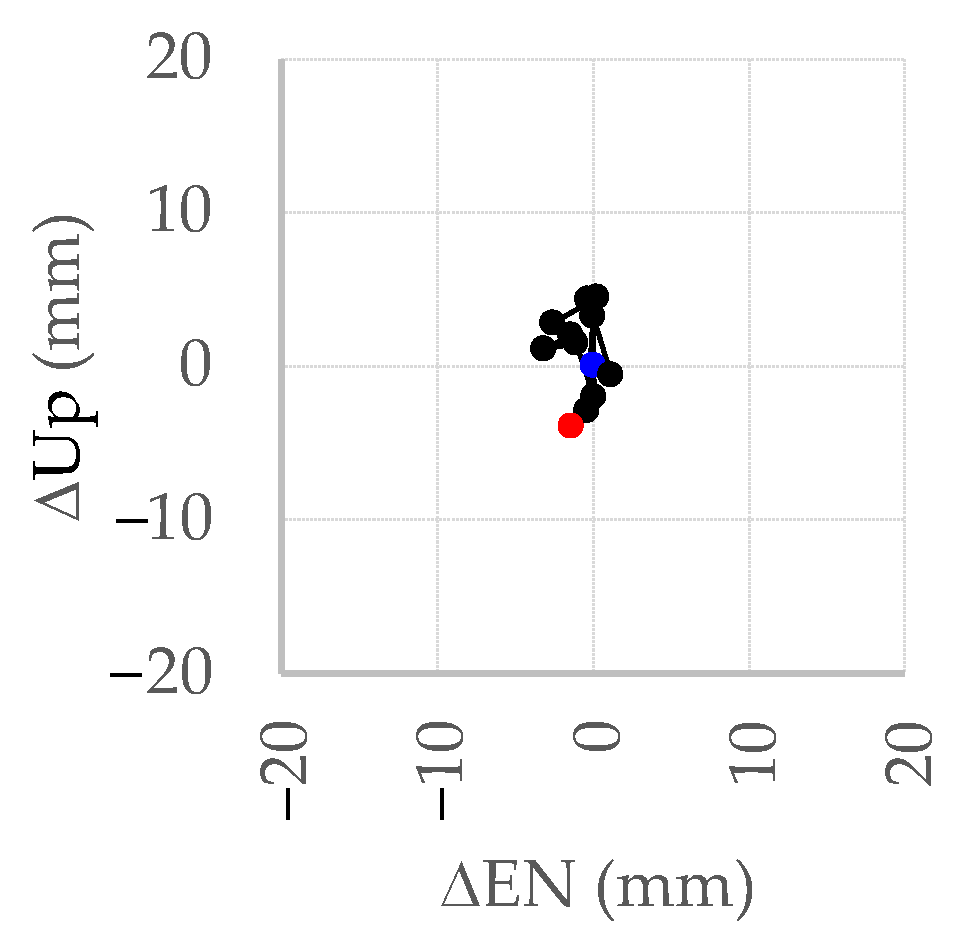
The plots illustrate the temporal evolution of ΔE (Figure 8b), ΔN (Figure 8c), ΔUp (Figure 8a), and ΔEN (Figure 8d) for the three stations PALE, TERM, and CAMP compared to the initial value (all time series start from 0.0). For each component, the minimum–maximum variability range is shown (continuous black and blue lines, respectively), together with the monthly mean values. The initial value is highlighted in blue, intermediate values in black, and the final value in red. The trend line (black dashed line) and its corresponding equation are also reported for each component. The trend was estimated by imposing a null intercept, since all horizontal and vertical coordinate variations were computed relative to the initial value. The analysis indicates that ΔUp(t) exhibits a lower coefficient of determination (R2) compared to ΔE(t), ΔN(t), and ΔEN(t) (0.300 vs. 0.993, 0.990, and 0.995, respectively). Moreover, ΔUp(t) shows a variability range on the order of several millimeters (approximately from 6 to −14 mm) during the last four months of the time series. In contrast, ΔE(t) presents an average variability of about 1 mm, with a maximum observed in December (4 mm). ΔN(t) shows a similar behavior, with typical variability of approximately 1 mm, a maximum in December (4 mm), and an additional peak at the end of the series in March (7 mm). ΔEN(t) follows a comparable pattern, with typical variability around 1 mm, a maximum in December (3 mm), and a further peak in March (3 mm). Based on these results, the estimated trend lines derived for each component were used to detrend the CSRS time series (ΔUp, ΔE, and ΔN), in order to make the ΔEN vs. ΔUp variations directly comparable with those obtained from the legacy software packages (Figure 9).
Following the detrending procedure, the CSRS solution has stable behavior over time. The values cluster around zero, and the overall pattern becomes directly comparable with the solutions obtained from the other software packages.

3.5. Spatial Variance and Confidence Ellipse Analysis

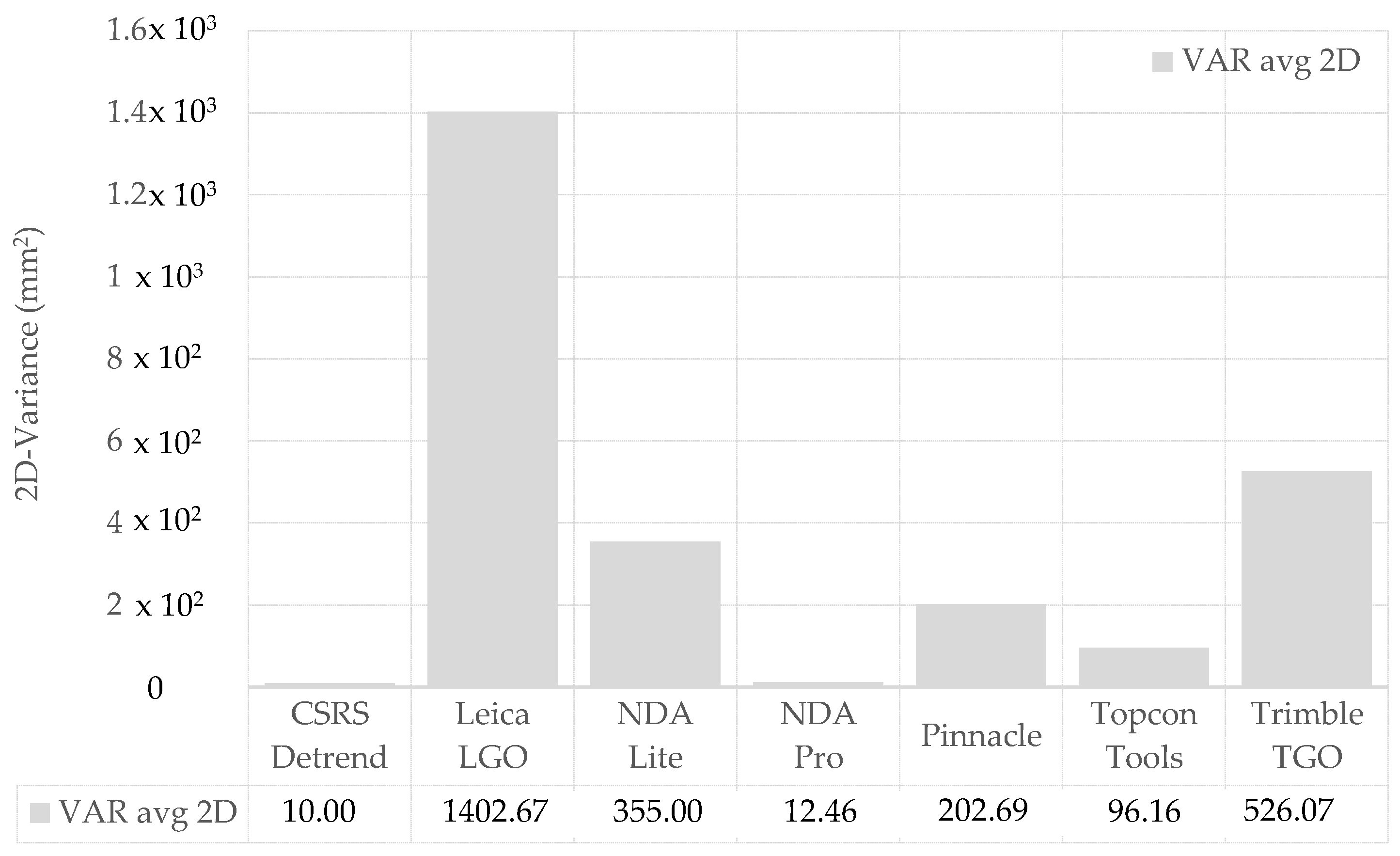
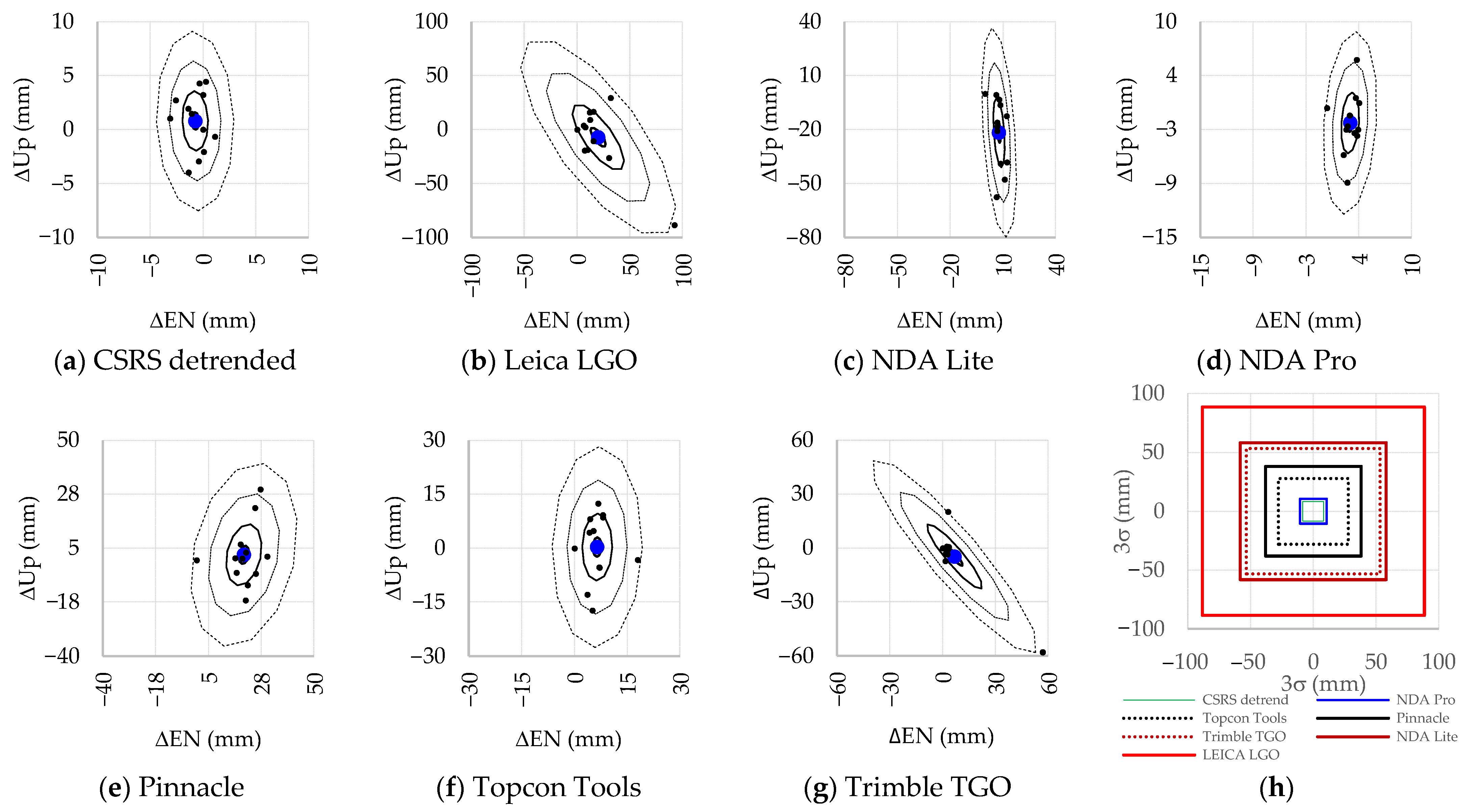
To further quantify the dispersion of the GNSS solutions, an additional analysis of the two-dimensional spatial variance Var E N   U p was performed (Figure 10). The results highlight significant differences among the software packages. The detrended CSRS and NDA Pro solutions are clearly the most compact, with Var E N   U p = 10 mm2 and Var E N   U p = 12.46 mm2, respectively, indicating a highly concentrated point cloud around the corresponding centroid. In contrast, the Leica LGO solution exhibits the highest variance overall (1402.67 mm2), reflecting a much wider and more variable spatial distribution of points, followed by Trimble TGO ( Var E N   U p = 526.07 mm2) and NDA Lite ( Var E N   U p = 355 mm2).
Concluding the analyses, it becomes evident that commercial software operating in static mode and solutions based on PPP processing cannot be used interchangeably for geodetic network framing in civil engineering applications. Specific expedients are required to ensure temporally stable and internally consistent solutions. Although differences exist among the solutions obtained with legacy software packages, these are not characterized by statistically significant trends, and the resulting solutions generally remain compact over time, especially in the case of NDA Pro. The only exception among the static solutions is for Leica LGO, which exhibits significantly higher and more dispersed values, particularly in the vertical component. Conversely, the results indicate that a rapid PPP-based approach, implemented through online open-source resources, requires appropriate corrections, specifically, detrending of the solution, to achieve results comparable to those obtained with scientific software. To this end, Figure 11 presents the temporal evolution of the monthly mean values for all six stations in the ΔEN–ΔUp plane, including the detrended CSRS solution for comparison.
In these plots, the axis extent is different from one solution to another and was defined as the minimum range required to enclose the largest confidence ellipse, in order to clearly highlight the point distribution in the ΔUp–ΔEN plane. The maximum variability range of the largest confidence ellipses is reported in Figure 11, with different colors for each solution, from the largest corresponding to a wider dispersion (Leica LGO, in red) to the smallest (CSRS, in green, followed by NDA Pro, in blue). Nevertheless, for each individual plot, the horizontal and vertical axis ranges are kept identical, so that the orientation of the ellipses is immediately perceptible and a consistent comparison among the different solutions is ensured. In addition to the point distribution (shown in black), the centered mean value of the distribution along the two components is represented in blue. This point corresponds to the center of the three concentric confidence ellipses displayed in the figure, generated using the computed deviations (±3σ, ±2σ, ±σ) for each component, as well as the ellipse derived from the standard error of the mean. According to Gandolfi et al. [15], the points outside the greater ellipses (±3σ) are considered as outliers (Figure 11b,g). Thus, temporal analysis would have the advantage of highlighting outliers that acquisition at a specific time is likely not able to detect. The comparison among the different software solutions shows that the detrended CSRS solution exhibits a well-centered mean ( E N ¯ = 0.8   m m ; U p ¯ = 0.7   m m ) and a very small ellipse associated with the standard error of the mean, as a direct consequence of the detrending procedure. In contrast, Leica LGO displays a mean that is farther from the expected reference point ( U p ¯ = 20   m m ; E N ¯ = 7.1   m m ), and its representation in the ΔUp–ΔEN plane, characterized by the largest axis variability (approximately ±100 m along both components), appears significantly more dispersed. NDA Lite shows a similar behavior, with a markedly negative mean value along the horizontal component ( E N ¯ = 21.6   m m ) and a relatively wide axis variability, confirming a higher dispersion of the solution. Conversely, NDA Pro represents one of the most balanced solutions. The mean is very close to zero ( U p ¯ = 2.7   m m ; E N ¯ = 1.7   m m ), the axis variability range is relatively limited (–15 mm; +10 mm), and the ellipse derived from the standard error of the mean is among the smallest shown. This indicates a stable mean value and overall reliable behavior. Pinnacle also demonstrates good stability, although with a mean more shifted along the vertical component ( U p ¯ = 20.2   m m ). Topcon Tools stands out for its well-centered mean ( U p ¯ = 6.5   m m ; E N ¯ = 0.3   m m ) and relatively compact ellipse, placing this solution among the most regular. Trimble TGO shows intermediate characteristics: the mean ( U p ¯ = 6.9   m m ; E N ¯ = 4.7   m m ) is moderately offset, likely influenced by an outlier within the time series. Overall, a clear pattern emerges: Detrended CSRS and NDA Pro represent the most stable and well-centered solutions, whereas Leica LGO, NDA Lite, and, to a lesser extent, Trimble TGO exhibit greater variability and less reliable mean positioning. The remaining solutions fall within an intermediate range, characterized by generally good stability but with some residual bias.

4. Conclusions

This study provides a quantitative comparison of GNSS processing software for geodetic network framing in civil engineering applications.
The results indicate that most of the static network-based commercial software generally provides stable and internally consistent solutions suitable for millimeter-level geodetic applications.
Specifically, NDA Pro appears as the most stable and compact solution, characterized by limited dispersion for both horizontal and vertical components (≤2–3 mm) and strong internal consistency, as confirmed by the ellipses of confidence where its value is among the smallest shown. Also, the mean value of the distribution along the two components is very close to zero. Topcon Tools and Pinnacle also demonstrate a solid performance, with mean values of ΔEN of ~3–4 mm and ΔUp values typically ranging between 5 and 7 mm. Leica LGO and NDA Lite exhibit greater variability, particularly for the vertical component. In particular, the latter solution shows a systematically different behavior for the vertical component compared to the other software solutions, with more evident mean deviations over 10 mm.
The PPP-based solution using the CSRS online serviceshows a statistically significant temporal trend that prevents direct comparability with static solutions unless appropriate detrending is performed. After detrending, the PPP solution becomes comparable in stability and dispersion to the best-performing static solutions, with average values of ΔEN and ΔUp of a few millimeters.
Therefore, PPP and static network solutions cannot be considered directly interchangeable for civil engineering geodetic framing without additional corrections. When properly treated, however, PPP approaches represent a viable alternative, provided that temporal trends and reference frame consistency are carefully managed.

Author Contributions

Conceptualization, A.M., C.P., and G.D.; methodology, A.M., C.P., and G.D.; software, A.M., C.P., and G.D.; validation, A.M., C.P., and G.D.; formal analysis, A.M.; investigation, A.M., C.P., and G.D.; resources, G.D.; data curation, G.D.; writing—original draft preparation, A.M., C.P., and G.D.; supervision, A.M. and G.D. All authors have read and agreed to the published version of the manuscript.

Funding

This research received no external funding.

Data Availability Statement

Data will be made available on request.

Acknowledgments

This work is dedicated to the memory of Agostino Messana, on the first anniversary of his passing.

Conflicts of Interest

The authors declare no conflicts of interest.

Appendix A

Geomatics 06 00040 i001Geomatics 06 00040 i002aGeomatics 06 00040 i002bGeomatics 06 00040 i003Geomatics 06 00040 i004Geomatics 06 00040 i005Geomatics 06 00040 i006Geomatics 06 00040 i007Geomatics 06 00040 i008aGeomatics 06 00040 i008bGeomatics 06 00040 i009Geomatics 06 00040 i010

References

  1. Dach, R. Bernese GNSS Software, Version 5.2; Astronomical Institute, University of Bern: Bern, Switzerland, 2015. [Google Scholar]
  2. Martín, A.; Anquela, A.B.; Capilla, R.; Berné, J.L. PPP Technique Analysis Based on Time Convergence, Repeatability, IGS Products, Different Software Processing, and GPS+GLONASS Constellation. J. Surv. Eng. 2011, 137, 99–108. [Google Scholar] [CrossRef]
  3. Braga, F.L.S.; Dal Poz, W.R. Potentialities of PPP in the BERNESE GNSS Software with Compatibilization of Geodetic Reference System and Time—Potencialidades Do PPP No Software Bernese Com Compatibilizações de Sistemas Geodésicos de Referência e de Tempo. Rev. Bras. Cartogr. 2019, 71, 726–755. [Google Scholar] [CrossRef]
  4. Štěpánek, P.; Douša, J.; Filler, V.; Hugentobler, U. DORIS Data Analysis at Geodetic Observatory Pecný Using Single-Satellite and Multi-Satellite Geodetic Solutions. Adv. Space Res. 2010, 46, 1578–1592. [Google Scholar] [CrossRef]
  5. Aydin, C.; Uygur, S.Ö.; Çetin, S.; Özdemir, A.; Dogan, U. Ability of GPS PPP in 2D Deformation Analysis with Respect to GPS Network Solution. Surv. Rev. 2019, 51, 199–212. [Google Scholar] [CrossRef]
  6. Rabah, M.; Zedan, Z.; Ghanem, E.; Awad, A.; Sherif, A. Study the Feasibility of Using PPP for Establishing CORS Network. Arab. J. Geosci. 2016, 9, 613. [Google Scholar] [CrossRef]
  7. Rosado, B.; Barbero, I.; Jiménez, A.; Páez, R.; Prates, G.; Fernández-Ros, A.; Gárate, J.; Berrocoso, M. SPINA Region (South of Iberian Peninsula, North of Africa) GNSS Geodynamic Model. In Proceedings of the International Symposium on Earth and Environmental Sciences for Future Generations; Freymueller, J.T., Sánchez, L., Eds.; Springer International Publishing: Cham, Switzerland, 2018; pp. 331–337. [Google Scholar]
  8. Bitharis, S.; Fotiou, A.; Pikridas, C.; Rossikopoulos, D. A New Velocity Field of Greece Based on Seven Years (2008–2014) Continuously Operating GPS Station Data. In Proceedings of the International Symposium on Earth and Environmental Sciences for Future Generations; Freymueller, J.T., Sánchez, L., Eds.; Springer International Publishing: Cham, Switzerland, 2018; pp. 321–329. [Google Scholar]
  9. Wang, H.; Dang, Y.; Hou, Y.; Bei, J.; Wang, J.; Bai, G.; Zhang, S. Rapid and Precise Solution of the Whole Network of Thousands of Stations in China Based on PPP Network Solution by UPD Fixed Technology. Acta Geod. et Cartogr. Sin. 2020, 49, 278. [Google Scholar]
  10. Snay, R.A.; Soler, T. Continuously Operating Reference Station (CORS): History, Applications, and Future Enhancements. J. Surv. Eng. 2008, 134, 95–104. [Google Scholar] [CrossRef]
  11. Berber, M.M.; Ustun, A.; Yetkin, M. Static and Kinematic PPP Using Online Services: A Case Study in Florida. J. Spat. Sci. 2017, 62, 337–352. [Google Scholar] [CrossRef]
  12. Ouassou, M.; Kierulf, H.P.; Dahlø, T.-O. Noise Variance Decomposition of Regional GNSS Network with Missing Observations Using Structured Additive Predictor. Discov. Appl. Sci. 2024, 7, 45. [Google Scholar] [CrossRef]
  13. Bertiger, W.; Bar-Sever, Y.; Dorsey, A.; Haines, B.; Harvey, N.; Hemberger, D.; Heflin, M.; Lu, W.; Miller, M.; Moore, A.W.; et al. GipsyX/RTGx, a New Tool Set for Space Geodetic Operations and Research. Adv. Space Res. 2020, 66, 469–489. [Google Scholar] [CrossRef]
  14. Bogusz, J.; Klos, A. On the Significance of Periodic Signals in Noise Analysis of GPS Station Coordinates Time Series. GPS Solut. 2016, 20, 655–664. [Google Scholar] [CrossRef]
  15. Gandolfi, S.; Tavasci, L.; Poluzzi, L. Study on GPS–PPP Precision for Short Observation Sessions. GPS Solut. 2017, 21, 887–896. [Google Scholar] [CrossRef]
  16. García-Armenteros, J.A. Quality Assessment of the Topo-Iberia CGPS Stations and Data Quality’s Effects on Postfit Ionosphere-Free Phase Residuals. Geod. Geodyn. 2024, 15, 189–199. [Google Scholar] [CrossRef]
  17. Łyszkowicz, A.; Pelc-Mieczkowska, R.; Bernatowicz, A.; Savchuk, S. First Results of Time Series Analysis of the Permanent GNSS Observations at Polish EPN Stations Using GipsyX Software. Artif. Satell. J. Planet. Geod. 2021, 56, 101–118. [Google Scholar] [CrossRef]
  18. Kushwaha, R.; Nagarajan, R.; Sharma, A.; Goyal, R.; Dikshit, O.; Balasubramanian, N. Comparative Assessment of Scientific and Online GNSS Data Processing Software Based on Indian CORS Subnetwork. J. Surv. Eng. 2026, 152, 05025008. [Google Scholar] [CrossRef]
  19. Johnson, P.M.; Tjahjono, D. Assessing Software Review Meetings: A Controlled Experimental Study Using CSRS. In Proceedings of the ICSE ’97: 19th International Conference on Software Engineering, Boston, MA, USA, 17–23 May 1997. [Google Scholar]
  20. Tetreault, P.; Kouba, J.; Heroux, P.; Legree, P. CSRS-PPP: An Internet Service for GPS User Access to the Canadian Spatial Reference Frame. Geomatica 2005, 59, 17–28. [Google Scholar] [CrossRef]
  21. Dawidowicz, K.; Krzan, G. Coordinate Estimation Accuracy of Static Precise Point Positioning Using On-Line PPP Service, a Case Study. Acta Geod. Geophys. 2014, 49, 37–55. [Google Scholar] [CrossRef]
  22. Belloni, V.; Fugazza, D.; Di Rita, M. UAV-Based Glacier Monitoring: GNSS Kinematic Track Post-Processing and Direct Georeferencing for Accurate Reconstructions in Challenging Environments. Int. Arch. Photogramm. Remote Sens. Spat. Inf. Sci. 2022, XLIII-B1-2022, 367–373. [Google Scholar] [CrossRef]
  23. Masykur, M.; Handoko, E.Y. Susilo Web-Based Online Post-Processing GNSS Service InaCORS BIG for Mapping Control Point Positioning for Channel or Road Design. IOP Conf. Ser. Earth Environ. Sci. 2021, 936, 012024. [Google Scholar] [CrossRef]
  24. Caldera, S.; Realini, E.; Barzaghi, R.; Reguzzoni, M.; Sansò, F. Experimental Study on Low-Cost Satellite-Based Geodetic Monitoring over Short Baselines. J. Surv. Eng. 2016, 142, 04015016. [Google Scholar] [CrossRef]
  25. Cina, A.; Dabove, P.; Manzino, A.M.; Piras, M. Augmented Positioning with CORSs Network Services Using GNSS Mass-Market Receivers. In Proceedings of the 2014 IEEE/ION Position, Location and Navigation Symposium—PLANS 2014, Monterey, CA, USA, 5–8 May 2014; pp. 359–366. [Google Scholar]
  26. Almeida, M.S.; Dal Poz, W.R. Precise Point Positioning and Relative Positioning with GNSS: What Most Accuratecurrently? Bol. Ciênc. Geod. 2016, 22, 175–195. [Google Scholar] [CrossRef]
  27. Kalaycı, İ.; Yüksel, B.; Öğütcü, S. Impact of Baseline Distance and Interstation Height Difference On the Accuracy of GPS-Derived Station Coordinates. IOP Conf. Ser. Earth Environ. Sci. 2016, 44, 042026. [Google Scholar] [CrossRef]
  28. Joo, H.-S.; Han, C.-D.; Yeu, Y.; Choi, S.-P. Analysis of GPS Data between Precise Ephemeris and Broadcast Ephemeris Using GAMIT and LGO. J. Korean Soc. Surv. Geod. Photogramm. Cartogr. 2009, 27, 761–768. [Google Scholar]
  29. Landau, H. TOPAS a New GPS Adjustment System for Multistation Positioning and Orbit Determination. In Proceedings of the GPS-Techniques Applied to Geodesy and Surveying; Groten, E., Strauß, R., Eds.; Springer: Berlin/Heidelberg, Germany, 1988; p. 503. [Google Scholar]
  30. Leica SKI-Pro, GPS System 500 User Manual|AI Chat & PDF Download|Manualzz. Available online: https://www.geometh-data.ethz.ch/student/anleitungen/leicaman/gps_leica/e/SKI-Pro.pdf. (accessed on 10 March 2026).
  31. Leick, A. GPS Satellite Surveying; Wiley: New York, NY, USA, 1995; ISBN 978-0-471-30626-9. [Google Scholar]
  32. Lycourghiotis, S.; Kariotou, F. Τhe “GPS/GNSS on Boat” Technique for the Determination of the Sea Surface Topography and Geoid: A Critical Review. Coasts 2022, 2, 323–340. [Google Scholar] [CrossRef]
  33. Krynski, J.; Zanimonskiy, Y.M. Towards More Reliable Estimation of GPS Positioning Accuracy. In A Window on the Future of Geodesy; Sansò, F., Ed.; Springer: Berlin/Heidelberg, Germany, 2005; pp. 48–53. [Google Scholar]
  34. Baiocchi, V.; Bosman, A.; Dardanelli, G.; Giannone, F. First Considerations on Post Processing Kinematic GNSS Data during a Geophysical Oceanographic Cruise. Acta Imeko 2021, 10, 10–16. [Google Scholar] [CrossRef]
  35. Uradziński, M.; Bakuła, M. Assessment of Static Positioning Accuracy Using Low-Cost Smartphone GPS Devices for Geodetic Survey Points’ Determination and Monitoring. Appl. Sci. 2020, 10, 5308. [Google Scholar] [CrossRef]
  36. Dawidowicz, K.; Krzan, G.; Świątek, K. Relative Gps/Glonass Coordinates Determination in Urban Areas–Accuracy Anaysis. In Proceedings of the 15th International Multidisciplinary Scientific GeoConference SGEM, Albena, Bulgaria, 18 June 2015; Volume 2, pp. 423–430. [Google Scholar]
  37. Šarlah, N.; Štebe, G.; Sterle, O. Process of setting up and testing our own GNSS reference station. Geod. Vestn. 2015, 59, 457–472. [Google Scholar] [CrossRef]
  38. Elmezayen, A.; El-Rabbany, A. Precise Point Positioning Using World’s First Dual-Frequency GPS/GALILEO Smartphone. Sensors 2019, 19, 2593. [Google Scholar] [CrossRef]
  39. Mohammed, I.H.; Ataiwe, T.N.; Al Sharaa, H. Accuracy Assessment of a Variety of GPS Data Processing, Online Services and Software. Geomat. Environ. Eng. 2021, 15, 5–19. [Google Scholar] [CrossRef]
  40. Andritsanos, V.D.; Arabatzi, O.; Gianniou, M.; Pagounis, V.; Tziavos, I.N.; Vergos, G.S.; Zacharis, E. Comparison of Various GPS Processing Solutions toward an Efficient Validation of the Hellenic Vertical Network: The ELEVATION Project. J. Surv. Eng. 2016, 142, 04015007. [Google Scholar] [CrossRef]
  41. Mageed, K.M.A. Comparison of GPS Commercial Software Packages to Processing Static Baselines up to 30 Km. ARPN J. Eng. Appl. Sci. 2015, 10, 10640–10650. [Google Scholar]
  42. Panza, G.F.; Peresan, A.; Magrin, A.; Vaccari, F.; Sabadini, R.; Crippa, B.; Marotta, A.M.; Splendore, R.; Barzaghi, R.; Borghi, A.; et al. The SISMA Prototype System: Integrating Geophysical Modeling and Earth Observation for Time-Dependent Seismic Hazard Assessment. Nat. Hazards 2013, 69, 1179–1198. [Google Scholar] [CrossRef]
  43. Dardanelli, G.; La Loggia, G.; Perfetti, N.; Capodici, F.; Puccio, L.; Maltese, A. Monitoring Displacements of an Earthen Dam Using GNSS and Remote Sensing. In Proceedings of the SPIE; SPIE: Washington, DC, USA, 2014; Volume 9239, p. 923928. [Google Scholar]
  44. Pipitone, C.; Maltese, A.; Dardanelli, G.; Brutto, M.L.; Loggia, G.L. Monitoring Water Surface and Level of a Reservoir Using Different Remote Sensing Approaches and Comparison with Dam Displacements Evaluated via GNSS. Remote Sens. 2018, 10, 71. [Google Scholar] [CrossRef]
  45. Dardanelli, G.; Lo Brutto, M.; Pipitone, C. GNSS CORS Network of the University of Palermo: Design and First Analysis of Data. Geogr. Tech. 2020, 15, 43–69. [Google Scholar] [CrossRef]
  46. Baroni, L.; Cauli, F.; Farolfi, G.; Maseroli, R. Final Results of the Italian “Rete Dinamica Nazionale” (RDN) of Instituto Geografico Militare Italiano (IGMI) and Its Alignment to ETRF2000. Boll. di Geod. e Sci. Affin. 2009, 68, 287–320. [Google Scholar]
  47. Available online: https://www.topconpositioning.com/it/it/solutions/technology/infrastructure-software-and-services/topnet-live-corrections (accessed on 10 March 2026).
  48. Jin, S.; Wang, Q.; Dardanelli, G. A Review on Multi-GNSS for Earth Observation and Emerging Applications. Remote Sens. 2022, 14, 3930. [Google Scholar] [CrossRef]
  49. Jin, S.; Meng, X.; Dardanelli, G.; Zhu, Y. Multi-Global Navigation Satellite System for Earth Observation: Recent Developments and New Progress. Remote Sens. 2024, 16, 4800. [Google Scholar] [CrossRef]
  50. Petropoulos, G.P.; Maltese, A.; Carlson, T.N.; Provenzano, G.; Pavlides, A.; Ciraolo, G.; Hristopulos, D.; Capodici, F.; Chalkias, C.; Dardanelli, G.; et al. Exploring the Use of Unmanned Aerial Vehicles (UAVs) with the Simplified ‘Triangle’ Technique for Soil Water Content and Evaporative Fraction Retrievals in a Mediterranean Setting. Int. J. Remote Sens. 2021, 42, 1623–1642. [Google Scholar] [CrossRef]
  51. Johansen, K.; Maltese, A.; McCabe, M.F. Monitoring Agricultural Ecosystems. In Unmanned Aerial Systems for Monitoring Soil, Vegetation, and Riverine Environments; Elsevier: Amsterdam, The Netherlands, 2023; pp. 125–151. ISBN 978-0-323-85283-8. [Google Scholar]
  52. Kenyeres, A.; Bellet, J.G.; Bruyninx, C.; Caporali, A.; de Doncker, F.; Droscak, B.; Duret, A.; Franke, P.; Georgiev, I.; Bingley, R.; et al. Regional Integration of Long-Term National Dense GNSS Network Solutions. GPS Solut. 2019, 23, 122. [Google Scholar] [CrossRef]
  53. Pipitone, C.; Maltese, A.; Brutto, M.L.; Dardanelli, G. A Review of Selected Applications of GNSS CORS and Related Experiences at the University of Palermo (Italy). Remote Sens. 2023, 15, 5343. [Google Scholar] [CrossRef]
  54. Dardanelli, G.; Sansone Santamaria, A. RFI: A Case Study of the University of Palermo. In Proceedings of the V International Conference and Exhibition Melaha, Cairo, Egypt, 3 May 2010; pp. 1–9. [Google Scholar]
  55. Dardanelli, G.; Pipitone, C. Hydraulic Models and Finite Elements for Monitoring of an Earth Dam, by Using GNSS Techniques. Period. Polytech. Civ. Eng. 2017, 61, 421–433. [Google Scholar] [CrossRef]
  56. Maltese, A.; Pipitone, C.; Dardanelli, G.; Capodici, F.; Muller, J.-P. Toward a Comprehensive Dam Monitoring: On-Site and Remote-Retrieved Forcing Factors and Resulting Displacements (GNSS and PS–InSAR). Remote Sens. 2021, 13, 1543. [Google Scholar] [CrossRef]
  57. Stocchi, P.; Antonioli, F.; Montagna, P.; Pepe, F.; Lo Presti, V.; Caruso, A.; Corradino, M.; Dardanelli, G.; Renda, P.; Frank, N.; et al. A Stalactite Record of Four Relative Sea-Level Highstands during the Middle Pleistocene Transition. Quat. Sci. Rev. 2017, 173, 92–100. [Google Scholar] [CrossRef]
  58. Parrino, N.; Pepe, F.; Burrato, P.; Dardanelli, G.; Corradino, M.; Pipitone, C.; Morticelli, M.G.; Sulli, A.; Di Maggio, C. Elusive Active Faults in a Low Strain Rate Region (Sicily, Italy): Hints from a Multidisciplinary Land-to-Sea Approach. Tectonophysics 2022, 839, 229520. [Google Scholar] [CrossRef]
  59. Pipitone, C.; Dardanelli, G.; Lo Brutto, M.; Bruno, V.; Mattia, M.; Guglielmino, F.; Rossi, M.; Barreca, G. Use of CORS Time Series for Geodynamics Applications in Western Sicily (Italy). In R3 in Geomatics: Research, Results and Review; Parente, C., Troisi, S., Vettore, A., Eds.; Springer International Publishing: Cham, Switzerland, 2020; pp. 61–76. [Google Scholar]
  60. Barreca, G.; Bruno, V.; Dardanelli, G.; Guglielmino, F.; Lo Brutto, M.; Mattia, M.; Pipitone, C.; Rossi, M. An Integrated Geodetic and InSAR Technique for the Monitoring and Detection of Active Faulting in Southwestern Sicily. Ann. Geophys. 2020, 63, 3. [Google Scholar] [CrossRef]
  61. Dardanelli, G.; Paliaga, S.; Allegra, M.; Carella, M.; Giammarresi, V. Geomatic Applications Tourban Park in Palermo. Geogr. Tech. 2015, 10, 28–43. [Google Scholar]
  62. Dardanelli, G.; Carella, M. Integrated Surveyng with Mobile Mapping System, Egnos, Ntrk and Laser Technologies in the Park “Ninni Cassara” in Palermo. ISPRS Ann. Photogramm. Remote Sens. Spat. Inf. Sci. 2013, II-2-W1, 95–100. [Google Scholar] [CrossRef]
  63. Sferlazza, S.; Maltese, A.; Dardanelli, G.; Veca, D.S.L.M. Optimizing the Sampling Area across an Old-Growth Forest via UAV-Borne Laser Scanning, GNSS, and Radial Surveying. ISPRS Int. J. Geo-Inf. 2022, 11, 168. [Google Scholar] [CrossRef]
  64. Angrisano, A.; Dardanelli, G.; Innac, A.; Pisciotta, A.; Pipitone, C.; Gaglione, S. Performance Assessment of PPP Surveys with Open Source Software Using the GNSS GPS–GLONASS–Galileo Constellations. Appl. Sci. 2020, 10, 5420. [Google Scholar] [CrossRef]
  65. Dardanelli, G.; Pipitone, C. The Effects of Cors Network Geometry and Differential Nrtk Corrections on Gnss Solutions. Geogr. Tech. 2021, 16, 56–69. [Google Scholar] [CrossRef]
  66. Catania, P.; Comparetti, A.; Febo, P.; Morello, G.; Orlando, S.; Roma, E.; Vallone, M. Positioning Accuracy Comparison of GNSS Receivers Used for Mapping and Guidance of Agricultural Machines. Agronomy 2020, 10, 924. [Google Scholar] [CrossRef]
  67. Dardanelli, G.; Maltese, A.; Pipitone, C.; Pisciotta, A.; Lo Brutto, M. NRTK, PPP or Static, That Is the Question. Testing Different Positioning Solutions for GNSS Survey. Remote Sens. 2021, 13, 1406. [Google Scholar] [CrossRef]
  68. Dardanelli, G.; Maltese, A. On the Accuracy of Cadastral Marks: Statistical Analyses to Assess the Congruence among GNSS-Based Positioning and Official Maps. Remote Sens. 2022, 14, 4086. [Google Scholar] [CrossRef]
  69. Maltese, A.; Pipitone, C.; Mattia, M.; Rossi, M.; Bruno, V.; Dardanelli, G. Multimodal Distribution of Positioning Errors in NRTK GNSS CORSs: A Case Study in Sicily (Italy). Remote Sens. 2025, 17, 2452. [Google Scholar] [CrossRef]
  70. Ammoscato, A.; Corsale, R.; Dardanelli, G.; Scianna, A.; Villa, B. GPS-GIS Integrated System for Electromagnetic Pollution. Int. Arch. Photogramm. Remote Sens. Spat. Inf. Sci. 2008, XXXVII, 491–498. [Google Scholar]
  71. Dardanelli, G.; Marretta, R.; Sansone Santamaria, A.; Streva, A.; Lo Brutto, M.; Maltese, A. Analysis of Technical Criticalities for GIS Modelling an Urban Noise Map. Geogr. Tech. 2017, 12, 41–61. [Google Scholar] [CrossRef]
  72. Benciolini, B.; Biagi, L.; Crespi, M.G.; Manzino, A.; Roggero, M. Linee Guida per La Realizzazione Di Reti Di Stazioni Sermanenti Di Servizio. Boll. di Geod. e Sci. Affin. Firenze Italy 2006, 65, 93–121. [Google Scholar]
  73. Radicioni, F.; Stoppini, A. La nuova rete GNSS multicostellazione dell’Umbria. GEOmedia 2019, 23, 6–11. [Google Scholar]
  74. Saastamoinen, J. Atmospheric Correction for the Troposphere and Stratosphere in Radio Ranging Satellites. In The Use of Artificial Satellites for Geodesy; American Geophysical Union (AGU): Washington, DC, USA, 1972; pp. 247–251. [Google Scholar]
  75. Niell, A.E. Global Mapping Functions for the Atmosphere Delay at Radio Wavelengths. J. Geophys. Res. Solid Earth 1996, 101, 3227–3246. [Google Scholar] [CrossRef]
  76. Klobuchar, J.A. Ionospheric Effects on GPS. In Global Positioning System: Theory and Applications; Parkinson, B.W., Spilker, J.J., Eds.; American Institute of Aeronautics and Astronautics INC.: Washington, DC, USA, 1996; pp. 485–515. [Google Scholar]
  77. Schwiderski, E.W. On Charting Global Ocean Tides. Rev. Geophys. 1980, 18, 243–268. [Google Scholar] [CrossRef]
  78. Welch, B.L. The Generalization of ‘Student’s’ Problem When Several Different Population Varlances are Involved. Biometrika 1947, 34, 28–35. [Google Scholar] [CrossRef] [PubMed]
  79. West, R.M. Best Practice in Statistics: Use the Welch t-Test When Testing the Difference between Two Groups. Ann. Clin. Biochem. 2021, 58, 267–269. [Google Scholar] [CrossRef] [PubMed]
Figure 1. (a) Geographical identification of the study area: Sicily, (Italy) in the black box. (b) Distribution of the UNIPA GNSS CORS analyzed in this research. The reference stations PALE, TERM, and CAMP used as constraints in the static processing are identified with yellow triangles, and the others, AGRI, ALCA, CALT, PART, PRIZ, and TRAP, with blue circles. Reference system UTM-WGS84 33N (ETRF2000-RDN2008)-EPSG: 6708.
Geomatics 06 00040 g001
Figure 2. Baselines solution scheme adopted for the geodetic network framework, using as reference constrained stations the permanent stations of Campobello di Mazara (CAMP), Palermo (PALE) and Termini Imerese (TERM), represented with white triangles. The eighteen bases between the stations are processed within three independent sessions: in green the first session, in blue the second session and, finally, in red the third session. Reference system UTM-WGS84 33N (ETRF2000-RDN2008)-EPSG6708.
Geomatics 06 00040 g002
Figure 3. Comparison of the coordinates obtained from legacy software and CSRS with respect to the Bernese solution, in terms of the three-dimensional vector difference (ΔXYZ). The four columns represent the coordinate differences computed for the individual stations (PART in red, PRIZ in blue, TRAP in grey) and the average value of the three stations (in black).
Geomatics 06 00040 g003
Figure 4. Temporal evolution of the horizontal component (ΔEN) assumed as the mean of the monthly solutions from all available stations (12 values) with legacy software packages and CRSR service (panels (ag)), represented with black markers. The initial reference solution is represented with the blue marker, and the final solution with the red marker. Time is expressed as a fraction of a year, ranging from 0 (March 2010) to 1 (March 2011).
Geomatics 06 00040 g004
Figure 5. Temporal evolution of the vertical component (ΔUp) assumed as the mean of the monthly solutions from all available stations (12 values) with legacy software packages and CRSR service (panels (ag)), represented with black markers. The initial reference solution is represented with the blue marker and the final solution with the red marker. Time is expressed as a fraction of a year, ranging from 0 (March 2010) to 1 (March 2011).
Geomatics 06 00040 g005
Figure 6. Comparison between the horizontal (x-axis) and vertical (y-axis) solutions (ΔEN(t) vs. ΔUp(t)). The horizontal and vertical components are assumed as the mean of the monthly solutions from all available stations (12 values) with legacy software packages and CRSR service (panels (ag)), represented with black markers. The initial reference solution is represented with the blue marker and the final solution with the red marker. Time is expressed as a fraction of a year, ranging from 0 (March 2010) to 1 (March 2011).
Geomatics 06 00040 g006
Figure 7. Histograms of the slope (m) expressed in mm/year compared to the trend evolution over time of the horizontal and vertical components (ΔEN and ΔUp). The magnitude of the slopes is reported in the table below the histogram. The error bars represent the standard error associated with the trend estimates, expressed in mm.
Geomatics 06 00040 g007
Figure 8. Temporal evolution of (a) the vertical component (ΔUp(t)), (b,c) separately, the horizontal components (ΔE(t) and ΔN(t), respectively), and (d) the horizontal component (ΔEN(t)). The coordinates represent the mean of the monthly solutions from PALE, TERM, and CAMP stations (12 values) compared to the initial reference solution (in blue) with legacy software packages and CRSR service (panels (ad)), represented with black markers. The final solution is identified with the red marker. The black and the blue lines represent the minimum–maximum variability range, while the black dashed line is the trend line. Time is expressed as a fraction of a year, ranging from 0 (March 2010) to 1 (March 2011).
Geomatics 06 00040 g008
Figure 9. Detrended solution from CSRS software service for ΔEN component (on x-axis) and ΔUp (on y-axis), represented with black markers. The initial reference solution is represented with the blue marker and the final solution with the red marker.
Geomatics 06 00040 g009
Figure 10. Two-dimensional variance ( Var E N   U p )   computed for each software package. The magnitude is reported in the table below the histogram, expressed in mm2.
Geomatics 06 00040 g010
Figure 11. (a) The detrended solution obtained with CSRS is represented with the corresponding confidence ellipses. The centered mean value of the distribution along the two components is represented in blue. (bg) A representation is shown of the distribution of the monthly mean values for all six stations (in black) and the confidence ellipses varying the standard deviation (±3σ, ±2σ, ±σ, from the outer boundary to the inner one, respectively) for each legacy software package. In panel (h), the maximum variability range is represented with different colors for each solution.
Geomatics 06 00040 g011
Table 1. Comparative overview of diagnostic functionalities implemented in legacy GNSS processing software, subdivided into categories including baseline, satellite, timeline, observation, network, adjustment, point, graphical, and overall diagnostic flexibility.
Diagnostic
Category
Topcon Tools PinnacleTrimble Geomatics Office (TGO)Leica Geo Office
(LGO)
NDA
Lite
NDA
Professional
Baseline DiagnosticsRMS, duration, number of epochs, FIX/FLOAT status; baseline processing parameters. ΔN/ΔE/ΔUp components, RMS, epochs, FIX/FLOAT percentages, detailed vector reports, quality checks. WAVE processor: acceptance criteria, independent baseline sets, receiver session identification residual plots, sigma values, quality checks. FIX/FLOAT, ratio test, residuals, ambiguity resolution indicators, residual plots, quality checks. Pre-processing of RINEX data: acquisition completeness, cycle slips, noise levels, multipath indicators; no baseline computation. Full baseline vectors and covariance matrices; multi-frequency combinations; ambiguity fixing; hub-satellite selection; stochastic modeling.
Satellite DiagnosticsEphemeris view; list of satellites used. Skyplot, per-satellite epoch tracking, visibility plots, zoom on individual satellites Satellite timeline; tracking verification, skyplot, DOP values, ephemeris properties, SNR informationSkyplot, SNR plots, multipath analysis, DOP, tracking interruptions. Per-PRN acquisition %, cycle slips, noise, multipath, session filtering.Satellite elevation-dependent weighting; hub selection; multi-constellation support; ionospheric/tropospheric modeling per satellite.
Temporal Diagnostics
(Timeline)
Basic timeline for
session overlap verification.
Timeline of sessions; base–rover overlap
analysis.
Advanced session timeline: epoch-level analysis, identification of
receivers and sessions, multi-receiver overlay.
Epoch timeline; filtering of problematic epochs. DQE timeline: noise evolution, multipath trends, cycle-slip series, completeness over epochs. Epoch-level processing of baselines; ambiguity resolution per session; tropospheric estimation; multi-session network compensation.
Observation DiagnosticsGNSS Observations tableVector residuals, tau values, weighted residuals, accuracy diagrams. Observation residuals, sigma values, configurable weighting strategies. Quality control of sessions and points. Observation residuals, sigma values, quality indicators.Noise on L1/L2/C1/C2, multipath, cycle slips, acquisition percentages. Full observation residuals, covariance propagation, stochastic models, weighting strategies, ambiguity validation tests.
Network DiagnosticsNetwork closure errors; control point constraints.Baseline accuracy diagrams; FIX/FLOAT quality checks.Minimally and fully constrained adjustments; error ellipses; network statistics.3D network adjustment; error ellipses; comparison with known coordinates.No network adjustment; pre-processing indicators for station quality screening.Full network adjustment: constrained/unconstrained solutions, covariance propagation, error ellipses, closure checks, constraint handling.
Adjustment DiagnosticsFinal adjustment report with residuals and standard deviations.Residuals, tau values, weighting, baseline accuracy diagrams. Advanced adjustment engine: weighting strategies, residuals full reports.Rigorous 3D adjustment; residuals, weighting, full network reports.Rigorous least-squares adjustment engine; deterministic + stochastic model; full covariance matrices; residual analysis; variance factor estimation
Point DiagnosticsStandard deviations; control point constraints. FIX/FLOAT %, RMS, solution quality indicatorsComparison of known vs. estimated coordinates; sigma; error ellipses. Error ellipses, sigma values, coordinate comparison.Station-level quality indicators (no coordinate estimation): noise, multipath, cycle slips.Full coordinate estimation; error ellipses; sigma values; ambiguity-fixed vs float solutions.
Graphical Diagnostic ToolsObservation and ephemeris view.Skyplot, epoch graphs, vector diagrams. Network view, Skyplot, timeline, residual plots. Skyplot plots,
multipath graphs, residual plots.
DQE plots: noise vs epoch, multipath vs epoch, cycle-slip distribution, completeness plots.Network view, baseline vectors, residual plots, ambiguity-fixing diagnostics, tropospheric/ionospheric summaries.
Overall
Diagnostic Flexibility
MediumHighVery highVery highMediumVery high
Table 2. Welch’s t-test statistical analysis for the horizontal component ΔEN(t). The table summarizes the t-Welch statistic and the corresponding p-value for each software pair. The most representative values (high t-Welch value and p-value lower than the conventional threshold of 0.05) are highlighted in bold.
t-Welch
(p-Value)
CSRSLeica
LGO
NDA
Lite
NDA
Pro
PinnacleTopcon
Tools
Trimble
TGO
CSRS0
(1)
Leica LGO−3.0074
(0.0065)
0
(1)
NDA Lite−3.2897
(0.0035)
−0.0113
(0.991)
0
(1)
NDA Pro−4.1494
(0.0004)
−2.0261
(0.056)
−2.2567
(0.039)
0
(1)
Pinnacle−1.0838
(0.291)
2.0288
(0.056)
2.4565
(0.024)
3.829
(0.001)
0
(1)
Topcon Tools −2.4421
(0.024)
0.3518
(0.729)
0.4471
(0.663)
1.9934
(0.066)
−1.7543
(0.097)
0
(1)
Trimble
TGO
−1.6372
(0.118)
2.0201
(0.0568)
2.4028
(0.027)
3.6461
(0.0014)
−0.5677
(0.584)
1.4774
(0.158)
0
(1)
Table 3. Welch’s t-test statistical analysis for the vertical component ΔUp(t). The table summarizes the t-Welch statistic and the corresponding p-value for each software pair. The most representative values (high t-Welch value and p-value lower than the conventional threshold of 0.05) are highlighted in bold.
t-Welch
(p-Value)
CSRSLeica
LGO
NDA
Lite
NDA
Pro
PinnacleTopcon
Tools
Trimble
TGO
CSRS0
(1)
Leica LGO0.2717
(0.7887)
0
(1)
NDA Lite3.7087
(0.0019)
2.9987
(0.012)
0
(1)
NDA Pro0.2398
(0.8149)
−0.2024
(0.8431)
−3.676
(0.0019)
0
(1)
Pinnacle−0.8061
(0.4368)
−0.4569
(0.6547)
1.7728
(0.1019)
−1.0331
(0.3223)
0
(1)
Topcon Tools0.2967
(0.7716)
−0.3903
(0.7034
2.1184
(0.0487)
−0.0344
(0.9729)
−0.5101
(0.6222)
0
(1)
Trimble
TGO
0.4707
(0.6497)
−0.5897
(0.5672)
2.2144
(0.0403)
−0.0264
(0.9791)
−0.5927
(0.5657)
0.2304
(0.8198)
0
(1)
Table 4. Welch’s t-test statistical analysis for the combined plano–vertical component ΔENUp(t). The table summarizes the t-Welch statistics and the corresponding p-value for each software pair. The most representative values (high t-Welch value and p-value lower than the conventional threshold of 0.05) are highlighted in bold.
t-Welch
(p-Value)
CSRSLeica
LGO
NDA
Lite
NDA
Pro
PinnacleTopcon
Tools
Trimble
TGO
CSRS0
(1)
Leica LGO0.1398
(0.8897)
0
(1)
NDA Lite1.6604
(0.1198)
1.4497
(0.1691)
0
(1)
NDA Pro−3.3301
(0.0036)
−3.3667
(0.0038)
−3.289
(0.0047)
0
(1)
Pinnacle0.2874
(0.7754)
0.139
(0.8873)
−1.2184
(0.239)
4.4628
(0.0003)
0
(1)
Topcon Tools −0.8578
(0.3988)
−0.9161
(0.3689)
−2.1387
(0.0467)
3.7052
(0.001)
−1.4097
(0.169)
0
(1)
Trimble
TGO
−1.0048
(0.3304)
−1.0441
(0.3098)
−2.2144
(0.0408)
3.3607
(0.0036)
−1.5862
(0.1296)
0.2304
(0.8198)
0
(1)
Table 5. Standard error associated with the trend estimates (m).
SE (mm)CSRSLeica
LGO
NDA
Lite
NDA
Pro
PinnacleTopcon
Tools
Trimble
TGO
ΔEN(t)123317315
ΔUp(t)23020312918
Disclaimer/Publisher’s Note: The statements, opinions and data contained in all publications are solely those of the individual author(s) and contributor(s) and not of MDPI and/or the editor(s). MDPI and/or the editor(s) disclaim responsibility for any injury to people or property resulting from any ideas, methods, instructions or products referred to in the content.