Article

Dynamic Vapor Sorption (DVS) Analysis of the Thermo-Hygroscopic Behavior of Arthrospira platensis Under Varying Environmental Conditions


1
Applied Thermodynamics Laboratory, National Engineering School of Gabes, University of Gabes, Gabes 6029, Tunisia
2
LETTM Laboratory, Faculty of Sciences of Tunis, University of Tunis el Manar, Tunis 2092, Tunisia
3
Applied College, Shaqra University, Shaqra 11961, Saudi Arabia
*
Author to whom correspondence should be addressed.
Thermo 2025, 5(4), 56; https://doi.org/10.3390/thermo5040056 (registering DOI)
Submission received: 27 September 2025 / Revised: 13 November 2025 / Accepted: 15 November 2025 / Published: 2 December 2025

Abstract

This paper presents a new study and analysis of the thermo-hygroscopic behavior of Arthrospira platensis using dynamic vapor sorption (DVS) system. Thermo-hygroscopic characterization is essential for optimizing the drying process and enhancing storage conditions. Therefore, the objective of this work was to investigate the thermo-hygroscopic properties of Arthrospira (Spirulina) platensis using a dynamic vapor sorption (DVS) system. This thermo-hygroscopic analysis focused on three fundamental parameters, namely: the desorption isotherms, the net isosteric heat of water desorption, and the moisture diffusivity. Desorption isotherms were measured at five different temperatures (25 °C, 40 °C, 50 °C, 60 °C and 80 °C) over a relative humidity range of 10–80%. The desorption isotherm data were fitted to five semi-empirical models: GAB, Oswin, Smith, Henderson, and Peleg. The results indicated that the GAB model provided the best fit for the experimental data. The net isosteric heat of desorption was determined using the Clausius–Clapeyron relation. It decreased from 21.3 to 4.29 KJ/mol as the equilibrium moisture content increased from 0.02 to 0.1 Kg/Kg (dry basis). Additionally, the moisture diffusivity of Arthrospira platensis was estimated based on Fick’s second law of diffusion and the desorption kinetics obtained from the DVS equipment. This parameter varied between 1.04 10−8 m2/s and 1.46 10−7 m2/s for average moisture contents ranging from 0.003 Kg/Kg to 0.191 Kg/Kg (dry basis). Furthermore, the activation energy for desorption was estimated to be approximately 33.7 KJ/mol.

1. Introduction

Arthrospira (Spirulina) platensis is a microscopic and filamentous cyanobacterium that has existed for over 3 billion years. Its name is derived from its spiral shape, and it belongs to the family of cyanobacteria, commonly referred to as blue-green micro algae. Spirulina platensis is low in calories but packed with nutrients in a very small volume [1]. Indeed, Arthrospira contains a very high protein content, exceeding 60% of its dry mass, making it one of the most significant sources of protein among both protists and plants [2].
At the end of the cultivation phase, the algal biomass exhibits a very high moisture content, posing significant challenges for storage and recovery. Consequently, reducing its water content through dehydration is essential to preserve biomass quality. This dehydration process represents nearly 30% of the overall processing cost for Arthrospira platensis [3]. Various dehydration techniques have been employed to dry the Spirulina platensis biomass, including convective air drying [4,5], solar drying [6], freeze drying [7], spray drying [8], drum drying [9], and hot air drying assisted by capillary draining [10].
A key aspect of our research involves the design of dryers for Arthrospira platensis. This process requires a comprehensive understanding of the desorption isotherms, particularly the relationship between equilibrium moisture content and water activity. According to Leung [11] and Rouquerol et al. [12], water activity measurements techniques can be classified into two main approaches. The manometric methods, where the pressure above the sample is recorded, without direct measurement of mass variation. The other approach is the gravimetric methods, in which the pressure is held constant while the sample’s mass is measured. Among gravimetric techniques, the saturated salts method is commonly used as a standard. However, this method can take several days, or even weeks, to achieve equilibrium, and at high relative humidity, the extended duration can promote bacterial growth, which could invalidate the results. Given that Spirulina platensis is highly hygroscopic and its properties change rapidly over time, it is therefore essential to employ the dynamic vapor sorption (DVS) technique. Desorption experiments conducted with DVS exhibit excellent reproducibility, ensuring unbeatable accuracy of this method [11].
Assessing the thermo-hygroscopic characteristics of Spirulina, including net isosteric heat and moisture diffusivity (in the hygroscopic state) is crucial for optimizing its drying process. Indeed, the net isosteric heat of desorption, typically derived from desorption isotherms using Clausius–Clapeyron relation, is essential for accurately estimating the energy requirements for desorption [13]. Moreover, the diffusion coefficient of Spirulina platensis during desorption is a key parameter for simulating and optimizing the drying process [14].
Although the thermo-hygroscopic characterization of Spirulina is an area of growing interest, few studies on this subject have been conducted to date. These studies focus generally on the moisture sorption behavior and the moisture diffusivity under varying temperature and humidity conditions. Among the studies reported in the literature; Desmorieux and Decaen examined Spirulina desorption isotherms using three methods: gravimetric static, dew point temperature measurement, and dynamic vapor sorption (DVS) over a temperature range of 25–40 °C. Their results showed that measurements obtained using DVS resulted in a lower equilibrium moisture content compared to the other methods. Additionally, they concluded that the desorption isotherm was not significantly influenced by air temperature within this range [15]. Oliveira et al. studied the drying behavior of Spirulina in cylindrical pellets (d = 3 mm) at temperatures between 50 °C and 60 °C, with air velocity of 1.5 m/s and relative humidity ranging from 7% to 10%. The diffusivity values were found to range between 0.233 × 10⁻¹⁰ and 0.286 × 10⁻¹⁰ m2/s [16]. Dissa et al. investigated the drying of Spirulina under conditions of T = 50 °C and RH = 10%, using samples of different shapes. For cylindrical samples of 3–6 mm diameter and L = 4 cm, the diffusivity values were found to range from 0.122 × 10⁻¹⁰ to 0.167 × 10⁻¹⁰ m2/s. While slab-shaped Spirulina samples yielded values between 1.79 × 10⁻¹⁰ and 6.73 × 10⁻¹⁰ m2/s at temperatures of 40–60 °C, RH = 10%, and air velocities ranging from 0 to 1.2 m/s [17]. Eloi Salmwandé investigated the moisture diffusivity of Spirulina under controlled drying conditions (T = 50 °C, RH = 6%) using cylindrical samples (d = 20 mm). The diffusivity values were found to range from 1.7 × 10⁻¹⁰ to 6.73 × 10⁻¹⁰ m2/s [18]. Pamella de Carvalho Melo investigated the drying kinetics of Spirulina platensis at temperatures of 30, 40, 50, and 60 °C. This author reported that, firstly, the drying times required for Spirulina to reach constant weight were 7.00, 4.58, 3.83, and 3.25 h, respectively. Secondly, the effective diffusion coefficient increased with temperature, ranging from 3.343 × 10⁻⁸ to 14.881 × 10⁻⁸ m2/s. In addition, the Midilli mathematical model was applied at 30, 40, and 50 °C, while the Diffusion model was used at 60 °C. The activation energy for liquid diffusion was found to be 39.52 kJ/mol [19]. These studies highlight the limited but valuable data available on the thermo-hygroscopic behavior of Arthrospira platensis, particularly in the context of varied environmental conditions. Notably, the dynamic vapor sorption (DVS) technique has proven to be an effective and insightful method for examining moisture sorption and desorption, providing more accurate and lower equilibrium moisture content measurements compared to other traditional methods [20]. Given the promising capabilities of DVS, further research utilizing this technique could significantly enhance our understanding of the moisture diffusion, sorption, and desorption behavior of Arthrospira platensis, ultimately aiding in the optimization of its drying and storage processes.
Therefore, this study aims to (1) determine the desorption isotherms of Arthrospira platensis using the DVS technique over a wide temperature range of 25–80 °C and a relative humidity range of 10–80%, (2) identify and validate the most suitable model for fitting the desorption isotherm data, (3) calculate the net isostatic heat of desorption as a function of equilibrium moisture content using the Clausius–Clapeyron equation, and (4) estimate the moisture diffusion coefficient of Spirulina platensis during desorption process based on Fick’s second law of diffusion, and correlate the moisture diffusion coefficient with both equilibrium moisture content and temperature across the investigated ranges of humidity and temperature.

2. Materials and Methods

2.1. Biomass Cultivation and Preparation

The Arthrospira platensis strain M2 (straight morphology) was provided from Pasteur Institute and cultivated at Bio Gatrana Farm under controlled conditions, in the governorate of Sidi Bouzid, Tunisia. During cultivations, water was supplemented with 20% Modified Zarrouk medium [16]—containing the following components (g/L): NaHCO3, 16.9; K2HPO4, 0.4; NaNO3, 2.7; MgSO4 7H2O, 0.3; K2SO4, 1.5; FeSO4 7H2O, 0.01; NaCl, 1.1; CaCl2, 0.03; EDTA, 0.08—and micronutrients. At the end of cultivation, the biomass was recovered by filtration and pressed to recover the biomass with a moisture content of 5.6 ± 0.2% (dry basis).

2.2. DVS (Dynamic Vapor Sorption) Apparatus and Experimental Procedure

Dynamic vapor sorption (DVS) experiments were performed using a DVS Advantage apparatus (DVS-ET-1, Surface Measurement Systems Ltd., London, UK). This apparatus is available at LAGEPP (Laboratory of Automation, Process Engineering, and Pharmaceutical Engineering), affiliated with the University of Lyon (France). The system is equipped with a high-precision microbalance (±0.1 μg). Approximately 10 ± 2 mg of Arthrospira platensis biomass was placed on a stainless-steel sample pan. The analysis was conducted at a controlled temperature, under a continuous flow of dry nitrogen (200 mL/min), which was used as the carrier and purge gas.
The relative humidity (RH) was varied in a stepwise fashion from 10% to 80% in increments of 10% RH, using a mixture of dry and saturated nitrogen streams regulated by mass-flow controllers. At each RH step, the sample mass was continuously recorded until equilibrium was reached, defined as a mass change rate lower than 0.002% per minute over 10 min. The corresponding equilibrium moisture content (dry basis) was automatically calculated by the DVS software. The desorption isotherm was obtained by plotting the equilibrium mass (or mass change, Δm/m0) against relative humidity during the RH decrease. These data were extracted from the DVS output and plotted as the desorption branch of the isotherm.
All experiments were performed in duplicate to ensure repeatability. The data were subsequently used to calculate related thermodynamic parameters, including the heat of sorption and the moisture diffusion coefficient in the hygroscopic state.

2.3. Modeling of the Desorption Isotherms

The desorption curves are influenced by the nature and hygroscopic state of Spirulina platensis as well as the process through which equilibrium is achieved. Numerous theoretical, semi-empirical and empirical models have been proposed in the literature to describe experimental desorption isotherm data [21,22]. The most widely recognized models are listed in Table 1. Among these, the GAB model, which has three parameters, is generally considered to be a robust theoretical model for most agri-food products across a broad range of water activity levels [23].
The parameters in the GAB, Oswin, Henderson, Smith, and Peleg models are empirical constants obtained by fitting the experimental equilibrium moisture data (Xeq) to each model. These constants do not have a fixed physical value but rather reflect the sorption characteristics of the material under the studied conditions. Typically, the constants vary with temperature, composition, and structural properties of the material. For instance, in the GAB model, Xm represents the monolayer moisture content, while C and K are related to the energy of sorption in the monolayer and multilayer regions, respectively. In the Oswin, Henderson, Smith, and Peleg models, the constants (A, B, C, D) are determined empirically and describe the shape and curvature of the sorption isotherm. These parameters were estimated using nonlinear regression analysis, and their significance was assessed based on the goodness-of-fit indicators (R2 and χ2).

2.4. Statistical Analysis

The chi-square test (R2) and the relative mean deviation χ2 were employed to evaluate the fit of the drying models [27,28]. Their mathematical expressions are provided in Equations (1) and (2):
R 2 = 1 1 n ( X R i , exp X R i , p r e ) 2 1 n ( X R ¯ X R i , p r e ) 2
χ 2 = 1 n ( X R i , exp X R i , p r e ) 2 N z
where XRi.exp is the i-th value of the experimental moisture content. XRi.pre is the i-th value of the moisture content predicted by the selected model. XR is the average moisture content. N is the number of observations and z is the number of constants.

2.5. Isosteric Heat

The net isosteric heat of sorption, or enthalpy (Qst), measures the energy changes that occur when water molecules interact with the sorbent during the sorption process [28]. The heat of desorption refers to the energy required to overcome the intermolecular forces between water vapor molecules and the adsorbent surface [29]. Therefore, the heat of sorption serves as an indicator of the intermolecular attractive forces between water vapor and the sorption sites [30].
The net isosteric heats of desorption for water at various moisture contents were calculated using the Clausius–Clapeyron equation (Equation (3)), based on data derived from the GAB equation:
l n a w 1 T = Q s t , n R
where aw is the water activity (dimensionless), T is the absolute temperature (°K), and R is the ideal gas constant (J/mol/K)
Assuming that Qst,n is independent of temperature at a given specific equilibrium moisture content, integrating Equation (3) results in Equation (4).
ln a w = ( Q s t , n R ) 1 T + c t e
To construct the isosteric curves, the following procedure was applied:
-
Selection of fixed Xeq values: Several equilibrium moisture contents were selected within the range common to all measured isotherms.
-
Extraction of corresponding aw values: For each selected Xeq, the corresponding water activity was obtained at each experimental temperature.
-
Application of the Clausius–Clapeyron equation: For each Xeq, ln(aw) was plotted against 1/T (K−1). A linear regression of these points provided the slope, which was used to calculate the net isosteric heat of sorption (Qst,n) according to Equation (4).
This approach assumes that the heat of sorption remains constant over the narrow temperature range studied and that equilibrium conditions were reached before each measurement. All regressions were performed using nonlinear least squares fitting, and only correlations with R2 > 0.95 were considered acceptable for calculating Qst,n values.

2.6. Estimation of Moisture Diffusion Coefficient

The water diffusion coefficient is a crucial property for accurately designing and controlling drying processes, as well as related operations such as storage. The effective diffusion coefficient (Deff) is calculated from water desorption kinetics using the complete solution of Fick’s second law under the assumptions that humidity is uniformly distributed within the product, the medium is isotropic and homogeneous, the diffusion coefficient (Deff) is constant and that product contraction is negligible [31]. Second law of Fick is expressed in Equation (5) as follows:
d X d t = D e f f 2 X 2 r
where X is the local dry basis moisture content (Kg/Kg). t is the time (s). r is the spatial variable and Deff is the diffusion coefficient (m2/s). The general solution to Equation (4) proposed by Crank takes the form of an infinite series [32] as expressed in Equation (6).
X R = X X e q X 0 X e q = 8 π 2 n = 0 1 ( 2 n + 1 ) 2 e x p ( ( 2 n + 1 ) 2 π 2 D e f f . t 4 e 2 )
where XR is the reduced moisture content, X0 is the initial moisture content, X is the average moisture content at time t, Xeq is the average equilibrium moisture content, and e is the sample thickness.
When the diffusion time is sufficiently long, all terms in the series become negligible compared to the first term [26], resulting in Equation (7):
l n X R = ln 8 π 2 π 2 D e f f . t 4 e 2
The effect of temperature on the diffusion coefficient generally follows an Arrhenius-type law [26] as expressed in Equation (8):
D e f f = D 0   e x p ( E a R T )
where D0 is the pre-exponential factor, Ea is the activation energy (KJ/mol), R is the ideal gas constant (J/mol/°K), and T is the product temperature (°K). Equation (9) can be rearranged as:
l n D e f f = ln D 0 E a R . 1 T
Based on these equations, we have studied the evolution of the effective diffusion for different moisture contents, the effect of temperature on the diffusion coefficient and the activation energy.

3. Results and Discussion

3.1. Desorption Isotherms

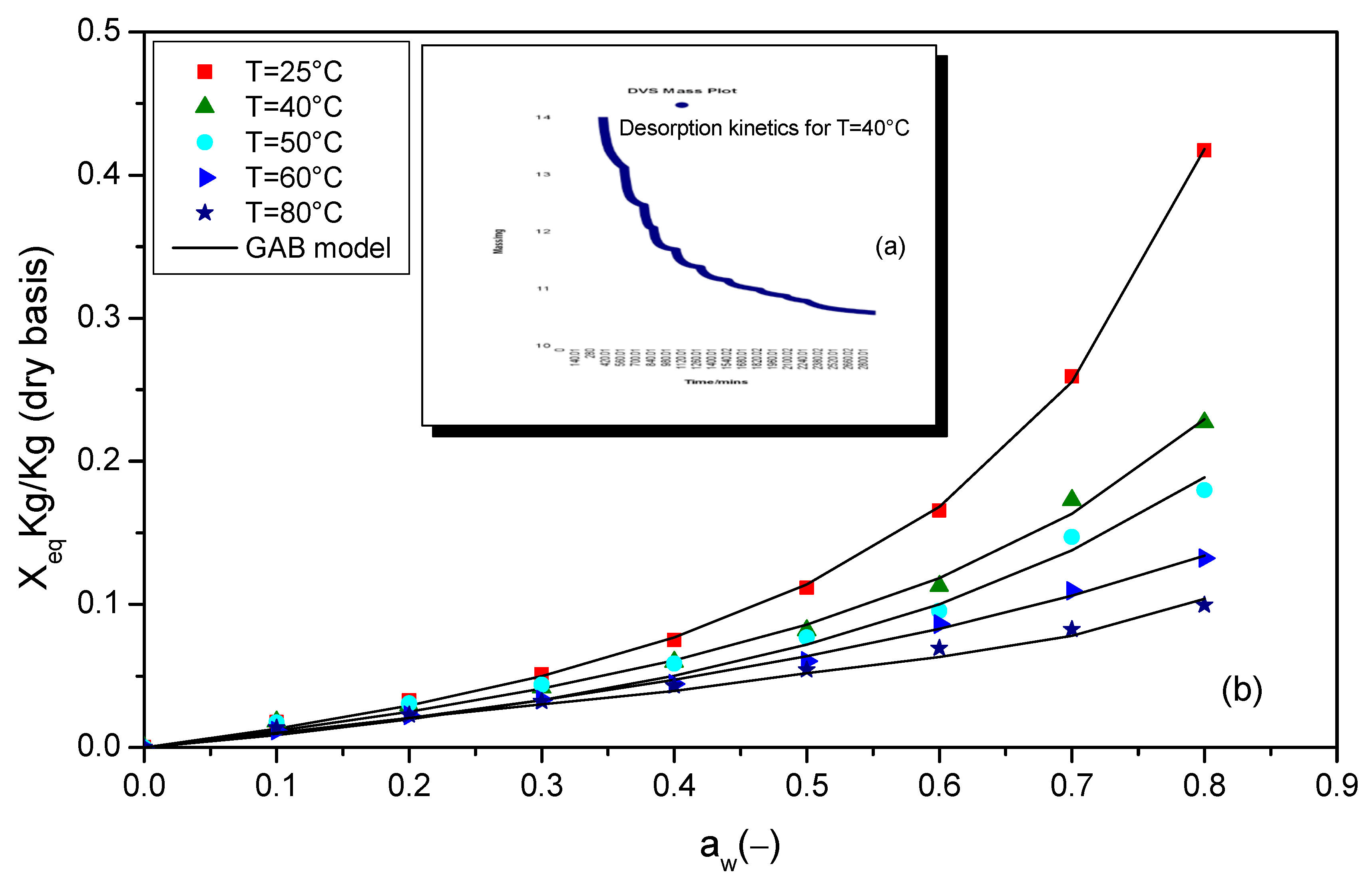
The sorption isotherm represents the equilibrium relationship between the water activity in a product and its moisture content. At equilibrium and constant temperature, the water activity is considered equivalent to the relative humidity of the surrounding air. Figure 1 illustrates the desorption isotherm by dynamic vapor sorption (DVS) technique at temperatures of 25 °C, 40 °C, 50 °C, and 80 °C, over a water activity range of 10% to 80%, The curves represent the average of two repetitions for each experiment, ensuring consistency and reliability in the results, reflecting the high reproducibility of the tests (p < 5%), despite the lengthy duration of each experiment, which exceeded three days.
The desorption isotherm exhibited a Type III shape, characterized by a slow increase in moisture content at low water activity followed by a steep rise at higher water activity. This behavior indicates weak binding forces between water and the solid matrix, which is typical of materials with low surface polarity or high sugar content [15,16,18,33,34,35].
As the temperature increased, the moisture content decreased at lower water activity values (<0.5), likely due to a reduction in hydrophilic sites caused by physiochemical changes induced by higher temperatures [16]. Figure 1 clearly shows that this behavior was most pronounced for Spirulina between 50 °C and 80 °C, possibly due to physical and/or chemical damage occurring during the drying process. Similar findings were reported by Oliveira, who investigated Spirulina desorption isotherms at 40 °C, 50 °C, and 60 °C using the gravimetric static method. Eloi Salmwendé also reported similar results in his study of Spirulina desorption isotherms at 25 °C and 50 °C using the same method for two different stumps [18]. Furthermore, Desmorieux and Decaen examined Spirulina desorption isotherms using three methods (gravimetric static, dew point temperature measurement, and DVS) in the 25–40 °C temperature range. They found that measurements obtained using DVS resulted in a lower equilibrium moisture content compared to the other methods and concluded that the desorption isotherm was not influenced by air temperature within this range [15]. However, this was not the case in our study, which may be attributed to the pretreatment operations applied to the Spirulina, which likely exerted a significant impact on the isotherm and possibly on its internal structure. According to industrial standards, the moisture content of Spirulina should not exceed 0.075 kg/kg [15]. Based on Figure 1, this corresponds to a maximum relative humidity of 10–15% in the storage atmosphere at nearly all temperatures.

3.2. Fitting of Spirulina Platensis Desorption Isotherms

Five sorption equations were used to fit the experimental desorption data of the microalgae Spirulina, and the derived parameters are presented in Table 2.
It is evident that the GAB model provided the best mathematical fit for describing moisture desorption isotherms, achieving the highest R2 (≥0.9973) and the lowest χ2 (0.0014) across the tested temperatures and water activity range. This was followed by the Oswin model (R2 = 0.9921 to 0.9997, χ2 = 0.0032 to 0.0066), with the Smith, Henderson, and Peleg models ranking sequentially lower (see Table 2). The GAB model includes several parameters that effectively describe the experimental data for relative humidity values ranging from 10% to 90%, a range of particular interest for food applications [36]. Indeed, its parameters (Xm, C, and K) characterize the sorption process at the molecular level: Xm represents the monolayer moisture content, C indicates the strength of binding between water and the primary sorption sites, and K describes the multilayer sorption properties.
The monolayer moisture content (Xm) is particularly significant, as it represents the amount of water strongly adsorbed to specific sites and is considered the optimum level at which lipid oxidation, non-enzymatic browning, and enzyme activity rates are minimized [37,38]. As shown in Table 2, Xm values decreased with increasing temperature, which can be attributed to a reduction in hygroscopicity, and to structural and physicochemical changes caused by the elevated temperature [15]. Furthermore, the decrease in Xm with temperature may also reflect changes in the binding energy of the sorption sites, as water molecules become less tightly associated with the surface at higher thermal energies. This trend is often accompanied by a reduction in the Guggenheim constant (C), indicating weaker water–solid interactions, and a slight increase in the multilayer factor (K), suggesting that multilayer water behaves more like bulk water at elevated temperatures. Similar findings were reported by Oliveira, who found that the GAB model provided a better correlation coefficient (above 99%) and a lower percentage error (below 10%) compared to the two-parameter BET model [16].

3.3. Calculation of Net Isosteric Heat of Desorption

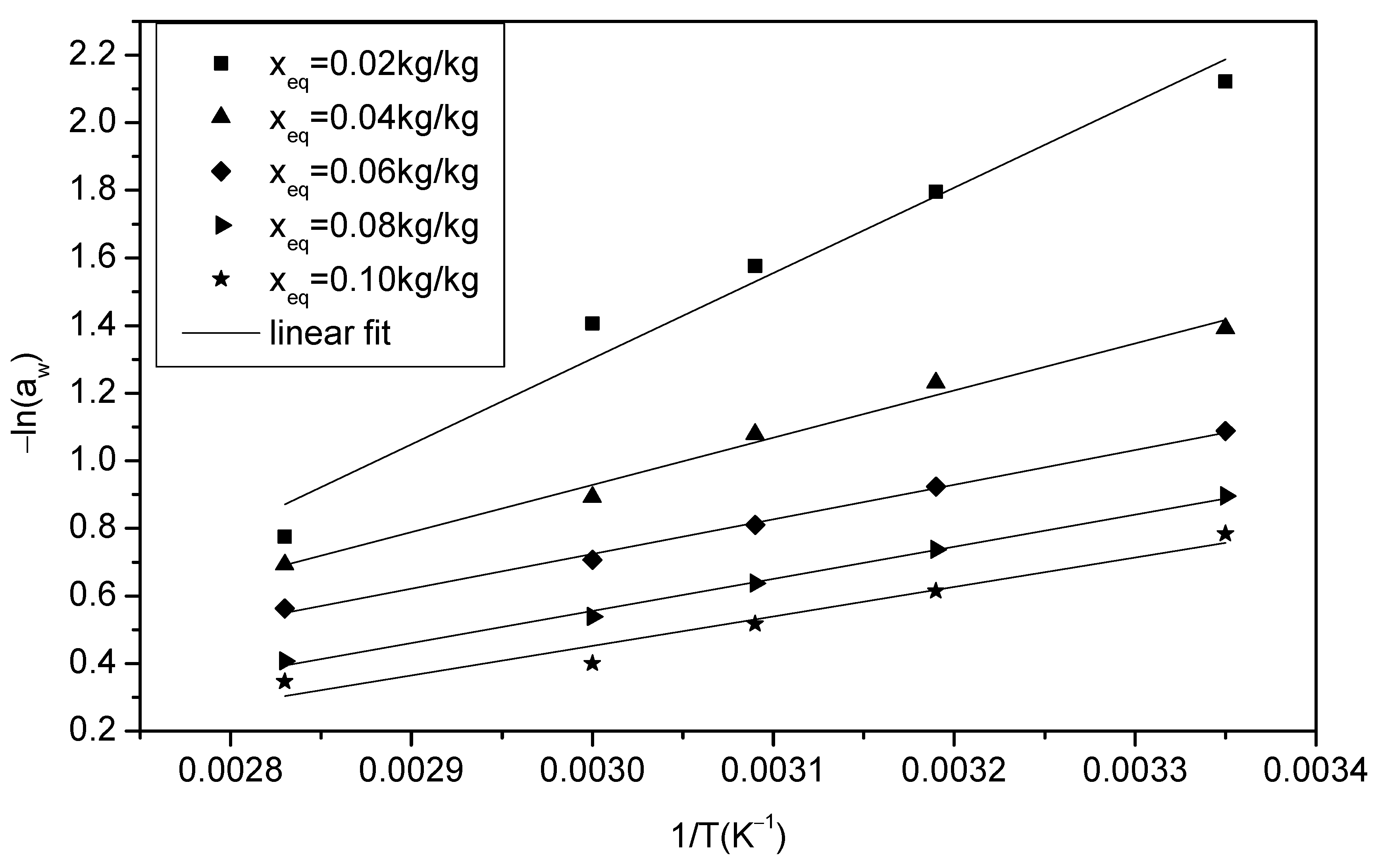
The previously identified GAB model (Table 2) was used to calculate the net heat of desorption. The desorption isosteres for Spirulina platensis are shown in Figure 2.
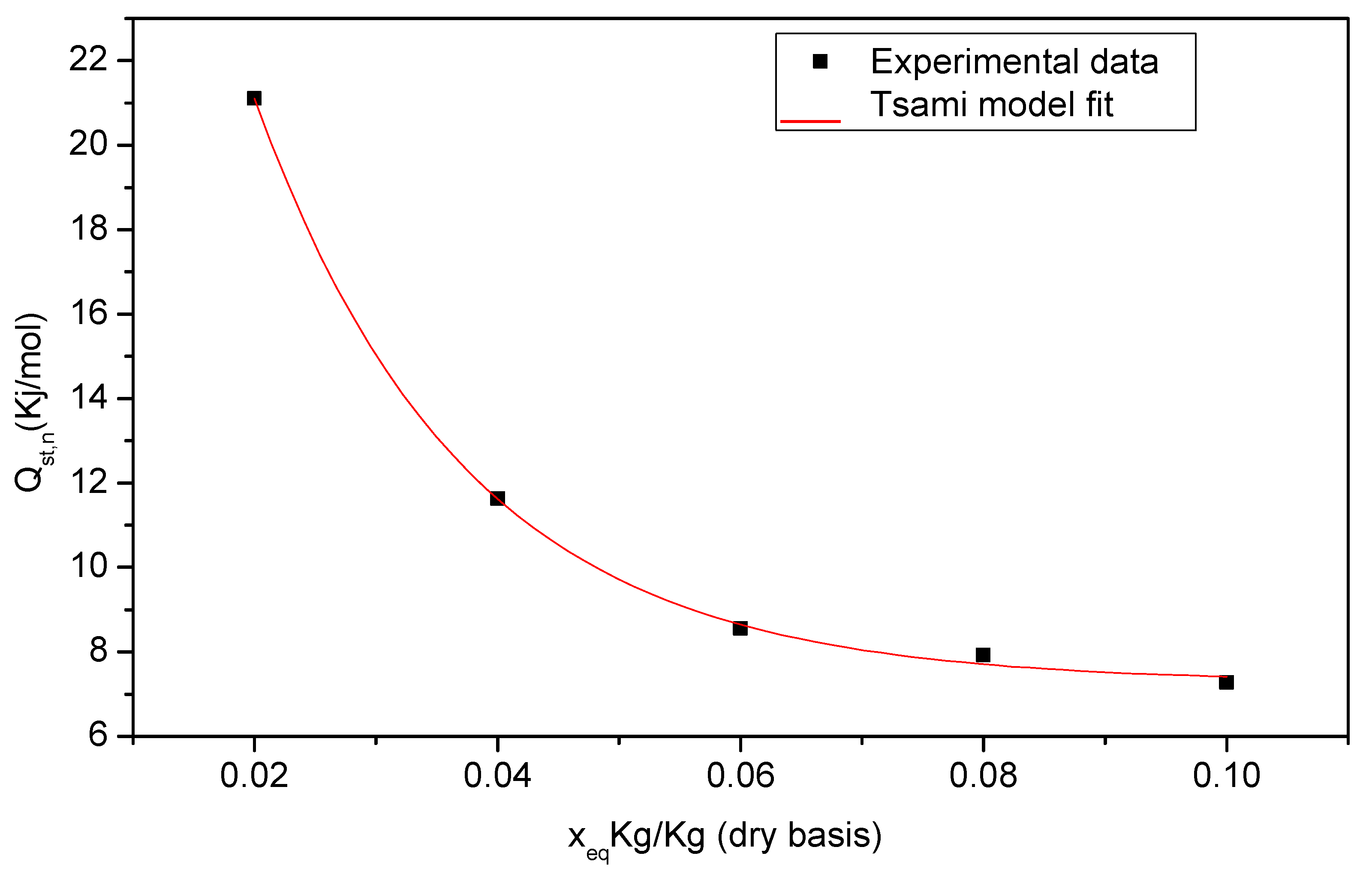
Desorption isosteres are generally described by Clausius–Clapeyron equation [39]. The slope of the isosteres curves allows for the determination of the corresponding net isosteric heat of desorption for each moisture content as illustrated in Figure 3.
Analysis of the curve showing the net isosteric heat of desorption as a function of equilibrium moisture content highlights its significance for low moisture levels in Spirulina. Specifically, the net isosteric heat (Qst,n) for Spirulina platensis decreased from 21.3 to 4.29 KJ/mol as the equilibrium moisture content increased from 0.02 to 0.1 Kg/Kg (dry basis). This decrease is attributed to the strong binding of water molecules to the solid matrix, which necessitates considerable additional heat beyond the latent heat of vaporization to effectively dehydrate the product. A research study conducted by Moreira et al. (2017) reported that the Qst,n values for Fucus vesiculosus seaweed decreased from 21.24 to 0.01 KJ/mol as Xeq increased from 0.07 to 0.34 Kg/Kg (dry basis), suggesting that the interaction energy between water and seaweed samples in the high moisture region was comparable to that between pure water molecules [40]. Yu et al. (2019) also observed a decrease in Qst,n for the probiotic-fermented sea tangle powder, from 15.02 to 0.49 KJ/mol as Xeq increased from 0.02 to 1.29 Kg/Kg (dry basis) at temperatures ranging from 4 °C to 37 °C, which aligns with our findings [41].
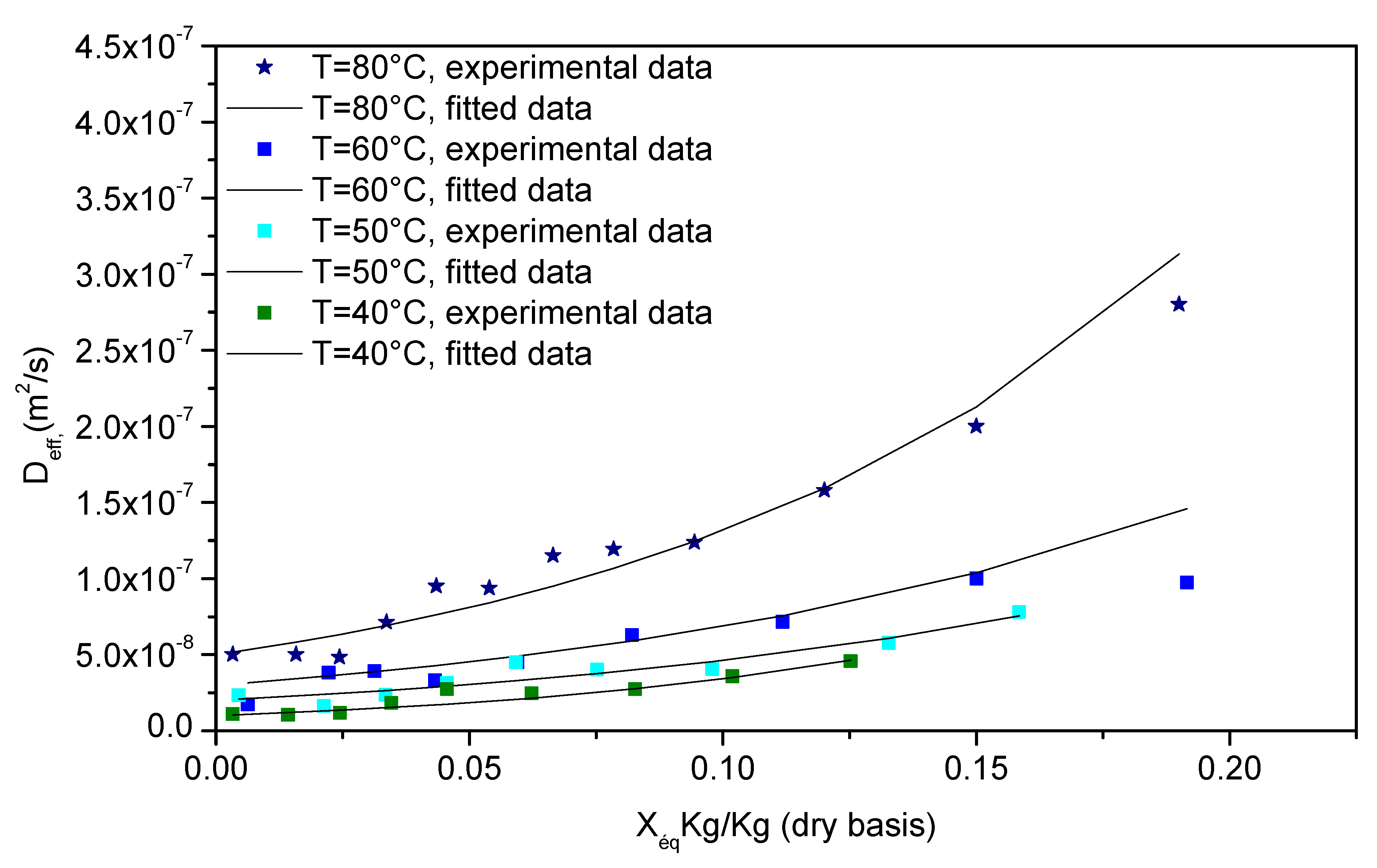
The diffusion coefficient (in the hygroscopic state) was estimated, For each desorption temperature, from the desorption kinetics curves, it was estimated based on Equation (7) by plotting the curves of -Ln(aw) as a function of time. Figure 4 illustrates the variation in the diffusion coefficient as a function of moisture content, ranging from 0.003 Kg/Kg to 0.2 Kg/Kg (dry basis), for the different desorption temperatures. The moisture content of Spirulina platensis, at each relative humidity step, is determined by averaging the moisture content during the corresponding desorption kinetic.
The equilibrium moisture content (Xeq) values shown in Figure 4 were selected to cover the range effectively measured in all desorption experiments at different temperatures. These values were chosen to enable a consistent comparison of moisture diffusivity across the relevant moisture content range and reflect the practical range observed in the samples during the desorption process
This figure illustrates the monotonic relationship between the moisture diffusivity coefficient and the water content. Such behavior in liquid diffusion during the drying of foodstuffs has been reported by several authors [17,19,31]. From these results, it can be inferred that the main physical parameters influencing Spirulina diffusivity are the drying temperature and the moisture content. As shown in the figure, the diffusion coefficient values ranged from 2.75 × 10⁻⁸ to 2.88 × 10⁻⁷ m2/s for temperatures ranging from 40 °C to 80 °C during the desorption process. These values are higher than those reported in the literature, as our work focuses on the hygroscopic state of Arthrospira platensis.
The dynamic vapor sorption (DVS) technique involves exposing the sample to controlled variation in relative humidity conditions and observing the changes in weight due to moisture sorption. At lower equilibrium moisture content levels, the moisture in the sample is generally more mobile, allowing them to be readily absorbed or desorbed as the relative humidity changes. This dynamic behavior results in higher measured diffusivity at low moisture content, as the material responds more rapidly to changes in vapor pressure and moisture uptake or release [42]. Furthermore, at low equilibrium moisture contents, the moisture gradient between the material and the surrounding atmosphere is typically higher. This steeper gradient enhances the driving force for water into or out of the material. Since moisture diffusion is governed by Fick’s law, which depends on the concentration gradient, a higher moisture gradient leads to an apparent increase in diffusivity [42].
Previous studies reported lower diffusivity values (which were determined for overall drying kinetics). Indeed, Eloi Salmwandé reported diffusivities ranging from 1.7 × 10⁻¹⁰ to 6.73 × 10⁻¹⁰ under drying conditions of 50 °C, 6% RH, and cylindrical shape (d = 20 mm) [18]. Likewise, Oliveira et al. [16] found diffusivities between 0.233 × 10⁻¹⁰ and 0.286 × 10⁻¹⁰ for drying conditions of 50–60 °C, an air velocity of 1.5 m/s, 7–10% RH, and cylindrical pellets (d = 3 mm).
Dissa et al. [17] observed diffusivity values between 0.122 × 10⁻¹⁰ and 0.167 × 10⁻¹⁰ for drying at 50 °C, 10% RH, and cylindrical shapes (d = 3–6 mm, L = 4 cm). In the same study, this author also investigated Spirulina in a slab shape (L = 6 cm, width = 2 cm), obtaining diffusivities between 1.79 × 10⁻¹⁰ and 6.73 × 10⁻¹⁰ for drying at 40–60 °C, 10% relative humidity, and air velocities ranging from 0 to 1.2 m/s. A sharp increase in the moisture diffusivity coefficient is observed above a water content of 0.1 Kg/Kg (dry basis). This trend has also been reported for Spirulina. Additionally, it is evident that temperatures of 40–50 °C and 60 °C result in very similar diffusivity values.
As the moisture content increases, Spirulina transitions to a state where liquid water becomes more prevalent, thereby reducing diffusivity since liquid water moves differently through the material compared to water vapor. The higher moisture diffusivity observed at low equilibrium moisture content can be attributed to several factors, including a steeper moisture gradient, a more accessible pore structure, increased surface area for sorption, and the presence of less tightly bound water within the material [34,36]. These factors facilitate faster water vapor transport through Arthrospira Platensis, resulting in higher diffusivity values, as observed using the DVS technique.
Numerous empirical parametric equations describing the moisture diffusivity of biological materials as a function of moisture content have been reported in the literature, with a comprehensive compilation provided by Zogzas et al. 1996 [43]. The influence of temperature on diffusivity can be effectively described by an Arrhenius-type relationship [25]. However, the impact of moisture content has not yet been framed within a widely accepted general model. The diffusion coefficient can be expressed by the following Equation (10):
D e f f = A × e x p B T
Here, A generally follows the Arrhenius law and can be expressed as
A = a × e x p E a R T  
By plotting Ln(A) against (1/T), the activation energy can be determined. Similarly, the variation in parameter B with temperature can be analyzed. The values of A and B are obtained by fitting the experimental data describing Deff = f(Xeq) using an exponential function of the form a × exp(b × x). Therefore, for moisture contents ranging from 0.003 to 0.2 Kg/Kg (dry basis) and temperatures from 40 °C to 80 °C, the liquid water diffusivity of Spirulina platensis can be expressed by the following empirical Equation (12):
D e f f X . T = 13.709 × 10 08 exp 33,704 R T × e x p 0.1566 T + 59.284 X  
The activation energy represents the energy barrier that must be overcome for the diffusion process to occur effectively [41,42]. For liquid diffusion in S. platensis, the activation energy (Ea) was found to be 33.71 KJ/mol, which aligns with the findings of Zogzas et al. [43], who reported activation energies for agri-food products ranging from 12.7 to 110 KJ/mol [43]. Similar findings were reported by Pamella de Carvalho melo [19], who found an activation energy of 39.52 KJ/mol in [19]. It is important to note that, in drying processes, the lower the activation energy, the greater the water diffusion within the product [44,45]. In other words, a smaller amount of energy is required to initiate the physical transformation, specifically the conversion of liquid water into vapor [46].
Table 3 shows the effect of temperature and air relative humidity on the diffusion coefficient. The moisture content indicated corresponds to that of the product at the beginning of each humidity stage:
The effect of temperature and relative humidity on the moisture diffusion coefficient are often interdependent. Generally, increasing the temperature leads to an increase in moisture diffusivity due to the increased kinetic energy of the water molecules and a greater moisture gradient. Conversely, a lower relative humidity increases the moisture gradient between the material and the surrounding air, leading to higher diffusivity. Specifically, temperature increases the moisture diffusion coefficient by enhancing molecular movement, reducing viscosity, and increasing vapor pressure, whereas air relative humidity affects the diffusion process by modifying the moisture gradient and the extent of water binding within the material [34,38,44].

4. Conclusions

The purpose of this work was to determine the desorption isotherms of Spirulina platensis using the dynamic vapor sorption technique and to establish predictive correlations for its thermo-hygroscopic properties based on experimental data and physical principles.
Based on our results, the following conclusions can be drawn:
The desorption isotherms of Spirulina platensis, obtained over a temperature range of 25 °C to 80 °C exhibited type III behavior according to BET classification, commonly observed in many agri-food products. Among the empirical and semi-empirical sorption models tested, the GAB model proved to be the most suitable for predicting desorption isotherms of Spirulina platensis within the studied temperatures and water activities ranges. The selection of this model is based on the highest values of the coefficient of determination (R2) and the lowest values of the standard error (χ2). In addition, the net isosteric heat of desorption decreased from 21.3 to 4.29 KJ/mol as the equilibrium moisture content increased from 0.02 to 0.1 Kg/Kg (dry basis). The diffusion coefficient (in the hygroscopic state) varied between 2.75 10−8 m2/s and 15.710−8 m2/s over the temperature range of 40 °C to 80 °C, corresponding to an activation energy of 33.7 KJ/mol.
The thermo-hygroscopic investigation conducted in this study provides a fundamental basis for optimizing the drying process of Spirulina biomass and effectively reducing its energy costs. Based on this study, the next step of this work is to develop a physical drying model in order to predict the drying rate of a thin biomass layer undergoing convective drying, assisted by capillary drainage. This model can identify the optimal drying parameters by integrating the drying conditions and the capillary properties of the drying support.

Author Contributions

Conceptualization and validation, T.G. and L.H.; writing—original draft preparation, T.G.; investigation—review and editing, L.H.; methodology and resources, T.G. and L.H.; project administration, M.B.; supervision, M.B. All authors have read and agreed to the published version of the manuscript.

Funding

This research received no external funding.

Data Availability Statement

Data are contained within the article.

Conflicts of Interest

The authors declare no conflicts of interest.

References

  1. Soni, R.A.; Sudhakar, K.; Rana, R.S. Spirulina: From growth to nutritional product: A review. Trends Food Sci. Technol. 2017, 69, 157–171. [Google Scholar] [CrossRef]
  2. Vernes, L.; Granvillain, P.; Chemat, F.; Vian, M. Phycocyanin from Arthrospira platensis. Production. extraction and analysis. Curr. Biotechnol. 2015, 4, 481–491. [Google Scholar] [CrossRef]
  3. Ghnimi, T.; Hassini, L.; Bagane, M. Intensification of the convective drying process of Arthrospira (Spirulina) platensis by capillary draining: Effect of the draining support. J. Appl. Phycol. 2019, 31, 2921–2931. [Google Scholar] [CrossRef]
  4. Chen, C.; Chang, J.; Lee, D. Dewatering and drying methods for microalgae. Dry. Technol. 2015, 33, 443–454. [Google Scholar] [CrossRef]
  5. Jimenez, C.; Cossio, B.R.; Labella, D.F.; Niell, X. The feasibility of industrial production of Spirulina (Arthrospira) in Southern Spain. Aquaculture 2003, 217, 179–190. [Google Scholar] [CrossRef]
  6. Show, K.; Le, D.; Tay, J.; Lee, T.; Chang, J. Microalgal drying and cell disruption: Recent advances. Bioresour. Technol. 2014, 184, 258–266. [Google Scholar] [CrossRef] [PubMed]
  7. Mariana, D.; de Moraes, J.O.; Ferrari, M.C.; Neves, F.D. Production of Spirulina (Arthrospira platensis) powder by innovative and traditional drying techniques. J. Food Process Eng. 2021, 45, e13919. [Google Scholar]
  8. Desmorieux, H.; Hernandez, F. Biochemical and Physical Criteria of Spirulina after Different Drying Processes. In Proceedings of the 14th International Drying Symposium (IDS 2004), Sào Paulo, Brazil, 22–25 August 2004; pp. 900–907. [Google Scholar]
  9. Silva, N.C.; Machado, M.V.C.; Brandão, R.J.; Duarte, C.R.; Barrozo, M.A.S. Dehydration of microalgae Spirulina platensis in a rotary drum with inert bed. Powder Technol. 2019, 351, 178–185. [Google Scholar] [CrossRef]
  10. Ghnimi, T.; Hassini, L.; Bagane, M. Convective and infrared drying assisted by capillary drainage of spirulina: A real possibility to reduce the energy consumption. J. Heat Mass Transf. 2019, 55, 867–876. [Google Scholar] [CrossRef]
  11. Leung, H.K. Water Activity and Other Colligate Properties of Foods. In Proceedings of the ASAE Annual Meeting, Chicago, IL, USA, 12–13 December 1983. Paper No. 83-6508. [Google Scholar]
  12. Rouquerol, F.; Rouquerol, J.; Sing, K. Adsorption by Powders and Porous Solids: Principles, Methodology and Applications; Academic Press: Cambridge, MA, USA, 1999. [Google Scholar]
  13. Shu, Q.; Liao, L.C.F.; Xu, B.Q.; Zou, W.Q. Recovery of rare earth element ytterbium(III) by dried powdered biomass of spirulina: Adsorption isotherm. kinetic and thermodynamic study. Trans. Nonferrous Met. Soc. China 2021, 31, 1127–1139. [Google Scholar] [CrossRef]
  14. Pedrosa, M.; Ribeiro, R.S.; Guerra-Rodríguez, S.; Rodríguez-Chueca, J.; Rodríguez, E.; Silva, A.M.; Ðolic, M.; Ribeiro, A.R.L. Spirulina-based carbon bio-sorbent for the efficient removal of metoprolol, diclofenac and other micropollutants from wastewater. Environ. Nanotechnol. Monit. Manag. 2022, 18, 100720. [Google Scholar] [CrossRef]
  15. Desmorieux, H.; Decaen, N. Convective Drying of Spirulina in Thin Layer. J. Food Eng. 2005, 66, 497–503. [Google Scholar] [CrossRef]
  16. Oliveira, E.G.; Duarte, J.H.; Moraes, K.; Crexi, V.T.; Pinto, L.A.A. Optimization of Spirulina platensis convective drying: Evaluation on phycocyanin loss and lipid oxidation. Int. J. Food Sci. Technol. 2010, 45, 1572–1578. [Google Scholar] [CrossRef]
  17. Dissa, A.O.; Compaore, A.; Tiendrebeogo, E.; Koulidiati, J. An Effective Moisture Diffusivity Model Deduced from Experiment and Numerical Solution of Mass Transfer Equations for a Shrinkable Drying Slab of Microalgae Spirulina. Dry. Technol. 2014, 32, 1231–1244. [Google Scholar] [CrossRef]
  18. Tiendrebeogo, E.S. Characterization of Two Different Stumps of Spirulina platensis Drying: Assessment of Water Transport Coefficient. Food Nutr. Sci. 2015, 6, 1437–1449. [Google Scholar] [CrossRef]
  19. Pamella, D.C.M.; Ivano, A.D.; Lisboa, C.F.; Pedro, H.T.D. Kinetics drying of Spirulina platensis. Afr. J. Agric. Res. 2016, 11, 4683–4691. [Google Scholar] [CrossRef]
  20. Heng, Y.Y.J.; Williams, D. Vapour Sorption and Surface Analysis. In Solid State Characterization of Pharmaceuticals; Richard, A., Storey, I.Y.S., Eds.; John Wiley & Sons: Chichester, UK, 2011; pp. 268–276. [Google Scholar]
  21. Brunauer, S.; Emmett, P.H.; Teller, E. Adsorption of Gases in Multimolecular Layers. J. Am. Chem. Soc. 1938, 60, 309–319. [Google Scholar] [CrossRef]
  22. Henderson, S.M. A basic concept of equilibrium moisture. Agric. Eng. 1952, 33, 29–32. [Google Scholar]
  23. Yanniotis, S.; Blahovec, J. Model analysis of sorption isotherms. LWT-Food Sci. Technol. 2009, 42, 1688–1695. [Google Scholar] [CrossRef]
  24. Guggenheim, V.W.A. Applications of Statistical Mechanics; Clarendon Press/Clarendon University Press: London, UK, 1966. [Google Scholar]
  25. Oswin, C.R. The kinetics of package life. III. The isotherm. J. Soc. Chem. Ind. 1946, 65, 419–421. [Google Scholar] [CrossRef]
  26. Smith, S.E. The sorption of water vapor by high polymers. J. Am. Chem. Soc. 1947, 69, 646–651. [Google Scholar] [CrossRef]
  27. Peleg, M. Assessment of a semi-empirical four parameter general model for sigmoid moisture sorption isotherms. J. Food Process Eng. 1993, 16, 21–37. [Google Scholar] [CrossRef]
  28. Midilli, A.; Kucuk, H. Mathematical modeling of thin layer drying of pistachio by using solar energy. Energy Convers. Manag. 2003, 44, 1111–1122. [Google Scholar] [CrossRef]
  29. Rizvi, S.S.H. Thermodynamic properties of foods in dehydration. In Engineering Properties of Foods; Rao, M.A., Rizvi, S.S.H., Eds.; Academic Press: New York, NY, USA, 1995; pp. 223–309. [Google Scholar]
  30. Wang, N.; Brennan, J.G. Moisture sorption isotherm characteristics of potatoes at four temperatures. J. Food Eng. 1991, 14, 269–287. [Google Scholar] [CrossRef]
  31. Zielinska, M.; Markowski, M. Air drying characteristics and moisture diffusivity of carrots. Chem. Eng. Process. Intensif. 2010, 49, 212–218. [Google Scholar]
  32. Toğrul, H.; Arslan, N. Moisture Sorption Behaviour and Thermodynamic Characteristics of Rice stored in a Chamber under Controlled Humidity. Biosyst. Eng. 2006, 95, 181–195. [Google Scholar] [CrossRef]
  33. McMinn, W.A.M.; Al-Muhtaseb, A.H.; Magee, T.R.A. Enthalpy-entropy compensation in sorption phenomena of starch materials. Food Res. Int. 2005, 38, 505–510. [Google Scholar] [CrossRef]
  34. Iglesias, H.A.; Chirife, J. Handbook of Food Isotherms, Water Sorption Parameters for Food and Food Components; Academic Press: Cambridge, MA, USA, 1982. [Google Scholar]
  35. Wolf, W.; Spiess, W.; Jung, G. The water vapor sorption isotherms of foodstuffs. Lebensm. Wiss. Technol. 1973, 6, 94–96. [Google Scholar]
  36. Timmermann, E.O.; Chirife, J.; Iglesias, H.A. Water sorption isotherms of foods and foodstuffs: BET or GAB parameters? J. Food Eng. 2001, 48, 19–31. [Google Scholar] [CrossRef]
  37. Vega-Gálvez, A.; Miranda, M.; Vergara, J.; Uribe, E.; Puente, L.; Martínez, E.A. Nutrition facts and functional potential of quinoa (Chenopodium quinoa willd.), an ancient Andean grain: A review. J. Sci. Food Agric. 2010, 90, 2541–2547. [Google Scholar] [CrossRef]
  38. Goneli, A.L.D.; Corrêa, P.C.; de Oliveira, G.H.H.; Gomes, C.F.; Botelho, F.M. Water sorption isotherms and thermodynamic properties of pearl millet grain. Int. J. Food Sci. Technol. 2010, 45, 828–838. [Google Scholar] [CrossRef]
  39. Mounir, K.; Kechaou, N.; Fliyou, M. Experimental study of sorption isotherms and drying kinetics of Moroccan Eucalyptus globulus. Dry. Technol. 2002, 20, 2027–2039. [Google Scholar]
  40. Moreira, F.; Chenlo, J.; Sineiro, S.; Sexto, S.A. Drying temperature effect on powder physical properties and aqueous extract characteristics of Fucus vesiculosus. J. Appl. Phycol. 2016, 28, 2485–2494. [Google Scholar] [CrossRef]
  41. Moojoong, D.; Yu, K.; Kim, Y.M.; Kwon, G. Moisture sorption characteristics of probiotic-fermented sea tangle powder and its thermodynamic properties. J. Food Process. Preserv. 2019, 43, 13991. [Google Scholar]
  42. Arlabosse, P.; Rodier, E.; Ferrasse, J.H.; Chavez, S.; Lecomte, D. Comparison Between Static and Dynamic Methods for Sorption Isotherm Measurements. Dry. Technol. 2003, 21, 479–497. [Google Scholar] [CrossRef]
  43. Zogzas, N.P.; Maroulis, Z.B.; Marinos-Kouris, D. Moisture Diffusivity Data Compilation in Foodstuffs. Dry. Technol. 1996, 14, 2225–2253. [Google Scholar] [CrossRef]
  44. Goneli, A.L.D.; Corrêa, P.C.; de Oliveira, G.H.H.; Afonso Júnior, P.C. Water sorption properties of coffee fruits, pulped and green coffee. LWT-Food Sci. Technol. 2013, 50, 386–391. [Google Scholar] [CrossRef]
  45. Jangam, S.V.; Law, C.L.; Mujumdar, A.S. Drying of Food, Vegetables and Fruits, 1st ed.; National University of Singapore: Singapore, 2010; p. 232. [Google Scholar]
  46. Corrêa Filho, L.C.; Andrade, E.T.; Martinazzo, A.P.; Andrea, E.M.; Sousa, F.A.; Figueira, V.G. Drying kinetics, volumetric contraction and liquid diffusion analysis of fig (Ficus carica L.). Rev. Bras. Eng. Agric. Ambient. 2015, 19, 797–802. [Google Scholar]
Figure 1. Example of DVS plot for T = 40 °C (a) and desorption isotherms of Arthrospira platensis at different temperatures (b).
Thermo 05 00056 g001
Figure 2. Desorption isosteres of Arthrospira platensis for different moisture contents.
Thermo 05 00056 g002
Figure 3. Variation in net isosteric heat of desorption as a function of equilibrium moisture content.
Thermo 05 00056 g003
Figure 4. Variation in the diffusion coefficient as a function of the equilibrium moisture content.
Thermo 05 00056 g004
Table 1. Models used to fit desorption isotherm data.
ModelsEquationReferences
GAB X e q = X m C K a w 1 K a w ( 1 + C 1 K a w ) [24]
Oswin X e q = A ( a w 1 a w ) B [25]
Smith X e q = A + B l n ( 1 a w ) [26]
Henderson X e q = ( ( l n ( 1 a w ) A ) 1 B [22]
Peleg X e q = A a w B + C a w D [27]
Table 2. Values of the tested model parameters for the different temperatures.
ModelsTemperature (°C)Models ParametersR2X2
GAB25Xm = 0.11950.99970.0032
C = 1.1509
K = 0.5711
40Xm = 0.11250.99770.0059
C = 1.0234
K = 0.6256
50Xm = 0.11040.99730.0053
C = 0.5313
K = 0.6844
60Xm = 0.05200.99840.0029
C = 0.4081
K = 0.7789
80Xm =0.02840.99900.0014
C = 0.3897
K = 0.9079
OSWIN25A = 0.11430.99970.0032
B = 0.9382
40A = 0.08480.99650.0067
B = 0.7324
50A = 0.07740.99500.0063
B = 0.6335
60A = 0.06070.99210.0060
B = 0.6013
80A = 0.05210.99460.0036
B = 0.4983
SMITH25A = −0.02980.97870.0299
B = 0.2491
40A = −0.00510.99440.0085
B = 0.1406
50A = 0.00280.99590.0057
B = 0.1112
60A = 0.00290.99650.0040
B = 0.0843
80A = 0.00830.98980.0050
B = 0.0608
HENDERSON25A = 2.88390.99820.0086
B = 0.6572
40A = 5.83530.99710.0061
B = 0.8727
50A = 9.39700.99560.0059
B = 1.0333
60A = 14.24600.99740.0034
B = 1.0940
80A = 36.05300.99930.0012
B = 1.3561
PELEG25A = 1.33540.99150.0224
B = 2.7232
C = 0.5994
D = 2.7205
40A = 1.17230.98990. 0138
B = 1.9747
C = 0.8313
D = 1.9891
50A = 1.12350.98900.0111
B = 1.5453
C = 0.8772
D = 1.5416
60A = 1.09120.99580.0051
B = 1.5079
C = 0.9093
D = 15.1630
80A = 1.06210.99750.0029
B = 1.1165
C = 0.9379
D = 1.1155
Table 3. The effect of temperature and air relative humidity on the moisture diffusion coefficient.
Effect of Temperature at HR = 60%Effect of Relative Humidity at T = 50 °C
T (°C)Deff (m2/s)HR(%), X0 (Kg/Kg Dry Basis) (%)Deff (m2/s)
402.75 × 10−810, X0 = 2.981.60 × 10−8
504.05 × 10−830, X0 = 5.533.14 × 10−8
607.16 × 10−850, X0 = 8.714.01 × 10−8
8015.7 × 10−870, X0 = 15.245.76 × 10−8
Disclaimer/Publisher’s Note: The statements, opinions and data contained in all publications are solely those of the individual author(s) and contributor(s) and not of MDPI and/or the editor(s). MDPI and/or the editor(s) disclaim responsibility for any injury to people or property resulting from any ideas, methods, instructions or products referred to in the content.