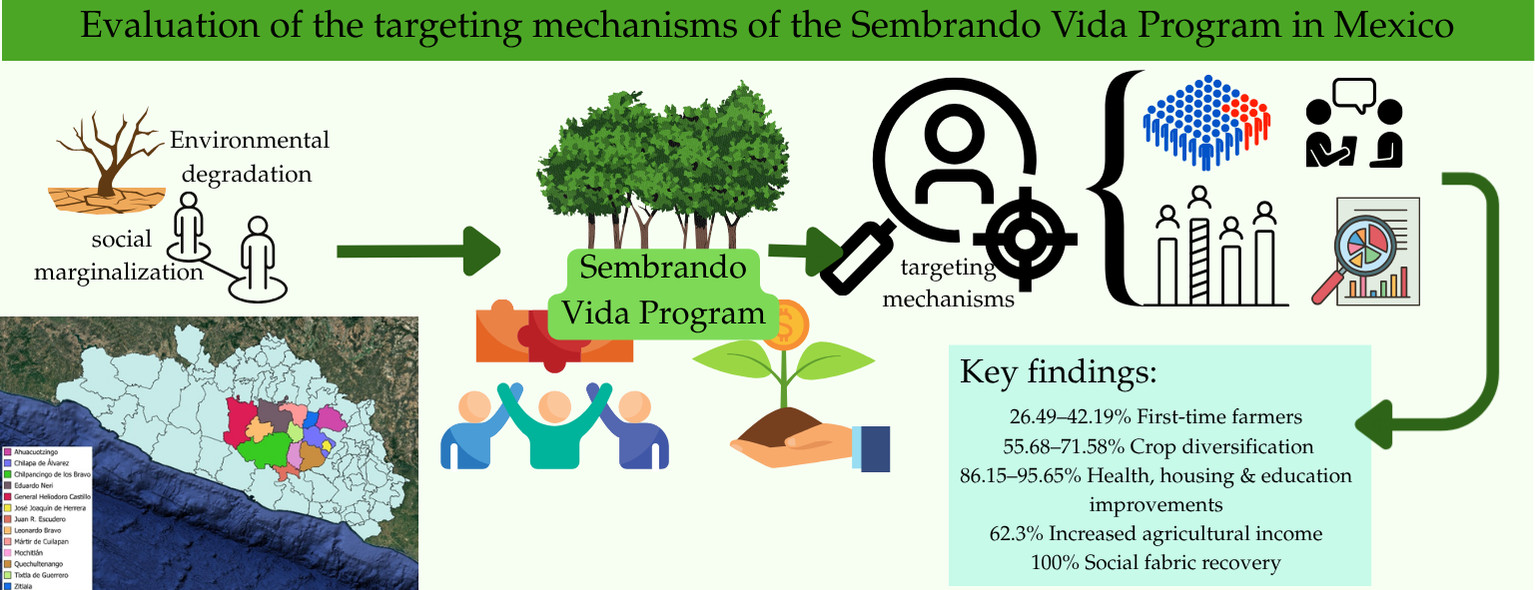

Evaluation of the Targeting Mechanisms of the Sembrando Vida Program in Mexico
 , , , , , and
Abstract
1. Introduction
Literature Review
2. Materials and Methods
2.1. Materials
2.2. Methodology
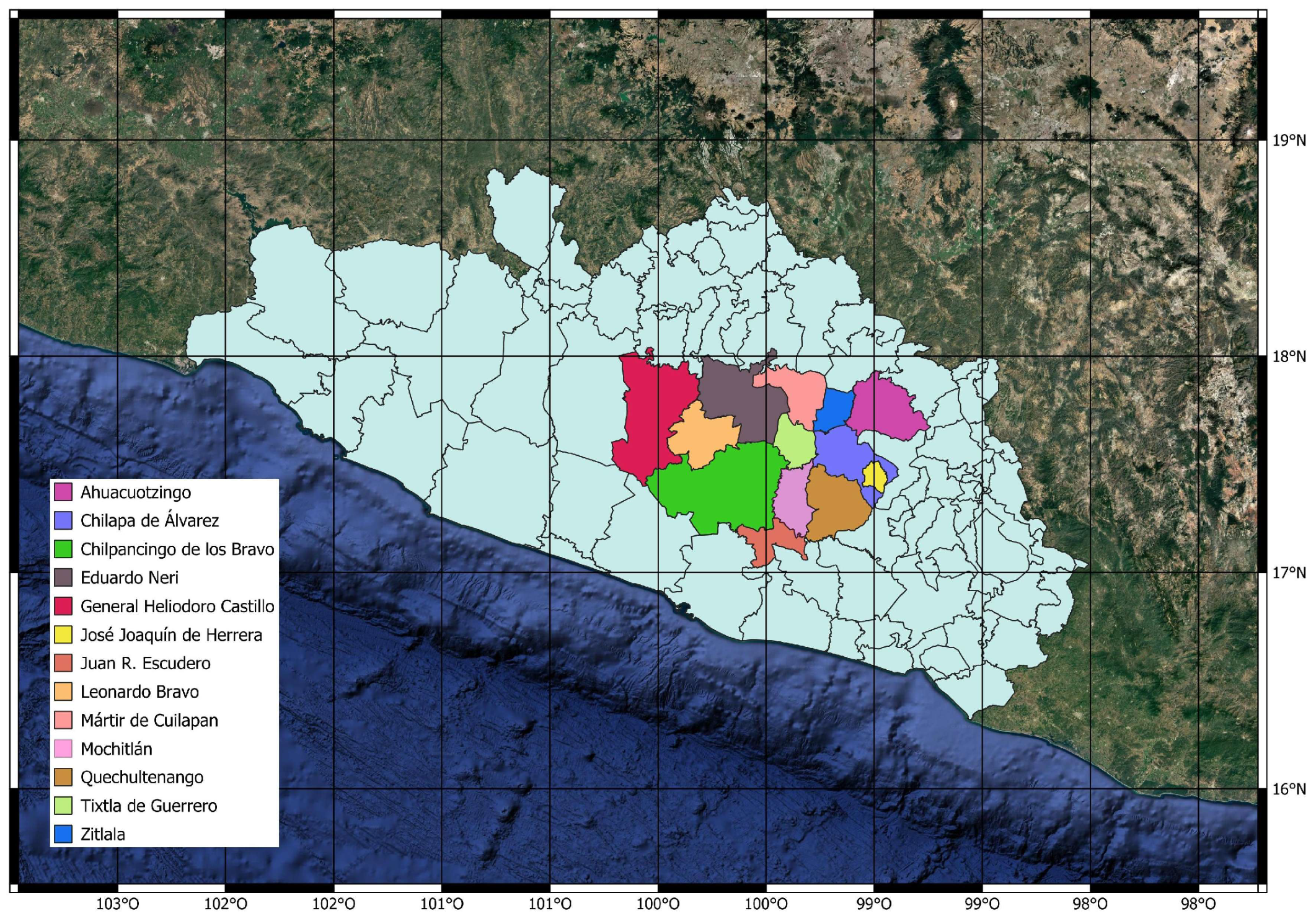
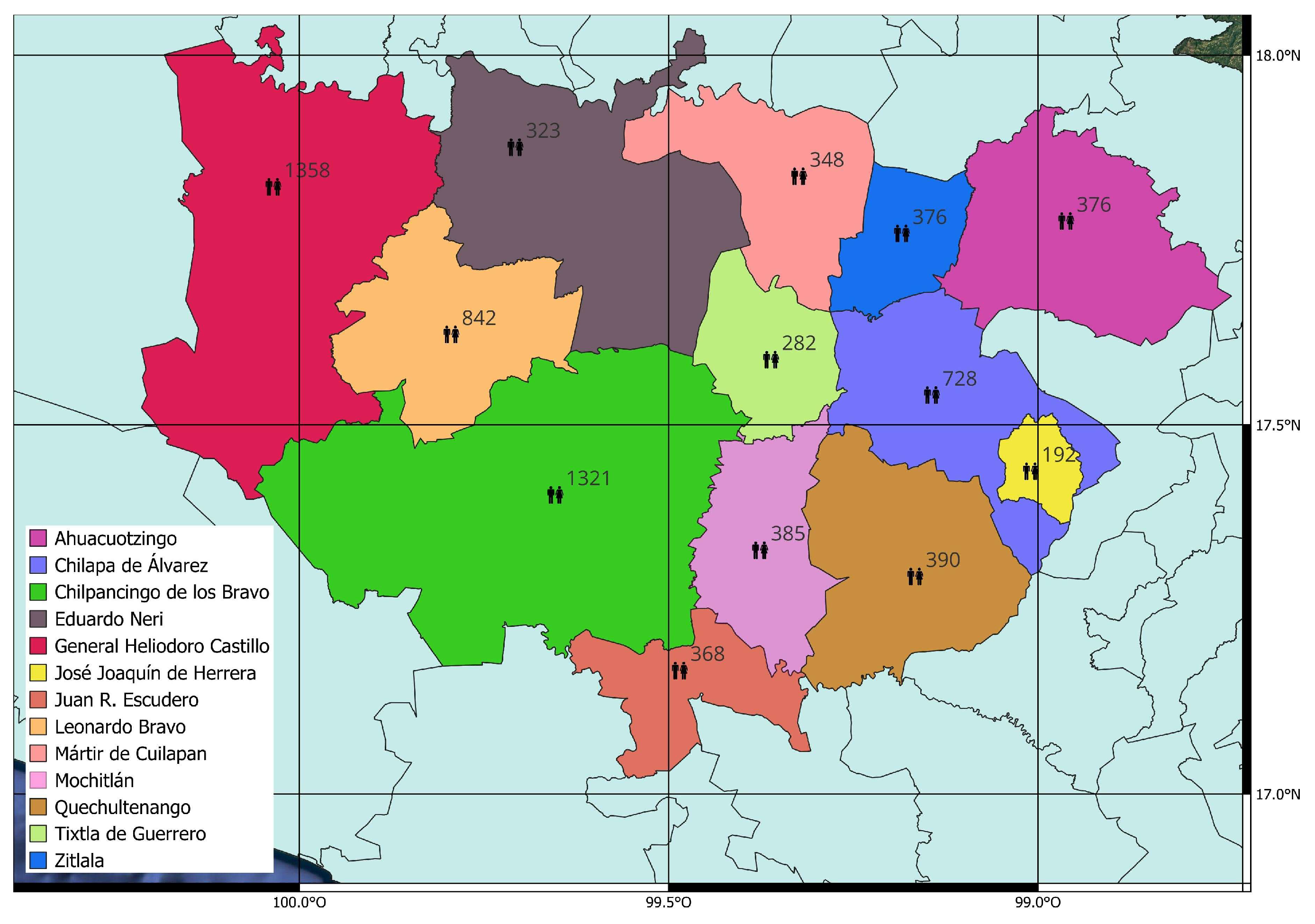
2.2.1. Study Area
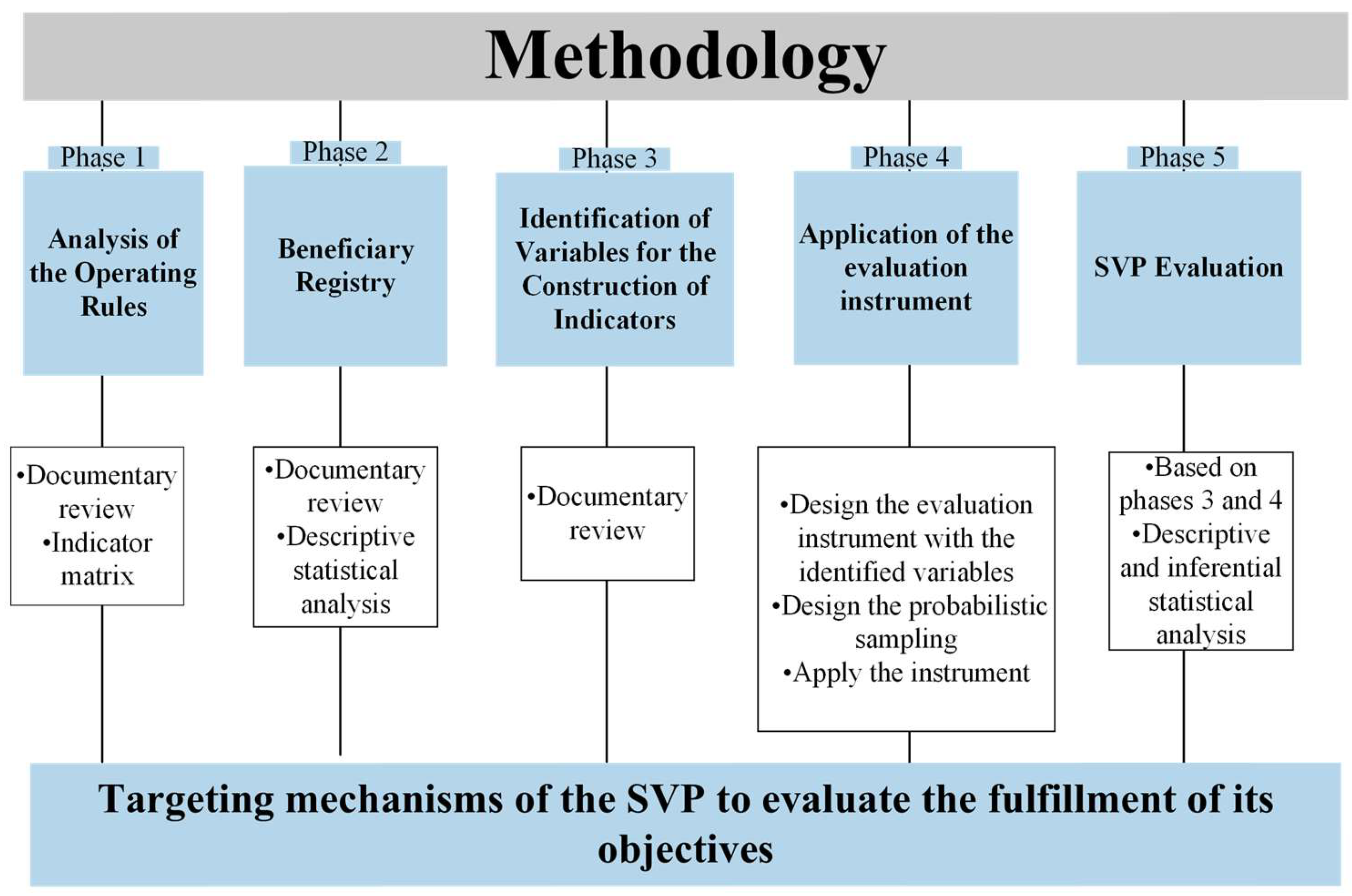
2.2.2. Methodological Diagram
2.2.3. Analysis of the Operating Rules
2.2.4. Beneficiary Registry
2.2.5. Identification of Variables
2.2.6. Application of the Evaluation Instrument
2.2.7. SVP Evaluation
3. Results
3.1. Rules of Operation
3.2. Beneficiary Registry
3.3. Analysis of Indicators
4. Discussion
5. Conclusions
Author Contributions
Funding
Institutional Review Board Statement
Informed Consent Statement
Data Availability Statement
Conflicts of Interest
References
- Organización de las Naciones Unidas. ¿Qué Es El Cambio Climático? Available online: https://www.un.org/es/climatechange/what-is-climate-change (accessed on 3 February 2025).
- El Estado de Los Bosques Del Mundo 2022; FAO: Rome, Italy, 2022.
- América Latina y El Caribe—Panorama Regional de la Seguridad Alimentaria y la Nutrición 2024; FAO; IFAD; PAHO; UNICEF; WFP: Santiago, Chile, 2025.
- Secretaría de Bienestar Programa Sembrando Vida. Available online: https://www.gob.mx/bienestar/acciones-y-programas/programa-sembrando-vida (accessed on 27 August 2024).
- Diario Oficial de la Federación ACUERDO Por El Que Se Emiten Las Reglas Operación Del Programa Sembrando Vida, Para El Ejercicio Fiscal 2024. Available online: https://www.dof.gob.mx/nota_detalle.php?codigo=5713371&fecha=30/12/2023#gsc.tab=0 (accessed on 25 July 2024).
- Pulhin, J.M.; Ramirez, M.A.M.; Garcia, J.E.; Pangilinan, M.J.Q.; Evaristo, M.B.S.; Catudio, M.L.R.O.; Magpantay, A.T.; Tasico, S.L.; Pulhin, F.B.; Abes, J.L.; et al. Contextualizing Sustainable Forest Management and Social Justice in Community-Based Forest Management (CBFM) Program in the Philippines. Trees For. People 2024, 16, 100589. [Google Scholar] [CrossRef]
- Bohnet, I.C.; Bryce, R.; Måren, I.E.; Barraclough, A.D.; Malcolm, Z.; Külm, S.; Kokovkin, T.; Taylor, S.; Cudlinova, E.; Sepp, K. Co-Creating Cultural Narratives for Sustainable Rural Development: A Transdisciplinary Learning Framework for Guiding Place-Based Social-Ecological Research. Curr. Opin. Environ. Sustain. 2025, 73, 101506. [Google Scholar] [CrossRef]
- Rostami, K.; Salehi, L. Rural Cooperatives Social Responsibility in Promoting Sustainability-Oriented Activities in the Agricultural Sector: Nexus of Community, Enterprise, and Government. Sustain. Futures 2024, 7, 100150. [Google Scholar] [CrossRef]
- Sudomo, A.; Leksono, B.; Tata, H.L.; Rahayu, A.A.D.; Umroni, A.; Rianawati, H.; Asmaliyah; Krisnawati; Setyayudi, A.; Utomo, M.M.B.; et al. Can Agroforestry Contribute to Food and Livelihood Security for Indonesia’s Smallholders in the Climate Change Era? Agriculture 2023, 13, 1896. [Google Scholar] [CrossRef]
- Dossa, K.F.; Bissonnette, J.F.; Soudet, T. Comparison of Governance Policies for Agroforestry Initiatives: Lessons Learned from France and Quebec. Sustainability 2025, 17, 6114. [Google Scholar] [CrossRef]
- Krčmářová, J.; Kala, L.; Brendzová, A.; Chabada, T. Building Agroforestry Policy Bottom-up: Knowledge of Czech Farmers on Trees in Farmland. Land 2021, 10, 278. [Google Scholar] [CrossRef]
- Löhr, K.; Aruqaj, B.; Baumert, D.; Bonatti, M.; Brüntrup, M.; Bunn, C.; Castro-Nunez, A.; Chavez-Miguel, G.; Del Rio, M.L.; Hachmann, S.; et al. Social Cohesion as the Missing Link between Natural Resource Management and Peacebuilding: Lessons from Cocoa Production in Côte d’ivoire and Colombia. Sustainability 2021, 13, 2. [Google Scholar] [CrossRef]
- Sikandar, F.; Erokhin, V.; Xin, L.; Sidorova, M.; Ivolga, A.; Bobryshev, A. Sustainable Agriculture and Rural Poverty Eradication in Pakistan: The Role of Foreign Aid and Government Policies. Sustainability 2022, 14, 14751. [Google Scholar] [CrossRef]
- Islam, K.K.; Fujiwara, T.; Hyakumura, K. Agroforestry, Livelihood and Biodiversity Nexus: The Case of Madhupur Tract, Bangladesh. Conservation 2022, 2, 305–321. [Google Scholar] [CrossRef]
- Doukas, Y.E.; Salvati, L.; Vardopoulos, I. Unraveling the European Agricultural Policy Sustainable Development Trajectory. Land 2023, 12, 1749. [Google Scholar] [CrossRef]
- Fusco, G. Twenty Years of Common Agricultural Policy in Europe: A Bibliometric Analysis. Sustainability 2021, 13, 10650. [Google Scholar] [CrossRef]
- Kalinowska, B.; Bórawski, P.; Bełdycka-Bórawska, A.; Klepacki, B.; Perkowska, A.; Rokicki, T. Sustainable Development of Agriculture in Member States of the European Union. Sustainability 2022, 14, 4184. [Google Scholar] [CrossRef]
- Dushkova, D.; Ivlieva, O. Empowering Communities to Act for a Change: A Review of the Community Empowerment Programs towards Sustainability and Resilience. Sustainability 2024, 16, 8700. [Google Scholar] [CrossRef]
- Mardero, S.; Schmook, B.; Calmé, S.; Casanova, G.; White, R.M. Drifting Past Policy Coherence? Rhetoric and Realities of the Mexican Sembrando Vida Program’s Sustainability Goals. Land 2025, 14, 278. [Google Scholar] [CrossRef]
- Gallardo-Salazar, J.L.; Sáenz-Romero, C.; Lindig-Cisneros, R.A.; Blanco-García, A.; Osuna-Vallejo, V. Evaluation of Forestry Component Survival in Plots of the Program “Sembrando Vida” (Sowing Life) Using Drones. Forests 2023, 14, 2117. [Google Scholar] [CrossRef]
- Cruz-Carrasco, C.; Luna-Fuentes, A.; Zárate-Nicolás, B.H.; Pérez-Flores, M.E.; Toledo-López, A. To Care and to Produce: Community Participation and Care Economy Among Women in Mexico’s Sembrando Vida Program. Soc. Sci. 2025, 14, 518. [Google Scholar] [CrossRef]
- Gonzalez-Moctezuma, P.; Winkler-Schor, S.; Moure, M. The promises and missed opportunities of upscaling agroforestry: Lessons from Mexico’s Sembrando Vida program. Agrofor. Syst. 2025, 99, 1–13. [Google Scholar] [CrossRef]
- Calzada, L.; Schneider, L.C.; Figueroa, F. Local perspectives and institutional bricolage around conservation and development: Sembrando Vida and the Maya Train in the Southern Yucatán Peninsula. Reg. Environ. Chang. 2025, 25, 1–17. [Google Scholar] [CrossRef]
- Diario Oficial de la Federación ACUERDO Por El Que Se Emiten Los Lineamientos de Operación Del Programa Sembrando Vida. Available online: https://www.dof.gob.mx/nota_detalle.php?codigo=5548785&fecha=24/01/2019#gsc.tab=0 (accessed on 25 July 2024).
- Diario Oficial de la Federación ACUERDO Por El Que Se Emiten Las Reglas de Operación Del Programa Sembrando Vida, Para El Ejercicio Fiscal 2020. Available online: http://dof.gob.mx/nota_detalle.php?codigo=5590695&fecha=30/03/2020#gsc.tab=0 (accessed on 25 July 2024).
- Diario Oficial de la Federación ACUERDO Por El Que Se Emiten Las Reglas de Operación Del Programa Sembrando Vida, Para El Ejercicio Fiscal 2021. Available online: https://www.dof.gob.mx/nota_detalle_popup.php?codigo=5608917 (accessed on 25 April 2024).
- Diario Oficial de la Federación ACUERDO Por El Que Se Emiten Las Reglas de Operación Del Programa Sembrando Vida, Para El Ejercicio Fiscal 2022. Available online: https://www.dof.gob.mx/nota_detalle.php?codigo=5639899&fecha=31/12/2021 (accessed on 25 July 2024).
- Diario Oficial de la Federación ACUERDO Por El Que Se Emiten Las Reglas de Operación Del Programa Sembrando Vida, Para El Ejercicio Fiscal 2023. Available online: https://www.dof.gob.mx/nota_detalle.php?codigo=5676230&fecha=30/12/2022 (accessed on 25 July 2024).
- Secretaría de Bienestar Programas Para El Desarrollo. Available online: https://pub.bienestar.gob.mx/pub/programasIntegrales (accessed on 2 September 2024).
- Ahmed, S.K. How to Choose a Sampling Technique and Determine Sample Size for Research: A Simplified Guide for Researchers. Oral Oncol. Rep. 2024, 12, 100662. [Google Scholar] [CrossRef]
- Sweeney Williams, A. Estadística Para Negocios y Economía, 11th ed.; Cengage Learning: Mexico City, Mexico, 2012. [Google Scholar]
- Gómez-Rodriguez, G.A.; López-Martínez, J.O.; Špirić, J.; Macario-Mendoza, P.A. Local Perceptions in the Implementation of the Sembrando Vida Program in Southern Mexico. Hum. Ecol. 2023, 51, 379–395. [Google Scholar] [CrossRef]
- Castañeda-Navarrete, J. Homegarden Diversity and Food Security in Southern Mexico. Food Sec. 2021, 13, 669–683. [Google Scholar] [CrossRef]
- Jha, S.; Kaechele, H.; Sieber, S. Factors Influencing the Adoption of Agroforestry by Smallholder Farmer Households in Tanzania: Case Studies from Morogoro and Dodoma. Land Use Policy 2021, 103, 105308. [Google Scholar] [CrossRef]
- Kempf, R.B.; Wedig, J.C.; Borba, C.D.A. Agroforestry Knowledge and Practices: Strategies of Resistance by Peasant and Quilombola Women in Brazil. Conservation 2025, 5, 46. [Google Scholar] [CrossRef]
- Dhakal, C.; Khadka, S.; Park, C.; Escalante, C.L. Climate Change Adaptation and Its Impacts on Farm Income and Downside Risk Exposure. Resour. Environ. Sustain. 2022, 10, 100082. [Google Scholar] [CrossRef]
- Hasibuan, A.M.; Wulandari, S.; Ardana, I.K.; Saefudin; Wahyudi, A. Understanding Climate Adaptation Practices among Small-Scale Sugarcane Farmers in Indonesia: The Role of Climate Risk Behaviors, Farmers’ Support Systems, and Crop-Cattle Integration. Resour. Environ. Sustain. 2023, 13, 100129. [Google Scholar] [CrossRef]
- Programa de las Naciones Unidas para el Medio Ambiente Una Muralla Verde Para Promover La Paz y Restaurar La Naturaleza En La Región Africana Del Sahel. Available online: https://www.unep.org/es/noticias-y-reportajes/reportajes/una-muralla-verde-para-promover-la-paz-y-restaurar-la-naturaleza (accessed on 12 December 2025).
- UN Environment Programme How “Forest Gardens” Are Restoring Land—and Hope—in Sub-Saharan Africa. Available online: https://www.unep.org/news-and-stories/story/how-forest-gardens-are-restoring-land-and-hope-sub-saharan-africa (accessed on 12 December 2025).
- Programa de las Naciones Unidas para el Medio Ambiente La Naturaleza Se Está Recuperando: La ONU Premia Siete Iniciativas Emblemáticas de Restauración Mundial. Available online: https://www.unep.org/es/noticias-y-reportajes/comunicado-de-prensa/la-naturaleza-se-esta-recuperando-la-onu-premia-siete (accessed on 13 December 2025).
- Diario Oficial de la Federación ACUERDO Por El Que Se Emiten Las Reglas de Operación Del Programa Sembrando Vida, Para El Ejercicio Fiscal 2025. Available online: https://www.dof.gob.mx/nota_detalle.php?codigo=5749915&fecha=21/02/2025#gsc.tab=0 (accessed on 13 December 2025).
- Corlazzoli, V.; González-Velosa, A.M. 10 ASL Years. Amazon Sustainable Landscapes Program. A Decade of Connections: People, Institutions and Landscapes in the Amazon 2015–2025; World Bank: Washington, DC, USA, 2025. [Google Scholar]
- Ruiz-Guevara, N.; Zamora-Cristales, R.; Rachmaninoff, V.; Gallardo-Lomeli, L.; González, M.; Gronkiewicz, M.; Tan, J. Strategy Initiative 20 × 20: Restoring Multifunctional Landscapes in Latin America and the Caribbean by 2030. Available online: https://initiative20x20.org/publications/strategy-initiative-20x20-restoring-multifunctional-landscapes-latin-america-and (accessed on 12 December 2025).
- Trees for the future Trees for the Future Recognized as a UN World Restoration Flagship. Available online: https://trees.org/2024/02/13/flagship/ (accessed on 29 December 2025).
- Victoria Heath Will Africa’s Great Green Wall Ever Be Finished? Available online: https://geographical.co.uk/science-environment/will-africas-great-green-wall-ever-be-finished (accessed on 29 December 2025).
- Programa de las Naciones Unidas para el Medio Ambiente Más de Cien Países Planean Restaurar Mil Millones de Hectáreas de Tierras Degradadas. Available online: https://www.unep.org/es/noticias-y-reportajes/reportajes/mas-de-cien-paises-planean-restaurar-mil-millones-de-hectareas-de#:~:text=otros%20ecosistemas%20terrestres.-,Desaf%C3%ADo%20de%20Bonn,ecosistemas%20terrestres%2C%20costeros%20y%20marinos (accessed on 12 December 2025).
- World Wildlife Fund. Connecting Corridors Terai Arc Landscape; WWF Nepal: Kathmandu, Nepal, 2021. [Google Scholar]
- WWF Nepal Terai Arc Landscape Recognized as UN World Restoration Flagship. Available online: https://www.wwfnepal.org/?383435/Terai-Arc-Landscape-recognized-as-UN-World-Restoration-Flagship (accessed on 29 December 2025).
- Secretaría de Bienestar Sembrando Vida Cumple Seis Años de Trabajo y Resultados. Available online: https://www.gob.mx/bienestar/prensa/sembrando-vida-cumple-seis-anos-de-trabajo-y-resultados?idiom=es (accessed on 29 December 2025).



| Year | Indicators * | |||||
|---|---|---|---|---|---|---|
| 2019 | % of agricultural subjects below the welfare line | % of beneficiaries receiving financial support | % of beneficiaries receiving financial support relative to the target population | % of beneficiaries receiving in-kind support compared to planned | % of technical staff complying with at least 85% of the work plan with beneficiaries | % of retention compared to the previous period |
| % of beneficiaries achieving at least 85% compliance with the work plan established by technical staff | % of financial support deliveries supervised by technical staff | % of in-kind support deliveries supervised by technical staff | % of registered technical-production staff relative to planned | % of social technical staff registered in the program relative to planned | ||
| 2020 | % of agricultural subjects below the welfare line | % of beneficiaries receiving financial support | % of beneficiaries receiving financial support relative to the target population | % of beneficiaries receiving in-kind support compared to planned | % of technical staff complying with at least 85% of the work plan with beneficiaries | % of retention compared to the previous period |
| % of beneficiaries achieving at least 85% compliance with the work plan established by technical staff | % of financial support deliveries supervised by technical staff | % of in-kind support deliveries supervised by technical staff | % of registered technical-production staff relative to planned | % of social technical staff registered in the program relative to planned | ||
| Year | Indicators * | |||||
|---|---|---|---|---|---|---|
| 2021 | % of active individuals with 2.5 ha in production | % of target population reporting that they meet basic food needs | % of beneficiaries receiving financial support relative to active subjects | % of beneficiaries receiving financial support on time relative to active program subjects | % of financial support allocated to beneficiary savings disbursed | % of technical staff complying with at least 80% of the work plan with beneficiaries |
| % of retention compared to the previous period | % of beneficiaries achieving at least 80% compliance with the work plan established by technical staff | % of agricultural production obtained | % of social technical staff registered in the program relative to planned | % of registered technical-production staff relative to planned | ||
| 2022 | % of population below the poverty line in rural localities | % of active individuals with 2.5 ha in production | % of subjects whose family’s basic food needs are met with products from the AFS/MIAF, relative to their income | % of beneficiaries receiving financial support relative to active subjects | % of beneficiaries receiving financial support on time relative to active program subjects | % of resources contributed to the savings of program beneficiaries |
| % of technical staff complying with at least 80% of the work plan with beneficiaries | % of beneficiaries receiving in-kind support compared to planned | % of retention compared to the previous period | % of beneficiaries achieving at least 80% compliance with the work plan established by technical staff | % of beneficiaries who record their savings relative to the total number of active participants in the program | % of registered technical-production staff relative to planned | |
| % of social technical staff registered in the program relative to planned | % of in-kind support deliveries supervised by technical staff | |||||
| Year | Indicators * | ||||
|---|---|---|---|---|---|
| 2023 | % of active individuals with 2.5 ha in production | % of subjects whose family’s basic food needs are met with products from the AFS/MIAF, relative to their income | % of beneficiaries receiving financial support relative to active subjects | % of beneficiaries receiving financial support on time relative to active program subjects | % of resources contributed to the savings of program beneficiaries |
| % of beneficiaries achieving at least 80% compliance with the work plan established by technical staff | % of beneficiaries receiving in-kind support compared to planned | ||||
| 2024 | % of active individuals with 2.5 ha in production | % of subjects whose family’s basic food needs are met with products from the AFS/MIAF, relative to their income | % of beneficiaries receiving financial support relative to active subjects | % of beneficiaries receiving financial support on time relative to active program subjects | % of technical staff meeting monthly work plan activities agreed with the PLC |
| % of beneficiaries receiving in-kind support compared to planned | |||||
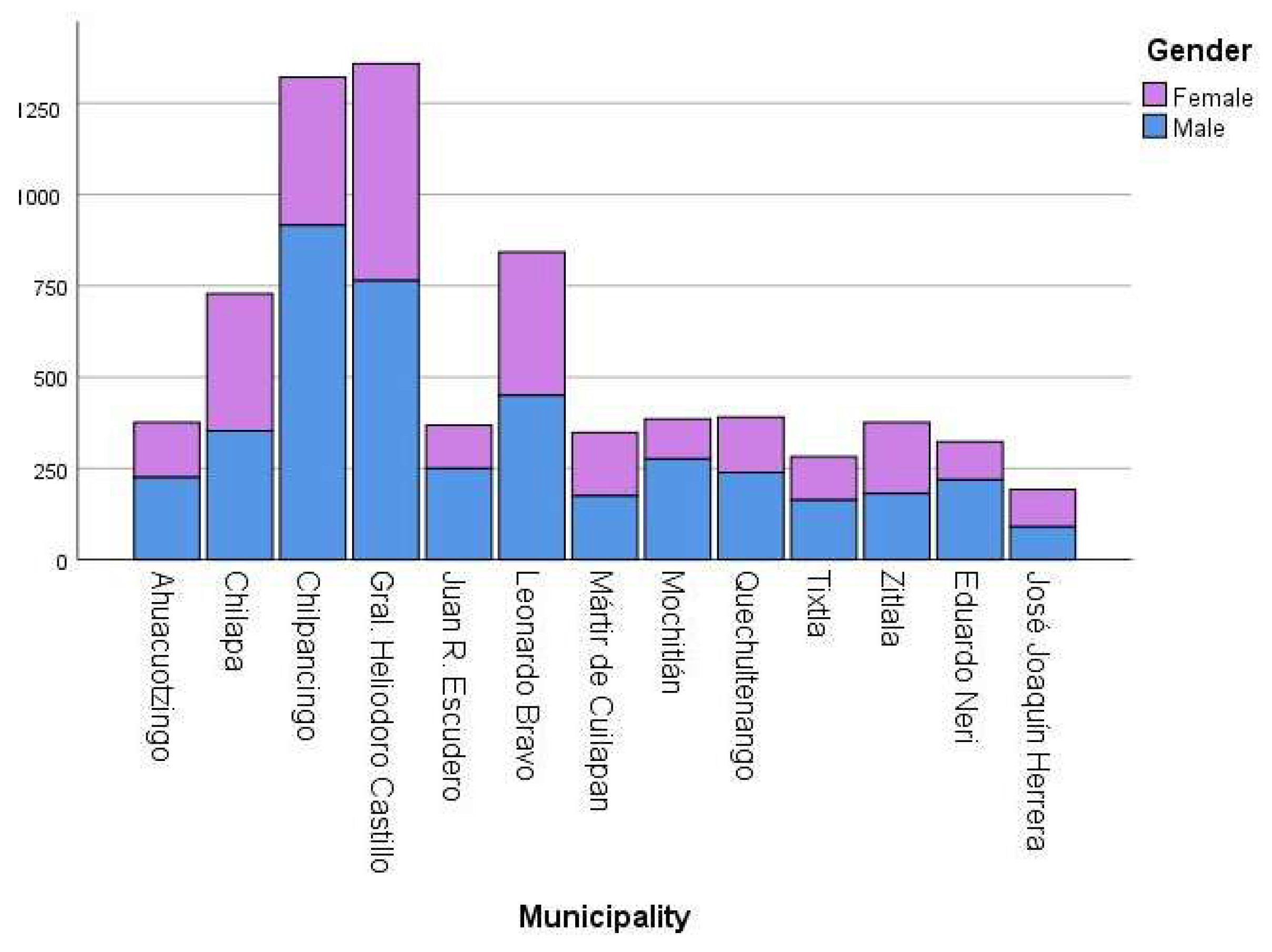
| Municipality | Beneficiaries | Stratified Sample |
|---|---|---|
| Ahuacuotzingo | 376 | 5 |
| Chilapa de Álvarez | 728 | 10 |
| Chilpancingo de los Bravo | 1321 | 18 |
| Eduardo Neri | 323 | 4 |
| Gral. Heliodoro Castillo | 1358 | 18 |
| José Joaquín de Herrera | 192 | 3 |
| Juan R. Escudero | 368 | 5 |
| Leonardo Bravo | 842 | 11 |
| Mártir de Cuilapan | 348 | 5 |
| Mochitlán | 385 | 5 |
| Quechultenango | 390 | 5 |
| Tixtla | 282 | 5 |
| Zitlala | 376 | 5 |
| TOTAL | 7289 | 99 |
| Social % | Environmental % | Economic % | |||
|---|---|---|---|---|---|
| Beneficiaries who have returned to their place of origin | 6.9 | Beneficiaries who have diversified their production | 62.3 | Beneficiaries who have made improvements in their health, housing, or education | 93 |
| Beneficiaries who entered agriculture | 33.7 | Beneficiaries who implement the environmental practices learned on their plots | 100 | Beneficiaries who have experienced an increase in their agricultural income | 62.3 |
| Recovery of the community’s social fabric | 100 | ||||
| Participation of youth aged 18–29 years | 7.9 | ||||
| Participation of women | 39.6 | ||||
| Year | Evolution |
|---|---|
| 2019–2020 | During this period, the primary indicator was the percentage of agricultural subjects below the welfare line, reflecting an initial focus on identifying populations living in poverty. |
| 2021 | The indicator measuring the percentage of the population meeting its basic food needs was introduced, aiming to strengthen the monitoring of welfare conditions and food self-sufficiency. |
| 2022 | The indicator was defined that represents the percentage of the population below the poverty line in rural localities, emphasizing the multidimensional impact of rural poverty beyond income. |
| 2023–2024 | The focus on food self-sufficiency and the percentage of individuals able to meet their basic needs was maintained, prioritizing economic well-being. |
| Year | Evolution |
|---|---|
| 2019–2020 | No indicators explicitly addressed hectare productivity; rather, the focus remained on the delivery of financial support to agricultural subjects and on welfare conditions. |
| 2021 | The indicator measuring the percentage of active participants cultivating 2.5 hectares was incorporated, aimed at assessing the program’s actual productivity and land use efficiency. |
| 2022–2024 | The indicator representing the percentage of active participants cultivating 2.5 hectares was maintained, highlighting the continued importance of land productivity as a key component of the SVP. |
| Year | Evolution |
|---|---|
| 2019–2020 | The initial emphasis focused on measuring the percentage of agricultural subjects who received financial support in relation to those planned, while also assessing the delivery of in-kind support. |
| 2021–2024 | The delivery of economic benefits continued, with the incorporation of a more detailed evaluation, including the percentage of individuals receiving timely support and their contributions to savings. This focus allowed for the assessment of both subsidy delivery and the promotion of financial education among beneficiaries. |
| Year | Evolution |
|---|---|
| 2019–2020 | No indicators explicitly referred to food self-sufficiency; rather, the emphasis remained on the delivery of financial support to agricultural subjects and on welfare conditions. |
| 2021 | An indicator was implemented to measure the percentage of the target population that meets its basic food needs. This marked progress toward analyzing food self-sufficiency capacity as an outcome of the program. |
| 2022–2024 | Emphasis was placed on the percentage of individuals meeting their food needs through products derived from cultivated hectares, relative to the income received. This shift underscored the importance of land cultivation and its direct contribution to food security. |
| Year | Evolution |
|---|---|
| 2019–2020 | Technical staff compliance with the work plan was evaluated, with a minimum standard of 85%. |
| 2021 | The indicator was adjusted to a compliance standard of 80%, adapting to a more realistic approach that encompasses a greater diversity of activities within the work plan. |
| 2022–2024 | The evaluation of technical staff continued, underscoring the importance of their participation. By 2024, the percentage of technical staff meeting monthly activity requirements was incorporated, indicating a deeper level of supervision and performance evaluation. |
| Population Proportion (P) | Intervals |
|---|---|
| Beneficiaries who have made improvements in their health, housing, or education | 86.15% ≤ P ≤ 95.65% |
| Beneficiaries who have experienced an increase in their agricultural income | 55.68% ≤ P ≤ 71.58% |
| Beneficiaries who have diversified their production | 55.68% ≤ P ≤ 71.58% |
| Beneficiaries who have returned to their place of origin | 2.84% ≤ P ≤ 11.3% |
| Beneficiaries who entered agriculture | 26.49% ≤ P ≤ 42.19% |
| Participation of women | 32.39% ≤ P ≤ 48.51% |
| Participation of youth aged 18–29 years | 3.58% ≤ P ≤ 12.58% |
| Program | Year of Start | Region | Objective | 2030 Goal (Hectares) | Stakeholders | Financial Support | Results |
|---|---|---|---|---|---|---|---|
| Amazon Sustainable Landscapes Program 1 | 2015 | Amazon | To connect people and institutions to link conserved and managed landscapes, maintain 73 million hectares of forest land, promote sustainable land management on 52,700 hectares, and support actions to reduce CO2 emissions by 2030. | 73,000,000 | Environmental authorities of Amazonian countries, public and private national and international organizations, civil society, and community organizations. | Provides financial support and funding through specific national projects implemented in Amazonian countries. | 7.4 million ha of new or expanded protected areas, 17,814 ha of restored forest, support for 60 community initiatives related to 15 non-timber species, 3 sustainable financing mechanisms supported, 91 million Mt CO2 eq of greenhouse gas emissions mitigated. |
| Initiative 20 × 20 2 | 2014 | Latin America and the Caribbean | To bring more than 50 million hectares of degraded land into a process of conservation and restoration by 2030 through various projects. | 50,000,000 | National governments, financial and technical partners, academics, communities, civil society, and transboundary regions committed to land restoration and conservation. | Receives funding for environmental restoration projects, some of which provide economic benefits to farmers. | 8.2 million ha of degraded land restored, and 14.6 million ha converted into conservation areas. |
| Trees for the future “Agroforestry gardens” 3 | 2014 | Africa | Increase soil fertility and smallholder productivity, expanding restoration from 41,000 to 229,000 hectares by 2030 and supporting the creation of 230,000 jobs. | 229,000 | International non-profit organization (TREES) and farmers. | Does not provide direct financial support; instead, it supports communities and farmers in Africa through training, seeds, and tools for regenerative agriculture, promoting sustainable incomes and reducing poverty and deforestation. | It has restored 41,345 ha since 2014. It has supported more than 50,000 households and captured 347 metric tons of CO2 per hectare. The restoration of arid lands also contributes to increasing income and improving the health of farmers and their families. |
| The great green wall 4 | 2007 | Africa | Implement a mosaic of restoration and rehabilitation interventions to address land degradation and desertification, restoring 100 million hectares, creating 10 million green jobs, and capturing 250 million tons of CO2 by 2030. | 100,000,000 | The United Nations (UN) and international organizations. | Receives funding to implement practical projects benefiting local communities and the environment, aiming to create 10 million green jobs by 2030. | Three million new jobs have been created in the countries participating in the project, which has restored 30 million hectares of degraded land. The project is 30% complete. |
| The Bonn challenge 5 | 2011 | Global | Restore 150 million hectares by 2020 and 350 million hectares by 2030, aiming to improve both ecological integrity and human well-being. | 350,000,000 | Countries, governments, international organizations (IUCN, FAO, UN), NGOs, Indigenous communities, private sector actors, and landowners. | Does not provide direct funding; resources are directed toward ecosystem restoration and the strengthening of local and regional initiatives. | It has restored more than 160 million hectares currently, with 61 countries committed to the initiative. |
| Terai Arc Landscape 6 | 2001 | India and Nepal | Protect a rapidly degrading biodiversity hotspot shared by India and Nepal. | 2,470,000 | NGOs, state and local governments, civil society, and Indigenous communities. | Receives funding from international organizations for the restoration project. It generates green jobs and promotes sustainable economic activities. | It restored 66,800 hectares, increased the rhinoceros population from 409 to 752 (2005–2021), and tigers from 121 to 355 (2010–2022). |
| SVP 7 | 2019 | Mexico | Promote the social well-being of women and men farmers by promoting food self-sufficiency, through actions that foster the reconstruction of the social fabric and environmental restoration, implemented via plots with agroforestry production systems. | 1,139,372.50 | Government, beneficiaries, and technical staff (productive and social). | Provides direct monthly financial support of MXN 6450 to beneficiaries. | It recovered 1,202,959.708 ha, surpassing its proposed goal of 1,139,372.5 ha, generated more than 442,000 permanent jobs, established 18,500 PLC, 368 cooperatives, 1400 productive projects, and approximately 48,000 actions benefiting their own communities. |
Disclaimer/Publisher’s Note: The statements, opinions and data contained in all publications are solely those of the individual author(s) and contributor(s) and not of MDPI and/or the editor(s). MDPI and/or the editor(s) disclaim responsibility for any injury to people or property resulting from any ideas, methods, instructions or products referred to in the content. |
© 2026 by the authors. Licensee MDPI, Basel, Switzerland. This article is an open access article distributed under the terms and conditions of the Creative Commons Attribution (CC BY) license.
Share and Cite
Castro-Bello, M.; Vázquez-Martínez, D.D.; Morales-Morales, C.; Fuentes-Pacheco, J.; Gutiérrez-Valencia, D.E.; Marmolejo-Vega, C.V.; Zagal-Barrera, S.R. Evaluation of the Targeting Mechanisms of the Sembrando Vida Program in Mexico. Conservation 2026, 6, 8. https://doi.org/10.3390/conservation6010008
Castro-Bello M, Vázquez-Martínez DD, Morales-Morales C, Fuentes-Pacheco J, Gutiérrez-Valencia DE, Marmolejo-Vega CV, Zagal-Barrera SR. Evaluation of the Targeting Mechanisms of the Sembrando Vida Program in Mexico. Conservation. 2026; 6(1):8. https://doi.org/10.3390/conservation6010008
Chicago/Turabian StyleCastro-Bello, Mirna, Diana Dolores Vázquez-Martínez, Cornelio Morales-Morales, Jorge Fuentes-Pacheco, Diego Esteban Gutiérrez-Valencia, Carlos Virgilio Marmolejo-Vega, and Sergio Ricardo Zagal-Barrera. 2026. "Evaluation of the Targeting Mechanisms of the Sembrando Vida Program in Mexico" Conservation 6, no. 1: 8. https://doi.org/10.3390/conservation6010008
APA StyleCastro-Bello, M., Vázquez-Martínez, D. D., Morales-Morales, C., Fuentes-Pacheco, J., Gutiérrez-Valencia, D. E., Marmolejo-Vega, C. V., & Zagal-Barrera, S. R. (2026). Evaluation of the Targeting Mechanisms of the Sembrando Vida Program in Mexico. Conservation, 6(1), 8. https://doi.org/10.3390/conservation6010008