Article

Early Selection of Popcorn Lines for Tolerance to Salt Stress

by
Rosenilda de Souza
1,*,
Henrique Duarte Vieira
1,
Samuel Henrique Kamphorst
2,
Valter Jário de Lima
2,
Ellen Peixoto Azeredo
1 and
Antônio Teixeira do Amaral Junior
2
1
Phytotechnics Laboratory, Center for Agricultural Science and Technologies (CCTA), State University of Norte Fluminense Darcy Ribeiro—UENF, Campos dos Goytacazes 28013-602, RJ, Brazil
2
Plant Breeding Laboratory, Center for Agricultural Science and Technologies (CCTA), State University of Norte Fluminense Darcy Ribeiro—UENF, Campos dos Goytacazes 28013-602, RJ, Brazil
*
Author to whom correspondence should be addressed.
Stresses 2026, 6(1), 9; https://doi.org/10.3390/stresses6010009
Submission received: 24 January 2026 / Revised: 20 February 2026 / Accepted: 25 February 2026 / Published: 28 February 2026
(This article belongs to the Section Plant and Photoautotrophic Stresses)

Abstract

The evaluation of popcorn lines for salt stress during the germination phase facilitates the early selection of superior genotypes, ensuring crop success. This study assessed 31 lines to identify genotypes tolerant to salt stress in the early phase and to understand the effects. Seeds were sown on paper substrate with two concentrations of sodium chloride: zero (NS) and 100.0 mM (SS), in a randomized block design with four replicates of 25 seeds each. Physical and physiological traits of seeds and seedlings were evaluated. Analysis of variance revealed significant effects (p ≤ 0.01) for genotype, salinity condition, and their interaction. Genetic variability was observed under both conditions. In NS, area and germination were the most influential factors in differentiating lines, while in SS, total seedling length and the percentage of abnormal seedlings were key. The stress tolerance index identified lines L263, L684, L472, and L358 as the most tolerant, and lines L690, L217, L220, and L213 as the most sensitive. Tolerant genotypes are potential candidates for crossbreeding aimed at developing hybrids adapted to salinity conditions, promoting agricultural sustainability in adverse environments. The significant interaction between genotypes and salinity conditions reinforces the importance of conducting selection in specific stress environments.

1. Introduction

Soil salinity is an abiotic stress that adversely affects crops from the early stages of plant development, leading to production losses. According to FAO data, approximately 8.7% of the global soil area is affected by salt, and it is predicted that by 2050, this figure could reach 50% of the world’s arable land [1]. Increased salinity jeopardizes agricultural production and food security for billions of people. In this scenario, it is essential to evaluate the differential response of genotypes to salt stress, aiming to develop productive cultivars, including popcorn, adapted to these new cultivation conditions.
Popcorn (Zea mays L. var. Everta) is a special type of corn designed for human consumption, particularly during leisure activities. In recent years, Brazil has emerged as one of the world’s largest producers of this type of corn, thanks to the population’s growing appreciation and consumption [2]. With the increasing national importance of this crop, research has been conducted to select superior genotypes tolerant to biotic and abiotic stresses [3,4,5,6,7,8,9]. However, these studies have primarily focused on improving the efficiency of nitrogen and phosphorus use, resistance to diseases and pests, and tolerance to water stress. This leaves a gap in the development of cultivars adapted to salt stress conditions, representing a vulnerability in the face of the adverse effects of climate change.
In maize, salinity impacts everything from germination and initial seedling growth to the overall performance of the crop [10,11,12]. Excess salts reduce the soil’s water potential, negatively affecting plant metabolism, whether through difficulties in water absorption, toxicity from specific ions, or the indirect interference of salts with physiological processes [13,14,15]. When excessive soluble salts are present at the outset of crop establishment, i.e., immediately after sowing, the reduction in soil water potential leads to decreased water absorption capacity by the seeds, thereby impairing seed germination and seedling development [16]. Nonetheless, sensitivity and tolerance to salt stress can vary according to the species and cultivar, the stage of plant development, the physical conditions and water availability in the soil, and the duration of the stress. Recent studies confirm that such responses vary according to genetic and environmental factors, highlighting the need to consider these variables when interpreting salinity tolerance results [17,18].
The development of genotypes tolerant to abiotic stresses depends on at least two factors: the identification of germplasm that is tolerant to the specific stress, and a fast and efficient evaluation method capable of quickly differentiating the outcomes of crosses and the selection process of materials. In this regard, evaluating early stages of plant development emerges as a promising strategy for identifying superior genotypes. This methodology leverages easily measurable and highly responsive traits, which can enhance the efficiency of selection under stress conditions [19]. Additionally, studies have shown that traits related to seed germination and seedling development are instrumental for developing corn genotypes that are more tolerant to abiotic stress [20,21,22,23].
Accordingly, this study aims to: (i) investigate the effects of salinity on popcorn lines; (ii) analyze the genetic variability that can be selected for salt stress tolerance; and (iii) identify popcorn lines that are superior in tolerance to salt stress during the initial development phase. The results confirmed that salinity negatively impacts the initial development of seedlings, and in a distinct way in each genotype, which reinforces the need to conduct selection in specific stress environments.

2. Results

2.1. Genetic Variability and Performance of the Lines Under Salinity Conditions

In the combined analysis, the sources of variation “genotype” (G) and “salinity condition” (SC) showed statistically significant differences in the F test (p ≤ 0.01) for all evaluated traits, except for the effect of SC on germination and abnormal seedlings (Table 1). The genotype × salinity condition interaction (G × SC) effect was significant for all studied variables (Table 1).
In both salinity conditions, the individual analyses identified significant differences (p ≤ 0.01) across all variables. The experimental coefficients of variation (CVe%) were low (<12% in NS and <14% in SS) for all traits, except for the percentage of abnormal plants (Table 1).
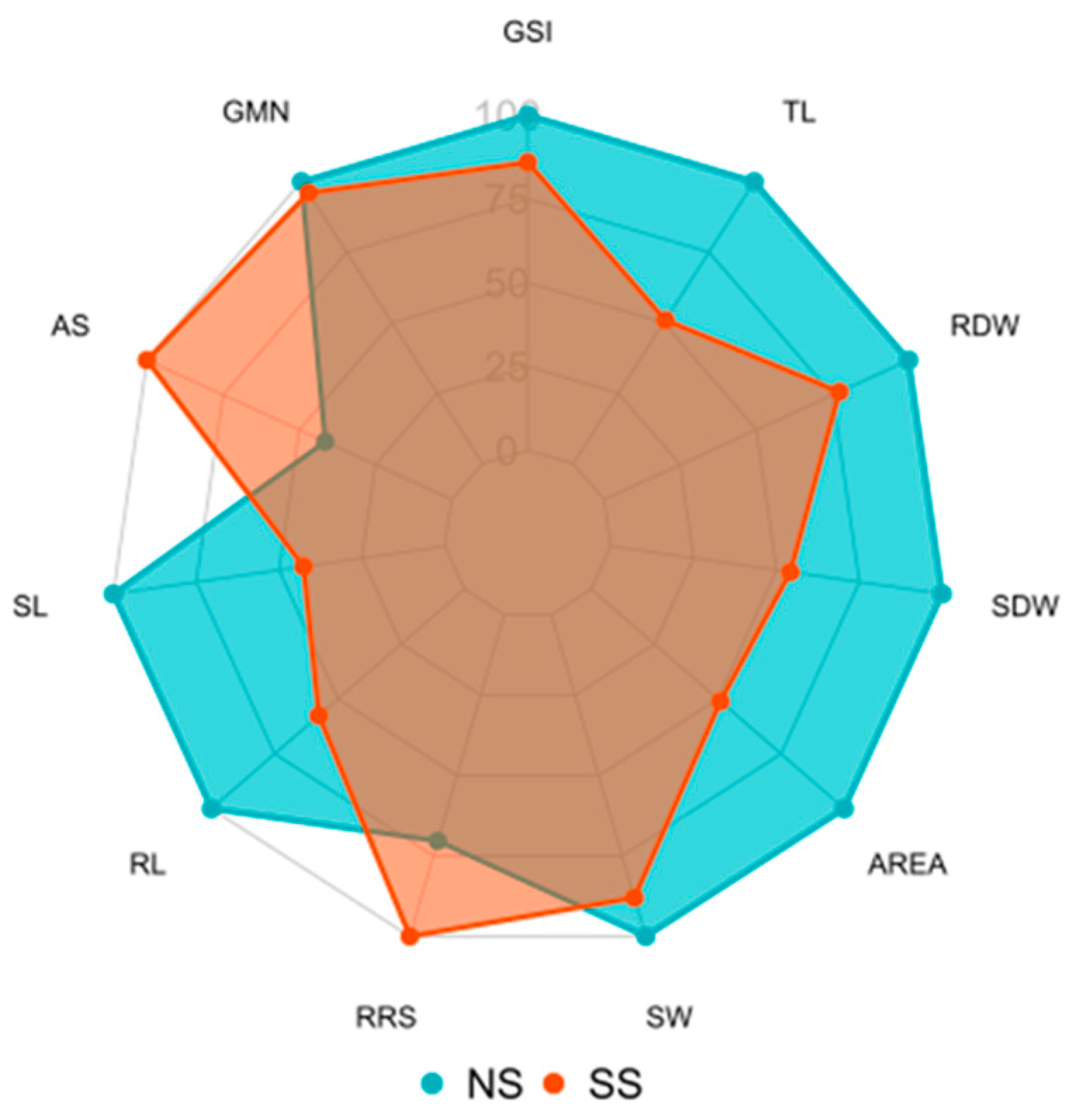
Significant reductions were observed when comparing the stress condition to the control, with decreases exceeding 20% in several traits: SL (57.3%), TL (49.0%), Area (48.9%), SDW (45.8%), RL (42.4%), and RDW (22.7%). GMN, GSI, and SW experienced smaller declines of 3.9%, 14.0%, and 12.0%, respectively. Conversely, the traits AS and RRS increased by 58.5% and 29.6%, respectively (Figure 1).
Regarding the genetic ( σ g 2 ) and environmental ( σ e 2 ) variance values, the former was superior to the latter for all variables under both salinity conditions (Table 1). Heritability estimates ( h 2 ) for the agronomic traits ranged from 88.7% to 98.2% in NS conditions and from 87.4% to 98.4% in SS conditions.

2.2. Cluster Analysis

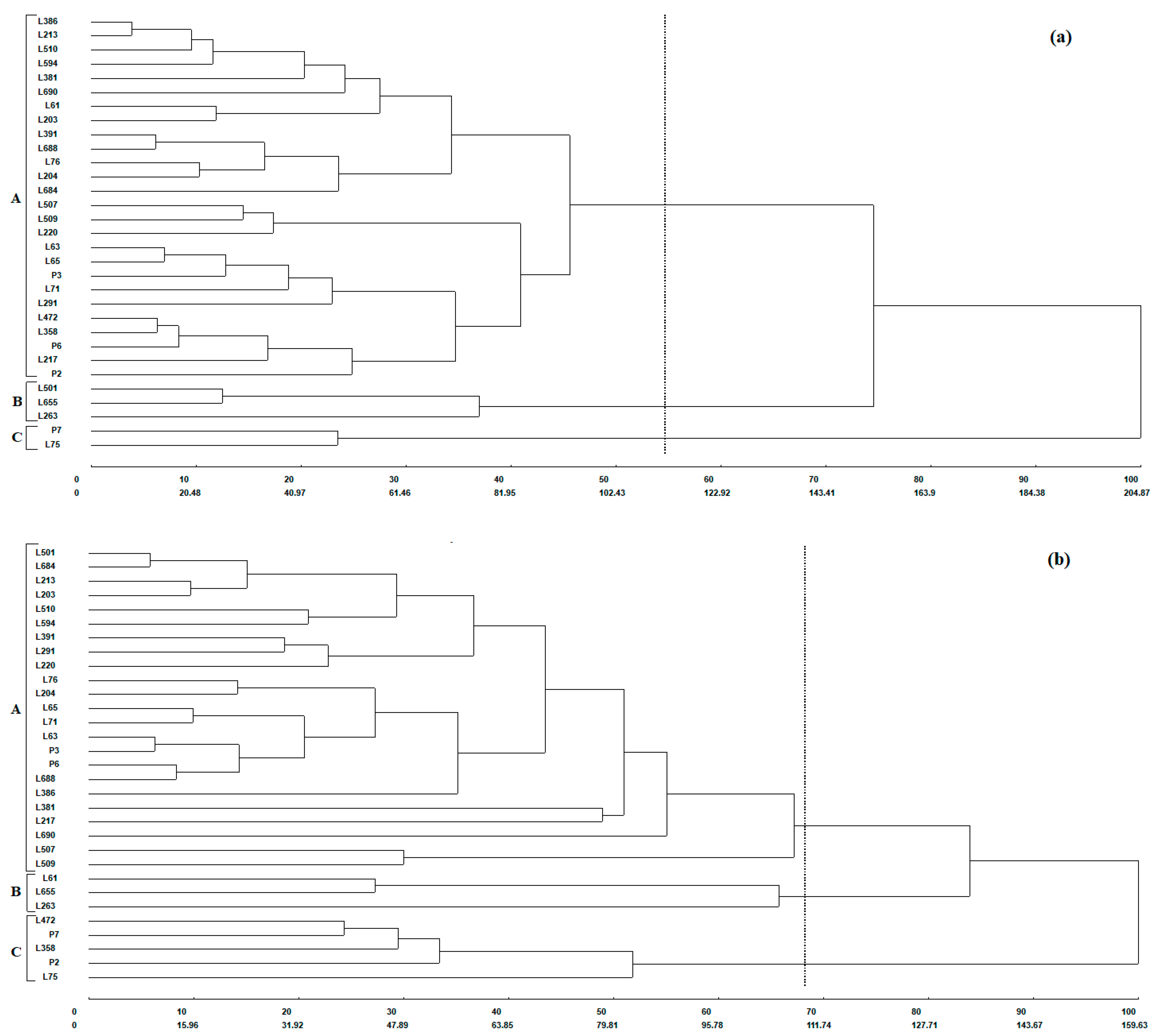
In each salinity condition (Figure 2a,b), three groups were formed, though there were shifts in the composition of groups within each environment. The cutoff point was set according to the methodology of [24], with a k-value of 1.5. The cophenetic correlation values were 0.67 in NS and 0.66 in SS.
Under NS conditions, Group A comprised 26 lines, representing 84.0% of the total genotypes. Group B included three lines (L501, L655, and L263), and Group C consisted of two lines, P7 and L75 (Figure 2a).
Under SS conditions, Group A included 23 lines, accounting for 74.2% of the total genotypes. Group B was composed of three lines (L61, L655, and L263), while Group C included lines L472, P7, L75, L358, and P2 (Figure 2b).

2.3. Principal Component Analysis

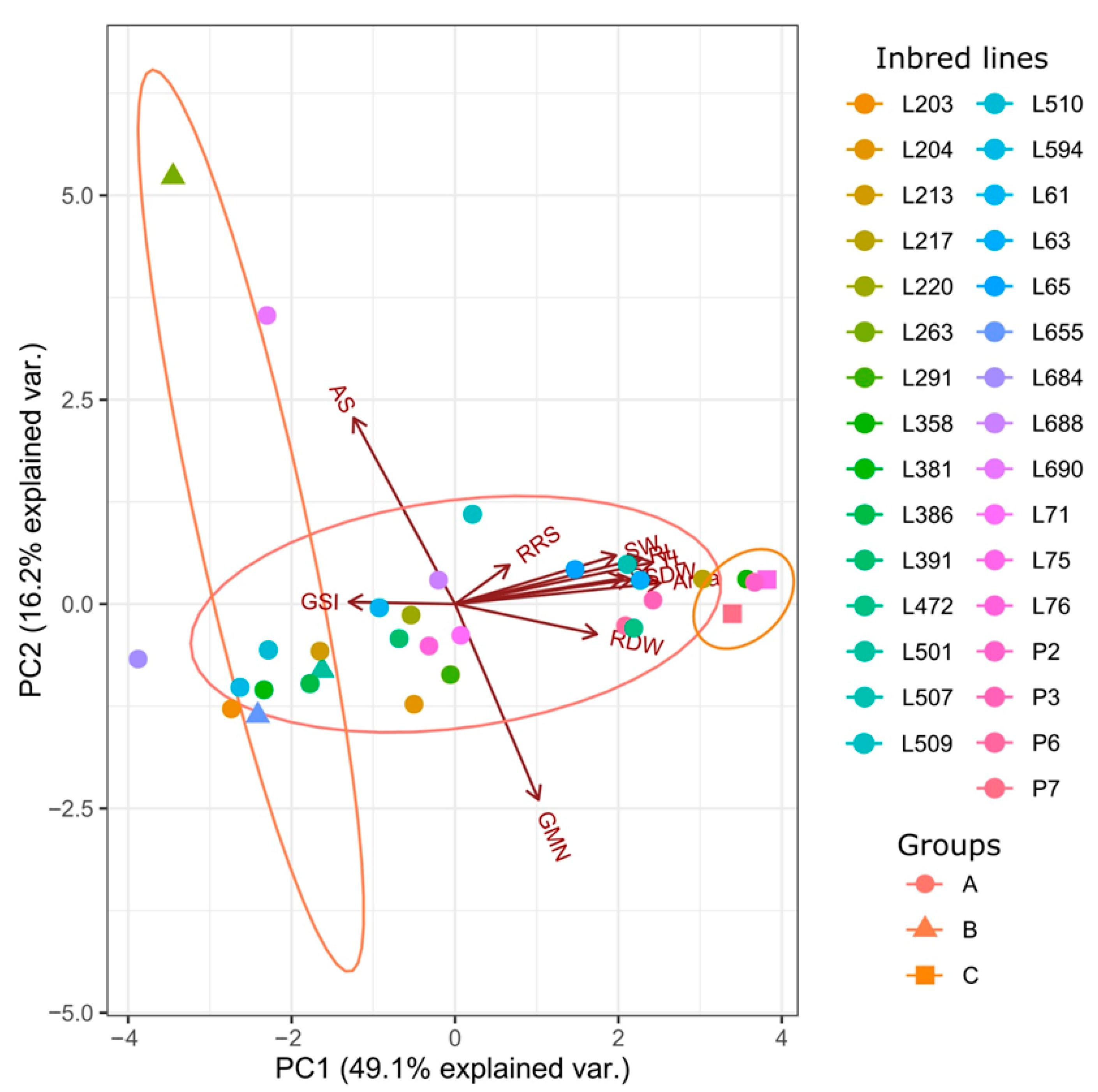
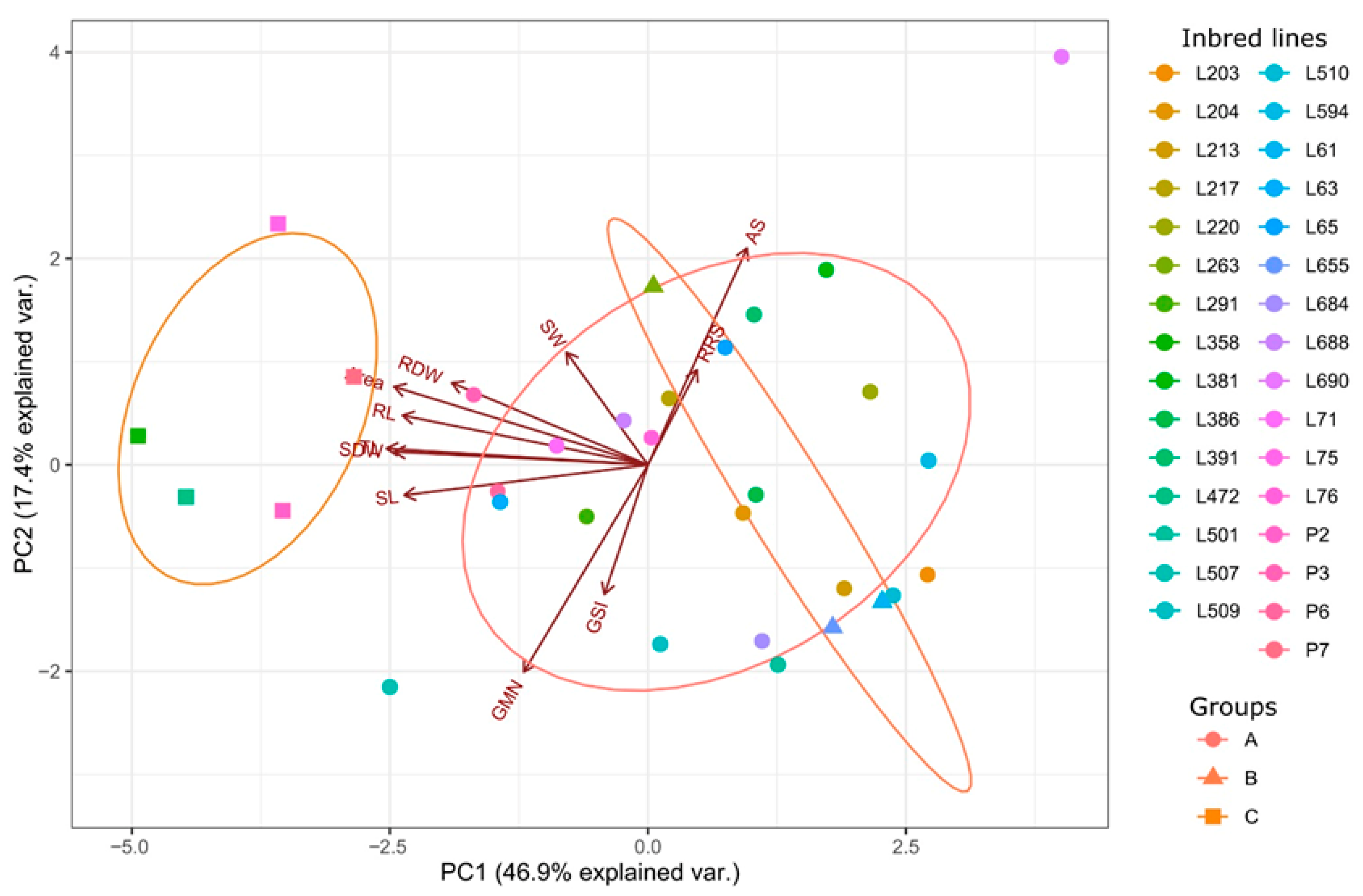
In the no-salt-stress condition, the first principal component explained 49.1% of the variation, with the Area variable having the greatest influence. The second principal component explained 16.2% of the variation, with GMN being the variable with the greatest weight (Figure 3). In the salt stress condition, the first principal component explained 46.9% of the variation, with the TL variable having the greatest influence. The second component explained 17.4% of the variation, with AS being the variable with the greatest weight (Figure 4).
In both environments, SS and NS, three groups were formed (Figure 3 and Figure 4). Under NS, lines in Group A generally exhibited lower germination and seedling development, with higher values for AS. Group C was distinguished by having the highest means for seedling traits such as RL, RDW and Area, along with an average value for GSI.
In SS, lines in Group A typically showed lower seedling development and higher values for AS. Group B did not display a well-defined pattern, whereas Group C lines stood out with the highest means for most evaluated traits.

2.4. Selection of Lines for Salt Stress Conditions Using the Tolerance Index

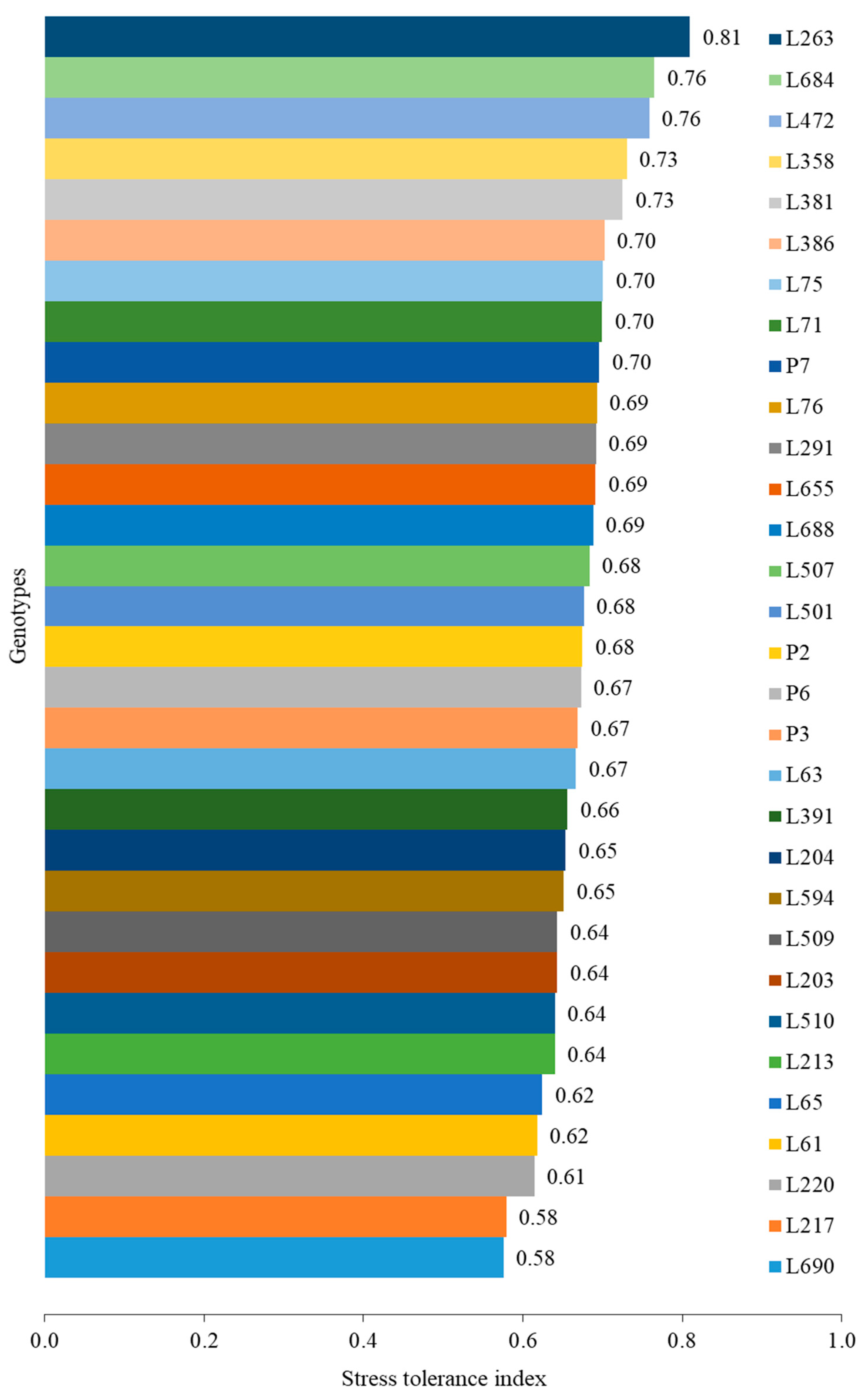
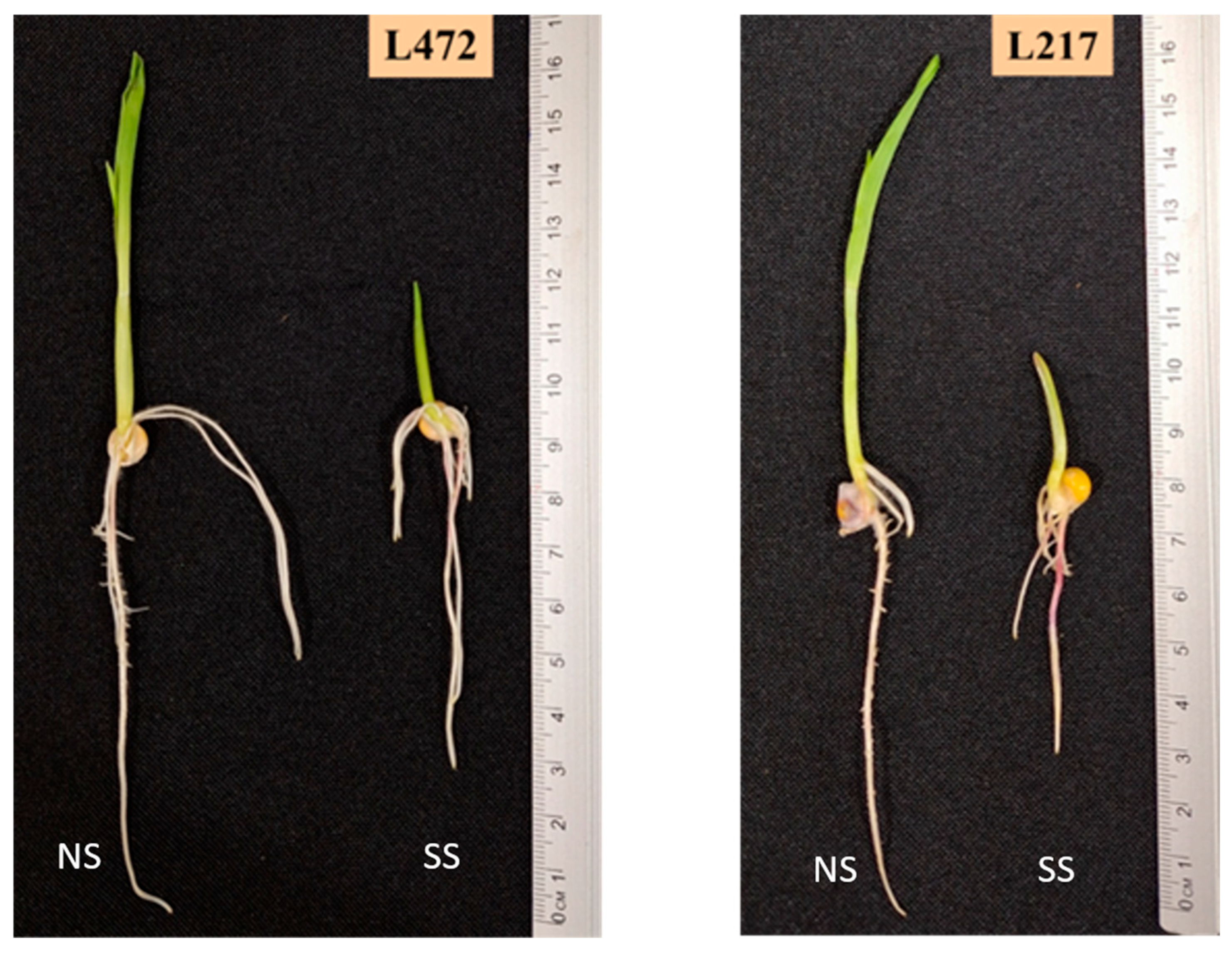
The salt stress tolerance index (STI) for each genotype represents the average tolerance value across the nine evaluated traits. The variables RRS and AS were excluded because their averages increased in the saline condition. The STI values ranged from 0.58 to 0.81, with values closer to 1.0 indicating greater tolerance to salt stress (Figure 5). Lines L263, L684, L472 (Figure 6), L358, and L381 exhibited the highest STI, with L263 reaching 0.81. Thus, the variation in responses of these genotypes across the two environments was considered low. Conversely, lines L690, L217 (Figure 6), L220, L61, and L65 showed the lowest indices, with values below 0.62.

3. Discussion

Salt stress significantly impacted both the speed and percentage of seed germination. However, the most profound effect of excessive salt exposure was on traits related to the initial development of seedlings, such as length, area, width, and shoot dry weight. Initially, the presence of salt in the germination medium lowers water potential, which hampers water absorption by the seeds. As water is crucial for the resumption of metabolic activities, the physiological drought caused by excess salt affects germination, leading to fewer normal seedlings and reduced germination speed [16,25]. Subsequently, biochemical and physiological processes are initiated, resulting in the excessive production of radical functional groups that may oxidize cell membranes and stunt seedling growth and development [14,15].
Despite the NaCl concentration not being sufficient to statistically differentiate between NS and SS conditions for the GMN trait, nine of the 31 lines exhibited a significant decrease in germination under saline conditions. Concurrently, decreased germination was linked to an increased number of abnormal seedlings, as observed in lines L75, P3, L220, L391, L65, L381, and L690. Salinity also impacted the speed of seed germination, with only two lines, L507 and L263, maintaining their average performance under saline conditions.
Among seedling traits, shoot development was most affected by salinity, with reductions of 57.3% for SL and 45.8% for SDW. Although the root is the first organ exposed to the saline solution, shoots are more sensitive to stress than roots [26]. Based on seedling length and dry weight, lines L472, L358, L684, and L263 demonstrated the smallest declines under saline conditions, indicating greater tolerance to salinity. Conversely, lines L594, L220, L61, and L217 experienced the most significant shoot losses.
Salinity tolerance is a complex trait influenced by the expression of multiple genes and can vary not only between species but also among genotypes within the same species. Plants employ various mechanisms to cope with salinity, including maintaining osmotic balance, ion exclusion, ion inclusion and compartmentalization, antioxidant responses, and hormonal regulation. Notably, the ability to restrict the transport of Na+ and Cl to the leaves and to compartmentalize these ions in vacuoles distinguishes salt-tolerant plants from their salt-sensitive counterparts [27,28,29,30].
The significant effects observed for genotype, salinity condition, and the interaction between genotype and saline condition indicate that the sodium chloride concentration used (100.0 mM NaCl) effectively distinguished the stress environment from the control and differentiated between salinity-tolerant and -sensitive lines. The significant interaction effect implies that the ranking of lines varies according to the environment. This variation suggests that the alleles regulating trait expression under stress differ, at least in part, from those controlling the trait under ideal germination conditions [31]. Therefore, the selection of superior genotypes should be conducted separately for each condition, rather than based on the average performance across conditions.
The differential response of the lines to stress and the increased magnitude of phenotypic variance under saline conditions indicate a greater variation among genotypes in this environment, signifying genetic variability that is subject to selection for salinity tolerance. The same observations have been made by other researchers for traits related to germination under salt stress in corn [32] and rice [33], germination under water stress in popcorn [3], and for plant traits under salt stress in common corn [21].
Consequently, the significant magnitudes of the σ g 2 values, being greater than the σ e 2 values, confirm that the observed variance results from genetic differences between the lines, facilitating the identification of sources of favorable alleles for salt stress tolerance in the initial development phase. Additionally, high heritability values above 87.0 were detected, which is a fundamental condition for achieving genetic gains through selection in both germination conditions. These heritability estimates are consistent with values identified for physical and physiological seed and seedling traits under ideal germination conditions [34,35]. However, under stress conditions, heritability values below 60.0% are reported for seedling traits in popcorn inbred lines subjected to low phosphorus levels [7].
The stress condition enhances the expression of genetic variation due to the expression of genes associated with salinity tolerance and/or reduced environmental variation [36,37,38]. This potential variation, previously unselected, becomes detectable under stress and can lead to increased heritability [36], and should be leveraged in breeding programs aimed at developing popcorn cultivars with salinity tolerance at early developmental stages.
In this context of stress conditions, early characterization has been shown to provide information that guides breeders in selecting genotypes adapted to saline environments. Germination and initial seedling growth are the stages most sensitive to excess salts in the soil, since they are physiological processes directly affected by salinity [10,39]. Furthermore, the performance of genotypes in the germination process is an indication of whether or not they are tolerant of salts during subsequent stages of development [40].
However, although controlled laboratory conditions allowed for a precise assessment of initial responses to salt stress, it is important to emphasize that such environments may not fully represent the complexity of field conditions. Future studies should expand the evaluation of salt stress in naturally saline soils, especially regarding its impact on traits related to popcorn productivity. The integration between controlled environment screening and phenotypic validation in the field will strengthen the robustness of selection and increase the reliability in identifying superior salt-tolerant genotypes.
In this study, lines that consistently grouped together under both salinity conditions, particularly genotypes P7 and L75, displayed great genetic similarity and, consequently, similar performance irrespective of germination conditions. These lines constitute Group C of the dendrogram under stress conditions, which is notable for exhibiting the highest means for seedling traits. Besides these genotypes, lines L263, L684, L472, L358, and L381 are identified as potential parents for inclusion in crosses aimed at developing hybrids tolerant to salt stress in the initial phase of development.
Crossing these superior lines with the most sensitive lines, namely, L690, L217, L220, L61, and L65, can serve as a model for genetic studies on traits related to salinity tolerance. Understanding the genetic mode of action, combined with prior knowledge of genetic variability, heritability, and other parameters, provides a foundation for breeders’ decisions during different stages of the breeding process [19]. This approach was similarly applied in breeding aimed at adapting to drought in early stages of popcorn development [3]. From genetic-based studies, these authors identified that genetic dominance effects control traits evaluated at the seedling stage, and hybrids can be utilized since the beneficial effects of allelic complementation will be explored.
In the present study, the observed greater genetic variation and high heritability estimates in saline conditions suggest that significant genetic progress can be achieved for salt tolerance in popcorn through early selection.

4. Materials and Methods

4.1. Plant Material

The plant material consisted of 31 popcorn lines from the Germplasm Bank at the Universidade Estadual do Norte Fluminense Darcy Ribeiro (UENF). These lines derive from genotypes adapted to the temperate and/or tropical climates of various Latin American countries [41], as detailed in Supplementary Information (SI, Table S1).

4.2. Application of Salinity Conditions and Experimental Design

Seeds were subjected to two salinity conditions: non-saline (NS) and salt stress (SS). In the NS condition, the paper substrate was moistened with pure deionized water (electrical conductivity of 0.2847 dS m−1 at 25 °C) at a ratio of 2.5 times the weight of the paper. Under SS conditions, the substrate was moistened with a deionized water solution containing sodium chloride (NaCl) at a concentration of 100.0 mM (electrical conductivity of 9.3 dS m−1 at 25 °C). In both conditions, the rolls were placed in transparent polyethylene bags and transferred to germinators, maintained at a temperature of 20–30 °C with a photoperiod of 8 h/day and 16 h/night, and a luminous intensity of 150–300 µmol m−2 s−1. Substrate moisture was monitored daily over the seven days of the test, with deionized water added as necessary in both conditions.
The experiments were structured in a randomized block design with four replicates, each consisting of 25 seeds.

4.3. Evaluated Traits

The genotypes were evaluated based on physiological seed variables, namely germination percentage (GMN), germination speed index (GSI), and percentage of abnormal seedlings (AS), as well as the following physical and physiological seedling variables: seedling area (Area), length (SL), and width (SW); shoot dry weight (SDW); root length (RL); root dry weight (RDW); root-to-shoot ratio (RRS); and total seedling length (TL). Physiological evaluations were conducted following the Rules for Seed Testing standards [42].
During the germination test, the germination speed index was calculated using the formula proposed by [43], based on daily counts of seeds with at least 0.5 cm of radicle emergence. At the end of the seven-day implantation period, the number of normal and abnormal seedlings and non-germinated seeds [42] was quantified and expressed as a percentage. The variables Area, SL, RL, TL, RRS, and SW were assessed through digital phenotyping of 10 random seedlings from each replicate using GroundEye® (Tbit Tecnologia S.A., Lavras, Brazil) equipment.
To determine dry weight, the 10 seedlings used for digital phenotyping were separated into shoots and roots, placed in paper envelopes, and dried in a forced-air oven at 65 °C for 72 h. After drying, the samples were cooled in desiccators and weighed, with results expressed in mg seedling−1.

4.4. Statistical Analyses

4.4.1. Analysis of Variance and Genetic Parameters

After verifying the normality and homogeneity of the data, adopting a significance level of 5% for all analyses, the data were subjected to combined analysis of variance (NS and SS) following the random statistical–mathematical model given by the expression
Y i j k = μ + G i + B / S C k j + S C k + G S C i k + E i j k
where Y i j k = observation of genotype i (i = 1, 2, …, 31) in block j (j = 1, 2, 3, 4) in salinity condition k (k = 1, 2); μ = general constant; G i = effect of genotype i; B / S C k j = effect of block j within salinity condition k; S C k = effect of salinity condition k; G S C i k = effect of genotype × salinity condition interaction; and E i j k = experimental error, assumed to be normally and independently distributed (NID) with mean 0 and variance σ 2 . In the joint analysis, the source of variation ‘genotype’ was considered random and ‘salinity condition’ was considered fixed.
The individual analysis of variance for each salinity condition (NS and SS) followed the random statistical–mathematical model given by the expression
Y i j = μ + G i + B j + E i j
where Y i j = observation of genotype i (i = 1, 2, …, 31) in block j (j = 1, 2, 3, 4); μ = general constant; G i = effect of genotype i; B j = effect of block j; and E i j = experimental error, assumed to be NID with mean 0 and variance σ 2 .
From the individual analysis of variance, the following genetic parameters were estimated: environmental variance ( σ e 2 ), phenotypic variance ( σ p 2 ), genotypic variance ( σ g 2 ), and heritability ( h 2 ). The genetic parameters from the individual analysis were obtained using the formulas proposed by [44].
Genetic dissimilarity was calculated using a data matrix for cluster analysis consisting of the 11 evaluated variables. To generate the dendrogram, the generalized Mahalanobis distance (D2) [45] was estimated. The Unweighted Pair Group Method with Arithmetic Mean (UPGMA) was employed to construct the clusters. The relative importance of the variables was determined by the principal components analysis (PCA) based on the standardized means [44].
Statistical analyses were performed using Genes (v1990.2024.37) [46] and R software (v4.4.2).

4.4.2. Salt Stress Tolerance Index

The salt stress tolerance index (STI) was calculated using the methodology proposed by [47], with the equation STI = (Yc × Ys)/(Yc)2, where STI = stress tolerance index; Yc = value assessed in a non-saline environment; and Ys = value assessed in a saline environment. Nine variables that exhibited a decrease in the mean under salinity conditions were used for this calculation. Tolerance responses range from 0.0 to 1.0, where values closer to 1.0 indicate greater tolerance of the genotype to salt stress, and those closer to 0.0 indicate lower tolerance.

5. Conclusions

The findings of this study clearly indicate that salinity significantly impacts the initial development of popcorn seedlings, particularly affecting length, area, and shoot dry weight.
Genetic variability that could enable selection for salt stress tolerance was identified among the popcorn lines tested. Lines L263, L684, L472, and L358 were distinguished as the most tolerant, exhibiting high stress tolerance indices. Conversely, lines L690, L217, L220, and L213 were identified as the most sensitive.
The genotypes showing tolerance are promising candidates for creating crosses aimed at developing hybrids that are well-adapted to saline conditions during the initial development phase. However, the detection of a significant interaction between genotypes and salinity conditions highlights the necessity of performing selection within specific stress environments.

Supplementary Materials

The following supporting information can be downloaded at https://www.mdpi.com/article/10.3390/stresses6010009/s1, Table S1. Identification (ID) and information on generation, country of origin, source, and climatic adaptation of the 31 popcorn lines. References [41,48,49] were cited in Supplementary Materials.

Author Contributions

R.d.S., S.H.K., H.D.V. and A.T.d.A.J. conceived the study; R.d.S. and E.P.A. conducted the ex-periments; R.d.S. and V.J.d.L. performed data analysis; R.d.S. wrote the manuscript; S.H.K., H.D.V. and V.J.d.L. critically reviewed the manuscript. All authors have read and agreed to the published version of the manuscript.

Funding

This research was funded by Fundação Carlos Chagas Filho de Amparo à Pesquisa do Estado do Rio de Janeiro, under project numbers E-26/204.334/2021 and E-26/204.335/2021.

Institutional Review Board Statement

Not applicable.

Informed Consent Statement

Not applicable.

Data Availability Statement

All data generated or analyzed are included within this article or in the Supplementary Information. The data are available from the corresponding author upon reasonable request.

Conflicts of Interest

The authors declare no competing interests.

Abbreviations

The following abbreviations are used in this manuscript:
UENFUniversidade Estadual do Norte Fluminense Darcy Ribeiro
SCSaliity condition
NSNon-saline
SSSalt stress
NaClSodium chloride
GGenotype
CVeCoefficients of variation
GMNGermination
GSIGermination speed index
ASAbnormal seedlings
AreaSeedling area
SLShoot length
SWShoot width
SDWShoot dry weight
RLRoot length
RDWRoot dry weight
RRSRoot-to-shoot ratio
TLTotal length
STISalt stress tolerance index
UPGMAUnweighted Pair Group Method with Arithmetic Mean
PCAPrincipal components analysis

References

  1. FAO—Food and Agriculture Organization of the United Nations. The Global Map of Salt-Affected Soils (GSASmap); Global Soil Partnership: Rome, Italy, 2021; Available online: https://www.fao.org/global-soil-partnership/gsasmap/en (accessed on 22 January 2026).
  2. Amaral Júnior, A.T.; Gonçalves, L.S.A.; Freitas Júnior, S.P.; Candido, L.S.; Vittorazzi, C.; Pena, G.F.; Ribeiro, R.M.; Silva, T.R.C.; Pereira, M.G. UENF 14: A new popcorn cultivar. Crop Breed. Appl. Biotechnol. 2013, 13, 218–220. [Google Scholar] [CrossRef]
  3. Carvalho, C.M.; Khan, S.; Teixeira do Amaral Junior, A.; de Lima, V.J.; de Souza Silva, J.G.; Catarino Fuly, L.M.; Torres Leite, J.; Rosa dos Santos Junior, D.; Nicácio Viana, F.; de Souza, R.; et al. Early selection for drought tolerance in popcorn based on gene effects estimated in seedlings. Front. Plant Sci. 2023, 14, 1203972. [Google Scholar] [CrossRef]
  4. Kamphorst, S.H.; Gonçalves, G.M.B.; do Amaral Júnior, A.T.; de Lima, V.J.; Schmitt, K.F.M.; Leite, J.T.; Azeredo, V.C.; Gomes, L.P.; Silva, J.G.d.S.; Carvalho, C.M.; et al. Supporting physiological trait for indirect selection for grain yield in drought-stressed popcorn. Plants 2021, 10, 1510. [Google Scholar] [CrossRef] [PubMed]
  5. Khan, S.; Pinto, V.B.; do Amaral Júnior, A.T.; Gonçalves, G.M.B.; Guedes Corrêa, C.C.; Alves Ferreira, F.R.; Rodrigues de Souza, G.A.; Campostrini, E.; Mendonça Freitas, M.S.; Evangelista Vieira, M.; et al. Revealing the differential protein profiles behind the nitrogen use efficiency in popcorn (Zea mays var. everta). Sci. Rep. 2022, 12, 1521. [Google Scholar] [CrossRef] [PubMed]
  6. Peterlini, E.; Pinto, R.J.B.; Scapim, C.A.; Rizzardi, D.A.; Bertagna, F.A.B.; do Amaral Júnior, A.T. Diallel analysis of popcorn populations for yield, popping expansion and resistance to fall armyworm. Rev. Ceres 2020, 67, 288–295. [Google Scholar] [CrossRef]
  7. Santos, O.J.A.P.; Gonçalves, L.S.A.; Scapim, C.A.; de Sousa, S.M.; Castro, C.R.; Baba, V.Y.; de Oliveira, A.L.M. Screening of inbred popcorn lines for tolerance to low phosphorus. Genet. Mol. Res. 2016, 15, gmr15027519. [Google Scholar] [CrossRef]
  8. Souza, Y.P.; Silva, R.A.; Viana, F.N.; Teixeira, J.F.; Santos, D.R.; Amaral, A.T., Jr.; Scapim, C.A.; Guerra, M.P.; Figueiredo, A.C.; Leite, J.T. Prospecting of popcorn inbred lines for nitrogen use efficiency and responsiveness. Rev. Ceres 2023, 70, e70614. [Google Scholar] [CrossRef]
  9. Viana, F.N.; Santos, T.O.; Scapim, C.A.; Leite, J.T.; Amaral Júnior, A.T.; Souza, R.; Kamphorst, S.H.; Oliveira, F.; Souza, Y.P.; Fritsche-Neto, R. Heritability of morphophysiological traits in popcorn for drought tolerance and their use as breeding indicators of superior genotypes. Agronomy 2022, 12, 1517. [Google Scholar] [CrossRef]
  10. Farooq, M.; Hussain, M.; Wakeel, A.; Siddique, K.H.M. Salt stress in maize: Effects, resistance mechanisms, and management—A review. Agron. Sustain. Dev. 2015, 35, 461–481. [Google Scholar] [CrossRef]
  11. Zamani, E.; Bakhtari, B.; Razi, H.; Hildebrand, D.; Moghadam, A.; Alemzadeh, A. Comparative morphological, physiological, and biochemical traits in sensitive and tolerant maize genotypes in response to salinity and Pb stress. Sci. Rep. 2024, 14, 31036. [Google Scholar] [CrossRef]
  12. Oliveira, F.A.; Medeiros, J.F.; Cunha, R.C.; Souza, M.W.L.; Lima, L.A.; Silva, O.M.P. Desenvolvimento inicial do milho-pipoca irrigado com água de diferentes níveis de salinidade. Rev. Bras. Ciênc. Agrár. 2009, 4, 149–155. [Google Scholar] [CrossRef][Green Version]
  13. Lu, Y.; Fricke, W. Salt Stress—Regulation of Root Water Uptake in a Whole-Plant and Diurnal Context. Int. J. Mol. Sci. 2023, 24, 8070. [Google Scholar] [CrossRef] [PubMed]
  14. Forman, H.J.; Maiorino, M.; Ursini, F. Signaling functions of reactive oxygen species. Biochemistry 2010, 49, 835–842. [Google Scholar] [CrossRef]
  15. Joseph, B.; Jini, D. Development of salt stress-tolerant plants by gene manipulation of antioxidant enzymes. Asian J. Agric. Res. 2011, 5, 17–27. [Google Scholar] [CrossRef]
  16. Manono, B.O. Effects of Salinity on Seed Germination: Mechanisms, Impacts, and Mitigation Strategies. Seeds 2026, 5, 1. [Google Scholar] [CrossRef]
  17. Norouzi, S.; Akbari, G. Changes in biochemical compositions and salinity tolerance responses of different bread wheat varieties cultivated in an arid and semi-arid climate. Sci. Rep. 2025, 15, 44914. [Google Scholar] [CrossRef]
  18. Mheni, N.T.; Kilasi, N.; Quiloy, F.A.; Heredia, M.C.; Bilaro, A.; Meliyo, J.; Dixit, S.; Nchimbi Msolla, S. Breeding rice for salinity tolerance and salt-affected soils in Africa: A review. Cogent Food Agric. 2024, 10, 2327666. [Google Scholar] [CrossRef]
  19. Hallauer, A.R.; Carena, M.J.; Filho, J.B.M. Quantitative Genetics in Maize Breeding; Springer: New York, NY, USA, 2010. [Google Scholar] [CrossRef]
  20. Abreu, V.M.d.; Von Pinho, É.V.R.; Mendes-Resende, M.P.; Balestre, M.; Lima, A.C.; Santos, H.O.; Von Pinho, R.G. Combining ability and heterosis of maize genotypes under water stress during seed germination and seedling emergence. Crop Sci. 2019, 59, 33–43. [Google Scholar] [CrossRef]
  21. Eker, S.; Cömertpay, G.; Konuşkan, Ö.; Ülger, A.C.; Öztürk, L.; Çakmak, İ. Effect of salinity stress on dry matter production and ion accumulation in hybrid maize varieties. Turk. J. Agric. For. 2006, 30, 365–373. [Google Scholar]
  22. Shao, H.B.; Chu, L.Y.; Jaleel, C.A.; Zhao, C.X. Water-deficit stress-induced anatomical changes in higher plants. Comptes Rendus Biol. 2008, 331, 215–225. [Google Scholar] [CrossRef]
  23. Uga, Y.; Sugimoto, K.; Ogawa, S.; Rane, J.; Ishitani, M.; Hara, N.; Kitomi, Y.; Inukai, Y.; Ono, K.; Kanno, N.; et al. Control of root system architecture by DEEPER ROOTING 1 increases rice yield under drought conditions. Nat. Genet. 2013, 45, 1097–1102. [Google Scholar] [CrossRef]
  24. Mojena, R. Hierarchical grouping methods and stopping rules: An evaluation. Comput. J. 1977, 20, 359–363. [Google Scholar] [CrossRef]
  25. Marcos-Filho, J. Seed Physiology of Cultivated Plants; ABRATES: Londrina, PR, Brazil, 2016. [Google Scholar]
  26. Munns, R.; Sharp, R.E. Involvement of abscisic acid in controlling plant growth in soil of low water potential. Funct. Plant Biol. 1993, 20, 425–437. [Google Scholar] [CrossRef]
  27. Bernstein, N. Plants and salt: Plant response and adaptations to salinity. In Model Ecosystems in Extreme Environments; Seckbach, J., Rampelotto, P.H., Eds.; Academic Press: London, UK, 2019; pp. 101–112. [Google Scholar] [CrossRef]
  28. Maathuis, F.J.M.; Ahmad, I.; Patishtan, J. Regulation of Na+ fluxes in plants. Front. Plant Sci. 2014, 5, 467. [Google Scholar] [CrossRef]
  29. Munns, R. Comparative physiology of salt and water stress. Plant Cell Environ. 2002, 25, 239–250. [Google Scholar] [CrossRef] [PubMed]
  30. Zhao, C.; Zhang, H.; Song, C.; Zhu, J.-K.; Shabala, S. Mechanisms of plant responses and adaptation to soil salinity. Innovation 2020, 1, 100017. [Google Scholar] [CrossRef]
  31. Fritsche-Neto, R.; Miranda, G.V.; Lima, R.O.; Souza, L.V.d.; Silva, J.d. Herança de caracteres associados à eficiência de utilização do fósforo em milho. Pesqui. Agropecu. Bras. 2010, 45, 465–471. [Google Scholar] [CrossRef]
  32. Giaveno, C.D.; Ribeiro, R.V.; Souza, G.M.; Oliveira, R.F. Screening of tropical maize for salt stress tolerance. Crop Breed. Appl. Biotechnol. 2007, 7, 304–313. [Google Scholar] [CrossRef][Green Version]
  33. Alkahtani, J.; Dwiningsih, Y. Analysis of morphological, physiological, and biochemical traits of salt stress tolerance in Asian rice cultivars at different stages. Stresses 2023, 3, 717–735. [Google Scholar] [CrossRef]
  34. Correia, L.Z.; Silva, A.L.; Santos, V.R.; Oliveira, F.P.; Almeida, M.R.; Pereira, T.A.; Costa, E.L.; Ribeiro, T.M.; Souza, G.A. Understanding genetic diversity in selected genotypes of Coffea canephora by seed attributes. Int. J. Agric. Biol. 2024, 32, 425–432. [Google Scholar] [CrossRef]
  35. Rodrigues, C.A.; Vieira, H.D.; Souza, R.d.; Mendes, D.S.; Viana, A.P. Genetic gain in Passiflora seed traits from recurrent selection among full-sib families. Crop Breed. Appl. Biotechnol. 2023, 23, e44302319. [Google Scholar] [CrossRef]
  36. Bradshaw, A.D.; Hardwick, K. Evolution and stress—Genotypic and phenotypic components. Biol. J. Linn. Soc. 1989, 37, 137–155. [Google Scholar] [CrossRef]
  37. Kamphorst, S.H.; Carvalho, C.M.; Leite, J.T.; Santos, T.O.; Viana, A.P.; Amaral Júnior, A.T. Can genetic progress for drought tolerance in popcorn be achieved by indirect selection? Agronomy 2019, 9, 792. [Google Scholar] [CrossRef]
  38. Khan, A.A.; Rao, S.A.; McNeilly, T. Assessment of salinity tolerance based upon seedling root growth response functions in maize (Zea mays L.). Euphytica 2003, 131, 81–89. [Google Scholar] [CrossRef]
  39. Munns, R.; Tester, M. Mechanisms of salinity tolerance. Annu. Rev. Plant Biol. 2008, 59, 651–681. [Google Scholar] [CrossRef]
  40. Larcher, W. Ecofisiologia Vegetal; Rima Artes e Textos: São Carlos, SP, Brazil, 2006. [Google Scholar]
  41. Santos, T.O.; Leite, J.T.; Kamphorst, S.H.; Carvalho, C.M.; Amaral Júnior, A.T.; Viana, A.P. Phenotyping Latin American open-pollinated varieties of popcorn for environments with low water availability. Plants 2021, 10, 1211. [Google Scholar] [CrossRef]
  42. Brasil. Regras Para Análise de Sementes; Ministério da Agricultura, Pecuária e Abastecimento, Secretaria de Defesa Agropecuária: Brasília, DF, Brazil, 2009.
  43. Maguire, J.D. Speed of germination: Aid in selection and evaluation for seedling emergence and vigor. Crop Sci. 1962, 2, 176–177. [Google Scholar] [CrossRef]
  44. Cruz, C.D.; Carneiro, P.C.S.; Regazzi, A.J. Modelos Biométricos Aplicados ao Melhoramento Genético; UFV: Viçosa, MG, Brazil, 2014; Volume 1. [Google Scholar]
  45. Mahalanobis, P.C. On the generalized distance in statistics. Proc. Natl. Inst. Sci. India 1936, 2, 49–55. [Google Scholar]
  46. Cruz, C.D. Genes Software—Extended and integrated with R, Matlab and Selegen. Acta Sci. Agron. 2016, 38, 547. [Google Scholar] [CrossRef]
  47. Fernandez, G.C.J. Effective selection criteria for assessing stress tolerance. In Proceedings of the International Symposium on Adaptation of Food Crops to Temperature and Water Stress; Asian Vegetable Research and Development Center: Tainan City, Taiwan, 1992; pp. 257–270. [Google Scholar]
  48. Leite, J.T.; Kamphorst, S.H.; Carvalho, C.M.; Santos, T.O.; Amaral Júnior, A.T.; Viana, A.P. All are in a drought, but some stand out: Multivariate analysis in the selection of agronomically efficient popcorn genotypes. Plants 2022, 11, 2275. [Google Scholar] [CrossRef]
  49. Kurosawa, R.N.F.; Amaral Júnior, A.T.; Viana, A.P.; Gonçalves, L.S.A.; Rodrigues, R.; Silva, F.H.L. Popcorn germplasm resistance to fungal diseases caused by Exserohilum turcicum and Bipolaris maydis. Bragantia 2017, 77, 36–47. [Google Scholar] [CrossRef]
Figure 1. Percentages of means of physical and physiological traits of seeds and seedlings of inbred popcorn lines evaluated in the salt stress condition (SS) relative to the no-salt-stress condition (NS). GSI = germination speed index; GMN = germination; AS = abnormal seedling; SL = shoot length; RL = root length; RRS = ratio of root to shoot; SW = shoot width; SDW = shoot dry weight; RDW = root dry weight; TL = total length.
Stresses 06 00009 g001
Figure 2. Clustering dendrograms for the Mahalanobis generalized distance level (D2) (Unweighted Pair Group Method with Arithmetic Mean), based on physical and physiological traits of seeds and seedlings of 31 popcorn lines (Zea mays L. var. Everta) evaluated under the no-salt-stress condition (a) and salt stress condition (b) A, B and C correspond to the groups formed.
Stresses 06 00009 g002
Figure 3. Principal component analysis based on physical and physiological traits of seeds and seedlings of 31 inbred lines of popcorn evaluated in the no-salt-stress condition. GSI = germination speed index; GMN = germination; AS = abnormal seedling; SL = shoot length; RL = root length; RRS = ratio of root to shoot; SW = shoot width; SDW = shoot dry weight; RDW = root dry weight; TL = total length.
Stresses 06 00009 g003
Figure 4. Principal component analysis based on physical and physiological traits of seeds and seedlings of 31 inbred lines of popcorn evaluated in the salt stress condition. GSI = germination speed index; GMN = germination; AS = abnormal seedling; SL = shoot length; RL = root length; RRS = ratio of root to shoot; SW = shoot width; SDW = shoot dry weight; RDW = root dry weight; TL = total length.
Stresses 06 00009 g004
Figure 5. Salt stress tolerance index for 31 inbred lines of popcorn (Zea mays L. var. Everta) calculated from nine physical and physiological traits of seeds and seedlings.
Stresses 06 00009 g005
Figure 6. Effect of saline stress on the initial development phase of inbred lines of popcorn (Zea mays L. var. Everta). L472 = line tolerant to saline stress. L217 = line sensitive to saline stress. NS = no-salt-stress condition. SS = salt stress condition.
Stresses 06 00009 g006
Table 1. Summary of analysis of variances, mean estimates, standard deviation, and genetic parameters of physiological seeds traits of popcorn lines under different salinity conditions (with and without salt stress).
Combined AnalysisNo-Salt-Stress 1Salt Stress 1
TraitGSCG × SC X ¯ C V e (%) σ p 2 σ g 2 σ e 2 h 2 X ¯ C V e (%) σ p 2 σ g 2 σ e 2 h 2
GSI******11.6 ± 0.73.40.470.430.0491.99.9 ± 1.03.91.101.060.0496.6
GMN**ns**97.1 ± 4.12.917.1215.191.9388.793.3 ± 6.04.636.1631.594.5787.4
AS**ns**2.1 ± 3.8114.514.1812.701.4989.55.1 ± 6.073.835.6532.073.5890.0
SL******6.8 ± 1.36.01.801.760.0497.72.9 ± 0.89.10.590.580.01797.1
RL******8.5 ± 2.011.94.083.820.2593.84.9 ± 1.08.41.061.020.0496.0
RRS******1.3 ± 0.211.00.060.060.00591.51.8 ± 0.413.60.130.1160.01688.1
SW******0.26 ± 0.025.20.0010.00050.0000592.10.23 ± 0.022.80.00030.00030.0000196.3
Area******3.8 ± 1.08.31.051.020.02597.61.9 ± 0.67.20.300.2990.00598.4
SDW******15.2 ± 2.56.56.286.040.2496.28.2 ± 2.310.55.164.9750.1996.3
RDW******16.2 ± 4.26.817.4617.150.3198.212.5 ± 3.49.711.6311.260.3796.9
TL******15.2 ± 3.17.69.338.990.3496.47.8 ± 1.76.32.842.780.0697.9
1 The F-test was significant at 1% probability for all characteristics. G = genotype; SC = salinity condition; G × SC = genotype × salinity condition interaction; X ¯ = mean; C V e (%) = coefficient of experimental variation; σ p 2 = phenotypic variance; σ g 2 = genotypic variance; σ e 2 = environmental variance; h 2 = heritability (%); GSI = germination speed index; GMN = germination (%); AS = abnormal seedling (%); SL = shoot length (cm); RL = root length (cm); RRS = ratio of root to shoot; SW = shoot width (cm); Area = (cm2); SDW = shoot dry weight (mg·seedling−1); RDW = root dry weight (mg·seedling−1); TL = total length (cm); ns = not significant by the F test; ** significant at 1% probability by the F test.
Disclaimer/Publisher’s Note: The statements, opinions and data contained in all publications are solely those of the individual author(s) and contributor(s) and not of MDPI and/or the editor(s). MDPI and/or the editor(s) disclaim responsibility for any injury to people or property resulting from any ideas, methods, instructions or products referred to in the content.