Systematic Review

Increasing the Reuse Potential of Recycled Aggregates from Concrete and Masonry CDW: Treatment, Performance, and Sustainability for Structural Applications


by
Nisal Dananjana Rajapaksha
1,
Mehrdad Ameri Vamkani
1,
Michaela Gkantou
1,
Francesca Giuntini
2 and
Ana Bras
1,*
1
Built Environment and Sustainable Technologies (BEST) Research Institute, Liverpool John Moores University, Byrom Street, Liverpool L3 3AF, UK
2
Pharmacy and Biomolecular Science, Liverpool John Moores University, Byrom Street, Liverpool L3 3AF, UK
*
Author to whom correspondence should be addressed.
Constr. Mater. 2026, 6(3), 29; https://doi.org/10.3390/constrmater6030029
Submission received: 23 January 2026 / Revised: 24 March 2026 / Accepted: 22 April 2026 / Published: 15 May 2026
(This article belongs to the Topic Green Construction Materials and Construction Innovation)

Abstract

Recycled aggregates (RAs) from construction and demolition waste (CDW) provide substantial circular-economy benefits, yet their elevated porosity, adhered mortar, and heterogeneity typically impair the mechanical performance and durability of recycled aggregate concrete (RAC). This PRISMA 2020-compliant systematic review synthesises 2180 records (2015–2026) to evaluate advanced strategies for enhancing RA quality prior to structural use. This paper critically compares removal-based treatments (mechanical, thermal, acid cleaning) with strengthening and densification approaches, including accelerated carbonation, pozzolanic and nano-silica coatings, polymer impregnation, microbial-induced calcium carbonate precipitation (MICP), and modified mixing methods such as triple-stage mixing (TSMA). Evidence shows that while all RA types (including recycled fine aggregate (RFA), recycled coarse aggregate (RCA), and their combination (RFCA)) can slightly reduce compressive strength and 30% replacement serves as a critical threshold, beyond this, strength loss accelerates, particularly in RCA and RFCA mixes. However, accelerated carbonation and TSMA consistently refine the interfacial transition zone, reduce water absorption by 17–30%, and recover 85–94% of natural aggregate concrete strength. Bio-deposition reduces water absorption by 13–21%, while acid/silica fume treatments improve late-age strength but carry environmental trade-offs. This review formulates a practice-oriented implementation framework for structural-grade RAC. Sustainability analyses indicate that carbonated RA can achieve net-positive CO2 abatement when under low-carbon energy supply. A mechanistic schematic is presented to synthesise treatment-to-pore-structure/durability pathways across the four principal treatment routes, and a quantitative synthesis plot compares water absorption reductions across all treatment types using 13 data points drawn from included studies. A structured treatment comparison evaluates the energy intensity, industrial scalability, CO2 footprint, and technology readiness level for each strategy. The remaining challenges include a lack of hybrid treatment studies, limited real-scale durability data, and insufficient mechanistic models linking treatment to pore structure evolution. This review recommends harmonised durability-based criteria and updates to standards (e.g., BS 8500, EN 12620) to support the scalable deployment of treated RA.

1. Introduction

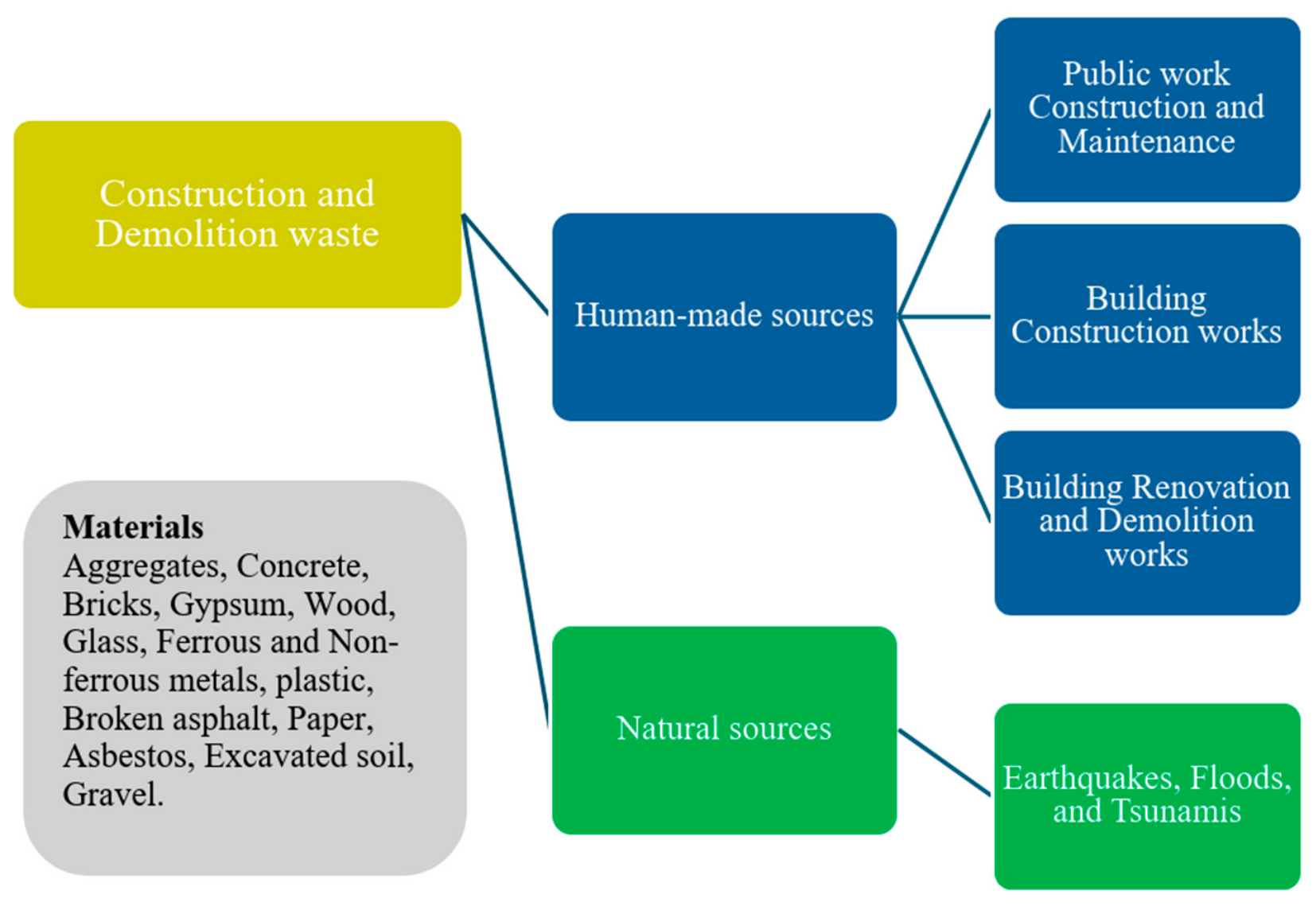
Globally, municipal solid waste is projected to grow from ~2.1 billion t (2023) to ~3.8 billion t by 2050; within this total, CDW represents a substantial and growing stream, with Europe alone generating ~450–500 million t of CDW annually and the US generating ~600 million t (2018), with concrete comprising ~⅔ by weight [1,2]. Figure 1 demonstrates the classification of CDW according to the source of origin. It provides a clear idea about CDW resources and materials that are included in CDW. Table 1 shows CDW-related data from countries across the world [3] and, comparing CDW with the turnover of the construction sector, considerable high variation can be identified. As an average, 400 tonnes of CDW are generated per million USD of construction GDP, while CDW volumes are dominated by large economies, such as Hong Kong, China, and the USA, which produce more CDW than the average. This reflects rapid urban redevelopment, high demolition rates, and limited reuse of construction materials [3]. Aggregates (sand, gravel, crushed rock) are the second most extracted resource after water; quarrying and processing are energy and land-intensive, with cradle-to-gate LCAs showing significant climate, acidification, and eutrophication impacts largely driven by crushing/sieving electricity demand. Case studies report ~2.3 kg CO2e per tonne of sandstone aggregate, and sector LCAs emphasise data gaps and sensitivity to plant energy mix [4]. The electricity-intensive processes, which are crushing, screening, and advanced treatments, are the primary contributors to RA impacts and are highly dependent on regional grid carbon intensity and plant configuration. Many studies rely on generic datasets and poorly documented assumptions for electricity use, transport distance, and treatment efficiency, leading to wide variability and limited comparability between LCAs. This sensitivity is increased for treated recycled aggregates, where durability gains an offset from high-carbon energy inputs [5]. Recycling concrete/masonry into RA reduces virgin aggregate demand, diverts waste from landfills, and can lower embodied impacts, especially when locally sourced and treated; bibliometric analyses show an exponential rise in CDW research since 2016 but still modest attention to reuse/upcycling relative to other waste topics, indicating room for scaling RA use [6]. RA’s attached mortar, higher porosity, and water absorption lead to lower density and mechanical performance versus natural aggregates (NA); variability and contamination further constrain reliability, with codes often limiting replacement ratios or exposure classes [7,8].
Research on RA and RAC has accelerated over the last decade along three converging axes: (i) treatment and densification routes, spanning-accelerated carbonation, thermomechanical conditioning, nano-silica and pozzolanic coatings, polymer impregnation, and microbial-induced calcium carbonate precipitation (MICP); (ii) transport-controlled durability constraints, particularly chloride ingress, carbonation kinetics, and freeze/thaw resistance, which are governed by RA porosity, adhered mortar content, and the quality of the interfacial transition zone (ITZ); and (iii) sustainability and technoeconomic assessment, encompassing the energy cost of treatment versus performance gains and the direct and indirect CO2 uptake associated with carbonation. Despite this growing body of evidence, several key controversies and gaps persist: the acceptable maximum replacement level for fine RA in structural applications remains debated, the transferability of laboratory durability results to real-scale field performance is poorly validated, and mechanistic linkages between specific treatment pathways, pore-structure evolution, and long-term service life have not been systematically synthesised. Existing standards (EN 12620; BS 8500) allow for coarse recycled concrete aggregate (RCA) with exposure class restrictions but provide limited guidance on treated RA and do not yet incorporate performance-based acceptance criteria consistent with modern service-life modelling frameworks [9,10]. This review addresses these gaps by integrating recent advances in RA treatment, durability performance, predictive modelling, and lifecycle sustainability within a PRISMA 2020-compliant systematic framework. The four specific contributions of this review, relative to the prior syntheses, are as follows: (i) a systematic comparison of removal-based and strengthening-based treatment pathways from both performance and LCA perspectives; (ii) the explicit analysis of ITZ evolution mechanisms under different treatment routes; (iii) the articulation of inter-study heterogeneity and risk-of-bias for materials science studies; and (iv) a translation of the synthesised evidence into implementable performance-based acceptance thresholds aligned with current service-life design standards. This review integrates these axes to provide practice-ready guidance for structural applications. We situate the evidence against current standards and guidance (e.g., EN 12620, BS 8500, ACI practice documents, and relevant RILEM TCs) and later propose performance-based acceptance criteria (e.g., resistivity and chloride migration thresholds, carbonation coefficients) consistent with service life modelling.
Figure 1. Classification of construction and demolition waste (CDW) according to the source of origin [11].
Constrmater 06 00029 g001

1.1. The Significance of Using Recycled Aggregate for Structural Applications

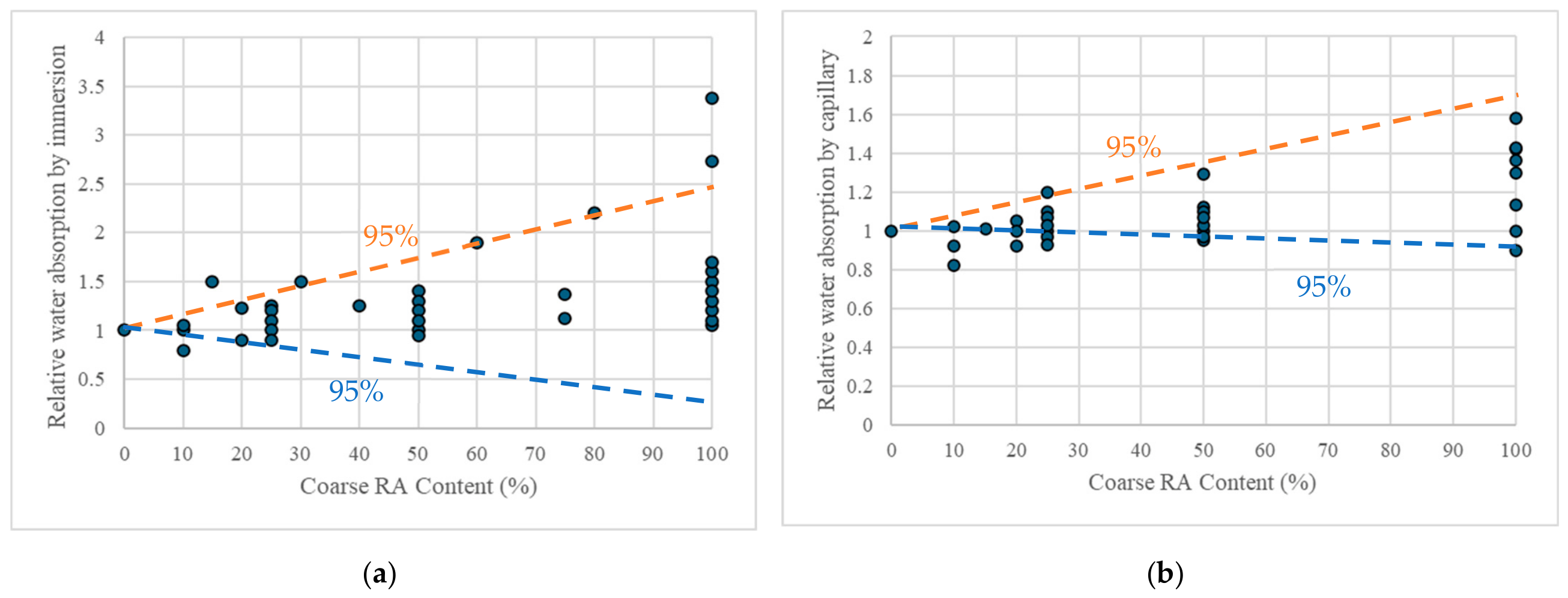
To ensure the long-term integrity of structural concrete, it is critical to evaluate mechanical properties, such as density and compressive strength, alongside durability indicators, such as water absorption, chloride migration, and carbonation depth. These assessments are essential because they determine the material’s capacity to sustain design loads while resisting environmental degradation and reinforcement corrosion over the structure’s service life. RA typically exhibits lower specific gravity (≈2.3–2.4 vs. ≈2.64–2.68 for NA and ≈5–9% vs. ≈1%) due to adhered mortar, and the properties vary with source (concrete vs. ceramic vs. mixed) and processing, complicating mix design and QA/QC [12]. Figure 2 shows the influence of course RA content on the relative water absorption of concrete by immersion and capillary action that presents the increase of the permeability of RAC with the increase of RA percentage. The 95% confidence interval indicates that concrete produced with 100% coarse RA exhibits approximately 2.47 times higher water absorption by immersion and about 1.7 times higher sorptivity compared to the corresponding natural aggregate concrete (NAC). This behaviour is primarily attributed to the higher porosity of RA, resulting from adhered old mortar and pre-existing microcracks. Some studies report opposing trends, but the overall evidence confirms that increasing RA replacement generally compromises impermeability. Additionally, the adverse effect of fine recycled aggregates is more evident than that of coarse RA due to the increased number of capillary channels introduced into the cementitious matrix. These findings highlight that transport-related durability parameters govern the performance limitations of high-replacement RAC rather than strength. This justifies the need for RA treatment and mix-design optimisation strategies [13]. These trends demonstrate that transport-controlled durability strategies have the ability to address the primary limitation of high RA replacement levels. This explains the need for RA treatments and optimised mix design strategies to reduce WA and porosity.
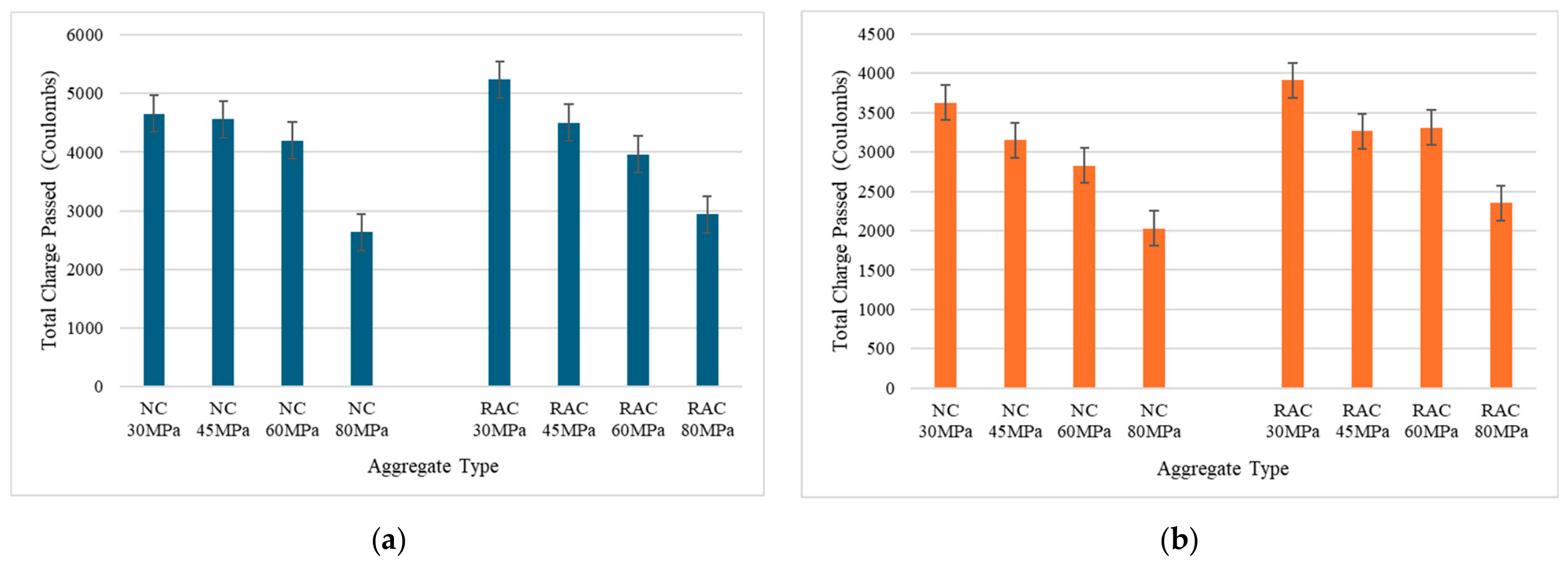
Reduced compressive strength and modulus and increased transport properties (permeability, sorptivity) are common in concrete with RA, and durability (chloride ingress, freeze/thaw, sulphate attack) can be inferior unless pretreatments or optimised designs are applied [14,15]. Figure 3 presents the total charge passed at 28 and 90 days for natural aggregate concrete (NAC) and recycled aggregate concrete (RAC) produced with different strength classes (30, 45, 60, and 80 MPa). At both curing ages, the charge passed decreases with increasing concrete strength, indicating reduced chloride permeability associated with lower water:cement ratios and denser cementitious matrices. RAC presents higher chloride permeability than the corresponding NAC at lower strength levels (30 Mpa). However, this difference is minimised as the strength class increases. In higher-strength mixes (60–80 Mpa), RAC shows comparably improved chloride penetration resistance relative to NAC at later ages. The consistent reduction in the charge passed from 28 to 90 days indicates continued hydration and pore structure refinement. These observations support the previous findings that recycled aggregates derived from higher-quality parent concrete show lower water absorption and reduced adhered mortar content, indicating enhanced durability performance [16]. Also, some studies reported that RAC incorporating aggregates sourced from higher-strength concrete can achieve durability levels comparable to NAC [13], and improve the quality of recycled aggregates through presoaking treatments enhances the strength of the concrete and reduces the chloride ingress [17]. The high-performance RAC contained the ability to resist chloride, comparable to conventional concrete, when the aggregate quality and mix design were properly controlled [18,19]. The improvements of chloride penetration-resistance between RAC and NAC at higher strength classes (60–80 Mpa) indicate that the durability is not inherent to RA, but durability implications are still governed by the porosity. This highlights the importance of effective aggregate treatment to enable durability against critical structural exposure conditions.
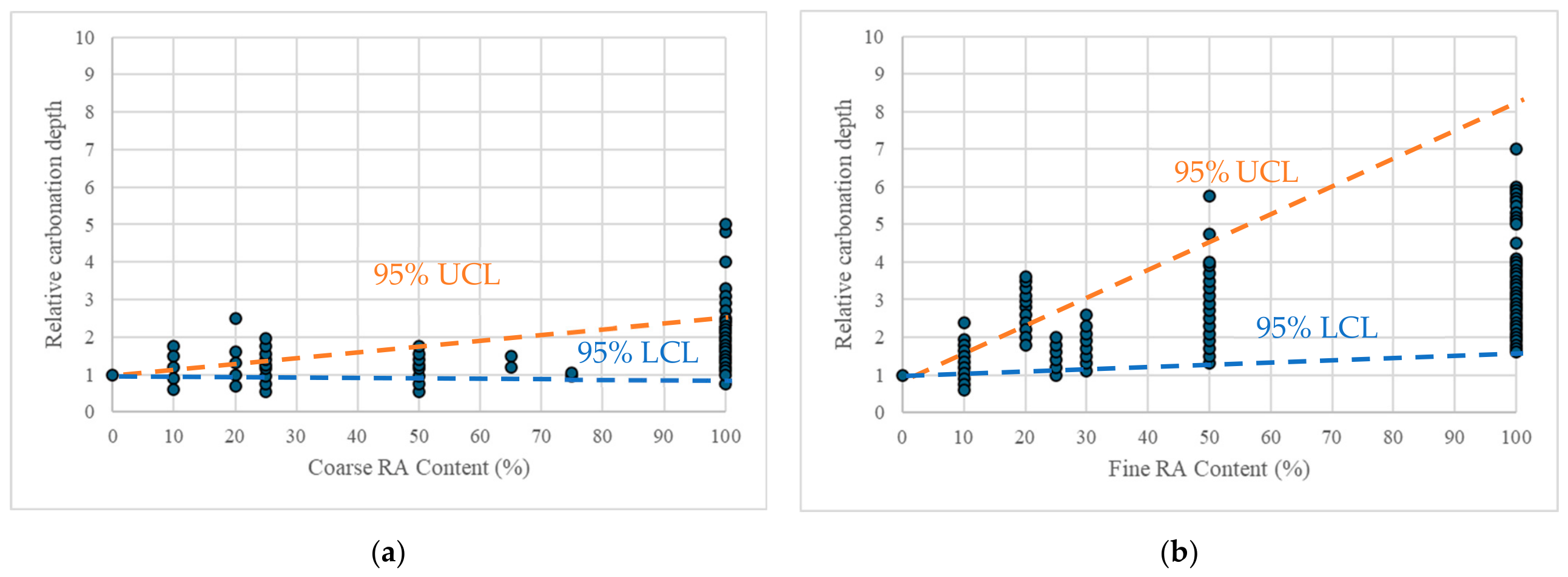
Figure 4 demonstrates the effect of recycled aggregate (RA) replacement levels on the relative carbonation depth of recycled aggregate concrete (RAC) compared with natural aggregate concrete (NAC). These measurements were made by using the results of 600 measurements of coarse RA and 360 measurements of fine RA. When increasing the coarse RA content, a clear increasing trend can be identified, and a 95% confidence interval indicates that RAC containing 100% coarse RA shows carbonation depths up to approximately 2.5 times greater than NAC. The effect is extremely high when fine recycled aggregates are incorporated. In the same percentage of fine RA, the above value increased to 8.7 times. This increase is associated with the higher water absorption and capillary porosity of fine RA [20]. This behaviour is mainly attributed to increased permeability and reduced buffering capacity. Adhered mortar and microcracks in RA facilitate CO2 ingress and accelerate carbonation. However, Figure 4 indicates that the carbonation performance can be partially improved through mix design optimisation. RAC with high RA content can achieve carbonation resistance comparable to natural aggregate concrete when lower water/cement ratios are used. These results confirm that the carbonation resistance of RAC is strongly governed by RA quality, aggregate fraction, and pore structure. Therefore, RA treatment and performance-based mix design are essential to ensure long-term durability [13].
Standards (e.g., BS EN 12620; BS 8500) permit RA use with caveats and exposure class restrictions: coarse crushed concrete aggregate (CCA) may be allowed up to certain percentages and in defined classes, while fine RA is more limited and assessed case-by-case [10,21].
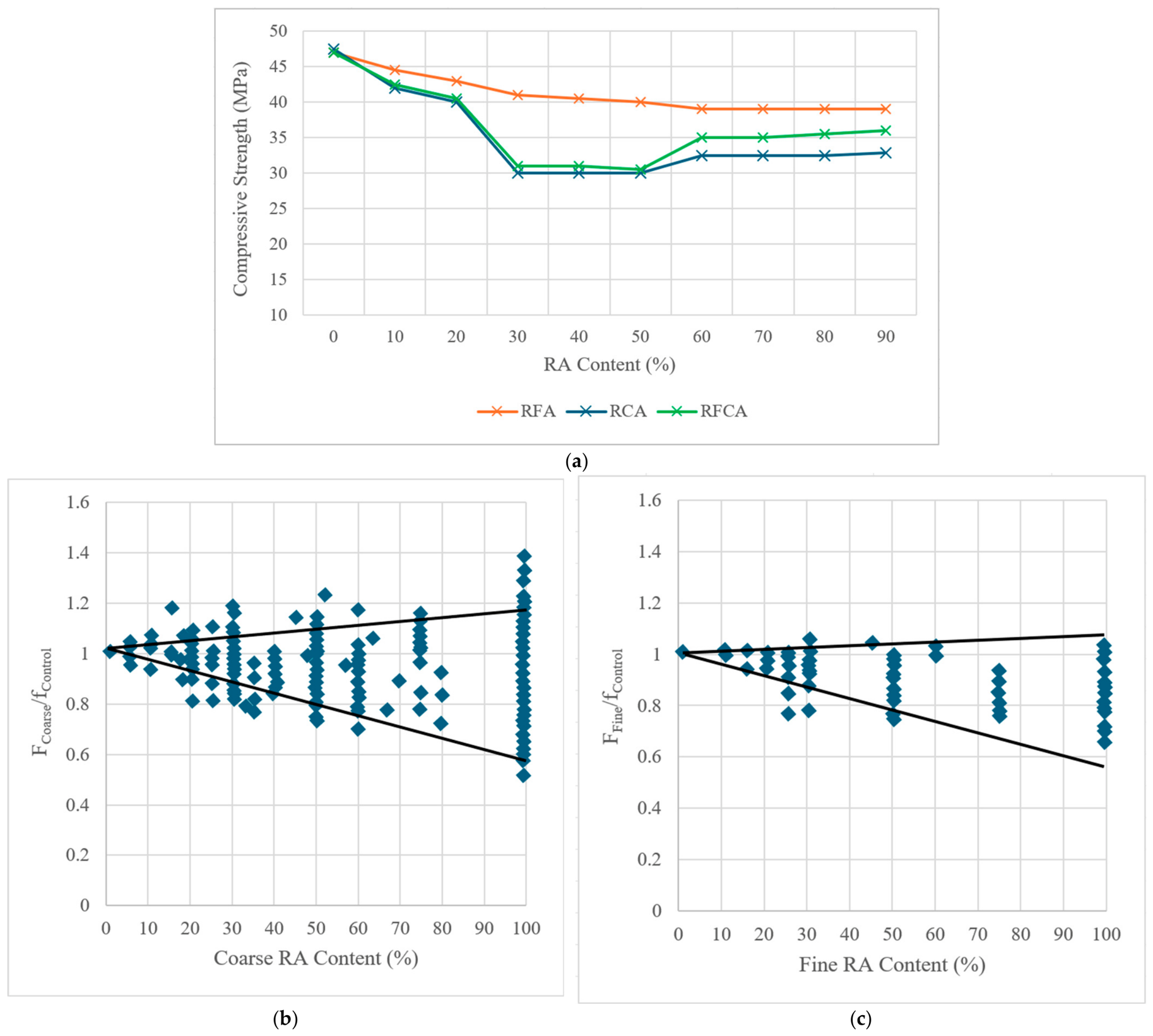
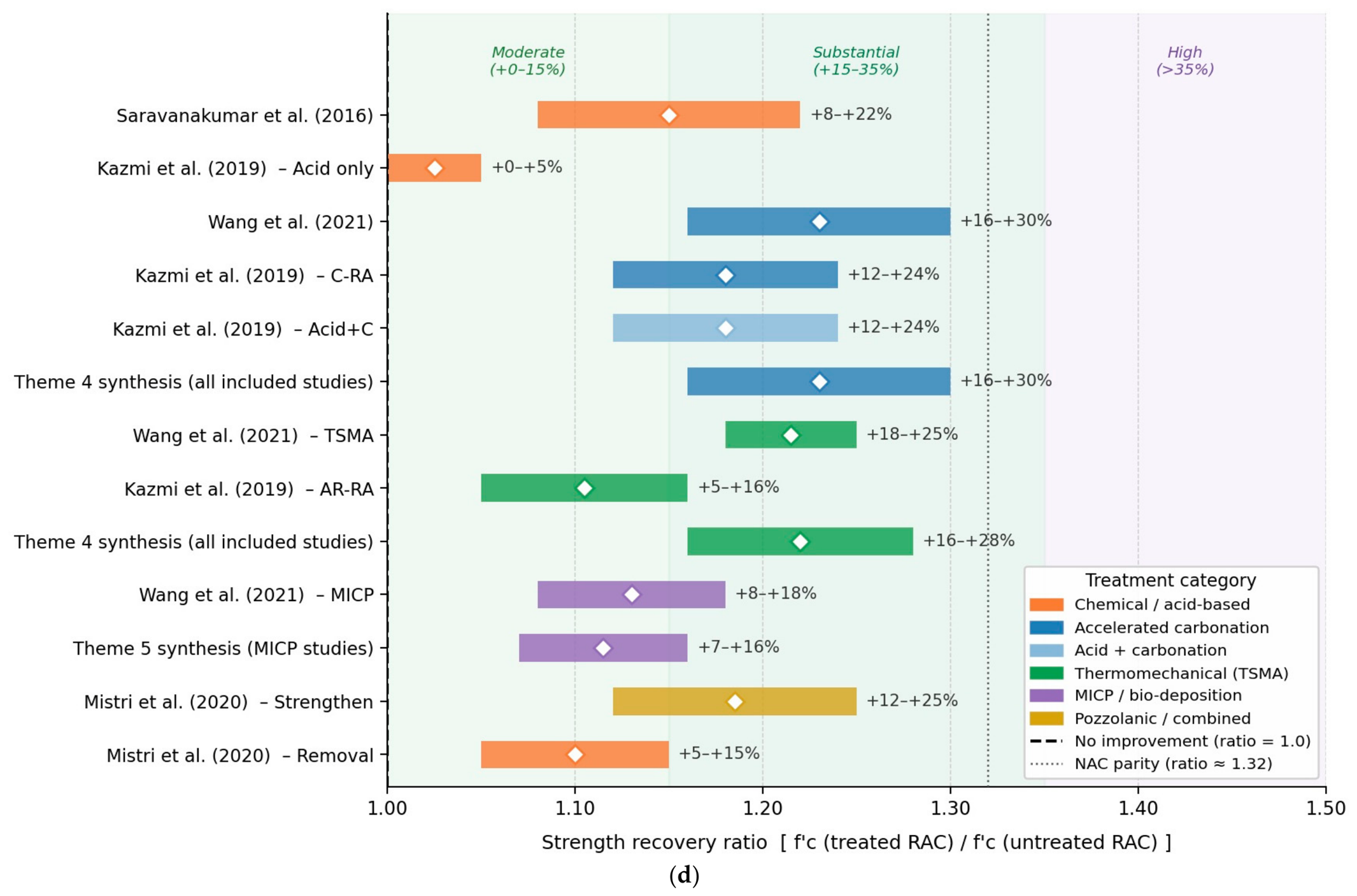
As shown in Figure 5a, the replacement of recycled fine aggregate (RFA), recycled coarse aggregate (RCA), and their combined use (RFCA) show different strength patterns but indicate a clear reduction of compressive strength with each RA type. Thirty percent recycled content is clearly a threshold, as above that there is a clear decrease in compressive strength—mainly highlighted by RCA and RFCA mixes. The concrete with RCA and RCFA shows a 10 MPa reduction between ~20 and 30% replacement levels, which indicates load transfer reduction by interfacial degradation around coarse particles [22]. Previous studies also reported the same behaviour of coarse aggregate [23]. The concrete with RFA shows a more gradual reduction (~14 MPa) across the full replacement range (0–90%). However, Figure 5b shows that coarse aggregate has the ability to produce higher compressive strength mixes while fine RA mixes show a greater reduction of compressive strength than NAC, as shown in Figure 5c. These results indicate that compressive strength is not evaluated through aggregate size. Figure 5d shows that strength ratio recovery significantly increases if MICP/bio-deposition, accelerated carbonation, or thermomechanical treatments are added to RAC.
Figure 2, Figure 3, Figure 4 and Figure 5 show that the durability performance in RAC mainly depends on transport-related mechanisms and pore structure optimisations, not only strength. It highlights the importance of addressing these challenges through aggregate treatment and mixed proportion optimisation, which is discussed in this review.

1.2. The Significance of Using Recycled Aggregate for Finishing Materials

RA represents a high-potential resource when applied strategically. Transitioning RA away from primary load-bearing structural components and toward plastering and finishing mortars emerges as a strategically important, low-risk valorisation pathway. By utilising recycled concrete waste in finishing materials, which are essential for surface functionality and durability rather than structural integrity, the construction industry can close the circularity loop without compromising the safety of primary building frameworks. It is important to note that finishing mortar applications are positioned in this review as a complementary valorisation pathway—not as the primary focus, which is structural RAC—which enables the productive reuse of fine RA fractions (<4 mm) that exhibit water absorption and porosity characteristics unsuitable for structural concrete without treatment. This distinction clarifies this review’s scope: the structural RAC evidence base (Themes 2–7) is the primary contribution; the finishing mortar pathway (Section 1.2) is presented to complete the picture of how CDW can be valorised across the full RA size distribution, consistent with circular economy hierarchy principles.
As a strategic valorisation pathway to structural recycled aggregate concrete, the utilisation of recycled concrete waste (<4 mm) in plastering and finishing mortars represents a strategically important and comparatively low-risk reuse route within the construction materials value chain. Finishing materials are essential for functionality and durability at the service level but are not used for primary load-bearing components. When compared to RAC, this difference minimises the technical and regulatory barriers that are associated with RA incorporation. Some studies highlighted that non-structural materials such as renders, plasters, masonry mortars, and repair layers show less sensitivity to variability in aggregate quality, grading, and porosity, which are inherent characteristics of recycled concrete aggregates extracted from CDW [27,28]. According to that data, finishing mortars provide a practical path to reusing CDW with satisfying safety margins. Structural recycled aggregate concrete (RAC) show compressive strength, elastic modulus, and long-term durability govern design acceptance, and plastering mortars are primarily controlled by workability, adhesion, surface integrity, and crack resistance [28]. In non-structural applications including finishing work, CDW is effectively valorised with minimal variations of properties. The plastering mortars, which are the most common non-structural finishing material, require significantly lower mechanical and durability requirements compared with structural concrete. Properties such as workability, water retention, adhesion strength, shrinkage control, surface cohesion, and crack resistance dominate performance assessments [29]. This difference in performance priorities permits recycled fine concrete and sands, which are typically challenging in structural RAC because of high water absorption and poor interfacial transition areas, to be used productively in finishing works with minimal processing. Properly graded and mixed RA shows its ability to deliver adequate fresh and hardened mortar behaviour for plastering purposes in moderate and high-replacement ratios [28,30].
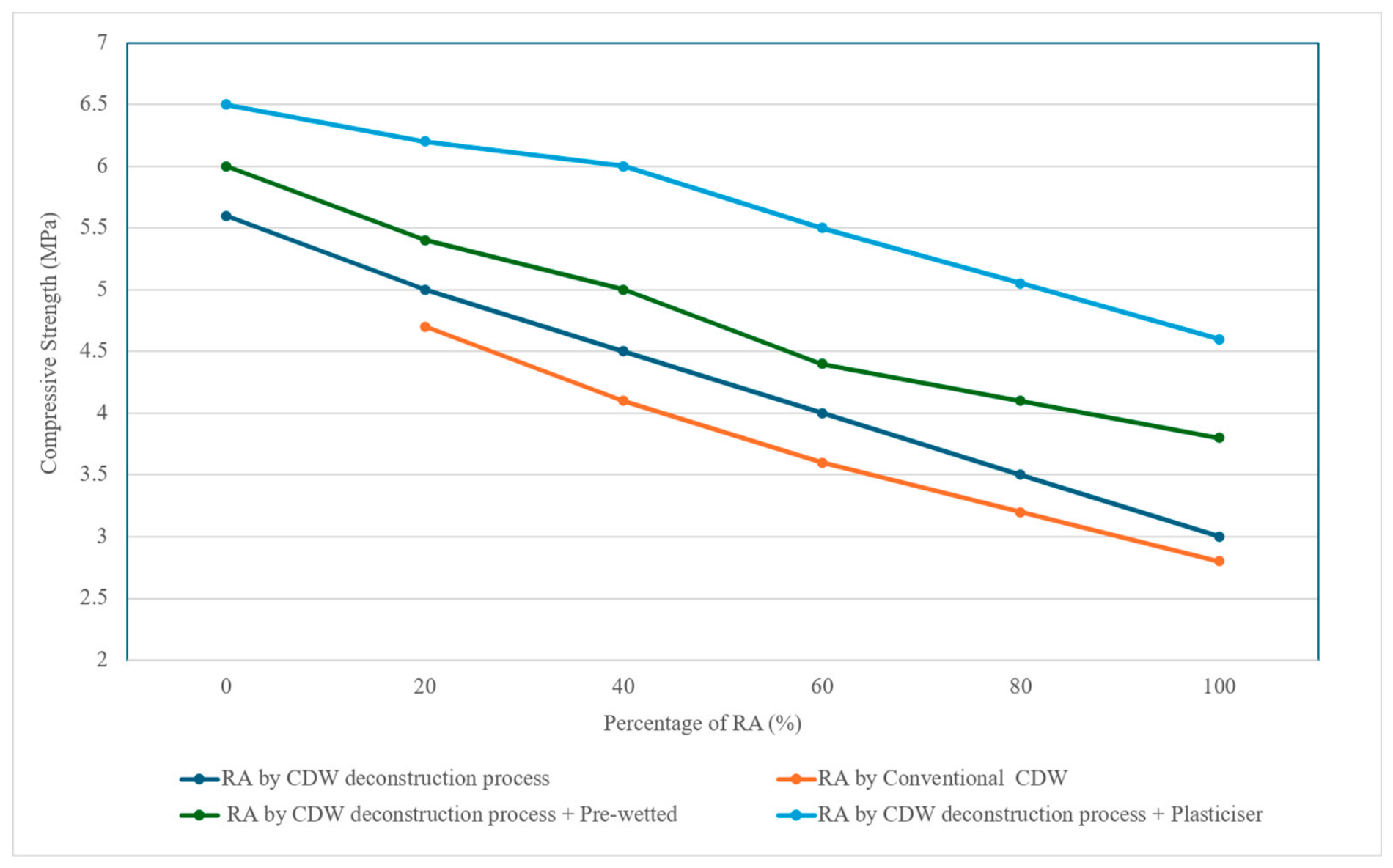
The replacement of 15% recycled plastering waste for conventional aggregates resulted in moderate reductions of compressive strength (≈11%) and flexural strength (≈22%), while consistency, apparent density, and segregation tendency, which are properties of fresh mortar, showed minimum variation compared to conventional plastering mixes [30]. Furthermore, some studies investigated up to 40% of RA replacements, showing further reduction of compressive strength, but still in an acceptable range (5 MPa). Figure 6 shows the compressive strength variation of RA in different percentages. By using a commercial plasticiser, 60% RA replacement also reaches the acceptable range. While RA shows higher water absorption than a conventional aggregate, prewetting is an effective treatment on RA to increase the strength and reduce the w:c ratio, which can be effective in structural recycled aggregate concrete (RAC) [31]. These findings indicate that the performance losses of recycled aggregates, which are critical in structural concrete, become significantly less restrictive in finishing applications where the performance depends on serviceability and workability. Because of the higher water absorption of recycled aggregates compared to natural aggregates, in the usage of RA for plastering, the prewetting of aggregates was identified as an effective technique for the mitigation of excessive water absorption. Further, it reduces the water:cement ratio and is more effective for strength improvement than direct use of RA. This strategy is also beneficial in structural RAC.
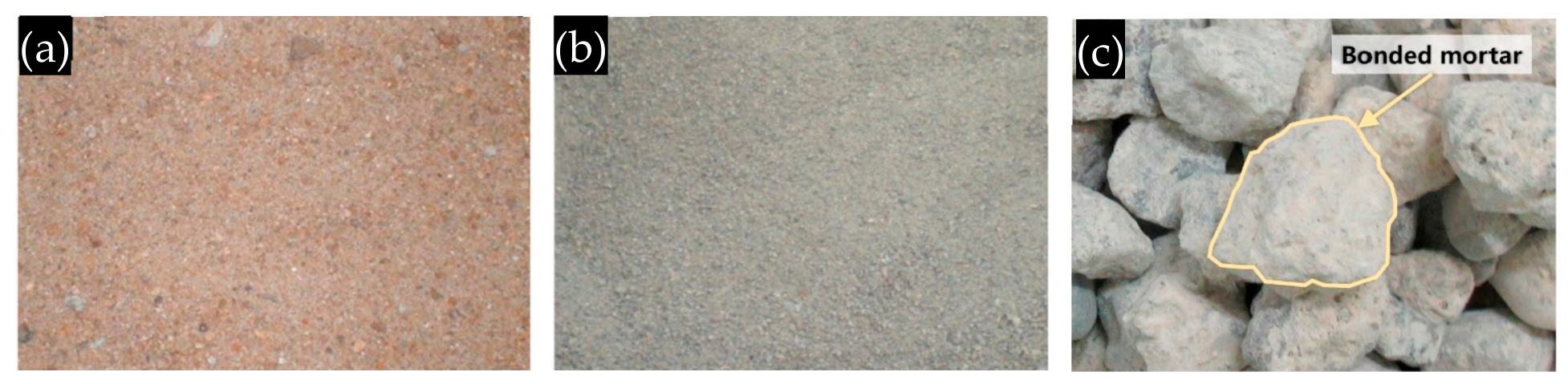
Microstructurally, RA, which is used in plastering mortars, gives certain functional advantages. According to Figure 7, the adhered old mortar present in both fine and coarse aggregates has been proven by the colour of fine RA compared to fine NA, and it increases the surface toughness and internal porosity. These enhance mechanical interlocking and the bond between the paste and aggregates in low-strength cementitious systems. This bonding improvement increases the adhesion to substrates and reduces debonding risk in renders and plasters when applied to masonry and concrete backgrounds [32]. Some studies highlighted that even in higher capillary absorption levels, cement-rendering mortars meet key performance, which complies with rendering standards. Some cases were reported with greater bonding strength between RA mortars and substrates than conventional NA mortars [33]. This shows that the service performance of mortars is not dependent on higher WA and porosity.
The valorising of RCA in finishing materials strongly aligns with the circular economy principles, which are waste hierarchy and resource efficiency. Because of the negative impact of fine RA on strength and durability, it is limited in its use for concrete rather than coarse RA. Redirecting this fine RA to utilisation in finishing materials avoids down-cycling and retains more material value without down-cycling into low-grade applications, such as landfills and road sub-base filling [33]. These values support the environmental advantages that align with LCAs. Fine RA significantly reduces the embodied energy and environmental impacts of mortar production. Some studies found that recent LCA on rendering mortar, which substitutes 25% of sand with recycled fine aggregates, improved the overall environmental and economic efficiency of the mix by 20–47% [35]. These reductions in conventional material usage address the most significant environmental impacts, such as energy consumption, resource depletion, and land use associated with virgin aggregate quarrying [36]. By utilising these materials for finishing purposes, the higher proportion of CDW gets recycled without limiting to coarse RA.
Considering the extensive discussion of the literature on RA and RAC, existing studies reviewed individual enhancement strategies such as carbonation, mix-design modification, and mechanical performance rather than long term durability. Fewer studies integrated treatment effectiveness through long-term durability indicators such as chloride ingress, carbonation resistance, transport properties, and environmental and sustainability implications. Also, it is important to address the system-level strategies to increase RA reuse potential, as well as future directions enabling high-value structural applications. This review addresses these gaps by systematically integrating recent advancements between 2015 and 2026 in RA treatments, durability performance, lifecycle performance, and sustainability. This review advances prior work by (i) synthesising treatment/microstructure/durability linkages (with emphasis on ITZ evolution), (ii) comparing removal vs. strengthening routes from performance and LCA perspectives, (iii) articulating heterogeneity and risk-of-bias for materials studies, and (iv) outlining implementable performance metrics to support code acceptance.

2. Objectives, Scope, and Structure of the Review

This review addresses the following objectives:
  • Critically assess material, process, and system-level strategies to increase RA reuse potential for structure and durability of critical concretes.
  • Evaluate beneficiation/treatment, carbonation, bio-mineralisation (MICP), mix design, and modelling approaches.
  • Identify gaps and future directions enabling high-value structural applications.

2.1. Scope of the Review

  • Time period: 2015–2026.
  • CDW types: concrete, masonry, mixed CDW.
  • Application focus: structural/durability critical concrete (RAC).
  • Technologies: beneficiation (mechanical, chemical, thermal), CO2 carbonation, MICP, mix design and modelling, LCA.
  • Exclusions: road base/unbound, recycled asphalt (except when informing RA properties, but not core focus).

2.2. Key Definitions and Concepts

  • Recycled aggregates (RA): coarse (>4 mm) vs. fine (<4 mm) fractions from CDW (concrete, masonry, mixed).
  • Recycled aggregate concrete (RAC): concrete with partial/full RA substitution for NA.
  • Beneficiation/treatment: methods to remove or densify adhered mortar (mechanical, chemical, thermal, carbonation, polymer/nano-silica impregnation, bio-mineralisation).
  • Circularity, upcycling vs. down-cycling: strategies increasing value retention by upgrading RA quality (e.g., forced carbonation) vs. using RA in low-grade applications.

2.3. Structure of the Review

This paper first outlines the Methods (PRISMA 2020) and a Theoretical Framework (RA properties, RAC performance theory, circularity, historical evolution, debates), followed by Thematic Findings (sources/variability; treatments; bio-mineralisation; mechanical/durability; modelling/design; sustainability/LCA), and concludes with Synthesis, gaps, practice implications, and research recommendations.

3. Methods

3.1. Review Protocol and Reporting Standard

This review adopts the PRISMA 2020 reporting guideline (27-item checklist, flow diagram), suitable for systematic/semi-systematic materials science syntheses where heterogeneity precludes meta-analysis.
Databases to query: Scopus and Science Direct
Primary search string
(“recycled aggregate” OR “recycled aggregates” OR “RA”)
AND (“construction and demolition waste” OR CDW)
AND concrete
AND (reuse OR application OR performance OR properties OR strength OR durability)
Secondary search string (for specific mechanisms)
(“recycled aggregate” OR “RA”)
AND (“carbonation” OR “biomineralisation” OR “treatment” OR “enhancement”)
AND (“construction and demolition waste” OR CDW)
AND concrete
Filters: Time period: 2015–2026. Document type: Journal articles, reviews, conference papers. Language: English

3.2. Eligibility Criteria and Selection Process

Inclusion: peer-reviewed experimental, numerical, or review studies focusing on RA from concrete/masonry CDW; treatment/beneficiation, CO2 carbonation, MICP; structural/durability performance; LCA/CO2 uptake.
Exclusion: nonconcrete applications (e.g., asphalt), case studies without material characterisation, lab-only RA studies lacking scalability/real-world discussion.
Identification → Screening → Eligibility → Inclusion following PRISMA flow; titles/abstracts screened, then full text assessed against inclusion/exclusion (flow diagram template per PRISMA 2020).
Parameters extracted: RA source/type (concrete, masonry, mixed), treatment (mechanical/chemical/thermal/carbonation/MICP), replacement ratios, mechanical (compressive, tensile, modulus), durability (water absorption, sorptivity, chloride, carbonation depth, freeze/thaw, sulphate), environmental metrics (LCA, CO2 uptake), modelling/optimisation details. Synthesis is qualitative and comparative due to heterogeneity in RA sources/testing.

3.3. Risk of Bias Assessment and Synthesis Notes

Two reviewers independently screened full texts and extracted data; disagreements were resolved by consensus. We adapted risk-of-bias criteria for materials studies, prioritising works that (i) reported RA provenance/contaminants, (ii) characterised RA properties (density, WA, mortar content) and curing, (iii) provided multi-indicator durability data, and (iv) documented treatment parameters and scalability. Given substantial heterogeneity across RA sources, treatments, and test protocols, we conducted a qualitative comparative synthesis and reported quantitative ranges where consistent definitions existed; meta-analysis was not feasible. The PRISMA flow diagram is provided in Table 3 and the full PRISMA 2020 checklist is in Table A1. A structured risk-of-bias screening table for the core included studies is provided in Table A2. This research adapted risk-of-bias concepts to materials studies: reproducibility of RA characterisation, sample sizes, statistical reporting, transparency about RA source/contamination, scalability/industrial relevance. Where possible, studies with multi-indicator durability and clear pretreatment protocols were selected. This review was conducted and reported in accordance with the PRISMA 2020 guidelines for systematic reviews. The full PRISMA 2020 checklist is provided in Table A1, and a PRISMA-compliant flow diagram summarising identification, screening, eligibility, and inclusion processes is presented in Table 3. This review was not prospectively registered, and no protocol was prepared or published in advance, which is transparently acknowledged here in line with PRISMA recommendations for unregistered reviews.

4. Theoretical Background

RA often shows lower density and higher water absorption vs. NA due to residual mortar and microcracking—typical ranges: water absorption 5–9% (RCA/RFA) vs. ~1% NA; specific gravity ~2.34–2.41 vs. ~2.64–2.68 (NA).
An attached mortar layer and microcracks widen pore networks and alter the ITZ when RA is used; contamination (ceramics, sulphates) influences properties and water demand. When properly sorted/washed, recycled concrete aggregates generally meet chemical limits (chlorides/sulphates). However mixed/masonry fractions can elevate porosity and reactivity-requiring controls [12,15,37]. RAC is a multi-phase composite (NA/RA + residual mortar + new paste), with modified ITZ around RA. Increased transport properties (permeability, sorptivity) and altered carbonation kinetics are common; pretreatments aim to densify the RA surface, reduce water uptake, and improve bond [14]. Downcycling uses low-grade applications (e.g., subbases), and upcycling targets high-value structural concrete by enhancing RA quality (carbonation/MICP, thermomechanical treatments) to retain value. Bibliometric evidence suggests a need to shift CDW use toward reuse/upcycling in concrete [6,38]. Early adoption focused on unbound layers/low-grade uses; with improved sorting and standards (BS EN 12620, BS 8500), coarse RA entered concrete with limits. Recent RILEM work and carbonation technologies push RA toward structural applications [21,38].
However, there are some key debates and controversies:
  • Maximum acceptable RA replacement levels in concrete: Many studies point out ≤50% coarse RA for comparable structural performance with pretreatment; full replacement is possible with optimised treatments/mixes but durability margins vary [39,40].
  • Fine RA in structural concrete: This has been historically discouraged due to high water demand; emerging carbonated RFA shows promise for fully recycled mixes under durability demands [41].

  • Sustainability vs. performance trade-offs: LCAs show net benefits if RA is local and treated efficiently; energy for treatments must be balanced against performance gains and CO2 sequestration [42,43].
A comparative synthesis across the seven most-cited papers on the reuse of recycled aggregate concrete (RAC) is presented below (Table 2), highlighting converging evidence, contradictions, and practical implications for structural and durability-critical applications. The synthesis emphasises treatment strategies (chemical, carbonation, bio-deposition, modified mixing), their quantitative impact, and sustainability considerations. The key findings include (i) adhered mortar, which is the primary cause of inferior RA performance; (ii) strengthening approaches (carbonation, pozzolanic coatings, TSMA, bio-deposition), which outperform removal methods for eco-efficiency; (iii) durability penalties, which scale with RA content and fines; and (iv) combined treatments and modified mixing, which can recover up to 85–94% of NAC strength. Actionable guidance recommends accelerated carbonation (with lime presoak), silica-fume impregnation or TSMA, and bio-deposition for low-carbon contexts.
Table 2. Comparative synthesis and literature matrix on the reuse of aggregates for recycled aggregate concrete (RAC).
Paper (Year)RA Source and TypeTreatment/ApproachMix/TestKey MetricsHeadline ResultsLimitations/Notes
Saravanakumar et al., 2016 [24]20-year-old demolished concrete, coarse RAChemical presoaking (H2SO4, HCl, HNO3) + silica fumeACI mix 1:1.4:2.3, w/c 0.45; cubes; 7–90 dSG, WA, abrasion, compressive strengthWA ↓15–30%; SG ↑2.62; strength ↑8–22%; abrasion ↑19–34%Acid effluent; SO3 risk; SSD mandatory
Silva et al., 2015 [20]RCA, RMA, MRANo treatment; statistical analysis; mineral additions; superplasticisers600+ data points; accelerated carbonation testsCarbonation depth; k_ac vs. strength100% coarse RA → 2.5× NAC; fine RA → 8.7× NAC; SP reduces depth by 52%; carbonation rate ~0.8 mm/yearMineral additions ↑ carbonation; RA quality critical
Guo et al., 2018 [13]RCA, fine RANo treatment; SCM; CO2 curing; surface coatingsDurability tests: WA, chloride, carbonation, frost, ASRWA, chloride diffusion, carbonation depth, dynamic modulusWA ↑ up to 2.47×; chloride ↑ up to 2.07×; frost loss 10.4% vs. NAC 0.6%; SCM improves durabilityFine RA most detrimental; ASR risk
Wang et al., 2021 [25]RCA, RCBA, mixed RACarbonation, bio-deposition, pozzolans, nanoparticles, TSMAReview + experimental synthesisStrength, shrinkage, WA, durabilityCarbonation ↑ flexural 28.7%, shrinkage ↓ 25%; bio-deposition WA ↓ 13.5–21.2%; TSMA ↑ strength 20%Nanoparticle dispersion costly; bio-deposition scalability
Bravo et al., 2015 (Constr. Build. Mater. 77: 357–369) [27]Mixed CDW aggregates (five Portuguese plants), coarse and fineNo treatment; systematic durability study33 mixes: 10–100% RA (coarse and fine); constant slump via water adjustmentWater absorption (immersion/capillarity); carbonation depth (7–91 d); chloride diffusion (28/91 d)Durability drops linearly with RA; fine RA much worse; carbonation depth +22–182% at 28 d; chloride diffusion ↑ (esp. with clay-rich fines); source composition is decisiveEffective w/c ↑ to keep slump, driving porosity; plant-to-plant variability; highlights need for source QA/QC
Kazmi et al., 2019 (Cem. Concr. Compos. 104: 103398) [26]CDW RA (20 mm); coarse RAFive treatments: accelerated carbonation, acetic acid (3%) immersion, acetic + mechanical rubbing, acetic + carbonation, lime immersion + carbonationNAC vs. RAC cylinders (150 × 300 mm), 28/90 d; compressive, split tensile, flexural, modulus; complete stress/strain modellingAggregate WA, SG, bulk density, crushing value; mechanical suite; stress/strainTreated RA: WA −17–20% (C-RA, LC-RA); RAC strength/modulus ↑—AR-RAC and LC-RAC closest to NAC (~85–94%); energy absorption ↑; developed empirical modelsCarbonation needs preconditioning (RH, CH). Acid + rubbing adds energy/time but avoids high chemical loads
Mistri et al., 2020 (Constr. Build. Mater. 233: 117894) [5]Global review; coarse and fine RATreatment taxonomy and appraisal: removal (water, autogenous, mechanical, heat, acids), strengthening (pozzolans, polymers, bio-deposition, carbonation); modified mixing (TSMA/triple)Review; includes micro-mechanisms, sustainability analysisn/a (synthesis)Recommendation: prioritise strengthening AM (pozzolans/nano-silica, TSMA/triple, bio-deposition, carbonation) over removal for eco-efficiency, scalabilityCarbonation depends on CH; polymers reduce WA but not strength; caution with sodium silicate (ASR risk), acid wash burdens
↑—Increase, ↓—Decrease.

5. Review of Themes and Findings

A systematic literature search was conducted in Scopus and Science Direct, and the following flowchart presents the approach (Table 3).
Table 3. PRISMA 2020 flowchart.
IdentificationRecords identified through Scopus: 241
Records identified through ScienceDirect: 2054
Total records before de-duplication: 2295
Records after de-duplication: 2180
ScreeningRecords screened (titles/abstracts): 2180
Records excluded: 2093
EligibilityFull-text articles assessed for eligibility: 87
Full-text articles excluded (not meeting inclusion criteria): 41
IncludedStudies included in qualitative synthesis: 46
Core studies included in comparative matrix: 7
The research was structured using a comprehensive thematic tagging system focused on RA quality enhancement (covering carbonation and beneficiation), accelerated CO2 curing, and innovative bio-mineralisation techniques such as bacteria-based healing (MICP). These tags further extended to critical performance metrics including mechanical strength and durability factors like chloride ingress, permeability, and carbonation resistance. This systematic categorisation directly informed the subsequent Thematic Findings (from themes 1 to 7), which synthesised data regarding aggregate sources and variability, treatment methods, bio-mineralisation, and mechanical/durability properties, as well as advancements in predictive modelling, mix design, and sustainability via Life Cycle Assessment (LCA).

5.1. Theme 1: Sources, Classification, and Quality Variability of RA

Concrete RA generally exhibits superior properties vs. mixed/ceramic RA (higher density, lower fines/friability); variability depends on the season/location of collection, underscoring the need for robust source control and washing/classification. Influence of contamination and processing routes: Sulphates, ceramics, and high-porosity constituents increase water demand and reduce durability; wet/dry cycling degrades mixed RA (fines increase, high LA abrasion), challenging use without treatment. Statistical variability and design reliability: Studies highlight low coefficients of variation only when RA is well segregated and characterised; otherwise, variability impacts strength predictions and durability design; probabilistic design may be needed [12,37,44].
A critical but often underestimated determinant of RA quality is the strength class and water-to-cement ratio (w/c) of the parent concrete from which the RA was produced. RA derived from high-strength parent concrete (compressive strength ≥ 40 MPa; w/c ≤ 0.45) typically exhibits lower adhered mortar content, higher specific gravity (≥2.45 g/cm3), and lower water absorption (≤5%) compared with RA from lower-strength sources (w/c > 0.55), which can exhibit water absorption of 8–12% [12,16]. This source dependency propagates directly into RAC durability: concrete produced with higher-grade parent RCA can achieve chloride permeability and carbonation resistance approaching that of NAC at equivalent w/c ratios, while lower-grade RCA requires treatment interventions to reach comparable performance thresholds [13,16]. The practical implication is that RA supply chain documentation—including parent concrete grade, demolition age, and contamination history—is a prerequisite for reliable structural RAC design, yet is rarely available in practice, underscoring the case for performance-based characterisation and source certification protocols.
Interstudy variability in reported RAC properties is substantial and must be interpreted with caution. Across the included studies, coefficients of variation (CoV) for the compressive strength of untreated RAC at 30–50% coarse RCA replacement range from 5% (well-segregated, single-source RCA) to over 20% (mixed CDW sources with variable contamination) compared with CoV of 3–7% for equivalent NAC mixes [12,37]. This heterogeneity is amplified for durability indicators: chloride migration coefficients (Dᴨssm) of untreated RAC at 50% replacement show a 3-fold spread across studies, largely attributable to differences in RA source, w/c ratio, and curing age. This statistical variability means that design recommendations derived from single-source laboratory studies may not be transferable to practice without source qualification and supports the adoption of probabilistic design approaches for RAC in exposure classes XC3/4 and XD2/3 (for example).

5.2. Theme 2: Beneficiation and Treatment Techniques

Four main types of treatment were found: mechanical processing and adhered mortar removal, chemical treatments, thermal treatments, and carbonation-based treatments.
  • Mechanical processing and adhered mortar removal. Ball milling, autogenous cleaning, and thermomechanical treatments can reduce adhered mortar, densify surfaces, and improve abrasion/fragmentation resistance; integrated thermomechanical (TmRA) treatments report RAC performance close to NA concrete.
  • Chemical treatments. Acid soaking (HCl/H2SO4) can remove mortar but may risk aggregate corrosion; combined chemical mechanical stress methods are effective but risk damaging original aggregate if harsh.
  • Thermal treatments. Heating (including microwave) eases mortar detachment; benefits depend on temperature control to avoid microcracking.
  • Carbonation based treatments. Accelerated/forced carbonation densifies RA mortar by forming CaCO3, improving strength and durability; RILEM TC 309 MCP identifies potential and bottlenecks, including upscaling and technoeconomics [38,39,45,46,47].
From a mechanistic standpoint, the performance of all four treatment categories is mediated by their effect on the interfacial transition zone (ITZ) of RAC. RAC has a more complex microstructure than NAC because it contains two ITZs: the primary ITZ, between new cement paste and the RA surface, and the secondary (or inner) ITZ, between the residual mortar layer and the original aggregate within the RA particle. The secondary ITZ is typically weaker than the primary ITZ in NAC owing to its higher w/c ratio, elevated porosity, and the presence of micro-cracks inherited from demolition crushing. Removal-based treatments (mechanical, thermal, acid) aim to eliminate the residual mortar and thereby eliminate the secondary ITZ entirely, leaving a cleaner aggregate surface for bonding. Strengthening-based treatments (accelerated carbonation, pozzolanic coatings, MICP (discussed in theme 3), polymer impregnation) instead densify the residual mortar in situ, reducing the porosity of the secondary ITZ, precipitating new binding phases (CaCO3 or C–S–H) in pores and micro-cracks, and thus reducing water uptake and improving transport resistance. Accelerated carbonation acts by reacting CO2 with portlandite (Ca(OH)2) and calcium silicate hydrate phases in the residual mortar to form calcite, which infills pores, reduces the water absorption of the treated RA by 17–30%, and stiffens the ITZ [39,45,46]. In terms of industrial feasibility, carbonation-based treatments are the most scalable, with RILEM TC 309-MCP having identified pilot-scale carbonation reactors at 0.5–5 t/h throughput [38,45]. MICP processes remain primarily at laboratory or small-pilot scale due to the costs of bacterial culture media, nutrient supply, and bioreactor control, though spray-based inoculation methods show promise for cost reduction [48,49,50]. Thermomechanical processing adds significant energy and capital cost but can produce RCA with specific gravity and water absorption approaching natural aggregate benchmarks [39]. Acid washing effectively reduces water absorption but generates hazardous effluent streams (H2SO4/HCl waste) requiring treatment, limiting its environmental and economic case at scale [5,24]. From an LCA perspective, accelerated carbonation with a low-carbon CO2 source (e.g., captured flue gas or direct air capture) is the only treatment pathway currently capable of achieving net-negative carbon for the RA treatment step, with published estimates of net CO2 abatement in the range of 18–24 kg CO2e per tonne of carbonated RCA [38,40,43].

5.3. Theme 3: Bio-Mineralisation and Bio-Based Enhancement Strategies

Ureolytic bacteria (e.g., Sporosarcina pasteurii, Bacillus spp.) precipitate CaCO3 within RA pores/cracks, reducing water absorption and enhancing density; process parameters (bacterial concentration, nutrients, pH, temperature, time) strongly influence outcomes.
Spray/dip treatments using spores can be more robust; RA can act as a carrier and reservoir for nutrients, enabling in situ mineralisation; seawater-adapted strains demonstrate performance under marine conditions. Studies suggest coupling MICP with CO2 carbonation can optimise RA densification and potentially reduce required CO2 purity, which is promising, but field-scale validation remains limited [2,48,49,50,51]. MICP operates by bacterially precipitating CaCO3 within the same pore network, achieving water absorption reductions of 13–21%, but it is sensitive to bacterial concentration, nutrient availability, and pH control [48,49]. Accelerated carbonation and MICP approaches are mechanistically complementary, and their sequential application (carbonation followed by MICP) has been proposed as a means of achieving synergistic densification, though validated data at scale are limited [2]. Table 2 (comparative synthesis) captures the key differences across treatment strategies.
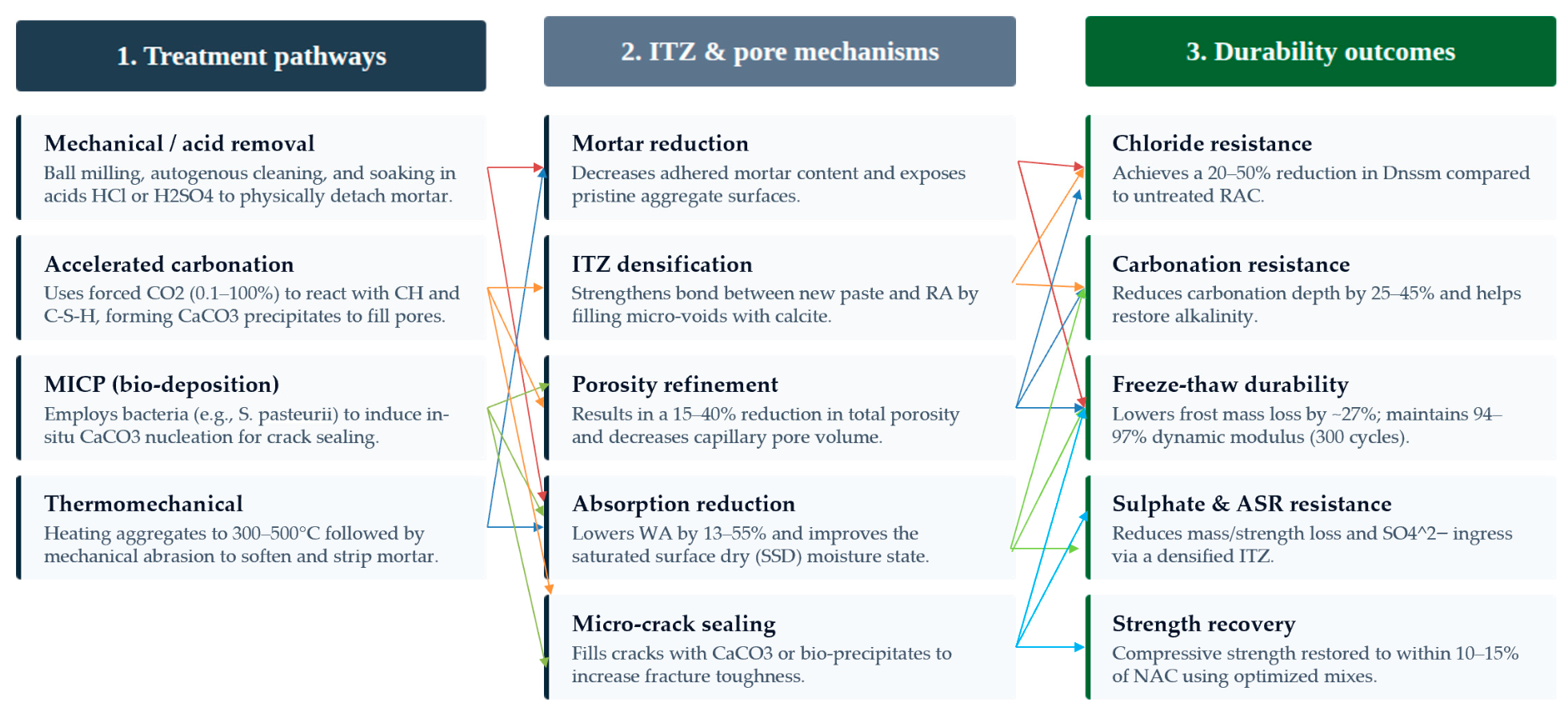
Figure 8 presents a mechanistic schematic synthesising the pathways by which the four principal RA treatment strategies modify pore structure and the interfacial transition zone (ITZ), and how these microstructural changes translate into improved durability performance. This conceptual framework is original to this review and is not reproduced from any single source.
In Figure 8, the left column represents the treatment pathways (numbered ①–④ per themes in Section 5.2). In Figure 8, the centre column represents pore-structure and ITZ mechanisms with supporting evidence ranges. In Figure 8, the right column represents durability outcomes with indicative performance thresholds referenced to EN/BS/NT Build standards. Downward arrows in the centre column indicate the sequential cascade from mortar removal to micro-crack sealing. Colour-coded arrows from left to centre identify which treatments activate each mechanism; grey arrows from centre to right indicate mechanistic pathways to each durability outcome.
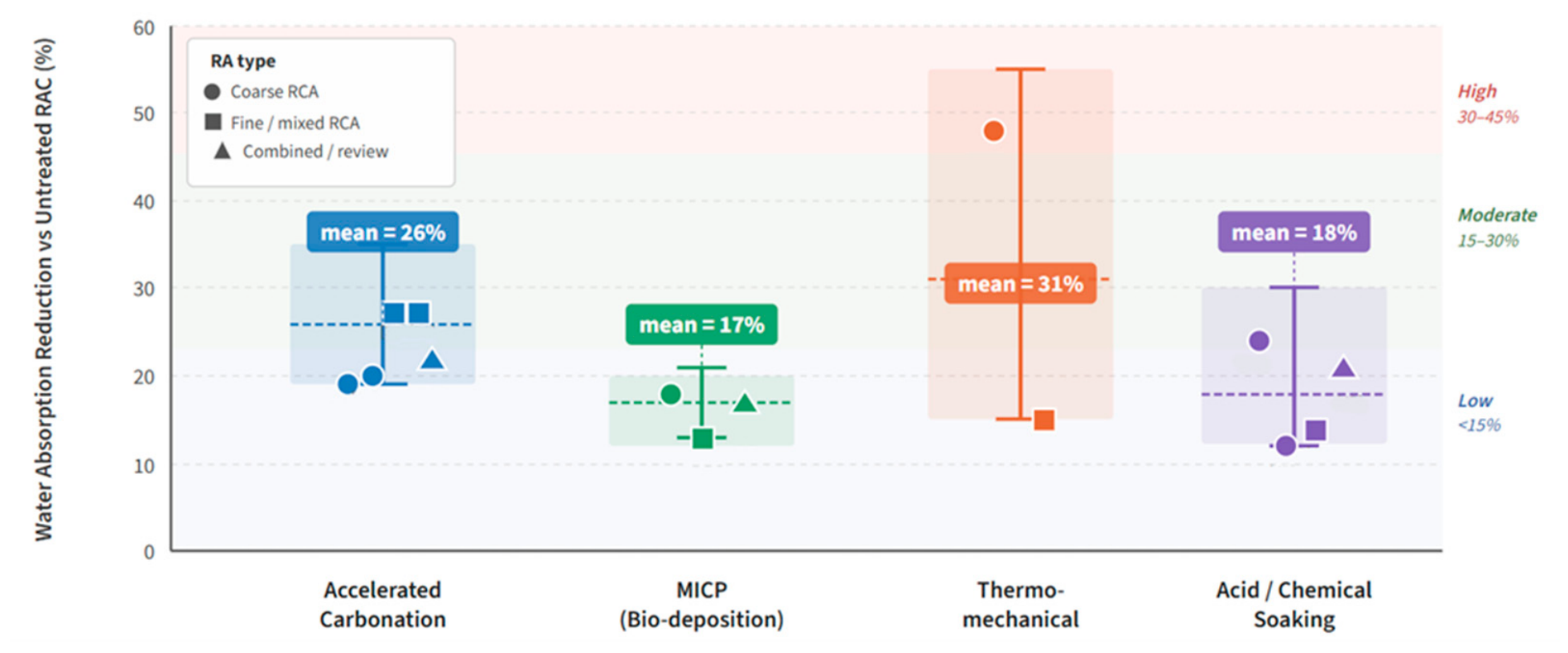
Figure 9 shows a fully synthesised, original plot showing water absorption reduction (%) across the four treatment types, drawn entirely from data extracted from the included studies in the review.

5.4. Theme 4: Mechanical Performance of RAC

Untreated RA often lowers compressive/tensile/flexural strengths; carbonated RA (CRAC) shows +16–30% compressive strength improvement vs. untreated RAC; thermomechanical RA mixes approach NA concrete performance. Comparisons with NA concrete: With pretreatment (carbonation/MICP/thermomechanical), RAC can achieve strengths within 10–15% of control NA concrete at ≤50% RA, and in some cases match or exceed targeted mixes [39,40,52,53]. Table 4 provides a structured comparison of the principal RA treatment strategies across six evaluation criteria: energy intensity, industrial scalability, water absorption reduction, strength recovery relative to NAC, CO2 footprint, and technology readiness level (IRL). This synthesis table is original to this review.

5.5. Theme 5: Durability Performance

Pretreatments tend to reduce RA water absorption (typical reductions ~15–20% for MICP; 13–55% durability indicator improvement for carbonated RA concrete vs. untreated RAC). Carbonated RA concretes exhibit lower chloride permeability vs. untreated RAC and improved carbonation resistance due to densified microstructure, though still often below NA concrete baselines. Carbonated RFA improves frost resistance by ~27.6% vs. non-carbonated mixes; sulphate resistance also benefits, with reduced mass/strength loss vs. untreated RAC [2,41,51,52]. Real-world exposure conditions impose durability demands that are not fully captured by single-indicator laboratory tests. Under wet/dry cycling—representative of XD2/XS2 splash and tidal exposure—untreated RAC shows accelerated chloride accumulation at the concrete surface due to capillary suction during drying phases, with chloride concentration profiles reaching the reinforcement cover depth approximately 1.5–2× faster than equivalent NAC at 50% coarse RCA replacement [2,13]. Accelerated carbonation pretreatment substantially mitigates this effect: treated RAC in simulated tidal exposure (3.5% NaCl, 12 h wet/12 h dry cycles) shows chloride profiles comparable to or only marginally worse than NAC controls, attributed to the reduced porosity and capillary absorption of carbonated RA [2]. Under freeze/thaw cycling (ASTM C666 or EN 12390-9), untreated RAC at 30–50% replacement typically loses 5–12% of its dynamic elastic modulus after 300 cycles, while carbonated RAC retains 94–97%, attributable to reduced capillary pore volume available for ice lens formation [41,52]. For marine environments, seawater-adapted MICP strains have demonstrated promising densification of RA at the laboratory scale, maintaining water absorption below 5% after 90-day immersion, but data under sustained cyclic marine loading or in combination with reinforcement corrosion monitoring are absent. This gap is a priority for future field validation programmes.
The evidence reviewed supports the following indicative performance-based acceptance thresholds for treated RA concrete in structural applications, which could be incorporated into updated guidance under BS 8500 and EN 12620. For carbonated RCA concrete targeting moderate-to-severe chloride exposure (XD2/XS2): bulk electrical resistivity ≥ 100 Ω·m; non-steady-state chloride migration coefficient (Dᴨssm, NT Build 492) ≤10 × 10−12 m2/s at 90 days. For carbonation resistance (XC3/4 exposure): accelerated carbonation coefficient (kac) ≤ 3.0 mm/year½ at 50% CO2 concentration. For the treated aggregate itself: water absorption by immersion (EN 1097-6) ≤5% and specific gravity ≥2.4 g/cm3. These thresholds are grounded in the quantitative ranges synthesised across the included studies and are consistent with service-life modelling using fib Model Code 2010 carbonation and chloride ingress sub-models. They are proposed here as a starting point for round-robin testing and code development through RILEM or CEN/TC 154, rather than as immediately normative values.

5.6. Theme 6: Modelling, Design, and Optimisation Approaches

Models must capture the multi-phase nature (aggregate + residual mortar + new paste + ITZ); empirical relations link RA replacement with modulus/strength/transport properties, but uncertainties persist due to source variability. Predicting RAC carbonation is complicated by pre-carbonated RA and altered alkalinity; recent reviews call for optimised moisture/CO2 conditions and improved coupled transport reaction models. Performance-based mix design frameworks combining pretreatment + SCMs + water management (presoaking RA or internal curing concepts) and workability control (SPs) can close performance gaps; statistical design (ANOVA) supports robust selection of replacement levels [2,14,54].
Service-life prediction for RAC presents specific modelling challenges that distinguish it from NAC. The carbonation of RAC is governed not only by the standard Fick’s law √t relationship but is also influenced by the pre-existing carbonation within the residual mortar of treated RA, which reduces the available alkalinity and alters the effective CO2 buffering capacity of the concrete. Recent mechanistic reviews demonstrate that standard carbonation models (e.g., DuraCrete, fib Model Code) overestimate the carbonation depth of carbonated RAC by 15–25% unless the residual alkalinity of the precarbonated RA is explicitly accounted for [2]. For chloride ingress, the multi-phase nature of RAC (aggregate + residual mortar + ITZ + new paste) means that effective chloride diffusion coefficients are higher and more variable than for equivalent NAC, and that empirical correction factors derived from NAC data (e.g., time-dependent exponents for Dᴨssm) may not apply directly [2,14]. Emerging modelling approaches that treat RAC as a composite with explicitly parameterised ITZ properties (porosity, permeability, width) show promise for improving prediction accuracy but require validated microstructural data from treated RA sources. Integrating machine-learning regression models—trained on the growing experimental dataset for RAC—with physics-based transport models represents a productive avenue for multi-variable strength and durability prediction that could partially mitigate the uncertainty introduced by source variability [22,54].

5.7. Theme 7: Environmental and Sustainability Assessment

Using RA can lower embodied impacts by 8–15% (when well-treated and locally sourced), but benefits depend strongly on transport distances and treatment energy; for recycled fine aggregates, carbon strength trade-offs must be evaluated across the life cycle.
CO2 sequestration potential. The accelerated carbonation of RCA yields net positive carbon abatement (~21 kg CO2e per tonne of carbonated RCA in an industrial scale scenario), though energy inputs, sulphuric acid supply chains, and electricity carbon intensity strongly influence the balance. Combining DAC with RCA carbonation shows potential but requires careful system integration. Technoeconomic and LCA assessments emphasise a balance where carbonation/MICP deliver sufficient durability gains to justify energy inputs, especially when low-purity CO2 streams or waste heat are leveraged [38,40,42,43,55].

6. Conclusions

This review highlights that the accelerated carbonation of RA (coarse and fine) consistently improves durability indicators (13–55% vs. untreated RAC), reduces transport properties, and boosts strength; integrated thermomechanical treatments deliver RAC performance close to NA concrete; and MICP reduces absorption and can enhance strength, especially when parameters are optimised [2,39,51].
With optimised pretreatment and mix design, ≤50% coarse RA can achieve compressive strength within 10–15% of NA concrete and meet chloride/frost resistance criteria; fully recycled mixes (coarse + fine) become feasible with carbonated RFA but require careful durability verification [40,41].
However, there are limited studies on hybrid sequences (e.g., carbonation + MICP; thermomechanical + polymer impregnation) and their long-term durability/LCA [38]. There is the need for mechanistic models capturing pre-carbonated RA, CO2 uptake, and ITZ evolution to improve service life predictions [2]. We also highlighted an insufficient real scale and long-term trials of treated RA concretes across exposure classes, and standardised durability protocols for carbonated/MICP-treated RA remain emergent [56]. Implications for practice and standards show that variability and contamination control remain primary obstacles for implementation and that quality protocols, source segregation, and washing are essential [37]. Updating BS 8500/EN 12620 guidance to recognise treated RA (carbonated/MICP) with performance-based acceptance (durability indices, resistivity, chloride migration) could expand structural use, and distances should be limited to a local supply to preserve LCA benefits [10,21].
Recommendations for future research includes the integrated experimental/numerical optimisation with the couple pretreatment (carbonation/MICP/thermomechanical) with SCMs and admixtures using DoE/ANOVA and multi-objective optimisation balancing mechanical/durability/LCA [54].
The following conclusions are drawn directly from the systematic synthesis, corresponding to the objectives stated in Section 2. (i) Regarding the critical assessment of treatment strategies (Objective 1), strengthening-based treatments, especially accelerated carbonation and TSMA, consistently outperform removal-based approaches for structural RAC. Accelerated carbonation reduces water absorption by 17–30%, lowers chloride migration coefficients, and recovers 85–94% of NAC compressive strength at ≤50% coarse RCA replacement [26,39,45]. MICP delivers water absorption reductions of 13–21% and shows particular promise for marine and cyclic moisture environments, though process control and scalability remain barriers [48,51]. Thermomechanical processing can bring RCA-specific gravity and absorption to near-natural aggregate levels but at a high energy cost. (ii) Regarding carbonation, MICP, and modelling frameworks (Objective 2), the evidence confirms that accelerated carbonation is the only treatment currently capable of net-positive CO2 abatement (18–24 kg CO2e per tonne of treated RCA), contingent on low-carbon energy inputs [38,40,43]. Service-life modelling of carbonated RAC requires the explicit treatment of residual alkalinity, which shifts carbonation depth predictions by 15–25% relative to standard NAC models, as well as adapted chloride ingress coefficients accounting for the modified ITZ [2]. (iii) Regarding gaps and future directions (Objective 3), three priority gaps are identified—the absence of validated hybrid treatment sequences (e.g., carbonation + MICP), the lack of real-scale long-term exposure data for treated RAC, and the need for standardised acceptance test protocols for carbonated and MICP-treated RA that can support code update processes.
Limitations of this review: Several limitations should be acknowledged. First, meta-analysis was not feasible due to substantial heterogeneity in RA sources, testing protocols, and treatment conditions across included studies; quantitative conclusions are therefore presented as ranges rather than pooled effect sizes and should be interpreted accordingly. Second, the evidence base is dominated by short-term laboratory studies (curing age ≤ 1 year; specimen scale); long-term (>3 year) field or pilot-scale data for treated RAC remain scarce, which limits confidence in extrapolating durability predictions to 50–100-year service-life scenarios. Third, the review covers literature up to 2026 as captured by the defined PRISMA search; rapidly evolving topics such as hybrid bio-carbonation treatments and digital RA characterisation tools may not be fully represented. Fourth, LCA conclusions are sensitive to regional electricity grid carbon intensity and transport distance assumptions, which vary widely across the included studies and limit the generalisability of carbon abatement estimates. These limitations do not undermine the core conclusions but identify clear priorities for future research and for the design of targeted experimental programmes aimed at generating the high-quality, harmonised data needed to support performance-based standards development.

Author Contributions

Conceptualization, N.D.R. and A.B.; methodology, N.D.R., A.B. and M.A.V.; validation, A.B.; formal analysis, N.D.R., M.A.V., M.G., A.B. and F.G.; investigation, N.D.R. and A.B.; resources, A.B.; data curation, N.D.R. and A.B.; writing—original draft preparation, N.D.R.; writing—review and editing, A.B., M.A.V., M.G., F.G. and A.B.; visualization, A.B., M.G. and F.G.; supervision, A.B.; project administration, A.B.; funding acquisition, A.B. All authors have read and agreed to the published version of the manuscript.

Funding

This work is supported by Innovate UK through the project “Realising Net-zero Liverpool (RNZL)” (grant number J272019) and by the HORIZON-MSCA-2024-SE-01 Concrete Innovation for Recycled Content and Low Environmental impact (CIRCLE) (grant agreement: 101235813).

Data Availability Statement

Data will be amiable upon request.

Acknowledgments

We would also like to acknowledge with much appreciation the crucial role of the technical staff of BEST Research Institute.

Conflicts of Interest

The authors declare no conflict of interest.

Appendix A

This appendix provides the completed PRISMA 2020 Checklist corresponding to the systematic review methodology used in this manuscript. “Included” indicates where the item is addressed; “N/A” indicates items not applicable to a qualitative synthesis without meta-analysis.
Table A1. PRISMA 2020 checklist.
ItemChecklist ItemLocation in Manuscript
1Identify the report as a systematic review.Abstract
2Structured summary with elements of PRISMA for Abstracts.Abstract
3Describe rationale for the review in the context of what is already known.Introduction
4Provide an explicit statement of the objectives/questions.Section 2
5Specify inclusion/exclusion criteria.Section 3.2
6Describe all information sources and search dates.Section 3.1
7Present full search strategies for all databases.Section 3.1
8Specify the methods used to decide study inclusion (screening).Section 3.2
9Describe methods of data extraction.Methods
10List and define all variables extracted.Methods
11Describe methods used to assess risk of bias.Methods (bias paragraph)
12Specify effect measures used.Thematic Findings
13Describe synthesis methods.Methods/Themes
14Methods assessing heterogeneity.Themes (variability discussion)
15Sensitivity analyses (if done).N/A
16Reporting bias assessment.N/A
17Certainty or confidence in body of evidence.Discussed narratively
18Study selection results with numbers.PRISMA Flow Diagram
19Present characteristics of included studies.Table 2
20Risk of bias in included studies.Methods
21Results of individual studies.Themes 1–7
22Synthesis results.Section 5
23Reporting biases.N/A
24Certainty of evidence.Section 6 and Discussion
25Interpretation of results.Discussion and Conclusion
26Limitations of evidence.Conclusion
27Funding and support sources.Acknowledgments
In alignment with PRISMA 2020 recommendations, all included studies (n = 46) were screened for methodological transparency and reporting quality across six domains: (i) RA characterisation, (ii) treatment protocol transparency, (iii) completeness of durability indicators, (iv) exposure relevance to structural applications, (v) scalability/industrial feasibility, and (vi) general methodological comments. This table supports a transparent assessment of heterogeneity and reliability and explains the weighting used in the comparative synthesis.
Table A2. Risk-of-bias screening table (PRISMA 2020).
Study (Year)RA CharacterisationTreatment TransparencyDurability CompletenessExposure RelevanceScalability NotesComments
Saravanakumar et al. (2016) [24]Reports RA properties and acid + silica-fume protocol; durability covers WA, abrasion, strength (fragmentation/long-term limited); effluent/acid handling constrains scalability.
Silva et al. (2015) [23]N/A✔ (carbonation)Large compiled dataset; strong carbonation analysis and statistical treatment; no treatment protocol (observational/meta-type evidence).
Guo et al. (2018) [13]N/A/●Broad durability suite (WA, chloride, carbonation, frost); good RA reporting; some treatment aspects are review-type rather than prescriptive protocols.
Wang et al. (2021) [25]Integrates carbonation, biodeposition, nanoparticles, TSMA; review/experimental synthesis—method transparency varies by source; good coverage of durability mechanisms.
Bravo et al. (2015) [27]N/AMulti-plant mixed RA; systematic durability matrix; constant-slump approach reveals source variability; practical relevance to production settings.
Kazmi et al. (2019) [26]Five explicit treatments (incl. accelerated carbonation, acetic acid, lime + CO2); detailed mechanics/transport; scalability depends on conditioning/energy control.
Mistri et al. (2020) [5]
Legend: ✔ = Yes; ● = Partial/unclear; N/A = Not applicable. Domains screened: RA characterisation; treatment protocol transparency; durability indicator completeness; exposure relevance for structural applications; scalability/industrial feasibility; comments. NOTE: The marks above reflect the reporting quality and methodological transparency that can be assessed from the included publications and their summaries in this review. They are intended to support a transparent comparative synthesis and to explain weighting choices when interpreting cross-study durability outcomes.

References

  1. UNEP. Global Waste Management Outlook 2024—Beyond an Age of Waste: Turning Rubbish into a Resource; UNEP: Nairobi, Kenya, 2024. [Google Scholar] [CrossRef]
  2. Zhang, Z.; Angst, U.; Troian, V.; Guo, B.; Zeng, Q. Durability performance of concrete incorporating carbonated recycled coarse aggregates: A review. npj Mater. Sustain. 2025, 3, 27. [Google Scholar] [CrossRef] [PubMed]
  3. Menegaki, M.; Damigos, D. A review on current situation and challenges of construction and demolition waste management. Curr. Opin. Green Sustain. Chem. 2018, 13, 8–15. [Google Scholar] [CrossRef]
  4. Lee, C. A Life Cycle Approach to Environmental Sustainability in Aggregate Production Systems What Matters and for Whom? 2024. Available online: https://www.researchgate.net/publication/380547081_A_Life_Cycle_Approach_to_Environmental_Sustainability_in_Aggregate_Production_Systems_What_matters_and_for_whom (accessed on 11 January 2026).
  5. Mistri, A.; Bhattacharyya, S.K.; Dhami, N.; Mukherjee, A.; Barai, S.V. A review on different treatment methods for enhancing the properties of recycled aggregates for sustainable construction materials. Constr. Build. Mater. 2020, 233, 117894. [Google Scholar] [CrossRef]
  6. Petrović, E.; Thomas, C. Global Patterns in Construction and Demolition Waste (C & DW) Research: A Bibliometric Analysis Using VOSviewer. Sustainability 2024, 16, 1561. [Google Scholar] [CrossRef]
  7. Patil, Y.R.; Dakwale, V.A.; Ralegaonkar, R.V. Recycling Construction and Demolition Waste in the Sector of Construction. Adv. Civ. Eng. 2024, 2024, 6234010. [Google Scholar] [CrossRef]
  8. Vural, N.; Yılmaz, M.; Onat, B.; Tuğrul, A. Life cycle assessment of sandstone aggregate quarry activities—A case study in Istanbul, Türkiye. Int. J. Life Cycle Assess. 2025, 30, 862–879. [Google Scholar] [CrossRef]
  9. BS 8500-1:2023; Concrete Complementary British Standard to BS EN 206. The British Standard Institution (BSI): London, UK, 2023.
  10. BS EN 12620:2013; Aggregates for Concrete. BSI Customer Relations: London, UK, 2014.
  11. Reis, G.S.D.; Quattrone, M.; Ambrós, W.M.; Grigore Cazacliu, B.; Hoffmann Sampaio, C. Current Applications of Recycled Aggregates from Construction and Demolition: A Review. Materials 2021, 14, 1700. [Google Scholar] [CrossRef]
  12. Martínez, P.S.; Ferrández, D.; Melane-Lavado, A.; Zaragoza-Benzal, A. Characterisation of Three Types of Recycled Aggregates from Different Construction and Demolition Waste: An Experimental Study for Waste Management. Int. J. Environ. Res. Public Health 2023, 20, 3709. [Google Scholar] [CrossRef]
  13. Guo, H.; Shi, C.; Guan, X.; Zhu, J.; Ding, Y.; Ling, T.C.; Zhang, H.; Wang, Y. Durability of recycled aggregate concrete—A review. Cem. Concr. Compos. 2018, 89, 251–259. [Google Scholar] [CrossRef]
  14. Alibeigibeni, A.; Stochino, F.; Zucca, M.; Gayarre, F. Enhancing Concrete Sustainability: A Critical Review of the Performance of Recycled Concrete Aggregates (RCAs) in Structural Concrete. Buildings 2025, 15, 1361. [Google Scholar] [CrossRef]
  15. Pramanik, S.; Mazumder, D. Effective utilisation of construction and demolition waste through recycling coarse and fine aggregate: A critical review. J. Mater. Cycles Waste Manag. 2025, 27, 4192–4218. [Google Scholar] [CrossRef]
  16. Duan, Z.; Poon, C. Properties of recycled aggregate concrete made with recycled aggregates with different amounts of old adhered mortars. Mater. Des. (1980–2015) 2014, 58, 19–29. [Google Scholar] [CrossRef]
  17. Shi, C.; Li, Y.; Zhang, J.; Li, W.; Chong, L.; Xie, Z. Performance enhancement of recycled concrete aggregate—A review. J. Clean. Prod. 2016, 112, 466–472. [Google Scholar] [CrossRef]
  18. Xiao, J.; Li, W.; Fan, Y.; Huang, X. An overview of study on recycled aggregate concrete in China (1996–2011). Constr. Build. Mater. 2012, 31, 364–383. [Google Scholar] [CrossRef]
  19. Zhang, D.; Li, X.; Ma, X.; Wang, Z. Effects of Mineral Admixtures on the Chloride Permeability of Hydraulic Concrete. Adv. Mat. Res. 2010, 168–170, 2082–2085. [Google Scholar] [CrossRef]
  20. Silva, R.V.; Neves, R.; de Brito, J.; Dhir, R.K. Carbonation behaviour of recycled aggregate concrete. Cem. Concr. Compos. 2015, 62, 22–32. [Google Scholar] [CrossRef]
  21. Wake, G. “Use of Recycled Aggregates in Concrete,” 2023. Available online: https://cement.mineralproducts.org/MPACement/media/Cement/Publications/Fact-Sheets/2023-02-09_FS_6-Use_of_recycled_aggs_in_concrete.pdf (accessed on 10 December 2025).
  22. Dabiri, H.; Kioumarsi, M.; Kheyroddin, A.; Kandiri, A.; Sartipi, F. Compressive strength of concrete with recycled aggregate; a machine learning-based evaluation. Clean. Mater. 2022, 3, 100044. [Google Scholar] [CrossRef]
  23. Silva, R.V.; de Brito, J.; Dhir, R.K. The influence of the use of recycled aggregates on the compressive strength of concrete: A review. Eur. J. Environ. Civ. Eng. 2015, 19, 825–849. [Google Scholar] [CrossRef]
  24. Saravanakumar, P.; Abhiram, K.; Manoj, B. Properties of treated recycled aggregates and its influence on concrete strength characteristics. Constr. Build. Mater. 2016, 111, 611–617. [Google Scholar] [CrossRef]
  25. Wang, B.; Yan, L.; Fu, Q.; Kasal, B. A Comprehensive Review on Recycled Aggregate and Recycled Aggregate Concrete. Resour. Conserv. Recycl. 2021, 171, 105565. [Google Scholar] [CrossRef]
  26. Kazmi, S.; Munir, M.; Wu, Y.-F.; Patnaikuni, I.; Zhou, Y.; Xing, F. Influence of different treatment methods on the mechanical behaviour of recycled aggregate concrete: A comparative study. Cem. Concr. Compos. 2019, 104, 103398. [Google Scholar] [CrossRef]
  27. Bravo, M.; de Brito, J.; Pontes, J.; Evangelista, L. Durability performance of concrete with recycled aggregates from construction and demolition waste plants. Constr. Build. Mater. 2015, 77, 357–369. [Google Scholar] [CrossRef]
  28. Silva, R.V.; de Brito, J.; Dhir, R.K. Properties and composition of recycled aggregates from construction and demolition waste suitable for concrete production. Constr. Build. Mater. 2014, 65, 201–217. [Google Scholar] [CrossRef]
  29. Papayianni, I.; Stefanidou, M. Durability aspects of ancient mortars of the archeological site of Olynthos. J. Cult. Herit. 2007, 8, 193–196. [Google Scholar] [CrossRef]
  30. Catalin, S.; Daniela, M.L.; Monica, P.L.; Raluca, S.L. Recycling Plaster Waste as a Substitute for Aggregates in Obtaining Plastering Mortars. Buildings 2023, 13, 491. [Google Scholar] [CrossRef]
  31. Mora-Ortiz, R.; Munguía-Balvanera, E.; Díaz, S.; Magaña-Hernández, F.; Del Angel-Meraz, E.; Bolaina-Juárez, Á. Mechanical Behaviour of Masonry Mortars Made with Recycled Mortar Aggregate. Materials 2020, 13, 2373. [Google Scholar] [CrossRef]
  32. Muhammad, F.; Harun, M.; Ahmed, A.; Kabir, N.; Khalid, H.; Hanif, A. Influence of bonded mortar on recycled aggregate concrete properties: A review. Constr. Build. Mater. 2024, 432, 136564. [Google Scholar] [CrossRef]
  33. Silva, R.V.; de Brito, J.; Dhir, R.K. Performance of cementitious renderings and masonry mortars containing recycled aggregates from construction and demolition wastes. Constr. Build. Mater. 2016, 105, 400–415. [Google Scholar] [CrossRef]
  34. Kim, Y.; Hanif, A.; Kazmi, S.M.; Munir, M.J.; Park, C. Properties enhancement of recycled aggregate concrete through pretreatment of coarse aggregates—Comparative assessment of assorted techniques. J. Clean. Prod. 2018, 191, 339–349. [Google Scholar] [CrossRef]
  35. Maaze, M.; Garg, N.; Das, S.; Shrivastava, S. Techno-economic and environmental life cycle impacts of recycled concrete as fine aggregate in rendering mortar: A multi-criteria approach. Discov. Mater. 2025, 5, 118. [Google Scholar] [CrossRef]
  36. Marinković, S.; Radonjanin, V.; Malešev, M.; Ignjatović, I. Comparative environmental assessment of natural and recycled aggregate concrete. Waste Manag. 2010, 30, 2255–2264. [Google Scholar] [CrossRef] [PubMed]
  37. da Silva Neto, G.A.; de Oliveira, J.P.; Salles, P.V.; de Vasconcelos Barros, R.; Aguilar, M.T.P.; dos Santos, W.J. Influence of Heterogeneity, Typology, and Contaminants of Recycled Aggregates on the Properties of Concrete. Open Constr. Build. Technol. J. 2021, 14, 382–399. [Google Scholar] [CrossRef]
  38. Villagran-Zaccardi, Y.; Ellwood, L.; Perumal, P.; Torrenti, J.M.; Zhao, Z.; Bernard, E.; Hanein, T.; Ling, T.C.; Wang, W.; Zhang, Z.; et al. Carbonated recycled concrete aggregates in construction: Potential and bottlenecks identified by RILEM TC 309-MCP. Mater. Struct. 2024, 58, 20. [Google Scholar] [CrossRef]
  39. Bhartesh; Singh, G. Performance of recycled concrete aggregates developed through integrated thermomechanical treatment process. Mater. Struct. 2024, 57, 160. [Google Scholar] [CrossRef]
  40. Reinhardt, L.; Vogel, C. Performance evaluation of recycled aggregate concrete for sustainable construction in urban infrastructures. Int. J. Civ. Eng. Archit. Eng. 2025, 6, 36–42. [Google Scholar]
  41. Jean, B.; Liu, H.; Zhu, X.; Wang, X.; Yan, X.; Ma, T. Enhancing the Mechanical and Durability Properties of Fully Recycled Aggregate Concrete Using Carbonated Recycled Fine Aggregates. Materials 2024, 17, 1715. [Google Scholar] [CrossRef]
  42. Ang, P.; Goh, W.; Bu, J.; Cheng, S. Assessing Carbon Capture and Carbonation in Recycled Concrete Aggregates: A Holistic Life Cycle Assessment Perspective with Simulation at Industrial Scale. J. Clean. Prod. 2024, 474, 143553. [Google Scholar] [CrossRef]
  43. Lei, B.; Yu, L.; Chen, Z.; Yang, W.; Deng, C.; Tang, Z. Carbon Emission Evaluation of Recycled Fine Aggregate Concrete Based on Life Cycle Assessment. Sustainability 2022, 14, 14448. [Google Scholar] [CrossRef]
  44. Pereira, P.; Vieira, C.; Lopes, M. Degradation assessment of recycled aggregates from Construction and Demolition Waste through wet-dry cycles. In Proceedings of the 17th European Conference on Soil Mechanics and Geotechnical Engineering, ECSMGE 2019—Proceedings, Reykjavík, Iceland, 1–6 September 2019. [Google Scholar] [CrossRef]
  45. Kim, J.; Jang, H. A Comparative Study on Mortar Removal Methods and their Influence on Recycled Aggregate Properties. Period. Polytech. Civ. Eng. 2022, 66, 731–738. [Google Scholar] [CrossRef]
  46. Peiris, D.; Gunasekara, C.; Law, D.W.; Patrisia, Y.; Tam, V.W.; Setunge, S. Impact of treatment methods on recycled concrete aggregate performance: A comprehensive review. Environ. Sci. Pollut. Res. 2025, 32, 14405–14438. [Google Scholar] [CrossRef] [PubMed]
  47. Reddy, V.; Rao, M.S.; Shrihari, S. Appraisal of Processing Techniques for Recycled Aggregates in Concrete. Int. J. Eng. Adv. Technol. 2019, 8, 1661–1665. [Google Scholar] [CrossRef]
  48. Ahmad, M.A.; Liu, B.; Li, Q.; Adeel, M.; Zhang, J.; Zhou, Y.; Deng, X. Bio-deposition approaches for sustainable execution of recycled aggregates in concretes. Front. Mater. 2023, 10, 1131673. [Google Scholar] [CrossRef]
  49. Chang, J.; Yang, D.; Lu, C.; Shu, Z.; Deng, S.; Tan, L.; Wen, S.; Huang, K.; Duan, P. Application of microbially induced calcium carbonate precipitation (MICP) process in concrete self-healing and environmental restoration to facilitate carbon neutrality: A critical review. Environ. Sci. Pollut. Res. 2024, 31, 38083–38098. [Google Scholar] [CrossRef] [PubMed]
  50. Wang, J.; Pang, S.; Zhan, X.; Wei, W.; Li, X.; Wang, L.; Huang, X.; Zhang, L. Improving Recycled Concrete Aggregate Performance via Microbial-Induced Calcium Carbonate Precipitation: Effects of Bacterial Strains and Mineralisation Conditions. Buildings 2025, 15, 825. [Google Scholar] [CrossRef]
  51. Zhang, J.; Wang, C.; Wang, Z. Factors Affecting the Physical Properties of Microbial Induced Calcium Carbonate Precipitation (MICP) Enhanced Recycled Aggregates. Buildings 2024, 14, 2851. [Google Scholar] [CrossRef]
  52. Jamil, S.; Idrees, M.; Akbar, A.; Ahmed, W. Investigating the Mechanical and Durability Properties of Carbonated Recycled Aggregate Concrete and Its Performance with SCMs. Buildings 2025, 15, 201. [Google Scholar] [CrossRef]
  53. Jamil, S.; Idrees, M.; Akbar, A.; Barbhuiya, S. Optimizing concrete properties with carbonated recycled concrete aggregate: A sustainable approach. Arch. Civ. Mech. Eng. 2025, 25, 266. [Google Scholar] [CrossRef]
  54. Patowary, F.; Siddique, M. Durability assessment of recycled aggregate concrete admixed with superplasticiser. Innov. Infrastruct. Solut. 2025, 10, 276. [Google Scholar] [CrossRef]
  55. Chen, L.; Yang, A. Assessing the net carbon removal potential by a combination of direct air capture and recycled concrete aggregates carbonation. Resour. Conserv. Recycl. 2025, 212, 107940. [Google Scholar] [CrossRef]
  56. Mozumder, R.S.; Hoque, M.M.; Taki, M.Z.H.; Bhowmik, M.C.; Sheikh, P.; Saha, N. Durability assessment methods of CO2-treated recycled concrete aggregate for transportation infrastructure. Discov. Civ. Eng. 2025, 2, 213. [Google Scholar] [CrossRef]
Figure 2. Influence of course aggregate content. (a) Relative water absorption by immersion. (b) Relative water absorption by capillary. Circular markers represent individual experimental data points, while dash lines indicate the 95% confidence interval boundaries [13].
Constrmater 06 00029 g002
Figure 3. Effect of chloride ingress of different concrete grades for concrete made with natural aggregate (NC) and recycled aggregate (RAC) for C30 (30 MPa), C45 (45 MPa), C60 (60 MPa), and C80 (80 MPa) with NA/RA over (a) 28 days and (b) 90 days [16].
Constrmater 06 00029 g003
Figure 4. Relative carbonation depth versus (a) coarse recycled aggregate and (b) fine recycled aggregate replacement levels for a confidence level of 95% [13,20].
Constrmater 06 00029 g004
Figure 5. (a) Twenty-eight-day compressive strength versus RA content (RFA—recycled fine aggregate, RCA—recycled coarse aggregate, RFCA—recycled fine and coarse aggregates) [22]. (b) Relative concrete compressive strength using coarse recycled aggregate [23]. (c) Relative compressive strength using fine recycled aggregate [23]. (d) Synthesised compressive strength recovery ratios for treated vs. untreated RAC across studies included in this systematic review. Horizontal coloured bars represent the reported or derived range of strength recovery ratios at equivalent RCA replacement level and w/c ratio. Diamond markers indicate mid-range estimates. Dashed line: ratio = 1.0 (no improvement). Dotted line: NAC parity (ratio 1.32, assuming untreated 50% coarse RCA achieves 76% of NAC strength, from Figure 5 synthesis). Data sourced from Table 2 and Themes 4 and 5, based on [5,24,25,26].
Constrmater 06 00029 g005aConstrmater 06 00029 g005b
Figure 6. Compressive strength of the mortar at 28 days vs. percentage of RA [31].
Constrmater 06 00029 g006
Figure 7. Optical images of (a) natural fine aggregates; (b) recycled fine aggregate; (c) recycled coarse aggregate with bonded mortar [32,34].
Constrmater 06 00029 g007
Figure 8. Mechanistic pathways linking the four principal RA treatment strategies to pore structure/ITZ evolution and downstream durability performance. Conceptual schematic synthesised from data across included systematic review studies. Colour-coded arrows indicate the treatment pathway groups and their mechanistic links: red/orange = mechanical and acid removal; yellow/orange = accelerated carbonation; green = MICP or bio-deposition; and blue = thermomechanical treatment. Abbreviations: ITZ, interfacial transition zone; WA, water absorption; CH, calcium hydroxide; C-S-H, calcium silicate hydrate; CaCO3, calcite; Dnssm, non-steady-state chloride migration coefficient; k_ac, carbonation coefficient; TmRA/TSMA, thermomechanical recycled aggregate treatment; SSD, saturated surface—dry.
Constrmater 06 00029 g008
Figure 9. Synthesised comparison of water absorption reduction (%) in treated recycled aggregate versus untreated RAC, by treatment type. Error bars represent the reported min/max range across individual studies; horisontal lines indicate the group mean; shaded envelopes show the full inter-study spread. Coloured background bands indicate effectiveness classes: low (<15%), moderate (15–30%), high (30–45%), and very high (>45%). Numbers in brackets correspond to reference indices in this review. WA measured by immersion per EN 1097-6 or equivalent. Figure synthesised from data in Refs. [2,24,25,26,39,40,51,52].
Constrmater 06 00029 g009
Table 1. Total CDW generation and CDW indicators for countries across the world [3].
CountryCDW
(Thousand Tonnes)
Construction GDP (Million USD)Population Density (People per sq.km of Land)CDW per Million USD of Construction GDP (Tonnes)CDW
per Capita (Tonnes)
China1,130,0001,277,866145.3884.30.828
USA534,000695,78834.8767.51.676
Germany85,986172,045232.1499.81.062
France65,308153,205121.1426.30.985
UK58,249156,721267.1371.70.902
Italy38,809105,867206.7366.60.638
Netherlands22,22737,354500.6595.01.318
Hong Kong20,27312,8246885.21580.82.804
Australia19,49695,9343.1203.20.831
Austria941126,575103.5354.11.102
Spain749188,13892.985.00.161
Poland516776,375124.167.70.136
Denmark383712,348134.4310.70.680
Czech Rep.301518,695136.3161.30.286
Portugal107312,400113.586.60.103
Slovakia55812,444112.744.80.103
Slovenia2383637102.465.40.115
Table 4. Comparative evaluation of RA treatment strategies. WA = water absorption (EN 1097-6); NAC = natural aggregate concrete; TRL = Technology Readiness Level (1–9, adapted from EC TRL framework). Pathway categories: Removal = mortar detachment; Strengthening = pore/ITZ densification; Modified mixing = process-level (no pretreatment). Strength recovery at 30–50% coarse RCA replacement. Data synthesised from Refs. [2,5,24,25,26,38,39,40,43,48,49,51,52].
TreatmentPathway CategoryEnergy IntensityIndustrial ScalabilityWA Reduction vs. Untreated (%)Strength Recovery vs. NAC (%)CO2 FootprintTechnology Readiness Level (TRL)
Mechanical (ball mill/autogenous)RemovalHigh (mechanical energy)Medium/high (batch scale demonstrated)15–30%85–92%Moderate (electrical energy cost)TRL 5–6
Acid washing (H2SO4/HCl)RemovalLowLow (effluent treatment limits scale)15–30%88–94%Moderate/high (effluent disposal cost)TRL 4–5
Accelerated carbonationStrengtheningLow/moderate (CO2 supply)High (RILEM TC 309-MCP; 0.5–5 t/h pilots)17–35%88–94%Low/negative (18–24 kg CO2e/t net abatement possible)TRL 6–7
MICP (bio-deposition)StrengtheningLow (biological process)Low (lab/pilot; bio-reactor control limits scale)13–21%90–95%Low (no thermal input)TRL 3–4
Thermomechanical (TmRA/TSMA)StrengtheningVery high (300–500 °C heat + abrasion)Medium (lab-scale demonstrated)40–55%88–94%High (large thermal energy input)TRL 4–5
Acetic acid + carbonation (combined)Removal + StrengtheningModerateMedium18–22%90–96%Moderate (acid waste + CO2 supply)TRL 4–5
TSMA/Triple mixing methodModified mixingLowMedium (mixer adaptation only)10–20%92–97%Low (no pretreatment needed)TRL 6–7
Row shading: blue = removal strategies; green = strengthening strategies; yellow = combined/modified mixing.
Disclaimer/Publisher’s Note: The statements, opinions and data contained in all publications are solely those of the individual author(s) and contributor(s) and not of MDPI and/or the editor(s). MDPI and/or the editor(s) disclaim responsibility for any injury to people or property resulting from any ideas, methods, instructions or products referred to in the content.