
Mathematical Model of Human Walking: A Theoretical Study Based on Anthropometric Data




Abstract
1. Introduction
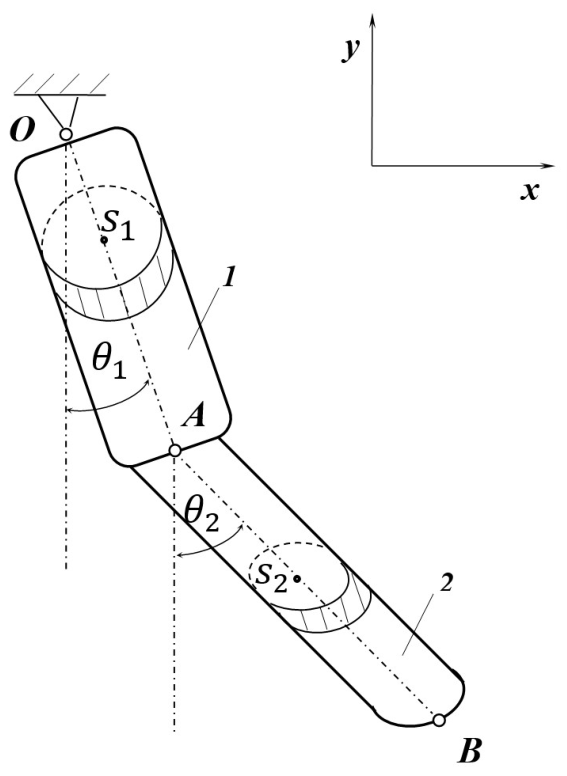
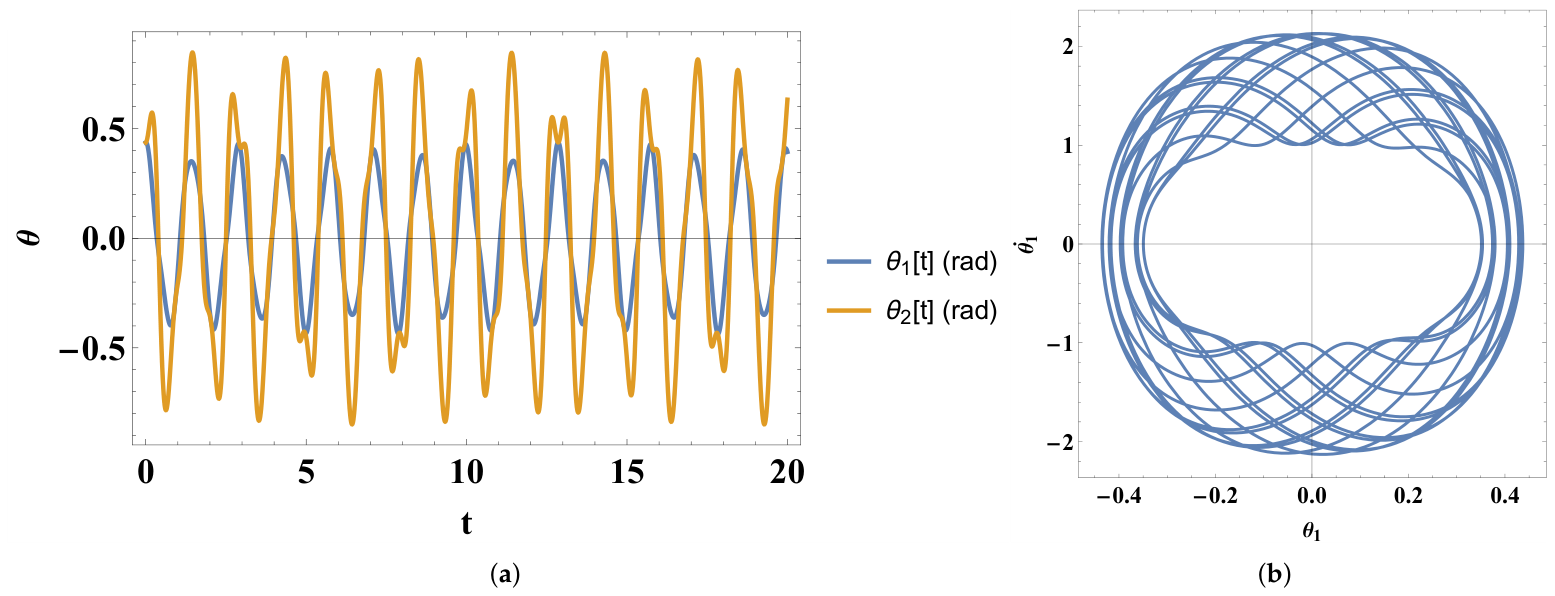
- For moderate initial angles (from the frontal plane) and angular velocities of the thigh and shank, the pendulum exhibits motion closely resembling natural human gait.
- −
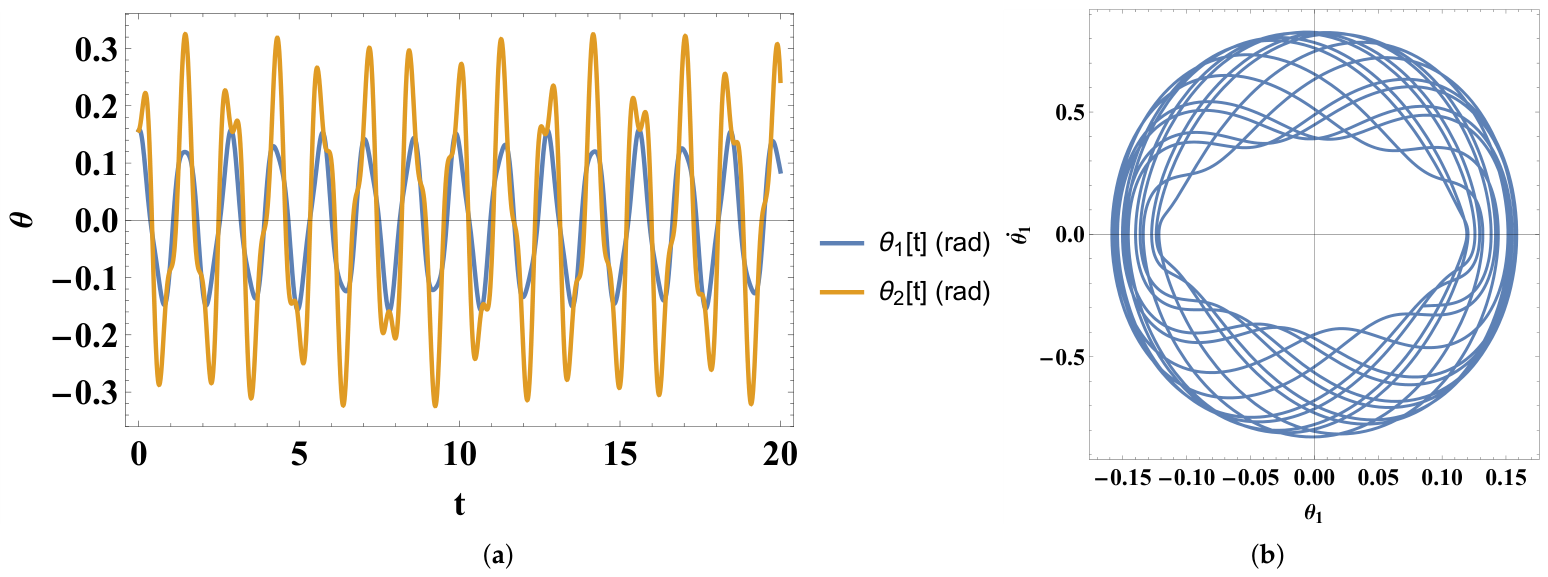
- When these parameters are small, it shows regular motion, i.e., it does not attest essential chaotic behaviour; the walking speed is then low.
- −
- When they are larger: the walking speed increases, but elements of chaos appear and increase with their increment, thus requiring in such regimes of motion much finer tailoring with the function of the muscles, nervous system, joints, etc.
Our findings support that human movement requires intricate control [21,22,23,24]. It is a medically well-established fact that Parkinson’s patients, in whom the brain control of movement is disturbed, demonstrate walking patterns as described in small stride lengths and walking speed—see, e.g., Refs. [25,26,27,28].
1.1. On Some Classical Applications of the Double Pendulum
1.2. On Some Modern Applications of the Double Pendulum
2. The Model
3. The Equations of Motion
4. Biomechanical Data
5. Analytical and Numerical Results
5.1. Analytical Results
5.2. Numerical Results
- (1)
- For relatively small initial angles and speeds, we obtain the following solutions for and :
- (2)
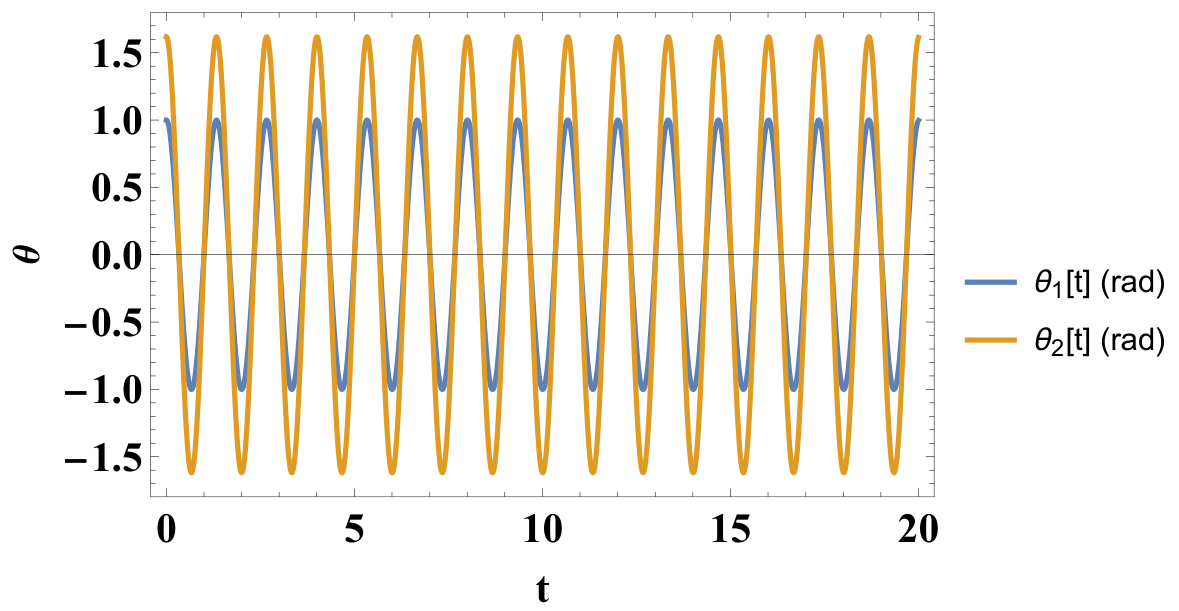
- For initial angles and slow speeds, we obtain the following solutions for and :
6. Comparison of Our Model Results to Experimental Data for Real Walking
7. What Can the Model Be Good for in Addition?
7.1. For Studying the Phase Difference Between Left- and Right-Limb Kinematics
7.2. Studying the Asymmetry of Walking Reflected by the Lengths of the Steps Made with the Left Versus the Right Leg
7.2.1. Studying the Phase Shift in Walking
- (1)
- Phase difference via cross-correlationLet and denote the left- and right-leg joint-angle trajectories, respectively, expressed as continuous functions of normalised gait time . Each function represents one complete gait cycle, with corresponding to the instant of left heel-strike. The signals and are assumed to be approximately periodic and sufficiently smooth for correlation-based phase analysis.The inter-limb phase difference (PD) quantifies the temporal offset between the left- and right-leg kinematic waveforms. It is defined as the temporal shift that maximises the cross-correlation between the two signals:where denotes the correlation coefficient computed over the normalised gait cycle. For a healthy bipedal gait, the expected value is , reflecting the characteristic anti-phase alternation between the limbs.
- (2)
- Phase difference from heel-strike timingWhen discrete gait events are available (e.g., heel-strike times from force plates, foot switches, or IMUs), the phase difference can be computed directly from event timing. Let and denote the times of the left and right heel-strike, respectively, and let be the stride duration (left heel-strike to subsequent left heel-strike). The phase difference is then given by the following equation:Under normal gait conditions, this definition also yields , consistent with the cross-correlation approach.
- (3)
- Phase shift in harmonic decompositionEach signal can be represented by a truncated Fourier series of the formwhere and denote the amplitude and phase of the k-th harmonic, respectively, and is a time independent constant.For each harmonic component, the inter-limb phase shift is defined as the difference between the harmonic phases of the right and left limbs:The fundamental harmonic () typically captures the primary flexion–extension pattern of the gait cycle. For a healthy bipedal gait, the limbs operate in near-perfect anti-phase, yieldingwhile higher-order harmonics exhibit smaller and more variable phase differences. Deviations from these expected values reflect disruptions in inter-limb coordination and may indicate gait asymmetry or pathology.
7.2.2. Interpretation of the Phase Shift
7.3. For Studying Different Groups of People—Different Ages, Ethnicity, Etc.
- (a) Gait analysis and rehabilitation; it can simulate normal and pathological walking patterns, helping clinicians design targeted physiotherapy or post-surgery recovery plans.
- (b) Prosthetics and orthotics design; by adjusting parameters (mass, length, and inertia) to match a patient’s anatomy, engineers can optimise artificial limbs for more natural movement.
8. Concluding Remarks
Author Contributions
Funding
Institutional Review Board Statement
Informed Consent Statement
Data Availability Statement
Acknowledgments
Conflicts of Interest
References
- Yordanov, Y.; Nacheva, A.; Tornjova, S.; Kondova, N.; Dimitrova, B.; Topalova, D. Anthropology of the Bulgarian Population at the End of the 20th Century (30–40 Years Old Persons); Academic Publishing House “Prof. Marin Drinov”: Sofia, Bulgaria, 2006. [Google Scholar]
- Zatsiorsky, V.M. Kinetics of Human Motion; Human Kinetics: Champaign, IL, USA, 2002; ISBN 0-7360-3778-0. [Google Scholar]
- Shan, G.; Bohn, C. Anthropometrical data and coefficients of regression related to gender and race. Appl. Ergon. 2003, 34, 327–337. [Google Scholar] [CrossRef]
- McConville, J.; Churchill, T.; Kaleps, I.; Clauser, C.; Cuzzi, J. Technical Report AFAMRL-TR-80-119; Aerospace Medical Research Laboratoy, Wright–Patterson Air Force Base: Oklahoma, Ohio, USA, 1980. [Google Scholar]
- Zatsiorsky, V.; Seluyanov, V.; Chugunova, L.G. Methods of determining mass-inertial characteristics of human body segments. In Contemporary Problems of Biomechanics; Chemyi, G.G., Regirer, S.A., Eds.; CRC Press: Boca Raton, MA, USA, 1990; pp. 272–291. [Google Scholar]
- Nikolova, G.S.; Toshev, Y.E. Estimation of male and female body segment parameters of the Bulgarian population using a 16-segmental mathematical model. J. Biomech. 2007, 40, 3700–3707. [Google Scholar] [CrossRef]
- Ott, E. Chaos in Dynamical Systems; Cambridge University Press: Cambridge, UK, 2002. [Google Scholar] [CrossRef]
- Rose, J.; Gamble, J.G. Human Walking; Lippincott Williams & Wilkins: Phyladelphia, PA, USA, 2006. [Google Scholar]
- Kim, S.Y.; Hu, B. Bifurcations and transitions to chaos in an inverted pendulum. Phys. Rev. E 1998, 58, 3028–3035. [Google Scholar] [CrossRef]
- DeSerio, R. Chaotic pendulum: The complete attractor. Am. J. Phys. 2003, 71, 250–257. [Google Scholar] [CrossRef]
- Beletskii, V.V.; Pivovarov, M.L.; Starostin, E.L. Regular and chaotic motions in applied dynamics of a rigid body. Chaos 1996, 6, 155–166. [Google Scholar] [CrossRef] [PubMed]
- Choi, J.H.; Jang, D.H.; Lim, H. Speed-dependent modulation of swing leg rest length during human walking. J. Biomech. 2026, 194, 113058. [Google Scholar] [CrossRef] [PubMed]
- Lim, H.; Park, S. A bipedal compliant walking model generates periodic gait cycles with realistic swing dynamics. J. Biomech. 2019, 91, 79–84. [Google Scholar] [CrossRef] [PubMed]
- Song, H.; Park, H.; Park, S. A springy pendulum could describe the swing leg kinetics of human walking. J. Biomech. 2016, 49, 1504–1509. [Google Scholar] [CrossRef]
- Abdullah, M.; Hulleck, A.A.; Katmah, R.; Khalaf, K.; El-Rich, M. Multibody dynamics-based musculoskeletal modeling for gait analysis: A systematic review. J. Neuroeng. Rehabil. 2024, 21, 178. [Google Scholar] [CrossRef]
- Ambrósio, J.A.C.; Kecskeméthy, A. Multibody Dynamics: Computational Methods and Applications. In Multibody Dynamics of Biomechanical Models for Human Motion via Optimization; Orden, J.C.G., Goicolea, J.M., Cuadrado, J., Eds.; Springer: Berlin/Heidelberg, Germany, 2007; pp. 245–272. [Google Scholar] [CrossRef]
- Srdjevic, Z.; Cveticanin, L. Identifying nonlinear biomechanical models by multicriteria analysis. J. Sound Vib. 2012, 331, 1207–1216. [Google Scholar] [CrossRef]
- Tejado, I.; Valério, D.; Pires, P.; Martins, J. Fractional order human arm dynamics with variability analyses. Mechatronics 2013, 23, 805–812. [Google Scholar] [CrossRef]
- Patnaik, S.; Hollkamp, J.P.; Semperlotti, F. Applications of variable-order fractional operators: A review. Proc. R. Soc. A 2020, 476, 20190498. [Google Scholar] [CrossRef] [PubMed]
- Müller, B.; Wolf, S.I.; Brüggemann, G.P.; Deng, Z.; McIntosh, A.S.; Miller, F.; Selbie, W.S. Handbook of Human Motion; Springer: Cham, Switzerland, 2018. [Google Scholar]
- Chen, J. Chaos from Simplicity: An Introduction to the Double Pendulum; University of Canterbury: Christchurch, New Zealand, 2008. [Google Scholar]
- Morin, D. Introduction to Classical Mechanics: With Problems and Solutions; Cambridge University Press: Cambridge, UK, 2008. [Google Scholar]
- Baker, G.L.; Blackburn, J.A. The Pendulum: A Case Study in Physics; OUP Oxford: Oxford, UK, 2008. [Google Scholar]
- Neptune, R.R. Optimization Algorithm Performance in Determining Optimal Controls in Human Movement Analyses. J. Biomech. Eng. 1999, 121, 249–252. [Google Scholar] [CrossRef]
- Yin, W.; Zhu, W.; Gao, H.; Niu, X.; Shen, C.; Fan, X.; Wang, C. Gait analysis in the early stage of Parkinson’s disease with a machine learning approach. Front. Neurol. 2024, 15, 1472956. [Google Scholar] [CrossRef]
- Di Biase, L.; Di Santo, A.; Caminiti, M.L.; De Liso, A.; Shah, S.A.; Ricci, L.; Di Lazzaro, V. Gait analysis in Parkinson’s disease: An overview of the most accurate markers for diagnosis and symptoms monitoring. Sensors 2020, 20, 3529. [Google Scholar] [CrossRef]
- Zhang, W.; Ling, Y.; Chen, Z.; Ren, K.; Chen, S.; Huang, P.; Tan, Y. Wearable sensor-based quantitative gait analysis in Parkinson’s disease patients with different motor subtypes. npj Digit. Med. 2024, 7, 169. [Google Scholar] [CrossRef] [PubMed]
- Mirelman, A.; Bonato, P.; Camicioli, R.; Ellis, T.D.; Giladi, N.; Hamilton, J.L.; Hass, C.J.; Hausdorff, J.M.; Pelosin, E.; Almeida, Q.J. Gait impairments in Parkinson’s disease. Lancet Neurol. 2019, 18, 697–708. [Google Scholar] [CrossRef]
- Herman, I.P. Physics of the Human Body, 2nd ed.; Springer: Berlin/Heidelberg, Germany, 2016. [Google Scholar] [CrossRef]
- Majed, L.; Ibrahim, R.; Lock, M.J.; Jabbour, G. Walking around the preferred speed: Examination of metabolic, perceptual, spatiotemporal and stability parameters. Front. Physiol. 2024, 15, 1357172. [Google Scholar] [CrossRef]
- Saibene, F.; Minetti, A.E. Biomechanical and physiological aspects of legged locomotion in humans. Eur. J. Appl. Physiol. 2003, 88, 297–316. [Google Scholar] [CrossRef]
- Stergiou, N.; Harbourne, R.T.; Cavanaugh, J.T. Optimal Movement Variability: A New Theoretical Perspective for Neurologic Physical Therapy. J. Neurol. Phys. Ther. 2006, 30, 120–129. [Google Scholar] [CrossRef]
- Pérez-Toro, P.; Vásquez-Correa, J.; Arias-Vergara, T.; Nöth, E.; Orozco-Arroyave, J. Nonlinear dynamics and Poincaré sections to model gait impairments in different stages of Parkinson’s disease. Nonlinear Dyn. 2020, 100, 3253–3276. [Google Scholar] [CrossRef]
- Lukšys, D.; Griškevičius, J. Application of nonlinear analysis for the assessment of gait in patients with Parkinson’s disease. Technol. Health Care 2022, 30, 201–208. [Google Scholar] [CrossRef]
- Guo, Y.; Yang, J.; Liu, Y.; Chen, X.; Yang, G.Z. Detection and assessment of Parkinson’s disease based on gait analysis: A survey. Front. Aging Neurosci. 2022, 14, 916971. [Google Scholar] [CrossRef] [PubMed]
- Lockhart, T.E.; Stergiou, N. New perspectives in human movement variability. Ann. Biomed. Eng. 2014, 41, 1593–1594. [Google Scholar] [CrossRef]
- van Emmerik, R.E.A.; van Wegen, E.E.H. On Variability and Stability in Human Movement. J. Appl. Biomech. 2000, 16, 394–406. [Google Scholar] [CrossRef]
- Bartlett, R.; Wheat, J.; Robins, M. Is movement variability important for sports biomechanists? Sport. Biomech. 2007, 6, 224–243. [Google Scholar] [CrossRef] [PubMed]
- Nayfeh, A.H.; Mook, D.T. Nonlinear Oscillations; John Wiley & Sons: Hoboken, NJ, USA, 2024. [Google Scholar]
- Strogatz, S.H. Nonlinear Dynamics and Chaos: With Applications to Physics, Biology, Chemistry, and Engineering; Chapman and Hall/CRC: Boca Raton, FL, USA, 2024. [Google Scholar] [CrossRef]
- Ardema, M.D. Analytical Dynamics: Theory and Applications; Springer Science & Business Media: Berlin, Germany, 2005. [Google Scholar]
- Guckenheimer, J.; Holmes, P. Nonlinear Oscillations, Dynamical Systems, and Bifurcations of Vector Fields; Springer Science & Business Media: Berlin, Germany, 2013; Volume 42. [Google Scholar]
- Dutra, M.S.; de Pina Filho, A.C.; Romano, V.F. Modeling of a bipedal locomotor using coupled nonlinear oscillators of Van der Pol. Biol. Cybern. 2003, 88, 286–292. [Google Scholar] [CrossRef]
- Nikolov, S.G.; Vassilev, V.M.; Zaharieva, D.T. Annual Meeting of the Bulgarian Section of SIAM 2018 Studies in Computational Intelligence. In Proceedings of the Analysis of Swing Oscillatory Motion; Springer: Berlin/Heidelberg, Germany, 2021; Volume 961, pp. 313–323. [Google Scholar] [CrossRef]
- Nikolov, S.; Zaharieva, D. Dynamical behaviour of a compound elastic pendulum. In Proceedings of the MATEC Web of Conferences; EDP Sciences: Les Ulis Cedex, France, 2018; Volume 145, p. 01003. [Google Scholar] [CrossRef]
- Arnold, V.I. Geometrical Methods in the Theory of Ordinary Differential Equations; Springer Science & Business Media: Berlin, Germany, 2012; Volume 250. [Google Scholar]
- Baines, P.G. Deterministic nonperiodic flow. J. Atmos. Sci. 1963, 20, 130–141. [Google Scholar] [CrossRef]
- Lorenz, E.N. Deterministic nonperiodic flow 1. In Universality in Chaos, 2nd ed.; Routledge: Oxfordshire, UK, 2017; pp. 367–378. [Google Scholar] [CrossRef]
- Penner, A.R. The physics of golf. Rep. Prog. Phys. 2002, 66, 131. [Google Scholar] [CrossRef]
- Cross, R. A double pendulum swing experiment: In search of a better bat. Am. J. Phys. 2005, 73, 330–339. [Google Scholar] [CrossRef]
- Alexander, R.M. Optimum timing of muscle activation for simple models of throwing. J. Theor. Biol. 1991, 150, 349–372. [Google Scholar] [CrossRef]
- Cross, R. Physics of overarm throwing. Am. J. Phys. 2004, 72, 305–312. [Google Scholar] [CrossRef]
- Putnam, C.A. Sequential motions of body segments in striking and throwing skills: Descriptions and explanations. J. Biomech. 1993, 26, 125–135. [Google Scholar] [CrossRef]
- Phillips, S.J.; Roberts, E.M.; Huang, T. Quantification of intersegmental reactions during rapid swing motion. J. Biomech. 1983, 16, 411–417. [Google Scholar] [CrossRef]
- Bartlett, R. Sports Biomechanics: Reducing Injury and Improving Performance; Routledge: Oxfordshire, UK, 2002. [Google Scholar]
- Daish, C.B. The Physics of Ball Games; English Universities Press: London, UK, 1972. [Google Scholar]
- Jorgensen, T.P. On the dynamics of the golf swing. Am. J. Phys. 1970, 38, 644–651. [Google Scholar] [CrossRef]
- Rasouli, F.; Reed, K.B. Identical Limb Dynamics for Unilateral Impairments through Biomechanical Equivalence. Symmetry 2021, 13, 705. [Google Scholar] [CrossRef]
- Cerda-Lugo, A.; González, A.; Cardenas, A.; Piovesan, D. Modeling the neuro-mechanics of human balance when recovering from a fall: A continuous-time approach. BioMed. Eng. OnLine 2020, 19, 67. [Google Scholar] [CrossRef] [PubMed]
- Hettich, G.; Fennell, L.; Mergner, T. Double Inverted Pendulum Model of Reactive Human Stance Control. In Proceedings of the Multibody Dynamics 2011, ECCOMAS Thematic Conference, Brussels, Belgium, 4–7 July 2011. [Google Scholar]
- Brenière, Y.; Ribreau, C. A double-inverted pendulum model for studying the adaptability of postural control to frequency during human stepping in place. Biol. Cybern. 1998, 79, 337–345. [Google Scholar] [CrossRef]
- Dempster, W.T. Space Requirements of the Seated Operator, Geometrical, Kinematic, and Mechanical Aspects of the Body with Special Reference to the Limbs; WADC Technical Report 55-159; Wright-Patterson Air Force Base: Fairborn, OH, USA, 1955. [Google Scholar]
- Clauser, C.E.; McConville, J.T.; Young, J.W. Weight, Volume, and Center of Mass of Segments of the Human Body; Technical Report AMRL-TR-69-70; Wright-Patterson Air Force Base: Fairborn, Ohio, USA, 1969. [Google Scholar]
- Chandler, R.; Clauser, C.E.; McConville, J.T.; Reynolds, H.; Young, J.W. Investigation of Inertial Properties of the Human Body; Technical Report AMRL-TR-74-137; Wright-Patterson Air Force Base: Fairborn, OH, USA, 1975. [Google Scholar]
- De Leva, P. Adjustments to Zatsiorsky-Seluyanov’s segment inertia parameters. J. Biomech. 1996, 29, 1223–1230. [Google Scholar] [CrossRef] [PubMed]
- Challis, J.H. Anthropometry. In Experimental Methods in Biomechanics; Springer: Berlin/Heidelberg, Germany, 2020; pp. 125–150. [Google Scholar]
- Dumas, R.; Wojtusch, J. Estimation of the Body Segment Inertial Parameters for the Rigid Body Biomechanical Models Used in Motion Analysis. In Handbook of Human Motion; Müller, B., Wolf, S., Eds.; Springer: Berlin/Heidelberg, Germany, 2018; pp. 47–77. [Google Scholar] [CrossRef]
- Lu, Y.; Li, H.; Lai, J.; Wang, J.; Yu, Y.; Lu, T.; Wei, X.; Wang, H.; Song, A. Adjustable Rigid-Soft Wearable Hand Robot With Magnetorheological Cable-Driven Mechanism for Grasping Assistance. IEEE Trans. Neural Syst. Rehabil. Eng. 2025, 33, 3053–3064. [Google Scholar] [CrossRef] [PubMed]
- Arnold, V.I.; Vogtmann, K.; Weinstein, A. Mathematical Methods of Classical Mechanics; Springer: Berlin/Heidelberg, Germany, 1989; Volume 60. [Google Scholar]
- Campa, A.; Dauxois, T.; Ruffo, S. Statistical mechanics and dynamics of solvable models with long-range interactions. Phys. Rep. 2009, 480, 57–159. [Google Scholar] [CrossRef]
- Nikolova, G.; Kotev, V.; Dantchev, D.; Tsveov, M. Study of mass-inertial characteristics of female human body by walking. In Proceedings of the AIP Conference Proceedings; AIP Publishing LLC: Melville, NY, USA, 2020; Volume 2239, p. 020032. [Google Scholar] [CrossRef]
- Nikolova, G.; Dantchev, D.; Tsveov, M. Age changes of mass-inertial parameters of the female body by walking. Vib. Proced. 2023, 50, 125–130. [Google Scholar] [CrossRef]
- Harris, G.F.; Smith, P.A. Human Motion Analysis: Current Applications and Future Directions; Institute of Electrical and Electronics Engineers: New York, NY, USA, 1996. [Google Scholar]
- Braune, W.; Fischer, O. The Human Gait; Springer Science & Business Media: Berlin, Germany, 2012. [Google Scholar]
- Winter, D.A. Biomechanics and Motor Control of Human Movement; John Wiley and Sons: Hoboken, NJ, USA, 2009. [Google Scholar]
- Asbeck, A.T.; De Rossi, S.M.; Galiana, I.; Ding, Y.; Walsh, C.J. Stronger, smarter, softer: Next-generation wearable robots. IEEE Robot. Autom. Mag. 2014, 21, 22–33. [Google Scholar] [CrossRef]
- Herman, I.P. Physics of the Human Body, 1st ed.; Springer: Berlin/Heidelberg, Germany, 2007. [Google Scholar]
- Van Der Velde, G.; Laloyaux, H.; Ronsse, R. Inducing asymmetric gait in healthy walkers: A review. Front. Rehabil. Sci. 2025, 6, 1463382. [Google Scholar] [CrossRef] [PubMed]
- Seuthe, J.; Hermanns, H.; Hulzinga, F.; D’Cruz, N.; Deuschl, G.; Ginis, P.; Nieuwboer, A.; Schlenstedt, C. Gait asymmetry and symptom laterality in Parkinson’s disease: Two of a kind? J. Neurol. 2024, 271, 4373–4382. [Google Scholar] [CrossRef] [PubMed]
- Vismara, L.; Cimolin, V.; Buffone, F.; Bigoni, M.; Clerici, D.; Cerfoglio, S.; Galli, M.; Mauro, A. Brain Asymmetry and Its Effects on Gait Strategies in Hemiplegic Patients: New Rehabilitative Conceptions. Brain Sci. 2022, 12, 798. [Google Scholar] [CrossRef]
- Wang, Y.; Zhang, P.; Chen, G.; Jiang, T.; Zou, Y. Comparison of the asymmetries in foot posture, gait and plantar pressure between patients with unilateral and bilateral knee osteoarthritis based on a cross-sectional study. Sci. Rep. 2024, 14, 26761. [Google Scholar] [CrossRef]
- Shultz, S.J.; Nguyen, A.D. Bilateral asymmetries in clinical measures of lower-extremity anatomic characteristics. Clin. J. Sport Med. 2007, 17, 357–361. [Google Scholar] [CrossRef]
- Munoz, A.I.; Espallargas, N.; Mischler, S.T. Briefs in Applied Sciences and Technology; Springer: Berlin/Heidelberg, Germany, 2020. [Google Scholar]
- Esparza-Ros, F.; Vaquero-Cristóbal, R. Sources of Error and Statistics Applied to Anthropometry. In Anthropometry; Springer Nature: Cham, Switzerland, 2025; pp. 35–57. [Google Scholar] [CrossRef]
- Basty, N.; Thanaj, M.; Whitcher, B.; Bell, J.D.; Thomas, E.L. Comparing DXA and MRI body composition measurements in cross-sectional and longitudinal cohorts. Commun. Med. 2026, 6, 227. [Google Scholar] [CrossRef]
- Minetto, M.A.; Busso, C.; Lalli, P.; Gamerro, G.; Massazza, G. DXA-Derived Adiposity and Lean Indices for Management of Cardiometabolic and Musculoskeletal Frailty: Data Interpretation Tricks and Reporting Tips. Front. Rehabil. Sci. 2021, 2, 712977. [Google Scholar] [CrossRef]
- Tavoian, D.; Ampomah, K.; Amano, S.; Law, T.D.; Clark, B.C. Changes in DXA-derived lean mass and MRI-derived cross-sectional area of the thigh are modestly associated. Sci. Rep. 2019, 9, 10028. [Google Scholar] [CrossRef]
- Afonso, J.; Bessa, C.; Pinto, F.; Ribeiro, D.; Moura, B.; Rocha, T.; Vinícius, M.; Canário-Lemos, R.; Peixoto, R.; Clemente, F.M. Structural and Functional Asymmetries in Humans. In Asymmetry as a Foundational and Functional Requirement in Human Movement; Springer: Singapore, 2020; pp. 9–16. [Google Scholar] [CrossRef]
- Glazier, P.S.; Davids, K. Constraints on the Complete Optimization of Human Motion. Sports Med. 2009, 39, 15–28. [Google Scholar] [CrossRef]
- Lanza, I.R.; Towse, T.F.; Caldwell, G.E.; Wigmore, D.M.; Kent-Braun, J.A. Effects of age on human muscle torque, velocity, and power in two muscle groups. J. Appl. Physiol. 2003, 95, 2361–2369. [Google Scholar] [CrossRef] [PubMed]
- Jaric, S.; Radosavljevic-Jaric, S.; Johansson, H. Muscle force and muscle torque in humans require different methods when adjusting for differences in body size. Eur. J. Appl. Physiol. 2002, 87, 304–307. [Google Scholar] [CrossRef]
- Ateş, F.; Hug, F.; Bouillard, K.; Jubeau, M.; Frappart, T.; Couade, M.; Bercoff, J.; Nordez, A. Muscle shear elastic modulus is linearly related to muscle torque over the entire range of isometric contraction intensity. J. Electromyogr. Kinesiol. 2015, 25, 703–708. [Google Scholar] [CrossRef] [PubMed]
- Cavanagh, P.R.; Lafortune, M.A. Ground reaction forces in distance running. J. Biomech. 1980, 13, 397–406. [Google Scholar] [CrossRef] [PubMed]
- Veltink, P.; Liedtke, C.; Droog, E.; van der Kooij, H. Ambulatory measurement of ground reaction forces. IEEE Trans. Neural Syst. Rehabil. Eng. 2005, 13, 423–427. [Google Scholar] [CrossRef]
- Munro, C.F.; Miller, D.I.; Fuglevand, A.J. Ground reaction forces in running: A reexamination. J. Biomech. 1987, 20, 147–155. [Google Scholar] [CrossRef]
- Lugade, V.; Lin, V.; Chou, L.S. Center of mass and base of support interaction during gait. Gait Posture 2011, 33, 406–411. [Google Scholar] [CrossRef]
- Kazemi, M.; Dabiri, Y.; Li, L. Recent advances in computational mechanics of the human knee joint. Comput. Math. Methods Med. 2013, 2013, 718423. [Google Scholar] [CrossRef]
- Fung, Y.C. Biomechanics: Mechanical Properties of Living Tissues; Springer Science & Business Media: Berlin, Germany, 2013. [Google Scholar]
- Bohannon, R.W.; Williams Andrews, A. Normal walking speed: A descriptive meta-analysis. Physiotherapy 2011, 97, 182–189. [Google Scholar] [CrossRef] [PubMed]



| Study | n | Age [Years] | Body Height [cm] | Body Mass [kg] | Lengths [cm] | Mass [kg] | Centre of Mass [%] | Principal Inertial Moments [kg.cm2] |
|---|---|---|---|---|---|---|---|---|
| Bulgarian males Nikolova and Toshev [6] | 2435 | 30–40 | 171 | 77.7 | = 51.0 = 37.2 | = 11.0 = 3.3 | = 41.4 = 44.6 | |
| Russian males Zatsiorsky [2] | 100 | 23.8 | 174 | 73.0 | ||||
| German males Shan and Bhon [3] | 25 | 25.9 | 181 | 78.4 | = 46.3 | = 10.8 = 3.7 | = 32.2 = 46.4 | |
| The US american males McConville et al. [4] | 31 | 27.4 | 177 | 77.3 | = 46.5 | = 8.4 =5.4 | = 57.1 = 37.0 |
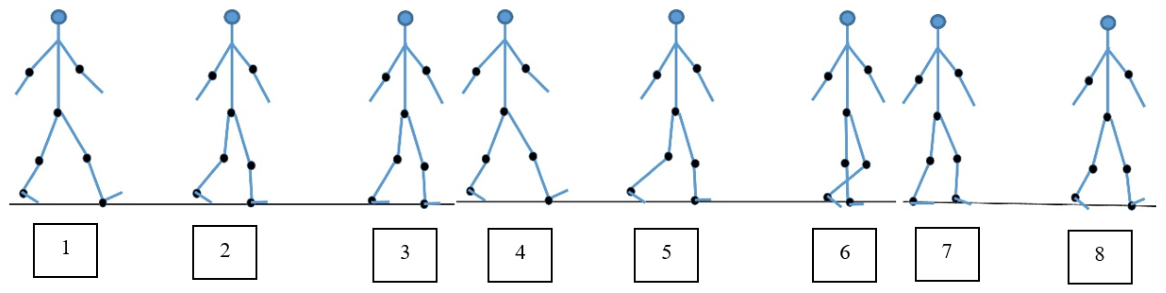
| Gait Phases of the Human Gait Cycle | Initial Contact | Loading Response | Mid Stance | Terminal Stance | Pre Swing | Initial Swing | Mid Swing | Terminal Swing |
|---|---|---|---|---|---|---|---|---|
| Hip | 20° | 20° | 0° | −20° | −10° | 15° | 25° | 20° |
| Knee | 0°–5° | 20° | 0°–5° | 0°–5° | 40° | 60°–70° | 25° | 0°–5° |
| Ankle joint | 0° | 5°–10° | 5° | 10° | 15° | 5° | 0° | 0° |
Disclaimer/Publisher’s Note: The statements, opinions and data contained in all publications are solely those of the individual author(s) and contributor(s) and not of MDPI and/or the editor(s). MDPI and/or the editor(s) disclaim responsibility for any injury to people or property resulting from any ideas, methods, instructions or products referred to in the content. |
© 2026 by the authors. Licensee MDPI, Basel, Switzerland. This article is an open access article distributed under the terms and conditions of the Creative Commons Attribution (CC BY) license.
Share and Cite
Dantchev, D.; Nikolov, S.; Nikolova, G.S. Mathematical Model of Human Walking: A Theoretical Study Based on Anthropometric Data. Biomechanics 2026, 6, 42. https://doi.org/10.3390/biomechanics6020042
Dantchev D, Nikolov S, Nikolova GS. Mathematical Model of Human Walking: A Theoretical Study Based on Anthropometric Data. Biomechanics. 2026; 6(2):42. https://doi.org/10.3390/biomechanics6020042
Chicago/Turabian StyleDantchev, Daniel, Svetoslav Nikolov, and Gergana S. Nikolova. 2026. "Mathematical Model of Human Walking: A Theoretical Study Based on Anthropometric Data" Biomechanics 6, no. 2: 42. https://doi.org/10.3390/biomechanics6020042
APA StyleDantchev, D., Nikolov, S., & Nikolova, G. S. (2026). Mathematical Model of Human Walking: A Theoretical Study Based on Anthropometric Data. Biomechanics, 6(2), 42. https://doi.org/10.3390/biomechanics6020042