
Article

Community Participation Challenges in Aedes aegypti Surveillance: Analysis of Reluctance Factors in Two Cities in Argentina from March to December 2021

by
Milagros Girart
1,*,
Catalina Canosa
1,
Carolina Goizueta
1,
Manuel Osvaldo Espinosa
1,
María Victoria Periago
1,2 and
Carolina López Ferloni
1
1
Fundación Mundo Sano, Buenos Aires C1061ABC, Argentina
2
Consejo Nacional de Investigaciones Científicas y Técnicas (CONICET), Buenos Aires C1425FQB, Argentina
*
Author to whom correspondence should be addressed.
Parasitologia 2026, 6(3), 25; https://doi.org/10.3390/parasitologia6030025
Submission received: 21 January 2026 / Revised: 29 April 2026 / Accepted: 13 May 2026 / Published: 14 May 2026

Abstract

Dengue represents a growing challenge for public health in Argentina, where entomological surveillance is essential to Aedes aegypti control interventions. However, low community participation in surveillance activities constitutes a major obstacle to these interventions. In this mixed-methods (quantitative–qualitative) study, we analyzed the reasons for reluctance to undergo household inspections in Tartagal and Puerto Iguazú between March and December 2021. A total of 9065 responses were recorded, among which the most frequent reason was the perception that inspection was unnecessary (64.2%). Four additional categories of reluctance were identified: impossibility or restriction of access to the housing unit, lack of interest in the visit, safety concerns, and other causes. Analysis using the Shannon diversity index showed homogeneity of responses in Tartagal (H′ = 0.77) and greater diversity in Puerto Iguazú (H′ = 1.59). Although most respondents reported knowing what dengue is and where the vector mosquito breeds, lack of interest in identifying breeding sites predominated in Tartagal, whereas greater willingness to collaborate was observed in Puerto Iguazú. The findings suggest that risk perception, overlap of activities, institutional recognition, and safety concerns influence community participation. Understanding these factors is key to adjusting surveillance strategies and increasing the effectiveness of vector control programs.

1. Introduction

Dengue is one of the most important arboviral diseases in public health. It is caused by four dengue virus serotypes and is transmitted primarily by the mosquito Aedes aegypti in Argentina [1]. Among arthropod-borne viral diseases, dengue causes the highest human morbidity and mortality [2]. Given the re-emergence of this disease, with an increase in cases worldwide and frequent epidemic outbreaks [3,4], the need for effective prevention tools has become increasingly urgent. Maintaining representative entomological surveillance is essential to generate data on activity patterns, distribution, and infestation levels of the vector insect. At the local, national, or regional level, this information serves as an input for establishing priorities and planning preventive control interventions.
In Argentina, dengue has expanded beyond tropical and subtropical regions into temperate areas, including major urban centers [5]. Since the introduction of serotype DENV-2 in northwestern Argentina in 1998, outbreaks of varying intensity have occurred, with circulation of all four serotypes and five major epidemics in 2009, 2016, 2020, 2023, and 2024 [6]. Both Tartagal (Salta) and Puerto Iguazú (Misiones) are at high risk for local transmission of dengue and other Ae. aegypti-borne viruses and have experienced recurrent dengue outbreaks over the past 25 years [7,8].
Surveillance tools, such as breeding-site abundance maps along with the estimation of infestation-level indicators, have historically been used to provide visual support for decision-making, with the aim of improving the preparedness of public health services for dengue outbreaks and epidemics [8,9]. However, selecting control strategies requires identifying high-risk areas and periods, as well as understanding the mechanisms of virus spread within the community [7,10,11,12].
In Argentina, specifically in the cities of Tartagal [8] and Puerto Iguazú [7], an Ae. aegypti surveillance and monitoring program is implemented through public–private collaboration, using two main tools: the estimation of infestation indices via inspection of housing units (larval samplings), and the monitoring of oviposition activity through a network of ovitraps [13,14]. To achieve representative coverage of mosquito activity in an area, community participation is essential, given the domestic behavior of Ae. aegypti. Closed households or those that do not allow entry constitute the main limitation of larval samplings, as they reduce population coverage and provide indicators (such as Housing index or Breteau index) that do not accurately reflect the actual entomological situation.
Recently, within the framework of the entomological surveillance program implemented in these two cities, an increase has been observed in the proportion of housing units where field agents were unable to carry out their activities. For example, data from program implementation shows that at the start of activities in Tartagal in 2009, household participation was high, and the reluctance rate was 5.6%. Over time, participation declined, with an increase in the percentage of reluctance reaching an average of 29.5% between 2018 and 2021. Similarly, in Puerto Iguazú, the reluctance rate was 0.05% in 2007, while between 2018 and 2021 it reached an average of 16%. This issue also affects other cities that implement entomological surveillance programs for arboviruses [15,16,17,18,19,20]. These studies have identified several reasons for variations in community participation, including perceptions of the ineffectiveness of fumigation, distrust toward the personnel conducting interventions, inappropriate visiting schedules [20], and safety concerns [18], among others. However, a limited number of studies have explored in depth the reasons for reluctance toward dengue prevention and vector control activities [20], and evidence on this issue remains scarce.
The objective of this study was to improve community adherence to entomological surveillance in Tartagal and Puerto Iguazú, and to understand the reasons for lack of community participation in Ae. aegypti surveillance and monitoring activities. The following mixed quantitative–qualitative study was conducted within the regular framework of the program’s activities.

2. Materials and Methods

This study adopted an exploratory-descriptive mixed-methods design. It combined qualitative categorization of open-ended responses with quantitative descriptive analyses, including frequency distributions, percentage calculations, the Shannon diversity index (H′), and analysis of closed-ended questionnaire responses.

2.1. Study Area

The city of Tartagal is in the northeast of the province of Salta, Argentina, and belongs to the municipality of Tartagal within the Department of General José de San Martín, 55 km south of the Bolivian border. On the other hand, the city of Puerto Iguazú is in the northern part of the province of Misiones, Argentina, and belongs to the municipality of Iguazú and the department of the same name. The city borders Ciudad del Este, Paraguay, and Foz do Iguaçu, Brazil. In both areas, Fundación Mundo Sano (FMS) has local offices where Ae. aegypti surveillance and monitoring activities began in 2004 (Puerto Iguazú) and 2009 (Tartagal); these activities are carried out as part of a public–private collaboration between FMS and the local municipalities. According to the 2022 census, Tartagal has a population of 59,568 inhabitants and its urban area covers approximately 21.3 km2, while Puerto Iguazú has a population of 45,700 inhabitants and an urban area of about 16 km2 [21].

2.2. Inspection of Housing Units

In both Tartagal [8] and Puerto Iguazú [7], Ae. aegypti surveillance was conducted by a mixed team of field agents (FMS and local municipality) through larval samplings to identify infestation indices (Housing index or Breteau index), following the same guidelines and standard operating procedures (SOPs) in both areas [22]. These guidelines detail the methodology for calculating the number of housing units that must be sampled to achieve adequate urban coverage (>5%). Focal cycle rounds are conducted through planned visits to blocks within the urban area, for the systematic inspection of household peridomestic areas in search of Ae. aegypti breeding sites and the survey of all containers and items capable of storing water. Surveillance activities in Tartagal began in 2009 and are ongoing, with focal cycles covering 100% of the city’s urban area [8]. Since 2012, focal cycles have been performed once a year during the summer/autumn season, with larval samplings during the winter/spring season, covering a minimum of 20% of city’s urban area. The focal cycle activity is complemented by control measures consisting of the elimination of containers and larval control using a Bti biolarvicide (Bacillus thuringiensis subspecies israelensis) in non-removable breeding sites [8]. In Puerto Iguazú, larval samplings have been conducted year-round since 2007, covering at least 20% of the city’s urban area and control activities with larvicides are performed by the municipality itself. The larval samplings in Puerto Iguazú were carried out until 2023.
The specific SOP on the inspection of household units included a form to record the status of each unit. Each day, two field agents were assigned per block to conduct inspections within a neighborhood in both cities. Upon arriving at each household, the agents announce themselves; if there is no response, or if no responsible adult is present at the time of the visit, the household is classified as closed (C). If an adult owner or responsible resident does not authorize entry, the household is classified as reluctant (R). If entry is authorized and the inspection is carried out, the household is classified as inspected (I).

2.3. Data Registry

In addition to the form used to record the status of each household, in 2021 a table for documenting the reasons for household reluctance was incorporated into the SOP so that the same field agents performing the inspection could record the responses. The data on reasons for reluctance used for this study was collected between March and December 2021 in both Tartagal and Puerto Iguazú. When a resident refused the inspection, they were asked openly about the reason for their refusal, without suggesting any predefined list of responses, and the verbatim response was recorded by the field agents. After reviewing the answers provided by residents, eight initial categories of reluctance were identified. However, after three independent researchers analyzed the verbatim responses and cross-checked the categories to confirm their classification, these were redefined and regrouped, resulting in a total of five final categories, some of which were subdivided into subcategories (Table 1). All responses indicating reasons for reluctance were included in the categorization.
Once the five categories were defined, the number of responses corresponding to each category was counted for each city, as well as the combined total. Subsequently, the percentage represented by each category relative to the total number of responses was calculated in Tartagal and Puerto Iguazú. The same procedure was applied at the neighborhood level within each city, and pie charts were generated and displayed on maps. The analysis was conducted at the neighborhood level, as this scale may be effective for the implementation of targeted strategies, given that within each city there is a heterogeneity between neighborhoods (socioeconomic status, access to water and sanitation, etc.).
After the first three months of data collection, a preliminary analysis of open-ended responses identified that the most frequent reason for reluctance was that the household inspection was considered unnecessary. Based on this finding, a specific questionnaire was designed and implemented during the remaining data collection period to further explore the perceptions and/or knowledge about dengue among those housing units. First, respondents were asked whether they were familiar with FMS and whether their household had ever been visited by FMS. Subsequently, questions addressed knowledge about dengue, including whether they knew what dengue is, if they knew where the mosquitoes that transmit it breed, and whether they would be interested in knowing if mosquito breeding sites were present in their household. All questions were closed-ended (Yes, No, I don’t know), except for question 4; if they replied yes, a follow-up question was added to determine where they thought mosquitos bred, and the verbatim reply was recorded.
Additionally, the Shannon diversity index (H′) [23] was calculated for each city to assess the diversity of responses. For this purpose, a matrix was constructed containing the total number of responses recorded from each household per category of reluctance for each city, one for Tartagal and one for Puerto Iguazú. The H′ index was calculated using the “vegan” package in RStudio (version 2025.09.01) [24] with the command shannon <- diversity (index = “shannon”). Although this is traditionally used for ecological studies, in the context of this research, it was used to measure the diversity in responses between the two cities.

3. Results

Categorized reasons for reluctance were analyzed in both cities. In Tartagal, data on reasons for reluctance resulted in a total of 6693 responses. When categorized (Table 2), most responses corresponded to Category 1 (n = 5214; 77.9%), followed by Category 5 (n = 838; 12.5%). In Puerto Iguazú, data on reasons for reluctance yielded a total of 2372 responses. In this area, responses were more evenly distributed among categories (Table 2); however, as observed in Tartagal, the largest proportion of responses corresponded to Category 1 (n = 609; 25.7%). When responses from both areas were combined, the highest percentage corresponded to Category 1 (64.2%), while the lowest corresponded to Category 3 (5.3%).
The results of the Shannon diversity index (H′) calculation showed that the theoretical maximum possible H′ was 1.61 given the number of categories of reluctance, with an H′ value of 0.77 for Tartagal and 1.59 for Puerto Iguazú, indicating greater homogeneity of responses in Tartagal than in Puerto Iguazú.
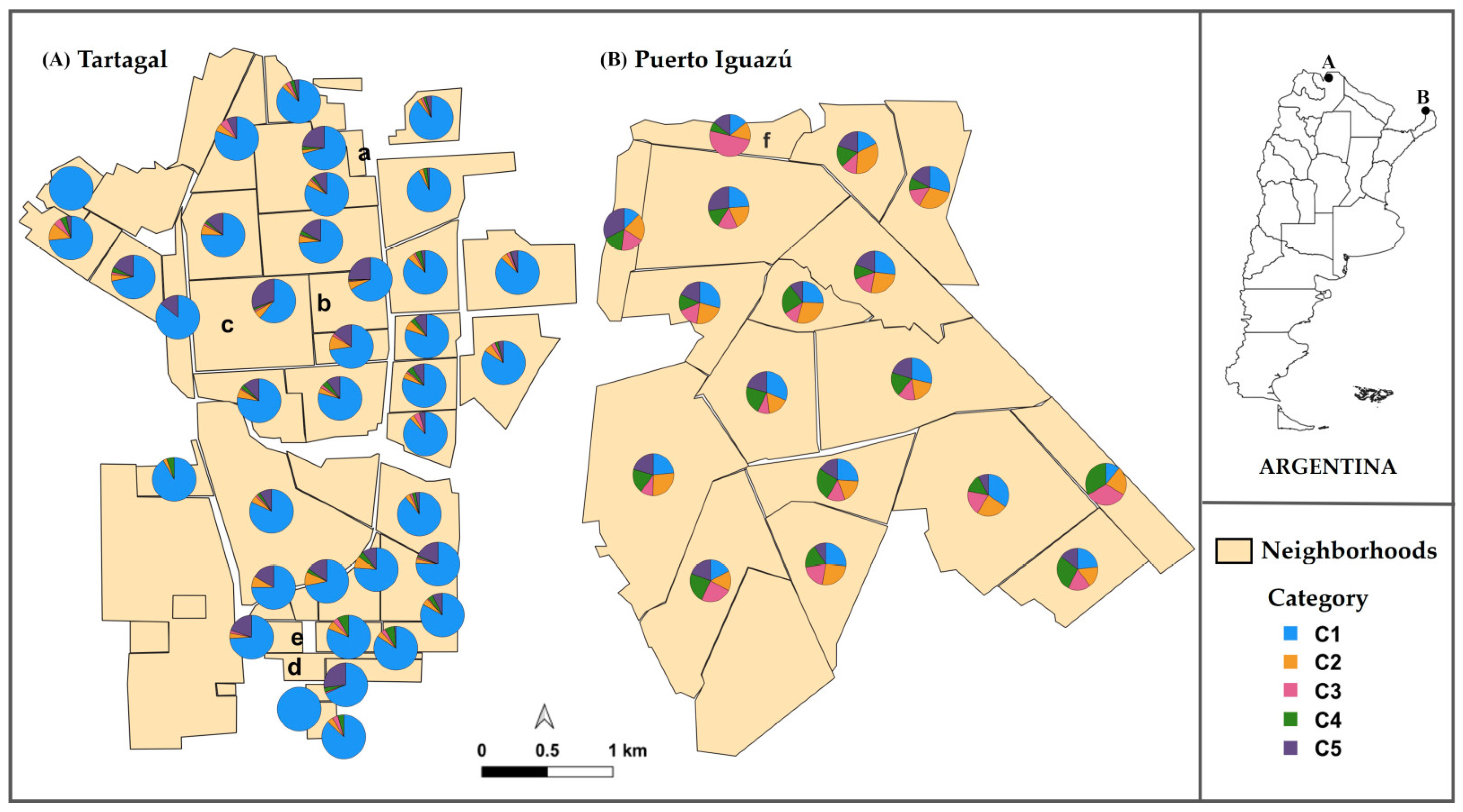
Figure 1 shows the percentage of responses by category in each neighborhood of Tartagal and Puerto Iguazú. As observed in Figure 1A, more than 50% of the responses correspond to the same category (Category 1) all over the city; that is, they do not consider the inspection necessary. Although this category predominates in all cases, in the neighborhoods of Casco Centro (c), Alberdi (b), 203 viviendas (d), SUPE (e), and 200 viviendas (a), more than 20% of the responses correspond to Category 5 (“other causes”). In general, these other causes are related to houses without yards or commercial premises, overlapping activities, and complaints or requests. The Shannon index confirms the homogeneity of responses in Tartagal (H′ = 0.77).
In contrast, in Puerto Iguazú, as observed in Figure 1B, the proportion of categories differs across neighborhoods, but in all cases, none exceed 50% of responses. Only in one neighborhood, Portuaria (f), do 50% of the responses correspond to the same category (category 3), that is, lack of interest in receiving the visit. Here, response proportions are more evenly distributed, indicating greater heterogeneity (H′ = 1.59).
The additional questionnaire aimed at further exploring the main reason for reluctance (category 1) yielded a total of 923 responses (545 from Tartagal and 378 from Puerto Iguazú) (Table 3). When asked whether they were familiar with FMS, most of the respondents in Puerto Iguazú (56.9%) answered affirmatively, whereas in Tartagal, approximately half of the respondents reported not knowing FMS (50.6%). However, in both cities, a large majority reported having received a visit from FMS at their home at least once (>60%).
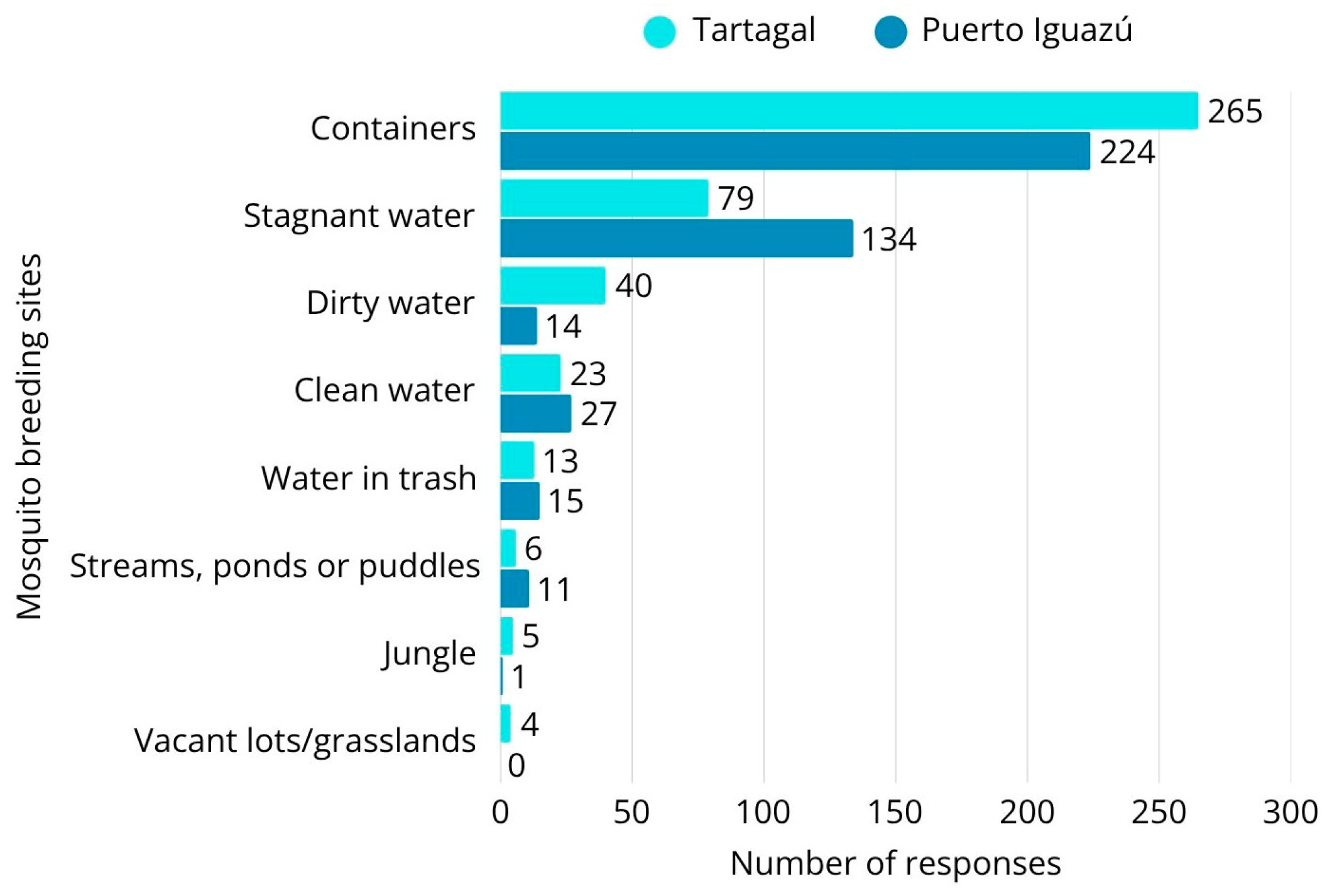
On the other hand, nearly all respondents stated that they knew what dengue is and where the mosquitoes that transmit it breed (Table 3). In this case, differences between responses from Tartagal and Puerto Iguazú were minimal. In addition, 861 open-ended responses were recorded (435 from Tartagal and 426 from Puerto Iguazú), in which respondents mentioned the places where mosquitoes breed (Figure 2). The most frequent categories were “containers” (61% in Tartagal and 53% in Puerto Iguazú) and “stagnant water” (18% and 31%, respectively).
Finally, when respondents were asked whether they would be interested in knowing if mosquito breeding sites were present in their homes, differences were observed between the two study sites (Table 3). In Puerto Iguazú, 69.8% of respondents expressed interest, whereas in Tartagal, 53.2% reported that they were not interested.

4. Discussion

This study identified the most frequent reasons for reluctance toward Ae. aegypti surveillance and monitoring activities in the localities of Tartagal (Salta) and Puerto Iguazú (Misiones), Argentina. The results indicate a high number of reluctant households, reflecting a significant obstacle to community participation that has increased over the years of program implementation.
In both cities, inspection activities have maintained broad coverage since the beginning of the program. However, over the years, an increase in the proportion of reluctance was recorded by field agents: from 5.6% in 2009 to an average of 29.5% between 2018 and 2021 in Tartagal, and from 0.05% in 2007 to 16% between 2018 and 2021 in Puerto Iguazú.
This pattern of low community participation in dengue control activities has been reported in several studies [25]. In Taiwan, for example, research has shown that fatigue caused by prolonged exposure to similar or repetitive messages (message fatigue) may reduce motivation to participate in preventive activities, particularly in high-risk areas where incidence, prevalence, and vector density are higher [26]. The repetition of interventions within long-term programs could negatively affect community participation, as evidenced in this study by the increase in reluctant households.
The main reason for reluctance reported by respondents was that they did not consider the household inspection to be necessary. At the same time, most participants stated that they knew what dengue is and where the mosquitoes that transmit it breed. Greater knowledge of the disease would be expected to increase participation in preventive activities. However, some authors have noted that knowledge of dengue and its complications does not necessarily translate into behavioral change [27]. This finding is consistent with a study conducted in Cuba, where approximately half of the surveyed sample perceived vector control program activities as unnecessary [15]. This response was associated with a low-risk perception among the population, due to a temporal distance of more than 15 years between dengue outbreaks in Cuba. Similarly, other authors have highlighted that risk perception regarding vector-borne diseases may influence the effectiveness of public health interventions [17].
Additionally, task overlap between FMS and the municipalities of the studied localities was mentioned as a reason for reluctance. This finding is consistent with a study conducted in Pakistan, which reported a lack of coordination among the community, community leaders, and governmental agencies [19]. This study also found a significant association between the implementation of control practices (such as cleaning containers, using repellents and mosquito nets, among others) and community engagement with health departments, non-governmental organizations (NGOs), and other agencies involved in dengue control. In the present study, in Puerto Iguazú, most respondents stated that they were familiar with FMS and expressed interest in knowing whether mosquito breeding sites were present in their households. In contrast, in Tartagal, a large proportion of respondents reported not knowing FMS despite having received visits, and the level of interest in mosquito breeding sites was low. These results suggest that greater institutional recognition, both of governmental and non-governmental organizations, may promote more active community participation.
Other reasons for reluctance included safety concerns and logistical difficulties, such as the need for entry permits or individuals reporting being busy at the time of inspection. Similar findings have been reported in other studies, which mention distrust toward personnel carrying out interventions and inadequate visiting schedules [20], as well as refusal of inspection visits due to safety concerns [18]. Reluctance may therefore be related to the need to maintain household security and privacy, particularly in contexts where insecurity is a daily concern. In this regard, institutional recognition and the establishment of trust-based relationships with inspection agents are essential. For future research, it would be relevant to further explore how aspects related to privacy and security influence the willingness to participate in vector control activities.
Furthermore, some respondents expressed complaints and/or requests that constituted additional reasons for reluctance. Among these, requests for fumigation were reported, which contrasts with findings from a previous study, where fumigation was perceived as ineffective [20]. However, in that study, the authors pointed out that part of this perceived ineffectiveness was based on the presence of abandoned neighboring houses or other breeding sites in the surrounding area. This latter aspect is consistent with complaints identified in the present study, related to the lack of preventive actions by neighbors, suggesting that it may represent a relevant factor in community participation that warrants further in-depth investigation.
A limitation of this study was that it included only participants who were reluctant to undergo household inspections. Therefore, only barriers to participation could be identified. Further studies are needed to identify facilitators for household inspections. Additionally, structured interviews were not conducted, and data was collected through a simple survey with open and closed-ended questions.
The findings of this study highlight the importance of community reluctance in the sustainability of Ae. aegypti surveillance and control programs. Some authors propose actively involving the community from the planning, implementation, and evaluation stages of activities, rather than limiting participation to a merely collaborative role [15]. Community participation, through various strategies (education, empowerment, or direct involvement in preventive activities), has been shown to have a significant impact on the reduction in Ae. aegypti and on improvements in population knowledge, attitudes, and behaviors [25], as observed in the Patio Limpio campaign in Mexico [16]. Thus, incorporating research that examines the reasons for reluctance makes it possible to adjust both community-oriented interventions and implementation shortcomings by field agents, thereby strengthening the effectiveness of dengue prevention and control actions.

Author Contributions

Conceptualization, C.L.F., C.C., C.G. and M.V.P.; Methodology, C.L.F., C.G. and M.V.P.; Validation, M.V.P.; Formal analysis, C.C., C.L.F. and C.G.; Investigation, M.O.E., M.V.P., M.G., C.G., C.L.F. and C.C.; Data curation, C.L.F. and C.G.; Writing—Original Draft Preparation, M.V.P., M.O.E. and M.G.; Writing—Review and Editing, M.V.P. and C.L.F.; Visualization, M.G. and M.O.E.; Supervision, M.V.P. and C.L.F.; Project Administration, C.L.F. and M.V.P. All authors have read and agreed to the published version of the manuscript.

Funding

This research was funded by Fundación Mundo Sano. No grant number.

Institutional Review Board Statement

Ethical review and approval were waived for this study. According to Argentinian Resolution 1480/2011 from the Ministry of Health, ethical approval was not required, as these programs were implemented as a municipal public health intervention.

Informed Consent Statement

Informed consent was waived in accordance with Argentinian Resolution 1480/2011 from the Ministry of Health, given that no identifiable information was recorded in the study.

Data Availability Statement

The original contributions presented in this study are included in the article. Further inquiries can be directed to the corresponding author.

Acknowledgments

We would like to thank the field agents of Puerto Iguazú and Tartagal, who conducted the Aedes aegypti surveillance and monitoring program and recorded the data used for this study, as well as the Mundo Sano local coordinators. We also acknowledge Florencia Portella for her contribution to the preliminary data analysis, Camila López Villalba for her work on data entry and categorization and Sofía Luna Sidoli Cano for her collaboration on data analysis. Finally, we thank all individuals who participated in the study and made the data collection possible.

Conflicts of Interest

The authors declare no conflicts of interest.

Abbreviations

The following abbreviations are used in this manuscript:
FMSFundación Mundo Sano
SOPStandard operating procedures
NGONon-governmental organization

References

  1. Christophers, S.R. Aedes Aegypti (L) The Yellow Fever Mosquito. Its Life History, Bionomics and Structure; Cambridge University Press: London, UK, 1960. [Google Scholar]
  2. Hermann, L.L.; Gupta, S.B.; Manoff, S.B.; Kalayanarooj, S.; Gibbons, R.V.; Coller, B.-A.G. Advances in the Understanding, Management, and Prevention of Dengue. J. Clin. Virol. 2015, 64, 153–159. [Google Scholar] [CrossRef]
  3. Sarker, R.; Roknuzzaman, A.S.M.; Haque, M.A.; Islam, M.R.; Kabir, E.R. Upsurge of Dengue Outbreaks in Several WHO Regions: Public Awareness, Vector Control Activities, and International Collaborations Are Key to Prevent Spread. Health Sci. Rep. 2024, 7, e2034. [Google Scholar] [CrossRef]
  4. Haider, N.; Hasan, M.N.; Onyango, J.; Billah, M.; Khan, S.; Papakonstantinou, D.; Paudyal, P.; Asaduzzaman, M. Global Dengue Epidemic Worsens with Record 14 Million Cases and 9000 Deaths Reported in 2024. Int. J. Infect. Dis. 2025, 158, 107940. [Google Scholar] [CrossRef]
  5. Estallo, E.L.; Sippy, R.; Stewart-Ibarra, A.M.; Grech, M.G.; Benitez, E.M.; Ludueña-Almeida, F.F.; Ainete, M.; Frias-Cespedes, M.; Robert, M.; Romero, M.M.; et al. A Decade of Arbovirus Emergence in the Temperate Southern Cone of South America: Dengue, Aedes aegypti and Climate Dynamics in Córdoba, Argentina. Heliyon 2020, 6, e04858. [Google Scholar] [CrossRef]
  6. Rapaport, S.; Mauriño, M.; Morales, M.A.; Fabbri, C.; Luppo, V.; Buyayisqui, M.P.; Varela, T.; Giovacchini, C.; Urueña, A. Epidemiology of Dengue in Argentina during the 2010/11 to 2019/20 Seasons: A Contribution to the Burden of Disease. Trop. Med. Infect. Dis. 2024, 9, 45. [Google Scholar] [CrossRef]
  7. Rotela, C.H.; Espinosa, M.O.; Albornoz, C.; Lafaye, M.; Lacaux, J.P.; Tourre, Y.; Vignolles, C.; Scavuzzo, M. Desarrollo de Mapas Predictivos de Densidad Focal de Aedes aegypti En La Ciudad de Puerto Iguazú (Argentina), Basados En Información Ambiental Derivada de Imágenes Spot 5 HRG1. Rev. SELPER 2010, 30, 24–33. [Google Scholar]
  8. Espinosa, M.; Weinberg, D.; Rotela, C.H.; Polop, F.; Abril, M.; Scavuzzo, C.M. Temporal Dynamics and Spatial Patterns of Aedes Aegypti Breeding Sites, in the Context of a Dengue Control Program in Tartagal (Salta Province, Argentina). PLoS Negl. Trop. Dis. 2016, 10, e0004621. [Google Scholar] [CrossRef]
  9. Andreo, V.; Porcasi, X.; Guzman, C.; Lopez, L.; Scavuzzo, C.M. Spatial Distribution of Aedes aegypti Oviposition Temporal Patterns and Their Relationship with Environment and Dengue Incidence. Insects 2021, 12, 919. [Google Scholar] [CrossRef] [PubMed]
  10. Garelli, F.M.; Espinosa, M.O.; Gürtler, R.E. Processes Affecting Aedes aegypti (Diptera: Culicidae) Infestation and Abundance: Inference Through Statistical Modeling and Risk Maps in Northern Argentina. J. Med. Entomol. 2012, 49, 722–730. [Google Scholar] [CrossRef]
  11. Román-Pérez, S.; Aguirre-Gómez, R.; Hernández-Ávila, J.E.; Íñiguez-Rojas, L.B.; Santos-Luna, R.; Correa-Morales, F. Identification of Risk Areas of Dengue Transmission in Culiacan, Mexico. ISPRS Int. J. Geo-Inf. 2023, 12, 221. [Google Scholar] [CrossRef]
  12. Knoblauch, S.; Su Yin, M.; Chatrinan, K.; de Aragão Rocha, A.A.; Haddawy, P.; Biljecki, F.; Lautenbach, S.; Resch, B.; Arifi, D.; Jänisch, T.; et al. High-Resolution Mapping of Urban Aedes aegypti Immature Abundance through Breeding Site Detection Based on Satellite and Street View Imagery. Sci. Rep. 2024, 14, 18227. [Google Scholar] [CrossRef]
  13. Costa, F.; Fattore, G.; Abril, M. Diversity of Containers and Buildings Infested with Aedes aegypti in Puerto Iguazú, Argentina. Cad. Saúde Pública 2012, 28, 1802–1806. [Google Scholar] [CrossRef]
  14. German, A.; Espinosa, M.O.; Abril, M.; Scavuzzo, C.M. Exploring Satellite Based Temporal Forecast Modelling of Aedes aegypti Oviposition from an Operational Perspective. Remote Sens. Appl. Soc. Environ. 2018, 11, 231–240. [Google Scholar] [CrossRef]
  15. Toledo-Romaní, M.E.; Baly-Gil, A.; Ceballos-Ursula, E.; Boelaert, M.; Van der Stuyft, P. Participación comunitaria en la prevención del dengue: Un abordaje desde la perspectiva de los diferentes actores sociales. Salud Pública Méx. 2006, 48, 39–44. [Google Scholar] [CrossRef][Green Version]
  16. Tapia-Conyer, R.; Méndez-Galván, J.; Burciaga-Zúñiga, P. Community Participation in the Prevention and Control of Dengue: The Patio Limpio Strategy in Mexico. Paediatr. Int. Child Health 2012, 32, 10–13. [Google Scholar] [CrossRef]
  17. Schmidt, K.; Dressel, K.M.; Niedrig, M.; Mertens, M.; Schüle, S.A.; Groschup, M.H. Public Health and Vector-Borne Diseases—A New Concept for Risk Governance. Zoonoses Public Health 2013, 60, 528–538. [Google Scholar] [CrossRef]
  18. Naranjo, D.P.; Qualls, W.A.; Jurado, H.; Perez, J.C.; Xue, R.-D.; Gomez, E.; Beier, J.C. Vector Control Programs in Saint Johns County, Florida and Guayas, Ecuador: Successes and Barriers to Integrated Vector Management. BMC Public Health 2014, 14, 674. [Google Scholar] [CrossRef]
  19. Zahir, A.; Ullah, A.; Shah, M.; Mussawar, A. Community Participation, Dengue Fever Prevention and Control Practices in Swat, Pakistan. Int. J. MCH AIDS 2016, 5, 39–45. [Google Scholar] [CrossRef] [PubMed]
  20. Palma-Pinedo, H.; Cabrera, R.; Yagui- Moscoso, M. Factores detrás de la renuencia al control vectorial del Dengue en tres distritos del Norte del Perú. Rev. Peru. Med. Exp. Salud Publica 2016, 33, 13. [Google Scholar] [CrossRef] [PubMed]
  21. Ceballos, P.; Ackermann, G.M.; Costanzo, M.J. Anuario Estadístico de la República Argentina; Argentina Instituto Nacional de Estadística y Censos: Buenos Aires, Argentina, 2023. [Google Scholar]
  22. Ministerio de Salud de Brasil. Levantamento Rápido de Índices Para Aedesaegypti—LIRAa—Para Vigilancia Entomológica de Aedes aegypti en Brasil: Metodologia Para Evalución de los Índices de Breateau y de Vivienda y Tipo de Recipientes, 1st ed.; Ministerio de Salud de Brasil: Brasilia, Brasil, 2015. [Google Scholar]
  23. Shannon, C.; Weaver, W. The Mathematical Theory of Communication; University of Illinois Press: Urbana, IL, USA, 1964. [Google Scholar]
  24. Equipo RStudio. RStudio: Entorno de Desarrollo Integrado Para R; Posit Software, PBC: Boston, MA, USA, 2015; Available online: https://posit.co/download/rstudio-desktop/ (accessed on 11 May 2026).
  25. Arfan, I.; Sulistyorini, L.; Sulistyowati, M.; Syahrul, F.; Junaidi, H.; Rizky, A. Benefits and Barriers of Community Participation in Dengue Control: A Systematic Review. Afr. J. Reprod. Health 2024, 28, 482–498. [Google Scholar] [CrossRef] [PubMed]
  26. Lin, C.-H.; Chang, Y.-J.; Lu, H.-Y. Tailoring Dengue Health Communication: Survey-Based Strategies to Reduce Message Fatigue across Risk Areas. PLoS Negl. Trop. Dis. 2025, 19, e0012723. [Google Scholar] [CrossRef]
  27. Banneheke, H.; Paranavitane, S.; Jayasuriya, V.; Banneheka, S. Perceived Risk of Dengue in Ones’ Living Environment as a Determinant of Behavior Change through Social Mobilization and Communication: Evidence from a High Risk Area in Sri Lanka. J. Arthropod-Borne Dis. 2016, 10, 392–402. [Google Scholar]
Figure 1. (Left): Percentage of responses by category in (A) Tartagal (Salta) and (B) Puerto Iguazú (Misiones), Argentina (March 2021–December 2021). Letters indicate specific neighborhoods: (a) 200 viviendas, (b) Alberdi, (c) Casco Centro, (d) 203 viviendas, (e) SUPE and (f) Portuaria. (Right): Location of both cities in Argentina and reference map.
Parasitologia 06 00025 g001
Figure 2. Mosquito breeding sites reported by respondents from Tartagal, Salta, and Puerto Iguazú, Misiones, Argentina (n = 861). Number of responses by city.
Parasitologia 06 00025 g002
Table 1. Description of the five categories of reluctance.
CategoriesSubcategoriesExample
1. Perception of the inspection as unnecessary “I keep my yard clean; there is no need for you to come in”
“I don’t have anything with water.”
“It’s not necessary for you to come in; we always keep everything clean”
2. Impossibility or restriction of access
to the housing unit
2.1 Institutional setting requires authorization for entry“Due to protocol, I cannot let you in; we work with children”
“You need to bring an authorization to enter, as this is an institution”
2.2 Reports being busy, working, or leaving the house at the time of the visit *“I don’t have much time; if you can, come back tomorrow”
“I’m leaving for work”
“I’m on a video call; come back another time”
3. Lack of interest in the visit “I don’t want you to come in; I’m not interested”
“Looked through the window but did not approach”
“No, thank you, I never let anyone in, especially now”
“I prefer not to provide my information, sorry”
4. Safety concerns4.1 Safety concerns related to field agents: dogs, insults, mistreatment“I have very aggressive dogs and can’t restrain them”
“Doesn’t want us to come anymore (verbal insults)”
4.2 Safety concerns of the residents: alone, older adult“Man in a wheelchair cannot open the gate for us”
“Elderly woman cannot let us in; she is alone”
“Another time, I’m alone right now”
“No, I can’t right now; I have a small baby and I’m busy”
5. Other causes5.1 Houses without yards or commercial premises“I don’t have a yard”
“These are only commercial premises”
5.2 Overlapping activities“Municipal staff already came”
“Your colleague came about 20 days ago”
“They came many times already; they always go to the same houses”
5.3 Complaints, and/or requests“There’s no point in coming if you don’t provide anything or fumigate”
“They have come many times and don’t provide solutions”
“There’s no need to check my yard; what I want is for you to fix that over there [the other house]”
“Go check my neighbor’s grass, next door”
All quotes were originally collected in Spanish and translated into English by the authors. * Houses were not revisited since field agents are instructed, as per SOP, to visit another house in the same block.
Table 2. Total number of responses and percentage by category (March 2021–December 2021) in Tartagal (Salta) and Puerto Iguazú (Misiones), Argentina.
CategoryTartagal
n (%)
Puerto Iguazú
n (%)
Total
n (%)
15214 (77.9%)609 (25.7%)5823 (64.2%)
2353 (5.3%)530 (22.3%)883 (9.7%)
3113 (1.7%)364 (15.4%)477 (5.3%)
4175 (2.6%)425 (17.9%)600 (6.6%)
5838 (12.5%)444 (18.7%)1282 (14.1%)
Total6693 (100%)2372 (100%)9065 (100%)
Table 3. Number and percentage of responses regarding knowledge of and visits by FMS.
Tartagal
n (%)
Puerto Iguazú
n (%)
QuestionYesNoI don’t knowYesNoI don’t know
1. Are you familiar with FMS?257
(47.2%)
276
(50.6%)
12
(2.2%)
215
(56.9%)
149
(39.4%)
14
(3.7%)
2. Have you ever received a visit from FMS?348
(63.9%)
173
(31.7%)
24
(4.4%)
256
(67.7%)
96
(25.4%)
26
(6.9%)
3. Do you know what dengue is?530
(97.2%)
15
(2.8%)
-371
(98.1%)
7
(1.9%)
-
4. Do you know where the mosquitoes that transmit dengue breed? If the response is yes, where do they breed?522
(95.8%)
11
(2.0%)
12
(2.2%)
374
(98.9%)
2
(0.5%)
2
(0.5%)
5. Would you be interested in knowing whether there are mosquito breeding sites in your household?255
(46.8%)
290
(53.2%)
-264
(69.8%)
114
(30.2%)
-
Disclaimer/Publisher’s Note: The statements, opinions and data contained in all publications are solely those of the individual author(s) and contributor(s) and not of MDPI and/or the editor(s). MDPI and/or the editor(s) disclaim responsibility for any injury to people or property resulting from any ideas, methods, instructions or products referred to in the content.