
Taxonomy and Phylogeny Reveal a Cryptic New Species of Opuntia (Cactaceae) from Tamaulipas, Mexico †

 ,
,
Abstract
1. Introduction
2. Materials and Methods
2.1. Species Sampling

2.2. Surface Analysis (SEM)
2.3. Data from Herbaria
2.4. Isolation of DNA Extraction
2.5. PCR Amplification and Sequencing
2.6. Sequence Assembly
2.7. Phylogenetic Methods
3. Results
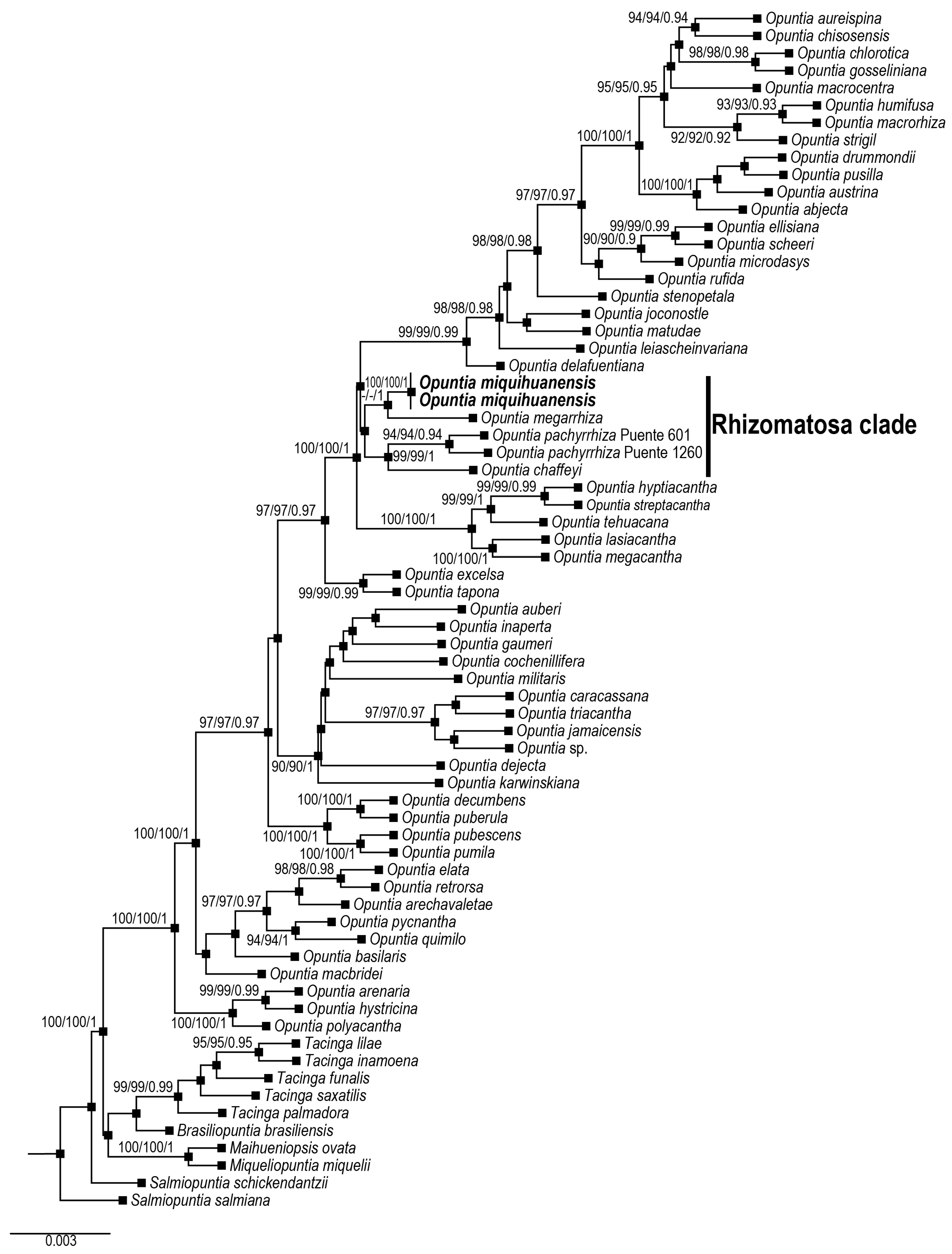
3.1. Phylogenetic Results
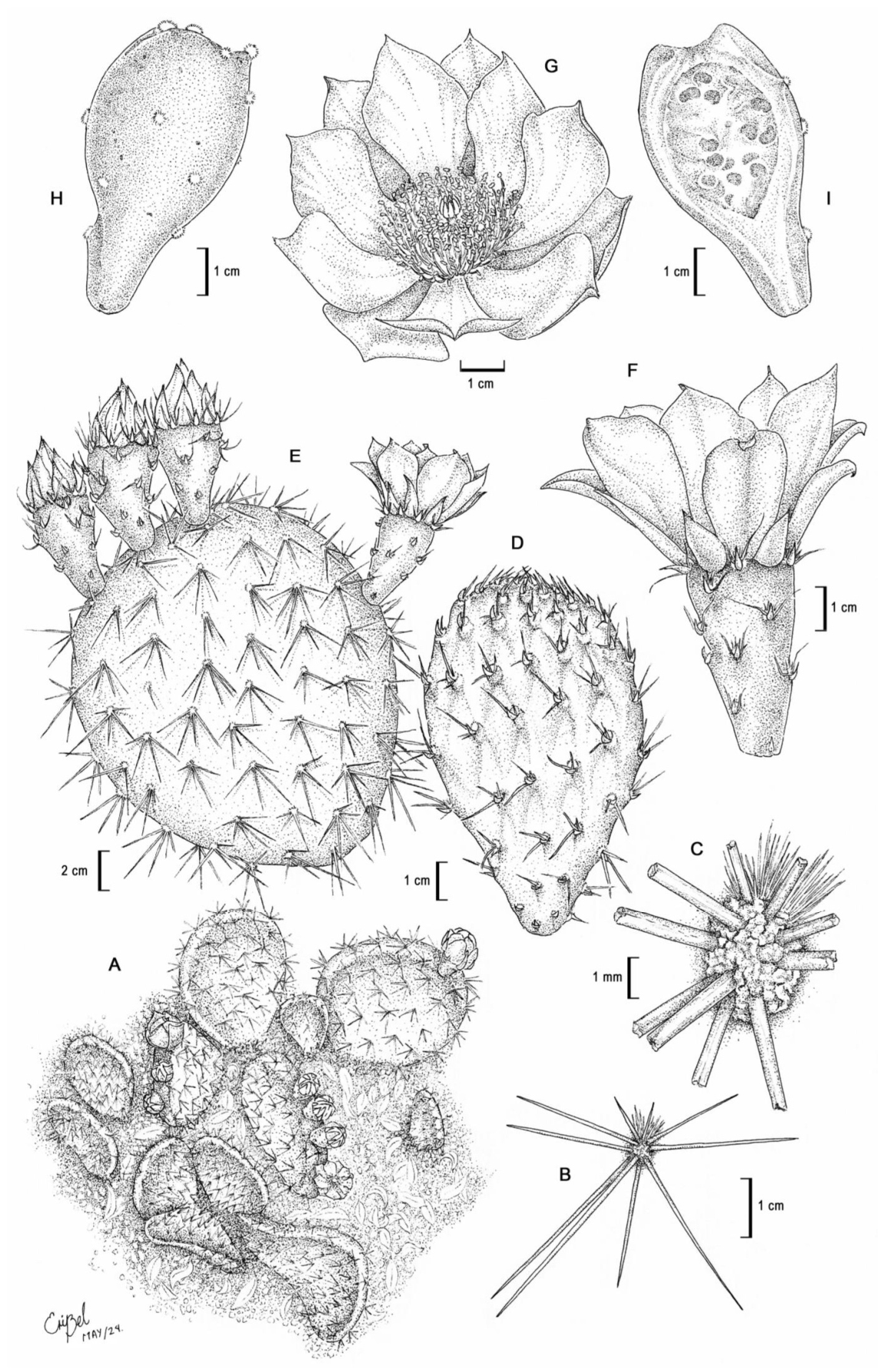
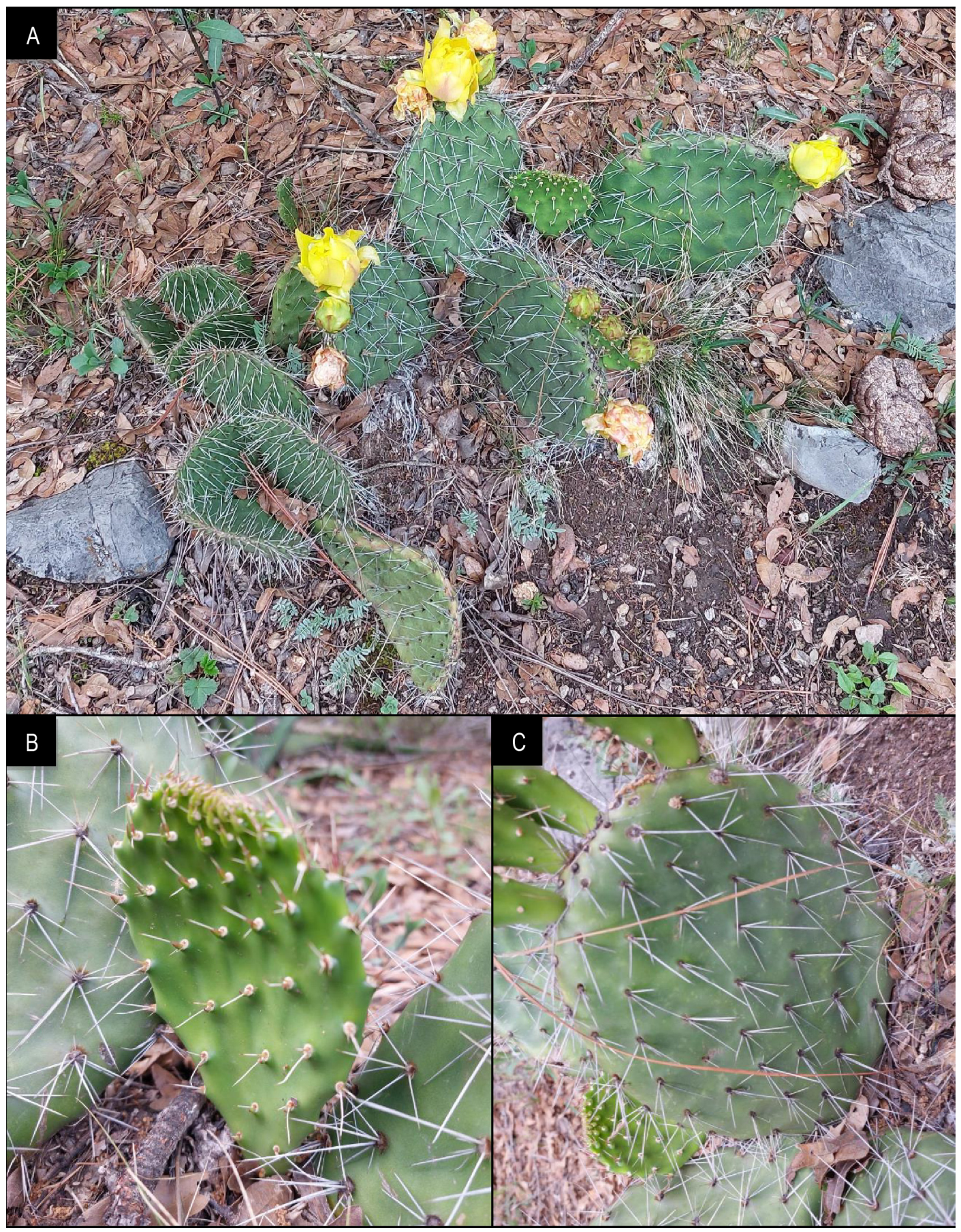
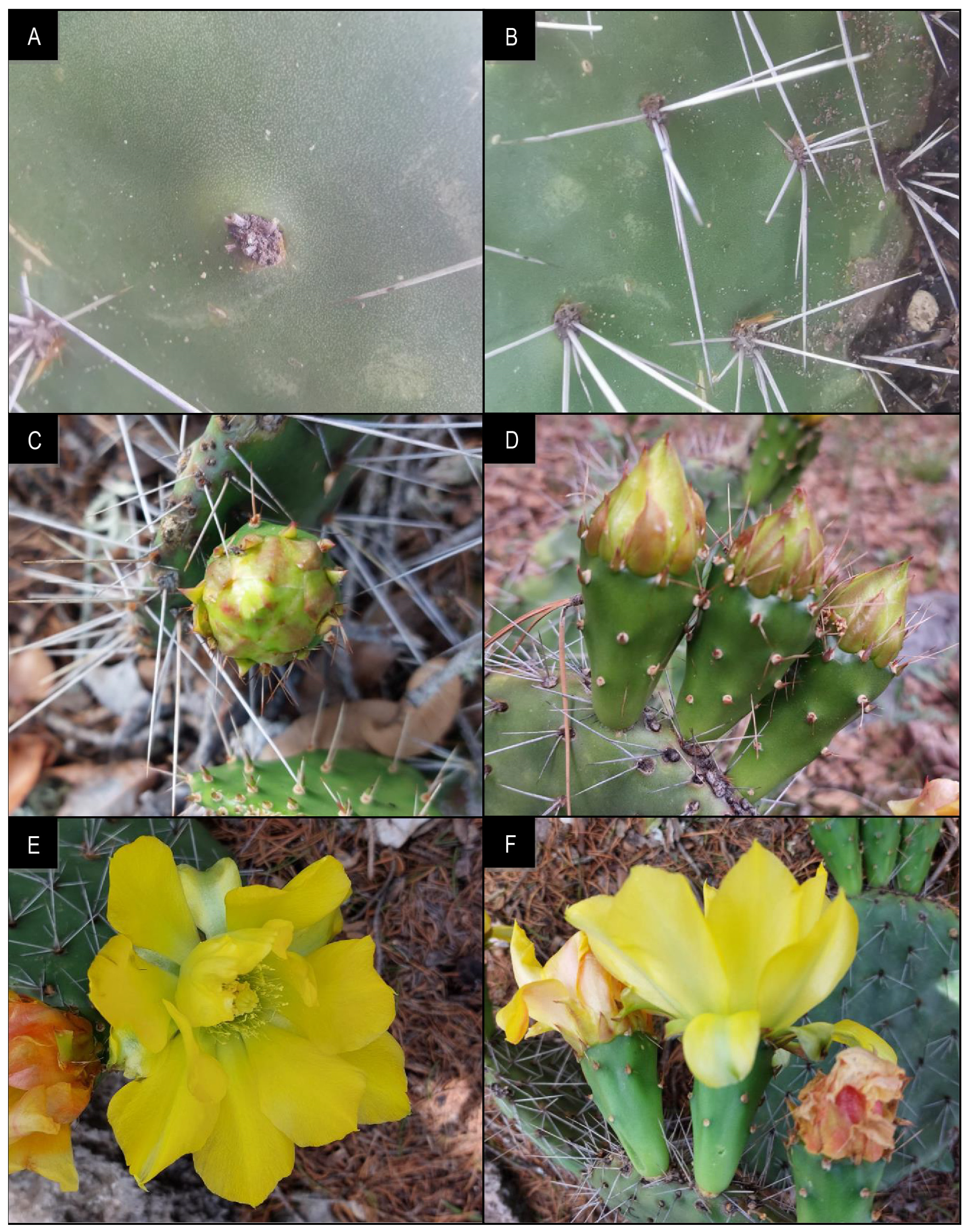
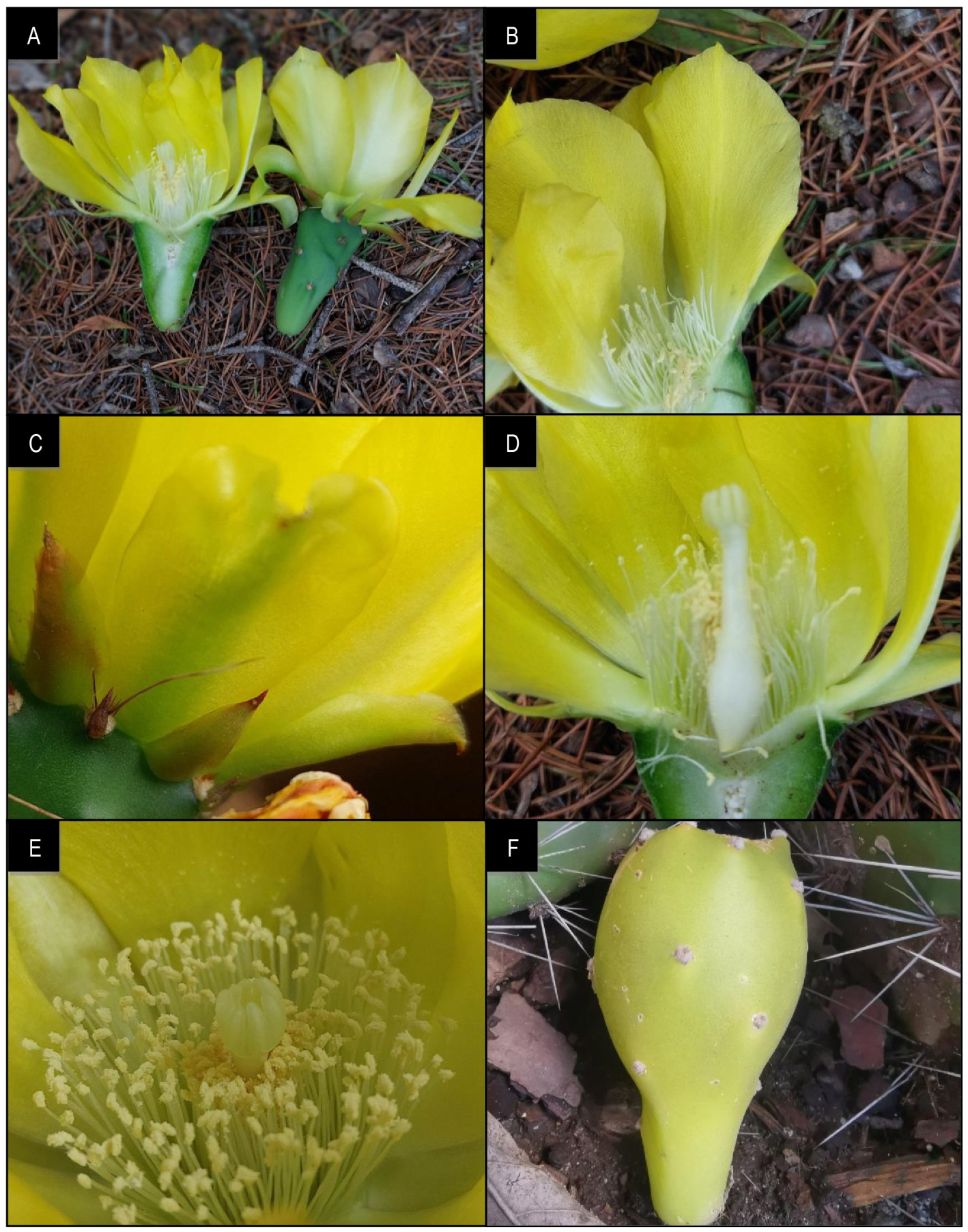
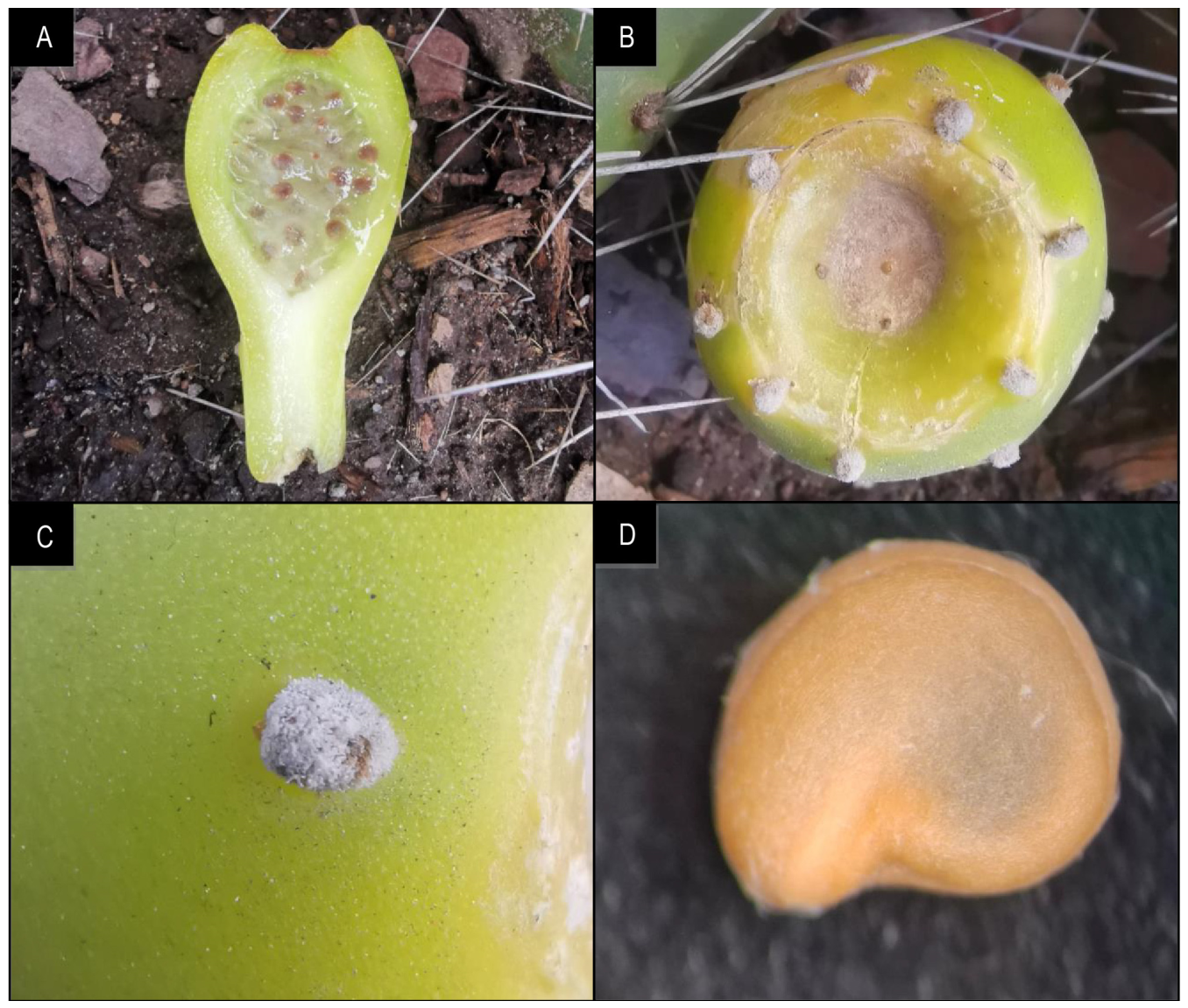
3.2. Taxonomic Treatment


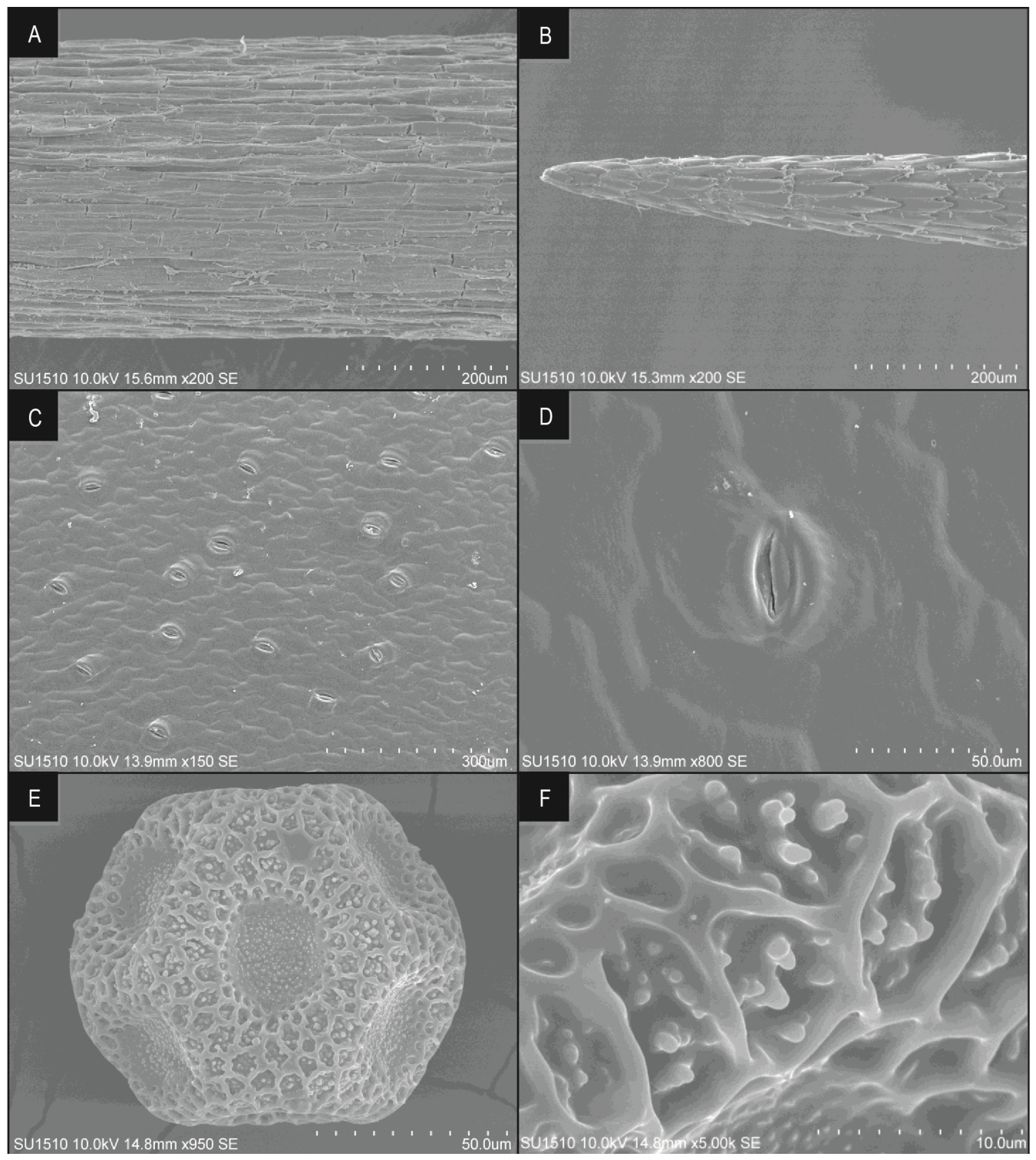
3.3. Micromorphology
3.4. Etymology
3.5. Phenology
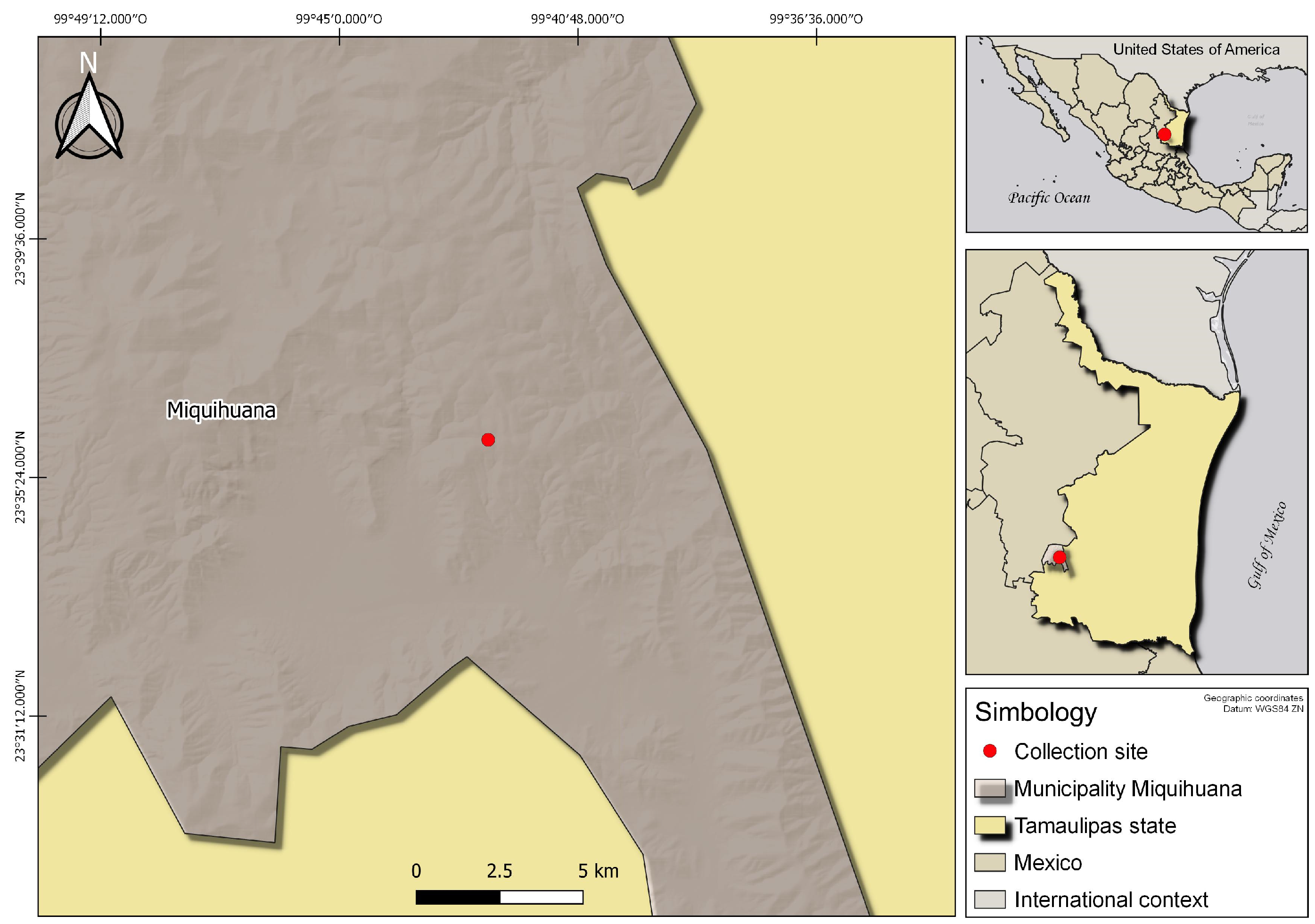
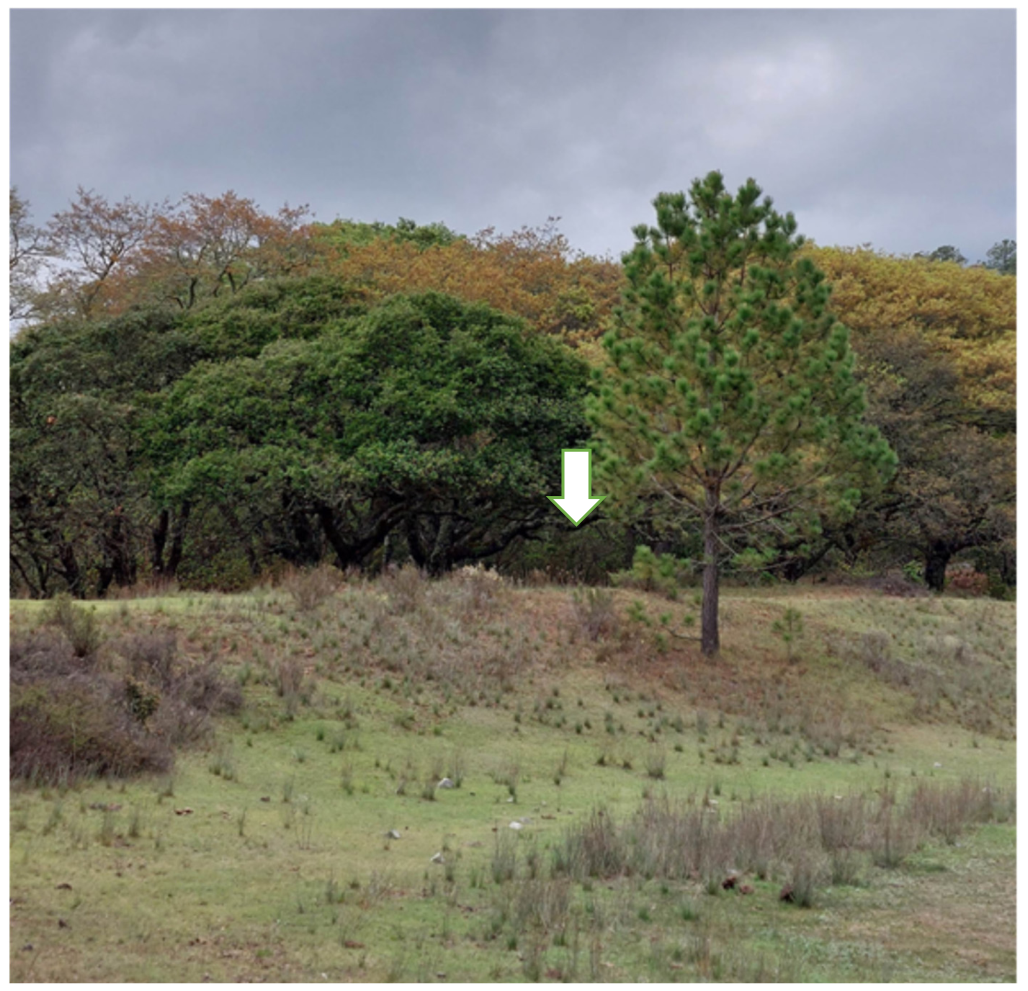
3.6. Distribution and Habitat
3.7. Conservation Status
4. Discussion
Author Contributions
Funding
Data Availability Statement
Acknowledgments
Conflicts of Interest
References
- Novoa, A.; Le Roux, J.J.; Robertson, M.P.; Wilson, J.R.; Richardson, D.M. Introduced and invasive cactus species: A global review. AoB PLANTS 2014, 7, plu078. [Google Scholar] [CrossRef]
- Abouseadaa, H.H.; Atia, M.A.M.; Younis, I.Y.; Issa, M.Y.; Ashour, H.A.; Saleh, I.; Osman, G.H.; Arif, I.A.; Mohsen, E. Gene-targeted molecular phylogeny, phytochemical profiling, and antioxidant activity of nine species belonging to family Cactaceae. Saudi J. Biol. Sci. 2020, 27, 1649–1658. [Google Scholar] [CrossRef] [PubMed]
- Korotkova, N.; Aquino, D.; Arias, S.; Eggli, U.; Franck, A.; Gómez-Hinostrosa, C.; Guerrero, P.C.; Hernández, H.M.; Kohlbecker, A.; Köhler, M.; et al. Cactaceae at Caryophyllales.org—A dynamic online species-level taxonomic backbone for the family. Willdenowia 2021, 51, 251−270. [Google Scholar] [CrossRef]
- Goettsch, B.; Hernández, H.M. Beta diversity and similarity among cactus assemblages in the Chihuahuan Desert. J. Arid. Environ. 2006, 65, 513–528. [Google Scholar] [CrossRef]
- Ritz, C.M.; Reiker, J.; Charles, G.; Hoxey, P.; Hunt, D.; Lowry, M.; Stuppy, W.; Taylor, N. Molecular phylogeny and character evolution in terete-stemmed Andean opuntias (Cactaceae-Opuntioideae). Mol. Phylogenet. Evol. 2012, 65, 668–681. [Google Scholar] [CrossRef] [PubMed]
- Hernández-Ledesma, P.; Berendsohn, W.G.; Borsch, T.; Mering, S.V.; Akhani, H.; Arias, S.; Castañeda-Noa, I.; Eggli, U.; Eriksson, R.; Flores-Olvera, H.; et al. A taxonomic backbone for the global synthesis of species diversity in the angiosperm order Caryophyllales. Willdenowia 2015, 45, 281–383. [Google Scholar] [CrossRef]
- Anderson, E.F. The Cactus Family; Timber Press: Portland, OR, USA, 2001. [Google Scholar]
- Vilà, M.; Burriel, J.A.; Pino, J.; Chamizo, J.; Llach, E.; Porterias, M.; Vives, M. Association between Opuntia species invasion and changes in land-cover in the Mediterranean region. Glob. Change Biol. 2003, 9, 1234–1239. [Google Scholar] [CrossRef]
- Martínez-Avalos, J.G.; Jurado, E. Geographic distribution and conservation of Cactaceae from Tamaulipas Mexico. Biodivers. Conserv. 2005, 14, 2483–2506. [Google Scholar] [CrossRef]
- García-Morales, L.J. Contribución al conocimiento de la diversidad taxonómica de las cactáceas (Caryophyllales, Cactaceae) en Tamaulipas, México. In La biodiversidad en Tamaulipas; Cruz Angón, A., López Higareda, D., Malgarejo, E.D., Rodríguez Ruiz, E.R., Eds.; Comisión Nacional para el Conocimiento y Uso de la Biodiversidad (CONABIO): Mexico City, Mexico, 2024; pp. 127–138. [Google Scholar]
- García-Morales, L.J. Estudio Sobre la Diversidad, Distribución y Algunos Aspectos Ecológicos de las Cactáceas (Caryophyllales: Cactaceae) de la Sierra Madre Oriental, Sierra de San Carlos y Zonas Adyacentes en el Estado de Tamaulipas, México. Bachelor’s Thesis, Instituto Tecnológico de Ciudad Victoria, Ciudad Victoria, Mexico, 2006. [Google Scholar]
- García-Morales, L.J.; García-Jiménez, J.; Contreras-Medina, R.; Alcántara-Ayala, O.; Luna-Vega, I. Diversity, distribution and conservation of the Cactaceae (Caryophyllales) from Tamaulipas Mexico. Plant Biosyst. 2022, 156, 1405–1421. [Google Scholar] [CrossRef]
- García-Morales, L.J.; Contreras-Medina, R.; Alcántara-Ayala, O.; Luna-Vega, I.; García-Jiménez, J. Biodiversidad Tamaulipeca Vol. I; Dirección General de Educación Superior Tecnológica (DGEST)—Instituto Tecnológico de Ciudad Victoria: Ciudad Victoria, Mexico, 2005. [Google Scholar]
- Bravo-Hollis, H. Las Cactáceas de México Vol. 1; Universidad Nacional Autónoma de México: Mexico City, Mexico, 1978; 351p. [Google Scholar]
- Britton, N.L.; Rose, J.N. The Cactaceae: Description and illustrations of Plants of the Cactus Family, Vol. 1; Carnegie Institution: Washington, DC, USA, 1919; 236p. [Google Scholar]
- Guzmán, U.L.; Arias, S.; Dávila, P. Catálogo de Cactáceas Mexicanas; Universidad Nacional Autónoma de México: Mexico City, Mexico, 2003; 315p. [Google Scholar]
- Hunt, D.; Taylor, N.; Charles, G. The New Cactus Lexicon; DH Books: Milborne Port, UK, 2006. [Google Scholar]
- Hunt, D. Further Studies in Opuntioideae (Cactaceae). Succ. Pl. Res. 2014, 8, 185−200. [Google Scholar]
- Hunt, D. CITES Cactaceae Checklist, 3rd ed.; DH Books: Milborne Port, UK, 2016. [Google Scholar]
- Hernández, H.M.; Gómez-Hinostrosa, C.; Bárcenas, R.T. Studies on Mexican Cactaceae. I. Opuntia pachyrrhiza, a new species from the Chihuahuan Desert, Mexico. Novon 2001, 11, 309–314. [Google Scholar] [CrossRef]
- Lodé, J. Taxonomy of the Cactaceae (Supplement); Alphabetical INDEX of Taxa in Current Usage and Their Synonyms; Cactus Adventures International: Barcelona, Spain, 2015; 46p. [Google Scholar]
- Martínez-González, C.R. Opuntia × soumaya (Cactaceae; Opuntioideae), a new hybrid from Mexico based on morphological, micromorphology and molecular evidence. Phytotaxa 2025, 717, 31–51. [Google Scholar] [CrossRef]
- Parfitt, B.D.; Pinkava, D.J. Nomenclatural systematic reassessment of Opuntia engelmanii and Opuntia lindheimeri (Cactaceae). Madroño 1988, 35, 342−349. [Google Scholar]
- Pinkava, D.J. Nomenclatural changes in Opuntia (Cactaceae). Haseltonia 1996, 4, 103−104. [Google Scholar]
- Pinkava, D.J. On the evolution of the continental North American Opuntioideae. Studies in the Opuntioideae (Cactaceae). Succ. Pl. Res. 2002, 6, 59–98. [Google Scholar]
- Scheinvar, L. Opuntia heliabravoana, Una Especie Nueva de Cactaceae; Anales del Instituto de Biología, Universidad Nacional Autónoma de México, Serie Botánica: Mexico City, Mexico, 1974; Volume 45, pp. 75–86. [Google Scholar]
- Scheinvar, L. Redescubrimiento de Opuntia oligacantha Forster en el Valle de México y en la Altiplanicie Mexicana; Anales del Instituto de Biología, Universidad Nacional Autónoma de México, Serie Botánica: Mexico City, Mexico, 1987; Volume 57, pp. 109–122. [Google Scholar]
- Scheinvar, L. Opuntia zamudioi, una nueva especie de Querétaro. Cactáceas Suculentas Mex. 1999, 44, 88−93. [Google Scholar]
- Scheinvar, L. Opuntia stricta (Haw.) Haw. subsp. esparzae, una nueva subespecie de las dunas del río Concá, Arroyo Seco, Querétaro, México. Cactáceas Suculentas Mex. 2002, 47, 94−102. [Google Scholar]
- Scheinvar, L.; Manzanero, G. Opuntia chiangiana, una nueva especie de Cactaceae de Oaxaca, México. Novon 2009, 19, 222−228. [Google Scholar] [CrossRef]
- Scheinvar, L.; Olalde, G.; Filardo, S.; Beckler, P. Diez Especies Mexicanas Productoras de Xoconostles: Opuntia spp. y Cylindropuntia imbricata (Cactaceae); Universidad Nacional Autónoma de México: Mexico City, Mexico; Universidad Autónoma del estado de Hidalgo: Mexico City, Mexico; Universidad Autónoma Metropolitana: Mexico City, Mexico, 2010; 177p. [Google Scholar]
- Scheinvar, L.; Gallegos-Vázquez, C.; Gámez-Tamariz, N.; Olalde-Parra, G. Atlas de los Nopales Silvestres Mexicanos; Universidad Nacional Autónoma de México: Mexico City, Mexico, 2020; 607p. [Google Scholar]
- Wilcox, C.D.; Dove, S.; McDavis, W.; Greer, D. Image Tool, version 3.0; University of Texas Health Center: San Antonio, TX, USA, 2002. [Google Scholar]
- Thiers, B. Index Herbariorum: A Global Directory of Public Herbaria and Associated Staff. New York Botanical Garden’s Virtual Herbarium. Available online: https://sweetgum.nybg.org/science/ih/ (accessed on 1 February 2025).
- Martínez-González, C.R.; Ramírez-Mendoza, R.; Jiménez-Ramírez, J.; Gallegos-Vázquez, C.; Luna-Vega, I. Improved method for genomic DNA extraction for Opuntia Mill. (Cactaceae). Plant Methods 2017, 13, 82. [Google Scholar] [CrossRef] [PubMed]
- Schmitz-Linneweber, C.; Maier, R.; Jean-Pierre, A.; Cottet, A.; Herrmann, R.; Mache, R. The plastid chromosome of spinach (Spinacia oleracea): Complete nucleotide sequence and gene organization. Plant Mol. Biol. 2001, 45, 307−315. [Google Scholar] [CrossRef] [PubMed]
- Dong, W.; Xu, C.; Li, C.; Sun, J.; Zuo, Y.; Shi, S.; Cheng, T.; Guo, J.; Zhou, S. ycf1, the most promising plastid DNA barcode of land plants. Sci. Rep. 2015, 5, 8348. [Google Scholar] [CrossRef]
- Taberlet, P.G.; Ludovic, P.; Guy, P.; Bouvet, J. Universal primers for amplification of three non-coding regions of chloroplast DNA. Plant Mol. Biol. 1991, 17, 1105−1109. [Google Scholar] [CrossRef]
- Shaw, J.; Lickey, E.B.; Schilling, E.E.; Small, R.L. Comparison of whole chloroplast genome sequences to choose noncoding regions for phylogenetic studies in angiosperms: The tortoise and the hare III. Am. J. Bot. 2007, 94, 275−288. [Google Scholar] [CrossRef]
- White, T.J.; Bruns, T.D.; Lee, S.B.; Taylor, J.W. Amplification and direct sequencing of fungal ribosomal RNA genes for phylogenetics. In PCR Protocols: A Guide to Methods and Applications; Innis, M.A., Gelfand, D.H., Sninsky, J.J., White, T.J., Eds.; Academic Press: New York, NY, USA, 1990; pp. 135–322. [Google Scholar]
- Majure, L.; Puente, R.; Griffith, M.P.; Judd, W.S.; Soltis, P.S.; Soltis, D.E. Phylogeny of Opuntia s.s. (Cactaceae): Clade delineation, geographic origins, and reticulate evolution. Am. J. Bot. 2012, 99, 847−864. [Google Scholar] [CrossRef]
- Hall, T.A. BioEdit: A user-friendly biological sequence alignment editor and analysis program for Windows 95/98/NT. Nucleic Acids Symp. Ser. 1999, 41, 95−98. [Google Scholar]
- Zhang, Z.; Schwartz, S.; Wagner, L.; Miller, W. A greedy algorithm for aligning DNA sequences. J. Comput. Biol. 2000, 7, 203−214. [Google Scholar] [CrossRef] [PubMed]
- Martínez-González, C.R.; Gallegos-Vázquez, C.; Scheinvar, L.; Muñiz-Díaz de León, M.E.; Jiménez-Ramírez, J. Re-evaluation of Opuntia matudae (Cactaceae). Phytotaxa 2019, 423, 158−170. [Google Scholar] [CrossRef]
- Martínez-González, C.R.; Muñiz-Díaz de León, M.E.; González-Martínez, C.A.; Jiménez-Ramírez, J.; Morales-Sandoval, J.; Gallegos-Vázquez, C. Phylogenetic placement and new data on macro- and micromorphology of Opuntia joconostle (Cactaceae). Bradleya 2020, 38, 158−169. [Google Scholar] [CrossRef]
- Katoh, K.; Misawa, K.; Kuma, K.; Miyata, T. MAFFT: A novel method for rapid multiple sequence alignment based on fast Fourier transform. Nucleic Acids Res. 2002, 30, 3059–3066. [Google Scholar] [CrossRef]
- Katoh, K.; Rozewicki, J.; Yamada, K.D. MAFFT online service: Multiple sequence alignment, interactive sequence choice and visualization. Brief. Bioinform. 2017, 20, 1160–1166. [Google Scholar] [CrossRef] [PubMed]
- Katoh, K.; Standley, D.M. MAFFT multiple sequence alignment software version 7: Improvements in performance and usability. Mol. Biol. Evol. 2013, 30, 772−780. [Google Scholar] [CrossRef]
- Müller, K.; Quandt, D.; Müller, J.; Neinhuis, C. PhyDE®-Phylogenetic Data Editor. Program Distributed by the Authors, Versión 10.0. Available online: http://www.phyde.de/ (accessed on 16 April 2025).
- Wiens, J.J. Missing data and the design of phylogenetic analyses. J. Biomed. Inform. 2006, 39, 34−42. [Google Scholar] [CrossRef]
- Swofford, D.L. PAUP*, Phylogenetic Analysis Using Parsimony (* and Other Methods); Version 4.10; Sinauer Associates: Sunderland, MA, USA, 2002. [Google Scholar]
- Huelsenbeck, J.P.; Ronquist, F. MrBayes: Bayesian inference of phylogeny. Bioinformatics 2001, 17, 754−755. [Google Scholar] [CrossRef]
- Huelsenbeck, J.P.; Larget, B.; Alfaro, M.E. Bayesian phylogenetic model selection using reversible jump Markov Chain Montecarlo. Mol. Biol. Evol. 2004, 21, 1123−1133. [Google Scholar] [CrossRef] [PubMed]
- Frandsen, P.B.; Calcott, B.; Mayer, C.; Lanfear, R. Automatic selection of partitioning schemes for phylogenetic analyses using iterative k-means clustering of site rates. BMC Evol. Biol. 2015, 15, 13. [Google Scholar] [CrossRef]
- Stamatakis, A. RAxML version 8: A tool for phylogenetic analysis and post-analysis of large phylogenies. Bioinformatics 2014, 30, 1312–1313. [Google Scholar] [CrossRef] [PubMed]
- Lanfear, R.; Frandsen, P.B.; Wright, A.M.; Senfeld, T.; Calcott, B. PartitionFinder 2: New methods for selecting partitioned models of evolution for molecular and morphological phylogenetic analyses. Mol. Biol. Evol. 2016, 34, 772−773. [Google Scholar] [CrossRef] [PubMed]
- Rambaut, A.; Drummond, A.J.; Xie, D.; Baele, G.; Suchard, M.A. Posterior Summarization in Bayesian Phylogenetics Using Tracer 1.7. Syst. Biol. 2018, 67, 901–904. [Google Scholar] [CrossRef]
- Bouckaert, R.; Heled, J.; Kühnert, D.; Vaughan, T.; Wu, C.-H.; Xie, D.; Suchard, M.A.; Rambaut, A.; Drummond, A.J. BEAST 2: A software platform for Bayesian Evolutionary analysis. PLoS Comput. Biol. 2014, 10, E1003537. [Google Scholar] [CrossRef]
- SEMARNAT. Secretaría de Medio Ambiente y Recursos Naturales (2010) Norma Oficial Mexicana NOM-059-SEMARNAT; Diario Oficial de la Federación (DOF): Mexico City, Mexico, 2010.
- Estrada, A.E.; Arévalo, J.R.; Villarreal, J.A.; Salinas, M.M.; Encina-Domínguez, J.A.; González, H.; Cantú, C.M. Classification and ordination of main plant communities along an altitudinal gradient in the arid and temperate climates of northeastern Mexico. Sci. Nat. 2015, 102, 59. [Google Scholar] [CrossRef]
- Salinas-Rodríguez, M.M.; Hernández-Sandoval, L.; Carrillo-Reyes, P.; Castillo-Gómez, H.A.; Castro-Castro, A.; Estrada-Castillón, E.; Figueroa-Martínez, D.S.; Gómez-Escamilla, I.N.; González-Elizondo, M.; Gutiérrez-Ortega, J.S.; et al. Diversidad de plantas vasculares de la Provincia Fisiográfica de la Sierra Madre Oriental, México. Bot. Sci. 2022, 100, 469–492. [Google Scholar] [CrossRef]
- Halftter, G.; Morrone, J.J. An analytical review of Halffter’s Mexican transition zone, and its relevance for evolutionary biogeography, ecology and biogeographical regionalization. Zootaxa 2017, 4226, 1–46. [Google Scholar] [CrossRef] [PubMed]
- Villaseñor, J. Checklist of the native vascular plants of Mexico. Rev. Mex. Biodiv. 2016, 87, 559–902. [Google Scholar] [CrossRef]
- Vázquez-Sánchez, M.; Terrazas, T.; Arias, S.; Ochoterena, H. Molecular phylogeny, origin and taxonomic implications of the tribe Cacteae (Cactaceae). Syst. Biodivers. 2013, 11, 103–116. [Google Scholar] [CrossRef]
- Majure, L.C.; Achá, S.; Baker, M.A.; Puente-Martínez, R.; Köhler, M.; Fehlberg, S. Phylogenomics of One of the World’s Most Intriguing Groups of CAM Plants, the Opuntioids (Opuntioideae: Cactaceae): Adaptation to Tropical Dry Forests Helped Drive Prominent Morphological Features in the Clade. Diversity 2023, 15, 570. [Google Scholar] [CrossRef]



| Loci/Segment | Name | Sequence 5′-3′ | Tm (°C) | Reference |
|---|---|---|---|---|
| matk | 1326R | TCTAGCACACGAAAGTCGAAGT | 48 | [36] |
| 390F | CGATCTATTCATTCAATATTTC | 48 | [36] | |
| ycf1 | 118 F | CTTATCTCTTACTTCTCCAAGCTC | 52 | [37] |
| 1330R | GCGGCTAAACTAGGTGGATGTG | 52 | [37] | |
| trnL-trnF | C | CGAAATCGGTAGACGCTACG | 50 | [38] |
| D | GGGGATAGAGGGACTTGAAC | 50 | [38] | |
| E | GGTTCAAGTCCCTCTATCCC | 50 | [38] | |
| F | ATTTGAACTGGTGACACGAG | 50 | [38] | |
| psbJ-petA | psbJ | ATAGGTACTGTARCYGGTATT | 50 | [39] |
| petA | AACARTTYGARAAGGTTCAATT | 50 | [39] | |
| ITS | ITS5 | GGAAGTAAAAGTCGTAACAAGG | 57 | [40] |
| ITS4 | TCCTCCGCTTATTGATATGC | 57 | [40] | |
| ppc | Op 19F | GAGATGAGGGCAGGGATGAGTTACTTCC | 55 | [41] |
| Op 569R | CTAGCCAACAAGCAAACATC | 55 | [41] |
| Species Name | GenBank Accessions | |||||
|---|---|---|---|---|---|---|
| trnL-trnF | matK | ITS | psbJ-petA | ycf1 | ppc | |
| Brasiliopuntia brasiliensis | JF712685 | JF786712 | JF786876 | JF787469 | JN387143 | JN387207 |
| Maihueniopsis ovata | JF712696 | JF786723 | JF786887 | JF787479 | JN387144 | JN387208 |
| Miqueliopuntia miquelii | JF712698 | JF786725 | JF786889 | JF787480 | JN387145 | JN387210 |
| Opuntia auberi | JF712699 | JF786726 | JF786890 | JF787481 | JN387146 | JN387211 |
| Opuntia chaffeyi | JF712733 | JF786761 | JF786922 | JF787513 | – | – |
| Opuntia cochenillifera | JF712700 | JF786727 | JF786891 | JF787482 | JN387147 | JN387212 |
| Opuntia dejecta | – | JF786729 | JF786893 | – | JN387148 | JN387213 |
| Opuntia gaumeri | JF712702 | JF786730 | JF786894 | JF787484 | JN387149 | JN387214 |
| Opuntia inaperta | JF712706 | JF786734 | JF786898 | JF787488 | JN387151 | JN387216 |
| Opuntia karwinskiana | JF712707 | JF786735 | JF786899 | JF787489 | JN387152 | JN387217 |
| Opuntia abjecta | JF712838 | JF786865 | JF787021 | JF787598 | JN387199 | JN387264 |
| Opuntia arechavalatae | JF712714 | JF786742 | JF786906 | JF787496 | JN387155 | JN387220 |
| Opuntia arenaria | JF712715 | JF786743 | JF786907 | – | JN387155 | JN387220 |
| Opuntia aureispina | JF712718 | JF786746 | JF786910 | JF787607 | JN387158 | JN387223 |
| Opuntia austrina | JF712719 | JF786747 | JF786911 | JF787499 | JQ676985 | JN387224 |
| Opuntia basilaris | JF712722 | JF786750 | JF786913 | JF787502 | JN387159 | JN387225 |
| Opuntia caracassana | JF712729 | JF786757 | JF786918 | JF787509 | JN387159 | JN387225, |
| Opuntia chisosensis | JF712734 | JF786762 | JF786923 | JF787514 | JN387159 | JN387225 |
| Opuntia chlorotica | JF712735 | JF786763 | JF786924 | JF787608 | JN387162 | JN387228 |
| Opuntia delafuentiana | KM678218 | KM678215 | KM678221 | – | – | – |
| Opuntia drummondii | JF712742 | JF786770 | JF786930 | JF787520 | JN387163 | JN387229 |
| Opuntia elata | JF712746 | JF786774 | JF786934 | – | JN387164 | JN387230 |
| Opuntia ellisiana | JF712747 | JF786775 | JF786935 | JF787523 | JN387166 | JN387232 |
| Opuntia excelsa | JF712755 | JF786783 | JF786942 | JF787530 | JN387167 | JN387233 |
| Opuntia gosseliniana | JF712761 | JF786789 | JF786948 | JF787611 | JN387169 | JN387234 |
| Opuntia humifusa | JF712762 | JF786790 | JF786949 | JF787536 | JN387169 | JN387234 |
| Opuntia hyptiacantha | MW504058 | MW553200 | MW475081 | ON254911 | – | – |
| Opuntia hystricina | JF712764 | JF786792 | JF786951 | JF787538 | – | – |
| Opuntia jamaicensis | JF712765 | JF786793 | JF786952 | – | JN387169 | JN387234 |
| Opuntia lasiacantha | MW504050 | MW545824 | KM507353 | – | – | – |
| Opuntia leiascheinvariana | KM507356 | KM507350 | KM507353 | – | – | – |
| Opuntia macbridei | JF712771 | JF786799 | JF786957 | JF787542 | JN387172 | JN387238 |
| Opuntia macrocentra | JF712773 | JF786801 | JF786959 | JF787544 | JN387174 | JN387240 |
| Opuntia macrorhiza | JF712774 | JF786802 | JF786960 | JF787545 | JQ676983 | JN387241 |
| Opuntia megacantha | MW504046 | MW520856 | MW475069 | ON254903 | – | – |
| Opuntia megarhyza | JF712779 | JF786807 | JF786964 | JF787549 | JN387175 | – |
| Opuntia microdasys | JF712781 | JF786809 | JF786966 | JF787551 | JN387175 | JN387242 |
| Opuntia miquihuanensis | PX965785 | PX962276 | PX945583 | – | – | |
| Opuntia miquihuanensis | PX965786 | PX962277 | PX945584 | – | – | |
| Opuntia pachyrrhyza | JF712785 | JF786813 | JF786970 | JF787554 | JN387178 | JN387178 |
| Opuntia polyacantha | JF712794 | JF786822 | JF786979 | JF787562 | JN387180 | JN387245 |
| Opuntia pusilla | JF712800 | JF786827 | JF786984 | JF787566 | JN387181 | JN387246 |
| Opuntia pycnantha | JF712803 | JF786830 | JF786987 | JF787565 | JN387182 | JN387247 |
| Opuntia quimilo | JF712804 | JF786831 | JF786988 | JF787569 | JN387183 | JN387248 |
| Opuntia retrorsa | JF712814 | JF786839 | JF786995 | JF787575 | JN387185 | JN387250 |
| Opuntia rufida | JF712812 | JF786840 | JF786997 | JF787577 | JN387251 | JF786840 |
| Opuntia sanguinea | JF712817 | – | JF787000 | JF787580 | JN387190 | JN387255 |
| Opuntia scheeri | JF712819 | JF786847 | JF787002 | JF787581 | JN387192 | JN387257 |
| Opuntia schickendantzii | JF712820 | JF786848 | JF787003 | JF787582 | JN387192 | JN387257 |
| Opuntia stenopetala | JF712825 | JF786852 | JF787008 | JF787618 | JN387192 | JN387257 |
| Opuntia streptacantha | MW504054 | MW546909 | MW745077 | ON254899 | – | – |
| Opuntia strigil | JF712829 | JF786856 | JF787012 | JF787590 | JN387195 | JN387260 |
| Opuntia tapona | JF712833 | JF786860 | JF787016 | JF787593 | JN387198 | JN387263 |
| Opuntia tehuacana | MT887611 | – | MT856449 | – | – | – |
| Opuntia triacantha | – | JN676103 | JN676102 | JN676105 | JN387200 | JN387265 |
| Salmiopuntia salmiana | JF712815 | JF786842 | JF786998 | JF787578 | JN387188 | JN387253 |
| Tacinga funalis | – | AY042660 | – | – | – | – |
| Tacinga inamoena | JF786870 | JF786870 | JF787026 | JF787619 | JN387201 | JF787026 |
| Tacinga lilae | JF712769 | JF786797 | JF786955 | JF787612 | JN387171 | JN387237 |
| Tacinga palmadora | JF712845 | JF786872 | JF787028 | JF787603 | JN387203 | JN387267 |
| Tacinga saxatilis | JF712846 | JF786873 | JF787029 | JF787620 | JN387204 | JN387268 |
| Habit | Opuntia miquihuanensis | Opuntia pachyrrhiza |
|---|---|---|
| Erect to Prostrate | Erect to Prostrate | |
| Shape of cladodes | Elliptic | Elliptic |
| Long of cladodes | 18–21 cm | 40 cm |
| Diameter of cladodes | 12–17 cm | 12 cm |
| Epidermis | Glabrous | Glabrous |
| Number of areola series in the cladodes | 6–7 | 8–9 |
| Direction of the spines | Straight (75–100°) and diffuse (21–74°) | Straight (75–100°), diffuse (21–74°) and radial or adpressed (0–20°) |
| Flower color | Yellow | Yellow |
| Number of stigma lobes | 8 | 6–10 |
| Shape of the style | Cuneate | Subconical |
| Fruit shape | Pedunculate | Obovoid |
| Fruit length | 6.1–6.5 cm long | 2.7 cm long |
| Pedunculated fruit | Yes | ----- |
| External color of fruits | Yellowish green | Yellow |
| Trichomes on the areolas | Long gray trichomes | Long yellow trichomes |
| Internal color of fruits | Greenish-white | ----- |
| Color of the funiculars | White | ----- |
| Funiculars | Tasteless | ----- |
| Seed shape | Discoid | Discoid |
Disclaimer/Publisher’s Note: The statements, opinions and data contained in all publications are solely those of the individual author(s) and contributor(s) and not of MDPI and/or the editor(s). MDPI and/or the editor(s) disclaim responsibility for any injury to people or property resulting from any ideas, methods, instructions or products referred to in the content. |
© 2026 by the authors. Licensee MDPI, Basel, Switzerland. This article is an open access article distributed under the terms and conditions of the Creative Commons Attribution (CC BY) license.
Share and Cite
Martínez-González, C.R.; Raymundo, T.; Garza-Ocañas, F.; García-Morales, L.J.; Jiménez-Ramírez, J.; García Jimenéz, J. Taxonomy and Phylogeny Reveal a Cryptic New Species of Opuntia (Cactaceae) from Tamaulipas, Mexico. Taxonomy 2026, 6, 33. https://doi.org/10.3390/taxonomy6020033
Martínez-González CR, Raymundo T, Garza-Ocañas F, García-Morales LJ, Jiménez-Ramírez J, García Jimenéz J. Taxonomy and Phylogeny Reveal a Cryptic New Species of Opuntia (Cactaceae) from Tamaulipas, Mexico. Taxonomy. 2026; 6(2):33. https://doi.org/10.3390/taxonomy6020033
Chicago/Turabian StyleMartínez-González, César Ramiro, Tania Raymundo, Fortunato Garza-Ocañas, Leccinum J. García-Morales, Jaime Jiménez-Ramírez, and Jesús García Jimenéz. 2026. "Taxonomy and Phylogeny Reveal a Cryptic New Species of Opuntia (Cactaceae) from Tamaulipas, Mexico" Taxonomy 6, no. 2: 33. https://doi.org/10.3390/taxonomy6020033
APA StyleMartínez-González, C. R., Raymundo, T., Garza-Ocañas, F., García-Morales, L. J., Jiménez-Ramírez, J., & García Jimenéz, J. (2026). Taxonomy and Phylogeny Reveal a Cryptic New Species of Opuntia (Cactaceae) from Tamaulipas, Mexico. Taxonomy, 6(2), 33. https://doi.org/10.3390/taxonomy6020033