Article

Conventional Versus 3D-Printed Temporary Dental Crowns: A Micro-CT Analysis of Porosity and Fracture Resistance


1
Institute of Stomatology, Riga Stradins University, LV-1007 Riga, Latvia
2
Department of General Dentistry, Riga Stradins University, LV-1007 Riga, Latvia
3
Baltic Biomaterials Centre of Excellence, Headquarters at Riga Technical University, LV-1658 Riga, Latvia
*
Author to whom correspondence should be addressed.
Submission received: 4 March 2026 / Revised: 13 April 2026 / Accepted: 8 May 2026 / Published: 12 May 2026

Highlights

What are the main findings?
  • Micro-CT showed markedly lower porosity in 3D-printed provisional crowns (V-Print c&b temp) compared with conventionally fabricated crowns (ProtempTM 4, Success CD).
  • ProtempTM 4 exhibited the highest fracture resistance, while Success CD showed the lowest failure loads; the 3D-printed material demonstrated intermediate mechanical performance under monotonic compression.
What are the implications of the main findings?
  • Low porosity in 3D-printed provisionals indicates improved structural homogeneity but does not necessarily translate to an increase in maximum fracture resistance.
  • Material selection for temporization should be case-dependent: 3D printing favors uniformity and reproducibility, whereas bis-acrylic materials may provide a larger safety margin in high-load situations.

Abstract

Background: Temporary dental crowns are an essential component of fixed prosthodontic treatment, protecting prepared teeth and maintaining occlusal function and aesthetics until delivery of the definitive restoration. Their clinical performance is strongly influenced by their internal microstructure, which directly affects mechanical behavior. Therefore, the aim of this study was to compare the internal porosity and fracture resistance of temporary dental crowns fabricated using conventional and 3D-printing techniques. Materials and Methods: This in vitro study compared the porosity and fracture resistance of three materials for provisional restorations: a bis-acrylic resin (ProtempTM 4), an autopolymerizing resin (Success CD), and a 3D-printed light-curing resin (V-Print c&b temp). Thirty-six standardized single-unit crowns (n = 12 per group) were fabricated. All specimens were analyzed using high-resolution micro-computed tomography to determine total crown volume, pore volume, and relative porosity. Fracture resistance was evaluated under monotonic compressive loading in a universal testing machine. Data were analyzed using appropriate parametric or non-parametric statistical tests (α = 0.05). Results: The 3D-printed material exhibited the lowest mean porosity (0.0029%), whereas ProtempTM 4 and Success CD showed substantially higher porosity values. However, ProtempTM 4 demonstrated the highest mean fracture resistance, followed by the 3D-printed resin and Success CD. No direct correlation between porosity and fracture resistance was observed, indicating that material chemistry and internal bonding play a more decisive role than void content alone. Conclusions: These findings suggest that 3D printing improves structural homogeneity, while bis-acrylic materials provide superior load-bearing capacity, and that each fabrication method offers distinct advantages depending on clinical requirements.

1. Introduction

Temporary dental crowns are an integral component of fixed prosthodontic treatment, serving to protect prepared teeth, maintain occlusal stability, preserve periodontal health, and support aesthetics until delivery of the definitive restoration. Although intended for interim use, provisional crowns are routinely exposed to masticatory forces, thermal fluctuations, and the oral environment, making their mechanical reliability and structural integrity clinically relevant [1,2,3,4]. Inadequate temporary restorations may lead to fracture, loss of retention, marginal discrepancies, bacterial infiltration, and compromised treatment outcomes [2,5,6].
The clinical performance of temporary crowns is influenced not only by their external geometry but also by their internal microstructure. Internal porosity, resulting from air entrapment or incomplete polymerization, has been associated with reduced mechanical strength, increased crack initiation, and enhanced biofilm accumulation [7,8,9,10]. These effects may compromise both the durability and biological behavior of provisional restorations. Consequently, minimizing porosity while maintaining adequate fracture resistance remains a key objective in the selection and fabrication of temporary crown materials [7,10,11].
Conventional temporary crowns are commonly fabricated using polymer-based materials such as polymethyl methacrylate (PMMA), bis-acrylic resins, and autopolymerizing resin [2,3,11]. Bis-acrylic materials, exemplified by ProtempTM 4, offer improved handling characteristics, reduced exothermic reaction, and enhanced esthetics compared with traditional PMMA, but may exhibit brittle behavior under high occlusal loads [2,3]. Autopolymerizing resins, such as Success CD, rely on manual mixing, which increases the risk of air entrapment and heterogeneous polymerization, potentially leading to higher internal porosity and reduced mechanical uniformity [4,12].
Advances in digital dentistry have introduced computer-aided design and computer-aided manufacturing (CAD/CAM) workflows for provisional restorations, including both subtractive milling and additive manufacturing [7,11,12]. Three-dimensional (3D) printing has gained increasing attention as a fabrication method for temporary crowns due to its high reproducibility and controlled polymerization. Light-curing resins designed for additive manufacturing, such as V-Print c&b temp, are polymerized layer by layer under controlled conditions, which may reduce internal void formation and improve structural homogeneity. Several studies have reported favorable mechanical and surface properties of 3D-printed materials for provisional restorations compared with conventionally fabricated counterparts; however, their fracture resistance remains variable and highly dependent on material composition and processing parameters [13,14,15,16,17].
Porosity is a critical yet underexplored factor linking fabrication technique to mechanical performance. While fracture resistance, marginal adaptation, and surface roughness of materials for provisional restorations have been widely investigated, quantitative three-dimensional assessment of internal porosity and its relationship with fracture behavior is limited [7,10,11]. Traditional evaluation methods, such as microscopy or surface analysis, provide only qualitative or two-dimensional information and often require destructive specimen preparation. In contrast, micro-computed tomography (micro-CT) enables non-destructive, high-resolution three-dimensional visualization and quantification of internal voids, allowing precise measurement of pore volume, distribution, and relative porosity [10,12].
Only a limited number of studies have simultaneously evaluated porosity and fracture resistance of temporary crowns fabricated using different manufacturing techniques under standardized conditions [7,11,12,18,19]. Direct comparisons between conventional hand-mixed materials and modern 3D-printed resins using identical crown geometry and controlled testing protocols remain scarce. This represents a relevant research gap, as internal microstructure may significantly influence mechanical reliability and clinical longevity.
Therefore, the aim of this in vitro study was to compare the internal porosity and fracture resistance of temporary dental crowns fabricated using two conventional methods—a bis-acrylic resin (ProtempTM 4) and an autopolymerizing resin (Success CD)—and one additive manufacturing method using a 3D-printed light-curing resin (V-Print c&b temp). High-resolution micro-CT was employed to quantify porosity, and standardized compressive testing was used to assess fracture resistance. The null hypothesis was that there would be no statistically significant differences in porosity or fracture resistance among the tested materials.

2. Materials and Methods

This in vitro study evaluated the porosity and fracture resistance of temporary single-unit crowns fabricated from three materials for provisional restorations (n = 12 per group; N = 36): Success CD (autopolymerizing resin; Promedica, Germany), ProtempTM 4 (bis-acrylic resin; 3M ESPE, Germany), and V-Print c&b temp (light-curing resin for additive manufacturing; VOCO, Germany). All materials were processed according to the manufacturers’ instructions under standardized laboratory conditions.
A Frasaco plastic typodont jaw containing the maxillary right first molar (#16) was used as the master model (Figure 1). The master tooth was prepared for a full-coverage crown using a precision milling device (AF 350; Amann Girrbach, Germany) following standard biomechanical preparation principles, including approximately 6° total occlusal convergence, uniform axial reduction of ~1.0–1.5 mm, occlusal reduction of ~1.5–2.0 mm, rounded internal line angles, and a continuous chamfer finish line [20]. A negative mold was then produced using a putty-type vinyl polysiloxane (VPS) impression material (Elite HD+ Putty Soft; Zhermack, Italy).

2.1. Conventional Crown Fabrication (Success CD and ProtempTM 4)

Using the VPS mold of the prepared tooth, each material (Success CD and ProtempTM 4) was mixed and applied separately according to the respective manufacturer’s instructions. The mold was filled and seated over the prepared master to form the crown shell using consistent manual finger pressure to ensure complete adaptation.
After polymerization, crowns were removed, finished, and visually inspected to confirm marginal integrity and the absence of gross defects. A total of 24 crowns were fabricated using this method (12 per material). The use of a single VPS mold derived from the same prepared master tooth ensured a high level of geometric consistency and minimized operator-dependent variability in crown morphology across specimens.
No separating medium was applied, as the typodont material allowed for easy removal of the restorations after polymerization. Following fabrication and finishing, all crowns were stored in a dry environment at room temperature prior to further processing and testing.

2.2. Digital Acquisition and 3D Printing (V-Print c&b Temp)

The Frasaco typodont jaw was scanned before and after tooth preparation using a laboratory scanner (Medit T-Series T710; Medit Co., Republic of Korea). The pre- and post-preparation datasets were digitally superimposed using best-fit alignment based on unchanged adjacent tooth structures to ensure spatial consistency of the prepared maxillary right first molar (#16) within the dental arch.
The original unprepared crown morphology of tooth #16 (D16) was segmented from the pre-preparation scan and exported as an STL file to serve as the master crown geometry. Care was taken to preserve the original geometric parameters during segmentation and export. Because all printed crowns were derived from the same digital master file, geometric variability between specimens was minimized.
Crowns were fabricated using a 3D printer (Formlabs Form 4BL; Formlabs, USA) and the V-Print c&b temp resin following the manufacturer’s recommended print parameters, build orientation, support strategy, post-print cleaning, and post-curing procedures. All crowns were printed using a standardized build orientation. The orientation was selected such that the layer interfaces were positioned perpendicular to the direction of the applied compressive load, corresponding to the long axis of the crown. After printing, crowns were finished to remove supports and visually inspected using the same criteria applied to the conventionally fabricated crowns (n = 12).

2.3. Micro-CT Acquisition

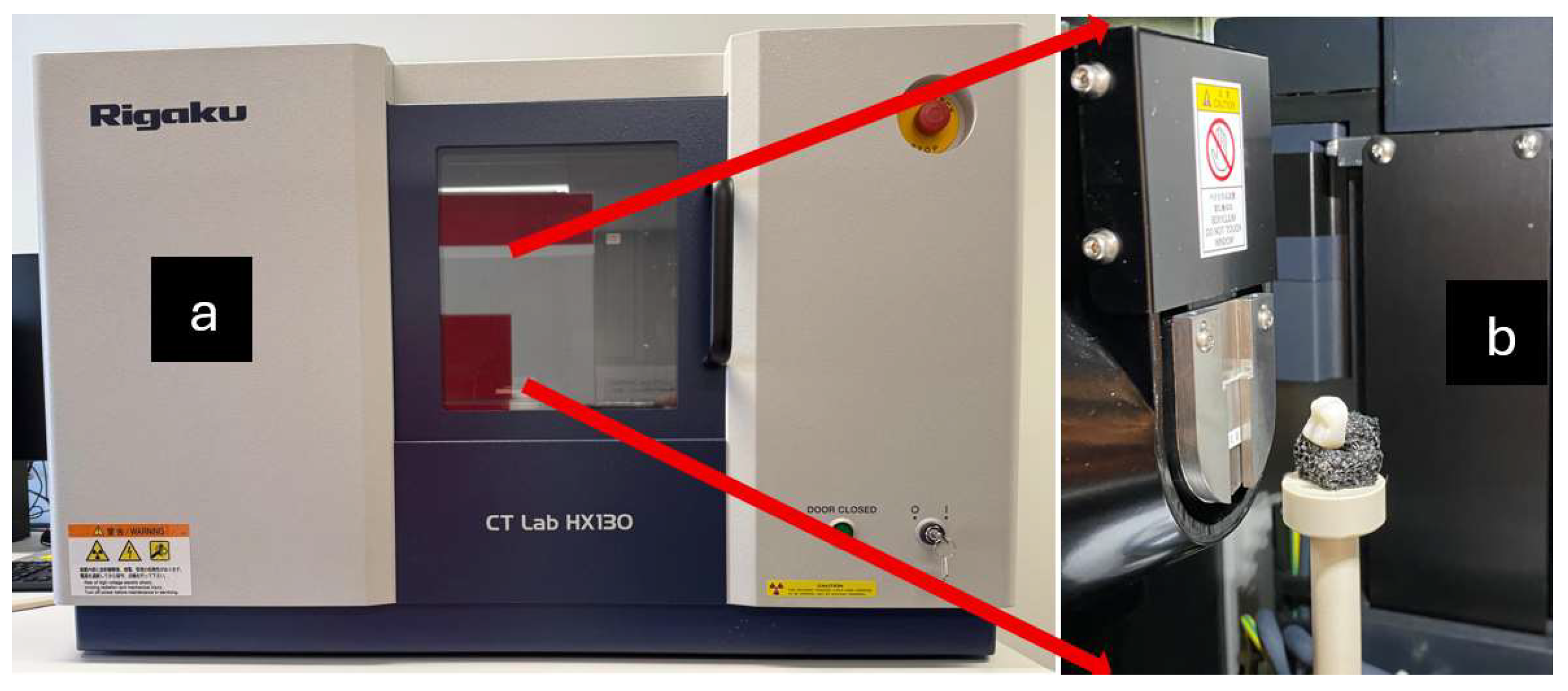
All crowns (N = 36) were scanned using a high-resolution micro-computed tomography system (CT Lab HX; Rigaku Corp., Japan). Scanning was performed at 90 kV and 61 µA using short geometry, with a 1.0 mm aluminum filter and focal mode set to Small (S). Acquisition parameters included a 25 mm field of view (FOV), high-resolution scan mode, and a full 360° rotation, with a scan time of 4 min per specimen. The resulting isotropic voxel size was 25.2 µm.
Following acquisition, images were reconstructed using the system’s standard reconstruction pipeline. Scanner-reported calibration data were applied to ensure accurate voxel scaling for volumetric analysis.

2.4. Image Segmentation and Porosity Quantification

Reconstructed datasets were imported into Mimics Core 27.0 (Materialise NV, Leuven, Belgium) for segmentation of the crown structures. Threshold-based segmentation was applied to isolate crown material from background and internal air voids. Segmented 3D models were exported to 3-matic 19.0 (Materialise NV, Leuven, Belgium) for mesh optimization, surface repair, and volumetric analysis.
For each crown, total crown volume and total pore volume were calculated. Relative porosity (%) was computed as follows: Porosity (%) = (Pore volume/Total crown volume) × 100.

2.5. Abutment Fabrication and Cementation

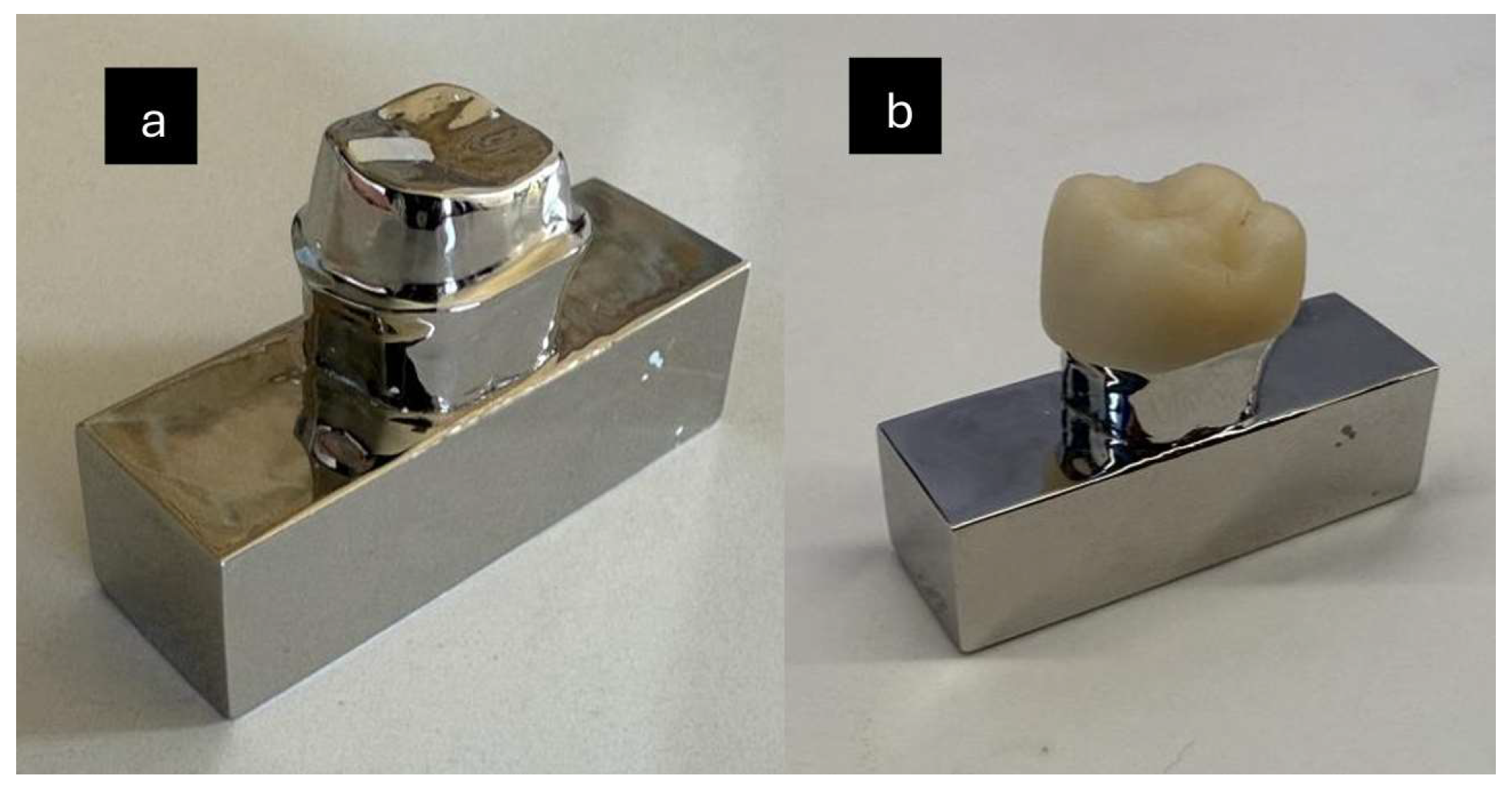
To standardize seating and testing conditions, a cobalt–chromium (Co–Cr) abutment replicating the prepared tooth was custom-milled (Figure 2). Each crown was cemented to the Co–Cr abutment using a temporary luting cement (Temp-Bond NE; Kerr, USA) following the manufacturer’s protocol for mixing, clean-up, and setting time. During cementation, crowns were seated using consistent vertical finger pressure to ensure complete adaptation to the abutment. All cementation procedures were performed by the same investigator to minimize operator-related variability. As marginal fit was not evaluated and all specimens were handled identically, seating pressure was not considered a critical variable in this study. Excess cement was removed, and each specimen was maintained under constant pressure until the initial setting of the luting agent. After cementation and completion of the specified setting period, specimens were prepared for mechanical testing.

2.6. Fracture Resistance Testing

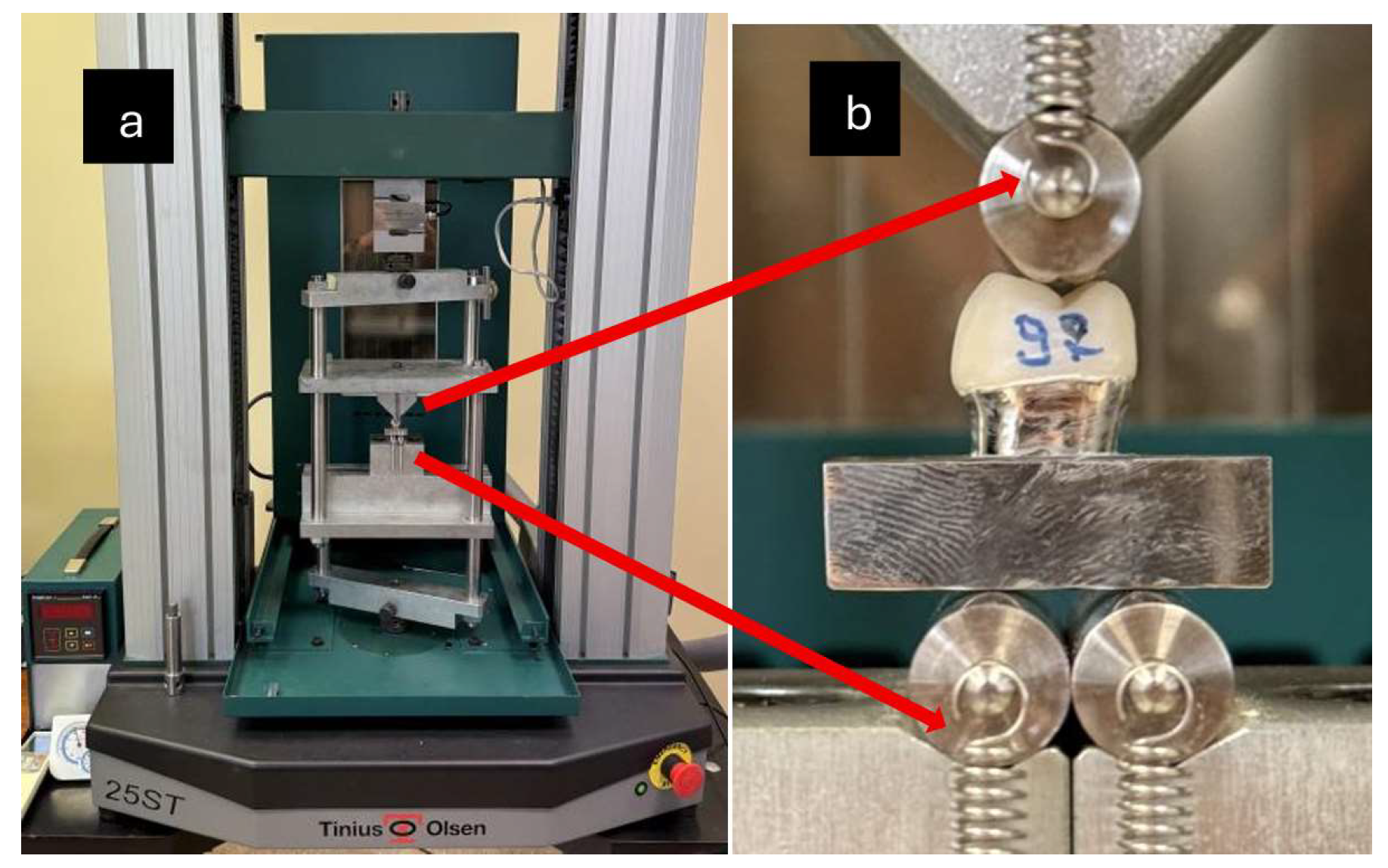
Fracture resistance testing was performed using a universal testing machine (Tinius Olsen; Tinius Olsen, Norway) controlled with Horizon software (v10.2.5) (Figure 3). To standardize load application, each assembly was carefully positioned and visually verified to ensure axial alignment before testing. A compressive load was applied at a crosshead speed of 5 mm/min until catastrophic failure. The maxi mum load at failure (N) was recorded as fracture resistance. Force (N) and displacement (mm) were recorded continuously and force–displacement curves were generated for each specimen.

2.7. Statistical Analysis

Statistical analyses were performed using JASP (Version 0.95.4). Data distribution was assessed separately for each group using the Shapiro–Wilk test, complemented by visual inspection of Q–Q plots to evaluate departures from normality. Homogeneity of variances was examined using Levene’s test.
Given evidence of non-normal distributions and dispersion heterogeneity in the porosity data, non-parametric analyses were applied. Results are therefore presented as median and interquartile range (IQR) where appropriate. Between-group differences in porosity were evaluated using the Kruskal–Wallis test. Effect size was calculated using epsilon-squared (ε2), derived from the H statistic, to estimate the proportion of variance attributable to group differences.
Potential outliers were identified using the Tukey interquartile range (IQR) criterion (values exceeding 1.5 × IQR beyond the upper or lower quartile). Two observations in the Success CD group and one observation in the ProtempTM 4 group exceeded this threshold. As these values represented measurable structural characteristics rather than confirmed measurement errors, all observations were retained in the primary analysis. A sensitivity analysis excluding these values was additionally conducted to evaluate robustness; exclusion did not materially alter the statistical significance or direction of the findings.
Outlier detection for fracture resistance data was performed using the same Tukey interquartile range (IQR) criterion. No values met the criteria for outliers; therefore, all observations were included in the final analysis.
For completeness, normally distributed outcomes with homogeneous variances were summarized as mean ± standard deviation (SD) with 95% confidence intervals (CIs), and analyzed using one-way ANOVA followed by Tukey’s HSD post hoc testing when applicable. Statistical significance was set at α = 0.05 (two-sided).

3. Results

3.1. Porosity Analysis

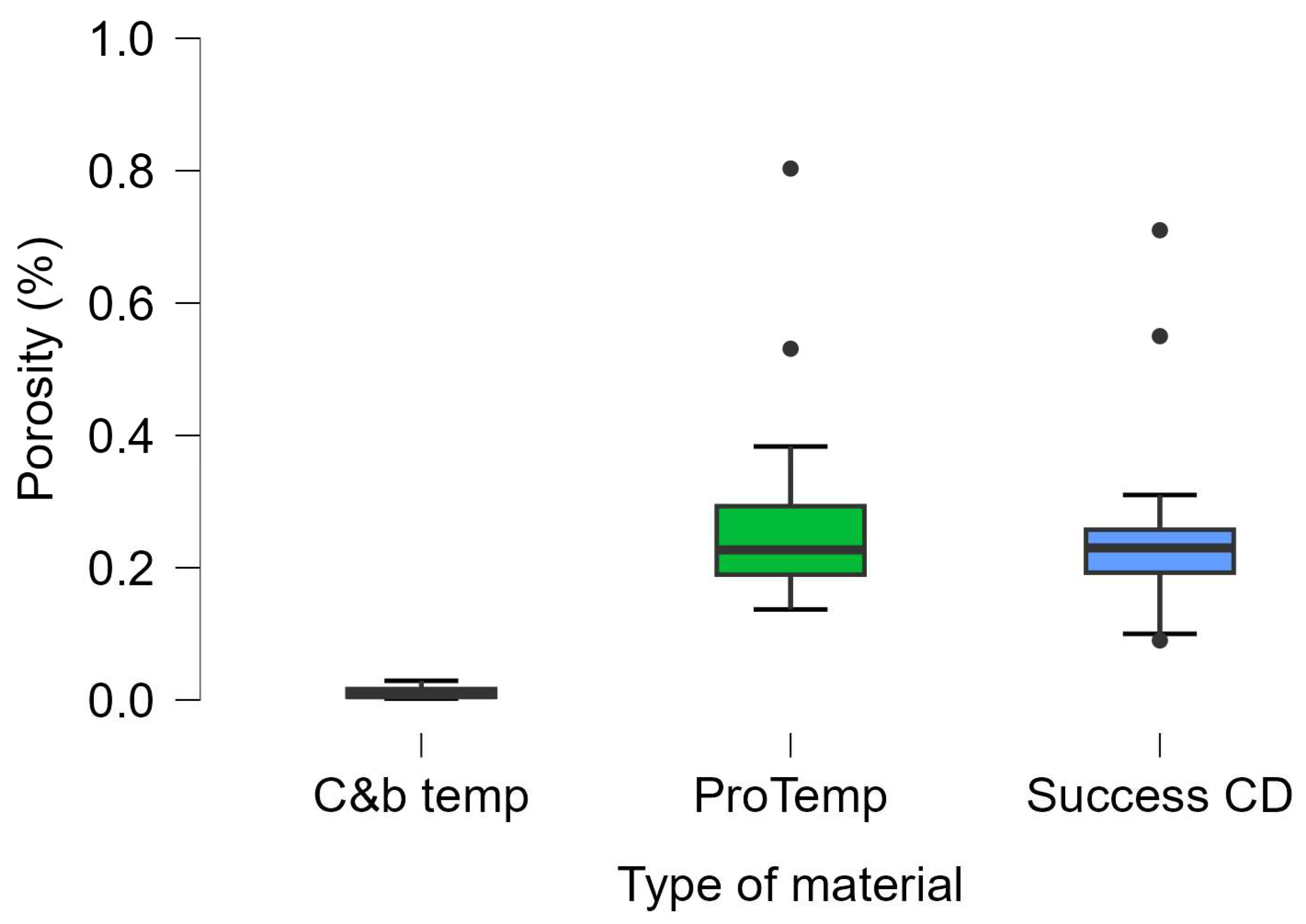
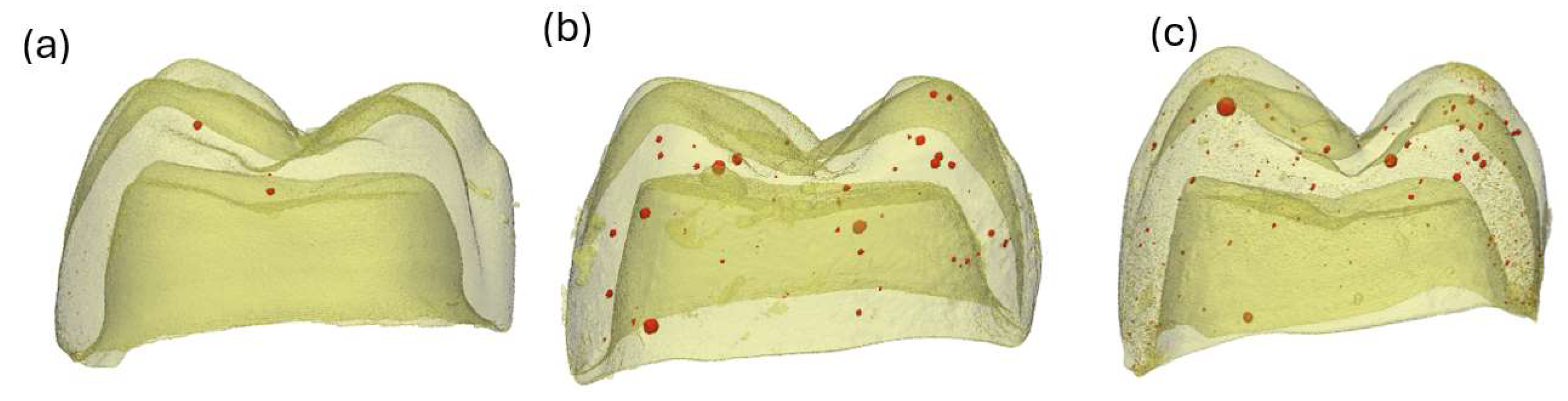
Micro-computed tomography (micro-CT) revealed clear differences in relative porosity among the three fabrication methods (Figure 4). The 3D-printed V-Print c&b temp crowns exhibited the lowest porosity, with a mean value of 0.0029% (95% CI: 0.0013–0.0045%) relative to total crown volume. In contrast, the conventionally fabricated crowns demonstrated substantially higher porosity values: ProtempTM 4 showed a mean porosity of 0.072% (95% CI: 0.057–0.088%) and Success CD showed the highest mean porosity of 0.09% (95% CI: 0.05–0.13%) (Figure 5). Overall, the 3D-printed crowns presented approximately 25-fold lower pore volume fractions compared with the conventional materials (Figure 6).

3.2. Fracture Resistance

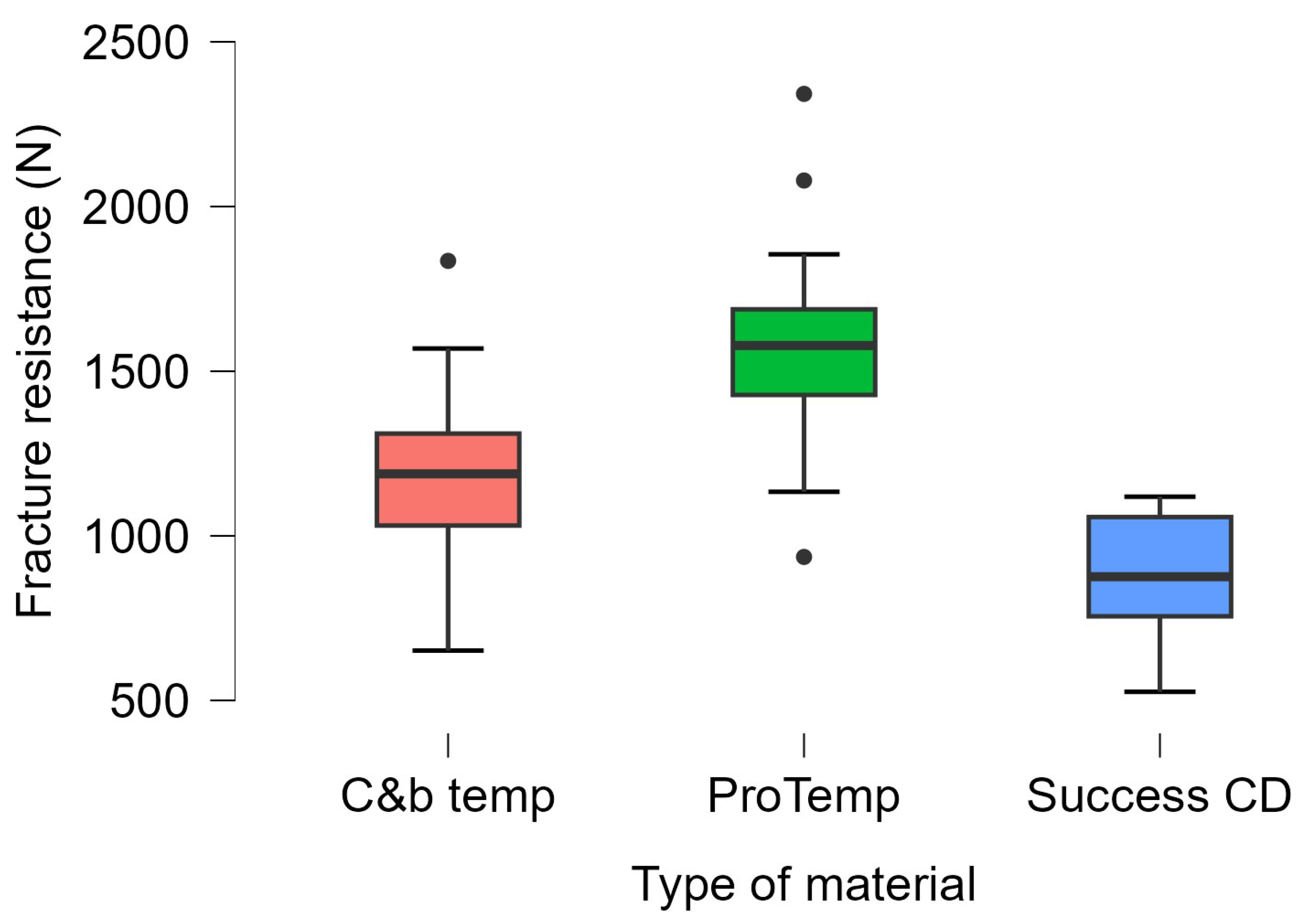
Monotonic compression testing demonstrated statistically significant differences in compressive failure load among the evaluated materials (one-way ANOVA: F(2,34) = 16.88, p = 8.11 × 10⁻⁶, η2 = 0.50) (Figure 6). The material factor accounted for approximately 50% of the total variance in failure load, indicating a large effect size.
ProtempTM 4 crowns exhibited the highest mean failure load (1594.8 ± 364.6 N), followed by V-Print c&b temp crowns (1170.9 ± 343.4 N), whereas Success CD crowns demonstrated the lowest mean values (874.7 ± 194.4 N).
Tukey HSD post hoc comparisons confirmed that ProtempTM 4 showed significantly higher failure loads than both V-Print c&b temp (p = 0.0049) and Success CD (p < 0.001). The difference between V-Print c&b temp and Success CD did not reach statistical significance after adjustment for multiple comparisons. Despite exhibiting the lowest internal porosity, the 3D-printed material did not demonstrate superior compressive failure load relative to the bis-acrylic resin.

4. Discussion

Micro-CT analysis demonstrated markedly lower pore volume in the 3D-printed resin compared with both conventionally fabricated materials. This finding is consistent with the underlying processing principles of each method. Additive, light-driven polymerization proceeds under controlled conditions and in thin layers, which limits air entrapment and can yield a more homogeneous internal structure with lower defect density [21]. In contrast, manual handling and chemically initiated curing may introduce air bubbles and spatially variable polymerization, increasing internal voids and heterogeneity—an effect repeatedly reported for conventional bis-acrylic and autopolymerizing resins [21].
From a clinical perspective, reduced porosity may be beneficial for two principal reasons. First, pores can act as stress concentrators that facilitate crack initiation and propagation; therefore, minimizing void content may support improved mechanical reliability over time [7,11]. Second, internal and surface porosity may contribute to increased roughness and microbial retention. Lower-porosity, well-finished printed resins have been associated with reduced biofilm accumulation compared with autopolymerizing materials, potentially limiting discoloration and soft-tissue irritation during temporization [8,9,16,22]. Accordingly, the very low pore fractions observed in the printed group may translate to improved dimensional stability and hygiene, provided that the manufacturer’s recommended post-processing and finishing protocols are strictly followed.
Despite the lowest porosity, the 3D-printed group did not exhibit the highest fracture resistance. Instead, ProtempTM 4 showed the greatest failure loads, followed by the 3D-printed resin and then Success CD. The recorded fracture resistance values (874.7–1594.8 N) overlap with the range of maximum bite forces reported in healthy individuals, which may exceed 1000 N in posterior regions. Ref. [23] While the higher-strength materials exceed typical functional loads, the lower fracture resistance observed in the autopolymerizing resin approaches the upper limits of physiological bite forces, indicating a reduced safety margin in high-load situations or in patients with elevated occlusal forces [24].
This hierarchy aligns with established composition–structure–property relationships in materials for provisional restorations. Bis-acrylics typically form a densely cross-linked methacrylate network with inorganic fillers, which contributes to increased stiffness and resistance to crack propagation, thereby enhancing mechanical strength. Similar material-dependent behavior has been reported in resin-based restorative systems, where the composition of the organic matrix and filler content plays a critical role in determining mechanical performance [3,25,26,27]. In contrast, printed resins are fabricated layer by layer, which may result in directional mechanical behavior due to interfaces between layers. If light exposure or post-curing is insufficient, incomplete polymerization at these interfaces may create localized weak zones under compressive or multi-axial loading [12].
However, in the present study, the layer interfaces were oriented perpendicular to the applied compressive force, a configuration generally associated with improved mechanical performance. Therefore, the intermediate failure loads observed for the printed material are more likely related to intrinsic material characteristics, such as resin composition and network structure, rather than unfavorable layer orientation.
Importantly, the present findings also highlight that porosity alone does not dictate mechanical performance. While fewer voids may reduce stress concentrators, material chemistry, filler architecture, and interfacial bonding remain decisive determinants of crack initiation and propagation. Thus, the printed group’s lower void content likely improved microstructural uniformity but did not fully compensate for differences in network structure and potential interface-related weaknesses, resulting in intermediate fracture resistance.
Processing-related variables may further influence the mechanical performance of 3D-printed provisionals [15,16]. Printing orientation and post-processing can substantially affect strength by altering the alignment of interlayer planes relative to principal stresses and by increasing the degree of conversion; several studies have reported measurable improvements when orientation and curing protocols are optimized [4,14,28]. Additionally, fatigue and thermo-mechanical aging may affect printed resins differently than monotonic compression tests suggest; cyclic loading and thermal cycling have been reported to accentuate interlayer weaknesses and alter strength rankings, particularly under suboptimal orientations [13,14,29]. Although the present work used monotonic compression only, these findings provide important context for interpreting the intermediate failure loads observed for the printed material.
Clinically, all three materials tolerated loads consistent with short-term posterior temporization; however, their safety margins differed. In situations where higher occlusal forces or parafunction are anticipated, the bis-acrylic option may offer greater resistance to catastrophic failure, whereas the printed option offers superior internal uniformity and workflow advantages. Therefore, selection should consider occlusal demand, expected service time, and the feasibility of optimizing printing orientation and post-curing parameters. Where fit precision, reproducibility, or rapid remake capability are priorities (e.g., multiple units or reduced chairside time), a printed provisional may be advantageous, provided that orientation and post-curing are validated and surfaces are adequately finished to reduce roughness and biofilm retention [9,18,22]. Conversely, in high-load posterior regions or patients with parafunction, a bis-acrylic provisional may provide a larger safety margin due to its material architecture and higher ultimate failure load [3,6].

Limitations and Future Directions

This in vitro study evaluated monotonic compression only; no thermo-mechanical aging or fatigue cycling was performed, although cyclic loading and temperature variation may change strength rankings and disproportionately affect printed materials. The printed group was assessed under a single build orientation and post-curing protocol, despite known effects of these parameters on anisotropy and degree of conversion. Additionally, each material category was represented by a single formulation, which may limit generalizability across materials within the same class. While internal porosity and fracture load were quantified, other clinically relevant outcomes—such as marginal adaptation over time, surface roughness, color stability, and biofilm accumulation—were not assessed.
Future studies should incorporate standardized thermo-mechanical aging and fatigue protocols, systematically evaluate the effects of printing orientation and post-curing, and include multiple resins per category to better separate fabrication-method effects from material chemistry. Post-fracture analyses using micro-CT registered to pre-fracture scans, combined with targeted SEM fractography, could localize crack origins and relate fracture paths to voids and interlayer interfaces, clarifying why low-porosity printed crowns may still exhibit intermediate fracture resistance. In addition, CAD/CAM-milled provisionals fabricated from pre-polymerized blocks should be included in comparative designs to assess how industrial polymerization and reduced void formation translate into mechanical performance and clinical durability.
Overall, the findings support a complementary view: 3D printing provides excellent internal uniformity and reproducible workflows, while bis-acrylic materials retain an advantage in ultimate load-bearing capacity. The most predictable temporization outcomes are likely achieved by matching material and fabrication approach to occlusal demands and anticipated service duration, while applying evidence-based processing and finishing protocols to maximize performance of printed provisionals.
From a clinical perspective, the findings of this study suggest that material selection for temporary crowns should be guided by the anticipated functional demands. Bis-acrylic materials demonstrate higher fracture resistance and may therefore be preferable in situations involving increased occlusal loading or parafunctional activity. In contrast, 3D-printed materials offer advantages in terms of internal uniformity and workflow reproducibility, which may be beneficial in controlled, short-term applications. As reduced porosity does not necessarily translate into superior mechanical performance, both material composition and fabrication technique should be considered when selecting provisional restoration materials. Overall, the results support a complementary approach, where optimal clinical outcomes are achieved by matching the material and manufacturing method to the specific clinical scenario and expected service duration.

5. Conclusions

  • The 3D-printed resin (V-Print c&b temp) exhibited the lowest internal porosity and the most homogeneous internal pore pattern, whereas the conventionally fabricated crowns (ProtempTM 4 and Success CD) showed substantially higher pore volume fractions.
  • The bis-acrylic material (ProtempTM 4) demonstrated the highest fracture resistance, followed by the 3D-printed resin and the autopolymerizing resin (Success CD), confirming meaningful strength differences among the tested materials.
  • The findings indicate that differences in porosity were not directly reflected in compressive failure load values, implying that additional material-related factors may contribute to mechanical behavior.

Author Contributions

Conceptualization, M.S., M.N. and O.R.; methodology, M.S., M.N. and O.R.; investigation, M.S. and M.D.; data curation, M.S. and M.D.; formal analysis, M.S. and M.D.; writing—original draft preparation, M.S.; writing—review and editing, M.S., M.N., O.R. and M.D.; supervision, M.N. and O.R. All authors have read and agreed to the published version of the manuscript.

Funding

The authors acknowledge the access to the infrastructure and expertise of the BBCE—Baltic Biomaterials Centre of Excellence (European Union’s Horizon 2020 research and innovation programme under grant agreement No. 857287).

Institutional Review Board Statement

Not applicable.

Informed Consent Statement

Not applicable.

Data Availability Statement

The original contributions presented in this study are included in the article. Further inquiries can be directed to the corresponding author.

Acknowledgments

The authors would like to thank Klāvs Karlsons for support during the crown 3D-printing process in the dental laboratory. Additionally, we acknowledge the RSU Institute of Stomatology, Rīga Stradiņš University, and Riga Technical University for providing access to laboratory facilities.

Conflicts of Interest

The authors declare no conflicts of interest.

Abbreviations

The following abbreviations are used in this manuscript:
3Dthree-dimensional
CAD/CAMcomputer-aided design and computer-aided manufacturing
Co–Crcobalt–chromium alloy
DLPdigital light processing
micro-CTmicro-computed tomography
PMMApolymethyl methacrylate
SEMscanning electron microscopy
SLAstereolithography
STLstereolithography file format
VPSvinyl polysiloxane

References

  1. Abdullah, A.O.; Pollington, S.; Liu, Y. Comparison between direct chairside and digitally fabricated temporary crowns. Dent. Mater. J. 2018, 37, 957–963. [Google Scholar] [CrossRef]
  2. Abdulmohsen, B.; Parker, S.; Braden, M.; Patel, M.P. A study to investigate and compare the physicomechanical properties of experimental and commercial temporary crown and bridge materials. Dent. Mater. 2016, 32, 200–210. [Google Scholar] [CrossRef] [PubMed]
  3. Dönmez, M.B.; Diken Turksayar, A.A.; Olcay, E.O.; Dönmez Şahmali, S.M. Fracture resistance of single-unit implant-supported crowns: Effects of prosthetic design and restorative material. J. Prosthodont. 2021, 31, 348–355. [Google Scholar] [CrossRef]
  4. Ha, S.-R.; Kim, S.-H.; Lee, J.-B.; Han, J.-S.; Yeo, I.-S. Improving shear bond strength of temporary crown and fixed dental prosthesis resins by surface treatments. J. Mater. Sci. 2016, 51, 1463–1475. [Google Scholar] [CrossRef]
  5. Bora, P.V.; Sayed Ahmed, A.; Alford, A.; Pittman, K.; Thomas, V.; Lawson, N.C. Characterization of materials used for 3D printing dental crowns and hybrid prostheses. J. Esthet. Restor. Dent. 2024, 36, 220–230. [Google Scholar] [CrossRef] [PubMed]
  6. Mazurek-Popczyk, J.; Nowicki, A.; Arkusz, K.; Pałka, Ł.; Zimoch-Korzycka, A.; Baldy-Chudzik, K. Evaluation of biofilm formation on acrylic resins used to fabricate dental temporary restorations with the use of 3D printing technology. BMC Oral Health 2022, 22, 442. [Google Scholar] [CrossRef] [PubMed]
  7. Kumar, G.V.; Devi, R.; Anto, N. Evaluation and comparison of the surface roughness and porosity of different provisional restorative materials: An in vitro study. CODS J. Dent. 2016, 8, 39–45. [Google Scholar] [CrossRef]
  8. Sarna-Boś, K.; Skic, K.; Sobieszczański, J.; Boguta, P.; Chałas, R. Contemporary approach to the porosity of dental materials and methods of its measurement. Int. J. Mol. Sci. 2021, 22, 8903. [Google Scholar] [CrossRef]
  9. Jain, S.; Sayed, M.E.; Shetty, M.; Alqahtani, S.M.; Al Wadei, M.H.D.; Gupta, S.G.; Othman, A.A.A.; Alshehri, A.H.; Alqarni, H.; Mobarki, A.H.; et al. Physical and mechanical properties of 3D-printed provisional crowns and fixed dental prosthesis resins compared to CAD/CAM milled and conventional provisional resins: A systematic review and meta-analysis. Polymers 2022, 14, 2691. [Google Scholar] [CrossRef]
  10. Rizzante, F.; Bueno, T.; Guimarães, G.; Moura, G.; Teich, S.; Furuse, A.; Mendonça, G. Comparative physical and mechanical properties of a 3D-printed temporary crown and bridge restorative material. J. Clin. Exp. Dent. 2023, 15, e464–e469. [Google Scholar] [CrossRef]
  11. Tüfekçi, B.B.; Yeşil, Z. Examination of the effect of aging process on marginal fit and fracture strength of temporary crowns prepared from different materials. Heliyon 2024, 10, e26737. [Google Scholar] [CrossRef]
  12. Nold, J.; Wesemann, C.; Rieg, L.; Binder, L.; Witkowski, S.; Spies, B.C.; Kohal, R.J. Does printing orientation matter? In-vitro fracture strength of temporary fixed dental prostheses after a 1-year simulation in the artificial mouth. Materials 2021, 14, 259. [Google Scholar] [CrossRef]
  13. Velo, M.M.A.C.; Forcin, L.V.; Marun, B.M.; Nascimento, T.R.D.L.; Rodrigues, M.S.; Alhotan, A.; Alhijji, S.; Brondino, N.C.; Bombonatti, J.F.S. Mechanical performance enhancement of 3D-printed temporary dental resin by niobium nanoparticle incorporation: An in vitro comparative study with conventional composite and 3D permanent materials. Polymers 2025, 17, 2400. [Google Scholar] [CrossRef] [PubMed]
  14. Firlej, M.; Pieniak, D.; Snarski-Adamski, A.; Biedziak, B.; Niewczas, A.; Petru, J.; Matijošius, J.; Krzysiak, Z.; Zaborowicz, K. Comparative study on the wear resistance of C&B-type polymer materials for temporary crowns manufactured using 3D DLP printing technology. Materials 2025, 18, 5478. [Google Scholar] [CrossRef]
  15. Galbraith, A.; Doan, M.; Galbraith, T.; Abubakr, N.H. Evaluation of color stability and marginal integrity in provisional restorations: A study of milling, 3D printing, and conventional fabrication methods. Dent. J. 2025, 13, 189. [Google Scholar] [CrossRef] [PubMed]
  16. del Hougne, M.; Di Lorenzo, I.; Höhne, C.; Schmitter, M. A retrospective cohort study on 3D-printed temporary crowns. Sci. Rep. 2024, 14, 17295. [Google Scholar] [CrossRef]
  17. Abad-Coronel, C.; Carrera, E.; Mena Córdova, N.; Fajardo, J.I.; Aliaga, P. Comparative analysis of fracture resistance between CAD/CAM materials for interim fixed prosthesis. Materials 2021, 14, 7791. [Google Scholar] [CrossRef]
  18. Abdullah, H.A.; Al-Ibraheemi, Z.A.; Majeed, M.A.; Al-Nasrawi, S. Evaluation of flexural strength and degree of conversion of temporary crown materials at different aging periods in artificial saliva. Braz. Dent. Sci. 2024, 27, e4368. [Google Scholar] [CrossRef]
  19. Balkenhol, M.; Knapp, M.; Ferger, P.; Heun, U.; Wöstmann, B. Correlation between polymerization shrinkage and marginal fit of temporary crowns. Dent. Mater. 2008, 24, 1575–1584. [Google Scholar] [CrossRef]
  20. Alqarawi, F.K.; Sayed, M.E.; Dewan, H.; Shaabi, F.I.; Naim, H.; Ahmad, M.; Hakami, H.I.; Alsubaiy, E.F.; Sultan, A.; AlResayes, S.S. Cumulative effect of digital manufacturing techniques, preparation taper and finish line designs on the retention of aged temporary molar crowns—An in vitro study. Saudi Dent. J. 2024, 36, 1477–1482. [Google Scholar] [CrossRef]
  21. Ribeiro, A.K.C.; Freitas, R.F.C.P.; Carvalho, I.H.G.; Miranda, L.M.; Silva, N.R.; Almeida, L.F.D.; Zhang, Y.; Carreiro, A.F.P.; Souza, R.O.A. Flexural strength, surface roughness, micro-CT analysis, and microbiological adhesion of a 3D-printed temporary crown material. Clin. Oral Investig. 2023, 27, 2207–2220. [Google Scholar] [CrossRef]
  22. Mayer, J.; Stawarczyk, B.; Vogt, K.; Hickel, R.; Edelhoff, D.; Reymus, M. Influence of cleaning methods after 3D printing on two-body wear and fracture load of resin-based temporary crown and bridge material. Clin. Oral Investig. 2021, 25, 5987–5996. [Google Scholar] [CrossRef]
  23. Ferrario, V.F.; Sforza, C.; Zanotti, G.; Tartaglia, G.M. Maximal bite forces in healthy young adults as predicted by surface electromyography. J. Dent. 2004, 32, 451–457. [Google Scholar] [CrossRef] [PubMed]
  24. Mârtu, I.; Murariu, A.; Baciu, E.R.; Savin, C.N.; Foia, I.; Tatarciuc, M.; Diaconu-Popa, D. An interdisciplinary study regarding the characteristics of dental resins used for temporary bridges. Medicina 2022, 58, 811. [Google Scholar] [CrossRef]
  25. Reda, S.A.; Hussein, Y.F.; Riad, M. The impact of Bis-GMA free and Bis-GMA containing resin composite as posterior restoration on marginal integrity: A randomized controlled clinical trial. BMC Oral Health 2023, 23, 1022. [Google Scholar] [CrossRef] [PubMed]
  26. Aktaş, N.; Bankoğlu Güngör, M. Evaluation of wear on primary tooth enamel and fracture resistance of esthetic pediatric crowns manufactured from different materials. Medicina 2024, 60, 1678. [Google Scholar] [CrossRef]
  27. Sriprasert, N.; Krajangta, N.; Wasanapiarnpong, T.; Didron, P.P.; Rakmanee, T. Fracture resistance of commercial and novel ceramic-reinforced polymer crowns with luting cements of varying elastic modulus. Polymers 2026, 18, 25. [Google Scholar] [CrossRef]
  28. Firouz, F.; Vafaee, F.; Izadi, A.; Farhadian, M.; Rajabi, H.; Niaghiha, F. Effect of temporary cement on the color of temporary crowns made by conventional pressing methods and subtractive CAD/CAM technologies. ODOVTOS Int. J. Dent. Sci. 2024, 26, 62–70. [Google Scholar] [CrossRef]
  29. Nowicki, A.; Krawiec, K.; Osypko, K.; Kurzawa, A.; Stachowicz, M.; Kotowski, P.; Pyka, D. Fatigue Analysis of 3D-Printed Materials for Temporary Reconstructions on Dental Implants—A Pilot Study. Appl. Sci. 2025, 15, 3212. [Google Scholar] [CrossRef]
Figure 1. Rigaku CT Lab HX micro-CT (a); dental crown (b).
Oral 06 00056 g001
Figure 2. Cobalt–chromium (Co–Cr) abutment (a), dental crown on the abutment (b).
Oral 06 00056 g002
Figure 3. Tinius Olsen universal testing machine (a); fracture testing (b).
Oral 06 00056 g003
Figure 4. Micro-CT Porosity Analysis Presented as Box Plots.
Oral 06 00056 g004
Figure 5. Fracture Resistance Results Presented as Box Plots.
Oral 06 00056 g005
Figure 6. Micro-CT scan: V-Print c&b temp crown (a); ProtempTM 4 (Bisacrylic) crown (b); Success CD crown (c).
Oral 06 00056 g006
Disclaimer/Publisher’s Note: The statements, opinions and data contained in all publications are solely those of the individual author(s) and contributor(s) and not of MDPI and/or the editor(s). MDPI and/or the editor(s) disclaim responsibility for any injury to people or property resulting from any ideas, methods, instructions or products referred to in the content.