
Conventional Versus 3D-Printed Temporary Dental Crowns: A Micro-CT Analysis of Porosity and Fracture Resistance


Highlights
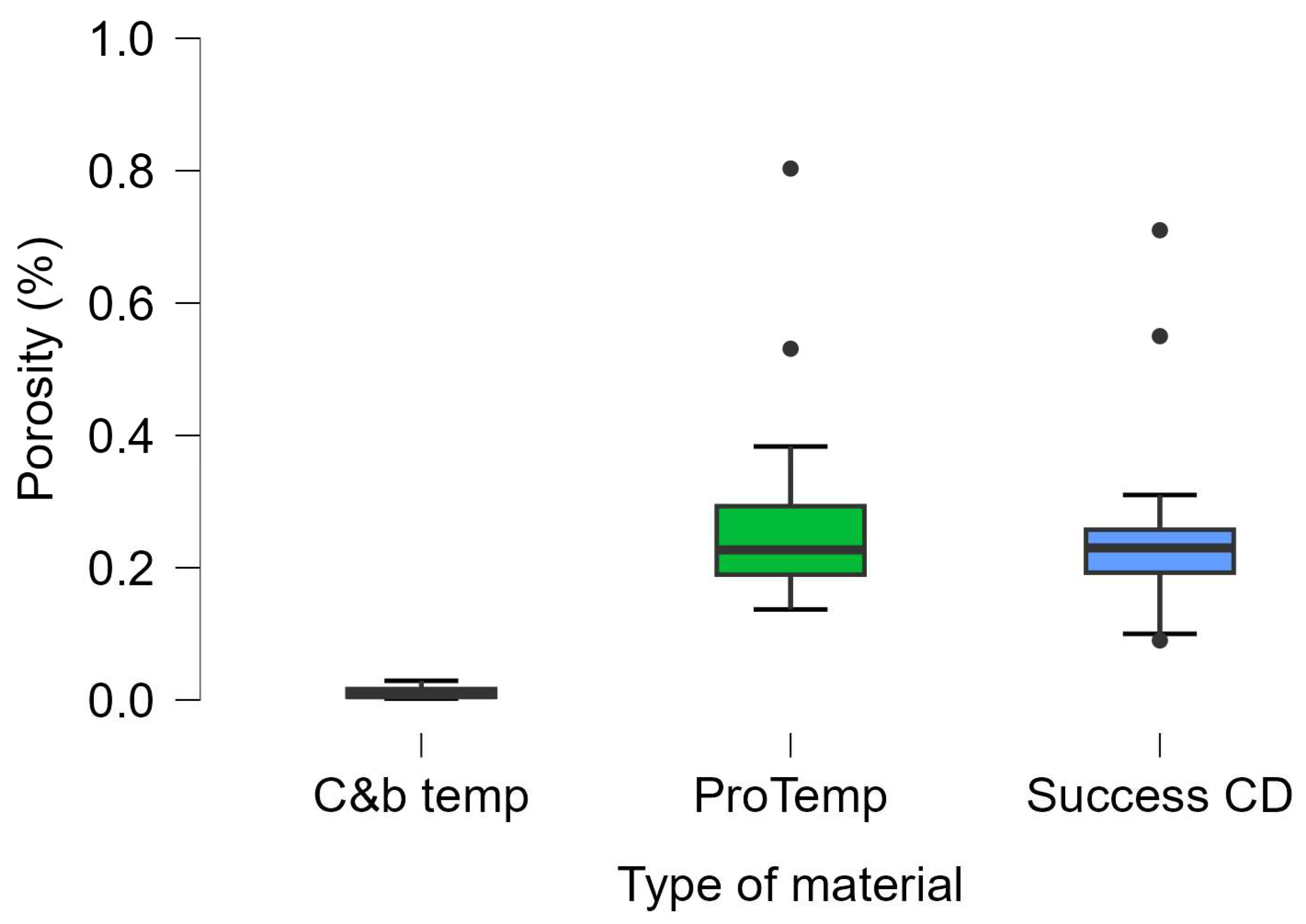
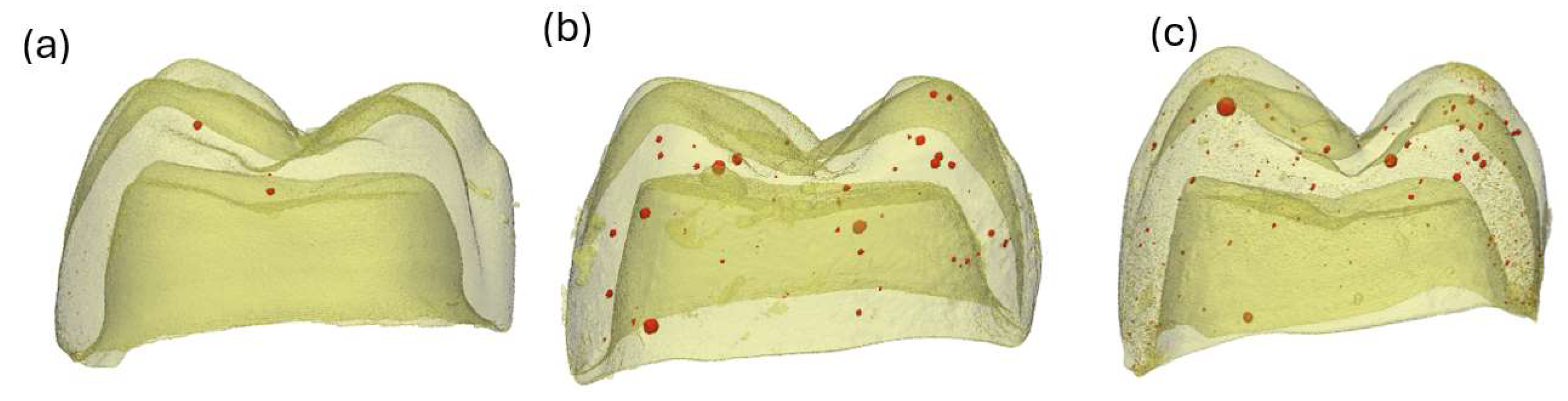
- Micro-CT showed markedly lower porosity in 3D-printed provisional crowns (V-Print c&b temp) compared with conventionally fabricated crowns (ProtempTM 4, Success CD).
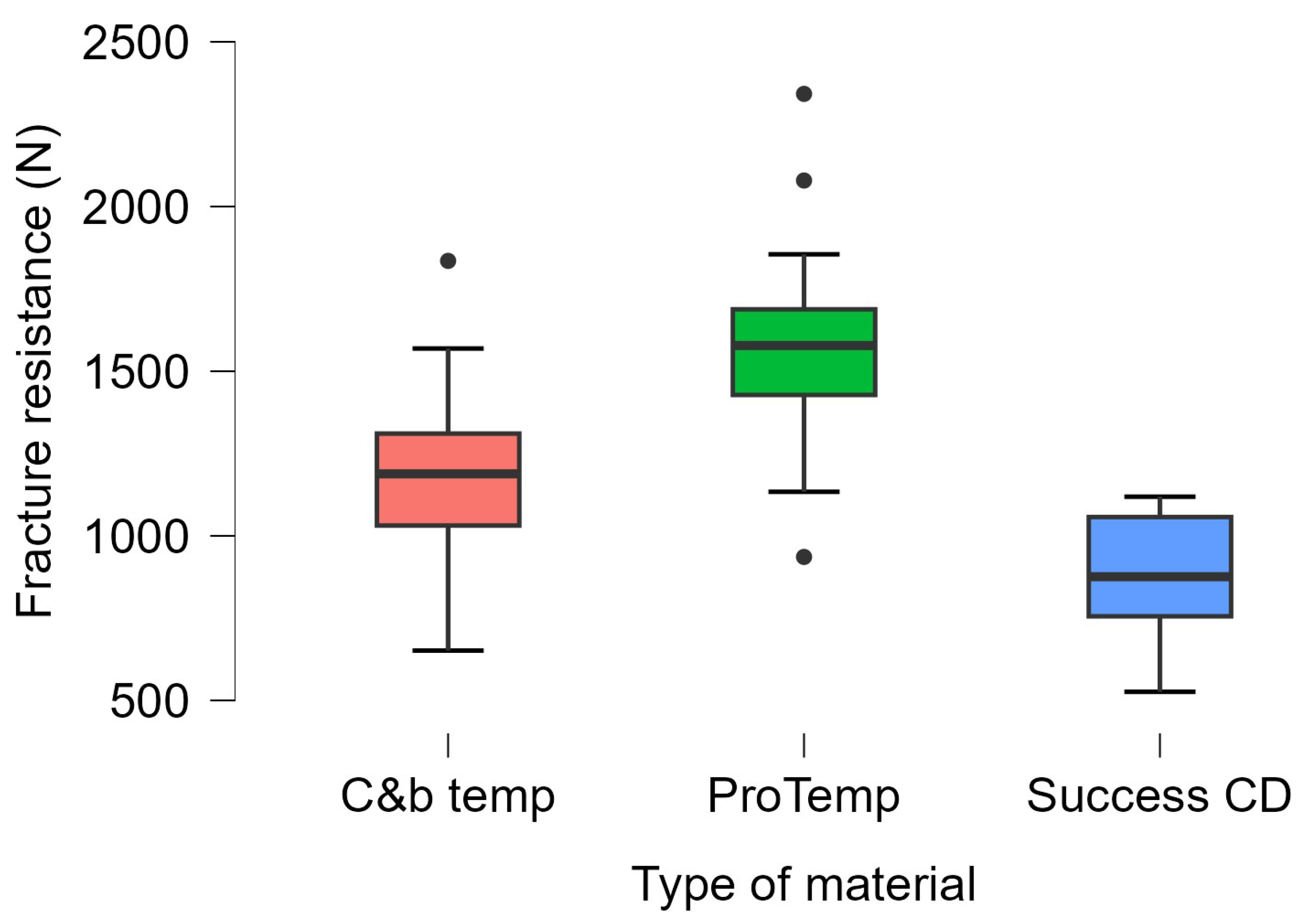
- ProtempTM 4 exhibited the highest fracture resistance, while Success CD showed the lowest failure loads; the 3D-printed material demonstrated intermediate mechanical performance under monotonic compression.
- Low porosity in 3D-printed provisionals indicates improved structural homogeneity but does not necessarily translate to an increase in maximum fracture resistance.
- Material selection for temporization should be case-dependent: 3D printing favors uniformity and reproducibility, whereas bis-acrylic materials may provide a larger safety margin in high-load situations.
Abstract
1. Introduction
2. Materials and Methods
2.1. Conventional Crown Fabrication (Success CD and ProtempTM 4)
2.2. Digital Acquisition and 3D Printing (V-Print c&b Temp)
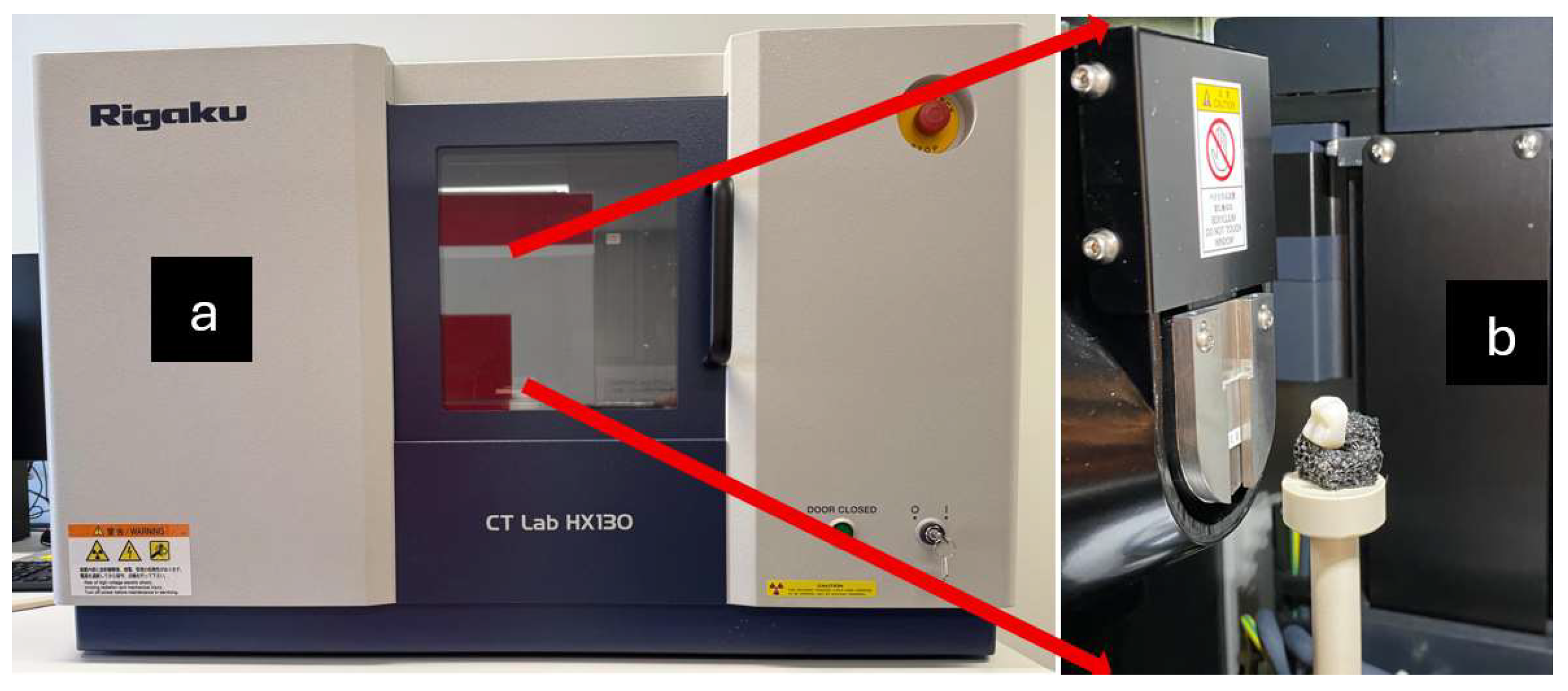
2.3. Micro-CT Acquisition
2.4. Image Segmentation and Porosity Quantification
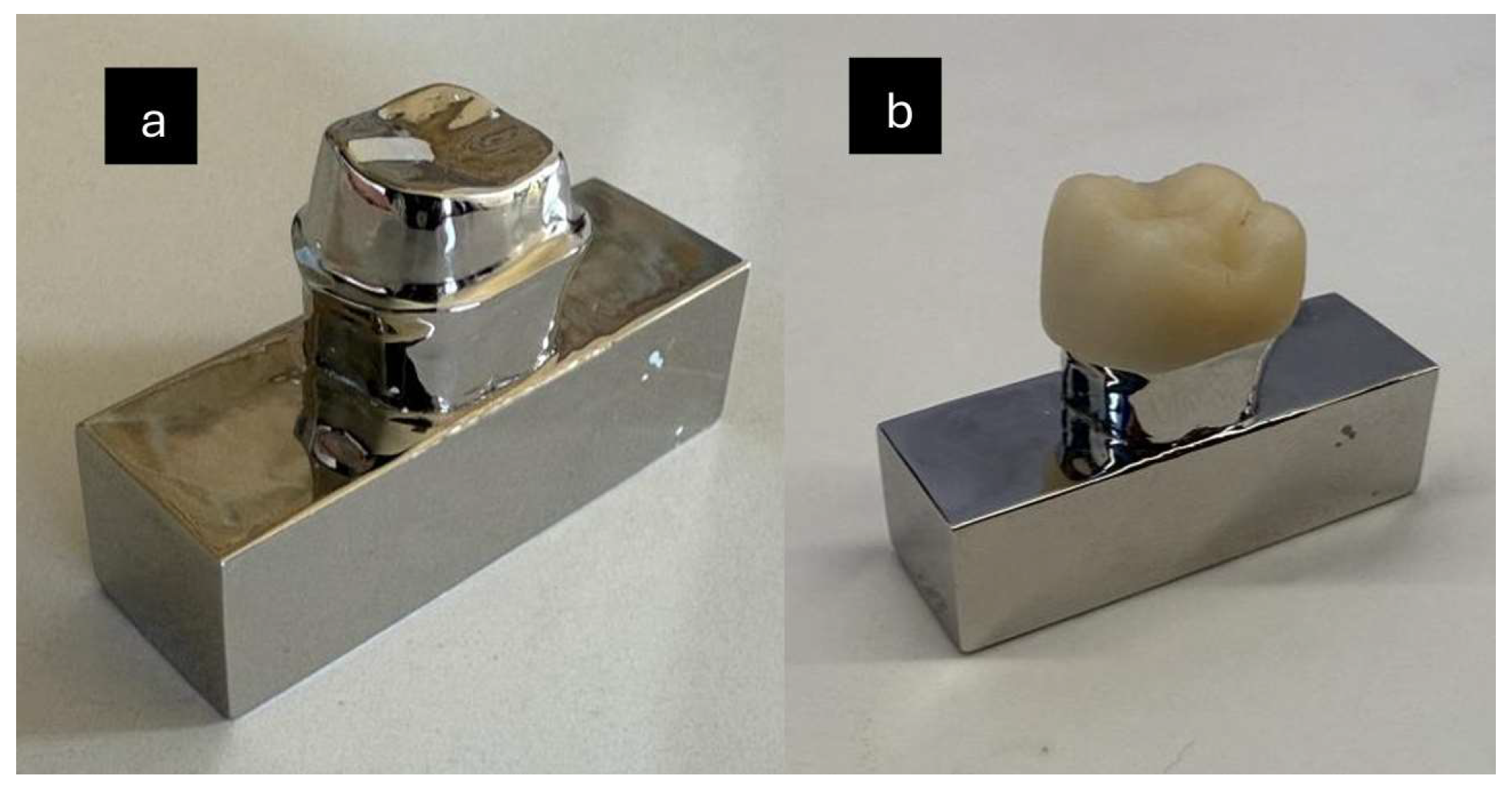
2.5. Abutment Fabrication and Cementation
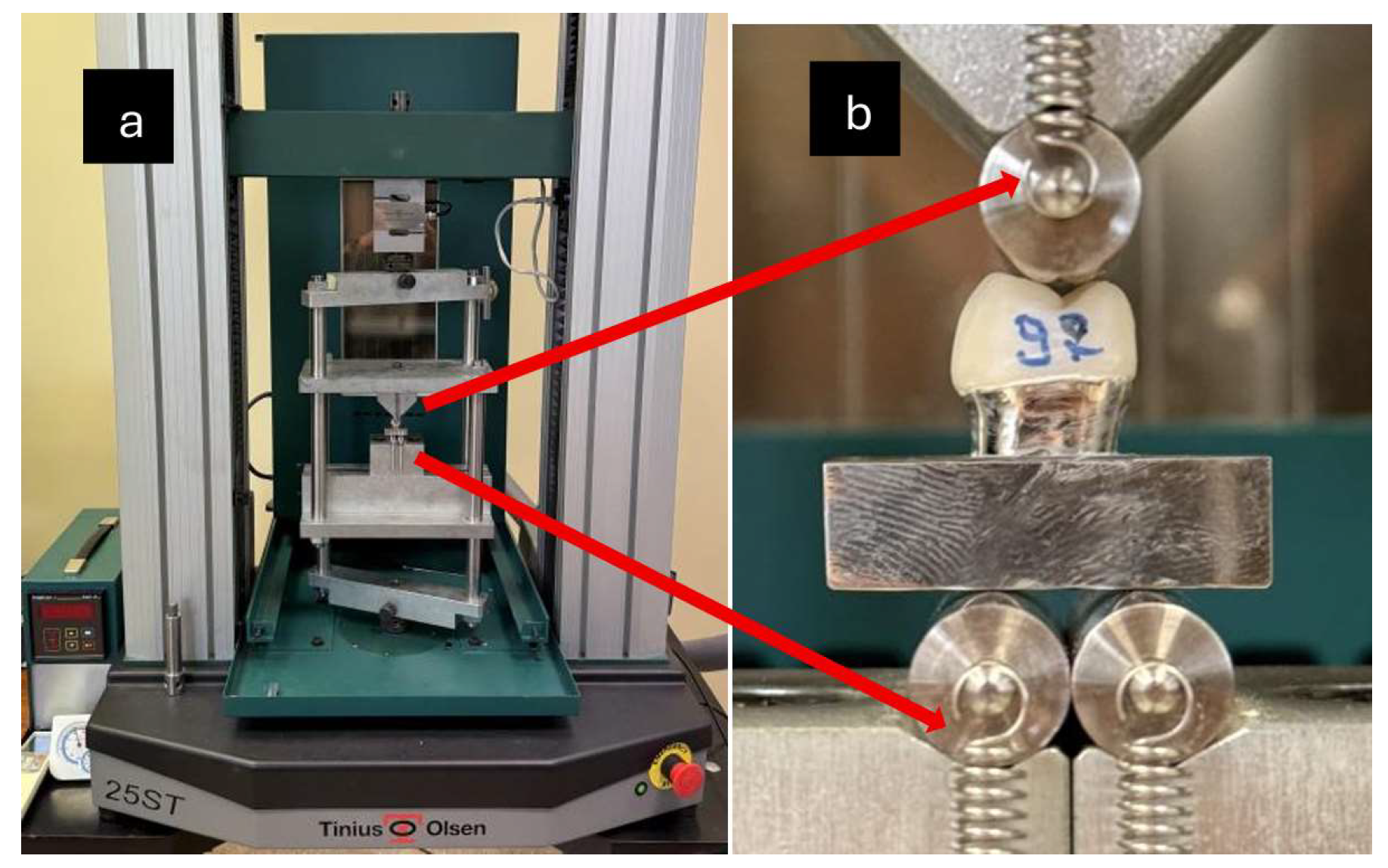
2.6. Fracture Resistance Testing
2.7. Statistical Analysis
3. Results
3.1. Porosity Analysis
3.2. Fracture Resistance
4. Discussion
Limitations and Future Directions
5. Conclusions
- The 3D-printed resin (V-Print c&b temp) exhibited the lowest internal porosity and the most homogeneous internal pore pattern, whereas the conventionally fabricated crowns (ProtempTM 4 and Success CD) showed substantially higher pore volume fractions.
- The bis-acrylic material (ProtempTM 4) demonstrated the highest fracture resistance, followed by the 3D-printed resin and the autopolymerizing resin (Success CD), confirming meaningful strength differences among the tested materials.
- The findings indicate that differences in porosity were not directly reflected in compressive failure load values, implying that additional material-related factors may contribute to mechanical behavior.
Author Contributions
Funding
Institutional Review Board Statement
Informed Consent Statement
Data Availability Statement
Acknowledgments
Conflicts of Interest
Abbreviations
| 3D | three-dimensional |
| CAD/CAM | computer-aided design and computer-aided manufacturing |
| Co–Cr | cobalt–chromium alloy |
| DLP | digital light processing |
| micro-CT | micro-computed tomography |
| PMMA | polymethyl methacrylate |
| SEM | scanning electron microscopy |
| SLA | stereolithography |
| STL | stereolithography file format |
| VPS | vinyl polysiloxane |
References
- Abdullah, A.O.; Pollington, S.; Liu, Y. Comparison between direct chairside and digitally fabricated temporary crowns. Dent. Mater. J. 2018, 37, 957–963. [Google Scholar] [CrossRef]
- Abdulmohsen, B.; Parker, S.; Braden, M.; Patel, M.P. A study to investigate and compare the physicomechanical properties of experimental and commercial temporary crown and bridge materials. Dent. Mater. 2016, 32, 200–210. [Google Scholar] [CrossRef] [PubMed]
- Dönmez, M.B.; Diken Turksayar, A.A.; Olcay, E.O.; Dönmez Şahmali, S.M. Fracture resistance of single-unit implant-supported crowns: Effects of prosthetic design and restorative material. J. Prosthodont. 2021, 31, 348–355. [Google Scholar] [CrossRef]
- Ha, S.-R.; Kim, S.-H.; Lee, J.-B.; Han, J.-S.; Yeo, I.-S. Improving shear bond strength of temporary crown and fixed dental prosthesis resins by surface treatments. J. Mater. Sci. 2016, 51, 1463–1475. [Google Scholar] [CrossRef]
- Bora, P.V.; Sayed Ahmed, A.; Alford, A.; Pittman, K.; Thomas, V.; Lawson, N.C. Characterization of materials used for 3D printing dental crowns and hybrid prostheses. J. Esthet. Restor. Dent. 2024, 36, 220–230. [Google Scholar] [CrossRef] [PubMed]
- Mazurek-Popczyk, J.; Nowicki, A.; Arkusz, K.; Pałka, Ł.; Zimoch-Korzycka, A.; Baldy-Chudzik, K. Evaluation of biofilm formation on acrylic resins used to fabricate dental temporary restorations with the use of 3D printing technology. BMC Oral Health 2022, 22, 442. [Google Scholar] [CrossRef] [PubMed]
- Kumar, G.V.; Devi, R.; Anto, N. Evaluation and comparison of the surface roughness and porosity of different provisional restorative materials: An in vitro study. CODS J. Dent. 2016, 8, 39–45. [Google Scholar] [CrossRef]
- Sarna-Boś, K.; Skic, K.; Sobieszczański, J.; Boguta, P.; Chałas, R. Contemporary approach to the porosity of dental materials and methods of its measurement. Int. J. Mol. Sci. 2021, 22, 8903. [Google Scholar] [CrossRef]
- Jain, S.; Sayed, M.E.; Shetty, M.; Alqahtani, S.M.; Al Wadei, M.H.D.; Gupta, S.G.; Othman, A.A.A.; Alshehri, A.H.; Alqarni, H.; Mobarki, A.H.; et al. Physical and mechanical properties of 3D-printed provisional crowns and fixed dental prosthesis resins compared to CAD/CAM milled and conventional provisional resins: A systematic review and meta-analysis. Polymers 2022, 14, 2691. [Google Scholar] [CrossRef]
- Rizzante, F.; Bueno, T.; Guimarães, G.; Moura, G.; Teich, S.; Furuse, A.; Mendonça, G. Comparative physical and mechanical properties of a 3D-printed temporary crown and bridge restorative material. J. Clin. Exp. Dent. 2023, 15, e464–e469. [Google Scholar] [CrossRef]
- Tüfekçi, B.B.; Yeşil, Z. Examination of the effect of aging process on marginal fit and fracture strength of temporary crowns prepared from different materials. Heliyon 2024, 10, e26737. [Google Scholar] [CrossRef]
- Nold, J.; Wesemann, C.; Rieg, L.; Binder, L.; Witkowski, S.; Spies, B.C.; Kohal, R.J. Does printing orientation matter? In-vitro fracture strength of temporary fixed dental prostheses after a 1-year simulation in the artificial mouth. Materials 2021, 14, 259. [Google Scholar] [CrossRef]
- Velo, M.M.A.C.; Forcin, L.V.; Marun, B.M.; Nascimento, T.R.D.L.; Rodrigues, M.S.; Alhotan, A.; Alhijji, S.; Brondino, N.C.; Bombonatti, J.F.S. Mechanical performance enhancement of 3D-printed temporary dental resin by niobium nanoparticle incorporation: An in vitro comparative study with conventional composite and 3D permanent materials. Polymers 2025, 17, 2400. [Google Scholar] [CrossRef] [PubMed]
- Firlej, M.; Pieniak, D.; Snarski-Adamski, A.; Biedziak, B.; Niewczas, A.; Petru, J.; Matijošius, J.; Krzysiak, Z.; Zaborowicz, K. Comparative study on the wear resistance of C&B-type polymer materials for temporary crowns manufactured using 3D DLP printing technology. Materials 2025, 18, 5478. [Google Scholar] [CrossRef]
- Galbraith, A.; Doan, M.; Galbraith, T.; Abubakr, N.H. Evaluation of color stability and marginal integrity in provisional restorations: A study of milling, 3D printing, and conventional fabrication methods. Dent. J. 2025, 13, 189. [Google Scholar] [CrossRef] [PubMed]
- del Hougne, M.; Di Lorenzo, I.; Höhne, C.; Schmitter, M. A retrospective cohort study on 3D-printed temporary crowns. Sci. Rep. 2024, 14, 17295. [Google Scholar] [CrossRef]
- Abad-Coronel, C.; Carrera, E.; Mena Córdova, N.; Fajardo, J.I.; Aliaga, P. Comparative analysis of fracture resistance between CAD/CAM materials for interim fixed prosthesis. Materials 2021, 14, 7791. [Google Scholar] [CrossRef]
- Abdullah, H.A.; Al-Ibraheemi, Z.A.; Majeed, M.A.; Al-Nasrawi, S. Evaluation of flexural strength and degree of conversion of temporary crown materials at different aging periods in artificial saliva. Braz. Dent. Sci. 2024, 27, e4368. [Google Scholar] [CrossRef]
- Balkenhol, M.; Knapp, M.; Ferger, P.; Heun, U.; Wöstmann, B. Correlation between polymerization shrinkage and marginal fit of temporary crowns. Dent. Mater. 2008, 24, 1575–1584. [Google Scholar] [CrossRef]
- Alqarawi, F.K.; Sayed, M.E.; Dewan, H.; Shaabi, F.I.; Naim, H.; Ahmad, M.; Hakami, H.I.; Alsubaiy, E.F.; Sultan, A.; AlResayes, S.S. Cumulative effect of digital manufacturing techniques, preparation taper and finish line designs on the retention of aged temporary molar crowns—An in vitro study. Saudi Dent. J. 2024, 36, 1477–1482. [Google Scholar] [CrossRef]
- Ribeiro, A.K.C.; Freitas, R.F.C.P.; Carvalho, I.H.G.; Miranda, L.M.; Silva, N.R.; Almeida, L.F.D.; Zhang, Y.; Carreiro, A.F.P.; Souza, R.O.A. Flexural strength, surface roughness, micro-CT analysis, and microbiological adhesion of a 3D-printed temporary crown material. Clin. Oral Investig. 2023, 27, 2207–2220. [Google Scholar] [CrossRef]
- Mayer, J.; Stawarczyk, B.; Vogt, K.; Hickel, R.; Edelhoff, D.; Reymus, M. Influence of cleaning methods after 3D printing on two-body wear and fracture load of resin-based temporary crown and bridge material. Clin. Oral Investig. 2021, 25, 5987–5996. [Google Scholar] [CrossRef]
- Ferrario, V.F.; Sforza, C.; Zanotti, G.; Tartaglia, G.M. Maximal bite forces in healthy young adults as predicted by surface electromyography. J. Dent. 2004, 32, 451–457. [Google Scholar] [CrossRef] [PubMed]
- Mârtu, I.; Murariu, A.; Baciu, E.R.; Savin, C.N.; Foia, I.; Tatarciuc, M.; Diaconu-Popa, D. An interdisciplinary study regarding the characteristics of dental resins used for temporary bridges. Medicina 2022, 58, 811. [Google Scholar] [CrossRef]
- Reda, S.A.; Hussein, Y.F.; Riad, M. The impact of Bis-GMA free and Bis-GMA containing resin composite as posterior restoration on marginal integrity: A randomized controlled clinical trial. BMC Oral Health 2023, 23, 1022. [Google Scholar] [CrossRef] [PubMed]
- Aktaş, N.; Bankoğlu Güngör, M. Evaluation of wear on primary tooth enamel and fracture resistance of esthetic pediatric crowns manufactured from different materials. Medicina 2024, 60, 1678. [Google Scholar] [CrossRef]
- Sriprasert, N.; Krajangta, N.; Wasanapiarnpong, T.; Didron, P.P.; Rakmanee, T. Fracture resistance of commercial and novel ceramic-reinforced polymer crowns with luting cements of varying elastic modulus. Polymers 2026, 18, 25. [Google Scholar] [CrossRef]
- Firouz, F.; Vafaee, F.; Izadi, A.; Farhadian, M.; Rajabi, H.; Niaghiha, F. Effect of temporary cement on the color of temporary crowns made by conventional pressing methods and subtractive CAD/CAM technologies. ODOVTOS Int. J. Dent. Sci. 2024, 26, 62–70. [Google Scholar] [CrossRef]
- Nowicki, A.; Krawiec, K.; Osypko, K.; Kurzawa, A.; Stachowicz, M.; Kotowski, P.; Pyka, D. Fatigue Analysis of 3D-Printed Materials for Temporary Reconstructions on Dental Implants—A Pilot Study. Appl. Sci. 2025, 15, 3212. [Google Scholar] [CrossRef]


Disclaimer/Publisher’s Note: The statements, opinions and data contained in all publications are solely those of the individual author(s) and contributor(s) and not of MDPI and/or the editor(s). MDPI and/or the editor(s) disclaim responsibility for any injury to people or property resulting from any ideas, methods, instructions or products referred to in the content. |
© 2026 by the authors. Licensee MDPI, Basel, Switzerland. This article is an open access article distributed under the terms and conditions of the Creative Commons Attribution (CC BY) license.
Share and Cite
Salms, M.; Namikis, M.; Dambergs, M.; Radzins, O. Conventional Versus 3D-Printed Temporary Dental Crowns: A Micro-CT Analysis of Porosity and Fracture Resistance. Oral 2026, 6, 56. https://doi.org/10.3390/oral6030056
Salms M, Namikis M, Dambergs M, Radzins O. Conventional Versus 3D-Printed Temporary Dental Crowns: A Micro-CT Analysis of Porosity and Fracture Resistance. Oral. 2026; 6(3):56. https://doi.org/10.3390/oral6030056
Chicago/Turabian StyleSalms, Matiss, Martins Namikis, Matiss Dambergs, and Oskars Radzins. 2026. "Conventional Versus 3D-Printed Temporary Dental Crowns: A Micro-CT Analysis of Porosity and Fracture Resistance" Oral 6, no. 3: 56. https://doi.org/10.3390/oral6030056
APA StyleSalms, M., Namikis, M., Dambergs, M., & Radzins, O. (2026). Conventional Versus 3D-Printed Temporary Dental Crowns: A Micro-CT Analysis of Porosity and Fracture Resistance. Oral, 6(3), 56. https://doi.org/10.3390/oral6030056