1. Introduction
Over the years, the management of edentulism has seen remarkable advancements, with dental implants emerging as one of the most reliable solutions for both total and partial edentulism [
1]. These implants effectively restore patients’ aesthetic and functional needs while ensuring comfort and facilitating social integration [
2]. Following tooth extraction, the alveolar socket undergoes a natural bone remodeling process, and dental implants provide a predictable solution for replacing missing teeth [
3]. Survival rates exceeding 90% over approximately ten years have been reported [
4]. Despite significant improvements in techniques, materials, and implant designs, implant failure remains a critical concern in the scientific community [
5].
Multiple factors contribute to implant failure, including biological, mechanical, and behavioral components [
4]. Biological factors, particularly systemic medications, are especially important, as a substantial proportion of middle-aged and elderly patients receiving dental implants have chronic diseases that require prolonged pharmacological therapy [
6]. Successful osseointegration, defined as direct contact between the implant surface and bone tissue without interposition of soft tissue, is fundamental for implant success [
7]. Bone metabolic activity is a key determinant of osseointegration, and any disruption in bone metabolism can impair bone regeneration, potentially leading to premature implant loss or peri-implant complications [
8]. Certain pharmacological agents interfere with bone turnover and osseointegration, ultimately affecting implant survival in the medium and long term [
7]. Although the impact of long-term systemic medications on bone healing is recognized [
9], the specific effects of chronic drug therapy on implant failure and bone metabolic pathways remain insufficiently studied [
7,
8].
Given the widespread use of antihyperlipidemic medications in patients requiring chronic treatment, it is important to consider the global burden of hypercholesterolemia. Approximately 25.5% of the Asian population is affected by hypercholesterolemia, a common form of dyslipidemia resulting from genetic, environmental, and lifestyle factors [
10]. Prevalence is considerably higher in high-income countries, reaching up to six times the rates observed in low- and middle-income regions [
11]. This pattern is particularly evident in Lebanon, where in 2020, antihyperlipidemic medication use reached 225 defined daily doses per 1000 individuals aged 40 years and older, representing about 23% of the population [
11].
Statins, or hydroxymethylglutaryl-coenzyme A (HMG-CoA) reductase inhibitors, constitute a major class of antihyperlipidemic drugs [
12]. In combination with dietary and lifestyle modifications, statins reduce triglycerides (TG) and low-density lipoprotein cholesterol (LDL-C) while increasing high-density lipoprotein cholesterol (HDL-C) levels [
12]. Beyond lipid-lowering effects, statins possess anti-inflammatory and immunomodulatory properties and may promote bone health in clinical settings [
12]. Recent studies have highlighted the potential of statins to enhance bone remodeling, a factor critical for implant osseointegration [
13]. Statins stimulate the expression of anabolic genes involved in bone formation, including bone morphogenetic protein-2 (BMP-2), type I collagen, and osteocalcin. They also reduce osteoclast activity by lowering the Receptor Activator of Nuclear Factor-κB Ligand/Osteoprotegerin (RANKL/OPG) ratio, thereby promoting bone formation and improving bone tissue quality [
14]. These properties suggest that statins may not only control dyslipidemia but also contribute to enhanced stability and long-term success of dental implants.
2. Materials and Methods
2.1. Patients and Data Sources
This retrospective cohort study was conducted in accordance with the STROBE guidelines [
15] and adhered to the ethical principles of the Declaration of Helsinki (1975, revised 2013) [
16]. Ethical approval (CER-2024-245) was obtained from the Faculty of Dental Medicine at Saint Joseph University of Beirut. The study utilized medical records and digital archives of periapical radiographs for implants placed at the faculty, including access to the radiology unit. All patients had previously provided informed consent permitting the use of their dental information for research purposes.
A comprehensive database was created using Microsoft Excel® software (Version 2409; Microsoft Corp., Redmond, WA, USA) to identify all patients who received dental implants between 1 January 2012 and 31 December 2022. Patient files were retrieved from the archives for detailed review. Data collected included implant characteristics (diameter and length), surgical procedures (guided bone regeneration, sinus membrane elevation), and preoperative patient information such as general and dental health, medical history (type, dose, and duration of medications), sociodemographic factors, parafunctional habits, and behavioral factors. All preoperative information was obtained from standardized questionnaires already present in the faculty’s records. Perioperative and postoperative radiographs were reviewed, and follow-up duration was calculated from implant placement to the last recorded visit.
2.2. Inclusion Criteria
Eligible patients were classified as American Society of Anesthesiologists (ASA) physical status I or II [
17] and had no systemic conditions or metabolic bone diseases other than hyperlipidemia. Participants were required to be non-smokers and non-alcoholic, with stable periodontal health, good oral hygiene (bleeding on probing <10%), and no occlusal parafunctions. Only implants with available follow-up periapical radiographs were included. Patients were required to be on a single antihyperlipidemic medication, with no concurrent polypharmacy, and were not pregnant at the time of implant placement.
2.3. Exclusion Criteria
Patients with severe systemic diseases (ASA III–IV) [
17], Paget’s disease, uncontrolled hyperthyroidism, diabetes, malignancy, corticosteroid or antiepileptic therapy, or vitamin D deficiency were excluded. Additional exclusions included stage 3–4 periodontal disease, pathological occlusal parafunctions, pregnancy, posterior implants <3.5 mm in diameter, inadequate radiographs, poor oral hygiene, non-conical or not approved by the United States Food and Drug Administration (FDA) implants, or implants lacking sandblasted and double-etched surfaces. Alcohol and tobacco users were also excluded. Furthermore, patients taking any form of polypharmacy or any medication other than a single antihyperlipidemic agent were excluded to avoid confounding effects on implant outcomes.
2.4. Study Population
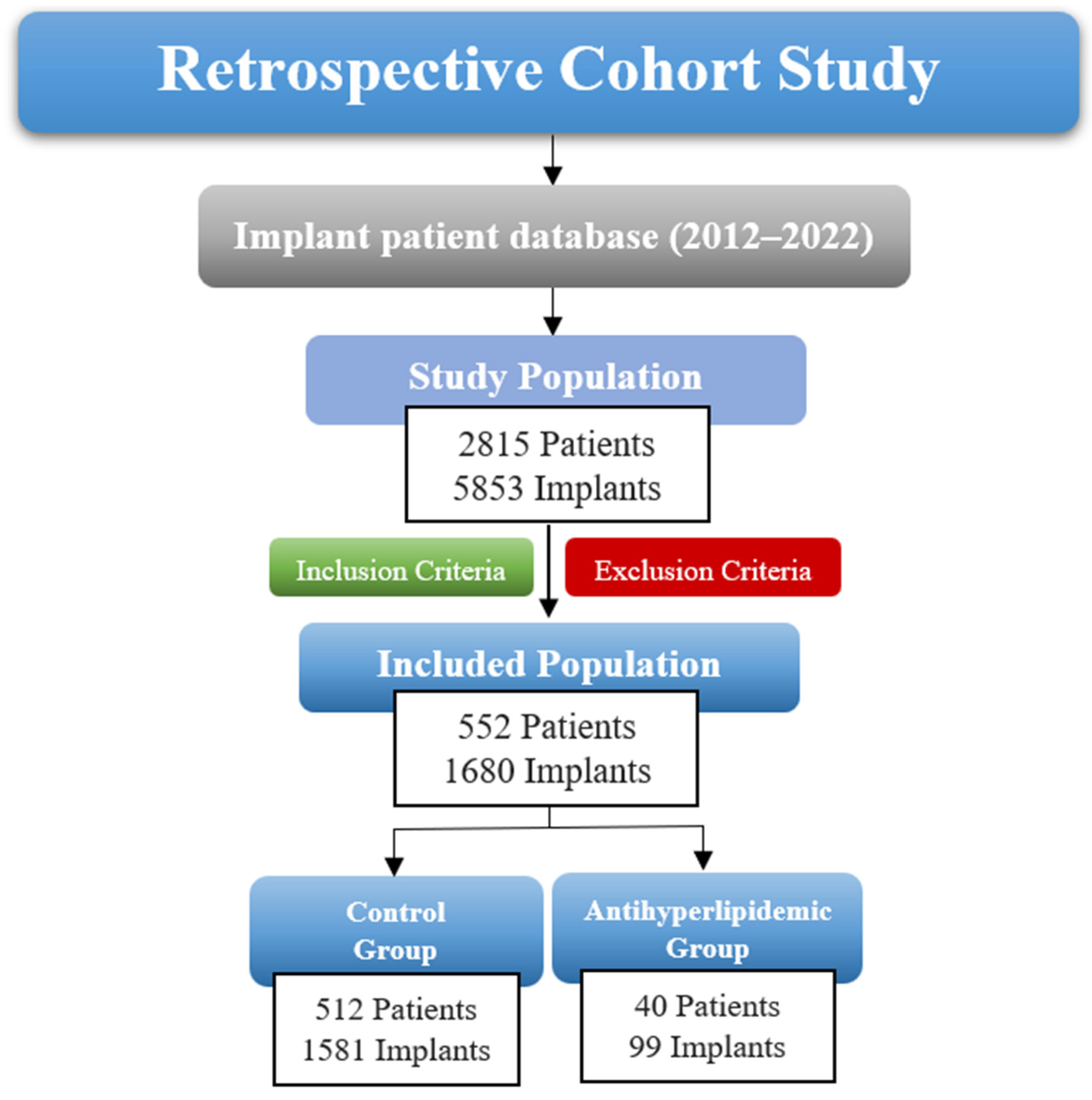
A total of 552 patients receiving 1680 dental implants met the predefined inclusion criteria and were included in the study population. Based on medication status, the participants were categorized into two groups. The control group consisted of 512 patients who were not receiving antihyperlipidemic therapy and accounted for a total of 1581 implants. The study group comprised 40 patients undergoing antihyperlipidemic monotherapy, in whom 99 dental implants were placed (
Figure 1). The antihyperlipidemic monotherapy group consisted exclusively of statin users. The observed disparity in sample sizes between groups was rigorously addressed using appropriate statistical methods such as survival analyses and multivariable regression models. This ensured that group comparisons remained valid and that the study findings were robust and scientifically reliable, accounting for unequal group sizes and potential confounding variables.
2.5. Implant Placement and Postoperative Protocols
Implant surgery was performed under local anesthesia using 1.8 mL of 4% Articaine with 1:100,000 epinephrine. For patients with insufficient bone volume, augmentation procedures, including lateral bone grafting or sinus membrane elevation, were performed six months prior to implant placement. Postoperatively, patients were instructed to rinse with 0.12% chlorhexidine three times daily for seven days and to follow a soft diet. A prophylactic antibiotic regimen of 1 g amoxicillin® orally twice daily for seven days was prescribed, along with analgesics (paracetamol® 2 × 500 mg every six hours as needed). Follow-up visits were scheduled 7–10 days post-surgery for suture removal and reinforcement of oral hygiene instructions. Prior to prosthesis placement, osseointegration was assessed clinically and radiographically to monitor bone stability and detect potential resorption or mobility.
2.6. Study Outcomes and Follow-Up
The primary outcome was implant failure. Patients were followed until implant failure occurred, death, or loss to follow-up before the study endpoint. Implant failure was defined according to the Pisa Consensus Conference guidelines of the International Congress of Oral Implantologists (ICOI) as described by Misch et al. [
18]. Failure criteria included functional pain, implant mobility, radiographic bone loss ≥ 50% of implant length, persistent exudate, or implant loss. Clinical and radiographic assessments were conducted throughout follow-up, evaluating implant stability, peri-implant bone levels, and signs of infection. Each implant was classified according to failure occurrence.
Follow-up duration was determined from the date of implant placement to the most recent clinical examination recorded in the patient files. Throughout the observation period, clinical and radiographic assessments were performed to evaluate implant stability, peri-implant bone levels, the presence of infection, and peri-implant bone loss. Radiographic evaluation was carried out by a single calibrated operator using periapical radiographs obtained with the long-cone paralleling technique and Rinn film holders (exposure parameters: 0.25 s, 65 kV, 2 mA).
Medication use was verified at each follow-up visit through review of the patient’s medical records. In addition, plaque control, periodontal status, and the frequency and quality of supportive peri-implant care (SPIC), as well as the cleanability of the prosthetic restorations, were systematically assessed. Radiographs were digitally archived using Soft-Dent DBSWIN® software version 5.17 (Dürr Dental, Bietigheim-Bissingen, Germany). Measurements were calibrated according to the known implant length to ensure precise determination of the distance between the crestal bone level and the implant platform. Information regarding implant failures and their reported causes was extracted from the corresponding implant records of the included patients.
2.7. Statistical Methods
Statistical analysis was performed using IBM SPSS Statistics for Windows, Version 25.0 (Released 2017; IBM Corp., Armonk, NY, USA). Quantitative variables are presented as means ± standard deviations (SD) with 95% confidence intervals (CI), and qualitative variables as frequencies and percentages. Implant survival differences between the Monotherapy Antihyperlipidemic Group and the Healthy Control Group were analyzed using log-rank tests and Kaplan–Meier survival curves.
Cox regression analysis was performed to evaluate the impact of relevant clinical variables (age, sex, implant diameter and length, insertion torque, and bone quality) on implant survival across both groups, while accounting for censored data. The model was assessed using the Omnibus test, and hazard ratios with corresponding 95% confidence intervals and p-values were reported. Statistical significance was defined as p < 0.05.
Overall, a comprehensive survival analysis framework, including Kaplan–Meier estimation, log-rank testing, multivariable Cox proportional hazards regression, and the Omnibus test for overall model significance, was applied to ensure robust, risk-adjusted comparisons between groups in the presence of unequal sample sizes and censored time-to-event data, thereby strengthening the reliability and internal validity of the study findings.
3. Results
Between 2012 and 2022, a total of 552 patients met the inclusion criteria, including 512 non-users (control group) and 40 patients receiving monotherapy antihyperlipidemic drugs. Overall, 1680 osseointegrated dental implants were evaluated, of which 1581 were placed in non-users and 99 in patients using antihyperlipidemic monotherapy. The analysis was structured into two primary objectives: first, to assess whether a significant difference in implant survival existed between the two groups over the 10-year study period, and second, to determine whether implant failure rates differed significantly between antihyperlipidemic drug users and non-users. The two groups were comparable with respect to variables known to potentially influence bone metabolism and implant survival, including gender, age, implant length, implant diameter, insertion torque, and bone type (
Table 1).
The descriptive analysis evaluated differences in implant-related characteristics between users and non-users of antihyperlipidemic drugs. A statistically significant association was identified for gender, with males demonstrating a lower likelihood of antihyperlipidemic drug use compared with females (OR = 0.61; 95% CI: 0.39–0.96;
p = 0.033). Age was also significantly associated with drug use, as patients older than 65 years were more likely to receive antihyperlipidemic therapy (OR = 3.24; 95% CI: 2.13–4.93;
p < 0.001). With respect to implant geometry, implant length did not differ significantly between the groups (
p = 0.111); however, implants with a diameter greater than 4 mm were significantly more frequent among antihyperlipidemic drug users (OR = 1.70; 95% CI: 1.11–2.59;
p = 0.014). Furthermore, higher insertion torque (>30 Ncm) was significantly more prevalent in the user group (OR = 3.31; 95% CI: 1.82–6.01;
p < 0.001). No statistically significant associations were observed regarding bone quality for bone types 2 or 3 (
p > 0.05), while no antihyperlipidemic drug users were identified in the bone type 4 category (
p = 0.999) (
Table 1).
In the antihyperlipidemic drug user group, 71 implants were placed in female patients, with one recorded failure, while 27 implants were placed in male patients, with no failures. In the non-user group, 937 implants were placed in female patients, of which 42 failed, and 563 implants were placed in male patients, with 39 failures. The mean follow-up period for the study population was 73.2 months (SD = 71.4) (
Table 2).
The multifactorial failure analysis evaluated the risk of implant failure, expressed as Hazard Ratios (HR), within the antihyperlipidemic drug user group. Across all examined variables, gender was the only variable to show a statistically significant association with implant failure within the two groups. Women were found to have a significantly higher risk of implant failure compared to men (HR 1.71, 95% CI 1.08–2.71,
p = 0.021). All other examined variables, including age, implant length, diameter, and insertion torque, showed no statistically significant associations (
p > 0.05 for all) (
Table 2).
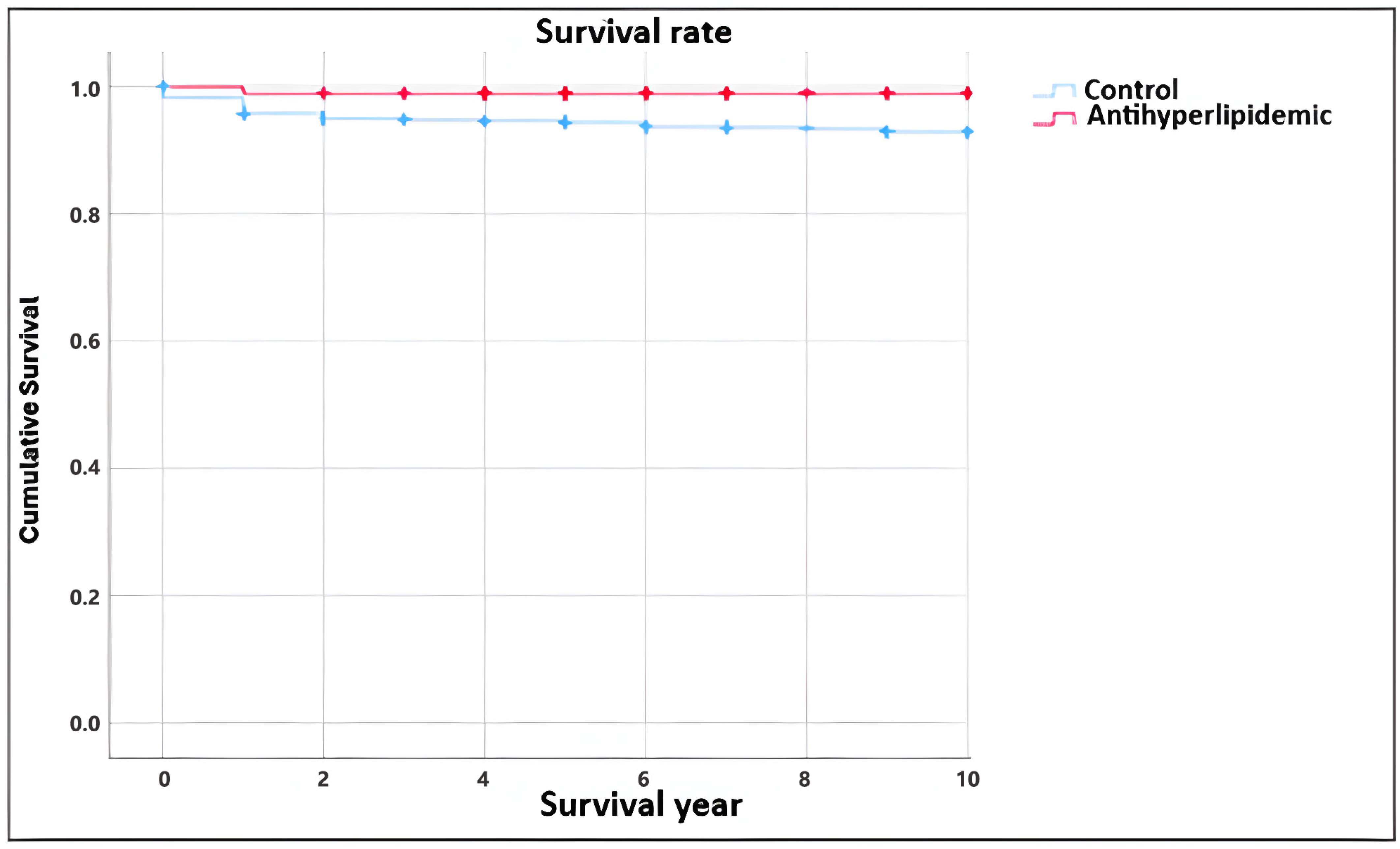
Over the entire observation period, 1598 implants survived while 82 implants failed, corresponding to an overall survival rate of 95.1%. Within the 10-year retrospective cohort, implant survival was 98.99% in the antihyperlipidemic drug user group and 94.88% in the non-user group. Kaplan–Meier survival curve analysis was performed to compare survival trends between the two groups, providing a balanced assessment and minimizing potential bias associated with long-term data collection. The survival curves demonstrated a gradual decline in implant survival probability for both groups, with the antihyperlipidemic drug user group consistently exhibiting higher survival probabilities than the non-user group (
Figure 2). Statistical significance of these trends was evaluated using the Log-Rank (Mantel–Cox) test, a non-parametric method for comparing survival distributions over time. The test yielded a chi-square value of 3.966 and a
p-value of 0.046, indicating a statistically significant difference in implant survival between the two groups (
Table 3).
A fixed-effects logistic regression model was applied to evaluate implant failure probabilities within each group. The analysis indicated that the non-user group experienced an implant failure rate of 5.12%, corresponding to an odds ratio of 0.054. In contrast, the antihyperlipidemic drug user group demonstrated a statistically significant improvement in implant survival, with an odds ratio of 0.194 (95% CI: 0.027–1.414;
p = 0.005) (
Table 4).
The overall significance of the regression model was evaluated using the Omnibus test. Cox proportional hazards regression analysis was performed to identify factors influencing implant survival while adjusting for potential confounders, including antihyperlipidemic drug use, age, gender, implant length, implant diameter, insertion torque, and bone type. Among these variables, gender demonstrated a statistically significant effect, with female patients exhibiting a higher risk of implant failure compared to male patients [OR (95% CI): 1.58 (1.13–2.22);
p = 0.008]. Additionally, antihyperlipidemic drug use was associated with a significant positive effect on implant survival [OR (95% CI): 0.16 (0.02–1.15);
p = 0.048]. The Omnibus test yielded a
p-value of <0.05, confirming the overall statistical significance of the model and supporting the observed associations between these factors and implant survival (
Table 5).
4. Discussion
Dental implants are widely regarded as a first-line therapy for replacing one or more missing teeth, with long-term survival rates reported between 90 and 95% [
2]. As implant therapy demonstrates consistently high success, an increasing number of patients with systemic medical conditions seek this treatment [
9]. However, systemic diseases and the pharmacological agents used to manage them can influence osseointegration and implant survival. Chronic systemic conditions and the medications used to manage them have been shown to affect osseointegration and the long-term success of dental implants [
7].
The current study demonstrates that antihyperlipidemic therapy, specifically statin use in patients with hyperlipidemia, may actively be associated with enhanced dental implant survival, likely through beneficial effects on bone metabolism. Statins, commonly prescribed to manage hyperlipidemia, inhibit 3-hydroxy-3-methylglutaryl coenzyme A (HMG-CoA) reductase in hepatocytes, blocking the conversion of HMG-CoA to mevalonic acid [
19]. Beyond their lipid-lowering properties, statins have been shown to promote osteogenesis and bone remodeling, which may explain their protective effect on implant survival [
7].
In this retrospective cohort study, patients receiving antihyperlipidemic demonstrated significantly higher implant survival rates compared to controls. Kaplan–Meier survival curves indicated that survival probabilities for the antihyperlipidemic group consistently exceeded those of the control group throughout the observation period (
Figure 2). The Log-Rank test confirmed a statistically significant difference between the groups (Chi-square = 3.966,
p = 0.046) (
Table 3). Implant failure rates were 5.12% in controls versus 1.01% in the antihyperlipidemic group, corresponding to a 5.07 times higher risk of failure in the control group (
Table 4). Cox regression analysis further demonstrated that antihyperlipidemic use was associated with a hazard ratio of 0.16 (95% CI: 0.02–1.15), suggesting a substantial reduction in implant failure risk (
Table 5). Collectively, these findings indicate that systemic antihyperlipidemic therapy may confer a protective effect on dental implants.
Extensive preclinical and clinical evidence supports the biological basis for these observations. Wang et al. reported that statins increase bone mineral density, although further research is required to fully understand their effects on bone metabolism [
20]. Sendyk et al. conducted a systematic review demonstrating that statins significantly improve bone-to-implant contact (BIC) across thirteen histomorphometry studies [
21]. Kellesarian et al. [
22] confirmed in animal models that both local and systemic statin administration enhances bone development and mineralization, improving BIC and mechanical properties of implant surfaces. Moraschini et al. reported that topical or surface-applied simvastatin and fluvastatin significantly enhance peri-implant osteogenesis [
23]. Tahamtan et al. [
24] consistently observed increased new bone formation (NBF) and bone density around implants with both local and systemic statin administration. Katanec et al. further confirmed that statins delivered via multiple routes, including systemic, local, oral, subcutaneous, or intraosseous, enhance osseointegration, implant–bone surface contact, and newly formed bone volume [
25]. Zidrou et al. similarly reported that statins stimulate bone remodeling, promote tissue maturation around implants, and improve overall dental implant osseointegration [
26].
In addition to pharmacological effects, biological sex emerged as a significant determinant of implant outcomes. This analysis revealed a higher prevalence of long-term implant failures among females compared to males (
Table 2). Cox regression confirmed that females exhibited a significantly higher risk of implant failure, with a hazard ratio of 1.58 (95% CI: 1.13–2.22;
p = 0.008) (
Table 5). Epidemiological and clinical evidence supports sex-based differences in disease progression, symptom expression, and therapeutic response [
27,
28], emphasizing the importance of considering sex as a variable in medicated populations.
From a biological perspective, estrogen plays a critical role in maintaining bone homeostasis. Estrogen deficiency enhances osteoclast activity and bone resorption by impairing osteoprotegerin (OPG) production, which normally binds RANKL and inhibits osteoclast activation [
27,
28]. Absence of estrogen prolongs osteoclast lifespan, reduces osteoblast survival, and amplifies T lymphocyte-mediated RANKL production, collectively shifting bone remodeling toward resorption. Postmenopausal estrogen decline further impairs skeletal stem cell differentiation, diminishes regenerative capacity, and disrupts the balance between osteoblasts and osteoclasts [
29,
30]. Estrogen deficiency also alters macrophage polarization, slowing regenerative processes and exacerbating bone loss [
27]. These mechanisms explain the heightened susceptibility of postmenopausal women to implant failure and underscore the interplay between sex hormones and pharmacological therapies; however, hormonal status was not recorded in this cohort, and this interpretation remains speculative.
Taken together, this highlights the dual importance of systemic pharmacological therapy and biological sex in dental implant outcomes. Antihyperlipidemic therapy, particularly statins, appears to enhance implant survival through osteogenic and anti-resorptive mechanisms, whereas postmenopausal estrogen deficiency represents a risk factor for implant failure. These insights provide a foundation for integrating systemic pharmacological strategies with optimized implant design, aiming to maximize long-term osseointegration and clinical success.
Strengths and Limitations
This study is the first to compare a mono-medicated antihyperlipidemic cohort with healthy controls regarding long-term dental implant survival. By focusing on a single-drug cohort, the design minimized potential confounding from pharmacological interactions observed in previous retrospective studies.
The robustness of the findings was supported through comprehensive statistical modelling, including Kaplan–Meier survival analysis, Cox regression, and Omnibus testing. Multilevel survival modelling allowed adjustment for potential confounders, and oral hygiene did not show a statistically significant effect on implant survival within the studied groups.
Adherence to antihyperlipidemic therapy is generally high, reported at up to 88%, and the skeletal effects of these medications are primarily time-dependent rather than strictly dose-dependent, reinforcing the clinical relevance of the results [
31].
Nevertheless, several limitations should be acknowledged. The retrospective design and reliance on self-reported medical information may have introduced recall bias. Additionally, group imbalances, lack of randomization, and absence of blinding may have contributed to selection bias. These factors highlight the need for future prospective studies to confirm and extend these findings. Additionally, implant-level observations may not have been fully independent because multiple implants were placed in some patients, which could have influenced variance estimates. These factors underscore the need for future prospective, randomized controlled studies involving larger, well-balanced cohorts and standardized treatment protocols to robustly validate the present findings, which should therefore be interpreted within a hypothesis-generating framework providing preliminary evidence on the association between antihyperlipidemic therapy and dental implant survival.



 ,
,