
The Ritual Logic of Attention-Based Politics: Legitimacy, Recognition, and Platformised Participation


Abstract
1. Introduction
2. The Ritual Logic of Attention
2.1. Recognition as Ritual Currency
2.2. Legitimacy Under Platformised Participation
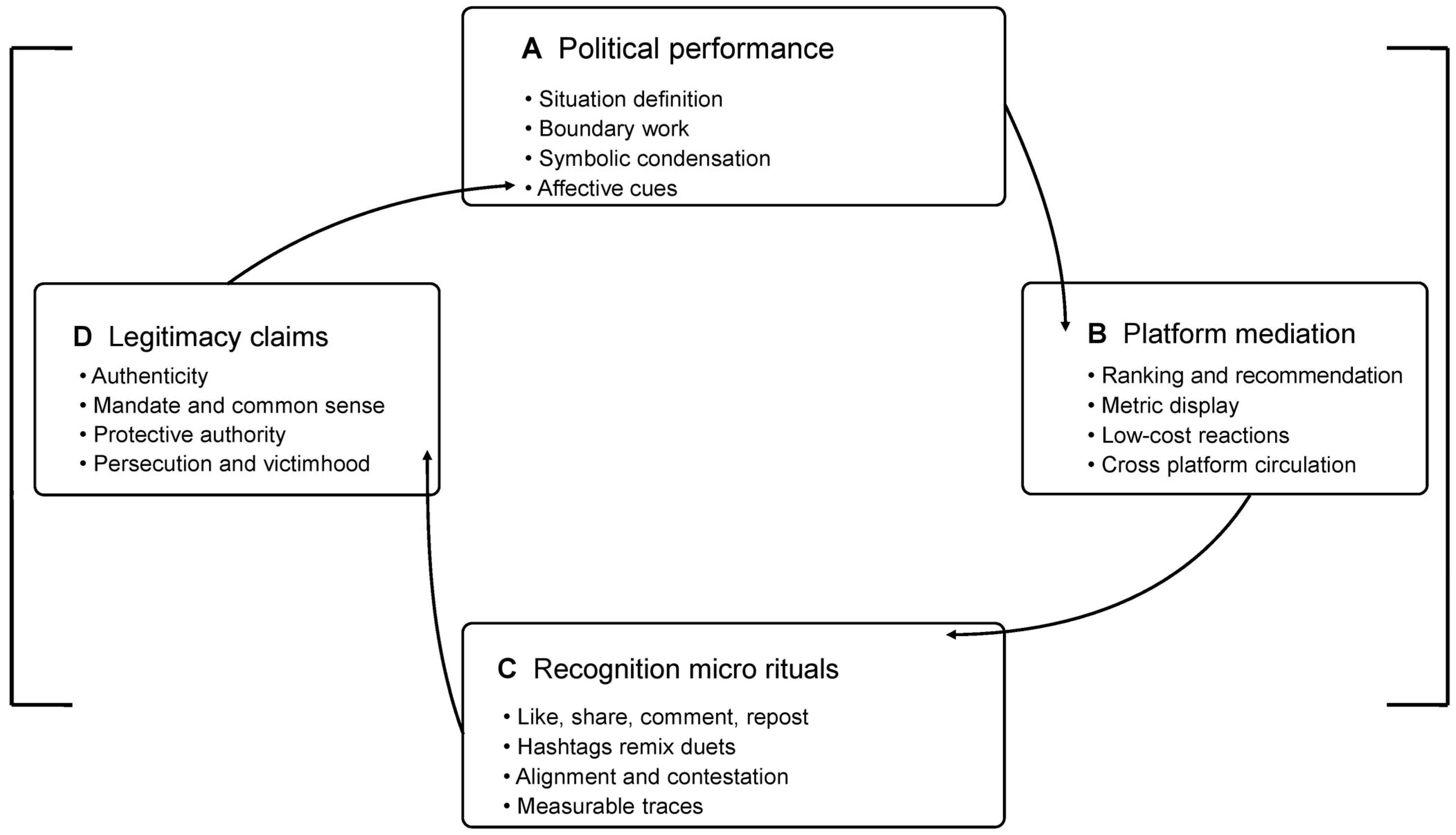
2.3. The Ritual Circuit of Attention-Based Politics
3. Analytical Strategy of the Framework
3.1. Illustrative Episode Families
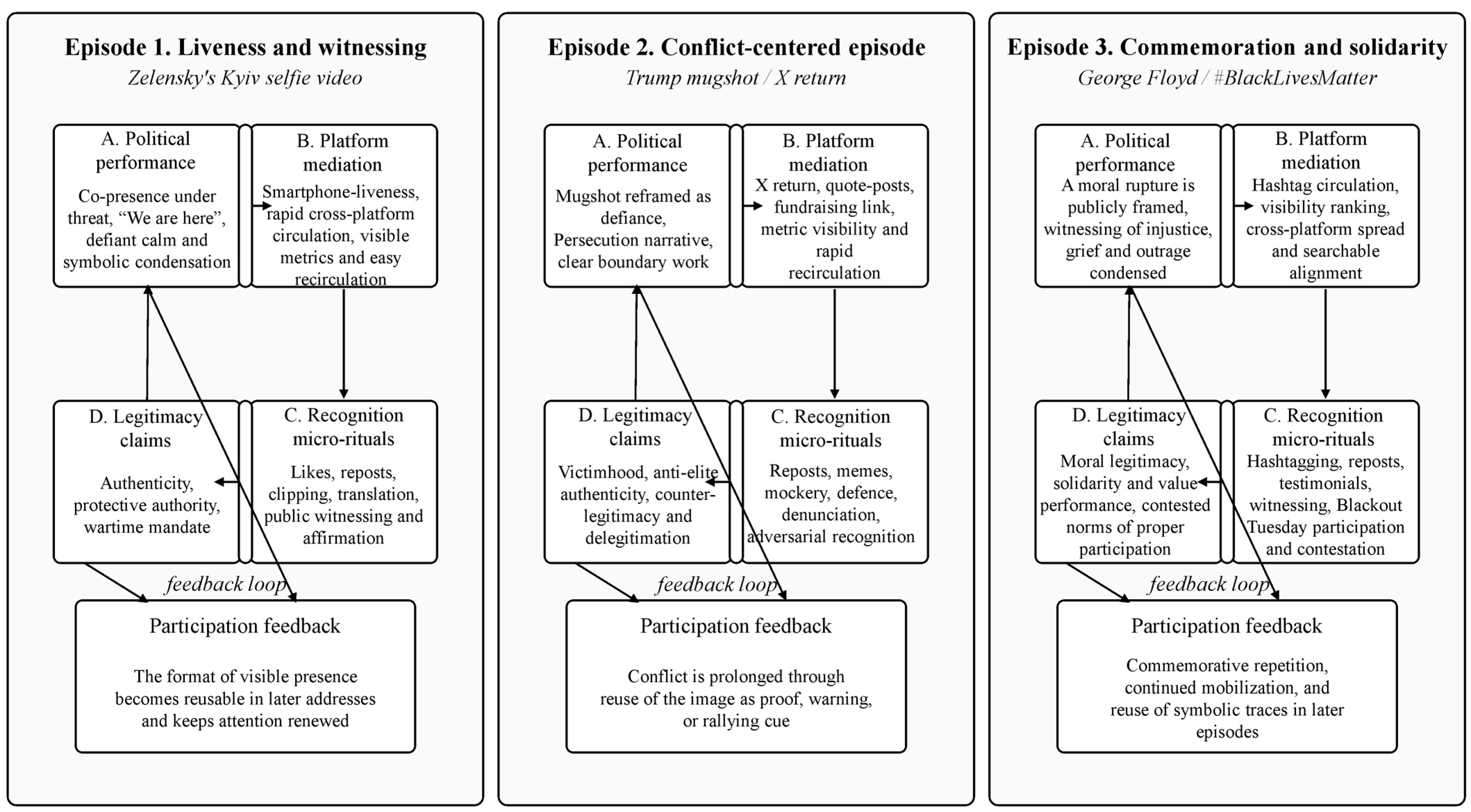
3.2. Ritual Episodes as Analytical Probes
3.3. Scope Conditions and Limits of the Framework
4. Analytical Demonstrations of the Framework
4.1. Recognition and the Public Ratification of Visibility
4.2. Boundary Work, Value Alignment, and Moral Differentiation
4.3. Emotion Management and Affective Durability
5. Toward a Comparative Vocabulary of Online Political Media Rituals
6. Discussion and Conclusions
Funding
Institutional Review Board Statement
Informed Consent Statement
Data Availability Statement
Acknowledgments
Conflicts of Interest
References
- Altheide, D. L. (2020). Pandemic in the time of Trump: Digital media logic and deadly politics. Symbolic Interaction, 43(3), 514–540. [Google Scholar] [CrossRef]
- Anderson, M., Barthel, M., Perrin, A., & Vogels, E. A. (2020). #BlackLivesMatter surges on Twitter after George Floyd’s death. Pew Research Center. Available online: https://www.pewresearch.org/short-reads/2020/06/10/blacklivesmatter-surges-on-twitter-after-george-floyds-death/ (accessed on 2 December 2025).
- Barberá, P., Casas, A., Nagler, J., Egan, P. J., Bonneau, R., Jost, J. T., & Tucker, J. A. (2019). Who leads? Who follows? Measuring issue attention and agenda setting by legislators and the mass public using social media data. American Political Science Review, 113(4), 883–901. [Google Scholar] [CrossRef]
- Beer, D. (2016). Metric power. Springer. [Google Scholar] [CrossRef]
- Bennett, W. L., & Livingston, S. (2018). The disinformation order: Disruptive communication and the decline of democratic institutions. European Journal of Communication, 33(2), 122–139. [Google Scholar] [CrossRef]
- Bennett, W. L., & Segerberg, A. (2012). The logic of connective action: Digital media and the personalization of contentious politics. Information, Communication & Society, 15(5), 739–768. [Google Scholar] [CrossRef]
- Biswas, A., Lin, Y.-R., Tai, Y. C., & Desmarais, B. A. (2025). Political elites in the attention economy: Visibility over civility and credibility? In Proceedings of the international AAAI conference on web and social media, Copenhagen, Denmark, June 23–26 (Vol. 19, pp. 241–258). AAAI. [Google Scholar] [CrossRef]
- Brubaker, R. (2017). Between nationalism and civilizationism: The European populist moment in comparative perspective. Ethnic and Racial Studies, 40(8), 1191–1226. [Google Scholar] [CrossRef]
- Bucher, T. (2012). Want to be on the top? Algorithmic power and the threat of invisibility on Facebook. New Media & Society, 14(7), 1164–1180. [Google Scholar] [CrossRef]
- Burgess, J., Mitchell, P., & Münch, F. V. (2018). Social media rituals: The uses of celebrity death in digital culture. In Z. Papacharissi (Ed.), A networked self and birth, life, death (pp. 224–239). Routledge. [Google Scholar] [CrossRef]
- Carey, J. W. (2002). Political ritual on television: Episodes in the history of shame, degradation and excommunication. In J. Curran, & T. Liebes (Eds.), Media, ritual and identity (pp. 42–70). Routledge. [Google Scholar]
- Carey, J. W. (2009). Communication as culture, revised edition: Essays on media and society. Routledge. [Google Scholar]
- Chang, H.-C. H., Richardson, A., & Ferrara, E. (2022). #JusticeforGeorgeFloyd: How Instagram facilitated the 2020 black lives matter protests. PLoS ONE, 17(12), e0277864. [Google Scholar] [CrossRef]
- Collins, R. (2005). Interaction ritual chains. Princeton University Press. [Google Scholar]
- Coster, H., & Dang, S. (2023). Trump returns to X, formerly Twitter, with mug shot and appeal for donations. Reuters. Available online: https://www.reuters.com/technology/trump-returns-social-media-site-x-formerly-twitter-with-mug-shot-post-2023-08-25/ (accessed on 26 January 2026).
- Couldry, N. (2003). Media rituals: A critical approach. Routledge. [Google Scholar]
- Couldry, N., & Hepp, A. (2017). The mediated construction of reality. Polity Press. [Google Scholar]
- Covington, P., Adams, J., & Sargin, E. (2016). Deep neural networks for YouTube recommendations. In Proceedings of the 10th ACM conference on recommender systems, Boston, MA, USA, 15–19 September (pp. 191–198). Association for Computing Machinery. [Google Scholar] [CrossRef]
- Cui, X. (2019). Mediatized rituals: Understanding the media in the age of deep mediatization. International Journal of Communication, 13, 4155–4168. [Google Scholar]
- Dayan, D., & Katz, E. (1992). Media events: The live broadcasting of history. Harvard University Press. [Google Scholar]
- Edelman, M. (1988). Constructing the political spectacle. University of Chicago Press. [Google Scholar]
- Enli, G. (2015). Mediated authenticity: How the media constructs reality. Peter Lang. [Google Scholar]
- Frosh, P., & Pinchevski, A. (2018). Media and events after media events. Media, Culture & Society, 40(1), 135–138. [Google Scholar] [CrossRef]
- Gilardi, F., Gessler, T., Kubli, M., & Müller, S. (2022). Social media and political agenda setting. Political Communication, 39(1), 39–60. [Google Scholar] [CrossRef]
- Gillespie, T. (2018). Custodians of the internet: Platforms, content moderation, and the hidden decisions that shape social media. Yale University Press. [Google Scholar]
- Goffman, E. (1959). The presentation of self in everyday life. Doubleday Anchor. [Google Scholar]
- Goffman, E. (1986). Frame analysis: An essay on the organization of experience. Northeastern University Press. [Google Scholar]
- González-Bailón, S., d’Andrea, V., Freelon, D., & De Domenico, M. (2022). The advantage of the right in social media news sharing. PNAS Nexus, 1(3), pgac137. [Google Scholar] [CrossRef]
- Hallgren, L. (2025). The symbiotic relationship between Volodymyr Zelensky and Western news: Authenticity and performance in Ukraine’s fight against Russia. Media, War & Conflict, 18(2), 197–213. [Google Scholar] [CrossRef]
- Hatfield, J. E. (2024). Valuing trans lives after suicide: Rituals of commemoration in digital social media culture. Social Media + Society, 10(3), 20563051241274680. [Google Scholar] [CrossRef]
- Hepp, A. (2019). Deep mediatization. Routledge. [Google Scholar]
- Jungherr, A., & Schroeder, R. (2023). Artificial intelligence and the public arena. Communication Theory, 33(2–3), 164–173. [Google Scholar] [CrossRef]
- Kirby, D., & Özkula, S. M. (2023). The dead pig’s photo album: Affective visual rituals in collective identity formation. International Journal of Cultural Studies, 26(5), 567–587. [Google Scholar] [CrossRef]
- Krzyżanowski, M. (2020). Discursive shifts and the normalisation of racism: Imaginaries of immigration, moral panics and the discourse of contemporary right-wing populism. Social Semiotics, 30(4), 503–527. [Google Scholar] [CrossRef]
- Merkovity, N. (2017). Introduction to attention-based politics. Przegląd Politologiczny (Political Science Review), 2017(4), 47–59. [Google Scholar] [CrossRef]
- Merkovity, N. (2019). A possible framework for attention-based politics: A field for research. International Journal of E-Politics, 10(2), 13–23. [Google Scholar] [CrossRef]
- Papacharissi, Z. (2015). Affective publics: Sentiment, technology, and politics. Oxford University Press. [Google Scholar]
- Pardes, A. (2020). On Instagram, black squares overtook activist hashtags. Wired. Available online: https://www.wired.com/story/instagram-black-squares-overtook-activist-hashtags/ (accessed on 3 February 2026).
- Pauha, T. (2024). Ritual dynamics of Qur’an burning. Temenos—Nordic Journal for the Study of Religion, 60(1), 57–80. [Google Scholar] [CrossRef]
- Rothenbuhler, E. W. (2006). Ritual. In G. J. Shepherd, J. S. John, & T. Striphas (Eds.), Communication as…: Perspectives on theory (pp. 13–21). SAGE. [Google Scholar]
- Slattery, G., Layne, N., & Brittain, B. (2023). Divided US embraces Trump mug-shot merchandise. Reuters. Available online: https://www.reuters.com/world/us/divided-us-embraces-trump-mug-shot-merchandise-2023-08-25/ (accessed on 24 April 2026).
- Suchman, M. C. (1995). Managing legitimacy: Strategic and institutional approaches. The Academy of Management Review, 20(3), 571–610. [Google Scholar] [CrossRef]
- Tikka, M. (2019). Ritualisation of crisis communication: Crowd-enabled responses to the Stockholm terror attack on Twitter. Nordicom Review, 40(1), 105–120. [Google Scholar] [CrossRef]
- Trillò, T., Hallinan, B., & Shifman, L. (2022). A typology of social media rituals. Journal of Computer-Mediated Communication, 27(4). [Google Scholar] [CrossRef]
- Tufekci, Z. (2013). “Not this one”: Social movements, the attention economy, and microcelebrity networked activism. American Behavioral Scientist, 57(7), 848–870. [Google Scholar] [CrossRef]
- Ural, H. (2023). Rethinking affective publics as media rituals through temporality, performativity and liminality. Media, Culture & Society, 45(5), 1036–1049. [Google Scholar] [CrossRef]
- Valaskivi, K., Sumiala, J., & Tikka, M. (2022). Ambivalent rituals of belonging: (Re)theorising hybrid, violent media events. Nordic Journal of Media Studies, 4(1), 81–98. [Google Scholar] [CrossRef]
- van Dijck, J. (2020). Governing digital societies: Private platforms, public values. Computer Law & Security Review, 36, 105377. [Google Scholar] [CrossRef]
- van Dijck, J., Poell, T., & de Waal, M. (2018). The platform society. Oxford University Press. [Google Scholar] [CrossRef]
- Webster, J. G. (2011). The duality of media: A structurational theory of public attention. Communication Theory, 21(1), 43–66. [Google Scholar] [CrossRef]
- Webster, J. G. (2016). The marketplace of attention: How audiences take shape in a digital age. MIT Press. [Google Scholar]
- Wells, C., & Friedland, L. A. (2023). Recognition crisis: Coming to terms with identity, attention and political communication in the twenty-first century. Political Communication, 40(6), 681–699. [Google Scholar] [CrossRef]
- Yeung, K. (2018). Algorithmic regulation: A critical interrogation. Regulation & Governance, 12(4), 505–523. [Google Scholar] [CrossRef]
- zelenskyy_official. (2022). We are here. We are in Kyiv. We defend Ukraine. Instagram. Available online: https://www.instagram.com/p/CaaFzibgLES/ (accessed on 26 March 2026).
- Zerubavel, E. (1991). The fine line: Making distinctions in everyday life. University of Chicago Press. [Google Scholar]



| Illustrative Episode | Ritual Configuration | Temporal Form | Dominant Participation Mode | Dominant Legitimacy Mode | Main Ritual Effect |
|---|---|---|---|---|---|
| Zelensky’s Kyiv selfie video | Concentrated witnessing | Concentrated | Witnessing and protective co-presence | Protective legitimacy | Protective authority ratified through shared witnessing |
| Trump’s Fulton County mugshot | Cyclical antagonism | Cyclical | Antagonistic alignment and adversarial recirculation | Persecuted authenticity | Symbolic centrality renewed through adversarial recirculation |
| George Floyd protest wave | Prolonged commemorative alignment | Prolonged | Commemorative alignment and moral witnessing | Moral restoration | Moral claims stabilised through commemorative witnessing |
Disclaimer/Publisher’s Note: The statements, opinions and data contained in all publications are solely those of the individual author(s) and contributor(s) and not of MDPI and/or the editor(s). MDPI and/or the editor(s) disclaim responsibility for any injury to people or property resulting from any ideas, methods, instructions or products referred to in the content. |
© 2026 by the author. Licensee MDPI, Basel, Switzerland. This article is an open access article distributed under the terms and conditions of the Creative Commons Attribution (CC BY) license.
Share and Cite
Merkovity, N. The Ritual Logic of Attention-Based Politics: Legitimacy, Recognition, and Platformised Participation. Journal. Media 2026, 7, 93. https://doi.org/10.3390/journalmedia7020093
Merkovity N. The Ritual Logic of Attention-Based Politics: Legitimacy, Recognition, and Platformised Participation. Journalism and Media. 2026; 7(2):93. https://doi.org/10.3390/journalmedia7020093
Chicago/Turabian StyleMerkovity, Norbert. 2026. "The Ritual Logic of Attention-Based Politics: Legitimacy, Recognition, and Platformised Participation" Journalism and Media 7, no. 2: 93. https://doi.org/10.3390/journalmedia7020093
APA StyleMerkovity, N. (2026). The Ritual Logic of Attention-Based Politics: Legitimacy, Recognition, and Platformised Participation. Journalism and Media, 7(2), 93. https://doi.org/10.3390/journalmedia7020093