
Article

Impact of AIFS and GFS Initialization on WRF Operational Forecasts During High-Impact Storms in Spain (2025)


by
Raúl Arasa Agudo
1,*,
Matilde García-Valdecasas Ojeda
2,3,
Miquel Picanyol Sadurní
4 and
Bernat Codina Sánchez
1,5
1
Applied Technology Department, Meteosim, 08028 Barcelona, Spain
2
Applied Physics Department, University of Granada, 18071 Granada, Spain
3
Interuniversity Institute for Earth System Research in Andalusia (IISTA), 18006 Granada, Spain
4
Software Engineering Department, Meteosim, 08028 Barcelona, Spain
5
Applied Physics Department, University of Barcelona, 08028 Barcelona, Spain
*
Author to whom correspondence should be addressed.
Earth 2026, 7(3), 77; https://doi.org/10.3390/earth7030077
Submission received: 15 March 2026 / Revised: 13 April 2026 / Accepted: 2 May 2026 / Published: 9 May 2026

Abstract

The Artificial Intelligence Forecasting System (AIFS), recently released by the European Centre for Medium-Range Weather Forecasts (ECMWF), represents a major shift in global weather prediction by replacing traditional physically based approaches with machine-learning methods. This study evaluates the impact of using AIFS as initial and lateral boundary conditions for the Weather Research and Forecasting (WRF) model, in contrast to the well-established physically based GFS. The aim of this work is to analyze the sensitivity of these different modelling configurations during three high-impact storms that affected Spain in 2025 and the effects of replacing GFS for AIFS as lateral and boundary conditions for WRF over the accuracy of operational forecasts. The analysis focuses on maximum wind gusts, accumulated precipitation, and the generation of meteorological warnings. Results show that AIFS substantially underestimates wind gusts with mean bias values between −13 and −25 km/h, and its forecasts differ markedly from those of GFS. When coupled with WRF, however, both AIFS-WRF and GFS-WRF produce similar results, with a general tendency to overestimate gusts, with mean bias values between 4 and 15 km/h. In all cases, WRF adds value, improving the representation of wind-related variables compared with the raw global model outputs. For accumulated precipitation, both WRF configurations reproduce the main rainfall patterns associated with the storms. AIFS-WRF shows a stronger tendency to overestimate precipitation, with RMSE values of 64, 23, and 12 mm for the different high-impact storms considered, although it also achieves the highest correlations. Finally, the analysis of meteorological warnings indicates that AIFS alone generates almost no wind gusts alerts. Once coupled with WRF, both configurations generate warnings in the regions where the most severe conditions occurred. Overall, while the added value of mesoscale models such as WRF is well established and confirmed here, the AI-based AIFS does not show clear advantages in comparison with traditional global models for these high-impact events being analyzed.

1. Introduction

Weather forecasts based on modelling tools have become essential for managing potential extreme meteorological phenomena and have contributed to protecting human lives [1]. They also constitute a fundamental input variable for a wide range of prediction applications, such as air quality [2,3,4], hydrology [5], wind and solar resource assessments [6,7], forest fire risk [8], and ocean waves and marine currents [9]. Moreover, in a climate change scenario, where extreme events may become more frequent and intense [10], these forecasts are gaining even more relevance.
National meteorological agencies, research institutes, universities, and private companies have traditionally used models that solve the equations governing the atmospheric dynamics to provide global-scale forecasts—e.g., the Global Forecasting System (GFS) [11] or the Integrated Forecasting System (IFS) [12]—as well as regional- or local-scale forecasts using limited-area models (LAM), such as the Weather Research and Forecasting model (WRF) [13] or the Harmonie–Arome model [14].
Recent advances in artificial intelligence have led to the emergence of AI-based models for weather forecasting applications. Models such as GraphCast [15], Pangu-Weather [16] or FourCastNet [17], among others, have demonstrated the ability to provide weather forecasts with equal or even greater accuracy than numerical models under certain conditions [18,19], although some limitations have been identified [20,21,22].
In recent years, the European Centre for Medium-Range Weather Forecasts (ECMWF) has developed a new artificial-intelligence-based model, AIFS (Artificial/Integrated Forecasting System) [23,24]. AIFS was trained using historical data from the ECMWF Reanalysis v5 (ERA5) [25] for the period 1979–2022, together with IFS forecasts from 2016 to 2022 [26].
In February 2025, ECMWF publicly released operational AIFS forecasts (available online: https://confluence.ecmwf.int/display/fcst/implementation+oF+Aifs+Single+v1 (accessed on 15 January 2026)). To the authors knowledge, no published studies have yet evaluated their application and impact as initial and lateral boundary conditions (LBC) for limited-area models. This research aims to assess how the use of AIFS predictions influences mesoscale forecasts generated by the WRF model, compared with those obtained using GFS output as initial and LBC, extending a previous study on air quality applications [27]. Here, the main interest is the analysis of the sensitivity of WRF to different global model initializations for the prediction of precipitation events and high winds. Modelling periods containing relevant episodes of precipitation and high winds were selected. The studied area corresponds to the Iberian Peninsula (IP), with a specific focus on Spain.
The study developed is significant because no research studies have been identified, at the time of writing, that analyze the performance of the WRF model using AIFS as LBC. It is relevant in terms of achieving improvements in the accuracy of meteorological forecasts and especially for extreme events.
A description of the study area, the datasets, and the methodology used to compare observed and modelled values is provided in Section 2. The results are presented in Section 3, followed by a discussion in Section 4. Finally, the main conclusions are summarized in Section 5.

2. Materials and Methods

This section is structured in three subsections: Section 2.1 describes the main geographical and environmental features of the area of interest; Section 2.2 presents a detailed description of the modelling approach; and finally, Section 2.3 provides a description of the datasets used, the modelling period, and model evaluation procedure. In Table 1, the main characteristics of the methodology of this research paper are summarized.

2.1. Area Characteristics

The studied area corresponds to the Iberian Peninsula (IP), with a specific focus on Spain. The IP is located in the southwestern part of Europe, and it is connected to the rest of the continent by the Pyrenees. It is bounded to the west and north by the Atlantic Ocean, and to the east and southeast by the Mediterranean Sea. The inner part of the IP is dominated by the Central Plateau, a large elevated plain surrounded by major mountain ranges such as the Pyrenees, the Cantabrian Mountains, the Central System, and Sierra Morena. This complex orography contributes to the marked climatic diversity of the IP.
In the north, an oceanic climate predominates, with abundant rainfall and mild temperatures. Inland areas experience a continental climate, with cold winters and hot, dry summers. Along the eastern and southern coasts, the Mediterranean climate prevails, characterized by hot, dry summers and mild winters. In the mountainous areas, high-altitude conditions result in colder temperatures and frequent precipitation. IP shows spatial and seasonal temperature variability due to its latitude, topography, and sea influence. Maximum temperature often exceed 40 °C in summer in the southern part, while minimum winter temperature in mountain regions can drop below −10 °C.
The selected region is affected by high-impact storms that cause significant damage to infrastructure and daily life.

2.2. Modelling Approach

2.2.1. WRF Modelling System

The mesoscale meteorological model used in this study is the Weather Research and Forecasting—Advanced Research model (WRF-ARW) [13], version 4.3.3, developed by the National Center of Atmospheric Research (NCAR). It is a next-generation numerical weather prediction system designed for both research and operational forecasting, as well as regional climate applications [28,29,30,31,32,33,34]. It is a fully compressible, non-hydrostatic model that uses terrain-following hydrostatic pressure vertical coordinates.
WRF offers a large variety of parameterizations, which provide simplified representations of physical processes that are not explicitly described by the dynamical equations (e.g., radiation, microphysics) or that occur at spatial scales too small to be resolved by the model (e.g., turbulence, convection). These parameterizations play a key role in determining the model accuracy across different climatic and geographical conditions. Therefore, selecting appropriate combinations of parameterizations is essential for improving forecast reliability [35,36,37,38,39].
The model was configured using a two-way nesting strategy with two computational domains at horizontal resolutions of 9 km and 3 km, respectively, applying a spatial grid ratio of 3:1 between consecutive domains. A model time step of 24 s was adopted following numerical stability criteria associated with the outermost domain resolution. No nudging technique was applied during the simulations, allowing the atmospheric evolution to be driven exclusively by the model dynamics and the prescribed initial and boundary conditions. Lateral boundary conditions were updated every 6 h using the corresponding external forcing data.
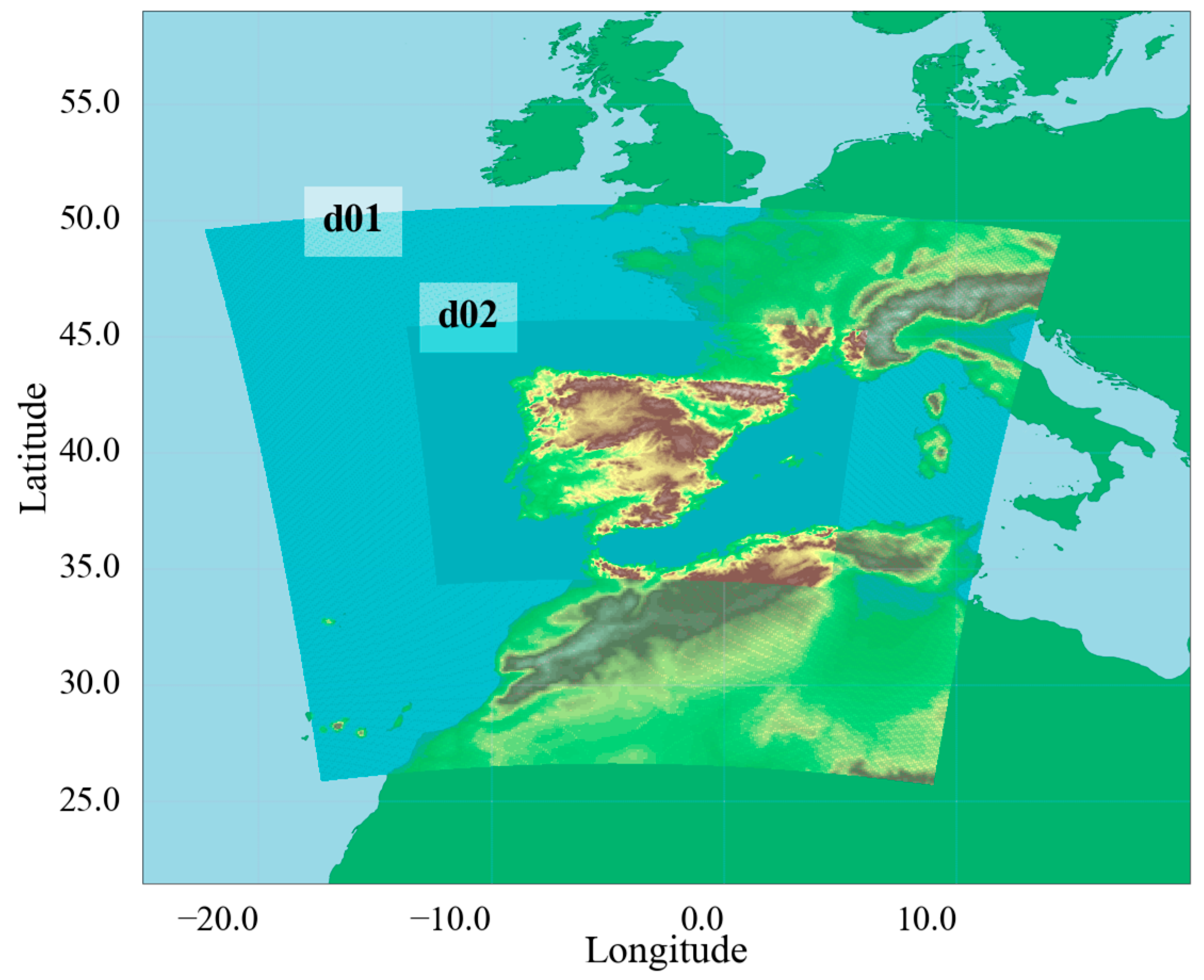
Figure 1 shows the modelling domains used in this study. The parent domain (d01), with a grid-point spacing of 9 km and which aimed to capture synoptic features and general circulation patterns, is centred at 38.658° N, 4.043° W, and covers the IP, northwestern Africa, France, and adjacent marine areas. It spans approximately 2700 × 2700 km2 (west–east × south–north). The nested domain (d02), with a grid spacing of 3 km, covers the entire IP (1560 × 1245 km2) and the aim is to capture the mesoscale phenomena that affects the region of interest.
For this study, we have configured the WRF model for operational forecasts using the parameterizations employed in [27,37] and summarized in Table 2. These parameterizations have been selected because they are widely used in WRF applications and have shown high accuracy for forecasting variables such as wind speed [27,37] and precipitation [36] over the IP. These parameterizations were kept fixed, as the aim of this work is to analyze the sensitivity of WRF forecasts to different global model initializations rather than to evaluate the sensitivity to physical parameterizations. Since this work represents the continuation of a previous study, the modelling configuration has been maintained unchanged.
The configuration of vertical levels, topography, and land-use data follows the strategy adopted in our previous study [27]. A total of 42 vertical levels were used, with the top set at 50 hPa. Vertical resolution was enhanced near the surface, as previous studies have demonstrated that this improves the accuracy of wind-related variables [37,40], with 25 levels below 1500 m.a.s.l (metres above sea level) and the first model level at approximately 8 m.a.s.l. Topography and land-use fields were selected from the default WRF datasets, using the highest available resolution: GTOPO30 for terrain height and USGS for land-use categories, both at 30 arc-second resolutions (approximately 1 km at the equator).
Table 2. Configuration options selected in WRF.
Scheme/Parameterization/OptionOption Selected
Models Domaind01, d02
Spatial Resolution9 km (d01), 3 km (d02)
Vertical Levels42 with the top set at 50 hPa
Time Step24 s
LBC Update6 h
NudgingNo nudging
TopographyGTOPO30
Land UsesUSGS
MicrophysicsWDM7 [41]
Longwave RadiationRRTMG [42]
Shortwave RadiationDudhia [43]
CumulusKain-Fritsch [44] (d01 only)
Surface LayerMM5 similarity [45]
Land SurfaceNoah LSM [46]
Planetary Boundary LayerYonsei University [47]
A total of 14 simulations were conducted, each spanning 30 h. The first 6 h were treated as spin-up time to reduce the influence of initial conditions. These simulations correspond to the three high-impact storms described in Section 2.3.2, lasting 3, 2, and 2 days, respectively (7 days in total). For each day, two simulations were performed (one initialized with GFS and one with AIFS), resulting in 14 forecasts and a maximum forecast horizon of 24 h.

2.2.2. Global Model Initializations

Two global models have been used to provide initial and lateral boundary conditions (LBC) for the WRF mesoscale simulations: GFS and AIFS. The IFS model was not included in the comparison because previous work [27] showed that IFS and AIFS produce very similar results, and therefore IFS would not provide additional insight. In addition, evidence already exists regarding the performance of IFS-driven WRF simulations [48], as well as direct comparisons between IFS and AIFS [49,50].
GFS is provided by the National Centers for Environmental Prediction (NCEP, available online: https://www.nco.ncep.noaa.gov/pmb/products/gfs/ (accessed on 15 January 2026)) with a horizontal resolution of 0.25°, and it is updated every 6 h (00, 06, 12 and 18 UTC). AIFS is supplied by ECMWF (available online: https://data.ecmwf.int/ (accessed on 15 January 2026)) also with a 0.25° resolution and with the same updated frequency.
The forecast horizons are 384 h for GFS, and 360 h for AIFS. GFS provides 41 vertical levels, whereas AIFS provides 13 levels. In both models, the first vertical level is located at 1000 hPa. The second level is near the surface: at 975 hPa for GFS, and at 925 hPa for AIFS. The highest vertical level reaches 0.01 hPa in GFS and 50 hPa in AIFS.
Regarding temporal resolution, GFS provides hourly data for the first 120 forecast hours, and 3-hourly data from 120 to 384 h. AIFS provides 6-hourly data throughout the entire forecast period.
These specifications refer to publicly available open-data products suitable for initializing mesoscale models. All simulations in this study, for every global model and every storm, were initialized using global model outputs corresponding to 00 UTC.

2.3. Data Sets, Modelling Analysis Period, and Model Evaluation

2.3.1. Meteorological Data

Local meteorological stations managed by the Spanish National Meteorological Agency (AEMET) were used to evaluate the performance of the simulations. The full AEMET network of automatic stations was considered, comprising more than 750 stations across Spain. The data considered from AEMET is official data. These data have undergone quality control, and any values that could be considered anomalous (out of range or meaningless) have been excluded from the analysis.

2.3.2. Modelling Analysis Period

The analysis focused on three high-impact storms that affected the IP during March and April 2025: Martinho, Nuria, and Olivier [51]. These three high-impact storms were selected because they occurred shortly after the public release of AIFS forecasts and represent storms of clearly different intensities. This diversity ensures that the results do not simply reflect the models’ behaviour under a single type of meteorological situation. While some storms, such as Martinho, produced widespread and severe impacts, others, like Olivier, were more spatially confined and considerably milder.
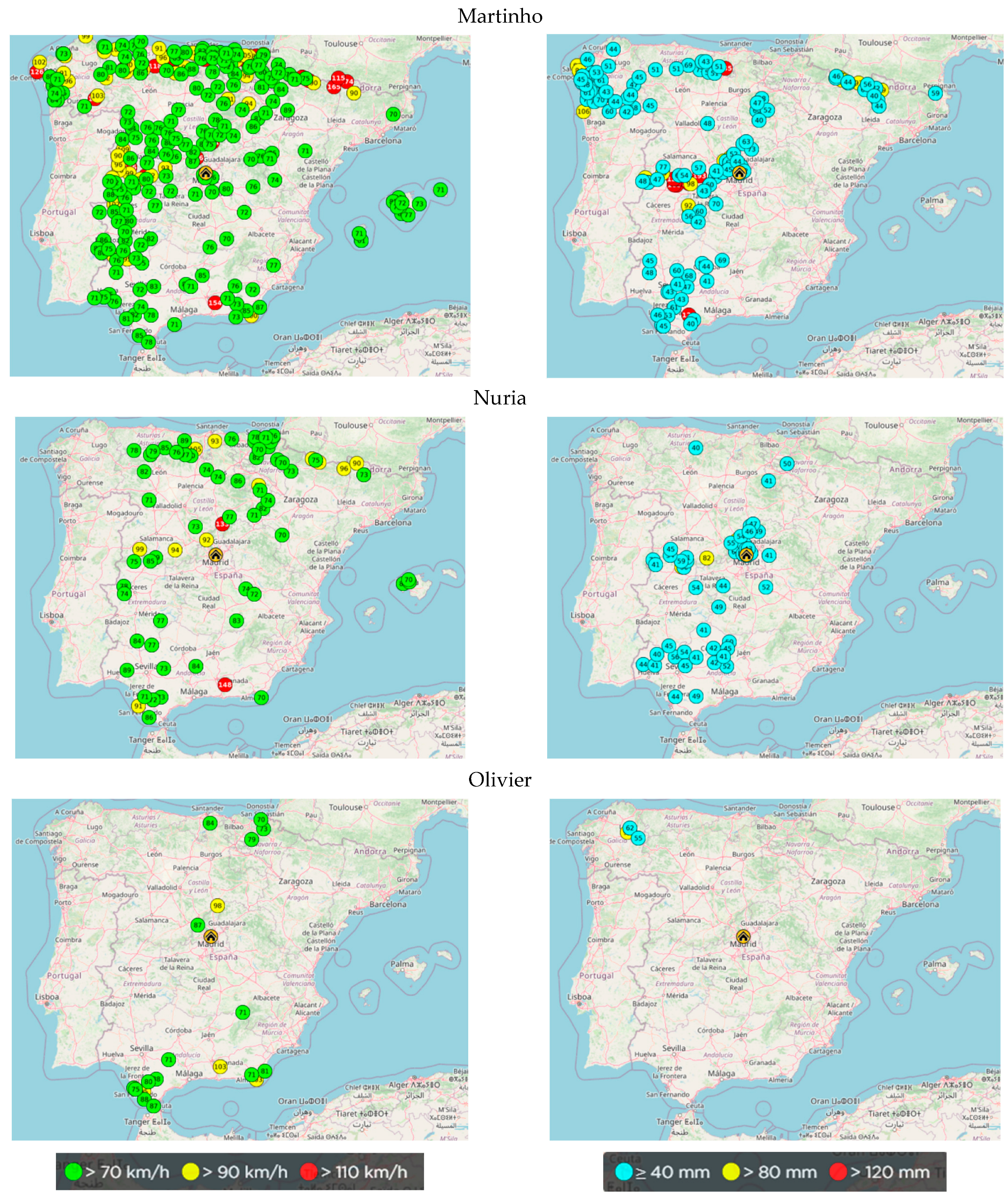
Storm Martinho [52] affected the entire IP, mainly between 20–22 March, progressing from west to east. Maximum wind gusts (considering wind sustained for 3 s) reached 174 km per hour (km/h) at Cap de Vaquèira (42.69194° N, 0.97389° E, 03:30 local time (LT) on 21 March 2025), 165 km/h at Cerler-Cogulla (42.555° N, 0.54306° E, 07:00 LT on 21 March 2025), and 154 km/h in Sierra Nevada (37.06306° N, 3.38694° W, 12:50 LT on 20 March 2025). The heaviest rainfall occurred on March 21, with daily accumulations of 132.4 mm in Puerto del Pico (40.34156° N, 5.01152° W), 97.8 mm in Garganta la Olla (40.11111° N, 5.78472° W), and 87.6 mm in Piornal (40.1153° N, 5.8492° W). The main consequences of this storm were flooding, particularly in inland regions.
Storm Nuria [53] impacted the entire IP on 3 and 4 April, producing intense precipitation over southern Castile and León and western Andalusia, and strong winds in Galicia, Andalusia, the Pyrenees, the Basque Country, and southern Castile and León. Maximum gusts of up to 148 km/h were recorded at the Sierra Nevada station (37.06306° N, 3.38694°W, 14:00 LT on 4 April 2025), 132.8 km/h in Cerezo de Arriba (41.19193° N, 3.47517°W, 06:00 LT on 4 April 2025), and Alto Campoo (43.03667° N, 4.37444° W, 11:00 LT on 4 April 2025). Daily rainfall reached 85 mm in Piornal (40.1153° N, 5.8492° W), 67.4 mm in Puerto El Pico (40.34156° N, 5.01152° W), and 63 mm in Garganta de la Olla (40.11111°N, 5.78472° W). The storm also produced hailstorms that severely affected agricultural areas in Castilla-La Mancha.
Storm Olivier [54] originated as an isolated upper-level depression and affected large areas of the IP between 10 and 11 April 2025, particularly Andalusia, Castile and León, and Euskadi and Extremadura. Maximum gusts reached 103 km/h at Cabo de Gata Faro (36.72194° N, 2.19306° W, 05:00 LT on 11 April 2025), 103 km/h in Sierra Nevada (37.06306° N, 3.38694° W, 22:00 LT on 11 April 2025), and Cerezo de Arriba (41.19193° N, 3.47517° W, 17:00 LT on 11 April 2025). On 11 April, daily rainfall totals reached 117.9 mm in Lugo—Col. Fingoi (42.99917° N, 7.55139° W), 65 mm in Lugo Rozas (43.11139° N, 7.45722° W), and 51 mm in Becerrera-Penamaior (42.865° N, 7.18361° W). Storm Olivier also transported Saharan dust, resulting in mud rain, especially in the southern areas of the IP.
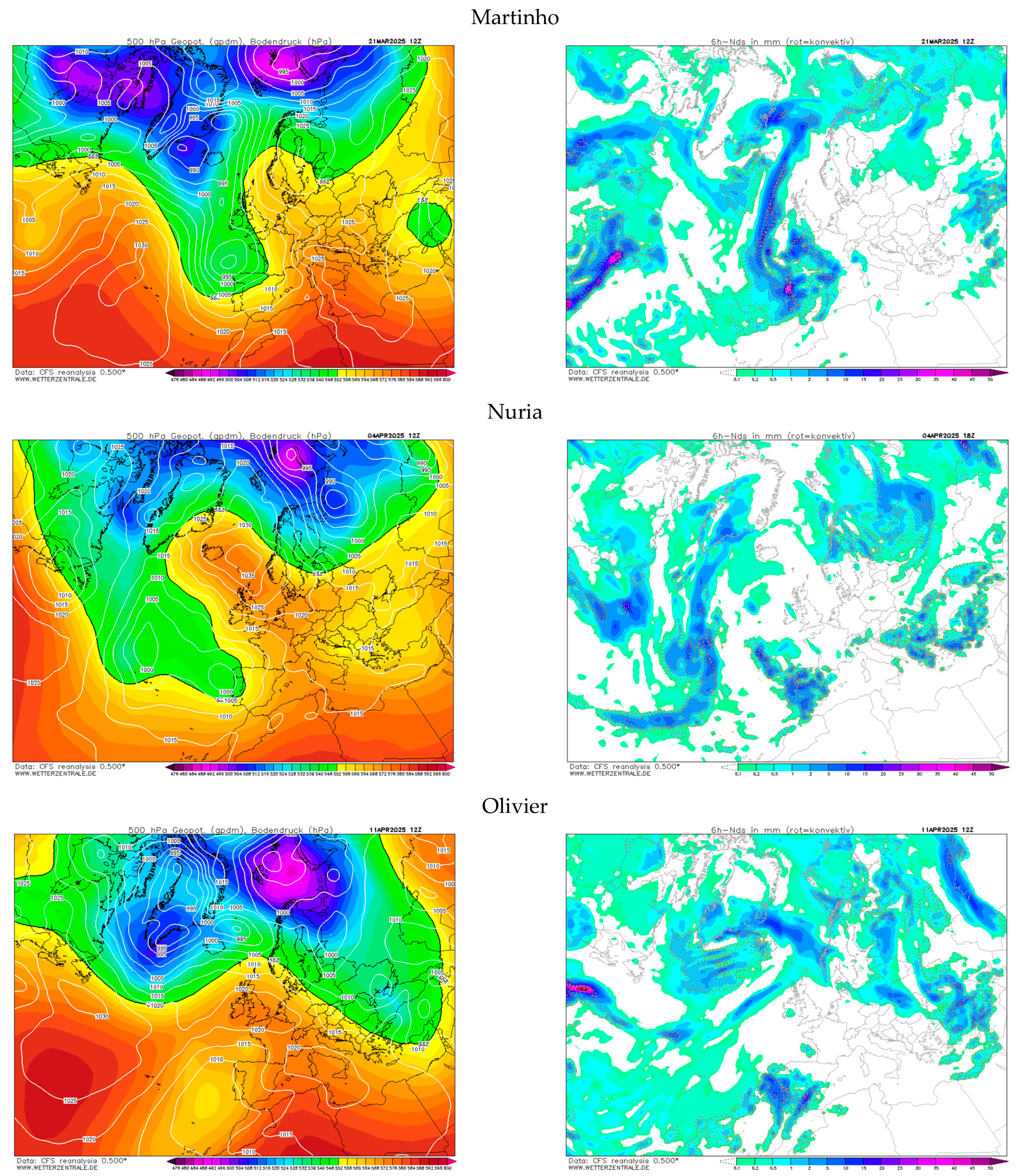
For each storm, CFS analyses were used to describe the synoptic situation. Figure 2 shows the 500 hPa geopotential height and the 6 h accumulated precipitation fields from the CFS analyses [55].
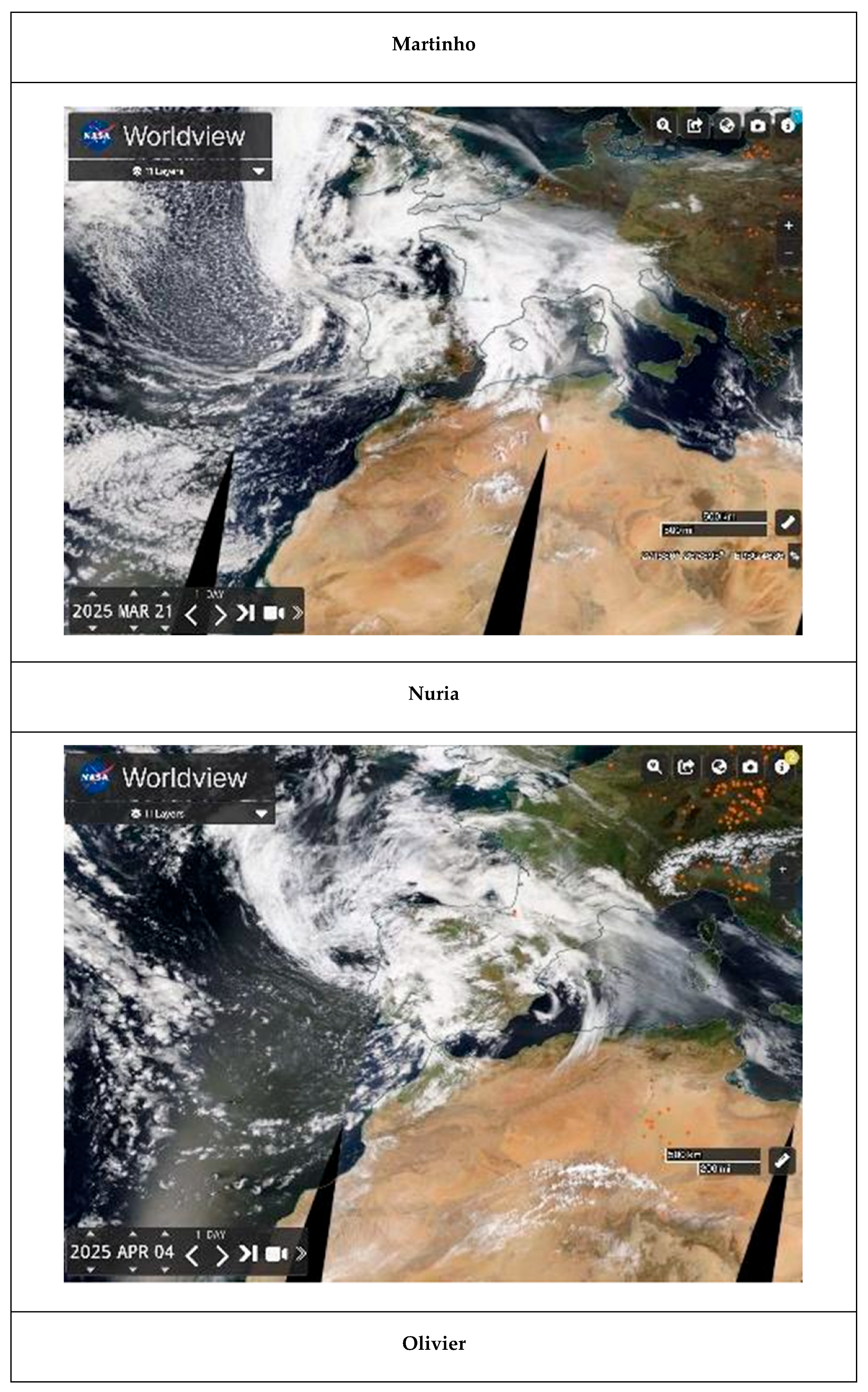
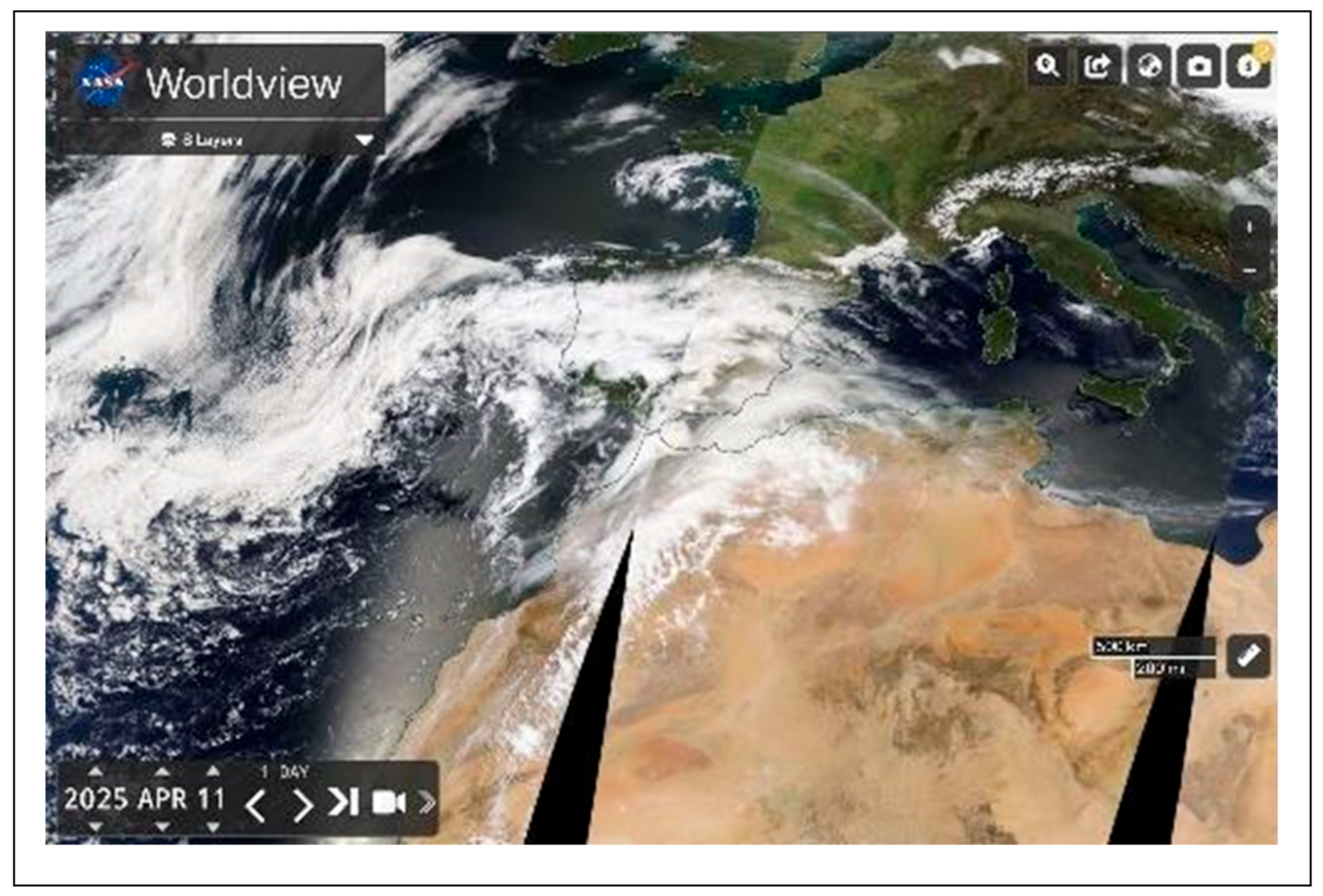
Figure 3 presents the maximum wind gusts and daily precipitation values recorded by AEMET stations during each episode. Figure 4 displays the cloud cover over the IP during the analyzed days.

2.3.3. Forecast Evaluation and Forecast Sensitivity Analysis

To evaluate the forecast performance and sensitivity to different global initialization models, a combined approach was adopted, integrating deterministic statistical metrics with graphical and qualitative comparisons. The analysis focused on two key meteorological variables: wind speed at 10 m, including both mean wind (averaged during 1 h) and wind gusts (sustained for 3 s), and accumulated precipitation.
Forecast accuracy was quantified using several statistical metrics. For wind speed, Pearson’s Correlation Coefficient (PCC), Mean Bias (MB) and Root Mean Square Error (RMSE) were computed. For these statistical metrics, the comparison was performed by using the WRF forecasted value at the model grid cell nearest to each observation station. For precipitation, the Brier Score (BS) [58] was also included, as it is particularly suitable for evaluating this variable.
The analysis was carried out over domain d02, the innermost modelling domain (Figure 1). All statistics were computed using accumulated precipitation, mean wind speed, and maximum wind gusts for each episode, comparing model outputs with observations. Model performance was evaluated for 24 h forecasts.
For wind gust analysis, both global model outputs (AIFS and GFS) and WRF simulations initialized with each global model were considered. For accumulated precipitation, only GFS-WRF and AIFS-WRF simulations were analyzed, since precipitation from GFS and AIFS is not ingested by WRF as an initial condition in cold-start configurations.
The numerical evaluation was complemented by several qualitative analyses:
  • Scatter plots comparing GFS vs. AIFS and GFS-WRF vs. AIFS-WRF for mean wind speed and wind gusts, and GFS-WRF vs. AIFS-WRF for accumulated precipitation.
  • Visual spatial analyses, using bidimensional maps to compare the geographical distribution and spatial patterns of variables across WRF simulations and against station observations.
  • Warning-level comparisons, based on the regional thresholds used by AEMET [59]. These warnings are compared against AEMET reports of every episode from [52,53,54]. Yellow, orange, and red warnings are defined for every geographical region considered by AEMET using specific threshold values. AEMET generates warnings for geographical divisions similar to climate regions and defines yellow, orange, and red warnings. For each variable (wind, temperature, snow, etc.), AEMET defines a numerical threshold above which the warning is triggered. This numerical threshold depends on the area of the territory, so there are no limits for the entire area. For example, in the case of wind gusts, yellow values can indicate speeds in the range of 70 to 90 km/h; orange values between 90 and 110 km/h; and red values between 120 and 140 km/h depending on the geographical division of Spain considered by AEMET. For each modelling configuration, warnings were estimated by counting model grid points exceeding alert thresholds and assigning a percentile-based trigger level. These were compared with AEMET official reports for each episode [52,53,54].

3. Results

The following sections present the main findings of the study: deterministic forecast evaluations including scatter plot analysis, visual inspection of spatial differences, and comparison of meteorological warnings across configurations.

3.1. Numerical Evaluation

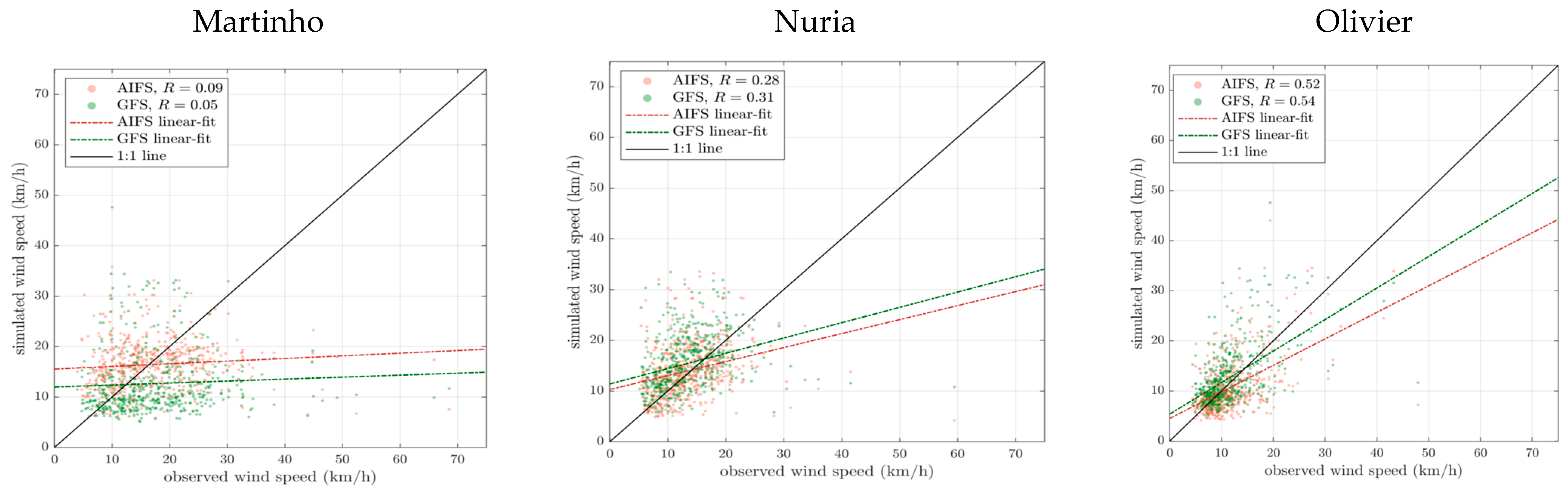
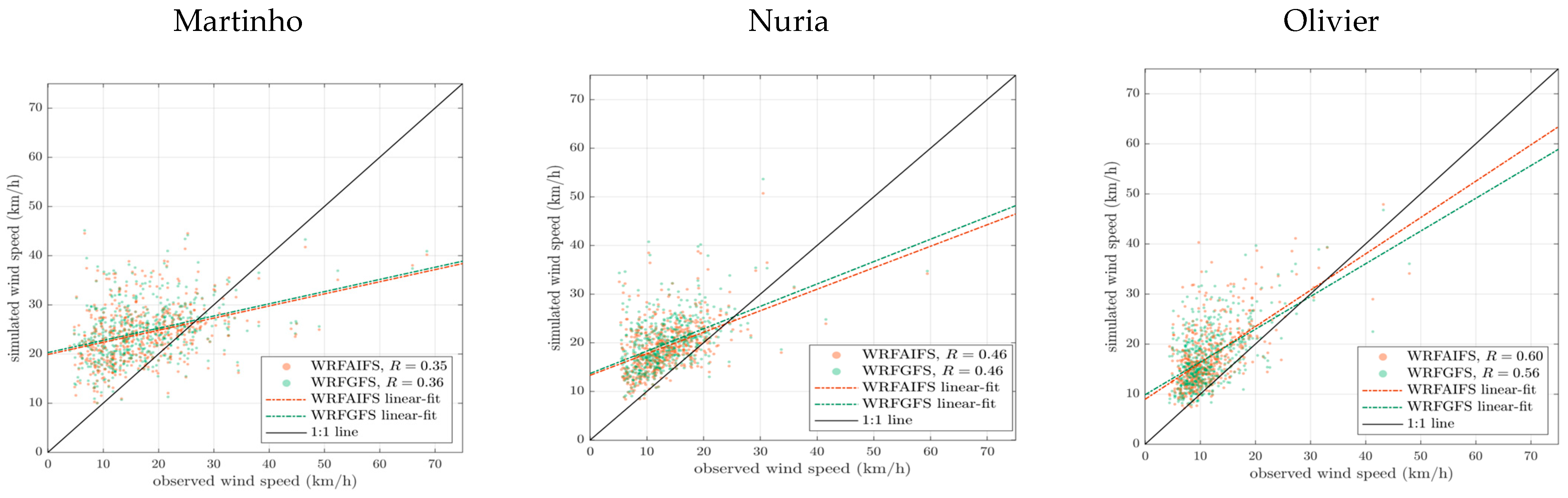
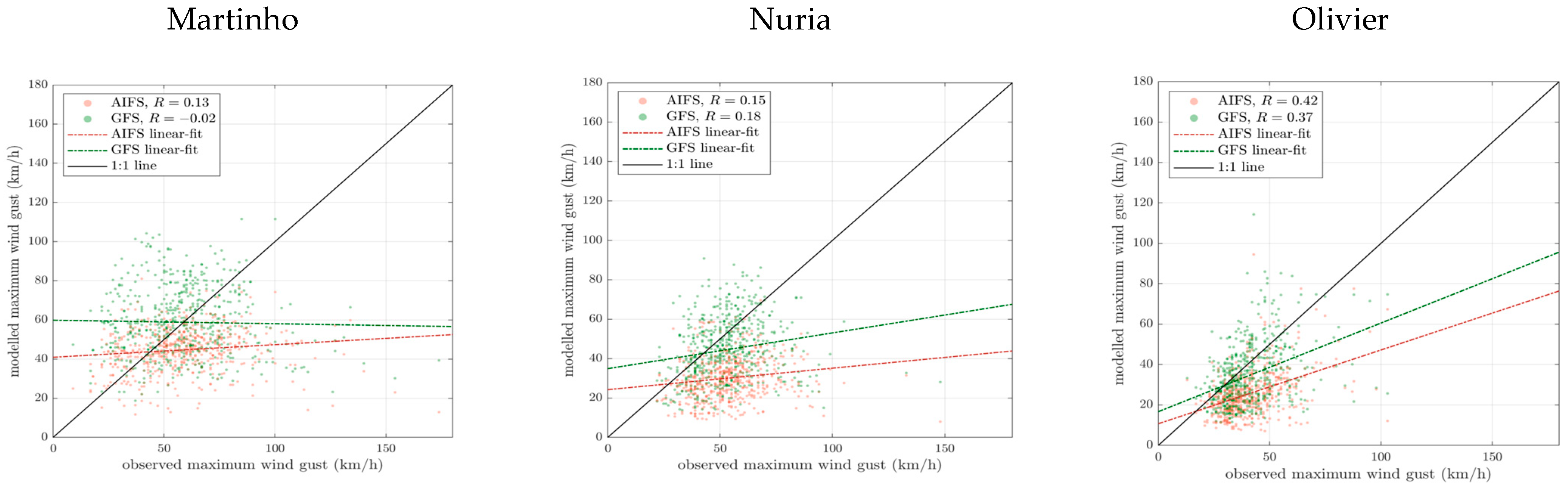
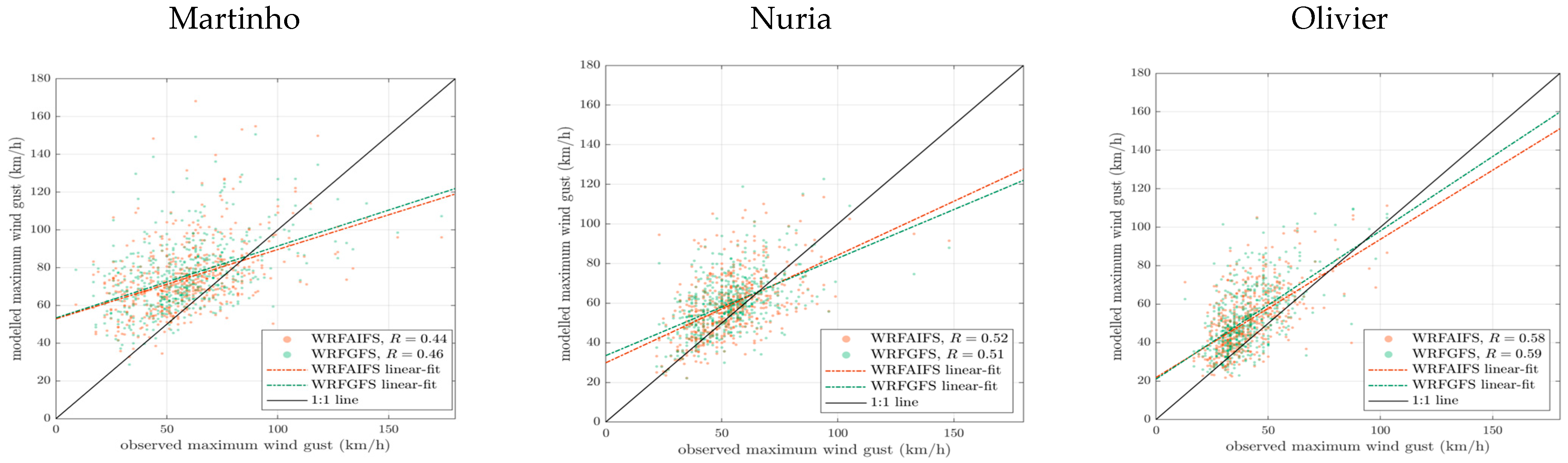
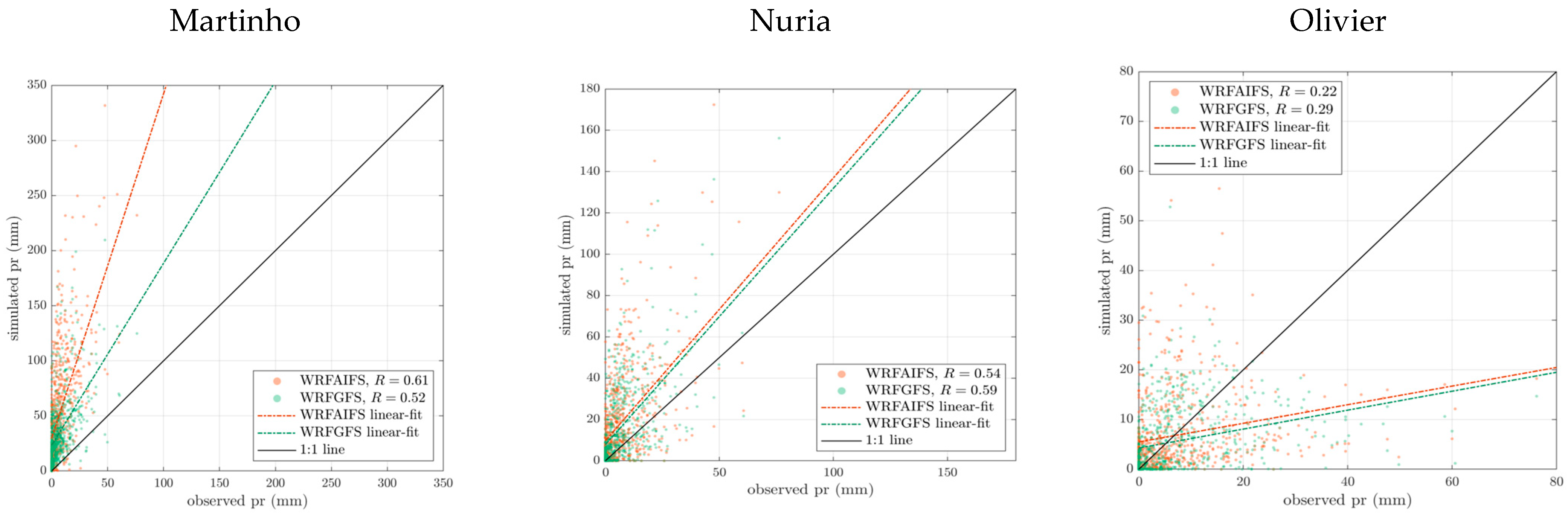
Table 3, Table 4 and Table 5 summarize the statistical parameters used in the numerical evaluation. Figure 5, Figure 6, Figure 7, Figure 8 and Figure 9 show scatter plots comparing AIFS-WRF and GFS-WRF simulations with observations for accumulated precipitation, mean wind speed, and wind gusts.

3.2. Visual Inspection of Differences

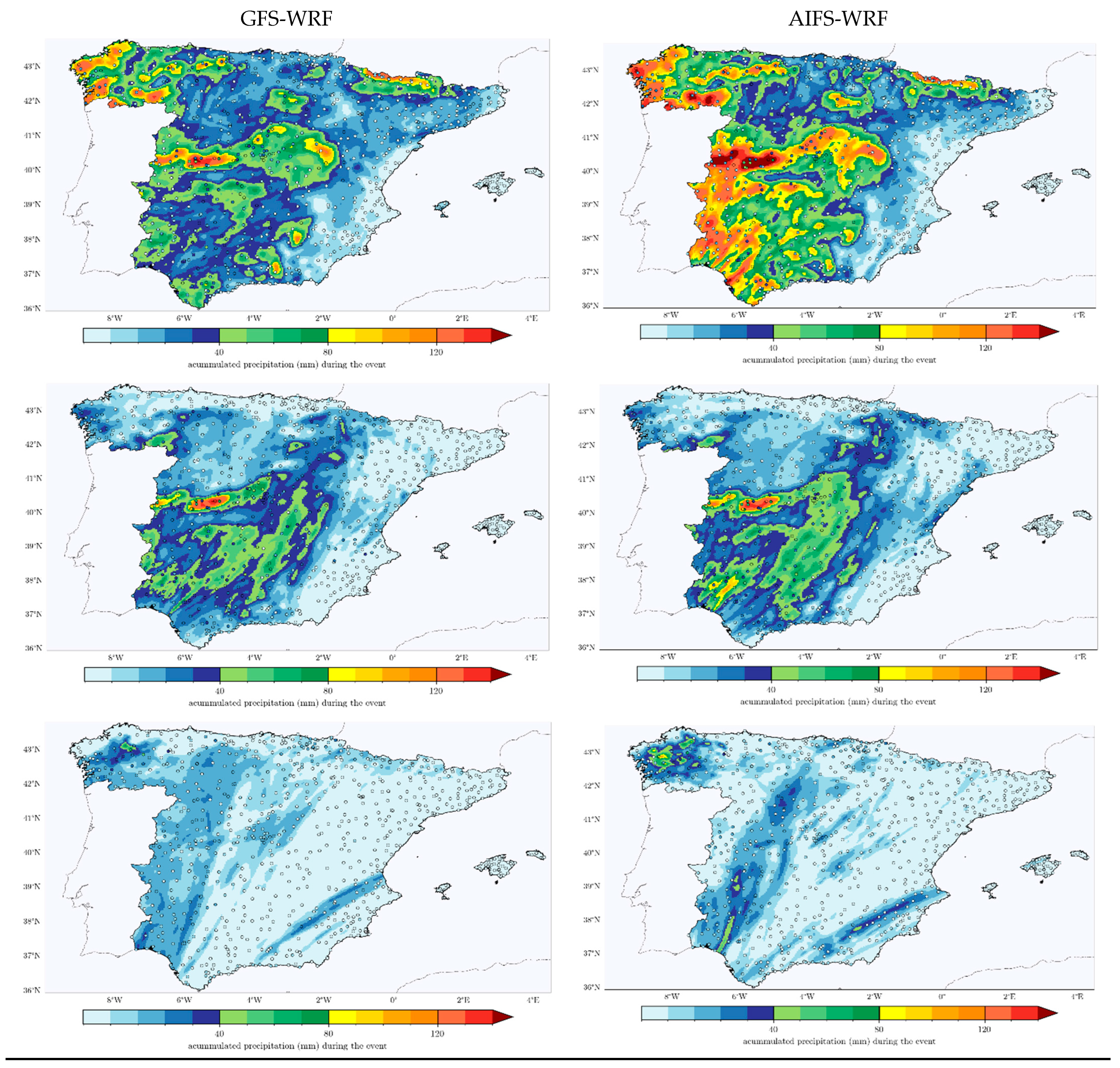
Figure 10, Figure 11 and Figure 12 present spatial comparisons of accumulated precipitation and maximum wind gusts for each high-impact storm.

3.3. Generation of Meteorological Warnings

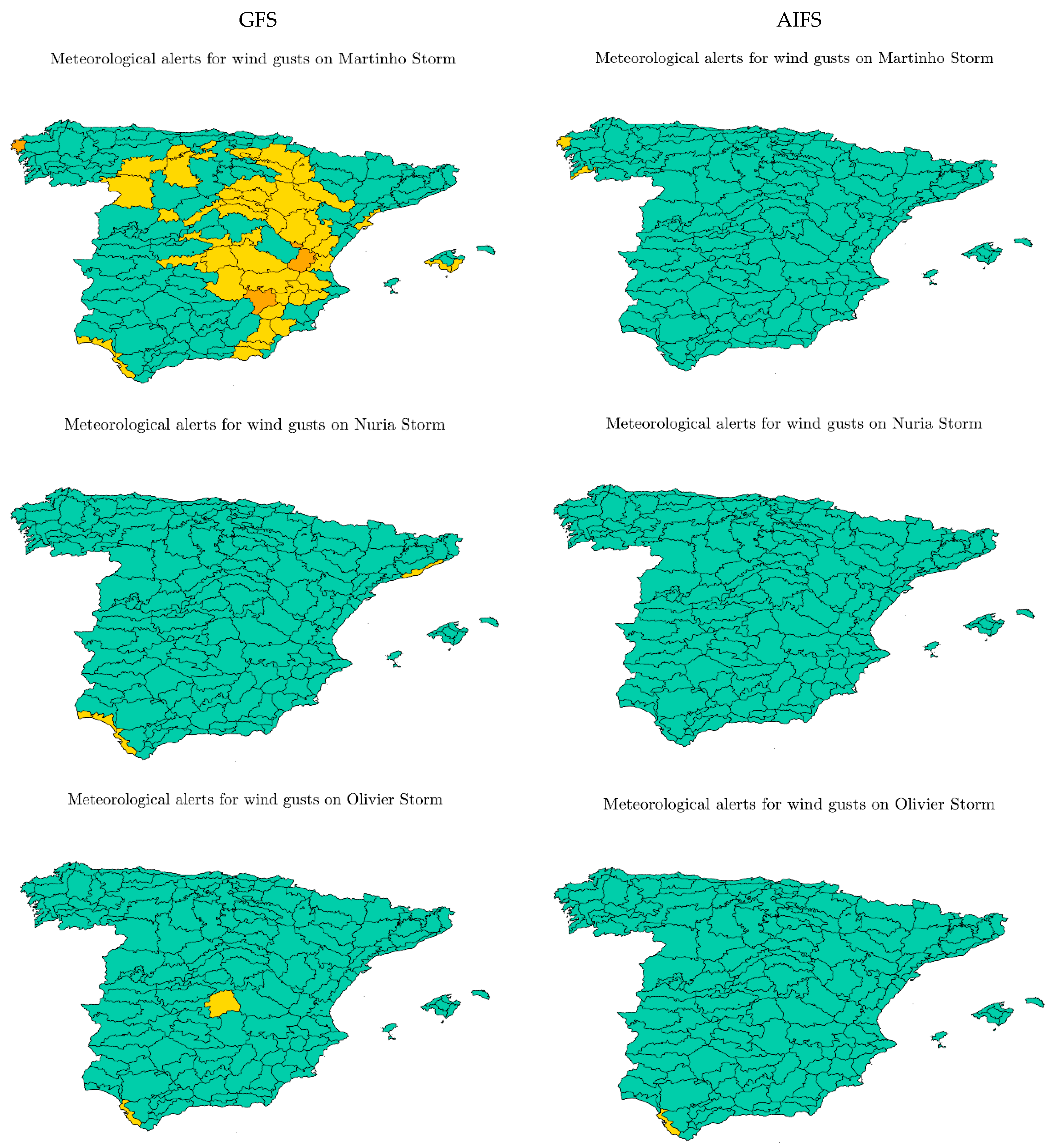
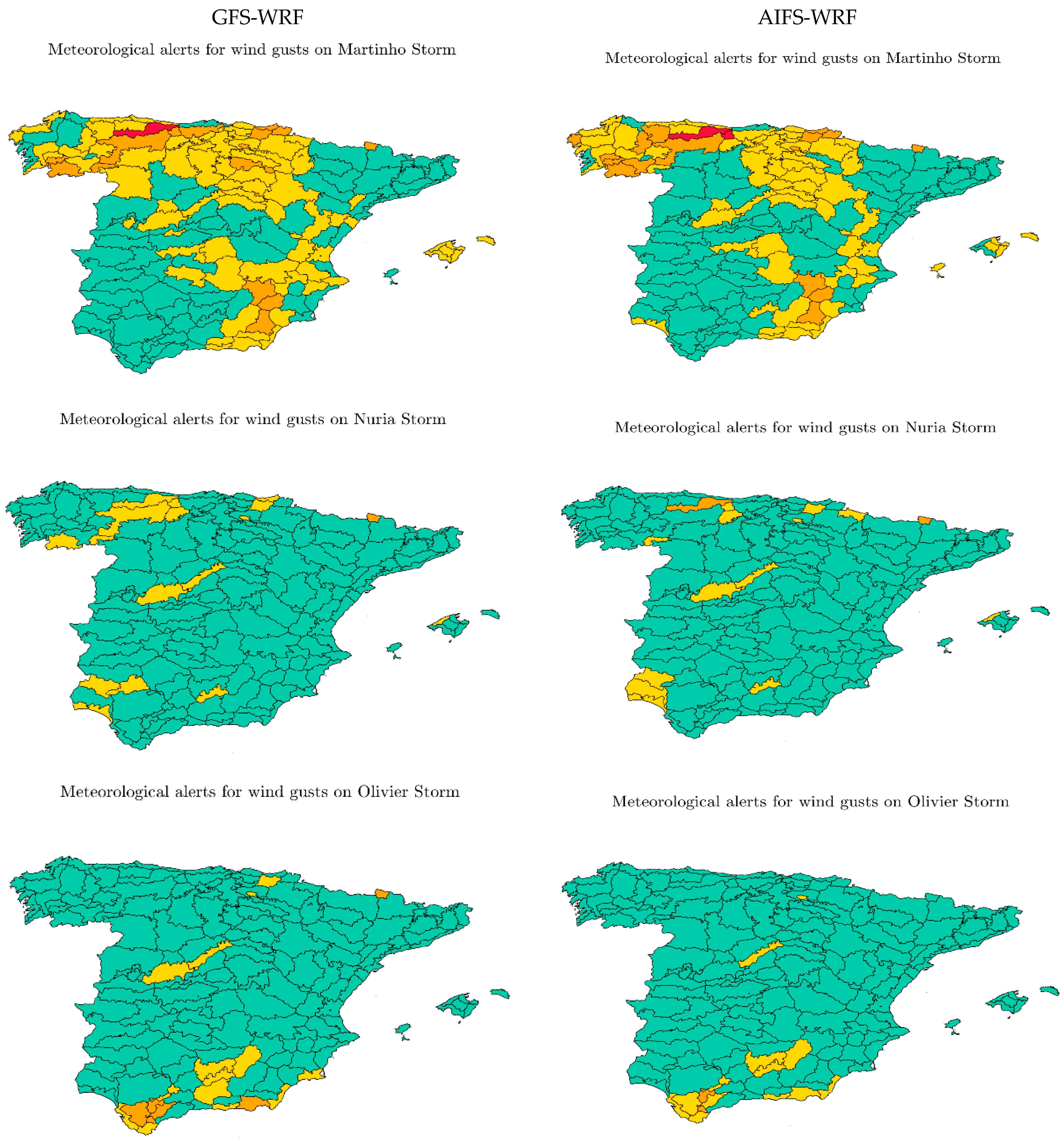
Figure 13, Figure 14 and Figure 15 compare the meteorological warnings generated from each modelling configuration for the three high-impact storms.

4. Discussion

Given the recent public release of AIFS forecasts, no previous studies analyzing their coupling with mesoscale models such as WRF have been identified. Consequently, the results obtained in this work cannot be compared with existing literature. This study represents the second part of a research line examining the effects of introducing AIFS as initial and lateral boundary conditions for WRF. The main results obtained in the first part were published in [27]. In that paper, the authors showed that, although the performances of AIFS-WRF and GFS-WRF were generally similar, the choice of the global model influenced the reproduction of meteorological phenomena such as sea-breeze development, vertical temperature and wind profiles, and the evolution of the planetary boundary layer height. Authors also analyzed how those differences affected air-quality related applications, such as backward trajectories and the ventilation index. For the episodes analyzed, the conclusion was that GFS-WRF provided lower uncertainty than AIFS-WRF [27].
In the present study, the focus is different. Here, we analyze the effects of using AIFS or GFS as initial and LBC in WRF in the forecast of precipitation and maximum wind gusts during high-impact storms affecting Spain in 2025. Regarding the numerical comparison between modelled and observed values, and based on the scatter plots generated, we can see that for mean wind speed, coupling WRF with either GFS or AIFS substantially increases the correlation compared with the raw GFS/AIFS model forecasts. All the WRF configurations, as well as GFS itself, show a clear tendency to overestimate mean wind speed. In terms of RMSE, AIFS forecasts exhibit lower values, between 5 and 9 km/h, depending on the event. The large number of validation stations used in this study should be taken into account when interpreting these results.
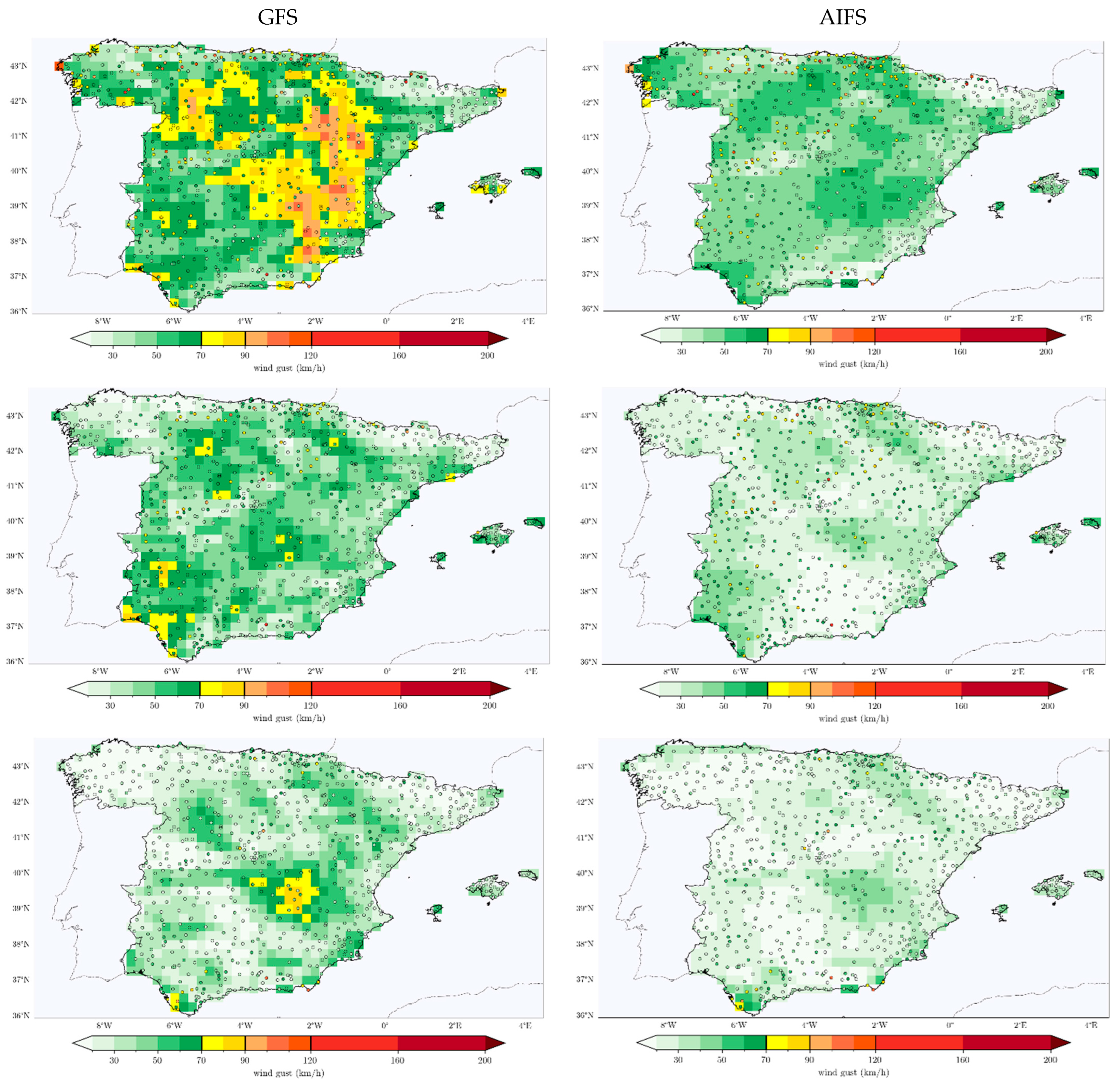
For maximum wind gusts, as expected, uncertainty increases relative to mean wind speed, since this variable is more difficult to reproduce. Again, GFS-WRF and AIFS-WRF show the highest correlations and lowest RMSE values. It is worth noting that the observed overestimation of mean wind speed persists in the WRF simulations, while the raw AIFS forecasts show a marked underestimation of gusts, with biases between −13 and −25 km/h. The MB and RMSE values obtained are consistent with those reported in similar studies [60,61]. It should also be highlighted that, in the case of Storm Martinho, neither GFS nor AIFS are able to accurately reproduce the observed mean wind speeds or the maximum gusts. For example, observed wind gusts exceeded 100 km/h, while both models simulated values below 60 km/h. In these situations, the benefit of using WRF becomes evident, as the model substantially increases the simulated values and provides mean wind and gust estimates much closer to observations. This improvement arises because the maximum wind gusts observed cannot be reproduced by the coarse resolution of the global models; in other words, these gusts are due to sub-grid-scale processes that the global model cannot explicitly resolve. This finding is also consistent with the results of the previous study [27], which also identified differences in the simulated wind fields depending on whether GFS or AIFS was used as the LBC in WRF.
Regarding accumulated precipitation, the accuracy and uncertainty of GFS-WRF and AIFS-WRF are very similar for the three events analyzed. In some cases, the Brier Score values are zero or close to zero because the thresholds of 40, 80, and 120 mm were rarely exceeded. For the Martinho and Nuria storms, overestimations were found in all cases, which are especially high in the case of Martinho with AIFS-WRF, with overestimations of up to 44 mm. This behavior is clearly visible in the scatter plots, where modelled values exceed 200 mm while the corresponding observations remain below 50 mm.
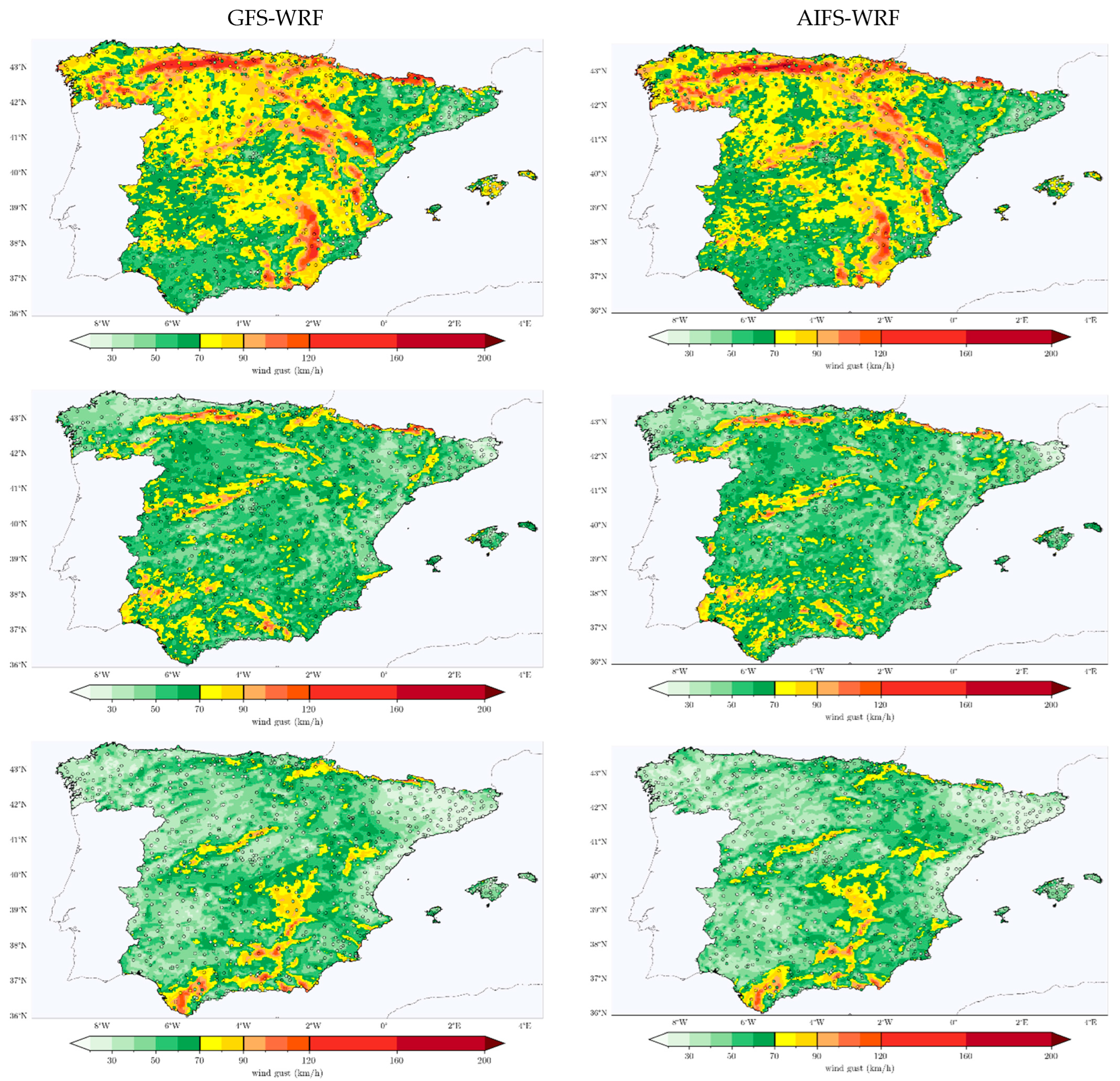
The visual inspection of the spatial differences shows that, in general, AIFS predicts lower maximum wind gusts than GFS. AIFS fails to capture the highest gusts recorded during the analyzed storms. GFS detects stronger gusts, but only in a few locations, and in some cases with spatial displacement (e.g., during Martinho, GFS places the strongest gusts in the eastern IP, whereas observations show them in the west). The underestimation of maximum wind gusts by AIFS is probably related to the same mechanism that makes data-driven models underestimate extremes in general, as noted in [20], and is due to the very nature of the model and the training data. Once WRF is coupled with either GFS or AIFS, both GFS-WRF and AIFS-WRF simulated more intense wind gusts. For Martinho, these are located along the Cantabrian coast, the western Pyrenees, the Ebro Valley, Galicia, southeastern Castile and León, and eastern Andalusia. Except for the Ebro Valley, where no significant wind gusts were recorded, the spatial patterns closely match the observations. During Nuria, the strongest gusts were recorded in Andalusia, northern Spain, and southern Castile and León, in good agreement with the modelled patterns. For Olivier, the strongest gusts were observed in the southern IP, which is also where the models placed the highest values.
For accumulated precipitation, both GFS-WRF and AIFS-WRF overestimate precipitation during Martinho and Nuria. For Martinho, AIFS-WRF shows the largest overestimation but also the highest correlation. This large overestimation significantly reduces the confidence of this forecast and exceeds what would be considered acceptable for operational applications. Both models correctly identify the regions with the highest rainfall totals in the north, centre, and southwest of the IP. For the Nuria event, GFS-WRF shows the best correlation and lowest uncertainty. Both WRF configurations successfully reproduce the areas of southern, central, and central–western Spain where the highest rainfall occurred. For Olivier, GFS-WRF and AIFS-WRF provide very similar results in terms of correlation and uncertainty, correctly identifying the northwestern region where the highest amount of accumulated precipitation was recorded. AIFS-WRF shows greater dispersion in forecast values.
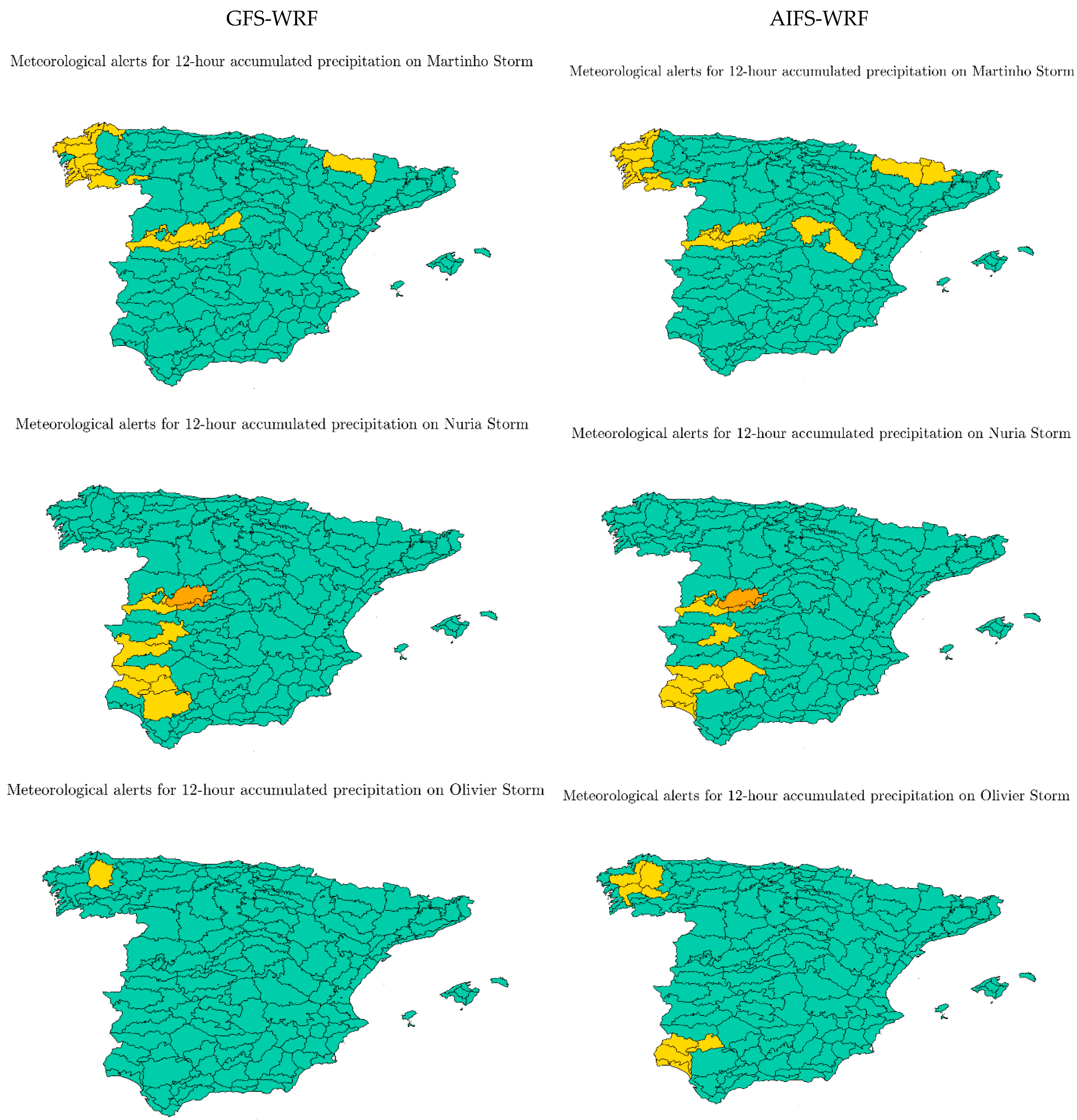
Regarding weather warnings (Figure 13, Figure 14 and Figure 15), AIFS generates virtually no wind gust warnings for any of the three episodes, while GFS produces numerous yellow and orange warnings for Martinho, but only a few isolated warnings for Nuria and Olivier. Once WRF is used with either GFS or AIFS as boundary and initial conditions, the number of predicted warnings increases, with no substantial differences between GFS-WRF and AIFS-WRF. This suggests that the WRF model itself is responsible for generating most of the warning signals. When compared with those issued by AEMET [52,53,54], which are not automatic model outputs but the result of near real-time monitoring, expert interpretation, and multiple observation platforms, WRF configurations are able to reproduce many of the issued warnings, particularly for Martinho.
For accumulated precipitation, both WRF configurations generate warnings in the regions where the maximum values of accumulated precipitation were observed. The results are very similar between GFS-WRF and AIFS-WRF. For Martinho, both AIFS-WRF and GFS-WRF configurations reproduce warnings in many regions, except in southwest Spain.
The authors would like to remark that the comparison between GFS/AIFS-WRF was made using only the publicly available data from both global models, as the objective was to assess their operational implications. It should be emphasized that, at the time of this study, the characteristics of the publicly available datasets differed between both models, particularly in terms of vertical resolution and time frequency, as described in Section 2.2.2. These differences inevitably influence the results, given that the global models are used to initialize a mesoscale model such as WRF. For example, regarding the Planetary Boundary Layer Height (PBLH), which affects the wind pattern near the surface, GFS provides seven vertical levels, whilst AIFS provides only three. If both global models had comparable vertical resolution, the differences obtained would likely be smaller.

5. Conclusions

Two global models, GFS and AIFS, have been used as initial and LBC for the mesoscale model WRF. A comparison of the forecasts produced by each configuration has been made, focusing on the meteorological variables most relevant during the high-impact storms that affected Spain in 2025: maximum wind gusts and accumulated precipitation. Furthermore, the generation of meteorological warnings has been analyzed as an additional tool to compare the performance of the GFS-WRF and AIFS-WRF simulations. It should be noted that the conclusions apply to the three high-impact storms analyzed, and that a longer analysis period would be needed to obtain fully generalizable results.
The main conclusions of this study are summarized below:
Wind gusts:
AIFS generally underestimates wind gusts, and its forecasts differ substantially from those of GFS.
GFS-WRF and AIFS-WRF produce very similar results, with a tendency to overestimate gusts. WRF adds value, improving the representation of this variable compared with the raw global model outputs.
For all three high-impact storms considered, WRF is able to reproduce the occurrence of maximum wind gusts; although, in some cases, such as Martinho’s, simulated locations are spatially displaced relative to observations.
Accumulated precipitation:
In general, both GFS-WRF and AIFS-WRF are able to generate weather warnings for wind gusts and accumulated rainfall during the three events analyzed.
AIFS-WRF shows a greater tendency to generate warnings, both in terms of intensity and spatial extent.
For accumulated precipitation, WRF configurations show similar levels of accuracy and uncertainty, although AIFS-WRF exhibits larger overestimations in some cases (e.g., Martinho).
Overall, while the added value of mesoscale models such as WRF is well established and confirmed here, the AI-based AIFS does not show clear advantages in comparison with traditional global models for these high-impact events analyzed. The competitive advantage of data-driven models such as AIFS over physics-based models like GFS generally emerges for time periods longer than 24–48 h. For this reason, such an advantage cannot be observed in this work. Furthermore, the differences in the vertical level structure of both models affect the results when their forecasts are used as LBC for a mesoscale model such as WRF, as evidenced in [27].
Some areas for improvement have been identified to address the limitations of the current work and to obtain more representative conclusions for operational forecasting. The following directions for future work are suggested:
Analyze the sensitivity of additional variables, such as rainfall rate.
Consider a longer period to analyze the differences between modelling configurations.
Add other statistical metrics like the Fractional Skill Score, temporal autocorrelation, and spatial correlation.
Add a categorical evaluation distinguishing between regions and warning categories.
Extend the forecast horizon from 24 to 120 h and analyze how the differences between a physics-based and data-driven model, coupled with WRF, depend on the forecast horizon.
Improve understanding of the differences between simulations by comparing operational convective diagnosis parameters of interest [62] across configurations.
Assess the sensitivity of WRF to other emerging AI-based global models, such as AIGFS (Artificial Intelligence Global Forecast System), AIGEFS (Artificial Intelligence Global Ensemble Forecast System), and HGEFS (Hybrid-GEFS) from NOAA [63].
Extend the analysis to the whole IP, including observations from the Portuguese Institute for Sea and Atmosphere (IPMA).

Author Contributions

Conceptualization, R.A.A.; methodology, R.A.A., M.G.-V.O. and M.P.S.; software, M.G.-V.O.; validation, R.A.A. and M.G.-V.O.; formal analysis, R.A.A. and M.G.-V.O.; investigation, R.A.A. and M.G.-V.O.; resources, R.A.A., M.G.-V.O. and M.P.S.; data curation, M.G.-V.O. and M.P.S.; writing—original draft preparation, R.A.A.; writing—review and editing, R.A.A., M.G.-V.O. and B.C.S.; visualization, R.A.A. and M.G.-V.O.; supervision, R.A.A.; project administration, R.A.A.; funding acquisition, R.A.A. and M.G.-V.O. All authors have read and agreed to the published version of the manuscript.

Funding

M.G.-V.O. was funded by MICIU/AEI/10.13039/501100011033 and by FEDER, UE, in the framework of project PID2021-126401OB-I00.

Data Availability Statement

The datasets presented in this article are not readily available because they are part of an ongoing study.

Acknowledgments

The authors thank AEMET for all the information available either on its website or in its open data service, which has allowed the comparison of the different models during the selected episodes.

Conflicts of Interest

Authors Raúl Arasa Agudo, Miquel Picanyol Sadurnía and Bernat Codina Sánchez were employed by the company Meteosim. The remaining authors declare that the research was conducted in the absence of any commercial or financial relationships that could be construed as a potential conflict of interest.

Abbreviations

The following abbreviations are used in this manuscript:
AEMETNational Spanish Meteorological Agency
AIArtificial Intelligence
AIGFSArtificial Intelligence Global Forecast System
AIFSArtificial Intelligence/Integrated Forecasting System
ARWAdvanced Research WRF
BSBrier Score
CFSClimate Forecasting System
ECMWFEuropean Centre for Medium-Range Weather Forecasts
ERA5ECMWF Reanalysis v5
GFSGlobal Forecasting System
IFSIntegrated Forecasting System
IPIberian Peninsula
IPMAInstituto Português do Mar e da Atmosfera
LAMsLimited Area Models
LBCLateral Boundary Conditions
m.a.g.lMetres Above Ground Level
m.a.s.lMetres Above Sea Level
MBMean Bias
NCARNational Center of Atmospheric Research
PBLHPlanetary Boundary Layer Height
PCCPearson’s Correlation Coefficient
RMSERoot Mean Square Error
LTLocal Time
USGSUnited States Geological Survey
UTCUniversal Time Coordinated
WRFWeather Research and Forecasting System

References

  1. AMS. Weather Analysis and Forecasting. An Information Statement of the American Meteorological Society. Available online: https://www.ametsoc.org/ams/about-ams/ams-statements/statements-of-the-ams-in-force/weather-analysis-and-forecasting2 (accessed on 26 March 2025).
  2. Yarragunta, Y.; Francis, D.; Fonseca, R.; Nelli, N. Evaluation of the WRF-Chem performance for the air pollutants over the United Arab Emirates. Atmos. Chem. Phys. 2025, 25, 1685–1709. [Google Scholar] [CrossRef]
  3. Arasa, R.; Domingo-Dalmau, A.; Vargas, R. Using a Coupled Air Quality Modeling System for the Development of an Air Quality Plan in Madrid (Spain): Source Apportionment and Analysis Evaluation of Mitigation Measures. J. Geosci. Environ. Prot. 2016, 4, 46–61. [Google Scholar] [CrossRef]
  4. Arasa, R.; Lozano-García, A.; Codina, B. Evaluating Mitigation Plans over Traffic Sector to Improve NO2 Levels in Andalusia (Spain) Using a Regional-Local Scale Photochemical Modelling System. Open J. Air Pollut. 2014, 3, 70–86. [Google Scholar] [CrossRef][Green Version]
  5. Wang, W.; Liu, J.; Xu, B.; Li, C.; Liu, Y.; Yu, F. A WRF/WRF-Hydro coupling system with an improved structure for rainfall-runoff simulation with mixed runoff generation mechanism. J. Hydrol. 2022, 612, 128049. [Google Scholar] [CrossRef]
  6. Cuevas-Figueroa, G.; Stansby, P.K.; Stallard, T. Accuracy of WRF for prediction of operational wind farm data and assessment of influence of upwind farms on power production. Energy 2022, 254, 124362. [Google Scholar] [CrossRef]
  7. Jimenez, P.A.; Hacker, J.P.; Dudhia, J.; Haupt, S.E.; Ruiz-Arias, J.A.; Gueymard, C.A.; Thompson, G.; Eidhammer, T.; Deng, A. WRF-Solar: Description and Clear-Sky Assessment of an Augmented NWP Model for Solar Power Prediction. Bull. Am. Meteorol. Soc. 2016, 97, 1249–1264. [Google Scholar] [CrossRef]
  8. Coen, J.L.; Cameron, M.; Michalakes, J.; Patton, E.G.; Riggan, P.J.; Yedinak, K.M. WRF-Fire: Coupled Weather–Wildland Fire Modeling with the Weather Research and Forecasting Model. J. Appl. Meteor. Climatol. 2013, 52, 16–38. [Google Scholar] [CrossRef]
  9. Leung, N.-C.; Chow, C.-K.; Lau, D.-S.; Lam, C.-C.; Chan, P.-W. WRF-ROMS-SWAN Coupled Model Simulation Study: Effect of Atmosphere–Ocean Coupling on Sea Level Predictions Under Tropical Cyclone and Northeast Monsoon Conditions in Hong Kong. Atmosphere 2024, 15, 1242. [Google Scholar] [CrossRef]
  10. Seneviratne, S.I.; Zhang, X.; Adnan, M.; Badi, W.; Dereczynski, C.; Di Luca, A.; Ghosh, S.; Iskandar, I.; Kossin, J.; Lewis, S.; et al. Weather and Climate Extreme Events in a Changing Climate. In Climate Change 2021: The Physical Science Basis; Contribution of Working Group I to the Sixth Assessment Report of the Intergovernmental Panel on Climate Change; Masson-Delmotte, V., Zhai, P., Pirani, A., Connors, S.L., Péan, C., Berger, S., Caud, N., Chen, Y., Goldfarb, L., Gomis, M.I., et al., Eds.; Cambridge University Press: Cambridge, UK; New York, NY, USA, 2021; pp. 1513–1766. [Google Scholar] [CrossRef]
  11. NOAA. The Global Forecasting System (GFS). Available online: https://www.emc.ncep.noaa.gov/emc/pages/numerical_forecast_systems/gfs/documentation.php (accessed on 24 March 2025).
  12. ECMWF. IFS Documentation. Available online: https://www.ecmwf.int/en/publications/ifs-documentation (accessed on 24 March 2025).
  13. Skamarock, W.C.; Klemp, J.B.; Dudhia, J.; Gill, D.O.; Barker, D.M.; Duda, M.G.; Huang, X.-Y.; Wang, W.; Powers, J.G. A Description of the Advanced Research WRF Version 3; NCAR Technical Note 475; National Center for Atmospheric Research: Boulder, CO, USA, 2008. [Google Scholar]
  14. Bengtsson, L.; van Rooy, W.; Lenderink, G.; Onvlee, J.; Tijm, S. The HARMONIE–AROME Model Configuration in the ALADIN–HIRLAM NWP System. Mon. Weather Rev. 2017, 145, 1919–1935. [Google Scholar] [CrossRef]
  15. Lam, R.; Sanchez-Gonzalez, A.; Willson, M.; Wirnsberger, P.; Fortunato, M.; Alet, F.; Ravuri, S.; Ewalds, T.; Eaton-Rosen, Z.; Hu, W.; et al. Learning skillful medium-range global weather forecasting. Science 2023, 382, 1416–1421. [Google Scholar] [CrossRef]
  16. Bi, K.; Xie, L.; Zhang, H.; Chen, X.; Gu, X.; Tian, Q. Accurate medium-range global weather forecasting with 3D neural networks. Nature 2023, 619, 533–538. [Google Scholar] [CrossRef] [PubMed]
  17. Pathak, J.; Subramanian, S.; Harrington, P.; Raja, S.; Cattopadhyay, A.; Mardanim, M.; Kurth, T.; Hall, D.; Li, Z.; Azizzadenesheli, K.; et al. FourCastNet: A Global Data-driven High resolution Weather Model using Adaptative Fourier Neural Operators. arXiv 2022. [Google Scholar] [CrossRef]
  18. Olivetti, L.; Messori, G. Do data-driven models beat numerical models in forecasting weather extremes? A comparison of IFS HRES, Pangu-Weather, and GraphCast. Geosci. Model. Dev. 2024, 17, 7915–7962. [Google Scholar] [CrossRef]
  19. Charlton-Perez, A.J.; Dacre, H.F.; Driscoll, S.; Gray, S.L.; Harvey, B.; Harvey, N.J.; Hunt, K.M.R.; Lee, R.W.; Swaminathan, R.; Vandaele, R.; et al. Do AI models produce better weather forecasts than physics-based models? A quantitative evaluation case study of Storm Ciarán. npj Clim. Atmos. Sci. 2024, 7, 93. [Google Scholar] [CrossRef]
  20. Zhang, Z.; Fischer, E.; Zscheischler, J.; Engelke, S. Numerical models outperform AI weather forecasts of record-breaking extremes. arXiv 2025. [Google Scholar] [CrossRef]
  21. Nipen, T.N.; Haugen, H.H.; Ingstad, M.S.; Nordhagen, E.M.; Salihi, A.F.S.; Tedesco, P.; Seierstad, I.A.; Kristiansen, J.; Lang, S.; Alexe, M.; et al. Regional data-driven weather modeling with a global stretched grid. arXiv 2024. [Google Scholar] [CrossRef]
  22. ECMWF. Evaluation Rainfall Forecasts in Ecuador: Observations from AI and Physical Models. Available online: https://www.ecmwf.int/en/about/media-centre/science-blog/2025/evaluating-rainfall-forecasts-ecuador (accessed on 22 December 2025).
  23. ECMWF. AIFS: A New ECMWF Forecasting System. Available online: https://www.ecmwf.int/en/newsletter/178/news/aifs-new-ecmwf-forecasting-system (accessed on 24 March 2025).
  24. Lang, S.; Alexe, M.; Chantry, M.; Dramsch, J.; Pinault, F.; Raoult, B.; Clare, M.; Lessig, C.; Maier-Gerber, M.; Magnusson, L.; et al. AIFS—ECMWF’s data-driven forecasting system. arXiv 2024. [Google Scholar] [CrossRef]
  25. Hersbach, H.; Bell, B.; Berrisford, P.; Biavati, G.; Horányi, A.; Muñoz Sabater, J.; Nicolas, J.; Peubey, C.; Radu, R.; Rozum, I.; et al. ERA5 Hourly Data on Single Levels from 1940 to Present. Copernicus Climate Change Service (C3S) Climate Data Store (CDS). 2023. Available online: https://doi.org/10.24381/cds.adbb2d47 (accessed on 22 August 2025). [CrossRef]
  26. ECMWF. Implementation of AIFS Single v1. Available online: https://confluence.ecmwf.int/display/FCST/Implementation+of+AIFS+Single+v1 (accessed on 26 March 2025).
  27. Arasa Agudo, R.; García-Valdecasas Ojeda, M.; Picanyol Sadurní, M.; Codina Sánchez, B. Sensitivity of WRF Operational Forecasting to AIFS Initialisation: A Case Study on the Implications for Air Pollutant Dispersion. Earth 2025, 6, 132. [Google Scholar] [CrossRef]
  28. Porras, I.; Solé, J.; Marcos, R.; Arasa, R. Meteorological and Climate Modelling Services Tailored to Viticulturists. Atmos. Clim. Sci. 2021, 11, 148–164. [Google Scholar] [CrossRef]
  29. Solé, J.; Arasa, R.; Picanyol, M.; González, M.; Domingo-Dalmau, A.; Masdeu, M.; Porras, I.; Codina, B. Assessment of Climate Change in Nicaragua: Analysis of Precipitation and Temperature by Dynamical Downscaling over a 30-Year Horizon. Atmos. Clim. Sci. 2016, 6, 445–474. [Google Scholar] [CrossRef]
  30. Awan, N.K.; Truhetz, H.; Gobiet, A. Parameterization-induced error characteristics of MM5 and WRF operated in climate mode over the Alpine region: An ensemble-based analysis. J. Clim. 2011, 24, 3107–3123. [Google Scholar] [CrossRef]
  31. Bukovsky, M.S.; Karoly, D.J. Precipitation simulations using WRF as a nested regional climate model. J. Appl. Meteorol. Climatol. 2009, 48, 2152–2159. [Google Scholar] [CrossRef]
  32. Leung, L.R.; Kuo, Y.H.; Tribbia, J. Research needs and directions of regional climate modeling using WRF and CCSM. Bull. Am. Meteorol. Soc. 2006, 87, 1747–1751. [Google Scholar] [CrossRef]
  33. García-Valdecasas, M.; Gámiz-Fortis, S.; Castro-Díez, Y.; Esteban-Parra, M.J. Evaluation of WRF capability to detect dry and wet periods in Spain using drought indices. JGR Atmos. 2017, 122, 1569–1594. [Google Scholar] [CrossRef]
  34. Donaire-Montaño, D.; García-Valdecasas Ojeda, M.; Tacoronte, N.; Rosa-Cánovas, J.J.; Castro-Díez, Y.; Esteban-Parra, M.J.; Gámiz-Fortis, S.R. Finding optimal Noah-MP parameterizations for the characterization of surface heat fluxes in the Iberian Peninsula. Atmos. Res. 2025, 323, 108143. [Google Scholar] [CrossRef]
  35. Oliva, A.S.; García-Valdecasas Ojeda, M.; Arasa Agudo, R. Evaluation of the Sensitivity of the Weather Research and Forecasting Model to Changes in Physical Parameterizations During a Torrential Precipitation Event of the El Niño Costero 2017 in Peru. Water 2025, 17, 209. [Google Scholar] [CrossRef]
  36. Solano-Farias, F.; García-Valdecasas, M.; Donaire-Montaño, D.; Rosa-Cánovas, J.J.; Castro-Díez, Y.; Esteban-Parra, M.J.; Gámiz-Fortis, S.R. Assessment of physical schemes for WRF model in convection-permitting mode over southern Iberian Peninsula. Atmos. Res. 2024, 299, 107175. [Google Scholar] [CrossRef]
  37. Arasa, R.; Porras, I.; Domingo-Dalmau, A.; Picanyol, M.; Codina, B.; González, M.; Piñón, J. Defining a Standard Methodology to Obtain Optimum WRF Configuration for Operational Forecast: Application over the Port of Huelva (Southern Spain). Atmos. Clim. Sci. 2016, 6, 329–350. [Google Scholar] [CrossRef]
  38. Reboredo, B.; Arasa, R.; Codina, B. Evaluating Sensitivity to Different Options and Parameterizations of a Coupled Air Quality Modelling System over Bogotá, Colombia. Part I: WRF Model Configuration. Open J. Air Pollut. 2015, 4, 47–64. [Google Scholar] [CrossRef][Green Version]
  39. Arasa, R.; Soler, M.R.; Olid, M. Evaluating the Performance of a Regional-Scale Photochemical Modelling System: Part I. Ozone Predictions. ISRN Meteorol. 2012, 2012, 860234. [Google Scholar] [CrossRef][Green Version]
  40. Seaman, N.; Gaudet, B.; Zielonka, J.; Stauffer, D. Sensitivity of Vertical Structure in the Stable Boundary Layer to Variations of the WRF Model’s Mellor-Yamada-Janjic Turbulence Scheme. In Proceedings of the 10th WRF Users’ Workshop, Boulder, CO, USA, 23–26 June 2009. [Google Scholar]
  41. Bae, S.Y.; Hong, S.Y.; Tao, W.K. Development of a Single-Moment Cloud Microphysics Scheme with Prognostic Hail for the Weather Research and Forecasting (WRF) Model. Asia-Pac. J. Atmos. Sci. 2019, 55, 233–245. [Google Scholar] [CrossRef]
  42. Iacono, M.J.; Delamere, J.S.; Mlawer, E.J.; Shephard, M.W.; Clough, S.A.; Collins, W. Radiative Forcing by Long-Lived Greenhouse Gases: Calculations with the AER Radiative Transfer Model. J. Geophys. Res. Atmos. 2008, 113, D13103. [Google Scholar] [CrossRef]
  43. Dudhia, J. Numerical Study of Convection Observed during the Winter Monsoon Experiment Using a Mesoscale Two-Dimensional Model. J. Atmos. Sci. 1989, 46, 3077–3104. [Google Scholar] [CrossRef]
  44. Kain, J.S. The Kain-Fritsch Convective Parameterization: An Update. J. Appl. Meteorol. 2004, 43, 170–181. [Google Scholar] [CrossRef]
  45. Zhang, D.L.; Anthes, R.A. A high-resolution model of the planetary boundary layer—Sensitivity tests and comparisons with SESAME-79 data. J. Appl. Meteorol. 1982, 21, 1594–1609. [Google Scholar] [CrossRef]
  46. Chen, F.; Dudhia, J. Coupling an Advanced Land Surface–Hydrology Model with the Penn State–NCAR MM5 Modeling System. Part I: Model Implementation and Sensitivity. Mon. Weather Rev. 2001, 129, 569–585. [Google Scholar] [CrossRef]
  47. Hong, S.-Y.; Noh, Y.; Dudhia, J. A New Vertical Diffusion Package with an Explicit Treatment of Entrainment Processes. Mon. Weather Rev. 2006, 134, 2318–2341. [Google Scholar] [CrossRef]
  48. Taszarek, M.; Pilguj, N.; Orlikowski, J.; Surowiecki, A.; Walczakiewicz, S.; Pilorz, W.; Piasecki, K.; Pajurek, Ł.; Półrolniczak, M. Derecho Evolving from a Mesocyclone—A Study of 11 August 2017 Severe Weather Outbreak in Poland: Event Analysis and High-Resolution Simulation. Mon. Weather Rev. 2019, 147, 2283–2306. [Google Scholar] [CrossRef]
  49. ECMWF. AIFS-Single vs. IFS Scorecard. Available online: https://sites.ecmwf.int/aifs/scorecards/AIFS-single%20vs%20IFS%20scorecard.html (accessed on 7 October 2025).
  50. Pan, L.; Zhang, H.; Liang, M.; Li, P.; Cao, C.; Du, L.; Liu, J. Comparative analysis of precipitation forecast between the Artificial Intelligence System (AIFS) and Its Integrated Forecastin System (IFS). Am. Meteorol. Soc. 2025, 40, 1653–1670. [Google Scholar] [CrossRef]
  51. High-Impact Storms Defined by AEMET in 2024–2025. Available online: https://www.aemet.es/es/conocermas/borrascas/2024-2025 (accessed on 23 September 2025).
  52. Storm Martinho. Available online: https://www.aemet.es/es/conocermas/borrascas/2024-2025/estudios_e_impactos/martinho (accessed on 23 September 2025).
  53. Storm Nuria. Available online: https://www.aemet.es/es/conocermas/borrascas/2024-2025/estudios_e_impactos/nuria (accessed on 7 October 2025).
  54. Storm Olivier. Available online: https://www.aemet.es/es/conocermas/borrascas/2024-2025/estudios_e_impactos/olivier (accessed on 7 October 2025).
  55. Saha, S.; Moorthi, S.; Wu, X.; Wang, J.; Nadiga, S.; Tripp, P.; Behringer, D.; Hou, Y.-T.; Chuang, H.-Y.; Iredell, M.; et al. The NCEP Climate Forecast System Version 2. J. Clim. 2024, 27, 2185–2208. [Google Scholar] [CrossRef]
  56. CFS Analysis by Wetterzentrale. Available online: https://www.wetterzentrale.de/reanalysis.php? (accessed on 23 September 2025).
  57. Corrected Reflectance Product of Terra/MODIS from NASA Worldview. Available online: https://worldview.earthdata.nasa.gov/ (accessed on 23 September 2025).
  58. Theis, S.E.; Hense, A.; Damrath, U. Probabilistic precipitation forecast from a deterministic model: A pragmatic approach. Meteorol. Appl. 2005, 12, 257–268. [Google Scholar] [CrossRef]
  59. AEMET. Criterios específicos para la emisión de avisos de FMA. Available online: https://www.aemet.es/documentos/es/eltiempo/prediccion/avisos/plan_meteoalerta/METEOALERTA_ANX1_Umbrales_y_niveles_de_aviso.pdf (accessed on 7 October 2025).
  60. Suárez, M.; Poffo, D.; Pierobon, E.; Martina, A.; Saffe, J.; Rodríguez, A. Wind and Gust Forecasts Assessment of Weather Research and Forecast (WRF) Model in Córdoba, Argentina. Asian J. Atmos. Environ. 2022, 16, 2021133. [Google Scholar] [CrossRef]
  61. Gonçalves, L.d.J.M.; Kaiser, J.; Palmeira, R.M.d.J.; Gallo, M.N.; Parente, C.E. Evaluation of a High Resolution WRF Model for Southeast Brazilian Coast: The Importance of Physical Parameterization to Wind Representation. Atmosphere 2024, 15, 533. [Google Scholar] [CrossRef]
  62. AEMET. Guía de campos y parámetros operativos de interés en el diagnóstico convectivo. Available online: https://www.aemet.es/documentos/es/conocermas/recursos_en_linea/publicaciones_y_estudios/publicaciones/NT_17_AEMET/NT17_diagnostico_convectivo.pdf (accessed on 8 October 2025).
  63. NOAA Deploys New Generation of AI-Driven Global Weather Models. Available online: https://www.noaa.gov/news-release/noaa-deploys-new-generation-of-ai-driven-global-weather-models (accessed on 16 February 2026).
Figure 1. Modelling domains used in the simulations.
Earth 07 00077 g001
Figure 2. Geopotential height at 500 hPa (left) and 6 h accumulated precipitation (right) according to CFS for 21 March 2025 (Martinho), 4 April 2025 (Nuria) and 11 April 2025 (Olivier) at 12 UTC. Charts obtained from Wetterzentrale [56].
Earth 07 00077 g002
Figure 3. Maximum values of wind gusts (left) and accumulated precipitation during all the episodes (right) in AEMET stations during the storms used in the study. Only values exceeding 80 km/h for wind gusts and 40 mm for accumulated precipitation are shown. OpenStreeMap has been used as the background.
Earth 07 00077 g003
Figure 4. Terra/MODIS corrected reflectance satellite imagery illustrating cloud cover. Images obtained from NASA Worldview [57].
Earth 07 00077 g004aEarth 07 00077 g004b
Figure 5. Scatter plots comparing GFS and AIFS mean wind forecasts with observations for each high-impact storm. The correlation coefficient (R) and the linear fit are shown for each simulation.
Earth 07 00077 g005
Figure 6. As in Figure 5, but comparing WRF simulations with observations.
Earth 07 00077 g006
Figure 7. Scatter plots comparing GFS and AIFS wind gusts forecasts with observations for each high-impact storm. The correlation coefficient (R) and the linear fit are shown for each simulation.
Earth 07 00077 g007
Figure 8. As in Figure 7, but comparing WRF simulations with observations.
Earth 07 00077 g008
Figure 9. Scatter plots comparing WRF-simulated accumulated precipitation with observations for each high-impact storm. The correlation coefficient (R) and the linear fit are shown for each simulation.
Earth 07 00077 g009
Figure 10. Maximum wind gusts forecasted by GFS and AIFS for each high-impact storm: Martinho (top), Nuria (middle), and Olivier (bottom). Points indicate AEMET station observations.
Earth 07 00077 g010
Figure 11. Maximum wind gusts forecasted by GFS-WRF and AIFS-WRF for each high-impact storm: Martinho (top), Nuria (middle), and Olivier (bottom). Points indicate AEMET station observations.
Earth 07 00077 g011
Figure 12. Accumulated precipitation forecast by GFS-WRF and AIFS-WRF for each high-impact storm: Martinho (top), Nuria (middle), and Olivier (bottom). The points marked on the map correspond to the values measured at AEMET stations.
Earth 07 00077 g012
Figure 13. Meteorological warnings for maximum wind gusts generated from GFS and AIFS forecasts, using the thresholds and areas defined in [59] for Martinho (top), Nuria (middle), and Olivier (bottom). Colours correspond to the AEMET warning-levels [59].
Earth 07 00077 g013
Figure 14. Meteorological warnings for maximum wind gusts generated from GFS-WRF and AIFS-WRF forecasts, using the thresholds and areas defined in [59] for Martinho (top), Nuria (middle), and Olivier (bottom). Colours correspond to the AEMET warning-levels [59].
Earth 07 00077 g014
Figure 15. Meteorological warnings for 12 h accumulated precipitation generated from GFS-WRF and AIFS-WRF forecasts, using the thresholds and areas defined in [59] for Martinho (top), Nuria (middle), and Olivier (bottom). Colours correspond to the AEMET warning-levels [59].
Earth 07 00077 g015
Table 1. Main methodological characteristics.
CharacteristicsModel/Data/Methodology Used
Region of interestIberian Peninsula/Spain
Mesoscale meteorological modelWRF
Global model as LBCGFS and AIFS
Meteorological data to validateFrom local official stations, AEMET
Modelling analysis period20–22 March 2025, Martinho high-impact storm
3–4 April 2025, Nuria high-impact storm
10–11 April 2025, Olivier high-impact storm
Meteorological variables analyzedMean wind speed, wind gust, and accumulated precipitation
Forecast evaluationNumerical deterministic evaluation using statistical parameters (MB, RMSE, PCC, BS)
Scatter plots
Visual spatial analysis/bidimensional maps
Warning levels
Table 3. Statistical parameters comparing GFS, AIFS, GFS-WRF and AIFS-WRF forecasts for mean wind speed during the high-impact storms considered in the study. MB and RMSE values are expressed in km/h to facilitate the comparison with meteorological warning thresholds.
EpisodeStatistical ParameterGFSAIFSGFS-WRFAIFS-WRF
MartinhoPCC0.170.100.360.35
MB (km/h)4−177
RMSE (km/h)1191111
NuriaPCC0.310.280.460.46
MB (km/h)2166
RMSE (km/h)7698
OlivierPCC0.530.520.560.60
MB (km/h)1−166
RMSE (km/h)6588
Table 4. Statistical parameters comparing GFS, AIFS, GFS-WRF, and AIFS-WRF forecasts for maximum wind gusts during the high-impact storms considered in the study.
EpisodeStatistical ParameterGFSAIFSGFS-WRFAIFS-WRF
MartinhoPCC00.130.460.44
MB (km/h)1−131615
RMSE (km/h)28272727
NuriaPCC0.180.150.510.52
MB (km/h)−9−2554
RMSE (km/h)21291616
OlivierPCC0.370.420.590.58
MB (km/h)−6−15109
RMSE (km/h)17201817
Table 5. Statistical parameters comparing GFS-WRF and AIFS-WRF forecasts for accumulated precipitation during the high-impact storms considered in the study.
EpisodeStatistical ParameterGFS-WRFAIFS-WRF
MartinhoPCC0.520.61
MB (mm)2744
RMSE (mm)4064
BS (>40 mm)0.300.45
BS (>80 mm)0.070.22
BS (>120 mm)0.020.07
NuriaPCC0.590.54
MB (mm)911
RMSE (mm)2023
BS (>40 mm)0.100.13
BS (>80 mm)0.010.02
BS (>120 mm)0.010.01
OlivierPCC0.290.22
MB (mm)−2−1
RMSE (mm)1012
BS (>40 mm)0.010.02
BS (>80 mm)00
BS (>120 mm)00
Disclaimer/Publisher’s Note: The statements, opinions and data contained in all publications are solely those of the individual author(s) and contributor(s) and not of MDPI and/or the editor(s). MDPI and/or the editor(s) disclaim responsibility for any injury to people or property resulting from any ideas, methods, instructions or products referred to in the content.