4.7. Urban Heat Island Evidence: LST–Impervious Surface Relationship
The MODIS-derived dry-season LST exhibited a strong positive spatial association with AlphaEarth ISA fraction across all five cities and available study years. Pearson correlation coefficients ranged from r = 0.748 (Ho Chi Minh City, 2023) to r = 0.900 (Manila, 2021), with all values statistically significant. Fisher-z confidence intervals were added for all city–year correlations, supporting the robustness of the ISA-LST association while still requiring cautious interpretation because correlation does not prove causality.
Surface urban heat island (SUHI) intensity, defined as the LST difference between urban pixels (ISA ≥ 50%) and rural pixels (ISA ≤ 10%) following the thresholds of Imhoff et al. (2010) [
38], varied markedly among the five cities.
Two operational definitions of “urban” are used in this study: the AlphaEarth-classified ISA thresholds (≥50% urban/≤10% rural) for the city-level SUHI metric reported below; and the Dynamic World built-fraction proxy for the 1 km mixed-pixel sensitivity analysis (
Section 4.7 paragraph on mixed-pixel sensitivity) which uses ≥70%/≤30% strata to avoid the memory cost of full-raster AlphaEarth classification. The two definitions are consistent in spirit (both contrast pure-impervious vs. pure-pervious 1 km pixels) but the strict thresholds differ between analyses; we report city-level SUHI under Imhoff thresholds and stratified Pearson under DW thresholds for transparency.
Manila had the most extreme SUHI effect at 8.92 °C in 2023 (LST_urban = 35.6 °C, LST_rural = 26.6 °C), followed by Kuala Lumpur (7.99 °C), Jakarta (6.69 °C), Bangkok (4.37 °C) and Ho Chi Minh City (4.00 °C). The very high SUHI values from Manila during this period can be ascribed to its relatively high population density (~22,000 inhabitants/km2) plus steep urban–rural gradients due to surrounding agricultural lowlands and mountainous regions. By contrast, Bangkok showed a moderately high SUHI (3.1–4.5 °C) although its ISA was the highest (57.7–65.1%), which can be attributed to the moderating role of the Chao Phraya River system and wide canal network in this area.
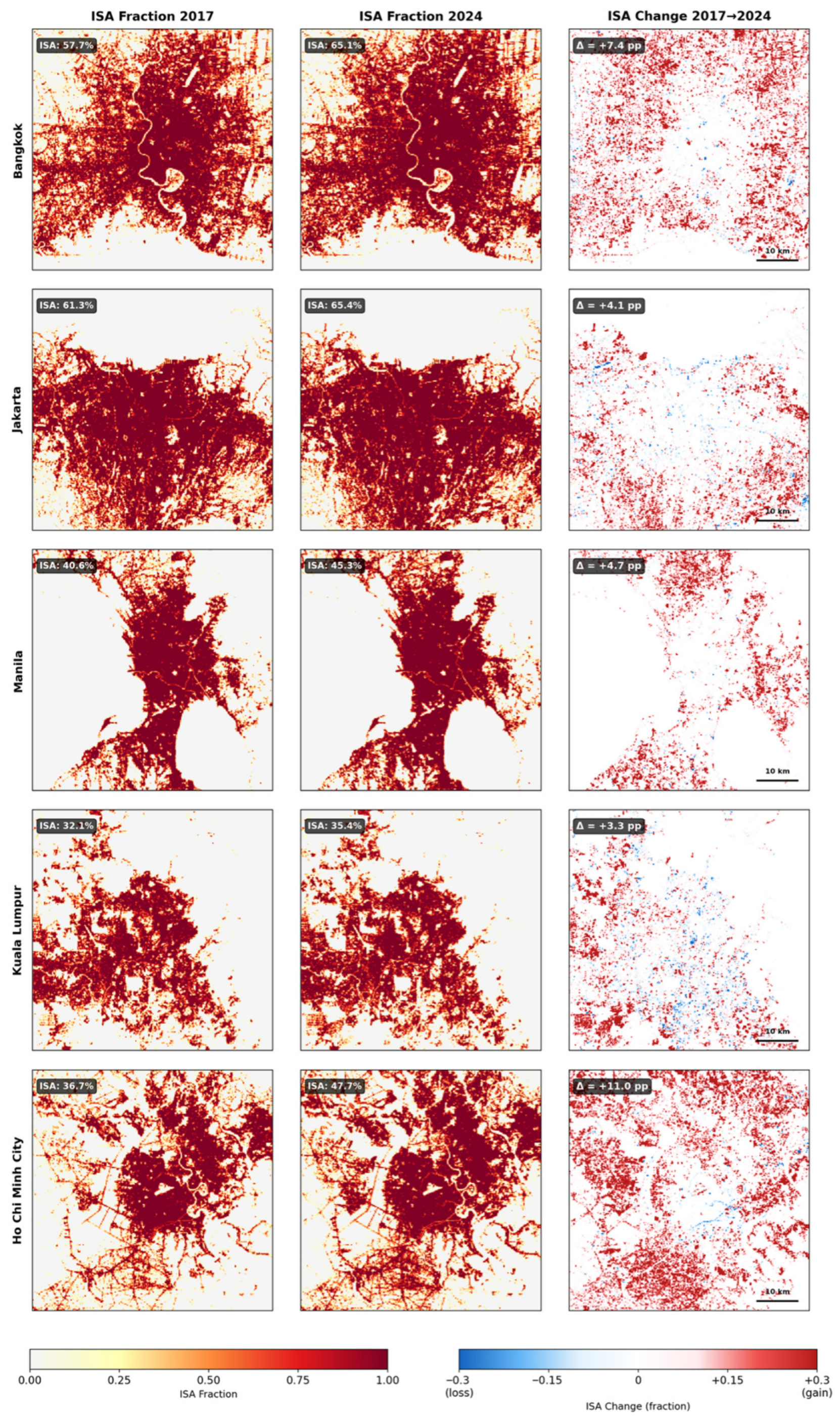
Temporal analysis of AlphaEarth-derived ISA during 2017–2024 showed that Ho Chi Minh City had the most rapid impervious area growth, increasing from 36.7% in 2017 to 47.7% in 2024 (+11.0 percentage points; linear slope = 1.48 pp yr
−1, 95% CI: 1.06–1.91; Theil-Sen slope = 1.43 pp yr
−1). Bangkok increased by +7.4 pp (slope = 1.27 pp yr
−1, 95% CI: 0.85–1.69), Manila by +4.7 pp (0.52 pp yr
−1, 95% CI: 0.32–0.73), Jakarta by +4.1 pp (0.63 pp yr
−1, 95% CI: 0.41–0.85), and Kuala Lumpur by +3.3 pp. Kuala Lumpur’s linear slope confidence interval included zero (−0.34 to 1.92 pp yr
−1), so its trend is reported conservatively despite a positive Theil-Sen slope (a city-level summary of ISA expansion and SUHI intensity is provided in
Table 10).
The spatial distribution of this expansion is shown in the change maps (
Figure 3) where new ISA concentrates along radial transport corridors in Ho Chi Minh City, whereas Bangkok exhibits more dispersed peri-urban expansion. Mean SUHI intensity during 2017–2024 was highest in Manila (8.51 °C, 95% CI: 8.10–8.92) and Kuala Lumpur (8.07 °C, 95% CI: 7.69–8.44), followed by Jakarta (6.42 °C, 95% CI: 5.87–6.96), Ho Chi Minh City (4.17 °C, 95% CI: 3.88–4.46), and Bangkok (4.01 °C, 95% CI: 3.68–4.34). LST values for 2025 should be treated as provisional because the 2025 dry-season composite was incomplete at the time of analysis.
The CIs above account for inter-annual sampling variability only. To incorporate the documented MOD11A2 retrieval uncertainty (approximately ±1 K RMSE), we ran a 1000-iteration Monte-Carlo simulation that perturbs each annual LST_urban and LST_rural with independent N(0, 1 K) noise (treated as systematic per annual city-mean—a conservative upper bound that does not assume averaging across city pixels). The resulting combined 95% confidence intervals for the 2017–2024 city-mean SUHI are: Bangkok 4.01 °C [3.03, 4.99], Jakarta 6.42 °C [5.33, 7.50], Manila 8.51 °C [7.47, 9.55], Kuala Lumpur 8.07 °C [7.02, 9.12], and Ho Chi Minh City 4.17 °C [3.19, 5.14]. The LST retrieval term widens the SUHI CI by approximately 140–305%, indicating that retrieval uncertainty—not inter-annual sampling—dominates the uncertainty budget for city-mean SUHI. Per-city Monte-Carlo statistics are reported in
Supplementary File SUHI_LST_MonteCarlo_CI.csv. The reported city ranking (Manila > Kuala Lumpur > Jakarta > Ho Chi Minh City ≈ Bangkok) is preserved under this conservative bound. The Monte-Carlo procedure provides the LST component of the end-to-end uncertainty budget recommended by Olofsson et al. (2014) [
35] for remote-sensing land-change assessment.
The combined CIs above treat the entire MOD11A2 retrieval RMSE (~1 K) as a systematic error per annual city-mean and perturb LST_urban and LST_rural independently. This is a conservative upper bound. The MOD11A2 quality assurance literature decomposes the retrieval error into a systematic component (~0.5 K, dominated by emissivity, view-angle, and atmospheric effects shared across nearby pixels) and a random component (~0.7 K, averaging down with the number of city-pixel observations). Under a less conservative split—σ_systematic = 0.5 K, σ_random = 0.7/√n with
n ≈ 700–1000 city pixels—the random term contributes ≤0.03 K to the city-mean SE, and the resulting combined CIs would be substantially narrower than those reported. Furthermore, if systematic biases are spatially correlated between adjacent urban and rural pixels (cov(LST_urban, LST_rural) > 0), the SUHI = LST_urban − LST_rural variance is smaller than the independent-error Monte-Carlo assumes. We retain the conservative reporting in the main text and provide this sensitivity caveat for transparency; the qualitative city ranking and the SUHI decline trend reported in
Section 5.5 are robust to the less conservative assumption.
A mixed-pixel sensitivity analysis was added for 2024 using MODIS LST points and Dynamic World built fraction in 500 m buffers as an ISA proxy. High-ISA pixels were warmer than low-ISA pixels by 4.00 °C in Bangkok, 6.09 °C in Jakarta, 8.15 °C in Kuala Lumpur, and 8.53 °C in Manila. Ho Chi Minh City had too few high-ISA pure pixels under the >70% threshold for a stable high-minus-low contrast, but mixed pixels averaged 33.78 °C compared with 31.62 °C in low-ISA pixels. This sensitivity analysis supports the ISA-LST relationship while explicitly showing how mixed pixels behave between rural and dense urban thermal conditions.
Pooling across the five cities the LST–ISA Pearson r is 0.649 (95% CI: 0.600–0.693,
n = 599) for pure-pervious pixels (ISA < 30%), 0.511 (95% CI: 0.461–0.558,
n = 883) for mixed pixels (30% ≤ ISA ≤ 70%), and −0.139 (95% CI: −0.323 to +0.055,
n = 104; not significant,
p = 0.16) for pure-impervious pixels (ISA > 70%). The non-significant high-ISA stratum is consistent with surface-energy-balance saturation once impervious cover dominates the 1 km pixel. Per-city values are: Bangkok r = 0.59/0.62/0.42 (low/mixed/high;
n = 72/248/18), Jakarta 0.56/0.61/−0.09 (
n = 64/177/42), Manila 0.66/0.62/0.18 (
n = 122/106/35), Kuala Lumpur 0.65/0.57/0.32 (
n = 207/116/9), and Ho Chi Minh City 0.35/0.46/(too few high-ISA samples for r) (
n = 134/236/0). Per-stratum statistics are tabulated in
Stratified_LST_ISA_Pearson_2024.csv (Supplementary Data).
Ho Chi Minh City’s ribbon-style development along radial transport corridors [
31] produce an urban morphology in which impervious surfaces are spatially distributed rather than concentrated; even though the city-mean ISA fraction reached 47.7% in 2024 (the largest 2017–2024 increase in the cohort, +11.0 pp), few 1 km MODIS pixels exceeded the 70% built fraction threshold required to populate the high-ISA stratum. Manila, Jakarta, and Kuala Lumpur—which have more compact urban cores—retain enough such pixels for the high-ISA contrast to be computed (
n = 35, 42, 9 pixels respectively). The absence of a high-ISA stratum for Ho Chi Minh City is therefore a substantive geographic finding about urban form, not merely a sampling artifact.
4.8. Independent Spatial Consistency: AlphaEarth vs. JRC GHSL
Cross-dataset comparison between AlphaEarth ISA fraction and JRC GHSL building footprint fraction at 1 km resolution (2018 epoch) demonstrated strong spatial consistency across all five cities (
Table 11). Pearson correlation coefficients ranged from r = 0.866 (95% CI: 0.849–0.881) in Ho Chi Minh City to r = 0.936 (95% CI: 0.928–0.943) in Jakarta. Overall agreement with GHSL-derived built-up labels ranged from 59.2% in Bangkok (95% CI: 56.1–62.2) to 84.5% in Manila (95% CI: 82.1–86.6). This check partly addresses shared-lineage concerns with Dynamic World, but it remains a spatial-consistency comparison rather than independent ground-truth validation.
As the ISA comparison we predicted, the AlphaEarth ISA fraction was systematically larger than GHSL building fraction and with a mean bias that ranges from +0.203 (Manila) to +0.388 (Bangkok). Such positive bias is physically consistent as ISA includes all sealed surfaces (buildings, roads, parking lots and sidewalks) while GHSL only includes building footprints. The top bias was observed for Bangkok (+0.388), matching its huge distribution of the road network and extending urban morphology that contributes to a significant share of non-building impervious surfaces to total ISA. Manila had the least bias (+0.203) and greatest overall agreement (OA = 84.5%); stemming from its very high density built environment where structural requirements do well in filling up urban space versus road/parking infrastructure per unit area.
The consistency across both built-up surface types supports the spatial plausibility of the AlphaEarth ISA classifications for urban environmental analysis. However, this comparison confirms spatial pattern consistency, not absolute ISA accuracy. The 10 m to 1 km aggregation may inflate correlations by smoothing sub-pixel heterogeneity and by emphasizing broad urban–rural gradients. Future validation should therefore use independent non-Sentinel-2 data such as aerial photography, LiDAR-derived building footprints, or field-surveyed reference samples.