Article

Evolution of DOM Composition and Hydrochemical Characteristics in Rivers of the Huaibei Plain: Gradient Effects from Agriculture to Urbanization


1
School of Carbon Neutrality Science and Engineering, Anhui University of Science and Technology, Hefei 232001, China
2
National Engineering Research Center of Coal Mine Water Hazard Controlling, Suzhou University, Suzhou 234000, China
*
Author to whom correspondence should be addressed.
Earth 2026, 7(3), 75; https://doi.org/10.3390/earth7030075
Submission received: 3 April 2026 / Revised: 28 April 2026 / Accepted: 2 May 2026 / Published: 4 May 2026

Abstract

Rapid urbanization imposes significant pressure on riverine water environments, yet the evolution of hydrochemical characteristics and dissolved organic matter (DOM) in rivers across urbanization gradients within developing regions, such as the Huaibei Plain, remains inadequately understood. Thus, this study investigates the hydrochemical and DOM characteristics of rivers across distinct urbanization gradients (suburban, peri-urban, and urban) in this area. Using an excitation–emission matrix coupled with a parallel factor analysis (EEM-PARAFAC) and hydrochemical analyses, we found that while rock weathering is the primary major ion source, human activities distinctly alter water profiles. Agriculturally dominated suburban rivers had significantly higher nitrate (NO3) concentrations than those in urban and peri-urban rivers. Their DOM was predominantly humic-like (C1, C3) with a high humification index (HIX), indicating a substantial input of soil-derived humic substances driven by runoff from the agricultural catchment. Conversely, urban and peri-urban rivers exhibited higher chloride (Cl) concentrations due to domestic sewage. Their DOM was dominated by protein-like components (C2 and C4, averaging 65–68%), with high biological indices (BIX) reflecting autochthonous origins. Correlation analysis confirmed these anthropogenic impacts: NO3 positively correlated with humic-like components and HIX, while Cl strongly correlated with protein-like components. These findings confirm that DOM components and spectral indices are effective tracers of anthropogenic disturbance and hold promise for monitoring and predicting water quality, thus providing a scientific basis for improved water resource management and restoration strategies.

1. Introduction

With the rapid increase in urbanization, water quality deterioration and aquatic ecosystem degradation in urban rivers have severely restricted the sustainable utilization and ecological development of urban aquatic resources [1]. Currently, China is experiencing an unprecedented urban expansion process [2], which has led to the conversion of a large number of natural and agricultural rivers into urban rivers. The global urban population is projected to reach 2.3 billion by 2025 [3], which will further exacerbate the anthropogenic disturbance of urban river ecosystems. As an important water diversion channel for the South-to-North Water Diversion Project, the major rivers in the Huaibei Plain have important water supply and ecological functions [4]. This region is also characterized by intensive agricultural cultivation, rapid peri-urbanization, and coal mining activities, making it highly representative for revealing anthropogenic disturbance gradients in riverine ecosystems [5,6]. The hydrochemical composition of river water is jointly controlled by basin geological conditions, atmospheric precipitation, climate, vegetation, and anthropogenic activities [7], and the analysis of surface water hydrogeochemical characteristics is the basis for clarifying the source of major ions and their response to the surrounding environment [8]. Similarly, DOM is highly sensitive to changes in urbanization levels and the comprehensive status of the aquatic environment [9]. Moreover, methods for its detection are efficient, require small water sample volumes, and are non-destructive to the sample structure [10].
DOM is a highly reactive heterogeneous mixture with a complex structure, composed of humus, proteins, polysaccharides, and other organic macromolecules [11]. It has two main sources: autochthonous sources (mainly derived from the death and decomposition of phytoplankton and microorganisms in water) and allochthonous sources (primarily from the decomposition of soil organic matter and plant tissues in the watershed) [12]. As a core nutrient reservoir and carbon source in aquatic ecosystems, DOM plays a pivotal role in linking biogeochemical cycling, pollutant transport and transformation, and water quality evolution [13]. Compared with rivers in remote natural areas, urban rivers typically have higher concentrations of protein-like DOM components due to intense anthropogenic disturbances [2]. Excessive DOM in natural water bodies can not only hinder the penetration of sunlight into the deep water layer and inhibit aquatic photosynthesis [14,15], but also lead to the formation of stable complexes with heavy metals, enhancing their mobility and bioavailability [2]. In addition, DOM can react with disinfectants during drinking water treatment to generate disinfectant by-products, posing a potential risk to human health [16]. Therefore, exploring the composition and spectral characteristics of DOM is of great significance for revealing its source apportionment, environmental behavior, and transformation processes in aquatic ecosystems.
Fluorescence spectroscopy is an effective tool for characterizing the optical properties of DOM in water [17]. Excitation–Emission Matrix–Parallel Factor Analysis (EEM-PARAFAC) has been widely applied in the study of DOM in rivers [18], lakes [19], and groundwater [20] due to its high sensitivity, wide applicability, and simple operation. For example, Wang Ya et al. [18] used EEM-PARAFAC to analyze DOM composition in coastal rivers of the Pearl River Delta and found that urban rivers had relatively high contents of protein-like components. Peng Yigao et al. [21] revealed that high-antimony groundwater was characterized by a higher humification index and lower fluorescence intensity via EEM-PARAFAC. In addition, fluorescence index (FI), humification index (HIX), and biological index (BIX) can be calculated from EEM data to identify the source and humification degree of DOM [17].
Current studies on DOM in the urban rivers of China have mostly focused on economically developed megacities such as Ningbo [22], Shenzhen [18], and Chongqing [1], whereas research on DOM in rivers of less developed cities in the Huaibei Plain remains scarce [23]. Rivers are critical channels connecting the terrestrial–aquatic organic and inorganic carbon cycles and play an important role in regional carbon cycling [1]. The water quality and DOM composition of rivers across different urbanization gradients are a comprehensive reflection of natural processes and anthropogenic impacts in the watershed [24], and the quantity and quality of DOM are closely linked to urbanization intensity [1]. Zhang Hangzhen et al. [25] investigated the relationship between dissolved organic matter (DOM) and river water quality on a global scale, demonstrating that climate change concurrently influences both water quality parameters and DOM sources, with DOM showing strong correlations with key water quality indicators. Moreover, research in Bohai Bay, China, and its tributary rivers has revealed that fluorescence-based components and spectral indices are capable of serving as reliable predictors for water quality [26].
Therefore, it is crucial to systematically explore the spectral characteristics and source apportionment of DOM in rivers across different urbanization gradients in Suzhou City, a typical, less-developed city in the Huaibei Plain. This study aims to (1) clarify the spatial differentiation patterns of major ion compositions, hydrochemical facies, and ion sources of rivers across distinct urbanization gradients in the Huaibei Plain; (2) identify the fluorescent components of DOM and reveal their spatial variation characteristics; and (3) explore the coupling relationship between hydrochemical parameters and DOM spectral indices, and screen out effective indicators for tracing anthropogenic disturbance. The results will fill a gap in the research of DOM in less-developed urban rivers of the Huaibei Plain and provide a scientific basis for the ecological management of river water in the region.

2. Materials and Methods

2.1. Study Area

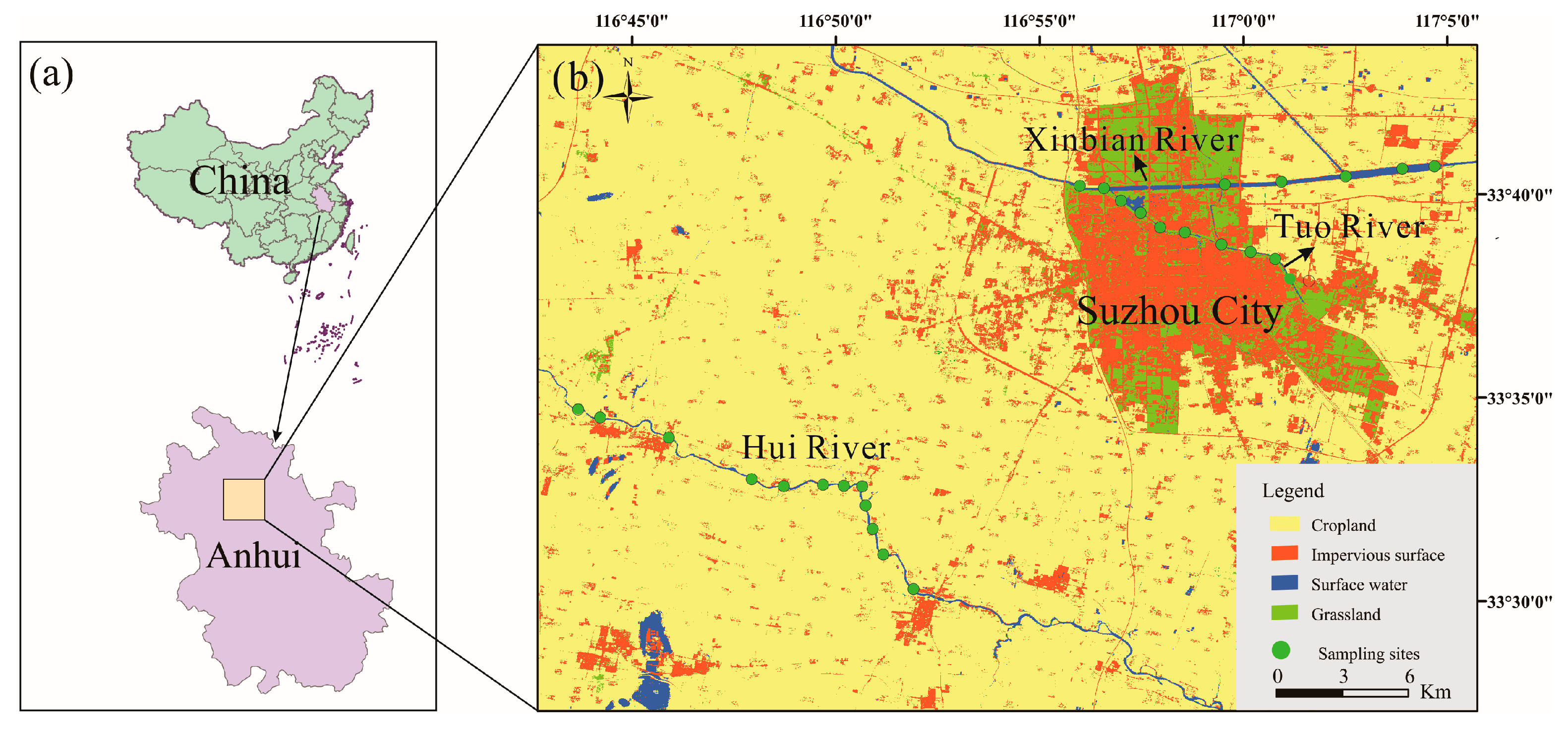
The study area is located in Suzhou City, northern Anhui Province, which is a typical representative of the Huaibei Plain, and sits in the warm temperate monsoon climate zone (Figure 1a). Precipitation in this region has clear seasonal variations and an uneven annual distribution, with abundant rainfall in summer and scarce precipitation in winter, and concentrated rainfall is prone to cause flood disasters. Three typical rivers with different urbanization gradients were selected as the research objects: the Hui River (suburban river, dominated by agricultural land use), the Tuo River (urban river, dominated by urban impervious surfaces), and the Xinbian River (peri-urban river, transitional zone between urban and suburban areas) (Figure 1b).
The Hui River is a suburban river dominated by agricultural land use. It originates in Caolou in northwestern Shangqiu City, Henan Province, and is a tributary of the Huaihong New River in the Hongze Lake system of the Huaihe River Basin. The total length of the Hui River is 235 km, with a drainage area of 4176 km2. The basin has low and variable annual precipitation, limited runoff with large inter-annual fluctuations, and extremely uneven intra-annual runoff distribution. The average annual discharge at Huangkouji Hydrological Station is 4.19 m3/s, with an average annual natural runoff of 1.44 × 10⁸ m3 [24,27].
The Tuo River is defined as an urban river, with urban impervious surfaces as the dominant land use. It is a left-bank tributary of the Huaihe River, originating from Liudi in Shangqiu City, Henan Province. The Tuo River has a total length of 112 km, a water depth of 0.5–1.5 m, and a drainage capacity of 3.52–72.10 m3/s. This river traverses the core urban built-up area of Suzhou City and is strongly disturbed by domestic sewage and urban stormwater runoff [23,27].
The Xinbian River serves as the peri-urban river, representing the transitional zone between urban and suburban areas. It is a large artificial river with a total length of 127 km and a watershed area of 2493.3 km2 within Suzhou City. The basin crosses Henan, Anhui, and Jiangsu provinces; the main stream diverts water from the Tuo River at Qilingzi and flows into the Lihewa of Hongze Lake at Fuyuzi in Sihong County, Jiangsu Province [24,27].

2.2. Sample Collection and Testing

A total of 27 sampling sites were systematically set in the study area, including 12 sampling sites distributed along the mainstream of the Hui River (suburban river), another 10 sampling sites along the Tuo River (urban river), and the remaining 5 sampling sites along the Xinbian River (peri-urban river). Sampling points were arranged along the main streams of the three rivers following a uniform spatial gradient principle, covering upstream, midstream, and downstream segments to fully represent the overall water environmental characteristics of each river system. As shown in Figure 1b, the spatial distribution of sampling sites and land use types was mapped based on Globeland30 land use data and Sentinel-2 remote sensing imagery (2024); the Hui River, Tuo River, and Xinbian River were explicitly labeled on the map, and the spatial scope corresponding to suburban, peri-urban, and urban gradients was clearly marked. All water samples were collected in triplicate at each sampling site to ensure statistical robustness. Sampling was completed within one day, and samples were transported to the laboratory within 4 h under a controlled temperature of 2–4 °C. Total dissolved solids (TDS) and pH were measured in situ. Collected water samples were stored in 1000 mL high-density polyethylene (HDPE) bottles. Upon transportation to the laboratory, the water samples were immediately filtered through 0.45 μm cellulose membranes to remove suspended particulate matter. For cation analysis (Ca2+, Mg2+, Na+, and K+), the filtered samples were acidified to pH < 2 with ultra-pure nitric acid to prevent metal precipitation and adsorption, then stored at 4 ℃ in darkness until analysis. For anion analysis (Cl, SO42, F, and NO3), the filtered samples were stored at 4 °C without acidification. The concentrations of the major cations and anions were determined by ion chromatography (ICS-600-900, Thermo Fisher Scientific, Waltham, MA, USA). The measurement of HCO3 and CO32 was carried out using phenolphthalein and methyl orange as indicators, and titration was performed with 0.05 mol/L HCl (DZ/T 0064.49-2021). All instrumental measurements were conducted in triplicate, and the relative standard deviation (RSD) was controlled within 5% to ensure data precision. Fluorescence spectroscopy was performed using an F-4700 spectrophotometer (Hitachi, Japan). Samples were scanned in a 1 cm quartz cuvette with excitation (Ex) wavelengths from 250 to 500 nm and emission (Em) wavelengths from 250 to 600 nm, at a scanning speed of 2400 nm/min. Ultrapure water was used as a blank to correct for background effects. The fluorescence index (FI) is defined as the fluorescence intensity ratio between 450 nm and 500 nm under an excitation wavelength of 370 nm [28]. The biological index (BIX) is calculated as the ratio of emission fluorescence intensity at 380 nm to 430 nm under an excitation wavelength of 310 nm [28]. The humification index (HIX) is calculated as the integral area of fluorescence signals in the emission ranges of 435–480 nm and 300–345 nm under an excitation wavelength of 254 nm [28].

2.3. Statistical Analysis

Parallel factor analysis (PARAFAC) was performed on the excitation–emission matrix (EEM) fluorescence spectra using Matlab 2022b combined with the drEEM toolbox. The resolved fluorescent component information was subjected to matching analysis against the online spectral library of DOMFluor. One-way analysis of variance (ANOVA) and multivariate statistical analysis were conducted using IBM SPSS Statistics 24. Graphs were plotted using OriginPro 2025 and R.

3. Results

3.1. Characteristics of Conventional Ion Contents

The statistical characteristics of major cation and anion concentrations in rivers across different urbanization gradients in the study area are shown in Table 1. Three rivers were all slightly alkaline (pH 7.42~8.50), with significant differences in pH values among different urbanization gradients: the peri-urban river had the highest average pH (8.39), followed by the urban river (8.26), and the suburban river had the lowest (7.75). This may be related to the differences in anthropogenic nutrient input and aquatic microbial metabolism among different rivers.
Among the anions, HCO3 was dominant. HCO3 concentrations in the suburban river ranged from 229.12 to 324.31 mg/L, with a mean value of 295.65 mg/L, while those in the urban river varied from 372.20 to 495.76 mg/L, with a mean of 416.47 mg/L. In the peri-urban river, concentrations ranged from 212.64 to 387.46 mg/L, with a mean of 304.75 mg/L. Hence, HCO3 concentrations were highest in the urban river, followed by the peri-urban river and then the suburban river. The order of concentrations for major cations and anions was consistent in both the peri-urban river and the urban river: Na+ > Ca2+ > Mg2+ > K+, and HCO3 > SO42 > Cl > F. In contrast, the order for major anions in the suburban river was HCO3 > Cl > SO42 > F.

3.2. Controlling Factors of Hydrochemical Characteristics

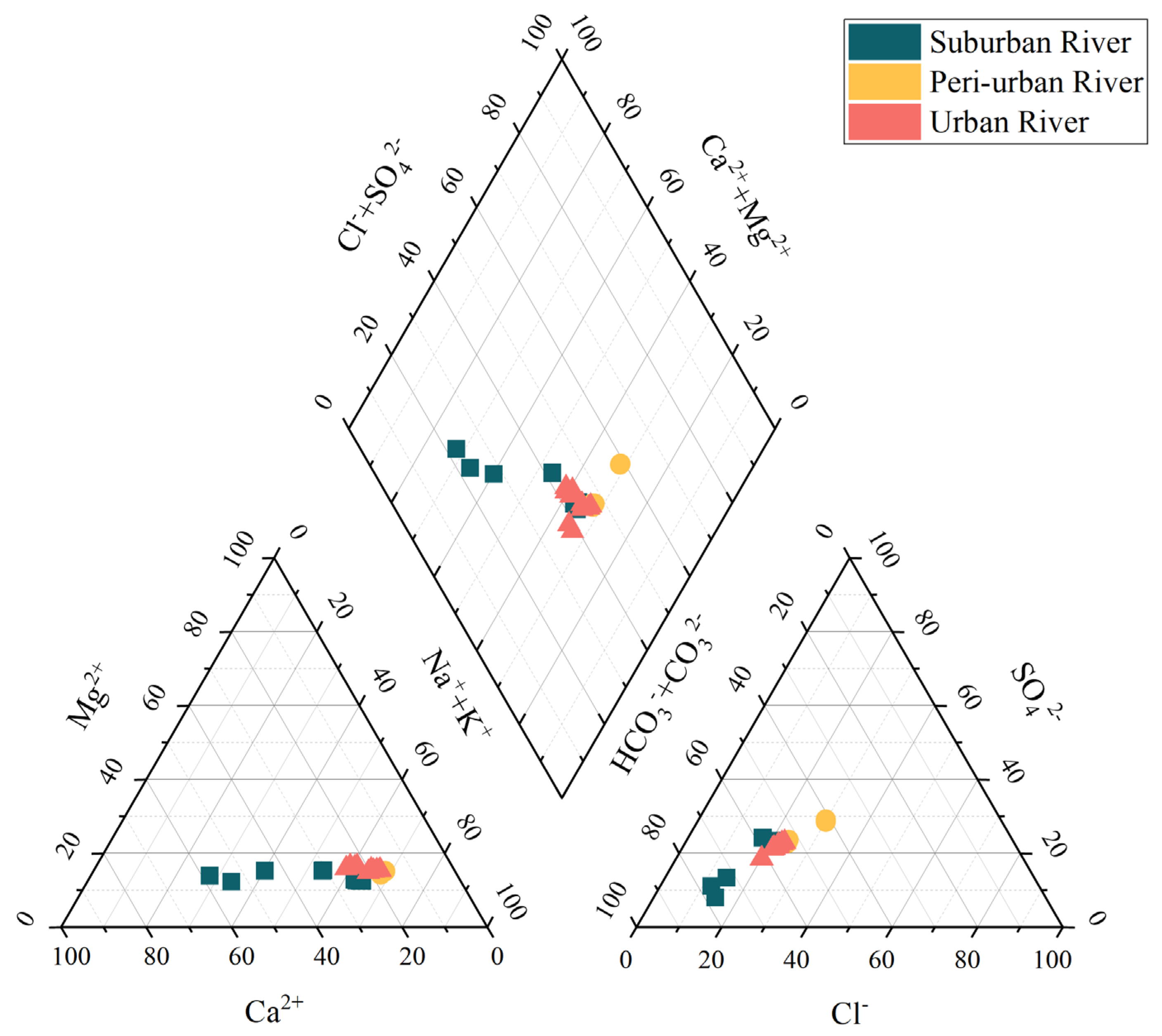
The Piper trilinear diagram is a classic method for identifying hydrochemical facies and has been widely applied in the analysis of aquatic hydrochemical compositions [29]. As shown in Figure 2, HCO3 was the dominant anion in all three rivers, followed by Cl and SO42; Na+ was the predominant cation, followed by Ca2+ and Mg2+. The average milliequivalent percentages of Na+ in total cations for the suburban, peri-urban, and urban rivers were 47.1%, 56.7%, and 52.5%, respectively, and the corresponding average milliequivalent percentages of HCO3 in total anions were 50.9%, 38.1%, and 46.7%, respectively. The hydrochemical facies of both urban and peri-urban river waters were classified as the Na-HCO3 type, indicating that the ion composition of urban and peri-urban rivers is significantly affected by rock weathering. In addition, Na+ accounts for more than half of the total cation assemblage, indicating that its concentration is not only regulated by rock weathering but also subjected to intense anthropogenic interference. Domestic sewage discharge, detergent emissions, urban runoff, and agricultural irrigation return flow are dominant exogenous sources of Na+, which cause substantial enrichment of sodium ions in urban and peri-urban rivers [30]. For the suburban river, 75% of the water samples were Na-HCO3 type, and 25% were Ca-HCO3 type, suggesting that the suburban river is jointly affected by silicate weathering (Na+ release) and carbonate weathering (Ca2+ release), which is consistent with the geological background of the Huaibei Plain [31].
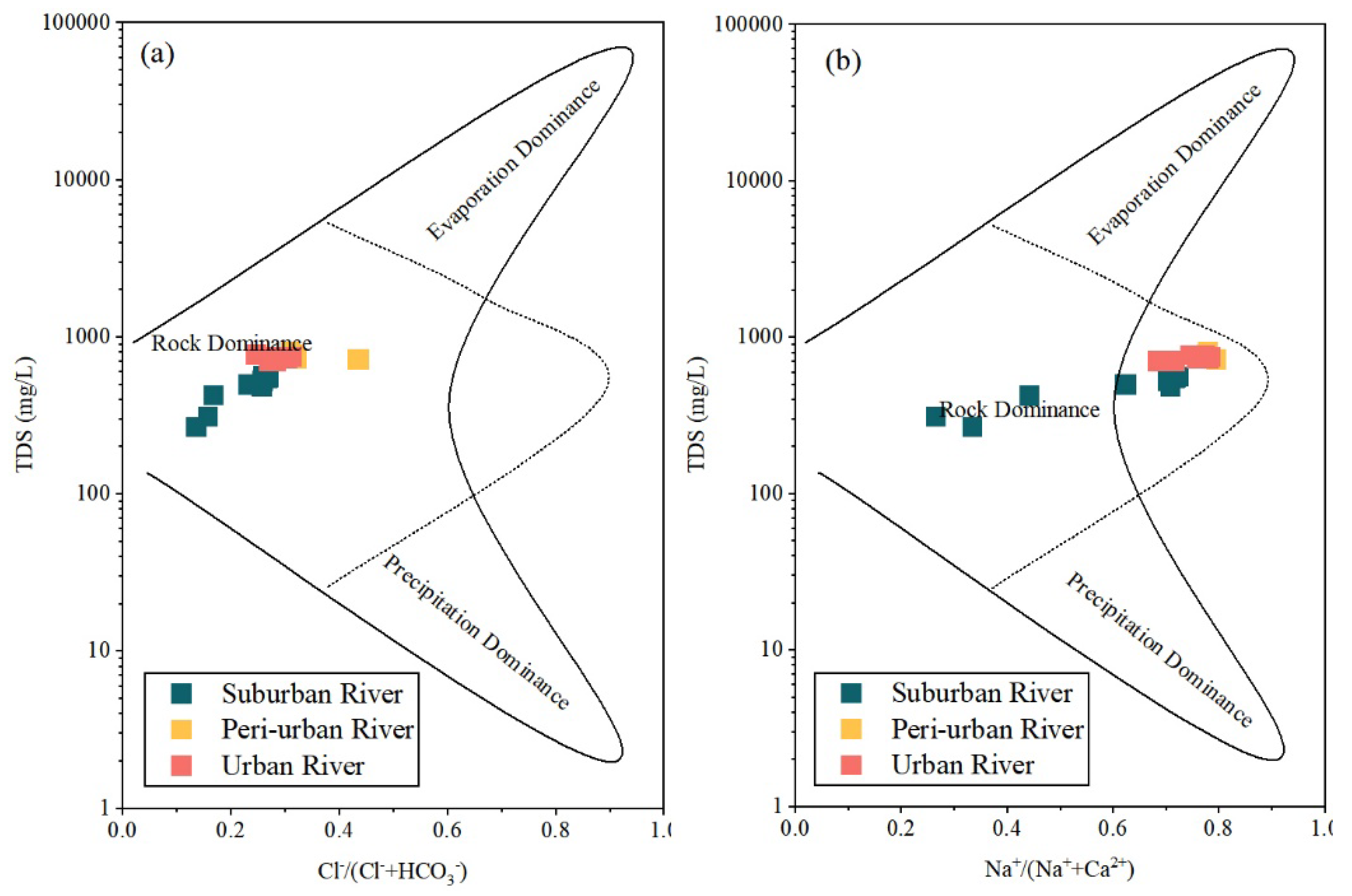
Gibbs diagrams are an effective tool to distinguish the contributions of evaporation–crystallization, atmospheric precipitation, and rock weathering to the hydrochemical characteristics of surface water [31,32]. As shown in Figure 3, all sampling points are concentrated in the rock weathering dominance area, with a small number of points close to the evaporation–crystallization area. This indicates that rock weathering is the primary controlling factor of the hydrochemical characteristics of rivers in the study area, and evaporation–crystallization has a secondary influence. Combined with the ion concentration characteristics, anthropogenic activities (agricultural non-point source pollution, domestic sewage discharge) have altered the relative content of partial ions (NO3, Cl) on the basis of natural rock weathering [24]. This is the main reason for the differences in hydrochemical parameters among rivers with different urbanization gradients.

3.3. EEM-PARAFAC Components

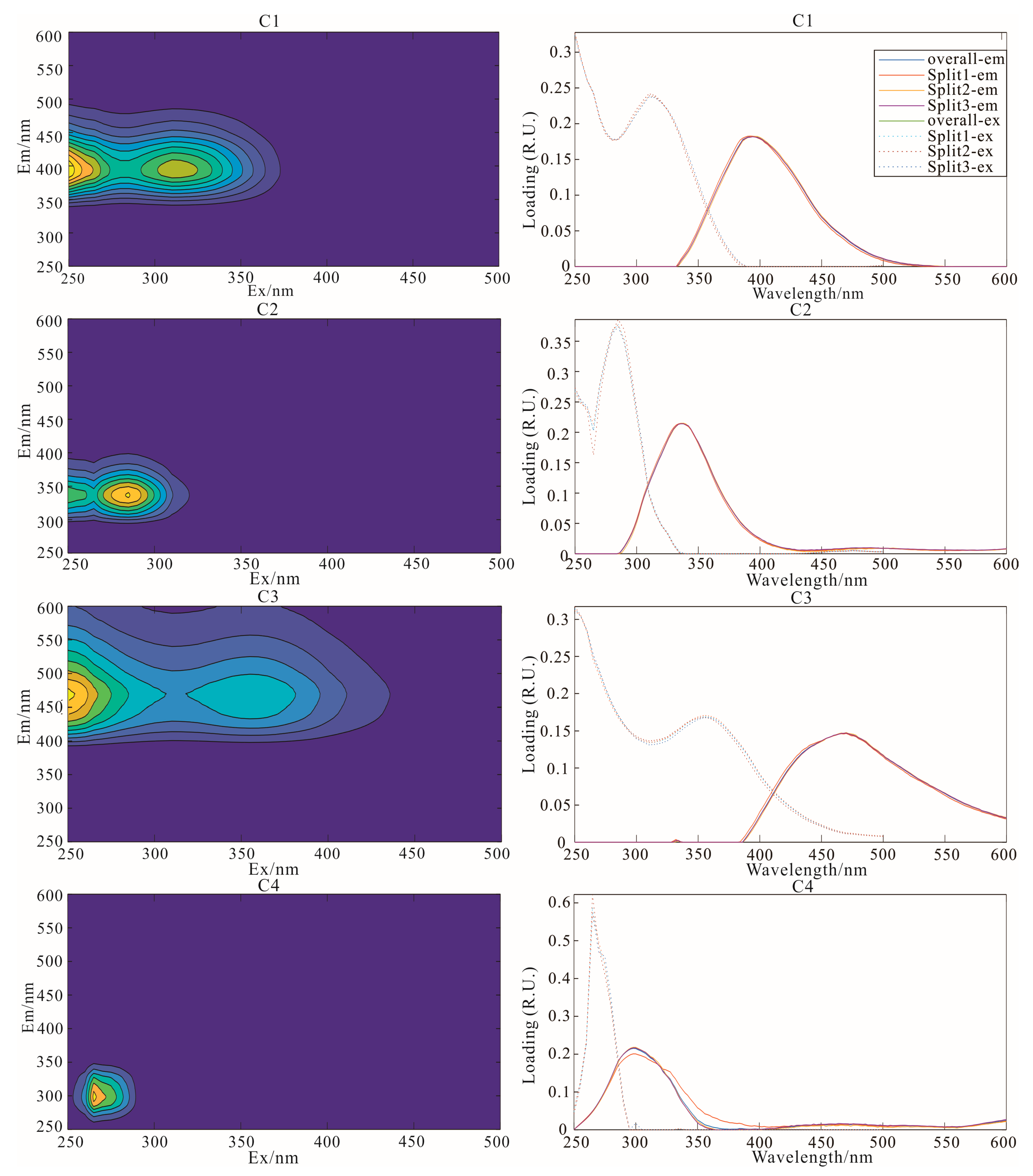
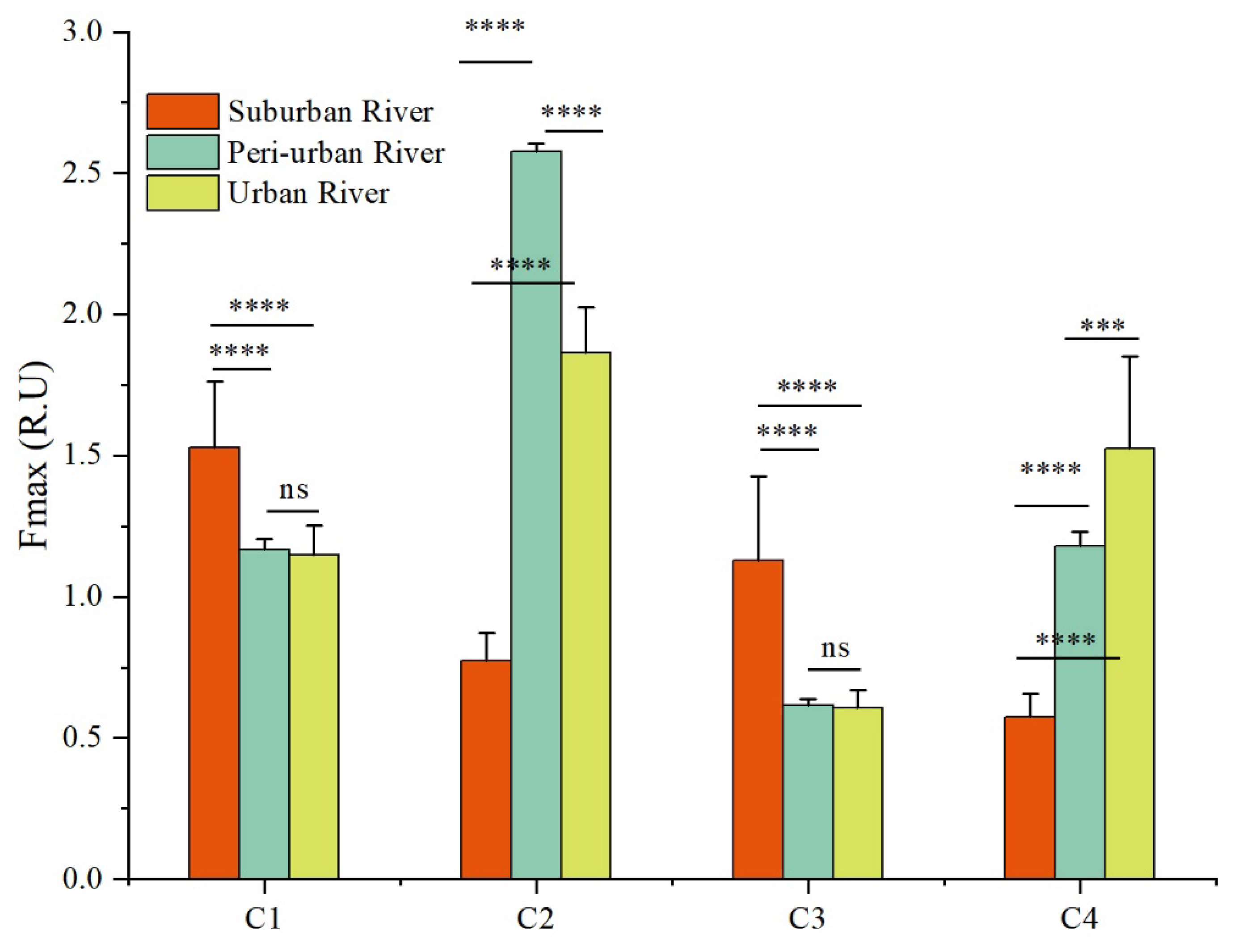
Four fluorescent components were identified from the EEM-PARAFAC combined with core consistency diagnosis and split-half validation (Figure 4), and the spectral characteristics and source analysis of each component were obtained by matching with the DOMFluor database (Table 2). C1 and C3 exhibited excitation and emission wavelength maxima (380 nm < Em) characteristic of humic-like substances, whereas C2 and C4 displayed spectral signatures (Em < 380 nm) consistent with protein-like components [33]. C1 (Ex/Em = 250(310)/394 nm) is a terrestrial humic-like fluorophore associated with microbially processed terrestrial organic matter, potentially influenced by agricultural activities [33,34]. The fluorescent component C1 in the suburban river was significantly higher (p < 0.05) than that in the urban and peri-urban rivers (Figure 5).
The maximum excitation wavelength of component C2 was 285 nm, and the maximum emission wavelength was 336 nm, which was close to the position of the traditional T peak and could be identified as a tryptophan-like substance [35,36]. Component C3 exhibited a maximum emission peak at 470 nm, which is characteristic of a typical terrestrial humic-like component [37,38]. Component C3 generally displayed higher peak intensities in catchments strongly disturbed by anthropogenic activities and in wastewater, in comparison with surface water and groundwater under natural background conditions [39]. Component C4 showed a maximum excitation wavelength of 265 nm and a maximum emission wavelength of 298 nm, and was identified as a tyrosine-like substance [40]. As a protein-like component, C4 is generally related to high eutrophication and strong autochthonous production. The tyrosine-like component (C4) has a low molecular weight and high bioavailability, and can be used to indicate the contemporary primary productivity and microbial activity of the water body. Moreover, the proportion of protein-like components increases in catchments that are strongly disturbed by human activities or in polluted areas [41].

4. Discussion

4.1. Differences in Conventional Ion and Fluorescence Parameters of Rivers Across Different Urbanization Levels

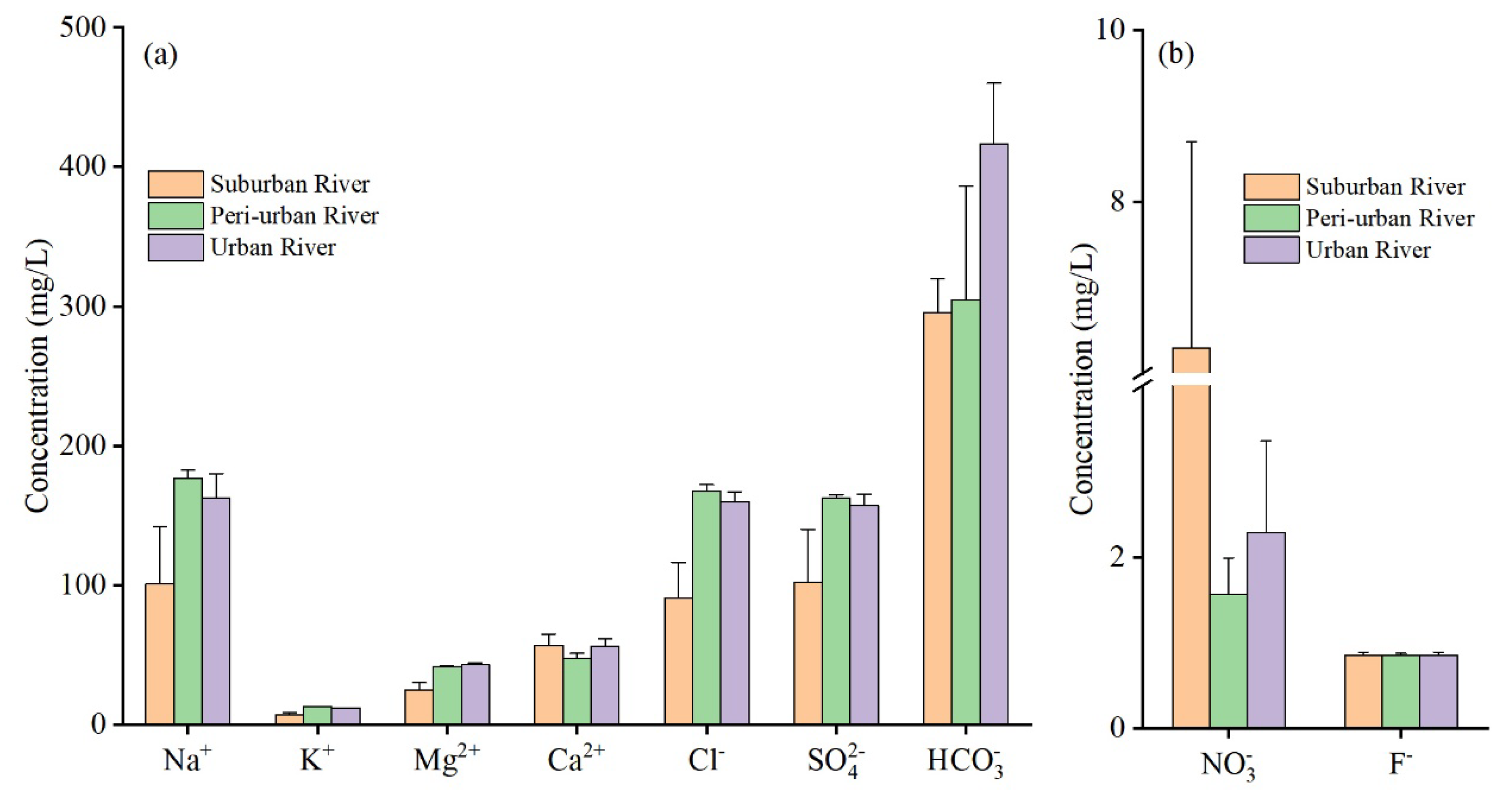
A comparison of ion concentrations showed that Cl concentrations in the overlying water of urban and peri-urban rivers were significantly higher (p < 0.05) than those in suburban rivers, while SO42 and NO3 concentrations in suburban rivers were significantly higher (p < 0.05) than those in urban and peri-urban rivers (Figure 6). The suburban river watershed is dominated by agricultural land and coal mines (Qinan and Qidong Coal Mines), where agricultural non-point source pollution is characterized by high NO3 input (from chemical fertilizer application) and mine drainage discharges with high concentrations of SO42. This pattern is consistent with the findings of previous studies on groundwater in agricultural areas of the Huaibei Plain and rivers affected by mining drainage [42], indicating that the combined effects of agricultural fertilization and mining activities are a typical characteristic distinguishing suburban rivers from urban rivers. In this study, the significant enrichment of Cl in urban rivers (mean concentration > 150 mg/L) is consistent with the findings reported by Jiang Yaqi et al. [7] for rivers in similarly rapidly urbanized regions, which collectively confirms that domestic sewage discharge serves as a critical indicator of anthropogenic disturbance to hydrochemical characteristics in such areas.
The relative abundances of the four fluorescent components in rivers across different urbanization gradients are shown in Figure 5. The fluorescence intensities of humic-like components (C1 and C3) in the suburban river were significantly higher than those in urban and peri-urban rivers (p < 0.05). The average proportions of C1 and C3 in the suburban river were 38.05% and 27.89%, respectively, with a total proportion of 65.94%. This indicates that DOM in the suburban river is dominated by humic-like components, which is due to the intensive agricultural activities in the suburban watershed: a large amount of soil humus is transported into the river by rainfall erosion and surface runoff, resulting in a high proportion of land-derived DOM [43]. In contrast, the fluorescence intensities of protein-like components (C2 and C4) in urban and peri-urban rivers were significantly higher than those in the suburban river (p < 0.05). The total proportions of C2 and C4 in urban and peri-urban rivers were 65.78% and 67.83%, respectively, indicating that DOM in urban and peri-urban rivers is dominated by protein-like components. The high proportion of protein-like components is closely related to the large amount of domestic sewage discharge in urban and peri-urban areas. Tryptophan and tyrosine in domestic sewage are the main sources of protein-like DOM, and the weak hydrodynamic conditions of urban rivers also facilitate the accumulation of protein-like components [9]. Our results are consistent with those reported for several rapidly urbanized regions. Wang Ya et al. [18] documented high abundances of protein-like components (C2, and C4) in urban rivers of the Pearl River Delta, which was attributed to wastewater discharge. Similarly, Zhang Liuqing et al. [1] found that urbanization enhances autochthonous protein-like signals in dissolved organic matter. In contrast with those findings, suburban rivers in our study area exhibited a notably higher proportion of humic-like components (C1+C3, approximately 66%), reflecting the strong influence of agricultural runoff in this region and demonstrating a distinct effect of the urbanization gradient on dissolved organic matter composition.
Fluorescence parameters of DOM can reveal information, such as its source, humification degree, and autochthonous characteristics [9]. FI can be used to identify the sources of DOM. When the FI value is greater than 1.9, this suggests that the DOM is predominantly autochthonous. When it is between 1.4 and 1.9, this indicates a combined influence of terrestrial sources and autochthonous production. When the FI value is less than 1.4, this implies that DOM shows strong terrigenous characteristics [44]. The FI values for the suburban river mostly fell between 1.4 and 1.9, indicating that its DOM contained contributions from both terrestrial and autochthonous sources [9]. In contrast, the FI values of urban and peri-urban rivers were slightly higher than 1.9, which could be attributed to direct anthropogenic disturbances leading to elevated levels of protein-like components [45]. HIX can be used to indicate the humification degree of DOM [46]. The HIX values of the suburban river ranged from 2.41 to 4.41, with a mean value of 3.05, whereas those of the urban river varied between 0.70 and 0.85, with an average of 0.77, while those of the peri-urban river ranged from 0.79 to 0.92, with a mean of 0.86. It is evident that the HIX value of DOM in the suburban river was significantly higher (p < 0.05) than those in the urban and peri-urban rivers, indicating a higher humification level of DOM in the suburban river [44]. Soil DOM exhibits a high HIX value, as macromolecular humus in soil is poorly bioavailable and shows a high degree of humification. Meanwhile, a higher HIX value indicates distinct terrigenous characteristics of DOM and is associated with the input of agricultural non-point source pollution [47]. BIX is another important indicator for identifying DOM sources. A BIX value greater than 1 suggests that DOM is mainly autochthonous [48]. The BIX values of the suburban river were approximately 1, with some sites showing BIX values below 1, indicating that the suburban river was influenced by both terrigenous and autochthonous sources. However, those of urban and peri-urban rivers were all greater than 1, implying significant autochthonous characteristics in these rivers. Furthermore, r(T/C) was applied to evaluate the pollution status of rivers, and an r(T/C) value > 2 suggests the impact of wastewater discharge [44]. Urban and peri-urban rivers presented relatively high r(T/C) values, with average values of 2.84 and 2.67, respectively. In contrast, the r(T/C) value of the suburban river (average: 0.79) was significantly lower (p < 0.05) than those of urban and peri-urban rivers (Table 3). Therefore, DOM in the suburban river was mainly controlled by terrigenous sources, whereas DOM in urban and peri-urban rivers was dominated by autochthonous sources and significantly affected by sewage discharge.

4.2. Relationship Analysis Between Hydrochemical Parameters and DOM

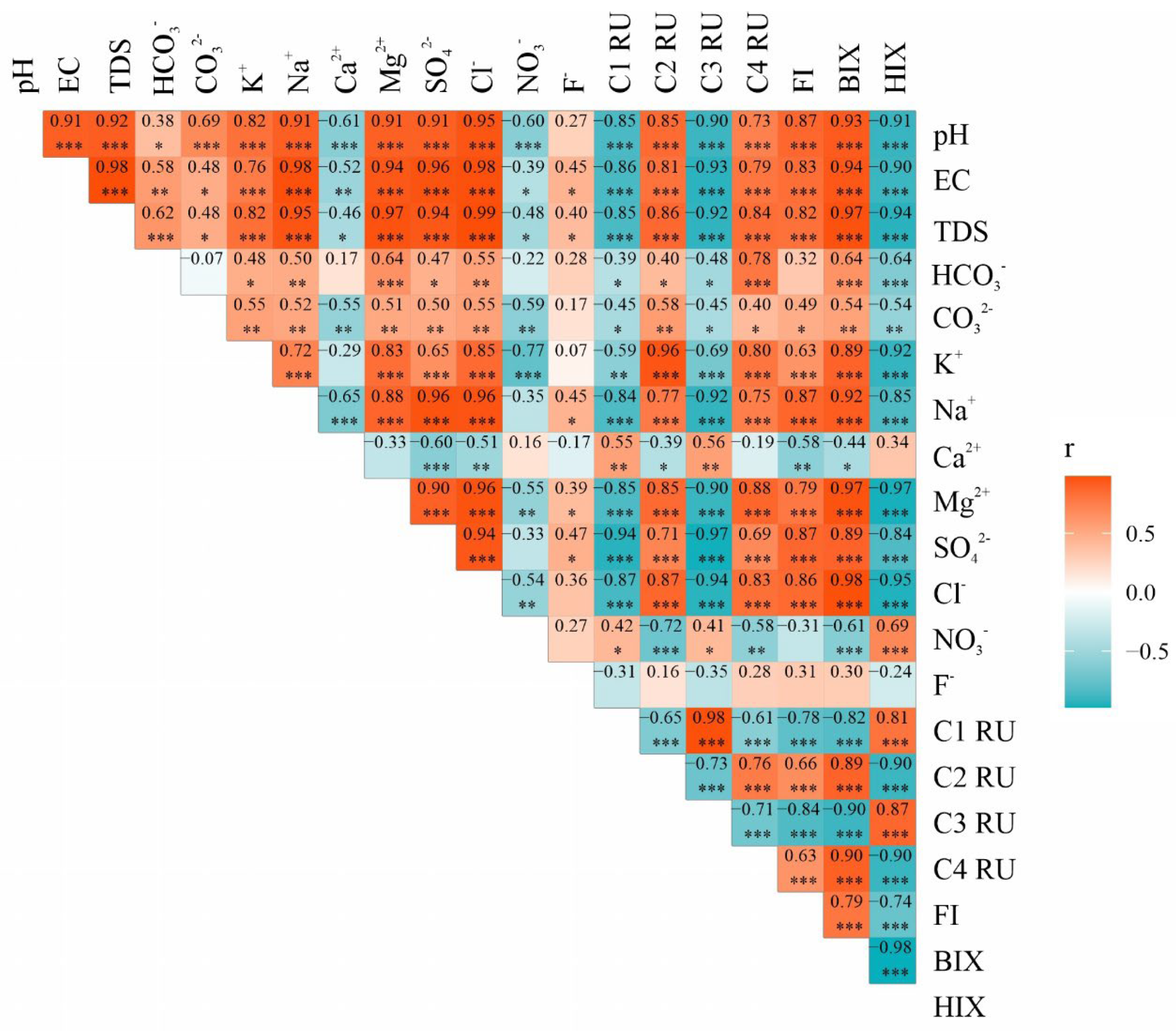
The assessment of surface water quality is usually based on physical, chemical, and biological indicators, and the use of fluorescence spectral parameters to characterize water quality characteristics has been verified as an effective method [26]. Previous studies have mostly focused on the relationship between DOM spectral indices and heavy metals or nutrient indicators (COD, TP, and NH4+-N) [44,49], while the coupling relationship between major hydrochemical parameters (dominant anions and cations) and DOM spectral indices remains unclear. In this study, Pearson correlation analysis was used to explore the relationship between hydrochemical parameters, DOM fluorescent components, and spectral indices (Figure 7). NO3 exhibited significantly positive correlations (p < 0.05) with humic-like components (C1 and C3) and HIX. Humic-like components (C1 and C3) are mostly derived from the terrestrial soil environment; in particular, agricultural activities import terrigenous DOM into aquatic ecosystems, thereby increasing the sources of allochthonous organic matter in aquatic ecosystems [25,50]. Meanwhile, rivers dominated by agricultural land usually present high concentrations of NO3 [51]. Consequently, humic-like components serve as important parameters for indicating agricultural non-point source pollution [52]. Cl and SO42 showed strong positive correlations with protein-like components (C2 and C4) (p < 0.001). In natural water bodies, Cl and SO42 are mostly associated with anthropogenic disturbances [31]. Therefore, protein-like components are important indicators for reflecting anthropogenic disturbance [46]. Furthermore, Mg2+, Na+, and K+ also exhibited strong positive correlations with the protein-like components (C2 and C4), and some studies have suggested that DOM is related to water–rock interactions [53]. Previous research has indicated that an increase in dissolved organic carbon concentration in water is often accompanied by rising levels of Mg2+, Na+, and HCO3 [54]. It can be seen that the relationships between DOM fluorescent components and anions/cations are complex. Nevertheless, increasing evidence has confirmed the feasibility of using DOM fluorescent components and spectral parameters to characterize anthropogenic disturbances [52]. In general, the correlation analysis further verifies that DOM fluorescent components and their spectral indices can effectively characterize the type and degree of anthropogenic disturbance in rivers across different urbanization gradients, and the coupling relationship between hydrochemical parameters and DOM provides a new perspective for the comprehensive assessment of river water quality in the Huaibei Plain.

5. Conclusions

In this study, water samples were collected from typical rivers across different urbanization levels in the Huaibei Plain. By integrating Piper trilinear diagrams, Gibbs diagrams, EEM-PARAFAC, and Pearson correlation analysis, we systematically characterized the hydrochemical properties of river waters across different urbanization gradients, identified the fluorescent components of DOM, and elucidated the coupling relationships between hydrochemical parameters and DOM spectral characteristics. The main conclusions are as follows:
(1) All river waters in the study area exhibited weak alkalinity, with significant gradient differences in hydrochemical parameters. Rock weathering dominates the hydrochemical background of regional rivers, while anthropogenic activities drive the gradient differentiation of ion components. Urban and peri-urban rivers were characterized by elevated Cl, indicative of domestic sewage input, whereas suburban rivers exhibited significantly higher NO3 and SO42, reflecting the combined pressure from agricultural non-point sources and mining drainage.
(2) DOM components present a clear urbanization gradient differentiation pattern. The variations in DOM spectral indices among rivers with different urbanization gradients were highly consistent with the characteristics of DOM fluorescent components. Suburban rivers are dominated by terrigenous humic-like components (C1+C3, 65.94%) with high HIX, while urban and peri-urban rivers are dominated by autochthonous protein-like components (C2+C4, 65.78% to 67.83%) with high BIX, which directly reflects the source transition of DOM from agricultural allochthonous input to urban autochthonous production.
(3) Explicit coupling relationships were found between hydrochemical parameters and DOM fluorescent components/spectral indices, providing a reliable basis for tracing different types of anthropogenic disturbances. NO3 was significantly positively correlated (p < 0.05) with terrestrial humic-like components (C1, C3) and HIX, serving as a key indicator for agricultural non-point source pollution in the study area. Chloride (Cl) showed an extremely significant positive correlation (p < 0.001) with protein-like components (C2 and C4) and r(T/C), which directly reflected the contributions of domestic sewage discharge and urban anthropogenic disturbances to the river water quality. These relationships demonstrate that DOM fluorescence spectroscopy is not merely a complementary tool but can effectively decode the complex mixture of anthropogenic pressures, translating water chemistry into actionable source identification.

6. Limitations and Future Perspectives

While our study identified clear gradients in hydrochemistry and DOM characteristics linked to urbanization, several limitations should be acknowledged to properly contextualize the findings and guide future research.
(1) Our study adopted a one-time cross-sectional sampling strategy, without long-term continuous observations. Riverine DOM and ion concentrations are known to exhibit significant seasonal variations driven by precipitation, temperature, and agricultural cycles. Consequently, the patterns reported here may not fully represent the annual dynamics or extreme conditions such as post-fertilization periods, stormflow events. Future studies incorporating high-frequency, seasonal, or event-based sampling are needed to unravel the temporal stability and drivers of the observed gradients.
(2) EEM-PARAFAC analysis, while powerful for characterizing fluorescent DOM, does not fully capture the molecular complexity or biogeochemical lability of the DOM pool. Non-fluorescent or weakly fluorescent DOM, as well as the specific chemical structures and bioavailability of identified components, remain unexplored. Coupling optical spectroscopy with high-resolution mass spectrometry (FT-ICR MS) in future investigations will be crucial to reveal the molecular-level transformations and reactivity of DOM across urbanization gradients, offering deeper mechanistic insights.
(3) The assessment of anthropogenic influence relied primarily on spatial gradients (suburban, peri-urban, and urban) and land use categorization. While effective, this approach provides a qualitative rather than a quantitative linkage between specific human activities and water quality parameters. Future work would benefit from integrating quantitative metrics, such as population density, fertilizer application rates, sewage discharge volumes, or impervious surface area percentages, into statistical models such as PMF or land use regression to more precisely apportion and predict anthropogenic contributions.

Author Contributions

Conceptualization, K.W. and H.Y.; methodology, K.W.; software, K.W.; resources, S.F.; writing—original draft, K.W.; funding acquisition, H.Y. and S.F. All authors have read and agreed to the published version of the manuscript.

Funding

This paper was supported by the Nitrogen Cycling Process and Its Controlling Factors in the Unconsolidated Aquifer of the Huaibei Plain (2025xhx050); The Academic Funding for Top-talents in Disciplines of Universities in Anhui Province (gxbjZD2022075); Key Scientific Research Project of Suzhou University (2025yzd09).

Institutional Review Board Statement

Not applicable.

Informed Consent Statement

Not applicable.

Data Availability Statement

The original contributions presented in this study are included in the article. Further inquiries can be directed to the corresponding author.

Conflicts of Interest

The authors declare no conflicts of interest.

Abbreviations

The following abbreviations are used in this manuscript:
DOMDissolved organic matter
EEM-PARAFACExcitation–emission matrix coupled with parallel factor analysis
NO3Nitrate
HIXHigh humification index
BIXBiological indices
TDSTotal dissolved solids
r(T/C)The ratio of fluorescence intensity at peaks T and C

References

  1. Zhang, L.; Xu, Y.J.; Li, S. Riverine Dissolved Organic Matter (DOM) as Affected by Urbanization Gradient. Environ. Res. 2022, 212, 113457. [Google Scholar] [CrossRef]
  2. Shang, Y.; Song, K.; Jacinthe, P.-A.; Wen, Z.; Zhao, Y.; Lyu, L.; Fang, C.; Li, S.; Liu, G.; Hou, J.; et al. Fluorescence Spectroscopy of CDOM in Urbanized Waters across Gradients of Development/Industrialization of China. J. Hazard. Mater. 2021, 415, 125630. [Google Scholar] [CrossRef]
  3. Parr, T.B.; Cronan, C.S.; Ohno, T.; Findlay, S.E.G.; Smith, S.M.C.; Simon, K.S. Urbanization Changes the Composition and Bioavailability of Dissolved Organic Matter in Headwater Streams. Limnol. Oceanogr. 2015, 60, 885–900. [Google Scholar] [CrossRef]
  4. Yu, H.; Lin, M.; Peng, W.; He, C. Seasonal Changes of Heavy Metals and Health Risk Assessment Based on Monte Carlo Simulation in Alternate Water Sources of the Xinbian River in Suzhou City, Huaibei Plain, China. Ecotoxicol. Environ. Saf. 2022, 236, 113445. [Google Scholar] [CrossRef]
  5. Yu, H.; Gui, H.; Zhao, H.; Wang, M.; Li, J.; Fang, H.; Jiang, Y.; Zhang, Y. Hydrochemical Characteristics and Water Quality Evaluation of Shallow Groundwater in Suxian Mining Area, Huaibei Coalfield, China. Int. J. Coal Sci. Technol. 2020, 7, 825–835. [Google Scholar] [CrossRef]
  6. Qiu, H.; Gui, H.; Xu, H.; Cui, L.; Yu, H. Occurrence, Controlling Factors and Noncarcinogenic Risk Assessment Based on Monte Carlo Simulation of Fluoride in Mid-Layer Groundwater of Huaibei Mining Area, North China. Sci. Total Environ. 2023, 856, 159112. [Google Scholar] [CrossRef]
  7. Jiang, Y.; Gui, H.; Li, C.; Chen, J.; Chen, C.; Wang, C.; Zhao, H.; Guo, Y.; Xu, J.; Li, J.; et al. Evaluation of the Difference in Water Quality between Urban and Suburban Rivers Based on Self-Organizing Map. Acta Geophys. 2021, 69, 1855–1864. [Google Scholar] [CrossRef]
  8. Jiang, Y.; Gui, H.; Yu, H.; Wang, M.; Fang, H.; Wang, C.; Chen, C.; Zhang, Y.; Huang, Y. Hydrochemical Characteristics and Water Quality Evaluation of Rivers in Different Regions of Cities: A Case Study of Suzhou City in Northern Anhui Province, China. Water 2020, 12, 950. [Google Scholar] [CrossRef]
  9. Tang, J.; Li, X.; Cao, C.; Lin, M.; Qiu, Q.; Xu, Y.; Ren, Y. Compositional Variety of Dissolved Organic Matter and Its Correlation with Water Quality in Peri-Urban and Urban River Watersheds. Ecol. Indic. 2019, 104, 459–469. [Google Scholar] [CrossRef]
  10. Zhang, H.; Zhang, F.; Song, J. Analysis of Hydrochemical Characteristics and Three-Dimensional Fluorescence Spectra in the Semi-Arid Ebinur Lake Watershed, Xinjiang, China. Water 2018, 10, 426. [Google Scholar] [CrossRef]
  11. Wen, Z.; Shang, Y.; Song, K.; Liu, G.; Hou, J.; Lyu, L.; Tao, H.; Li, S.; He, C.; Shi, Q.; et al. Composition of Dissolved Organic Matter (DOM) in Lakes Responds to the Trophic State and Phytoplankton Community Succession. Water Res. 2022, 224, 119073. [Google Scholar] [CrossRef]
  12. Qu, Q.; Hu, X.; Feng, R. Using the Potential Transformation of Dissolved Organic Matter to Understand Carbon Emissions from Inland Rivers. Environ. Sci. Technol. 2024, 58, 14384–14395. [Google Scholar] [CrossRef] [PubMed]
  13. Kaal, J.; Pérez-Rodríguez, M.; Biester, H. Molecular Probing of DOM Indicates a Key Role of Spruce-Derived Lignin in the DOM and Metal Cycles of a Headwater Catchment: Can Spruce Forest Dieback Exacerbate Future Trends in the Browning of Central European Surface Waters? Environ. Sci. Technol. 2022, 56, 2747–2759. [Google Scholar] [CrossRef]
  14. Shang, Y.; Wen, Z.; Song, K.; Liu, G.; Lai, F.; Lyu, L.; Li, S.; Tao, H.; Hou, J.; Fang, C.; et al. Natural versus Anthropogenic Controls on the Dissolved Organic Matter Chemistry in Lakes across China: Insights from Optical and Molecular Level Analyses. Water Res. 2022, 221, 118779. [Google Scholar] [CrossRef]
  15. Shao, T.; Wang, T.; Liang, X.; Xu, H.; Li, L. Characterization of DOC and CDOM and Their Relationship in Turbid Waters of a High-Altitude Area on the Western Loess Plateau, China. Water Sci. Technol. 2019, 80, 1796–1806. [Google Scholar] [CrossRef]
  16. Pifer, A.D.; Fairey, J.L. Improving on SUVA254 Using Fluorescence-PARAFAC Analysis and Asymmetric Flow-Field Flow Fractionation for Assessing Disinfection Byproduct Formation and Control. Water Res. 2012, 46, 2927–2936. [Google Scholar] [CrossRef]
  17. Ma, Y.; Li, S. Spatial and Temporal Comparisons of Dissolved Organic Matter in River Systems of the Three Gorges Reservoir Region Using Fluorescence and UV–Visible Spectroscopy. Environ. Res. 2020, 189, 109925. [Google Scholar] [CrossRef]
  18. Wang, Y.; Zhang, Y.; Tang, S.; Liang, Y.; Wu, R.; Li, P. Coupling of Anthropogenic Activities and Natural Factors on Dissolved Organic Matter: Insights from Coastal Urban Rivers in Southern China. J. Environ. Chem. Eng. 2024, 12, 114701. [Google Scholar] [CrossRef]
  19. He, J.; Wu, X.; Zhi, G.; Yang, Y.; Wu, L.; Zhang, Y.; Zheng, B.; Qadeer, A.; Zheng, J.; Deng, W.; et al. Fluorescence Characteristics of DOM and Its Influence on Water Quality of Rivers and Lakes in the Dianchi Lake Basin. Ecol. Indic. 2022, 142, 109088. [Google Scholar] [CrossRef]
  20. Liang, Y.; Gong, X.; Ma, R.; Zou, C.; Jiang, X.; Liu, C.; Ma, K.; Liu, Y.; Wang, Y. Controls of Surface Water-Groundwater Interaction on the Migration and Transformation of Dissolved Organic Matter in Coastal Area. J. Hydrol. 2026, 666, 134792. [Google Scholar] [CrossRef]
  21. Peng, Y.; Hao, C.; Gu, H. Spatial Distribution and Sources of Dissolved Organic Matter in High-Antimony Shallow Groundwater in the Xikuangshan Mine, Hunan, China. Pol. J. Environ. Stud. 2022, 31, 4805–4816. [Google Scholar] [CrossRef]
  22. Duan, N.; Yu, X.; Jiang, Z.; Chen, H.; Feng, H.; Kang, Y.; Ma, H.; Zhu, H. Impacts of an Intensive Traditional Mariculture Model on Offshore Environments as Evidenced by Dissolved Organic Matter and Bacterial Communities. Water Res. 2024, 267, 122530. [Google Scholar] [CrossRef]
  23. Yu, H.; Gui, H.; Jiang, Y.; Li, Z.; Wang, M.; Fang, H.; Wang, C.; Chen, C.; Qiu, H.; Zhang, Y. Characteristics of Dissolved Organic Matter Content in Urban Rivers under Different Environmental Impact Zones: A Case Study of China’s Tuo River. Pol. J. Environ. Stud. 2020, 29, 3891–3900. [Google Scholar] [CrossRef] [PubMed]
  24. Jiang, Y.; Gui, H.; Li, J.; Yu, H. Identification of Pollution Sources of Urban Rivers by Fluorescence Spectroscopy and APCS-MLR and PMF Receptor Modelling in the Huaibei Plain, China. J. Environ. Chem. Eng. 2025, 13, 119790. [Google Scholar] [CrossRef]
  25. Zhang, H.; Cheng, D.; Song, J.; Zhang, Y. Spatiotemporal Fate of Dissolved Organic Matter (DOM) in Aquatic Systems: Drivers, Patterns and Global Implications. J. Hydrol. 2025, 661, 133637. [Google Scholar] [CrossRef]
  26. Liu, S.; Liu, K.; Wu, J.; Sun, P.; Zheng, N.; Zhao, W.; Bai, Y.; Zhang, H.; Su, R. Evaluation and Estimation of Water Quality Based on EEMs-PARAFAC and Optical Indices in the Bohai Rim. J. Environ. Chem. Eng. 2025, 13, 117316. [Google Scholar] [CrossRef]
  27. Suzhou Water Conservancy Bureau Introduction to the Major Rivers in Suzhou City. Available online: https://slj.ahsz.gov.cn/qmtxhzz/zyhljj/index.html (accessed on 26 April 2026).
  28. Ma, J.; Pei, D.; Zhang, X.; Lai, Q.; He, F.; Fu, C.; Liu, J.; Li, W. The Distribution of DOM in the Wanggang River Flowing into the East China Sea. Int. J. Environ. Res. Public Health 2022, 19, 9219. [Google Scholar] [CrossRef]
  29. Feng, X.; Yang, Y. Hydrochemical and Stable Isotopic Spatiotemporal Variation Characteristics and Their Environmental Significance in the Kashi River Mountain Area of Ili, Xinjiang, China. Environ. Geochem. Health 2022, 44, 799–816. [Google Scholar] [CrossRef]
  30. Yang, K.; Zhang, Q.; Liang, B.; Lin, Q.; Wang, W. Combination of Multivariate Statistical Analysis and Inverse Mixing Modeling to Unravel the Solute Sources and Hydrological Processes in a Typical Small Urbanized Watershed. Stoch. Environ. Res. Risk Assess. 2025, 39, 3045–3062. [Google Scholar] [CrossRef]
  31. Yang, N.; Song, X.; Hou, E.; Wang, G.; Guo, L. Unraveling Hydrochemical Formation and Evolution Mechanism of River Water and Groundwater in an Arid Inland River Basin (Northwest China): A Multi-Technique Approach. J. Hydrol. Reg. Stud. 2025, 62, 102843. [Google Scholar] [CrossRef]
  32. Li, Y.; Wang, Q.; Jiang, C.; Li, C.; Hu, M.; Xia, X. Spatial Characteristics and Controlling Indicators of Major Hydrochemical Ions in Rivers within Coal-Grain Composite Areas via Multivariate Statistical and Isotope Analysis Methods. Ecol. Indic. 2024, 158, 111352. [Google Scholar] [CrossRef]
  33. Kulkarni, H.V.; Mladenov, N.; Johannesson, K.H.; Datta, S. Contrasting Dissolved Organic Matter Quality in Groundwater in Holocene and Pleistocene Aquifers and Implications for Influencing Arsenic Mobility. Appl. Geochem. 2017, 77, 194–205. [Google Scholar] [CrossRef]
  34. Queimaliños, C.; Reissig, M.; Pérez, G.L.; Soto Cárdenas, C.; Gerea, M.; Garcia, P.E.; García, D.; Diéguez, M.C. Linking Landscape Heterogeneity with Lake Dissolved Organic Matter Properties Assessed through Absorbance and Fluorescence Spectroscopy: Spatial and Seasonal Patterns in Temperate Lakes of Southern Andes (Patagonia, Argentina). Sci. Total Environ. 2019, 686, 223–235. [Google Scholar] [CrossRef]
  35. Bastidas Navarro, M. Large Differences in Bacterial Community Composition of Nearby Shallow Lakes Surrounded by Nothofagus Pumilio Forest in Patagonia (Argentina). J. Plankton Res. 2022, 44, 350–364. [Google Scholar] [CrossRef]
  36. Gao, Z.; Guéguen, C. Size Distribution of Absorbing and Fluorescing DOM in Beaufort Sea, Canada Basin. Deep Sea Res. Part Oceanogr. Res. Pap. 2017, 121, 30–37. [Google Scholar] [CrossRef]
  37. Shutova, Y.; Baker, A.; Bridgeman, J.; Henderson, R.K. Spectroscopic Characterisation of Dissolved Organic Matter Changes in Drinking Water Treatment: From PARAFAC Analysis to Online Monitoring Wavelengths. Water Res. 2014, 54, 159–169. [Google Scholar] [CrossRef] [PubMed]
  38. Tanaka, K.; Kuma, K.; Hamasaki, K.; Yamashita, Y. Accumulation of Humic-like Fluorescent Dissolved Organic Matter in the Japan Sea. Sci. Rep. 2014, 4, 5292. [Google Scholar] [CrossRef] [PubMed]
  39. Smith, M.A.; Kominoski, J.S.; Gaiser, E.E.; Price, R.M.; Troxler, T.G. Stormwater Runoff and Tidal Flooding Transform Dissolved Organic Matter Composition and Increase Bioavailability in Urban Coastal Ecosystems. J. Geophys. Res.-Biogeosciences 2021, 126, e2020JG006146. [Google Scholar] [CrossRef]
  40. Chen, M.; Jung, J.; Lee, Y.K.; Hur, J. Surface Accumulation of Low Molecular Weight Dissolved Organic Matter in Surface Waters and Horizontal Off-Shelf Spreading of Nutrients and Humic-like Fluorescence in the Chukchi Sea of the Arctic Ocean. Sci. Total Environ. 2018, 639, 624–632. [Google Scholar] [CrossRef]
  41. Guéguen, C.; Itoh, M.; Kikuchi, T.; Eert, J.; Williams, W.J. Variability in Dissolved Organic Matter Optical Properties in Surface Waters in the Amerasian Basin. Front. Mar. Sci. 2015, 2, 78. [Google Scholar] [CrossRef]
  42. Jiang, C.; Cheng, L.; Li, C.; Zheng, L. A Hydrochemical and Multi-Isotopic Study of Groundwater Sulfate Origin and Contribution in the Coal Mining Area. Ecotoxicol. Environ. Saf. 2022, 248, 114286. [Google Scholar] [CrossRef]
  43. Tang, J.; Wang, W.; Yang, L.; Cao, C.; Li, X. Variation in Quantity and Chemical Composition of Soil Dissolved Organic Matter in a Peri-Urban Critical Zone Observatory Watershed in Eastern China. Sci. Total Environ. 2019, 688, 622–631. [Google Scholar] [CrossRef] [PubMed]
  44. Jiang, T.; Skyllberg, U.; Björn, E.; Green, N.W.; Tang, J.; Wang, D.; Gao, J.; Li, C. Characteristics of Dissolved Organic Matter (DOM) and Relationship with Dissolved Mercury in Xiaoqing River-Laizhou Bay Estuary, Bohai Sea, China. Environ. Pollut. 2017, 223, 19–30. [Google Scholar] [CrossRef]
  45. Gu, N.; Song, Q.; Yang, X.; Yu, X.; Li, X.; Li, G. Fluorescence Characteristics and Biodegradability of Dissolved Organic Matter (DOM) Leached from Non-Point Sources in Southeastern China. Environ. Pollut. 2020, 258, 113807. [Google Scholar] [CrossRef] [PubMed]
  46. Zhang, G.; Gu, N.; Xie, Y.; Zheng, R.; Zhu, H.; Qiu, Y.; Yu, X. Identifying Urban River Antibiotic Sources by Integrating Fluorescence Characterization and Path Modeling as an Alternative to Empirical PMF Approaches. J. Hazard. Mater. 2025, 500, 140508. [Google Scholar] [CrossRef]
  47. Huguet, A.; Vacher, L.; Relexans, S.; Saubusse, S.; Froidefond, J.M.; Parlanti, E. Properties of Fluorescent Dissolved Organic Matter in the Gironde Estuary. Org. Geochem. 2009, 40, 706–719. [Google Scholar] [CrossRef]
  48. Wang, D.; Song, C.; Zhang, B.; Chen, J.; Luo, A.; Wang, X.; Wu, S.; Ye, Y. Deciphering Dissolved Organic Matter from Freshwater Aquaculture Ponds in Eastern China Based on Optical and Molecular Signatures. Process Saf. Environ. Prot. 2021, 155, 122–130. [Google Scholar] [CrossRef]
  49. Lin, Z.; Oh, H.-J.; Chang, K.-H.; Lim, J.Y.; Oh, J.-M. Spatio-Temporal Dynamics Variation of Dissolved Organic Matter and Water Quality Parameters in Giheung Reservoir: A Vertical Perspective. J. Environ. Manag. 2025, 381, 125214. [Google Scholar] [CrossRef]
  50. Lambert, T.; Bouillon, S.; Darchambeau, F.; Morana, C.; Roland, F.A.E.; Descy, J.-P.; Borges, A.V. Effects of Human Land Use on the Terrestrial and Aquatic Sources of Fluvial Organic Matter in a Temperate River Basin (The Meuse River, Belgium). Biogeochemistry 2017, 136, 191–211. [Google Scholar] [CrossRef]
  51. Kou, X.; Mao, L.; Ding, J.; Zhuang, S.; Zheng, Q.; Li, Q.; Xu, C.; Gong, D.; Li, Y. Nitrogen Inputs, Fate, and Associated Health Risks in an Intensive Agricultural District: The Role of Irrigation-Induced Nitrogen. Agric. Water Manag. 2025, 322, 109995. [Google Scholar] [CrossRef]
  52. Yang, X.; Yu, X.; Cheng, J.; Zheng, R.; Wang, K.; Dai, Y.; Tong, N.; Chow, A.T. Impacts of Land-Use on Surface Waters at the Watershed Scale in Southeastern China: Insight from Fluorescence Excitation-Emission Matrix and PARAFAC. Sci. Total Environ. 2018, 627, 647–657. [Google Scholar] [CrossRef]
  53. Yi, B.; Liu, J.; He, W.; Lü, X.; Cao, X.; Chen, X.; Zeng, X.; Zhang, Y. Optical Variations of Dissolved Organic Matter Due to Surface Water—Groundwater Interaction in Alpine and Arid Datonghe Watershed. Sci. Total Environ. 2023, 864, 161036. [Google Scholar] [CrossRef]
  54. Ma, N.; Gao, L.; Ge, Z.; Li, M. Hydrochemical Characteristics of Groundwater in a Plain River Network Region: Establishing Linkages between Source and Water Quality Variables. Chemosphere 2023, 331, 138809. [Google Scholar] [CrossRef]
Figure 1. Distribution of sampling points and land-use map. (a) Geographic location of the study area in the Huaibei Plain, China; (b) spatial distribution of sampling sites, land-use types, and labeled rivers (Hui River, Tuo River, Xinbian River).
Earth 07 00075 g001
Figure 2. Piper trilinear diagrams of rivers under different urbanization levels.
Earth 07 00075 g002
Figure 3. Gibbs diagrams illustrating natural hydrochemical controlling factors for river water under different urbanization gradients. (a) Relationship between TDS and Cl/(Cl+HCO3); (b) relationship between TDS and Na+/(Na++Ca2+).
Earth 07 00075 g003
Figure 4. Four fluorescent components identified by EEM-PARAFAC.
Earth 07 00075 g004
Figure 5. Abundances of PARAFAC components in rivers under different urbanization levels. Note: *** indicates a significant difference at p < 0.001; **** indicates an extremely significant difference at p < 0.0001; ns represents no significant difference.
Earth 07 00075 g005
Figure 6. Contents of major ions in the overlying water of rivers with different urbanization levels. (a) Concentrations of major cations (Na2+, K+, Mg2+, Ca+, Cl, SO42, and HCO3); (b) concentrations of major anions (NO3, and F).
Earth 07 00075 g006
Figure 7. Correlation analysis between hydrochemical parameters, fluorescent components, and optical indices. Note: *: p < 0.05; **: p < 0.01; ***: p < 0.001.
Earth 07 00075 g007
Table 1. Descriptive statistical analysis of hydrochemical parameters in rivers across different urbanization gradients.
River pHHCO3CO32−K+Na+Ca2+Mg2+SO42−ClNO3F
Suburban RiverMean7.75 295.65 0.00 7.42 101.27 57.00 25.21 102.19 90.69 6.30 0.83
Max8.03 324.31 0.00 8.72 131.95 74.41 29.23 124.28 110.78 8.76 0.97
Min7.42 229.12 0.00 5.05 26.04 49.93 13.12 29.06 36.10 1.05 0.68
SD0.19 23.91 0.00 1.16 40.70 8.19 4.93 37.90 25.65 2.40 0.09
Peri-urban RiverMean8.39 304.75 10.53 13.17 176.71 47.80 41.73 162.92 167.53 1.57 0.85
Max8.50 387.46 15.00 13.26 186.36 52.54 42.04 165.27 174.13 2.04 0.89
Min8.22 212.64 0.00 13.08 172.06 44.47 41.29 160.73 162.01 1.14 0.82
SD0.11 81.48 6.00 0.07 5.68 3.38 0.37 1.95 4.82 0.42 0.02
Urban RiverMean8.26 416.47 5.10 11.89 162.75 56.17 43.20 157.24 160.01 2.28 0.86
Max8.50 495.76 18.00 12.45 178.86 65.96 44.55 167.95 168.95 3.65 0.91
Min8.04 372.20 0.00 11.24 139.22 48.63 41.91 149.77 151.07 0.66 0.79
SD0.14 43.62 7.49 0.33 17.37 5.40 0.98 8.00 7.16 1.07 0.04
Table 2. Spectral characteristics and source apportionment of four PARAFAC-identified fluorescent components.
ComponentEx/Em (nm)Probable SourceNumber of OpenFluor Matches
C1250(310)/394Microbial humic-like fluorescence, Peak ‘M’.83
C2285/336Tryptophan-like component, Peak ‘T’32
C3250(360)/470Terrestrial humic-like substances, Peak ‘A+C’91
C4265/298Protein-like substances, Peak ‘B’7
Table 3. Statistical analysis of DOM spectral indices in rivers across different urbanization gradients.
IndicatorSuburban RiverPeri-Urban RiverUrban River
AverageSDAverageSDAverageSD
FI1.850.0381.910.0131.910.021
BIX0.980.081.320.0141.320.054
HIX3.050.0410.860.0140.770.018
T/C0.790.152.670.212.840.44
Disclaimer/Publisher’s Note: The statements, opinions and data contained in all publications are solely those of the individual author(s) and contributor(s) and not of MDPI and/or the editor(s). MDPI and/or the editor(s) disclaim responsibility for any injury to people or property resulting from any ideas, methods, instructions or products referred to in the content.