1. Introduction
Global agriculture confronts an escalating convergence of structural pressures: rising food demand driven by demographic growth, the imperative to increase production efficiency without depleting finite natural resources, and the deepening climatic disruptions—in the form of intensified drought, flood, and thermal stress events—that increasingly compromise agri-food system resilience. Together, these pressures constitute a structural threat to the sustainability of modern agri-food systems, as the world population is estimated to reach 9.7 billion by 2050 [
1]. These challenges are intensified by the combined effects of soil degradation, deforestation, and intensive use of water resources in various production systems, factors that affect the resilience of agriculture to climate change, with a projected global temperature increase of 1.0 °C to 1.5 °C by 2030–2050 [
2]. Along the same lines, climate variability continues to have adverse effects on agricultural production, reducing yield stability and exacerbating the vulnerability of small producers in developing regions, as crop yields must increase by 60% to 100% by 2050, but resources are increasingly limited [
3]. Under these converging pressures, the limitations of conventional agronomic practice have become increasingly apparent, rendering the integration of data-driven technological approaches not merely beneficial but structurally necessary for timely, evidence-based agronomic decision-making [
4].
Digital technologies in agriculture have emerged as key tools for transforming traditional practices and addressing these challenges by integrating big data analytics, machine learning, and connected sensor networks that enable detailed monitoring of agro-environmental variables in real time [
5]. Among these, satellite imagery, AI-driven predictive models, and deep learning architectures have experienced the most pronounced growth in both research output and field application, facilitating tasks such as crop monitoring, yield prediction, and early detection of pests and diseases [
6]. Beyond individual applications, the convergence of intelligent systems with distributed ledger technologies and knowledge-based platforms extends the scope of process automation, improving traceability and optimizing the use of inputs throughout the agricultural value chain [
4,
7]. The implementation of sensor networks for water resource control through the Internet of Things (IoT) allows the capture of environmental and agronomic data flows, which, when integrated with predictive models, form the basis of what is known as smart agriculture [
8].
Despite these advances, the adoption of digital technologies in agriculture is not uniform across regions or types of farms, and there are significant gaps in research, infrastructure, and technical capacity that limit their implementation in low-resource systems. According to agricultural reports, 90% of the initiatives promoted by the FAO are concentrated in Europe and Asia [
9]. These notable gaps show the significant differences in technology adoption and penetration between developed and developing economies, as well as between large-scale producers and small farmers, limiting food production and the necessary quality of products [
10]. Factors such as internet connectivity, lack of access to interoperable data platforms, and technical training in digital technology are key determinants that slow the expansion of these innovations [
11]. Furthermore, many technological solutions, such as digital twins (DT), have been designed in highly industrialized production contexts, which poses challenges when it comes to adapting them to small-scale agricultural systems or different ecological conditions [
12]. Technological sustainability, under this conception, encompasses not only technical efficiency but also social inclusion, territorial adaptability, and data governance to ensure that these tools provide equitable and lasting benefits [
13].
The scientific literature on digital technologies in agriculture has grown rapidly in recent years, but it still shows thematic fragmentation, with numerous studies focusing on individual technological applications without a holistic view of their socio-economic and environmental implications [
8,
12,
14]. This limits the ability to identify clear trends regarding which technological applications have been developed most frequently, in which contexts, and with what measurable impacts on agro-environmental and economic sustainability [
15]. Technological fragmentation also hinders the formulation of effective public policies based on solid scientific evidence, which hinders the prioritization of strategic lines of research and innovation that can accelerate the transition to sustainable and resilient agricultural systems, with the aim of improving crop productivity without altering the health of agricultural soil [
16].
A further gap resides in the absence of integrative analytical frameworks capable of simultaneously addressing technological, territorial, and socioeconomic dimensions, which represents a significant gap in the current literature and an opportunity for future research, especially in environmental care and the protection of basic resources such as water and fertile soil [
17]. In this context, the following research question arises: What are the main applications, limitations, and trends of emerging digital technologies in sustainable agriculture during the period 2020–2025?
The fragmentation of studies makes it difficult to draw integrated conclusions that can guide public policy, technological investment, or sustainable innovation strategies. In addition, there is a marked asymmetry in the geographical and thematic distribution of research, with a predominance of highly technological contexts and little attention to rural regions. Therefore, a rigorous and cross-cutting systematization of the available scientific evidence is required to identify trends, gaps, challenges, and opportunities related to emerging technologies in agriculture. In this regard, the objective of this study is to conduct a systematic evidence mapping of emerging digital technologies applied to sustainable agriculture, thereby characterizing technological trajectories, application domains, implementation gaps, and actionable opportunities for advancement.
2. Materials and Methods
2.1. Methodological Design
This study was designed as a systematic evidence mapping of the scientific literature, aimed at providing a technical and strategic synthesis of the applications of artificial intelligence and emerging digital technologies in sustainable agriculture. An exploratory–analytical approach with an applied orientation was adopted and structured in accordance with the PRISMA 2020 reporting guidelines [
18]. The completed PRISMA checklist is available as (
Supplementary Material Table S1), which provide an internationally recognized framework for transparent and reproducible evidence identification, screening, and synthesis applicable to systematic evidence mapping studies where statistical meta-analysis is precluded by inter-study heterogeneity. This approach was complemented with advanced bibliometric analysis, text mining, and computational visualization techniques to identify technological patterns, thematic gaps, and relevant interdisciplinary relationships within the field of study [
18]. The entire methodological process was documented and implemented in the RStudio Version: 2026.01.1+403 statistical environment, ensuring full procedural traceability and result reproducibility.
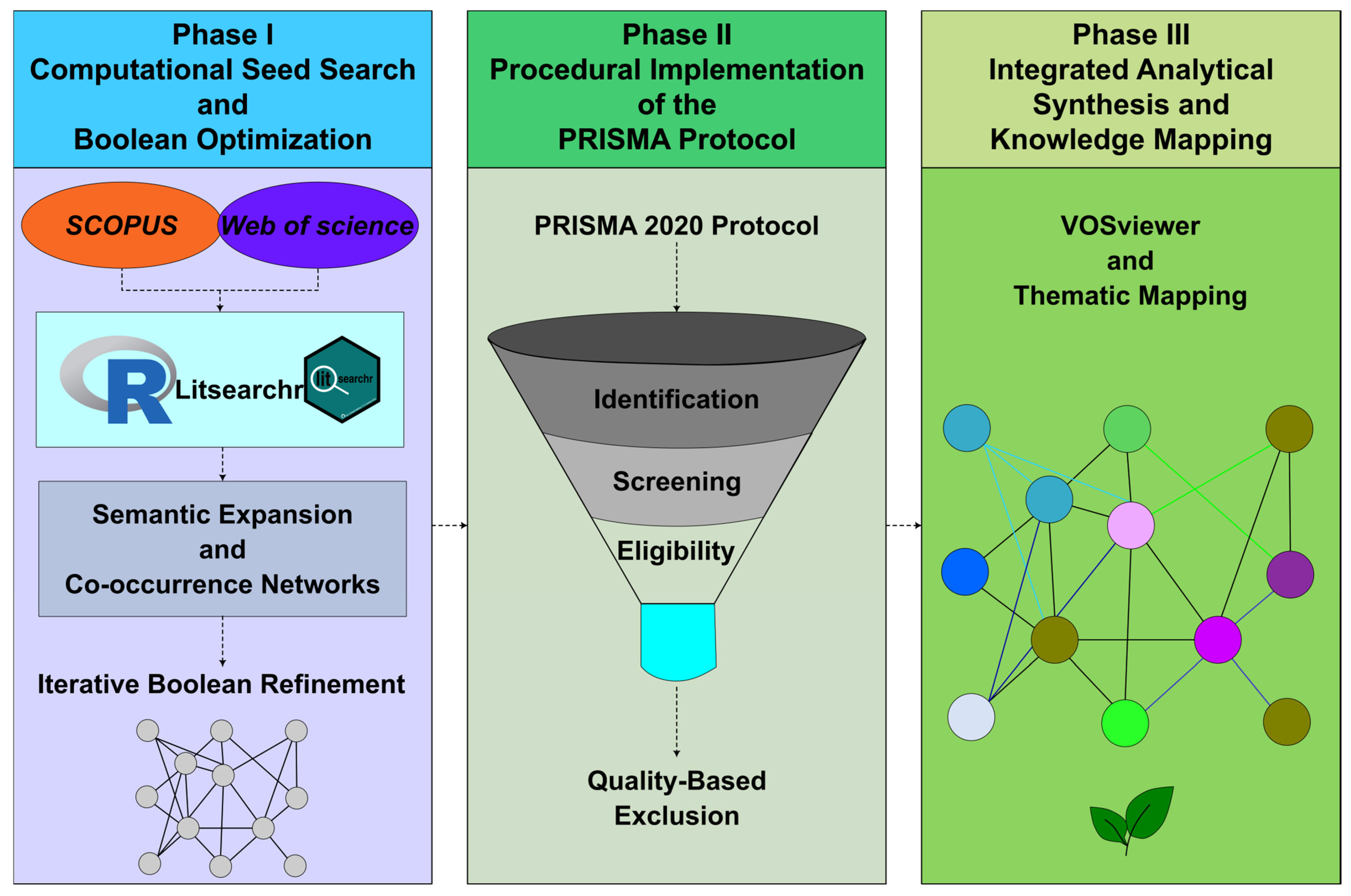
The methodological workflow was organized into three sequential and interrelated phases (
Figure 1), representing the procedural architecture that guides the entire study. Phase I (Computational Seed Search and Boolean Optimization) comprised a structured three-step computational procedure designed to ensure precision and reproducibility in database retrieval. First, a naïve seed search (initial exploration) was conducted in Scopus and Web of Science to identify preliminary descriptors and domain-specific terminology associated with emerging digital technologies and sustainable agriculture. This exploratory step allowed the identification of core concepts, synonymous expressions, and disciplinary variations in terminology. Second, a semantic expansion and Boolean optimization process was implemented using the litsearchr package (Version 1.0.0) in RStudio Version: 2026.01.1+403 (running R version 4.5.1). This stage involved automated term extraction from the seed corpus, keyword co-occurrence network construction, semantic clustering of descriptors, and iterative Boolean refinement. Co-occurrence networks enabled the detection of concept centrality and relational strength between technological and agricultural terms, reducing subjective bias in keyword selection. Finally, the optimized Boolean query was constructed through structured logical operators, generating a validated and reproducible search string that maximized recall and thematic specificity before formal PRISMA screening.
Phase II (Procedural Implementation of the PRISMA Protocol) describes the operational stages of the PRISMA 2020 framework as applied in this study. This phase includes record identification from Scopus and Web of Science, duplicate removal, title–abstract screening, full-text eligibility assessment, and final inclusion. The PRISMA structure is presented here as a procedural execution model to ensure transparency and replicability of the selection process.
Phase III (Integrated Analytical Synthesis and Evidence Mapping) consisted of a structured analysis of the included studies, performing a thematic analysis of the documents, co-authorship networks, keyword co-occurrence, and thematic evolution, detecting patterns of technological convergence and interdisciplinary links. A qualitative thematic coding process complemented the quantitative mapping, allowing for the categorization of application areas, sustainability dimensions, implementation gaps, and research trajectories. This integrative phase transformed the filtered dataset into an analytical framework, generating evidence-based future perspectives.
The analytical synthesis adopted in this systematic evidence mapping does not pursue statistical meta-analysis of reported performance indicators. The marked heterogeneity of primary studies —spanning divergent experimental conditions, crop varieties, sensor architectures, and validation datasets—renders cross-study statistical pooling epistemologically untenable. Accordingly, the framework prioritizes structured comparative interpretation of technological capabilities and operational trends within their respective empirical contexts, yielding evidence-based insights without generating spurious precision through aggregation across structurally incommensurable validation environments.
2.2. Inclusion and Exclusion Criteria
The articles were selected based on their thematic coherence, technological-empirical application, and methodological validity (
Table 1); highlighting original articles that had a completed final state. These three parameters were defined as a priori to ensure conceptual delimitation, empirical robustness, and technological specificity, aligning this evidence mapping study whit the evidence synthesis standards established by the PRISMA 2020 reporting framework. The thematic domain criterion ensured that only studies explicitly addressing emerging digital technologies (EDTs) within agricultural systems were considered. The methodological design parameter guaranteed the inclusion of studies with verifiable experimental or computational validation. Finally, technological relevance required demonstrable implementation of digital tools rather than conceptual discussion. These criteria were operationalized during screening and eligibility phases to minimize subjectivity and improve reproducibility.
2.3. Document Search Strategy
The document search strategy was designed by formulating a search string based on key terms and their technical synonyms, connected through Boolean operators (AND, OR) and applied to the title, abstract, and keyword fields (TITLE-ABS-KEY). The initial search, considered as a seed or “naïve” query, combined terms related to emerging digital technologies (“emerging digital technologies”) AND (“sustainable agriculture”). This strategy was preliminarily tested in the Scopus database, yielding a total of four documents. Rather than limiting the scope, this exploratory stage functioned as a computational anchor to enable data-driven expansion. The objective was not to define the field through manual selection but to generate an initial semantic core for automated term identification, reducing researcher bias and strengthening methodological transparency.
2.4. Semantic Search and Term Analysis with Litsearchr
The litsearchr package in R provides a data-driven framework for constructing and refining search strategies in systematic evidence mapping studies and related evidence synthesis designs through the use of keyword co-occurrence networks and automated term identification. Unlike conventional approaches that rely primarily on expert-selected descriptors, this method identifies relevant terms based on relational patterns extracted from an initial corpus of documents, enabling the detection of semantic associations and concept centrality across the literature. Within this framework, descriptor prioritization follows the Pareto-based concentration principle, whereby approximately 80% of the relational weight of the network is retained in order to preserve the most structurally relevant descriptors while reducing peripheral noise. By prioritizing informational centrality rather than isolated frequency counts, this strategy improves the semantic coherence of the search space and supports a more systematic and reproducible expansion of search queries, thereby minimizing subjective bias in keyword selection [
19].
The integration of computational procedures such as litsearchr, semantic co-occurrence networks, and changepoint analysis was intentionally adopted to strengthen the methodological robustness of this evidence mapping study beyond conventional PRISMA-based procedures [
19]. While the PRISMA framework ensures transparency during study identification, screening, and eligibility assessment, it does not prescribe systematic mechanisms for constructing or expanding search queries, which frequently remain dependent on manually selected descriptors. In this study, the application of
litsearchr enabled a data-driven identification of candidate keywords derived from relational patterns observed within the seed corpus. Keyword co-occurrence networks further facilitated the detection of semantic proximity and conceptual centrality across the literature, allowing a more comprehensive representation of the technological domain. In addition, changepoint analysis was applied during network pruning to detect statistically identifiable structural inflection points in connectivity distributions, ensuring that descriptor filtering was based on objective criteria rather than arbitrary threshold decisions.
The articles retrieved from the seed search were exported in .bib format and imported into the R environment using the import_results() function. During preprocessing, 52 records were identified as lacking author-defined keywords; therefore, semantic extraction from titles and abstracts was prioritized to avoid the systematic exclusion of potentially relevant studies. Using the tagged method, 168 terms were extracted, while the fakerake algorithm was applied to detect multi-word expressions with a minimum frequency threshold of three occurrences, ensuring statistical relevance while minimizing random noise in the descriptor pool.
A term–document matrix was subsequently constructed using the create_dfm() function, and a semantic co-occurrence network was generated through create_network(), where nodes represented descriptors and edges represented relational association strength. To reduce dimensionality while preserving the dominant semantic structure of the network, two predefined filtering criteria were applied. First, the cumulative 80% threshold retained terms representing the majority of relational weight within the network according to the Pareto-based concentration principle. This filtering step ensured that descriptors with the greatest informational centrality were prioritized while structurally weak or peripheral terms were excluded. Second, the changepoint method was implemented to detect structural inflection points in the connectivity distribution, providing a statistical basis for network pruning and preventing arbitrary truncation decisions.
This dual filtering strategy resulted in the exclusion of generic or structurally weak descriptors such as “article”, “development”, “soil”, and “internet”, while preserving 53 high-centrality terms. These descriptors were subsequently grouped into two predefined analytical domains—EDTs and sustainable agriculture (SA)—in order to ensure conceptual alignment with the research objectives prior to Boolean query reconstruction.
The final multi-class search string was automatically exported using the write_search() function in .txt format without applying stemming, thereby preserving exact phrase structures and maintaining semantic precision. Avoiding stemming prevented the artificial inflation of unrelated lexical variants and ensured that descriptor combinations remained conceptually coherent during database retrieval.
The Boolean search code obtained was: (“emerging digital technologies” OR “digital technologies” OR “smart farming” OR “precision agriculture” OR “agriculture 4.0” OR “agtech” OR “digital innovation”) AND (“sustainable agriculture” OR “climate-smart agriculture” OR “eco-friendly agriculture”), yielding a total of 1825 articles in the Scopus database and 724 documents in Web of Science.
2.5. PRISMA Screening and Eligibility Procedure
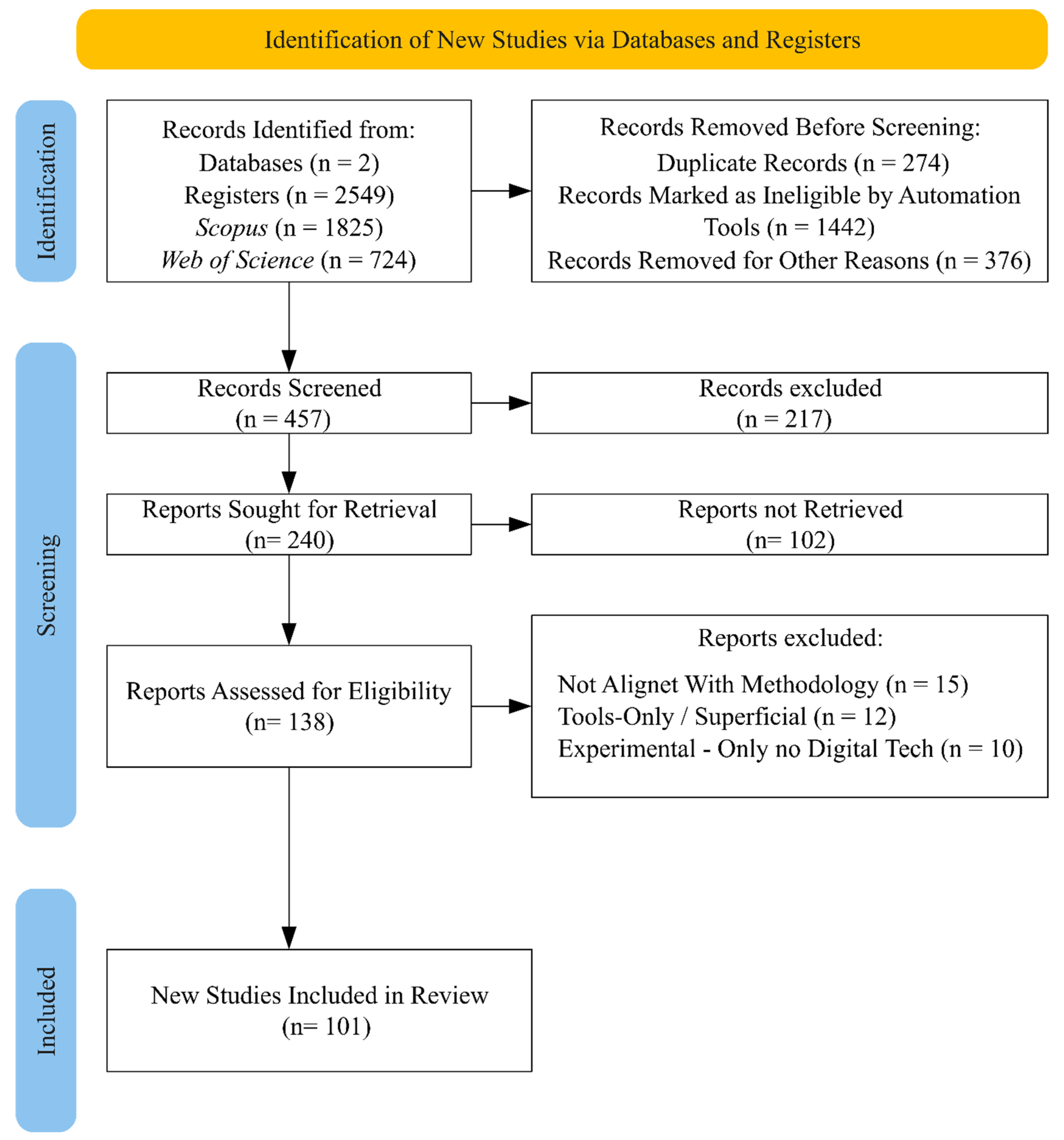
The selection procedure adhered strictly to the four-phase PRISMA 2020 protocol: identification, screening, eligibility, and final inclusion. The process began with the optimized Boolean query generated through the litsearchr systematization, which retrieved 2549 records from Scopus (n = 1825) and Web of Science (n = 724). After applying predefined filters—publication period (2020–2025), document type (article), journal source, language (English and Spanish), and open-access availability—the datasets were merged. Duplicate detection using semantic matching algorithms in R identified 274 redundant records, resulting in 457 unique articles entering the formal screening phase.
Title–abstract screening was conducted independently by two reviewers using operationalized inclusion and exclusion criteria focused on thematic alignment with sustainable agriculture, empirical implementation of digital technologies, and methodological transparency. During this stage, 217 records were excluded for failing to meet these criteria. The remaining 240 reports were sought for full-text retrieval; however, 102 could not be accessed or did not satisfy retrieval requirements, leaving 138 studies for full-text eligibility assessment.
Eligibility assessment involved a detailed methodological examination of research design, technological implementation, validation procedures, and clarity of reported outcomes. Six studies were excluded at this stage due to insufficient methodological transparency or lack of validated digital application. Consequently, 132 studies met all eligibility requirements and proceeded to structured quality appraisal, ensuring that methodological rigor was evaluated prior to definitive inclusion in the final analytical corpus.
2.6. Inter-Rater Reliability and Consistency in Selection
To ensure methodological transparency and reproducibility, the 457 records obtained after duplicate removal were independently screened by two reviewers at the title–abstract stage using predefined inclusion and exclusion criteria. Each record was classified dichotomously as “include” or “exclude” based on thematic coherence with sustainable agriculture, explicit empirical implementation of emerging digital technologies, and methodological clarity. Independent evaluation resulted in 392 concordant decisions, corresponding to an observed agreement (Po) of 0.858, while 65 records presented initial disagreement. Inter-rater reliability was quantified using Cohen’s kappa coefficient, calculated as κ = (Po − Pe)/(1 − Pe), where Pe represents the probability of agreement expected by chance derived from marginal inclusion and exclusion proportions. The expected agreement was 0.21, yielding κ = 0.72, indicating near-perfect agreement. Discrepancies were resolved through structured consensus discussion, after which 240 records advanced to full-text retrieval and 217 were definitively excluded.
2.7. Quality Assessment Framework
Quality appraisal was conducted after eligibility assessment and before final inclusion. The 132 eligible studies were evaluated using a structured matrix comprising five operationalized criteria: (i) clarity of research objectives; (ii) methodological transparency and replicability; (iii) validation rigor of digital technologies; (iv) coherence between results and conclusions; and (v) explicit contribution to sustainable agricultural systems. Each criterion was scored dichotomously (1 = satisfied; 0 = not satisfied). Studies scoring at least four out of five criteria were retained. This threshold was defined to ensure methodological robustness while avoiding excessive exclusion bias. Thirty-one studies failed to meet the minimum quality standard, primarily due to insufficient validation protocols or descriptive-only approaches. Consequently, 101 studies constituted the final analytical corpus. Quality assessment was performed independently by both reviewers prior to consensus validation.
2.8. Final Inclusion and Data Extraction
The final inclusion phase formalized the 101 studies that satisfied identification, screening, eligibility, and quality requirements. The complete selection process is illustrated in the PRISMA flow diagram (
Figure 2), which summarizes exclusions at each stage and ensures quantitative transparency. Data extraction was performed using a structured coding matrix developed in RStudio Version: 2026.01.1+403. Variables recorded included publication year, country, type of digital technology (e.g., IoT, machine learning, blockchain, remote sensing), agricultural application domain, sustainability indicators, validation methods, and reported outcomes. The matrix was processed as a data frame and analyzed using text-mining and bibliometric techniques. This stage ensured that only methodologically validated studies informed the synthesis, thereby strengthening the conceptual coherence and replicability of the analytical corpus.
2.9. Risk of Bias and Certainty of Evidence
Potential sources of bias in the 101 included studies were assessed across five analytically distinct domains. First, selective reporting of performance metrics: studies may preferentially disclose favorable accuracy, sensitivity, or precision values while omitting failure conditions, out-of-distribution validation results, or null findings—a bias pattern documented across applied machine learning literature and particularly prevalent in agricultural technology benchmarking. Second, incomplete methodological disclosure: insufficient specification of sensor calibration protocols, training-to-test data partitioning strategies, and hyperparameter selection procedures limits the independent reproducibility of reported findings and prevents meaningful cross-study comparison of algorithmic performance. Third, inadequate external validation: the absence of independent holdout datasets or cross-site replication under heterogeneous agroclimatic conditions constrains the generalizability of accuracy metrics beyond the specific experimental environments in which they were generated. Fourth, reproducibility constraints: the non-disclosure of model weights, data preprocessing pipelines, or computational environments in a substantial proportion of the corpus precludes independent replication and constitutes a systemic obstacle to the verification of reported results. Fifth, contextual confounding: the concentration of high-performing studies in controlled or highly instrumented production systems may not represent the operational realities of smallholder or low-resource agriculture, introducing a systematic optimism bias in the aggregated body of evidence.
3. Emerging Digital Technologies in Agriculture
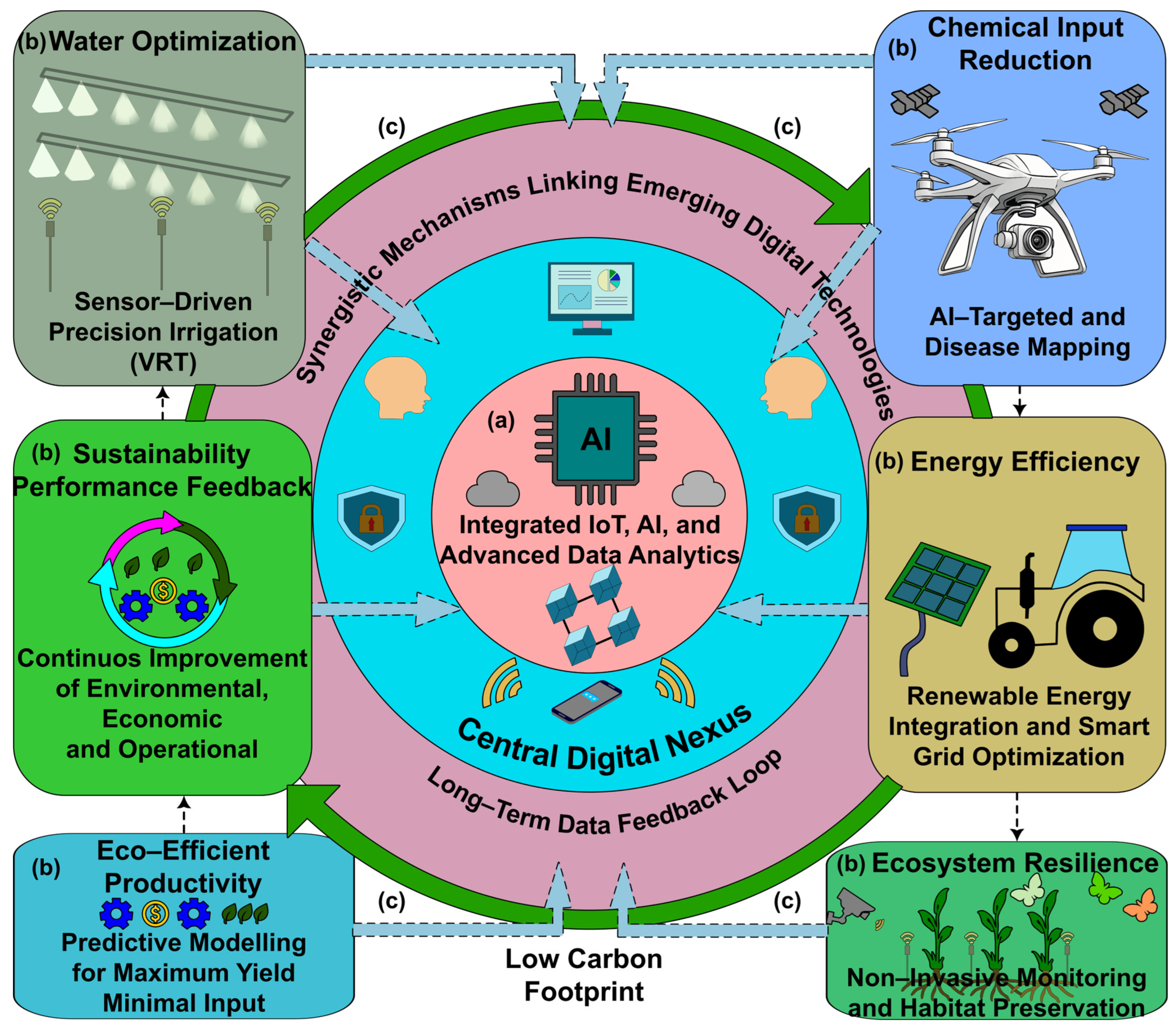
Emerging digital technologies are increasingly redefining agricultural systems through data-intensive analytics and decision-support frameworks grounded in high-resolution sensing (
Figure 3). Artificial intelligence models applied to irrigation scheduling, for example, achieve accuracies close to 80%, supporting agronomic decision-making despite recognized error margins associated with temperature fluctuations and soil moisture variability affecting evapotranspiration dynamics [
20]. Hybrid CNN–Transformer architectures such as SWFormer integrate local feature extraction with global contextual attention, reaching mAP values above 76% and classification accuracies exceeding 83% in crop segmentation tasks, thereby outperforming conventional convolutional models [
21]. Nonetheless, most reported validations were conducted under controlled or site-specific conditions and datasets, which may limit the extrapolation of reported precisions to heterogeneous agroecosystems characterized by diverse soil structures, climatic gradients, and management intensities. These sustainability outcomes are interpreted as indicative technological tendencies derived from heterogeneous experimental studies rather than strictly comparable quantitative benchmarks.
In the digital context, the convergence of IoT, remote sensing, and geographic information systems (GIS) represents a structural shift toward smart and sustainable agricultural frameworks. Multi-temporal analysis of satellite imagery, performed through cloud-based platforms and combined with machine learning algorithms, has achieved classification accuracies exceeding 90% and kappa coefficients close to 0.9 in LULC evaluations [
22], indicating strong agreement with field-truth references. Several studies have developed object detection architectures such as YOLOv8, trained on extensive agricultural datasets and enhanced through mosaic augmentation strategies, improving automated field feature recognition and facilitating near real-time monitoring workflows [
23]. However, most implementations still rely on high-resolution imagery, cloud infrastructure, and stable connectivity, which can limit scalability in resource-constrained environments. Furthermore, cross-ecosystem validation remains limited, underscoring the need for standardized benchmarking protocols to ensure generalizability across diverse agricultural landscapes.
3.1. Internet of Things (IoT) and Smart Sensors
In this context, IoT-enabled sensing platforms substantively augment agronomic diagnostic capacity by combining real-time data acquisition with advanced analytical models. Empirical studies report high diagnostic accuracy when deep learning processes signals derived from sensors, achieving disease detection with accuracies close to 98%, sensitivities above 94%, and F1 scores above 95%, demonstrating strong predictive consistency in controlled validation environments [
24]. These results indicate that sensor–AI integration can materially reduce detection latency in phytosanitary surveillance. In horticultural systems, these integrated approaches reduce water consumption to approximately 9 L per plant while maintaining productivity through irrigation schemes adjusted to evapotranspiration [
17,
25]. These outcomes attest to the operational feasibility of data-driven irrigation scheduling under controlled conditions. However, most validations are carried out under relatively stable environmental conditions and with limited spatial variability, considering that soil heterogeneity, sensor calibration drift, and microclimatic fluctuations can alter performance when these systems operate in diverse agroecological zones.
Sensor networks form the backbone of sustainable digital agriculture, enabling continuous, large-scale data acquisition and real-time system feedback. Empirical evidence demonstrates that integrating soil moisture, temperature, nutrient, and pest sensors generates high-resolution datasets capable of capturing the spatial and temporal variability of agroecosystems. Battery-free, passive UHF RFID sensors measure volumetric soil moisture with strong statistical agreement under field conditions (r = 0.9823; R
2 = 0.9648; RMSE = 1.39; MAE = 1.21) while operating without external power inputs [
26], indicating robust technical stability within defined environmental ranges. Similarly, integrating UAVs and WSNs expands spatial coverage and improves monitoring efficiency by reducing redundant data through SAX-based temporal compression, decreasing data volume by over 80% without significant information loss [
27]. Cloud-based modular IoT frameworks facilitate predictive analysis and automated environmental control in greenhouse systems, optimizing water and energy use and reducing operating costs [
28]. Meanwhile, smartphone-based colorimetric macronutrient sensors achieve an
R2 ≥ 0.996 with acceptable recovery rates, strengthening nutrient diagnostics [
29]. Although these advances confirm the technical feasibility of distributed sensing architectures, most validations remain context-specific, with limited long-term assessment of sensor drift, calibration variability, and performance across ecosystems. This demonstrates that expanding multi-site trials and standardizing interoperability protocols are essential to ensure reproducibility and scalable implementation in heterogeneous agricultural landscapes.
3.2. Artificial Intelligence and Machine Learning
Artificial intelligence (AI) and machine learning (ML) are fundamentally reshaping sustainable agriculture by converting large-scale climatic and sensor-derived datasets into predictive decision-support tools; however, their systemic robustness depends on contextual validation beyond reported accuracy metrics. Empirical studies document measurable operational gains in controlled environments, where IoT-AI hybrid greenhouse systems reduce water consumption by up to 30%, increase energy efficiency by 15%, and improve yield prediction by 12% using LSTM-based climate control models [
30], indicating that recurrent neural architectures can optimize environmental regulation processes. Similarly, machine learning-driven irrigation systems improve scheduling accuracy; the IoTML-SIS model achieved an accuracy of 0.938, outperforming KNN, SVM, logistic regression, MLP, and ELM algorithms in optimizing water management decisions [
31]. Therefore, these findings confirm that interregional validation, transparency in the generation of dataset reports, and the design of energy-efficient models must be strengthened, as they remain essential to ensure the scalability, equity, and long-term sustainability of AI-driven agricultural systems.
Machine learning systems strengthen anticipatory management by integrating sensor signals from multiple sources and historical datasets to detect water stress, pest outbreaks, and nutritional imbalances before visual symptoms appear (
Table 2). The HCS-DBN hybrid framework achieved 96.8% accuracy in detecting nutritional deficiencies, increased predictive performance by 12%, and reduced computational overhead by 15% under various soil conditions [
32], indicating that optimized deep belief architectures can balance accuracy and efficiency in agronomic diagnostics. Similarly, the YOLOv8 nano model maintains minimal reductions in throughput (−1% at mAP50:95; −0.4% at mAP50) while significantly improving processing efficiency. These predictive frameworks enable timely interventions such as precision irrigation, biological control, and site-specific fertilization, ultimately reducing input waste and strengthening the resilience of agroecosystems [
17]. However, the performance trade-offs between accuracy, computational demand, and implementation context have not yet been sufficiently studied, as addressing dataset representativeness, algorithmic bias, and energy consumption will be critical to ensuring equitable scalability across heterogeneous production systems.
Table 2.
Development, design, architecture and validation of digital technologies.
Table 2.
Development, design, architecture and validation of digital technologies.
| Technological Block in Agriculture | Representative Technologies | System Architecture/Design | Validation Metrics | Operational Contribution | Ref. |
|---|
| IoT and Smart Sensors | Passive RFID soil sensors; Electrochemical NPK sensors; LoRaWAN monitoring; Bioelectrical stress sensors | UHF passive RFID; smartphone colorimetric sensing; LPWAN communication; multimodal sensing platforms | R2 ≥ 0.96; accuracy up to 98.3%; RMSE = 1.39; DER < 11%; transmission success > 80% | Real-time environmental monitoring, nutrient quantification, low-energy deployment, early stress detection | [25,26,28,29,33,34] |
| Artificial Intelligence and Machine Learning | ML irrigation models; LSTM greenhouse control; DBN nutrient prediction; Vision Transformer Edge-AI | IoT-ML hybrid systems; RF, LSTM, DBN, SVM; lightweight transformer models; distributed prediction | Accuracy 88–97%; water savings 30%; energy efficiency +15%; prediction stability ≤ 4.7% | Predictive irrigation, adaptive climate control, yield estimation, intelligent classification | [30,31,32,35,36] |
| Precision Agriculture | UAV–WSN monitoring; smart irrigation systems; wireless fertilizer sensor | UAV integration; data compression (SAX); sensor-actuator precision control | Data reduction −80%; accuracy 0.938; thermal response inversely proportional to VWC | Spatial monitoring optimization, input reduction, irrigation accuracy | [27,31,34,37] |
| Robotics and Automation | Robotic sprayers; autonomous planter; embedded transplanter | Computer vision + autonomous control; mechatronic embedded systems | Spatial deviation ≤ 1%; 94% seed accuracy; ±0.4 mm spraying precision; 91.7% transplant efficiency | Labor reduction, precision application, operational efficiency | [38,39,40] |
| Blockchain and Digital Traceability | Multi-blockchain governance; Edge–Fog–Cloud BCT; ML-integrated IoAT | Distributed ledger; consensus optimization (SPOP); hybrid ML–blockchain security | Encryption −46%; overhead −18–21%; packet delivery +17%; 51% fault tolerance | Secure traceability, data integrity, distributed coordination | [41,42,43] |
| Digital Twins and Simulation | Soil moisture digital twin; sensor-network-based twin platforms | Digital twin + ML simulation; real-time synchronization via IoT | Model accuracy 94–96%; variability ≤ 4.7%; continuous synchronization | Model–field alignment, predictive simulation, computational efficiency | [44,45] |
3.3. Precision Agriculture
Precision agriculture relies fundamentally on remote sensing systems, as they allow the characterization of crop and soil conditions with high spatial and temporal resolution, without direct contact and under variable operational conditions [
46]. In this context, approaches based on computer vision enhance the interpretation of images acquired by remote platforms, improving early detection of agronomic anomalies. For instance, the KGDL-AOD model (knowledge-assisted agricultural object detection) demonstrated high robustness under heterogeneous scenarios, achieving mAP = 0.85, IoU = 0.82, and F1 = 0.80, outperforming reference models such as R-CNN, YOLO, and ECTB with improvements of 6%, 2%, and 1%, respectively [
47]. The integration of data captured through IoT platforms and machine learning enables the transformation of remote information into management actions, as observed in web–mobile IoT architectures for greenhouses, which achieved 97.27% in crop recommendation and 97.50% in disease detection, optimizing environmental variables and reducing resource use. These technologies therefore enhance spatial diagnosis of stress and facilitate site-specific interventions to optimize inputs and minimize environmental impacts [
35].
Drones and satellite imagery complement this approach by providing high temporal and spatial resolution data, which are essential for precise agricultural monitoring and for generating actionable information at the plot scale. The value of these platforms is particularly enhanced when images are integrated with real-time intelligent analysis architectures, such as edge–AI schemes, where lightweight models allow the classification of production scenarios without full dependence on the cloud. An agricultural edge computing architecture with lightweight deep learning, using the Vision Transformer MiT-B0 (128 × 128), achieved 88% accuracy in climate classification (11 classes) and 93% in crop classification (5 classes), with robust performance metrics (high F1 and low MAE, κ, and Hamming) [
36]. Moreover, the combination of computer vision and autonomous robotics enhances site-specific management derived from prescription maps, as evidenced by intelligent spraying robotic systems achieving spatial precision < 0.4 mm and 73.3% of impacts within ±1σ, with an average power consumption of 61–63 W. These results demonstrate that drones, satellites, and intelligent analytics consolidate precision agriculture as a key approach to improving productivity and sustainability through data-driven decision-making [
38].
Soil mapping constitutes one of the most relevant applications of precision agriculture, as it enables detailed characterization of the physical, chemical, and biological properties of the soil, integrating spatial information to guide site-specific management decisions. In this context, the development of smart sensors enhances the capture of critical edaphic variables and their translation into operational indicators. For example, a wireless fertilizer sensor based on resonant energy (36.5 MHz) has been reported to convert soil moisture into a thermal signal, reaching approximately 75 °C at 5% VWC in 1 min, with a thermal response inversely proportional to water content; additionally, it enables controlled nutrient release and real-time monitoring, contributing to improved fertilization efficiency in specific zones [
34]. Complementarily, non-invasive bioelectric sensors expand agroecosystem diagnostics by capturing physiological signals associated with stress, achieving multi-organ assessments with 98.3% accuracy in fruit and 95.8% in leaves, as well as tomographic resolution up to 2.6 mm, detecting stress before visible symptoms. These technologies thus enhance productive zoning, prevent soil degradation, and support the sustainability of the production system [
33].
Crop vigor analysis and the identification of spatial variability complement these efforts by providing a dynamic assessment of vegetative performance across different phenological stages, allowing timely and site-specific interventions. In intensive systems, for example, smart irrigation based on water-demand sensors and IoT has shown direct impacts on production uniformity. Gravimetric irrigation helped mitigate saline stress and reduce the proportion of non-commercial fruits; additionally, salinity was shown to decrease commercial yield by up to 68% and increase non-commercial yield above 20%, with a significant interaction (
p < 0.01), demonstrating the need for dynamic irrigation adjustments to maintain water use efficiency and crop vigor [
37]. Similarly, IoT platforms integrated into agrivoltaic schemes, controlled via PLC and LoRaWAN communication, increased energy efficiency by up to 28% through solar tracking, stabilizing system load (12.79–13.05 V; 0.49–0.39 A) and reducing charging times. This supports continuous monitoring and resource management at the spatial scale, demonstrating that these approaches strengthen smart agriculture by linking vigor diagnostics with more resilient irrigation and energy decisions [
48].
3.4. Robotics and Automation in Agriculture
Robotics applied to agriculture has advanced rapidly, excelling not only in harvesting but also in critical tasks such as sowing and transplanting, where precision determines successful crop establishment. In this context, an autonomous ground-based sowing vehicle with automated control achieved only 1% deviation in spacing, 94% accuracy in seed delivery, and 66.67% in dosing, demonstrating high spatial accuracy and potential to reduce labor dependence, although limitations were observed in the metering system [
39]. Complementarily, an embedded mechatronic transplanting system achieved optimal performance at 2.0 km/h and 30°, attaining 600 mm spacing, 91.7% efficiency, 90.3% furrow closure, and only 2.1% failure rate. These results confirm substantial improvements in operational continuity and transplant success rate, demonstrating that advances in autonomous field operations can materially improve transplant uniformity, operational continuity, and system resilience in mechanized production [
40].
3.5. Blockchain and Digital Traceability in Agriculture
The decentralized approach integrating Edge-IoT, machine learning, and blockchain increases package delivery rates by 16% to 17% and reduces network overhead by 18% to 21%, while maintaining secure transmission even in the presence of faulty nodes. This demonstrates simultaneous improvements in reliability, latency, and data security for connected agricultural environments [
43]. Furthermore, a privacy-oriented, multi-level Edge-Fog-Cloud blockchain architecture with QNN+BO optimization reduces encryption times by 46.7% and decryption times by 54.6%, while also reducing memory usage by 33% and achieving a MAPE of 19.3%. This consolidates a more efficient and attack-resistant validation scheme for Agri-IoT applications. These advancements strengthen sustainability certification and market trust through transparency and robust data protection [
42]. Despite these advances in traceability infrastructure, implementation within smallholder and artisanal production sectors remains markedly limited.
This approach facilitates the early detection of supply chain failures, as each transaction remains auditable and accessible to distributors, buyers, and certification bodies, reinforcing trust in product integrity. Traceability schemes based on multiple blockchains further improve operational performance; for example, the SPOP algorithm, which reduces consensus rounds to a single effective stage, maintains a 51% fault tolerance and improves scalability compared to traditional mechanisms like PBFT or RPCA, optimizing validation time and transactional transparency [
41]. While optimized or permissioned architectures reduce energy intensity compared to proof-of-work systems, comprehensive lifecycle assessments of blockchain implementation in agricultural supply chains remain limited, even though studies show that blockchain technology strengthens transparency and governance. Its integration into sustainable agriculture frameworks focuses on balancing the benefits of traceability with measurable energy efficiency and environmental responsibility.
3.6. Digital Twins and Agricultural Simulation
Agricultural digital twins represent a strategically significant innovation, enabling the virtual replication of field-scale system behavior through the integration of sensor data, remote sensing, and agronomic models, creating dynamic environments to simulate crop growth and its interaction with soil and climate. This capability is enhanced when the digital twin is fed by IoT networks with continuous real-time monitoring, as demonstrated in the Agri-IoT Living Lab, where the validation of soil and climate ranges established operational bases for data–model synchronization and simulation error control, while also showing high acceptance of digital access (73.2%) [
45]. In predictive terms, soil moisture–oriented digital twins have demonstrated high accuracy and stability; the use of random forest achieved 96.0% on real data and 94.9% on the digital twin, with variability ≤ 4.7% across textures, outperforming alternatives such as ANN and SVM in robustness. These results confirm that digital modeling allows the evaluation of irrigation or fertilization decisions before field implementation, reducing uncertainty, operational risks, and inefficient resource use [
44].
5. Practical Applications in Key Crops and Production Systems
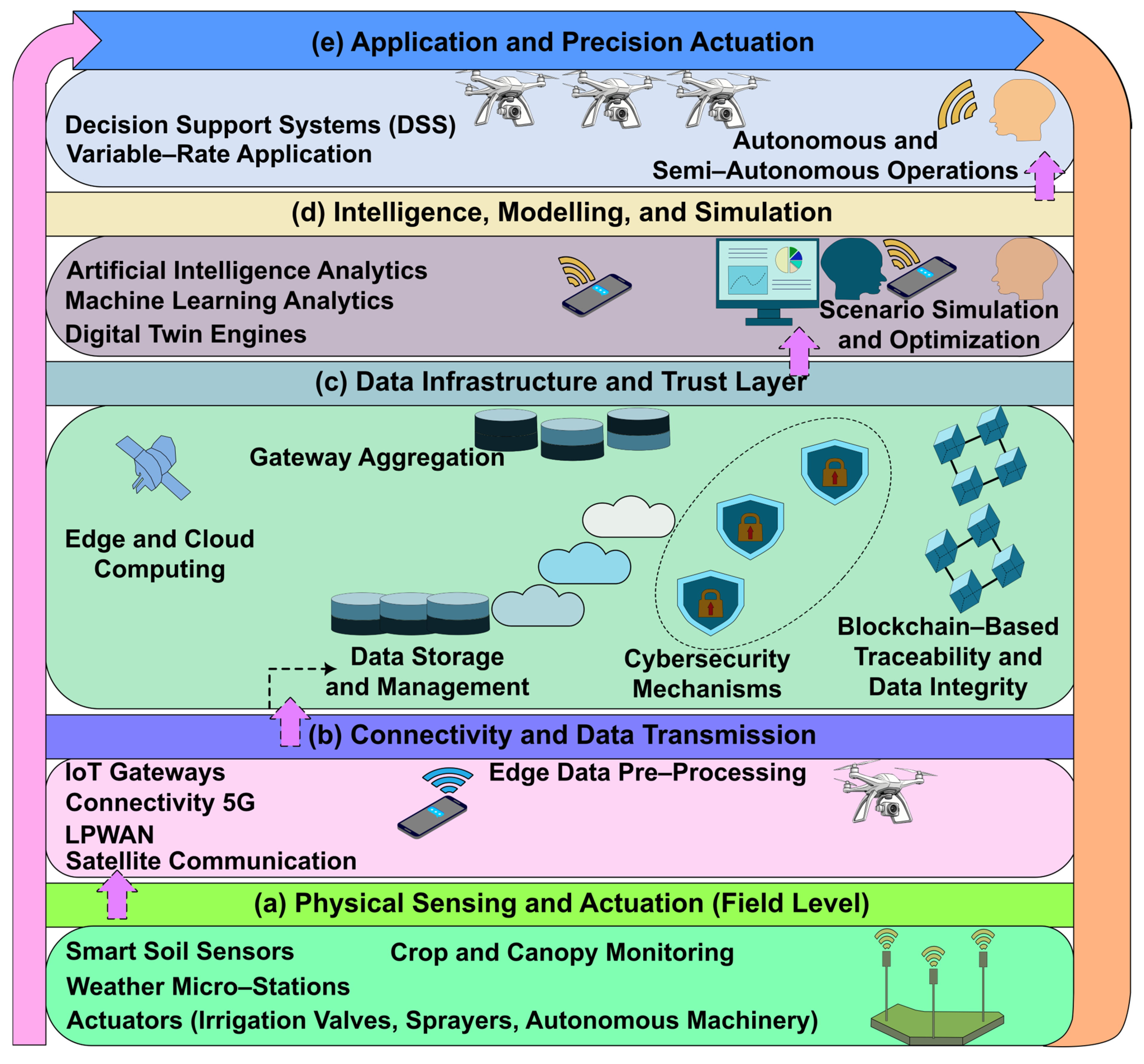
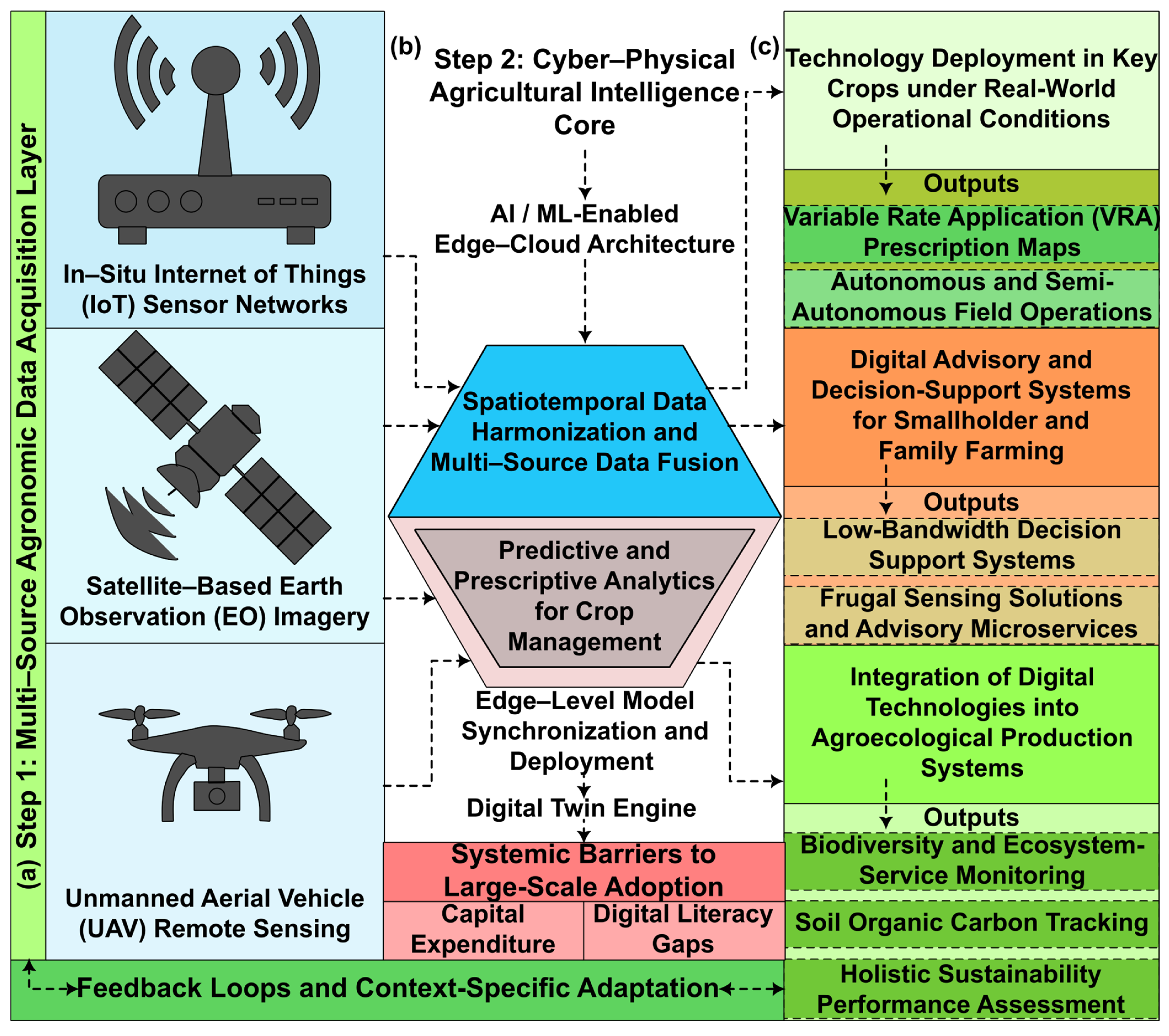
The evolution from conventional agronomic practices toward data-driven cyber-physical ecosystems entails reconfiguring agricultural management around continuous flows of data acquisition, transmission, processing, and decision execution (
Figure 5). In this context, high-frequency remote sensing, IoT, and advanced analytics enable the transformation of biological and environmental signals into prescriptive actions at the plot scale, optimizing interventions based on spatial and temporal variability. Web-integrated platforms with lightweight computer vision models have achieved real-time diagnostics with high accuracy, where MobileViTv2 reached 94% accuracy, F1 = 0.94, and AUC = 0.95–0.99, with web reliability of 85.3–90.2%, outperforming more complex alternatives [
70]. Likewise, the integration of hyperspectral sensors with CNNs allowed the identification of six stress levels with 83.40% accuracy, while MLVI and H_VSI indices anticipated stress 10–15 days before visible symptoms (r = 0.98), enabling early interventions and reducing losses [
71].
The performance of smart-agriculture systems is conditioned by comprehensive digital architectures capable of orchestrating the ingestion of multimodal data, its semantic standardization, and real-time processing to transform heterogeneous information into operational actions at the field level. Applied evidence supports this feasibility, where deep learning models with ensemble stacking and explainability (XAI) have classified diseases in Lagenaria siceraria with 99.52% accuracy, integrating into web platforms for real-time diagnostics and phytosanitary support [
72]. Similarly, systems combining CNN architectures (DenseNet121, EfficientNetB0, InceptionV3, MobileNetV2, ResNet50, and Xception) achieved 99% accuracy in cucumber pest detection, demonstrating the scalability of automated analysis across diverse production contexts [
73].
5.1. Technical Incorporation of Technology in Specific Crops and Real-World Contexts
The adoption of emerging technologies is driving substantial improvements in the efficiency and stability of multiple production systems, with particular impact on Andean crops, fruit orchards, and export-oriented value chains. In high-Andean environments, where climatic variability strongly affects productivity, the integration of soil sensors, satellite remote sensing, and predictive models enables the optimization of sowing windows, adjustment of water management, and reduction in losses due to abiotic stress. Recent evidence confirms the potential of AI to reinforce these systems: in potato, CNN models with transfer learning (VGG16) classified field pests with 96.3% accuracy and inference times of 45 ms, enabling edge deployments for early response [
74]. Similarly, in high-value fruit crops (avocado, blueberry, citrus, and grapevine), remote monitoring and automated irrigation support precise management of water and nutrient stress, increasing uniformity and fruit quality. In wheat, the combination of spectroscopy and machine learning allowed the detection of Fusarium spp. with metrics exceeding 0.89 and external validation achieving 100% predictive accuracy [
75]. Additionally, multi-species approaches based on EfficientNetB0–MobileNetV2 ensembles reached 99.77% accuracy across 38 classes, demonstrating feasibility for simultaneous diagnosis in multiple crops [
76].
In vegetables, the convergence of precision agriculture, IoT networks, and greenhouse sensorization has enabled high-resolution environmental control, optimizing critical variables (temperature, humidity, radiation, and CO
2) to improve yield and energy efficiency (
Table 4), while reducing phytosanitary pressure through early detection and localized management. In open-field conditions, computer vision applied to mechanized tasks shows direct sustainability impacts: deep learning–based systems were able to identify cabbage and perform intra-row weeding with up to 96.67% accuracy and ≤1.57% crop damage at low speeds, decreasing herbicide use and soil disturbance [
77]. Similarly, real-time detection models have achieved near state-of-the-art performance; for example, YOLOv8 and CNN architectures with transfer learning detected diseases in chili with mAP@0.5 = 0.995 and mAP@0.5–0.95 = 0.941, exceeding 99% in both precision and recall [
78]. Additionally, an improved YOLOv7 with BiFormer attention increased mAP by +2.5% and reached 94.2% accuracy for optimizing Chinese cabbage counting and establishment [
79], while in tomato, an optimized YOLOv8 demonstrated robust performance for foliar diagnostics (mAP@0.5 = 79.8%; F1 = 78.6%), indicating that these capabilities, integrated with blockchain traceability, spectral analysis, and digital twins, strengthen more competitive and resilient agro-export chains [
80].
5.2. Emerging Technology in Small-Scale Agriculture
The incorporation of appropriately calibrated digital technologies in smallholder agriculture offers a viable pathway for improving productivity and sustainability without necessitating capital-intensive infrastructure investments, particularly in rural contexts where capital, connectivity, and technical support are limited. Technological evidence shows that even advanced tools can be adapted to small-scale operations: electrochemical nanobiosensors induced by potential have enabled early detection of sugarcane rickets (Lxx DNA) directly in sap, with a detection limit of 10 cells/µL and high correlation (r = 0.99), showing concordance with qPCR (r = 0.84) [
81]. Mobile applications, low-cost sensing arrays, and agrometeorological alert platforms collectively enable smallholder producers to record critical agronomic variables, interpret risk thresholds, and adjust management decisions with substantially improved temporal precision, optimizing water, seeds, and fertilization according to actual field conditions. Furthermore, digitalization facilitates planting planning and anticipates adverse events such as frost, drought, or pest outbreaks, reducing losses and improving income stability. Notably, computer vision and deep learning models, such as the IPRMEFP-HOFTL framework, integrated hybrid architectures (WF, CapsNet-Xception, and DAE-LSTM) optimized for performance, achieving >98.22% accuracy in automatic pest recognition, strengthening accessible phytosanitary monitoring [
82].
In this same smallholder context, the integration of digital capabilities within producer organizations, associations, and cooperatives expands the potential of smart agriculture by facilitating shared access to information, services, and commercial networks through collective infrastructures and coordinated data governance. When these resources are implemented collaboratively, decision-making processes in the field become more efficient and response times for activities such as diagnosis, management, and harvesting are significantly reduced; empirical evidence from phenotyping studies illustrates this potential, as multispectral and VIS–NIR–SWIR hyperspectral imaging enabled the classification of eleven lettuce varieties, with models such as AdB, CN2, G-Boo, and NN achieving R
2 and ROC values above 0.99, demonstrating high precision for quality control and varietal differentiation [
83]. Similarly, the use of community drones, cooperative weather stations, and shared monitoring platforms reduces individual investment costs while improving agronomic planning and strengthening traceability in small-scale production systems.
Within these associative production schemes, digital infrastructures may also facilitate access to credit and formal market agreements by generating verifiable records of productive practices, quality standards, and technical compliance, thereby strengthening transparency in agricultural value chains. Technological applications have also contributed to improving operational efficiency; for example, computer vision systems applied to harvesting have produced promising results, as a modified SSD model achieved 95% detection precision and 96.1% recall in organic tomato crops, reducing operational time and increasing productivity in cooperative production contexts [
84]. At the same time, the digital transformation of small-scale agriculture must consider social inclusion dimensions, since women farmers in many rural territories continue to face structural barriers when accessing digital tools, training opportunities, and technological services, making it necessary to incorporate gender-sensitive approaches into extension programs and digital platforms to promote equitable technology adoption and prevent the persistence of existing inequalities in smallholder agricultural systems.
The digital transformation of small-scale agriculture cannot be assessed through a lens of technological neutrality: the distribution of benefits, access constraints, and adoption barriers is systematically differentiated by gender, age, land tenure status, ethnicity, and geographic marginality. Women farmers—who constitute an estimated 43% of the agricultural labor force in low- and middle-income countries yet control significantly smaller landholdings and operate with more constrained access to credit and extension services—face compounded barriers when engaging with emerging digital technologies [
9,
13]. These barriers are not incidental but are structurally produced: land titling regimes that exclude women from formal asset registration limit their eligibility for technology linked financing schemes; extension systems historically calibrated to male household heads systematically underserve women as primary end-users of advisory platforms; and digital interfaces designed without participatory input from women farmers reproduce navigational and linguistic assumptions that favor formally educated, commercially oriented operators [
15].
5.3. Integration into Agroecological Systems
The integration of digitalization into agroecological systems enhances productive efficiency while maintaining the ecological logic of management, providing objective, high-resolution information on soil–plant–climate dynamics. In this context, AI models applied to crop diagnostics have demonstrated high performance: hybrid architectures combining GNN, DynaNet, autoencoders, and RNN achieved 95.6% accuracy and >94% F1-score in predicting foliar diseases in millet, with inference times of 0.035 s per image, enabling timely field monitoring [
85]. Furthermore, UAV-assisted monitoring allows for the detection of stress and phenological anomalies in protected environments. The MambaIR-ROSE-YOLO framework achieved a mapping of accuracy (mAP) of 95.3% at high resolution and 94.4% at super-resolution for roses, with reconstruction quality metrics of PSNR 28.34 dB and SSIM 77.07%, thus supporting management decisions without compromising ecological principles [
86]. Accordingly, advanced analytics contribute to the prevention of phytosanitary risks through early warnings, in line with the preventive approach of agroecology.
The application of emerging technologies in phytosanitary diagnostics is consolidating as a key component of digital agriculture, enabling the identification of diseases and insect pests with high precision and facilitating early interventions that reduce losses and unnecessary agrochemical use. In rice, a hybrid CNN–ELM approach demonstrated outstanding performance in foliar disease classification, achieving 99.18% accuracy and outperforming conventional models such as BPNN, PCA-SVM, standard CNN, SVM, and deep architectures, highlighting its robustness for operational scenarios [
87]. Similarly, in castor, pest detection was enhanced through data augmentation strategies, where CNNs based on VGG16, VGG19, and ResNet50 increased validation accuracy from 71.23 to 74.85% to 82.18% (VGG16) and 76.71% (VGG19), improving model generalization under field variability [
88]. Furthermore, the convergence of AI and IoT is enabling automated alert systems for producers: an IoT–YOLOv8 framework with cloud integration generated early notifications and decision support in real time via remote diagnostics, achieving a macro-precision of 0.56, weighted recall of 0.51, and F1-score of 0.49, evidencing functional viability for continuous monitoring in distributed agricultural systems [
89].
The integration of digital agriculture in experimental studies confirms that the performance of smart farming systems depends not only on data availability but also on optimized models capable of operating in real time with high precision under field conditions. In this context, instant pest detection has shown significant advances through fused architectures, where the MobileNetV2–EfficientNetB0 model achieved an accuracy of 89.5%, precision/recall of 95.68%, F1-score of 95.67%, and AUC of 0.95, also highlighting ultra-fast inference (<10 ms) and superiority over baseline CNNs (81.25–83.10%), making it suitable for edge deployment in continuous monitoring [
90]. Complementarily, in intercropping and polyculture systems, hyperspectral imaging maintained exceptional precision in disease detection, reaching 99.676% in maize–soybean arrangements and 99.538% in pea–cucumber, demonstrating robustness against species heterogeneity and applicability in sustainable agriculture [
91]. Furthermore, the development of standardized datasets is strengthening model generalization and comparability, where MobileNetV2 achieved higher accuracy (92.5–93.8%), F1-score (85–88%), and AUC (95–98%) in foliar disease detection, outperforming widely used architectures such as DenseNet121, InceptionV3, and ResNet50, consolidating a solid foundation for training and validating digital field solutions [
92].
5.4. Comparative Integration of Emerging Digital Technologies in Crop Diagnosis and Management
In this context, the convergence of high-resolution remote sensing, machine learning, and agronomic analytics is expanding the capacity of agroecological systems to anticipate risks and optimize decisions without intensifying interventions on the agroecosystem. Specifically, the use of UAVs equipped with hyperspectral sensors has shown potential to estimate key productive variables, where SVM-based models achieved coefficients of determination ranging from R
2 = 0.62 to 0.73, and an ensemble approach with Boruta variable selection increased performance up to R
2 = 0.78 during the grain-filling stage in wheat, improving yield prediction accuracy under real field conditions [
93]. Similarly, the assessment of critical events associated with mechanical stress and harvest losses, such as lodging in rice, has been strengthened through deep learning applied to UAV imagery. Notably, the SWRD-YOLO model segmented lodged areas with 94.8% precision, 88.2% recall, mAP@0.5 of 93.3%, F1-score of 91.4%, and a processing speed of 16.15 FPS, outperforming baseline architectures such as YOLOv8n-seg. These results confirm that digital instrumentation not only enables timely environmental and productive monitoring but also facilitates early warning generation and preventive strategies aligned with resilience and sustainability principles inherent to agroecology [
94].
Table 4.
Functional digital applications in crops and production systems.
Table 4.
Functional digital applications in crops and production systems.
| Functional Application Block | Representative Crops/Systems | Digital Architecture | Performance Metrics (Range) | Operational Contribution | Ref. |
|---|
| AI-based disease and pest diagnosis | Bottle gourd, rice, tomato, chili, wheat, millet, multi-crop systems | CNN, YOLOv7/v8, EfficientNet, ensemble DL, hyperspectral imaging | Accuracy 94–99.7%; mAP up to 0.995; F1 > 0.95; inference < 45 ms | Real-time phytosanitary diagnosis, early stress anticipation, decision support platforms | [72,73,74,78,80,85,87,91,95] |
| Selective weed detection and control | Cabbage, wheat, vegetables, mixed systems | YOLOv8, HGNetv2, HHOGCN-WD, SWFormer, UAV prescription maps | mAP 76–84%; >99% classification accuracy; treated area −2–19% | Localized weed management, herbicide reduction, precision application | [21,54,77,96,97] |
| Yield prediction and performance forecasting | Rice, wheat, cotton, durum wheat, polyculture, extensive systems | UAV multispectral/hyperspectral + RF, SVM, CNN, ensemble models | = 0.6–0.9; RMSE 0.43–0.56 t ha−1; MAPE 7–10% | Early yield estimation, nitrogen optimization, harvest planning | [93,98,99,100,101,102] |
| Smart irrigation and fertigation systems | Orange, olive, greenhouse crops, hydroponics, general agriculture | IoT + ML + cloud/fog + AIoT architectures | up to 0.99; RMSE 2.35 × 10⁻⁴ | Adaptive irrigation, climate control, cost and energy reduction | [103,104,105,106,107,108,109,110] |
| Soil, nutrient and environmental monitoring | Cotton, sugarcane, potato, agricultural land | UAV multispectral, NIR spectroscopy, ML regression, spectral sensors | 0.8–0.9; salinity mapping 5 cm resolution; optimized N dose 109–186 kg ha−1 | Input optimization, soil conservation, nutrient efficiency | [111,112,113,114] |
| Integrated digital platforms and smart agriculture systems | General agricultural systems | IoT + Big Data Analytics + CNN–LSTM + web/cloud platforms | Accuracy up to 98.5%; predictive convergence > 95% | Scalable decision support, Agriculture 3.0 integration, real-time monitoring | [70,89,115,116,117,118] |
The analysis reveals a clear technological evolution from isolated machine learning applications to integrated AI ecosystems that combine deep learning, IoT, unmanned aerial vehicles (UAVs), hyperspectral sensing, and cloud-edge architectures. Early approaches focused primarily on CNN-based classification; however, recent studies show significant improvements through ensemble models, attention mechanisms, transformer-based networks, and multimodal data fusion. In diagnostic systems, YOLOv8, EfficientNet hybrids, and hyperspectral imaging consistently outperform traditional SVM, KNN, and baseline CNN architectures in accuracy, inference speed, and robustness. Similarly, in predictive and management applications, AIoT platforms, CNN-LSTM fusion, and hyperspectral-ML integrations deliver higher R2 values, reduced RMSE, and better resource optimization compared to conventional regression or satellite-only approaches. This progression demonstrates a transition towards scalable, real-time, decision-oriented digital agricultural systems, aligned with the paradigms of Agriculture 4.0.
6. Socio-Technical Barriers, Structural Limitations, and Implementation Gaps
Among the principal barriers to large-scale adoption, perhaps the most pervasive is the mismatch between algorithmic performance benchmarks established under experimental conditions and operational realities encountered in rural territories characterized by infrastructural constraints. Although deep learning approaches have demonstrated outstanding results in critical tasks—such as weed segmentation and phytosanitary diagnosis—their large-scale deployment faces constraints related to limited connectivity, energy availability, data heterogeneity, and lack of local capabilities for maintenance and calibration. For instance, advanced models like SWFormer achieved mAP = 76.54% and precision = 83.95% in crop–weed scenarios, demonstrating high spatial discrimination accuracy; however, these results rely on stable acquisition conditions and representative datasets, which are not always achievable in open fields and smallholder farms [
21]. Similarly, compact architectures designed for efficiency, such as RDRM-YOLO, reached precision = 94.3%, recall = 89.6%, and mAP = 93.5% with a model size of 7.9 MB, suggesting feasibility for edge computing. Nevertheless, challenges in interoperability, model updating, and generalization under agroclimatic and phenological variability persist, limiting their direct transferability to heterogeneous rural systems [
95].
The accumulated evidence suggests that the adoption barrier is not merely technological in character but is more accurately framed as a socio-technical friction: the bottleneck lies in infrastructure, data governance, and the human appropriation necessary to democratize precision agriculture. This phenomenon aligns with integrated IoT–Big Data–deep learning approaches, which have demonstrated the capacity to optimize monitoring, nutrition, and productive management under the agriculture 3.0 paradigm, yet their performance critically depends on robust data infrastructure and skilled personnel for continuous operation and maintenance [
115]. Similarly, hybrid models aimed at intelligent prediction, such as AgriCNN-LSTMFusion, achieved 98.5% accuracy by integrating sensors and deep learning, outperforming classical approaches; however, their transfer to real-world contexts requires high-quality data, persistent connectivity, and local technical capabilities to ensure calibration, updates, and operational reliability [
116].
Beyond infrastructural and algorithmic constraints, the adoption of digital technologies in agriculture is also shaped by social and institutional dynamics that influence farmers’ trust and willingness to incorporate digital tools into traditional production systems. Evidence indicates that the transition toward data-driven agriculture depends not only on technological availability but also on the capacity of producers to interpret and apply the information generated by IoT platforms and artificial intelligence-based decision systems [
3,
15]. In many rural contexts, generational differences in digital literacy and the persistence of experience-based farming practices can slow the adoption of these technologies. At the same time, concerns related to data ownership, privacy, and governance may generate skepticism among producers when agricultural information is processed through centralized digital infrastructures [
14]. These factors suggest that agricultural digitalization should be understood as a socio-technical transition that requires institutional support and continuous training processes to ensure sustainable adoption of emerging technologies in rural territories [
117].
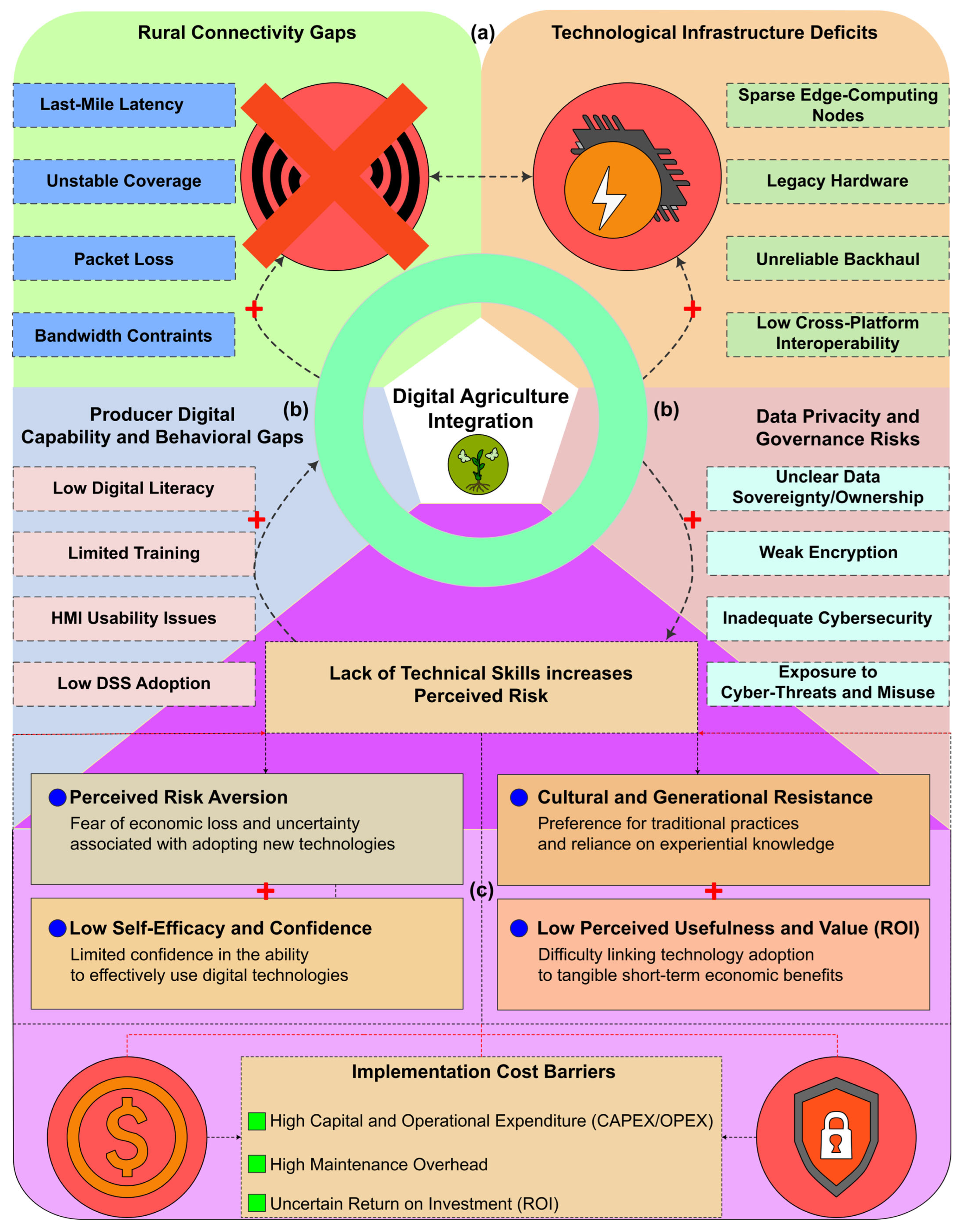
The socio-technical friction points identified in
Figure 6 acquire a gendered dimension that the technical framing of connectivity voids, infrastructure deficits, and digital capability gaps does not fully capture. What the matrix labels as a “critical digital capability deficit” in panel (c) is, for women farmers in many rural territories of sub-Saharan Africa, South Asia, and Latin America, better understood as the accumulated effect of restricted access to formal education, exclusion from peer technology-learning networks, limited smartphone ownership relative to male counterparts, and the concentration of agronomic training in formats—field days, producer associations, agricultural fairs—from which women are de facto excluded by household labor demands and mobility constraints [
3,
14]. The application bottlenecks depicted in
Figure 6 are not merely technical-capacity deficits amenable to generic training programs; they are socially stratified conditions requiring differentiated institutional responses.
Addressing these dynamics requires a transition from gender-blind to gender-transformative approaches in the design and deployment of agricultural digital tools. This entails the co-design of digital platforms with women farmer organizations as methodological partners rather than as passive beneficiaries; the integration of voice-based and low-literacy interfaces that reduce the formal literacy threshold for accessing AI-driven advisory systems; the structuring of extension programs around women’s schedules, languages, and knowledge systems; and the development of gender-disaggregated monitoring frameworks capable of tracking differential adoption rates, technology abandonment patterns, and distributional outcomes across sociodemographic groups [
9,
13]. Blockchain-based traceability systems and cooperative digital platforms represent particularly high-potential entry points for promoting women’s equitable participation in agricultural value chains, provided that governance structures ensure data sovereignty and benefit-sharing arrangements that do not replicate pre-existing power asymmetries. The systematic integration of gender equity metrics into future evidence mapping studies on agricultural digitalization constitutes both a scientific imperative—given the explanatory value these variables hold for adoption heterogeneity—and an ethical prerequisite for research claiming relevance to sustainable and inclusive food systems.
6.1. Access to Rural Connectivity
Limited access to connectivity in rural areas constitutes one of the main obstacles to the effective adoption of emerging digital technologies for sustainable agriculture, as most smart-agriculture solutions rely on continuous data flows, real-time synchronization, and machine-to-machine communication. Evidence from controlled systems highlights the productive potential of these technologies: the DARY system, based on sensors, microcontrollers, MQTT protocol, and a web application, increased pre-basic potato production by 22%, saved 27% of water, reduced energy consumption by 12%, and decreased costs by 35%, demonstrating that digital automation can simultaneously improve efficiency and sustainability [
106]. In territories characterized by complex geography, low population density, and dispersed production units, internet infrastructure is often insufficient, unstable, or economically unviable, compromising the operation of sensors, monitoring platforms, mobile applications, and AI-based decision-support systems. Nevertheless, these solutions require functional connectivity to ensure telemetry, traceability, and continuous operation. In response to this limitation, distributed cloud–fog architectures have been proposed to reduce dependence on the cloud; for instance, a WSN system in olive orchards using ZigBee/CSMA maintained ≈95% packet delivery (72–100%) despite physical obstacles and low congestion, demonstrating that localized communication strategies can sustain reliability in adverse rural environments [
108].
This connectivity gap restricts the deployment of sensor networks, the timely transmission of data, and operational access to critical services such as satellite imagery, predictive models, and dashboards, degrading the precision and utility of agronomic recommendations. Furthermore, the lack of coverage limits coordination among producers, technicians, and markets, reducing the capacity to respond to climatic events, pest outbreaks, or price fluctuations, with direct impacts on competitiveness and resilience. The expansion of rural connectivity faces economic and logistical barriers, including low population density, high deployment costs (fiber, towers, maintenance), and limited institutional capacity to support IoT operations [
109]. Although LPWAN, low-Earth orbit satellites, and hybrid schemes offer alternatives, adoption remains uneven and dependent on public policy. When minimal operational connectivity exists, benefits are immediate: in smart irrigation systems, an IoT architecture with environmental sensors enabled real-time monitoring of critical variables (T = 22.1–28 °C; RH = 39–49.1%; soil moisture = 62.5–65%; water level = 60–62%), validating the ability for digital water control and consumption reduction under real operational conditions. High-quality rural connectivity is therefore not an ancillary component but an enabling condition for equitable agricultural digitalization, allowing small and medium producers to fully benefit from these innovations [
107].
6.2. Insufficient Technological Infrastructure
Inadequate technological infrastructure constitutes a foundational constraint on the scalability of digital agriculture in rural and remote production contexts, as many areas lack operational weather stations, communication nodes, stable power supply, local servers, and management platforms capable of ensuring continuous data capture, storage, and transmission. Evidence indicates that when integrated platforms are available, high accuracy can be achieved for critical variables in smart irrigation, reaching R
2 = 0.96 for temperature and R
2 = 0.97 for ET
0 using XGBoost models [
110]. However, the scarcity of technological resources limits the effective functionality of sensors, drones, remote sensing, and AI-based models, all of which require minimal operational support to function reliably. Furthermore, the lack of maintenance services, spare parts, and specialized technical assistance increases system failures, downtime, and operational costs, discouraging adoption. Nevertheless, low-cost IoT architectures such as AgriLink have demonstrated field feasibility, monitoring soil moisture and environmental variables in orange orchards using DHT11 and soil sensors at 1 Hz, achieving accuracies of ±2 °C and ±5%, respectively [
103].
On the other hand, inadequate energy infrastructure amplifies technological gaps in digital agriculture, as in many rural areas the electricity supply is unstable or nonexistent, disrupting the continuous operation of sensors, monitoring stations, IoT gateways, and communication equipment required for data transmission. In this context, even highly accurate models for agronomic recommendations—such as IoT- and machine learning–based approaches achieving 0.99 precision with AdaBoost and 0.98 with Random Forest for fertilization—critically depend on stable power and connectivity to operate at scale [
119]. Interruptions in real-time monitoring degrade data quality, limit timely processing, and reduce the reliability of decision support systems. Although alternatives such as solar panels, long-life batteries, or hybrid schemes exist, their adoption remains constrained by initial costs, spare parts availability, and limited local technical expertise. It should be noted that advanced solutions, such as multispectral UAVs for estimating water stress in olive orchards (RWC R
2 = 0.80), require energy and logistical infrastructure that is not always available [
104].
6.3. Implementation Costs
Implementation costs constitute a structural barrier to scaling digital technologies in agriculture, particularly in small- and medium-sized farms where investment capacity and access to financing are limited. In practice, even proven solutions—such as automated grape cluster counting using YOLOv7x with UAV imagery (R
2 = 0.64)—require equipment, processing, and logistics that increase the cost of sustained adoption [
120]. The acquisition of hardware (sensors, drones, weather stations), connectivity, software licenses, and automated machinery entails a high initial expenditure, to which recurring costs for installation, calibration, maintenance, component replacement, and platform updates are added, increasing perceived risk and delaying return on investment. This financial burden is further intensified when the technology requires complementary infrastructure (stable energy supply, storage, and processing) or specialized personnel to operate and translate data into agronomic decisions. Similarly, AI-based “cognitive” weather stations, despite their high predictive accuracy (RMSE = 0.0034; Willmott index = 0.988), require investment in sensors, training, and continuous technical support [
121].
The absence of flexible financial models limits the sustained adoption of digital technologies, even when their agronomic performance is well documented. In many rural contexts, producers lack credit lines aligned with the agricultural cycle, subsidies for innovation, or co-financing schemes that allow them to amortize investments in sensors, UAVs, connectivity, and analytical software. Although deep learning models for pathogen prediction achieve high accuracy (CNN up to 96.933% and AUC-ROC 99.767%), their operational utility is sensitive to climatic dynamics and requires consistent data, which constrains their real economic benefit [
122]. This financial gap prevents gradual adoption through mechanisms such as equipment rental, pay-per-use, technological “servitization,” or scalable modular packages, forcing producers to bear high upfront costs and increasing perceived risk. This perception is further heightened because the profitability of these solutions depends on exogenous factors—climatic variability, digital infrastructure, and local technical capacities—creating uncertainty about return on investment. For instance, yield and protein estimation in durum wheat using multispectral UAVs with RF/NN/SVM (R
2 > 0.6 for yield; R
2 > 0.7 for protein) requires monitoring campaigns, data processing, and technical support, which increase recurrent costs [
98].
6.4. Lack of Digital Skills in Producers
The lack of digital skills among producers represents a structural limitation to the effective adoption of emerging technologies, as it shifts the challenge from technological availability to operational knowledge appropriation. This is particularly relevant for low-cost, user-driven solutions, such as non-destructive soil organic matter estimation using smartphone-based deep learning (RMSE = 0.17 with 500 samples), whose performance relies on proper field capture and validation protocols [
114]. In rural contexts, many farmers exhibit low digital literacy and limited experience with apps, dashboards, IoT platforms, or AI-based tools, complicating the configuration, calibration, and basic maintenance of sensors and monitoring systems. Consequently, the gap extends further, affecting the agronomic interpretation of data: without the competencies to translate analytical outputs (spectral indices, predictive alerts, risk thresholds) into management decisions, the information loses value and the likelihood of errors or technological abandonment increases. For instance, integrated UAV–IoT models for early yield prediction (PEnsemble4 with 91% accuracy, using CIre and NDRE) require minimal skills in indicator interpretation, data synchronization, and evidence-based decision-making [
99].
Insufficient and fragmented technical training represents a critical gap that limits the effective appropriation of digital technologies by producers, even when such tools are available. As a result, technologies based on remote sensing, data analytics, and decision-support systems remain underutilized despite their high agronomic potential. For instance, satellite-based mapping of wheat residue cover using Sentinel-2B (NDTI, R
2 = 0.85; accuracy = 86.53%) requires an adequate understanding of spectral indices and interpretation criteria to guide management practices [
123]. In many territories, training programs are designed using standardized approaches, without adaptation to heterogeneous educational levels, local languages, connectivity constraints, or traditional farming practices, which reduces their effectiveness and may generate resistance to innovation. This weakness becomes more pronounced when training is limited to isolated sessions, without continuous field-based support to troubleshoot operational failures, validate recommendations, and consolidate routines of use. For example, rice yield estimation using GF-1/GF-6 imagery and NDVI (R
2 = 0.88; RMSE = 3.48%) requires competencies to integrate spatial information into fertilization, irrigation, and residue management decisions [
101].
7. Future Perspectives and Lines of Research
Looking ahead, sustainable agriculture is expected to evolve toward increasingly integrated digital ecosystems in which multisensor data fusion, predictive analytics, and context-aware automation converge to enable anticipatory, real-time decision optimization—advancing the sector from reactive management toward proactive, evidence-based agronomic governance. In this context, the integration of environmental data with machine learning models has shown promising outcomes, as algorithms such as XGBoost have demonstrated superior capability for tomato disease classification when combined with deep features extracted from VGG16, achieving 93% accuracy and F1 = 0.93, and clearly outperforming traditional approaches such as Random Forest (76% accuracy and F1 = 0.76), particularly for critical failures such as early blight [
117]. Accordingly, a key research line will be the development of low-cost digital tools aimed at reducing technological gaps and facilitating field adoption. For instance, digital image processing with the extraction of color, shape, and texture attributes achieved relevant accuracies (89.6% for shape and 94% for texture), although challenges remain due to misclassification in categories such as round or rotten tomatoes. Overall, this evidence suggests that the future of the sector will depend on robust, affordable, and scalable solutions capable of combining technical precision with operational feasibility for large-scale implementation [
118].
7.1. Integration of Generative AI in Agriculture
The integration of generative artificial intelligence (GenAI) into agriculture is emerging as a strategic research line due to its ability to transform heterogeneous data into actionable operational knowledge (
Figure 7), thereby increasing the level of automation and precision in agricultural management. In this context, advances in proximal spectroscopy and smart sensing technologies represent a critical foundation to feed generative models. Evidence indicates that vis–NIR spectroscopy integrated with PLSR achieved strong predictive performance for estimating foliar nitrogen in potato (R
2 > 0.8; RPD > 2) under multi-site and multi-variety conditions, although underestimation was observed in leaves with N > 6% [
113]. Unlike conventional predictive approaches, generative AI can integrate climatic, edaphic, physiological, and productivity-related information to construct simulated scenarios, adaptive recommendations, and plot-specific management plans while explicitly accounting for climatic uncertainty and spatial variability. This capability is particularly relevant for optimizing fertilization, irrigation scheduling, and phytosanitary control, where the automated generation of yield maps, variable-rate prescriptions, and technical protocols can reduce analytical time and improve input-use efficiency. Complementarily, in sugarcane, spectral analysis enabled the characterization of yield response to nitrogen through linear and quadratic fittings, identifying variable optimal doses (109.3–185.7 kg ha
−1) depending on plot and cropping cycle, reinforcing the need for intelligent systems capable of producing differentiated and context-aware recommendations [
112].
7.2. Interoperable Digital Ecosystems
The development of interoperable digital ecosystems is emerging as a critical pillar to consolidate the technological transformation of the agricultural sector, as it enables overcoming the current fragmentation of digital solutions, which often operate as isolated “technology islands” without effective communication. From an operational perspective, interoperability makes it possible to integrate field sensors, IoT platforms, drones, remote sensing, and agronomic management systems into a unified infrastructure, ensuring standardized data exchange and real-time information traceability. Within this framework, advances in data-driven water modeling highlight the value of integrating heterogeneous sources: the calibration of the Crop Water Stress Index (CWSI) enabled the estimation of water stress with r
2 = 0.613, using lower (−1.74·VPD − 1.23) and upper (2.32 °C) Tc–Ta baselines, thereby supporting the characterization of soil water loss and irrigation requirements [
124]. This not only improves analytical quality but also enables more robust predictive models and automated control systems by providing integrated time series of climatic, edaphic, and productivity variables. Complementarily, intelligent water control based on IoT and AIoT demonstrated high accuracy in hydroponic systems, where the IWRC approach achieved outstanding performance using the MLR-PSO-ANFIS444 model (RMSE = 2.35 × 10
−4; R
2 = 0.99), confirming that the integration of data and algorithms within interoperable platforms is decisive to reduce water consumption and optimize water-use efficiency [
105].
Interoperable ecosystems foster collaboration among institutions, technology companies, research centers, and producer organizations by creating environments in which agricultural data can be shared, validated, and reused under standardized formats. In terms of outcomes, multi-source data integration has demonstrated significant improvements in agronomic prediction and control: in cotton, a scale-sensitive CNN model based on UAV imagery outperformed conventional architectures, achieving R
2 > 0.90 and low errors (MAE = 3.08 lb/row; MAPE = 7.76–10%), highlighting the potential of connected platforms to estimate productivity using RGB images [
102]. This connectivity reduces duplication of efforts, accelerates solution development, and strengthens applied knowledge networks that particularly benefit small and medium-scale farmers through access to shared platforms, digital advisory services, and scalable recommendation models. Interoperability also facilitates the effective integration of emerging technologies—such as digital twins, generative AI, or blockchain—by enabling secure and continuous connections between devices, databases, and analytical systems, thereby maximizing their field-level impact. Complementarily, in precision agriculture, the HHOGCN-WD model achieved >99.13% accuracy in weed detection and classification, enabling site-specific control and reducing herbicide use through optimized segmentation. Overall, these advances indicate that interoperability not only increases efficiency, but also strengthens traceability, transparency, and environmental sustainability, supporting the transition toward intelligent, resilient, and competitive agricultural systems [
97].
7.3. Fully Autonomous Systems
The transition toward fully autonomous agricultural systems represents one of the most ambitious transformations in digital agriculture, as it integrates advanced robotics, artificial intelligence, high-precision sensors, and farm management platforms to execute operations without direct human intervention. Under this approach, autonomous tractors, harvesting robots, and intelligent drones operate as coordinated units capable of interpreting environmental data, planning routes, adjusting decisions in real time, and working continuously, thereby increasing efficiency and reducing costs in critical tasks such as irrigation, fertilization, weed control, and plant health monitoring. From a technological evidence perspective, autonomy is strengthened when systems incorporate remote sensing and high-resolution spatial analytics: in cotton, the use of multispectral UAV imagery enabled soil salinity estimation at detailed spatial scales, where SSA-SVM and BPNN models improved estimation accuracy by 5% and 10.69%, respectively, generating maps with 5 cm resolution, which supports localized autonomous interventions to mitigate salinity-induced stress [
111]. Complementarily, in vegetable crops, low-cost UAVs were used to develop weed prescription maps, reducing the treated area by 2.18% to 18.92%; moreover, the artificial neural network (ANN) approach showed higher efficiency than methods such as MLC and OBIA, confirming the potential to automate sustainable management decisions and minimize generalized herbicide applications. Overall, these findings demonstrate that full autonomy depends not only on robotic machinery, but also on the integration of remote perception, predictive modeling, and interoperable connectivity, enabling intelligent agricultural systems capable of precise, adaptive, and sustainable actions [
96].
At the research level, autonomous agricultural systems create decisive opportunities to design more resilient and sustainable agroecosystems, as crop management can be driven by dynamic and highly localized decision-making. One of the most promising directions is the development of collaborative robot swarms, in which multiple small units perform complementary tasks (monitoring, weeding, site-specific fertilization, or selective harvesting) while minimizing soil compaction and improving adaptation to spatial variability within the field [
79]. In parallel, the integration of deep learning algorithms will allow these systems to evolve continuously by incorporating feedback from previous campaigns to optimize navigation routes, reduce energy consumption, and improve intervention accuracy [
90]. In this context, UAV-based remote sensing represents a key enabler of autonomy, as it provides detailed spatial information to guide management actions; for instance, in cotton, multispectral UAV imagery enabled high-resolution soil salinity estimation, where SSA-SVM feature selection and the BPNN model improved prediction accuracy by 5% and 10.69%, respectively, generating 5 cm resolution maps, which supports targeted corrections in field microzones [
111].
7.4. Data-Driven Regenerative Agriculture
Data-assisted regenerative agriculture is emerging as an innovative perspective that integrates ecological principles with digital technologies to restore soil functionality, enhance biodiversity, and strengthen productive resilience under climate change. Within this approach, agroecosystem instrumentation through in situ sensors, satellite remote sensing, UAVs, and analytical platforms enables continuous monitoring of critical variables such as soil structure and moisture, vegetation cover dynamics, biological activity, and carbon accumulation, thereby generating quantifiable evidence of the impacts of regenerative practices (no-tillage, cover crops, diversified rotations, and organic matter incorporation) [
119]. Furthermore, predictive models support the anticipation of system trajectories under alternative management scenarios, reducing uncertainty and improving long-term decision-making. In polycropping systems, for instance, multivariate analysis revealed key relationships between soil properties, nutrients, and productivity: the principal component PC2 explained 12.65% of the variance, with
kg/ha), PMN, and Fe as dominant variables, whereas soil C and residue N negatively conditioned the PC1–PC2 relationship, ultimately influencing yield outcomes [
125].
The combination of satellite data with machine learning models has demonstrated strong potential for estimating agricultural productivity and supporting management decisions with greater accuracy. In rice systems, the RFE-MIR variable selection strategy improves predictive performance, with k-NN standing out as the best-performing algorithm (R
2 = 0.61; RMSE = 578.43 kg ha
−1), followed by ANN (R
2 = 0.58). This highlights the usefulness of these techniques for anticipating system responses under different conditions [
100]. Similarly, in horticultural crops, low-cost drone approaches reduced the treated area by between 2.18% and 18.92%, and neural network-based methods outperformed conventional techniques. This convergence of AI, remote sensing, and data-driven management accelerates the transition to measurable and self-sustaining regenerative systems oriented toward environmental restoration [
96]. Building on this empirical foundation, the integration of big data analysis and artificial intelligence further strengthens the regenerative approach by enabling simultaneous correlation of soil, climatic, spectral and productivity-related variables to generate plot-specific recommendations.
7.5. Toward a Phased Transition in Intelligent and Sustainable Agriculture
Although the previous sections outlined multiple emerging technologies shaping the future of sustainable agriculture, their transformative potential will not materialize instantaneously. Rather, their evolution will likely follow a gradual and staged trajectory, conditioned by technological maturity, infrastructure availability, regulatory adaptation, and environmental constraints. For this reason, it is essential to conceptualize a progressive roadmap that clarifies how current developments may realistically transition into fully integrated agro-digital ecosystems.
In the short term (1–3 years), the priority should focus on consolidation rather than expansion. Many IoT-based monitoring systems, AI models, and blockchain traceability platforms already demonstrate technical feasibility; however, interoperability gaps, fragmented data standards, and uneven digital infrastructure still limit scalability. Efforts during this stage should therefore prioritize standardization, energy-efficient system design, and the adoption of less carbon-intensive distributed ledger mechanisms. Strengthening edge computing capabilities and optimizing low-power communication networks will be particularly important in rural contexts where connectivity and energy access remain constrained.
In the medium term (3–7 years), the emphasis may shift from isolated deployment toward systemic integration. At this stage, sensor networks, predictive analytics, automation platforms, and digital twins could progressively operate as interconnected layers rather than standalone solutions. This integration would enable real-time adaptive management supported by cross-platform data exchange. However, such expansion must be accompanied by regulatory harmonization, cybersecurity reinforcement, and lifecycle environmental assessments to ensure that efficiency gains are not offset by increased digital energy demand.
Looking further ahead (7–15 years), the long-term horizon envisions agroecosystems functioning as adaptive cyber-physical networks capable of autonomous optimization under climate variability. In this scenario, AI-driven decision systems, synchronized digital twins, and low-emission distributed validation architectures could collectively enhance resilience, traceability, and resource efficiency. Nonetheless, achieving this stage will depend on parallel advances in green computing, renewable-powered data infrastructures, and standardized environmental accountability metrics that prevent digital rebound effects.
By framing future developments within a phased progression, this roadmap clarifies that the transformation of digital agriculture will depend not only on technological sophistication but also on coordinated advances in sustainability governance, infrastructural equity, and environmental responsibility.
8. Conclusions
The systematic analysis demonstrates that emerging digital technologies are delivering measurable performance improvements across multiple agricultural systems. Deep learning models for crop disease detection consistently achieved accuracies between 90% and 99%, while yield prediction and irrigation optimization models frequently reported coefficients of determination above 0.85. Smart irrigation systems documented water savings of up to 30%, and precision fertilization approaches reduced input use by 15–25% without compromising productivity. In controlled-environment agriculture, intelligent energy management systems achieved reductions close to 20% in energy consumption. UAV-based hyperspectral monitoring improved early stress detection accuracy by approximately 20–25% compared to traditional scouting methods. Blockchain-enabled traceability platforms enhanced data transparency and integrity levels above 95%, confirming the consolidation of performance-validated digital agricultural ecosystems.
The quantified improvements identified in this review highlight strong practical implications for producers, technology developers, and researchers. Farmers adopting AI-driven monitoring and IoT architectures may enhance operational efficiency by 15–30%, reducing resource waste and increasing decision reliability. Water optimization technologies demonstrating savings near 30% are particularly relevant in drought-prone regions, strengthening climate resilience and economic stability. For technology developers, improving interoperability and edge-computing capabilities can maintain system reliability above 90% under real field conditions. Researchers benefit from evidence showing superior robustness of convolutional and ensemble learning models across heterogeneous datasets. Linking algorithmic performance metrics with sustainability indicators also supports evidence-based policymaking and encourages integrated innovation frameworks that align digital transformation with environmental efficiency and long-term agricultural resilience goals.
Despite strong quantitative evidence, several limitations must be considered. Approximately 40% of the analyzed studies employed heterogeneous evaluation metrics, limiting direct comparability across technological solutions. Many reported implementations were validated under experimental or pilot-scale conditions, raising uncertainty regarding scalability and long-term economic feasibility. Interoperability constraints remain evident across IoT platforms, blockchain systems, and sensor networks, especially in low-connectivity rural environments. Geographic concentration of studies in technologically advanced regions may introduce contextual bias in reported performance levels. Variability in datasets, climatic conditions, and crop systems further restricts generalization. Nevertheless, the cumulative findings indicate a transition toward integrated, sustainability-oriented digital ecosystems. Future research should prioritize standardized metrics, longitudinal assessments, and territorially adaptive frameworks to ensure scalable and equitable agricultural digitalization.




 ,
,