Article

Development of High-Resolution Agroclimatic Zoning Method to Determine Micro-Agroclimatic Zones in Greece

by
Nikolaos-Fivos Galatoulas
1,*,
Dimitrios E. Tsesmelis
1,
Angeliki Kavga
1,
Kleomenis Kalogeropoulos
2 and
Pantelis E. Barouchas
1
1
Department of Agriculture, University of Patras, Messolonghi Campus, 30200 Messolonghi, Greece
2
GeoInvision Lab, Department of Surveying and Geoinformatics Engineering, University of West Attica, 28 Ag. Spiridonos, 12243 Egaleo, Greece
*
Author to whom correspondence should be addressed.
Earth 2026, 7(2), 61; https://doi.org/10.3390/earth7020061
Submission received: 2 February 2026 / Revised: 11 March 2026 / Accepted: 7 April 2026 / Published: 9 April 2026

Abstract

Climate variability and rising water scarcity are major challenges to agricultural sustainability, particularly in Mediterranean climates with high spatial heterogeneity. Agroclimatic zoning is a fundamental analytical tool for digital agriculture and climate-resilient agriculture. The current effort proposes an integrated agroclimatic and micro-agroclimatic zoning approach for Greece, based on the Aridity Index (AI), CORINE Land Cover 2018 land-use data, and topographic factors. Daily precipitation and reference evapotranspiration data from 139 meteorological stations and 382 rain gauges were spatially interpolated using Empirical Bayesian Kriging, identifying eight agroclimatic classes adapted to the country’s specific conditions. The results indicate a high degree of variability in space, with most agricultural areas being classified as dry to sub-humid, suggesting higher irrigation requirements and sensitivity to drought. Micro-agroclimatic zones have been identified by combining agroclimatic classes, land use, and elevation. Consequently, the derived zones can be used as groundwork for designing methodologies towards more efficient agrometeorological monitoring through the improved localization of IoT agrometeorological stations. Validation with the Köppen–Geiger climate classification reveals high spatial and statistical agreement (χ2 = 248,454.09, df = 49, p < 0.001), proving the climatic validity of the proposed approach and its higher sensitivity to local water balance conditions.

1. Introduction

The ever-increasing demand for food and agricultural products creates a continuous and extensive use of natural resources, resulting in significant degradation in many areas [1,2,3,4]. Adding to the equation is that 21st-century agriculture is called upon to survive in a rapidly changing environment, where intense pressures from climate change, land-use changes, socio-economic imbalances, and food market volatility interact [5,6]. On the other hand, as an industry, it is also a victim of an unfavorable situation that it has contributed to itself. Although climate change disrupts a wide range of climatic factors, temperature and precipitation are the most basic of these [7,8,9,10,11,12,13]. Since each different crop has an optimal range of climatic conditions within which it can reproduce and grow, it is easy to understand how it affects the evolution of crops [14,15,16]. In turn, this leads to a forced continuous rotation of crops, which aims to replace the present crops with others that can respond more satisfactorily to the new climatic data [17,18,19]. However, such constant rotations incur costs at multiple levels and negatively impact all the environmental indicators of the three pillars of sustainability (economy, society, and natural environment) [20,21,22,23].
It should not be ignored that these phenomena are not new but have always existed and will continue to exist. The question is whether these trends are changing (significantly or not significantly) or have remained stable for thousands of years [24,25,26,27,28,29,30]. One such example is the Mediterranean Basin, where droughts, floods, heatwaves, snowfall, and other climatic phenomena are prevalent. Many studies have focused on this area and have called it a climate change hotspot in recent years [31]. It should be emphasized that in the existing area, there has been continuous agricultural activity since ancient times; typical examples include the Nile Delta in Egypt, which remains predominantly agricultural [32,33]. It produces wheat, rice, cotton, vegetables, and fruits, but faces challenges related to water scarcity and overpopulation [34,35,36,37]. Additionally, the Pinios plain, one of Greece’s most important rural areas, is a region that grows cotton, grains, olives, and vines, but faces issues related to overpumping of aquifers [38,39,40,41,42]. Also, Asia Minor, which is now part of today’s Turkey, was rich in grains, vines, olives, and, of course, remains agricultural primarily to this day (grains, fruits, and tobacco), although industrialization is increasing [43,44,45]. Table 1 below lists some of the areas with ongoing agricultural activity from ancient periods.
Taking into account the various climate scenarios, they show that the region is being led to more unfavorable conditions, and the difference between precipitation and reference evapotranspiration can reach 40–50% [80,81,82]. However, in the various analyses and in these future stories, the quality of the data used should be examined [83]. More generally, there are discrepancies in the available data, which is probably because the grid data was created for various purposes [84]. In areas where there is no data, they are helpful enough to capture a broader picture macroscopically, although they cannot depict the microclimate of the area [85,86]. Particular issues occur in areas with intense relief and high variability [87]. This creates significant issues in agriculture, particularly in terms of irrigation needs and predicting pests and diseases [88,89]. The solution to this issue is the creation of a network of agrometeorological stations that will cover rural areas, with an extension to other cases, such as addressing environmental risks [90,91,92].
In this context, the delimitation of agroclimatic zones is particularly important, as they serve as a key tool for understanding the climate–agriculture relationship and informing decisions at the strategic planning level [93,94,95,96]. These zones are identified based on parameters such as temperature, rainfall, soil moisture, solar radiation, and, indirectly, by evapotranspiration, allowing crops to be categorized and agricultural practices to be adapted at the local and regional levels [97,98,99,100,101,102]. The recognition of agroclimatic zones in the Mediterranean region, for example, highlights crucial differentiations between coastal and inland areas, as well as between mountainous and lowland regions, which affect the choice of crops and the management of water resources [103]. At the same time, these zones serve as the basis for creating adaptive scenarios for climate change, thereby enhancing the ability to predict risks such as droughts, heatwaves, and epidemics of phytopathological organisms [104]. Therefore, the integration of agroclimatic zones combined with high-precision data and networks of agrometeorological stations creates a strong basis for sustainable and resilient agricultural development [105].
New technologies can be applied during the cultivation process, resulting in a minimum impact on natural resources, especially in vulnerable areas, and saving water, energy, and pesticides, among other resources. In this context, and as a prerequisite for meeting the standard’s requirements, the use of digital means in smart agriculture by producers is considered. Through access to qualitative and quantitative recording tools of all kinds of cultivation interventions carried out, digital algorithms provide advice on fertilization, plant protection, and irrigation; various types of other digital data collected by networks of installed sensors are used in artificial intelligence (AI), automation, and Internet of Things (IoT) technologies. Greece, as a country in the Mediterranean basin, faces the corresponding issues. Building on the economic crisis of previous years, the agricultural sector faces numerous challenges in the digital agriculture of tomorrow. In this effort, a methodology was developed to create agroclimatic zones and agro-microclimatic zones using the Aridity Index (AI). The Aridity Index (AI) was computed as the ratio between annual precipitation and evapotranspiration following the UNEP aridity framework. In this study, evapotranspiration was implemented as FAO-56 reference evapotranspiration (ETo) calculated using the Penman–Monteith method [106]. Therefore, within the context of this study, PET is considered equivalent to ETo for the purpose of the Aridity Index calculation (AI = P/ETo). The calculation of this index requires average annual values of reference evapotranspiration (ETo) and precipitation (P); the period studied was from 1971 to 2010. The novelty of this study lies in the operational integration of aridity-based zoning with land-use constraints and agroclimatic station deployment, providing a functional spatial framework directly applicable to digital agriculture and agrometeorological network design.

2. Materials and Methods

2.1. Study Area

Greece is located in the eastern Mediterranean and covers an area of approximately 131,957 km2, with a highly indented coast of about 13,676 km, and a population of about 10.5 million inhabitants. The geographical configuration in Greece is highly fragmented due to the presence of a large number of mountainous regions, large island groups, and plains of varying sizes. The climate varies from hot and dry during summer to cold and wet during winter, with considerable spatial variation, which explains the environmental diversity of the region. The diversity also encompasses both natural and socio-economic aspects, making Greece a typical Mediterranean region for evaluating adaptation and resource management strategies to climate change [3,107,108].
Agriculture is still one of the core sectors of the country’s economy, as it occupies about 20% of the country’s land. The principal agricultural products include cereals such as wheat, barley, and maize; industrial crops including cotton, tobacco, and sugar beet; tree crops such as olives, vineyards, citrus fruits, peaches, and apricots; and horticultural crops including tomatoes, cucumbers, peppers, melons, and watermelons. Olive groves and vineyards are characteristic features of the Mediterranean landscape, while cotton production in Thessaly and Central Macedonia underscores the strategic significance of irrigated agriculture for regional economies. Livestock farming is influenced by the country’s semi-arid and mountainous terrain. Persistent deficiencies in water distribution infrastructure have led to a structural reliance on groundwater abstraction, often at unsustainable rates [109]. This has generated localized problems of aquifer overextraction and coastal zone salinization, as well as issues of water quality impairment. Therefore, Greek agriculture is very reliant on annual rainfall and is susceptible to climatic fluctuations and droughts. Seasonal deficits documented over the last decades have put pressure not only on agricultural production but also on wider socio-economic stability [41,42,110,111].
These challenges must be met through adaptive water resource management and investment in adaptive infrastructure as a way to mitigate water scarcity risks to improve agriculture’s preparedness against climate-induced stresses. Climate adaptation should be introduced to water management strategies and the design of targeted water scarcity mitigation measures [112,113]. With its geographical diversity, agroclimatic complexity, and reliance on water-sensitive crops, Greece presents a highly suitable case for examining climate-resilient agricultural practices and the applications of advanced agricultural technologies [114].

2.2. Application of Aridity Index

The Aridity Index (AI) is one of the most widely used indices for quantifying the relationship between water availability and atmospheric demand. It is calculated by the formula, average inter-annual precipitation (P)/average inter-reference evapotranspiration (ETo), where P represents the availability of water resources, while ETo represents the demand for water in the climate. In this way, this index can be used as a criterion for the balance between the availability of moisture and the demand of the climate in order to classify regions as humid, arid, or semi-arid. According to the UNEP (United Nations Environment Programme) classification, AI values < 0.65 characterize dry zones, which are distinguished into hyper-arid: AI < 0.05; arid: 0.05 ≤ AI < 0.20; semi-arid: 0.20 ≤ AI < 0.50; dry sub-humid: 0.50 ≤ AI < 0.65. The index is widely used in climate change research, water resources management, and agriculture because it provides a simple yet effective method for evaluating the susceptibility of regions to drought and for developing drought adaptation strategies [97,115].

2.3. Methodology

Agriculture in the 21st century is challenged by a rapidly changing environment, with strong pressures from climate change, land-use change, socio-economic disparities, and food market instability. The expected scenarios for 2030, 2050, and 2100 show important changes in temperature, precipitation, the number of extreme weather events, and the availability of water resources. On one hand, important changes are observed in land use, with increased urbanization and reduced arable land, especially in regions with low regional development. The lack of labor in the agricultural sector, combined with the aging of the rural population, is a critical factor that undermines the continuity of production. On the other hand, the instability of global and local food markets, as evidenced by recent events (health, geopolitical, and energy), makes it imperative to enhance the resilience of the primary sector.
In this framework, it is evident that there is a need for better preparation and adaptation of agriculture to the new reality. Digital transformation offers a powerful tool for understanding, predicting, and managing complex interactions that shape modern agricultural production. Using innovative agriculture technologies, geospatial information systems, sensors, artificial intelligence, and computational forecasting and decision-making tools, agriculture can become more sustainable, efficient, and adaptive to future challenges. In the context of this study, Greek arable land tiles are classified into climatic and microclimatic zones. This sets the groundwork for designing agri-meteorological station placement and localisation strategies for the purposes of supporting further deployments of data collection instrumentation and enhancing precision farming readiness. During the preparation of the location studies, all available data can be utilized, and the general guidelines and best practices defined by the World Meteorological Organization (WMO) for the case of reference station placement can be followed.
In order to determine the locations of agrometeorological stations (grass reference and support stations), it is first necessary to divide the Greek territory into agroclimatic zones and then to map the distribution of agricultural land. The procedures described above are detailed below. Climatic zones are regions characterized by common climatic characteristics, and the purpose of these clusters necessitates that these categories be modified depending on the case for which they were created. More specifically, the term climate refers to the “average weather conditions” of extensive geographical areas over a long period of time. Such a zone is defined as an area characterized by homogeneity of meteorological parameters (over a period of at least thirty years) that decisively affect the yield and size of production. The meteorological parameters examined, which have a direct correlation with the parameters measured for crop monitoring, are the following:
  • Precipitation (mm);
  • Hours of sunshine (hr);
  • Estimated solar radiation from hours of sunshine (w/m2);
  • Temperature (°C);
  • Relative humidity (%);
  • Wind speed (m/s).
In this effort, a methodology was developed to create agroclimatic zones and agro-microclimatic zones using the Aridity Index (AI). The calculation of this index requires average annual values of reference evapotranspiration (139 meteorological stations) and precipitation (382 rain gauges), and the period used was from 1971 to 2010 on a daily time step. The climate data used for the compilation of the climate zones were sourced from the Hydroscope (https://www.main.hydroscope.gr/, accessed on 9 September 2025), a website providing access to hydrological, meteorological, hydrogeological and geographical data in Greece, which are collected from bodies such as the Ministry of Environment, Public Power Corporation, the Hellenic National Institute of Hydrology, the Ministry of Agriculture and Rural Development and the National Observatory of Athens. In addition, it used land use and geomorphological data (Table 2).
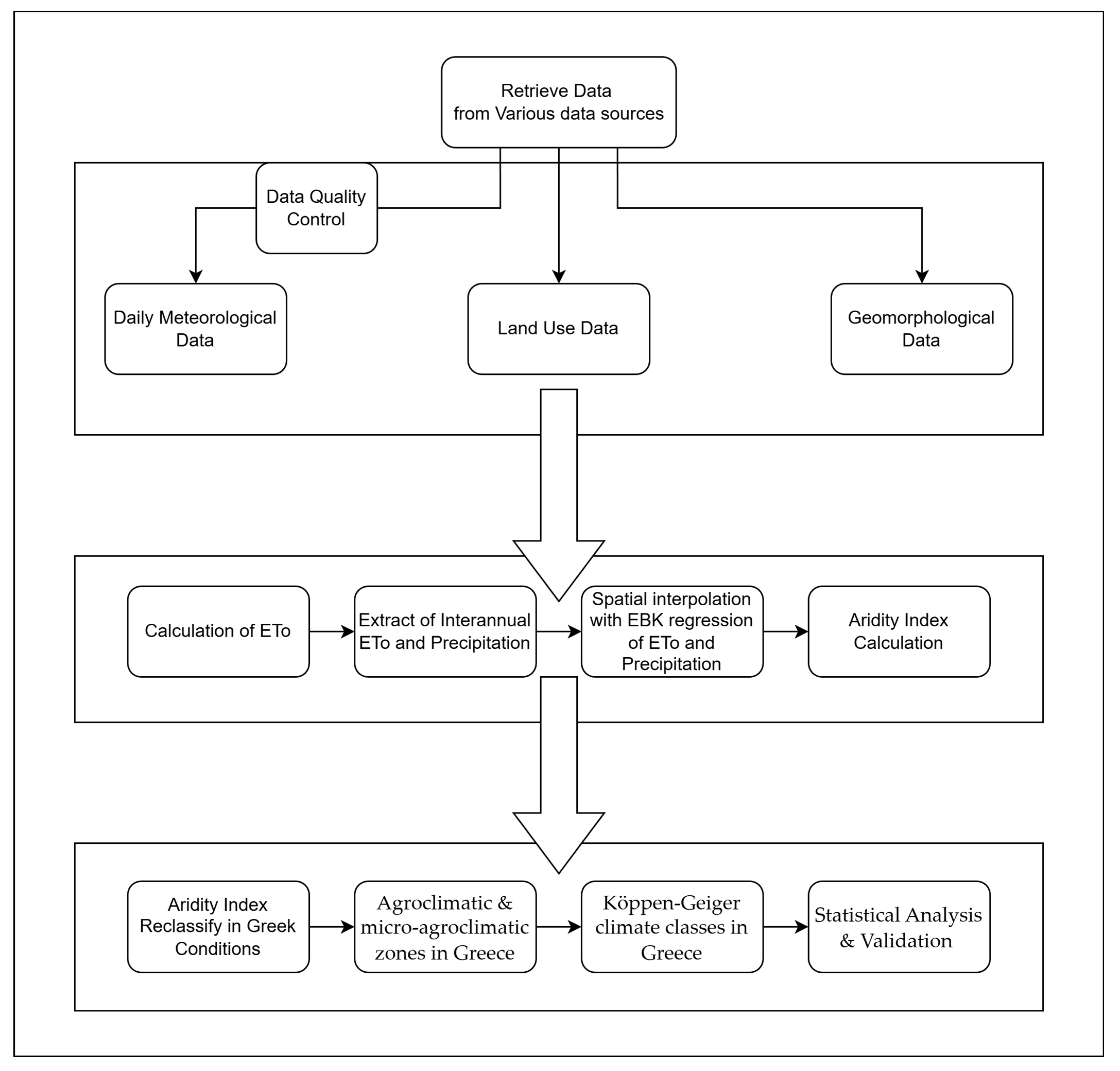
In the context of this study (Figure 1), the first step of the current methodology was data collection (meteorological, land use, and digital elevation model) and pre-processing. The second step was the data quality control of the daily meteorological data (time series gaps, outliers, etc.) and the ETo calculation. Data quality control included completeness assessment, outlier detection, and internal consistency checks. Stations with less than 80% data availability over the period 1971–2010 were excluded from further analysis. Missing daily values were retained without interpolation, as agroclimatic indicators were derived from long-term averages. Outliers were identified through range checks and comparison with available data points from neighboring stations, while physically inconsistent values such as negative precipitation were removed. Following quality control procedures, a total of 139 meteorological stations and 382 rain gauges were retained and used in the subsequent spatial interpolation analysis. ETo was then calculated from the quality-controlled datasets [116,117,118]. The third step was the extraction of monthly, annual, and interannual values and the conversion of point values into spatial values with EBK regression Prediction for Precipitation and ETo with a digital elevation model. Topographic information was derived from the SRTM 1 Arc-Second Global DEM (approximately 30 m spatial resolution). Following this, the AI for the Hellenic territory was calculated and reclassified into 8 new classes based on the ESRI Natural Breaks (Jenks) algorithm on the spatial level and carefully adapted to Greek climatic conditions. This step is the key determinant for the geo-distribution of micro-agroclimatic zones in Greece. Guided by the understanding that microclimatic zones play a crucial role in crops and the agricultural sector, they were developed based on the interpretation of microclimatic phenomena and variables (micro-meteorology), as well as their economic implications.
Table 2. Main datasets used in the study, including their source, spatial or temporal resolution, and role in the methodological framework.
DatasetDescriptionSpatial/Temporal ResolutionSource
Meteorological observationsDaily precipitation, temperature, relative humidity, wind speed, and sunshine durationDaily time series (1971–2010)Hydroscope database
CORINE Land Cover 2018Land-use/land-cover categories100 mCopernicus/CORINE Land Cover 2018 [119]
Digital Elevation Model (DEM)Elevation data used as auxiliary covariate30 mNASA
Spatial interpolation of precipitation and reference evapotranspiration (ETo) was carried out using Empirical Bayesian Kriging Regression Prediction (EBK-RP) in ArcGIS Pro 3.6.1. This method combines regression modeling with Empirical Bayesian Kriging, allowing spatial autocorrelation to be taken into account while also incorporating auxiliary information. In the present effort, elevation derived from a digital elevation model (DEM) was used as the explanatory variable, given its well-established influence on climatic gradients in mountainous Mediterranean environments. The interpolation procedure was based on an exponential semivariogram model, using a subset size of 100, an overlap factor of 1, and 100 simulations, in accordance with the standard EBK parameterization. A standard circular neighborhood was adopted, with 10–15 neighboring stations considered for each prediction location. No transformation or detrending was applied to the input data.
The micro-agroclimatic zones were delineated by combining the agroclimatic classes derived from the Aridity Index with the agricultural land-use categories of CORINE Land Cover. In this framework, the influence of topography is already incorporated indirectly into the agroclimatic zoning through the interpolation procedure and the generation of the climatic surfaces. The more detailed internal coding scheme was developed primarily for the subsequent operational stage, namely the identification of representative locations for station siting, and therefore lies beyond the main scope of the present study.
Admittedly, the role of microclimatic zones introduces a new significant dimension to the agricultural sector. The delimitation of these zones is determined by the climatic conditions, but also by the type of vegetation cover. Considering the climatic zones that were created, the vegetation cover (including agricultural areas), and the effect of elevation, agro-microclimatic zones were established to group similar areas in order to achieve better data monitoring capabilities on capturing micro-climatic phenomena in finer resolutions and facilitating parcel zoning in the vein of variable rate application and precision farming technologies. It should be emphasized that the microclimatic zones should be connected to supporting stations where they will provide important climatic and soil information at the microclimatic level. For example, rainfall is an important parameter in the irrigation strategy and shows large fluctuations at the local level. With the above, the amount of rain will be expressed from the rain gauges of denser and precisely located station networks. In addition, these stations can support the development of plant protection and integrated pest management algorithms based on climatic observations. Finally, the agroclimatic zones were validated against the Köppen–Geiger climate classification in order to assess their spatial consistency and climatic relevance. Both map layers were processed at a spatial resolution of 250 m, and the Köppen–Geiger layer was resampled to the same grid as the Aridity Index surfaces to ensure spatial comparability.
The agreement between the two classification schemes was evaluated using an area-weighted confusion matrix, which allowed the spatial correspondence between agroclimatic and Köppen–Geiger classes to be quantified. In addition, the statistical association between the two categorical systems was assessed using the chi-square test and Cramér’s V statistic, while Cohen’s Kappa coefficient and weighted Kappa were calculated as supplementary indicators of agreement. Differences in the distribution of Aridity Index (AI) values among Köppen–Geiger classes were further examined using the Kruskal–Wallis test. The results of these tests are reported in Table 2.
Most of the agricultural land examined in this study was associated with intermediate Köppen–Geiger classes, particularly BSk (cold semi-arid steppe), Csa (temperate, dry summer, hot summer), and Csb (temperate, dry summer, warm summer), where a broad range of AI values was observed. By contrast, more extreme climate classes corresponded to narrower and more distinct AI ranges, supporting the climatic consistency of the proposed agroclimatic zoning framework.

3. Results

3.1. Agroclimatic Zones

The climatic data used in this study were daily time series of precipitation (P), minimum, maximum, and mean air temperature (Tmin, Tmax, and Tmean), mean relative humidity (RH), wind speed at 2 m height (WS), and solar radiation (Rs) or number of sunshine hours (SH). The calculation of Rs was conducted as depicted in Equation (1) [120]. These variables were used to compute reference evapotranspiration (ETo) at a daily time step using the FAO-56 Penman–Monteith method [106]. Although FAO-56 PM is widely recognized as the most robust physically based approach for estimating ETo, its application requires a relatively large number of meteorological inputs, which may limit its use in data-scarce regions [106,121,122]. The time series covers 1 January 1971 to 31 December 2010, representing an adequate period to characterize climate variability based on the best available datasets and the World Meteorological Organization’s (WMO) recommendations for climate normals.
R s = k R s R a T m a x T m i n
where
Rs = estimated daily solar radiation (MJ/m2/day);
Ra = daily extraterrestrial radiation (MJ/m2/d);
Tmax = daily maximum air temperature (°C);
Tmin = daily minimum air temperature (°C);
KRs = empirical adjustment coefficient (0.16 for inland regions and 0.19 for coastal regions) [106].
E T o = 0.408 Δ R n G + γ 900 Τ + 273 u 2 ( e s e a ) Δ + γ ( 1 + 0.34 u s )
where
ETo = reference evapotranspiration (mm/day);
Rn = net radiation at the crop surface (MJ/m2/day);
G = soil heat flux density (MJ/m2/day);
T = average daily air temperature 2 m (°C);
u2 = wind speed 2 m (m/s);
es = saturation vapor pressure (kPa);
ea = actual vapor pressure (kPa);
es − ea = vapor pressure deficit kPa;
Δ = Δ is the slope of the vapor pressure curve (kPa/°C);
γ = psychrometric constant (kPa/°C);
G = soil heat flux (G = 0, in daily applications).
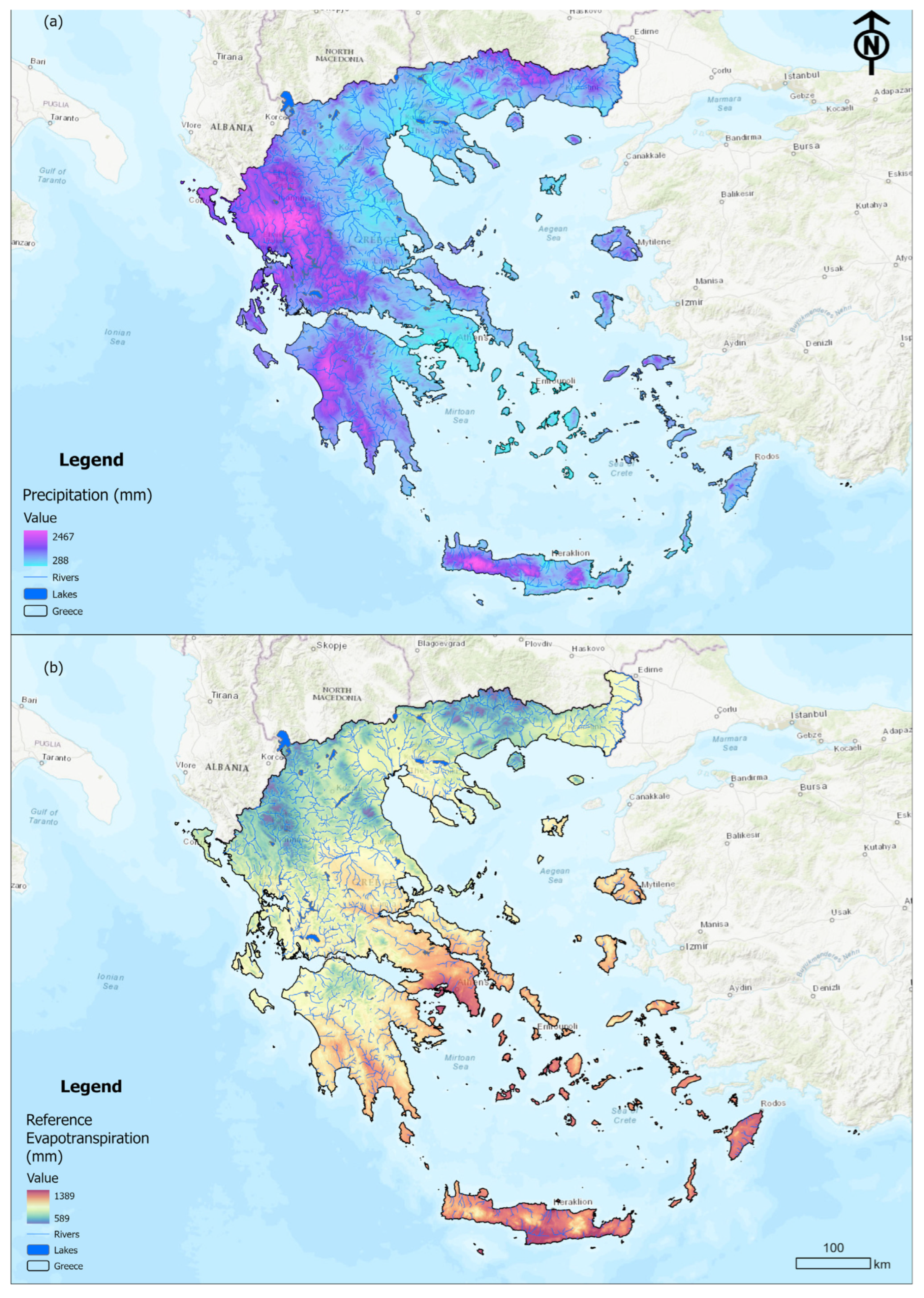
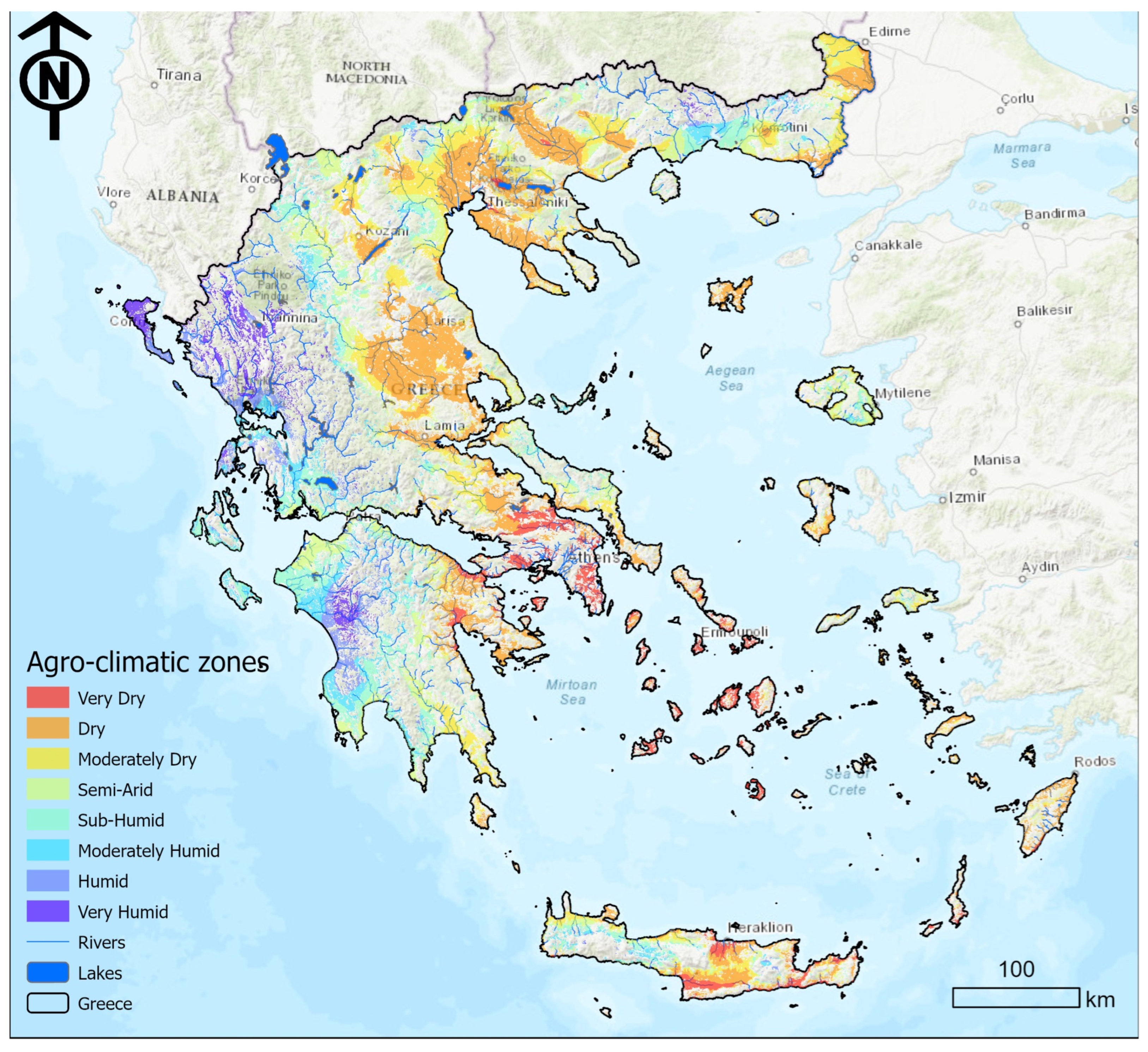
The historical climatic data series used were obtained from Hydroscope (http://www.main.hydroscope.gr, accessed on 15 July 2025). The interannual values of precipitation and reference evapotranspiration were transformed from point values to spatial values with EBK regression prediction for P and ETo with a digital elevation model [123]. The spatial results of these climatic parameters are depicted in Figure 2a,b. Based on these parameters (precipitation and reference evapotranspiration), the AI was calculated for the period from 1971 to 2010 using ArcGIS Pro 3.5.3 (Figure 3). The next step in the index calculation was reclassification and adaptation to local climatic conditions. The technique of spatial classification was the Natural Breaks (Jenks). The zones created by this process are eight for the entire Greek territory (Table 3). Zones in orange and yellow represent dry and moderately dry regions, including Thessaly, Attica, and some areas of the eastern Peloponnese. Light green to turquoise shades indicate semi-arid and sub-humid conditions, covering large sections of the central lowlands and coastal areas. Blue gradients reflect increasingly humid environments, with darker shades representing very humid areas, especially in western Greece, Epirus, and parts of Macedonia, where local features increase rainfall. Major rivers and lakes appear in light and dark blue, clearly showing the country’s water network. This map emphasizes the significant climatic differences between the dry southern and island areas and the wetter northern and western regions.
Model performance was assessed through leave-one-out cross-validation within the EBK framework. The results indicated satisfactory predictive performance, with root mean square error (RMSE) values of 119.76 mm for precipitation and 54.37 mm for reference evapotranspiration (ETo). In addition, the standardized RMSE values were close to unity, indicating that the interpolation captured the spatial variability of the two climatic variables reasonably well while also providing reliable estimates of prediction uncertainty.
One of the principal methodological features of the research is the spatial interpolation of two climatic parameters derived from discrete data points across the heterogeneous terrain of Greece. The study employs Empirical Bayesian Kriging (EBK), a high-level geostatistical interpolation method well suited to the complexity of the study area.
Table 3 presents the classes that were created as well as the ranges of AI values they include. The rural areas in Greece are in lowlands, in semi-mountainous and mountainous zones [124,125]. According to this statement, the next step of the current effort was to focus on rural areas and the produced maps masked based on CORINE Land Cover 2018 (vector 100 m spatial resolution) [119].

3.2. Validation of Methodological Robustness

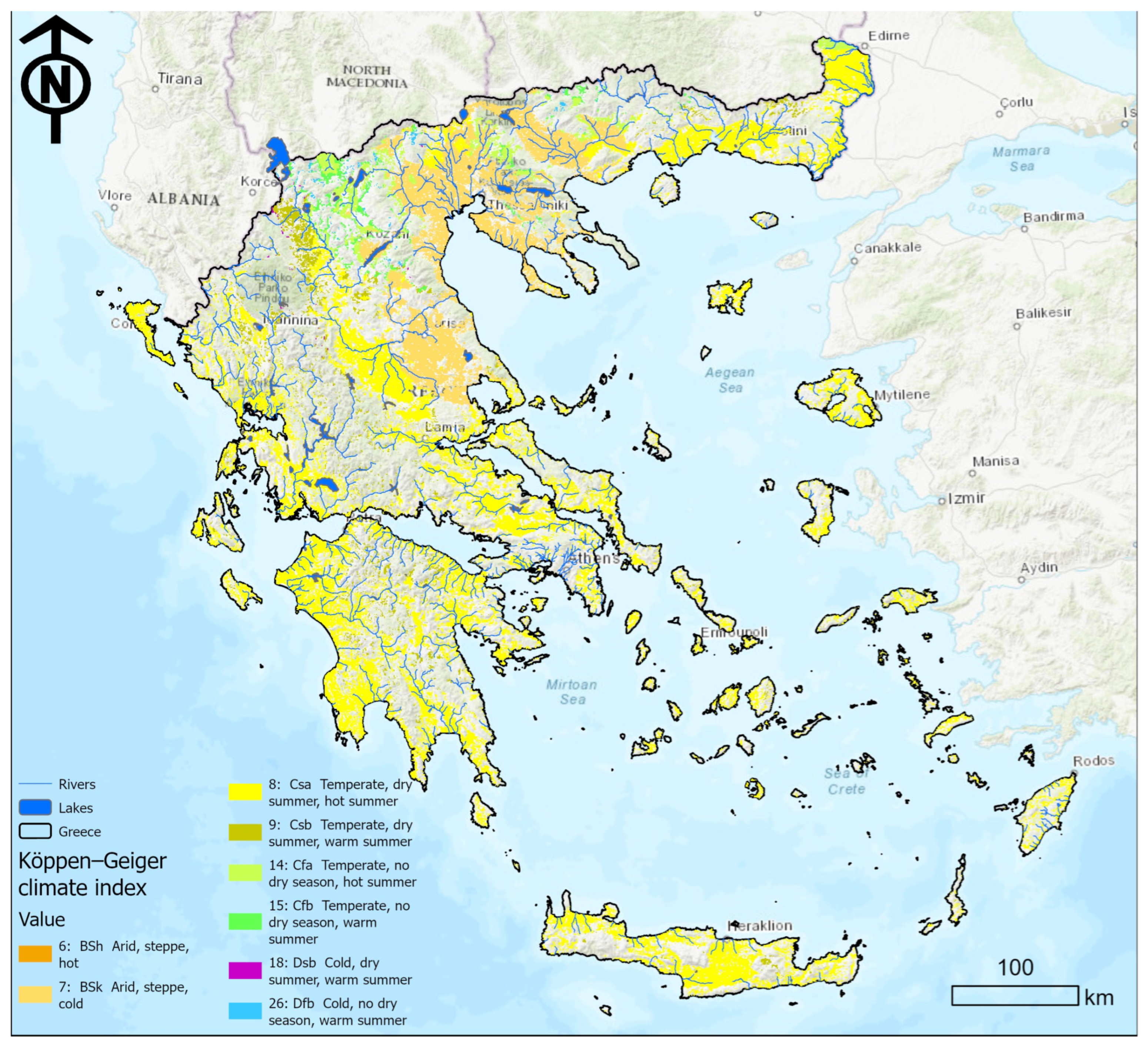
To validate the methodology, the Köppen–Geiger climate index was used (Figure 4), which is an empirical but systematized climate classification scheme based on the correlation of meteorological parameters with the boundaries of the spread of natural vegetation. The system defines climate types through combinations of temperature and precipitation criteria on an annual and monthly basis, with an emphasis on precipitation seasonality and temperature fluctuations. The basic categories (tropical, dry, temperate, continental, and polar climates) are divided into subcategories that accurately attribute the variations in the thermohydrological regime. The revised Köppen–Geiger Index applies a lot of observational and reanalysis data to create highly resolved climate maps and support spatial and temporal observations of climatic change in zones. It is thus a valuable reference in agroclimatology, bioclimatic geography, and climate change research, providing insight into the impact of change on agricultural systems and ecosystems [96,126,127,128].
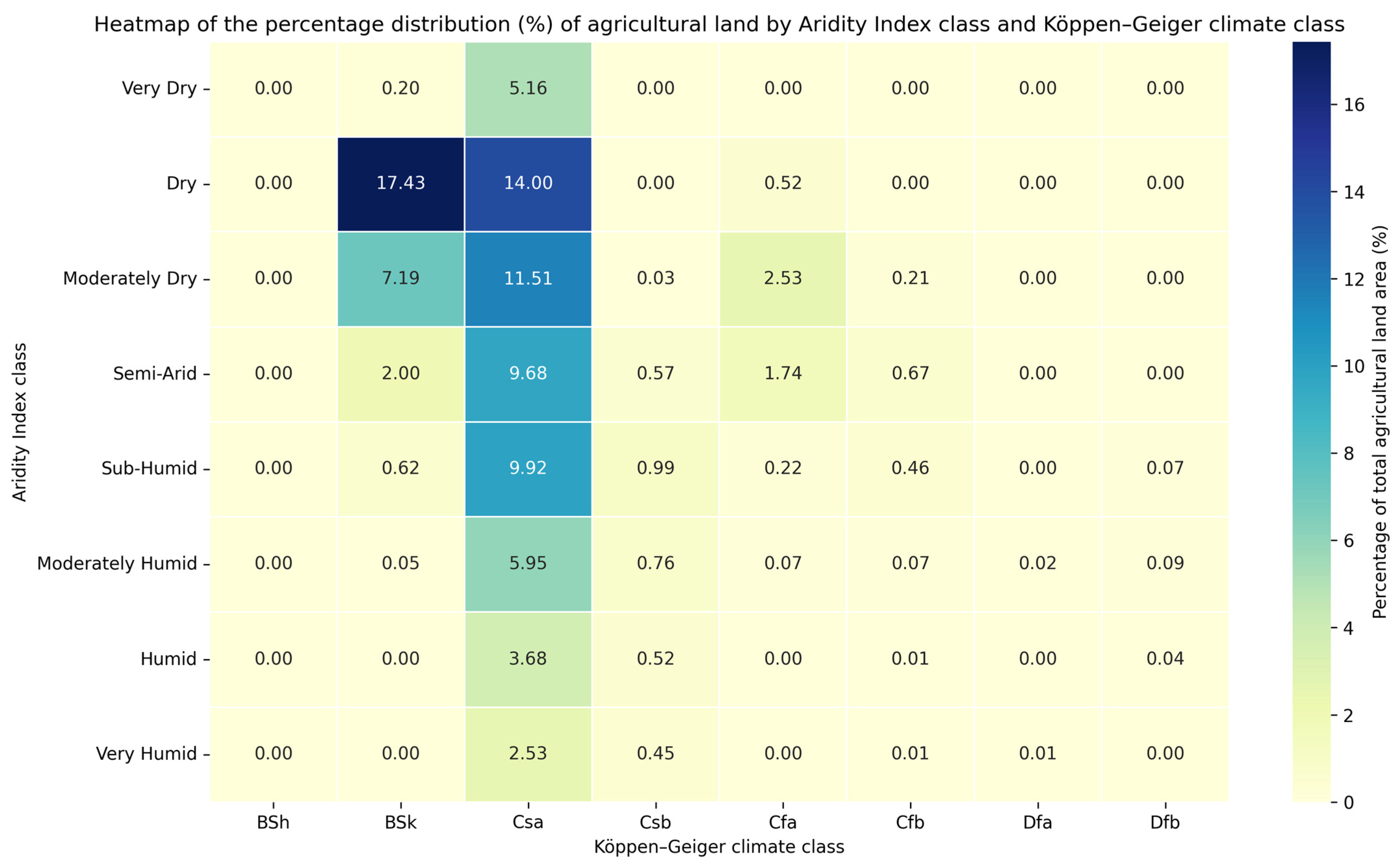
The comparison between the agroclimatic zoning derived from the Aridity Index and the Köppen–Geiger climate classification was based on valid agricultural pixels after raster alignment and masking. The resulting cross-tabulation showed that agricultural land in Greece is concentrated mainly within the intermediate Köppen–Geiger classes, especially BSk, Csa, and Csb, which also correspond to the broadest range of agroclimatic classes. More specifically, the very dry class was associated almost entirely with Csa and, to a much smaller extent, BSk, while the dry and moderately dry classes were strongly represented within BSk and Csa. The semi-arid and sub-humid classes were distributed more widely across Csa, Csb, Cfa, and Cfb, reflecting transitional climatic conditions. By contrast, the humid and very humid classes were more restricted and occurred mainly in areas classified as Csa, Csb, and Dfb, whereas the colder Köppen classes (Dfa and Dfb) occupied only limited portions of the agricultural land.
The statistical comparison confirmed that the relationship between the two classification schemes is highly significant (Table 4). The chi-square test indicated a strong overall association between agroclimatic and Köppen–Geiger classes (χ2 = 248,454.09, df = 49, p < 0.001), while Cramér’s V (V = 0.236) suggested a moderate association between the two categorical systems. In addition, Cohen’s Kappa (κ = 0.077) and weighted Kappa (κw = 0.207) indicated limited direct agreement. This result is not unexpected, since the two classification systems are based on different principles: the Köppen–Geiger scheme describes broad macroclimatic regimes, whereas the proposed agroclimatic zoning reflects the functional balance between water availability and atmospheric demand. Thus, the cross-tabulation results, chi-square test, Cramér’s V, and the distribution of AI values across Köppen–Geiger classes provide a more meaningful basis for interpretation than direct categorical agreement alone. This result is further supported by the Kruskal–Wallis test, which showed statistically significant differences in AI classes among Köppen–Geiger classes (H = 137,047.78, p < 0.001). Overall, the results demonstrate that the proposed agroclimatic zoning framework is climatically consistent with the Köppen–Geiger classification, while at the same time being more sensitive to agri-environmental gradients related to water balance and agricultural conditions.
To assess the reliability and climatic consistency of the derived micro-agroclimatic zones, a comparison was made with the widely accepted Köppen–Geiger climate classification, which is based on long-term temperature and precipitation patterns. This comparison allows independent verification of the zones derived from the Aridity Index and examines whether the aridity classes align with established climatic regimes. The spatial comparison of the two maps (Figure 3 and Figure 4) demonstrates a clear systematic agreement between the driest agroclimatic classes and the Mediterranean climate types Csa and Csb, which dominate the lowland and coastal areas of the country. Accordingly, the wetter agroclimatic classes largely coincide with the classes Cfa, Cfb, and Dfb, which are mainly located in Western Greece, Epirus, and the mountainous zones of Northern Greece. The quantitative comparison of the two classifications, as reflected in the frequency heatmap (Figure 5), further strengthens the spatial findings. Values represent the proportion of total agricultural land area occupied by each AI–Köppen class combination. It is observed that:
  • The dry and very dry agroclimatic classes (AI Classes 1–2) show a high concentration in areas with Csa and Csb climate, confirming the compatibility of the Aridity Index with the Mediterranean pattern of dry hot summers.
  • The moderately dry to semi-arid classes (Classes 3–4) are mainly distributed between the Csa/Csb and the transitional classes Cfa, indicating zones of increased climatic variability.
  • The sub-humid and moderately humid classes (Classes 5–6) are strongly correlated with the Cfa and Cfb classes, which are characterized by the absence of severe summer drought.
  • The humid and very humid classes (Classes 7–8) occur almost exclusively in areas with Cfb and Dfb climates, confirming the index’s ability to capture areas with a surplus of water resources.
The distribution of percentages in the heatmap shows a clear diagonal structure, indicating strong agreement between the two classification systems and limited overlap of incompatible classes. The limited deviations observed between specific Aridity Index and Köppen–Geiger classes are interpreted because of the different theoretical bases of the two approaches. Whereas the Köppen system describes the macroclimatic conditions, the Aridity Index represents the functional equilibrium between water availability and demand.
Thus, these differences do not represent a failure of the method, but, on the contrary, demonstrate the micro-agroclimatic nature of these areas, which are able to detect more detailed differences, which are of crucial importance for agricultural production and water resources management. The combined spatial overlap and quantitative correlation analysis documents that the proposed micro-agroclimatic zones exhibit a high degree of climatic consistency with the Köppen–Geiger classification, while at the same time offering functional advantages for agricultural planning applications. This agreement confirms that the Aridity Index is an appropriate indicator for climate specialization at the agro-ecosystem level, especially in areas with strong spatial heterogeneity such as Greece.

3.3. Micro-Agroclimatic Zones

With agro-microclimatic zones playing an important role in crops and in the agricultural sector in general, they were developed in accordance with the latest developments in the scientific field of micro-observations and interpretation of micro-climatic phenomena and variables, and their counterparts in the economic field. Following these terms, the role of microclimatic zones adds a new important dimension to the agricultural sector. The delimitation of these zones is determined by the climatic conditions, but also by the type of vegetation cover. Taking into account the agroclimatic zones created, the vegetation cover (agricultural areas), and the effect of altitude, agro-microclimatic zones were established to group similar areas and to place the supported agrometeorological stations (SAS) in a way that would yield better results by covering the locality of the phenomena. It should be emphasized that the SAS will provide important climatic and soil information at the microclimatic level. For example, rainfall is an important parameter in the irrigation strategy and shows large fluctuations at the local level. With the above installation, the amount of rain from the rain gauges of the stations will be expressed. In addition, they will be used for plant protection algorithms that use the corresponding climatic observations. However, it is necessary to add a third parameter, that of the elevation model, which is extracted from the digital terrain model [123].
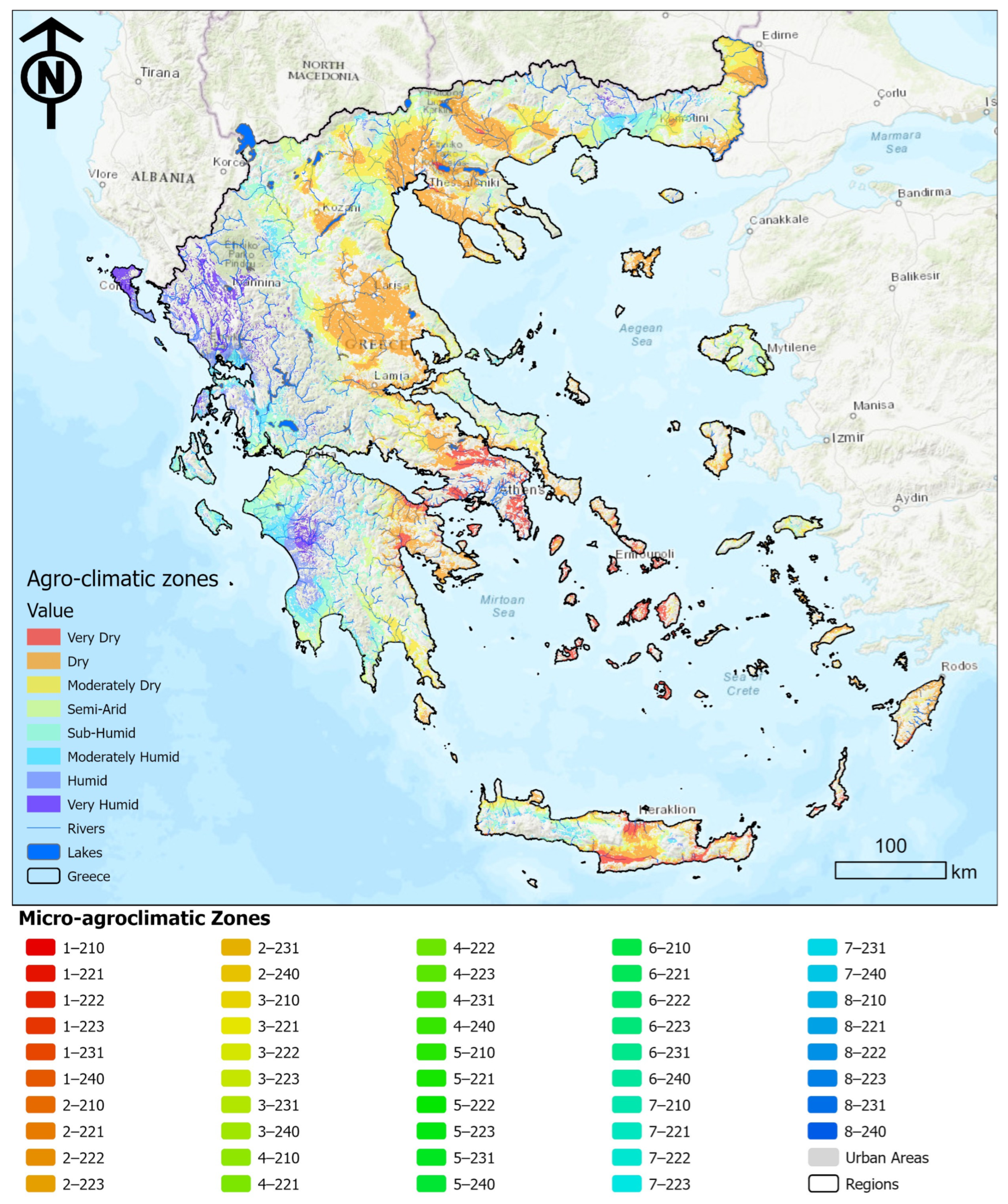
The integration of CORINE Land Cover 2018 categories allows the analysis of the interaction between climate and land use. It is observed that intensive agricultural uses are mainly concentrated in zones with a dry-to-sub-humid climatic regime, where human intervention compensates for natural constraints through irrigation and inputs. On the other hand, natural and semi-natural land cover is plotted alongside the wet areas, indicating that climate affects the rural landscape. The micro-agroclimatic zones map is an essential component of the agricultural spatial planning approach (Figure 6 and Table A1). The composite agroclimatic codes shown in Figure 6 represent the combination of aridity class, land use, and elevation. A cross-reference of all classes is provided in Appendix A, Table A1. In addition, given climate change, the micro-agroclimatic zones may serve as indicators of aridity onset in the regions. Therefore, this study suggests that micro-agroclimatic zones are useful for managing natural resources. Particularly in light of climate change, these zones can serve as early warning indicators of the transition of regions to drier regimes, supporting adaptation strategies and the sustainable management of natural resources.
Very dry and dry micro-agroclimatic zones (Classes 1–2) occupy a significant part of the lowland and semi-mountainous areas of Eastern and Central Greece, as well as large areas of Crete and the Aegean island complexes. These areas are characterized by limited rainfall and high evapotranspiration, making agricultural activity particularly dependent on irrigation. The fact that intensive agricultural use exists in these regions reveals the increased pressure on water resources and the increased sensitivity to drought. The moderately dry and semi-arid regions (Classes 3–4) are considered transitional regions between arid and humid climates. They are mostly found in the interior lowlands and low-altitude regions, which indicate greater climatic stability but also increased sensitivity to temperature and precipitation variations. These regions display high agricultural potential but also need proper irrigation resource management and appropriate agricultural techniques. The sub-humid and moderately humid regions (Classes 5–6) are mostly found in Western Greece, Epirus, and the western part of the Peloponnese, where the increased rainfall amount contributes to the positive water balance. These regions are mostly linked to tree crops, natural vegetation, and low irrigation requirements, but also display increased sensitivity to climate variability. Finally, concerning the humid/very humid climate classes (Classes 7–8), these are mostly found in the mountainous/semi-mountainous regions of Northwestern Greece, where the geographical characteristics favor the accumulation of cloud moisture, resulting in precipitation. Even though humid/very humid climates are less useful for agriculture, their specific role is crucial for regulating water resources, replenishing groundwater, and supporting agriculture in lowland areas.

4. Discussion

The current effort confirms findings from other works showing the effectiveness of using indicators for agroclimatic zones, particularly in cases where they are combined with land use and topography [129,130]. The Aridity Index, land-use data from CORINE, and elevation data have been shown to significantly enhance the spatial sensitivity of agroclimatic classifications, especially in regions characterized by strong climatic and geomorphological heterogeneity, such as the Mediterranean basin. Similar approaches have been proposed in Mediterranean and semi-arid environments, where evapotranspiration-based indices outperform rainfall-only measurements in representing agricultural water stress and crop suitability [131,132]. The strong correspondence observed between the proposed method for precising agroclimatic zones and the Köppen–Geiger climate classification highlights the strong climatic relevance, in line with recent global and regional assessments linking aridity metrics with established climate regimes [96,126]. At the same time, the deviations between the two classifications underline the added value of the proposed method in capturing functional agroclimatic conditions. Specifically, Köppen–Geiger classes describe macroclimatic envelopes, and aridity indices integrate atmospheric demand and water availability, which are directly relevant to irrigation requirements and drought vulnerability in agricultural systems [98,99]. In addition, integrating CORINE Land Cover 2018 classes with the Aridity Index classes pinpoints the possible characterization of spatial units by climatic constraints, uncertainties, and prevalent land-use patterns. As emphasized in agroecological and land system studies, a systematic analysis of the interactions between natural limitations and anthropogenic land management, decisions, and practices’ footprint is pivotal in determining plausible pathways for the deployment of nature-based solutions, as well as achieving more sustainable agricultural productivity [133]. The concentration of arable crops in the dry to sub-humid agroclimatic classes (Classes 2–5) is in line with previous studies that have shown the dependence of Mediterranean lowland agriculture on irrigation infrastructure and groundwater extraction [38,39,40,41,42,109]. Consequently, the spatial correlation indicates a higher sensitivity to drought and climate change, as agricultural production in these regions is highly dependent on artificial water supply [80,81,82].
By contrast, evergreen crops like olive trees and other tree crops have a broader agroclimatic distribution, ranging from moderately dry to moderately humid classes (Classes 3–6). In this regard, the physiological tolerance of perennial Mediterranean crops and the historical adaptation of agricultural practices to water-limited conditions is confirmed, as evidenced in agroclimatic studies of southern Europe and the eastern Mediterranean [14,15,65,66,67]. Heterogeneous agricultural regions are mostly found in transitional agroclimatic regions, where climatic gradients and topographic variability promote mixed agricultural systems. These systems have long been identified as being more robust to climatic variability, as crop diversity mitigates agroclimatic hazards and improves adaptability [16,18,22].
Climate classification maps are still valuable tools for summarizing complex climate patterns; however, they have traditionally been available at relatively coarse spatial resolutions (>0.1°), which hinders their use in farm-level decision support. Recent progress has been made in the development of high-resolution Köppen–Geiger maps with topographic corrections and uncertainty estimates, as well as future projections under various emission scenarios [126,134,135]. In parallel, global and regional climate modeling projects such as CMIP6 and EURO-CORDEX, and biogeographic models developed by the European Environment Agency, have increased the availability of climate projections relevant to agriculture [80,81,82]. More recently, the European Commission’s Destination Earth initiative proposes to deliver high-resolution simulations of climate–ecosystem interactions, which could revolutionize climate services for agriculture [136].
However, most studies are still based on historical extrapolation and gradualism, often neglecting the possibility of non-linear dynamics and abrupt changes in Earth system processes [137]. Fine-resolution analysis has demonstrated that warming rates are highly variable across landscapes, underlining the need for enhanced downscaling methods to better represent microclimatic conditions. New approaches to climate downscaling have been proposed to better support crop suitability assessments and field-level decision-making under both current and future climates [138,139]. Moreover, the integration of climate information with agricultural models is still rudimentary, and agroecological studies have recently started to investigate the potential effects of large-scale tipping processes in the Earth system on land suitability and food system resilience. Current land-use and crop maps also impede these types of analyses. CORINE Land Cover is a consistent and available pan-European dataset, but it is not detailed on crop type and crop management beyond very broad categories like irrigated versus non-irrigated arable land [140,141]. More specialized datasets, such as JRC AGRI4CAST and vegetation indices such as NDVI and fAPAR, provide additional information but are limited by coarse spatial resolution, short time series, or single-year observations. Global agro-ecological frameworks such as FAO–IIASA’s Global Agro-Ecological Zones (GAEZ) and the ECOCROP database provide valuable information on crop requirements but are not designed to capture fine-scale spatial heterogeneity or dynamic land-use transitions [108,142,143,144].
Within this context, the proposed micro-agroclimatic zoning framework contributes a functional and scalable approach that bridges climatic balance indicators with land-use patterns. A key direction for future research lies in extending this framework to scenario-driven zoning that integrates Earth Observation time series, remote sensing, and advanced machine-learning techniques. Recent studies have demonstrated the potential of temporal convolutional neural networks, transformer architectures, and cloud-based platforms to generate high-resolution land-use and crop-type maps across Europe [141,145,146]. The increasing availability of open EO datasets enables the development of dynamic agroclimatic zoning systems capable of visualizing the spatial reorganization of cropping systems under climate uncertainty [147].
In this respect, pan-European geo-distribution layers of cropping systems could be substantially enhanced by integrating crop recognition with projected agroclimatic zone shifts, allowing the identification of future land-pressure hotspots and structural transitions, such as shifts from arable to permanent crops or grassland loss. The use of EU-wide datasets such as EU-CROPMAP as a baseline for current cropping patterns would further support comparative analyses under multiple climate and land-use scenarios, building on emerging methodologies for dynamic land-system modeling [148]. Such developments would strengthen the role of agroclimatic zoning as a core analytical layer for climate-smart agriculture, policy planning, and sustainable land management [149,150].
Moreover, the current outputs on the derivation of fine-scale micro-climatic zones comprise a preliminary step for improved downstream design of climate-smart agrometeorological station placement within the frame of monitoring and capturing finer agri-environmental indicators. In turn, field measurements from denser sensing networks following a micro-climatic agrometeorological placement methodology combined with Earth Observation (EO) data and Remote Sensing indices may lead to improved situational awareness and unprecedented resolution of agri-environmental and climatic indicators while unlocking upgraded capabilities in precision agriculture decision support system development.
Although the present study focuses on Greece, both the methodological approach and the main spatial patterns identified are broadly consistent with findings reported from other Mediterranean and semi-arid regions. In such environments, agroclimatic zoning is often based on the combined use of aridity-related indicators, land-use information, and topographic controls in order to represent the strong environmental heterogeneity that characterizes these landscapes. From this perspective, the concentration of agricultural land within dry-to-sub-humid zones, the strong dependence on irrigation, and the usefulness of water-balance-based classification for agricultural planning are not unique to Greece but reflect wider challenges across Mediterranean agricultural systems. A fully harmonized cross-regional comparison would require the use of comparable climatic datasets, land-use layers, and validation procedures across multiple countries, which is beyond the main scope of the present study. Even so, the results suggest that the proposed framework may also be applicable to other Mediterranean regions with similar climatic and geomorphological characteristics.

Study Limitations

Despite the satisfactory performance of the proposed methodology, certain limitations should be taken into account. The agroclimatic zoning framework was developed using meteorological data from the period of 1971–2010, covering 40 years. This long-time span provides a solid basis for describing the prevailing climatic conditions and helps reduce the influence of short-term interannual fluctuations. Therefore, it is well-suited to the identification of relatively stable agroclimatic patterns at the national scale and any further reanalysis. However, at the same time, the resulting zoning mainly reflects a historical climatic baseline and does not explicitly incorporate more recent climatic changes and warming trends that emerged after 2010. Nonetheless, studies on general climate profiles indicate a moderate to low variance from the extracted microclimatic attributes [25,151]. In addition, the use of this period was partly dictated by the availability of a sufficiently dense and consistent precipitation observation network, since comparable rain-gauge data were not continuously available beyond this period. A further limitation concerns the spatial interpolation process. Although the Empirical Bayesian Kriging Regression Prediction (EBK-RP) approach showed satisfactory validation results, interpolation uncertainty may still be greater in areas characterized by complex topography, fragmented landscapes, and island conditions. In such environments, local climatic gradients and microclimatic variability are more difficult to capture from station observations alone. This issue is particularly relevant in mountainous regions of Greece, where sharp elevation differences can lead to substantial climatic variation over relatively short distances. Finally, the present study was developed primarily as a national-scale methodological framework for agroclimatic and micro-agroclimatic zoning. As such, the results should be viewed mainly as a tool for spatial classification and planning, rather than as a replacement for detailed local-scale agrometeorological analysis. Future research could further strengthen this framework by incorporating more recent climatic observations, scenario-based projections, and a more detailed assessment of spatial uncertainty.

5. Conclusions

The integration of agroclimatic classes with crop categories identifies regions of high vulnerability, where intensive crops are found together with dry climatic conditions, as well as regions of high potential, where the climatic regime is favorable for agricultural production with low water inputs. On the other hand, it makes it possible to identify regions where future climate change could result in a mismatch between the agricultural system and the climatic conditions. In relation to agricultural adjustment within the framework of adapting to the challenges posed by climate change, this approach could help to concentrate agricultural adjustment efforts, strategic irrigation investments, and efficient agricultural water resource management, especially in regions that are beginning to exhibit a transition towards drier agroclimatic regions.
The present study developed and applied an agroclimatic and micro-agroclimatic zoning system for Greece, using the Aridity Index and supplemented with land-use information from the CORINE Land Cover 2018 dataset. The findings revealed the high spatial variability of climatic conditions, which characterizes the Greek rural area, and proved that agricultural activity is often practiced in areas with higher water deficit, further increasing the pressure on water resources. The high spatial and statistical agreement of agroclimatic zones with the Köppen–Geiger classification verifies the climatic accuracy of the proposed method. At the same time, the application of the Aridity Index provides a functional and meaningful zoning from an agronomic point of view, as it directly expresses the relationship between water availability and demand. This distinction is essential for the determination of irrigation requirements and the sensitivity of crops to drought.
The combination of crop types using CORINE Land Cover data pointed out areas where intensive agricultural practices are combined with arid and semi-arid climatic conditions, increasing the risk of unsustainable water use. On the other hand, wetter and sub-humid conditions are mostly related to less water-demanding land-use types and natural habitats, which have a decisive role in the regulation and refilling of water resources. In this respect, the findings of the present study show that the use of micro-agroclimatic zones can play a significant role in the reduction of water waste, enabling the following:
  • the adaptation of irrigation to the actual climatic conditions of each zone;
  • the limitation of over-pumping of groundwater aquifers;
  • the targeted application of inputs, reducing environmental pressures on soil and water bodies.
Therefore, micro-agroclimatic zones represent an important tool for digital agriculture, which has the capability to serve as a fundamental spatial reference level for Decision Support Systems (DSS), irrigation algorithms, Internet of Things (IoT), and agrometeorological networks. With this method, climate data is converted into useful knowledge, which promotes informed decision-making by considering evidence-based actions at the farmland level. Finally, this research informs that the zoning system proposed has a role that goes beyond a theoretical practice, a scientific map, and instead represents a useful tool within the context of natural resource conservation, especially water resources, and agricultural resilience in climate fluctuations and changes. The usage of these tools may help the agricultural sector make a smooth transition towards a more sustainable, resource-efficient, and digital agricultural system, which produces food without compromising existing natural resources.

Author Contributions

N.-F.G. and D.E.T.: conceptualization, methodology, formal analysis, writing—original draft preparation, investigation, visualization, and writing—review and editing. A.K.: formal analysis, investigation, writing—original draft preparation, visualization, and writing—review and editing. K.K.: writing—original draft preparation, investigation, visualization, and writing—review and editing. P.E.B.: methodology and writing—review and editing. All authors have read and agreed to the published version of the manuscript.

Funding

This research received no external funding.

Data Availability Statement

The original contributions presented in this study are included in the article. Further inquiries can be directed to the corresponding author.

Conflicts of Interest

The authors declare no conflicts of interest.

Appendix A. Composite Agroclimatic Classification Table

Table A1. Composite agroclimatic classification.
ID#Composite CodeAgroclimatic ClassLand UseElevation
11-210Very DryArable land0–200 m
21-221Very DryPermanent crops200–500 m
31-222Very DryPermanent crops500–1000 m
41-223Very DryPermanent crops1000–1500 m
51-231Very DryPastures200–500 m
61-240Very DryHeterogeneous agriculture>1500 m
72-210DryArable land0–200 m
82-221DryPermanent crops200–500 m
92-222DryPermanent crops500–1000 m
102-223DryPermanent crops1000–1500 m
112-231DryPastures200–500 m
122-240DryHeterogeneous agriculture>1500 m
133-210Moderately DryArable land0–200 m
143-221Moderately DryPermanent crops200–500 m
153-222Moderately DryPermanent crops500–1000 m
163-223Moderately DryPermanent crops1000–1500 m
173-231Moderately DryPastures200–500 m
183-240Moderately DryHeterogeneous agriculture>1500 m
194-210Semi-AridArable land0–200 m
204-221Semi-AridPermanent crops200–500 m
214-222Semi-AridPermanent crops500–1000 m
224-223Semi-AridPermanent crops1000–1500 m
234-231Semi-AridPastures200–500 m
244-240Semi-AridHeterogeneous agriculture>1500 m
255-210Sub-HumidArable land0–200 m
265-221Sub-HumidPermanent crops200–500 m
275-222Sub-HumidPermanent crops500–1000 m
285-223Sub-HumidPermanent crops1000–1500 m
295-231Sub-HumidPastures200–500 m
305-240Sub-HumidHeterogeneous agriculture>1500 m
316-210Moderately HumidArable land0–200 m
326-221Moderately HumidPermanent crops200–500 m
336-222Moderately HumidPermanent crops500–1000 m
346-223Moderately HumidPermanent crops1000–1500 m
356-231Moderately HumidPastures200–500 m
366-240Moderately HumidHeterogeneous agriculture>1500 m
377-210HumidArable land0–200 m
387-221HumidPermanent crops200–500 m
397-222HumidPermanent crops500–1000 m
407-223HumidPermanent crops1000–1500 m
417-231HumidPastures200–500 m
427-240HumidHeterogeneous agriculture>1500 m
438-210Very HumidArable land0–200 m
448-221Very HumidPermanent crops200–500 m
458-222Very HumidPermanent crops500–1000 m
468-223Very HumidPermanent crops1000–1500 m
478-231Very HumidPastures200–500 m
488-240Very HumidHeterogeneous agriculture>1500 m

References

  1. Hossain, A.; Krupnik, T.J.; Timsina, J.; Mahboob, M.G.; Chaki, A.K.; Farooq, M.; Bhatt, R.; Fahad, S.; Hasanuzzaman, M. Agricultural Land Degradation: Processes and Problems Undermining Future Food Security. In Environment, Climate, Plant and Vegetation Growth; Fahad, S., Hasanuzzaman, M., Alam, M., Ullah, H., Saeed, M., Ali Khan, I., Adnan, M., Eds.; Springer International Publishing: Cham, Switzerland, 2020; pp. 17–61. ISBN 978-3-030-49732-3. [Google Scholar]
  2. Tsesmelis, D.E.; Karavitis, C.A.; Kalogeropoulos, K.; Zervas, E.; Vasilakou, C.G.; Skondras, N.A.; Oikonomou, P.D.; Stathopoulos, N.; Alexandris, S.G.; Tsatsaris, A.; et al. Evaluating the Degradation of Natural Resources in the Mediterranean Environment Using the Water and Land Resources Degradation Index, the Case of Crete Island. Atmosphere 2022, 13, 135. [Google Scholar] [CrossRef]
  3. Tsesmelis, D.E.; Karavitis, C.A.; Kalogeropoulos, K.; Tsatsaris, A.; Zervas, E.; Vasilakou, C.G.; Stathopoulos, N.; Skondras, N.A.; Alexandris, S.G.; Chalkias, C.; et al. Development and Application of Water and Land Resources Degradation Index (WLDI). Earth 2021, 2, 515–531. [Google Scholar] [CrossRef]
  4. Dyson, T. Population and Food: Global Trends and Future Prospects; Routledge: Abingdon, UK, 1996; ISBN 978-1-134-81169-4. [Google Scholar]
  5. Vos, R.; Bellù, L.G. Chapter 2—Global Trends and Challenges to Food and Agriculture into the 21st Century. In Sustainable Food and Agriculture; Campanhola, C., Pandey, S., Eds.; Academic Press: Cambridge, MA, USA, 2019; pp. 11–30. ISBN 978-0-12-812134-4. [Google Scholar]
  6. Economou, F.; Papamichael, I.; Rodríguez-Espinosa, T.; Voukkali, I.; Pérez-Gimeno, A.; Zorpas, A.A.; Navarro-Pedreño, J. The Impact of Food Overproduction on Soil: Perspectives and Future Trends. In Planet Earth: Scientific Proposals to Solve Urgent Issues; Núñez-Delgado, A., Ed.; Springer International Publishing: Cham, Switzerland, 2024; pp. 263–292. ISBN 978-3-031-53208-5. [Google Scholar]
  7. Deitch, M.J.; Sapundjieff, M.J.; Feirer, S.T. Characterizing Precipitation Variability and Trends in the World’s Mediterranean-Climate Areas. Water 2017, 9, 259. [Google Scholar] [CrossRef]
  8. O’Gorman, P.A. Precipitation Extremes Under Climate Change. Curr. Clim. Change Rep. 2015, 1, 49–59. [Google Scholar] [CrossRef]
  9. Tsesmelis, D.E.; Leveidioti, I.; Karavitis, C.A.; Kalogeropoulos, K.; Vasilakou, C.G.; Tsatsaris, A.; Zervas, E. Spatiotemporal Application of the Standardized Precipitation Index (SPI) in the Eastern Mediterranean. Climate 2023, 11, 95. [Google Scholar] [CrossRef]
  10. Oikonomou, P.D.; Karavitis, C.A.; Tsesmelis, D.E.; Kolokytha, E.; Maia, R. Drought Characteristics Assessment in Europe over the Past 50 Years. Water Resour. Manag. 2020, 34, 4757–4772. [Google Scholar] [CrossRef]
  11. Asseng, S.; Ewert, F.; Martre, P.; Rötter, R.P.; Lobell, D.B.; Cammarano, D.; Kimball, B.A.; Ottman, M.J.; Wall, G.W.; White, J.W.; et al. Rising Temperatures Reduce Global Wheat Production. Nat. Clim. Change 2015, 5, 143–147. [Google Scholar] [CrossRef]
  12. Stefanidis, S. Ability of Different Spatial Resolution Regional Climate Model to Simulate Air Temperature in a Forest Ecosystem of Central Greece. J. Environ. Prot. Ecol. 2021, 22, 1488–1495. [Google Scholar]
  13. Abbass, K.; Qasim, M.Z.; Song, H.; Murshed, M.; Mahmood, H.; Younis, I. A Review of the Global Climate Change Impacts, Adaptation, and Sustainable Mitigation Measures. Environ. Sci. Pollut. Res. 2022, 29, 42539–42559. [Google Scholar] [CrossRef] [PubMed]
  14. Bhattacharya, A. Effect of Low-Temperature Stress on Germination, Growth, and Phenology of Plants: A Review. In Physiological Processes in Plants Under Low Temperature Stress; Bhattacharya, A., Ed.; Springer: Singapore, 2022; pp. 1–106. ISBN 978-981-16-9037-2. [Google Scholar]
  15. Porter, J.R.; Semenov, M.A. Crop Responses to Climatic Variation. Philos. Trans. R. Soc. B Biol. Sci. 2005, 360, 2021–2035. [Google Scholar] [CrossRef]
  16. Wuest, S.E.; Peter, R.; Niklaus, P.A. Ecological and Evolutionary Approaches to Improving Crop Variety Mixtures. Nat. Ecol. Evol. 2021, 5, 1068–1077. [Google Scholar] [CrossRef]
  17. Teixeira, E.I.; de Ruiter, J.; Ausseil, A.-G.; Daigneault, A.; Johnstone, P.; Holmes, A.; Tait, A.; Ewert, F. Adapting Crop Rotations to Climate Change in Regional Impact Modelling Assessments. Sci. Total Environ. 2018, 616–617, 785–795. [Google Scholar] [CrossRef] [PubMed]
  18. Yu, T.; Mahe, L.; Li, Y.; Wei, X.; Deng, X.; Zhang, D. Benefits of Crop Rotation on Climate Resilience and Its Prospects in China. Agronomy 2022, 12, 436. [Google Scholar] [CrossRef]
  19. Shah, K.K.; Modi, B.; Pandey, H.P.; Subedi, A.; Aryal, G.; Pandey, M.; Shrestha, J. Diversified Crop Rotation: An Approach for Sustainable Agriculture Production. Adv. Agric. 2021, 2021, 8924087. [Google Scholar] [CrossRef]
  20. Brankatschk, G.; Finkbeiner, M. Modeling Crop Rotation in Agricultural LCAs—Challenges and Potential Solutions. Agric. Syst. 2015, 138, 66–76. [Google Scholar] [CrossRef]
  21. He, D.-C.; Ma, Y.-L.; Li, Z.-Z.; Zhong, C.-S.; Cheng, Z.-B.; Zhan, J. Crop Rotation Enhances Agricultural Sustainability: From an Empirical Evaluation of Eco-Economic Benefits in Rice Production. Agriculture 2021, 11, 91. [Google Scholar] [CrossRef]
  22. Liang, Z.; Xu, Z.; Cheng, J.; Ma, B.; Cong, W.-F.; Zhang, C.; Zhang, F.; van der Werf, W.; Groot, J.C.J. Designing Diversified Crop Rotations to Advance Sustainability: A Method and an Application. Sustain. Prod. Consum. 2023, 40, 532–544. [Google Scholar] [CrossRef]
  23. Manono, B.O.; Khan, S.; Kithaka, K.M. A Review of the Socio-Economic, Institutional, and Biophysical Factors Influencing Smallholder Farmers’ Adoption of Climate Smart Agricultural Practices in Sub-Saharan Africa. Earth 2025, 6, 48. [Google Scholar] [CrossRef]
  24. Koutsoyiannis, D.; Iliopoulou, T.; Koukouvinos, A.; Malamos, N.; Mamassis, N.; Dimitriadis, P.; Tepetidis, N.; Markantonis, D. In Search of Climate Crisis in Greece Using Hydrological Data: 404 Not Found. Water 2023, 15, 1711. [Google Scholar] [CrossRef]
  25. Tzanis, C.G.; Koutsogiannis, I.; Philippopoulos, K.; Deligiorgi, D. Recent Climate Trends over Greece. Atmos. Res. 2019, 230, 104623. [Google Scholar] [CrossRef]
  26. Koutsoyiannis, D. Rethinking Climate, Climate Change, and Their Relationship with Water. Water 2021, 13, 849. [Google Scholar] [CrossRef]
  27. Beniston, M.; Stephenson, D.B. Extreme Climatic Events and Their Evolution under Changing Climatic Conditions. Glob. Planet. Change 2004, 44, 1–9. [Google Scholar] [CrossRef]
  28. Grant, P.R.; Grant, B.R.; Huey, R.B.; Johnson, M.T.J.; Knoll, A.H.; Schmitt, J. Evolution Caused by Extreme Events. Philos. Trans. R. Soc. B Biol. Sci. 2017, 372, 20160146. [Google Scholar] [CrossRef] [PubMed]
  29. Vaze, J.; Post, D.A.; Chiew, F.H.S.; Perraud, J.-M.; Viney, N.R.; Teng, J. Climate Non-Stationarity—Validity of Calibrated Rainfall–Runoff Models for Use in Climate Change Studies. J. Hydrol. 2010, 394, 447–457. [Google Scholar] [CrossRef]
  30. Tumajer, J.; Begović, K.; Čada, V.; Jenicek, M.; Lange, J.; Mašek, J.; Kaczka, R.J.; Rydval, M.; Svoboda, M.; Vlček, L.; et al. Ecological and Methodological Drivers of Non-Stationarity in Tree Growth Response to Climate. Glob. Change Biol. 2023, 29, 462–476. [Google Scholar] [CrossRef]
  31. Giorgi, F. Climate Change Hot-Spots. Geophys. Res. Lett. 2006, 33, L08707. [Google Scholar] [CrossRef]
  32. Hamza, W. The Nile Delta. In The Nile: Origin, Environments, Limnology and Human Use; Dumont, H.J., Ed.; Springer: Dordrecht, The Netherlands, 2009; pp. 75–94. ISBN 978-1-4020-9726-3. [Google Scholar]
  33. Zhao, X.; Sheisha, H.; Thomas, I.; Salem, A.; Sun, Q.; Liu, Y.; Mashaly, H.; Nian, X.; Chen, J.; Finlayson, B.; et al. Climate-Driven Early Agricultural Origins and Development in the Nile Delta, Egypt. J. Archaeol. Sci. 2021, 136, 105498. [Google Scholar] [CrossRef]
  34. El-Beheiry, M.; Ahmed, D.; Ammar, E.; Shaltout, K. Diversity of Crop Plants in Nile Delta, Egypt. Taeckholmia 2015, 35, 77–97. [Google Scholar] [CrossRef]
  35. El-Marsafawy, S.M.; Swelam, A.; Ghanem, A. Evolution of Crop Water Productivity in the Nile Delta over Three Decades (1985–2015). Water 2018, 10, 1168. [Google Scholar] [CrossRef]
  36. Redeker, C.; Kantoush, S.A. The Nile Delta: Urbanizing on Diminishing Resources. Built Environ. 2014, 40, 201–212. [Google Scholar] [CrossRef]
  37. Wolters, W.; Smit, R.; Nour El-Din, M.; Sayed Ahmed, E.; Froebrich, J.; Ritzema, H. Issues and Challenges in Spatial and Temporal Water Allocation in the Nile Delta. Sustainability 2016, 8, 383. [Google Scholar] [CrossRef]
  38. Lyra, A.; Loukas, A.; Sidiropoulos, P.; Tziatzios, G.; Mylopoulos, N. An Integrated Modeling System for the Evaluation of Water Resources in Coastal Agricultural Watersheds: Application in Almyros Basin, Thessaly, Greece. Water 2021, 13, 268. [Google Scholar] [CrossRef]
  39. Kakkavou, K.; Gemtou, M.; Fountas, S. Drivers and Barriers to the Adoption of Precision Irrigation Technologies in Olive and Cotton Farming—Lessons from Messenia and Thessaly Regions in Greece. Smart Agric. Technol. 2024, 7, 100401. [Google Scholar] [CrossRef]
  40. Mylopoulos, N.; Kolokytha, E.; Loukas, A.; Mylopoulos, Y. Agricultural and Water Resources Development in Thessaly, Greece in the Framework of New European Union Policies. Int. J. River Basin Manag. 2009, 7, 73–89. [Google Scholar] [CrossRef]
  41. Pisinaras, V.; Paraskevas, C.; Panagopoulos, A. Investigating the Effects of Agricultural Water Management in a Mediterranean Coastal Aquifer under Current and Projected Climate Conditions. Water 2021, 13, 108. [Google Scholar] [CrossRef]
  42. Sismanidi, M.; Kokkinaki, L.; Kavalieratou, S.; Georgoussis, H.; Giannoulis, K.D.; Dimitriou, E.; Panagopoulos, Y. Assessing the Effects of Bioenergy Cropping Scenarios on the Surface Water and Groundwater of an Intensively Agricultural Basin in Central Greece. Hydrology 2025, 12, 66. [Google Scholar] [CrossRef]
  43. Mitchell, S. Food, Culture, and Environment in Ancient Asia Minor. In A Companion to Food in the Ancient World; John Wiley & Sons, Ltd.: Hoboken, NJ, USA, 2015; pp. 283–295. ISBN 978-1-118-87825-5. [Google Scholar]
  44. Ercisli, S. A Short Review of the Fruit Germplasm Resources of Turkey. Genet. Resour. Crop Evol. 2004, 51, 419–435. [Google Scholar] [CrossRef]
  45. Erinc, S.; Tuncdilek, N. The Agricultural Regions of Turkey. Geogr. Rev. 1952, 42, 179–203. [Google Scholar] [CrossRef]
  46. Jeddou, M.B. Colonialism and Landscape: Population Dynamics and Land Use in Northern Tunisia under Roman and French Rule. Landscapes 2008, 9, 70–98. [Google Scholar] [CrossRef]
  47. Luttenberger, M. The Mediterranean Sea from Alexander to the Rise of Rome: The Hellenistic Age, 360–133 BC; Page Publishing Inc.: Meadville, PA, USA, 2022; ISBN 978-1-6624-6912-1. [Google Scholar]
  48. Sherwin-White, A.N. Geographical Factors in Roman Algeria. J. Roman Stud. 1944, 34, 1–10. [Google Scholar] [CrossRef]
  49. Mendjel, L.; Labed, O. Agriculture in the Central Maghreb Between Traditional Heritage and Andalusian Influence from the 2nd to the 10th Century AH. J. Educ. Teach. Train. 2025, 16, 1–18. [Google Scholar]
  50. Ogilvie, A.G. Morocco and Its Future. Geogr. J. 1912, 39, 554–570. [Google Scholar] [CrossRef]
  51. Coulter, J.W. Aspects of Morocco Today: Climate and Agriculture. J. Geogr. 1964, 63, 402–413. [Google Scholar] [CrossRef]
  52. Buzaian, A. Ancient Olive Presses and Oil Production: In Cyrenaica (North-East Libya). Ph.D. Thesis, University of Leicester, Leicester, UK, 2019. [Google Scholar]
  53. Ali, R.F.; AL-Sunosy, H.M.; Saed, E.M. A Survey of Medical Plants of Cyrene (Campus Apollo) Shahat-Al-Jabal Al-Akhdar, Libya. Libyan J. Sci. Technol. 2024, 15, 166–170. [Google Scholar] [CrossRef]
  54. Cabrera-Tejedor, C. From Hispalis to Ishbiliyya: The Ancient Port of Seville, from the Roman Empire to the End of the Islamic Period (45 BC—AD 1248). Ph.D. Thesis, University of Oxford, Oxford, UK, 2016. Available online: http://purl.org/dc/dcmitype/Text (accessed on 2 February 2026).
  55. Mariano, M.; Abella, S.; Araujo, R.; Ibisate González de Matauco, A.; Ollero, A. Nature-Human-River Relationships at the Ebro River and Its Delta (Spain). In River Culture: Life as a Dance to the Rhythm of the Waters; UNESCO Publishing: Paris, France, 2023. [Google Scholar] [CrossRef]
  56. Kirchner, H. The Archaeology of Field Systems in Al-Andalus. Agronomy 2024, 14, 196. [Google Scholar] [CrossRef]
  57. Martí, P.; García-Mayor, C. The Huerta Agricultural Landscape in the Spanish Mediterranean Arc: One Landscape, Two Perspectives, Three Specific Huertas. Land 2020, 9, 460. [Google Scholar] [CrossRef]
  58. Calatayud, S. New Crops in the Crisis of Mediterranean Agriculture: Valencia, 1800-1950. In Alternative Agriculture in Europe (Sixteenth-Twentieth Centuries); Rural History in Europe; Brepols Publishers: Turnhout, Belgium, 2020; Volume 16, pp. 277–294. ISBN 978-2-503-58674-8. [Google Scholar]
  59. Arnaud-Fassetta, G.; Provansal, M. The Lower Valley and the Delta of the Rhône River: Water Landscapes of Nature and History. In Landscapes and Landforms of France; Fort, M., André, M.-F., Eds.; Springer: Dordrecht, The Netherlands, 2014; pp. 207–218. ISBN 978-94-007-7022-5. [Google Scholar]
  60. Walsh, K.; Berger, J.-F.; Roberts, C.N.; Vanniere, B.; Ghilardi, M.; Brown, A.G.; Woodbridge, J.; Lespez, L.; Estrany, J.; Glais, A.; et al. Holocene Demographic Fluctuations, Climate and Erosion in the Mediterranean: A Meta Data-Analysis. Holocene 2019, 29, 864–885. [Google Scholar] [CrossRef]
  61. Ugolini, F. Quantifying Wheat Production, Consumption and Export in Roman Adriatic Italy (150 BC-AD 250). Agri Centuriati Int. J. Landsc. Archaeol. 20 2023, 2023, 91–111. [Google Scholar] [CrossRef]
  62. Goodchild, H. Modelling Roman Agricultural Production in the Middle Tiber Valley, Central Italy. Ph.D. Thesis, University of Birmingham, Birmingham, UK, 2007. [Google Scholar]
  63. Corti, G.; Cocco, S.; Brecciaroli, G.; Agnelli, A.; Seddaiu, G. Italian Soil Management from Antiquity to Nowadays. In The Soils of Italy; Costantini, E.A.C., Dazzi, C., Eds.; Springer: Dordrecht, The Netherlands, 2013; pp. 247–293. ISBN 978-94-007-5642-7. [Google Scholar]
  64. Marzano, A. Agriculture in Imperial Italy. In A Companion to Ancient Agriculture; John Wiley & Sons, Ltd.: Hoboken, NJ, USA, 2020; pp. 431–446. ISBN 978-1-118-97095-9. [Google Scholar]
  65. Timonen, R.E. Plain of Plenty: Farming Practices, Food Production, and the Agricultural Potential of the Late Bronze Age (1600–1200 BCE) Argive Plain, Greece; Archaeopress Publishing: Oxfordshire, UK, 2024. [Google Scholar]
  66. Chandezon, C. Agriculture in Greece and Coastal Anatolia, 500–100 BCE. In A Companion to Ancient Agriculture; John Wiley & Sons, Ltd.: Hoboken, NJ, USA, 2020; pp. 289–315. ISBN 978-1-118-97095-9. [Google Scholar]
  67. Foxhall, L. Bronze to Iron: Agricultural Systems and Political Structures in Late Bronze Age and Early Iron Age Greece. Annu. Br. Sch. Athens 1995, 90, 239–250. [Google Scholar] [CrossRef]
  68. Kokkinidou, D.; Trantalidou, K. Neolithic and Bronze Age Settlement in Western Macedonia. Annu. Br. Sch. Athens 1991, 86, 93–106. [Google Scholar] [CrossRef]
  69. Ghilardi, M.; Fouache, E.; Queyrel, F.; Syrides, G.; Vouvalidis, K.; Kunesch, S.; Styllas, M.; Stiros, S. Human Occupation and Geomorphological Evolution of the Thessaloniki Plain (Greece) since Mid Holocene. J. Archaeol. Sci. 2008, 35, 111–125. [Google Scholar] [CrossRef]
  70. Semple, E.C. Geographic Factors in the Ancient Mediterranean Grain Trade. Ann. Assoc. Am. Geogr. 1921, 11, 47–74. [Google Scholar] [CrossRef]
  71. Kouli, K. Vegetation Development and Human Activities in Attiki (SE Greece) during the Last 5000 Years. Veg. Hist. Archaeobotany 2012, 21, 267–278. [Google Scholar] [CrossRef]
  72. Fouache, É.; Dalongeville, R.; Kunesch, S.; Suc, J.-P.; Subally, D.; Prieur, A.; Lozouet, P. The Environmental Setting of the Harbor of the Classical Site of Oeniades on the Acheloos Delta, Greece. Geoarchaeology 2005, 20, 285–302. [Google Scholar] [CrossRef]
  73. Leach, H.M. On the Origins of Kitchen Gardening in the Ancient Near East. Gard. Hist. 1982, 10, 1–16. [Google Scholar] [CrossRef]
  74. Avni, Y. The Emergence of Terrace Farming in the Arid Zone of the Levant—Past Perspectives and Future Implications. Land 2022, 11, 1798. [Google Scholar] [CrossRef]
  75. Flohr, P.; Bradbury, J.; ten Harkel, L. Tracing the Patterns: Fields, Villages, and Burial Places in Lebanon. Levant 2021, 53, 315–335. [Google Scholar] [CrossRef]
  76. Jeffers, D. A Palaeoenvironmental History of the Southern Bekaa Valley and the Lebanon Mountains, Lebanon during the Last Glacial Period (~112-35 Ka BP). Ph.D. Thesis, University of Oxford, Oxford, UK, 2014. Available online: http://purl.org/dc/dcmitype/Text (accessed on 2 February 2026).
  77. Van Andel, T.H.; Runnels, C.N. The Earliest Farmers in Europe. Antiquity 1995, 69, 481–500. [Google Scholar] [CrossRef]
  78. Karmon, Y. The Geography of Israel: Ancient and Modern. J. Educ. Sociol. 1963, 36, 363–370. [Google Scholar] [CrossRef]
  79. Franklin, N.; Ebeling, J.; Guillaume, P.; Appler, D. An Ancient Winery at Jezreel, Israel. J. East. Mediterr. Archaeol. Herit. Stud. 2020, 8, 58–78. [Google Scholar] [CrossRef]
  80. Carvalho, D.; Pereira, S.C.; Silva, R.; Rocha, A. Aridity and Desertification in the Mediterranean under EURO-CORDEX Future Climate Change Scenarios. Clim. Change 2022, 174, 28. [Google Scholar] [CrossRef]
  81. Noto, L.V.; Cipolla, G.; Pumo, D.; Francipane, A. Climate Change in the Mediterranean Basin (Part II): A Review of Challenges and Uncertainties in Climate Change Modeling and Impact Analyses. Water Resour. Manag. 2023, 37, 2307–2323. [Google Scholar] [CrossRef] [PubMed]
  82. Cos, J.; Doblas-Reyes, F.; Jury, M.; Marcos, R.; Bretonnière, P.-A.; Samsó, M. The Mediterranean Climate Change Hotspot in the CMIP5 and CMIP6 Projections. Earth Syst. Dyn. 2022, 13, 321–340. [Google Scholar] [CrossRef]
  83. Hunziker, S.; Brönnimann, S.; Calle, J.; Moreno, I.; Andrade, M.; Ticona, L.; Huerta, A.; Lavado-Casimiro, W. Effects of Undetected Data Quality Issues on Climatological Analyses. Clim. Past 2018, 14, 1–20. [Google Scholar] [CrossRef]
  84. Knapp, K.R.; Ansari, S.; Bain, C.L.; Bourassa, M.A.; Dickinson, M.J.; Funk, C.; Helms, C.N.; Hennon, C.C.; Holmes, C.D.; Huffman, G.J.; et al. Globally Gridded Satellite Observations for Climate Studies. Bull. Am. Meteorol. Soc. 2011, 92, 893–907. [Google Scholar] [CrossRef]
  85. Abatzoglou, J.T. Development of Gridded Surface Meteorological Data for Ecological Applications and Modelling. Int. J. Climatol. 2013, 33, 121–131. [Google Scholar] [CrossRef]
  86. Daly, C. Guidelines for Assessing the Suitability of Spatial Climate Data Sets. Int. J. Climatol. 2006, 26, 707–721. [Google Scholar] [CrossRef]
  87. Klinges, D.H.; Duffy, J.P.; Kearney, M.R.; Maclean, I.M.D. Mcera5: Driving Microclimate Models with ERA5 Global Gridded Climate Data. Methods Ecol. Evol. 2022, 13, 1402–1411. [Google Scholar] [CrossRef]
  88. Wisser, D.; Frolking, S.; Douglas, E.M.; Fekete, B.M.; Vörösmarty, C.J.; Schumann, A.H. Global Irrigation Water Demand: Variability and Uncertainties Arising from Agricultural and Climate Data Sets. Geophys. Res. Lett. 2008, 35, L24408. [Google Scholar] [CrossRef]
  89. Subedi, S.; Kechchour, A.; Kantar, M.; Sharma, V.; Runck, B.C. Can Gridded Real-Time Weather Data Match Direct Ground Observations for Irrigation Decision-Support? Agrosystems Geosci. Environ. 2025, 8, e70100. [Google Scholar] [CrossRef]
  90. Martínez-Lüscher, J.; Teitelbaum, T.; Mele, A.; Ma, O.; Frewin, A.J.; Hazell, J. High-Resolution Weather Network Reveals a High Spatial Variability in Air Temperature in the Central Valley of California with Implications for Crop and Pest Management. PLoS ONE 2022, 17, e0267607. [Google Scholar] [CrossRef]
  91. Khatibu, S.; Ngowi, E. Agro-Meteorological Services in the Era of Climate Change: A Bibliometric Review of Research Trends, Knowledge Gaps, and Global Collaboration. Front. Clim. 2025, 7, 1576058. [Google Scholar] [CrossRef]
  92. Boursianis, A.D.; Papadopoulou, M.S.; Diamantoulakis, P.; Liopa-Tsakalidi, A.; Barouchas, P.; Salahas, G.; Karagiannidis, G.; Wan, S.; Goudos, S.K. Internet of Things (IoT) and Agricultural Unmanned Aerial Vehicles (UAVs) in Smart Farming: A Comprehensive Review. Internet Things 2022, 18, 100187. [Google Scholar] [CrossRef]
  93. Mohanty, U.C.; Sinha, P.; Nageswara Rao, M.M.; Swain, D.K.; Singh, K.K. Crop Modelling and Simulation Concept. In Climate Risk Management in Agriculture: Monthly and Seasonal Forecast Application; Mohanty, U.C., Sinha, P., Nageswara Rao, M.M., Swain, D.K., Singh, K.K., Eds.; Springer International Publishing: Cham, Switzerland, 2024; pp. 183–224. ISBN 978-3-031-51862-1. [Google Scholar]
  94. Boschetto, R.G.; Mohamed, R.M.; Arrigotti, J. Vulnerability to Desertification in a Sub-Saharan Region: A First Local Assessment in Five Villages of Southern Region of Malawi. Ital. J. Agron. 2010, 5, 91–101. [Google Scholar] [CrossRef]
  95. Singh, R.K.; Kumar, M. Assessing Vulnerability of Agriculture System to Climate Change in the SAARC Region. Environ. Chall. 2021, 5, 100398. [Google Scholar] [CrossRef]
  96. Malamos, N.; Tegos, A.; Bourantas, G.; Chalvantzis, C.; Koutsoyiannis, D. Global Reference Evapotranspiration Clustering and Its Relation to the Köppen-Geiger Climate Classification. J. Hydrol. 2025, 660, 133342. [Google Scholar] [CrossRef]
  97. Zomer, R.J.; Xu, J.; Trabucco, A. Version 3 of the Global Aridity Index and Potential Evapotranspiration Database. Sci. Data 2022, 9, 409. [Google Scholar] [CrossRef]
  98. Tsiros, I.X.; Proutsos, N.D.; Stefanidis, S.P. Uncertainties in the Estimation of Thornthwaite’s Aridity and Moisture Indices in Greece over the Last Century Using Ground and Gridded Datasets. Atmos. Res. 2025, 324, 108200. [Google Scholar] [CrossRef]
  99. Tsiros, I.X.; Nastos, P.; Proutsos, N.D.; Tsaousidis, A. Variability of the Aridity Index and Related Drought Parameters in Greece Using Climatological Data over the Last Century (1900–1997). Atmos. Res. 2020, 240, 104914. [Google Scholar] [CrossRef]
  100. FAO. Agro-Ecological Zoning: Guidelines; Food and Agriculture Organization of the United Nations: Rome, Italy, 1996. [Google Scholar]
  101. Metzger, M.J.; Bunce, R.G.H.; Jongman, R.H.G.; Mücher, C.A.; Watkins, J.W. A Climatic Stratification of the Environment of Europe. Glob. Ecol. Biogeogr. 2005, 14, 549–563. [Google Scholar] [CrossRef]
  102. Akritidis, D.; Georgoulias, A.K.; Lorilla, R.S.; Kontoes, C.; Ceglar, A.; Toreti, A.; Kalisoras, A.; Zanis, P. On the Northward Shift of Agro-Climatic Zones in Europe under Different Climate Change Scenarios. Environ. Sci. Proc. 2023, 26, 20. [Google Scholar] [CrossRef]
  103. Faraslis, I.; Dalezios, N.R.; Alpanakis, N.; Tziatzios, G.A.; Spiliotopoulos, M.; Sakellariou, S.; Sidiropoulos, P.; Dercas, N.; Domínguez, A.; Martínez-López, J.A.; et al. Remotely Sensed Agroclimatic Classification and Zoning in Water-Limited Mediterranean Areas towards Sustainable Agriculture. Remote Sens. 2023, 15, 5720. [Google Scholar] [CrossRef]
  104. Ceglar, A.; Zampieri, M.; Toreti, A.; Dentener, F. Observed Northward Migration of Agro-Climate Zones in Europe Will Further Accelerate Under Climate Change. Earths Future 2019, 7, 1088–1101. [Google Scholar] [CrossRef]
  105. Attri, S.D.; Mohapatra, M. Agrometeorological Services for Climate Resilient Agriculture. In Climate Resilience and Environmental Sustainability Approaches: Global Lessons and Local Challenges; Kaushik, A., Kaushik, C.P., Attri, S.D., Eds.; Springer: Singapore, 2021; pp. 127–139. ISBN 978-981-16-0902-2. [Google Scholar]
  106. Allen, R.G.; Pereira, L.S.; Raes, D.; Smith, M. Crop Evapotranspiration-Guidelines for Computing Crop Water Requirements-FAO Irrigation and Drainage Paper 56. Rome Food Agric. Organ. U. N. 1998, 56, 97–156. [Google Scholar]
  107. Hellenic Statistical Authority 2021 Population-Housing Census. Available online: https://www.statistics.gr/en/2021-census-pop-hous (accessed on 21 March 2024).
  108. Vasilakou, C.; Tsesmelis, D.E.; Kalogeropoulos, K.; Barouchas, P.E.; Machairas, I.; Feloni, E.G.; Tsatsaris, A.; Karavitis, C.A. Assessing Drought Severity in Greece Using Geospatial Data and Environmental Indices. Geomatics 2025, 5, 10. [Google Scholar] [CrossRef]
  109. Hellenic Statistical Authority. Agriculture Livestock; Hellenic Statistical Authority: Piraeus, Greece, 2022; p. 64. [Google Scholar]
  110. Daskalaki, P.; Voudouris, K. Groundwater Quality of Porous Aquifers in Greece: A Synoptic Review. Environ. Geol. 2008, 54, 505–513. [Google Scholar] [CrossRef]
  111. Petalas, C.P.; Diamantis, I.B. Origin and Distribution of Saline Groundwaters in the Upper Miocene Aquifer System, Coastal Rhodope Area, Northeastern Greece. Hydrogeol. J. 1999, 7, 305–316. [Google Scholar] [CrossRef]
  112. Karavitis, C.A.; Oikonomou, P.D. Water Resources Management and Policy in Greece: Challenges and Options. In The Geography of Greece: Managing Crises and Building Resilience; Darques, R., Sidiropoulos, G., Kalabokidis, K., Eds.; World Regional Geography Book Series; Springer International Publishing: Cham, Switzerland, 2024; pp. 113–128. ISBN 978-3-031-29819-6. [Google Scholar]
  113. Karavitis, C.A.; Tsesmelis, D.E.; Skondras, N.A.; Stamatakos, D.; Alexandris, S.; Fassouli, V.; Vasilakou, C.G.; Oikonomou, P.D.; Gregorič, G.; Grigg, N.S.; et al. Linking Drought Characteristics to Impacts on a Spatial and Temporal Scale. Water Policy 2014, 16, 1172–1197. [Google Scholar] [CrossRef]
  114. Kourgialas, N.N.; Anyfanti, I.; Karatzas, G.P.; Dokou, Z. An Integrated Method for Assessing Drought Prone Areas—Water Efficiency Practices for a Climate Resilient Mediterranean Agriculture. Sci. Total Environ. 2018, 625, 1290–1300. [Google Scholar] [CrossRef]
  115. Middleton, N.; Thomas, D. World Atlas of Desertification; UNEP: Nairobi, Kenya, 1997; ISBN 978-0-340-69166-3. [Google Scholar]
  116. Durre, I.; Menne, M.J.; Gleason, B.E.; Houston, T.G.; Vose, R.S. Comprehensive Automated Quality Assurance of Daily Surface Observations. J. Appl. Meteorol. Climatol. 2010, 49, 1615–1633. [Google Scholar] [CrossRef]
  117. Contractor, S.; Donat, M.G.; Alexander, L.V.; Ziese, M.; Meyer-Christoffer, A.; Schneider, U.; Rustemeier, E.; Becker, A.; Durre, I.; Vose, R.S. Rainfall Estimates on a Gridded Network (REGEN)—A Global Land-Based Gridded Dataset of Daily Precipitation from 1950 to 2016. Hydrol. Earth Syst. Sci. 2020, 24, 919–943. [Google Scholar] [CrossRef]
  118. World Meteorological Organization (WMO). Guide to Instruments and Methods of Observation; World Meteorological Organization: Geneva, Switzerland, 2024. [Google Scholar]
  119. Copernicus Land Monitoring Service. CORINE Land Cover 2018 (Vector), Europe, 6-Yearly (Version 2020_20u1); European Environment Agency: Copenhagen, Denmark, 2020. [Google Scholar]
  120. Hargreaves, G.H.; Samani, Z.A. Reference Crop Evapotranspiration from Temperature. Appl. Eng. Agric. 1985, 1, 96–99. [Google Scholar] [CrossRef]
  121. Proutsos, N.; Tigkas, D.; Tsevreni, I.; Alexandris, S.G.; Solomou, A.D.; Bourletsikas, A.; Stefanidis, S.; Nwokolo, S.C. A Thorough Evaluation of 127 Potential Evapotranspiration Models in Two Mediterranean Urban Green Sites. Remote Sens. 2023, 15, 3680. [Google Scholar] [CrossRef]
  122. Tsesmelis, D.E.; Machairas, I.; Skondras, N.; Oikonomou, P.; Barouchas, P.E. GAIA: A New Formula for Reference Evapotranspiration. Atmosphere 2024, 15, 1465. [Google Scholar] [CrossRef]
  123. Jarvis, A.; Reuter, H.; Nelson, A.; Guevara, E. Hole-Filled Seamless SRTM Data V4. Int. Cent. Trop. Agric. CIAT 2008. [Google Scholar]
  124. Beopoulos, N.; Skuras, D. Agriculture and the Greek Rural Environment. Sociol. Rural. 1997, 37, 255–269. [Google Scholar] [CrossRef]
  125. Yassoglou, N.; Tsadilas, C.; Kosmas, C. Soil Classification. In The Soils of Greece; Yassoglou, N., Tsadilas, C., Kosmas, C., Eds.; Springer International Publishing: Cham, Switzerland, 2017; pp. 19–25. ISBN 978-3-319-53334-6. [Google Scholar]
  126. Beck, H.E.; Zimmermann, N.E.; McVicar, T.R.; Vergopolan, N.; Berg, A.; Wood, E.F. Present and Future Köppen–Geiger Climate Classification Maps at 1-Km Resolution. Sci. Data 2018, 5, 180214. [Google Scholar] [CrossRef]
  127. Köppen, W. Das Geographische System Der Klimate. In Handbuch der Klimatologie; Köppen, W., Geiger, R., Eds.; Gebrüder Borntraeger: Berlin, Germany, 1936; Volume 1. [Google Scholar]
  128. Geiger, R. Klassifikation Der Klimate Nach W. Köppen. In Landolt-Börnstein-Zahlenwerte und Funktionen aus Physik, Chemie, Astronomie, Geophysik und Technik; Geiger, R., Ed.; Springer: Berlin, Germany, 1954; Volume 3, pp. 603–607. [Google Scholar]
  129. Prodanova, H.; Nedkov, S.; Petrov, G. GIS-Based Modelling of Landscape Patterns in Mountain Areas Using Climate Indices and Regression Analysis. Environ. Model. Softw. 2024, 180, 106160. [Google Scholar] [CrossRef]
  130. Faraslis, I.; Dalezios, N.R.; Spiliotopoulos, M.; Tziatzios, G.A.; Sakellariou, S.; Dercas, N.; Giannousa, K.; Belaud, G.; Daudin, K.; Cameira, M.d.R.; et al. Satellite-Based Innovative Agroclimatic Classification Under Reduced Water Availability: Identification of Optimal Productivity Zones. Land 2025, 14, 2147. [Google Scholar] [CrossRef]
  131. Gholinia, A.; Abbaszadeh, P. Agricultural Drought Monitoring: A Comparative Review of Conventional and Satellite-Based Indices. Atmosphere 2024, 15, 1129. [Google Scholar] [CrossRef]
  132. Perez, M.; Lombardi, D.; Bardino, G.; Vitale, M. Drought Assessment through Actual Evapotranspiration in Mediterranean Vegetation Dynamics. Ecol. Indic. 2024, 166, 112359. [Google Scholar] [CrossRef]
  133. Nhamo, L.; Mpandeli, S.; Liphadzi, S.; Mabhaudhi, T. (Eds.) Circular and Transformative Economy: Advances Towards Sustainable Socio-Economic Transformation; CRC Press: Boca Raton, FL, USA, 2024; ISBN 978-1-003-32761-5. [Google Scholar]
  134. Cui, D.; Liang, S.; Wang, D.; Liu, Z. A Global Dataset of Historical (1979–2013) and Future (2020–2100) Köppen–Geiger Climate Classification and Bioclimatic Variables. Earth Syst. Sci. Data 2021, 13, 5087–5114. [Google Scholar] [CrossRef]
  135. Peel, M.C.; Finlayson, B.L.; McMahon, T.A. Updated World Map of the Köppen-Geiger Climate Classification. Hydrol. Earth Syst. Sci. 2007, 11, 1633–1644. [Google Scholar] [CrossRef]
  136. Hoffmann, J.; Bauer, P.; Sandu, I.; Wedi, N.; Geenen, T.; Thiemert, D. Destination Earth—A Digital Twin in Support of Climate Services. Clim. Serv. 2023, 30, 100394. [Google Scholar] [CrossRef]
  137. Brovkin, V.; Brook, E.; Williams, J.W.; Bathiany, S.; Lenton, T.M.; Barton, M.; DeConto, R.M.; Donges, J.F.; Ganopolski, A.; McManus, J.; et al. Past Abrupt Changes, Tipping Points and Cascading Impacts in the Earth System. Nat. Geosci. 2021, 14, 550–558. [Google Scholar] [CrossRef]
  138. Maclean, I.M.D.; Suggitt, A.J.; Wilson, R.J.; Duffy, J.P.; Bennie, J.J. Fine-Scale Climate Change: Modelling Spatial Variation in Biologically Meaningful Rates of Warming. Glob. Change Biol. 2017, 23, 256–268. [Google Scholar] [CrossRef] [PubMed]
  139. Gardner, A.S.; Maclean, I.M.D.; Gaston, K.J.; Bütikofer, L. Forecasting Future Crop Suitability with Microclimate Data. Agric. Syst. 2021, 190, 103084. [Google Scholar] [CrossRef]
  140. Rosenzweig, C.; Mbow, C.; Barioni, L.G.; Benton, T.G.; Herrero, M.; Krishnapillai, M.; Liwenga, E.T.; Pradhan, P.; Rivera-Ferre, M.G.; Sapkota, T.; et al. Climate Change Responses Benefit from a Global Food System Approach. Nat. Food 2020, 1, 94–97. [Google Scholar] [CrossRef]
  141. Reidsma, P.; Wolf, J.; Kanellopoulos, A.; Schaap, B.F.; Mandryk, M.; Verhagen, J.; van Ittersum, M.K. Climate Change Impact and Adaptation Research Requires Integrated Assessment and Farming Systems Analysis: A Case Study in the Netherlands. Environ. Res. Lett. 2015, 10, 045004. [Google Scholar] [CrossRef]
  142. Li, R.; Li, B.; Yuan, Y.; Liu, W.; Zhu, J.; Qi, J.; Liu, H.; Ma, G.; Jiang, Y.; Li, Y.; et al. Improvement of FAPAR Estimation Under the Presence of Non-Green Vegetation Considering Fractional Vegetation Coverage. Remote Sens. 2025, 17, 603. [Google Scholar] [CrossRef]
  143. Kreković, D.; Galić, V.; Tržec, K.; Žarko, I.P.; Kušek, M. Comparing Remote and Proximal Sensing of Agrometeorological Parameters across Different Agricultural Regions in Croatia: A Case Study Using ERA5-Land, Agri4Cast, and In Situ Stations during the Period 2019–2021. Remote Sens. 2024, 16, 641. [Google Scholar] [CrossRef]
  144. van der Velde, M.; Biavetti, I.; El-Aydam, M.; Niemeyer, S.; Santini, F.; van den Berg, M. Use and Relevance of European Union Crop Monitoring and Yield Forecasts. Agric. Syst. 2019, 168, 224–230. [Google Scholar] [CrossRef]
  145. Li, J.; Yong, B.; Shen, Z.; Wu, H.; Yang, Y. A New Method for Hour-by-Hour Bias Adjustment of Satellite Precipitation Estimates over Mainland China. Remote Sens. 2023, 15, 1819. [Google Scholar] [CrossRef]
  146. Guo, Y.; Zou, D.; Wang, X.; Rao, Y.; Shang, P.; Chu, Z.; Lu, X. Method for Estimating the Optimal Coefficient of L1C/B1C Signal Correlator Joint Receiving. Remote Sens. 2022, 14, 1401. [Google Scholar] [CrossRef]
  147. Landa, V.; Reuveni, Y. Assessment of Dynamic Mode Decomposition (DMD) Model for Ionospheric TEC Map Predictions. Remote Sens. 2023, 15, 365. [Google Scholar] [CrossRef]
  148. Ghassemi, B.; Izquierdo-Verdiguier, E.; Verhegghen, A.; Yordanov, M.; Lemoine, G.; Moreno Martínez, Á.; De Marchi, D.; van der Velde, M.; Vuolo, F.; d’Andrimont, R. European Union Crop Map 2022: Earth Observation’s 10-Meter Dive into Europe’s Crop Tapestry. Sci. Data 2024, 11, 1048. [Google Scholar] [CrossRef]
  149. D’andrimont, R.; Verhegghen, A.; Lemoine, G.; Kempeneers, P.; Meroni, M.; Van, D.V.M. European Union Crop Type Map. Available online: https://publications.jrc.ec.europa.eu/repository/handle/JRC125312 (accessed on 2 February 2026).
  150. Yu, L.; Du, Z.; Li, X.; Zheng, J.; Zhao, Q.; Wu, H.; Weise, D.; Yang, Y.; Zhang, Q.; Li, X.; et al. Enhancing Global Agricultural Monitoring System for Climate-Smart Agriculture. Clim. Smart Agric. 2025, 2, 100037. [Google Scholar] [CrossRef]
  151. Kotsias, G.; Lolis, C.J. Air Temperature Extremes in the Mediterranean Region (1940–2024): Synoptic Patterns and Trends. Atmosphere 2025, 16, 852. [Google Scholar] [CrossRef]
Figure 1. The methodology flowchart with the steps of the current attempt.
Earth 07 00061 g001
Figure 2. Inter-annual spatial distribution of precipitation (a) and reference evapotranspiration (b) for the period of 1971–2010.
Earth 07 00061 g002
Figure 3. Agroclimatic zones in Greece based on the Aridity Index.
Earth 07 00061 g003
Figure 4. Spatial distribution of the Köppen–Geiger climate index.
Earth 07 00061 g004
Figure 5. Heatmap of the percentage distribution (%) of agricultural land by Aridity Index class and Köppen–Geiger climate class.
Earth 07 00061 g005
Figure 6. Development of spatial distribution of micro-agroclimatic zones in Greece (1971–2010).
Earth 07 00061 g006
Table 1. Significant agricultural activity from ancient times to today in the Mediterranean Basin.
NameCountryDescriptionSource
Nile DeltaEgyptFloodplain farming since the Pharaonic era: cereals (wheat, barley), flax, vegetables, and orchards.[34,35,36,37]
Medjerda (Bagradas) ValleyTunisiaCarthaginian and Roman heartlands: wheat, barley, olives, vines.[46,47]
Chelif ValleyAlgeriaNumidian and Roman farming: cereals, olives, and horticulture.[48,49]
Moulouya ValleyMoroccoAncient oasis and river valley agriculture: cereals, olives, and later citrus.[50,51]
Cyrenaica (Jebel Akhdar)LibyaFrom Greek Cyrene to Rome: grains, olive oil, and medicinal plants.[52,53]
Guadalquivir Valley (Baetica)SpainTartessian, Roman, Islamic agriculture: wheat, olives, citrus, and rice in wetlands.[54]
Ebro Valley and DeltaSpainRoman and medieval irrigation: cereals, vineyards, rice, and vegetables.[55,56]
Huerta de ValenciaSpainContinuous irrigated horticulture: vegetables, citrus, olives, and vines.[57,58]
Rhône Delta (Camargue)FranceGreek/Roman farming: grains, vineyards, as well as rice and livestock in the delta.[59,60]
Po Valley (Padus)ItalyRoman centuriation: cereals, rice, horticulture, and poplar plantations.[60,61]
Lower Tiber and Lazio PlainsItalyRoman core farmlands: wheat, olives, and vineyards; reclaimed marshlands.[62,63,64]
Thessaly Plain (Pineios)GreeceMycenaean to modern farming: cereals, later cotton, and fodder crops.[65,66,67]
Thessaloniki Plain (Axios–Aliakmonas)GreeceMulti-river plain: wheat, rice, cotton, and vegetables.[68,69]
Acheloos DeltaGreeceAlluvial plains: cereals, fodder crops, and olives.[70,71,72]
Messara Plain (Crete)GreeceMinoan farmland: cereals, olives, and vineyards.
Orontes (Asi) ValleyTürkiye/SyriaAncient Levantine farming: cereals, vegetables, and orchards.[73,74]
Beqaa Valley (Litani)LebanonFertile plateau: grains, vineyards, and fruit orchards.[75,76]
Büyük Menderes (Maeander) ValleyTürkiyeIonian/Lydian floodplain: wheat, cotton, and vineyards.[43,44,45,77]
Gediz (Hermus) ValleyTürkiyeLydian/Greek farmland: cereals, olives, and grapes.[43,44,45,77]
Küçük Menderes (Cayster) ValleyTürkiyeEphesus hinterland: cereals, vineyards, and olives.[43,44,45,77]
Jezreel (Esdraelon) ValleyIsraelAncient corridors: cereals, legumes, grapes, vegetables, and olives.[78,79]
Table 3. New classes for agroclimatic zones in Greece.
ClassesRanges of Aridity IndexDescription
1<0.35Very Dry
20.35–0.55Dry
30.55–0.63Moderately Dry
40.64–0.73Semi-Arid
50.73–0.85Sub-Humid
60.85–1.03Moderately Humid
71.03–1.29Humid
8>1.30Very Humid
Table 4. Quantitative agreement metrics between the proposed agroclimatic zoning and the Köppen–Geiger climate classification.
MetricValue
Valid pixels used for comparison638,488
Chi-square (χ2)248,454.09
Degrees of freedom49
p-value (χ2 test)<0.001
Cramér’s V0.236
Cohen’s Kappa (κ)0.077
Weighted Kappa (κw)0.207
Kruskal–Wallis H137,047.78
p-value (Kruskal–Wallis)<0.001
Disclaimer/Publisher’s Note: The statements, opinions and data contained in all publications are solely those of the individual author(s) and contributor(s) and not of MDPI and/or the editor(s). MDPI and/or the editor(s) disclaim responsibility for any injury to people or property resulting from any ideas, methods, instructions or products referred to in the content.