You are currently viewing a new version of our website. To view the old version click .
Engineering Proceedings
  • Proceeding Paper
  • Open Access

13 November 2024

Development of Aluminum and Copper Alloys for Electric Automotive Engines—From the Research Work at the University of Dunaújváros †
Department of Structural Integrity, University of Dunaújváros, Táncsics Mihály Str. 1/A, 2400 Dunaújváros, Hungary
Presented at the Sustainable Mobility and Transportation Symposium 2024, Győr, Hungary, 14–16 October 2024.
This article belongs to the Proceedings The Sustainable Mobility and Transportation Symposium 2024

Abstract

In the project work, CES EDUPACK material selection software and Arc melter 500 arc remelting equipment were used to select good-performance materials and produce a sample. First, aluminum alloys were considered due to their low weight; alloys Al7075, Al6082, and EN AW 6022 in different states were examined for maximum hardness and electrical conductivity, and then the Cu–Cr–Zr alloy was analyzed. The test results showed that for the EN AW 6082 alloy, the specimens heat-treated at 480 °C for 2 h + 175 °C for 2 h following the ECAP (equal channel angular pressing) A route or C route technique gave the best hardness–electrical conductivity pair. In the case of the EN AW 7075 alloy, the artificially aged sample after 4× ECAP forming showed the maximum values. In the case of EN AW 6022, which according to the Ashby chart may be the best alloy for the value pair sought, this alloy was fabricated, resulting in only as-cast samples being analyzed. Of the Cu alloys, the Cu–0.49–0.21Zr alloy after heat treatment at 450 °C for 1 h gives the most favorable hardness–conductivity.

1. Introduction

The production of the rotor in an electric engine involves a variety of specialized materials designed to enhance performance and durability. One method involves using fiber-reinforced plastic material incorporating magnetic filler material, which is layered within the rotor to provide structural integrity and magnetic properties [1]. Another approach includes using metallic and rare earth elements, such as indium and tin, which together improve electrical conductivity, thermal conductivity, and mechanical properties [2]. A rotor can also be composed of materials like aluminum–manganese alloy, ferrochromium alloy, and pure aluminum, with processes involving the addition of cerium–aluminum alloy to prevent cracking and enhance resistance to crack propagation [3]. Additionally, in the case of the ultra-efficient motors with a boron–aluminum alloy rotor, the main technical performance is far better than the common cast aluminum rotor ultra-efficient motors, and some are better than the cast copper rotor motors. This is an ultra-efficient motor production process with a high performance–price ratio [4].
Various aluminum alloys (for example, Al-B [4], Al-Mg [5], and Al-Ce alloys [6]) are used in the production of rotor parts for electric engines to balance strength, conductivity, and durability. But one prominent alloy is a copper-based alloy, aluminum–bronze material, consisting of 8.0–8.5 wt% aluminum, with the balance being copper, and minor additions of nickel and manganese to enhance mechanical properties and conductivity [7].
Another is an alloy comprising aluminum with lanthanoids (0.1–0.5 wt%), which helps to form conductor bars and shorting rings integral to rotor design [8]. A more specialized alloy includes an Al-Ce-based composition, with silicon and magnesium additions, offering high yield strength and electrical conductivity suitable for electric vehicle induction motors [6]. Additionally, an aluminum alloy combining pure aluminum with high-resistivity aluminum components, including manganese, titanium, chromium, and zirconium, is used to enhance motor performance and reliability [9].
As a first step, commercially available aluminum alloys were tested to see what process and how maximum hardness and electrical conductivity can be achieved in these alloys. The experiments started with less alloyed and highly alloyed aluminum alloys, such as EN AW 7075 and EN AW 6082, and with EN AW 6022, the alloy resulting from the material selection from the Al6xxx series (see Table 1).
Table 1. The main parameters of experiments.

2. Materials and Methods

Material selection was carried out using GRANTA EDUPACK software 2023 R1. The alloy EN AW 6022 gave the best IACS%-HV value among the Al6xxx series, while from the chart we looked for a less acceptable alloy to see where its maximum could be shifted when subjected to different treatments. The second alloy chosen was EN AW 6082. In addition, a less acceptable alloy from the Al7xxx series was also chosen, and this was EN AW 7075. The alloy EN AW 6022 is difficult to obtain commercially, so it was prepared using the Arc Melter 500 arc remelt machine at the university with four different alloying element compositions. The samples had a diameter of 40 mm and a height of 10 mm. Post-heat treatments were carried out in a Carbolite AAF/1100 annealing furnace (Neuhausen, Germany). Besides aluminum alloys, a copper alloy was also tested. This was also prepared using the arc remelting equipment mentioned above. Homogenization, severe plastic deformation processes (ECAP), and precipitation hardening were carried out in the series of experiments. The parameters of the experiments are summarized in Table 1.
Vickers hardness and electrical conductivity were measured on the fabricated specimens, and our data were incorporated into the GRANTA EDUPACK diagrams. Vickers hardness was measured on a Buehler Wilson UH4750S universal hardness tester (Lake Bluff, IL, USA), and a PCE-COM20 surface conductivity meter (Manchester, UK) was used to electrical conductivity. The test results obtained are presented in the Section 3.

3. Results

3.1. Examination Results for Aluminum Alloys

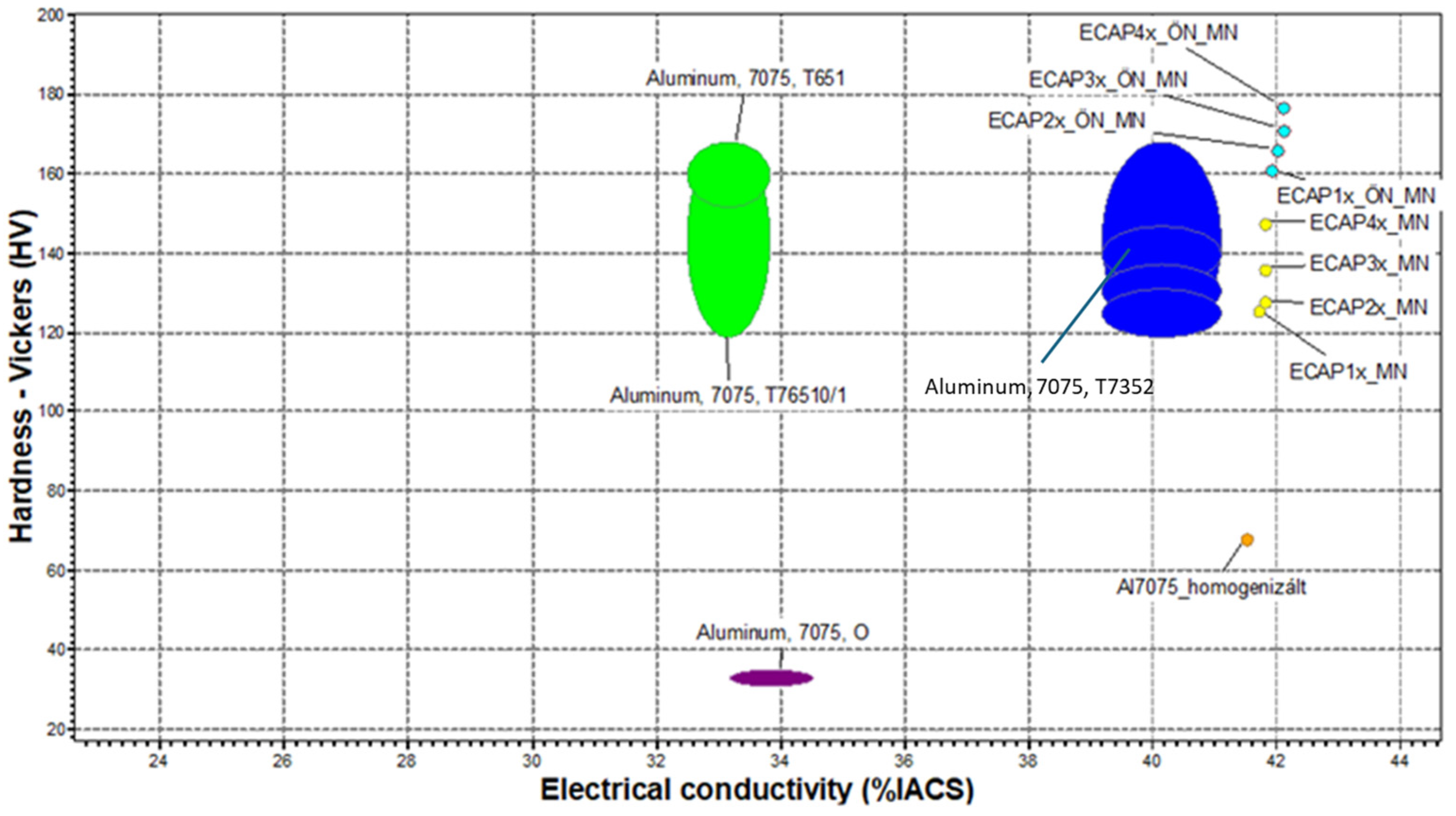
The obtained test results are plotted on GRANTA EDUPACK charts. For the EN AW 7075 alloy, the maximum hardness and electrical conductivity of the homogenized and ECAP samples were obtained with the 4× extruded sample (ECAP4×_MN), which has an average hardness of 140 HV and an electrical conductivity of 40 IACS%. When precipitation hardening was carried out on the formed samples, the hardness values increased further, reaching 180 HV after 6 days of artificial aging following self-aging (ECAP4×_ÖN_MN), and the electrical conductivity also showed a slight increase due to the precipitation of alloying elements (Figure 1).
Figure 1. Results for ENAW 7075 alloy samples (note: MN—only artificial aging; ÖN_MN—natural aging and artificial aging together).
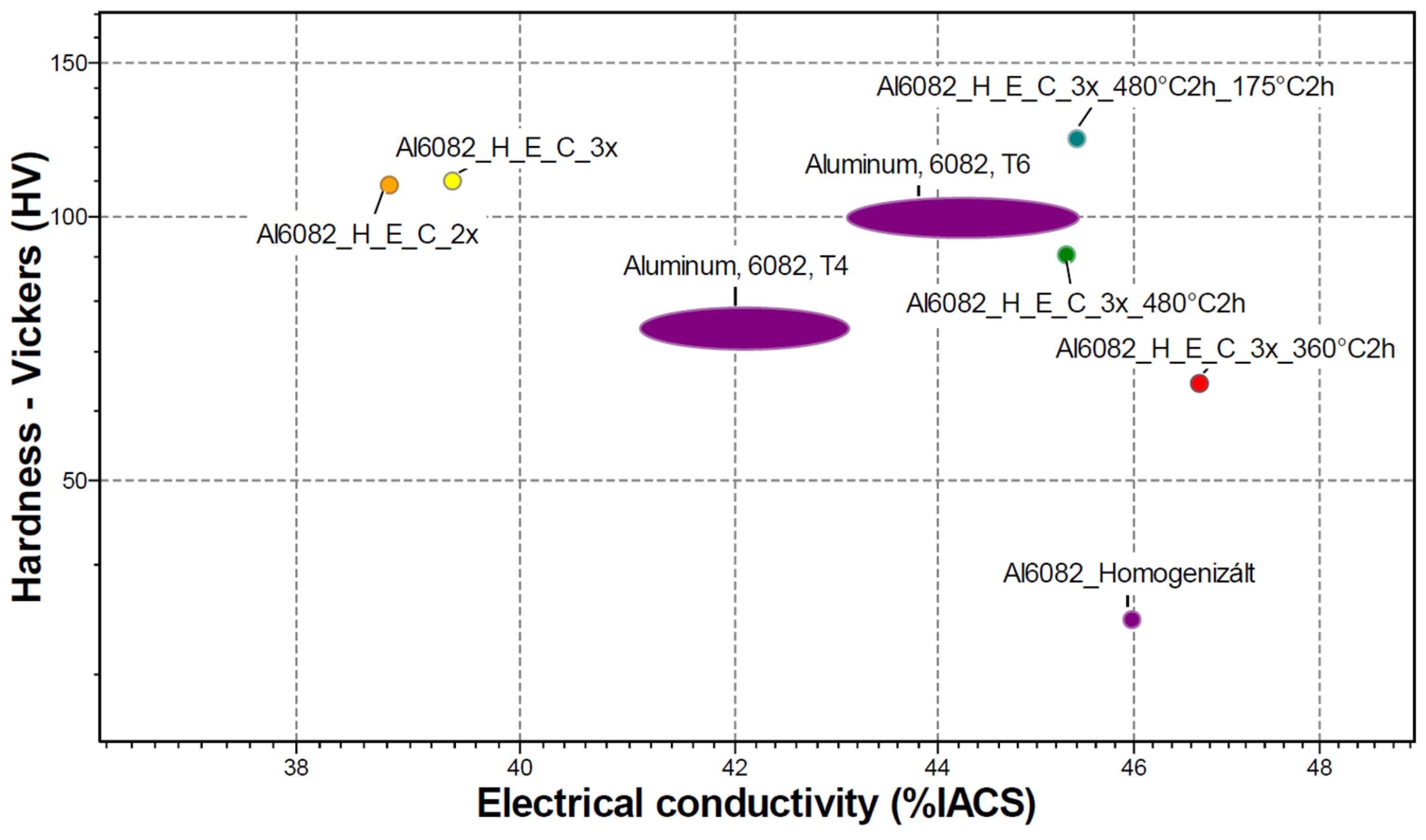
The results of the strength-enhancing treatments for the alloy EN AW 6082 are summarized in Figure 2. The highest hardness after forming was obtained for the sample ECAP-ed 3× with the A route technique, with an average value of 170 HV; the value obtained for electrical conductivity was only 35 IACS%, which was increased to 45 IACS% by precipitation hardening. This, of course, resulted in a drastic reduction in hardness, as the solution heat treatment and artificial aging resulted in hardnesses of only around 80 HV. The measured values fitted well within the values of the database (see Aluminium 6082 T4, T6).
Figure 2. Results for EN AW 6082 alloy samples.
The C route technique, on the other hand, resulted in much more favorable hardness values after the same precipitation hardening, with an average hardness value of around 120 HV and an electrical conductivity of 45 IACS% (Figure 2).
Summarizing the EN AW 6082 alloy results, the conductivity and hardness of the alloy samples hardened at 480 °C for 2 h and aged at 175 °C for 2 h, through ECAP 3×, achieved the most favorable results for both ECAP paths. Comparing the extrusion routes, the C route technique resulted in higher hardness values.
Of the Al6xxx alloys, the combination of properties we are interested in is best satisfied by EN AW 6022, which is difficult to obtain commercially, so the test samples were fabricated using the Arc Melter 500 arc machine. Table 2 summarizes the chemical composition of the standard and fabricated samples in wt%.
Table 2. Chemical composition of EN AW 6022 alloy (in wt%).
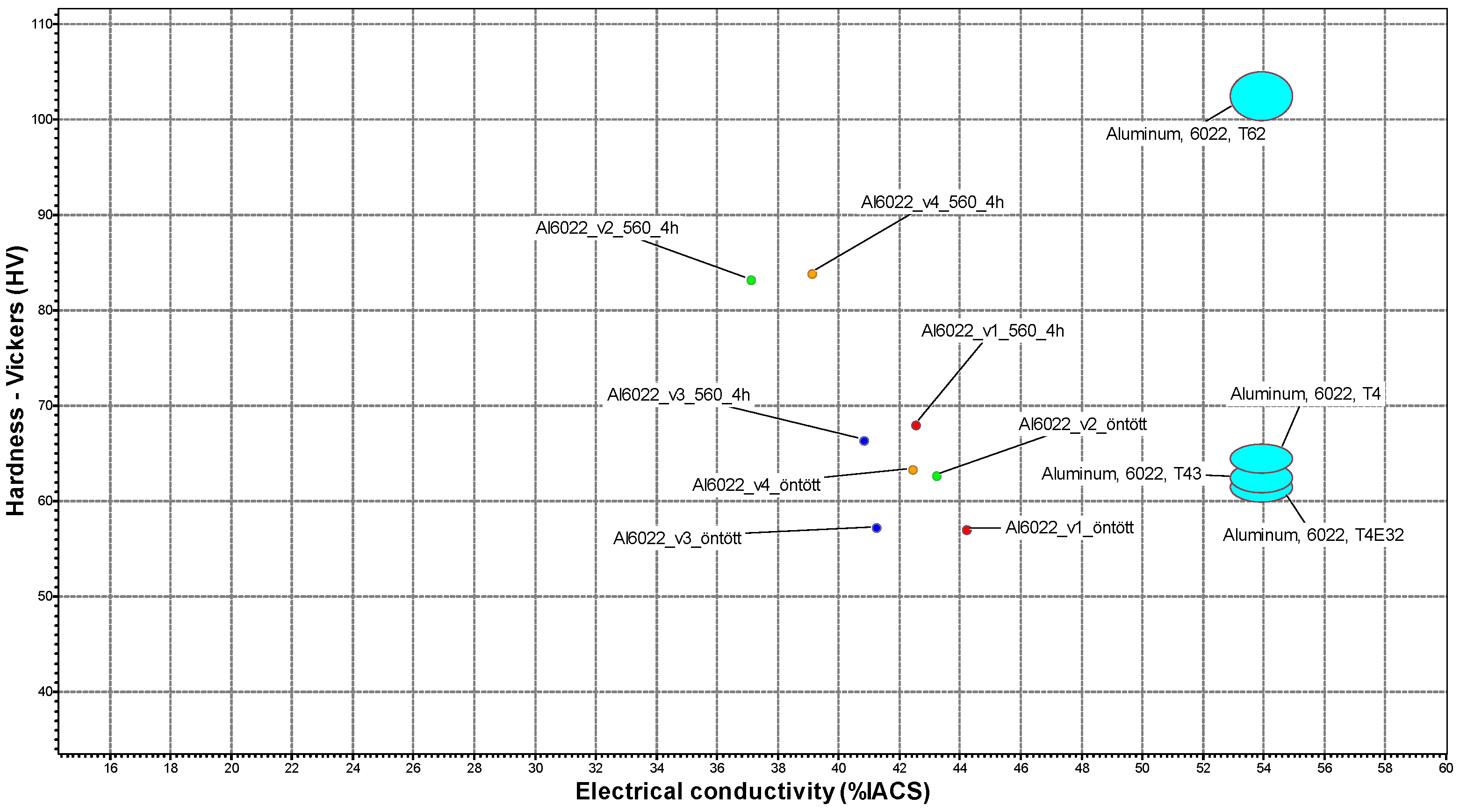
Due to the shape and size of the samples, only homogenization could be performed, as neither shaping nor subsequent heat treatment is relevant for these samples. The effect of homogenization is shown in the following diagrams, which show that compared to the cast samples, homogenization at 560 °C for 4 h resulted in the highest hardness using Al6022_v4, where the alloying elements were at their maximum for both Si and Mg. The hardness achieved is 84 HV and the electrical conductivity is 39 IACS% (Figure 3).
Figure 3. Results for EN AW 6082 alloy samples.
Comparing the test results of the aluminum alloys, the EN AW 7075 alloy achieved by artificial aging after natural aging for 6 days showed the highest hardness and electrical conductivity, 180 HV and 42 IACS%.

3.2. Examination Results for Copper Alloy

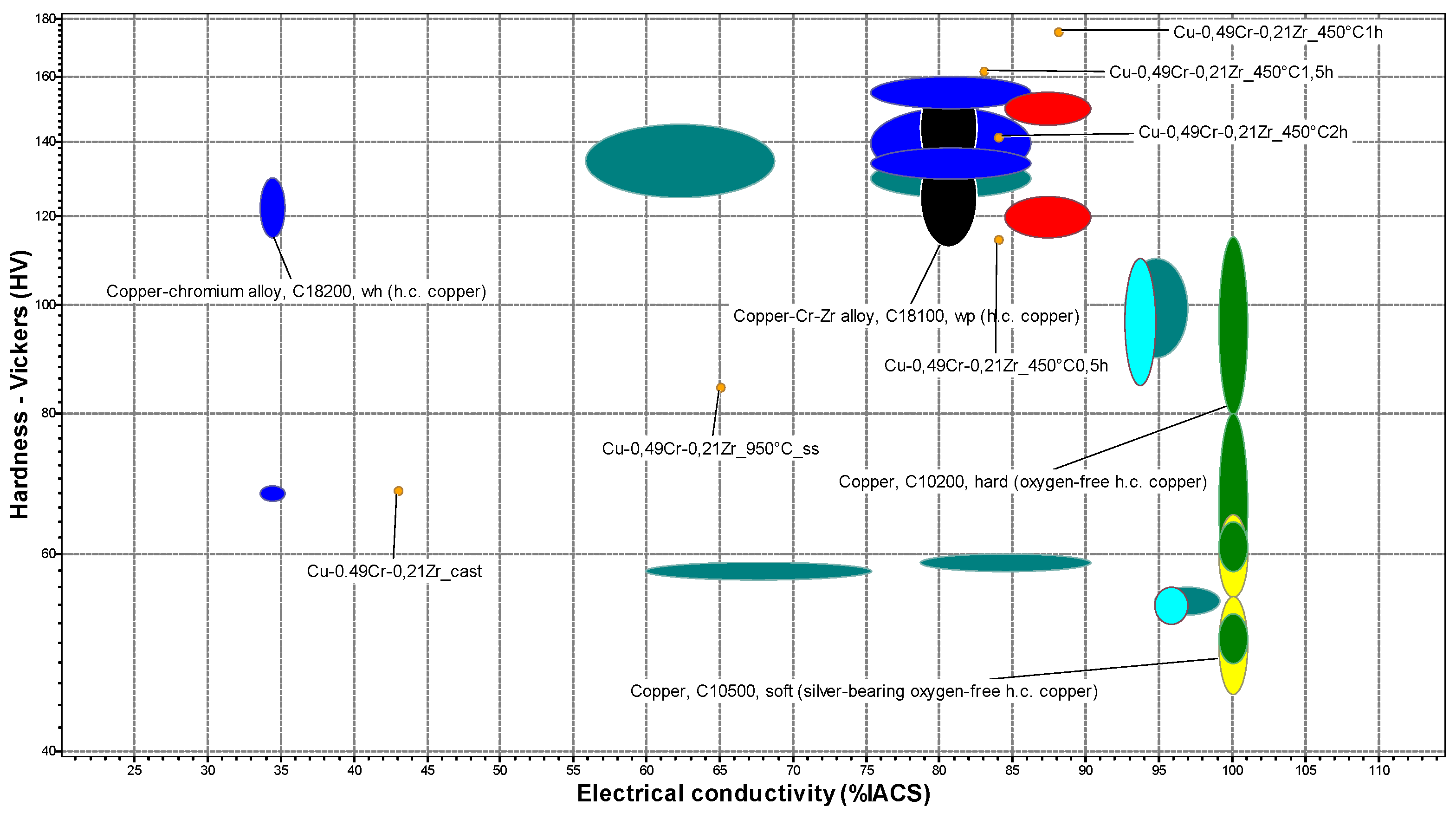
Also for the copper alloys, the alloy with the maximum combination of hardness and electrical conductivity was selected, which was the Cu–Cr–Zr alloy. This alloy was produced from two master alloys, Cu–Cr and Cu–Zr, which were fused to obtain the alloy Cu–0.49Cr–0.21Zr, whose cast samples could only be heat-treated due to their size and shape. The test results showed that an annealing at 450 °C for 1 h gives the alloy maximum values of 171 HV and 88 IACS% (Figure 4).
Figure 4. Results for Cu–Cr–Zr alloy samples (note: the same color means the same Cu alloy).

4. Discussion and Conclusions

Based on the experiments and tests carried out, the following conclusions can be drawn:
  • For the ENAW 6022 alloy, at the highest alloying ratio (1.5%Si and 0.7% Mg) and after 4 h homogenization at 560 °C, the maximum hardness and conductivity were obtained at 84 HV and 39 IACS%.
  • For the EN AW 6082 alloy C, solution heat treatment at 480 °C for 2 h and aging at 175 °C for 2 h after elbow pressing at C gave a maximum of 120 HV and 45 IACS%.
  • Among the experiments on the alloy En AW 7075, the passenger A elbow press with 4× through bending and 6 days of artificial aging after self-aging gave the best combination of properties: 180 HV and 42 IACS%.
  • The maxima of commercial aluminum alloys are far below the requirements of the rotor (IACS% should be 80% of CU-ETP (pure metal)).
  • The Cu–Cr–Zr alloy selected for copper alloys showed good results already after heat treatment at 450 °C for 1 h, with electrical conductivity at 88 IACS% and hardness at 171 HV.

Funding

This research was funded by EFOP-3.6.2-16-2017-00016 Autonóm járművek dinamikája és irányítása project.

Institutional Review Board Statement

Not applicable.

Data Availability Statement

Data supporting the findings of this study are contained within the article.

Acknowledgments

The author would like to thank Jánosné Fehér, who participated in the studies, and the students Vanda Sós, György Gulyás, Mónika Bányai, and Ibrahim Ribani.

Conflicts of Interest

The author declares no conflict of interest. The funders had no role in the design of the study; in the collection, analyses, or interpretation of data; in the writing of the manuscript; or in the decision to publish the results.

References

  1. Tarrant, C.D. Method of making a rotor. Compos. Part A Appl. Sci. Manuf. 1997, 28, 609. [Google Scholar] [CrossRef]
  2. Sagna, A.; Mansour, G.; Clenet, S.; Perry, N. Non-destructive control of permanent magnet rotors in a perspective of electric motor circularity. Procedia CIRP 2024, 122, 754–759. [Google Scholar] [CrossRef]
  3. Gope, R.; Mandal, A.; Ganguly, S. Enhanced impression creep performance of gravity and suction cast Al-12Ce alloy with Si and Mg additions. Mater. Today Commun. 2024, 38, 108511. [Google Scholar] [CrossRef]
  4. Su, H.; Wen, H.; Zheng, X.; Su, J. Development of a super high efficiency motor with boron aluminum alloy rotor. Procedia Eng. 2017, 174, 1221–1228. [Google Scholar] [CrossRef]
  5. Singh, P.; Ramacharyulu, D.A.; Kumar, N.; Saxena, K.K.; Eldin, S.M. Change in the structure and mechanical properties of Al–Mg–Si alloys caused by the addition of other elements: A comprehensive review. J. Mater. Res. Technol. 2023, 27, 1764–1796. [Google Scholar] [CrossRef]
  6. Lombardi, A.; Byczynski, G.; Vidanalage, B.; Fatima, A. Development of a Novel High Strength Aluminum-Cerium Based Rotor Alloy for Electric Vehicle Induction Motor Applications. SAE Int. J. Adv. Curr. Prac. Mobil. 2023, 5, 2365–2372. [Google Scholar] [CrossRef]
  7. Agapiou, J.S. Development of manufacturing technology for a hybrid induction rotor. Manuf. Lett. 2023, 35, 277–288. [Google Scholar] [CrossRef]
  8. Yuan, W.; Liang, Z.; Zhang, C.; Wei, L. Effects of La addition on the mechanical properties and thermal-resistant properties of Al–Mg–Si–Zr alloys based on AA 6201. Mater. Des. 2012, 34, 788–792. [Google Scholar] [CrossRef]
  9. Starke, E.A.; Eskin, D.G. Alloys: Aluminum In Encyclopedia of Condensed Matter Physics, 5th ed.; Elsevier: Amsterdam, The Netherlands, 2024; pp. 573–582. [Google Scholar]
Disclaimer/Publisher’s Note: The statements, opinions and data contained in all publications are solely those of the individual author(s) and contributor(s) and not of MDPI and/or the editor(s). MDPI and/or the editor(s) disclaim responsibility for any injury to people or property resulting from any ideas, methods, instructions or products referred to in the content.

Article Metrics

Citations

Article Access Statistics

Multiple requests from the same IP address are counted as one view.