1. Introduction
Data centers play a crucial role in enabling information access today. They enable the hosting and access of content by subscribers via the internet. Currently, a significant number of data centers are terrestrial-based. Such data centers are commonly deployed at varying scalability levels. Terrestrial data centers (TDCs) can be deployed at small-scale, medium-scale, large-scale and hyper-scale levels [
1,
2,
3]. TDCs have significant challenges regarding their high environmental toll [
4,
5,
6].
The TDC environmental toll arises due to their high water footprint necessitating the design of mitigating approaches [
7,
8,
9]. Nevertheless, the high TDC water footprint leads to negative environment sustainability outcomes [
9]. Previously, the use of TDCs was observed to have high power consumption leading to high grid loads [
10,
11]. However, this is being addressed as a significant number of TDC operators are deploying own power subsystems [
12,
13,
14]. However, the challenge of a high water footprint persists for TDCs [
15,
16].
Therefore, it is crucial to design new data center systems that reduce this challenge or ideally eliminate it. An example of such a system is the space-based data center (SBDC). The SBDC has the benefits of having a low land and water footprint, as they do not require access to Earth’s water resources for cooling. SBDCs have begun to receive research attention [
17,
18,
19,
20,
21,
22,
23]. The conduct of research into SBDCs has also begun to receive attention [
24]. SBDCs can be deployed in different scales and configurations, with the largest scale being the hyper-scale SBDC. A hyper-scale SBDC has power consumption in the range of hundreds of megawatts–few tens of gigawatts. Hyper-scale SBDCs are realizable due to advances in space technology in low-cost launch [
25] and large space structures [
26].
For such systems, the configuration of the power system is crucial to ensure long duration functioning and a high up time. For a hyper-scale SBDC in a non-geostationary orbit, i.e., low earth orbit, it is important to maximize data transmission (upload or download) during the communication window. This is because only satellites and space assets in the geostationary orbit have a period that is roughly equal to 24 h with a constant communication window. Hyper-scale SBDCs are important space assets as they are capable of processing data from small satellites and mega-constellations. It is crucial that the hyper-scale SBDC has power to enable transceiver operation during a communication window.
The challenge of ensuring transceiver operation in a hyper-scale SBDC for effective communication window utilization has not received sufficient research attention. The research proposed aims to design an intelligent power system that is aware of the communication window profile. The communication window profile concerned is that of hyper-scale SBDCs. The proposed system aims to ensure that sufficient power is available to enable transceiver operation during a communication window. The contributions are:
First, the research proposes the intelligent power–communication window aware system (IPCWA) as a component of the power system of the hyper-scale SBDC (HSBDC). In IPCWA, the HSBDC receives information on the communication window profile and develops an awareness of the transceiver operation before the presence of a communication window at a ground station. The HSBDC has a revisit indicator for a given ground station. The role of the IPCWA is set in a context where the HSBDC has revisiting indicators for different ground stations.
Second, the research discusses the integration of IPCWA into the HSBDC’s entities. The concerned entities are the cooling, communication, and the attitude orbital and control subsystems.
Third, the research formulates and investigates how IPCWA enables the HSBDC to take advantage of the communication window for different ground stations. The formulated metrics are the communication window utilization and the HSBDC uptime for a given number of ground stations. The investigation is done via the use of MATLAB R2025a simulations.
The rest of the presented research is organized in the following manner.
Section 2 describes the problem being addressed along with the relevant scenario.
Section 3 presents the proposed solution and its integration aspects.
Section 4 formulates the performance metrics, i.e., communication window utilization, and HSBDC uptime.
Section 5 discusses and presents the simulation results.
Section 6 is the conclusion.
2. Problem Description
The scenario described in the problem description is one in which there are space-based data centers processing data emerging from space-based assets. In this consideration, the proposed space-based data centers (SBDCs) are unmanned autonomous systems with low exposure to damage and collision from space debris. Let the set of SBDCs be denoted and given as:
The power aboard the SBDC, at the epoch, , and available for the communication subsystem (CMS) (i.e., transceiver) operation is denoted as . In addition, the power aboard the SBDC available for the computing system subsystem (CPS) (i.e., server payload) is denoted as . In addition, the power consumption by the attitude and orbital control system (AOCS) is denoted . The total power aboard the power subsystem of the SBDC, at the epoch, is given as: . The power required for the SBDC communication subsystem’s effective operation is denoted as . Given that an SBDC communication window spans epochs, communication window utilization becomes challenging for a single SBDC, i.e., , when:
The challenge in (2) is applicable to a constellation. In a constellation, the long term implications of available power for communications aboard multiple HSBDCs are considered. The necessity of considering a HSDBC constellation is due to the need to achieve a long uptime. The total power aboard the HSBDC, denoted as is also considered. The power required for the effective operation of the SBDCs communication subsystem, applicable to a context involving multiple SBDCs (SBDC constellation), is:
The challenge in (8) is one where multiple SBDCs are considered. This is important to ensure that the constellation deployment of SBDCs has a long communication duration and uptime. The challenge in (2) and (8) arises when other subsystems (besides the communication subsystems) of the concerned SBDC experience a significant increase in power consumption prior to an SBDC communication window.
3. IPCWA Architecture
The discussion here presents the proposed IPCWA and has two aspects. The first focuses on the HSBDC self-awareness dynamics of the proposed communication window awareness. This is done for a single satellite case. The second presents the execution and case of the IPCWA for an HSBDC constellation. This context arises due to the need of ensuring the realization of a long communication window.
3.1. IPCWA—Single HSBDC Case
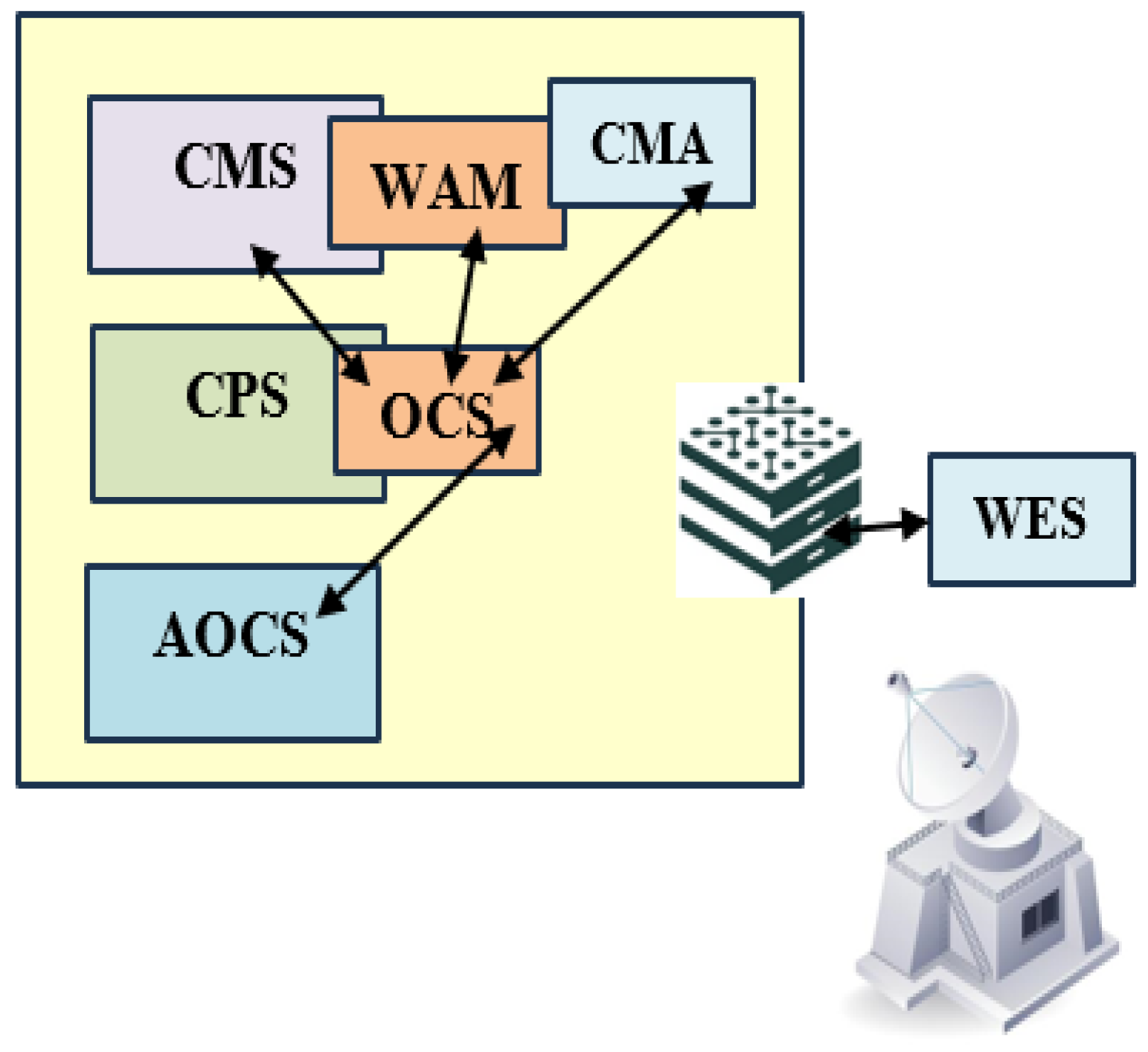
In the proposed IPCWA, the HSBDC hosts multiple subsystems, i.e., the CMS, CPS, and AOCS. The power consumption of these subsystems is known and accessible via an onboard computing system (OCS). The OCS is considered a core module of the CPS. In addition, the CMS hosts the window awareness module (WAM). The WAM is programmed, during the satellite design phase, to have an awareness of the HSBDC communication epochs. This is deemed feasible as HSBDC is envisaged to communicate with designated ground stations. Each of the HSBDCs in a constellation system has an awareness of the communication epochs without the necessity of ground station overhead. The reduction in the ground station overhead results in a case where the facility has reduced energy demand and operational complexity.
The communication window-related awareness is realized via a recognition of the initial communication window for a given ground station location. Future communication windows are indicated by the time lapse and duration from the initial communication window. They are described as an epoch of the first communication window, incremented by a given duration. This manner of determination is feasible as the execution of the space mission plan involves the determination of the communication windows of a space asset for a given ground station track. The determination and process awareness of ground station coverage alongside communication window profile is done during the HSBDC design phase and hosted in the WAM. The WAM sends a signal to the OCS as it approaches the occurrence of a communication window for a given ground station.
In the case where the HSBDC is expected to communicate with multiple ground stations, the WAM has increased complexity as it hosts more communication epochs. Each ground station-corresponding communication epoch has a WAM-embedded sub-entity (WES). In this case, the WAM also hosts the communication merge analyzer (CMA). The CMA determines the communication epoch approach instant. This is done via a constant and continuous probe of the multiple communication epochs by the WES.
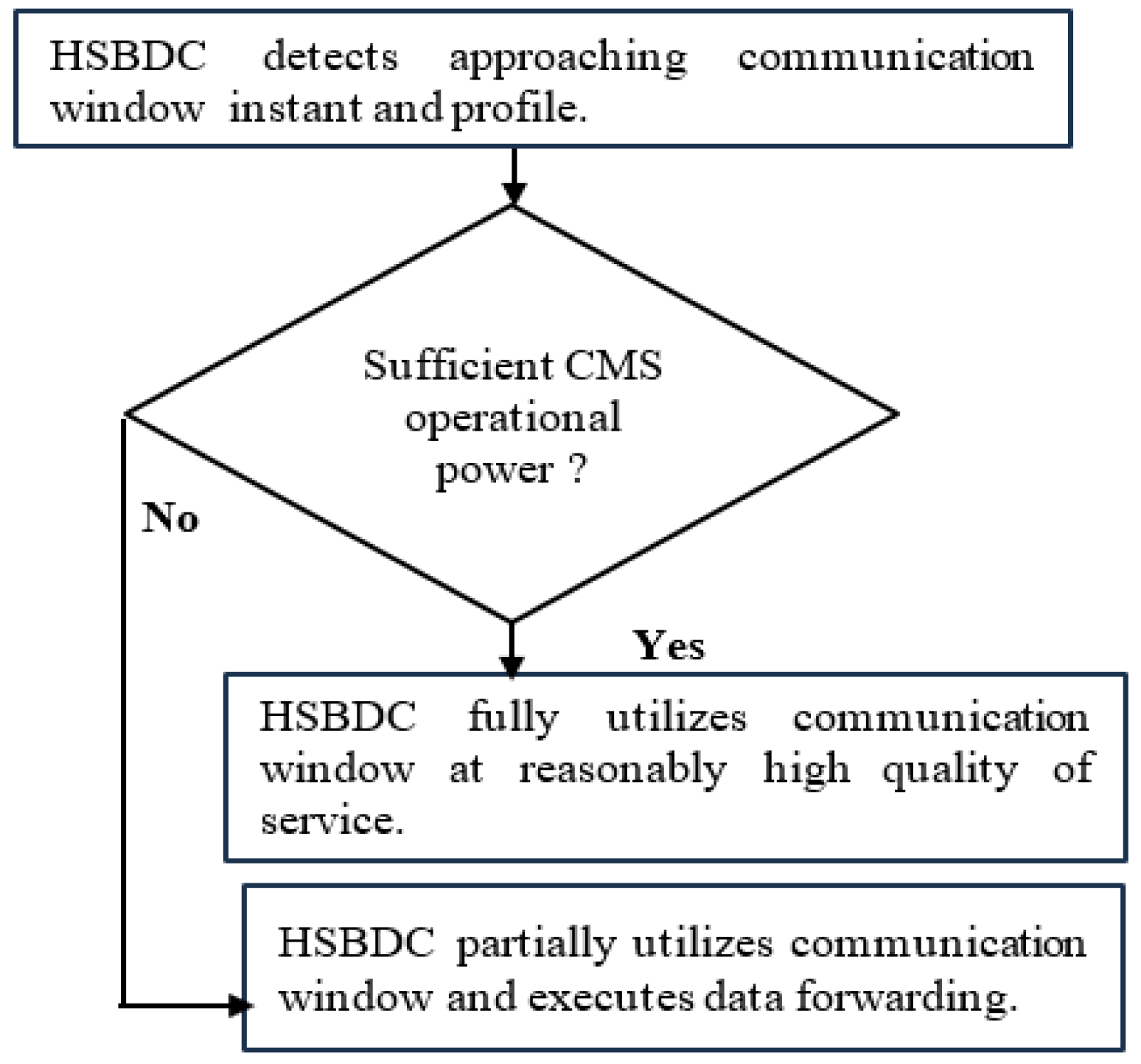
The WAM is also reconfigurable and has the ability to recognize the inclusion of new ground stations in its coverage track. This is deemed necessary as HSBDC service providers can acquire new clients with their newly introduced ground station locations. This is important to ensure that IPCWA is dynamic and not static. The inclusion of a new ground station is accompanied by an upgrade of the WAM with the information of the newly determined communication window profile. The update is executed from the satellite ground control station by a crew member. The relations between the entities concerned and the flowchart are in
Figure 1 and
Figure 2, respectively.
3.2. Proposed IPCWA—HSBDC Constellation Case
The use of IPCWA is also applicable to HSBDC constellations. In this case, the HSBDC is able to reach a ground station and execute a ground coverage via other space assets. Such a capacity is necessary when the HSBDC has a power deficit after executing data storage and processing heavy computing workloads. This arises when machine learning algorithms are trained in space. The use of the proposed approach of data forwarding via other space assets requires that the HSBDC executes communications via inter-satellite and inter-orbital links as part of the CMS. In this case, the complete execution of a data upload and data download is challenging for the HSBDC to achieve. The CMS verifies the non-completion of data uploads or downloads in this case. The CMS also determines the start epoch of communication window utilization and the proportion of the communication window that is meaningfully used. The HSBDC engages in communication with other satellites. The neighboring satellites can be in the same orbit (inter-satellite link) or in different orbits (inter-orbital link).
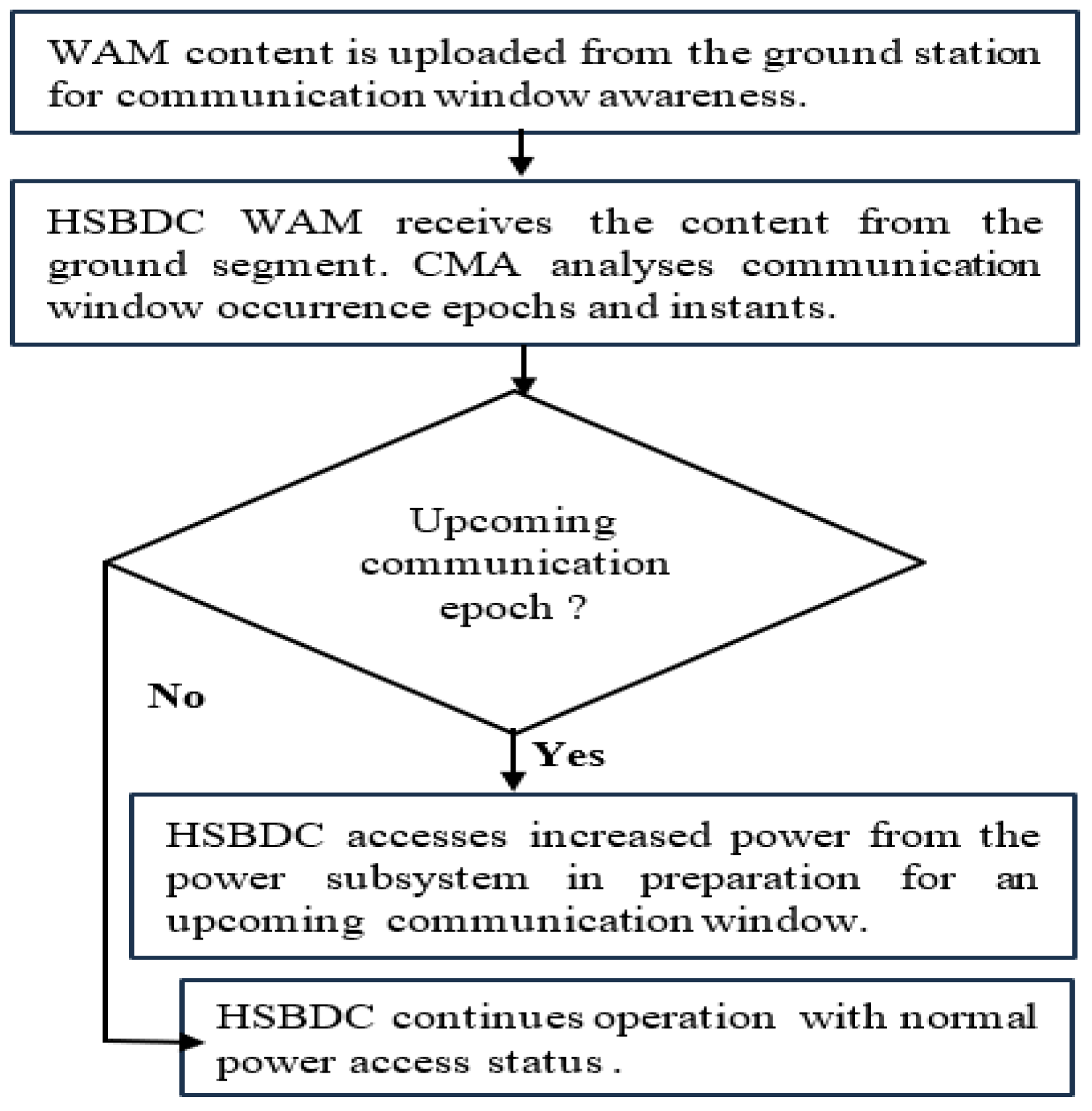
The HSBDC executes the following three tasks in sequence before determining the need to use other space assets. The first task being executed is evaluating the start epoch and stop epoch of communication window utilization. The second task is determining the amount of residual data requiring transmission to a ground station after the communication window has elapsed. The third task is determining the data forwarding route via exchange of control data between the HSBDC and other orbiting space assets. The determination of the forwarding satellites and routing logic is done during HSBDC mission design and planning. The realization of a suitable routing path requires reaching agreements with large-scale constellations in the low earth orbit or the geostationary satellites, with applicable coverage for executing data uploads or downloads with the concerned ground coverage track. The set of tasks executed in this case is shown in
Figure 3.
4. Performance Formulation
The discussion in this section formulates the metrics, i.e., communication window utilization and HSBDC effective uptime. In the existing approach (comparison benchmark), the SBDC is not necessarily an HSBDC. There is no awareness of communication window profile. The rest of the discussion is divided into two aspects. The first and second aspects formulate the communication window utilization and uptime, respectively.
4.1. Communication Window Utilization
The target and actual communication window durations for the HSBDC , at the epoch , are and respectively. The communication window utilizations in the existing and proposed case are and respectively, and given as:
In (10), the communication window utilization is the ratio of the target communication window duration to the actual communication window duration.
In the proposed case, the communication window utilization is the ratio of the now-increased communication window duration to the target communication window duration. The increased communication window duration is derived as a product of the actual observed communication window duration with the increment, i.e., the gain arising from the proposed approach.
is the gain associated with the proposed approach, and arises due to the non-communication of window profile and occurrence from a ground station. It is indicative of the reduction in latency.
4.2. HSBDC Effective Uptime
The performance formulation also considers the HSBDC uptime. The HSBDC uptime is influenced by the actual observed communication duration and the number of communication epochs in a 24 h period. The number of daily communication epochs for the HSBDC , is denoted . The HSBDC uptime in the existing approach without IPCWA is denoted and given as:
In (12), the uptime is the sum of the product of the number of daily communications and the actual communication window duration. The summation is executed over multiple time epochs for a given HSDBC.
The HSBDC uptime in the proposed approach, i.e., with IPCWA, is given as:
In (13), the uptime is derived as the sum of the product of the number of daily communications and the now-increased actual communication window duration. The increased actual communication window duration is obtained considering the gain factor and the effect of discontinuity in network communication instants.
is the non-ideal factor associated with the gain factor, introduced via the parameter . This is used to account for the non-ideal factor that may arise in dis-continuous network instants associated with the evaluation of the HSBDC uptime metric.
The uptime without and with IPCWA are denoted and respectively.
5. Performance Evaluation
The discussion here presents the performance evaluation and discusses the simulation results. The simulation parameters are presented in
Table 1. In the simulation, the HSBDC is located in the low earth orbit (LEO). Being in LEO, the communication window of up to 47.3 s is achievable. In addition, a communication window with a few tens of seconds in duration is suitable for data transmission applications where a round trip in hundreds of milliseconds is deemed sufficient given moderate latency and link throughput values. In this case, throughput values are of values up to 450 Mbps.
The simulation parameters in
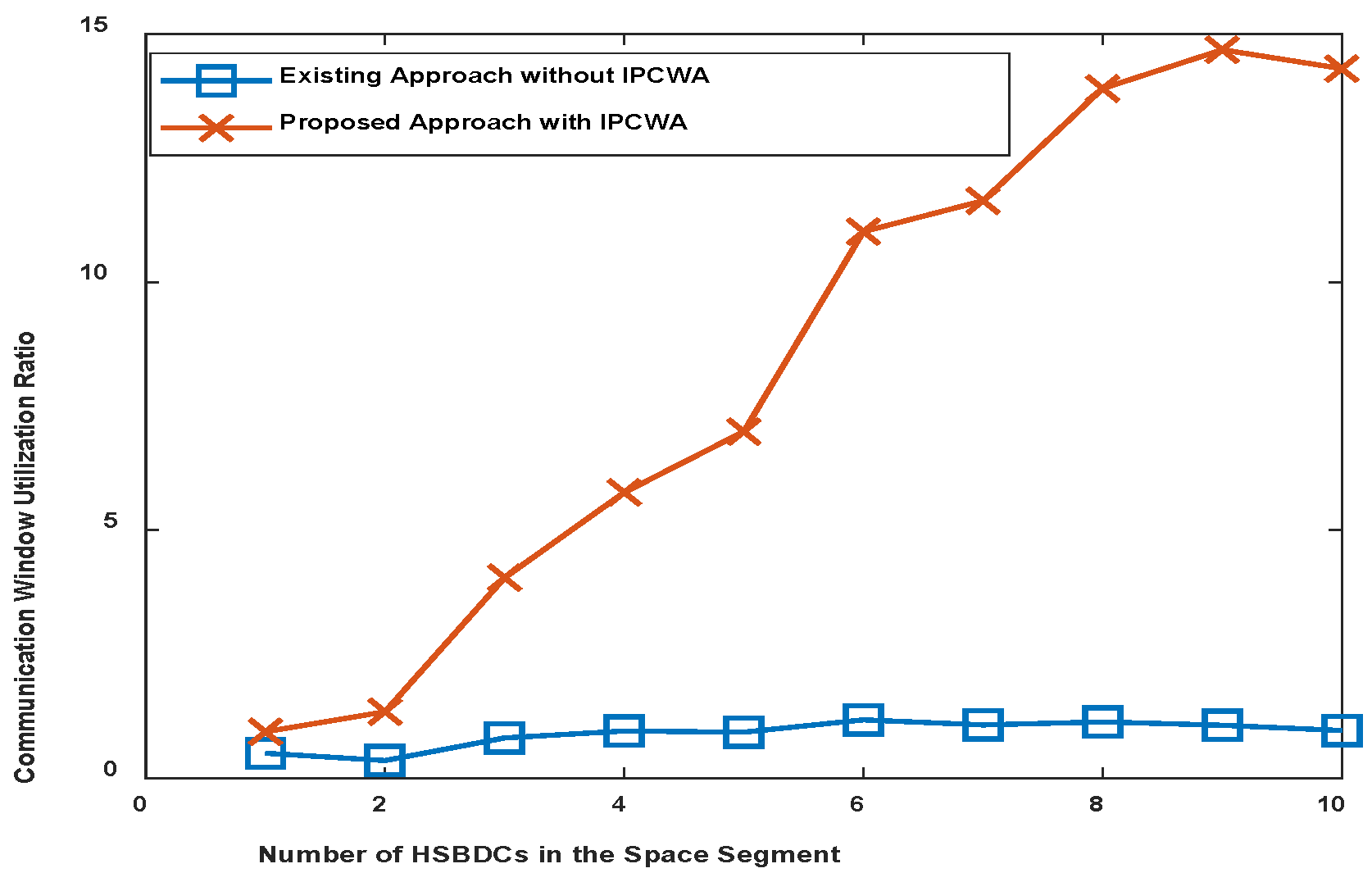
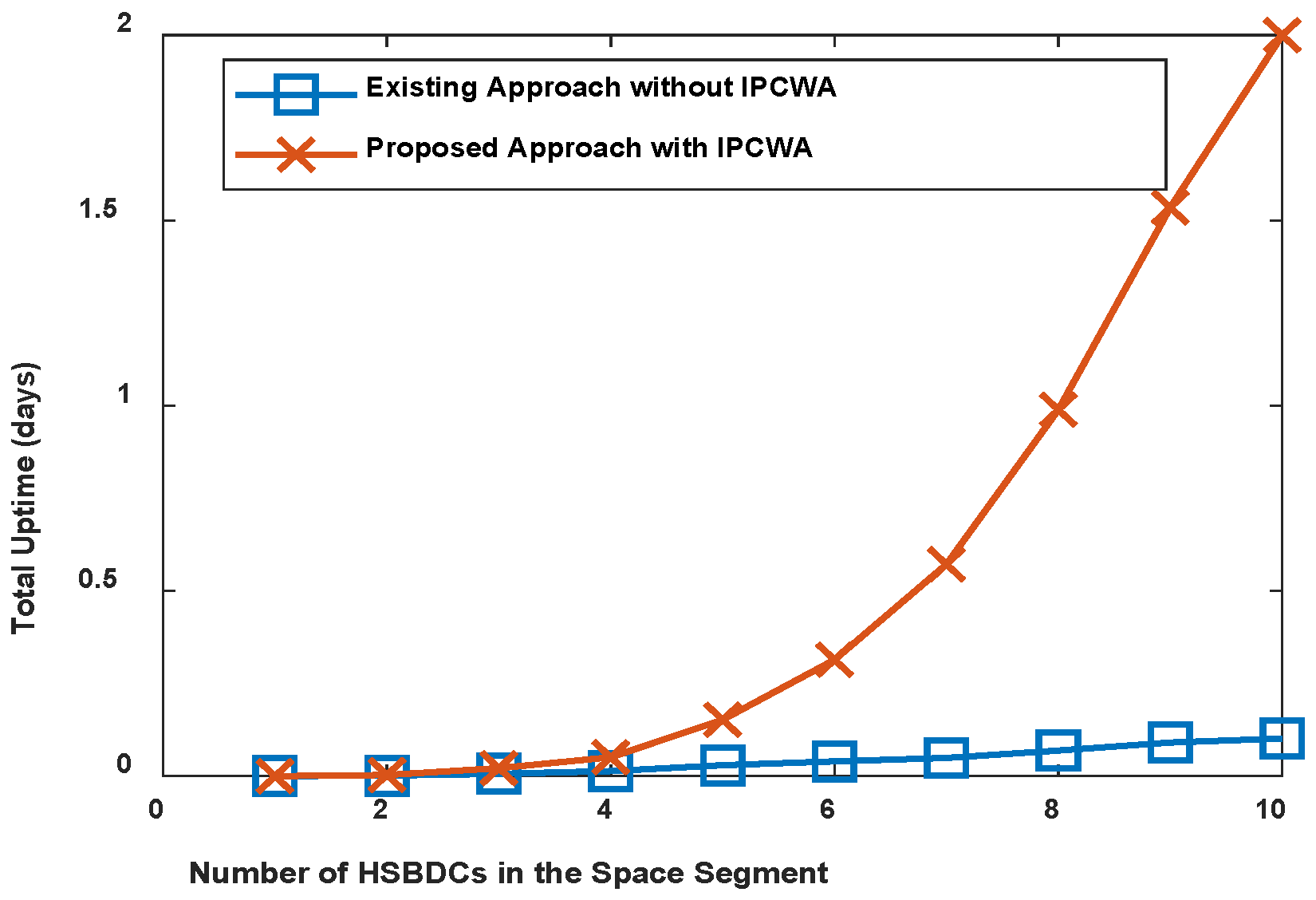
Table 1 show that the observed communication duration is less than the expected communication duration. This signifies that the occurrence of non-ideal behavior affecting communication window utilization is considered. The performance results for communication window utilization and uptime are evaluated via MATLAB simulation. The results for communication window utilization and uptime are in
Figure 4 and
Figure 5, respectively.
The results for the communication window utilization ratio describes the HSDBC’s readiness to utilize upcoming communication window approaches. A higher value of the communication window utilization ratio implies that the HSBDC utilizes communication opportunities with a ground station. From
Figure 4, the communication window utilization ratio increases with an increasing number of HSBDCs in the proposed case. Analysis shows that IPCWA enhances readiness for transmission during communication approaches by an average of 82.8%. The evaluation analyses the HSBDC uptime results. The uptime-related results obtained in this case are not continuous. Instead, a total uptime of a given number of days can be obtained over a period spanning even more days, say up to three days. This is obtainable for space assets in the low earth orbit. Analysis shows that using IPCWA enhances the uptime by an average of up to 55.9%.
6. Conclusions
The presented research recognizes the increasing role of non-terrestrial data centers, with a focus on space-based data centers. It recognizes that hyper-scale space-based data centers are increasingly feasible and necessary for big data storage and processing. In addition, the research recognizes that it is important that hyper-scale space-based data centers make the best use of the communication window and also achieve a long up time. This challenge is addressed via a mechanism aiming to achieve an increase in the power available for communication system and transceiver operation. The ability of the hyper-scale space-based data center to achieve a readiness for communication and achieve a high up time is formulated and investigated. Performance analysis shows that the use of the proposed mechanism and architecture enhances the hyper-scale space-based data center’s ability to maximize the use of communication opportunities by an average of 82.8%. In addition, the use of the proposed mechanism and architecture enhances the uptime by an average of 55.9%.
Author Contributions
Conceptualization, A.A.P.; methodology, A.A.P.; software, A.A.P.; validation, A.A.P., J.B.M. and L.J.; formal analysis, A.A.P.; investigation, A.A.P.; resources, A.A.P.; writing—original draft preparation, A.A.P.; writing—J.B.M. and L.J.; visualization, A.A.P.; supervision, A.A.P., project administration, A.A.P. All authors have read and agreed to the published version of the manuscript.
Funding
This research received no external funding.
Institutional Review Board Statement
Not applicable.
Informed Consent Statement
Not applicable.
Data Availability Statement
Data is contained within the article.
Acknowledgments
The authors acknowledge their indebtedness to the Department of Electrical, Electronic, and Computer Engineering, Cape Peninsula University of Technology, Cape Town, South Africa.
Conflicts of Interest
The authors declares no conflict of interest.
References
- Hoosain, M.S.; Paul, B.S.; Kass, S.; Ramakrishna, S. Tools Towards the Sustainability and Circularity of Data Centers. Circ. Econ. Sustain. 2022, 3, 173–197. [Google Scholar] [CrossRef] [PubMed]
- Dikaiakos, M.D.; Chatzigeorgiou, N.G.; Tryfonos, A.; Andreou, A.; Loulloudes, N.; Pallis, G.; Georgiou, G.E. A cyber-physical management system for medium-scale solar-powered data centers. Concurr. Comput. Pract. Exp. 2023, 35, e7658. [Google Scholar] [CrossRef]
- Zhang, Q.; Yang, S. Evaluating the sustainability of big data centers using the analytic network process and fuzzy TOPSIS. Environ. Sci. Pollut. Res. 2021, 28, 17913–17927. [Google Scholar] [CrossRef] [PubMed]
- Thangam, D.; Muniraju, H.; Ramesh, R.; Narasimhaiah, R.; Khan, N.M.; Booshan, S.; Booshan, B.; Manickam, T.; Ganesh, R.S. Impact of Data Centers on Power Consumption, Climate Change, and Sustainability; Advances in Computational Intelligence and Robotics Book Series; IGI Global Scientific Publishing: Hershey, PA, USA, 2024; pp. 60–83. [Google Scholar] [CrossRef]
- Lei, N.; Lu, J.; Shehabi, A.; Masanet, E. The water use of data center workloads: A review and assessment of key determinants. Resour. Conserv. Recycl. 2025, 219, 108310. [Google Scholar] [CrossRef]
- Falk, S.; van Wynsberghe, A. Challenging AI for Sustainability: What ought it mean? AI Ethics 2023, 4, 1345–1355. [Google Scholar] [CrossRef]
- Friedmann, J. Data Center Water Use’, Mitigation Roadmap, 2nd ed.; Innovation for Cool Earth Forum (ICEF): Kawasaki, Japan, 2024.
- Google2025. Water Stewardship Project Portfolio Replenish and Watershed Health Projects as of the End of 2024; Google: Mountain View, CA, USA, 2025. [Google Scholar]
- Smith, B. Our 2025 Environmental Sustainability Report. Microsoft on the Issues. 29 May 2025. Available online: https://blogs.microsoft.com/on-the-issues/2025/05/29/environmental-sustainability-report/ (accessed on 7 June 2025).
- Solomon, S. Sustainable by Design: Next-Generation Datacenters Consume Zero Water for Cooling. The Microsoft Cloud Blog, 9 December 2024. Available online: https://www.microsoft.com/en-us/microsoft-cloud/blog/2024/12/09/sustainable-by-design-next-generation-datacenters-consume-zero-water-for-cooling/ (accessed on 10 June 2025).
- Alissa, H.; Nick, T.; Raniwala, A.; Arribas Herranz, A.; Frost, K.; Manousakis, I.; Lio, K.; Warrier, B.; Oruganti, V.; DiCaprio, T.J.; et al. Using life cycle assessment to drive innovation for sustainable cool clouds. Nature 2025, 641, 331–338. [Google Scholar] [CrossRef] [PubMed]
- Alamanos, A. ChatGPT and Water Management; Edward Elgar Publishing eBooks: Cheltenham, UK, 2024; pp. 37–39. [Google Scholar] [CrossRef]
- Zong, J.; Peng, Y.; Zhang, B.; Yin, X. Research on Energy Consumption in Data Centers. In 2024 3rd International Conference on Energy, Power and Electrical Technology (ICEPET); IEEE: New York, NY, USA, 2024; pp. 1732–1738. [Google Scholar] [CrossRef]
- Caballar, R.D. Data Centers Can Slash Power Needs with One Coding Tweak. IEEE Spectrum. 2025. Available online: https://spectrum.ieee.org/data-center-energy-consumption (accessed on 3 April 2025).
- Skidmor, Z. Teraco Starts Work on 120 MW Solar Farm to Power South African Data Centers. Datacenterdynamics.com. 2024. Available online: https://www.datacenterdynamics.com/en/news/teraco-starts-work-on-120mw-solar-farm-to-power-south-african-data-centers/ (accessed on 7 June 2025).
- Morey, M. Data Center Owners Turn to Nuclear as Potential Electricity Source—U.S. Energy Information Administration (EIA). Eia.gov. 2024. Available online: https://www.eia.gov/todayinenergy/detail.php?id=63304 (accessed on 10 June 2025).
- Zewe, A. Explained: Generative AI’s Environmental Impact. MIT News, 17 January 2025. Available online: https://news.mit.edu/2025/explained-generative-ai-environmental-impact-0117 (accessed on 10 June 2025).
- Taiwo, R.; Yussif, A.-M.; Zayed, T. Making waves: Generative artificial intelligence in water distribution networks: Opportunities and challenges. Water Res. X 2025, 28, 100316. [Google Scholar] [CrossRef]
- Roman, D. Understanding the Environmental Impact of Generative AI Services. Commun. ACM 2025, 68, 46–53. [Google Scholar] [CrossRef]
- Periola, A.; Alonge, A.; Ogudo, K. Space Habitat Data Centers—For Future Computing. Symmetry 2020, 12, 1487. [Google Scholar] [CrossRef]
- Gumiela, M.; Musiał, A.; Wijata, A.M.; Lazaj, D.; Weiss, J.; Sagmeister, P.; Morf, T.; Schmatz, M.; Nalepa, J. Benchmarking Space-Based Data Center Architectures. In IGARSS 2023–2023 IEEE International Geoscience and Remote Sensing Symposium; IEEE: New York, NY, USA, 2023. [Google Scholar] [CrossRef]
- Eda, T.; Busto, M.; Udagawa, T.; Ishihama, N.; Tabata, K.; Matsuo, Y.; Yamasaki, I. Technical Challenges for AI in Space Data Centers. In IGARSS 2024—2024 IEEE International Geoscience and Remote Sensing Symposium; IEEE: New York, NY, USA, 2024; pp. 1733–1735. [Google Scholar] [CrossRef]
- Periola, A.; Alonge, A.; Ogudo, K. Space-Based Data Centers and Cooling: Feasibility Analysis via Multi-Criteria and Query Search for Water-Bearing Asteroids Showing Novel Underlying Regular and Symmetric Patterns. Symmetry 2023, 15, 1326. [Google Scholar] [CrossRef]
- Starcloud. Data Centers in Space. Starcloud.com. 2024. Available online: https://www.starcloud.com/ (accessed on 10 June 2025).
- Xu, Q.; Hollingsworth, P.; Smith, K. Launch Cost Analysis and Optimization Based on Analysis of Space System Characteristics. Trans. Jpn. Soc. Aeronaut. Space Sci. 2019, 62, 175–183. [Google Scholar] [CrossRef]
- Kulu, E. In-Space Manufacturing—2024 Industry Survey, Trends, Economics and Enablers. In Proceedings of the 75th International Astronautical Congress (IAC 2024), Milan, Italy, 14–18 October 2024. [Google Scholar] [CrossRef]
| Disclaimer/Publisher’s Note: The statements, opinions and data contained in all publications are solely those of the individual author(s) and contributor(s) and not of MDPI and/or the editor(s). MDPI and/or the editor(s) disclaim responsibility for any injury to people or property resulting from any ideas, methods, instructions or products referred to in the content. |