Proceeding Paper

Combining Life Support Systems with Digital Twins: A New Potential? †
University of Stuttgart, Institute of Space Systems, Department of Human Spaceflight, 70563 Stuttgart, Germany
*
Author to whom correspondence should be addressed.
Presented at the 15th EASN International Conference, Madrid, Spain, 14–17 October 2025.
Eng. Proc. 2026, 133(1), 94; https://doi.org/10.3390/engproc2026133094
Published: 8 May 2026

Abstract

The next generation of crewed space missions will take astronauts farther away from Earth than ever before. These missions will necessitate increasingly sophisticated and autonomous control of Life Support Systems (LSS) to ensure astronauts stay alive, healthy and happy. High system autonomy and resilience are therefore critical to mission success. A key enabler for future space missions are Digital Twins (DTs) of LSSs. The use of DTs to date includes a wide range of applications. Nevertheless, they have not yet been adopted for LSSs. Combining LSSs with DTs offers benefits in the development and testing of new LSS technologies, as well as their monitoring once missions are underway. Together with the DT, astronauts can make time-critical decisions on their own, which is a crucial factor for enabling deep space missions. However, implementing DTs comes with its own challenges, such as collecting all the necessary data with appropriate sensors and handling the vast amounts of data generated. Additionally, the DT must be given boundaries in which it can control its physical counterpart so as not to harm valuable equipment. These development issues and possible shortcomings of DTs, as well as the potential of DTs of LSSs are discussed in this paper.

1. Introduction and Motivation

When humans venture outside their accustomed environment, they need a Life Support System (LSS) to sustain themselves. These systems have been in use since the earliest space missions in the 1960s. From then on, LSSs have become increasingly complex. Early missions relied on bringing the consumables needed to sustain the life of astronauts in space with them in a stored manner. Newer systems such as those of the International Space Station (ISS) encompass a far more complex LSS, where the individual subsystems of the LSS are intertwined with each other [1]. On the one hand, this enables to partially close the consumable loop of the astronauts. On the other hand, this leads to a highly complex, interdependent system. Since the system complexity surpasses what the crew onboard the ISS can control, the LSS is controlled by a huge team on the ground [2].
Future missions to the Moon will necessitate increasingly sophisticated LSSs to ensure that the astronauts stay alive, healthy, and happy. Since these systems will face longer periods in the extreme space environment, new systems with a higher resilience and sustainability are needed. Missions travelling even further away from Earth, for example to Mars, additionally face the problem of having one-way communication delays of up to 22 min [3]. Therefore, a ground control of the LSS is not feasible anymore, since it would take too long to detect a problem back on Earth and then send the necessary commands back to the spacecraft or habitat [3]. For this reason, an enhanced LSS autonomy is necessary to enable the onboard crew to make decisions independently from Earth.
To solve these future challenges, Digital Twins (DT) are suggested, as they offer to bridge the necessary gaps and additionally offer further benefits. This paper therefore provides a short introduction to DTs and LSSs to gain a preliminary understanding of the challenges faced. After that, terrestrial applications of DTs are explored, and the benefits and challenges are highlighted. This is followed by investigating what work has been done on LSS DTs as of yet and how a conceptual LSS DT framework would work. The paper concludes with current work being done at the University of Stuttgart and an outlook into further research.

2. Background

2.1. Digital Twins

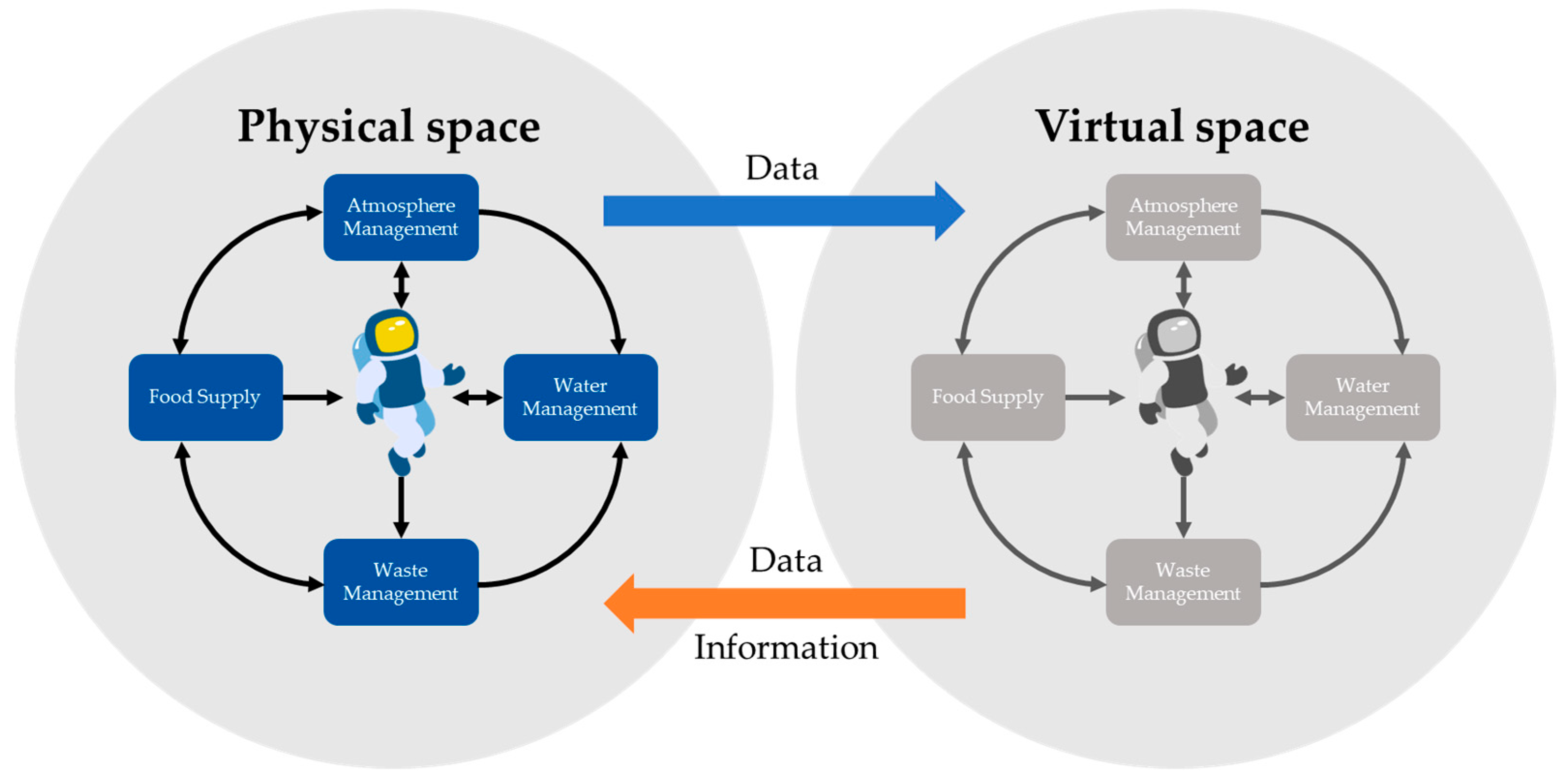
A DT is an exact replica of a physical object. All aspects of the physical object are represented in the virtual object. This means that any change that is made to the physical object is also reflected in the virtual object [4]. It is important to note that the DT can exist before the actual physical counterpart. From the basic structure of a DT depicted in Figure 1, it can be seen that the central element of a DT is the data connection between the physical and virtual space. This means that data can be transferred from the physical into the virtual space, and data, information, as well as commands can be transferred from the virtual into the physical space. This complements the three central elements of DTs: the physical object, the virtual object, and the digital thread between these two objects [5].

2.2. Life Support Systems

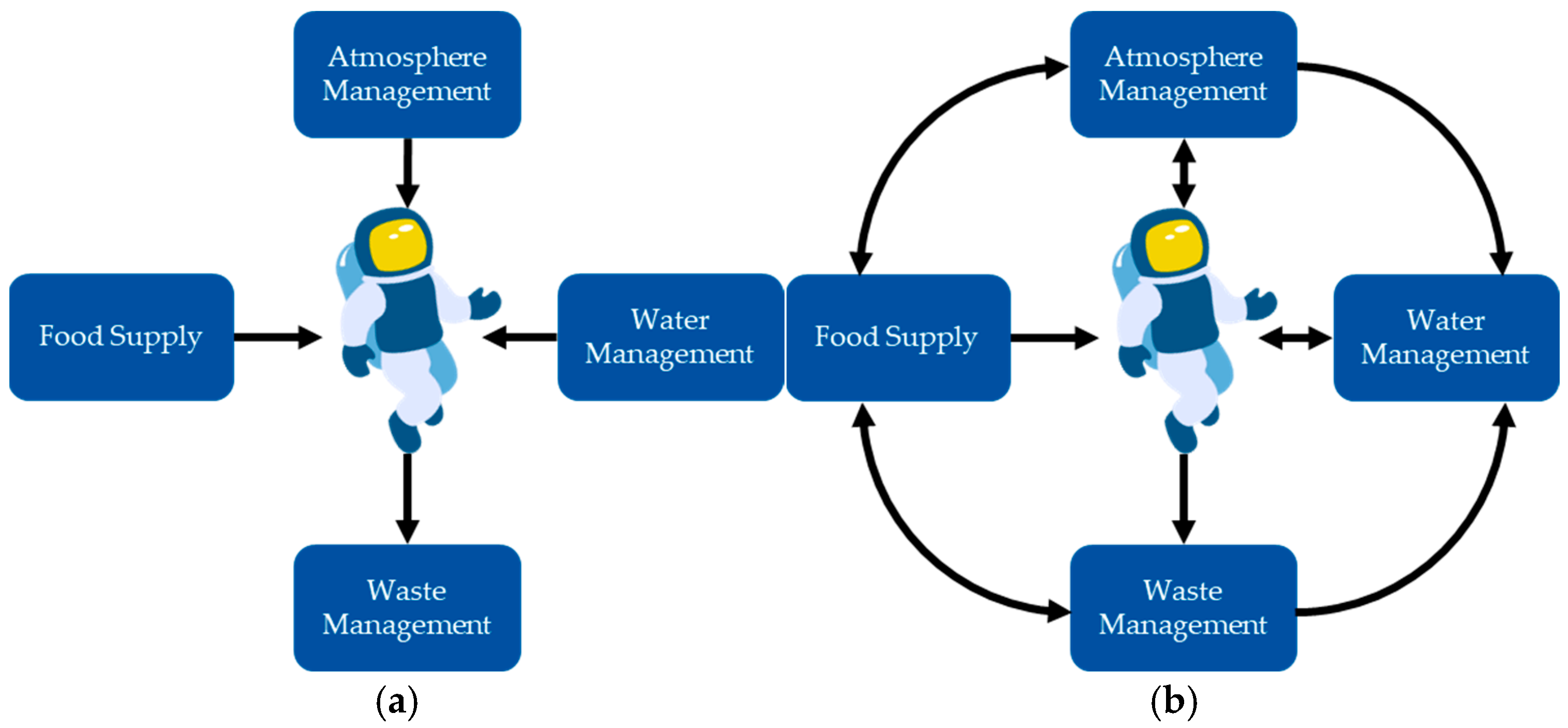
A LSS is one of the nine subsystems of a crewed spacecraft or space station. It is a system that “ensures the biological autonomy of man when isolated from his original biospheres” [7] (p. 79). It provides “a controlled and physiologically acceptable environment for a crew…” [7] (p. 79). Hence, the LSS must provide a form of atmosphere and water management, supply the crew with food, and take care of all the waste products. This system is therefore crucial to ensure that the crew stays alive, healthy, happy, and productive. The basic structure of a LSS can be seen in Figure 2. As explained above, LSSs have undergone a development from simple, open-loop systems (see Figure 2a) used for short mission durations during the dawn of the space age to more complex, interconnected, regenerative LSSs that are used on the ISS. This increase in loop closure means that fewer consumables are needed for the crew, since they can partially be recovered from waste products. A simplified example of a regenerative LSS can be seen in Figure 2b.

3. Digital Twins

3.1. History and Development

The concept of DTs was first developed by Michael Grieves in 2002 for an enhanced product lifecycle management [8]. Up until 2010, the concept remained untouched, but it was then coined under the term DT in an official NASA roadmap [9].
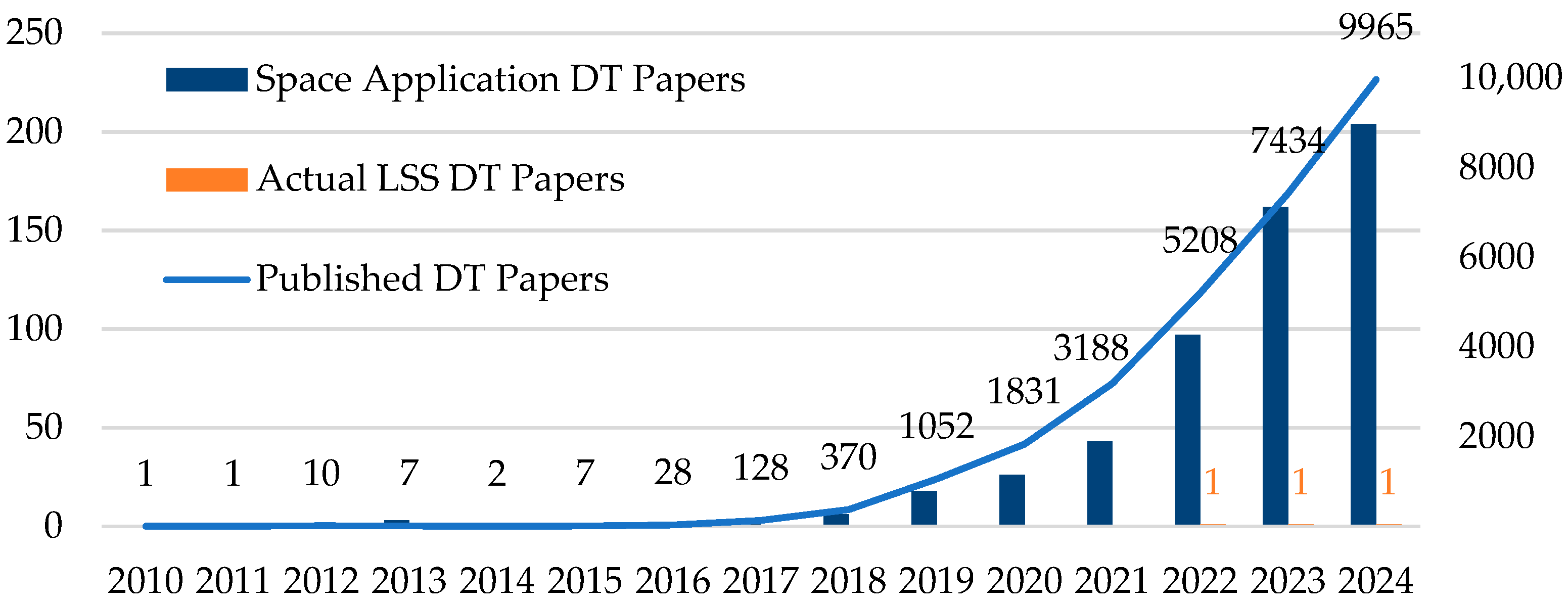
In order to better understand the development of publications regarding DTs, a literature review was performed by using the publication platform “Scopus” and searching for papers that contained the term “Digital Twin” either in the article title, abstract, or keywords. The resulting publication numbers were then compared to other platforms such as “Web of Science”. According to this research, the initial applications of DTs between 2010 and 2015 were in the fields of computer science, engineering, materials science, and medicine, as well as physics and astronomy [10]. Starting from 2015 onwards, the number of publications on DTs saw an exponential increase, which mostly stems from the expansion of the Internet of Things, where objects implemented with sensors offer real-time data acquisition. Additionally, the rise of Industry 4.0 accelerated the development of DTs [11]. The overall number of papers published on “Scopus” between 2010 and 2024 can be seen in Figure 3.

3.2. Applications

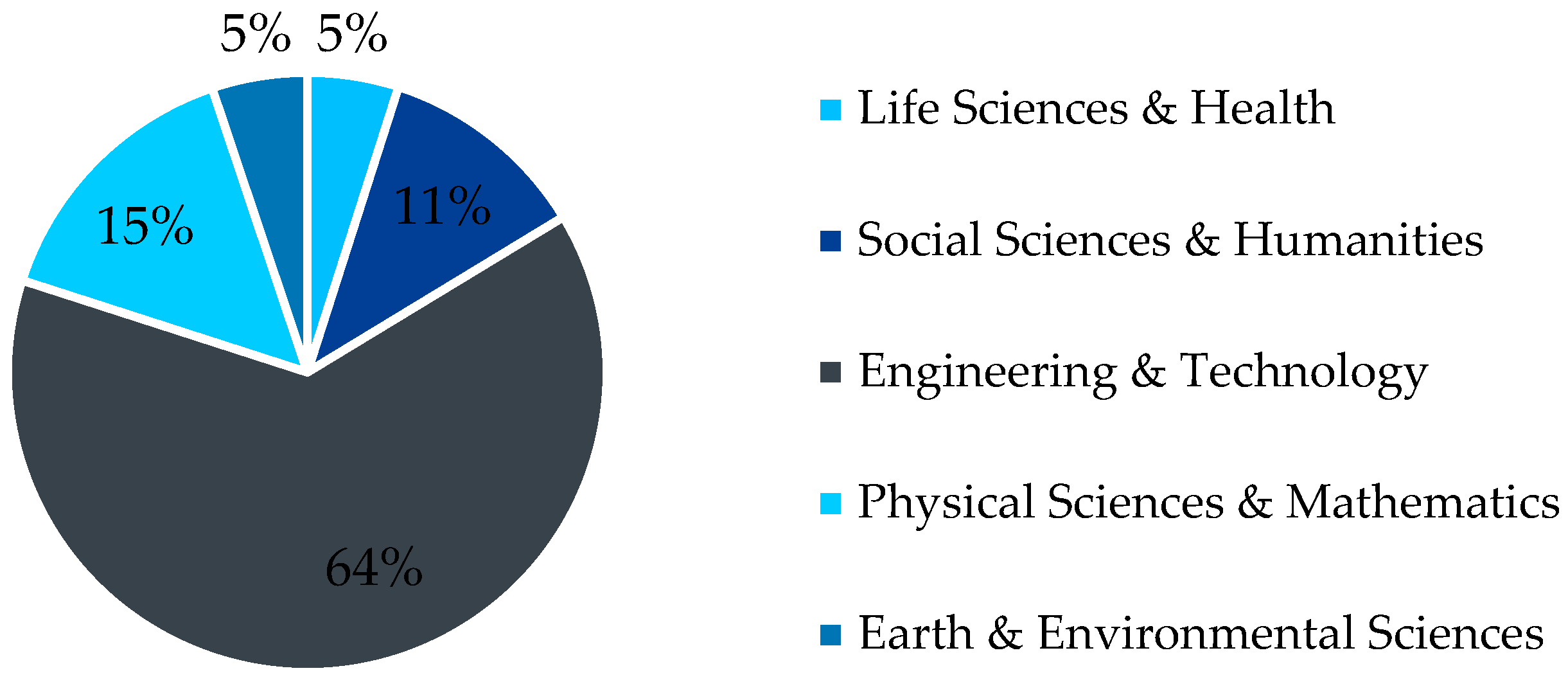
In order to gain a better understanding of where DTs are being researched and applied, the papers published on “Scopus” were summarised into five different categories. The distribution of publications in each field can be seen in Figure 4. For each application area, two exemplary uses are given. In the field of life sciences and health, DTs are being applied for targeted therapy and drug development [11,13,14]. With regard to social sciences and humanities, DTs are being used to enhance product performance and feedback as well as to discover new application opportunities by analysing user behaviour [15,16]. By far the biggest application field is engineering and technology, with a focus on manufacturing and the aerospace sector. Here, DTs are applied to analyse aircraft health and to monitor entire city power grids [11,17,18]. Physical sciences and mathematics see DTs used to analyse the evolution of the universe and model complex chemical production plants [19,20]. Lastly, DTs are used for weather modelling and forecasting as well as to model the Earth and analyse climate change in the field of earth and environmental sciences [11,21,22].

3.3. Use Cases

In general, it can be said that DTs can be used in all lifecycle stages of a product, from the development and creation to the actual construction and usage, all the way to the final disposal [16]. In the development stage of the product, DTs optimise the design process by offering improved decision-support capabilities [14,23]. During the construction and usage, DTs can be used for monitoring, where they can enhance real-time analysis and optimise quality control [11,24]. Once the product is being used, DTs enable prediction capabilities that provide insights into future performance and failure of the product [16,25]. Additionally, maintenance can profit from the prediction capability, offering improved planning and predictive and preventive maintenance [16,25,26].

3.4. Benefits and Challenges

As already mentioned, the fact that DTs can be used throughout the entire product lifecycle comes with numerous benefits. By using DTs in the creation phase, an efficient design and planning not just of the product but also of the product production process is possible [27]. The real-time analysis offers continuous monitoring capability and can be used to improve the product [11]. The ability to predict future states enhances predictive maintenance and prevents failures [16,28]. All of these benefits lead to an improved economy by reducing cost and development time, which in turn increases efficiency [11,27,29].
Of course, every technology comes with its own unique set of challenges. Since DTs are currently being developed by multiple different entities, there is a lack of standardisation [16]. This goes hand in hand with the problem of efficient data management. In order to perform the prediction capabilities that DTs offer, vast amounts of data need to be collected and stored while still being rapidly accessible [24]. Therefore, the question arises, what accuracy the DT needs and what model fidelity is required [29]. An inaccurate model would not offer the insights required for analysis, while a high-fidelity model might lead to the collection of unnecessary data and large computing power. Lastly, data security and privacy, as well as legal and ethical concerns, are topics that still need to be clarified [13].

4. The Life Support System Digital Twin

4.1. Research So Far

As seen from Section 3, lots of research on DTs has been done. For the field of aerospace engineering, NASA originally proposed to use DTs for propulsion, energy storage, avionics, vehicle structure, thermal management, and life support in 2010 [9]. Nevertheless, no actual research on LSS DTs was undertaken until 2022, when Nicolas Gratius researched a “probabilistic graphical model based Digital Twin” and “Digital Twins for autonomous Environmental Control and Life Support Systems” in 2024 [30,31,32]. This lack of research is shown in Figure 3.

4.2. Interaction and Benefits

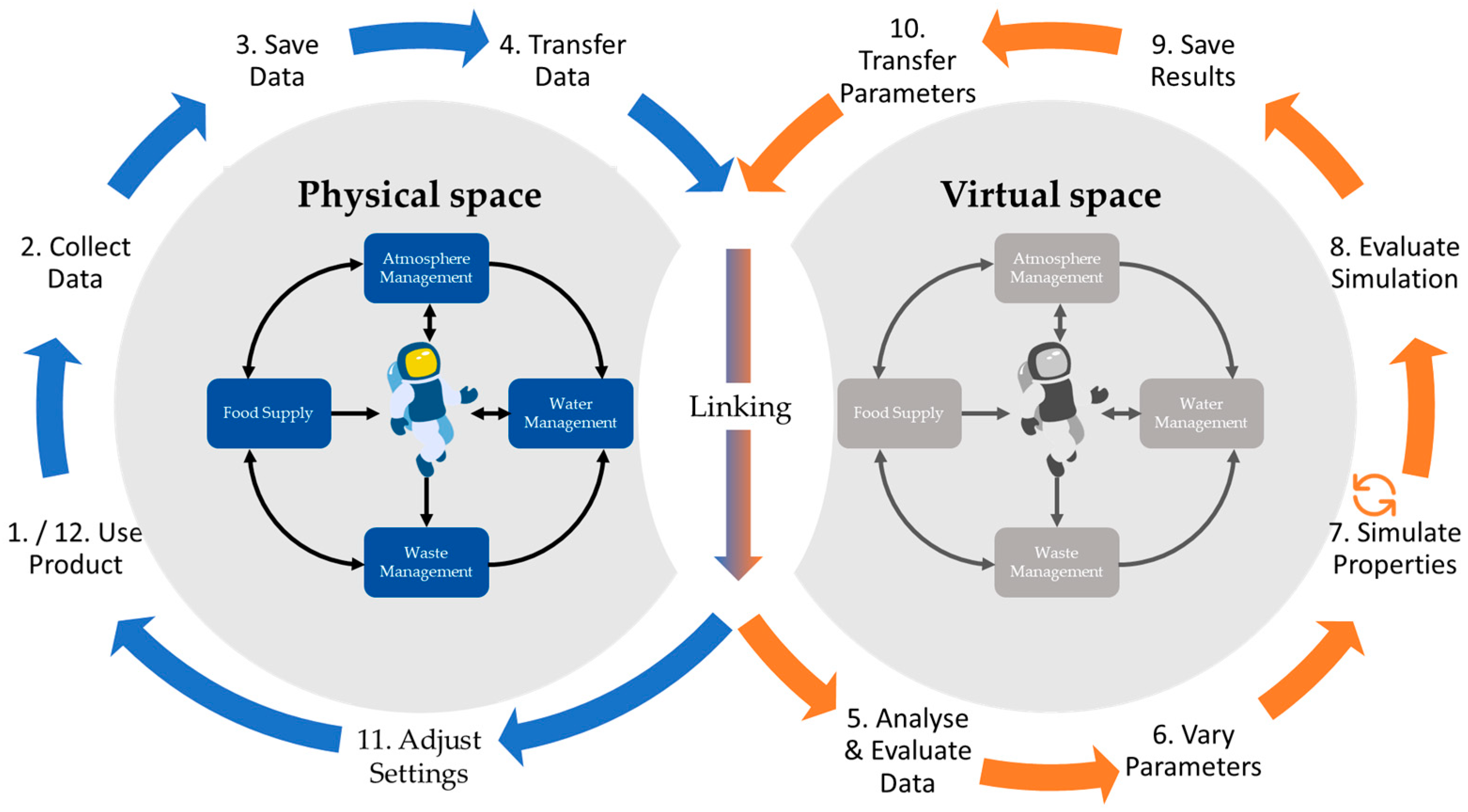
As described in Section 2, the DT is only complete if the physical and virtual space can exchange data and information with each other. This interaction is shown in more detail in Figure 5. While the LSS is being used in the physical space, sensor data is continuously collected and transferred via the digital thread from the physical into the virtual space. Here, the data is analysed and evaluated before selected parameters are varied and multiple simulations are run. The results are then evaluated and saved before the ideal actuator setpoints and commands are transferred back via the digital thread from the virtual to the physical space.
By running multiple simulations in the virtual space with varied parameters, a sustainable consumable use can be achieved by the DT. Additionally, collecting valuable data enhances the safety and success of the mission. This is made possible by front-running simulations, preventive maintenance, and fault diagnosis, as well as on-board error handling [17,34]. All of these benefits, combined with the overall benefits mentioned in Section 3.4., lead to an increased mission autonomy and less dependence on ground control, which is vital to enable long-duration space missions.

4.3. Challenges

Since the LSS DT controls vital systems, the underlying models need to be verified and validated [30,35]. This also encompasses the data acquisition and storage system, which needs to fit into the spacecraft and withstand the harsh environment of space [11,17]. By linking the physical and virtual LSS and having an autonomous decision capability, the LSS DT becomes very powerful. Therefore, it needs clearly defined boundaries in which to act so as not to harm the crew or the equipment. This is why a control agent is implemented in the digital thread connection between steps 10 and 11 from Figure 5. This agent checks if all actuator setpoints and commands that are sent align with the allowed parameters and only allows throughput if these parameters are adhered to. If this is not the case, the virtual space cycle is run again to find parameters that align with the set boundaries. Another challenge faced by LSS DTs is the integration of subsystems [30]. The LSS is a system-of-systems and additionally there are eight other subsystems, all of which ideally have their own DT and are interconnected with each other. Lastly, special crew training is needed, since the LSS DT gives the crew the possibility to autonomously control the spacecraft LSS, a capability that they did not have in the past, since this job was performed by ground control [30].

5. Current Research

The current research at the University of Stuttgart was already described in detail in a paper by Leese et al. [6]. Therefore, only a short description of the ongoing research regarding LSS DTs is given. The goal of the research is, on the one hand, to develop a small-scale LSS that encompasses all relevant subsystems. On the other hand, this LSS is modelled using the MATLAB-based simulation tool Virtual Habitat (V-HAB). The model is used to understand the complex behaviour of the LSS and size its components. Once the physical LSS is complete, which is expected to be towards the end of 2027, it will be used to validate the V-HAB model in the virtual space. This completes the LSS DT, which will then be used to perform a closed-loop control of the physical and virtual LSS as described in Section 4.2.

6. Conclusions

The authors conclude that DTs are a key enabler for long-duration deep space missions. A LSS DT enhances crew autonomy and offers a sustainable use of consumables. The real-time data analysis capability of the DT enables fault detection and aids the crew in decision support. Even though the benefits of LSS DTs are numerous, the research and work in this field have only started, and many challenges are yet to be overcome. Future work at the University of Stuttgart therefore will focus on refining the physical and virtual models and then implementing the LSS DT closed-loop control.

Author Contributions

F.L. provided the paper analysis, investigation, conceptualisation, visualisation and writing; C.O. provided review and supervision. All authors have read and agreed to the published version of the manuscript.

Funding

This research received no external funding.

Institutional Review Board Statement

Not applicable.

Informed Consent Statement

Not applicable.

Data Availability Statement

No new data were created or analysed in this study. Data sharing is not applicable to this article.

Conflicts of Interest

The authors declare no conflicts of interest.

Abbreviations

The following abbreviations are used in this manuscript:
DTDigital Twin
ISSInternational Space Station
LSSLife Support System
VHABVirtual Habitat

References

  1. Leese, F.; Olthoff, C. Analysis of Historical Life Support Systems to Define a Design Envelope for Future Missions. In Proceedings of the 54th International Conference On Environmental Systems, Prague, Czech Republic, 13–17 July 2025; Available online: https://hdl.handle.net/2346/102663 (accessed on 29 July 2025).
  2. Westcott, M. Autonomy in Orbit. Available online: https://engineering.cmu.edu/news-events/news/2025/03/04-autonomy-in-orbit.html (accessed on 24 September 2025).
  3. Torralba, M.; George, C.; Robinson, S.; Eshima, S.; Nabity, J. Estimation of System States for Non-Measured Parameters and Integration with a Digital Twin Framework to Boost Spacecraft Autonomy and Awareness. In Proceedings of the 51st International Conference on Environmental Systems, Saint Paul, MN, USA, 10–14 July 2022; pp. 1–12. Available online: https://hdl.handle.net/2346/89759 (accessed on 24 September 2025).
  4. Grieves, M.W. Digital Twins: Past, Present, and Future. In The Digital Twin; Crespi, N., Drobot, A.T., Minerva, R., Eds.; Springer: Cham, Switzerland, 2023; pp. 97–121. Available online: https://link.springer.com/chapter/10.1007/978-3-031-21343-4_4 (accessed on 24 September 2025).
  5. Digital Thread: Definition, Value, and Reference Model, 2023. Available online: https://www.aiaa.org/resources/digital-thread-white-paper (accessed on 24 September 2025).
  6. Leese, F.; Kamps, E.; Stratmann, V.; Olthoff, C. Outlook on Research on Life Support Systems together with Digital Twin modeling. In Proceedings of the 76th International Astronautical Congress (IAC), Sydney, Australia, 29 September–3 October 2025; pp. 1–8. Available online: https://www.researchgate.net/publication/396229498_Outlook_on_research_on_Life_Support_Systems_together_with_Digital_Twin_modeling (accessed on 24 September 2025).
  7. Eckart, P. Spaceflight Life Support and Biospherics; Microcosm Press: Torrance, CA, USA; Kluwer Academic Publishers: Dordrecht, The Netherlands; Boston, MA, USA, 1996. [Google Scholar]
  8. Grieves, M.W. SME Management Forum Completing the Cycle: Using PLM Information in the Sales and Service Functions. In Proceedings of the SME Management Forum, Troy, MI, USA, 31 October 2002; Available online: https://www.researchgate.net/publication/356192963 (accessed on 10 October 2025).
  9. Shafto, M.; Conroy, M.; Doyle, R.; Glaessgen, E.; Kemp, C.; Lemoigne, J.; Wang, L. Modeling, Simulation, Information Technology and Processing Roadmap: Technology Area 11. November 2010. Available online: https://www.researchgate.net/publication/280310295_Modeling_Simulation_Information_Technology_and_Processing_Roadmap#fullTextFileContent (accessed on 29 September 2025).
  10. Scopus. Digital Twin Publications between 2010 and 2015 on Scopus. Available online: https://www.scopus.com/results/results.uri?sort=plf-f&src=s&sid=a6eeed717c76dc6432fe0f4096bb05ea&sot=a&sdt=cl&sl=29&s=TITLE-ABS-KEY%28%22digital+twin%22%29&origin=resultslist&editSaveSearch=&txGid=4fb55b839b6df2e822017a23b1e794f4&sessionSearchId=a6eeed717c76dc6432fe0f4096bb05ea&limit=10&yearFrom=2010&yearTo=2015 (accessed on 17 October 2025).
  11. Attaran, M.; Celik, B.G. Digital Twin: Benefits, use cases, challenges, and opportunities. Decis. Anal. J. 2023, 6, 100165. [Google Scholar] [CrossRef]
  12. Scopus. Digital Twin Publications between 2010 and 2024 on Scopus. Available online: https://www.scopus.com/results/results.uri?sort=plf-f&src=s&sid=a6eeed717c76dc6432fe0f4096bb05ea&sot=a&sdt=cl&sl=29&s=TITLE-ABS-KEY%28%22digital+twin%22%29&origin=resultslist&editSaveSearch=&txGid=4fb55b839b6df2e822017a23b1e794f4&sessionSearchId=a6eeed717c76dc6432fe0f4096bb05ea&limit=10&yearFrom=2010&yearTo=2024 (accessed on 17 October 2025).
  13. Cellina, M.; Cè, M.; Alì, M.; Irmici, G.; Ibba, S.; Caloro, E.; Fazzini, D.; Oliva, G.; Papa, S. Digital Twins: The New Frontier for Personalized Medicine? Appl. Sci. 2023, 13, 7940. [Google Scholar] [CrossRef]
  14. Guo, J.; Lv, Z. Application of Digital Twins in multiple fields. Multimed. Tools Appl. 2022, 81, 26941–26967. [Google Scholar] [CrossRef] [PubMed]
  15. Madni, A.M.; Madni, C.C.; Lucero, S.D. Leveraging Digital Twin Technology in Model-Based Systems Engineering. Systems 2019, 7, 7. [Google Scholar] [CrossRef]
  16. Grieves, M.W. Virtually Intelligent Product Systems: Digital and Physical Twins. In Complex Systems Engineering: Theory and Practice; Flumerfelt, S., Schwartz, K.G., Mavris, D., Briceno, S., Eds.; American Institute of Aeronautics and Astronautics: Reston, VA, USA, 2019; pp. 175–200. [Google Scholar]
  17. Liu, W.; Wu, M.; Wan, G.; Xu, M. Digital Twin of Space Environment: Development, Challenges, Applications, and Future Outlook. Remote Sens. 2024, 16, 3023. [Google Scholar] [CrossRef]
  18. Tao, F.; Zhang, H.; Liu, A.; Nee, A.Y.C. Digital Twin in Industry: State-of-the-Art. IEEE Trans. Ind. Inform. 2018, 15, 2405–2415. [Google Scholar] [CrossRef]
  19. Mane, S.; Dhote, R.R.; Sinha, A.; Thirumalaiswamy, R. Digital twin in the chemical industry: A review. Digit. Twins Appl. 2024, 1, 118–130. [Google Scholar] [CrossRef]
  20. Doeser, L.; Ata, M.; Jasche, J. Learning the Universe: Learning to optimize cosmic initial conditions with non-differentiable structure formation models. Mon. Not. R. Astron. Soc. 2025, 542, 1403–1422. [Google Scholar] [CrossRef]
  21. Digital Twins of Planet Earth. 2024. Available online: https://earthenvironment.helmholtz.de/assets/changing_earth/user_upload/DT_synthesis_paper.pdf (accessed on 24 September 2025).
  22. Rasheed, A.; San, O.; Kvamsdal, T. Digital Twin: Values, Challenges and Enablers From a Modeling Perspective. IEEE Access 2020, 8, 21980–22012. [Google Scholar] [CrossRef]
  23. Barricelli, B.R.; Casiraghi, E.; Fogli, D. A Survey on Digital Twin: Definitions, Characteristics, Applications, and Design Implications. IEEE Access 2019, 7, 167653–167671. [Google Scholar] [CrossRef]
  24. Segovia, M.; Garcia-Alfaro, J. Design, Modeling and Implementation of Digital Twins. Sensors 2022, 22, 5396. [Google Scholar] [CrossRef] [PubMed]
  25. Negri, E.; Fumagalli, L.; Macchi, M. A Review of the Roles of Digital Twin in CPS-based Production Systems. Procedia Manuf. 2017, 11, 939–948. [Google Scholar] [CrossRef]
  26. Kritzinger, W.; Karner, M.; Traar, G.; Henjes, J.; Sihn, W. Digital Twin in manufacturing: A categorical literature review and classification. IFAC-PapersOnLine 2018, 51, 1016–1022. [Google Scholar] [CrossRef]
  27. Xiong, M.; Wang, H. Digital twin applications in aviation industry: A review. Int. J. Adv. Manuf. Technol. 2022, 121, 5677–5692. [Google Scholar] [CrossRef]
  28. Eckhart, M.; Ekelhart, A. Digital Twins for Cyber-Physical Systems Security: State of the Art and Outlook. In Security and Quality in Cyber-Physical Systems Engineering; Biffl, S., Eckhart, M., Lüder, A., Weippl, E., Eds.; Springer International Publishing: Cham, Switzerland, 2019; pp. 383–412. [Google Scholar]
  29. Brosinsky, C.; Westermann, D.; Krebs, R. Recent and Prospective Developments in Power System Control Centers: Adapting the Digital Twin Technology for Application in Power System Control Centers. In Proceedings of the 2018 IEEE International Energy Conference (ENERGYCON), Limassol, Cyprus, 3–7 June 2018; pp. 1–6. [Google Scholar]
  30. Gratius, N.; Wang, Z.; Hwang, M.Y.; Hou, Y.; Rollock, A.; George, C.; Bergés, M.; Akinci, B. Digital Twin Technologies for Autonomous Environmental Control and Life Support Systems. J. Aerosp. Inf. Syst. 2024, 21, 332–347. [Google Scholar] [CrossRef]
  31. Gratius, N.; Hou, Y.; Bergés, M.; Akinci, B. Lessons learned on the implementation of probabilistic graphical model-based digital twins: A space habitat study. J. Space Saf. Eng. 2023, 10, 172–181. [Google Scholar] [CrossRef]
  32. Gratius, N.; Hou, Y.; Bergés, M.; Akinci, B. Lessons learned on the implementation of probabilistic graphical model-based digital twins: A space habitat study. In Proceedings of the 73rd International Astronautical Congress (IAC), Paris, France, 18–22 September 2022; pp. 1–11. [Google Scholar]
  33. GFOS. Digital Twin. Available online: https://www.gfos.com/en/glossary/digital-twin/ (accessed on 15 June 2025).
  34. Glaessgen, E.; Stargel, D. The Digital Twin Paradigm for Future NASA and U.S. Air Force Vehicles. In Proceedings of the 53rd AIAA/ASME/ASCE/AHS/ASC Structures, Structural Dynamics and Materials Conference, 20th AIAA/ASME/AHS Adaptive Structures Conference, 14th AIAA, Honolulu, HI, USA, 23–26 April 2012. [Google Scholar]
  35. Vickers, J. Digital Twins: A Little Bit of Everything. In Proceedings of the MBSE Symposium, Huntsville, AL, USA, 21–22 May 2025; pp. 1–33. Available online: https://ntrs.nasa.gov/citations/20250004798 (accessed on 5 September 2025).
Figure 1. Basic structure of a Digital Twin adapted from [4], taken from [6].
Engproc 133 00094 g001
Figure 2. Basic structure of a Life Support System: (a) depicts an open-loop LSS, whilst (b) depicts a regenerative LSS.
Engproc 133 00094 g002
Figure 3. Published papers on DTs in various fields [12]. The blue line represented on the secondary axis represents the overall amount of papers published on DTs. The blue bars represent DT papers published in the field of space applications. The orange numbers represent the work that has been done as of yet on LSS DTs.
Engproc 133 00094 g003
Figure 4. Digital Twin application areas [12].
Engproc 133 00094 g004
Figure 5. Interaction of the physical and virtual space adapted from [33], taken from [6].
Engproc 133 00094 g005
Disclaimer/Publisher’s Note: The statements, opinions and data contained in all publications are solely those of the individual author(s) and contributor(s) and not of MDPI and/or the editor(s). MDPI and/or the editor(s) disclaim responsibility for any injury to people or property resulting from any ideas, methods, instructions or products referred to in the content.