1. Introduction
Since laminated composite materials are increasingly used in aircraft design, proactively managing fatigue to prevent delamination is essential for maintaining structural integrity and safety [
1]. To support this objective, experimental approaches play a vital role in assessing damage tolerance, namely the ability of a structure to sustain defects such as delamination without significant loss of performance. Experimental investigation of fatigue-induced delamination in carbon-fiber-reinforced polymer (CFRP) laminates, however, remains highly challenging, requiring precise testing methods and careful interpretation of results to complement and validate numerical models.
Numerous experimental studies on fatigue delamination in CFRP exist in the literature. Among the three phases of delamination (initiation, onset, and propagation), fatigue delamination growth onset testing in mode I is the only one for which a standard currently exists, ASTM D6115 [
2]. On the other hand, no standard test exists for fatigue delamination propagation in composites. Developing a standard test method for mode I fatigue delamination propagation in CFRP is a goal shared by both the European Structural Integrity Society Technical Committee 4 (ESIS TC4) [
3] and the American Society for Testing and Materials Subcommittee D30.06 (ASTM D30.06) [
4]. These standardization efforts pave the way for the development of generalized fatigue delamination models, describing fatigue delamination growth (FDG) in composites. However, while there is no standard for fatigue delamination propagation in CFRP, a common practice for determining
over a wide range of load intensities is to follow ASTM E647 for metals [
5].
In recent years, full-field techniques have increasingly been used to study fatigue delamination growth. Digital image correlation (DIC) is a robust and reliable method for measuring displacement and strain fields on the surface of components [
6]. This technique provides displacement fields around the delamination tip that can be used to monitor delamination length throughout the fatigue test by taking images every
cycles. The use of DIC in composite laminates is further investigated in this study, and the test results are fully depicted.
Fracture mechanics-based methods used to estimate delamination propagation in composites rely on the strain energy release rate (
) [
7]. To obtain
, the most commonly used finite element method (FEM) procedure is the virtual crack closure technique (VCCT) [
8]. In this procedure, characterizing composite material behavior is key for accurate estimations. In addition, modeling fatigue-driven delamination under variable mixed-mode conditions requires custom implementations in engineering FEM software.
This paper presents the experimental framework developed to investigate fatigue delamination behavior under non-constant mixed-mode conditions. For that, experimental methods for fatigue delamination growth were developed. The testing configuration and fatigue procedure for determining delamination growth, together with the data reduction and parsing techniques, were carefully addressed. The methodology is demonstrated considering the unfolding of a corner composite laminate, reproduced via a four-point bending test on an L-shaped unidirectional CFRP beam with a non-adhesive Teflon foil insert to initiate delamination. This methodology enables accurate fatigue delamination prediction and highlights the value of optical measurements in experiments under varying mixed-mode conditions. The proposed methods support damage tolerance assessment of composites under mixed-mode fatigue delamination.
2. Experimental Methods for Fatigue Delamination Growth
This section covers the experimental approach used to investigate fatigue delamination growth in composite materials. It includes the description of the testing configuration and the applied fatigue loading procedure. This is followed by an explanation of the methods used to monitor and determine delamination growth throughout the tests. Finally, the data reduction and parsing techniques used to analyze the experimental results are summarized, ensuring accurate interpretation of delamination behavior under cyclic loading.
2.1. Testing Configuration and Fatigue Procedure
The L-angle specimen used for the mixed-mode I/II fatigue tests in
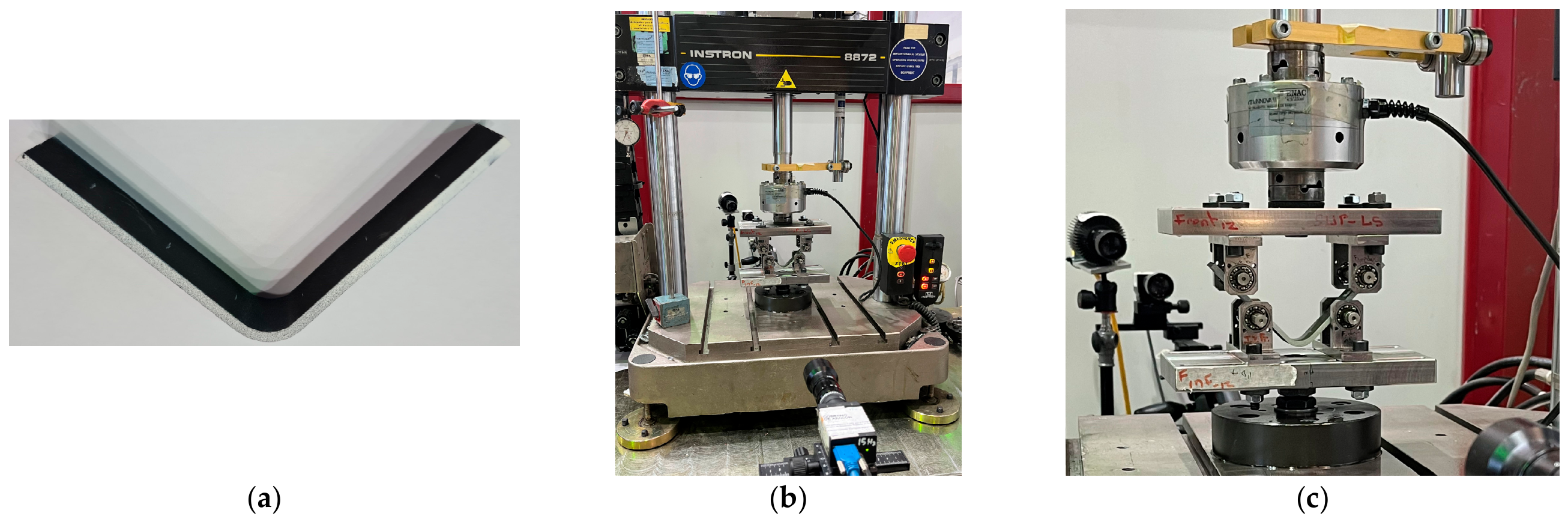
Figure 1a presents two straight legs joined by a 90° bend with an inner radius of 10.0 mm. It is fabricated from a unidirectional laminated composite of uniform thickness, with a non-adhesive Teflon foil insert at the midplane served as a delamination initiator. Although the specimens are based on the ASTM D6415 standard [
9], they incorporate a Teflon insert. Each specimen is 25.0 mm wide, 3.66 mm thick, and has 100 mm legs.
The material used in this study is a unidirectional (UD) prepreg, Hexply™ M21/34%/UD194/IMA-12k, produced by Hexcel (Stamford, CT, USA). It consists of IMA carbon fibers [
10] as reinforcement within an M21 epoxy resin matrix [
11]. This composite is representative of the materials used in specific structural components of the Airbus A350 and was supplied by AERNNOVA. The laminate is composed of 20 unidirectional plies, with a thin Teflon insert positioned at the midplane, following the layup configuration: [(0)
10/T/(0)
10].
The experimental setup for the four-point bending test on L-angle specimens was developed at ITA, as shown in
Figure 1b. The setup employed a servo hydraulic INSTRON universal testing machine (UTM) equipped with a 25 kN load cell to capture force data while operating under displacement control. The setup also included two cameras for performing digital image correlation (DIC) on the free edges of the specimen, both the front and back sides.
The fixture followed a four-point bending configuration using cylindrical machined-steel loading and support bars with diameters of 9.5 mm. These bars were mounted on roller bearings, as shown in
Figure 1c, which presents the curved beam bending test setup with a specimen ready for testing. The bearing fixtures minimize friction since the bearings allow rotation during specimen deformation and ensure pure bending loading. In accordance with the standard, the horizontal spacing between roller centers was set to 100 mm for the top fixture and 75 mm for the bottom fixture. Note that the testing fixtures are upside down compared to ASTM D6415 [
9] for easier specimen positioning.
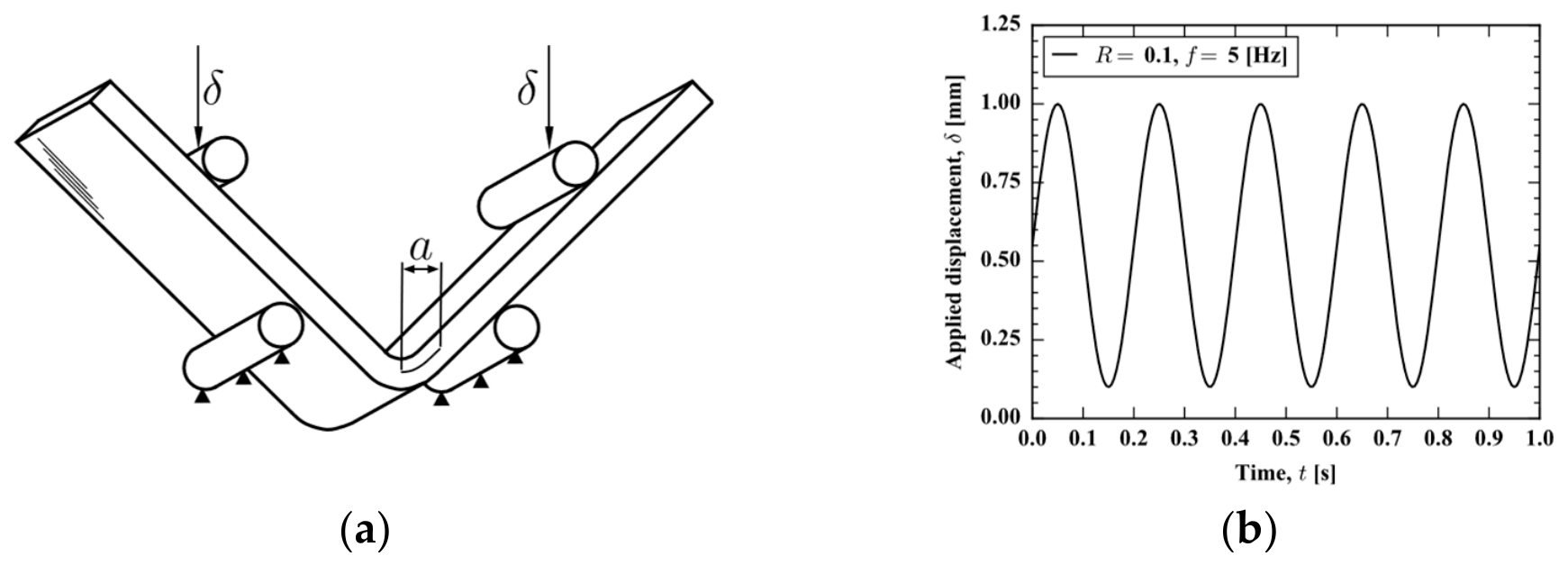
Compared with the standard configuration, the proposed test introduces a non-adhesive Teflon foil insert at the bend within the midplane, representing a manufacturing defect. The 15 mm insert was placed asymmetrically, with one end at the bend center and the other extending toward one leg, as illustrated in
Figure 2a. The curved beam specimens were loaded in four-point bending (4PB), producing a constant bending moment in the curved section. This loading induces a mixed-mode combination of mode I interlaminar tension and mode II interlaminar sliding shear, thereby driving delamination growth.
The boundary conditions for testing the L-angle specimens in mixed-mode I/II fatigue loading are shown in
Figure 2a. A cyclic displacement δ, was applied to the upper rollers following the sinusoidal waveform shown in
Figure 2b, while the lower rollers remained fixed. This setup induces flexural opening in the specimens. The fatigue 4PB tests were conducted under displacement control, with a maximum displacement of 1 mm at a frequency of 5 Hz. The displacement ratio,
was maintained at 0.1.
To capture both global and local mechanical responses and gain insight into the physical mechanisms at play, several measurement techniques were implemented:
Displacement monitoring, via the linear variable differential transformer (LVDT) in the crosshead of the UTM, to control the deflection of the specimen.
Reaction force measurement, using the load cell integrated into the UTM.
Digital image correlation (DIC), applied to the free edges of the specimen. This enabled tracking of global displacements and delamination length throughout the test.
The reaction load, and the delamination length, , were recorded continuously and synchronized with the applied displacement values . The number of applied cycles was also recorded. Displacement was measured redundantly, both through the UTM crosshead and with DIC, to avoid inaccuracies from differences in the kinematic chain. Displacement and load were recorded from one out of every hundred cycles, and for each selected cycle, the maximum and minimum values were extracted. Details of the delamination length computation, based on post-processing of the DIC results, are provided in the next subsection.
2.2. Determination of Crack Growth
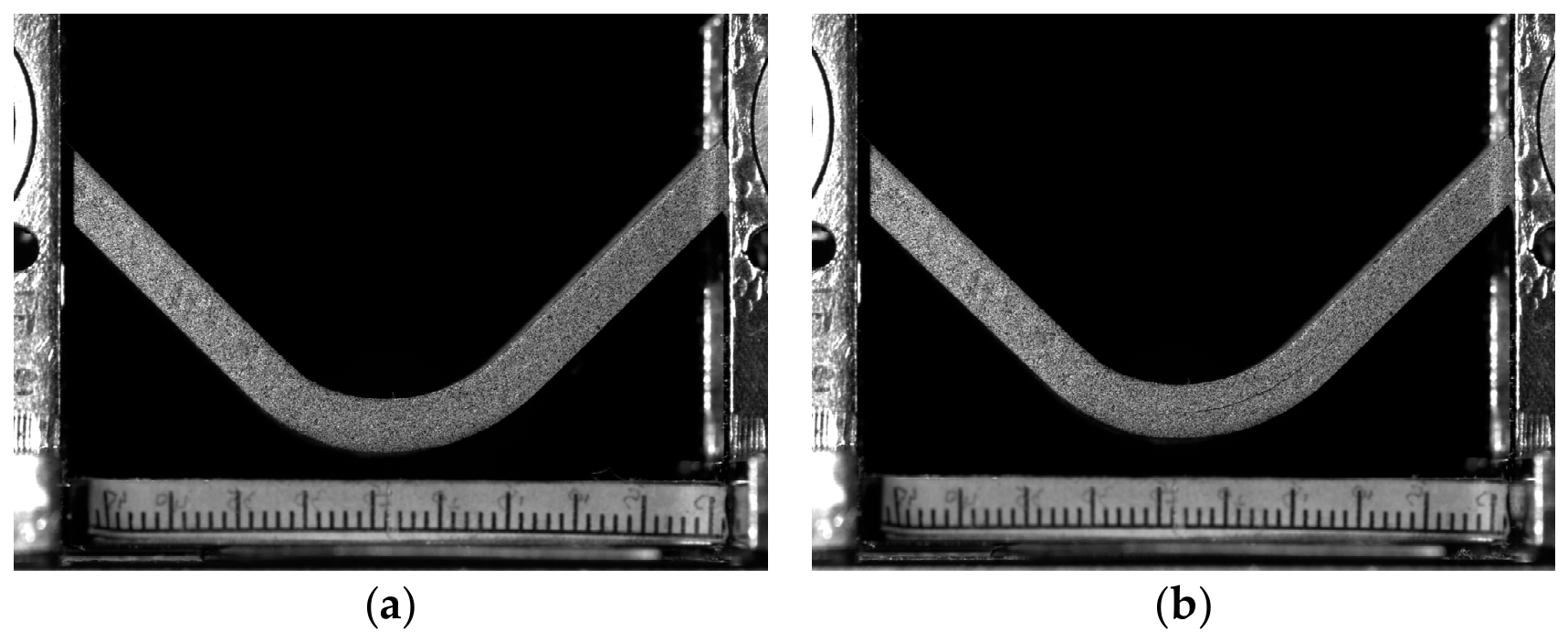
The experimental determination of delamination growth in this study was performed using the digital image correlation (DIC) technique. DIC provides non-contact, full-field measurement of displacement fields around the delamination tip by tracking the relative displacement of the specimen surface throughout the fatigue test. In practice, the free edges on both the front and back sides of the L-angle specimen were prepared to obtain a stable random contrast pattern for monitoring. Successive images were captured during cyclic loading at the maximum and minimum load positions and synchronized with the actuation system. These images were correlated with the reference state, allowing the displacement fields (Δx, Δy) to be extracted with sub-pixel accuracy. Digital images of the free edge of the L-angle specimen are presented in
Figure 3. By comparing the reference image before loading in
Figure 3a with subsequent images captured during loading, as shown in
Figure 3b, DIC algorithms track the movement of small subsets of the pattern to compute the displacement fields [
6].
The delamination tip position was determined by analyzing the relative displacement between corresponding points on opposite sides of the delamination, based on both the horizontal and vertical displacement fields. Although DIC can provide strains, relative displacement was chosen because it more directly captures delamination propagation. The delamination tip was identified at the point where the relative displacement became zero. To reduce data noise, a Savitzky–Golay filter was applied for smoothing, and a monotonically increasing delamination tip position was imposed to reflect delamination propagation. This method yields the delamination tip position and the delamination length under mixed-mode loading.
The same procedure was also applied to mode I and mode II static and fatigue characterization campaigns, enabling direct measurement of delamination propagation. The approach ensures the accuracy of the indirect measurements according to the standards while also providing redundancy in the assessment of actual delamination growth.
2.3. Data Reduction and Parsing Techniques Overview
Although there is no standard for fatigue delamination propagation in CFRP, a common test practice for determining
over a wide range of load intensities is to use the ASTM E647 standard test method for measuring fatigue crack growth rates [
5]. Appropriate standardized methods deal with testing procedures, fatigue loading conditions and load intensities, and interpretation of test results, including data reduction techniques for fatigue delamination data.
Accurate evaluation of fatigue delamination growth rates requires transforming raw crack length–cycle records into reliable
curves. In this work, the methodology combines standardized approaches from ASTM E647 [
5] with procedures specifically adapted, thereby ensuring both consistency and data reliability.
The secant method defined in ASTM E647 Annex X1.1 calculates the growth rate from two consecutive measurements, as expressed in Equation (1).
where
and
are crack lengths at cycles
and
, respectively. This method can be sensitive to scatter from small measurement errors. This method is frequently denoted as the two-point secant method and is used to provide a baseline for delamination growth.
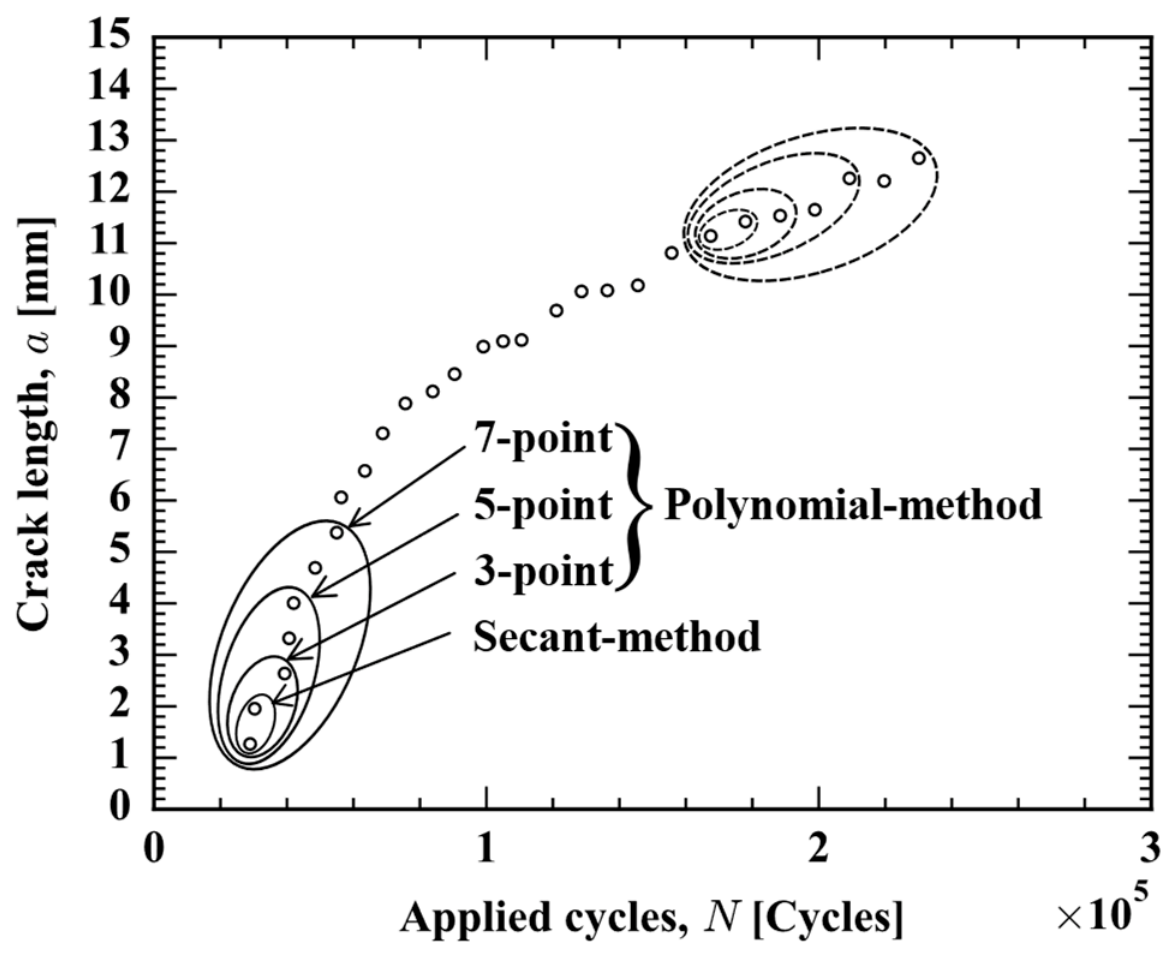
Additionally, Annex X1.2 of ASTM E647 recommends the incremental polynomial method, where a polynomial is fitted to a sliding window of several data points and the derivative at the midpoint gives the growth rate, as stated in Equation (2).
where
is the fitted polynomial and
is the central cycle. This procedure reduces scatter and has been found to be especially effective for low growth rates. A symmetric window containing an odd number of points is used, thereby ensuring a single center point. Typically, three, five, or seven successive data points are used for the calculations. For instance, a seven-point sliding polynomial can be applied to achieve a stable representation of local crack growth [
12]. An illustration of the secant and incremental polynomial methods is shown in
Figure 4.
The above data reduction recommendations are followed for the mode I and mode II characterization campaigns needed to feed the simulation models. However, when these methods are applied to high-frequency data acquisition curves, significant errors may arise due to large scatter in compliance relative to the small increase in the number of cycles between successive data points. To address this issue, the reduction methods in this study were applied to parsed data sets, corresponding to a total delamination extension increment of 0.05 mm. This ensures the integrity of the results, as it is common practice to consider a resolution threshold within the measurement system’s resolution [
12]. This helps avoid artificial transients or step changes in the data while retaining only meaningful increments.
The use of the secant and incremental polynomial methods, together with strict data parsing, provided a balance between sensitivity and stability. This combined approach improved the robustness and comparability of the final delamination growth curves.
3. Results and Discussion of the Case Study
In this section, a compressive analysis is presented to verify the validity of the proposed simulation approach and experimental framework using fatigue-driven delamination propagation under non-constant mixed-mode conditions as a benchmark case.
To predict fatigue delamination growth, propagation is assumed to follow a power–law relationship, commonly known as the Paris–Erdogan expression. The general form of the equation in terms of the
, shown in Equation (3), serves as the foundation for fracture mechanics-based delamination growth [
13].
where
is the delamination propagation rate,
is the number of applied cycles,
is the delamination length,
is a function of the strain energy release rate
, and
and
are empirically derived material constants. For a more detailed description, refer to [
14].
The following examines FEM simulation of fatigue-driven delamination propagation under non-constant mixed-mode conditions in the L-angle specimen. The simulation methodology is implemented in a user-defined subroutine, UMIXMODEFATIGUE, for Abaqus [
15], incorporating the effects of mode mixity by leveraging the mode separation provided by the VCCT approach. A detailed description of the fatigue delamination growth methodology is provided in [
16]. The element type used was a 3D continuum solid element (C3D8I). A refined mesh with 0.5 mm elements was used in the delamination region. A uniform 1 mm mesh was applied across the width, and the thickness was discretized with ten elements, dividing the [0]
20 layup into elements with two plies each.
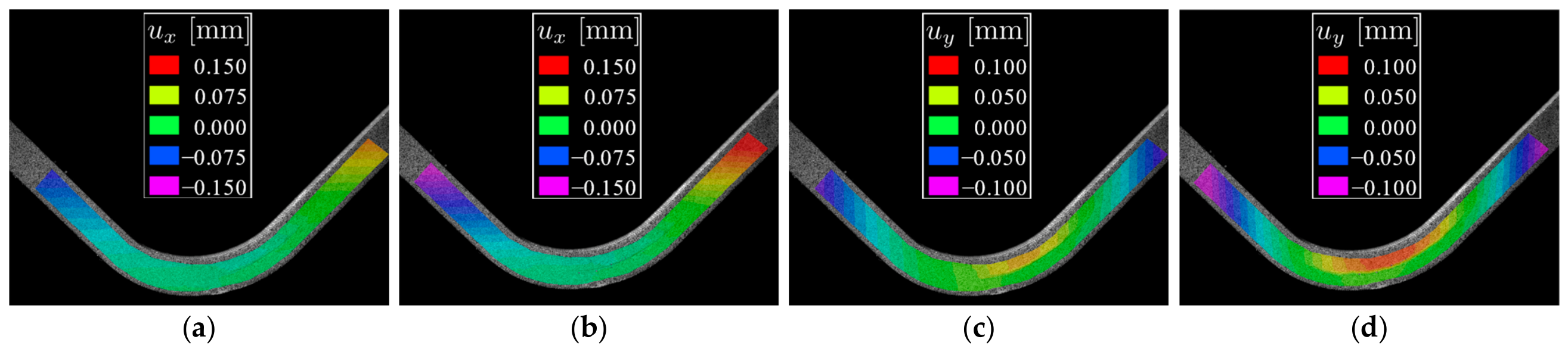
Regarding the experimental results, the delamination tip was determined by analyzing the relative displacement between corresponding points on either side of the delamination. The relative displacement was computed using both the horizontal and vertical displacement fields. As an example, the horizontal and vertical displacement fields at the beginning of the fatigue test and after applying 300,000 cycles are shown in
Figure 5.
The fatigue delamination experiment under mixed-mode loading conditions yielded delamination occurring only at the front and in the center of the bend. Comparing the initial stage of the fatigue test, when delamination was limited to the initial insert, with subsequent stages after a given number of cycles, when delamination had propagated. Both the horizontal and vertical displacement fields show notable differences, particularly at the delamination tip. Note that, since all images were captured at the same displacement of the actuation roller, the observed variations in the displacement fields were caused by delamination propagation. The propagation induces a local reduction in stiffness at the bend, which in turn reduces the global stiffness of the specimen, resulting in a corresponding decrease in the reaction force measured by the load cell, as analyzed below.
The maximum and minimum force–cycle and delamination–
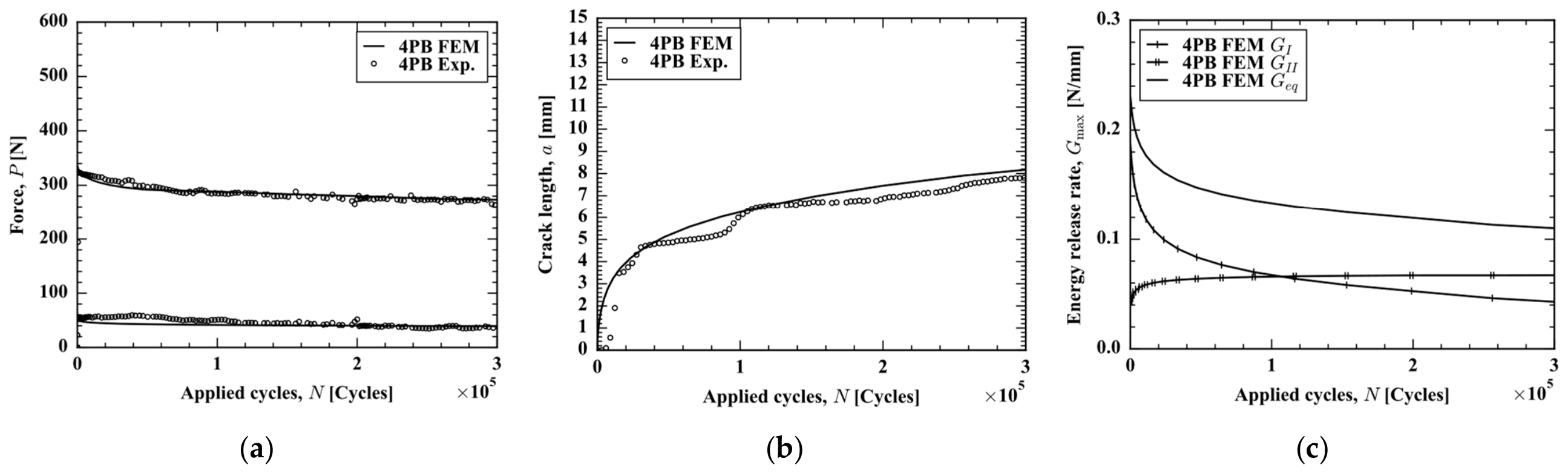
curves from the experiment (Exp.) and finite element model (FEM), as well as the FEM-based maximum strain energy release rate curves
, are compared in
Figure 6. The test was conducted under displacement control with
equal to 1 mm.
In the force–cycles curve, there is a decrease in both the maximum and minimum force levels due to delamination propagation during cycling under constant displacement. The delamination length–cycles curve shows that the delamination grows steadily throughout the test. The delamination growth predictions show close alignment with the experimental results. In the simulated maximum strain energy release rate–cycles curves, the maximum energy release rate for mode I, , decreases gradually from the initial value as the force drops and the delamination length increases, as previously shown. The mode II contribution, , rises from the initial value, but then almost stabilizes. and tend to stabilize because the delamination tip moves progressively away from the center of the L-angle, where the maximum interlaminar tension and interlaminar sliding shear occur. Concerning the equivalent energy release rate at maximum load, , defined as the sum of and , it decreases from the initial value. Thus, this test configuration under displacement control inherently tends to stop delamination propagation. The energy release rate and are higher at the beginning of the tests compared to the final stages.
The model validation objective for the varying mode-mix 4PB test on the L-angle under fatigue loading was achieved, successfully reproducing the aimed variation in a non-monotonic manner as the mixed-mode ratio changed. The procedure for experimentally determining fatigue delamination growth using DIC was successfully demonstrated.



 ,
,