Proceeding Paper

Advancing Sustainable Aviation: Insights from Methodologies, Technologies, and Policy Frameworks for Climate Impact Mitigation †

Centro Italiano Ricerche Aerospaziali (CIRA), Via Maiorise, 81043 Capua, CE, Italy
*
Author to whom correspondence should be addressed.
Presented at the 15th EASN International Conference, Madrid, Spain, 14–17 October 2025.
Eng. Proc. 2026, 133(1), 14; https://doi.org/10.3390/engproc2026133014
Published: 17 April 2026

Abstract

This work provides an extensive analysis of the different methodologies and related findings and implications of several projects that address the climate impact of aviation. By analyzing EU-funded initiatives and other significant projects worldwide, several critical insights have been drawn about how aviation contributes to climate change and the potential pathways to mitigate these impacts.

1. Introduction

One of the objectives of the CLAIM (Clean Aviation Support for Impact Monitoring) project is to support the achievement of the Clean Aviation Programme objective of significantly reducing net greenhouse gas (GHG) emissions through the definition of tangible metrics in terms of measurable emissions, due to the adoption of innovative technologies or optimized operations with advanced aircraft concepts and new configurational architectures.
This paper aims to analyze relevant climate impact methodologies currently available for assessing the complex relationship between non-CO2 and CO2 climate impacts in the aviation sector. The primary objective is to identify and evaluate the different analytical frameworks, metrics, and modelling tools that can be employed to quantify these effects in a consistent way. The study seeks to provide a comprehensive overview of the current state of knowledge and to highlight the main research gaps, methodological barriers, and technological limitations that impede accurate climate impact assessments. These insights are intended to guide and support future research priorities and to inform the design of innovative strategies for mitigating the overall climate footprint of aviation.
In addition, the study contributes to the identification of key scientific needs for improving climate models and emission evaluation tools, especially regarding the integration of non-CO2 effects such as contrail formation, NOx emissions, and water vapour. The proposed methodology is based on the analysis of a wide dataset of research and innovation projects according to their focus areas, scientific approaches, and technological readiness levels. This analysis enables a structured comparison of the proposed methods in terms of their relevance and potential contribution to comprehensive climate impact assessments. The goal is to provide a clear framework that helps orient future technology development streams towards more sustainable, climate-optimized, and ultimately net-zero-emission aircraft concepts.

2. Climate Impact of Aviation

Flight emissions modify the atmospheric concentrations of the components, altering the Earth’s radiative balance and causing climate change due to their chemical–physical interactive behaviours and their persistence over time through the atmospheric column. The impact amount depends on the time and place where it happens, since it also depends on the external environmental conditions (e.g., weather conditions). The climate impacts of aviation are related to the effects of CO2, NOx-induced O3, water vapour, and contrails [1]. Moreover, NOx impacts have several chemical feedbacks, while particulates are also important [2].
At a basic level, the climate impact of CO2 is strongly related to the total amount released during transport and industrial activities, including flights, but at a more rigorous level, the radiative forcing calculation is non-linear [3]. The impact is independent of the emission location, since CO2 is a long-lived gas. For constant flight level and fuel burn, the climate impact of CO2 is related to a first approximation to the air distance travelled, even if the flight distance and the fuel use are not linearly related [4]. It is given by the product of the route time (calculated considering the winds at flight level) and the true air speed, which is generally assumed to be constant. Therefore, the route time is used as a simple proxy for the climate impact of CO2. The climate impact is therefore greater for longer flights, which require more fuel and therefore produce greater amounts of CO2.
The climate impact of NOx-induced O3 is dependent on emission latitude and altitude [5,6], at a constant cruise altitude of 250 hPa; specifically, the impact is largest at the equator and decreases towards the poles [5,7]. A simplified climate impact proxy is therefore a function of route latitude. It is worth noting that the climate effect of NOx-induced ozone increases is significantly compensated by an accompanying decrease in methane (plus a methane-induced decrease in ozone), so the net climate impact of NOx changes is not easy to compute.
The climate impact of water vapour emissions is more relevant if the emissions are released directly into the stratosphere [8], where they have a longer lifetime. Therefore, the total route time that the aircraft would be in the stratosphere could be considered a simplified climate impact proxy. However, while it offers practical approximation, more detailed analyses are necessary to capture the full spectrum of atmospheric and climatic effects of aviation.
The climate impact from contrails (formed because of the mixing of hot, moist exhaust plume with cooler ambient air) is a complex interplay of their formation conditions, persistence, and radiative properties, with the Schmidt–Appleman criterion often used to predict their occurrence.

3. The Development of Modelling and Metrics

3.1. Climate Metrics for Aviation

In order to understand and manage the impacts of aviation on climate, quantitative tools have been developed, which translate complex physical processes into comparable measures of impact. Frequently used metrics include the Global Warming Potential (GWP) and Global Temperature change Potential (GTP), which express the related climate effect of emissions over a specific time horizon. However, the mix of short-lived and long-lived climate forcings represents a limitation of the adequacy of these traditional metrics. For example, contrails and NOx-induced O3 changes produce strong and short-lived effects, while CO2 accumulates and can persist for centuries. For this reason, recent studies explored time-dependent metrics specific to aviation, such as Effective Radiative Forcing (ERF) and Absolute Global Temperature change Potential (AGTP), to better capture the temporal and spatial variability of related impacts. These metrics are essential to supporting mitigation strategies, informing sustainable aviation fuel development, and supporting policy frameworks aimed at achieving climate-neutral flight pathways.

3.2. Analysis of State-of-the-Art Activities

With regards to modelling and metrics development, projects like REACT4C and ATM4E have pioneered the development of climate cost functions (CCFs) and environment change functions (ECFs), enabling better integration of climate considerations into aviation operations. These functions provide effective metrics for evaluating the trade-offs not only in terms of economic costs but also considering climate impacts, safety, and efficiency.
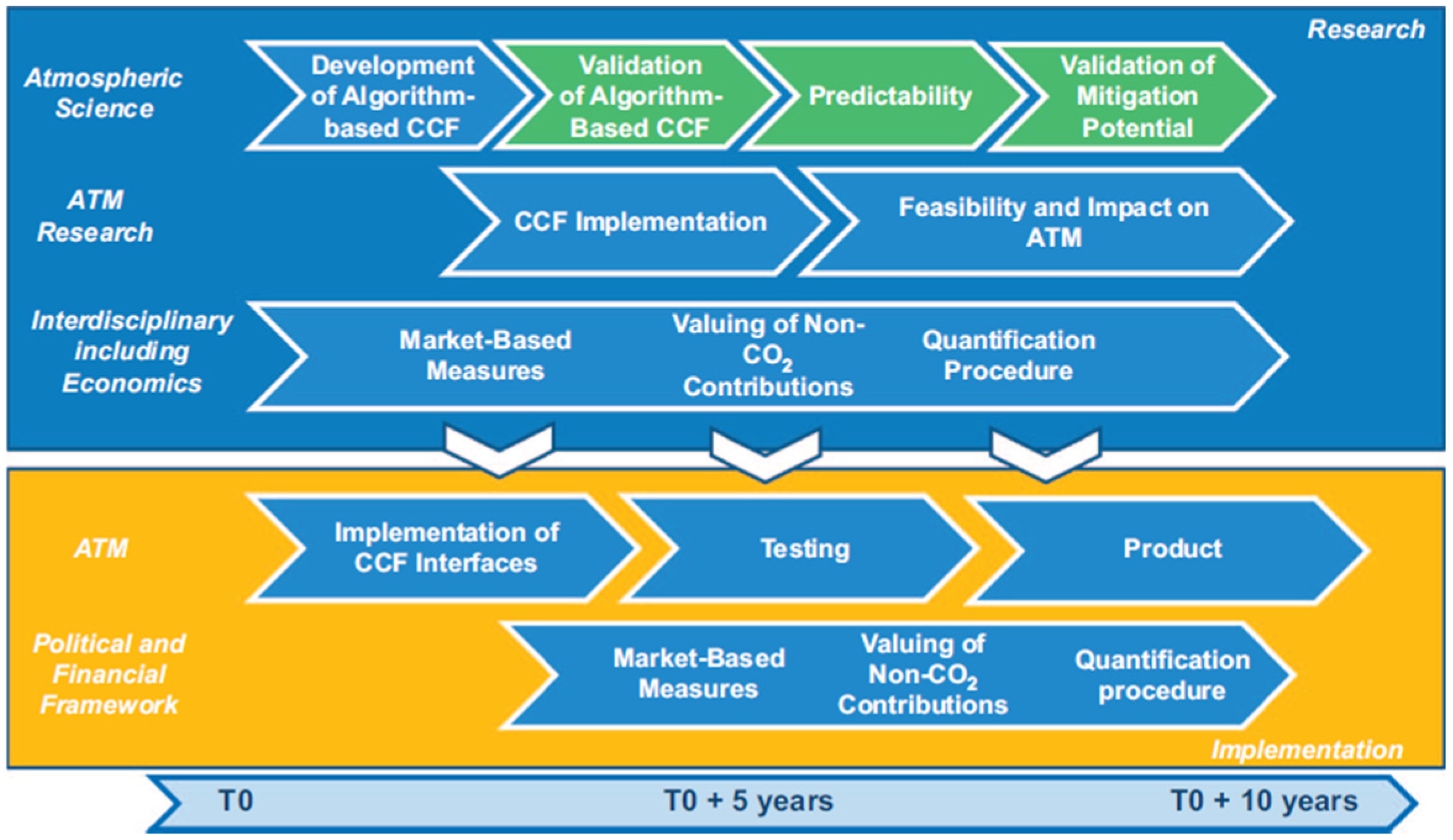
REACT4C investigated a concept to identify alternative routes characterized by a minimal climate impact, based on a weather-dependent route optimization [9]. The main objectives were the evaluation of the feasibility of adopting flight routes leading to reduced fuel consumption and emissions, as well as the estimation of the global effects on climate change. The novelty elements in REACT4C are represented by a modelling chain for the optimization of aircraft trajectories with respect to their climate impact, which is dependent on actual weather conditions. Specifically, the modelling concept is based on the calculation of CCFs, which are a measure for the climate impact of a local emission and represent the interface between climate-chemistry modelling on the one hand and flight planning of aircraft trajectories on the other hand [10]. The results from REACT4C indicate that a large potential exists to reduce the contribution of air traffic to climate change by rerouting; however, a trade-off exists between climate impact reductions and cost increase. Grewe et al. [11] presented a research roadmap for climate-optimized routing, illustrating the steps to overcome the challenges of implementing operationally such a system. Figure 1 reports the roadmap they formulated, considering several aspects such as atmospheric science, ATM-science, economic science, and pilot projects.
The ATM4E project investigated a concept for the environmental evaluation of air traffic operations, with the main aim of optimizing the ATM in European airspace, considering impacts on climate, air quality, and noise, following up on initial ideas developed in REACT4C. Beyond a feasibility study to optimize single-aircraft trajectories in realistic weather conditions, different air traffic scenarios were analyzed to understand the impact of environmentally optimized flights on changes in air traffic flows, creating challenges for ATM. The main aim of the project was split into four objectives: to define a multidimensional function (ECF) that includes effects on climate, air quality, and noise; to plan flight trajectories aimed at mitigating the environmental impact, under different meteorological situations; to evaluate environmentally optimized routes in a future atmosphere in a comprehensive climate-chemistry modelling, allowing a proof of concept of climate-optimization with daily route analysis; to develop a roadmap including recommendations and an implementation strategy for the environmental optimization of aircraft trajectories in close collaboration with aviation stakeholders.
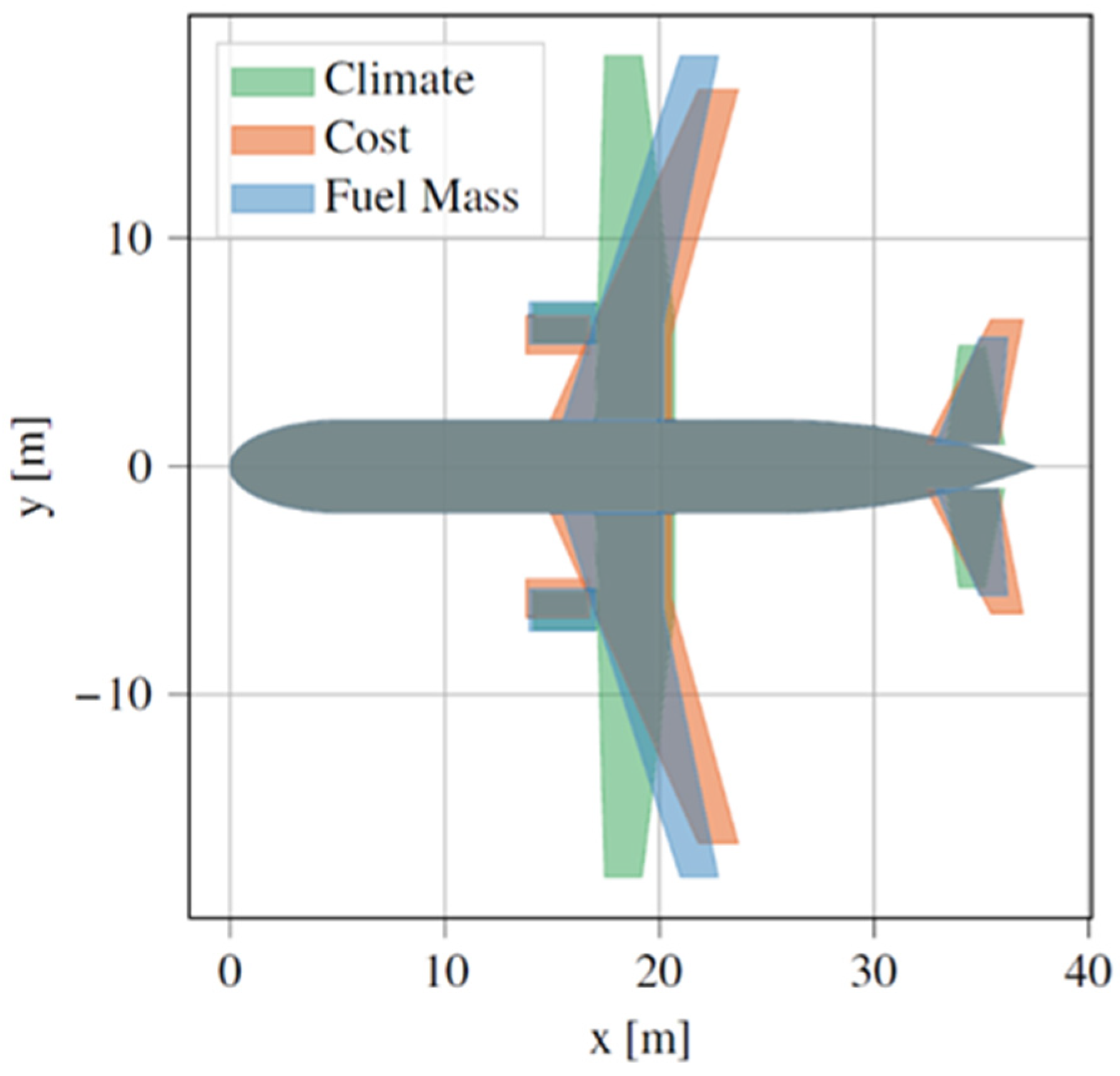
Unlike previous projects (e.g., REACT4C and ATM4E), GLOWOPT is based on a different climate mitigation approach, aimed at the optimization of aircraft design and not of aircraft operations (e.g., through flight routes). Specifically, the concept of CCFs was transferred to the optimization of aircraft design for reducing the climate impact by developing Climate Functions for Aircraft Design (CFAD). These functions provide a detailed representation of the climate impact associated with emissions generated by variables such as different cruise altitudes, aircraft speed, climb angles, and flight trajectory. Subsequently, CFADs were integrated into an existing Multidisciplinary Design Optimization (MDO) framework, incorporating input parameters such as fuel consumption and emission indices for various climate factors. The results achieved in GLOWOPT showed that the climate impact can be significantly reduced by flying lower and slower, using engines with lower pressure ratios, and adapting aircraft design accordingly. Lower altitudes reduce contrail effects, and lower pressure ratios reduce NOx impact, but CO2 emissions rise due to higher fuel burn. However, flying slower increases flight time and operating costs, so maximizing climate benefits entails economic trade-offs. Proesmans and Vos [12] optimized three objectives, i.e., climate impact, fuel use, and operating cost, finding that no single solution satisfies all (Figure 2). Therefore, aircraft design should include trade-off analyses and multi-objective cost functions together with CFAD.
These efforts have identified the need for refined atmospheric models and better integration of these effects into policy and operational frameworks. The determination of the CCFs starts with the calculation of the contributions of additional emissions to atmospheric concentrations (nitrogen oxides, ozone, methane, contrails, water vapour, carbon dioxide) and contrail properties.
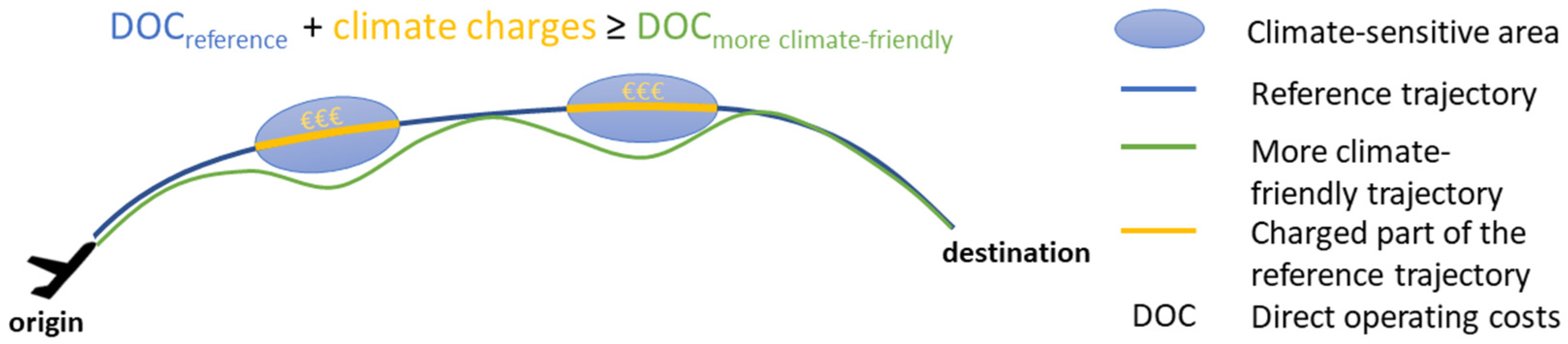
The importance of engaging stakeholders to ensure the practical implementation of mitigation strategies was emphasized in the frame of the CLIMOP project, which was aimed at determining alternative innovative Operational Improvements (OI) to reduce climate impact, taking CO2 and non-CO2 effects into account. In the first phase, stakeholders that are potentially involved in the implementation of OI in the aviation industry (e.g., airlines, airports) were identified. Then, the concept of Climate Sensitive Areas (CSA) was introduced (Figure 3) to define a pricing mechanism for the reduction in the climate impact of flights by incentivizing aircraft operators to take routes avoiding CSAs. This mitigation strategy has the potential to incentivize more climate-friendly routes if the original trajectory would cross a CSA. Overall, the inclusion of performance indicators and the development of policy-driven frameworks are critical for the promotion of sustainable aviation practices.

4. Comparison of Different Mitigation Options with Respect to Their Eco-Efficiency

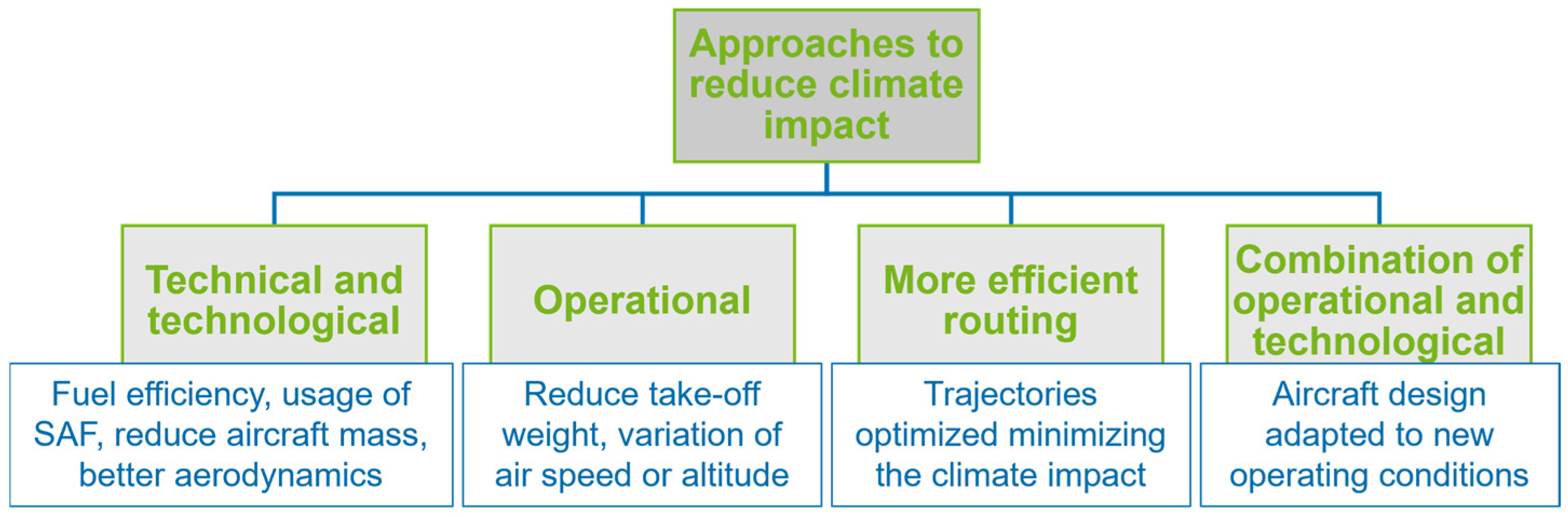
Grewe and Linke [13] aimed to compare different mitigation options with respect to their eco-efficiency, defined as the ratio of climate impact changes to cost increases, i.e., an indication of the overall potential to reduce the climate impact from aviation as well as the related costs. They provide a review of several approaches, considering findings from both research projects and works in the literature. Figure 4 reports a summary scheme of the reviewed approaches.
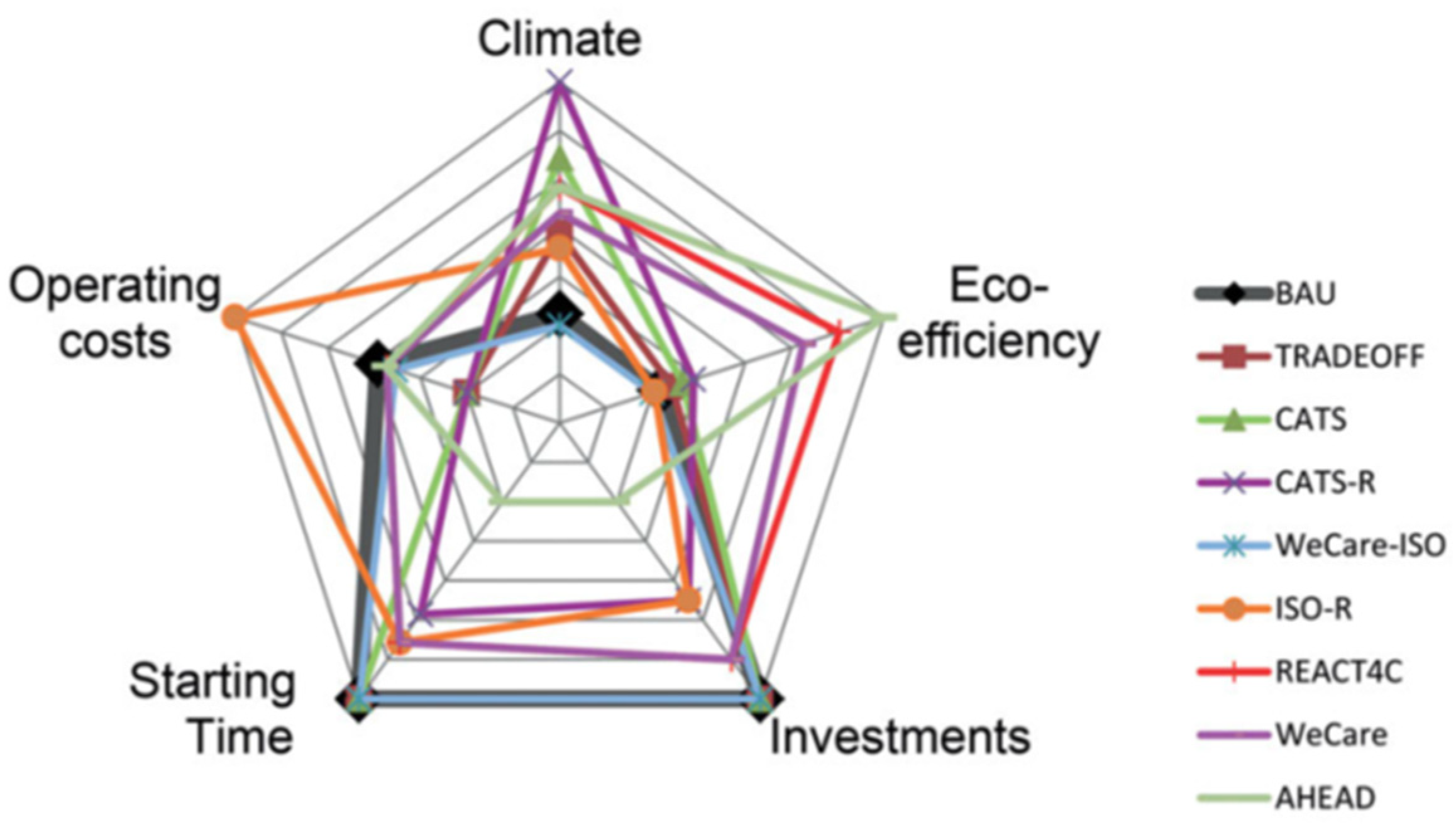
Numerous options to reduce aviation’s climate impact exist, but they are characterized by different frameworks, and their direct comparison is not trivial, due to several aspects in which they may differ. To overcome this issue, the authors proposed multi-dimensional diagrams, which can serve as a basis for decision-making, as they clearly outline the different aspects of individual mitigation options. An example diagram is reported in Figure 5, which includes five aspects and can compare results from several projects. The net’s area is indicative of the quality of a mitigation option because the most promising value is always at the endpoint of each axis.

5. Challenges and Gaps

Despite these advancements, several gaps remain. The complexity of non-CO2 emissions (such as contrail radiative forcing) still requires extensive research and more accurate predictive modelling. Furthermore, many proposed mitigation strategies involve increased costs or operational complexity, highlighting the need for robust cost–benefit analyses. The transition toward low-carbon fuels, hydrogen, or electric propulsion presents multiple challenges (technical, economic, operational, infrastructural, and regulatory) that span the entire aviation life cycle, from design to disposal, affecting both aircraft systems and operational practices. However, combining operational and technological options is not an easy task, as in some cases, both aspects are not compatible; furthermore, there are no data records to base this upon.
Key challenges include the following:
  • Uncertainty propagation: Climate responses vary across models and timescales, influencing the robustness of climate metrics.
  • Temporal and spatial dependence: Short-lived species (e.g., NOx, contrails) exert highly localized and time-dependent effects.
  • Metric selection: The choice of climate metrics can lead to markedly different policy implications.
  • Non-linear interactions: Feedback among emissions, atmospheric chemistry, and radiation complicates linear scaling assumptions.
  • Data availability and consistency: Limited observational datasets and heterogeneous emission inventories constrain model validation.
  • Meteorological conditions: To evaluate the environmental impacts in relation to experienced local meteo-conditions.
  • Integration into decision frameworks: Translating physical climate impacts into operational or economic terms remains a major challenge.
  • Scenario dependence: Climate metrics are sensitive to background climate states and future emission pathways.

6. Conclusions

In line with the perspective presented in the present work, in the opinion of the authors, Machine Learning (ML) techniques offer significant potential to enhance the prediction and management of greenhouse gas (GHG) emissions in aviation. Based on our assessment, by managing large and heterogeneous datasets, ML models can support accurate evaluations of emission trends, mitigation policy impacts, and airline operational efficiency. In particular, we consider Linear Regression models a solid foundation for estimating GHG emissions from flight data, while Multivariate Regression approaches allow the inclusion of multiple interacting factors, such as aircraft type, meteorological conditions, and flight routing, thus improving predictive performance. In our view, a key advantage of ML-based frameworks lies in their ability to be continuously updated with new operational and environmental data. This adaptability enables models to refine their accuracy over time, capturing the effects of evolving technologies, optimized flight operations, and novel regulatory contexts. According to our analysis, these methods can effectively support the evaluation of disruptive propulsion systems, including hybrid-electric and hydrogen-based configurations, by quantifying their potential environmental benefits.
Looking ahead, we believe that closer integration between ML tools and next-generation aircraft architecture will be essential for enabling data-driven decision-making pathways. At the same time, several ongoing international initiatives (BECOM, CICONIA, E-CONTRAIL) are addressing research toward more comprehensive climate-impact metrics that incorporate non-CO2 effects, aviation-induced meteorological changes, and climate-scale impact indicators. The convergence between these emerging metrics and the analytical capabilities of ML frameworks will help to establish a more rigorous methodological foundation, guiding technological innovation and strengthening mitigation strategies required to advance a sustainable and climate-resilient aviation sector.

Author Contributions

Conceptualization, E.B., A.L.Z. and V.V.; methodology, E.B., A.L.Z. and V.V.; writing—original draft preparation, E.B.; writing—review and editing, A.L.Z., V.V., L.T., M.A.S. and A.V.; supervision, A.V.; project administration, A.V.; funding acquisition, A.V. All authors have read and agreed to the published version of the manuscript.

Funding

This research was funded by the CLAIM Project, grant number 101140632, under the call HORIZON-JU-CLEAN-AVIATION-2023-02-CSA-01.

Institutional Review Board Statement

Not applicable.

Informed Consent Statement

Not applicable.

Data Availability Statement

No new data were created or analyzed in this study. Data sharing is not applicable to this article.

Acknowledgments

The authors wish to thank Pascal Bertram (DLR) and Volker Grewe (DLR) for the suggestions provided. Prajwal Shiva Prakasha (DLR) is acknowledged for the general support provided as coordinator of the CLAIM Project. CLAIM (Clean Aviation Support for Impact Monitoring) is supported by the Clean Aviation Joint Undertaking and its members.

Conflicts of Interest

The authors declare no conflicts of interest. The funders had no role in the design of the study; in the collection, analyses, or interpretation of data; in the writing of the manuscript; or in the decision to publish the results.

References

  1. Lee, D.; Fahey, D.; Skowron, A.; Allen, M.; Burkhardt, U.; Chen, Q.; Doherty, S.; Freeman, S.; Forster, P.; Fuglestvedt, J.; et al. The contribution of global aviation to anthropogenic climate forcing for 2000 to 2018. Atmos. Environ. 2021, 244, 117834. [Google Scholar] [CrossRef] [PubMed]
  2. Lee, D.; Pitari, G.; Grewe, V.; Gierens, K.; Penner, J.; Petzold, A.; Prather, M.; Schumann, U.; Bais, A.; Berntsen, T.; et al. Transport impacts on atmosphere and climate:Aviation. Atmos. Environ. 2010, 44, 4678–4734. [Google Scholar] [CrossRef] [PubMed]
  3. Boucher, O.; Borella, A.; Gasser, T.; Hauglustaine, D. On the contribution of global aviation to the CO2 radiative forcing of climate. Atmos. Environ. 2021, 267, 118762. [Google Scholar] [CrossRef]
  4. Dahlmann, K.; Grewe, V.; Matthes, S.; Yamashita, H. Climate assessment of single flights: Deduction of route specific equivalent CO2 emissions. Int. J. Sustain. Transp. 2023, 17, 29–40. [Google Scholar] [CrossRef]
  5. Grewe, V.; Stenke, A. AirClim: An efficient tool for climate evaluation of aircraft technology. Atmos. Chem. Phys. 2008, 8, 4621–4639. [Google Scholar] [CrossRef]
  6. Köhler, M.; Rädel, G.; Dessens, O.; Shine, K.; Rogers, H.; Wild, O.; Pyle, J. Impact of perturbations to nitrogen oxide emissions from global aviation. J. Geophys. Res. 2008, 13, D11. [Google Scholar] [CrossRef]
  7. Köhler, M.; Rädel, G.; Shine, K.P.; Rogers, H.L.; Pyle, J.A. Latitudinal variation of the effect of aviation NOx emissions on atmospheric ozone and methane and related climate metrics. Atmos. Environ. 2013, 64, 1–9. [Google Scholar] [CrossRef]
  8. Wilcox, L.J.; Shine, K.P.; Hoskins, B.J. Radiative forcing due to aviation water vapour emissions. Atmos. Environ. 2021, 63, 1–13. [Google Scholar] [CrossRef]
  9. Matthes, S.; Schumann, U.; Grewe, V.; Frömming, C.; Dahlmann, K.; Koch, A.; Mannstein, H. Climate optimized air transport. In Atmospheric Physics: Background—Methods—Trends; Schumann, U., Ed.; Springer: Berlin/Heidelberg, Germany, 2012. [Google Scholar]
  10. Grewe, V.; Frömming, C.; Matthes, S.; Brinkop, S.; Ponater, M.; Dietmüller, S.; Jöckel, P.; Garny, H.; Tsati, E.; Dahlmann, K.; et al. Aircraft routing with minimal climate impact: The REACT4C climate cost function modelling approach (V1.0). Geosci. Model Dev. 2014, 7, 175–201. [Google Scholar] [CrossRef]
  11. Grewe, V.; Matthes, S.; Frömming, C.; Brinkop, S.; Jöckel, P.; Gierens, K.; Champougny, T.; Fuglestvedt, J.; Haslerud, A.; Irvine, E.; et al. Climate-optimized air traffic routing for trans-Atlantic flights. Environ. Res. Lett. 2017, 12, 034003. [Google Scholar] [CrossRef]
  12. Proesmans, P.; Vos, R. Airplane Design Optimization for Minimal Global Warming Impact. J. Aircr. 2022, 59, 1363–1381. [Google Scholar] [CrossRef]
  13. Grewe, V.; Linke, F. Eco-efficiency in aviation. Meteorol. Z. 2017, 26, 689–696. [Google Scholar] [CrossRef]
Figure 1. Roadmap for implementing climate-optimized routing. Research and implementation activities are indicated in the blue and orange boxes, respectively. Validation activities are marked in green. From Grewe et al. (2017) [11].
Engproc 133 00014 g001
Figure 2. Top-view comparison of aircraft optimized for three different objectives. From Proesmans and Vos (2022) [12].
Engproc 133 00014 g002
Figure 3. Sketch of the concept of charging climate-sensitive areas (from https://www.climop-h2020.eu/wp-content/uploads/2023/11/D3.3-FINAL_Nov23.pdf, accessed on 11 June 2025).
Engproc 133 00014 g003
Figure 4. Summary scheme of the approaches to reduce the climate impact of aviation reviewed in Grewe and Linke (2017) [13].
Engproc 133 00014 g004
Figure 5. Multi-dimensional presentation of different mitigation options. From Grewe and Linke (2017) [13].
Engproc 133 00014 g005
Disclaimer/Publisher’s Note: The statements, opinions and data contained in all publications are solely those of the individual author(s) and contributor(s) and not of MDPI and/or the editor(s). MDPI and/or the editor(s) disclaim responsibility for any injury to people or property resulting from any ideas, methods, instructions or products referred to in the content.