Curved Shear Panel Theory as an Enabler for Gradient-Based Wing Optimization †

Abstract
1. Introduction
2. Materials and Methods
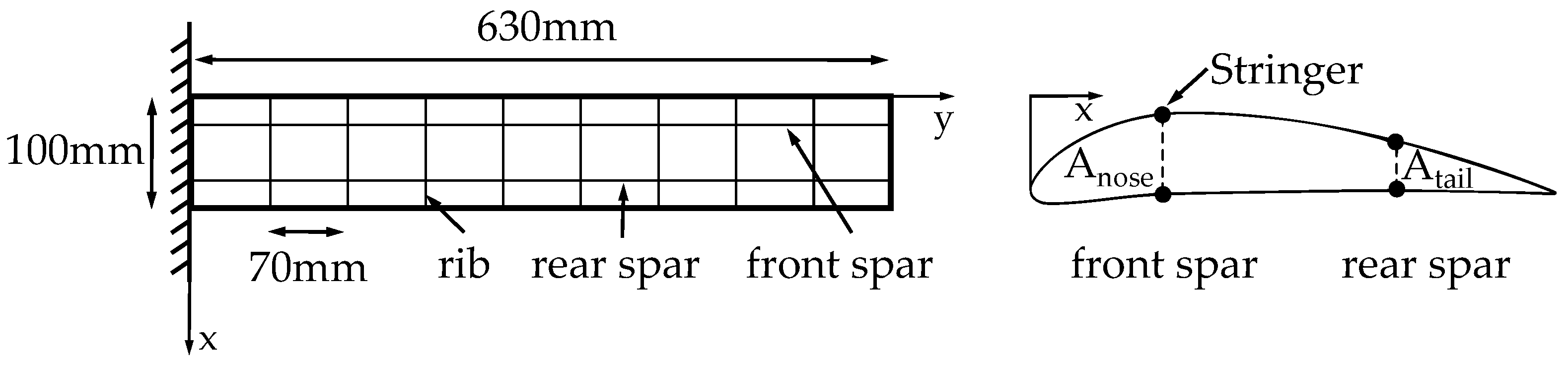
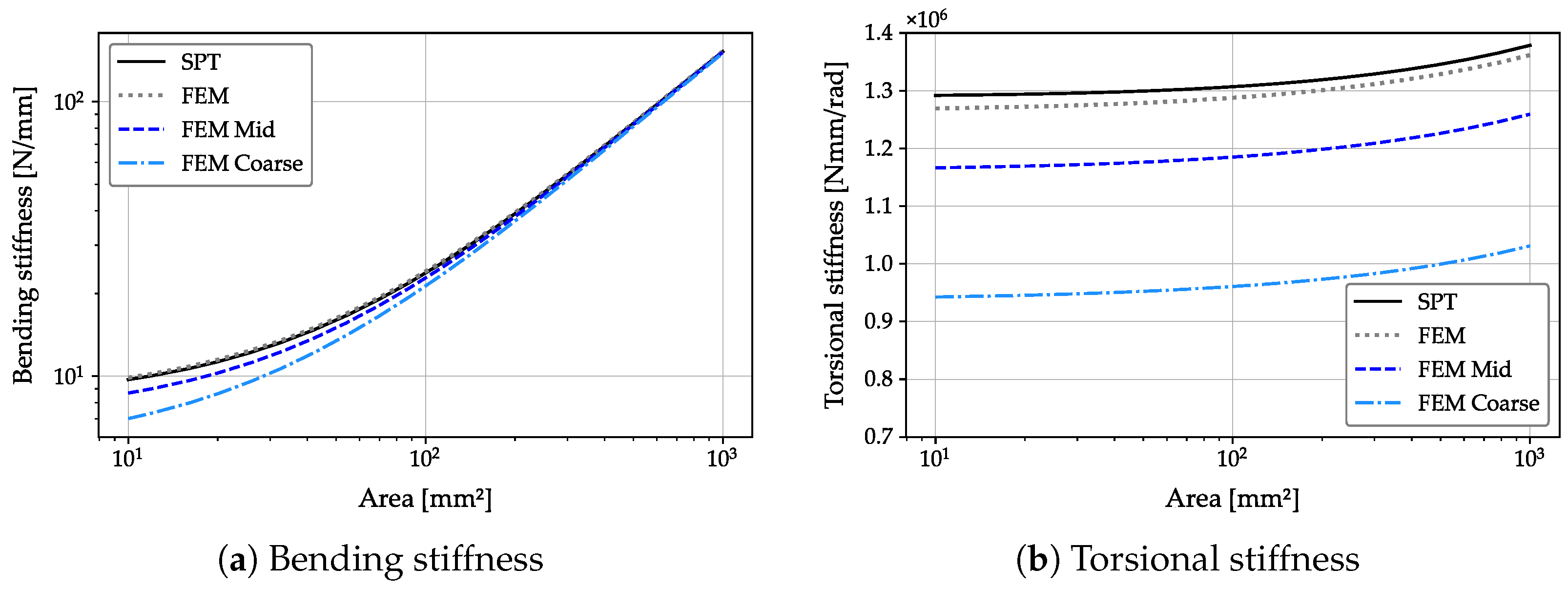
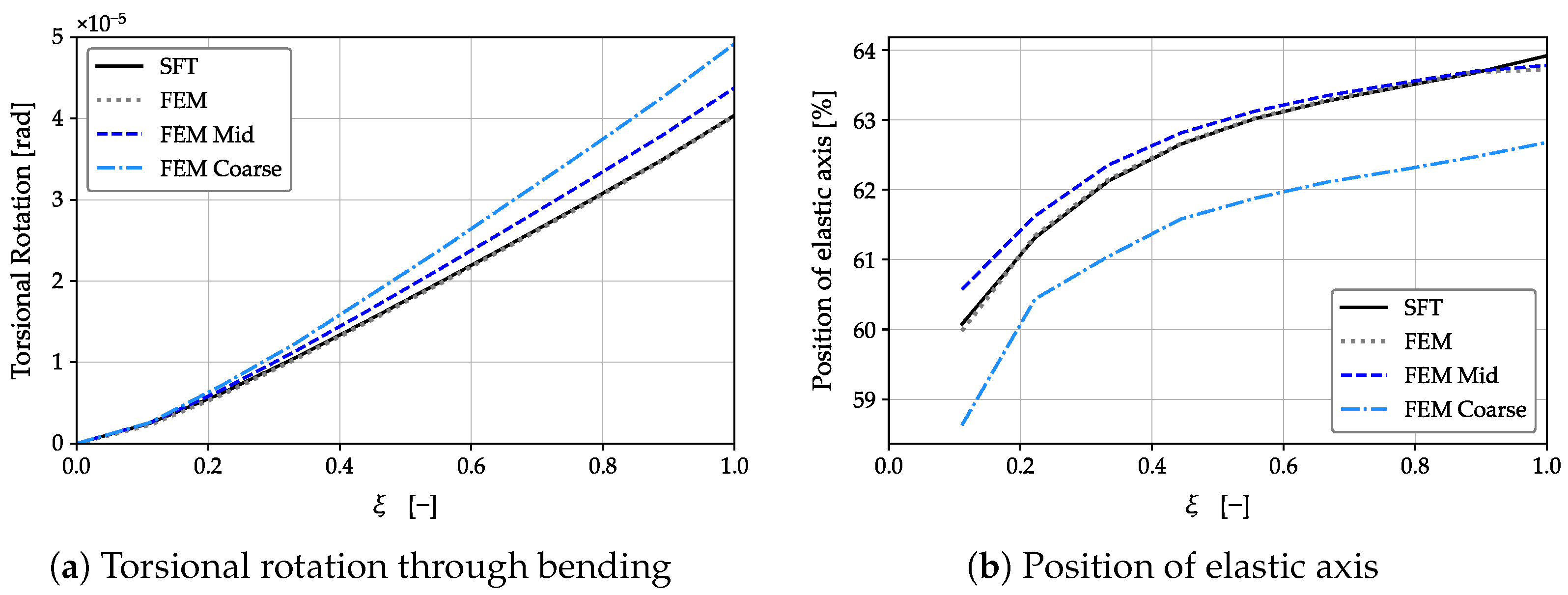
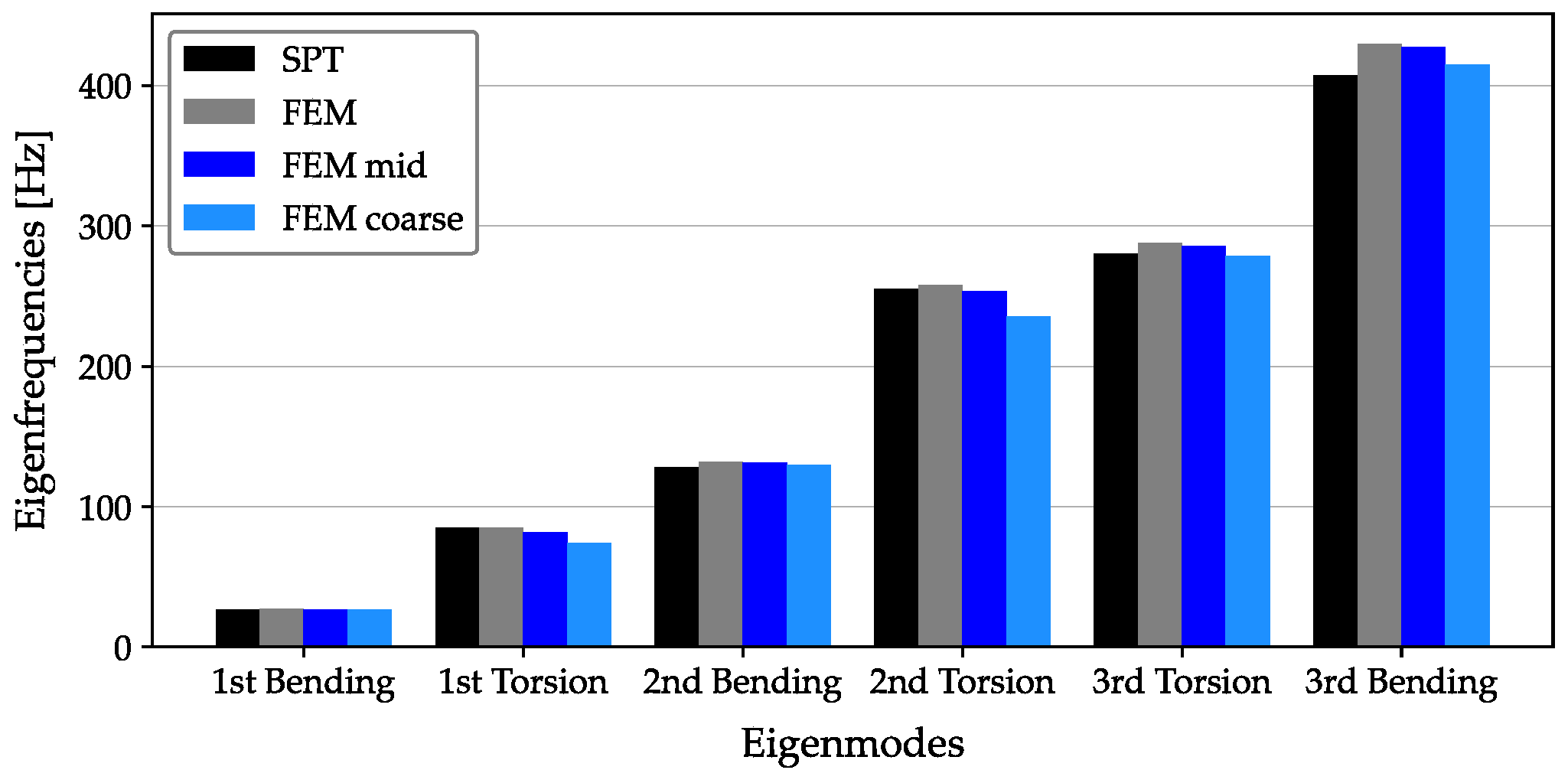
- A curved SPT model;
- A detailed FEM model serving as reference;
- A medium-mesh size FEM model;
- A coarse-mesh size FEM model.
3. Results and Discussion
4. Conclusions
Author Contributions
Funding
Institutional Review Board Statement
Informed Consent Statement
Data Availability Statement
Conflicts of Interest
Abbreviations
| FEM | Finite Element Method. |
| SPT | Shear Panel Theory. |
| VABS | Variational Asymptotic Beam Sectional Analysis. |
References
- Parolin, G.; Borges, A.T.; Santos, L.C.; Borille, A.V. A tool for aircraft eco-design based on streamlined Life Cycle Assessment and Uncertainty Analysis. Procedia CIRP 2021, 98, 565–570. [Google Scholar] [CrossRef]
- Lyssakow, P.; Krause, M.; Friedrich, L.; Schröder, K.-U. Towards a coupled structural and economical design procedure of unstiffened isotropic shell structures. Thin-Walled Struct. 2019, 145, 106416. [Google Scholar] [CrossRef]
- Lyssakow, P.; Yang, J.; Krause, M.; Schröder, K.-U. Analysis of mass and cost drivers of unstiffened isotropic shell structures considering their imperfection sensitivity. Thin-Walled Struct. 2021, 159, 107221. [Google Scholar] [CrossRef]
- Roudbarian, N.; Isfahani, A.; Kettenhofen, L.; Schröder, K.-U. Model-Based Systems Engineering for Sustainable Modular Design: Integrating Design, Manufacturing Operations, and Component Functionality. In Proceedings of the 2025 IEEE Conference on Technologies for Sustainability (SusTech), Los Angeles, CA, USA, 20–23 April 2025. [Google Scholar] [CrossRef]
- Försching, H.W. Grundlagen der Elastomechanik. In Grundlagen der Aeroelastik; Springer: Berlin/Heidelberg, Germany, 1974. [Google Scholar]
- Wright, J.R.; Cooper, J.E. Introduction to Aircraft Aeroelasticity and Loads; John Wiley & Sons: Chichester, UK, 2008. [Google Scholar]
- Schumacher, A. Optimierung mechanischer Strukturen: Grundlagen und industrielle Anwendungen; Springer: Berlin/Heidelberg, Germany, 2005. [Google Scholar]
- Francois, G.; Cooper, J.E.; Weaver, P.M. Impact of the Wing Sweep Angle and Rib Orientation on Wing Structural Response for Un-Tapered Wings. In Proceedings of the 57th AIAA/ASCE/AHS/ASC Structures, Structural Dynamics, and Materials Conference, San Diego, CA, USA, 4–8 January 2016. [Google Scholar]
- Chan, Y.N.; Harmin, M.Y.; Othman, M.S. Parametric Study of Varying Ribs Orientation and Sweep Angle of Un-Tapered Wing Box Model. Int. J. Eng. Technol. 2018, 7, 155–159. [Google Scholar] [CrossRef]
- Romli, A.I.; Harmin, M.Y.; Ujang, M.S.O. Parametric Study on the Flutter Characteristics of a Simple Rectangular Wing-Box Model with Varying Ribs Orientation. Int. J. Pure Appl. Math. 2018, 119, 3771–3777. [Google Scholar]
- Harmin, M.Y.; Ahmed, A.T.; Cooper, J.E.; Bron, F. Aeroelastic Tailoring of Metallic Wing Structures. In Proceedings of the 52nd AIAA/ASME/ASCE/AHS/ASC Structures, Structural Dynamics, and Materials Conference, Denver, CO, USA, 4–7 April 2011. Paper AIAA 2011-1712. [Google Scholar] [CrossRef]
- Richstein, R.; Schröder, K.-U. Characterizing the Digital Twin in Structural Mechanics. Designs 2024, 8, 8. [Google Scholar] [CrossRef]
- Giencke, E. Über die Berechnung von Flugkonstruktionen. In Jahrbuch 1964 der Wissenschaftlichen Gesellschaft für Luft- und Raumfahrt; Vieweg & Sohn: Braunschweig, Germany, 1965; pp. 94–108. [Google Scholar]
- Medeiros, R.R.; Cesnik, C.E.S.; Stodieck, O.; Calderon, D.E.; Cooper, J.E.; Coetzee, E.B. Comparison of structural model reduction methods applied to a large-deformation wing box. Aeronaut. J. 2021, 125, 1687–1709. [Google Scholar] [CrossRef]
- Ibrahim, H.S.; Harmin, M.Y.; Romli, F.I.; Mohd Harithuddin, A.S. Investigation of Equivalent Reduced Order Models for Flutter Analysis of Various Wing Plate Configurations. J. Aeronaut. Astronaut. Aviat. 2025, 57, 801–814. [Google Scholar]
- Malcolm, D.J.; Laird, D.L. Extraction of Equivalent Beam Properties from Blade Models. Wind Energy 2007, 10, 135–157. [Google Scholar] [CrossRef]
- Yu, W.; Volovoi, V.V.; Hodges, D.H.; Hong, X. Validation of the Variational Asymptotic Beam Sectional Analysis. AIAA J. 2002, 40, 2105–2112. [Google Scholar] [CrossRef] [PubMed]
- Guyan, R.J. Reduction of stiffness and mass matrices. AIAA J. 1965, 3, 380. [Google Scholar] [CrossRef] [PubMed]
- Craig, R.R., Jr.; Bampton, M.C.C. Coupling of Substructures for Dynamic Analyses. AIAA J. 1968, 6, 1313–1319. [Google Scholar] [CrossRef] [PubMed]
- Kurrer, K.-E. The History of the Theory of Structures: From Arch Analysis to Computational Mechanics; Ernst: Berlin, Germany, 2008. [Google Scholar]
- Hoogenboom, P.C.J.; Blaauwendraad, J. Quadrilateral shear panel. Eng. Struct. 2000, 22, 1690–1698. [Google Scholar] [CrossRef]
- Curtis, H.D.; Greiner, G.P. A stress-based quadrilateral shear panel. Finite Elem. Anal. Des. 1996, 21, 159–178. [Google Scholar] [CrossRef]
- Chen, H.C. A simple quadrilateral shear panel element. Commun. Appl. Numer. Methods 1992, 8, 1–7. [Google Scholar] [CrossRef]
- Bäß, M.; Schröder, K.-U. Simply Curved Shear Panel Theory in Three-Dimensional Space. Aerospace 2026, 13, 26. [Google Scholar] [CrossRef]
- Stodieck, O.; Cooper, J.E.; Weaver, P.M. Interpretation of bending/torsion coupling for swept, nonhomogenous wings. J. Aircr. 2016, 53, 892–899. [Google Scholar] [CrossRef][Green Version]



| Model | Approx. Global Element Size [mm] | Number of Elements | Number of Nodes | Degrees of Freedom |
|---|---|---|---|---|
| SPT | - | 140 | 40 | 120 |
| FEM | 1.75 | 49,836 | 47,092 | 282,552 |
| FEM mid | 20 | 784 | 501 | 3006 |
| FEM coarse | 100 | 186 | 80 | 480 |
Disclaimer/Publisher’s Note: The statements, opinions and data contained in all publications are solely those of the individual author(s) and contributor(s) and not of MDPI and/or the editor(s). MDPI and/or the editor(s) disclaim responsibility for any injury to people or property resulting from any ideas, methods, instructions or products referred to in the content. |
© 2026 by the authors. Licensee MDPI, Basel, Switzerland. This article is an open access article distributed under the terms and conditions of the Creative Commons Attribution (CC BY) license.
Share and Cite
Bäß, M.; Kettenhofen, L.; Schröder, K.-U. Curved Shear Panel Theory as an Enabler for Gradient-Based Wing Optimization. Eng. Proc. 2026, 133, 110. https://doi.org/10.3390/engproc2026133110
Bäß M, Kettenhofen L, Schröder K-U. Curved Shear Panel Theory as an Enabler for Gradient-Based Wing Optimization. Engineering Proceedings. 2026; 133(1):110. https://doi.org/10.3390/engproc2026133110
Chicago/Turabian StyleBäß, Moritz, Lukas Kettenhofen, and Kai-Uwe Schröder. 2026. "Curved Shear Panel Theory as an Enabler for Gradient-Based Wing Optimization" Engineering Proceedings 133, no. 1: 110. https://doi.org/10.3390/engproc2026133110
APA StyleBäß, M., Kettenhofen, L., & Schröder, K.-U. (2026). Curved Shear Panel Theory as an Enabler for Gradient-Based Wing Optimization. Engineering Proceedings, 133(1), 110. https://doi.org/10.3390/engproc2026133110