Proceeding Paper

A Rapid Stress Retrieval Approach for Long-Fiber Angle-Ply Laminates Using the RBF Kansa Method †

Department of Engineering Enterprise “Mario Lucertini”, University of Rome Tor Vergata, 00133 Rome, Italy
*
Author to whom correspondence should be addressed.
Presented at the 54th Conference of the Italian Scientific Society of Mechanical Engineering Design (AIAS 2025), Florence, Italy, 3–6 September 2025.
Eng. Proc. 2026, 131(1), 34; https://doi.org/10.3390/engproc2026131034
Published: 22 April 2026

Abstract

Building on a previous work presented by the authors, this study extends a fast stress retrieval method to long-fiber angle-ply laminates subjected to constant bending and torque moments. The fiber/matrix interface stress state is efficiently estimated using global deformation data obtained from a finite element analysis performed on a coarse model, potentially employing a homogenized material. Radial basis functions (RBFs) are utilized to bridge the macroscale and microscale, enabling the extraction of appropriate boundary conditions at the representative volume element (RVE) level. A collocation-based Kansa method, also leveraging RBF, is then applied to a carefully selected set of points to determine the local stress distribution. The accuracy of the proposed approach is assessed by comparing its results with high-fidelity FEM sub-modeling.

1. Introduction

Fiber-reinforced composites (FRCs) consist of two main components: strong, load-bearing fibers and a softer matrix [1]. While the fibers provide superior mechanical performance, the matrix plays a crucial role in binding them into the desired orientation and shape while protecting them from external factors. Together, these phases create a material that can outperform traditional structural metals [2]. The high strength-to-weight and stiffness-to-weight ratios of FRCs make them highly attractive across various applications, particularly in sectors such as automotive and aerospace, where reducing mass is critical [3]. Despite their promising potential, the adoption of FRCs is often hindered by inherent complexities. Their generally anisotropic mechanical behavior, heterogeneous composition, and complex stress states arising at the microscale pose significant challenges during the design phase. The employment of the Finite Element Method (FEM) is a common strategy for intricate structural analyses; however, in the case of FRCs, the stress state inside the laminate can be reliably retrieved only if the whole microstructure is modelled in detail [4], which is computationally very expensive. As an alternative, a sub-modelling approach can be employed [5], where a highly refined model of a representative portion is driven by displacement inputs from a coarser global model. This strategy, however, introduces the added complexity of managing two models and ensuring accurate data transfer between them, which becomes complicated when coupling different dimensionalities.
In the context of discretization, meshless methods were first introduced by Lucy in the 1970s [6] and have since been applied across various areas of physics and engineering, including studies on composite materials [7,8,9]. Their potential advantages are notable: they enable the solution of complex systems of partial differential equations (PDEs) without requiring a predefined grid while producing results expressed as analytical functions that are continuous over the domain and readily scalable. A possible candidate function for the analytical base of meshless methods is the Radial Basis Function (RBF). RBFs have demonstrated remarkable versatility across numerous applications. When coupled with FEM, they help overcome the discrete nature of the numerical grid, enabling a smoother and more continuous representation of stress distributions [10]. In other cases, RBFs have been employed to enforce local equilibrium, thereby enhancing the accuracy of coarse and computationally efficient FEM models in capturing various types of singularities [11,12].
In this study, we extend the approach of [1], which was restricted to cross-plies, to long-fiber angle-plies with general fiber orientations. The proposed method adopts a two-scale strategy that combines RBF interpolation with the Kansa method to address both the macroscale and microscale behavior of an angle-ply laminate. Its objective is to provide a reliable representation of the stress state at the fiber–matrix interface, which plays an important role in the onset of debonding [13]. The required inputs are the displacement field at the composite’s neutral plane and the laminate composition.

1.1. RBF Interpolation

RBFs were originally introduced in the field of multidimensional interpolation, when an analytical approximation is built upon a set of scattered values given at points, in a generic multidimensional space. Points where values are inputs are called source points, while points where values are to be found are referred to as target points. The RBF interpolant takes the form:
s ( x ) = i = 1 N γ i φ ( x x i )
where N is the number of source points, x i denotes the i-th source point, x is the target point, γ i are interpolation weights, and φ is the chosen radial basis function, whose argument is the Euclidean distance between points. Table 1 reports the most common RBFs, where r = x x i and ϵ is a shape parameter. In the case of the Generalized Multiquadratic function, the parameters R and p can be tuned to suit the specific problem.
The weights γ i derive from the solution of a linear system that enforces the condition that the interpolant reproduces the prescribed values g i at the source points. In matrix form, this condition can be written as
M γ = g
where M is the interpolation matrix, with its i-th row containing the radial basis functions evaluated between all source points and the i-th source point, γ is the vector of unknown weights and g is the vector of input values.
In some cases, the interpolant in (1) is augmented with a polynomial term:
s ( x ) = i = 1 N γ i φ ( x x i ) + h ( x )
This extension allows the exact reproduction of functions of the same form as h ( x ) . To preserve the square structure of the linear system in (2), an additional orthogonality condition is imposed [14].
RBFs have demonstrated remarkable versatility, yielding robust results in a wide range of applications, including mesh morphing [15,16], image analysis [17], data transfer [18], and optimization [19], among others. For a more comprehensive discussion, the reader is referred to the relevant literature [20].

1.2. Kansa Method

The Kansa method [21,22] belongs to the family of collocation methods [23], which provide approximate solutions to systems of PDEs by enforcing exact satisfaction of the equations at selected points within the problem domain. It is based on RBF interpolation and leverages the fact that most RBFs can be recursively differentiated. The domain is discretized into collocation points, while the unknown functions are approximated using an RBF expansion as in (1). The governing differential equations are then imposed at each collocation point, typically with distinct formulations for interior points and boundary points. Thanks to the analytical form of RBFs, differential operators can be applied directly to the interpolant. This leads to a single linear system, where the unknowns are the interpolation weights, and its solution yields the approximate solution of the original PDE problem.
The Kansa method has been successfully applied to a wide range of engineering problems, including heat transfer [24] and continuum mechanics [25]. In [26], it was specifically employed to evaluate the stress distribution through the thickness of a layered laminate.

2. Numerical Method

The proposed method employs a two-scale approach to analyze the composite. In the first step, the laminate is modeled as a homogeneous body, disregarding its internal structure. The second step addresses the microscale by evaluating the 2D stress state within the representative volume element (RVE), subject to boundary conditions that simulate its embedding in a 3D domain. Both steps rely on RBFs: in the first, the global displacement field at the neutral mid-plane is interpolated using RBFs, while in the second, the Kansa method uses RBFs as approximation functions to resolve the local stress state.

2.1. Macroscale

The method uses as input the displacement field at the laminate neutral plane, independent of its source—whether obtained from a simplified FEM model with a coarse solid mesh, from shell elements with homogenized material [27], or reasonably postulated based on design requirements. Since each angle-ply layer has its own local coordinate system, with the x-axis aligned with the fibers and the z-axis along the thickness, which may not coincide with the global system, a rotation matrix is applied to both the displacement field and the point coordinates. This ensures that all data are expressed in the layer-specific coordinate system. Denoting by θ the generic ply angle (positive for counterclockwise rotation about the z-axis), the rotation matrix is defined as:
R = [ cos θ sin θ sin θ cos θ ]
The displacements, once expressed in the local coordinate system, are interpolated using RBFs, resulting in an analytical representation suitable for differentiation. Together with the corresponding coordinates, these displacements provide the inputs required to compute the Green–Lagrange strain tensor at the laminate point (x, y) where the RVE under investigation is located. In the following, we outline well-established geometrical operations, whose theoretical foundations are detailed in the relevant literature (e.g., [28]) and recalled in [1]. Throughout, we adopt the same convention, denoting quantities associated with the undeformed (reference) configuration by uppercase letters and those related to the deformed (current) configuration by lowercase letters.
We introduce the mid-plane displacement field:
D = { U V W } ,
assuming that segments initially normal to the mid-plane remain normal after deformation, the deformed coordinates of a point yield:
{ x y z } = { X Y 0 } + { U V W } + n · Z
where n is the unitary vector normal to the actual mid-plane.
The deformation gradient F is given by
F = [ ( 1 + U X ) U Y U Z V X ( 1 + V Y ) V Z W X W Y ( 1 + W Z ) ]
and the vector n is obtained by normalizing to unity the cross product of the first two columns of F .
The Green–Lagrange strain tensor follows as
E = 1 2 ( F T F I )
where I denotes the identity matrix. Each component of E is a polynomial in Z, containing at least terms up to first order. Coefficients of these polynomials will be employed in the procedure dealing with the microscale.

2.2. Microscale

At this stage, the Kansa method is applied to a set of points distributed according to the 2D representation of the RVE, modeled here as a square matrix with a circular fiber at its center. We recall that the local x-axis is aligned with the fiber direction, while the z-axis corresponds to the thickness. The partial differential equations forming the basis of the Kansa method are those of equilibrium in strong form, reported below:
σ x x + τ x y y + τ x z z = 0 τ x y x + σ y y + τ y z z = 0 τ x z x + τ y z y + σ z z = 0
Since each phase is continuous along the x-axis, whereas in the transverse yz-plane the matrix continuity is repeatedly interrupted by the fibers, derivatives with respect to x are assumed negligible, and Equation (9) reduces to:
τ x y y + τ x z z = 0
σ y y + τ y z z = 0
τ y z y + σ z z = 0
Let us recall the constitutive stiffness relations for a generic orthotropic material:
{ σ x σ y σ z τ y z τ x z τ x y } = [ C 11 C 12 C 13 0 0 0 C 12 C 22 C 23 0 0 0 C 13 C 23 C 33 0 0 0 0 0 0 C 44 0 0 0 0 0 0 C 55 0 0 0 0 0 0 C 66 ] { ε x ε y ε z γ y z γ x z γ x y }
By establishing a local coordinate system at the RVE level, we define the local displacement vector { u v w } T . Under the small deformation assumption, the corresponding strain components are expressed as:
ε x = u x
ε y = v y
ε z = w z
γ y z = v z + w y
γ x z = u z + w x
γ x y = u y + v x
By substituting Equations (14)–(19) into Equation (13), Equations (10)–(12) can be reformulated in terms of the partial derivatives of the displacement and the mechanical properties of the material, under the assumption that each phase is homogeneous. The deformation along the fiber direction is obtained from the Green–Lagrange strain tensor, truncating E 11 at the linear term:
ε x = k x · ( z z m ) + ε x , m
where z m : the coordinate of the neutral plane. From Equations (11) and (12), one obtains
C 22 2 v y 2 + ( C 23 + C 44 ) 2 w y z + C 44 2 v z 2 = 0
C 44 2 w y 2 + ( C 23 + C 44 ) 2 v y z + C 33 2 w z 2 = C 13 · k x
Equation (10) yields:
C 66 y ( u y + v x ) + C 55 z ( u z + w x ) = 0
where derivatives in x can be neglected. We further introduce the primitive function F ( y , z ) , defined such that
F y = v x F z = w x
And, owing to kinematic considerations [1], it follows that
2 F y z = 1 2 k x y
where k x y denotes the coefficient associated with the linear term in E 12 .
Equations (21) and (22) form a system for determining v and w , Equation (23) together with Equation (25) allows for the determination of u and F .

Boundary Conditions

Figure 1 shows the point distribution within the matrix and the fiber. Nodes are evenly spaced along the outer edges of the matrix and coincide with those of the fiber at the interface between the two phases. The number of nodes along the external edges of the matrix are Ny+ = Ny− = Ny and Nz+ = Nz− = Nz for the y and z directions, respectively. The four corner points—indicated with P1, P2, P3 and P4—are excluded from the edges. The number of internal points within the matrix and fiber domains are Nim and Nif, respectively, while the number of boundary nodes at the common interface is denoted by Nb.
The boundary conditions required to correctly simulate the stress response of the RVE, as if embedded in a 3D composite, are summarized in Table 2 and Table 3 for the two distinct PDE systems. Here, y is the horizontal spacing between points along the upper and lower edges.
Equations (26)–(29) impose displacements at the corner points. Equations (30)–(33) enforce the average strain value and the periodicity condition of the deformation along the y-direction. Equations (34)–(37) ensure that the resultant forces on the vertical edges of the RVE vanish. Equations (38)–(41) impose continuity of displacement and forces across the matrix-fiber interface.
For the second system, Equations (42)–(45) impose the strain values along the lower edge of the RVE. Equations (46) and (52) enforce the vanishing of the average ε y and ε z strain components, respectively. Periodicity conditions are introduced through Equations (47)–(49) and (53). Equations (50) and (51) again set the resultant forces on the vertical edges equal to zero, and Equations (55)–(57) enforce continuity of displacements and forces at the matrix-fiber interface.

3. Results

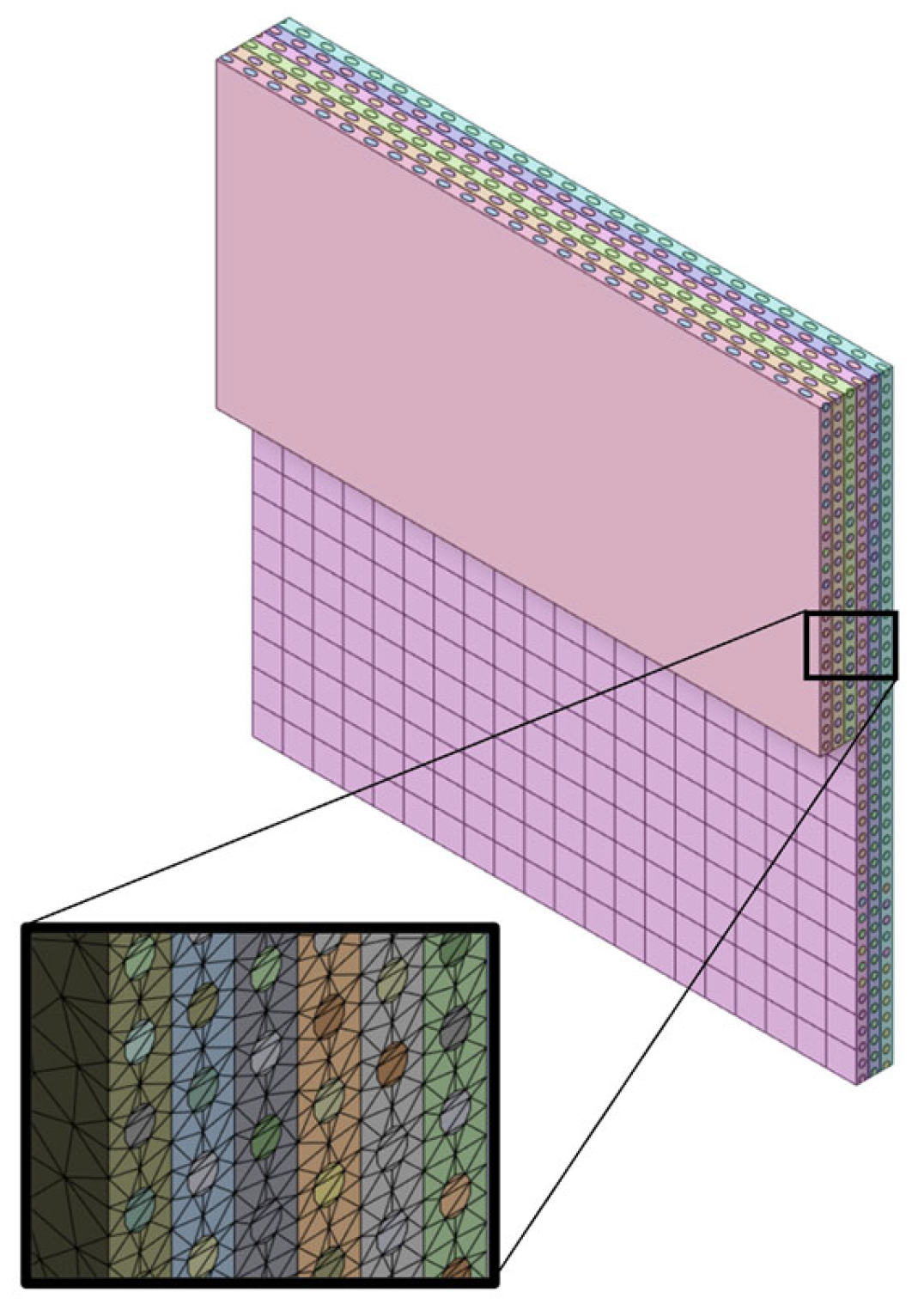
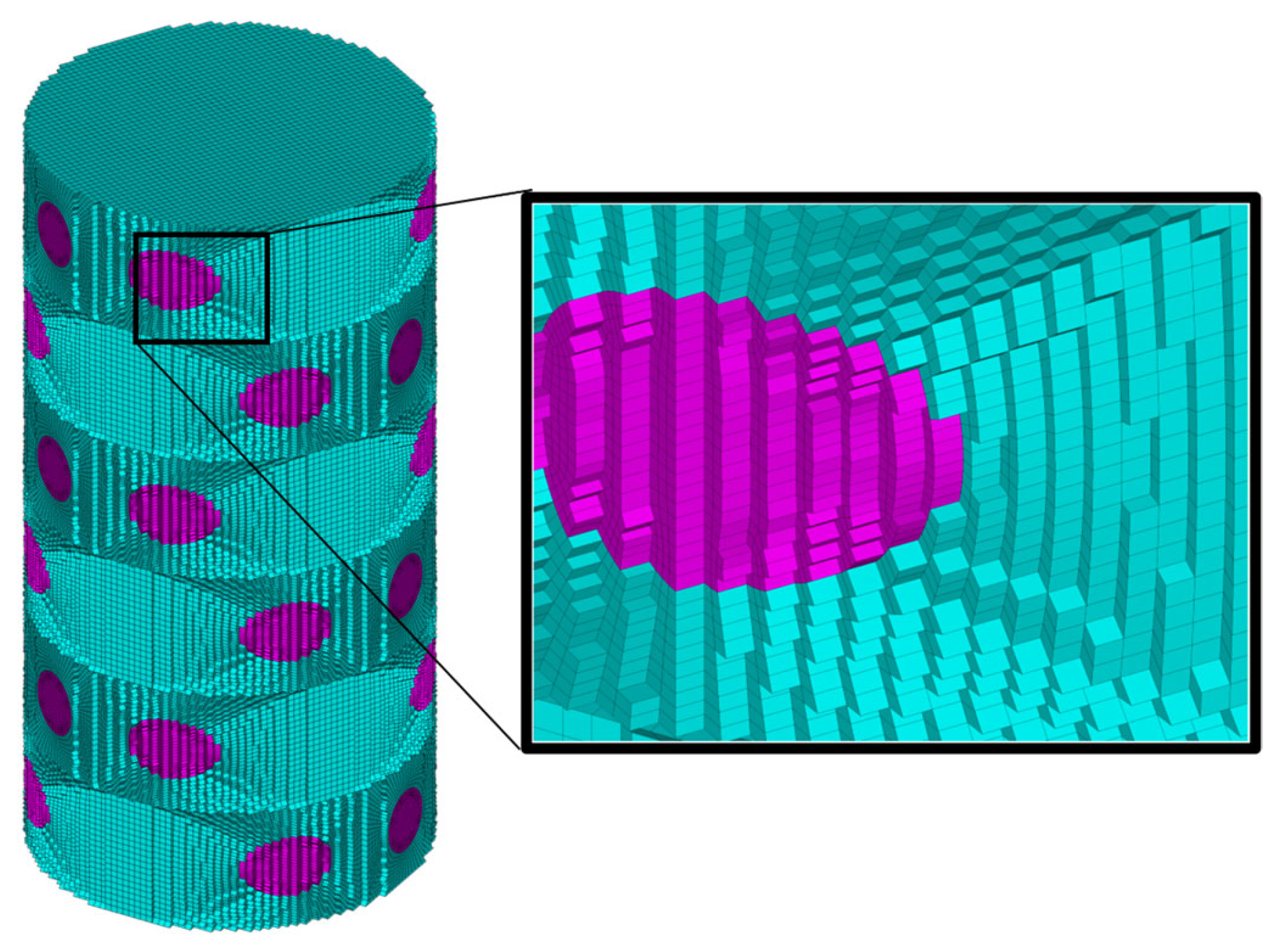
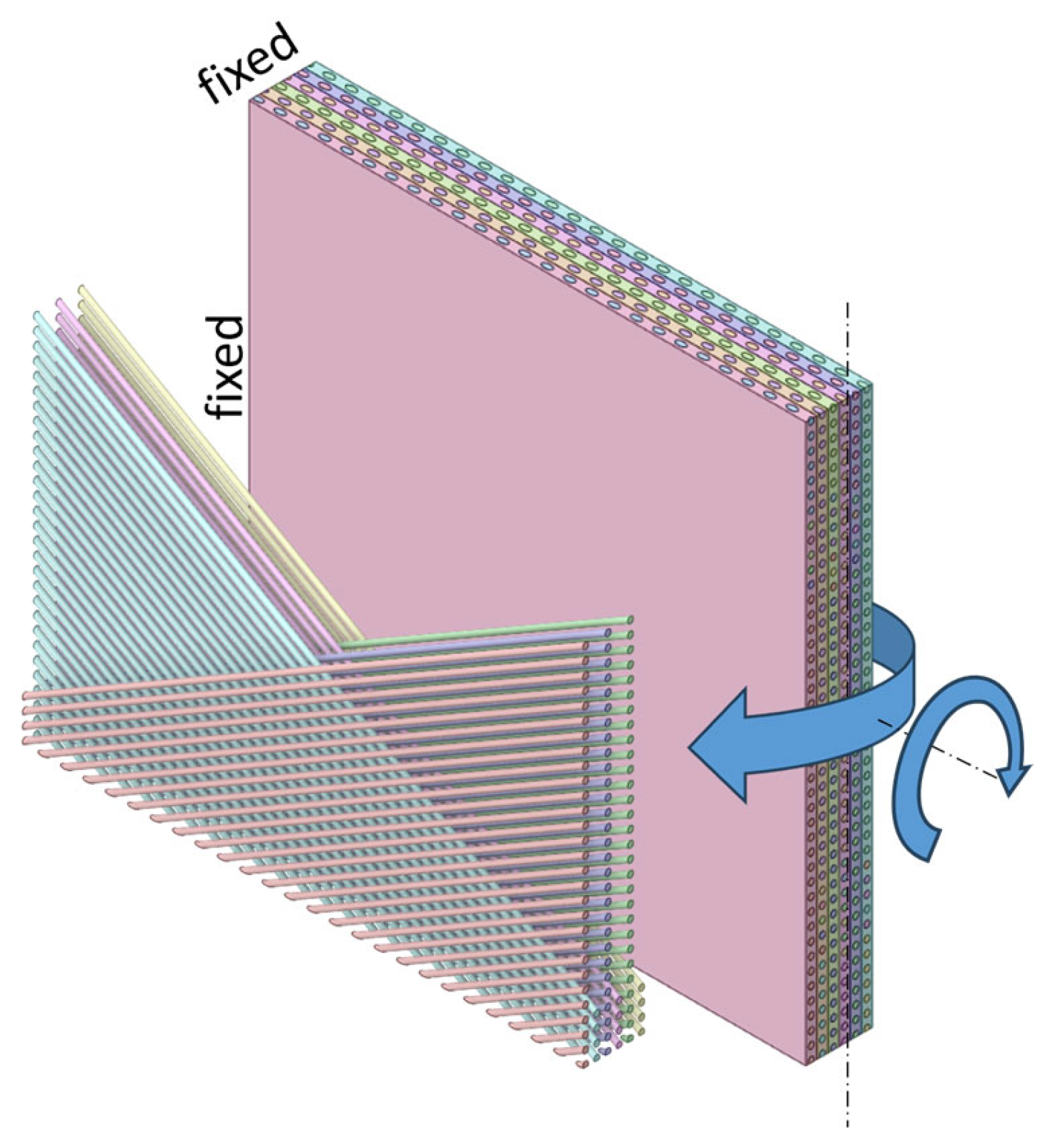
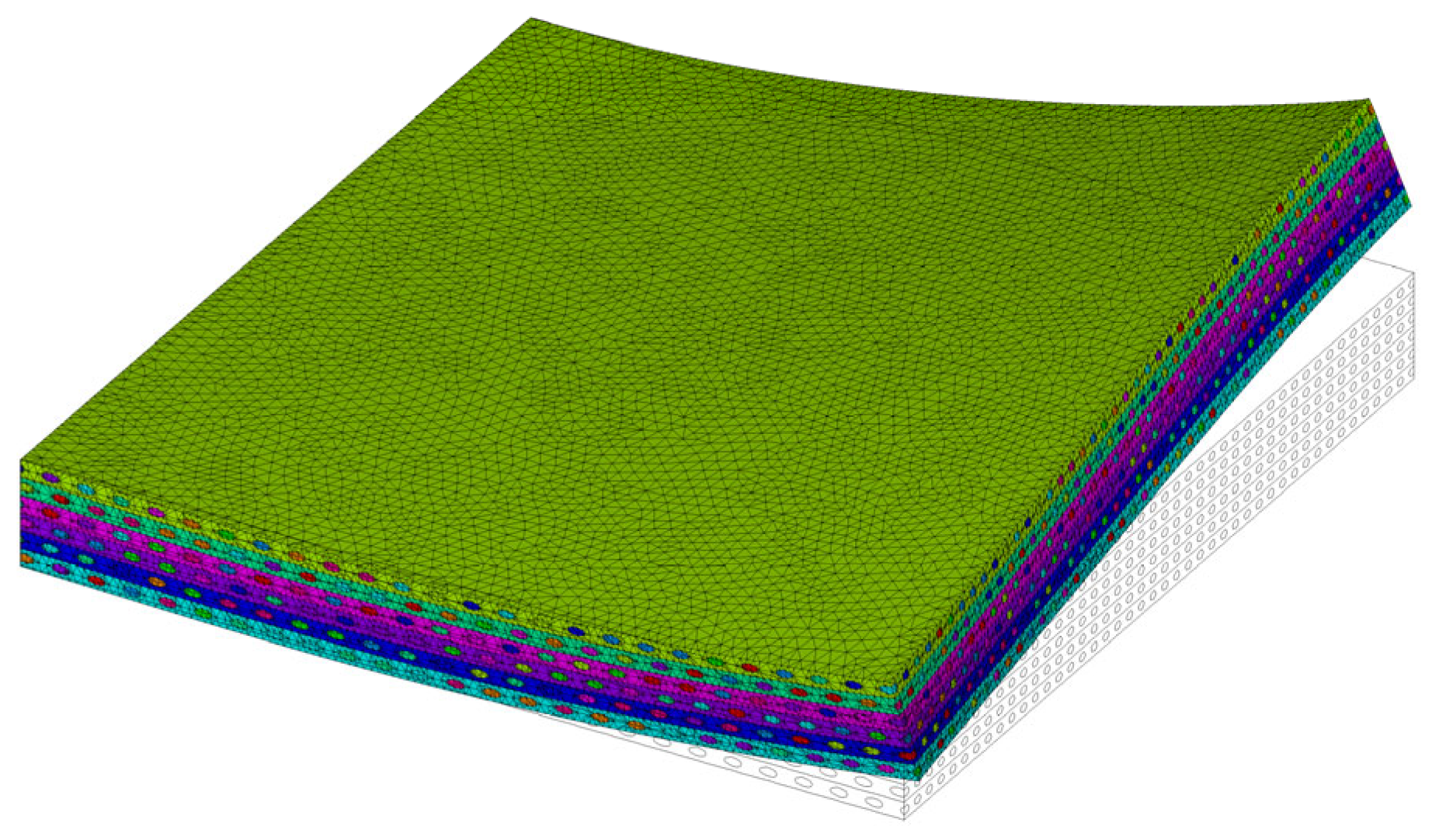
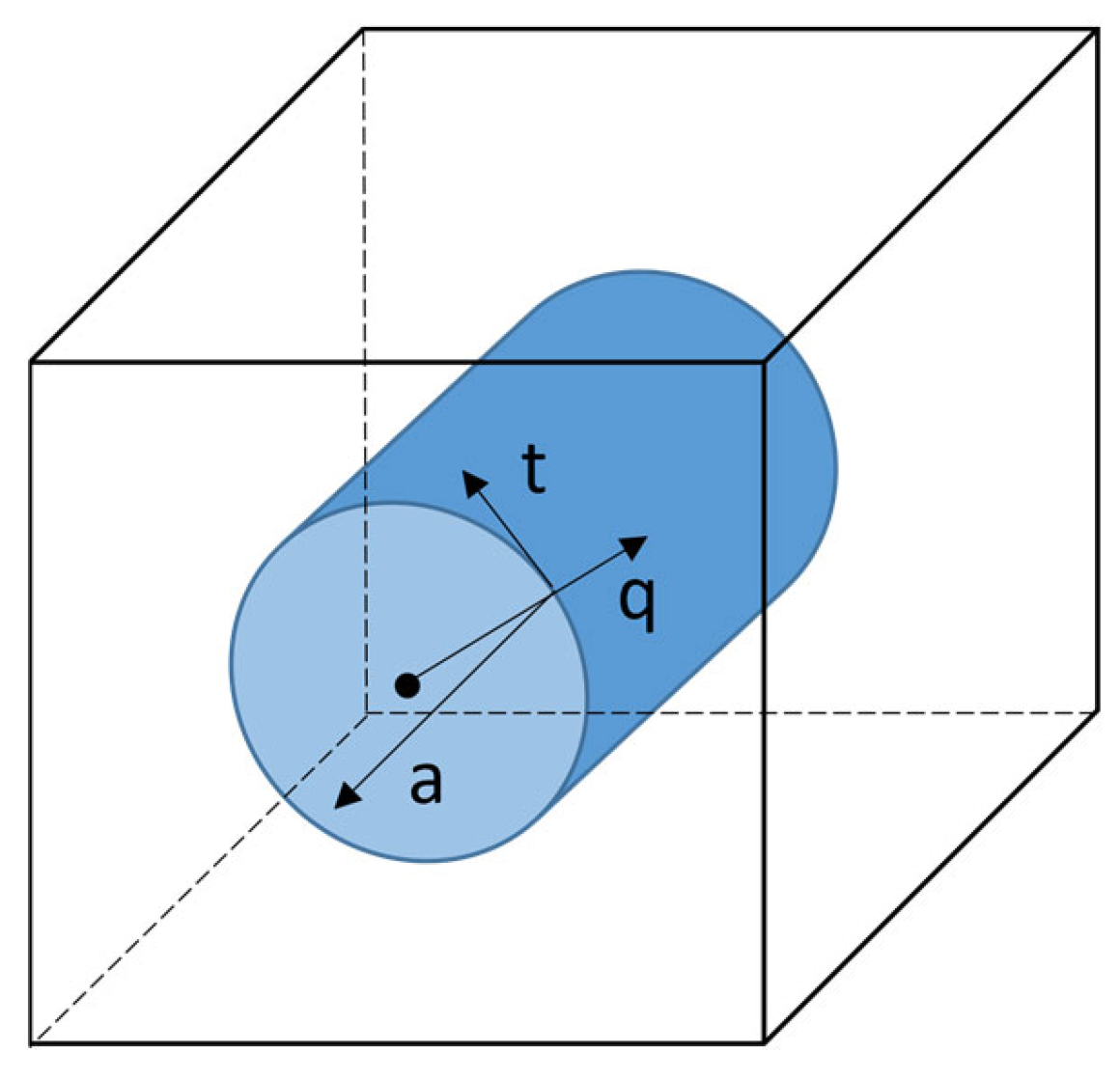
The proposed method was validated against FEM results for several test cases. A full FEM model of the laminate, consisting of fibers embedded in a matrix, was generated using quadratic tetrahedral elements with a coarse mesh refinement. Numerical simulations were carried out using ANSYS® 2023 R2 (Ansys Inc., Canonsburg, PA, USA). The objective of this model was to capture the global displacement field rather than the detailed stress distribution within individual layers. At the mid-plane of the model, a regular grid of nodes was obtained, with an inter-point spacing equal to 2.5 times the RVE edge length. Figure 2 depicts the laminate geometry with a cross-section showing the nodal grid, along with a close-up of the mesh. The nodal displacements obtained from the global FEM model were used both as input to initialize the proposed procedure (from the points of the grid at the mid-plane) and as boundary conditions for a refined sub-model employed as a reference solution. Figure 3 illustrates the mesh of this benchmark sub-model. The composite was subjected simultaneously to bending and torsional moments applied at one edge, while the opposite edge was fully constrained. Figure 4 shows the laminate together with the fiber arrangement and the loading scheme. The analyses accounted for large displacement effects. Two stacking sequences were examined, namely [+45/−45/+45/−45/+45/−45] and [+30/−30/+30/−30/+30/−30]. For each sequence, two fiber fractions, 5% and 20%, were simulated by varying the fiber size. Figure 5 presents the deformed laminate under the applied loads and constraints. The stress state was then evaluated for a column of RVEs located at the laminate center. Stress components at the fiber–matrix interface were classified following the scheme in Figure 6, where a is the unit vector parallel to the fiber axis and q and t are the local normal and tangential directions along the fiber perimeter.
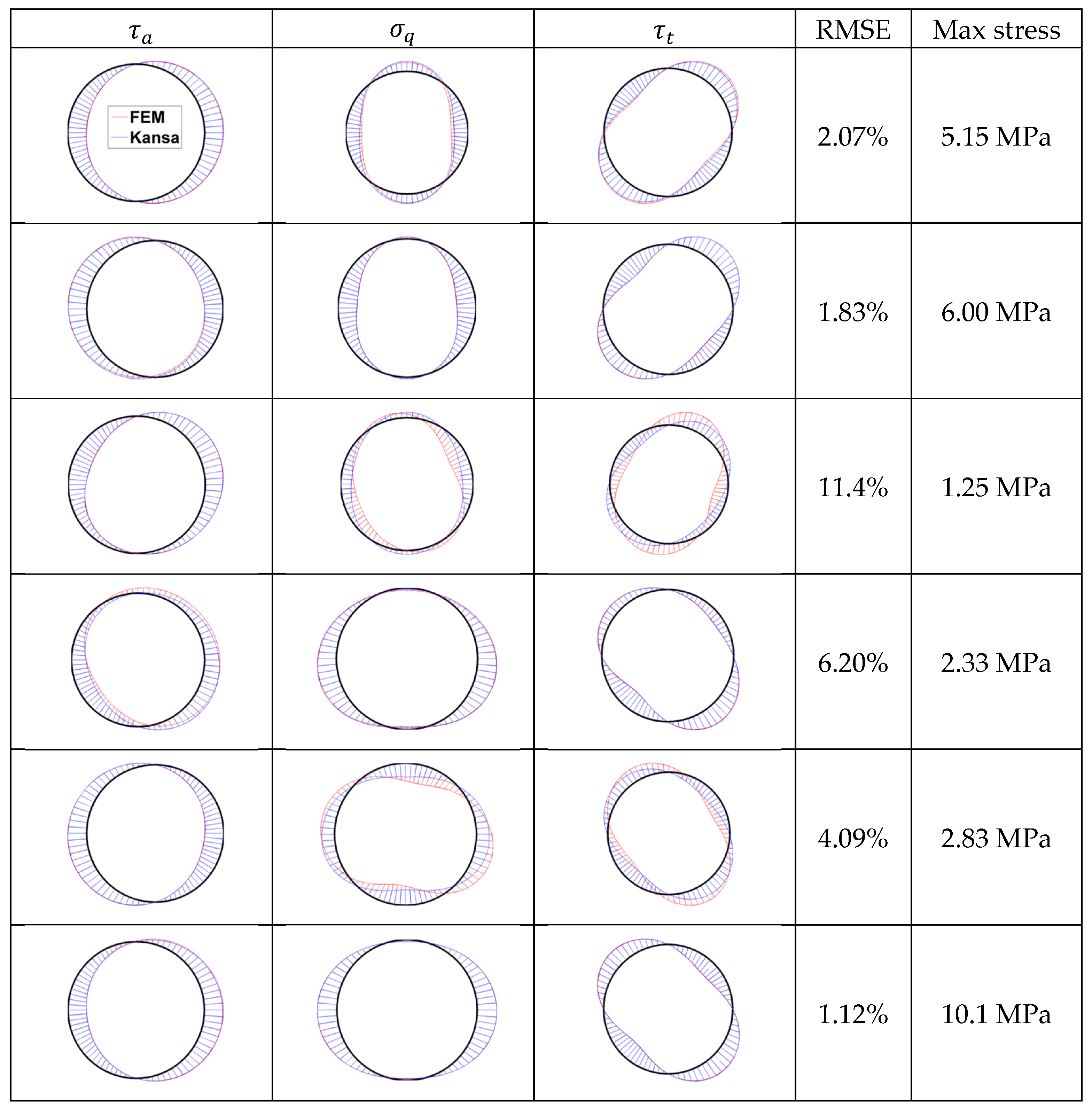
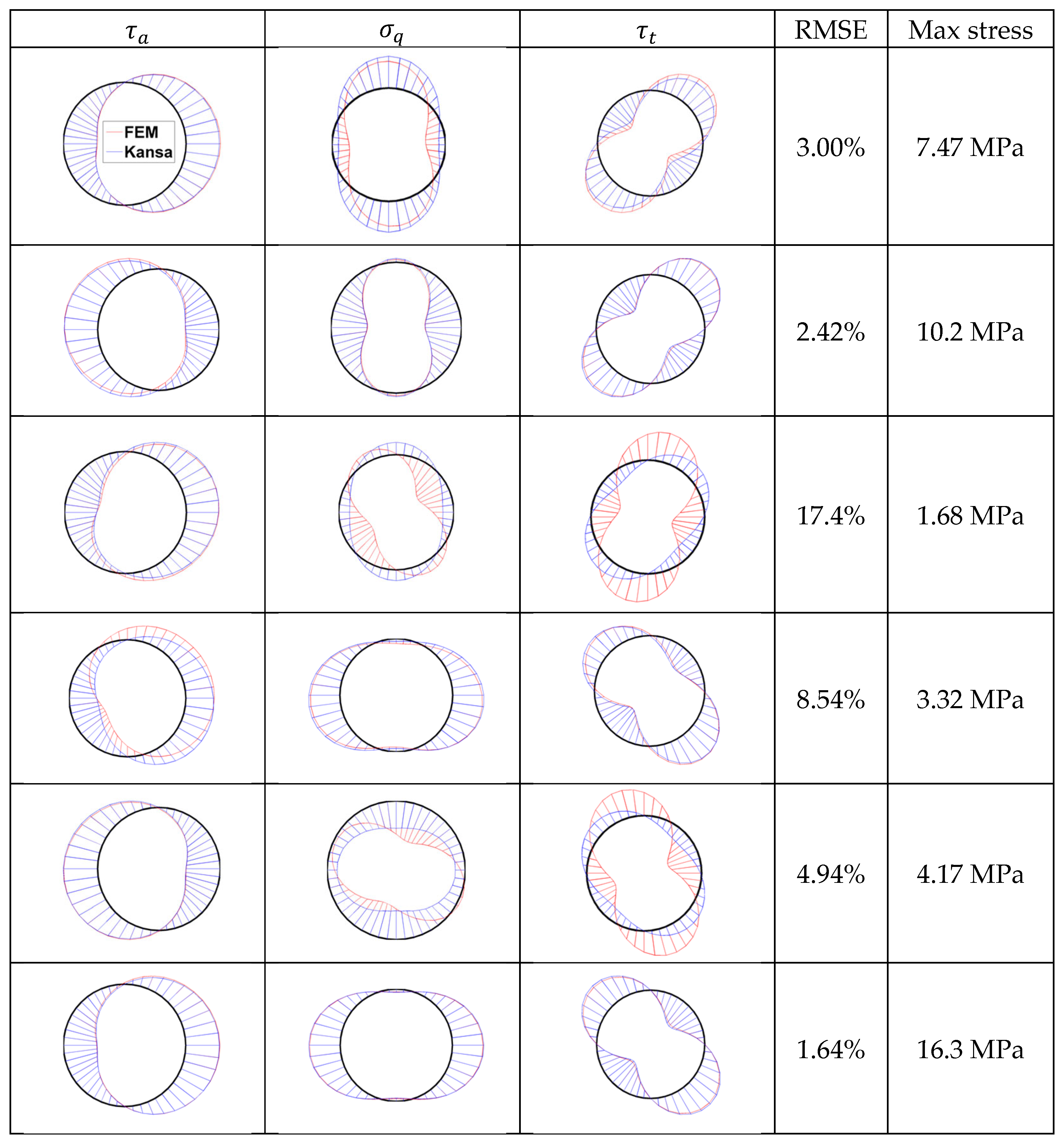
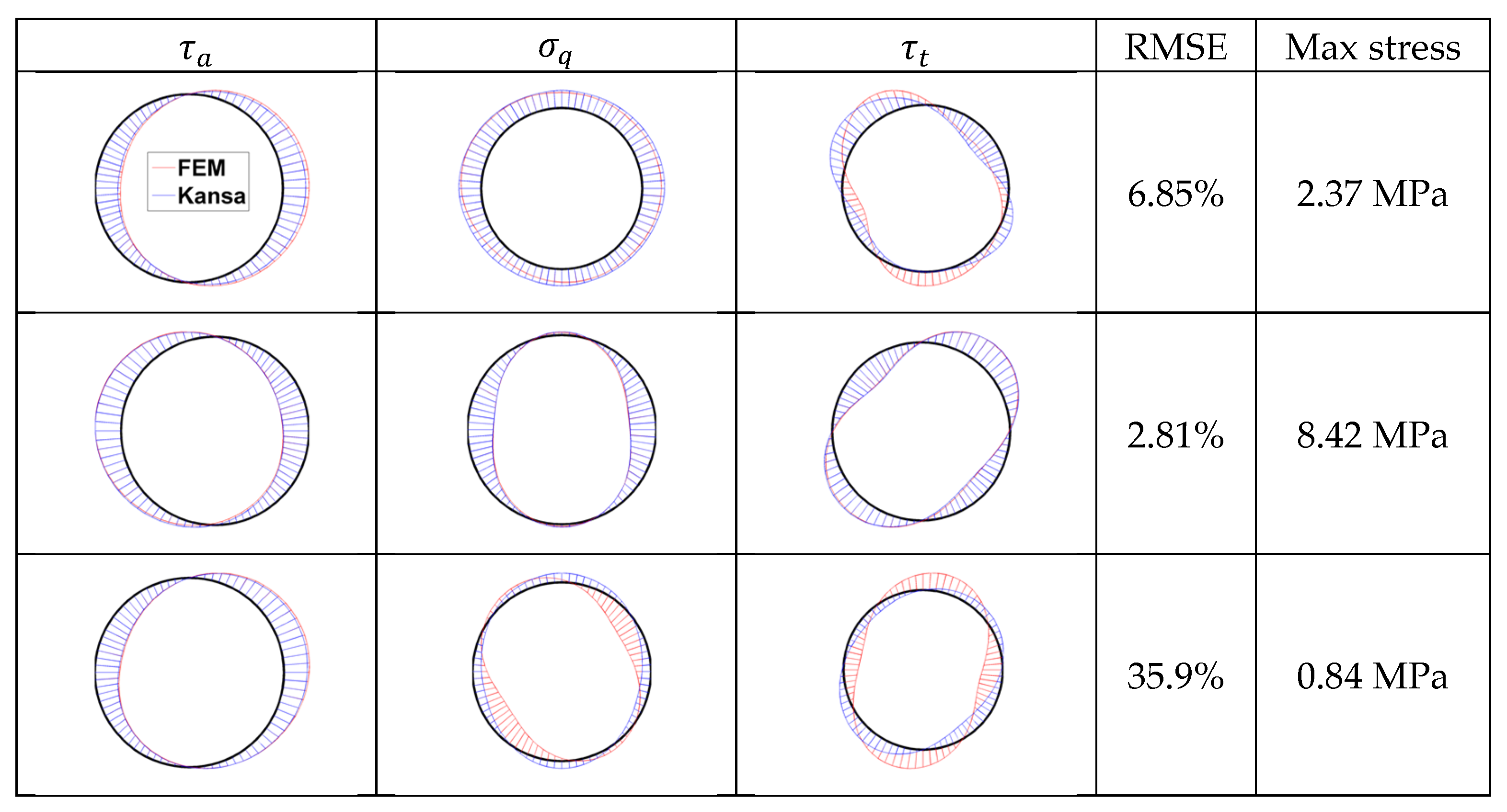
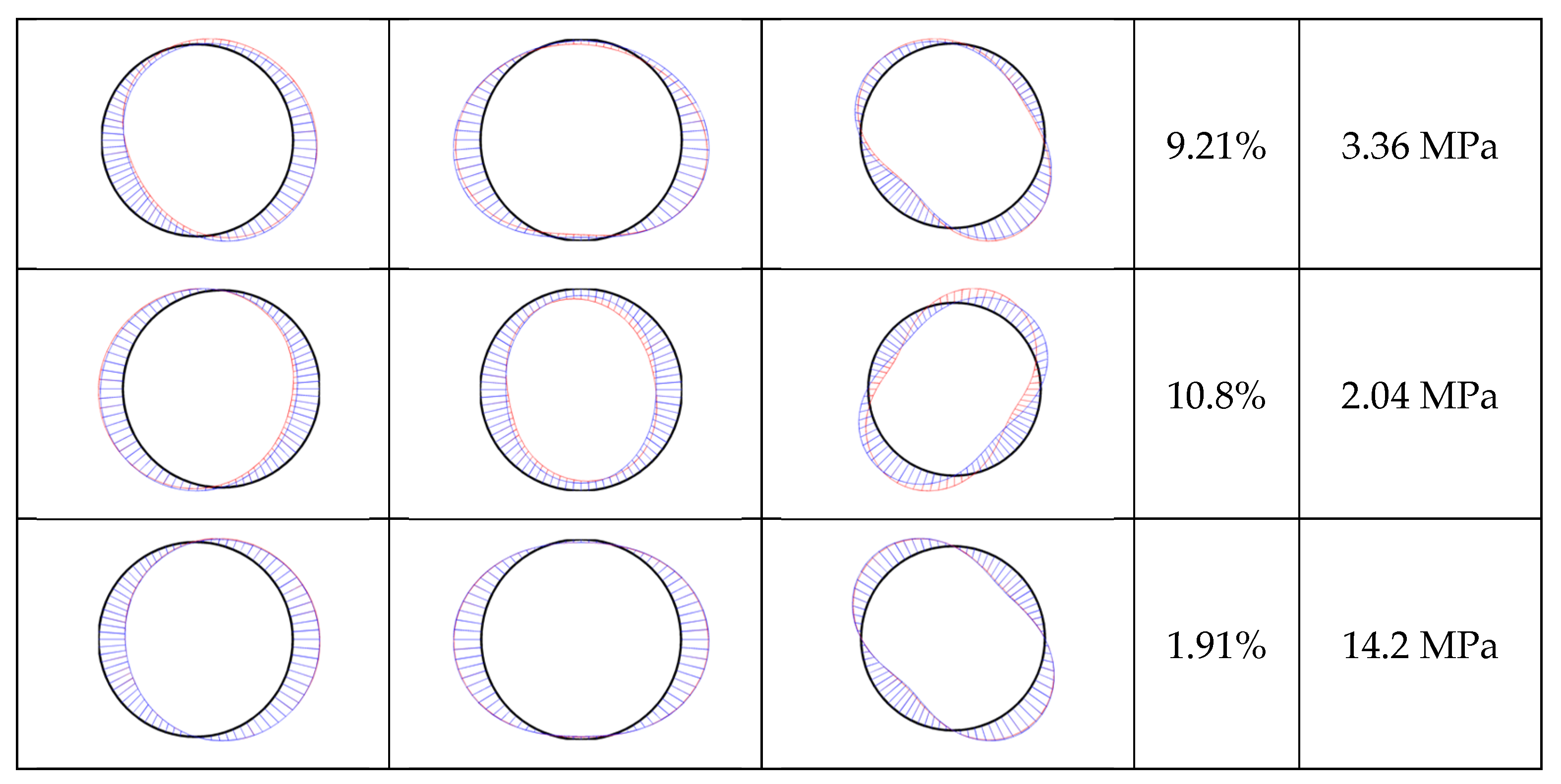
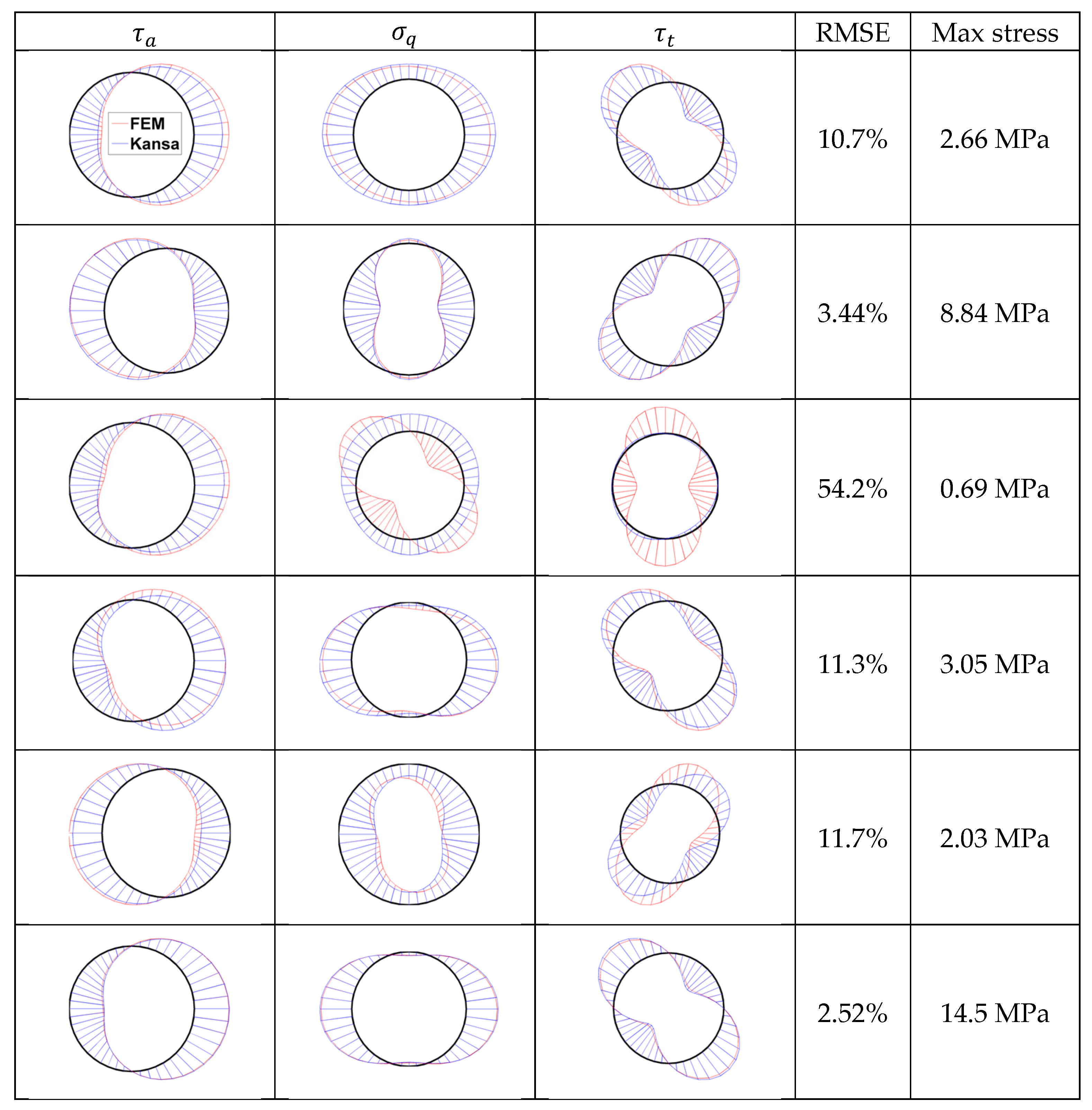
Figure 7 and Figure 8 show polar diagrams of the stress components at the fiber–matrix interface for each layer of the [+45/−45/+45/−45/+45/−45] laminate with thick and thin fibers, respectively. In the first three columns, FEM results (red) are compared with the output of the proposed method (blue). The same plots report the root-mean-square error (RMSE) relative to FEM for the global vector containing all stress components at all interface points. The last column displays the maximum overall stress for each layer, calculated as the square root of the sum of squared stress components. Figure 9 and Figure 10 present the corresponding results for the [+30/−30/+30/−30/+30/−30] stacking sequence. A complete analysis of a single RVE using the proposed strategy required approximately 40 s on an Intel(R) Core(TM) i7-8750H CPU @ 2.20 GHz with 16 GB RAM. A generalized multiquadratic RBF φ ( r ) = ( r 2 + R 2 ) p with p = 1.5 , R = 0.001 and ϵ = 1 , was used to interpolate the discrete nodal displacements from FEM. For the Kansa method, different RBF interpolants were employed for the matrix and fiber to accurately capture stress discontinuities at the interface. Each interpolant includes a linear polynomial whose coefficients are solved simultaneously with those of the radial basis functions. The polynomial augmentation renders the system underdetermined, which is addressed via the pseudoinverse. The kernel adopted for the Kansa procedure is the generalized multiquadratic with the same parameters ( p = 1.5 , R = 0.001 , ϵ = 1 ). For further discussion on the influence of the number and placement of points on the results, the reader is referred to [1].
Inspection of Figure 7, Figure 8, Figure 9 and Figure 10 indicates that the proposed method achieves high accuracy, comparable to that of a refined FEM model, in layers experiencing the highest stress levels. However, the accuracy deteriorates for regions with lower stresses, with errors reaching up to 50% for the smallest stress values.

4. Conclusions

This paper presented a method to determine the stress state at the fiber–matrix interface in long-fiber laminated angle-ply composites, based on the displacement field at the laminate neutral plane. The approach combines RBF interpolation with the Kansa method to capture both the macro- and microscale behavior of the composite. It is computationally efficient, enabling the analysis of a single RVE in under one minute on a standard laptop, without requiring simulation of the full laminate thickness. High accuracy is achieved for layers experiencing the highest stress levels, comparable to a refined FEM model.
However, the method has limitations arising from its underlying assumptions. It does not capture the local effects of distributed loads, and, due to the assumption of periodicity across neighboring RVEs, it is most suitable for stress states that vary gradually relative to the RVE dimensions. Furthermore, the accuracy diminishes significantly in layers subjected to lower stress levels.

Author Contributions

Conceptualization, A.C.; methodology, A.C.; software, A.C. and C.G.; validation, A.C. and C.G.; formal analysis, A.C.; investigation, A.C. and C.G.; resources, A.C.; data curation, A.C.; writing—original draft preparation, A.C.; writing—review and editing, A.C.; visualization, A.C.; supervision, A.C. and C.G.; project administration, A.C. All authors have read and agreed to the published version of the manuscript.

Funding

This research received no external funding.

Institutional Review Board Statement

Not applicable.

Informed Consent Statement

Not applicable.

Data Availability Statement

The data presented in this study are available on request from the corresponding author, as the research is still in progress.

Conflicts of Interest

The authors declare no conflicts of interest.

References

  1. Chiappa, A.; Groth, C.; Biancolini, M.E. A two-scale RBF meshless method for the interface stress retrieval in simply bended and torqued long-fibres laminates. Compos. Struct. 2023, 306, 116600. [Google Scholar] [CrossRef]
  2. Mallick, P.K. Fiber-Reinforced Composites: Materials, Manufacturing, and Design; CRC Press: Boca Raton, FL, USA, 2007. [Google Scholar] [CrossRef]
  3. Soutis, C. Fibre reinforced composites in aircraft construction. Prog. Aerosp. Sci. 2005, 41, 143–151. [Google Scholar] [CrossRef]
  4. Helali, H.T.; Grafinger, M. The precision of FEM simulation results compared with theoretical composite layup calculation. Compos. Part B Eng. 2016, 95, 282–292. [Google Scholar] [CrossRef]
  5. Romera, J.M.; Cantera, M.A.; Adarraga, I.; Mujika, F. Application of the submodeling technique to the analysis of the edge effects of composite laminates. J. Reinf. Plast. Compos. 2013, 32, 1099–1111. [Google Scholar] [CrossRef]
  6. Lucy, L.B. A numerical approach to the testing of the fission hypothesis. Astron. J. 1977, 82, 1013–1024. [Google Scholar] [CrossRef]
  7. Singh, J.; Shukla, K.K. Nonlinear flexural analysis of laminated composite plates using RBF based meshless method. Compos. Struct. 2012, 94, 1714–1720. [Google Scholar] [CrossRef]
  8. Ferreira, A.J.M.; Fasshauer, G.E.; Batra, R.C.; Rodrigues, J.D. Static deformations and vibration analysis of composite and sandwich plates using a layerwise theory and RBF-PS discretizations with optimal shape parameter. Compos. Struct. 2008, 86, 328–343. [Google Scholar] [CrossRef]
  9. Belinha, J.; Araújo, A.L.; Ferreira, A.J.M.; Dinis, L.M.J.S.; Jorge, R.N. The analysis of laminated plates using distinct advanced discretization meshless techniques. Compos. Struct. 2016, 143, 165–179. [Google Scholar] [CrossRef]
  10. Chiappa, A.; Salvini, P.; Brutti, C.; Biancolini, M.E. Upscaling 2D finite element analysis stress results using radial basis functions. Comput. Struct. 2019, 220, 131–143. [Google Scholar] [CrossRef]
  11. Chiappa, A.; Groth, C.; Biancolini, M.E. Improvement of 2D finite element analysis stress results by radial basis functions and balance equations. Int. J. Mech. 2019, 13, 90–99. [Google Scholar]
  12. Chiappa, A.; Groth, C.; Brutti, C.; Salvini, P.; Biancolini, M.E. Post-processing of 2D FEM Q1 models for fracture mechanics by radial basis functions and balance equations. Int. J. Mech. 2019, 13, 104–113. [Google Scholar]
  13. Uddin, K.Z.; Girard, H.; Mennie, N.B.; Doitrand, A.; Koohbor, B. Simultaneous measurement of fiber-matrix interface debonding and tunneling using a dual-vision experimental setup. Exp. Mech. 2024, 64, 1497–1511. [Google Scholar] [CrossRef]
  14. Buhmann, M.D. Radial basis functions. Acta Numer. 2000, 9, 1–38. [Google Scholar] [CrossRef]
  15. Groth, C.; Chiappa, A.; Biancolini, M.E.; Scalet, G. A computational approach for the simulation of shape memory polymer-based structures via finite elements and mesh morphing. Smart Mater. Struct. 2025, 34, 075049. [Google Scholar] [CrossRef]
  16. Geronzi, L.; Gasparotti, E.; Capellini, K.; Cella, U.; Groth, C.; Porziani, S.; Chiappa, A.; Celi, S.; Biancolini, M.E. Advanced radial basis functions mesh morphing for high fidelity fluid-structure interaction with known movement of the walls: Simulation of an aortic valve. In Computational Science—ICCS 2020, Proceedings of the 20th International Conference on Computational Science, Amsterdam, The Netherlands, 3–5 June 2020; Springer International Publishing: Cham, Switzerland, 2020; pp. 280–293. [Google Scholar] [CrossRef]
  17. Groth, C.; Chiappa, A.; Porziani, S.; Biancolini, M.E.; Marotta, E.; Salvini, P. A post-processing method based on radial basis functions for the fast retrieval of the strain field in digital image correlation methods. Materials 2022, 15, 7936. [Google Scholar] [CrossRef]
  18. Biancolini, M.E.; Chiappa, A.; Giorgetti, F.; Groth, C.; Cella, U.; Salvini, P. A balanced load mapping method based on Radial Basis Functions and Fuzzy Sets. Int. J. Numer. Methods Eng. 2018, 115, 1411–1429. [Google Scholar] [CrossRef]
  19. Groth, C.; Chiappa, A.; Biancolini, M.E. Shape optimization using structural adjoint and RBF mesh morphing. Procedia Struct. Integr. 2018, 8, 379–389. [Google Scholar] [CrossRef]
  20. Biancolini, M.E. Fast Radial Basis Functions for Engineering Applications; Springer International Publishing: Cham, Switzerland, 2018. [Google Scholar] [CrossRef]
  21. Kansa, E.J. Multiquadrics—A scattered data approximation scheme with applications to computational fluid-dynamics—I surface approximations and partial derivative estimates. Comput. Math. Appl. 1990, 19, 127–145. [Google Scholar] [CrossRef]
  22. Kansa, E.J. Multiquadrics—A scattered data approximation scheme with applications to computational fluid-dynamics—II solutions to parabolic, hyperbolic and elliptic partial differential equations. Comput. Math. Appl. 1990, 19, 147–161. [Google Scholar] [CrossRef]
  23. Chen, W.; Fu, Z.J.; Chen, C.S. Recent Advances in Radial Basis Function Collocation Methods; Springer: Berlin/Heidelberg, Germany, 2014. [Google Scholar] [CrossRef]
  24. Chantasiriwan, S. Multiquadric collocation method for time-dependent heat conduction problems with temperature-dependent thermal properties. J. Heat Transf. 2007, 129, 109–113. [Google Scholar] [CrossRef]
  25. Ferreira, A.J.M.; Roque, C.M.C.; Martins, P.A.L.S. Radial basis functions and higher-order shear deformation theories in the analysis of laminated composite beams and plates. Compos. Struct. 2004, 66, 287–293. [Google Scholar] [CrossRef]
  26. Chiappa, A.; Groth, C.; Reali, A.; Biancolini, M.E. A stress recovery procedure for laminated composite plates based on strong-form equilibrium enforced via the RBF Kansa method. Compos. Struct. 2020, 244, 112292. [Google Scholar] [CrossRef]
  27. Berger, H.; Kurukuri, S.; Kari, S.; Gabbert, U.; Rodriguez-Ramos, R.; Bravo-Castillero, J.; Guinovart-Diaz, R. Numerical and analytical approaches for calculating the effective thermo-mechanical properties of three-phase composites. J. Therm. Stress. 2007, 30, 801–817. [Google Scholar] [CrossRef]
  28. Holzapfel, G.A. Nonlinear Solid Mechanics: A Continuum Approach for Engineering; Wiley: Hoboken, NJ, USA, 2000. [Google Scholar] [CrossRef]
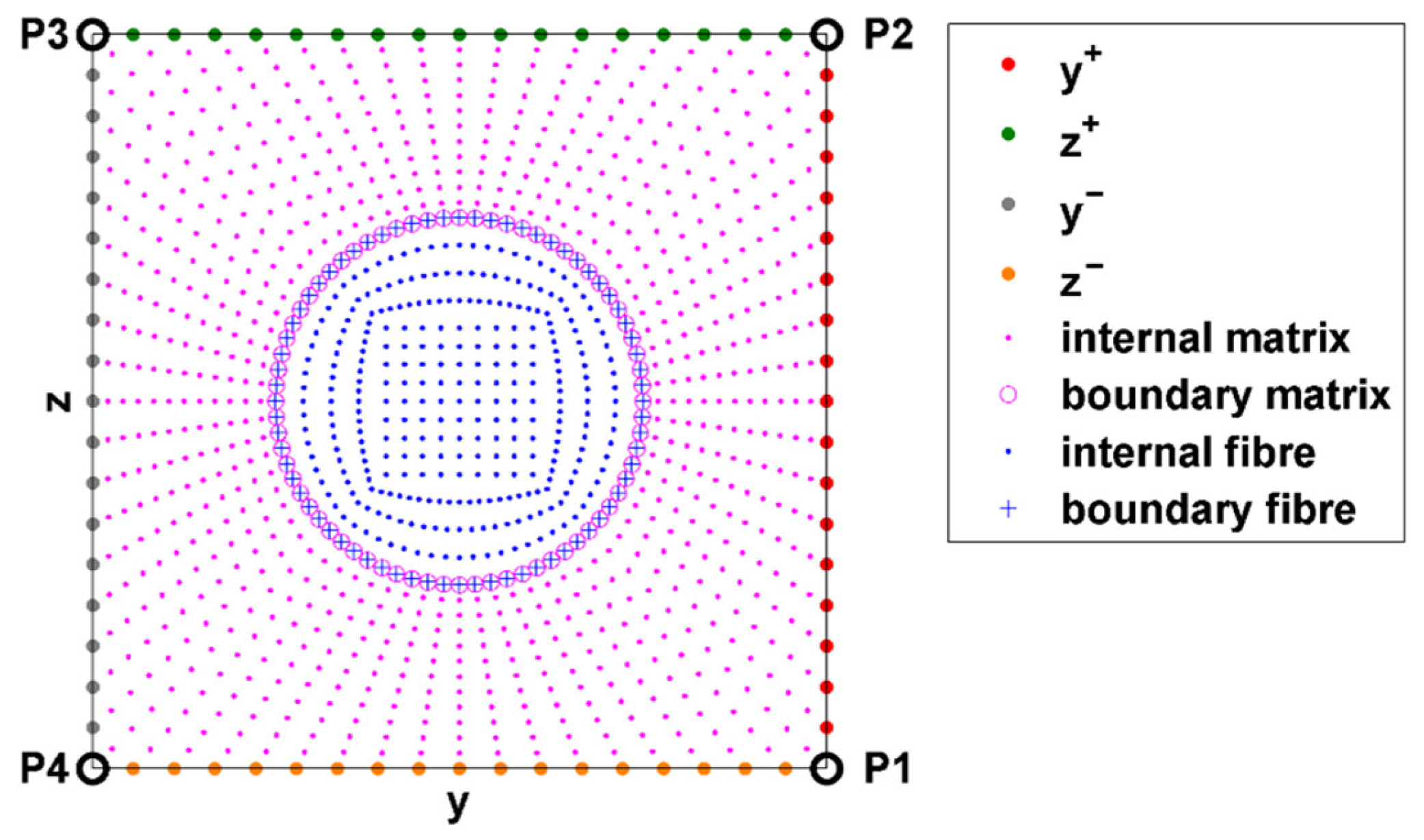
Figure 1. Point distribution over the RVE section.
Engproc 131 00034 g001
Figure 2. Laminate geometry with a cross-section highlighting the nodal grid at the mid-plane. The inset shows a close-up of the tetrahedral mesh used for discretization.
Engproc 131 00034 g002
Figure 3. Angle-ply sub-model used to accurately evaluate the stress state at the fiber–matrix interface.
Engproc 131 00034 g003
Figure 4. Laminate showing part of the fiber arrangement and the applied loading scheme.
Engproc 131 00034 g004
Figure 5. Deformed shape of the laminate overlaid with the undeformed wireframe, following the application of bending and torsion.
Engproc 131 00034 g005
Figure 6. Reference vectors used to define stress components at the fiber–matrix interface.
Engproc 131 00034 g006
Figure 7. Kansa method versus FEM benchmark for [+45/−45/+45/−45/+45/−45] laminate with thin fibers.
Engproc 131 00034 g007
Figure 8. Kansa method versus FEM benchmark for [+45/−45/+45/−45/+45/−45] laminate with thick fibers.
Engproc 131 00034 g008
Figure 9. Kansa method versus FEM benchmark for [+30/−30/+30/−30/+30/−30] laminate with thin fibers.
Engproc 131 00034 g009aEngproc 131 00034 g009b
Figure 10. Kansa method versus FEM benchmark for [+30/−30/+30/−30/+30/−30] laminate with thick fibers.
Engproc 131 00034 g010
Table 1. Most common radial basis functions.
RBF φ ( r )
Spline type r n , data
Thin plate spline r n log ( r ) , data
Multiquadratic 1 + ϵ 2 r 2
Inverse multiquadratic 1 1 + ϵ 2 r 2
Inverse quadratic 1 1 + ϵ 2 r 2
Gaussian e ϵ 2 r 2
Generalized multiquadratic ( ϵ 2 r 2 + R 2 ) p
Table 2. Equations entering the first Kansa system for the determination of the stress components σ x , σ y , σ z and τ y z .
Set of Involved PointsEquations Number of Equations
P1 v = 1 2 L y [ k y · ( z P 1 z m ) + ε y , m ] (26)1
P2 v = 1 2 L y [ k y · ( z P 2 z m ) + ε y , m ] (27)1
P3 v = 1 2 L y [ k y · ( z P 3 z m ) + ε y , m ] (28)1
P4 v = 1 2 L y [ k y · ( z P 4 z m ) + ε y , m ] (29)1
Y+/Y− v y + v y + = L y [ k y · ( z z m ) + ε y , m ] (30)Ny
Y+/Y− ( v y ) y + ( v y ) y = 0 (31)Ny
Y+/Y− ( w z ) y + ( w z ) y = 0 (32)Ny
Y+/Y− ( w y + v z ) y + ( w y + v z ) y = 0 (33)Ny
Z−Balance Equation (21) Nz
Z−Balance Equation (22) Nz
Z− y · σ z = 0 (34)1
Z− y · τ y z = 0 (35)1
Z+Balance Equation (21) Nz
Z+Balance Equation (22) Nz
Z+ y · σ z = 0 (36)1
Z+ y · τ y z = 0 (37)1
Inner MatrixBalance Equation (21) Nim
Inner MatrixBalance Equation (22) Nim
Inner FibreBalance Equation (21) Nif
Inner FibreBalance Equation (22) Nif
Interface v m a t r i x v f i b r e = 0 (38)Nb
Interface w m a t r i x w f i b r e = 0 (39)Nb
Interface ( σ y · q y + τ y z · q z ) m a t r i x ( σ y · q y + τ y z · q z ) f i b r e = 0 (40)Nb
Interface ( τ y z · q y + σ z · q z ) m a t r i x ( τ y z · q y + σ z · q z ) f i b r e = 0 (41)Nb
Table 3. Equations entering the first Kansa system for the determination of the stress components τ x y and τ x z .
Set of Involved PointsEquations Number of Equations
P1 γ x y = k x y · ( z P 1 z m ) + γ x y , m (42)1
P4 γ x y = k x y · ( z P 4 z m ) + γ x y , m (43)1
P1 γ x z = 0 (44)1
P4 γ x z = 0 (45)1
Y+/Y− ( F y ) y + ( F y ) y = 0 (46)Ny
Y+/Y− ( u y ) y + ( u y ) y = 0 (47)Ny
Y+/Y− ( u z + F z ) y + ( u z + F z ) y = 0 (48)Ny
Y+/Y− ( 2 F y z ) y + ( 2 F y z ) y = 0 (49)Ny
Z−Balance Equation (23) Nz
Z− y · τ x z = 0 (50)1
Z+Balance Equation (23) Nz
Z+ y · τ x z = 0 (51)1
Z+/Z− ( F z ) z + ( F z ) z = 0 (52)Nz
Z+/Z− ( 2 F y z ) z + ( 2 F y z ) z = 0 (53)Nz
Inner MatrixBalance Equation (23) Nim
Inner MatrixConsistency Equation (25) Nim
Inner FibreBalance Equation (23) Nif
Inner FibreConsistency Equation (25) Nif
Interface u m a t r i x u f i b r e = 0 (54)Nb
Interface ( F y ) m a t r i x ( F y ) f i b r e = 0 (55)Nb
Interface ( F z ) m a t r i x ( F z ) f i b r e = 0 (56)Nb
Interface ( τ x y · q y + τ x z · q z ) m a t r i x ( τ x y · q y + τ x z · q z ) f i b r e = 0 (57)Nb
Disclaimer/Publisher’s Note: The statements, opinions and data contained in all publications are solely those of the individual author(s) and contributor(s) and not of MDPI and/or the editor(s). MDPI and/or the editor(s) disclaim responsibility for any injury to people or property resulting from any ideas, methods, instructions or products referred to in the content.