1. Introduction
The satellite sector has seen significant growth and diversification in recent years, driven by advancements in satellite technology, miniaturization, and the increasing demand for satellite-based services. The rapidly increasing number of satellites in low Earth orbit (LEO), particularly in large constellations, is driving the need for autonomous satellites with a reduced reliance on ground infrastructure, as continuously tracking and controlling them from the ground becomes impractical and expensive. Onboard precise orbit determination (POD) will not only increase resilience by enabling satellites to quickly and independently assess collision risks and perform avoidance maneuvers but also extend service provision in scenarios where contact with ground stations is temporarily lost. Onboard POD reduces satellite dependency from the ground [
1], enabling scalable and more cost-efficient operations and new applications like LEO positioning, navigation, and timing (PNT).
Historically, GNSS has been well-established as a cost-efficient real-time navigation sensor for POD onboard LEO satellites [
2]. Since its launch in January 2023, the Galileo High Accuracy Service (HAS) offers new possibilities to GNSS users by providing global correction data [
3], allowing them to further improve positioning performance. Consequently, the Galileo HAS also bears the potential for new levels of performance in onboard real-time POD using GNSS.
Based on the favorable situation of the market, Spaceopal and the German Aerospace Center (DLR) have seen the opportunity to build a commercial product that leverages these technological advances and addresses the emerging needs of the growing LEO and low-MEO satellite segment.
2. Technology Transfer
The Galileo HAS POD receiver is a joint development between Spaceopal and DLR, combining industry expertise with advanced research.
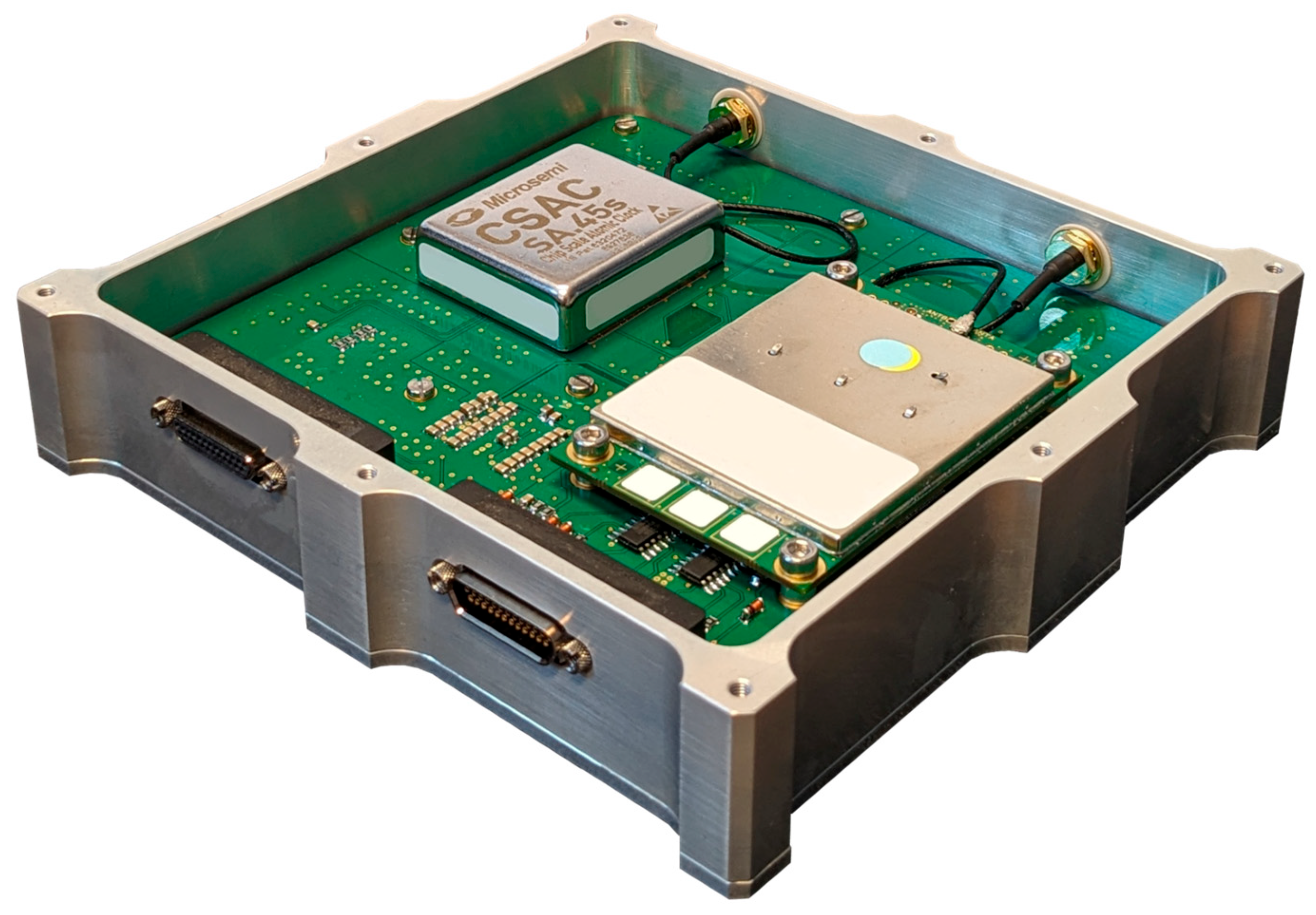
Figure 1 shows the Galileo HAS POD receiver prototype.
Spaceopal is the product owner, leveraging its extensive experience in commercially effective technology transfer, product design, and Galileo services. Drawing on its deep understanding of operational requirements and industry standards, Spaceopal defined the specifications and qualification criteria to ensure optimal performance and reliability and provides the GNSS decoder knowledge from its Galileo HAS Service Level 1 [
4] and Service Level 2 User Terminals for the application on the Galileo HAS POD receiver. DLR plays a crucial role as the technical lead, driving both space hardware and software development. Two DLR institutes participate in the project. Space Operations and Astronaut Training (DLR RB) leads the hardware and software development, including the POD algorithm, ensuring compliance with the system requirements. The Galileo Competence Center (DLR GK) undertakes verification and validation, ensuring its performance and reliability. As of today, DLR offers extensive expertise in real-time orbit determination and time synchronization for LEO satellites. The developed algorithms have been demonstrated in various publications over the past years, and have ultimately led to the development of a real-time orbit determination and time synchronization (ODTS) system for LEO satellites [
5].
3. Galileo HAS POD Receiver Design and Features
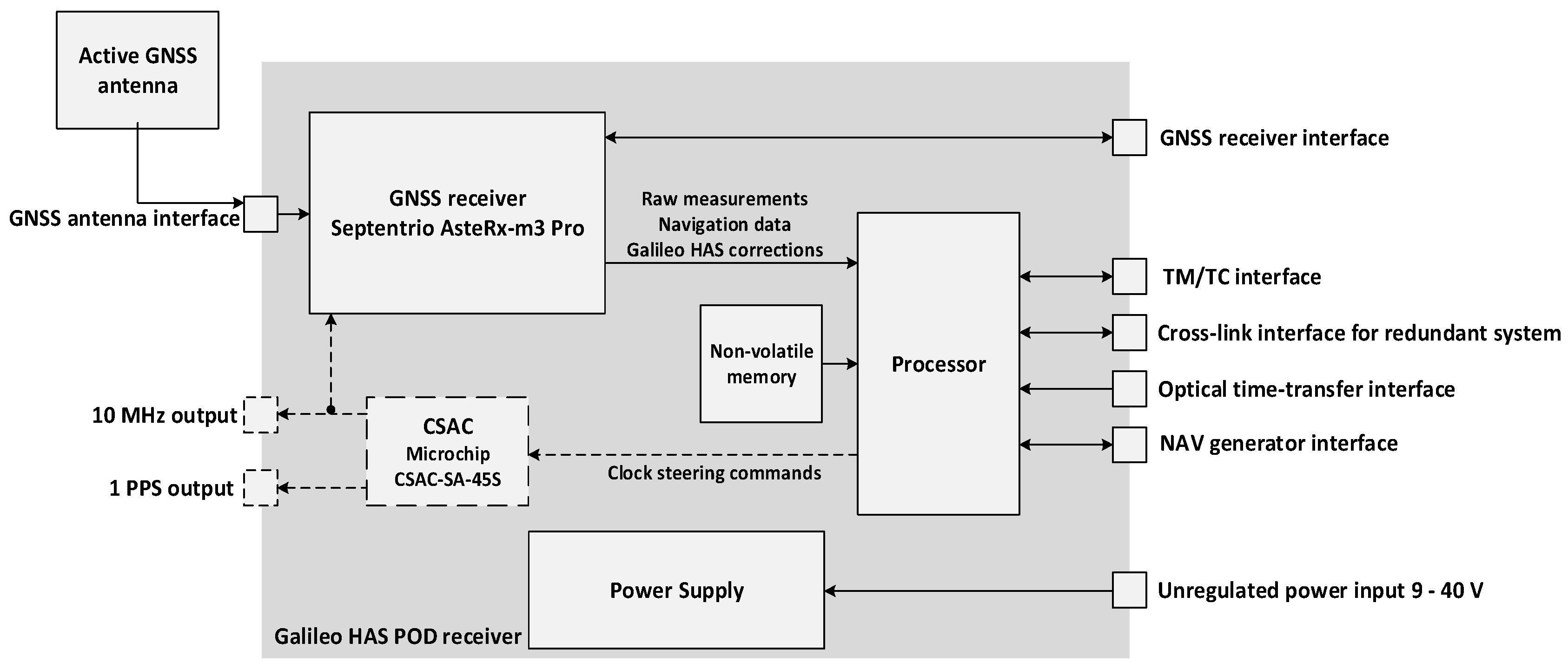
Figure 2 illustrates the functional system design of the Galileo HAS POD receiver. The design consists of a commercial off-the-shelf (COTS) GNSS receiver, a processor including a radiation-tolerant non-volatile memory, a power supply including dedicated latch-up protections for each functional block, and several data interfaces. The Galileo HAS POD receiver features configurable RS422 communication interfaces for telemetry and telecommand (TM/TC), attitude input, and cross-link communication in redundant system configurations or the input of additional range measurements, e.g., provided by an optical inter-satellite link (ISL). In addition, an Ethernet port is available for flexible data exchange.
For applications requiring precise synchronization with GNSS time, such as an LEO PNT navigation signal generator payload, the Galileo HAS POD receiver can optionally be supplemented by an internal chip scale atomic clock (CSAC), or, alternatively, the system can be connected to an external steerable reference oscillator.
When designing the unit, particular emphasis was placed on compact dimensions, a low mass, and a low power consumption. The Galileo HAS POD receiver measures approximately 100 × 95 × 44 mm3, weighs less than 1 kg, and has a power consumption of less than 5 W.
The Galileo HAS POD receiver is designed to support high-precision satellite navigation and timing using both GPS and Galileo constellations. It processes a wide range of signals, including GPS L1 C/A, L2C, and L5, and Galileo E1, E5a, E5b, AltBOC, and E6, with a particular focus on the Galileo E6-B signal for receiving HAS corrections. To mitigate the impact of interference and ensure robustness, the system supports Galileo Open Service Navigation Message Authentication (OS NMA) [
6] and includes interference detection and mitigation capabilities.
The POD algorithm, which is executed on the onboard processor, is based upon an extended Kalman filter (EKF). It processes dual-frequency pseudorange and carrier-phase measurements from one of the configurable signal combinations (E1 + E5a/E5b/AltBOC/E6 and L1 + L2C/L5), decoded navigation data, and Galileo HAS Initial Service corrections (Galileo INAV clock, INAV orbit corrections, as well as GPS LNAV clock, LNAV orbit corrections, and the code biases on Galileo E1/E5a/E5b and E6 and GPS L1, L2) [
7,
8,
9]. The filter implemented in the POD algorithm is updated with GNSS measurements every 10 to 30 s. Between two consecutive measurement updates, the satellite state vector is predicted up to 30 s into the future using the Dormand-Prince 5 numerical integrator. Conveniently, the integrator provides a polynomial which enables the smooth interpolation of the satellite position/velocity for any point in time within this prediction interval [
10,
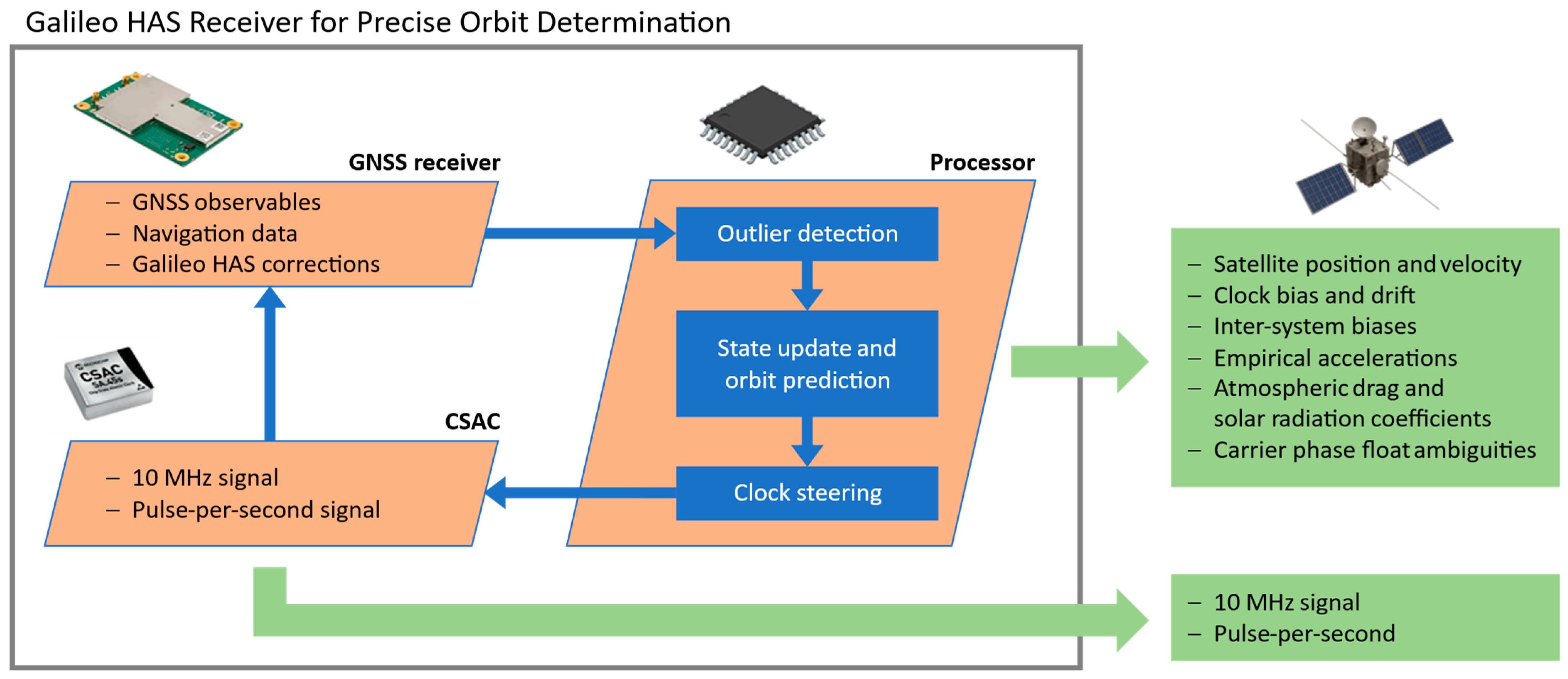
11]. The clock drift estimated by the POD algorithm is used as input for the clock steering which adjusts the 10 MHz signal of the CSAC to the GST time accordingly. In this way, the long-term clock errors are removed and the difference to the GST is only dominated by the short-term clock instability. Due to the high short-term stability of the CSAC, the clock does not drift by more than 1 ns within 30 s between two consecutive measurement updates. The different computational steps are illustrated in
Figure 3.
Table 1 presents a summary of the models used in the POD algorithm. The gravitation is modeled by the GOCO03S model with a degree and order of up to 70, with the time-varying terms Ċ
20, Ċ
21, and
. The third-body gravity is modeled with a point-mass approach using a truncated analytical series for lunar and solar positions. The Earth’s atmosphere is modelled using a Harris–Priester model and atmospheric drag is represented by a cannonball model, and solid Earth tides are modeled using K
2 tides. Empirical accelerations are estimated epoch-wise in the radial, along-track, and cross-track directions. Earth orientation parameters, which are required to formulate the equations of motion in an Earth-centered inertial frame, are obtained from the GPS CNAV MT31 message. The algorithm applies ionosphere-free combinations to eliminate first-order ionospheric errors and treats the carrier-phase ambiguities as float values. The POD algorithm outputs the satellite position and velocity, clock bias and drift, inter-system biases, empirical accelerations, satellite drag and radiation coefficients, and carrier-phase float ambiguities.
4. Galileo HAS POD Receiver Performance
Assuming ideal sky visibility conditions, i.e., a continuously zenith-pointing GNSS antenna, the use of a high-grade GNSS antenna, and no orbit maneuvers, a 3D RMS orbit accuracy of under 12 cm can be achieved for orbits with an altitude of 1300 km using broadcast ephemeris only. The orbit accuracy can be further improved to under 8 cm, additionally applying Galileo HAS corrections.
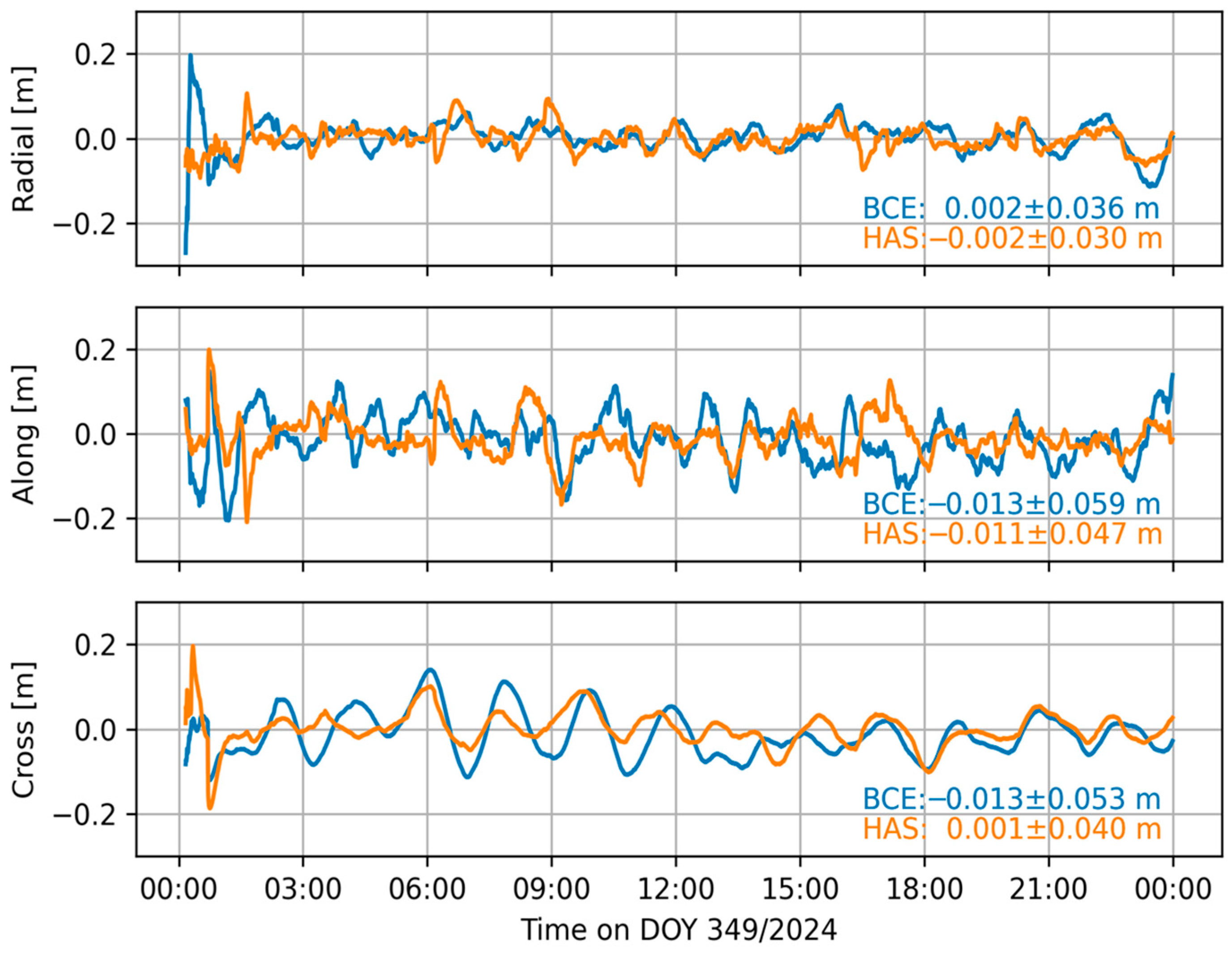
Figure 4 exemplarily presents the radial, along-track, and cross-track orbit error vs. time of Sentinel-6A (1330 km) for day 349 of year 2024 using the real-time POD algorithm with broadcast ephemerides (BCEs) and Galileo HAS corrections (HAS). For that, the real-time orbit is compared with a reference orbit which was computed offline by batch-processing using precise GNSS products like satellite orbits and clocks and code and phase biases from the International GNSS Service (GNSS) and carrier phase ambiguity fixing. For the orbit that was computed with BCE only, the mean error of the individual components over day 349 is between 2 mm and 1.3 cm, and the corresponding standard deviation is between 3.6 and 5.9 cm. For the orbit that was computed with additional Galileo HAS corrections, the mean error of the individual components over day 349 is between 2 mm and 1.1 cm, and the corresponding standard deviation is between 3 and 4.7 cm.
At an orbit altitude of 780 km, the respective figures are under 16 cm (using broadcast ephemeris only, 1σ) and 12 cm (additionally applying Galileo HAS corrections, 1σ).
The range residuals are under 7 cm (using broadcast ephemeris only, 1σ) and 5 cm (additionally applying Galileo HAS corrections, 1σ) at an orbit altitude of 1300 km, and under 9.5 cm and 7 cm at an orbit altitude of 780 km, respectively.
The timing accuracy with respect to the system time of the primary GNSS, which can be either Galileo System Time (GST) or GPS System Time (GPST), is better than 1 nanosecond (1σ) [
5,
11]. A summary is presented in
Table 2:
5. Hardware Design Approach and Manufacturing
The philosophy chosen for the design of the Galileo HAS POD receiver is the rigorous use of COTS electrical, electronic, and electromechanical (EEE) parts. In order to cope with the harsh environmental conditions in LEO or low MEO, the design includes several intelligent countermeasures such as latch-up protections of individual functional blocks against single-event latch-ups (SEL) and dual-bank memories for data redundancy and recovery from single-event upsets (SEU). This design philosophy makes it possible to benefit from maximum performance combined with lower production costs. For example, the GNSS receiver, which is one of the core components of the Galileo HAS POD receiver, is a commercial geodetic-grade receiver that supports all common constellations and signals and offers the best possible performance in terms of measurement accuracy.
In addition, where possible, EEE parts are selected that are qualified for automotive applications and feature an extended operational temperature range. Due to the strict regulations in the automotive sector, the highest possible robustness against all non-radiation-related influences such as vibration is achieved.
Manufacturing quality will play a critical role in the success of the Galileo HAS POD receiver as a commercial product and it has been approached with the utmost seriousness for the new proto-flight models currently under production. To ensure the highest quality and reliability, a commercial integrator with experience in the space sector was selected.
6. Qualification
The Galileo HAS POD receiver qualification adopted a New Space approach, where the established space standards like ECSS are leveraged as a foundational reference but implemented in a more flexible, guideline-based manner. This tailored framework allows the streamlining of processes, cost reduction, and an accelerated timeline while still ensuring compliance with core requirements for space systems.
The qualification follows several phases. A first phase, already finished in 2024, included the verification of the prototype receiver (hardware and software). The prototype functionalities were verified by testing the mechanical interfaces (size, weight, mounting interface, and connector locations), electrical interfaces (operation within nominal voltage and current), serial communication interfaces (TM/TC interface, debug and programming interface, GNSS receiver interface, and general-purpose serial interface for cross-linking or external clock steering), and radio frequency (R/F) signal interfaces (GNSS antenna input and external reference oscillator input). The receiver functional verification addressed the proper execution of the software on the hardware, including the runtime stability, the TM/TC interface to ensure that commands were properly executed and that the telemetry data format was in accordance with the interface control document, and the correct reception of the GNSS measurements by the processor. The POD algorithm was verified in real time using a GNSS R/F simulator and in postprocessing using existing GNSS observations from two LEO satellites (SWARM-C and Sentinel-6A) [
12,
13].
The prototype followed a first environmental pre-qualification including temperature tests (non-operational from −40 to +80 °C and operational from −20 to +70 °C), vibration following the MIL-STD-810G [
14], SEE tested with proton irradiation up to 200 MeV, and total ionizing dose (TID) tested up to 35 krad.
The current phase is the production of further Galileo HAS POD receiver units planned to be completed in 2025, and, once successfully concluded, the Galileo HAS POD receiver will reach TRL 7.
The Galileo HAS POD receiver will undergo vibration tests, including both sinusoidal and random profiles, using an 89 kN vibration system under clean conditions. The tests will simulate the mechanical stresses experienced during launch, ensuring structural integrity and functional reliability.
The Galileo HAS POD receiver will be subjected to thermal vacuum testing in clean conditions, adhering to ISO Class 8 standards, with a chamber pressure maintained below 1.3 × 10⁻⁵ mbar. The test will consist of five thermal cycles over a 48 h duration with temperatures ranging from −40 °C to 80 °C. These conditions will simulate the harsh thermal and vacuum environment of space, assessing the material stability, thermal expansion effects, and potential outgassing.
7. Future Work
To validate the Galileo HAS POD receiver in an operational environment, flight opportunities are being pursued for 2026. Both institutional and commercial options are under consideration, with several micro- and nanosatellite missions currently being evaluated.
In addition to the current activities presented, Spaceopal and DLR are exploring potential evolutions of the Galileo HAS POD receiver that do not require a hardware redesign or requalification. Planned algorithm enhancements include support for Galileo HAS Service Level 2 (SL2) features such as authentication services, Solar and Geomagnetic Activity (SAGA) parameters, and Earth Rotation Parameters (ERP), aiming to improve both accuracy and robustness. The Galileo HAS POD receiver also has sufficient processing capacity to support further functionalities, including the generation of additional outputs—such as a navigation message for an LEO-based PNT payload.
The Galileo HAS POD receiver represents an ideal solution for satellite integrators seeking high-precision orbit accuracy, reliable time synchronization, and a rigorously qualified and meticulously manufactured product.



 ,
,