Proceeding Paper

Microstructural and Spectral Characterization of ZrO2-Doped PEO/PMMA Nanocomposite Polymer Electrolytes †

by
Amudha Subramanian
*,
Rajalakshmi Kumaraiah
and
Mohammed Tasleem Tahira
Department of Physics, Shrimathi Devkunvar Nanalal Bhatt (S.D.N.B.) Vaishnav College for Women, Chrompet, Chennai 600 044, India
*
Author to whom correspondence should be addressed.
Presented at the 6th International Electronic Conference on Applied Sciences, 9–11 December 2025; Available online: https://sciforum.net/event/ASEC2025.
Eng. Proc. 2026, 124(1), 80; https://doi.org/10.3390/engproc2026124080
Published: 17 March 2026
(This article belongs to the Proceedings of The 6th International Electronic Conference on Applied Sciences)

Abstract

Blended nanocomposite solid polymer electrolytes are gaining considerable attention as next-generation materials for use in flexible lithium-ion battery systems. These materials help ensure a more uniform distribution of lithium ions at the electrode–electrolyte interface, contributing to the development of a stable interfacial layer that mitigates lithium dendrite formation. In this study, solid polymer electrolytes were synthesized using a binary polymer matrix composed of polyethylene oxide (PEO) and polymethyl methacrylate (PMMA), with lithium iodide (LiI) as the ionic salt. Zirconium dioxide (ZrO2) nanoparticles were introduced as nanofillers in varying concentrations to investigate their influence on the physical and functional characteristics of the polymer matrix. Characterization was carried out using Scanning Electron Microscopy (SEM), Fourier Transform Infrared Spectroscopy (FTIR), and X-ray Diffraction (XRD). SEM images indicated that ZrO2 nanoparticles remained well-dispersed up to 3 wt%, while higher loadings showed slight agglomeration. FTIR analysis revealed noticeable changes in absorption bands, suggesting strong interactions among polymer chains and the nanofillers. XRD data confirmed the semi-crystalline behavior of the PEO/PMMA blend system. The inclusion of ZrO2 nanofillers enhanced the structural integrity and ionic conductivity of the polymer matrix, making them promising candidates for applications in electrochemical energy storage and advanced material interfaces. The systematic incorporation of ZrO2 nanofillers into the PEO/PMMA matrix significantly improved the microstructural uniformity, polymer–filler interactions, and ionic transport behavior of the solid polymer electrolytes.

1. Introduction

The rapidly increasing demand for safer, flexible and high-performance lithium-ion batteries has stimulated extensive exploration of solid polymer nanocomposite electrolytes as effective alternatives to predictable liquid electrolytes [1]. Despite their widespread use due to high ionic conductivity, liquid electrolytes exhibit major shortcomings, notably electrolyte leakage and safety concerns arising from their flammable nature and poor interface stability with electrodes. These issues not only compromise battery safety but also accelerate lithium dendrite growth, which can result in internal short circuits and device failure [2]. Solid polymer electrolytes offer improved safety, mechanical flexibility and better electrode–electrolyte contact, making them attractive for next-generation energy storage systems [3]. Among various polymer hosts, polyethylene oxide has been extensively studied because of its excellent capability to solubilize lithium salts via coordination interactions involving Li+ and ether oxygen atoms, forming ion-conducting complexes [4]. However, the high degree of crystallinity of PEO at room temperature significantly restricts polymer chain mobility, leading to low ionic conductivity. To overcome this limitation, blending PEO with amorphous polymers such as polymethyl methacrylate has proven effective in reducing crystallinity while enhancing mechanical strength and thermal stability. The resulting semi-crystalline polymer matrix provides improved ion transport pathways through its amorphous regions. Furthermore, the incorporation of inorganic nanofillers into polymer blends has emerged as an efficient strategy to enhance electrolyte performance. Particularly, zirconium oxide nanoparticles have attracted considerable attention due to their high thermal stability, dielectric constant and strong interaction with polymer chains. These nanofillers disrupt polymer packing, increase free volume, promote lithium salt dissociation, and improve interfacial stability, thereby enhancing ionic conductivity [5]. Characterization methods including Scanning Electron Microscopy, Fourier Transform Infrared Spectroscopy and X-ray Diffraction played a crucial role in evaluating the structural and chemical performance of these nanocomposite polymer electrolyte films. SEM provides information on surface morphology and nanoparticle dispersion, FTIR identifies molecular-level interactions between polymers, salt and nanofillers while XRD reveals changes in crystallinity that directly influence ion transport efficiency [6]. Consequently, PEO-PMMA-based nanocomposite solid polymer electrolyte systems incorporating ZrO2 nanoparticles represent a promising approach for developing safe, stable and high-performance solid-state lithium-ion batteries.

2. Analytical Attributes

2.1. Reagent-Assisted Material Synthesis

Reagents like poly(methyl methacrylate), possessing a molecular weight of 9.96 × 10⁵ g mol−1, and poly(ethylene oxide) with a molecular weight of 5 × 10⁵ g mol−1, lithium iodide (LiI) and Zirconium dioxide (ZrO2) nanoparticles with dispersion below 100 nm were procured from Sigma Aldrich. All reagents were used without further purification.

2.2. Fabrication of Solid Polymer Nanocomposite Electrolyte Films

Solid nanocomposite polymer electrolyte films were synthesized using the conventional solution casting approach [7]. Initially, the required quantities of PEO (0.2 g) and PMMA (0.1 g) were dried in a vacuum oven at 373 K for 15 min to eliminate absorbed moisture. The dried polymers were dissolved in acetone (30 mL) and stirred continuously to obtain a clear and uniform polymer solution. The lithium salt of 10 wt% with respect to the total polymer blend (PEO/PMMA) was independently dried under vacuum and then slowly incorporated into the polymer blend while stirring. The mixture was further stirred to promote effective interaction between the polymer chains and lithium ions. Subsequently, ZrO2 nanoparticles were added at loadings of 3 wt% and 5 wt% calculated based on the total weight of the polymer matrix into the polymer–salt solution and dispersed by prolonged magnetic stirring for 2 h to ensure homogeneity [8]. The resulting solution was poured into a clean Petri dish and dried under ambient conditions to facilitate solvent evaporation. After complete drying, flexible and free-standing nanocomposite solid polymer electrolyte films were obtained and preserved in a desiccator to avoid moisture contamination before characterization.

2.3. Characterization

Surface morphology and microstructural features were studied using a Hitachi S-3400N SEM under cryogenic conditions in liquid nitrogen [9]. FTIR spectrum was approved using a Bruker Tensor 27 spectrometer to investigate molecular interactions and complex formation [10]. The crystalline nature of the nanocomposite solid polymer electrolyte films was investigated by XRD with a Bruker diffractometer utilizing radiation having the wavelength of λ = 1.54 Å in the 2θ ranging from 10° to 80° [7].

3. Results and Discussion

3.1. Microstructural Insights from SEM Investigation

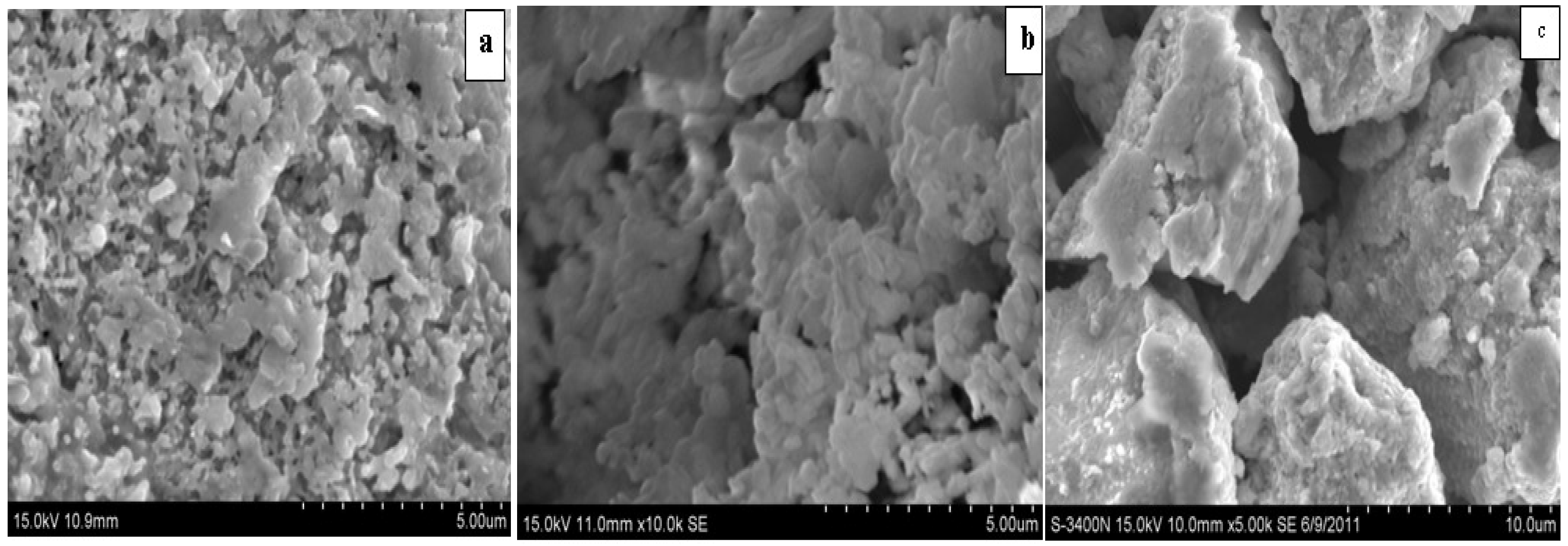
SEM analysis exposed in Figure 1a–c reveals the progressive modification in the surface morphology of PEO/PMMA/LiI-based electrolytes with increasing ZrO2 content. The filler-free electrolyte exhibits compact and closely packed surface domains, indicating residual crystalline ordering that can impede ion mobility [11]. Incorporation of 3 wt% ZrO2 leads to a more uniform and smoother surface, confirming effective nanoparticle dispersion and enhanced amorphous character of the polymer matrix which supports continuous ion transport pathways [12]. However, at 5 wt% ZrO2 loading, surface irregularities and localized particle aggregation become evident, reducing polymer chain flexibility and partially obstructing ionic conduction [13]. These morphological observations establish 3 wt% ZrO2 as the optimal filler concentration for achieving improved ionic conductivity in the nanocomposite electrolyte system [14].

3.2. FTIR Profiling of Molecular Structure in Solid Polymer Electrolyte Films

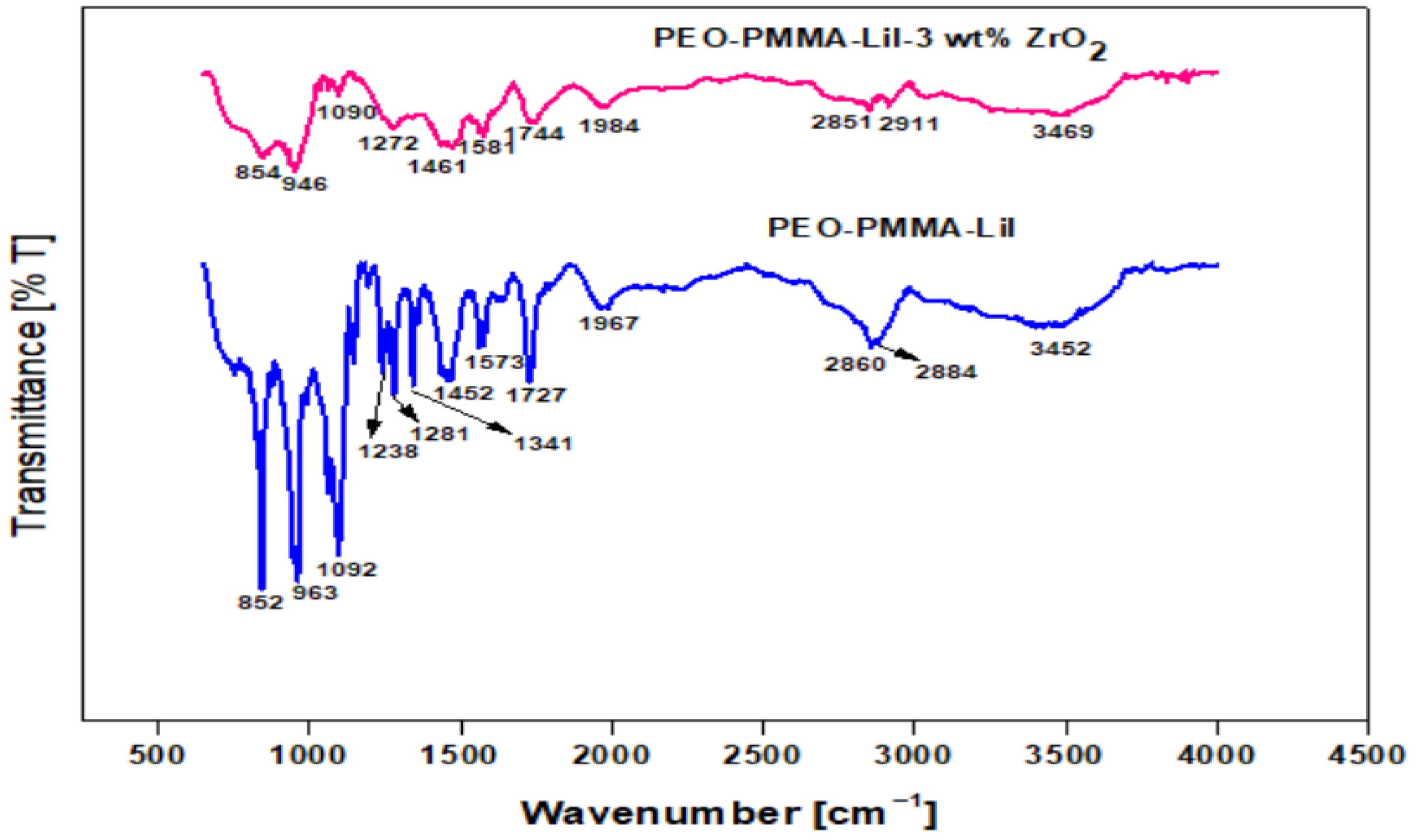
The FTIR spectra of PEO/PMMA/LiI and 3 wt% ZrO2-filled PEO/PMMA/LiI films are presented in Figure 2. The pristine electrolyte exhibits characteristic absorption bands corresponding to both PEO and PMMA components. The band observed near ~852 and ~1452 cm−1 is attributed to the C–C symmetric stretching and –CH2 scissoring vibration of PEO [15]. Upon incorporation of 3 wt% of ZrO2 nanoparticles, this band gets slightly shifted to ~854 and ~1461 cm−1, suggesting possible interactions between ZrO2 filler and ether oxygen groups of PEO. Peaks at ~963 and ~1092 cm−1 endorsed to -CH2 rocking and -C-O-C stretching mode of PEO were repositioned to ~946 and ~1090 cm−1 [8,15]. The vibrational band observed at ~1967, ~2860 and ~2884 cm−1 is attributed to asymmetric stretching and -C-H stretching mode of PEO was repositioned to ~1984, ~2851 and ~2911 cm−1 respectively [16,17]. The characteristic vibrational band observed at ~1727 cm−1 associated with C=O stretching of carbonyl group of PMMA polymer gets moved to ~1744 cm−1 [8]. Dual bands observed at ~1238 and ~1281 cm−1 correspond to -C-C-O in the ester group, and (C-C-O) stretching vibrations in the methyl carbonyl group [18,19] of PMMA polymer are altered to single band ~1272 cm−1 after the incorporation of ZrO2 nanofiller. This may be due to the strong interaction between polymer, salt and filler which may cause reduced crystallinity. The band at ~1573 cm−1 representing the coordination of lithium ions with the carbonyl (C=O) group of the PMMA matrix [20] gets shifted to ~1581 cm−1 in the filler loaded system, which indicates stronger interaction and possible modification of the local environment due to presence of the filler. It should be noted that absorption bands in the range of 1555–1580 cm−1 may also correspond to the asymmetric stretching vibration of carboxylate groups (νasym COO), while symmetric stretching modes typically appear near ~1370 cm−1. Therefore, the band observed in this region may also include contributions from carboxylate-type coordination formed due to strong interactions between lithium ions, the PMMA matrix, and the filler surface. This indicates that the interaction mechanism in the composite electrolyte may involve complex polymer–salt–filler coordination rather than simple Li+–carbonyl interaction alone. Peaks at ~1341 cm−1 consigned to –CH2 deformation of PMMA disappear in the complex after the inclusion of ZrO2 filler whereas the band at 3452 cm−1 attributed to the -OH group moved to ~3469 cm−1 [21]. Overall, the observed peak shifts and intensity variations suggest possible polymer–salt–filler interactions and when considered alongside SEM and XRD analyses, it provides supportive evidence of structural modifications induced by ZrO2 incorporation.

3.3. Structural Investigation by XRD

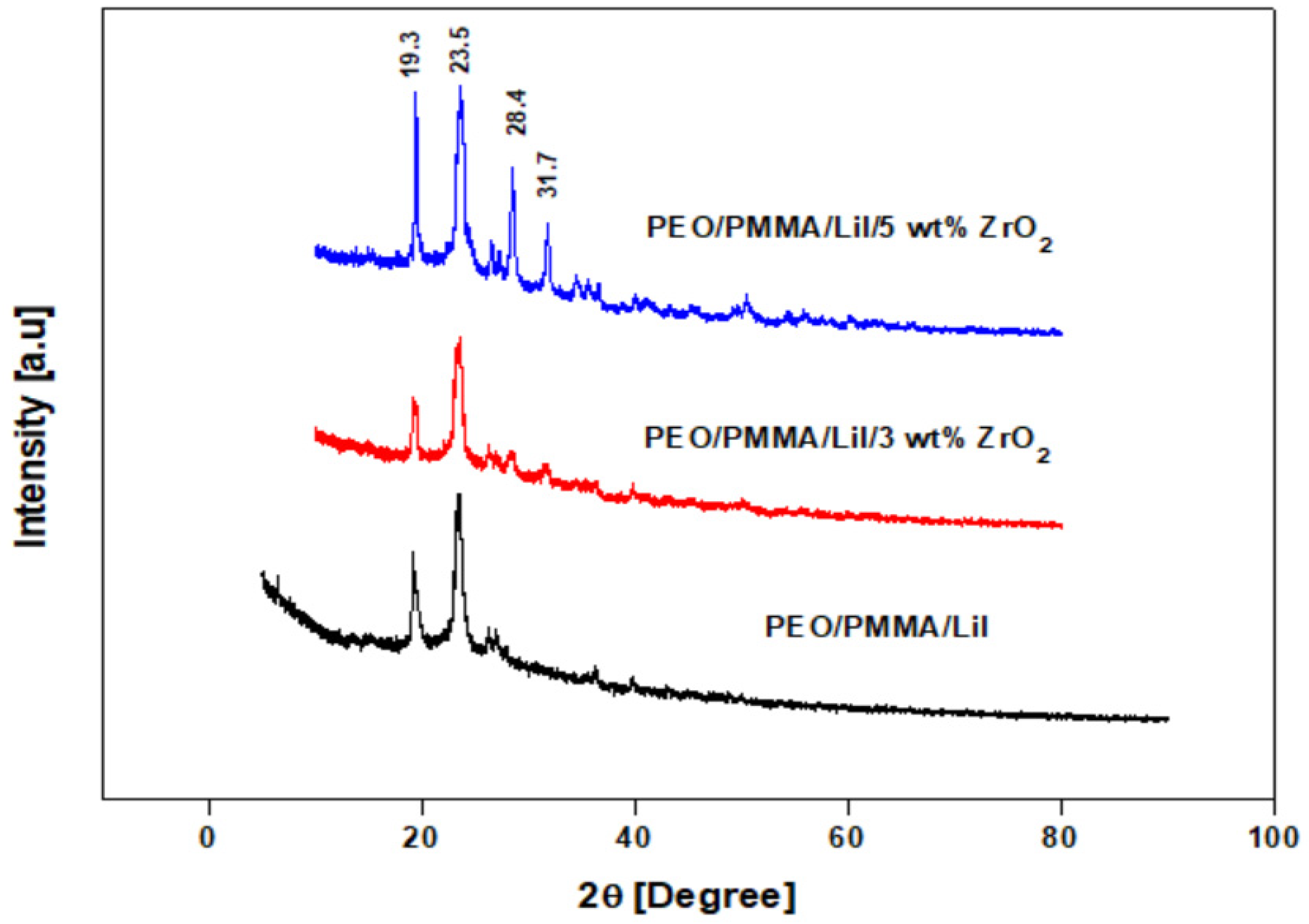
The crystalline structure of PEO/PMMA/LiI polymer electrolyte with and without ZrO2 nanofiller (3 and 5 wt%), was investigated using X-ray diffraction, as shown in Figure 3. The filler-free electrolyte displays distinct diffraction peaks around 2θ ≈ 19.1° and 23.4°, characteristic of the semi-crystalline nature of PEO, while the presence of a broad halo at lower angles corresponds to the amorphous PMMA phase, which partially suppresses long-range ordering [4]. The incorporation of 10 wt% LiI did not result in the appearance of additional crystalline peaks or distinct phase reflections in the XRD patterns. They showed the peaks corresponding to PEO and PMMA only which indicates that no detectable phase separation occurred within the investigated composition range. Upon the addition of ZrO2 nanoparticles, these PEO-related peaks become progressively broader, less intense and shifted to 19.3° and 23.5°, indicating disruption of crystalline domains due to strong interactions among polymer chains, lithium ions and the ceramic filler ZrO2 [22]. This structural modification is accompanied by the appearance of weak diffraction peaks at approximately 2θ ≈ 28.4° and 31.7°, confirming the successful incorporation of crystalline ZrO2 within the polymer matrix. Although the electrolyte containing 3 wt% ZrO2 exhibits the greatest reduction in crystallinity, this presents an optimal balance between amorphous content and uniform filler dispersion. This structural balance is favorable for enhanced segmental motion and continuous ion-transport pathways, which explains the superior ionic conductivity observed for the 3 wt% ZrO2-based electrolyte films [14]. Addition of 5 wt% ZrO2 shows the increase in intensity of peak which indicates the crystalline nature. Overall, the XRD results demonstrate that controlled incorporation of ZrO2 effectively tailors the polymer structure, making the nanocomposite electrolyte films suitable for solid-state electrochemical applications.

4. Conclusions

In this study, PEO/PMMA/LiI-based solid polymer nanocomposite electrolyte systems incorporating ZrO2 nanoparticles were successfully prepared via the solution casting method. Their structural, morphological, and spectroscopic properties were systematically investigated using XRD, FTIR and SEM analyses. SEM observations demonstrated that the addition of 3 wt% ZrO2 resulted in a relatively smooth and homogeneous morphology with uniform filler dispersion, whereas higher filler loading leads to particle agglomeration and surface irregularities. FTIR results confirmed strong coordination among Li+ ions, polymer functional groups and ZrO2 nanoparticles, suggesting the formation of polymer–salt–filler complexes. XRD results revealed a reduction in the characteristic crystalline peaks of PEO upon ZrO2 incorporation, indicating an increase in the amorphous nature of the polymer matrix. These structural and morphological modifications suggest that controlled addition of ZrO2 influences the microstructural properties of the polymer blend. Among the investigated compositions, the sample containing 3 wt% ZrO2 exhibited improved structural uniformity and enhanced amorphous character compared to other compositions. The present findings provide insight into the role of nanofiller incorporation in modifying polymer blend characteristics, and further electrochemical investigations are necessary to evaluate their suitability for solid-state electrolyte applications.

Author Contributions

Conceptualization and methodology: A.S.; Validation A.S. and R.K.; Visualization A.S., R.K. and M.T.T.; writing—original draft preparation A.S., R.K. and M.T.T.; Review and editing A.S. and R.K. All authors have read and agreed to the published version of the manuscript.

Funding

The authors would like to thank the Tamil Nadu State Council for Science and Technology (TNSCST) under the Student Project Scheme 2024–2025 (Grant No. PS-232).

Data Availability Statement

The data presented in this study are not publicly available due to privacy and ethical restrictions.

Conflicts of Interest

The authors declare no conflicts of interest.

References

  1. Zhang, J.; Zhao, N.; Zhang, M.; Li, Y.; Chu, P.K.; Guo, X.; Di, Z.; Wang, X.; Li, H. Flexible and ion- conducting membrane electrolytes for solid-state lithium batteries: Dispersion of garnet nanoparticles in polymer matrices. J. Mater. Chem. A 2018, 6, 20564–20573. [Google Scholar] [CrossRef]
  2. Manthiram, A.; Yu, X.; Wang, S. Lithium battery chemistries enabled by solid-state electrolytes. Nat. Rev. Mater. 2017, 2, 16103. [Google Scholar] [CrossRef]
  3. Zhao, Q.; Stalin, S.; Archer, L.A. Solid-state lithium batteries: Advances, challenges, and perspectives. Chem. Rev. 2020, 120, 4257–4300. [Google Scholar]
  4. Xue, Z.; He, D.; Xie, X. Poly(ethylene oxide)-based electrolytes for lithium-ion batteries. J. Mater. Chem. A 2015, 3, 19218–19253. [Google Scholar] [CrossRef]
  5. Croce, F.; Appetecchi, G.B.; Persi, L.; Scrosati, B. Nanocomposite polymer electrolytes for lithium batteries. Nature 1998, 394, 456–458. [Google Scholar] [CrossRef]
  6. Agrawal, R.C.; Pandey, G.P. Solid polymer electrolytes: Materials designing and all-solid-state battery applications. J. Phys. D Appl. Phys. 2016, 41, 223001. [Google Scholar] [CrossRef]
  7. Singh, R.; Chandra, A.; Thakur, A.K. Effect of polymer blending in ion transport in solid polymer electrolytes. Solid State Ion. 2019, 334, 24–31. [Google Scholar]
  8. Subramanian, A.; Kumaraiah, R.; Tahira, M.T. Novel dispersion of CeO2 nanofiller in PEO/PMMA blended nanocomposite solid polymer electrolytes. Eng. Proc. 2023, 56, 231. [Google Scholar]
  9. Hema, M.; Selvasekarapandian, S.; Arunkumar, D.; Sakunthala, A.; Nithya, H. Structural and morphological studies of polymer electrolyte films. Phys. B 2016, 403, 2740–2747. [Google Scholar] [CrossRef]
  10. Pradhan, D.K.; Choudhary, R.N.P.; Samantaray, B.K. Optical and electrical properties of polymer nanocomposite electrolytes. Mater. Chem. Phys. 2018, 115, 557–561. [Google Scholar] [CrossRef]
  11. Wang, Y.; Zhang, L.; Chen, S. Crystallinity-dependent ionic transport in PEO-based electrolytes. Electrochim. Acta 2019, 296, 117–125. [Google Scholar]
  12. Zhao, S.; Wang, S.; Chen, Y.; Xu, Y. Enhanced ionic conductivity in polymer electrolytes via nano-filler dispersion. J. Power Sources 2020, 449, 227563. [Google Scholar]
  13. Liu, W.; Liu, N.; Sun, J.; Hsu, P.C.; Li, Y.; Lee, H.W.; Cui, Y. Ionic conductivity reduction caused by filler aggregation in solid polymer electrolytes. Nano Lett. 2017, 15, 2740–2745. [Google Scholar] [CrossRef]
  14. Zhang, H.; Li, C.; Eshetu, G.G.; Laruelle, S.; Grugeon, S.; Armand, M. Nanocomposite polymer electrolytes: Influence of filler concentration on structure and ion transport. Energy Storage Mater. 2021, 34, 644–654. [Google Scholar]
  15. Patel, G.; Sureshkumar, M.B.; Patel, P. Spectroscopic Investigation and Characterizations of PAM/PEO Blends Films. Soft 2015, 4, 9–24. [Google Scholar] [CrossRef]
  16. Stephan, A.M.; Prem Kumar, T.; Anbu Kulandainathan, M.; Angu Lakshmi, N. Chitin-Incorporated Poly(ethylene oxide)-Based Nanocomposite Electrolytes for Lithium Batteries. J. Phys. Chem. B 2009, 113, 1963–1971. [Google Scholar] [CrossRef] [PubMed]
  17. Ramana Jeedi, V.; Laxmi Narsaiah, E.; Yalla, M.; Swarnalatha, R.; Narender Reddy, S.; Sadananda Chary, A. Structural and electrical studies of PMMA and PVdF based blend polymer electrolyte. SN Appl. Sci. 2020, 2, 2093. [Google Scholar] [CrossRef]
  18. Pelfrey, S.; Cantu, T.; Papantonakis, M.R.; Simonson, D.L.; Andrew McGill, R.; Macossay, J. Microscopic and spectroscopic studies of thermally enhanced electrospun PMMA micro- and nanofibers. Polym. Chem. 2010, 1, 866–869. [Google Scholar] [CrossRef][Green Version]
  19. Raheem, D.; Majid, Z. Polymethyl Methacrylate-Collagen-Magnesium Hydroxyapatite Bone Cement Preparation for Orthopedic Application. Chin. J. Biomed. Eng. 2020, 29, 18–23. [Google Scholar]
  20. Rajendran, S.; Kannan, R.; Mahendran, M. Ionic conductivity studies in poly(methylmethacrylate)–polyethlene oxide hybrid polymer electrolytes with lithium salts. J. Power Sources 2001, 96, 406–410. [Google Scholar] [CrossRef]
  21. Alghunaim, N.S. Spectroscopic analysis of PMMA/PVC blends containing CoCl2. Results Phys. 2015, 5, 331–336. [Google Scholar] [CrossRef]
  22. Sivaraj, P.; Selvasekarapandian, S.; Monisha, S.; Karthikeyan, S.; Hema, M. Structural and electrochemical properties of ZrO2-filled PEO-based solid polymer electrolytes. Ionics 2019, 25, 2861–2872. [Google Scholar]
Figure 1. SEM photomicrographs of (a) PEO/PMMA/LiI, (b) PEO/PMMA/LiI with 3 wt% ZrO2 and (c) PEO/PMMA/LiI with 5 wt% ZrO2.
Engproc 124 00080 g001
Figure 2. Infrared spectra highlighting molecular bonding in PEO/PMMA/LiI and PEO/PMMA/LiI/3 wt% ZrO2.
Engproc 124 00080 g002
Figure 3. XRD profiles of PEO/PMMA/Lil, PEO-PMMA-3 wt% ZrO2 and PEO-PMMA-5 wt% ZrO2.
Engproc 124 00080 g003
Disclaimer/Publisher’s Note: The statements, opinions and data contained in all publications are solely those of the individual author(s) and contributor(s) and not of MDPI and/or the editor(s). MDPI and/or the editor(s) disclaim responsibility for any injury to people or property resulting from any ideas, methods, instructions or products referred to in the content.