3.1. Criteria Evaluation
The whole process starts with the quantification of the four selected criteria. A summary of the data required for criteria calculation are provided in previous subchapters. For the evaluation, the economic criterion uses linear interpolation, while the other criteria are assessed via simple ranking.
To ensure maximum objectivity, the alternatives are first evaluated using the implementation criterion within the MCDA algorithm, yielding a score for further analysis. A simple ranking method is employed, with no preferences assigned. Consequently, all possible combinations of the three monitored sub-criteria are considered. This results in 139 suitable combinations used for the analysis. From these, a percentage success rate is calculated, with specific positions (1st–4th) representing the respective weights, which can be referred to as the average weighted position. The resulting scores reflect the relative success of each alternative with the total of all percentage scores summing up to 100% (
Table 8).
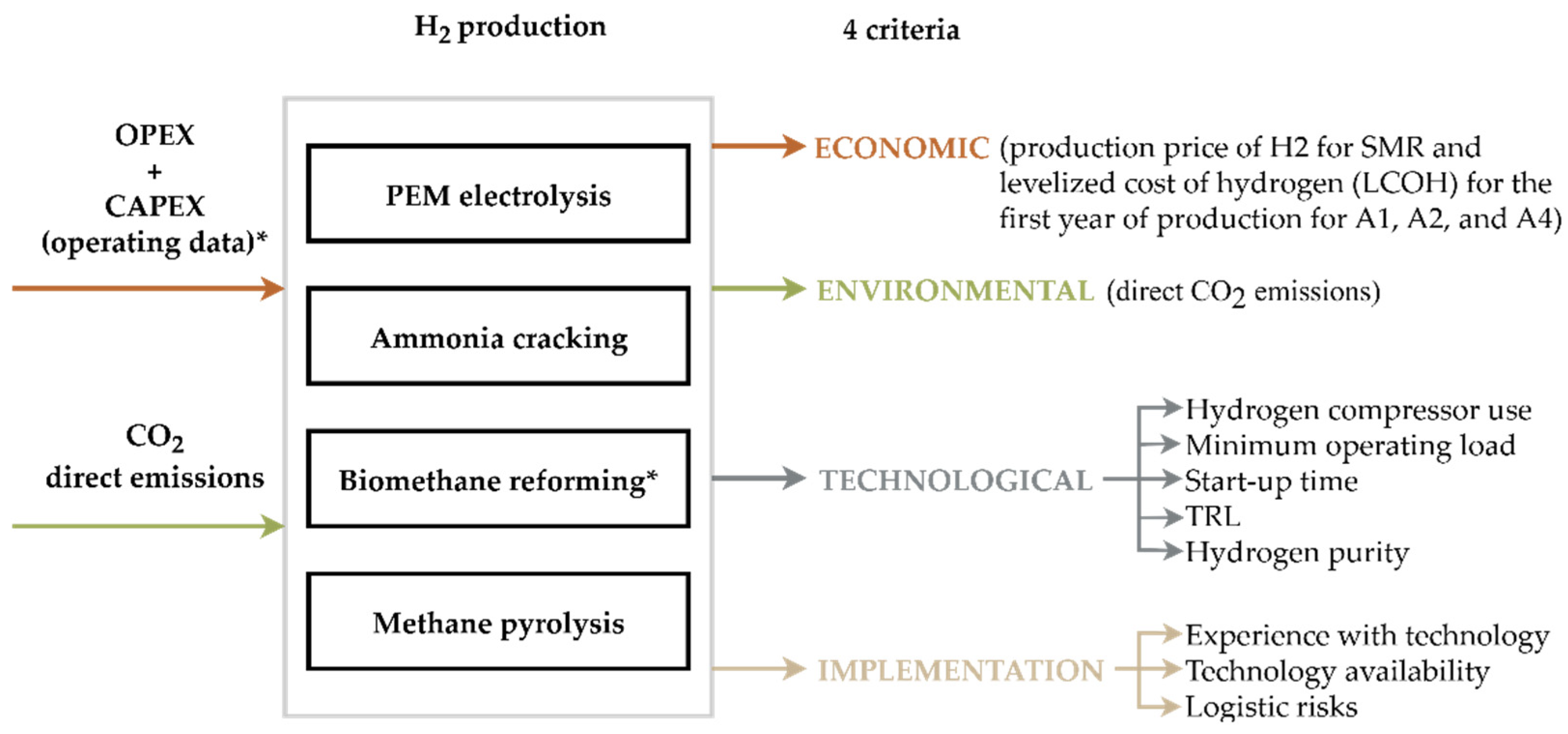
This approach is not applicable to the technological criterion, as the MCDA model is currently limited to four criteria, since including more would substantially increase the calculation time. Thus, the technological sub-criteria are normalized to values between 0 and 1, and equal weighting is used, as no particular sub-criterion is prioritized. For the six sub-criteria, an equal weight of 0.167 is assigned to each. The overall score of an alternative for the technological criterion (
is then calculated as the sum of the weighted scores of all sub-criteria (
:
where
is the weight of the ith sub-criterion. An example of the MCDA criterion calculation can be found in previous work [
35].
The economic criterion, expressed as either the first-year levelized cost of hydrogen or the hydrogen production price, is determined from operating data for the reforming unit, or calculated using Equations (1)–(3) (
Section 2.1.1). Evaluation of the environmental criterion is discussed in
Section 2.1.3.
Table 8 provides calculated values for individual H
2 technologies. Based on economic and environmental criteria, A3 offers the lowest cost but highest emissions, while A1 shows the best environmental performance at moderate cost. Including technological and implementation factors, the results are less distinct, requiring MCDA evaluation in the following step.
3.2. MCDA Results
For four monitored criteria, 16,395 consistent combinations of criteria importance were identified. Data regarding the individual combinations are provided in an excel file as a
Supplementary Material to be downloaded.
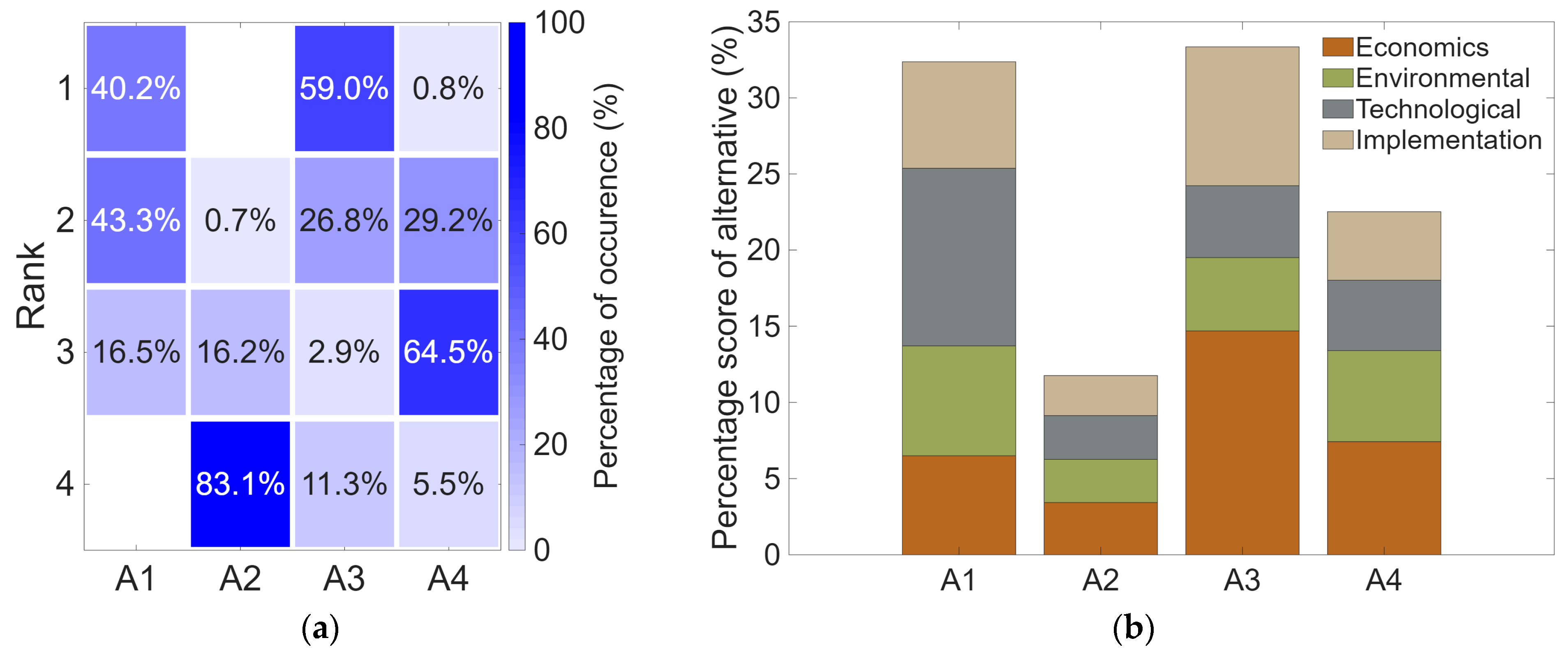
Figure 2a presents a percentage matrix showing how frequently each alternative occupies each rank, with rows for ranking positions and columns for alternatives.
Figure 2b displays weighted positions and the influence of each criterion, with total scores summing up to 100%. Weighted positions reflect each alternative’s overall performance based on rank frequency and position weight (1st–4th).
Figure 2a shows clear preference for A1 and A3, while ammonia (A2) consistently ranks last. Ammonia cracking remains uncompetitive under current conditions due to low maturity and utilization. SMR (A3) ranks first in 59% of cases (9673 combinations). Electrolysis (A1) dominates the top two positions in 84% of cases with no occurrence at the 4th position. With biomethane reforming placed 1st or 2nd in 86% of cases, the final rankings are nearly identical—33.36% for A1 and 32.37% for A3 (
Figure 2b). A1 leads in the technological criterion due to its operational flexibility and high hydrogen quality, whereas A3 benefits from the lowest production cost. Although methane cracking (A4) is economically comparable and produces solid carbon, this does not significantly improve its ranking.
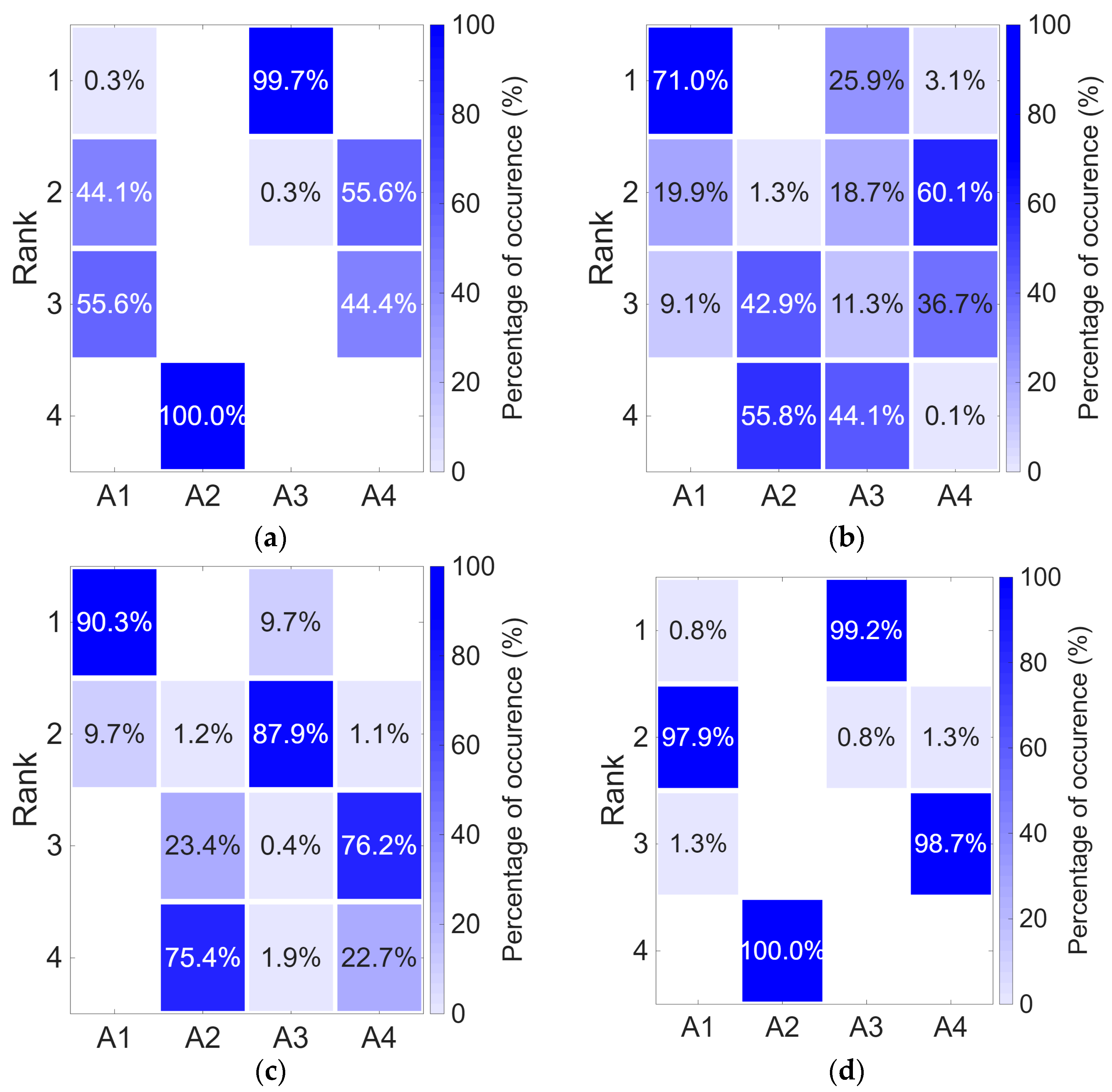
Evaluating all consistent preference combinations enables their objective comparison. However, prioritizing or ordering criteria can significantly affect outcomes. When one criterion is prioritized, consistent weight combinations decrease to 3970. When hydrogen price is prioritized, SMR (A3) ranks first in nearly all scenarios (
Figure 3a). Although methane pyrolysis (A4) has the second-lowest cost, it never ranks in first place. Under environmental preference, A4 ranks first in only 3% and second in 60% of cases, while A3 drops to 4th in 44% (
Figure 3b). Limiting the impact of hydrogen price reduces the advantage of large-scale production revealing slower start-up and load constraints of the reforming unit (
Figure 3c). In the final case (
Figure 3d), rankings remain stable across preferences: SMR (A3) consistently leads, while A4, as a newer technology, trails behind. Lastly, setting a preferred order of criteria reduces consistent combinations to 624 for four criteria, creating a personalized yet complex comparison.
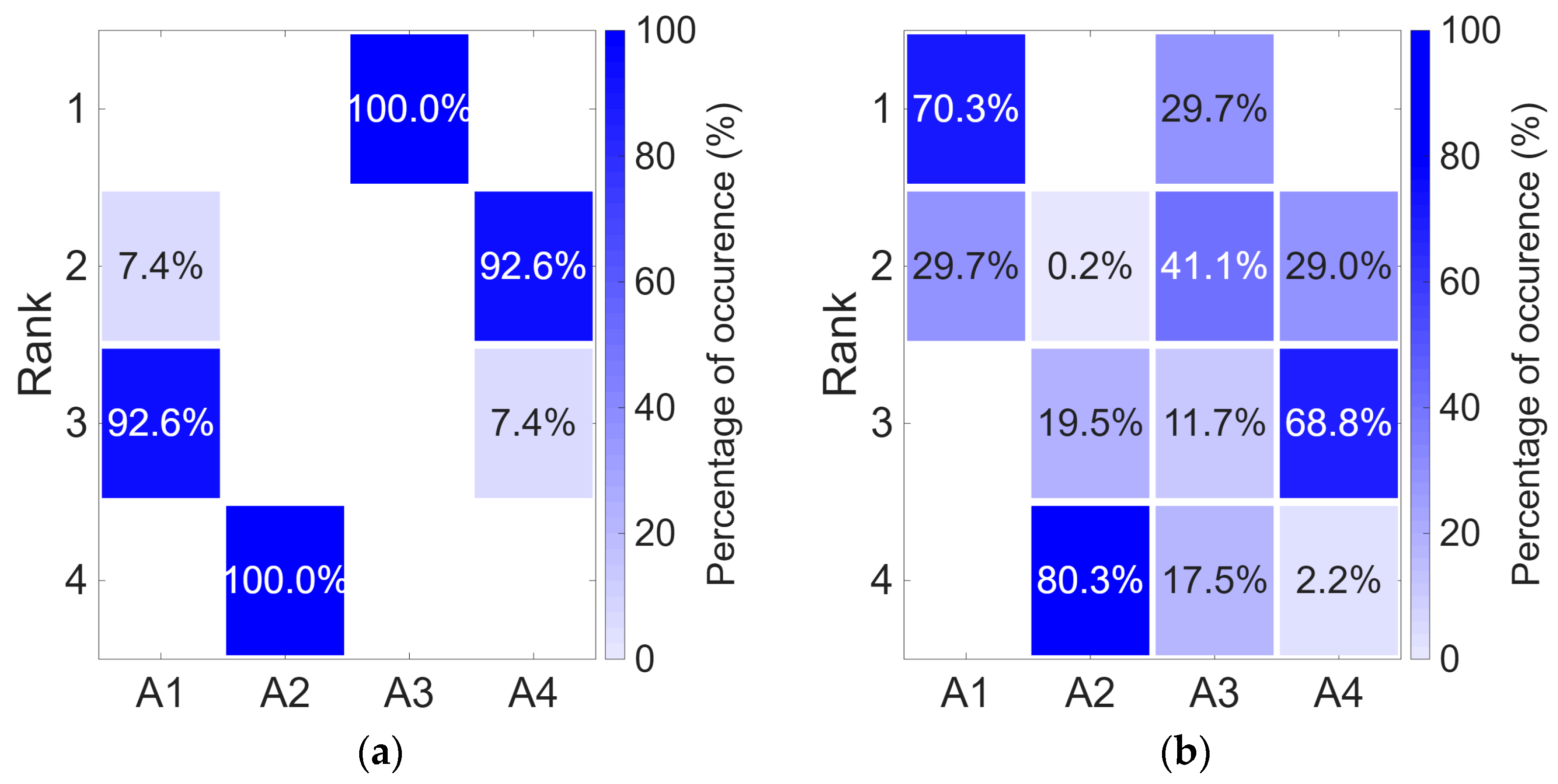
Figure 4a shows results for the order economic > technological > implementation > environmental. Despite using feedstock twice as expensive as natural gas, biomethane reforming (A3) still achieves the lowest hydrogen production cost. Electrolysis (A1), performing best technologically, ranks no higher than second (8% of combinations), with hydrogen costing 1.9 times more than steam reforming. While A1 scores 1.5 times higher in technology (
Table 8), it cannot offset the dominant economic criterion.
Sensitivity analyses consider ±60% changes in electricity or methane-rich gas prices. While higher methane gas prices favor electrolysis, the largest ranking shift occurs with a 60% drop in electricity price, giving hydrogen costs of 3.96, 9.19, 4.12, and 4.10 EUR/kg H
2 for A1–A4, respectively. Under this scenario, A1 ranks first or second across all combinations (
Figure 4b). The impact on the price and ranking of A2 is less significant.
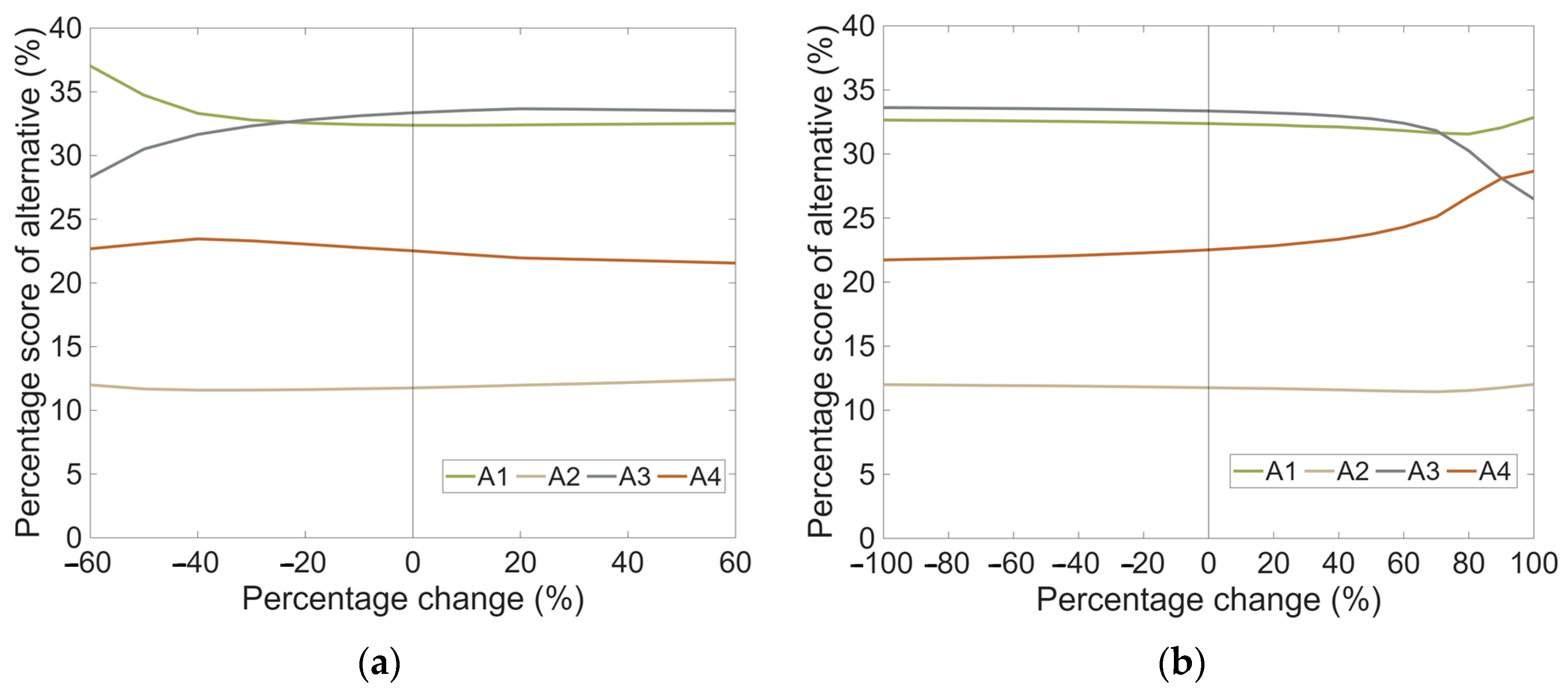
Sensitivity analysis confirms that the electricity price strongly influences the competitiveness of hydrogen production technologies. Therefore, the analysis was extended to evaluate the effect of percentage changes in the price of electricity and methane-rich gases on the percentage score of individual hydrogen alternatives (
Figure 5).
When the electricity price decreases by approximately 20%, electrolysis (A1) surpasses steam biomethane reforming (A3) in its overall percentage score (
Figure 5a). With decreasing electricity prices, A1 benefits from its strong technological performance, stemming from its operational flexibility, high hydrogen purity, and rapid dynamic response. A similar trend can be observed for methane pyrolysis (A4). As the price of electricity decreases, the production cost of pyrolysis-based hydrogen approaches that of SMR-based hydrogen, leading to an increase in the A4 score. In contrast, the score of steam biomethane reforming (A3) gradually decreases relative to the other alternatives. This indicates that electricity price affects methane pyrolysis more than steam biomethane reforming.
Conversely, when the price of methane-rich gases increases, the score of A3 declines (
Figure 5b). For A3 to outperform A1, an approximate 70% increase in methane-rich gas prices is required. The price of hydrogen produced via methane pyrolysis (A4) is less affected by increasing methane prices compared to SMR. However, for A4 to outperform A3, an even larger increase of around 90% is necessary. Up to this level of increase, SMR maintains a competitive advantage due to its high score in the implementation criterion and the second-highest score in the technological criterion as a well-established and mature process.
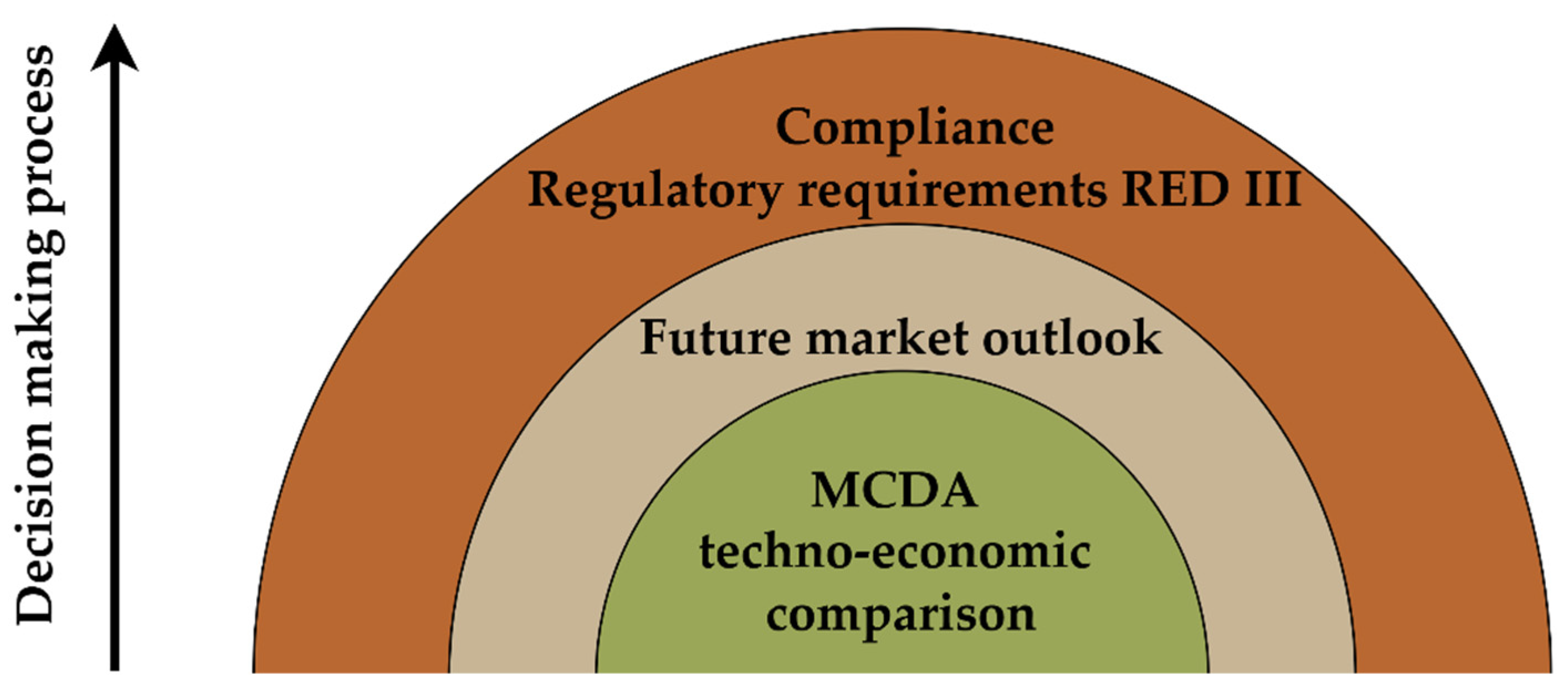
However, several factors beyond energy prices influence investment decisions, with the European Union playing a key role through policies favoring renewable projects. The RED III directive affects hydrogen classification, and only electrolysis can produce RFNBO, which refineries must supply to avoid regulatory penalties. Meeting RED III requirements for continuous renewable electricity is challenging, which makes the ammonia cracking scenario a potential solution. While ammonia cracking (A2) ranks lowest in techno-economic terms, its ability to contribute to RFNBO adds strategic value. Overall, choosing the company’s direction is a complex process (
Figure 6) requiring detailed evaluation and the long-term monitoring of market trends and EU policies, which is beyond the scope of this study.