Article

Direct Quantification of Oxalic Acid at Moderate-to-High Concentrations by Micro-Raman Spectroscopy: Analytical Performance and Electronic Structure Insights from NBO–AIM Analysis

by
Paola Peralta
1,*,
Rodrigo Ortega-Toro
2 and
Joaquín Hernández-Fernández
1,3,*
1
Chemistry Program, Department of Natural and Exact Sciences, University of Cartagena, San Pablo Campus, Cartagena de Indias 130015, Colombia
2
Food Packaging and Shelf-Life Research Group (FP&SL), Food Engineering Program, University of Cartagena, Cartagena de Indias 130015, Colombia
3
Department of Natural and Exact Science, Universidad de la Costa, Barranquilla 080002, Colombia
*
Authors to whom correspondence should be addressed.
Analytica 2026, 7(2), 41; https://doi.org/10.3390/analytica7020041 (registering DOI)
Submission received: 29 April 2026 / Revised: 21 May 2026 / Accepted: 4 June 2026 / Published: 9 June 2026

Abstract

Oxalic acid is extensively used in industrial chemical processes, purification systems, hydrometallurgical operations, and advanced oxidation environments where rapid and environmentally sustainable analytical methodologies are increasingly required for process monitoring and quality control. In this study, a micro-Raman spectroscopy methodology was developed for the direct quantification of oxalic acid in aqueous systems at moderate-to-high concentrations (0.079–0.793 M). The analytical strategy was based on the integrated Raman response of the carbonyl stretching region (1700–1750 cm−1), selected due to its strong concentration-dependent behavior, spectral definition, and reduced interference from the aqueous matrix. The proposed methodology demonstrated excellent analytical performance, including high linearity (R2 > 0.998), satisfactory precision, and reliable concentration-dependent reproducibility throughout the evaluated concentration range. To evaluate operational robustness, matrix-matched standards incorporating temperature variation (25–40 °C), turbidity (0–57 mg/L), dissolved Ca2+ (0–58 mg/L), and dissolved Fe3+ (0–7 mg/L) were prepared to simulate chemically perturbed industrial environments. Principal Component Analysis (PCA) demonstrated that the carbonyl vibrational region retained organized concentration-dependent spectral behavior despite operational perturbations. Partial Least Squares (PLS) regression models developed under these matrix-informed conditions preserved strong predictive capability (R2 ≈ 0.997), while preliminary prediction of process-related samples yielded excellent agreement between predicted and reference concentrations (R2 = 0.990). Although operational perturbations produced substantial attenuation of Raman intensity, particularly at lower concentration levels, the carbonyl Raman band remained spectrally detectable and analytically interpretable throughout all evaluated conditions. Electronic-structure analysis using Natural Bond Orbital (NBO) and Atoms-in-Molecules (AIM) methodologies demonstrated that the strong analytical behavior of the ν(C=O) vibrational mode is associated with enhanced electron-density localization, covalent stabilization, and favorable polarizability characteristics of the carbonyl bond. The combined experimental, chemometric, and computational results demonstrate the feasibility of matrix-informed micro-Raman spectroscopy as a rapid, reagent-free, and operationally robust methodology for oxalic acid monitoring in chemically perturbed aqueous industrial systems.

1. Introduction

Since oxalic acid (H2C2O4) is widely common in industrial and environmental applications, its accurate quantitation remains a pillar of modern analytical chemistry. This dicarboxylic acid is important for applications in metal surface treatment, rare-earth recovery, pharmaceutical precursor synthesis, and textile dyeing [1]. Oxalic acid is a recalcitrant end product of advanced oxidation processes for wastewater treatment; at high concentrations, oxalic acid is associated with elevated chemical oxygen demand and adversely impacts aquatic biota [2]. Historically, oxalate determination by chromatographic methods, especially High-Performance Liquid Chromatography coupled with UV detection, as well as volumetric and electrochemical methods, has been used [3]. However, these methods, while highly sensitive and well-established, often require solvents, sample preparation, and longer analysis times as essential limitations. Typical chromatographic techniques require acidic mobile phases (e.g., 5 mM H2SO4), retention times of 10–20 min per sample, and high chemical disposal (i.e., an increased environmental footprint of the lab [4]. Micro-Raman spectroscopy has emerged as a promising complementary technique to “direct analytical chemistry” technologies due to its non-invasive approach, enabling in situ analysis without reagents or complex pretreatments, thereby reducing signal acquisition time and solvent waste [5]. Notwithstanding the significant potential of Raman spectroscopy, the majority of prior work has been confined to trace detection in biological or environmental matrices, and method validation for industrial concentration ranges (0.793 and 0.079 M) is lacking, as signal intensity and molecular interactions are important sources of model linearity [6]. A key contribution of this work is the thorough analytical validation over this extended range, in which, for the first time, a sophisticated computational explanation and logic for the spectroscopic response were included. The impact of intra- and intermolecular interactions on molecular polarizability can be elucidated using quantum-chemical tools, such as Natural Bond Orbitals and topological analysis of electron density [7,8]. We can account for the changing intensity of C bands in this way. Based on this study, we now demonstrate the applicability of micro-Raman spectroscopy as an analytical approach for quantifying oxalic acid in water, considering linearity, detection and quantification limitations, reproducibility and repeatability in a lab environment. A key part of this research is to determine the sustainability profile of the proposed methodology using the latest Green Chemistry metrics [9] with respect to the AGREE and GAPI indices, and to compare its output to the latest conventional official measures. This method aligns with the 12 principles of chemistry [10] by eliminating organic solvents and reducing energy consumption. This paper not only provides an advanced analytical paradigm for industrial process control but also demonstrates the potential of integrating experimental and computational data to design a sustainable analytical process control [11].

2. Materials and Methods

2.1. Reagents and Sample Preparation

Analytical grade oxalic acid dihydrate (H2C2O4·2H2O) (purity ≥ 99.5%, Sigma-Aldrich, St. Louis, MO, USA) was used without additional purification. The solvent used was high-purity deionized water (resistivity 18.2 M Ω at 25 °C). For calibration curve and method validation, 10 independent standards were prepared at concentrations of 0.793, 0.714, 0.637, 0.555, 0.476, 0.397, 0.317, 0.238, 0.159, and 0.079 M. The solutions were prepared by gravimetric weighing on an analytical balance with a precision of ±0.1 mg and by volumetric dilution at 20 °C for an accurate concentration of the standard.

2.2. Micro-Raman Spectra Acquisition

The confocal Raman microspectroscopy system (DXR3 Raman Microscope, Thermo Fisher Scientific, Waltham, MA, USA) with an excitation laser at 532 nm was used to measure the signal, selected to reduce background fluorescence and enhance the Raman scattering cross-section [12]. The laser beam was directed to the liquid samples using a long-working-distance objective (50×).Acquisition metrics were adjusted to obtain a signal-to-noise ratio (S/N) greater than 100, 20–30 s exposure time, and the mean of 5 accumulations per sample. Laser power was kept below 10 mW to prevent thermal degradation of the sample. A daily calibration of the wavenumber was performed using the silicon characteristic band at 520.7 cm−1 [13]. Raman spectra were evaluated at different laser powers to analyze, in general terms, the variation in spectral response and relative standard deviation (RSD). The corresponding results are presented in the Supplementary Materials.

2.3. Evaluation of Laser Power Conditions

To evaluate the influence of laser power on the analytical performance of the Raman methodology, spectra were acquired at four excitation powers (6, 7, 9, and 10 mW) using oxalic acid solutions at two representative concentration levels corresponding to the upper and lower limits of the analytical working range (0.793 and 0.079 M, respectively). For each laser power condition, five independent Raman measurements were obtained under identical acquisition parameters, maintaining constant exposure time, spectral range, optical configuration, and instrumental alignment. The integrated area of the carbonyl stretching region (1700–1750 cm−1) was selected as the analytical response variable due to its strong concentration-dependent behavior and spectral definition. The influence of laser power was evaluated considering Raman signal intensity, spectral repeatability, and relative standard deviation (%RSD). The selected operational power was defined as the condition providing the best compromise between signal intensity and analytical repeatability while avoiding signal instability or excessive spectral fluctuations. The corresponding results are presented in the Supplementary Materials.

2.4. Statistical Analysis

2.4.1. Linearity Assessment

The model’s quantitative capability was assessed using the coefficient of determination (r2) and an analysis of variance for linear regression, based on the areas under the curve of the selected spectral band associated with C–C or C=O symmetric stretching [14].

2.4.2. Limits of Detection and Quantification

The limits of detection (LOD) and quantification (LOQ) were determined from the signal-to-noise ratio. Specifically, the LOD was defined as the concentration that yields an S/N ratio of 3. In contrast, the LOQ was defined as the concentration that yields an S/N ratio of 10, following the criteria accepted in the literature [15].

2.4.3. Precision and Accuracy

Precision was assessed using intra- and inter-day repeatability, indicated as relative standard deviation (RSD). Repeatability was assessed using six successive analyses at five concentration levels, performed on the same day by the same operator using the same instrument. Inter-day precision was assessed using five daily measurements at each level for 10 consecutive days. Accuracy was assessed using relative error and percentage recovery in fortified samples. A permissible variance of less than 15% was established, with a maximum of 20% permitted according to authorized processes [16].

2.4.4. Partial Least Squares (PLS) Regression Model

To correlate the Raman spectral response with the concentration of oxalic acid in aqueous solution, a partial least squares (PLS) regression model was applied to the spectral data, which allowed establishing a quantitative relationship between the spectral variables and the concentration of the analyte, identifying the regions of the spectrum with the greatest predictive capacity, and determining their predictive capacity within the studied concentration range.

2.4.5. Principal Component Analysis

Principal component analysis (PCA) was applied to the data matrix constructed from the topological descriptors obtained using AIM and the electronic parameters derived from NBO analysis to explore clustering patterns and relationships among the different interactions present in the system. The matrix included the electron density at the critical bonding point, its Laplacian, the kinetic and potential energy densities, the total energy density, and the energies associated with the donor and acceptor orbitals. The data were previously organized into a numerical table and scaled to avoid biases arising from differences in variable magnitudes. PCA was used as an exploratory tool to identify the relative contribution of each descriptor in differentiating between covalent bonds and hydrogen bonds, as well as to evaluate structural and electronic trends within the hydrated aggregate.

2.5. Green Assessment of the Analytical Procedure

2.5.1. Analytical Eco-Scale

The Ecoscale was used to evaluate the process. It assigns a score from 0 to 100 based on the risks associated with reagent use (according to the GHS categorization), the amount of energy consumed, the amount of waste generated, sample preparation, the quantity of reagents used, and the level of hazard to the analyst. A score of 75 or higher is considered excellent (eco-friendly), a score of 50 to 75 is reasonable, and a score below 50 is unsustainable [17,18]. The task was evaluated based on reagents, solvents, instruments, waste, consumables, and analysis times. Penalties were applied when processes required more than 1 kWh of energy per analysis, more than 10 mL of reagents, or complex sample pretreatment. The Ecoscale score decreased by an amount proportional to the safety or environmental impact of each penalty.
Eco-Scale Score = 100 − ∑(Penalties)

2.5.2. Green Analytical Procedure Index (GAPI)

The method was tested against the 15 GAPI criteria, which were grouped into five categories: sampling, sample preparation, analytical procedure, waste generation, and final evaluation. We used green, yellow, or red to show how sustainable each criterion was. The Raman approach does not use solvents or damage anything, so it should reveal more green spots in the pentagonal matrix [19,20].

2.5.3. AGREE Metric

The AGREE measure assessed the effectiveness of applying the 12 principles of Green Analytical Chemistry (GAC). It considered factors such as minimal preparation, lower energy consumption, use of safe reagents, waste reduction, on-site application, automation, analyst safety, and overall energy and environmental efficiency. Each principle was assigned a score from 0 to 1 to calculate a radial index [21].

2.6. Computational Study

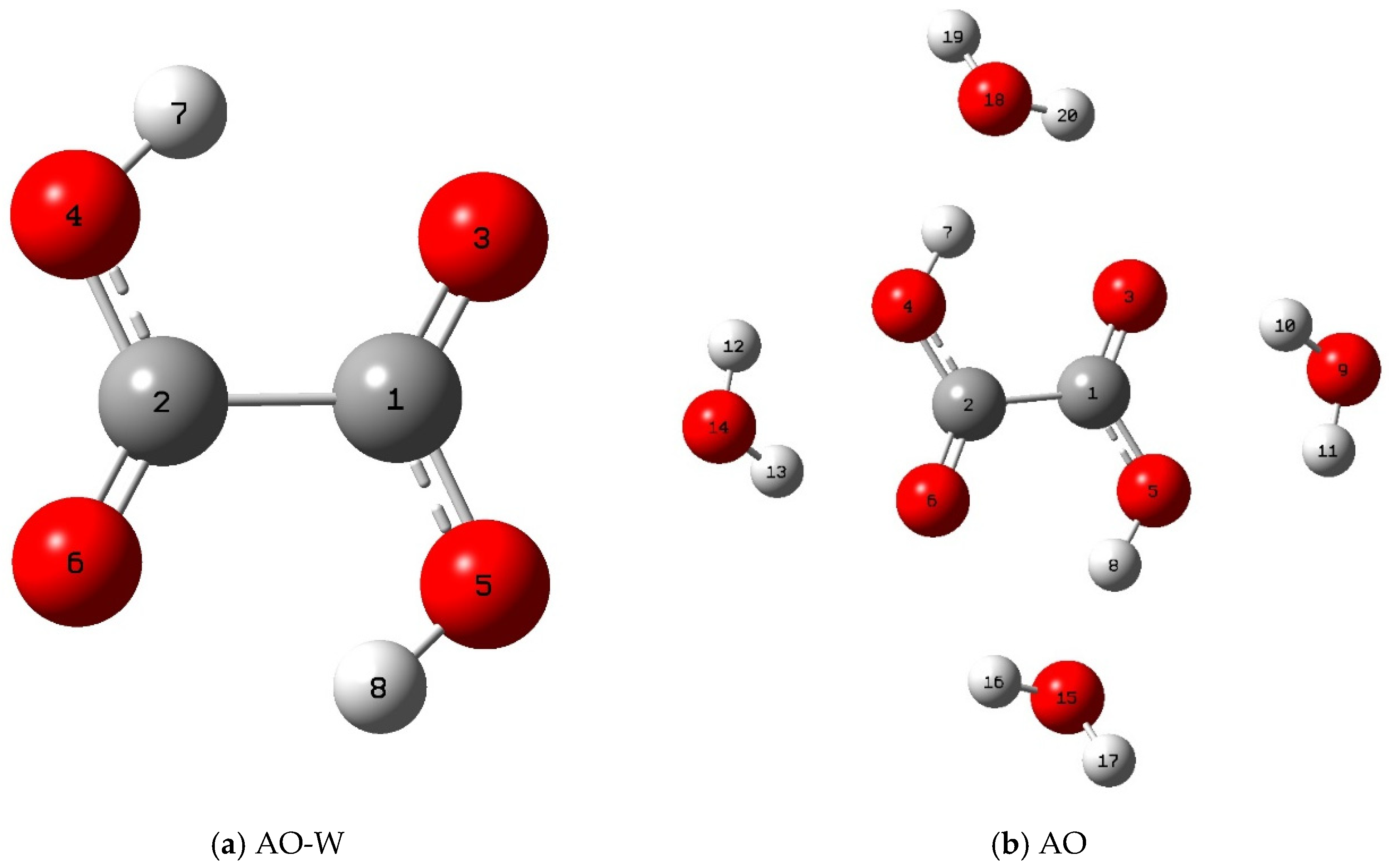
The electronic-structure calculations were carried out using Density Functional Theory with the Gaussian 16 software (Gaussian, Inc., Wallingford, CT, USA). Using the B3LYP hybrid functional and the extended base set 6-311++G(d,p) [22], we optimized the molecular geometries of oxalic acid (AO) and the oxalic-water (AO-W) system by allowing a sufficient description of lone pairs and polarization effects. Natural bond orbital (NBO), Atomic-in-Molecular Analysis (AIM), and Polarizability analyses were done to rationalize the Raman vibrational response; NBO was applied for the quantitative analysis of intramolecular charge transfer and hyperconjugation interactions (σ→σ∗), which are essential for understanding electron delocalization and its effect on polarizability. AIM was implemented to discover critical bonding points and analyze the topology of the electron density ρ(r) and its Laplacian ∇2ρ(r). This enabled us to analyze intra- and intermolecular hydrogen bonds in oxalic acid. See Figure 1.

2.7. Evaluation of Raman Response Under Variable Operational Conditions

To evaluate the analytical performance of the proposed Raman methodology under operational conditions of industrial chemical processes, an experimental design with variable physicochemical process conditions was implemented at a chemical industrial plant in Cartagena, Colombia. The evaluated systems were associated with industrial operations related to chemical production and fine chemical processing, where oxalic acid is commonly employed as a purifying agent, catalyst, and pH regulator during synthesis and purification stages. The evaluated operational variables included temperature, turbidity, and dissolved ionic species represented by Ca2+ and Fe3+ concentrations. These parameters were selected for their relevance to industrial aqueous streams, corrosion-related environments, crystallization systems, and purification processes involving oxalic acid-containing solutions. In such systems, process streams and reaction vessels frequently operate at moderate-to-high oxalic acid concentrations, despite the lower concentration requirements typically associated with final product specifications. The experimental design was organized across three independent production lines, identified as Lines A, B, and C, corresponding to systems with different oxalic acid concentrations within the analytical working range of the proposed Raman methodology. For each production line, Raman measurements were acquired under two operational conditions, identified as the initial and final conditions. The initial operational condition corresponded to environments characterized by lower turbidity and reduced ionic content. In contrast, the final operational condition incorporated increased turbidity, higher concentrations of dissolved ionic species, and temperature variations representative of operational process fluctuations commonly encountered during industrial synthesis and purification stages. For each evaluated operational condition, independent Raman spectra were acquired using identical instrumental parameters and acquisition settings. The integrated area of the Raman band located between 1700 and 1750 cm−1, assigned to the ν(C=O) vibrational mode of oxalic acid, was selected as the analytical response variable due to its spectral definition and concentration-dependent behavior. Spectral repeatability was evaluated using the relative standard deviation (RSD), calculated from replicate Raman measurements obtained under the same operational conditions. Statistical analysis of the experimental data was performed using a two-way analysis of variance (two-way ANOVA with interaction effects), considering operational condition and production line as independent factors and the integrated Raman area as the dependent variable. Statistical significance was evaluated at the 95% confidence level (p < 0.05). Additionally, a comparative statistical analysis between initial and final operational conditions was performed for each production line to evaluate variations in the integrated Raman response of the carbonyl band under variable industrial process environments.

2.7.1. Preparation of Matrix-Matched Standards

To evaluate the influence of operational variables commonly encountered in industrial chemical environments on the Raman response of oxalic acid, a second experimental set of matrix-matched standards was prepared. These standards were designed to simulate the physicochemical characteristics of process-related aqueous systems in chemical production and purification environments where oxalic acid is used as a process reagent, pH regulator, or purification agent. The matrix-matched standards were prepared using aqueous oxalic acid solutions within the analytical concentration range previously established for the calibration model (0.079–0.793 M). In addition to oxalic acid concentration, the experimental design incorporated controlled variations in turbidity, dissolved calcium ions (Ca2+), dissolved iron ions (Fe3+), and temperature. The selected operational ranges were defined based on physicochemical conditions experimentally observed in process-related samples collected from an industrial chemical plant located in Cartagena, Colombia. Temperature conditions were evaluated at 25 and 40 °C to simulate thermal variations commonly encountered during synthesis, purification, and process recirculation stages. Turbidity values ranged from approximately 0–7 mg/L under low-interference conditions to 50–57 mg/L under high-interference conditions. Calcium concentrations varied from 0–5 mg/L in low-interference systems to 49–58 mg/L in interference-modified conditions. Similarly, dissolved Fe3+ concentrations ranged between 0–5 mg/L under low-interference conditions and 4–7 mg/L under high-interference operational environments. The objective of this experimental strategy was not to reproduce the full chemical complexity of industrial matrices but rather to incorporate representative operational perturbations that could affect Raman signal intensity, spectral organization, and chemometric predictive performance. Consequently, the prepared standards allowed the construction of a matrix-informed spectral dataset suitable for evaluating the robustness of the Raman methodology under simulated industrial conditions. For each matrix condition, independent Raman spectra were acquired using identical instrumental parameters and acquisition settings. The carbonyl stretching region (1700–1750 cm−1) was selected as the principal analytical window due to its previously demonstrated concentration-dependent behavior, spectral definition, and analytical reproducibility.

2.7.2. PCA and PLS Modeling Under Simulated Operational Conditions

Multivariate chemometric analysis was performed using the spectral dataset obtained from the matrix-matched standards prepared under variable operational conditions. The objective of this analysis was to evaluate the influence of physicochemical perturbations on spectral organization, concentration discrimination, and predictive model performance. Before chemometric analysis, Raman spectra were subjected to spectral preprocessing to minimize non-chemical variability associated with baseline fluctuations, scattering effects, and signal-intensity distortions induced by turbidity and matrix heterogeneity. Spectral preprocessing included baseline correction, normalization, and spectral-region selection, with a focus primarily on the carbonyl stretching region (1700–1750 cm−1), which exhibited the strongest concentration-dependent Raman response throughout the study. Principal Component Analysis (PCA) was initially applied as an unsupervised exploratory technique to evaluate spectral clustering behavior, identify variance patterns, and investigate the influence of operational variables on the Raman spectral response. PCA allowed visualization of grouping tendencies associated with oxalic acid concentration while simultaneously evaluating the spectral dispersion introduced by turbidity, temperature, and dissolved ionic species. Subsequently, Partial Least Squares (PLS) regression analysis was performed to establish predictive relationships between Raman spectral information and oxalic acid concentration under simulated operational conditions. The PLS model incorporated spectral variability associated with temperature (25–40 °C), turbidity (0–57 mg/L), Ca2+ concentration (0–58 mg/L), and Fe3+ concentration (0–7 mg/L), thereby expanding the calibration space beyond conventional pure aqueous standards. Model performance was evaluated using cross-validation, with the coefficient of determination (R2), root-mean-square error of calibration (RMSEC), and root-mean-square error of cross-validation (RMSECV). The number of latent variables was selected to minimize prediction error while avoiding model overfitting. To preliminarily evaluate the applicability of the developed chemometric model under process-related conditions, the optimized PLS model was subsequently applied to Raman spectra of process-related samples acquired under variable operational conditions. The obtained predictions were compared under the known operational conditions and the expected concentration trends for each production line. The implemented chemometric strategy enabled assessment of the predictive robustness of the Raman methodology under simulated industrial conditions, while accounting for matrix-related variability commonly absent in conventional calibration models based exclusively on pure aqueous standards.

3. Results and Discussion

3.1. Spectral Behavior of Oxalic Acid Solutions

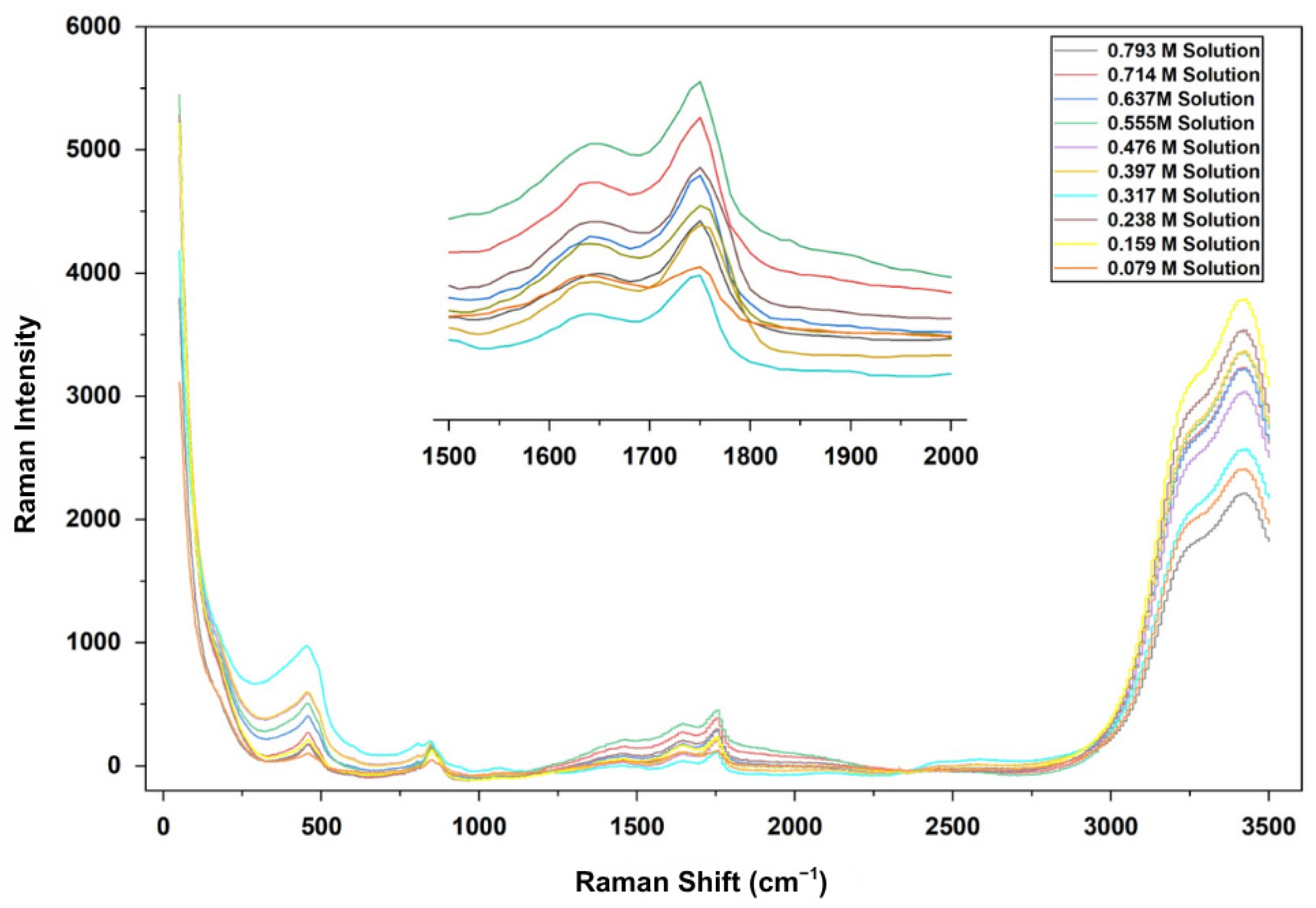
Figure 2 shows the Raman spectra of aqueous oxalic acid solutions at 0.793, 0.714, 0.637, 0.555, 0.476, 0.397, 0.317, 0.238, 0.159, and 0.079 M, respectively, while Table 1 presents the characteristic spectral regions of the oxalic acid solutions. The Raman spectra of the aqueous oxalic acid solutions showed several regions of analytical interest, although not all were equally suitable for quantitative purposes. A very intense, broad band was observed in the high-wavenumber region, approximately 3200–3500 cm−1, which is primarily associated with the O–H stretching vibrations of water and the hydrogen-bonding network in the liquid phase. Because the solvent contribution dominates this region, its analytical utility for the direct quantification of oxalic acid is limited. In the mid-wavenumber region, a band centered near 1600–1660 cm−1 was also detected. This signal is mainly governed by the H–O–H bending behavior of water and may partly coincide with oxalic acid contributions [23]. While there may be some degree of concentration dependence in this region, it may not be suitable for univariate calibration due to a significant solvent background. The key analytic feature in the present spectra was in the 1700–1750 cm−1 range. The bands are primarily derived from the C=O stretching vibration of protonated carboxylic groups, which showed the most pronounced monotonic increase with oxalic acid concentration [24]. Besides its apparent dependence on concentration, this band is less congested in the spectral region than the broad O–H stretching envelope, making it the most suitable region for quantitative analysis. Other oxalic acid bands were formed in regions 1435–1475 cm−1 and 850–905 cm−1. The former consists of C–O and symmetric COO stretching vibration modes, whereas the latter is due to C–C stretching of the oxalate skeleton. Both regions may contribute valuable secondary analytical information, but their response may be affected by protonation condition, band overlap, baseline treatment, and local spectral noise. At low wavenumbers, lower than approximately 600 cm−1, low-intensity skeletal and deformation modes were observed. Due to their lower intensity and signal-to-noise ratio, these bands are less suitable for routine quantification in aqueous solution. Overall spectral behavior shows that the 1700–1750 cm−1 band is the most desirable for calibration, and the 850–905 cm−1 and 1435–1475 cm−1 bands can be used as confirmation (secondary) bands. See Figure 2 and Table 1.
Raman behavior of oxalic acid in water is not only dependent on its total concentration but also on its protonation state. As a diprotic acid, it can exist in solution as a fully protonated species, as hydrogen oxalate, or as oxalate. Thus, the emission spectrum we observe in aqueous medium may represent the contribution of various species in equilibrium. Vibrationally, the presence of protonated carboxylic groups exhibits significant participation in the C=O stretching region, suggesting that the analytical significance of the 1700–1750 cm−1 range could be attributed to these groups [25]. As the extent of dissociation varies, the electron distribution between the C=O and C–O bonds can be modified, and the relative intensities, widths, and even the positions of specific bands can be manipulated. Hence, in regions with carboxylate motif vibrations such as 1435–1475 cm−1, the effect of speciation may seem more effective as compared to a band dominated by a localized carbonyl vibration [26]. The strong interaction with water also plays a role in this behavior. The aqueous medium promotes a large network of hydrogen bonds that alters the local environment of the carboxyl groups. This results in band broadening and reduced spectral discrimination between solutions of similar concentration, particularly in solvent-rich areas. This could be one reason why some bands show low change with concentration, not because the analyte itself is not contributing, but because the relative contribution does not vary drastically with water intensity or acid-base equilibrium. Here, an appropriate analytical band should not only be selected for its absolute amplitude but also for its sensitivity to speciation differences, its separation from the water bands, and its consistent response throughout the concentration range under study. According to this requirement, the 1700–1750 cm−1 region is particularly useful, offering good intensity, monotonic behavior, and less solvent interference.
Table 1. Spectral regions are characteristic of oxalic acid solutions.
Raman Region (cm−1)Vibrational AssignmentPhysical DescriptionBehavior with Concentration
3200–3500ν(O–H) stretching (H2O/H-bonded COOH)Very broad and intense band dominated by a hydrogen-bonded water networkPoor sensitivity to oxalic acid concentration; signal largely controlled by solvent [27]
1600–1660δ(H–O–H) bending of water with overlapping C=O contributionsBroad band from water bending vibration; partially overlaps with acid modesWeak or moderate changes due to dominant water contribution [28]
1700–1750ν(C=O) stretching of COOHCarbonyl stretching of protonated carboxylic groupsStrong monotonic increase with concentration; excellent analytical band [29]
1435–1475ν(C–O)/νs(COO) stretchingCarboxylate/carboxylic group vibration of the oxalate frameworkModerate increase; may depend on protonation/speciation [30]
850–905ν(C–C) stretchingSkeletal vibration of the oxalate backboneClear concentration dependence; useful secondary band [31]
540–600δ(O–C–O) bendingIn-plane deformation of carboxyl groupsModerate increase but lower intensity than the main bands [32]
200–500Low-frequency skeletal modesCollective and intermolecular vibrationsWeak and noisy in solution; limited quantitative utility [33]

3.2. Influence of Laser Power on Raman Signal Stability

The influence of laser power on the Raman response of oxalic acid was evaluated using excitation powers between 6 and 10 mW. The results demonstrated that increasing laser power generally improved the integrated Raman intensity of the carbonyl band, particularly in the higher-concentration system (0.793 M). At lower excitation powers (6–7 mW), lower Raman intensities and greater variability in the integrated spectral area were observed, suggesting reduced signal collection efficiency. In contrast, 9 and 10 mW provided stronger and more stable spectral responses across both evaluated concentration levels. Although the 9 mW condition exhibited slightly lower %RSD values, particularly for the 0.079 M solution, the 10 mW condition generated the highest integrated Raman intensity while maintaining acceptable repeatability (%RSD < 5%). The higher signal intensity obtained at 10 mW improved the signal-to-noise characteristics of the carbonyl region and enhanced spectral discrimination across the evaluated concentration range. Based on the combined evaluation of signal intensity, repeatability, and spectral stability, 10 mW was selected as the operational laser power for the subsequent analytical and computational studies. The corresponding results are presented in the Table S1.

3.3. Linearity, Limits of Detection and Quantification

The quantitative analysis of oxalic acid remains a critical analytical requirement across diverse industrial sectors, including textile bleaching, metal surface treatment, and wastewater management [34]. Our findings demonstrate that Raman spectroscopy, specifically targeting the stretching vibration in the 1700–1750 cm−1 region, provides a robust, highly linear analytical response for this purpose [35]. The achieved coefficient of determination over a broad concentration range (0.079 M to 0.793 M) indicates a high degree of predictive reliability, providing complementary analytical capabilities under the studied conditions. To contextualize the scientific impact of our results, it is necessary to compare our performance metrics with the existing literature focusing on the determination of oxalates in aqueous media. Our reported value of 0.9986 represents a higher degree of linearity than many electrochemical and enzymatic methods. For instance, studies utilizing modified electrodes for oxalic acid detection often report values in the 0.98–0.99 range due to electrode fouling at higher concentrations [36]. Our result is highly consistent with advanced spectroscopic studies, such as the work by Đuričković, which achieved values of 0.999 for organic species in aqueous solution, indicating that the Raman setup provides stable signal-to-noise characteristics across the evaluated concentration range, supporting robust quantitative performance. Limit of Detection (LOD) of 0.026 M (26 mM) and Limit of Quantitation (LOQ) of 0.087 M (87 mM) reflect the intended application of the method in medium-to-high concentration ranges. See Table 2. Marchetti et al. [37] reported Raman-based detection of 1.8 mM of pollutants in water, demonstrating significantly higher sensitivity for trace-level applications. Furthermore, traditional High-Performance Liquid Chromatography can achieve a sensitivity as low as 6.6 × 10⁻⁶ M [38]. While these methods are roughly 1000 to 4000 times more sensitive at the trace level, their application to high-concentration samples often requires dilution to remain within the detector’s linear range, and the need for dilution when exposed to industrial-strength solutions. The practical relevance of the investigated concentration range (up to 0.793 M) lies in its direct applicability to “working-strength” industrial stock solutions. Most catalytic oxidation processes and metal cleaning formulations operate at concentrations well above 0.1 M [39]. Ultra-sensitive methods like HPLC or enzymatic assays require extensive serial dilutions (often 1:1000 or greater) to bring industrial samples into their narrow linear range. These steps are a primary source of human error and propagate measurement uncertainty. Our method enables direct, undiluted measurement of stock solutions, facilitating direct analysis with reduced handling steps. By maintaining near-perfect linearity up to nearly 0.8 M, our method covers a concentration window that is outside the optimal operating range of most ultra-sensitive electrochemical sensors, which often saturate or lose selectivity at molar concentrations [40]. Our results position Raman spectroscopy as a relevant complementary analytical approach to established analytical standards based on three objective criteria. While HPLC analysis involves mobile phase preparation and longer analysis times depending on method configuration, our Raman protocol provides data in seconds [41]. This represents a substantial increase in sampling frequency, transitioning the analytical workflow from discrete lab-based testing to real-time, online process monitoring [42]. The literature indicates that Raman-based quantitation of organic acids typically exhibits an average deviation of only 8.4% from HPLC results, with some refined models showing differences as low as 2.4% [43]. These results suggest that the method provides analytically reliable performance without the associated complexity. Unlike titration or chromatography, which require hazardous solvents (e.g., acetonitrile) and generate chemical waste, Raman spectroscopy is widely recognized as a green analytical technique [44]. It is reagent-free, non-destructive, and can be performed through glass or plastic barriers [45]. This allows for in situ monitoring of corrosive acids without exposing personnel to hazards or risking sample contamination [46]. It is important to note that the method is not intended for trace-level detection, where chromatographic techniques remain superior. This behavior is consistent with the strong polarizability changes associated with the C=O stretching vibration, which drives the observed linear Raman response.

3.4. Intra-And Inter-Day Accuracy

Relative standard deviation of the method ranged from 1.5% to 3.8% for the 1700–1750 cm−1 range. The repeatability at these values has been demonstrated to be satisfactory, particularly at concentrations of 0.793, 0.714, 0.637, 0.555, 0.476, 0.397, 0.317, 0.238, 0.159, and 0.079 M. This stability is particularly significant for the analysis of micro-Raman, as the laser focus, the geometry of the signal collection, and the sample homogeneity can directly determine the reproducibility of the spectral response. Similar results have also been observed in micro-Raman studies of essential aqueous solutions in which spectral consistency and band-specific response are important aspects for an accurate quantification. These findings suggest that the 1675 cm−1 band is a reliable indicator for the direct quantification of oxalic acid in quality control situations. Nevertheless, chromatographic methods may still yield lower absolute detection limits for trace analysis [47]. See Table S2.

3.5. Green Assessment and Operational Advantages of the Raman Method

Approaches to the environmental assessment of the micro-Raman method should be interpreted in light of the analytical sustainability assessment frameworks proposed in this research. A score over 75 on the Analytical Ecological Scale corresponds to an excellent ecological analysis, and penalty points are assigned for departures from the ideal ecological procedure [48]. Given this scale, 94/100 means that the proposed Raman method falls into the excellent category. This aligns with the inherent features of Raman spectroscopy as an immediate, rapid, and non-destructive means with no extraction solvents or derivatization steps [49]. The same conclusion is supported by the Green Analytical Procedure Index (GAPI), which assesses the entire workflow from sampling to final determination, and by the AGREE metric, which combines the 12 principles of green analytical chemistry into a single scoring scheme [50]. Sustainability in general is best supported by the absence of analytical solvents, the absence of derivatization, low waste, and brief analysis time for the Raman method. Recent discussions about sustainable spectroscopic techniques emphasize that non-destructive vibrational methods can reduce reagent utilization, procedure complexity, and waste generation while maintaining analytical utility. Thus, the primary sustainability benefits of the proposed technique are direct measurement, minimal chemical waste, reduced occupational exposure to hazardous solvents, and potential fit with fast or online quality control processes. Key limitations are the instrument’s energy requirement and the presence of laser safety features, which are less problematic than the use of solvents and the handling of multiple samples across several-step chromatographic processes. See Table 3 and Table 4.
The circular AGREE pictogram [51] shows in an integrated way the degree of correspondence of the method with the 12 principles of green analytical chemistry. In the evaluated micro-Raman procedure, this favorable performance is numerically supported by the high score obtained for several specific criteria: minimal sample preparation (1.0), absence of derivatization (1.0), solvent consumption (1.0), risk to the operator (1.0), waste generation (1.0), and waste treatment (1.0). In addition, high values were obtained for the number of steps (0.9), energy consumption (0.9), automation (0.9), and in situ analysis (0.9), while miniaturization showed a value of 0.8. Taken together, these results explain the overall score of 0.84 obtained by the method, indicating good alignment with the principles of green analytical chemistry and confirming that its favorable environmental profile does not depend on a single attribute, but rather on a combination of a simplified analytical workflow, minimal sample preparation, elimination of additional reagents and solvents, and low waste generation. The compared chromatographic method showed lower values in several criteria, for example, solvent consumption (0.2), waste generation (0.2), waste treatment (0.2), in situ analysis (0.3), and miniaturization (0.4), supporting the notion that the main environmental advantage of the Raman approach lies in the operational simplification of the procedure and the reduction in chemical inputs and waste associated with the analysis.

3.6. Computational Details as a Tool to Support Raman

3.6.1. Natural Bond Orbital (NBO) Analysis

Oxalic acid (OA) electron delocalization by NBO-analysis shows that σ→σ* donor-acceptor interactions are predominant along the carboxylic backbone. The redistribution of electron density within the carboxyl groups is associated with molecular stabilization and vibrational response, consistent with observations in oxalic acid-based systems [52]. In the latter sense, the observation of σ(C–O), σ(C–C) and σ(O–H) bonds as donor orbitals and at the same time the accumulation of the corresponding antibonding orbitals would imply that the two carboxyl units of OA do not act as isolated electronic fragments but as a coupling network where internal polarisation promotes the overall stabilisation of the molecule [53]. In the oxalic acid–water (AO–W) complex, the donor-acceptor interaction pattern becomes more extensive due to the incorporation of O–H bonds associated with the water molecule and the formation of a hydrogen-bonded network with the acid fragment. This result is consistent with previous studies showing that oxalic acid hydration modifies the electron distribution, introduces additional intermolecular charge transfer pathways, and directly affects the stability of hydrogen-bonded motifs [54]. From an NBO perspective, the greater participation of σ(O–H) and σ*(O–H) orbitals in AO–W suggests a more pronounced electronic polarization than in the isolated monomer, which is characteristic of molecular aggregates in which water acts as an electronic and structural mediator of intermolecular interactions [55]. The increased electron delocalization in the hydrated system may be associated with greater charge transfer to antibonding orbitals localized to the bonds involved in the O–H⋯O interaction, which is consistent with the usual interpretation of NBO analysis for hydrogen-bonded complexes. In oxalic acid-containing systems, this type of donor-acceptor interaction is clear evidence of intermolecular stabilization and electronic reorganization induced by hydration or the supramolecular environment [55]. Therefore, the results obtained for AO–W indicate that the water molecule not only locally modifies the oxalic acid structure but also promotes a more efficient electron redistribution, with possible direct consequences for molecular polarizability and the calculated Raman response.
The electron density redistribution induced by hydration not only stabilizes the system but also modifies the local polarizability of the carboxylic groups. Since Raman intensity depends on the change in polarizability during vibrational motion, this electronic reorganization provides a molecular basis for the intense response observed in the carbonyl stretching region. In this respect, the NBO results are consistent with the experimental finding that the 1700–1750 cm−1 band exhibits the most analytically useful behavior, as the C=O vibrational mode appears particularly sensitive to the electronic perturbations imposed by the aqueous environment and the hydrogen-bonding network.

3.6.2. Atomic-in-Molecular Analysis (AIM)

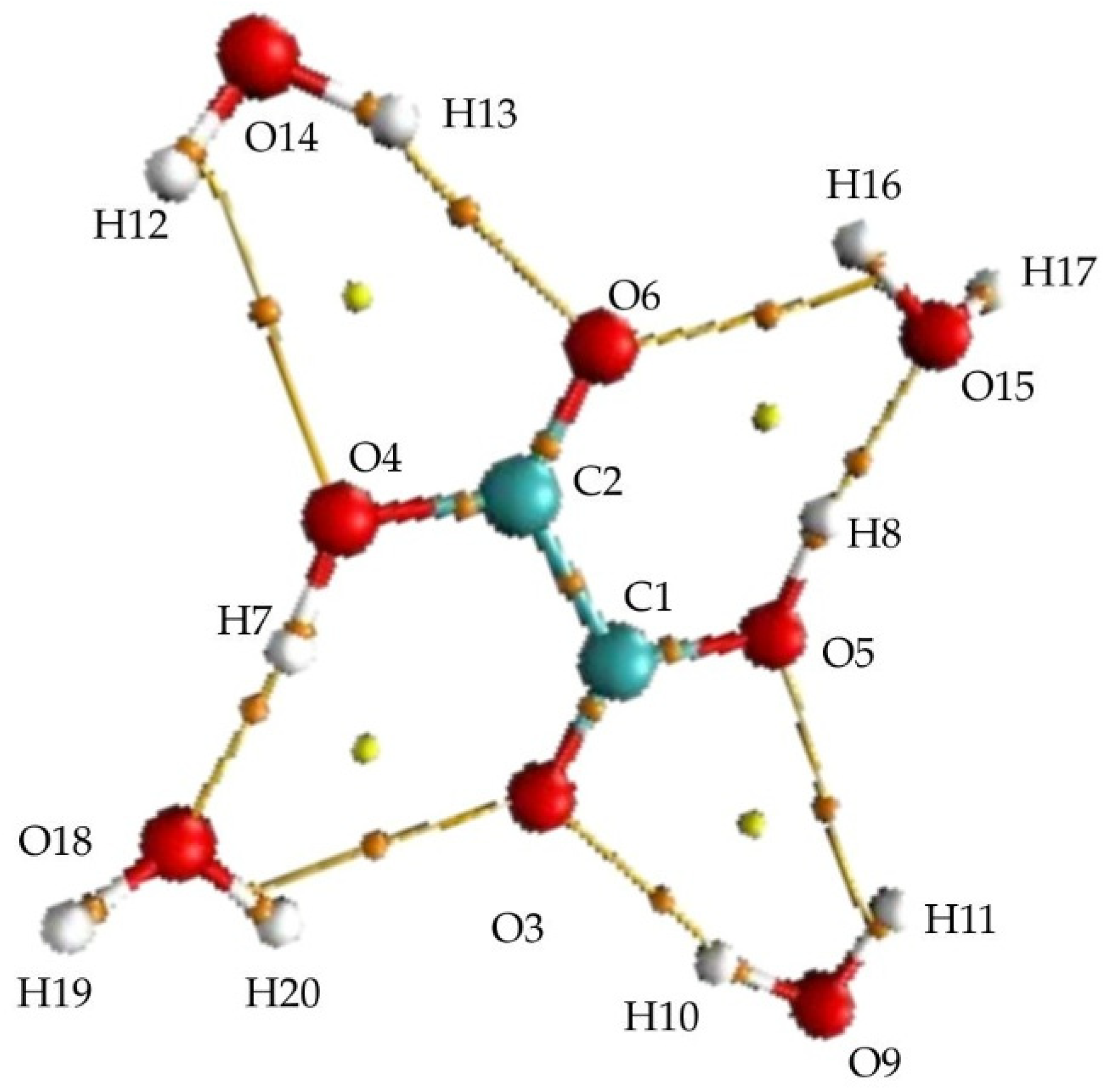
AIM analysis, based on topological analysis of electron density, was performed to gain further insight into the nature of non-covalent interactions. It determines the presence of intra- and intermolecular interactions, particularly the strength of hydrogen bonds, from various topological parameters, including electron density ρ(r), the Laplacian of electron density ∇2ρ(r), kinetic energy G(r), total energy density H(r), and potential energy density V(r). See Figure 3.
The analysis of the topological parameters in the BCPs, as shown in Table 5, indicates that not all hydrogen bonds exhibit the same strength or electronic character. The O18⋯H7 and O15⋯H8 contacts are the most relevant within the hydrating network, with electron density values ρ(r) of 0.04624 and 0.04625 a.u., respectively, and positive Laplacians close to 0.163 a.u. In both cases, H(r) is slightly negative (−0.0040 a.u.), indicating that, although the interaction remains closed-shell, there is a significant partial covalent contribution. Under the QTAIM criterion, the combination ∇2ρ (r) > 0 and H(r) < 0 corresponds to hydrogen bonds of intermediate intensity, while the magnitude of V(r), close to −0.049 a.u., suggests considerable topological stabilization [56], these interactions can be estimated at approximately 15.3 kcal mol−1. In chemical terms, the hydroxyl groups of oxalic acid act here as the main proton donors to neighboring water molecules, and this donation constitutes the dominant component of the explicit hydration network [57].
In interactions where water acts as a donor to acid, a clear hierarchy is observed based on the nature of the acceptor atom. The O3⋯H10 and O6⋯H13 bonds have ρ(r) = 0.0167 au, ∇2ρ(r) = 0.0691 and 0.0690 au, respectively, and a positive H(r) (0.0023 au), and should therefore be classified as weak hydrogen bonds, essentially dominated by electrostatic contributions. Even weaker are O4⋯H12 and O5⋯H11, with ρ(r) of 0.00781 and 0.0077 au, respectively, Laplacians of 0.0315 au, and H(r) of 0.0010 au. This sequence demonstrates that, within the same system, the carbonyl oxygens O3 and O6 accept hydrogen bonds more effectively than the hydroxyl oxygens O4 and O5. This trend is chemically reasonable and consistent with the general behavior of carboxylic groups, in which carbonyl oxygens preferentially act as hydrogen bond acceptors. In contrast, O–H groups function primarily as donors. Consequently, the microsolvation obtained not only hydrates oxalic acid but also functionally polarizes each carboxyl group into two distinct roles: a relatively strong donor site and a variable-strength acceptor site, with the carbonyl center being more efficient than the hydroxyl center.
From an analytical perspective, the AIM results indicate that microsolvation not only stabilizes the system through hydrogen bonding but also differentially polarizes the carboxylic groups according to their donor-acceptor role within the hydration network. In particular, the preferential participation of carbonyl oxygens as hydrogen bond acceptors and hydroxyl groups as proton donors suggests a non-equivalent electronic environment around the carboxylic motif in aqueous solution. This differential polarization more directly affects the local vibrational response of the C=O bond than solvent-dominated spectral regions, thus providing a molecular basis for the improved analytical performance observed experimentally in the 1700–1750 cm−1 region.

3.6.3. NBO-AIM-Raman Spectrum Relationship

The selection of a vibrational marker for Raman-based quantification requires not only spectral separation from the solvent background but also sufficient Raman activity, spectral stability, and concentration-dependent reproducibility. Experimentally, the carbonyl stretching region (1700–1750 cm−1) exhibited the strongest spectral definition, highest integrated intensity, and most consistent concentration-dependent response across the evaluated oxalic acid concentration range. In contrast, the hydroxyl (-OH) region was strongly affected by water-related broadening and spectral overlap, limiting its analytical applicability in aqueous systems. The computational analysis performed in this study was not intended to predict analytical performance in complex industrial matrices, but rather to provide molecular-level spectroscopic interpretation of the experimentally observed Raman behavior of the carbonyl vibrational mode. Raman scattering intensity is fundamentally associated with changes in molecular polarizability during molecular vibration. Consequently, vibrational modes exhibiting enhanced electronic redistribution and favorable variations in polarizability tend to exhibit stronger Raman activity and improved spectral definition. In this context, electronic-structure descriptors derived from Atoms in Molecules (AIM) and Natural Bond Orbital (NBO) analyses provide relevant spectroscopic information regarding the intrinsic Raman behavior of specific vibrational regions. The AIM analysis reveals that the carbonyl groups (C1=O3 and C2=O6) possess the highest electron density (ρ approx. 0.420 a.u.) of all bonds within the OXA–4H2O complex. This density is significantly greater than that of the C–C bond (ρ approx. 0.262 a.u.) and the surrounding hydrogen-bonding network. According to the criteria established by Rozas and Espinosa [57], the nature of a chemical interaction is best characterized by the total energy density (H(r)) at the bond critical point. For the carbonyl bonds, H(r) is strongly negative (H(r) approx. −0.726 a.u.). A negative H(r) value is commonly associated with shared-shell (covalent) character and enhanced structural stability [58]. In contrast, the intermolecular hydrogen bonds exhibit much lower electron densities (ρ < 0.05 a.u.) and H(r) values closer to zero, identifying them as closed-shell interactions [58]. The intense covalent character of the C=O bond ensures a large change in polarizability during its vibrational cycle, which is the primary driver of its strong Raman intensity [59]. The NBO analysis further underscores the stability of the carbonyl framework. The donor-acceptor interactions involving the sigma and sigma* orbitals show deep stabilization energies (approx. −1.256 a.u. for the donor NBO). This indicates that the carbonyl group acts as a localized electronic oscillator. While the carbonyl oxygens serve as hydrogen-bond acceptors in aqueous solution, a phenomenon known to red-shift and broaden signals in similar acyl systems [59], the magnitude of the internal bond strength remains the dominant factor. The Laplacian of electron density (∇2ρ(r) approx. 0.170 a.u.) for the carbonyl BCP is positive, which is characteristic of polarized covalent bonds where the charge concentration is separated between the atomic basins [60,61]. This polarization enhances the Raman scattering cross-section, making the band at 1765 cm−1 particularly sensitive to concentration changes. The experimental Raman spectra demonstrate a clear, linear response of the carbonyl band intensity across a wide concentration range (0.079 M to 0.793 M). This sensitivity is associated with the enhanced electronic stabilization afforded by the high electron density at the C=O bond critical point. Unlike the C–C stretching mode at 886 cm−1, which exhibits lower topological stability (ρ = 0.262 a.u., H(r) = −0.231 a.u.), the carbonyl signal remains well-resolved and intense even at low molarities. The distinct separation of the C=O signal from the water background allows for precise integration, making it one of the most reliable spectroscopic regions for the quantitative monitoring of oxalic acid in complex solvated systems. See Table S4.
By integrating AIM and NBO data, we demonstrate that the carbonyl group in oxalic acid represents the most electronically concentrated and covalently stable site within the molecule. Its high electron density (ρ) and strongly negative total energy density (H(r)) result in a Raman-active mode that is both intense and resilient to solvent-induced broadening. These properties help rationalize the experimentally observed analytical suitability of the 1700–1750 cm−1 region as the most suitable analytical window in the present study for the quantitative analysis of oxalic acid in aqueous solutions. Consequently, the combined experimental and computational results indicate that the analytical performance of the selected Raman band is not governed exclusively by empirical spectral intensity, but also by intrinsic electronic and polarizability-related properties associated with the ν(C=O) vibrational mode.

3.6.4. Principal Component Analysis of AIM Descriptors for Topological and Energetic Differentiation of Carbonyl Bonds

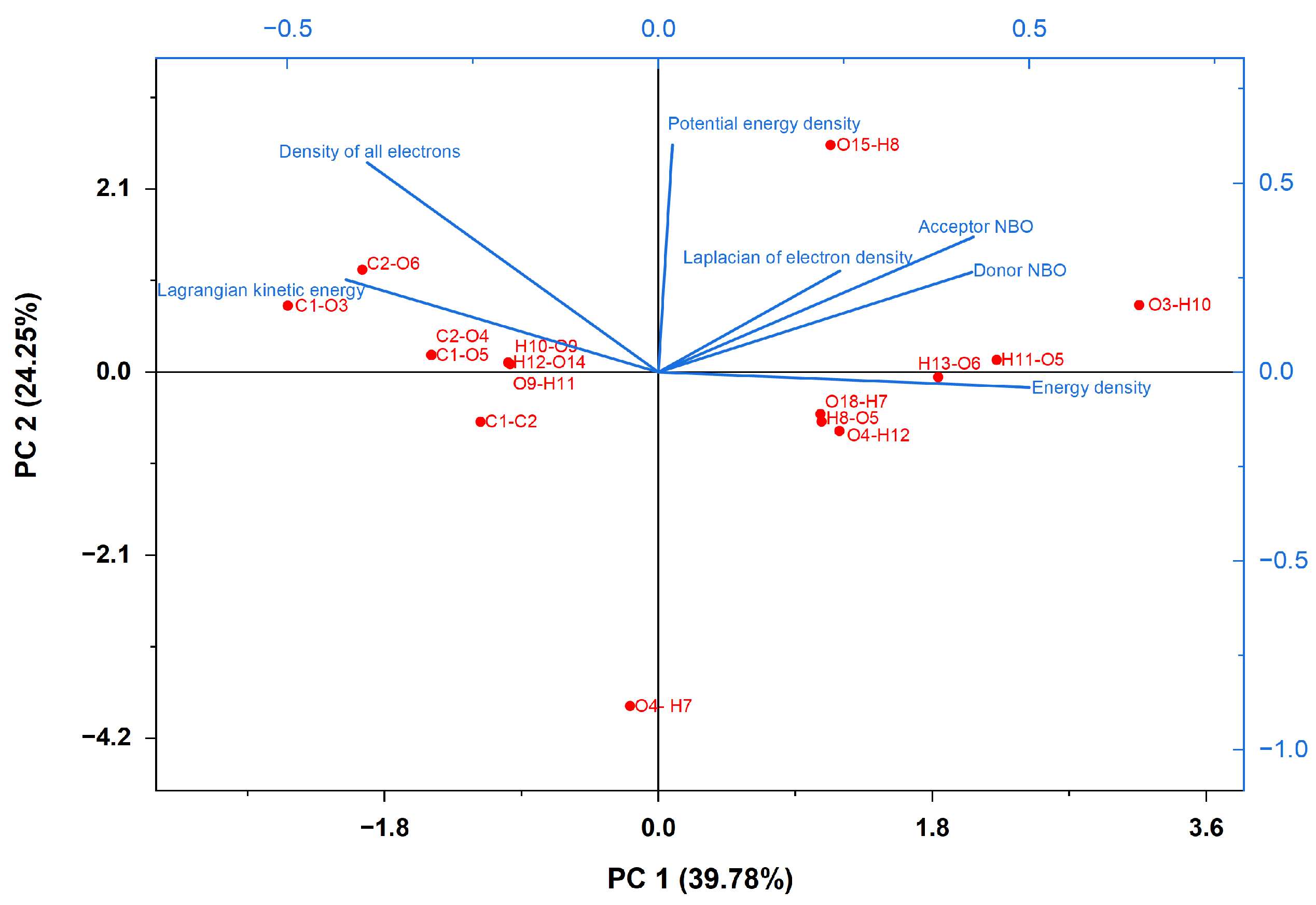
To jointly evaluate the topological information derived from the AIM analysis and the electronic parameters associated with the NBO analysis, a second principal component analysis (PCA) was performed, incorporating variables related to electron density, local energy terms, and donor-acceptor capacities. Figure 4 shows the biplot of the first two principal components, which explain 64.03% of the total variance, with contributions of 39.78% for PC1 and 24.25% for PC2.
PC1 primarily separates the covalent bonds of the molecular skeleton from intermolecular interactions. C1–O3 and C2–O6 bonds, along with C1–O5, C2–O4, and C1–C2, cluster towards negative PC1 values, in association with the total electron density and Lagrangian kinetic energy, confirming their strong covalent character. In contrast, several hydrogen bonds are distributed towards positive PC1 values, consistent with the vectors associated with the NBO donor and acceptor orbitals, suggesting that charge-transfer processes more strongly influence these interactions than a local accumulation of electron density. PC2, on the other hand, allows us to distinguish interactions with differential energy behavior. O15–H8 stands out on this axis, close to the potential energy density vector, suggesting a particular stabilizing contribution. Similarly, O4–H7 appears clearly separated from the rest, indicating an atypical electronic signature within the analyzed set. Overall, this PCA confirms that carbonyl bonds retain a well-defined electronic identity. In contrast, hydrogen bonds modulate the electronic environment of the system through donor-acceptor interactions, which is consistent with the changes observed in the vibrational response of oxalic acid in a hydrated medium.
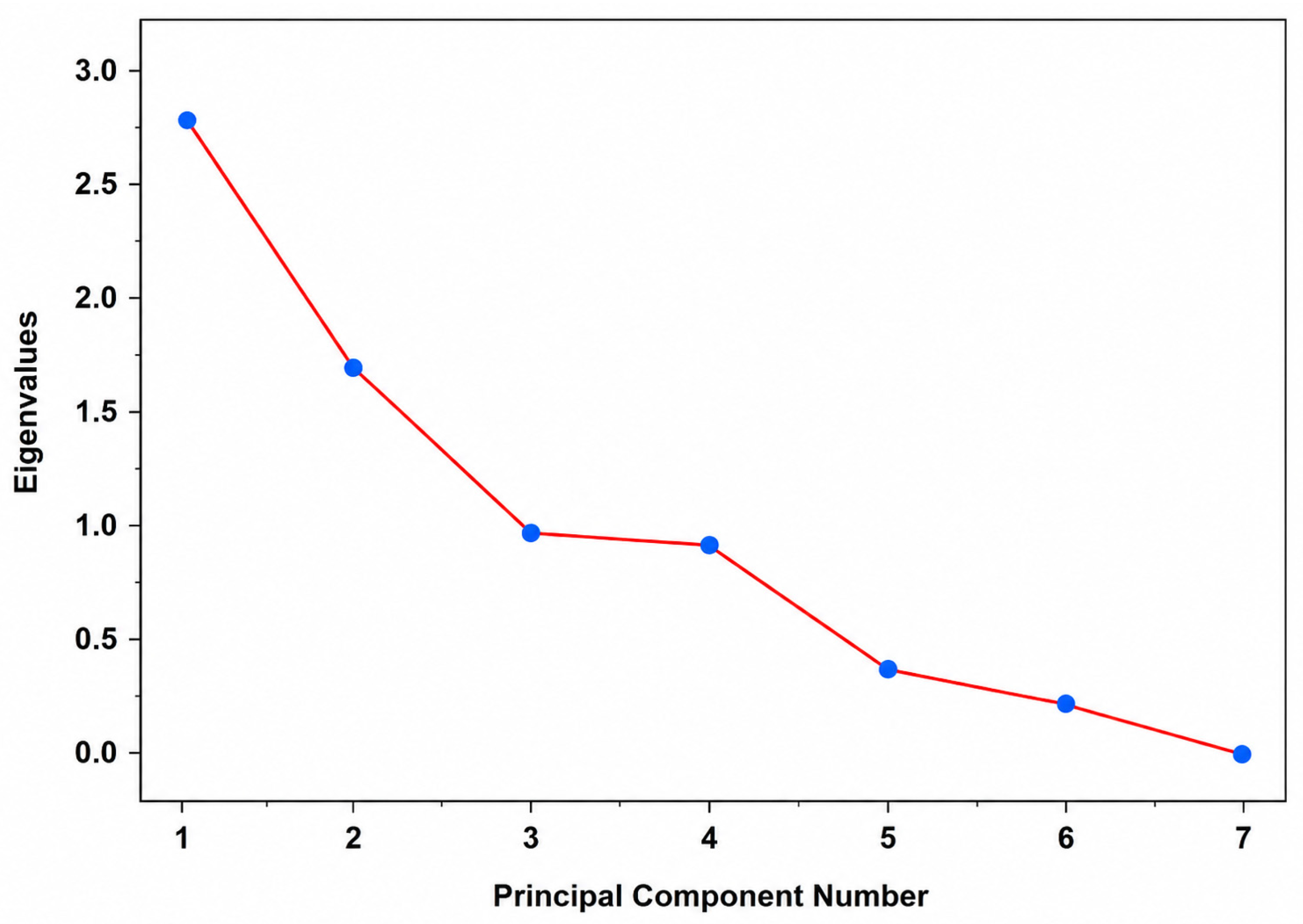
Figure 5 of the PCA sedimentation shows a progressive decrease in eigenvalues as the number of principal components increases. PC1 had the highest eigenvalue, indicating that this dimension is the main source of variability in the dataset. PC2 also made a significant contribution, while from PC3 onward, there is a marked reduction in eigenvalues, suggesting that the information explained by subsequent components is considerably less. According to Kaiser’s criterion, components with eigenvalues greater than 1 provide the most statistically significant information; therefore, the first two components can be considered the most representative of the system.
However, PC3 had an eigenvalue close to 1, so its inclusion may be relevant from an exploratory perspective, especially if its loadings are associated with Raman bands of chemical interest. This observation suggests that the main spectral variability is governed by a small number of latent patterns, possibly related to changes in the intensity of characteristic bands, conformational variations, intermolecular interaction effects, or modifications in the chemical environment of the analyzed species. In contrast, the higher-order components, especially PC5–PC7, showed low eigenvalues, so their contribution can be attributed mainly to residual variations, instrumental noise, or spectral information of lesser analytical relevance. Consequently, selecting two or three principal components is statistically consistent for interpreting the overall structure of the dataset, avoiding the inclusion of components with low contributions that could lead to overinterpretation of the model.

4. Effect of Variable Operational Conditions on the Raman Response

The influence of operational conditions on the Raman response of oxalic acid was evaluated through the integrated area of the carbonyl stretching region (1700–1750 cm−1), as summarized in Table 6 and Table 7. The evaluated operational variables included temperature, turbidity, and dissolved ionic species (Ca2+ and Fe3+), which are commonly associated with industrial aqueous systems and chemical process environments [62,63,64]. Table 6 shows that the Raman response of the carbonyl band remained strongly dependent on the operational environment. Under the initial process conditions, characterized by low turbidity and ionic content, the integrated Raman area exhibited the highest intensity values across all production lines. In contrast, under the final operational conditions, particularly those involving elevated turbidity and increased ionic concentration, a pronounced reduction in the integrated Raman area was observed [65]. This attenuation became progressively more severe from Line A to Line C. For Line A, the integrated Raman area decreased from approximately 11.399 to values between 11,590 and 3983, depending on the evaluated operational environment. Similar behavior was observed for Lines B and C, where the decrease in spectral intensity became proportionally larger at lower signal levels. The most pronounced attenuation was observed for Line C, which exhibited integrated Raman areas as low as 631.88 under the most demanding operational conditions. The relative standard deviation (RSD) values remained below 10% for all evaluated systems, indicating that although the magnitude of the Raman signal was significantly affected by operational conditions, the spectral response preserved acceptable repeatability [66,67]. This observation is particularly important because it demonstrates that the operational environment primarily modifies signal intensity rather than producing random spectral instability. The statistical behavior of these changes is summarized in Table 7. The comparative analysis between initial and final operational conditions revealed statistically significant reductions in the integrated Raman area for all production lines (p < 0.05). Line A exhibited a relative area reduction of 41.94%, whereas Line B showed a reduction of 45.49%. The largest attenuation was observed for Line C, which presented a relative area change of 63.56%. The progressive increase in attenuation from Line A to Line C demonstrates that the influence of operational conditions on the Raman response is concentration dependent. At lower concentration levels, the carbonyl Raman band becomes more susceptible to perturbations associated with scattering phenomena, optical attenuation, and changes in the local physicochemical environment generated by suspended solids and dissolved ionic species. From a spectroscopic perspective, the observed reduction in integrated Raman intensity can be associated with multiple physicochemical factors. Increased turbidity promotes additional light scattering and reduces effective laser penetration within the sample, decreasing the efficiency of Raman signal collection. Simultaneously, dissolved ionic species such as Ca2+ and Fe3+ may alter the local dielectric environment surrounding oxalate species, modifying intermolecular interactions and affecting the polarizability response associated with the ν(C=O) vibrational mode [68,69]. The stronger attenuation observed at lower concentrations suggests that matrix-related perturbations become proportionally more significant as the analyte’s intrinsic Raman contribution decreases. Under these conditions, the spectral dominance of the carbonyl vibration is reduced, making the Raman response more sensitive to environmental fluctuations and secondary scattering effects.
Importantly, despite the statistically significant attenuation observed under final operational conditions, the carbonyl Raman band remained detectable and analytically interpretable across all evaluated production lines. This behavior demonstrates that the proposed Raman methodology preserves operational applicability across variable physicochemical environments, particularly at moderate-to-high oxalic acid concentrations, where the carbonyl band exhibits greater spectral dominance and improved signal stability. The statistical and spectroscopic behavior observed in Table 6 and Table 7 is also consistent with the electronic-structure analysis discussed previously through NBO and AIM calculations. Variations in the local physicochemical environment may influence hydrogen-bonding interactions and electron-density distribution around the carbonyl groups, thereby affecting molecular polarizability and the intensity of the Raman-active ν(C=O) vibration [70]. Consequently, the experimentally observed attenuation behavior can be rationalized not only by optical scattering effects but also by changes in the electronic environment that govern the Raman response of oxalic acid under operating conditions.

4.1. Chemometric Evaluation of Matrix-Matched Standards

Conventional Raman calibration strategies developed exclusively using pure aqueous standards frequently fail to represent the physicochemical variability encountered in real industrial process environments. In operational chemical systems, variables such as suspended particles, dissolved ionic species, thermal fluctuations, and matrix heterogeneity can significantly modify Raman signal intensity, spectral stability, and chemometric predictive behavior. Consequently, calibration models established under idealized laboratory conditions may exhibit limited robustness when transferred to chemically perturbed operational systems. To address this limitation, a second experimental calibration set composed of matrix-matched oxalic acid standards was developed under controlled operational perturbations. The experimental design incorporated variations in temperature (25–40 °C), turbidity (0–57 mg/L), dissolved calcium concentration (0–58 mg/L), and dissolved iron concentration (0–7 mg/L), selected according to the physicochemical conditions experimentally identified in process-related samples obtained from an industrial chemical plant located in Cartagena, Colombia. The evaluated oxalic acid concentration range remained between 0.079 and 0.793 M, thereby preserving consistency with the original analytical interval established during method development. The resulting matrix-informed calibration dataset is summarized in Table S5. Under low-interference conditions, the Raman integrated area associated with the carbonyl stretching region (1700–1750 cm−1) exhibited the expected concentration-dependent behavior previously observed for pure aqueous standards. However, under interference-modified conditions characterized by elevated turbidity and increased ionic strength, substantial attenuation of Raman intensity was observed across all evaluated concentration levels. At 0.793 M, the integrated Raman area decreased from approximately 11,400 under low-interference conditions to approximately 4000 under high-interference operational conditions. Similarly, at 0.397 M, the integrated area decreased from approximately 7400 to nearly 2200 under elevated turbidity and dissolved-ion conditions. The most pronounced attenuation was observed at the lowest concentration level (0.079 M), where Raman integrated areas decreased from approximately 3400 to values below 750 under interference-modified conditions. These results demonstrate that matrix-related operational perturbations substantially affect Raman signal intensity, particularly under elevated suspended-particle and ionic-strength environments. The observed attenuation is primarily attributed to combined matrix effects involving light scattering, signal dispersion, local refractive-index heterogeneity, and perturbation of optical collection efficiency. Elevated turbidity likely increases photon scattering and reduces effective laser penetration, thereby decreasing the collected Raman signal intensity. Simultaneously, dissolved ionic species such as Ca2+ and Fe3+ may alter the local hydration environment surrounding oxalic acid molecules, contributing to modifications in spectral organization and band-shape behavior. Temperature variations may additionally influence hydrogen-bond dynamics and local molecular mobility within the aqueous medium. In addition to signal attenuation, operational perturbations also influenced spectral reproducibility. Under low-interference conditions, relative standard deviation (RSD) values remained generally below 3% for most concentration levels, indicating high spectral stability and analytical repeatability. However, under interference-modified conditions, increased RSD values were observed, particularly at lower oxalic acid concentrations. For example, the RSD increased from approximately 0.5–2.5% under clean conditions to values approaching 5–9% under elevated turbidity and ionic-strength environments. This increase in spectral variability is consistent with the combined effects of matrix-induced scattering, reduced signal-to-noise ratio, and enhanced sensitivity of low-intensity Raman signals to operational perturbations. The effect became more pronounced at lower oxalic acid concentrations, where reduced Raman intensity increases susceptibility to spectral fluctuations and baseline distortions. Nevertheless, despite the increase in variability, the carbonyl vibrational region remained spectrally detectable and analytically interpretable throughout all evaluated operational scenarios.
Importantly, although operational perturbations significantly modified Raman intensity and spectral reproducibility, the concentration-dependent spectral behavior of the carbonyl region was not completely lost. This observation indicates that the ν(C=O) vibrational mode retained sufficient spectroscopic coherence under chemically perturbed conditions to support subsequent multivariate chemometric analysis. Consequently, the incorporation of matrix-matched standards substantially expanded the calibration space beyond conventional pure aqueous systems. It provided a more realistic framework for evaluating predictive robustness under simulated industrial operational environments. These matrix-informed standards, therefore, served as the experimental basis for subsequent PCA and PLS analyses to evaluate spectral organization, predictive capability, and chemometric robustness under operationally perturbed conditions.

4.2. PCA Analysis of Matrix-Matched Standards

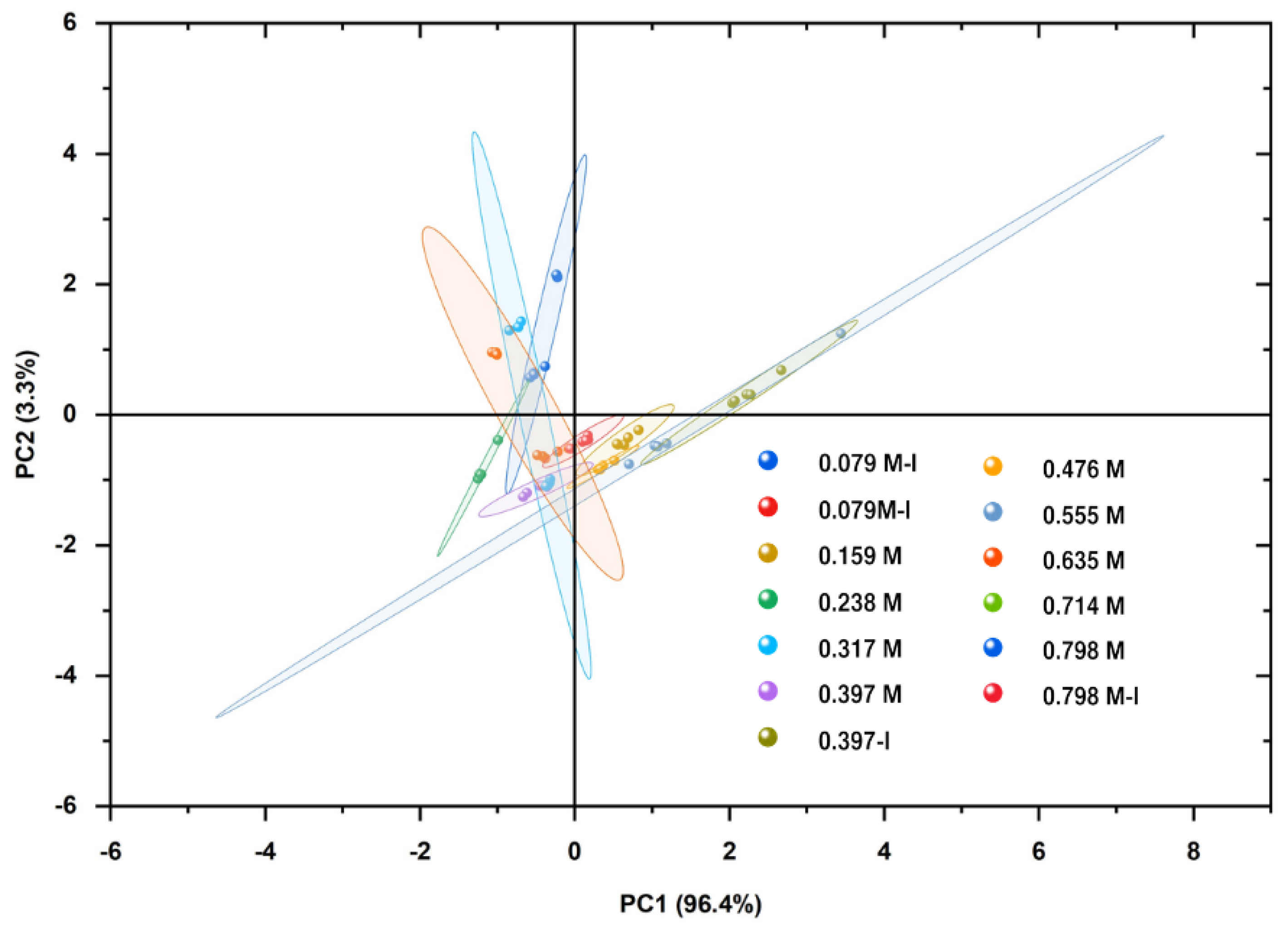
Principal Component Analysis (PCA) was performed using the Raman spectral dataset corresponding to the carbonyl stretching region (1700–1750 cm−1) obtained from the matrix-matched oxalic acid standards prepared under variable operational conditions. The objective of this analysis was to evaluate the multivariate spectral organization of the carbonyl vibrational mode under chemically perturbed environments and to investigate the influence of operational variables on spectral clustering behavior. The PCA scores plot is presented in Figure 6. The first principal component (PC1) explained 96.4% of the total spectral variance. In comparison, the second principal component (PC2) accounted for an additional 3.3%, resulting in cumulative explained variance greater than 99%. This behavior indicates that most of the relevant spectral variability within the selected analytical region was concentrated along a dominant multivariate direction strongly associated with the carbonyl Raman response. See Figure 6. The PCA analysis revealed organized concentration-dependent clustering tendencies across the evaluated oxalic acid standards. Under low-interference conditions, samples exhibited relatively compact grouping behavior, with progressive spatial distribution along the PC1 axis as a function of oxalic acid concentration. This observation demonstrates that the carbonyl vibrational region preserved coherent concentration-related spectral organization within the analytical interval evaluated. The incorporation of operational perturbations, represented by interference-modified standards containing elevated turbidity and dissolved ionic species, introduced measurable spectral dispersion within the multivariate space. This effect is evidenced by the expansion and displacement of the confidence ellipses associated with the interference-modified samples. The observed spectral broadening indicates that operational variables such as suspended-particle content, ionic strength, and thermal variation contribute additional sources of spectral variability beyond concentration alone. Despite the increase in spectral dispersion observed under chemically perturbed conditions, concentration-related clustering tendencies remained partially preserved throughout the PCA space. Interference-modified samples remained spatially associated with their corresponding concentration levels rather than exhibiting complete randomization or total overlap within the multivariate domain. This behavior suggests that, although matrix-related perturbations significantly affect Raman intensity and spectral reproducibility, the analytical information associated with the ν(C=O) vibrational mode was not completely lost. The displacement patterns observed in the PCA space are consistent with matrix-induced spectral perturbations associated with scattering effects, baseline variation, local refractive-index heterogeneity, and modifications in the hydration environment surrounding oxalic acid molecules. Elevated turbidity likely contributed to increased photon dispersion and reduced signal-collection efficiency, while dissolved Ca2+ and Fe3+ species may have altered local intermolecular interactions, affecting subtle band-shape characteristics within the carbonyl region. Importantly, the persistence of concentration-related organization within the PCA domain supports the spectroscopic robustness of the carbonyl analytical window selected in this study. These observations are consistent with the computational AIM and NBO analyses previously discussed, which demonstrated that the carbonyl bond represents the most electronically concentrated and structurally stable vibrational site within the oxalic acid molecule. The strong covalent character and enhanced electronic polarization of the ν(C=O) mode likely contribute to the preservation of spectroscopic coherence even under operationally perturbed conditions. From a chemometric perspective, the PCA results demonstrate that operational perturbations introduce significant but structured spectral variability rather than complete spectral degradation. Consequently, the carbonyl analytical region retained sufficient multivariate organization to support subsequent supervised predictive modeling using Partial Least Squares (PLS) regression. See Figure 6.

4.3. PLS Predictive Performance Under Simulated Operational Conditions

Partial least squares (PLS) regression analysis was subsequently performed using the Raman spectra acquired from the matrix-matched standards prepared under simulated operational conditions. Unlike the initial calibration model developed using pure aqueous standards, this second chemometric model incorporated spectral variability associated with temperature fluctuations, elevated turbidity, dissolved Ca2+ and Fe3+ species, and matrix-induced optical perturbations. The objective was to evaluate whether the carbonyl stretching region retained sufficient predictive capability under chemically perturbed environments representative of industrial operational systems.
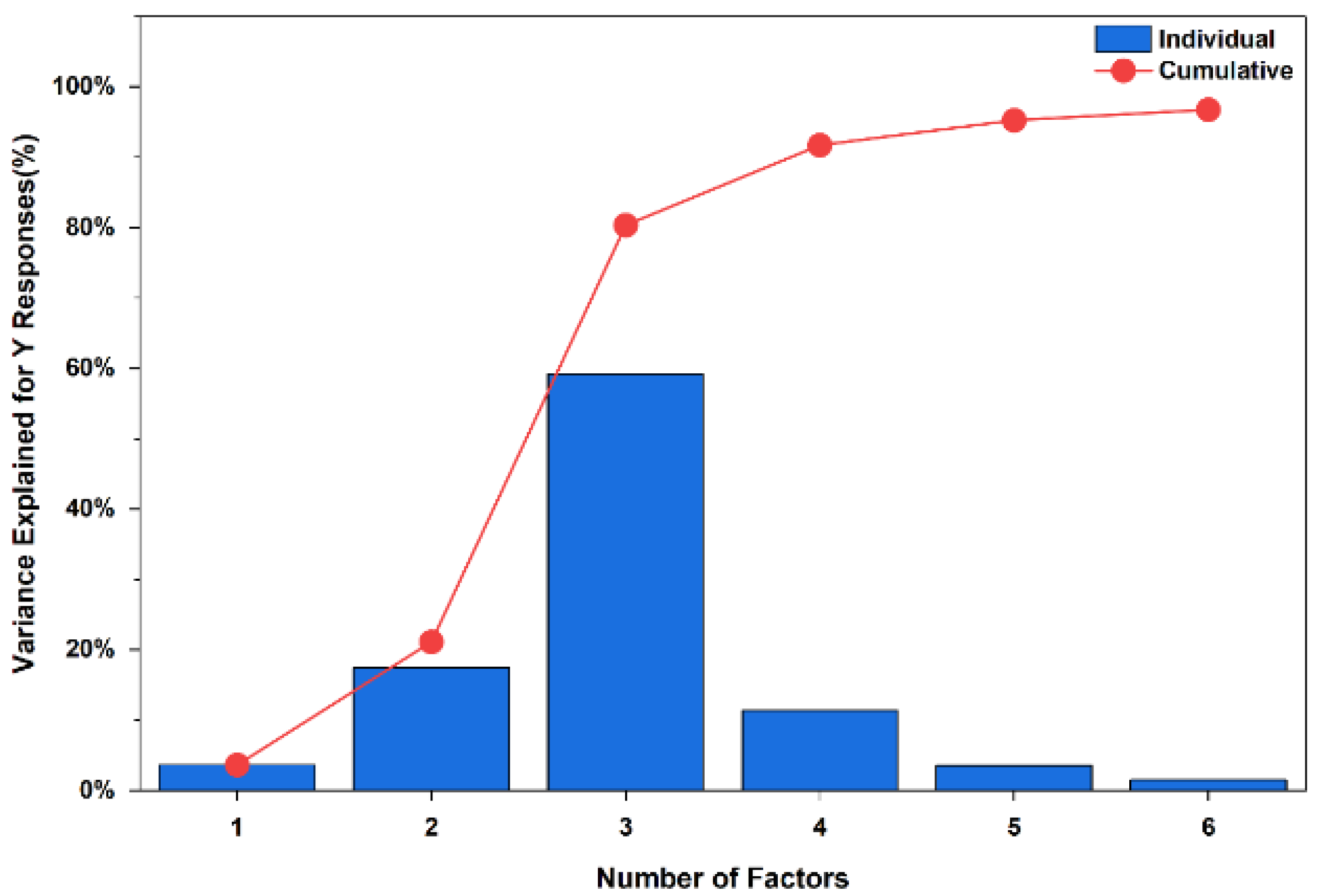
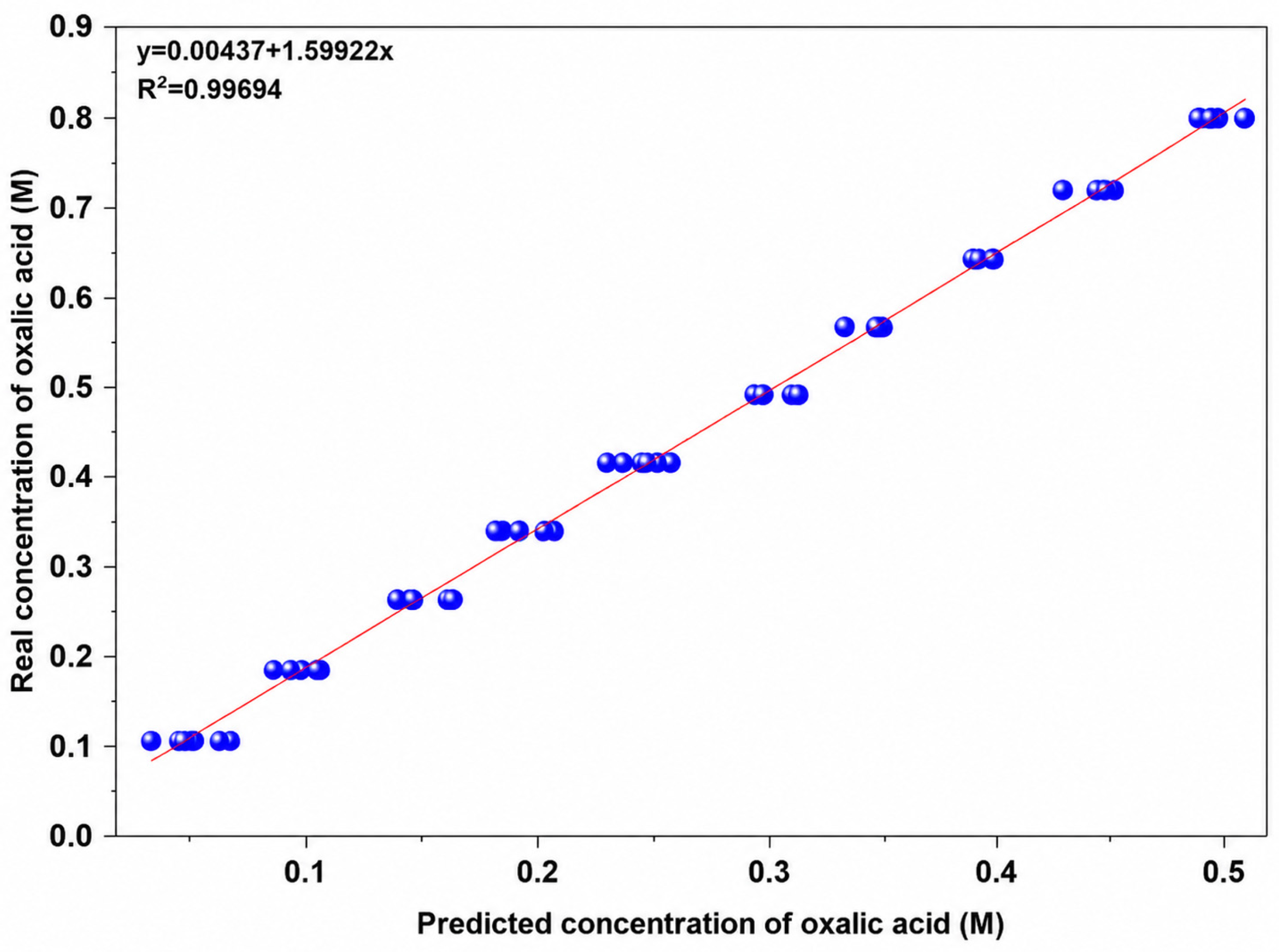
Cross-validation analysis demonstrated that the predictive error decreased substantially upon incorporating the first latent variables, indicating that the dominant concentration-dependent spectral information remained highly organized despite the introduction of operational perturbations. The largest improvement in predictive performance occurred within the first three to four latent factors, after which additional components contributed only marginal reductions in prediction error. This behavior suggests that the principal spectral variability associated with oxalic acid concentration remained concentrated within a relatively low-dimensional latent space. The model’s variance structure further confirmed this interpretation. The first latent factor captured most of the organized spectral variability within the Raman dataset, whereas subsequent factors primarily accounted for secondary variations associated with matrix effects, spectral broadening, baseline fluctuations, and operational heterogeneity. The relatively small contribution of higher-order factors indicates that the spectral perturbations introduced by turbidity, dissolved ions, and temperature variations did not completely disrupt the concentration-dependent organization of the carbonyl vibrational response. The predictive capability of the optimized PLS model remained highly satisfactory under the simulated operational conditions. Figure 7 shows the relationship between predicted and experimental oxalic acid concentrations, yielding a coefficient of determination (R2) of approximately 0.997. See Figure 8. The strong correlation demonstrates that the Raman spectra retained sufficient analytical information to support accurate quantitative prediction even in the presence of significant physicochemical perturbations. Importantly, the operationally perturbed model exhibited slightly more complex latent-variable behavior than the model developed using pure aqueous standards. This behavior is chemically reasonable because the introduced matrix perturbations generate additional spectral variability associated with scattering effects, local refractive-index heterogeneity, hydrogen-bond reorganization, and changes in the local dielectric environment surrounding oxalic acid molecules. Consequently, the PLS model captures not only concentration-dependent changes in intensity, but also subtle multivariate spectral modifications induced by operational conditions. The persistence of strong predictive performance under these chemically perturbed conditions further supports the spectroscopic robustness of the carbonyl analytical region selected throughout this study. Despite substantial attenuation of Raman intensity under elevated turbidity and ionic-strength environments, the ν(C=O) vibrational mode preserved sufficient spectral coherence to maintain organized chemometric behavior. This observation is fully consistent with the electronic-structure analysis obtained from AIM and NBO calculations, which show that the carbonyl bond is the most electronically stabilized and highly polarized vibrational site in the oxalic acid molecule. Overall, the results demonstrate that matrix-informed calibration strategies substantially improve the operational realism of Raman chemometric models while preserving excellent predictive performance. The developed PLS model, therefore, provides a robust framework for quantitative Raman analysis of oxalic acid under chemically perturbed operational conditions relevant to industrial process monitoring. See Table 8.

4.4. Preliminary Prediction of Process-Related Samples

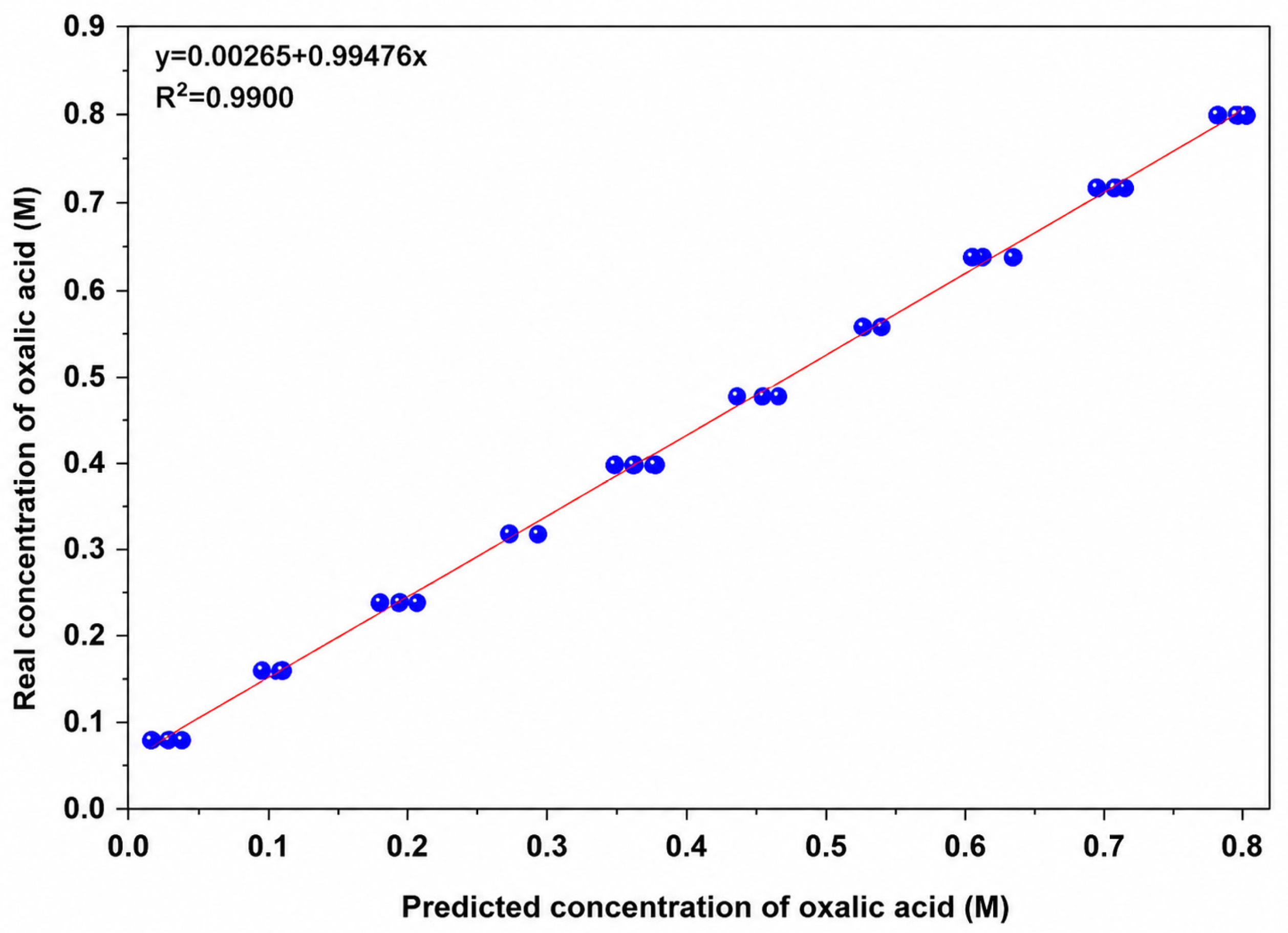
To evaluate the preliminary predictive applicability of the proposed Raman methodology under operationally perturbed conditions, the matrix-informed PLS model was applied to process-related oxalic acid standards prepared under physicochemical conditions representative of industrial operational environments. Figure 9 presents the relationship between the PLS-predicted concentrations and the corresponding reference oxalic acid concentrations obtained for the evaluated standards. The predictive model exhibited excellent agreement between predicted and reference concentration values across the evaluated concentration interval (0.079–0.793 M), yielding a coefficient of determination (R2) of 0.990. See Figure 9. The resulting regression equation, y = 0.00265 + 0.99476x, demonstrated a slope very close to unity and a near-zero intercept, indicating minimal systematic bias and high predictive consistency throughout the evaluated analytical range. Importantly, the predictive performance remained highly satisfactory despite incorporation of operational perturbations associated with elevated turbidity, dissolved Ca2+ and Fe3+ species, and temperature variations. These operational variables introduced substantial spectral attenuation and increased spectral dispersion, as previously observed in the PCA analysis; however, the multivariate PLS model successfully preserved concentration-dependent organization within the Raman dataset. The distribution of experimental points around the regression line revealed limited residual dispersion and absence of significant curvature or concentration-dependent deviation trends. This behavior suggests that the developed chemometric model adequately captured the dominant concentration-related spectral information associated with the carbonyl vibrational region while simultaneously accommodating secondary spectral variability introduced by matrix effects. The predictive behavior observed in Figure 9 further demonstrates that operational perturbations did not completely disrupt the analytical integrity of the ν(C=O) Raman response. Although elevated turbidity and ionic-strength conditions reduced Raman intensity and increased spectral variability, the carbonyl vibrational mode retained sufficient multivariate coherence to support reliable concentration prediction under chemically perturbed environments. These results are fully consistent with the computational AIM and NBO analyses discussed previously. The strong electronic stabilization, enhanced electron-density localization, and favorable polarizability characteristics associated with the carbonyl bond likely contribute to preservation of Raman activity and chemometric organization even under operationally heterogeneous conditions. Consequently, the combined experimental and computational findings indicate that the carbonyl stretching region constitutes a spectroscopically robust analytical window for oxalic acid quantification in industrial aqueous systems. Although the present study does not constitute a fully validated industrial deployment model incorporating external reference methods such as HPLC or titrimetric verification, the obtained results provide strong preliminary evidence supporting the operational applicability and predictive feasibility of matrix-informed Raman chemometric modeling for oxalic acid monitoring under real industrial process conditions.

5. Conclusions

A micro-Raman spectroscopy methodology was successfully developed for the direct quantification of oxalic acid in aqueous systems at moderate-to-high concentration levels using the carbonyl stretching region (1700–1750 cm−1) as the principal analytical window. The selected Raman band exhibited strong concentration-dependent behavior, excellent spectral definition, and reduced solvent interference, enabling robust quantitative analysis across the evaluated concentration range. The proposed methodology demonstrated excellent analytical performance, including high linearity, satisfactory precision, and reliable chemometric predictability. Multivariate analysis using PCA and PLS confirmed that the carbonyl vibrational mode is the dominant source of concentration-related spectral variability in the Raman dataset. The developed PLS models exhibited strong predictive capability under both ideal aqueous conditions and chemically perturbed operational environments. The incorporation of matrix-matched standards containing controlled variations in temperature, turbidity, dissolved calcium, and dissolved iron substantially expanded the operational realism of the calibration strategy. Although these perturbations produced significant attenuation of Raman intensity, particularly at lower oxalic acid concentrations, the carbonyl vibrational region preserved sufficient spectral coherence to maintain organized multivariate behavior and reliable quantitative prediction. These results demonstrate the operational robustness of the proposed Raman methodology under conditions representative of industrial aqueous systems. The computational AIM and NBO analyses provided molecular-level interpretation of the experimentally observed Raman behavior. The carbonyl bonds exhibited the highest electron density, strongest covalent stabilization, and most favorable polarizability characteristics within the hydrated oxalic acid system. These electronic properties explain the intense Raman activity and concentration-dependent stability of the ν(C=O) vibrational mode, thereby rationalizing the superior analytical performance of the carbonyl spectral region. Overall, this study demonstrates that the analytical suitability of the selected Raman band is governed not only by empirical spectral intensity but also by intrinsic electronic-structure properties, including electron-density localization and molecular polarizability. The combined experimental, chemometric, and computational strategy developed in this work provides a robust framework for Raman-based quantitative analysis in chemically perturbed industrial environments. It establishes a direct relationship between Raman analytical behavior and molecular electronic structure.

Supplementary Materials

The following supporting information can be downloaded at: https://www.mdpi.com/article/10.3390/analytica7020041/s1. Table S1. Experimental spectra of oxalic acid in solution applying different laser powers. Table S2. Intra-day precision assay for the micro-Raman method by 1700–1750 cm−1 band. Table S3. Natural Bond Orbitals. Table S4. Raman spectral behavior vs. NBO and AIM information. Table S5. Matrix-informed calibration dataset.

Author Contributions

Conceptualization, J.H.-F. and P.P.; Methodology, J.H.-F. and P.P.; Software, J.H.-F. and P.P.; Validation, J.H.-F. and P.P.; Formal analysis, J.H.-F., R.O.-T. and P.P.; Investigation, J.H.-F. and P.P.; Resources, J.H.-F. and R.O.-T.; Data curation, J.H.-F., R.O.-T. and P.P.; Writing—original draft, J.H.-F., R.O.-T. and P.P.; Writing—review & editing, J.H.-F. and P.P.; Visualization, J.H.-F. and R.O.-T.; Supervision, J.H.-F.; Project administration, J.H.-F. and P.P.; Funding acquisition, J.H.-F. All authors have read and agreed to the published version of the manuscript.

Funding

This research received no external funding.

Data Availability Statement

The original contributions presented in this study are included in the article. Further inquiries can be directed to the corresponding authors.

Conflicts of Interest

The authors declare no conflict of interest.

References

  1. Martínez-Huitle, C.A.; Brillas, E. Decontamination of wastewaters containing synthetic organic dyes by electrochemical methods: A general review. Appl. Catal. B Environ. 2008, 87, 105–145. [Google Scholar] [CrossRef]
  2. Beltrán-Flores, E.; Sarrà, M.; Blánquez, P. Pesticide bioremediation by Trametes versicolor: Application in a fixed-bed reactor, sorption contribution and bioregeneration. Sci. Total Environ. 2021, 794, 148386. [Google Scholar] [CrossRef] [PubMed]
  3. Zarehshi, A.; Aghajani, M. A review of plant fibers and their sorption property for wastewater treatment and water filter production. Discov. Environ. 2025, 3, 243. [Google Scholar] [CrossRef]
  4. Ali, A.A.-K.F.; Danielson, N.D. Liquid chromatography of short-chain carboxylic acids using a glutamic acid surfactant-coated C18 stationary phase. Talanta 2020, 213, 120807. [Google Scholar] [CrossRef]
  5. Wang, Y.; Zou, B.; Chai, L.; Lin, Z.; Feng, H.; Tang, Y.; Tian, R.; Tu, Y.; Zhang, B.; Zou, H. Monitoring of soil heavy metals based on hyperspectral remote sensing: A review. Earth-Sci. Rev. 2024, 254, 104814. [Google Scholar] [CrossRef]
  6. Quinson, J.; Jensen, K.M.Ø. From platinum atoms in molecules to colloidal nanoparticles: A review on reduction, nucleation, and growth mechanisms. Adv. Colloid Interface Sci. 2020, 286, 102300. [Google Scholar] [CrossRef]
  7. Verma, P.; Srivastava, A.; Srivastava, K.; Tandon, P.; Shimpi, M.R. Molecular structure, spectral investigations, hydrogen bonding interactions, and Reactivity-Property relationship of Caffeine-Citric acid Cocrystal by experimental and DFT approach. Front. Chem. 2021, 9, 708538. [Google Scholar] [CrossRef]
  8. Yamakita, Y.; Tasumi, M. Vibrational analyses of p-benzoquinodimethane and p-benzoquinone based on ab initio Hartree-Fock and second-order Moller-Plesset calculations. J. Phys. Chem. 1995, 99, 8524–8534. [Google Scholar] [CrossRef]
  9. Brizuela, A.B.; Bichara, L.C.; Romano, E.; Yurquina, A.; Locatelli, S.; Brandán, S.A. A complete characterization of the vibrational spectra of sucrose. Carbohydr. Res. 2012, 361, 212–218. [Google Scholar] [CrossRef] [PubMed]
  10. Kurul, F.; Doruk, B.; Topkaya, S.N. Principles of green chemistry: Building a sustainable future. Discov. Chem. 2025, 2, 68. [Google Scholar] [CrossRef]
  11. Amenaghawon, A.N.; Igemhokhai, S.; Eshiemogie, S.A.; Ugbodu, F.; Evbarunegbe, N.I. Data-driven intelligent modeling, optimization, and global sensitivity analysis of a xanthan gum biosynthesis process. Heliyon 2024, 10, e25432. [Google Scholar] [CrossRef]
  12. Nicolau, S.T.; Jiang, K.H.; Matzger, A.J. Selecting a laser excitation source and sampling strategy for Raman spectroscopy. Spectrochim. Acta Part A Mol. Biomol. Spectrosc. 2025, 343, 126588. [Google Scholar] [CrossRef]
  13. Holtstam, D.; Casey, P.; Bindi, L.; Förster, H.-J.; Karlsson, A.; Appelt, O. Fluorbritholite-(Nd), Ca2Nd3(SiO4)3F, a new and key mineral for neodymium sequestration in REE skarns. Mineral. Mag. 2023, 87, 731–737. [Google Scholar] [CrossRef]
  14. Liu, F.; Peng, C.; Wilson, B.P.; Lundström, M. Oxalic Acid Recovery from High Iron Oxalate Waste Solution by a Combination of Ultrasound-Assisted Conversion and Cooling Crystallization. ACS Sustain. Chem. Eng. 2019, 7, 17372–17378. [Google Scholar] [CrossRef]
  15. Cerqueira, L.B.; De Francisco, T.M.G.; Gasparetto, J.C.; Campos, F.R.; Pontarolo, R. Development and validation of an HPLC-MS/MS method for the early diagnosis of aspergillosis. PLoS ONE 2014, 9, e92851. [Google Scholar] [CrossRef] [PubMed]
  16. Iqbal, M.; Wani, T.A.; Khalil, N.Y.; Darwish, I.A. Development and validation of ultra-performance liquid chromatographic method with tandem mass spectrometry for determination of lenalidomide in rabbit and human plasma. Chem. Cent. J. 2013, 7, 7. [Google Scholar] [CrossRef] [PubMed]
  17. Tobiszewski, M. Metrics for green analytical chemistry. Anal. Methods 2018, 10, 2993–2998. [Google Scholar] [CrossRef]
  18. Yin, L.; Yu, L.; Guo, Y.; Wang, C.; Ge, Y.; Zheng, X.; Zhang, N.; You, J.; Zhang, Y.; Shi, M. Green analytical chemistry metrics for evaluating the greenness of analytical procedures. J. Pharm. Anal. 2024, 14, 101013. [Google Scholar] [CrossRef]
  19. Płotka-Wasylka, J. A new tool for the evaluation of the analytical procedure: Green Analytical Procedure Index. Talanta 2018, 181, 204–209. [Google Scholar] [CrossRef]
  20. Moros, J.; Garrigues, S.; De La Guardia, M. Vibrational spectroscopy provides a green tool for multi-component analysis. TrAC Trends Anal. Chem. 2010, 29, 578–591. [Google Scholar] [CrossRef]
  21. Pena-Pereira, F.; Wojnowski, W.; Tobiszewski, M. AGREE—Analytical Greenness Metric Approach and Software. Anal. Chem. 2020, 92, 10076–10082. [Google Scholar] [CrossRef]
  22. Stephens, P.J.; Devlin, F.J.; Chabalowski, C.F.; Frisch, M.J. Ab initio calculation of vibrational absorption and circular dichroism spectra using density functional force fields. J. Phys. Chem. 1994, 98, 11623–11627. [Google Scholar] [CrossRef]
  23. Ghosh, N.; Roy, S.; Bandyopadhyay, A.; Mondal, J.A. Vibrational Raman spectroscopy of the hydration shell of ions. Liquids 2022, 3, 19–39. [Google Scholar] [CrossRef]
  24. Hibben, J.H. The Raman spectra of oxalic acid. J. Chem. Phys. 1935, 3, 675–679. [Google Scholar] [CrossRef]
  25. Edsall, J.T. Raman Spectra of amino acids and related compounds IV. Ionization of di- and tricarboxylic acids. J. Chem. Phys. 1937, 5, 508–517. [Google Scholar] [CrossRef]
  26. Begun, G.M.; Fletcher, W.H. Vibrational spectra of aqueous oxalate ion. Spectrochim. Acta 1963, 19, 1343–1349. [Google Scholar] [CrossRef]
  27. Hadjiivanov, K.I.; Panayotov, D.A.; Mihaylov, M.Y.; Ivanova, E.Z.; Chakarova, K.K.; Andonova, S.M.; Drenchev, N.L. Power of Infrared and Raman Spectroscopies to Characterize Metal-Organic Frameworks and Investigate Their Interaction with Guest Molecules. Chem. Rev. 2020, 121, 1286–1424. [Google Scholar] [CrossRef]
  28. Auer, B.M.; Skinner, J.L. IR and Raman spectra of liquid water: Theory and interpretation. J. Chem. Phys. 2008, 128, 224511. [Google Scholar] [CrossRef]
  29. Carey, D.M.; Korenowski, G.M. Measurement of the Raman spectrum of liquid water. J. Chem. Phys. 1998, 108, 2669–2675. [Google Scholar] [CrossRef]
  30. Olbert-Majkut, A.; Ahokas, J.; Pettersson, M.; Lundell, J. Visible light-driven chemistry of oxalic acid in solid argon, probed by Raman spectroscopy. J. Phys. Chem. A 2013, 117, 1492–1502. [Google Scholar] [CrossRef]
  31. Frost, R. Raman spectroscopy of natural oxalates. Anal. Chim. Acta 2004, 517, 207–214. [Google Scholar] [CrossRef]
  32. Jensen, J.O. Vibrational frequencies and structural determination of digermylcarbodiimide. Spectrochim. Acta Part A Mol. Biomol. Spectrosc. 2004, 60, 2493–2498. [Google Scholar] [CrossRef]
  33. Verma, P.; Srivastava, A.; Tandon, P.; Shimpi, M.R. Insights into structural, spectroscopic, and hydrogen bonding interaction patterns of nicotinamide–oxalic acid (form I) salt by using experimental and theoretical approaches. Front. Chem. 2023, 11, 1203278. [Google Scholar] [CrossRef] [PubMed]
  34. Bro, R.; Smilde, A.K. Principal component analysis. Anal. Methods 2014, 6, 2812–2831. [Google Scholar] [CrossRef]
  35. Jolliffe, I.T.; Cadima, J. Principal component analysis: A review and recent developments. Philos. Trans. R. Soc. A Math. Phys. Eng. Sci. 2016, 374, 20150202. [Google Scholar] [CrossRef]
  36. Wold, S.; Esbensen, K.; Geladi, P. Principal component analysis. Chemom. Intell. Lab. Syst. 1987, 2, 37–52. [Google Scholar] [CrossRef]
  37. Rinnan, Å.; Van den Berg, F.; Engelsen, S.B. Review of the most common pre-processing techniques for near-infrared spectra. TrAC Trends Anal. Chem. 2009, 28, 1201–1222. [Google Scholar] [CrossRef]
  38. Weinhold, F. Natural bond orbital analysis: A critical overview of relationships to alternative bonding perspectives. J. Comput. Chem. 2012, 33, 2363–2379. [Google Scholar] [CrossRef] [PubMed]
  39. Weinhold, F.; Landis, C.R. Natural bond orbitals and extensions of localized bonding concepts. Chem. Educ. Res. Pract. 2001, 2, 91–104. [Google Scholar] [CrossRef]
  40. Barton, B.; Thomson, J.; Diz, E.L.; Portela, R. Chemometrics for Raman Spectroscopy harmonization. Appl. Spectrosc. 2022, 76, 1021–1041. [Google Scholar] [CrossRef]
  41. Shen, Y.; Luo, X.; Li, H.; Guan, Q.; Cheng, L. Evaluation of a high-performance liquid chromatography method for urinary oxalate determination and investigation regarding the pediatric reference interval of spot urinary oxalate to creatinine ratio for screening of primary hyperoxaluria. J. Clin. Lab. Anal. 2021, 35, e23870. [Google Scholar] [CrossRef]
  42. Gałuszka, A.; Migaszewski, Z.M.; Konieczka, P.; Namieśnik, J. Analytical Eco-Scale for assessing the greenness of analytical procedures. TrAC Trends Anal. Chem. 2012, 37, 61–72. [Google Scholar] [CrossRef]
  43. Mehta, M.; Mehta, D.; Mashru, R. Recent application of green analytical chemistry: Eco-friendly approaches for pharmaceutical analysis. Future J. Pharm. Sci. 2024, 10, 83. [Google Scholar] [CrossRef]
  44. Płotka-Wasylka, J. Green analytical chemistry: Past, present, and perspectives. Curr. Opin. Green Sustain. Chem. 2022, 36, 100643. [Google Scholar] [CrossRef]
  45. Verma, P.; Srivastava, A.; Tandon, P.; Shimpi, M.R. Experimental and quantum chemical studies of Nicotinamide-Oxalic acid salt: Hydrogen bonding, AIM and NBO analysis. Front. Chem. 2022, 10, 855132. [Google Scholar] [CrossRef]
  46. Glendening, E.D.; Landis, C.R.; Weinhold, F. NBO 6.0: Natural bond orbital analysis program. J. Comput. Chem. 2013, 34, 1429–1437. [Google Scholar] [CrossRef]
  47. Hu, Y.; Zhang, X.; Li, Q.; Zhang, Y.; Li, Z. Effect of water on the structure and stability of Hydrogen-Bonded Oxalic Acid dimer. ChemPhysChem 2017, 18, 3375–3383. [Google Scholar] [CrossRef]
  48. Da Silva Carvalho, E.; Ghosh, A.; Chaudhuri, P. Intermolecular Hydrogen-Bonded Interactions of Oxalic Acid Conformers with Sulfuric Acid and Ammonia. ACS Omega 2024, 9, 42470–42487. [Google Scholar] [CrossRef]
  49. Steffy, A.D.; Dhas, D.A.; Joe, I.H.; Balachandran, S. Theoretical investigations on structural, spectral, NBO, NLO and topology exploration (AIM, ELF, LOL, RDG) of piperazine-2,5-dione oxalic acid monohydrate. J. Mol. Struct. 2023, 1295, 136653. [Google Scholar] [CrossRef]
  50. Alwi, M.A.M.; Normaya, E.; Ismail, H.; Iqbal, A.; Piah, B.M.; Samah, M.A.A.; Ahmad, M.N. Two-Dimensional infrared correlation spectroscopy, conductor-like screening model for real solvents, and density functional Theory Study on the adsorption mechanism of polyvinylpolypyrrolidone for effective phenol removal in an aqueous medium. ACS Omega 2021, 6, 25179–25192. [Google Scholar] [CrossRef]
  51. Grabowski, S.J. A new measure of hydrogen bonding strength—Ab initio and atoms in molecules studies. Chem. Phys. Lett. 2001, 338, 361–366. [Google Scholar] [CrossRef]
  52. Rozas, I.; Alkorta, I.; Elguero, J. Behavior of ylides containing N, O, and C atoms as hydrogen bond acceptors. J. Am. Chem. Soc. 2000, 122, 11154–11161. [Google Scholar] [CrossRef]
  53. Lewell, X.Q.; Hillier, I.H.; Field, M.J.; Morris, J.J.; Taylor, P.J. Theoretical studies of vibrational frequency shifts upon hydrogen bonding. The carbonyl stretching mode in complexes of formaldehyde. J. Chem. Soc. Faraday Trans. 2 Mol. Chem. Phys. 1988, 84, 893–900. [Google Scholar] [CrossRef]
  54. Smith, E.; Dent, G. Modern Raman Spectroscopy: A Practical Approach; Wiley: Hoboken, NJ, USA, 2005. [Google Scholar] [CrossRef]
  55. Espinosa, E.; Molins, E.; Lecomte, C. Hydrogen bond strengths revealed by topological analyses of experimentally observed electron densities. Chem. Phys. Lett. 1998, 285, 170–173. [Google Scholar] [CrossRef]
  56. Bader, R.F.W. Atoms in Molecules: A Quantum Theory; Oxford University Press: Oxford, UK, 1990. [Google Scholar] [CrossRef]
  57. Matta, C.F.; Boyd, R.J. The Quantum Theory of Atoms in Molecules: From Solid State to DNA and Drug Design; Wiley-VCH: Weinheim, Germany, 2007. [Google Scholar] [CrossRef]
  58. Reed, A.E.; Curtiss, L.A.; Weinhold, F. Intermolecular interactions from a natural bond orbital, donor-acceptor viewpoint. Chem. Rev. 1988, 88, 899–926. [Google Scholar] [CrossRef]
  59. Weinhold, F.; Landis, C.R. Valency and Bonding: A Natural Bond Orbital Donor-Acceptor Perspective; Cambridge University Press: Cambridge, UK, 2005. [Google Scholar] [CrossRef]
  60. Foster, J.P.; Weinhold, F. Natural hybrid orbitals. J. Am. Chem. Soc. 1980, 102, 7211–7218. [Google Scholar] [CrossRef]
  61. Weinhold, F. Natural bond critical point analysis: Quantitative relationships between natural bond orbital-based and QTAIM-based topological descriptors of chemical bonding. J. Comput. Chem. 2012, 33, 2440–2449. [Google Scholar] [CrossRef]
  62. Klemettinen, A.; Adamski, Z.; Chojnacka, I.; Leśniewicz, A.; Rycerz, L. Recovery of Rare Earth Elements from the Leaching Solutions of Spent NdFeB Permanent Magnets by Selective Precipitation of Rare Earth Oxalates. Minerals 2023, 13, 846. [Google Scholar] [CrossRef]
  63. Nawab, A.; Yang, X.; Honaker, R. Parametric study and speciation analysis of rare earth precipitation using oxalic acid in a chloride solution system. Miner. Eng. 2022, 178, 107352. [Google Scholar] [CrossRef]
  64. Zhu, Z.; Pranolo, Y.; Cheng, C.Y. Separation of uranium and thorium from rare earths for rare earth production—A review. Miner. Eng. 2015, 77, 185–196. [Google Scholar] [CrossRef]
  65. Amenaghawon, A.N.; Aisosa, O.A.; Aisosa, U.G. A comprehensive review of recent advances in the biological synthesis of oxalic acid. Environ. Res. 2024, 247, 118267. [Google Scholar] [CrossRef]
  66. Li, H.; Zheng, Y.; Benum, L.W.; Oballa, M.; Chen, W. Carburization behaviour of Mn–Cr–O spinel in high temperature hydrocarbon cracking environment. Corros. Sci. 2009, 51, 2336–2341. [Google Scholar] [CrossRef]
  67. Fonteyne, M.; De Plecker, S.; Vercruysse, J.; De Beer, T.; Vervaet, C. Process analytical technology for continuous manufacturing of solid-dosage forms. TrAC Trends Anal. Chem. 2015, 67, 159–166. [Google Scholar] [CrossRef]
  68. Blenkinsop, J.; Sim, M.; Laws, D.; Tinsley, O.; Knight, K.; Soulsby, M.; Sharrad, C.; Sarsfield, M.; Stennett, M.; Hand, R.J. Methods for the destruction of oxalic acid decontamination effluents. Front. Nucl. Eng. 2024, 3, 1347322. [Google Scholar] [CrossRef]
  69. Vargas, L.M.T.; Salazar, Y.H.V.; Carmona, M.E.R. Determination of citric and oxalic acid in fungi fermentation broth through HPLC-DAD and solid-phase extraction. DYNA 2020, 87, 26–30. [Google Scholar] [CrossRef]
  70. Priyadarshini, M.; Das, S.; Gopinath, K.P.; Naushad, M. Advanced oxidation processes: Performance, advantages, limitations, and trends for wastewater treatment. J. Environ. Manag. 2022, 324, 116240. [Google Scholar] [CrossRef]
Figure 1. Optimized molecular structures of oxalic acid and hydrated oxalic acid (OXA–4H2O) systems used for computational analysis. Gray, red, and white spheres represent carbon, oxygen, and hydrogen atoms, respectively. Solid lines indicate covalent bonds.
Analytica 07 00041 g001
Figure 2. Raman spectrum of oxalic acid solutions in aqueous solutions at 0.793, 0.714, 0.637, 0.555, 0.476, 0.397, 0.317, 0.238, 0.159, and 0.079 M.
Analytica 07 00041 g002
Figure 3. AIM molecular plot showing the ring critical points (RCP; small yellow spheres), bond critical points (BCP; small orange spheres), and bonding paths (gold lines) of the OXA–4H2O complex calculated using the B3LYP/6-311++G(d,p) level. AIM: atoms in molecules; OXA–4H2O: oxalic acid–four water molecules.
Analytica 07 00041 g003
Figure 4. Principal component analysis of the AIM descriptors and NBO parameters of the hydrated oxalic acid system. The red dots correspond to the analyzed bonds and interactions, while the blue arrows represent the contribution of the electronic variables.
Analytica 07 00041 g004
Figure 5. Scree plot of the principal component analysis (PCA), showing the variation in the eigenvalues as a function of the number of principal components.
Analytica 07 00041 g005
Figure 6. PCA scores plot obtained from the carbonyl Raman region (1700–1750 cm−1) of matrix-matched oxalic acid standards prepared under variable operational conditions.
Analytica 07 00041 g006
Figure 7. Relationship between experimental and PLS-predicted oxalic acid concentrations obtained from matrix-matched standards under simulated operational conditions.
Analytica 07 00041 g007
Figure 8. Relationship between reference and PLS-predicted oxalic acid concentrations obtained from matrix-matched standards prepared under operationally perturbed conditions.
Analytica 07 00041 g008
Figure 9. Preliminary prediction of process-related oxalic acid samples using the matrix-informed PLS model under industrial operational conditions.
Analytica 07 00041 g009
Table 2. Linearity, limits of detection, and quantification of oxalic acid solutions.
CompoundMRaman Band (cm−1)r2LOD (M)LOQ (M)
0.793
0.714
0.635
0.556
Oxalic acid0.4761700–17500.99860.0260.087
0.397
0.317
0.238
0.159
0.079
Table 3. Analytical Eco-Scale for micro-Raman methods.
ParameterRamanPenaltyHPLCPenalty
Hazardous reagentsNone0Organic solvents (ACN/MeOH)6
Quantity of reagentsNone0Moderate4
Use of organic solventsNo0Yes6
Waste generationVery low0Moderate–high5
Waste treatmentNot required0Required3
Energy consumptionLow1Medium2
Risk to the operatorVery low0Moderate2
InstrumentationModerate1Complex2
Analysis timeVery short0Moderate1
Table 4. Results of the fifteen Green Analytical Procedure Indices (GAPI) for the micro-Raman method.
Stage of the MethodRamanHPLC
Sample type1.0 (Green)0.5 (Yellow)
Sample preservation1.0 (Green)0.5 (Yellow)
Sample preparation1.0 (Green)0.5 (Yellow)
Reagent use1.0 (Green)0.0 (Red)
Reagent toxicity1.0 (Green)0.5 (Yellow)
Solvent consumption1.0 (Green)0.0 (Red)
Waste generation1.0 (Green)0.0 (Red)
Waste treatment1.0 (Green)0.0 (Red)
Energy consumption0.8 (Green)0.5 (Yellow)
Operator safety1.0 (Green)0.6 (Yellow)
Analysis time1.0 (Green)0.6 (Yellow)
Overall environmental impact1.0 (Green)0.4 (Yellow)
Table 5. Topological AIM descriptors for hydrogen-bond interactions in the OXA–4H2O system.
Hydrogen BondsLaplacian of Electron DensityDensity of All ElectronsLagrangian Kinetic Energy G(r)Potential Energy Density V(r)Energy Density H(r)
O18–H70.16310.046240.04483−0.0489−0.0040
H7–O4−0.2347−0.234780.23478−0.688−0.6378
O4–H120.03150.007810.00686−0.005850.0010
H12–O14−0.26790.370460.06793−0.80582−0.7378
O3–H100.06910.01670.01487−0.012480.0023
H10–O9−0.26880.36580.06434−0.80081−0.7364
H13–O60.06900.01670.01486−0.012460.0023
O9–H11−0.26790.37040.06793−0.80583−0.7378
H8–O50.16300.046250.00448−0.04891−0.0040
H11–O50.03150.00770.00685−0.005830.0010
Table 6. Effect of operational conditions on the Raman integrated area of the carbonyl band.
Process SampleProcess ConditionProduction LineTheoretical Concentration of Oxalic Acid (M)Temperature (°C)Turbidity (mg/L)Ca2+ (mg/L)Fe3+ (mg/L)Integrated Area (1700–1750 cm−1)SDRSD
1Initial ConditionLine A0.7932552311,399.9758.990.52
2Initial ConditionLine B0.397257347378.01577.947.83
3Initial ConditionLine C0.079254223430.83328.639.50
4Final ConditionLine A0.7934035311,590.03952.018.21
5Final ConditionLine B0.397405357627.23288.123.78
6Final ConditionLine C0.079406442389.81288.125.85
7Final ConditionLine A0.79325524974282.58220.525.15
8Final ConditionLine B0.39725555652210.3857.982.62
9Final ConditionLine C0.0792557514631.8817.952.84
10Final ConditionLine A0.79340565763983.25139.033.49
11Final ConditionLine B0.39740525872226.5571.013.19
12Final ConditionLine C0.0794051526728.5561.468.44
Table 7. Statistical comparison of the integrated Raman area of the carbonyl band under initial and final operational conditions.
Production LineInitial Condition Integrated Area (1700–1750 cm−1)Final Condition Integrated Area (1700–1750 cm−1)Mean Final Area ± SDMean DifferenceRelative Area Change (%)Significance (p < 0.05)
Line A11,399.97 ± 58.996618.626618.62 ± 3979.47−4781.35−41.94Significant
Line B7378.01 ± 577.944021.394021.39 ± 3829.45−3356.62−45.49Significant
Line C3430.83 ± 328.631250.081250.08 ± 1242.55−2180.75−63.56Significant
Table 8. Percentage of variance explained by the PLS model for the spectral matrix (X) and for the concentration response variable (Y), as a function of the number of latent variables.
Number of FactorsVariance Explained for X Effects (%)Cumulative X Variance (%)Variance Explained for Y Responses (%)Cumulative Y Variance (%)
196.1335196.133513.675993.67599
23.3646299.4981317.4745121.1505
30.34799.8451359.2119180.36241
40.0090399.8541611.3624191.72482
50.0098599.864013.5607895.2856
60.0138199.877831.4957796.78136
Disclaimer/Publisher’s Note: The statements, opinions and data contained in all publications are solely those of the individual author(s) and contributor(s) and not of MDPI and/or the editor(s). MDPI and/or the editor(s) disclaim responsibility for any injury to people or property resulting from any ideas, methods, instructions or products referred to in the content.