
Research on the Activation Strategies of Passive Decay Heat Removal Systems in a Pool-Type SFR by Three-Dimensional Numerical Simulation

 , ,
, ,
Abstract
1. Introduction
2. Geometry and Simulation Methods
2.1. Geometry and Meshing
2.2. Model
2.3. Boundary Settings
3. Results and Discussion
3.1. Steady Simulation
3.1.1. Boundary Conditions for Steady Simulation
3.1.2. Steady Simulation Results
- Flow Distribution
- 2.
- Key Parameters
3.2. Transient Simulation
3.2.1. Boundary Conditions for Transient Simulation
- Immediate DHX activation upon accident initiation (0 s);
- Standard DHX activation (600 s after accident initiation);
- DHX remaining closed throughout the transient.
3.2.2. Transient Simulation Results
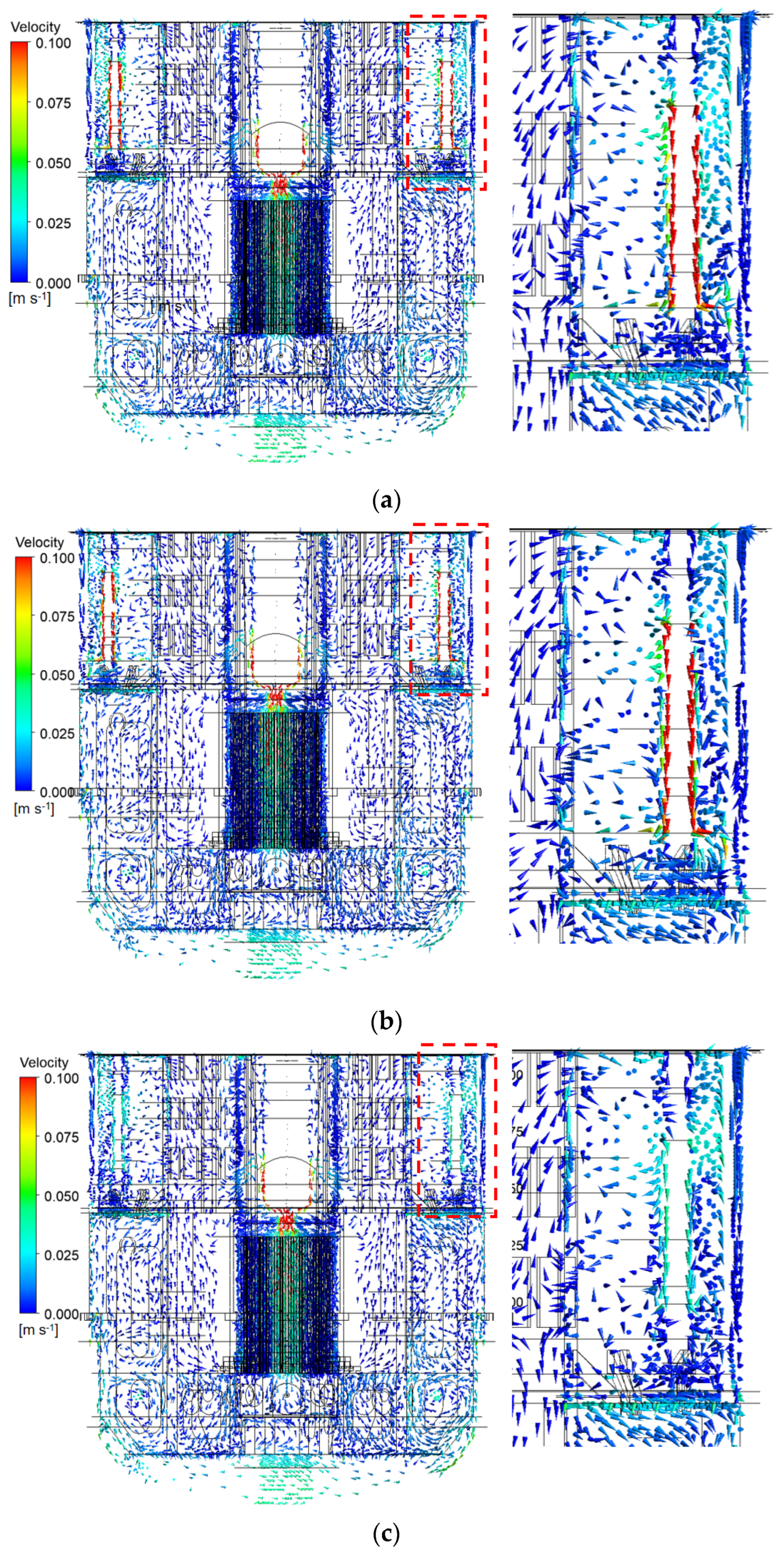
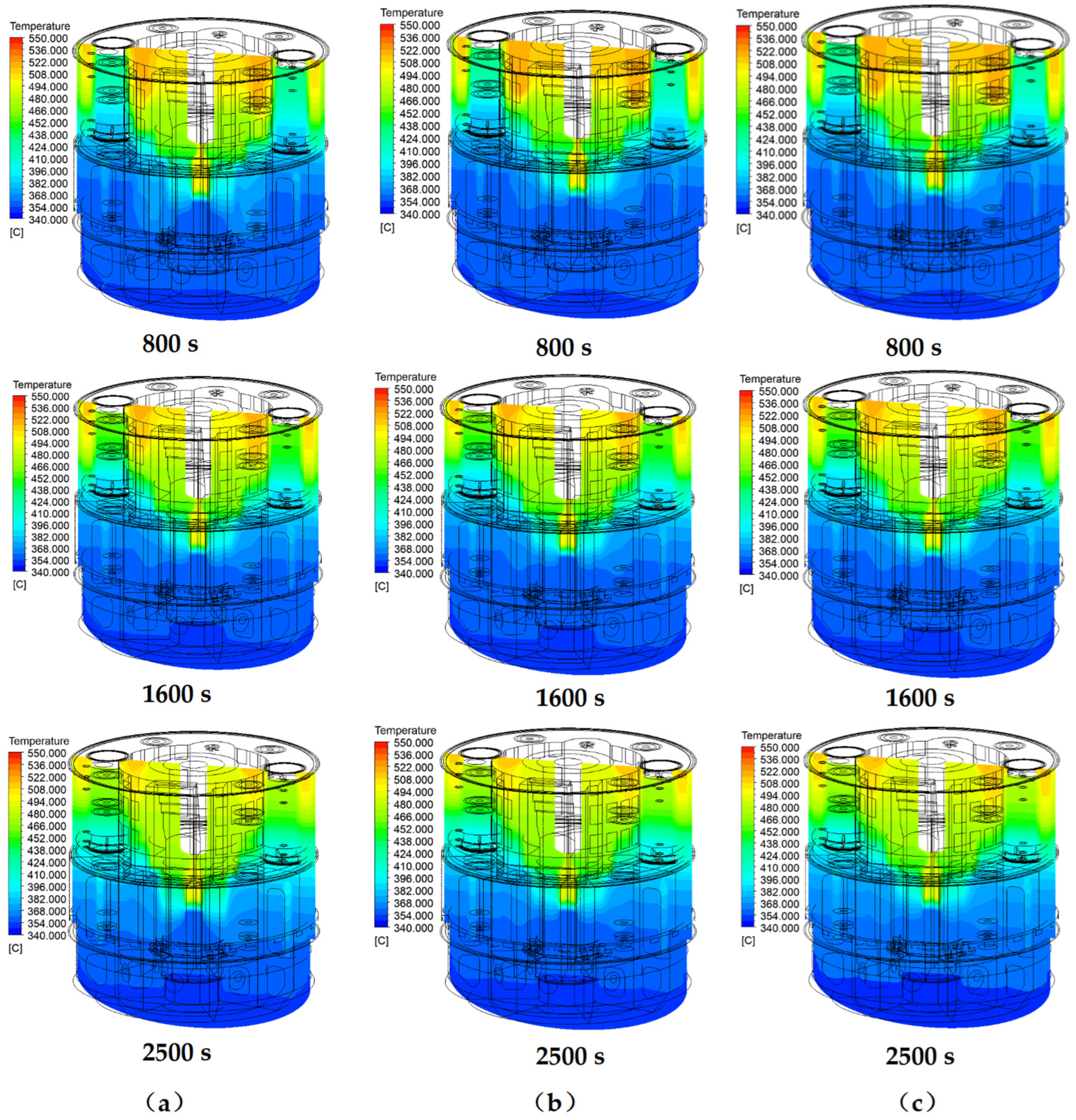
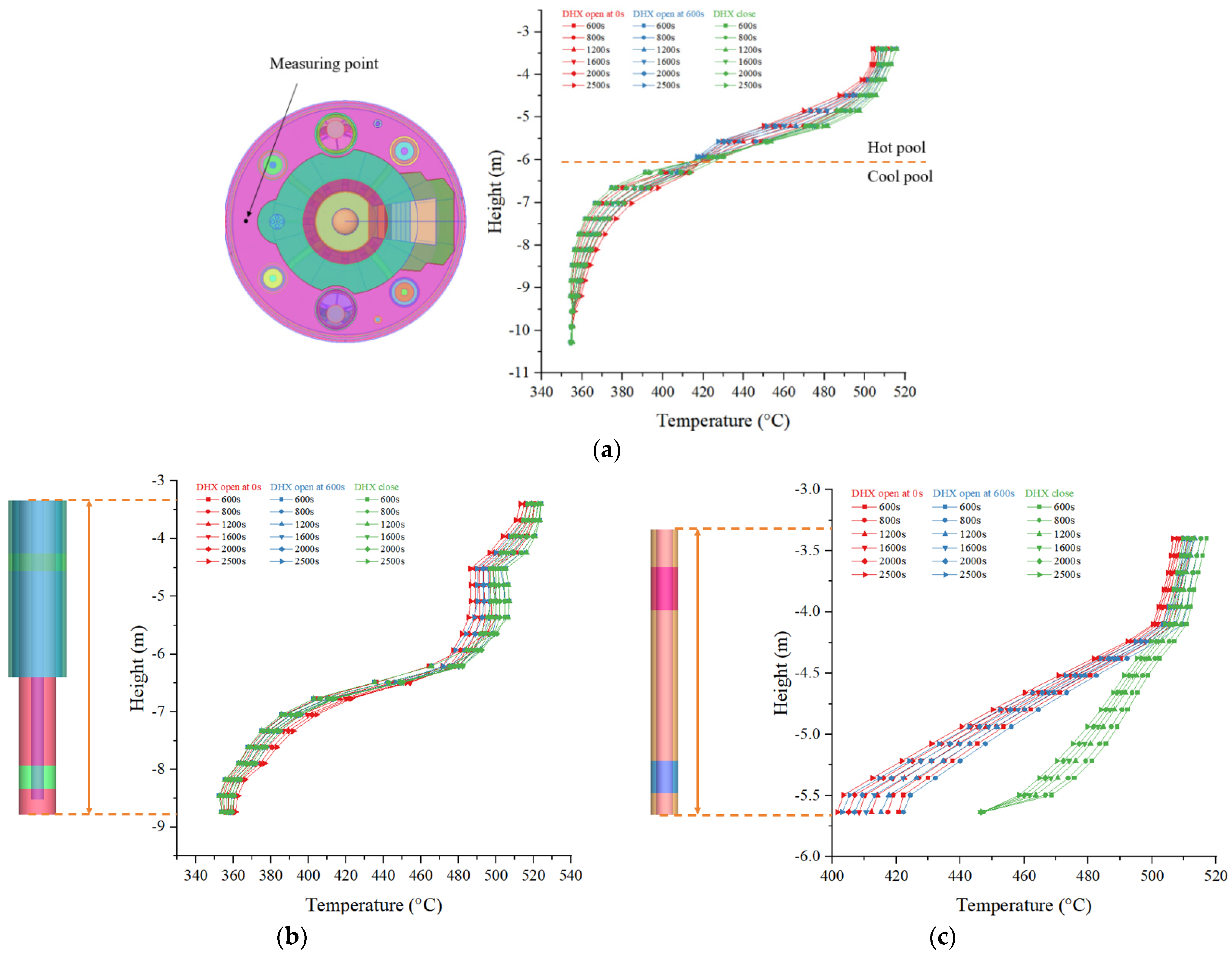
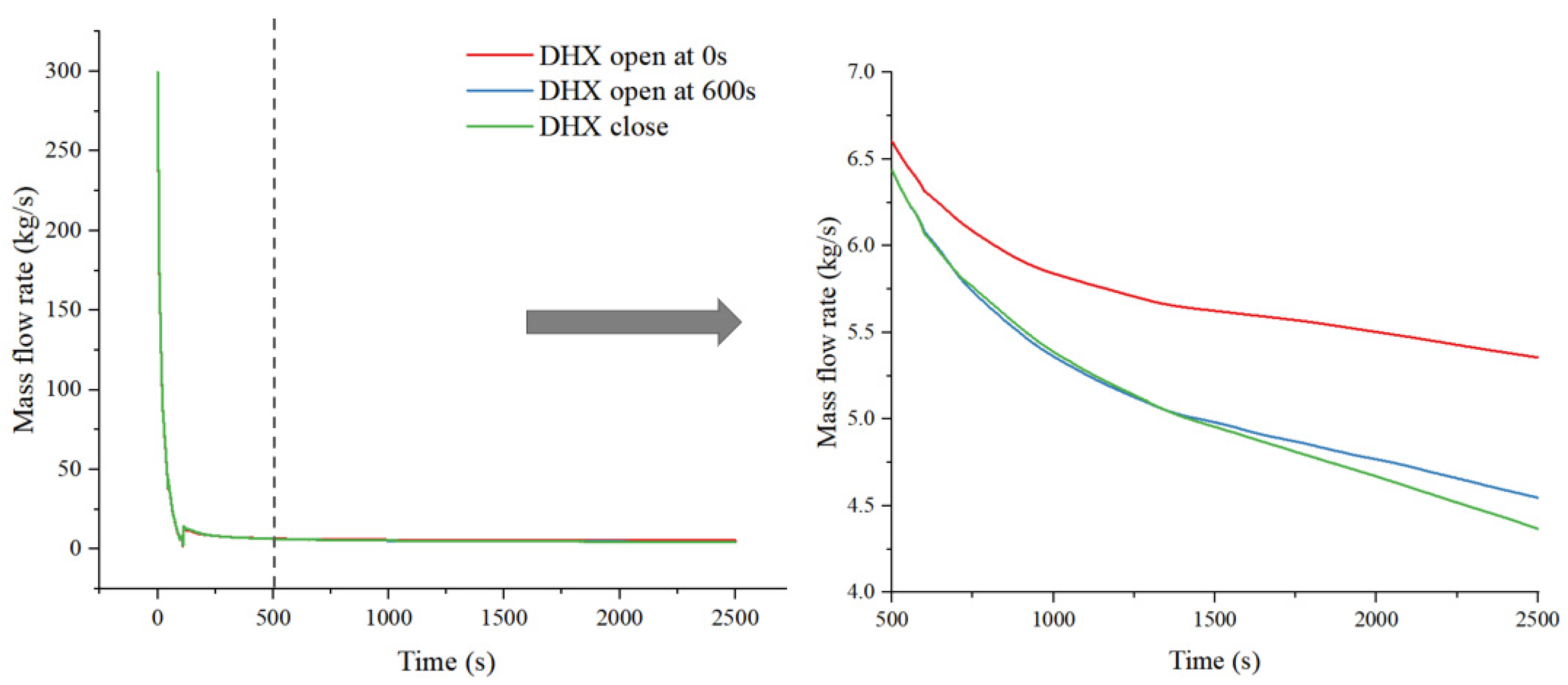
- Flow Field Analysis
4. Conclusions
- The established CFD model demonstrates a high degree of rationality, with a deviation of less than 2% at the 100% rated power baseline of the CEFR. This good agreement provides a reliable initial condition and a fundamental baseline for the subsequent transient accident analysis.
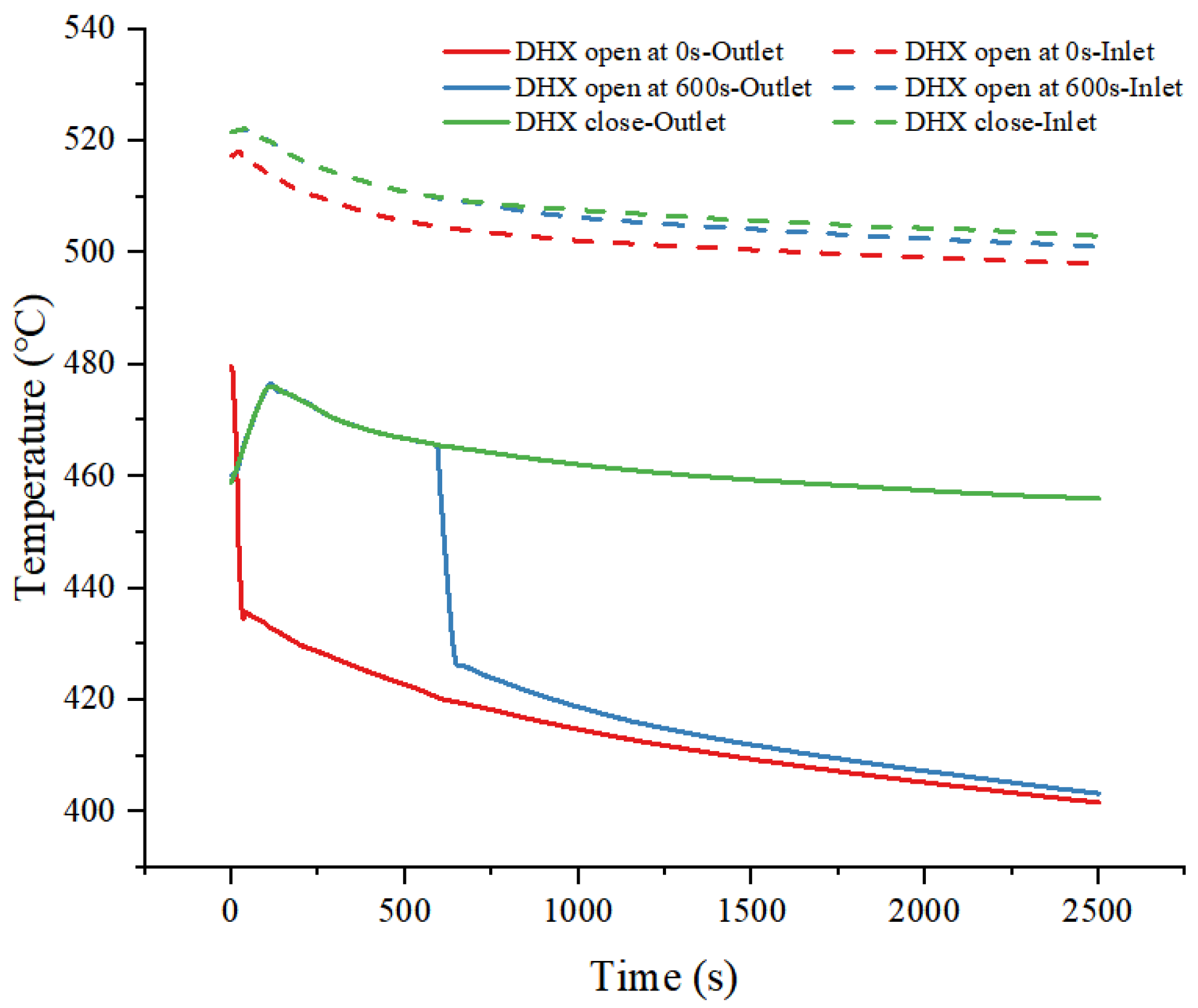
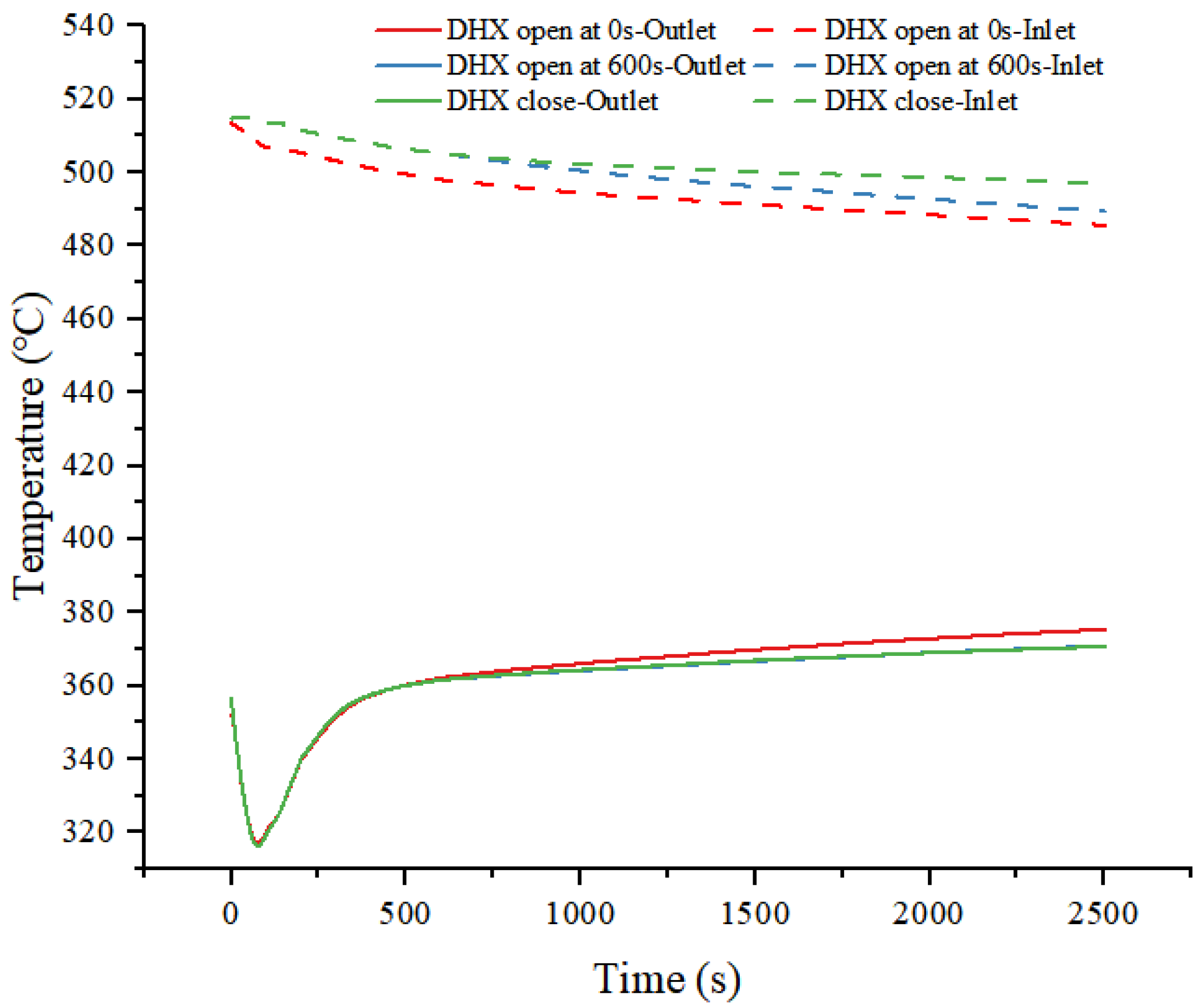
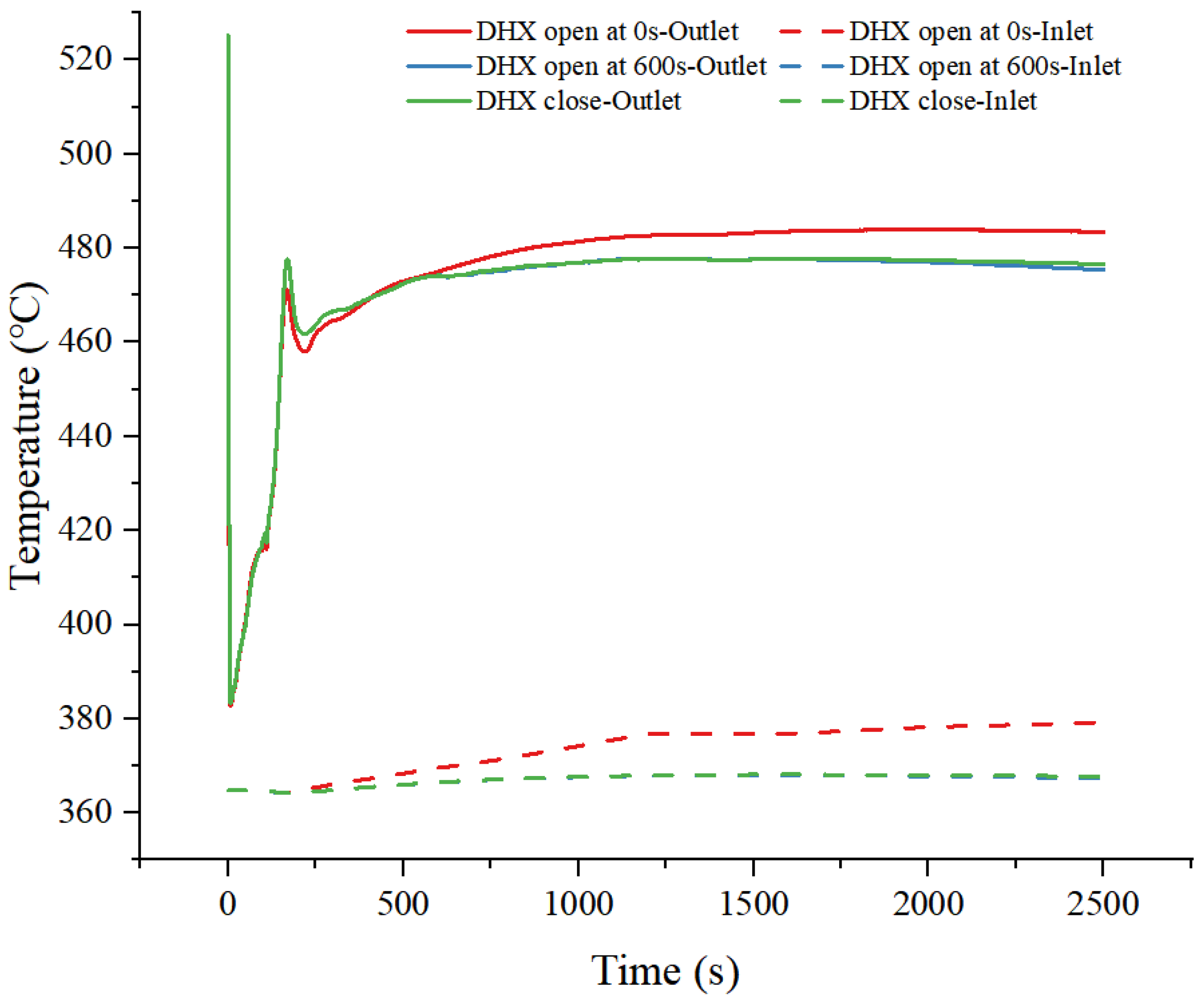
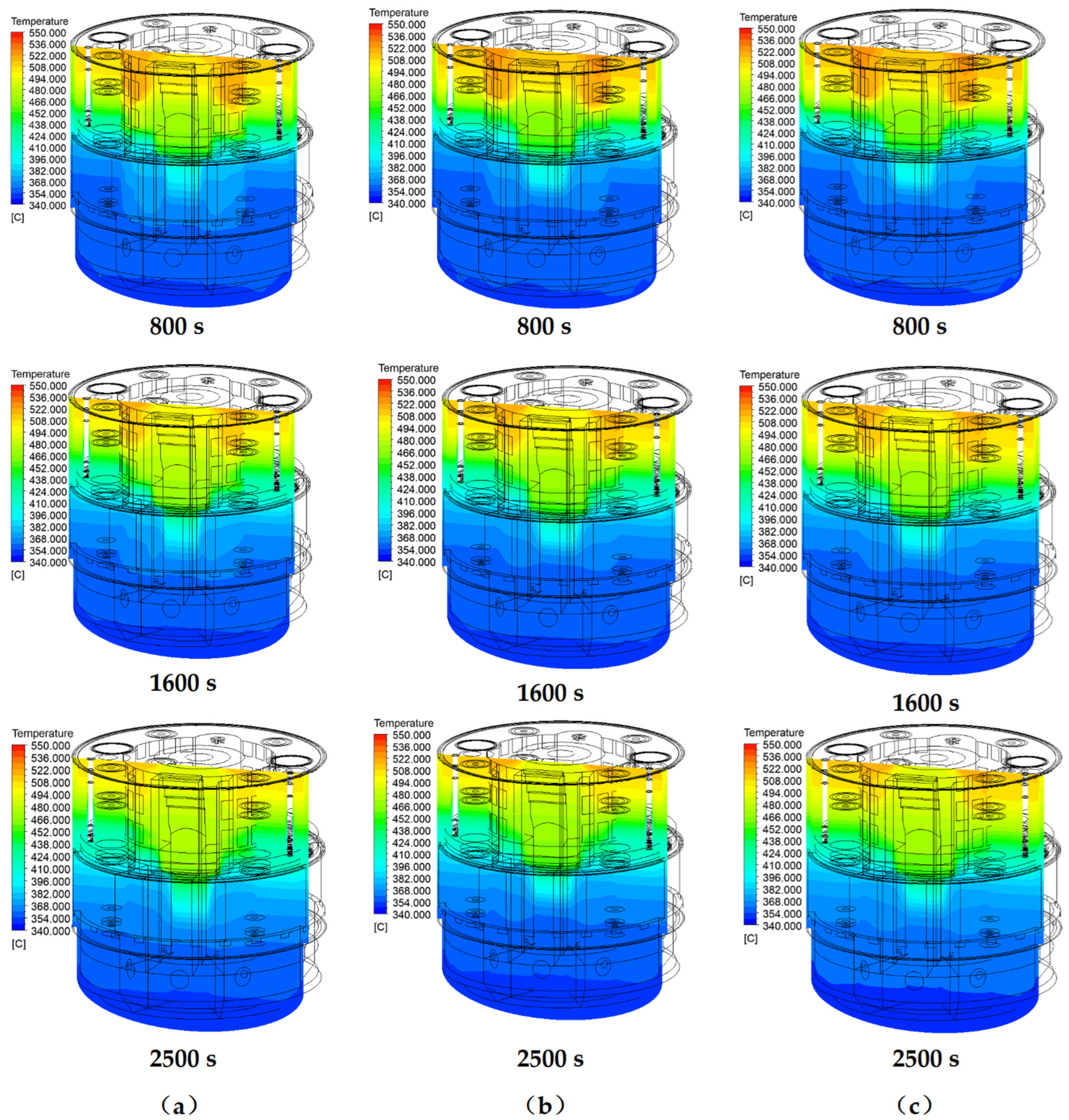
- The DHX activation timing exerts significant active regulatory effects on the establishment process of natural circulation. Regarding DHX activation, “sooner is not always better”. Compared with standard strategies, immediate activation of the DHX enhances fluid circulation and mixing between the hot and cold sodium pools at an earlier stage, thereby increasing core flow by over 10%. This enhanced circulation mechanism effectively reduces spatial temperature gradients and improves temperature field uniformity within the sodium pool. However, it simultaneously causes an accelerated return of hot fluid to the cold pool, which leads to a slight elevation in the core inlet temperature and, consequently, an increase in the core outlet temperature.
- Although the DHX activation strategy influences system transient response characteristics, under all simulated conditions, the core outlet temperature can be successfully reduced below the safety limit (550 °C) by leveraging the substantial thermal inertia of sodium coolant and the established natural circulation. This fully demonstrates the inherent passive safety capability of pool-type SFRs.
- Among the evaluated scenarios, under the standard strategy of activating the DHRS 600 s after an SBO, the sodium pool temperature is not only controlled below the safety limit during the initial stage, but also continues to decrease in the subsequent phases. Furthermore, reserving this 600 s grace period allows the reactor protection system and on-site personnel to assess the accident conditions and determine whether DHRS activation is necessary. This effectively prevents the spurious actuation of the DHRS during brief transient fluctuations. Moreover, in the event of an automatic control system failure, it ensures operators still have time to manually activate the system.
Author Contributions
Funding
Data Availability Statement
Conflicts of Interest
Abbreviations
| DHRS | Decay Heat Removal System |
| SFR | Sodium-Cooled Fast Reactor |
| AHX | Air Heat Exchanger |
| DHX | Decay Heat Exchanger |
| SBO | Station Blackout |
| UDF | User-Defined Function |
| CEFR | China Experimental Fast Reactor |
| IHX | Intermediate Heat Exchanger |
| EBR | Experimental Breeder Reactor |
| EFR | European Fast Reactor |
| DSFR | Demonstration Sodium-cooled Fast Reactor |
| PFBR | Prototype Fast Breeder Reactor |
| KAERI | Korea Atomic Energy Research Institute |
| BWR | Boiling Water Reactor |
| CFD | Computational Fluid Dynamics |
| RVCS | Reactor Vessel Cooling System |
Nomenclature
| velocity | |
| source term | |
| gravitational body force | |
| external body forces | |
| viscous stress tensor | |
| enthalpy | |
| diffusion flux | |
| viscosity | |
| turbulent viscosity | |
| turbulent kinetic energy | |
| turbulent dissipation rate | |
| generation of turbulence kinetic energy due to the mean velocity gradients | |
| generation of turbulence kinetic energy due to the buoyancy | |
| contribution of fluctuating dilatation in compressible turbulence to overall dissipation rate | |
| inertial resistance factor | |
| permeability |
References
- IAEA. Status of Fast Reactor Research and Technology Development, 1st ed.; IAEA: Vienna, Austria, 2012. [Google Scholar]
- Xu, M.; Yang, H. Safety properties of sodium-cooled fast reactors. Physics 2016, 45, 561–568. (In Chinese) [Google Scholar] [CrossRef]
- Generation IV International Forum. Technology Roadmap Update for Generation IV Nuclear Energy System; OECD Publishing: Paris, France, 2014. [Google Scholar]
- Nuclear Innovation & Research Office. Advanced Modular Reactors Technical Assessment; International Atomic Energy Agency: Vienna, Austria, 2021. [Google Scholar]
- Yang, H.; Guo, M. Design Innovation and Realization of China Experimental Fast Reactor. At. Energy Sci. Technol. 2020, 54, 199–205. (In Chinese) [Google Scholar] [CrossRef]
- Aoto, K.; Dufour, P.; Yang, H.; Glatz, J.P.; Kim, Y.-I.; Ashurko, Y.; Hill, R.; Uto, N. A summary of sodium-cooled fast reactor development. Prog. Nucl. Energy 2014, 77, 247–265. [Google Scholar] [CrossRef]
- Du, Y.; Liu, D.; Zhuo, Y.; Zhang, Q. Quantitative Coupling of Risk-Significant Sequences for SBO Accidents in Passive Nuclear Power Plants. Nucl. Saf. 2024, 23, 29–36. (In Chinese) [Google Scholar]
- Mochizuki, H. Development of the plant dynamics analysis code NETFLOW++. Nucl. Eng. Des. 2010, 240, 577–587. [Google Scholar] [CrossRef]
- Choi, C.; Ha, K. Performance test of MARS-LMR code with benchmark analysis of EBR-II SHRT-17. Ann. Nucl. Energy 2016, 94, 376–391. [Google Scholar] [CrossRef]
- Guo, C.; Lu, D.; Sui, D.; Zhang, X. SAC-CFR computer code verification with Experimental Breeder Reactor II loss-of-primary-flow-without-scram test data. Ann. Nucl. Energy 2015, 71, 166–173. [Google Scholar] [CrossRef]
- Yue, N.; Ma, Z.; Cal, R.; Hu, B.; Su, G.; Qiu, S. Thermal-hydraulic analysis of EBR-II Shutdown Heat Removal Tests SHRT-17 and SHRT-45R. Prog. Nucl. Energy 2015, 85, 682–693. [Google Scholar] [CrossRef]
- Wang, S.; Zhang, D.; Liu, Y.; Wang, C.; Qiu, S.; Su, G.; Tian, W. An experiment-based validation of a system code for prediction of passive natural circulation in sodium-cooled fast reactor. Int. J. Energy Res. 2021, 45, 12093–12109. [Google Scholar] [CrossRef]
- Cai, Y.; Zhang, D.; Lin, Y.; Du, P.; Wang, B.; Zhu, L.; Tian, W.; Qiu, S.; Su, G. Thermal-hydraulics analysis of a small lead-cooled fast reactor with reactor vessel cooling system using ACENA. Ann. Nucl. Energy 2026, 227, 119257. [Google Scholar] [CrossRef]
- Lin, Y.; Zhang, D.; Chen, Y.; Zhang, X.; Deng, J.; Tian, W.; Qiu, S.; Su, G. Preliminary development and validation of ACENA code for melting and freezing behavior simulation. Ann. Nucl. Energy 2025, 212, 110410. [Google Scholar] [CrossRef]
- Zarvugin, D.G.; Poplavskii, V.M.; Rachkov, V.I.; Sorokin, A.P.; Shvetsov, Y.E.; Rogozhkin, S.A.; Shepelev, S.F. Computational and experimental validation of the planned emergency heat-removal system for BN-1200. At. Energy 2014, 116, 271–277. [Google Scholar] [CrossRef]
- Jiang, D.; Deng, J.; Zhang, D.; Zhou, X.; Xiao, C.; Tian, W.; Zhang, J.; Su, G. Evaluation of a numerical model for predicting flow and heat transfer in a hexagonal helical cruciform seven-rods bundle and analysis of rod bundle size independence. Int. Commun. Heat Mass Transf. 2025, 161, 108409. [Google Scholar] [CrossRef]
- Vivek, V.; Sharma, A.K.; Balaji, C. A CFD based approach for thermal hydraulic design of main vessel cooling system of pool type fast reactor. Ann. Nucl. Energy 2013, 57, 267–279. [Google Scholar] [CrossRef]
- Zhou, X.; Zhang, D.; Zhou, L.; Wu, W.; Zhang, X.; Tian, W.; Qiu, S.; Su, G. Development and validation of a neutron transport solver with SP3 method based on Open FOAM. Prog. Nucl. Energy 2024, 170, 105120. [Google Scholar] [CrossRef]
- Xia, Z.; Lu, D.; Tang, J.; Liu, Y.; Yang, J.; Feng, L.; Ye, S.; Guo, Z.; Zhang, Y. Three-dimensional thermal hydraulic transient calculation of coupled cold and hot pools under a loss of feedwater accident in the China experimental fast reactor. Ann. Nucl. Energy 2019, 139, 107217. [Google Scholar] [CrossRef]
- Yin, J.; Lu, D.; Zhao, H.; Guo, J.; Liu, Y.; Yang, J.; Guo, Z.; Zhang, Y. 3D simulation of transient thermal-hydraulic characteristics in CEFR during emergency shutdown event. Prog. Nucl. Energy 2022, 153, 104410. [Google Scholar] [CrossRef]
- Ma, X.; Lu, D.; Liang, J.; Fu, J.; Liu, Y.; Yang, J.; Guo, Z.; Zhang, Y. Numerical Simulation of 3D Transient Thermal-Hydraulic Characteristics under Asymmetric Condition Induced by One Primary Pump Trip Concurrent with Loss of Off-Site Power in CEFR. Nucl. Sci. Eng. 2021, 41, 1234–1243. (In Chinese) [Google Scholar] [CrossRef]
- Liang, J.; Lu, D.; Fu, J.; Zhao, H.; Liu, Y.; Yang, J.; Ma, X.; Tang, J.; Zhang, Y. Numerical simulation on transient thermal and hydraulic characteristics in sodium pool of CEFR under OPT-SLOOP and OPT-RHROSL conditions. Ann. Nucl. Energy 2021, 160, 108398. [Google Scholar] [CrossRef]
- Zhang, Y.; Zhang, X.; Zhao, H.; Lu, D. Transient three-dimensional numerical simulation on asymmetrical flow and thermal characteristics of CEFR sodium pool under secondary pump shaft stuck accident. Prog. Nucl. Energy 2023, 162, 104780. [Google Scholar] [CrossRef]
- Yang, H. Fast Reactor Thermal-Hydraulics; Beijing Institute of Nuclear Energy Technology: Beijing, China, 2022; pp. 191–258. [Google Scholar]
- IAEA. Benchmark Analyses on the Natural Circulation Test Performed During the PHENIX End-of-Life Experiments; IAEA-TECDOC-1703; International Atomic Energy Agency: Vienna, Austria, 2013. [Google Scholar]
- Hazama, T. Prototype reactor Monju. In Sodium-Cooled Fast Reactors; Soda, K., Ohira, H., Aoto, K., Eds.; Academic Press: Amsterdam, The Netherlands, 2022; pp. 87–161. [Google Scholar]
- Sinha, K.; Chellapandi, P.; Srinivasan, G.; Dulera, I.; Vijayan, P.K.; Chande, S.K. Phenix, Superphenix, and the FBTR innovative reactors. In Handbook of Generation IV Nuclear Reactors, 2nd ed.; Pioro, I.L., Ed.; Woodhead Publishing: Cambridge, UK, 2023; pp. 355–393. [Google Scholar]
- Zhou, Z.; Xue, X.; Lin, C.; Yu, X.; Yang, Y.; Yang, H. Design Study on In-Vessel Natural Circulation for Decay Heat Removal in Pool-Type Sodium-Cooled Fast Reactors. At. Energy Sci. Technol. 2024, 58, 1817–1824. (In Chinese) [Google Scholar]
- Choi, C.; Ha, K.; Hong, J.; Yeom, S.; Eoh, J.; Jeong, H.-Y. Validation of intermediate heat and decay heat exchanger model in MARS-LMR with STELLA-1 and JOYO tests. Nucl. Eng. Des. 2016, 308, 269–282. [Google Scholar] [CrossRef]
- Vikram, G.; Natesan, K.; Raghupathy, M.R. Simulation of decay heat removal by active means following emergency shutdown in SFRs. Prog. Nucl. Energy 2023, 159, 104646. [Google Scholar] [CrossRef]
- Mente, V.M.; Pandey, G.K.; Banerjee, I.; Kumar, S.A.; Padmakumar, G.; Rajan, K. Experimental studies in water for safety grade decay heat removal of prototype fast breeder reactor. Ann. Nucl. Energy 2014, 65, 114–121. [Google Scholar] [CrossRef]
- Cheng, S. Thermal-Hydraulic Simulation of Standalone Heat Exchanger in Fast Reactor Cold Pool. Heilongjiang Sci. Technol. Inf. 2021, 18, 170–171. (In Chinese) [Google Scholar] [CrossRef]
- De Santis, A.; Di Maio, D.V.; Caruso, G.; Manni, F. Innovative radiation-based direct heat exchanger for liquid metal cooled reactors. Nucl. Eng. Des. 2013, 263, 164–171. [Google Scholar] [CrossRef]
- Liang, J. Three-Dimensional Numerical Simulation of Primary Circuit Natural Circulation Characteristics Under Station Blackout Condition in CEFR. Master’s Thesis, North China Electric Power University, Beijing, China, 2022. [Google Scholar] [CrossRef]
- Zhao, H.; Lu, D.; Zhang, Y.; Zhang, X. Numerical simulation of natural circulation characteristics under different DHX layout schemes in pool-type SFR during station blackout accident. Prog. Nucl. Energy 2023, 157, 104567. [Google Scholar] [CrossRef]
- Song, H.; Liu, Y.; Lu, D.; Zhao, H.; Zhang, Y. Comparison research on DRACS and PRACS for decay heat removal system in sodium-cooled fast reactors based on numerical simulations of PLANDTL-DHX. Prog. Nucl. Energy 2026, 190, 105961. [Google Scholar] [CrossRef]
- Song, H.; Zhang, Y.; Zhao, H.; Sui, D.; Lu, D. Comparison research on numerical modeling methods for the passive heat removal system of fast reactors based on PLANDTL benchmark experiment. Ann. Nucl. Energy 2025, 212, 111044. [Google Scholar] [CrossRef]
- Zhao, H.; Zhang, Y.; Song, H.; Shen, X.; Lu, D. 3-D numerical simulation on thermal hydraulic characteristics in integrated sodium pool of PHENIX reactor during dissymmetric test. Ann. Nucl. Energy 2024, 204, 110568. [Google Scholar] [CrossRef]
- Huh, B.G.; Kim, S.; Chung, C.H. The turbulent plandtl number for temperature analysis in rod bundle subchannels. J. Nucl. Sci. Technol. 2005, 42, 183–190. [Google Scholar] [CrossRef]
- Mikityuk, K. Heat transfer to liquid metal: Review of data and correlations for tube bundles. Nucl. Eng. Des. 2009, 239, 680–687. [Google Scholar] [CrossRef]
- Mochizuki, H.; Takano, M. Heat transfer in heat exchangers of sodium cooled fast reactor systems. Nucl. Eng. Des. 2009, 239, 295–307. [Google Scholar] [CrossRef]







| Item | Value |
|---|---|
| Reactor core thermal power/(MW) | 65 |
| cooling power of each IHX/(MW) | 16.25 |
| cooling power of each DHX/(MW) | 0.0525 |
| Mass flow of core/(kg/s) | 301 |
| Mass flow through RVCS/(kg/s) | 40 |
| Item | Simulation Values | Reference Values | Deviation |
|---|---|---|---|
| Core flow rate/(kg/s) | 301 | 301 | 0 |
| RVCS flow rate/(kg/s) | 35.54 | 40 | 0.40% |
| Core inlet temperature/°C | 360.54 | 360 | 0.15% |
| Core outlet temperature/°C | 522.79 | 530 | 1.36% |
| IHX inlet temperature/°C | 514.1 | 516 | 0.37% |
| IHX outlet temperature/°C | 350.8 | 353 | 0.62% |
| DHX inlet temperature/°C | 516.1 | 516 | 0.02% |
| DHX outlet temperature/°C | 486.2 | 490 | 0.78% |
Disclaimer/Publisher’s Note: The statements, opinions and data contained in all publications are solely those of the individual author(s) and contributor(s) and not of MDPI and/or the editor(s). MDPI and/or the editor(s) disclaim responsibility for any injury to people or property resulting from any ideas, methods, instructions or products referred to in the content. |
© 2026 by the authors. Licensee MDPI, Basel, Switzerland. This article is an open access article distributed under the terms and conditions of the Creative Commons Attribution (CC BY) license.
Share and Cite
Liu, Y.; Zhang, Y.; Liu, R.; Chen, X.; Song, H.; Lu, D. Research on the Activation Strategies of Passive Decay Heat Removal Systems in a Pool-Type SFR by Three-Dimensional Numerical Simulation. J. Nucl. Eng. 2026, 7, 35. https://doi.org/10.3390/jne7020035
Liu Y, Zhang Y, Liu R, Chen X, Song H, Lu D. Research on the Activation Strategies of Passive Decay Heat Removal Systems in a Pool-Type SFR by Three-Dimensional Numerical Simulation. Journal of Nuclear Engineering. 2026; 7(2):35. https://doi.org/10.3390/jne7020035
Chicago/Turabian StyleLiu, Yue, Yuhao Zhang, Ruoyu Liu, Xinyi Chen, Haijie Song, and Daogang Lu. 2026. "Research on the Activation Strategies of Passive Decay Heat Removal Systems in a Pool-Type SFR by Three-Dimensional Numerical Simulation" Journal of Nuclear Engineering 7, no. 2: 35. https://doi.org/10.3390/jne7020035
APA StyleLiu, Y., Zhang, Y., Liu, R., Chen, X., Song, H., & Lu, D. (2026). Research on the Activation Strategies of Passive Decay Heat Removal Systems in a Pool-Type SFR by Three-Dimensional Numerical Simulation. Journal of Nuclear Engineering, 7(2), 35. https://doi.org/10.3390/jne7020035