1. Introduction
As global energy demand increases and environmental concerns become more pressing, the pursuit of safer and more sustainable energy solutions has intensified. Molten salt reactors (MSRs) have emerged as a promising alternative in this evolving landscape, offering a significant departure from conventional reactor designs. With each new study, their potential has become even more evident, marking a critical step toward the future of nuclear energy. This is due to their ability to operate at high temperatures and low pressures, enabled by a liquid mixture of molten salts that serves as both fuel and coolant.
The exploration of molten salts in nuclear reactors began in the United States during the 1940s and 1950s as part of the Manhattan Project. Theoretical and experimental studies were conducted to assess their potential. These early investigations laid the groundwork for future research on molten salt reactor technology. At Oak Ridge National Laboratory (ORNL), the first MSR, known as the Aircraft Reactor Experiment (ARE), was built with support from the U.S. Aircraft Nuclear Propulsion program [
1].
In the following decades, research on MSRs grew. Between 1965 and 1969, the Molten Salt Reactor Experiment (MSRE) at Oak Ridge became one of the most significant nuclear experiments of its time. For the first time, molten salts were used both as a coolant and as a fuel, providing valuable insights into their viability for nuclear energy applications. Large-scale experimental studies demonstrated their stability at high temperatures. However, political and economic challenges led to the program’s cancellation in the 1970s. By 1976, official support for MSR development in the U.S. had been withdrawn. Financial constraints and a growing preference for more conventional reactor designs, such as light water reactors, shifted the focus away from molten salt technology. For decades, MSRs remained in the background of nuclear research [
1].
Interest in MSRs resurfaced in the early 2000s, driven by growing concerns over nuclear safety and the need for more efficient and sustainable reactor designs. In 2001, the Generation IV International Forum (GIF) recognized MSRs as one of six next-generation nuclear technologies. This renewed global attention led to new studies in Europe and other continents. Research on the molten salt fast reactor (MSFR), a variant of the MSR that uses thorium instead of uranium, gained prominence. China took a decisive step in 2011 by launching the Thorium Molten Salt Reactor (TMSR) program, focusing on advanced thorium-powered reactor designs. In Europe, research on the MSFR continued under the SAMOFAR program between 2012 and 2015, further promoting the development of MSRs as a safe and sustainable option [
2].
Homogeneous MSRs have been developed with a core filled exclusively with fuel salt and operating under a fast-neutron spectrum. Within this type of reactor, two types have been established: fluoride-based and chloride-based fast homogeneous MSRs [
3].
According to [
4], there has been growing interest in circulating fuel reactors, particularly fluid-fuel-type molten salt reactors, over the past two decades and more recently. Ref. [
5] presents the development of a simulation model for the molten salt fast reactor (MSFR) to predict the behavior of inert gas bubbles in the core and quantify their impact on reactivity. They modeled the inert gas bubbles using a multiphysics approach that combines computational fluid dynamics for fluid flow and heat transfer with the neutron diffusion equation and an equilibrium equation with diffusion terms. Their simulations revealed that the bubble distribution in the core has a significant impact on reactivity.
Having tools that allow us to simulate the behavior of the various phenomena occurring in a nuclear reactor is essential for safety and stability analyses. CFD models allow for more precise visualization of phenomena occurring in the reactor core, especially for fluid flows; however, the computational resources required are considerable, hindering rapid simulations.
The development of scaled models, which allow visualization of the entire core and the temperature behavior in each phase, reduces the computational resources required. However, challenges remain before these models can be used in dynamic and feedback simulations.
This work presents a method for developing mathematical models that enable full-scale reactor simulations without high computational power. This in-house-developed method has been applied to various reactor systems [
6,
7,
8,
9]. However, the systems in which the method was applied were solid–liquid systems, and the liquid phase was in motion, not the solid phase. In this work, the liquid–gas system, with both phases in motion, requires a relative velocity model to calculate the velocities of both phases.
The use of an upscaled heat transfer model for analyzing the two-phase system is proposed. To obtain the value of the upscaled coefficient, it is important to obtain the fields of the closure variables by solving the boundary value problems in a unitary cell with symmetry and periodicity. The upscaled model is developed by applying the volume averaging method [
10]. The procedure first considers the homogeneous two-phase flow equations (scaled equations) obtained by applying the volumetric averaging method, which constitute a boundary value problem with integro-differential equations. Furthermore, these equations and the boundary conditions are functions of scaled-up variables and spatial deviations. To find the solution, a formal solution is constructed mathematically, taking advantage of the linearity. This problem is solved in a unit cell consisting of a spherical bubble surrounded by molten salt (liquid phase). Considering symmetry and periodicity, the behavior at the reactor scale is approximated.
This paper is structured as follows:
Section 2 describes the molten salt reactor. The mathematical model and the average method applied in this work are presented in
Section 3. Also, the boundary conditions as a function of the scaled variables and spatial deviations, as well as the formal solution, are presented in
Section 3. Implementation of the closure problem in a computer program as well as results and analysis are presented in
Section 4.
Section 5 presents an upscaled two-equation model of heat transfer, expressed in terms of upscaled heat transfer coefficients that describe the MSR with bubbling Helio effects. Finally, the conclusions and future work are presented in
Section 6.
2. Reactor Description
The molten salt fast reactor (MSFR) is a 3000 MWth and 1300 MWe fast reactor with a thorium–uranium fuel cycle. It contains a total volume of 18 m
3 of fuel salt, with a height and radius of 2.25 m each. It operates at an inlet temperature of 923.15 K and reaches a maximum temperature of 1023.15 K [
11]. It uses a mixture of LiF–
232ThF
4–
233UF
4 salts. The fuel salt flows from the bottom to the top of the core and then feeds the 16 external modules (pump and heat exchanger) arranged around it.
There are 16 bubble injection systems, one for each pump and heat exchanger. The bubbling of helium (He) gas serves two functions: removing metal particles by flotation and extracting gaseous fission products (FPs), such as the noble gases Kr and Xe, and H, as well as suspended metal particles before their decomposition in the salt.
Molten salt reactors exhibit tighter and more complex couplings among physical mechanisms than solid-fuel reactors owing to their liquid fuel nature. This characteristic enhances the interplay between neutronics and thermal hydraulics, resulting in faster increases in core temperature during reactivity insertion accidents. Additionally, the analysis of heat transport between the liquid and gas phases is relevant, as it relates to the void fraction in the neutronic process, particularly due to the presence of helium gas bubbles.
Due to the liquid fuel, MSRs exhibit reactivity effects not present in light water reactors, particularly changes in fuel density, making them more susceptible to density variations. Delayed neutrons play a crucial role in reactor operation and safety, as they effectively extend neutron lifetime. If reactivity insertions are smaller than the total reactivity value of delayed neutrons, the result is a slower and more easily controllable transient event. However, a large reactivity insertion exceeding the delayed neutron value can lead to nearly instantaneous transients, known as rapid supercritical transients.
In a solid-fuel reactor, delayed neutrons are emitted with a spatial distribution almost identical to that of fast neutrons. This is because the fission products that emit delayed neutrons, called delayed neutron precursors, do not move significantly within the fuel rods before decaying. MSRs do not have this advantage, as their liquid fuel moves the precursors before they decay and emit delayed neutrons, with some of the longer-lived precursors emitting neutrons outside the reactor core. As a result, there is a reduction in the total number of delayed neutrons in the core, leading to a smaller margin between critical and rapid supercritical conditions.
It is theoretically possible for gases to coagulate within the salt, creating feedback effects and requiring an off-gas system. Likewise, solid precipitates could form, affecting the thermophysical properties of the fuel salt or adhering to the walls, thereby impacting the operation of certain components, such as heat exchangers. In accident scenarios, the fuel salt can even begin to freeze, which could have serious implications for reactor behavior and safety [
12].
The potential for xenon removal in molten salt reactors (MSRs) was discovered during the Airborne Reactor Experiment, which found that the measured level of xenon poisoning was only 5% of the theoretical value if all xenon remained contained within the fuel salt. In the Molten Salt Reactor Experiment (MSRE), the xenon removal mechanism was integrated into the fuel pump. The physical removal of gaseous fission products via inert gas injection has attracted particular interest due to its simplicity and compatibility with the fuel salt [
13].
A prototype xenon removal system for the Molten Salt Demonstration Reactor (MSDR) has been proposed based on this concept, which includes a bubble generator to inject helium bubbles and a gas separator to remove them. If the salt flows from the bubble generator to the bubble separator, the generation and removal of bubbles are confined within the xenon removal system. This design leads to higher physical quantities of fuel salt and recycled helium [
14].
3. Mathematical Model
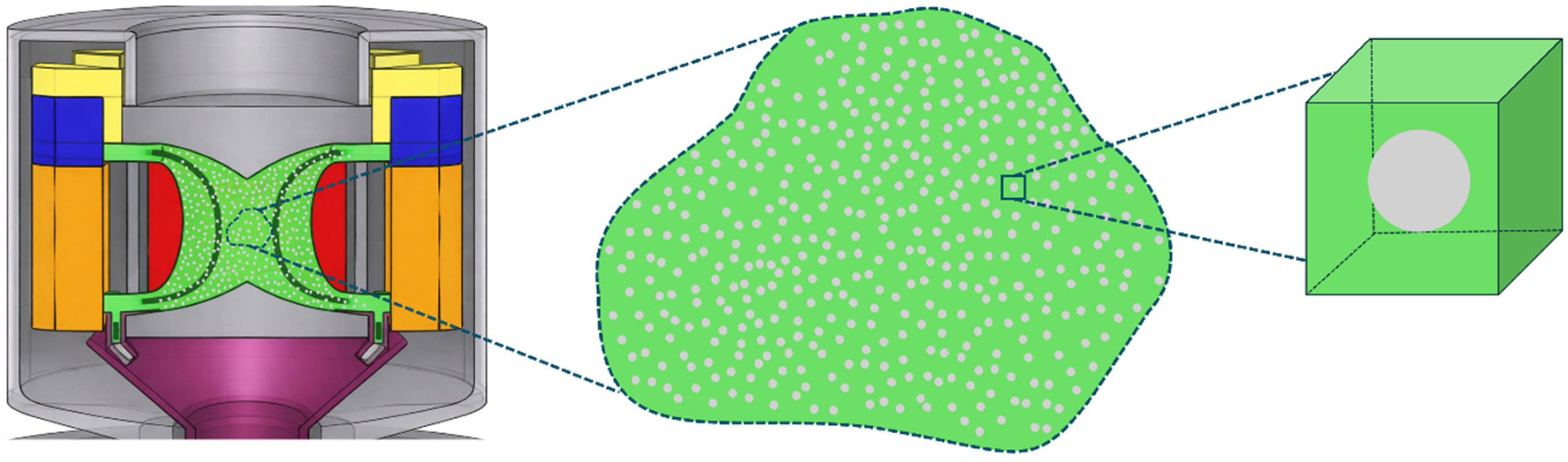
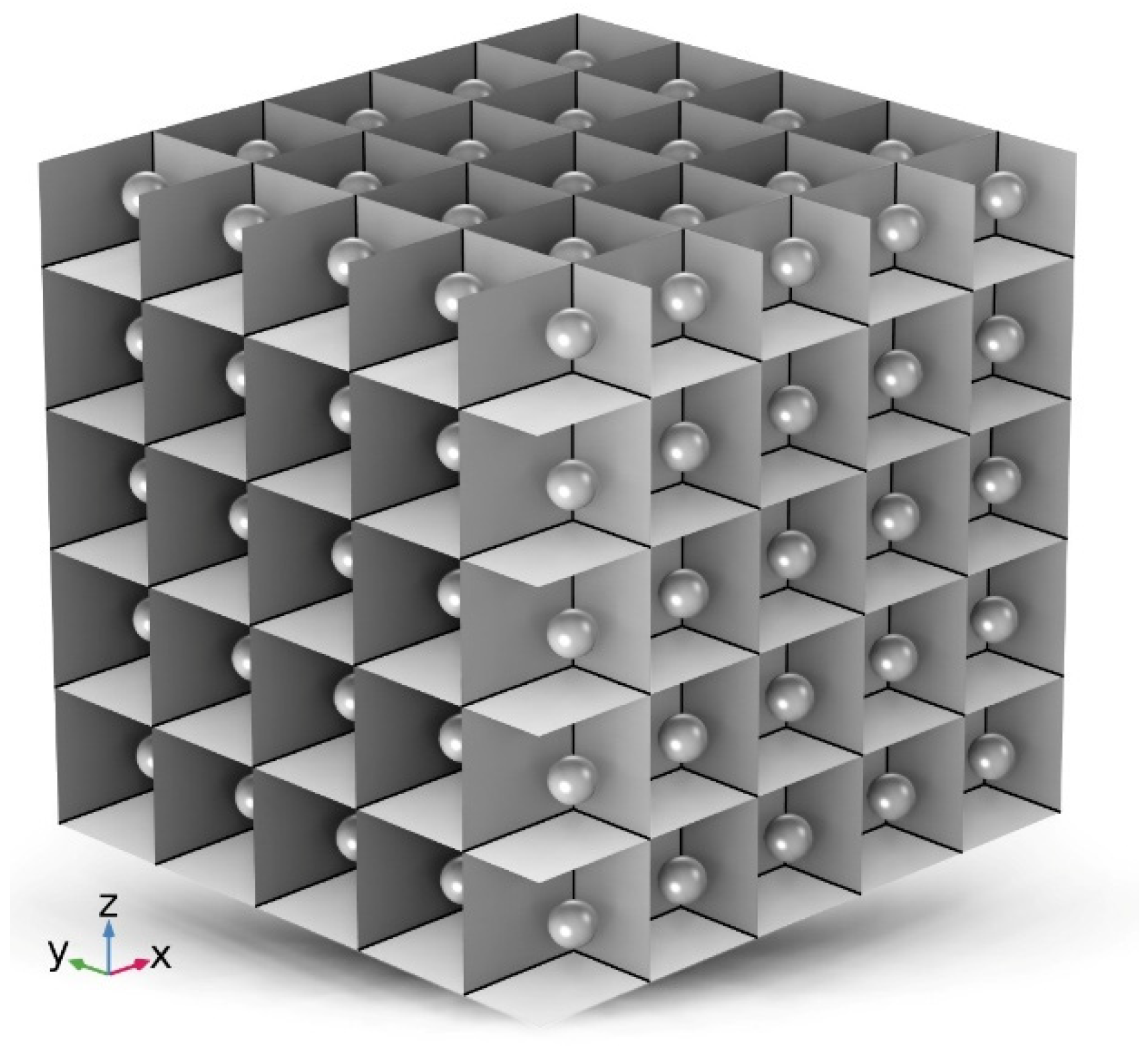
Figure 1 is a schematic diagram of an SMR, showing a representative region comprising helium bubbles dispersed in molten salt. In this region, heat transfer occurs between the two phases, along with neutron processes that generate thermal power.
The equations that govern heat transfer processes at the local scale are:
By applying the nuclear reactor upscaling procedure [
15], which is based on the averaging volume method [
10], we obtain the upscaled model. Averaging is employed to derive the governing differential equations for multiphase transport, in this case, a liquid–gas system. Also, a general closure scheme is formulated to account for spatial deviations. This closure scheme consists of a set of partial differential equations derived without assuming spatial periodicity. When these equations are solved within representative regions of a multiphase system, periodic boundary conditions arise naturally. Within the volume averaging framework, the core of the nuclear reactor is treated as a hierarchical porous medium. The representative unitary cell includes a representative helium bubble and a molten salt cube.
In this way, the governing equations valid at the helium bubble are spatially smoothed, and the final upscaled equation results from the following sequence:
Average the local equations for each phase, applying the average superficial operator.
Apply the spatial decomposition to the point variables.
Obtain a non-closed problem in terms of average quantities and spatial deviations.
Define spatial deviations and their formal solution, whose mathematical structure derives from the closure problems.
Solve the closure problems numerically and estimate the effective coefficients involved in the upscaled heat transport equations.
Applying this procedure, steps 1 and 2, we demonstrate that:
This set of equations is the upscaled model of the MSR for heat transport between the molten salt and Helio phases, applicable at the nuclear reactor scale. In these equations, the upscaled molten salt temperatures are given by:
and the local variable is given by
The spatial deviations in temperature are local and reflect complex interfacial phenomena at the two-phase interface. Similar definitions and meanings apply to the bubble phase, denoted by the subscript b. This means it is necessary to examine them at the microscale within a representative region of the molten-salt nuclear reactor. To build a solution, it is important to analyze the local scale, illustrated in
Figure 1.
3.1. Boundary Conditions and Formal Solution
The boundary conditions given by Equations (3) and (4) can be rewritten as:
As the representative region is spatially periodic and the source terms are either constant or spatially periodic, this periodicity condition is consistent with Equations (10) and (11). It is important to point out that the source terms are: , , , and . Then, if (where are the characteristic lengths at the scale of the bubble and the depth that surrounds it, and is the characteristic length of the representative region), the temperature sources and can be treated as constant. However, according to the periodicity condition given in Equation (10), the diffusion terms and are spatially periodic.
To solve the intrinsic upscaled temperature field of each phase defined by and , it is necessary to know the spatial deviations of the temperature and .
Starting from the boundary conditions in terms of the spatial deviations whose nature is linear, we can propose a formal solution in terms of the sources whose property is
, i.e.,
is the local scale because
.
This approach to solving the boundary value problem for and is known as the method of superposition, where , , , , and are the closure variables.
The governing equations for the spatial deviations of temperatures are given by:
These are obtained by combining the local upscaled equations, the decomposition of the local variable, and the consideration of quasi-stationary conditions.
3.2. Closure Variables
The closure problems arise directly from substituting the formal solution into the spatial deviation Equations (16) and (17) and into the boundary conditions (10) and (11). With this procedure, we have built three closure problems:
Closure problem for
and
Closure problem for
and
Closure problem for
and
The closure variables
,
,
,
,
and
are solved in the periodic cell, as illustrated in
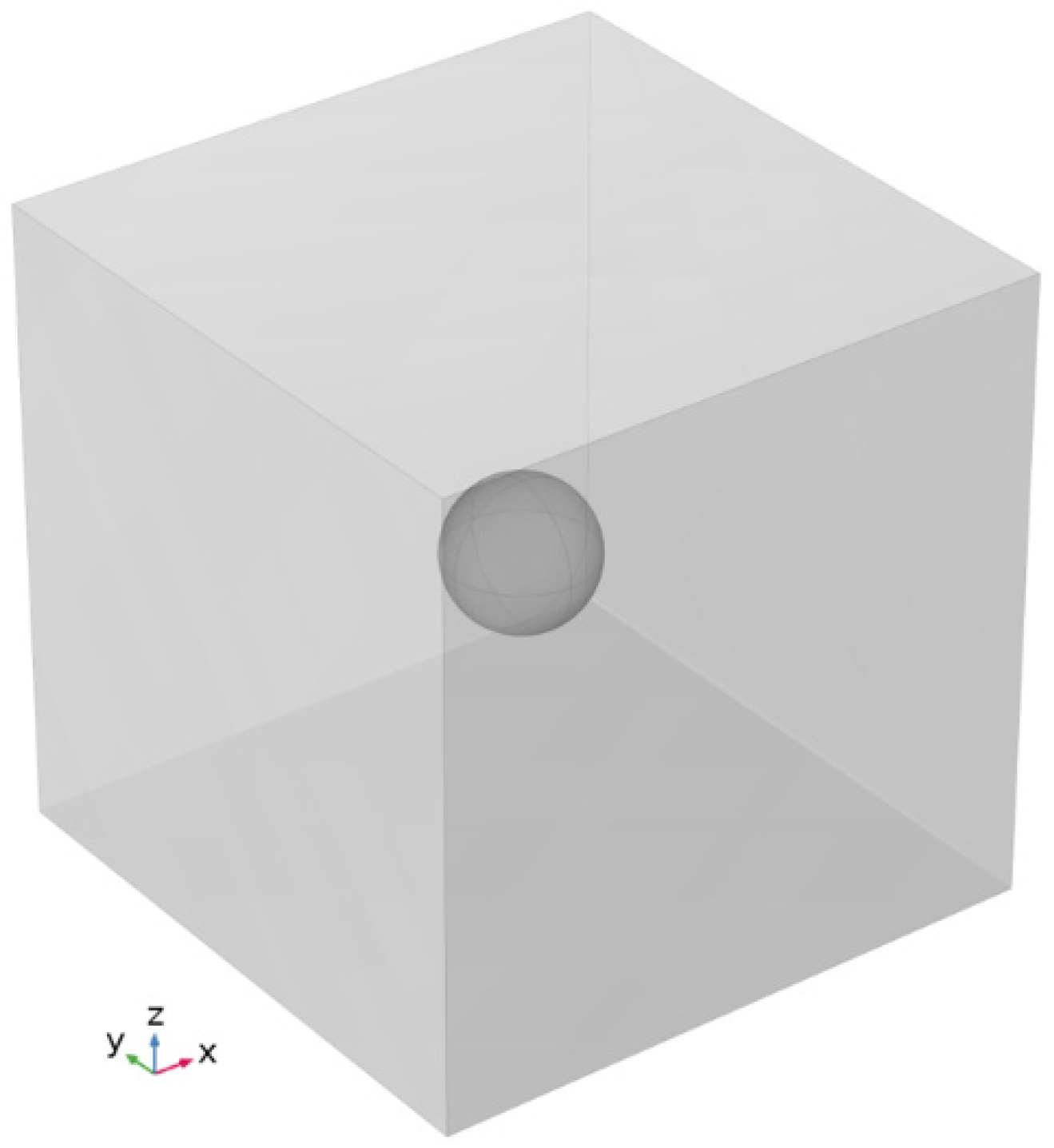
Figure 2. In this figure, Helio’s bubble is located at the centroid of the cubic cell, which is surrounded by molten salt. This representation is valid for highly dispersed bubble flow in a continuous medium because the effects of aggregation or interaction between bubbles are insignificant and can be disregarded. A further contribution would be to consider a group of bubbles in a cell, considering experiments with ordered and disordered bubbles.
The system can be represented by a unit cell, where the helium bubble is at the center, and the fuel salt surrounds it. Relative velocities are considered for the convective terms, since both phases are in motion, and constant properties are assumed as a first approximation. This allows us to obtain scaled coefficients applicable to the reactor scale, where the contributions of each phase’s properties and phenomena are preserved, while the mathematical model is simplified.
3.3. Periodicity Properties
If we treat the representative region shown in
Figure 3 as a unit cell in a spatially periodic two-phase flow, the boundary condition between unit cells can be approximated with a spatially periodic condition on
. This step is crucial for mathematically imposing periodic conditions that can be implemented in a computer program. Consider that the model is spatially periodic in the region representing the two-phase flow, as shown in
Figure 2. Then the unit normal vector must satisfy the following condition:
where
is the position vector, and
represents the three non-unique lattice vectors to describe a medium composed of a spatially periodic two-phase flow. According to [
15], the geometry of the representative region may be invariant to a transformation of the type
. However,
and
in Equations (6) and (7) are not invariant according to the principle of periodicity, unless these are constant, which does not apply because there is a non-uniform power distribution in the MSR reactor, and therefore the temperature fields of the molten salt and helium bubble phases are not uniform in space and change with time in response to a disturbance. However, the transformation is a principle of symmetry because it is invariant under the transformation.
3.4. Symmetry Properties
The transformation is a principle of symmetry because it is invariant under the transformation, as discussed previously. However, not only are the geometric characteristics of periodicity and symmetry fulfilled but the closure variables and the scaled heat transfer coefficients must also meet these characteristics, and this is revealed later in the results presented in
Section 5 and
Section 6, which makes it possible to analyze the heat transfer phenomena at the MSR scale in the presence of gas bubbles.
4. Implementation and Numerical Experiment
The two-fluid model for immiscible, dispersed bubbling flow in the continuous phase is used to estimate the phase velocity and void fractions. The model was validated against experimental data on the propagation velocity of the void fraction [
16].
Mass and momentum upscaled equations for liquid fuel
where
is the interfacial pressure difference between the interface and the liquid phase
. The term
represents a stress tensor due to the dyad of spatial deviations of the velocity in the liquid phase
. The values of
and
are 1/4 and 1/5, respectively, for the concentric cell. The relative velocity is given by
The interfacial density of drag force accounts for the interfacial shear stresses and is calculated in [
17] as:
where
Here
is the bubbe radius,
is the superficial tension. The virtual mass effects are given by
where
Mass and momentum equations for gas Helio
The stress due to the spatial deviation of gas velocity is neglected because and .
The physical properties of molten salt and helium used in this work are presented in
Table 1 and
Table 2.
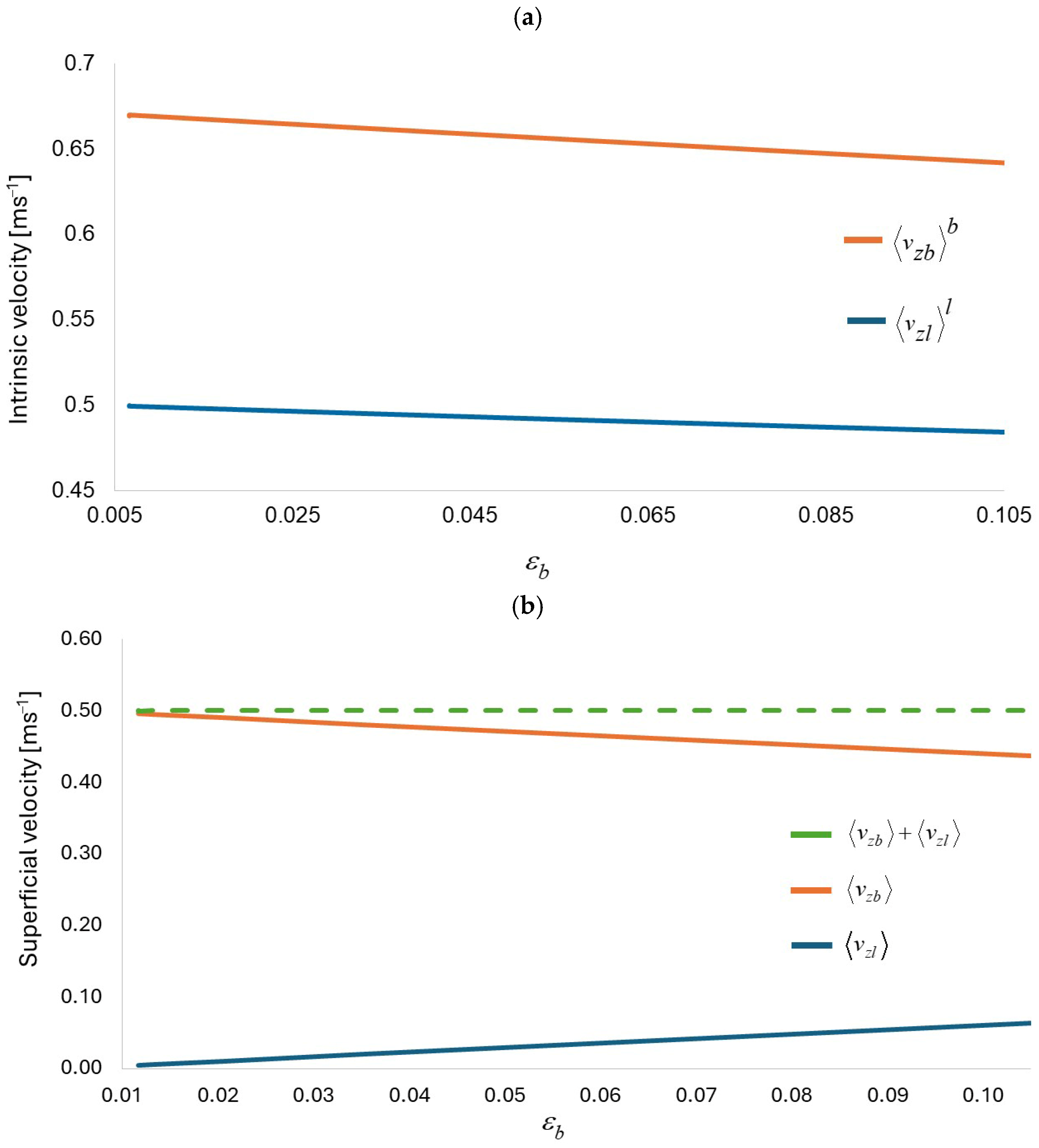
Figure 4a presents the behavior of the intrinsic velocity of the helium bubble and molten salt for different volume fractions of helium. The velocity decreases slightly with increasing bubble volume fraction due to interfacial forces, drag forces (which increase with bubble radius), and virtual forces. In
Figure 4b, the conservation of superficial velocity indicates that the numerical result is correct. In the dashed line, the total superficial velocity is shown.
The numerical experiment is performed under the nominal operating conditions of the MSR of and velocities of and , obtained from two-phase bubble flow given by Equations (23)–(29). The value of 0.0067 corresponds to the nominal operating condition of the MSR.
4.1. Implementation
The closure problems were implemented with COMSOL Multiphysics 6.8. This uses numerical routines based on the finite element method, in which the geometry is divided into subdomains. In these subdomains, the closure variables
,
,
,
,
and
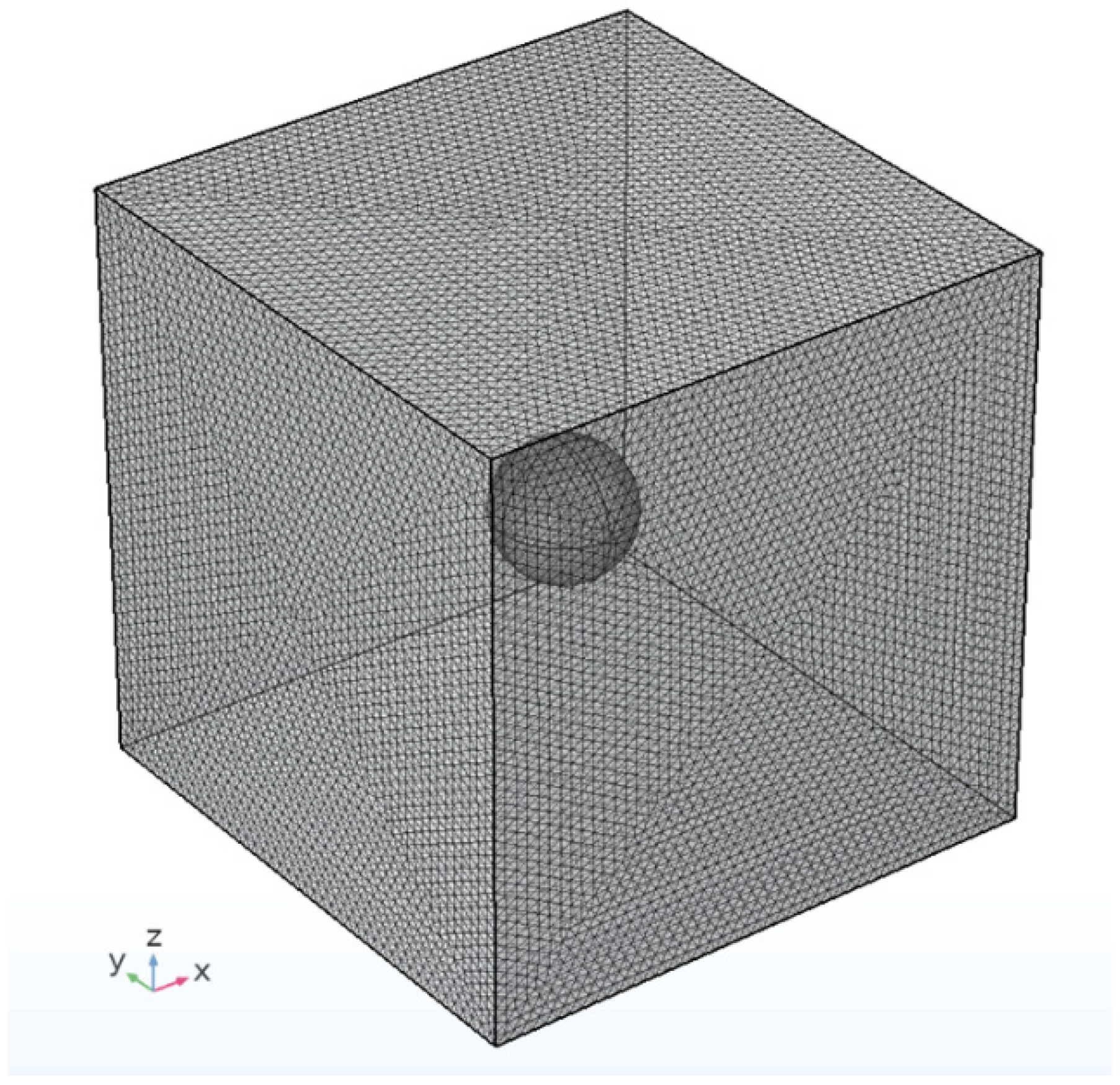
are calculated. As mentioned previously, a representative unit cell of the system was considered, with the whole domain consisting of 1,547,670 domain elements (
Figure 5), in which a bubble of radius 0.0011958 [m] is located at the center of a molten salt cube with each side length of 0.010225 [m].
Periodic conditions in COMSOL Multiphysics allow modeling of large, repetitive structures by analyzing only a single unit cell, significantly reducing computational cost. In this work, continuity periodicity was used, which enforces identical values on source and destination boundaries.
4.2. Numerical Results and Discussion
Once the unit cell is built, each closure problem is formulated as a set of PDEs, subject to boundary, symmetry, and periodicity conditions. The closure variables contribute to constructing effective coefficients by accounting for the influence of each phase on the phenomenon and the established geometry. In this section, the fields of closure variables are shown according to the closure problems.
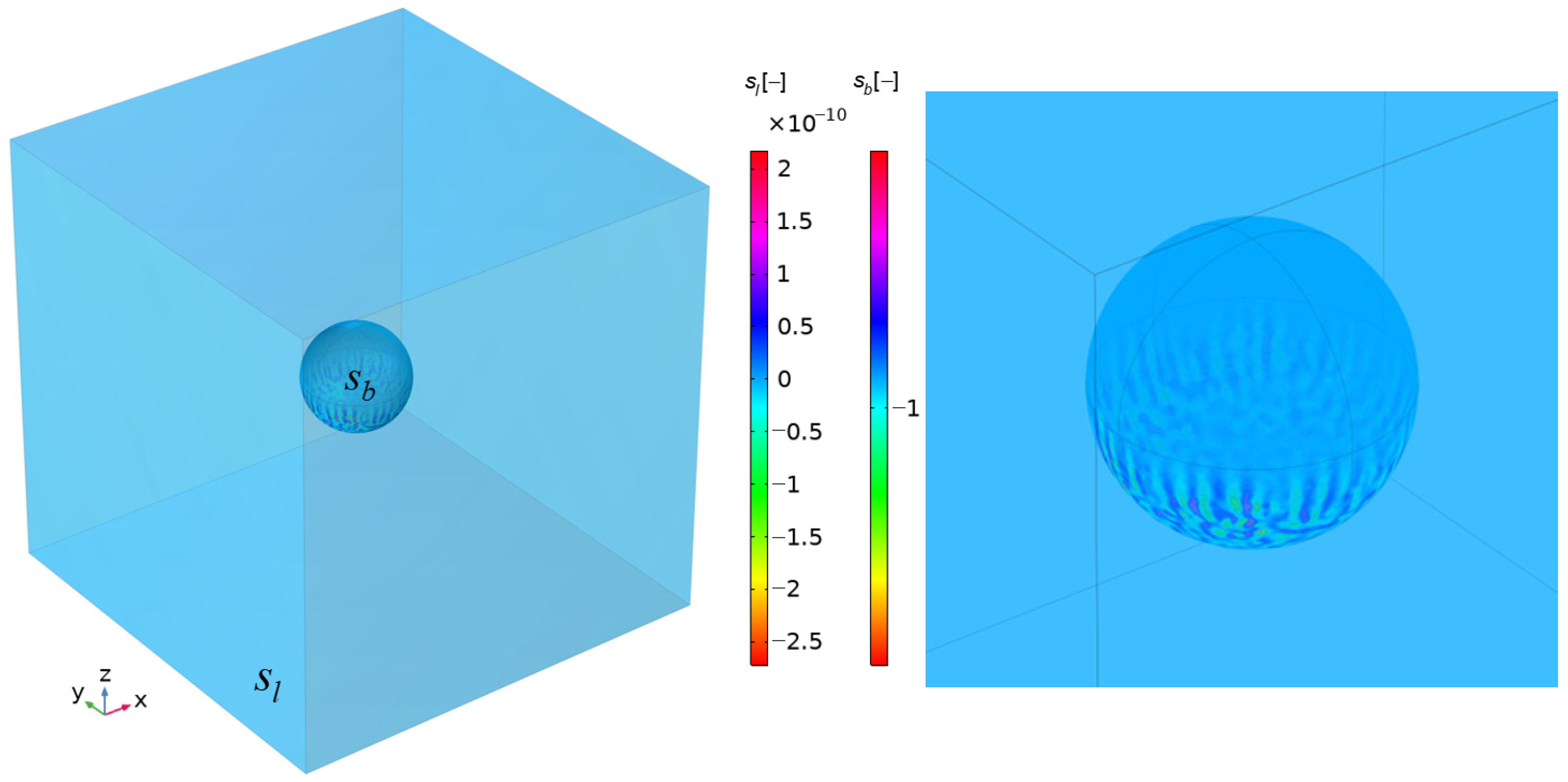
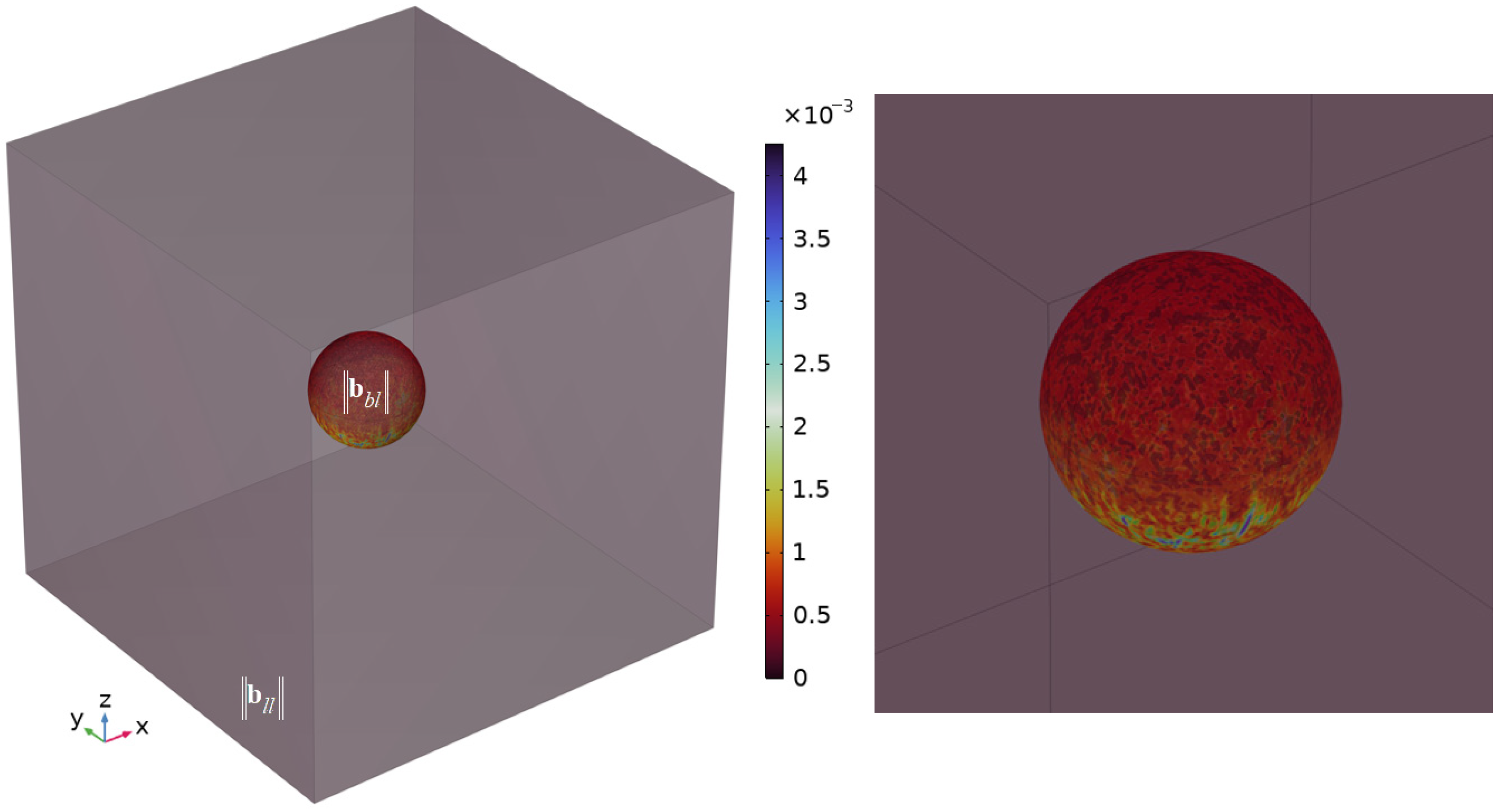
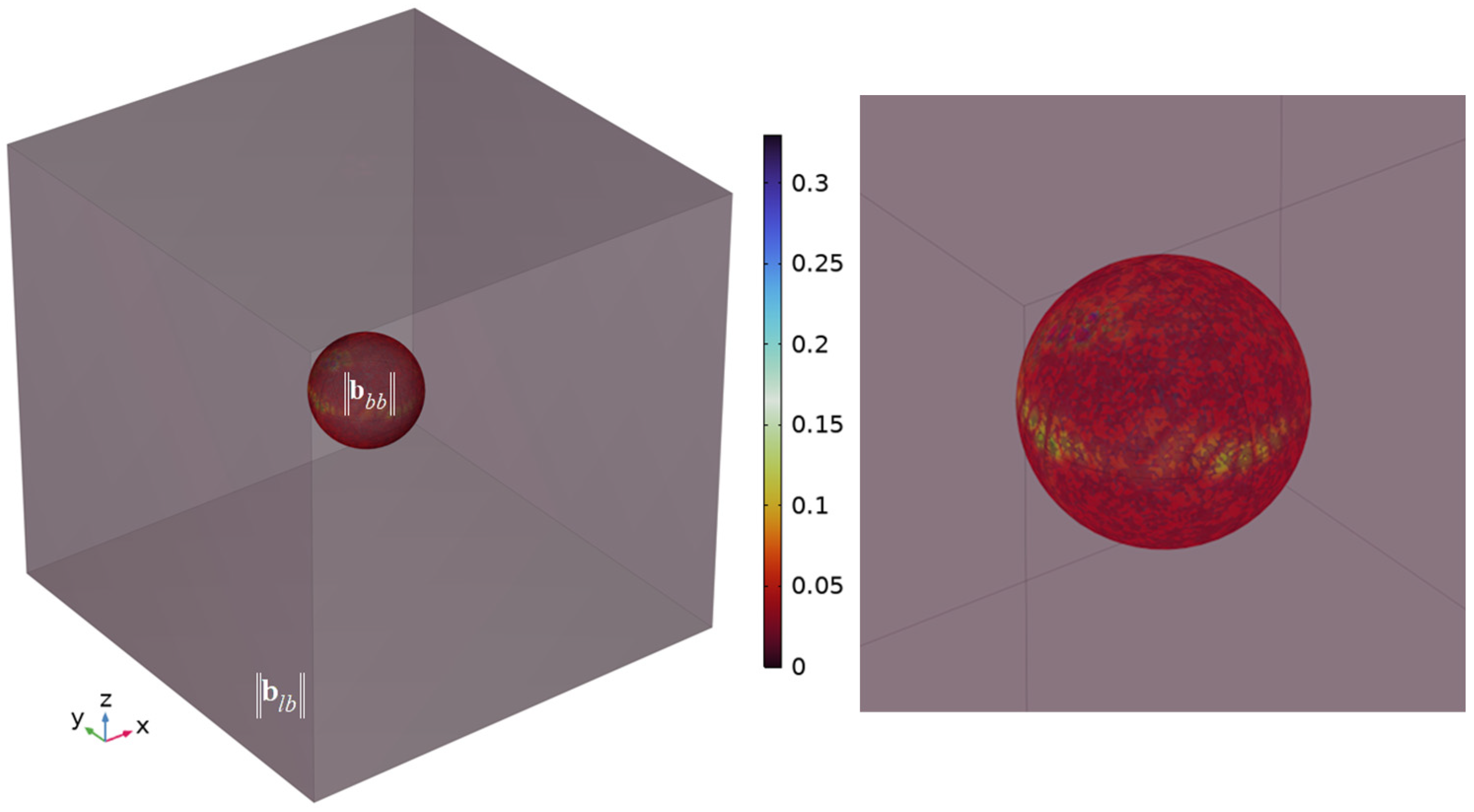
Figure 6 presents the fields of the Euclidean norms of closure variables
and
. It can be observed that the values of both variables are of the same order of magnitude; the main difference lies in the interfacial area
due to the influence of the surface integrals of Equation (18a,b). Also, it is possible to see the change in the field in the lower part of the bubble due to the movement of the molten salt. The associated closure variables solved are
for the gas phase and
for the liquid phase.
In
Figure 7, cut plans of the fields are presented; it is possible to observe the influence of liquid movement on the closure variables. Also, the symmetry in the behavior of the variables in planes ZY and ZX is observed. Cut plan YX shows the symmetry and the influence of velocity in the liquid phase. In this set of variables, velocity has a greater influence on behavior because the average and deviation velocities are included in the closure problem (Equation (18a)).
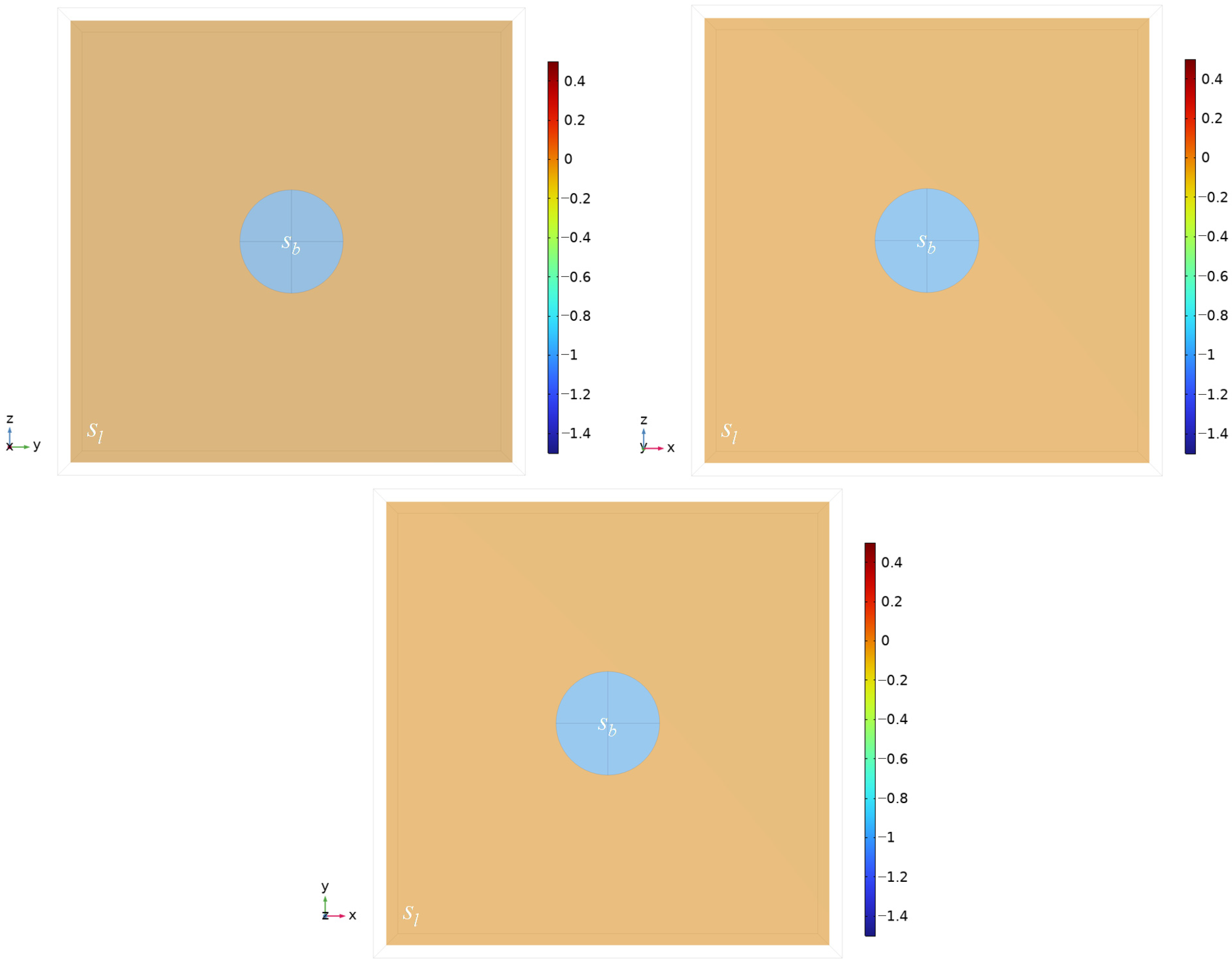
In the case of closure variables (gas phase) and (liquid phase), the fields are presented in
Figure 8. Unlike in
Figure 6, the influence of velocity is less than that of the previous closure variables because this includes bubble phenomena and bubble–salt interaction. In
Figure 9, the planes are presented, and it is possible to observe the influence of the movement in the ZY and ZX cut planes; also, the YX cut plane exhibits symmetry.
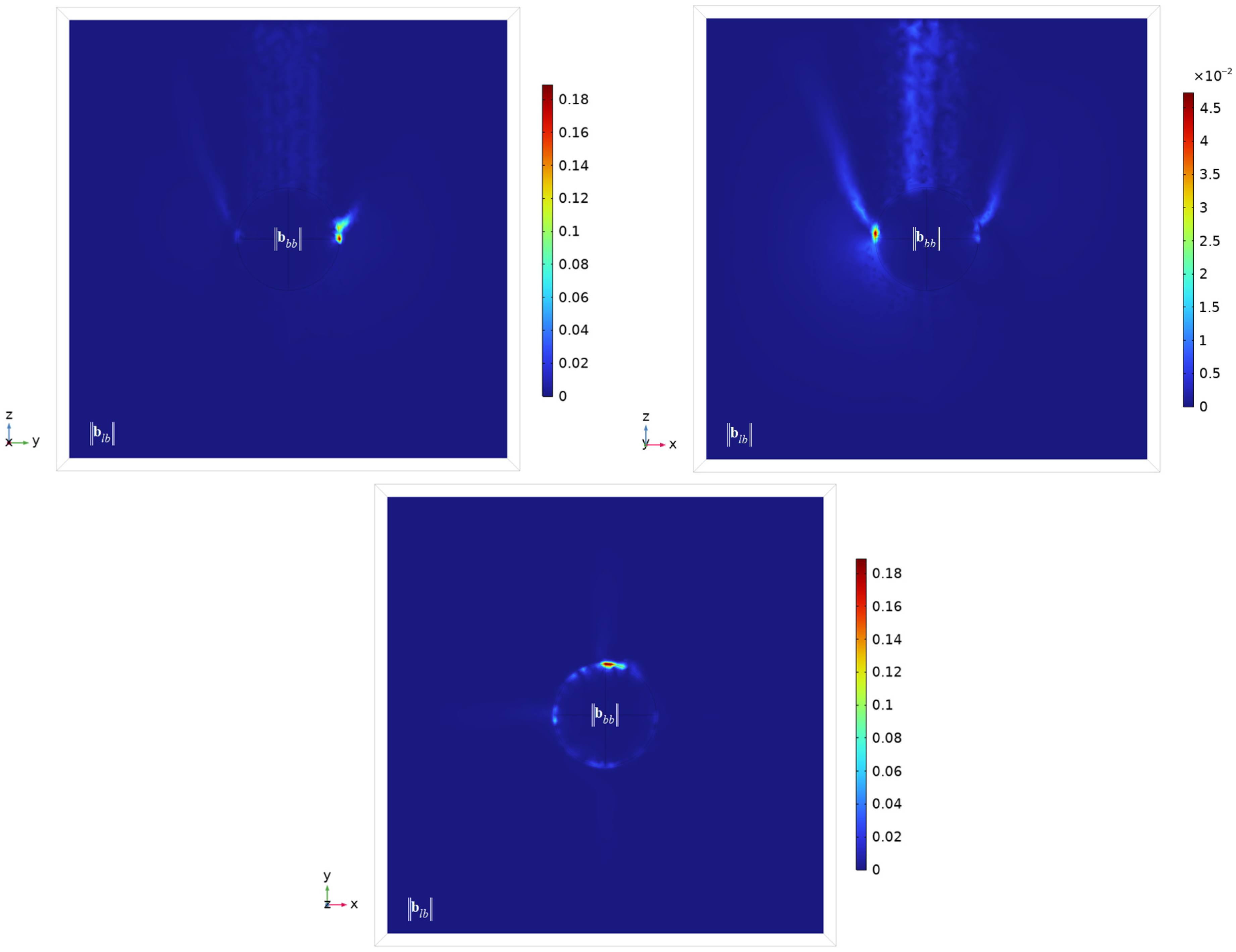
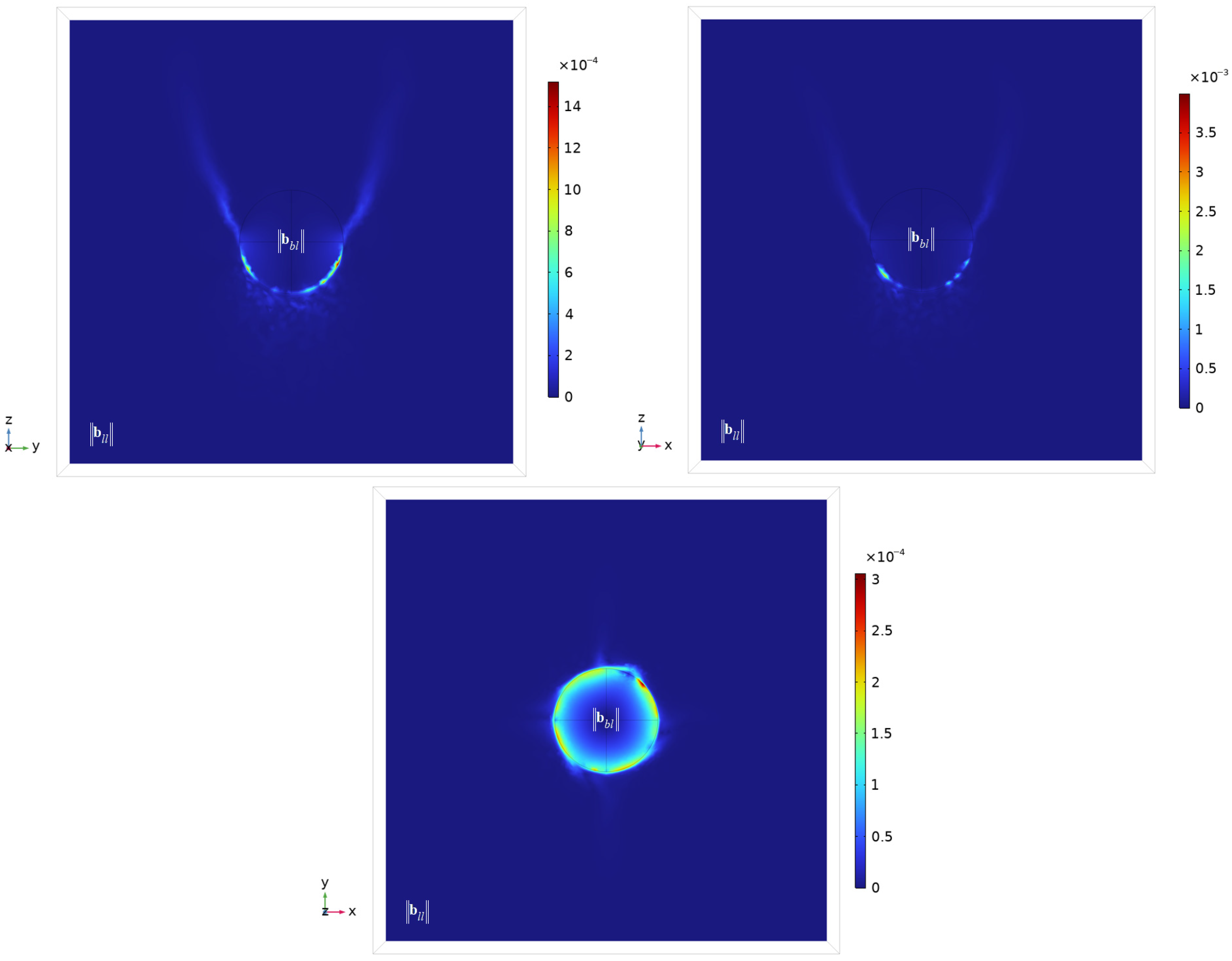
The third closure problem solves the variables (
Figure 10 and
Figure 11), which are important for calculating the upscaled coefficient related to surface heat transfer. The differences in the variables’ values are mainly due to the boundary condition given in Equation (20c).
These variables are, by an order of magnitude, larger than the variables in the previous closure problems. The largest value is found in the variable related to the bubble, and, at the interface, the contribution of each phase is observed.
5. Upscaled Model
According to the scaling methodology, it is possible to assume that a two-phase system can be scaled to obtain a two-equation model valid for the system, with coefficients that capture the contribution of one phase to the other for each phenomenon.
Now, substituting the formal solutions into the upscaled equations leads to
where
The upscaled coefficients ,,, represent the information and interactions between the two phases during heat transfer and are related to the thermal parameters of each phase and the heat transfer coefficients. The upscaled equation enables the determination of the intrinsic temperature distribution in the liquid phase of the fuel. However, these equations involve more terms than the local equation for the direct problem given in Equations (1) and (2).
The terms and are heat transfer by a pseudo-conductive mechanism, with interfacial interaction between phases, making both equations strongly coupled. Both phases contribute to the conductive heat transfer coefficient, which depends on the convective coefficient of phase one and the cross-coefficient. The latter contains information about phase two and its coefficient. In other words, the conductive mechanism depends not only on one phase but also on the contributions of the other phase and on their interaction at the interface. This is why it is considered a pseudo-conductive mechanism. The terms occur at the heat transfer interface, which gives information about the heat transferred from one phase to the other, where is the interfacial area density.
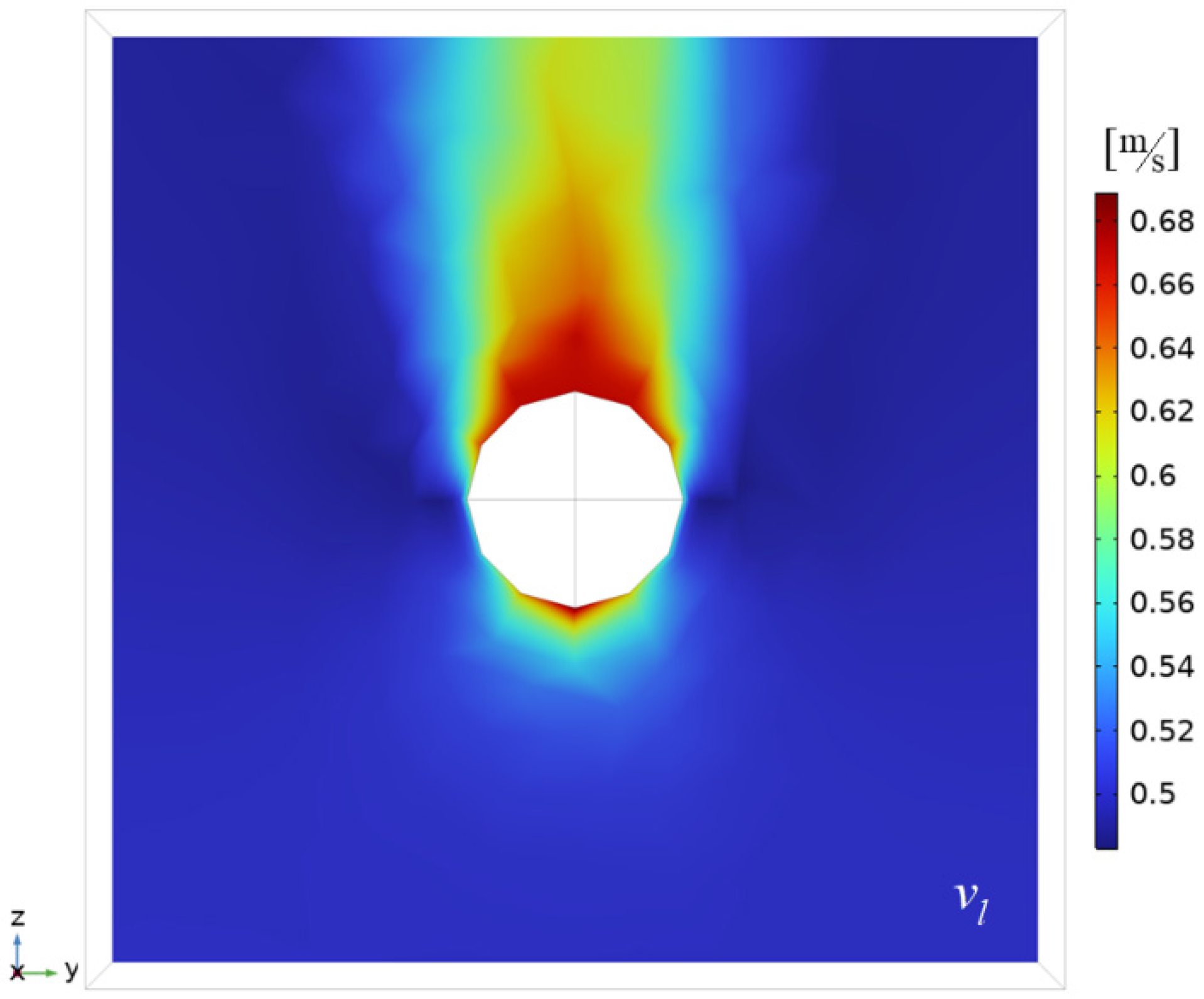
Figure 12 shows the velocity field of the molten salt, with a helium bubble at the cell centroid traveling at approximately 0.67 m/s and occupying a volume fraction of 0.0067.
This cell was used to calculate the heat transfer coefficients, scaled to 0.67 m/s, using Equations (32)–(36). In this figure, it can be observed that far from the bubble, the velocity of the molten salt is in the order of 0.5 m/s; however, around the bubble, the velocity field undergoes dramatic changes, similar to those experienced by an external flow obstructed by the bubble. This figure is representative because the interfacial phenomena at the molten salt–helium bubble interface govern the heat transfer mechanisms.
5.1. Upscaled Heat Transfer Coefficients
Once the closure variables are calculated, it is possible to obtain the value of the scaled coefficients to have the complete scaled model. In
Table 3, the values of the upscaled heat transfer component are presented.
The heat transfer interface coefficient , given in Equation (36), is 4117.70 , which means that the rate of heat transfer is high for a void fraction of 0.0067.
5.2. Validation
To validate the results of the upscaled heat transfer coefficients, we compare the results with the work in [
20,
21]. The effective thermal coefficient is calculated as follows:
Also, the coefficient is compared with a cell with a regular array of spheres (Equation (38)) and a regular array of cylinders (Equation (39))
where
.
The value of effective coefficient
is divided by
to obtain a normalized value. In
Table 4, the values of the normalized effective coefficient are presented, including the percentage error between the value calculated in this work and in [
15] and the phase field methodology in [
20].
It is evident that the error is minimal when the calculated value is compared with the results of Herrera et al. [
22], at around 0.21%.
To validate the value of
, we compare with the correlation established in [
15], given by
where
,
. Now, considering a cylinder array, the coefficient is
where
is the characteristic length of the continuous phase, represented in our case by the side of the cube of the periodic characteristic cell. In
Table 5, the interfacial heat transfer coefficient calculated in this work using the Whitaker analytical solution is presented. The data shown in the table are for a void fraction
; this error is smaller when using the cylinder model.
Equations (30) and (31) are (upscaled) two-equation models for non-equilibrium temperatures that allow calculation of the temperature field at the reactor scale, with the heat transfer coefficients given in
Table 3 and
Table 5.
6. Conclusions
This work presents the scale-up of a molten-salt nuclear reactor with helium bubbles for heat transfer analysis. The reactor scale-up was performed using the volumetric averaging method with periodicity and symmetry properties, characterized by a unit cell composed of a helium bubble surrounded by molten salt. One of the crucial steps in the scale-up procedure is to propose a formal solution for spatial temperature deviations, starting from the boundary conditions at the interface between the two phases. To solve for the closure variables of the formal solution, boundary value problems are developed (Equations (18a)–(20e), and the fields are analyzed to establish the significance of their effect. In this work, we find that the closure variable given by the boundary value problem (Equation (20a–e)) exhibits greater interfacial interaction and therefore governs the heat transfer mechanisms at the reactor scale.
In this work, it is shown that the periodicity and symmetrical properties of a unit cell can be a good approximation for scaling up a heterogeneous energy system such as a molten salt reactor with bubble Helio (Equations (30) and (31)), and transport properties can be obtained at the reactor scale (
Table 3 and
Table 5) that are comparable with previous works (
Table 4).
Author Contributions
Conceptualization, G.E.-P. and G.A.; methodology, A.D.P.-V., G.E.-P. and J.J.D.-A.; software, J.J.D.-A.; validation, J.J.D.-A.; formal analysis, A.D.P.-V.; investigation, J.J.D.-A.; writing—original draft preparation, G.E.-P., A.D.P.-V., J.J.D.-A. and G.A.; writing—review and editing, G.E.-P., G.A., A.D.P.-V. and J.J.D.-A. All authors have read and agreed to the published version of the manuscript.
Funding
The authors gratefully acknowledge the financial support of the Basic and Frontier Sciences Project 2023–2024 Reference CBF-2023-2024-2023 funded by the Secretariat of Science, Humanities, Technology and Innovation, SECIHTI. J. J. Domínguez-Alfaro acknowledges financial support from SECHITI during her Ph.D. studies through agreement CVU 1097589.
Data Availability Statement
No new data were created or analyzed in this study. Data sharing is not applicable to this article.
Acknowledgments
We appreciate the journal’s detailed editorial reviews.
Conflicts of Interest
The authors declare no conflict of interest.
Nomenclature
| Latin | | | | Intrinsic temperature of | [K] |
| Interfacial area | [m2] | | Spatial deviations in temperature | [K] |
| Volumetric heat transfer coefficient | [W/(m3 K)] | | Time | [s] |
| Aggregated mass acceleration vector | [m/s2] | | Upscaled conductive-convective heat transfer coefficient | [W/(m2 K)] |
| Specific heat | [J/(kg K)] | | Local velocity vector of | [m/s] |
| Interfacial drag force | [N m−3] | | Surface velocity of | [m/s] |
| Virtual mass force | [N m−3] | | Intrinsic velocity of | [m/s] |
| Identity tensor | [-] | | Velocity deviations of | [m/s] |
| Thermal conductivity | [W/(m K)] | | Total volume | [m3] |
| Upscaled thermal coefficient associated with | [W/(m K)] | Greek | | |
| Characteristic length at local scale | [m] | | Volume fraction | [-] |
| Characteristic length of reference system | [m] | | Mass density | [kg/m3] |
| Unit normal vector directed from liquid phase to gas phase | [-] | | Surface tension | [J/m2] |
| Power density | [W/m3] | Subscripts | | |
| Position vector | [m] | | Gas phase (helium bubble) | |
| Bubble radius | [m] | | Liquid phase (fuel salt) | |
| Local temperature of | [K] | | | |
References
- LeBlanc, D. Molten salt reactors: A new beginning for an old idea. Nucl. Eng. Des. 2010, 240, 1644–1656. [Google Scholar] [CrossRef]
- Roper, R.; Harkema, M.; Sabharwall, P.; Riddle, C.; Chisholm, B.; Day, B.; Marotta, P. Molten salt for advanced energy applications: A review. Ann. Nucl. Energy 2022, 169, 108924. [Google Scholar] [CrossRef]
- LeBlanc, D.; Rodenburg, C. Integral molten salt reactor. In Molten Salt Reactors and Thorium Energy; Woodhead Publishing: Cambridge, UK, 2017; pp. 815–833. [Google Scholar]
- Wooten, D.; Powers, J.J. A review of molten salt reactor kinetics models. Nucl. Sci. Eng. 2018, 191, 203–230. [Google Scholar] [CrossRef]
- Bajpai, P.; Lorenzi, S.; Cammi, A. A multiphysics model for analysis of inert gas bubbles in Molten Salt Fast Reactor. Eur. Phys. J. Plus 2020, 135, 409. [Google Scholar] [CrossRef]
- Pérez-Valseca, A.D.; Lopez-Solis, R.; Juárez-Martínez, L.C. Neutronics and Thermal Hydraulics Multiscale Simulation of a Lead-Cooled Fast Reactor. Nucl. Eng. Des. 2025, 441, 114189. [Google Scholar] [CrossRef]
- Lopez-Solis, R.; Espinosa-Paredes, G.; Pérez-Valseca, A.D.; Cruz-López, C.A. Multiphysics and multiscale simulation for an experimental sodium-cooled fast reactor. Nucl. Eng. Des. 2024, 422, 113167. [Google Scholar] [CrossRef]
- Pérez-Valseca, A.D.; Aguilar-Madera, C.G.; Herrera-Hernández, E.C.; Espinosa-Paredes, G. Upscaled heat transfer coefficients for a liquid metal-cooled fast nuclear reactor. Int. J. Heat Mass Transf. 2021, 165, 120622. [Google Scholar] [CrossRef]
- Pérez-Valseca, A.D.; Espinosa-Paredes, G.; Aguilar-Madera, C.G.; Herrera-Hernández, E.C.; Gómez-Torres, A.M. Upscaling and downscaling the heat transfer process coupled with neutronic reflected core for sodium-cooled fast nuclear reactor. Int. J. Heat Mass Transf. 2022, 189, 122713. [Google Scholar] [CrossRef]
- Whitaker, S. The Method of Volume Averaging; Springer Science and Business Media: New York, NY, USA, 2013; Volume 13. [Google Scholar]
- Allibert, M.; Aufiero, M.; Brovchenko, M.; Delpech, S.; Ghetta, V.; Heuer, D.; Laureau, A.; Merle-Lucotte, E. Molten salt fast reactor. In Handbook of Generation IV Nuclear Reactors; En Pioro, I., Ed.; Woodhead Publishing: Cambridge, UK, 2016. [Google Scholar]
- Chen, J.; Brooks, C.S. Modeling of transient and steady state xenon behavior in the Molten Salt Reactor Experiment. Ann. Nucl. Energy 2024, 204, 110525. [Google Scholar] [CrossRef]
- Cottrell, W.B. The Aircraft Nuclear Propulsion Project, Quarterly Progress Report for Period Ending June 10, 1953; Rep. ORNL-1536; Oak Ridge National Laboratory: Oak Ridge, TN, USA, 1953. [Google Scholar]
- Chen, J.; Brooks, C.S. Design and cost-benefit analysis of the xenon removal system for the molten salt demonstration reactor. Ann. Nucl. Energy 2024, 207, 110705. [Google Scholar] [CrossRef]
- Espinosa-Paredes, G. Research in Mexico on liquid metal-cooled nuclear reactors: Advances in the upscaling mathematical method. Nucl. Eng. Des. 2025, 443, 114324. [Google Scholar] [CrossRef]
- Espinosa-Paredes, G.; Soria, A. Method of finite difference solutions to the transient bubbly air–water flows. Int. J. Numer. Methods Fluids 1998, 26, 1155–1180. [Google Scholar] [CrossRef]
- Ishii, M.; Mishima, K. Two-fluid model and hydrodynamic constitutive relations. Nucl. Eng. Des. 1984, 82, 107–126. [Google Scholar] [CrossRef]
- Pioro, I. Introduction: Generation IV International Forum. In Handbook of Generation IV Nuclear Reactors; En Pioro, I., Ed.; Woodhead Publisher: Cambridge, UK, 2016. [Google Scholar]
- Arp, V.; Mccarty, R. Thermophysical Properties of Helium-4 from 0.8 to 1500 K with Pressures to 2000 MPa. 1989. Available online: https://ntrs.nasa.gov/citations/19900019365 (accessed on 5 January 2026).
- Hu, S.; Henager, C.H., Jr.; Heinisch, H.L.; Stan, M.; Baskes, M.I.; Valone, S.M. Phase-field modeling of gas bubbles and thermal conductivity evolution in nuclear fuels. J. Nucl. Mater. 2009, 392, 292–300. [Google Scholar] [CrossRef]
- Quintard, M.; Whitaker, S. Local thermal equilibrium for transient heat conduction: Theory and comparison with numerical experiments. Int. J. Heat Mass Transf. 1995, 38, 2779–2796. [Google Scholar] [CrossRef]
- Herrera-Hernández, E.C.; Pérez-Valseca, A.D.; Aguilar-Madera, C.G.; Vázquez-Rodríguez, A. Heat transfer coefficients for bubbly molten salt nuclear reactors. Nucl. Eng. Des. 2023, 414, 112549. [Google Scholar] [CrossRef]
| Disclaimer/Publisher’s Note: The statements, opinions and data contained in all publications are solely those of the individual author(s) and contributor(s) and not of MDPI and/or the editor(s). MDPI and/or the editor(s) disclaim responsibility for any injury to people or property resulting from any ideas, methods, instructions or products referred to in the content. |




 ,
,