Article

ADHD and Binge Eating Symptoms in Adult Women: A Cross-Sectional Study with a Gender-Focused Theoretical Overview


by
Edoardo Mocini
1,†,
Alessia Maiolo
2,†,
Valerio Riccardo Aquila
2,3,
Maria Eugenia Caligiuri
2,3,
Francesca Greco
4,
Gian Pietro Emerenziani
4,
Emanuele Tinelli
2,
Umberto Sabatini
2,
Elisa Giannetta
5,* and
Maria Grazia Tarsitano
6,*
1
Department of Theoretical and Applied Sciences, eCampus University, 22060 Novedrate, Italy
2
Department of Medical and Surgical Sciences, University Magna Graecia of Catanzaro, 88100 Catanzaro, Italy
3
Neuroscience Research Center, Department of Medical and Surgical Sciences, University Magna Graecia of Catanzaro, 88100 Catanzaro, Italy
4
Department of Clinical and Experimental Medicine, University Magna Graecia of Catanzaro, 88100 Catanzaro, Italy
5
Department of Experimental Medicine, Sapienza University of Rome, 00161 Rome, Italy
6
Department of Human Sciences and Promotion of the Quality of Life, San Raffaele Roma Open University, 00166 Rome, Italy
*
Authors to whom correspondence should be addressed.
These authors contributed equally to this work.
Women 2026, 6(2), 34; https://doi.org/10.3390/women6020034
Submission received: 3 April 2026 / Revised: 11 May 2026 / Accepted: 13 May 2026 / Published: 19 May 2026

Abstract

Attention deficit/hyperactivity disorder (ADHD) is a neurodevelopmental condition frequently associated with psychiatric comorbidity, including disordered eating. Adult women remain under-recognized and underrepresented in ADHD research, and emerging evidence suggests that symptom expression may be shaped by gendered social factors, ovarian hormone fluctuations, and metabolic health. In this manuscript, we provide a gender-focused theoretical overview of the literature linking ADHD to binge eating symptoms in adult women, with attention to underdiagnosis, menstrual cycle-related symptom variability, and obesity-related metabolic risk, and empirically test the association between a self-reported ADHD diagnosis and binge eating symptoms in an online cross-sectional sample of adult women. Women reporting an ADHD diagnosis (n = 140) were compared with a random subsample of n = 140 women without ADHD drawn from the same survey; comparability between groups on age, education, and employment was formally verified; and binge eating symptoms were assessed with the Binge Eating Scale (BES) as a continuous outcome and as an ordered three-category variable. Women reporting an ADHD diagnosis showed significantly higher BES scores than controls (rank-biserial r = 0.28, 95% CI 0.15–0.41), and a higher proportion of severe binge eating symptomatology (BES ≥ 27; 22.1% vs. 11.4%; OR = 2.20, 95% CI 1.14–4.25) than controls. The association remained significant in a sensitivity analysis adjusting for age and BMI. Taken together, our findings support the need for routine, gender-sensitive screening for binge eating symptoms in women with ADHD, as well as ADHD screening in women presenting with binge eating and obesity.

1. Introduction

Attention Deficit/Hyperactivity Disorder (ADHD) is a neurodevelopmental condition characterized by persistent patterns of inattention and hyperactivity/impulsivity [1]. ADHD is frequently associated with psychiatric comorbidity, including disordered eating. Binge eating behaviors, particularly Binge Eating Disorder (BED), have been reported more often among individuals with ADHD and have been linked to overweight/obesity [2,3].
Adult women represent a critical yet historically underserved population in ADHD research and clinical practice. ADHD in women is often under-recognized and diagnosed later in life, in part due to gendered expectations, reference bias in clinical assessment, and symptom presentations that can be more internalizing and masked by compensatory strategies [4,5,6].
Beyond psychosocial factors, emerging female-specific literature suggests that ADHD symptoms and treatment responses may fluctuate across hormonal milestones, including the menstrual cycle [7,8,9]. In parallel, obesity and metabolic dysregulation—conditions that can be linked to both ADHD and binge eating—are associated with menstrual irregularities and insulin resistance, potentially adding a physiological layer to symptom variability and contributing to a self-reinforcing cycle of dysregulation [10,11,12,13].
The aims of the present manuscript are twofold: (i) to provide a gender-focused theoretical overview of the literature on ADHD and binge eating symptoms in adult women, with particular attention to underdiagnosis, menstrual cycle-related symptom variability, and metabolic risk; and (ii) to empirically test, in a cross-sectional design, whether adult women with a self-reported ADHD diagnosis report higher binge eating symptom severity on the Binge Eating Scale (BES) than matched controls. We hypothesized that women with ADHD would report higher BES scores and a higher frequency of severe binge eating symptomatology.

2. Gender-Focused Theoretical Overview

2.1. Scope and Narrative Search Strategy

To contextualize the cross-sectional findings within a gender-focused framework, we conducted a structured narrative literature search (last search: 15 February 2026) in PubMed/MEDLINE, supplemented by targeted searches of recent reviews and key empirical studies. Search strings combined terms related to ADHD (e.g., “ADHD”, “attention-deficit/hyperactivity disorder”) with terms related to binge eating and eating disorders (e.g., “binge eating”, “Binge Eating Disorder”, “disordered eating”), and with female-specific and biological moderators (e.g., “women”, “female”, “masking”, “menstrual cycle”, “hormones”, “estrogen”, “progesterone”, “obesity”, “insulin resistance”, “metabolic syndrome”). We prioritized peer-reviewed reviews, meta-analyses, consensus statements, and empirical studies focusing on adult women, as well as high-quality studies addressing hormonal milestones and metabolic risk factors relevant to women.
Because the purpose of this section was to develop a gender-focused conceptual framework rather than to conduct a formal systematic review, we did not apply PRISMA procedures or perform a risk-of-bias appraisal. However, we used a structured narrative approach: we screened titles/abstracts for relevance to adult women, sex-hormone milestones, and metabolic comorbidity; prioritized systematic reviews/meta-analyses and consensus statements when available; and used backward/forward citation chasing to identify seminal empirical studies. Evidence not stratified by sex was considered only when mechanisms were plausibly applicable to women and when limitations for female-specific inference were acknowledged. The overview was used to pre-specify constructs highlighted in this manuscript (ADHD symptom domains, binge-eating severity as assessed by the Binge Eating Scale (BES), and hypothesized moderators including menstrual cycle variability and cardiometabolic risk).

2.2. Underdiagnosis and Masking of ADHD in Adult Women

Across studies, ADHD in adult women is frequently under-recognized and diagnosed later in life. Several factors are implicated, including less overt hyperactivity, higher internalizing symptoms, and the adoption of compensatory strategies that can mask impairment in academic, occupational, and caregiving contexts [4,5,6]. This diagnostic gap has downstream consequences: unrecognized ADHD may be framed primarily as anxiety, depression, or “stress-related” difficulties, while core problems in self-regulation and emotion regulation remain insufficiently targeted [4,5]. Within this context, binge eating symptoms may be overlooked—especially when clinical attention is directed primarily toward weight, dieting, or mood—even though ADHD-related impulsivity and emotional dysregulation can meaningfully contribute to loss-of-control eating and obesity trajectories [14,15,16].
Female ADHD phenotypes often differ from the historically male-referenced prototype. In community and clinical samples, women more commonly present with predominant inattention, internalizing distress, and emotion dysregulation, while overt hyperactivity may attenuate or be expressed as subjective restlessness [4,5,6]. Socialization processes and gender-role expectations may foster compensatory strategies (e.g., overpreparation, perfectionism) that reduce external disruption but increase chronic strain, contributing to “masking” and delayed recognition—often until life demands exceed coping capacity (e.g., higher education, early parenting, or caregiving) [17,18].
Recent syntheses emphasize that girls and women remain underrepresented in ADHD research and that female presentations are more likely to involve compensatory strategies (“masking”) and internalizing symptoms, which can delay recognition and contribute to underdiagnosis in adulthood [17,18]. Such diagnostic delays may leave eating-related dysregulation unaddressed for years, especially when weight concerns or mood symptoms become the primary focus of clinical encounters.
In this context, clinicians may prioritize comorbidities that are most salient at presentation (e.g., anxiety, depression, weight gain), while core ADHD-related difficulties in planning, inhibitory control, and emotion regulation remain untreated. This matters for disordered eating: loss-of-control eating can function as a short-term strategy to regulate affect, boredom, or stress, and may therefore represent one of the more “hidden” downstream expressions of chronic self-regulatory load in women with undiagnosed ADHD [14,15,16]. The frequent separation between psychiatric symptoms and metabolic/gynecologic complaints may further contribute to missed opportunities for integrated assessment and care.

2.3. Menstrual Cycle-Related Symptom Variability and Hormonal Milestones

A growing body of female-specific literature suggests that ADHD symptoms may vary across hormonal milestones, including puberty, the menstrual cycle, pregnancy, and menopause. Mechanistically, fluctuations in ovarian hormones may influence dopaminergic and executive functioning, potentially modulating attention, impulsivity, and emotional regulation [7,9]. Recent evidence indicates that women treated with stimulants may report cyclical changes in ADHD symptoms and mood, with clinically relevant symptom exacerbations during specific menstrual phases [8]. Narrative syntheses further highlight that menstrual cycle-related hormonal fluctuations can affect cognitive functioning and may have implications for individualized pharmacotherapy and treatment planning in women with ADHD [9]. Despite increasing interest, the evidence base remains limited and heterogeneous, underscoring the need for prospective studies that jointly assess cycle phase, hormonal status, medication response, and clinically meaningful outcomes [7,9].
Across the menstrual cycle, estrogen and progesterone fluctuations are associated with changes in dopaminergic neurotransmission and frontostriatal functioning, which are central to attention regulation, reward processing, and executive control [7,8,9]. Symptom exacerbations have been reported particularly in the late luteal and perimenstrual window, when estrogen levels fall and progesterone is high or rapidly changing, potentially increasing irritability, negative affect, and impulsive coping behaviors [8,9]. Although existing studies are heterogeneous and often based on small samples, they raise practical considerations for clinical monitoring, including prospective symptom tracking and evaluation of whether medication efficacy or tolerability varies across cycle phases [8,9].
Importantly, cycle-related variability is not uniform across women. Obesity is linked to hypothalamic–pituitary–ovarian axis disruption, higher rates of anovulation, and menstrual irregularities, with potential downstream effects on ovarian hormone profiles and cycle predictability [10,11,12,13]. Obesity-related insulin resistance and cardiometabolic risk may therefore interact with hormonal variability and contribute to within-person fluctuations in attention, mood, and appetite [10,11,12,13]. In women with ADHD, this may translate into variable symptom burden, inconsistent perceived medication response, and cyclical changes in cravings or loss-of-control eating, domains that are not always evaluated in routine ADHD care [7,8,9,10,11,12,13].

2.4. Binge Eating Symptoms, Reward Dysregulation, and Female-Specific Considerations

Binge eating symptoms may intersect with ADHD through multiple pathways. Executive dysfunction, distractibility, and time-management difficulties can promote irregular eating patterns (e.g., skipped meals followed by overeating), while impulsivity and reward-related processes may increase vulnerability to loss-of-control eating [14,19,20,21]. Neurobiologically, dysregulated dopamine signaling has been proposed as a shared mechanism for altered reward sensitivity and reinforcement learning in ADHD and binge eating [20,21]. In women, eating-related dysregulation may also be shaped by reproductive and metabolic contexts; cycle-related mood changes, sleep disruption, and fluctuating cravings may increase the salience of food as an immediately available reward, particularly when self-regulatory resources are taxed [7,8,9].
From a developmental perspective, comorbidity between ADHD and obesity has been described in pediatric samples, suggesting that risk trajectories can begin early and may extend into adulthood through repeated cycles of dysregulated eating, weight gain, and psychosocial burden [22]. Importantly, because women’s ADHD presentations can be less externally disruptive and more easily masked, eating-related coping strategies may become particularly salient yet remain under-discussed in routine ADHD evaluations and follow-up care [4,5,6,17,18]. Conversely, in weight-management, endocrinology, and gynecology settings, attention and self-regulation difficulties may be interpreted as low adherence or motivational deficits rather than a neurodevelopmental condition, further contributing to under-recognition of ADHD in women with binge eating and obesity [4,5,6].

2.5. Metabolic Risk, Menstrual Irregularity, and a Proposed Vicious Cycle

Obesity and cardiometabolic risk may represent both consequences and perpetuating factors in the ADHD–binge eating link. Meta-analytic evidence indicates a significant association between ADHD and overweight/obesity, particularly in adults [2,23]. Emerging evidence also suggests an increased risk of type 2 diabetes in individuals with ADHD, although this association may be partly explained by psychiatric comorbidities and related lifestyle factors [24]. In parallel, binge eating symptoms have been associated with decreased insulin sensitivity and adverse cardiometabolic profiles, especially when accompanied by obesity [19,20,21,25,26].
Mechanistically, ADHD-related patterns such as sleep–wake dysregulation, stress reactivity, and difficulties in maintaining regular physical activity or meal planning may contribute to weight gain and metabolic risk over time. At the same time, metabolic dysfunction may plausibly worsen cognitive and affective symptoms relevant to ADHD through pathways including inflammation, impaired glucose regulation, and fatigue—effects that could be particularly consequential in women already managing fluctuating hormonal states [23,24]. While such bidirectional mechanisms are not fully delineated, they underscore the need to conceptualize ADHD and binge eating within broader health trajectories rather than as isolated psychiatric symptoms.
In women, obesity is associated with reproductive and menstrual dysfunction, including menstrual irregularity and polycystic ovary syndrome (PCOS), conditions closely linked to insulin resistance and metabolic risk [27,28]. Menstrual cycle-related ovarian hormone fluctuations can modulate dopaminergic systems and cognitive control networks relevant to ADHD, with potential effects on attention, executive function, and reward sensitivity across the cycle [7,8,9,29,30]. Menstrual irregularity has also been described as a marker of underlying insulin resistance and increased risk of type 2 diabetes [31], and population studies report associations between metabolic syndrome and menstrual irregularity in midlife women [11]. We therefore propose a gender-focused vicious-cycle model in which ADHD-related dysregulation increases the risk of binge eating and weight gain; obesity-related insulin resistance and metabolic syndrome contribute to menstrual irregularities and potentially to altered hormonal milieus; and cyclical or hormonally mediated symptom fluctuations may further impair self-regulation, increasing susceptibility to binge eating and reinforcing metabolic risk [7,8,9,10,11,12,13]. This framework is theoretical and requires direct empirical testing, but it may help integrate psychiatric, reproductive, and metabolic dimensions that are often addressed in parallel rather than in concert.
The vicious cycle is therefore not only behavioral but also potentially neuroendocrine. Insulin resistance and metabolic syndrome are associated with hormonal and inflammatory changes that may influence central reward circuitry and stress systems, potentially increasing hedonic drive for food and impairing satiety signaling [25,26]. When combined with ADHD-related impulsivity and executive dysfunction, these biological pressures could increase the likelihood of recurrent binge episodes and further weight gain [19,20,21,25,26]. In parallel, menstrual irregularity and PCOS may reduce the predictability of hormonal transitions across the cycle, complicating patients’ ability to anticipate high-risk windows for affective lability and loss-of-control eating [27,28].

2.6. Clinical and Research Implications

Clinically, these converging lines of evidence support gender-sensitive, bidirectional screening: systematic assessment of binge eating symptoms, weight status and cardiometabolic risk in women with ADHD; and consideration of ADHD (including inattentive and masked presentations) in women presenting with binge eating, obesity, menstrual irregularity, or insulin resistance [17,18,24,28]. In ADHD-focused settings, brief, routine queries about loss-of-control eating and irregular eating patterns may help identify clinically relevant symptoms that are otherwise normalized or attributed solely to “diet failures” [14,15,16]. In weight-management, endocrinology, and gynecology settings, incorporating ADHD screening may help explain persistent difficulties with adherence, planning, and self-regulation, and may reduce the tendency to frame these difficulties as purely motivational [4,5,6].
Research priorities include longitudinal and mechanistic studies in adult women that jointly measure ADHD symptom domains, binge eating trajectories, menstrual cycle tracking and/or hormonal status, and metabolic markers (e.g., waist circumference, lipids, glucose, HbA1c) to clarify directionality and identify moderators such as obesity severity and PCOS status [7,8,9,10,11,12,13,24,28]. Ecological momentary assessment across the menstrual cycle, combined with objective metabolic and hormonal measures, could be particularly informative for understanding within-person variability and for designing timing-sensitive interventions. Finally, interventional studies should test whether integrated care pathways (ADHD-focused psychotherapy/coaching, evidence-based BED treatment, and cardiometabolic risk management) improve both psychiatric and metabolic outcomes in women.

3. Materials and Methods

3.1. Study Design and Participants

This manuscript includes a cross-sectional component based on an anonymous online survey targeting adult women. Participants were recruited through general-audience social media channels (Instagram and Facebook); no targeted ADHD communities or clinical networks were involved. Eligibility, stated at the beginning of the survey, required self-reported female gender and an age of 18 years or older, and all items were set as required in the survey platform. Gender was thus defined by self-identification; sex assigned at birth was not separately recorded. The survey collected sociodemographic information, a self-reported history of ADHD diagnosis, and responses to the Binge Eating Scale. ADHD status was ascertained by a single self-report item (“Do you have a diagnosis of ADHD? Answer YES only if you have received a diagnosis from a healthcare professional”); no validated ADHD symptom-rating scales were administered, and information on ADHD subtype, age at diagnosis, symptom severity, and current pharmacological treatment was not collected. ADHD symptoms were not screened in the control group either, so the possibility that some control participants had undiagnosed ADHD cannot be excluded; this is discussed further in the Limitations. The initial eligible sample comprised 1438 adult women who completed the survey. For the present analysis, we selected women reporting an ADHD diagnosis (n = 140) and compared them with a control group of n = 140 women without ADHD, drawn by random subsampling (set.seed(1) in R) from the pool of 1298 women not reporting an ADHD diagnosis. Comparability between groups on age, education, and employment was formally verified prior to the primary analyses, using both inferential tests and standardized mean differences (Section 4) (Table 1). We drew a random 1:1 subsample (set.seed(1) in R) rather than using the full pool of 1298 women without ADHD for three reasons. A balanced case–control design is standard when the exposed group is small and avoids the disproportionate influence of a much larger control sample on descriptive summaries. Both groups were recruited through the same general-audience channels, so a random subsample of equal size preserves the recruitment frame without analyst-driven selection. Finally, balance on age, education, and employment was verified a posteriori (Section 4) and was within acceptable thresholds, so propensity score matching was not required. The survey did not include menstrual cycle phase tracking, hormonal measures, or biochemical markers of metabolic health (e.g., fasting glucose/insulin).

3.2. Measures

Binge eating symptoms were assessed using the Binge Eating Scale (BES) [32], a 16-item self-report screening questionnaire that captures behavioral manifestations of binge eating as well as associated cognitions and emotions. The validated Italian version of the BES [33] was administered. The BES is a screening measure of binge eating severity and is not a diagnostic instrument for Binge Eating Disorder (BED); we therefore interpret BES scores as an index of binge eating symptom severity rather than as a proxy for a formal BED diagnosis. The survey platform recorded the BES total score for each participant; individual item responses were not stored, which precluded computation of internal-consistency coefficients (e.g., Cronbach’s alpha) in the present sample. Respondents select the statement that best describes their experience for each item. Following Marcus, Wing, and Hopkins [34], BES total scores were categorized as follows: scores ≤ 17 indicate no clinically significant binge eating; scores 18–26 indicate moderate symptomatology; and scores ≥ 27 indicate severe symptomatology. BES scores were analyzed both as a continuous outcome and as an ordered three-category variable. Body mass index (BMI) was computed from self-reported weight and height as kg/m2. ADHD status was based on self-reported lifetime diagnosis (see Section 3.1).

3.3. Statistical Analysis

To compare BES scores between women with and without ADHD, we planned regression-based comparisons and assessed assumptions of normality and homoscedasticity of residuals using graphical diagnostics and inferential tests (Shapiro–Wilk and Levene’s tests) [35,36]. When assumptions were violated, we applied transformations of the dependent variable and, if needed, non-parametric techniques [37]. The primary between-group comparison of BES scores was a two-tailed Wilcoxon–Mann–Whitney test; effect size was quantified by the rank-biserial correlation with 95% bootstrap confidence intervals (B = 5000), and the Hodges–Lehmann median difference was reported as a location estimator. To make use of the full three-category structure of the BES, we also performed a Cochran–Armitage trend test and a proportional-odds logistic regression with ADHD status as predictor; the proportional-odds assumption was verified by testing the equality of stage-specific log-odds ratios (χ2 = 0.29, p = 0.59). We hypothesized that women with ADHD would show higher BES scores and a higher frequency of severe binge eating symptomatology (BES ≥ 27) than controls; therefore, group differences in the proportion of participants above the severe threshold were tested using Pearson’s Chi-squared test [38], and the association was quantified as an odds ratio (OR) with Wald 95% confidence interval. Reporting follows the STROBE statement for cross-sectional studies. Comparability of the two groups on sociodemographic variables was assessed both by inferential tests and by standardized mean differences (SMDs), with |SMD| < 0.25 considered acceptable balance. As a sensitivity analysis to address potential residual confounding by age and body weight, we fitted an ordinary least squares regression of BES on ADHD status with age and BMI as covariates, and a logistic regression of BES ≥ 27 with the same covariates. Statistical significance was set at α = 0.05. All analyses were conducted using R software version 4.5.2 (R Foundation for Statistical Computing, Vienna, Austria).

4. Results

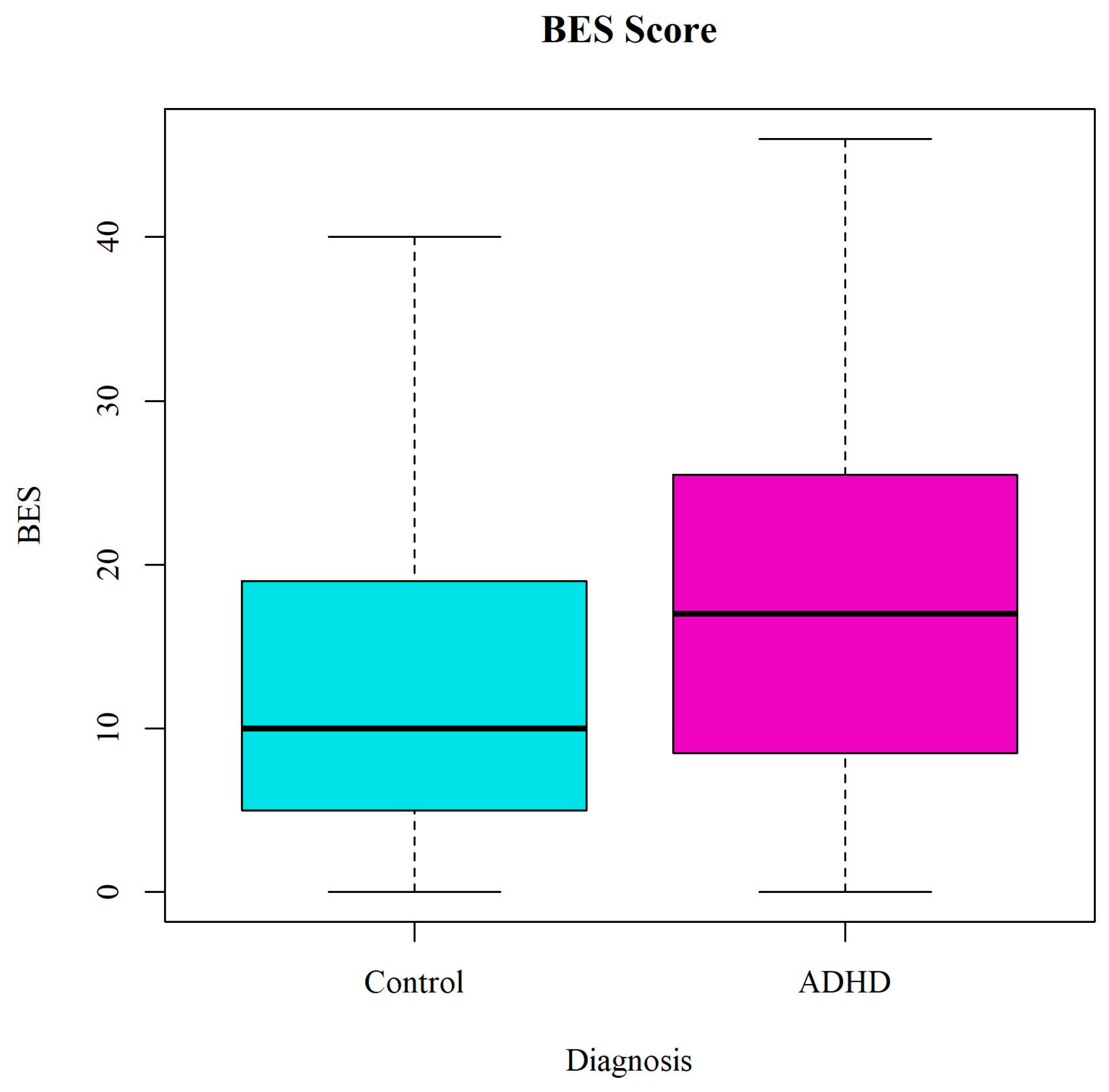
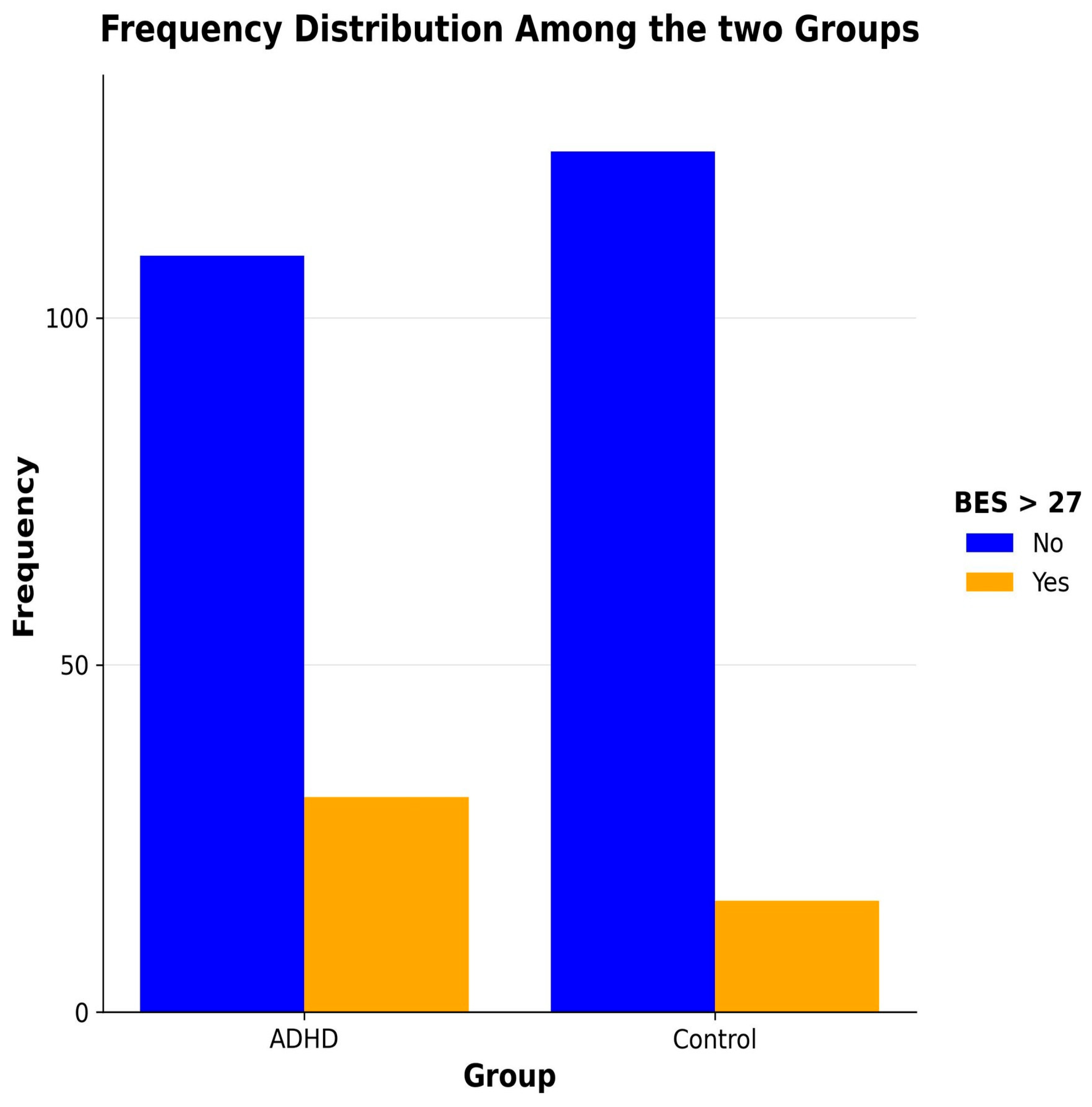
The two groups were comparable for age, job and education. Age was similar in both groups (W = 11,071; p = 0.06; SMD = −0.32, indicating a modest residual imbalance), as were Job (χ2 = 7.12; p = 0.21; all category-level |SMDs| < 0.25) and Education (χ2 = 11.75; p = 0.11; all category-level |SMDs| < 0.20). From the BES score comparison, since we observed a slight negative skewness in the model residuals, we attempted to transform the dependent variable but were unable to normalize the distribution (Figure 1; Shapiro–Wilk normality test p = 0.002). Therefore, we opted for a two-tailed Wilcoxon–Mann–Whitney test comparing the distributions of BES scores between the two groups (Control vs. ADHD). The Wilcoxon test detected a statistically significant difference between the two distributions (W = 12,512; p < 0.001), with a small-to-moderate effect size (rank-biserial r = 0.28, 95% bootstrap CI 0.15–0.41) and a Hodges–Lehmann median difference of 5 BES points (95% bootstrap CI 3–8), allowing us to reject H0. Considering the full three-category distribution of the BES, 52.1% of women with ADHD scored in the non-clinical range (≤17) vs. 73.6% of controls; 25.7% vs. 15.0% in the moderate range (18–26); and 22.1% vs. 11.4% in the severe range (≥27). A Cochran–Armitage trend test was statistically significant (z = 3.51, p < 0.001), and a proportional-odds logistic regression indicated a substantially higher odds of belonging to a higher BES severity category in the ADHD group (proportional OR = 2.48, 95% CI 1.52–4.05, p < 0.001). This approach confirmed that the ADHD group presented significantly higher binge eating symptomatology than controls (Figure 1). Additionally, the Chi-squared test found a significantly higher frequency of subjects with BES ≥ 27 in the ADHD group compared to controls (χ2 = 5.01; p = 0.025; OR = 2.20, 95% CI 1.14–4.25). Of the 140 ADHD participants, 31 had BES ≥ 27, compared to 16 of the 140 controls (Figure 2).
A sensitivity analysis adjusting for age and BMI confirmed the association: in an ordinary least squares regression of BES on ADHD status, the ADHD coefficient was β = 5.01 (95% CI 2.58–7.44, p < 0.001); and in a logistic regression of BES ≥ 27, the adjusted OR for ADHD was 2.17 (95% CI 1.10–4.42, p = 0.028). BMI was itself associated with higher BES scores (β = 0.46 per BMI unit, 95% CI 0.28–0.65, p < 0.001), but the ADHD effect remained of comparable magnitude and statistical significance after adjustment.

5. Discussion

Before discussing our findings, we reiterate a methodological boundary. The theoretical overview in Section 2, including hormonal, menstrual cycle, and metabolic considerations, was assembled as a conceptual framework and is not tested by our data. The cross-sectional component evaluates a single, narrowly defined association: whether adult women reporting an ADHD diagnosis score higher on the Binge Eating Scale than women without such a diagnosis. Mechanistic content throughout the Discussion should therefore be read as hypotheses for future research rather than inferences supported by the present dataset.
The results of this study provide significant insights into the psychological comorbidities associated with a self-reported ADHD diagnosis, particularly highlighting an association between self-reported ADHD and binge eating symptoms. This study showed that women reporting an ADHD diagnosis had significantly higher scores on the BES compared to matched controls, indicating an association between a self-reported ADHD diagnosis and higher levels of binge eating symptoms in the female sample studied. Because the BES is a screening measure rather than a diagnostic instrument for BED, we frame these findings in terms of binge eating symptoms rather than as evidence of a formal disorder. Several factors that could underlie the observed association are discussed below as plausible hypotheses; none of these were directly tested by the present data.
Importantly, our findings did not rely solely on the clinical threshold of the BES. Both the continuous non-parametric analysis and the ordered three-category analysis indicated a shift in the distribution toward higher symptom burden in women reporting an ADHD diagnosis, including below the severe clinical cutoff. The median BES score in the ADHD group (17) lies at the upper boundary of the non-clinical range, so our data support a conclusion about a higher proportion of women with ADHD in clinically meaningful symptom categories rather than about binge eating severity sufficient for a BED diagnosis at the group level. This convergence across analyses reinforces the notion that subclinical binge eating behaviors may be more prevalent and impactful in this population than previously recognized.
One potential explanatory factor is the difficulty individuals with ADHD experience in executive functioning, which can impair their ability to plan and organize meals. This disorganization has been hypothesized to contribute to irregular eating patterns, such as skipping meals or resorting to convenient, unhealthy food choices, contributing to obesity [2,23]. Additionally, people with ADHD might experience hyperfocus, where they become intensely engrossed in a task and lose track of time, often forgetting to eat [19]. This can result in extreme hunger later, which may increase the likelihood of binge eating episodes [39]. Impulsivity, a core symptom of ADHD, may be related to difficulty resisting cravings and controlling portion sizes [19]. Systematic reviews and meta-analyses also support an increased risk of eating disorders in individuals with ADHD, including BED [14]. Emotional dysregulation, another common feature of ADHD, can cause individuals to use food as a coping mechanism for managing stress, anxiety, or other negative emotions [40]. These behaviors can collectively contribute to a cycle of disordered eating and weight gain [41]. Furthermore, certain pharmacological treatments for ADHD can suppress appetite, leading individuals to skip meals unintentionally [42]. This effect can exacerbate irregular eating patterns, causing severe hunger later in the day and triggering binge eating episodes. This adds another layer of complexity to the relationship between ADHD and disordered eating behaviors. Previous literature has proposed that some individuals with ADHD may engage in binge eating as a form of self-medication for underlying dopaminergic dysregulation. ADHD has been associated with impairments in dopamine signaling, which may contribute to symptoms such as inattention and impulsivity [20]. Binge eating has been hypothesized to temporarily increase dopamine levels, offering short-term relief or reward [21]. Although this neurobiological mechanism is not directly examined in our study, it represents a potentially relevant framework for future investigation. In this context, it has been hypothesized that binge eating could function as a maladaptive form of emotional or neurochemical regulation in some individuals with ADHD [40]. An important reflection arises from this study regarding the distinction between the core pathology of a “pure” binge eating episode, which may have a specific cognitive cause, and binge eating driven by neuropsychological deficits such as dopaminergic dysregulation. According to Fairburn’s transdiagnostic theory, the former might be rooted in cognitive distortions, dysfunctional beliefs about eating, weight, and shape, and emotional regulation difficulties [43]. In contrast, the literature has proposed that binge eating in the context of ADHD could involve neuropsychological factors, including alterations in dopamine regulation [20,44]. However, there can be significant overlap between these types of binge eating. The weight gain initially caused by ADHD-related disordered eating behaviors can lead to weight stigma. Experiencing and internalizing this stigma can exacerbate cognitive factors associated with binge eating, such as negative body image, low self-esteem, and emotional distress [40,43]. Theoretical accounts have therefore suggested a possible compounded risk in which neuropsychological and cognitive factors may jointly contribute to the persistence and severity of binge eating behaviors.
For clarity, throughout this section we use “binge eating symptoms” to refer to elevated scores on the BES screening measure and to subclinical or clinically meaningful loss-of-control eating patterns. We use “Binge Eating Disorder (BED)” only when referring to the formal DSM-5 diagnosis, which requires structured clinical assessment that was not performed in the present study. Discussions framed at the disorder level (e.g., regarding diagnosed BED) draw on the cited literature rather than on the present cross-sectional findings. Given these findings, the screening for ADHD in patients with binge eating symptoms is clinically relevant. Earlier recognition may support more personalized assessment and treatment planning. ADHD and binge eating share common characteristics such as impulsivity and difficulty in impulse control, which can contribute to overweight and obesity [16]. Moreover, individuals with obesity exhibit a higher prevalence of both ADHD and binge eating symptoms compared to the general population [45]. It has been hypothesized that a multi-layered vicious cycle operates in women, whereby ADHD-related dysregulation increases vulnerability to binge eating and weight gain, while obesity-related insulin resistance and metabolic syndrome are associated with menstrual irregularities and may contribute to hormonal milieus relevant to attention, impulsivity, and mood across the menstrual cycle [7,8,9,10,11,12,13,25,26,27,28,29,30,31]. Because menstrual cycle phase, hormonal status, and biochemical metabolic markers were not assessed in our data, this vicious-cycle model remains a hypothesis to be tested in future mechanistic studies rather than an implication of the present findings. Therefore, clinicians should consider the possibility of comorbidity among ADHD, binge eating symptoms, and obesity when evaluating and treating patients. Expanding on this, structured screening approaches may be useful. Implementing routine ADHD screening for individuals presenting with binge eating symptoms could support more tailored assessment and treatment planning. This approach would enable healthcare providers to address the underlying ADHD symptoms that may contribute to binge eating behaviors, thereby improving overall treatment outcomes. Such screenings should include detailed assessments of executive functioning, emotional regulation, and impulsivity to identify ADHD symptoms that may not be immediately apparent. In addition, integrating behavioral and pharmacological interventions that target both ADHD and binge eating may offer therapeutic benefits that warrant investigation in future trials. These directions remain hypotheses generated by the present association and by converging literature, rather than implications directly supported by our cross-sectional data, and should be tested in dedicated prospective and interventional studies before being translated into specific clinical recommendations. For instance, cognitive behavioral therapy (CBT) could be adapted to address the specific needs of patients with comorbid ADHD and binge eating symptoms, focusing on strategies to improve executive functioning, develop healthier eating patterns, and manage impulsivity and emotional dysregulation. Pharmacological treatments that consider the impact on appetite and eating behaviors should be carefully selected to minimize adverse effects on binge eating tendencies. Finally, increased awareness and education about the comorbidity of ADHD and binge eating among healthcare providers, patients, and their families can facilitate earlier recognition and intervention. Providing resources and support for individuals with these conditions can empower them to seek appropriate help and adopt healthier coping mechanisms. In conclusion, this study supports an association between a self-reported ADHD diagnosis and binge eating symptomatology in this sample and supports the value of integrated screening and care strategies that deserve further investigation. By acknowledging and addressing the multifaceted nature of ADHD and binge eating symptoms, healthcare professionals can better support their patients in achieving improved mental and physical health outcomes. This study has some limitations. First, the diagnosis of ADHD was self-reported and not clinically verified, which may introduce reporting bias; the observed group differences could therefore in part reflect general psychological distress or heightened symptom awareness rather than ADHD specifically; moreover, no validated ADHD symptom-rating scales were administered, and information on ADHD subtype, symptom severity, age at diagnosis, and current or past pharmacological treatment was not collected, which restricts construct validity of the exposure and limits mechanistic inference. We regard this misclassification of ADHD status as the most consequential methodological limitation of the present study: in the absence of a structured clinical interview and validated symptom scales, the exposure variable captures self-identification with an ADHD diagnosis rather than current ADHD severity or subtype, and non-differential misclassification would be expected to attenuate rather than inflate the observed association. Likewise, the absence of information on ADHD pharmacotherapy is particularly relevant given the well-documented appetite-suppressing effects of stimulant treatment, which could plausibly mask higher binge eating severity in treated participants and therefore further attenuate group differences; the present results should be interpreted with this in mind. Second, although our focus was on symptomatology rather than formal diagnosis, we did not assess psychiatric comorbidities (e.g., mood and anxiety disorders) that might also influence eating behaviors; comorbid psychopathology and concurrent psychotropic medication (including stimulants, which may suppress appetite) could therefore account for part of the observed association, and the ADHD-specific component cannot be fully disentangled from broader psychopathology or treatment-related factors in the present data. Third, the survey did not include menstrual cycle phase tracking, hormonal measures, or biochemical markers of metabolic health (e.g., fasting glucose/insulin); therefore, we could not directly test the proposed hormonal–metabolic vicious-cycle pathways discussed in the gender-focused theoretical overview. Fourth, recruitment through general social media channels produced a convenience sample of internet-using adult women that was relatively highly educated, with a large proportion of participants in postgraduate education; residual confounding by factors associated with online self-selection cannot be ruled out, and generalizability is therefore limited. Fifth, as we ourselves argue in Section 2 that ADHD is under-recognized in adult women, our control group (defined by the absence of a reported ADHD diagnosis) may include women with undiagnosed ADHD; this misclassification is expected to attenuate the observed group difference, and the significant effect we report should therefore be regarded as a conservative estimate of the true association. Finally, the overview component was narrative in nature and should not be interpreted as a systematic review. Despite these limitations, this study presents several strengths. It is one of the few to focus specifically on women with ADHD, a population frequently underrepresented in research and often misdiagnosed. By using a validated psychometric tool such as the Binge Eating Scale (BES) together with effect size estimates, confidence intervals, and a three-category ordinal analysis complementing the dichotomous cutoff, the study provides new insights into the distribution of binge eating symptoms beyond clinical thresholds. Furthermore, the inclusion of a well-matched control group strengthens the reliability of the observed differences.
From a gender-sensitive perspective, our results should be interpreted against the backdrop of ADHD under-recognition in adult women and the tendency for symptoms to be masked by compensatory strategies. Throughout this manuscript, we use “gender-focused” to refer to gender-related mechanisms (such as under-recognition, masking, socially shaped help-seeking, and diagnostic bias), while sex-related biological mechanisms (ovarian hormones, menstrual cycle phase, metabolic markers) are considered as a separate level of analysis and are not directly assessed in our empirical component. We acknowledge that the two constructs, although partially interrelated, should not be conflated [4,5,6,17,18]. These factors can delay diagnosis and may reduce opportunities to identify clinically relevant comorbidities. Accordingly, clinicians working with women with ADHD should routinely screen for binge eating symptoms (including subthreshold presentations), weight stigma, and associated psychosocial distress, rather than focusing exclusively on weight or mood symptoms [14,16,40].
Although not assessed in the present dataset, menstrual cycle-related symptom variability and obesity-related metabolic dysregulation may represent important moderators of the ADHD–binge eating association in women. Future studies should integrate cycle tracking (and, where feasible, hormonal measures) alongside anthropometric and metabolic markers to test the proposed vicious-cycle model and to clarify whether specific menstrual phases or metabolic profiles confer higher risk for loss-of-control eating and functional impairment [7,8,9,10,11,12,13,25,26,27,28,29,30,31].

6. Conclusions

This study highlights a significant association between a self-reported ADHD diagnosis and binge eating symptomatology in adult women. Together with the gender-focused theoretical overview, these findings underscore the need for earlier recognition of ADHD in women and for routine, bidirectional screening: assessment of binge eating symptoms in women with ADHD, as well as consideration of ADHD in women presenting with binge eating and obesity. Because ADHD status was based on a single self-report item and data on ADHD symptom severity, medication, comorbid psychopathology, and menstrual cycle phase were not collected, these findings should be interpreted as preliminary evidence of an association rather than as a test of the hormonal or metabolic mechanisms discussed in the overview. Future longitudinal studies incorporating menstrual cycle tracking (and, where feasible, hormonal measures) alongside anthropometric and metabolic biomarkers are needed to test the proposed hormonal–metabolic vicious-cycle pathways and to inform personalized prevention and intervention strategies.

Author Contributions

M.G.T. played a pivotal role in the conceptualisation and supervision of the research project, in addition to providing invaluable input in the design of the study and the administration of its various components. E.M. and A.M. were instrumental in shaping the conceptualisation and design of the study, as well as in the data collection and curation process, the validation of the findings, and the initial draft of the manuscript. Furthermore, they were responsible for the formal analysis of the data, the methodology employed, and the critical revision of the manuscript. V.R.A. made a notable contribution to the statistical analysis, the interpretation of the data, and the visualisation of the findings. M.E.C., F.G., G.P.E., E.T., U.S. and E.G. provided critical revisions and contributed to the drafting of the manuscript. All authors have read and agreed to the published version of the manuscript.

Funding

This research received no specific grant from any funding agency in the public, commercial, or not-for-profit sectors.

Institutional Review Board Statement

The study was conducted in accordance with the ethical standards of the Declaration of Helsinki (1964) and its later amendments. The study was approved by the Ethics Committee of the Center for Research and Psychological Intervention (CeRIP) of the University of Messina (approval number 30/15/2023, dated 5 April 2023).

Informed Consent Statement

Informed consent was obtained from all subjects involved in the study.

Data Availability Statement

The datasets generated and/or analyzed during the current study are available from the corresponding author on reasonable request.

Conflicts of Interest

The authors declare no conflicts of interest.

Abbreviations

The following abbreviations are used in this manuscript:
ADHDAttention Deficit/Hyperactivity Disorder
BESBinge Eating Scale
BEDBinge Eating Disorder
BMIBody Mass Index
CBTCognitive Behavioral Therapy
IRInsulin Resistance
MetSMetabolic Syndrome

References

  1. American Psychiatric Association. Diagnostic and Statistical Manual of Mental Disorders, 5th ed.; American Psychiatric Publishing: Washington, DC, USA, 2013. [Google Scholar]
  2. Davis, C.; Levitan, R.D.; Smith, M.; Tweed, S.; Curtis, C. Associations among overeating, overweight, and attention deficit/hyperactivity disorder: A structural equation modelling approach. Eat. Behav. 2006, 7, 266–274. [Google Scholar] [CrossRef]
  3. Hanson, J.A.; Phillips, L.N.; Hughes, S.M.; Corson, K. Attention-deficit/hyperactivity disorder symptomatology, binge eating disorder symptomatology, and body mass index among college students. J. Am. Coll. Health 2020, 68, 543–549. [Google Scholar] [CrossRef] [PubMed]
  4. Young, S.; Adamo, N.; Ásgeirsdóttir, B.B.; Branney, P.; Beckett, M.; Colley, W.; Cubbin, S.; Deeley, Q.; Farrag, E.; Gudjonsson, G.; et al. Females with ADHD: An expert consensus statement taking a lifespan approach providing guidance for the identification and treatment of attention-deficit/hyperactivity disorder in girls and women. BMC Psychiatry 2020, 20, 404. [Google Scholar] [CrossRef]
  5. Quinn, P.O.; Madhoo, M. A review of attention-deficit/hyperactivity disorder in women and girls: Uncovering this hidden diagnosis. Prim. Care Companion CNS Disord. 2014, 16, 27250. [Google Scholar] [CrossRef]
  6. Gershon, J. A meta-analytic review of gender differences in ADHD. J. Atten. Disord. 2002, 5, 143–154. [Google Scholar] [CrossRef] [PubMed]
  7. Osianlis, E.; Thomas, E.H.X.; Jenkins, L.M.; Gurvich, C. ADHD and Sex Hormones in Females: A Systematic Review. J. Atten. Disord. 2025, 29, 706–723. [Google Scholar] [CrossRef] [PubMed]
  8. Zaritsky, R.; Reed, S.C.; Evans, S.M. Changes in ADHD Symptoms and Mood Across the Menstrual Cycle in Females Treated With Stimulants: A Pilot Study. J. Atten. Disord. 2026, 30, 329–341. [Google Scholar] [CrossRef]
  9. Wynchank, D.; Sutrisno, R.M.G.T.M.F.; van Andel, E.; Kooij, J.J.S. Menstrual Cycle-Related Hormonal Fluctuations in ADHD: Effect on Cognitive Functioning—A Narrative Review. J. Clin. Med. 2026, 15, 121. [Google Scholar] [CrossRef] [PubMed]
  10. Šišljagić, D.; Blažetić, S.; Heffer, M.; Vranješ Delać, M.; Muller, A. The Interplay of Uterine Health and Obesity: A Comprehensive Review. Biomedicines 2024, 12, 2801. [Google Scholar] [CrossRef]
  11. Lee, S.S.; Kim, D.H.; Nam, G.-E.; Nam, H.-Y.; Kim, Y.E.; Lee, S.H.; Han, K.D.; Park, Y.G. Association between Metabolic Syndrome and Menstrual Irregularity in Middle-Aged Korean Women. Korean J. Fam. Med. 2016, 37, 31–36. [Google Scholar] [CrossRef]
  12. di Girolamo, G.; Bracco, I.F.; Portigliatti Pomeri, A.; Puglisi, S.; Oliva, F. Prevalence of Metabolic Syndrome and Insulin Resistance in a Sample of Adult ADHD Outpatients. Front. Psychiatry 2022, 13, 891479. [Google Scholar] [CrossRef]
  13. Marcelli, I.; Capece, U.; Caturano, A. Bridging ADHD and Metabolic Disorders: Insights into Shared Mechanisms and Clinical Implications. Diabetology 2025, 6, 40. [Google Scholar] [CrossRef]
  14. Nazar, B.P.; Bernardes, C.; Peachey, G.; Sergeant, J.; Mattos, P.; Treasure, J. The risk of eating disorders comorbid with attention-deficit/hyperactivity disorder: A systematic review and meta-analysis. Int. J. Eat. Disord. 2016, 49, 1045–1057. [Google Scholar] [CrossRef] [PubMed]
  15. Pagoto, S.L.; Curtin, C.; Lemon, S.C.; Bandini, L.G.; Schneider, K.L.; Bodenlos, J.S.; Ma, Y. Association between adult attention deficit/hyperactivity disorder and obesity in the US population. Obesity 2009, 17, 539–544. [Google Scholar] [CrossRef]
  16. Fleming, J.P.; Levy, L.D.; Levitan, R.D. Symptoms of attention deficit hyperactivity disorder in severely obese women. Eat. Weight Disord. 2005, 10, e10–e13. [Google Scholar] [CrossRef]
  17. Hinshaw, S.P.; Nguyen, P.T.; O’Grady, S.M.; Rosenthal, E.A. Annual Research Review: Attention-deficit/hyperactivity disorder in girls and women: Underrepresentation, longitudinal processes, and key directions. J. Child Psychol. Psychiatry 2022, 63, 484–496. [Google Scholar] [CrossRef]
  18. Nussbaum, N.L. ADHD and female specific concerns: A review of the literature and clinical implications. J. Atten. Disord. 2012, 16, 87–100. [Google Scholar] [CrossRef] [PubMed]
  19. Cortese, S.; Bernardina, B.D.; Mouren, M.C. Attention-deficit/hyperactivity disorder (ADHD) and binge eating. Nutr. Rev. 2007, 65, 404–411. [Google Scholar] [CrossRef]
  20. Volkow, N.D.; Wang, G.J.; Kollins, S.H.; Wigal, T.L.; Newcorn, J.H.; Telang, F.; Fowler, J.S.; Zhu, W.; Logan, J.; Ma, Y.; et al. Evaluating dopamine reward pathway in ADHD: Clinical implications. JAMA 2009, 302, 1084–1091. [Google Scholar] [CrossRef]
  21. Bello, N.T.; Hajnal, A. Dopamine and binge eating behaviors. Pharmacol. Biochem. Behav. 2010, 97, 25–33. [Google Scholar] [CrossRef]
  22. Agranat-Meged, A.N.; Deitcher, C.; Goldzweig, G.; Leibenson, L.; Stein, M.; Galili-Weisstub, E. Childhood obesity and attention deficit/hyperactivity disorder: A newly described comorbidity in obese hospitalized children. Int. J. Eat. Disord. 2005, 37, 357–359. [Google Scholar] [CrossRef]
  23. Cortese, S.; Moreira-Maia, C.R.; St Fleur, D.; Morcillo-Peñalver, C.; Rohde, L.A.; Faraone, S.V. Association Between ADHD and Obesity: A Systematic Review and Meta-Analysis. Am. J. Psychiatry 2016, 173, 34–43. [Google Scholar] [CrossRef]
  24. Garcia-Argibay, M.; Li, L.; Du Rietz, E.; Zhang, L.; Yao, H.; Jendle, J.; Ramos-Quiroga, J.A.; Ribasés, M.; Chang, Z.; Brikell, I.; et al. The association between type 2 diabetes and attention-deficit/hyperactivity disorder: A systematic review, meta-analysis, and population-based sibling study. Neurosci. Biobehav. Rev. 2023, 147, 105076. [Google Scholar] [CrossRef]
  25. Ilyas, A.; Hübel, C.; Stahl, D.; Stadler, M.; Ismail, K.; Breen, G.; Treasure, J.; Kan, C. The metabolic underpinning of eating disorders: A systematic review and meta-analysis of insulin sensitivity. Mol. Cell. Endocrinol. 2019, 497, 110307. [Google Scholar] [CrossRef] [PubMed]
  26. Roehrig, M.; Masheb, R.M.; White, M.A.; Grilo, C.M. The metabolic syndrome and behavioral correlates in obese patients with binge eating disorder. Obesity 2009, 17, 481–486. [Google Scholar] [CrossRef] [PubMed]
  27. Itriyeva, K. The effects of obesity on the menstrual cycle. Curr. Probl. Pediatr. Adolesc. Health Care 2022, 52, 101241. [Google Scholar] [CrossRef]
  28. Teede, H.J.; Tay, C.T.; Laven, J.J.E.; Dokras, A.; Moran, L.J.; Piltonen, T.T.; Costello, M.F.; Boivin, J.; Redman, L.M.; Boyle, J.A.; et al. Recommendations From the 2023 International Evidence-based Guideline for the Assessment and Management of Polycystic Ovary Syndrome. J. Clin. Endocrinol. Metab. 2023, 108, 2447–2469. [Google Scholar] [CrossRef] [PubMed]
  29. Jacobs, E.; D’Esposito, M. Estrogen shapes dopamine-dependent cognitive processes: Implications for women’s health. J. Neurosci. 2011, 31, 5286–5293. [Google Scholar] [CrossRef]
  30. Dubol, M.; Epperson, C.N.; Sacher, J.; Pletzer, B.; Derntl, B.; Lanzenberger, R.; Sundström-Poromaa, I.; Comasco, E. Neuroimaging the menstrual cycle: A multimodal systematic review. Front. Neuroendocrinol. 2021, 60, 100878. [Google Scholar] [CrossRef] [PubMed]
  31. Solomon, C.G.; Hu, F.B.; Dunaif, A.; Rich-Edwards, J.; Willett, W.C.; Hunter, D.J.; Colditz, G.A.; Speizer, F.E.; Manson, J.E. Long or highly irregular menstrual cycles as a marker for risk of type 2 diabetes mellitus. JAMA 2001, 286, 2421–2426. [Google Scholar] [CrossRef]
  32. Gormally, J.; Black, S.; Daston, S.; Rardin, D. The assessment of binge eating severity among obese persons. Addict. Behav. 1982, 7, 47–55. [Google Scholar] [CrossRef]
  33. Di Bernardo, M.; Barciulli, E.; Ricca, V.; Mannucci, E.; Moretti, S.; Cabras, P.L.; Rotella, C.M. Binge eating scale in obese patients: Validation of the Italian version. Minerva Psichiatr. 1998, 39, 125–130. [Google Scholar]
  34. Marcus, M.D.; Wing, R.R.; Hopkins, J. Obese binge eaters: Affect, cognitions, and response to behavioural weight control. J. Consult. Clin. Psychol. 1988, 56, 433–439. [Google Scholar] [CrossRef] [PubMed]
  35. Shapiro, S.S.; Wilk, M.B. An analysis of variance test for normality (complete samples). Biometrika 1965, 52, 591–611. [Google Scholar] [CrossRef]
  36. Gastwirth, J.L.; Gel, Y.R.; Miao, W. The impact of Levene’s test of equality of variances on statistical theory and practice. Stat. Sci. 2009, 24, 343–360. [Google Scholar] [CrossRef]
  37. Gibbons, J.D.; Chakraborti, S. Nonparametric Statistical Inference, 5th ed.; Chapman and Hall/CRC Press: Boca Raton, FL, USA, 2011. [Google Scholar] [CrossRef]
  38. McHugh, M.L. The chi-square test of independence. Biochem. Med. 2013, 23, 143–149. [Google Scholar] [CrossRef] [PubMed]
  39. Kooij, J.J.S.; Bejerot, S.; Blackwell, A.; Caci, H.; Casas-Brugué, M.; Carpentier, P.J.; Edvinsson, D.; Fayyad, J.; Foeken, K.; Fitzgerald, M.; et al. European consensus statement on diagnosis and treatment of adult ADHD: The European Network Adult ADHD. BMC Psychiatry 2010, 10, 67. [Google Scholar] [CrossRef] [PubMed]
  40. Kaisari, P.; Dourish, C.T.; Higgs, S. Attention Deficit Hyperactivity Disorder (ADHD) and disordered eating behaviour: A systematic review and a framework for future research. Clin. Psychol. Rev. 2017, 53, 109–121. [Google Scholar] [CrossRef]
  41. Blinder, B.J.; Cumella, E.J.; Sanathara, V.A. Psychiatric comorbidities of female inpatients with eating disorders. Psychosom. Med. 2006, 68, 454–462. [Google Scholar] [CrossRef]
  42. Cortese, S.; Holtmann, M.; Banaschewski, T.; Buitelaar, J.; Coghill, D.; Danckaerts, M.; Dittmann, R.W.; Graham, J.; Taylor, E.; Sergeant, J.; et al. Practitioner Review: Current best practice in the management of adverse events during treatment with ADHD medications in children and adolescents. J. Child Psychol. Psychiatry 2013, 54, 227–246. [Google Scholar] [CrossRef]
  43. Fairburn, C.G.; Cooper, Z.; Shafran, R. Cognitive behaviour therapy for eating disorders: A “transdiagnostic” theory and treatment. Behav. Res. Ther. 2003, 41, 509–528. [Google Scholar] [CrossRef] [PubMed]
  44. Volkow, N.D.; Wang, G.J.; Fowler, J.S.; Telang, F. Overlapping neuronal circuits in addiction and obesity: Evidence of systems pathology. Philos. Trans. R. Soc. Lond. B Biol. Sci. 2008, 363, 3191–3200. [Google Scholar] [CrossRef] [PubMed]
  45. Hanć, T.; Cortese, S. Attention deficit/hyperactivity disorder and obesity: A review and model of current hypotheses explaining their comorbidity. Neurosci. Biobehav. Rev. 2018, 92, 16–28. [Google Scholar] [CrossRef] [PubMed]
Figure 1. Boxplots of BES scores by group.
Women 06 00034 g001
Figure 2. Frequency of subjects with BES ≥ 27 in each group.
Women 06 00034 g002
Table 1. Characteristics of the sample.
ADHDCONTROLS
N.140140
AGE MEDIAN (IQR)32.5 (11)35 (13.25)
BES MEDIAN (IQR)17 (16.5)10 (14)
BMI MEDIAN (IQR)23.8 (8.4)24.8 (9.1)
EDUCATION
Degree4146
Bachelor’s degree2623
Post graduate education7371
JOB
Unemployed916
Worker9895
Pensioner04
Student3325
Disclaimer/Publisher’s Note: The statements, opinions and data contained in all publications are solely those of the individual author(s) and contributor(s) and not of MDPI and/or the editor(s). MDPI and/or the editor(s) disclaim responsibility for any injury to people or property resulting from any ideas, methods, instructions or products referred to in the content.