
Article

Cellulose Nanocrystals Enhance the Rheological Properties and pH-Responsiveness of Potassium Oleate Solutions

by
Mikhail M. Avdeev
1,2,
Vyacheslav S. Molchanov
1,
Alexander I. Kuklin
2 and
Olga E. Philippova
1,*
1
Physics Department, Lomonosov Moscow State University, 119991 Moscow, Russia
2
Frank Laboratory of Neutron Physics, Joint Institute for Nuclear Research, 141980 Dubna, Russia
*
Author to whom correspondence should be addressed.
Polysaccharides 2026, 7(2), 50; https://doi.org/10.3390/polysaccharides7020050
Submission received: 11 March 2026 / Revised: 2 April 2026 / Accepted: 28 April 2026 / Published: 30 April 2026

Abstract

Wormlike micelles (WLMs) of surfactants with rheological properties highly responsive to pH are of growing interest for various applications. The present paper proposes an approach to enhance their rheological properties and make the pH-response more pronounced. It consists of the incorporation of a percolated network of cellulose nanocrystals (CNCs) into the solution of entangled WLMs. To provide pH-responsiveness, potassium oleate was used as a surfactant. Rheological studies demonstrated that CNCs increase the viscosity and storage modulus by one order of magnitude. This effect was attributed to the interaction of WLMs with nanocrystals and the formation of entanglements of WLMs with percolated CNCs. Moreover, added CNCs make the pH-response stronger. The lowering of pH from 10.1 to 9.7 leads to a sharp drop in viscosity by ca. 2000 Pa·s, which is much higher than the decrease in viscosity of the WLM solution without CNCs. According to SANS data, the drop in viscosity is due to the transformation of WLMs into vesicles. It occurs as a result of the protonation of surfactant carboxylic groups decreasing surface charge on the micelles. In the presence of CNCs, the transition pH shifts to an alkaline medium, indicating that CNCs promote vesicle formation. Also, CNCs cause some of the vesicles to aggregate with each other, as follows from dynamic light scattering and optical microscopy data. Both observations suggest an interaction between CNCs and vesicles, which is supported by ITC data. These findings are valuable for the research and development of high-performing surfactant-based products.

1. Introduction

Cellulose nanocrystals (CNCs) are one of the most promising bio-sourced nanomaterials due to their unique combination of properties, including high mechanical strength, renewable nature, and biodegradability [1,2,3]. They are widely available, as they are produced from cellulose, the most abundant natural polymer on Earth. CNCs are rod-like crystal nanoparticles with a width of approximately 4–70 nm and a length of 100–500 nm [4]. The degree of crystallinity of CNCs reaches up to 88% [5], which gives them enhanced mechanical properties: the elastic modulus of 110–220 GPa, and the tensile strength of 7.5–7.7 GPa [6].
Mechanically strong CNC particles are often used as nanofillers to reinforce various polymeric materials, including hydrogels [7,8,9]. However, they are less commonly used to strengthen surfactant-based hydrogels [10,11]. These hydrogels are formed by entangled wormlike surfactant micelles (WLMs). They need to be strengthened, especially because they are self-assembled systems that do not involve any covalent interactions between the molecules that make them up.
To the best of our knowledge, there are only two papers devoted to WLM-CNC systems [10,11]. In one of them [10], it was demonstrated that CNCs can significantly enhance the viscoelasticity of WLM solutions and even induce the formation of hydrogels. However, the experiments were performed with a rather sophisticated anionic rosin-based surfactant mixed with an excess of cetyltrimethylammonium bromide. In another paper [11], it was shown that CNCs not only enhance the rheological properties but also increase the proppant-carrying capacity of solutions of mixed WLMs formed by zwitterionic surfactant erucyl dimethyl amidopropyl betaine and nonionic surfactant alkyl polyglucoside. The proppant-carrying capacity is important for the use of surfactants in the oil industry as thickeners for fracturing fluids [12]. Therefore, the addition of CNCs improves the performance of WLMs in oil field applications. Based on the FTIR-data, the enhancement of the rheological properties of WLMs by added CNCs was attributed [11] to the interaction between WLMs and CNCs through electrostatic forces and hydrogen bonding. However, no structural studies were performed other than cryo-TEM.
A peculiar feature of surfactant-based hydrogels and viscoelastic solutions that determines the main areas of their use is the high responsiveness of their rheological properties [13] to various external stimuli such as pH [14,15,16,17,18,19,20], light [18,21,22], temperature [18,23], hydrocarbon [24,25] or CO2 [26] addition and so on. Among these stimuli, pH stands out as an effective, easy, and economical trigger. The pH-switchable behavior of surfactant-based hydrogels and viscoelastic solutions is exploited in temporary thickening and drag-reduction, as well as solid-transportation [15].
Typical pH-sensitive surfactants usually contain weak base or weak acid groups. Their protonation and deprotonation, respectively, induce the appearance of charges, which affect the surfactant self-assembly and, consequently, the rheological properties of WLM gels and solutions. By now, most pH-responsive surfactant systems are prepared from zwitterionic or cationic surfactants [13]. Zwitterionic surfactants, such as alkyldimethylamine oxide, form WLMs at a neutral pH, when they have no net charge, and therefore the repulsion between the surfactant head groups is weak. At acidic pH, the surfactant becomes positively charged, which induces the disruption of WLMs and a drop of viscosity [13]. As concern cationic surfactants, they are often used in combination with organic acids like phthalic [17,20], trans-o-hydroxycinnamic [18] or maleic [16] acids. At pH values where the cationic surfactant and acid have opposite charges, they attract each other and form long WLMs, providing high viscosity. At pH values where the charge of one sign predominates, the electrostatic repulsion disrupts the WLMs, leading to a decrease in viscosity.
At the same time, among the various pH-responsive surfactants, anionic carboxylate surfactants are of particular interest due to their affordability, sustainability, and low environmental toxicity [24]. However, they are much less studied than their zwitterionic and cationic counterparts [16,19]. In addition, the pH-responsive properties of carboxylated WLMs that have been strengthened with CNCs have not been reported until now. At the same time, it is important to investigate how the nanofiller particles influence the ability of WLMs to react to pH changes.
The present paper aims to study the strengthening of WLM solutions of anionic carboxylate surfactant by green nanofiller, CNCs, and to examine the effect of CNCs on the pH-responsive properties inherent to carboxylate WLMs. An anionic surfactant, potassium oleate (PO), was used in this study as it is widely available and has a wide range of applications in various industries [27]. In addition to rheological studies, structural investigations using small-angle neutron scattering (SANS) were conducted. SANS data allowed us to reveal changes in the morphology of surfactant self-assemblies, which underlie the rheological behavior of the system. It was demonstrated that CNCs enhance the viscoelasticity of WLM solutions and make the pH-responsiveness more pronounced. This provides CNC-enhanced WLMs with more options for practical use.

2. Materials and Methods

2.1. Materials

The surfactant PO (98% purity) was purchased from TCI Europe (Zwijndrecht, Belgium), the salt potassium chloride (99.5% purity) was provided by Fluka (Geel, Belgium) and both were used as received. The 1 M KOH and 1 M HCl solutions were used to adjust the pH. Distilled water was prepared using Millipore Milli-Q system (Millipore, Milford, MA, USA).
Carboxymethylated CNCs (product CNC-CM-SD) purchased from Cellulose Lab (Fredericton, New Brunswick, Canada) were used without purification. Their density is 1.5 g/cm3, the degree of crystallinity is 86–90%, the zeta potential is—40 mV, and the content of charged C O O groups is 1.2 mmol/g of CNCs. According to our previous measurements [8], these CNCs have a length of 90 nm and a diameter of 6 nm.

2.2. Sample Preparation

The WLM solutions containing 3 wt% PO (94 mM) and 2.6 wt% KCl (350 mM) were prepared by mixing the surfactant and salt with distilled water. The samples were stirred for 12 h to reach homogeneity. After that, CNCs were added, and the resulting suspensions were stirred again for 1 h and sonicated for 5 min. Pure CNC suspensions were prepared by adding CNC powder to 2.6 wt% solution of KCl in distilled water, stirring for 1 h and undergoing sonication for 5 min. The desired pH was then adjusted by adding 1 M KOH or 1 M HCl, and the sample was left to rest for 24 h. Small amounts of highly concentrated (1 M) HCl or KOH solutions were used for pH adjustment in order to maintain nearly constant concentrations of other components (PO, CNCs and KCl). To change the pH from 10.5 to 8.3, the highest and the lowest pH values used; 100 µL of 1M HCl was added to 3 mL of the solution/suspension. This resulted in a total volume increase of only 3% and an increase in ionic strength of 8%, from 0.35 to 0.38 M.

2.3. Rheology

The rheology of the solutions was studied with an Anton Paar Physica MCR 301 rheometer (Anton Paar, Graz, Austria). All experiments were conducted in a cone-plane cell CP40-2 with a 40 mm cone and 2° cone angle. Before each experiment, the samples were allowed to reach an equilibrium state after being loaded into the cell for 5 min. The dynamic data were obtained with a shear stress amplitude set within the range of linear viscoelastic response. All experiments were performed in triplicate and demonstrated good reproducibility.

2.4. Small-Angle Neutron Scattering

SANS measurements were conducted using the YuMO small-angle time-of-flight spectrometer with a two detector system [28] at the IBR-2 pulsed reactor (Frank Laboratory of Neutron Physics, Joint Institute for Nuclear Research, Dubna, Russia). The neutron wavelengths, λ, within a range of 0.05–0.8 nm, and the sample-detector distance of 4.5 m and 12.96 m were used to determine the differential cross-section per sample volume, d σ / d Ω ( q ) , as a function of the module of scattering vector, Q , in the range of 0.009–0.5   Å 1 . Viscoelastic samples were measured in special cylindrical quartz cells with a thickness of 2 mm. The remaining measurements were carried out using Hellma plane quartz cells with a thickness of 1 mm. All solutions for SANS measurements were prepared using D2O (99.9 at% D from AstraChem, Saint-Petersburg, Russia). All experiments were performed at 20 °C. The raw data were processed using the SAS package (version 3.5.1.) [29], including background subtraction and normalization against a vanadium standard.
The contrast variation in the PO-CNC suspensions was carried out using mixtures of D2O and H2O, with the following compositions in order to match some of the components: 0.35/0.65 of D2O/H2O for CNCs matching, and 0.1/0.9 of D2O/H2O for WLMs matching. These ratios were chosen based on the assumption that the scattering length density (SLD) of CNCs is close to 1.9   × 10 6   Å 2 [30] and the SLD of PO is 0.15 × 10 6   Å 2 [31].

2.5. Isothermal Titration Calorimetry

Isothermal titration calorimetry (ITC) experiments were carried out with a Nano ITC isothermal calorimeter (TA Instruments, New Castle, DE, USA) at 20 °C. A working cell was filled with a solution that had the same concentration of KCl (2.6 wt%) and the same pH as the titrant, ensuring that the salt concentration and pH remained constant during the measurements. The experiments were conducted by stepwise injection of 25 aliquots of 2 µL of a 1 wt% CNC suspension at 300 s intervals into 170 μL of 0.5 wt% PO (15.6 mM) in the working cell, while stirring at 200 rpm. The results obtained were corrected by subtracting the data of a control experiment, in which the titrant was injected into pure solvent. The peaks in the corrected thermograms were integrated and converted into thermodynamic profiles representing the enthalpy change as a function of the molar ratio of primary -OH groups on the surface of nanocrystals to PO molecules. Only primary hydroxyl groups located at the C6 position of the anhydroglucose unit in cellulose were considered because they are generally more accessible for hydrogen bonding and chemical modification compared to the secondary hydroxyl groups at C2 and C3 positions [32]. The number of primary -OH groups on the surface of CNCs was estimated according to the approach proposed by Habibi et al. [33]. The area of each injection was normalized to the number of moles of primary -OH groups on the surface of the nanocrystal particles in the titrant. The first peak in the thermogram was disregarded. The thermodynamic profiles were fitted using an independent binding site interaction model. The enthalpy change ∆H and association constant Ka were estimated graphically using the method of Velazquez-Campoy [34].

2.6. Dynamic Light Scattering

Dynamic light scattering experiments were conducted on an ALV/DLS/SLS-5000 goniometer system with an ALV digital correlator and a He-Ne laser (λ = 632.8 nm). The measurements were carried out on solutions containing PO vesicles, both in the presence and absence of CNCs. For the measurements, cylindric glass cells were used. All samples were studied at 20 °C and a scattering angle of θ = 150 ° . The processing of the DLS correlation functions was carried out using the ALV-Correlator software, with Contin analysis. For the calculations, the values of viscosity η and the refractive index of water at 20 °C were used. The estimated unweighted hydrodynamic radius of vesicles was obtained with the Stokes–Einstein equation for spherical particles R h = k b T / 6 π η D , where k b is the Boltzmann constant, T is the absolute temperature and D is the diffusion coefficient. The data were collected in sets of 20 measurements, each lasting 60 s, and then averaged for each sample.

2.7. Optical Microscopy

The optical microscope Nikon Eclipse LV100 POL (Nikon, Tokyo, Japan) was used to investigate the structure of the samples on the microscale level. All images were taken with 50X objective lens (CFI TU Plan Fluor Epi p 50×) at room temperature. The samples were placed between two quartz coverslips for measurements.

3. Results and Discussion

3.1. Enhancement of Rheological Properties by CNCs

To reveal the effect of CNCs on rheological properties, the WLM solutions, containing 3 wt% of PO and 2.6 wt% of a low-molecular-weight salt KCl were used. 3 wt% PO is a typical concentration of PO used to prepare long WLMs, which are entangled with each other, forming a transient network [24,35]. This concentration is well above the micelle overlap concentration ( C s u r f * ~ 0.1 wt% [24]). The salt provides screening for electrostatic repulsion between the surfactant heads, favoring the formation of long WLMs [36]. According to structural data [37], at 2.6 wt% KCl, the WLMs of PO are linear; branching starts to occur at 6 wt% KCl. The concentration of added CNCs was 2 wt%, which is above the threshold for the formation of a percolating network of nanocrystals ( C C N C *   ~   1 wt% [8]). In this network, the CNCs touch each other preferentially by their ends, which contain mainly hydrophobic CH groups [38,39]. Using chitin nanocrystals as an example, it has been shown that the percolation network of nanocrystals is more efficient in improving the rheological properties of entangled WLMs compared to single nanocrystals [40]. Therefore, in the present study, the concentrations of both WLMs and CNCs were selected in such a way that each of these components could form its own network within the mixture.
At room temperature, no phase separation in the PO-CNC system has been observed for at least one month. The colloidal stability is most likely due to the similar charges of the micelles and nanoparticles. At a pH of 10.5 used in the experiments, both PO micelles [41,42,43] and CNCs [8,44] are negatively charged and fully ionized [43,44]. Additionally, the hydrogen bonding between the O H groups on the surface of the CNCs and the C = O groups of PO may contribute to the colloidal stability, as was shown for WLMs of sodium oleate and cellulose nanofibrils [45].
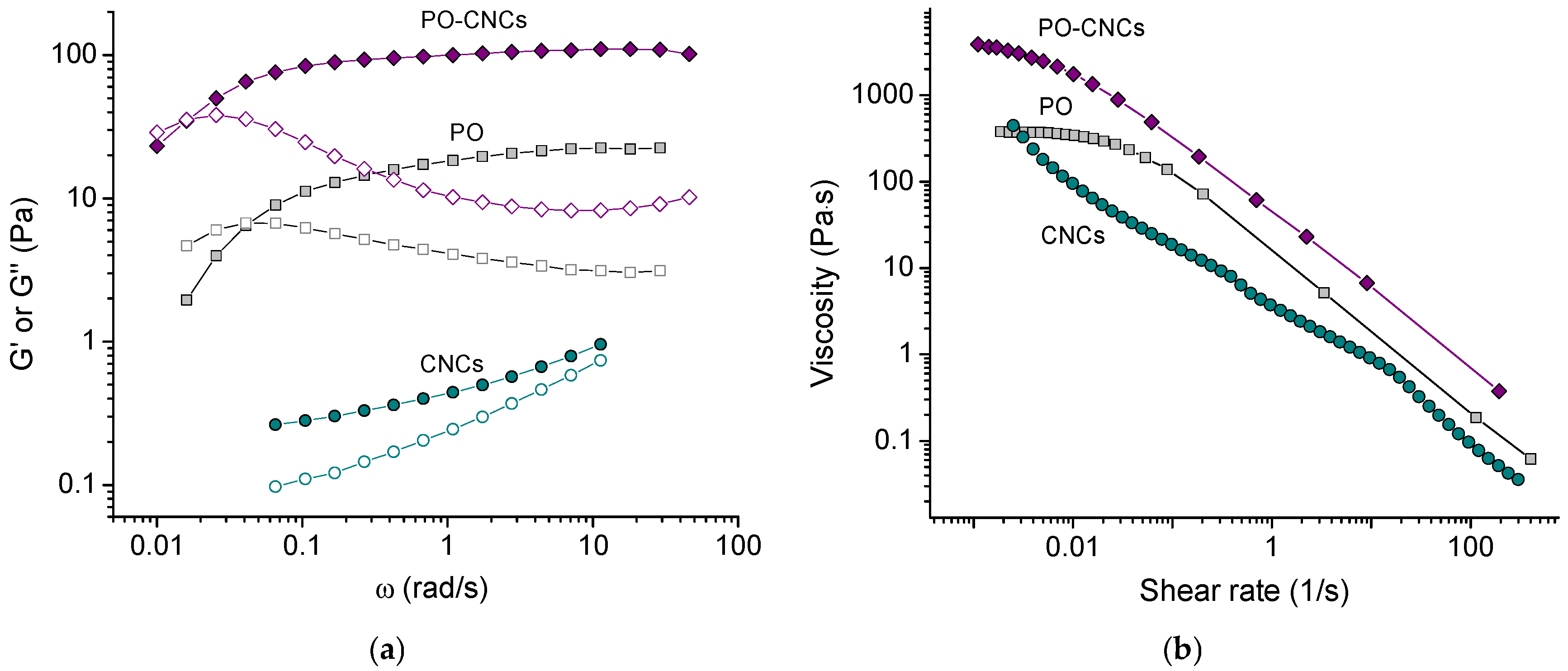
Frequency dependences of the storage and loss moduli were measured for WLM solution, CNC suspension, and their mixture (Figure 1a). For WLM solution, the frequency dependences of the storage G ( ω ) and loss G ( ω ) moduli typical for a semi-dilute WLM solutions were observed: in the high-frequency range, the elastic behavior predominated ( G   >   G ), whereas in the low-frequency region, the viscous behavior prevailed ( G   >   G ). The terminal relaxation time is equal to 25 s, as determined by the inverse frequency at the crossover point of G ( ω ) and G ( ω ) dependences. The G ( ω ) curve has a plateau (Figure 1a), which indicates a gel-like state of the system. From the value of the plateau modulus G 0   ( G 0 = 20 Pa) the mesh size of the pure surfactant network before the CNC addition can be determined as ξ = k T / G 0 1 / 3   ≈ 57 nm [45]. For a CNC-free PO solution, the average length of the WLMs, LWLM, was estimated using the following equations [46]:
G 0 k T ξ 3 = k T l e 9 / 5 l p 6 / 5     ,
L W L M l e = G 0 G m i n   ,
where l e is the entanglement length of the network, G m i n is the minimum value of the loss modulus and l p is the persistent length of WLMs, which is equal to 12.2 nm, according to the literature [47]. It was obtained that the entanglement length of the network l e   is 158 nm and the average length of WLMs L W L M is 1.2 µm.
Regarding the CNC suspension, it demonstrates elastic behavior ( G > G ) across the entire studied frequency range, indicating that it is above the gelation threshold [44,48]. But the percolated crystalline network is very weak so the storage G and loss G moduli have very small values and are highly frequency dependent (Figure 1a).
The addition of 2 wt% CNCs to the solution of PO WLMs results in a non-additive enhancement of the viscoelastic properties of the mixture (Figure 1a). For instance, at a frequency of 1 rad/s, the storage modulus G   of the PO-CNC mixture is 100 Pa, which is significantly higher than the sum of the G   values of its individual components (18.4 Pa for PO and 0.44 Pa for CNCs). Upon addition of 2 wt% CNCs, the plateau modulus G 0 increases by more than five times and the terminal relaxation time grows from 25 to 62 s, which indicates the strengthening of the micellar network due to the presence of CNCs. In the PO-CNC system, the synergistic enhancement of rheological properties can be attributed to the formation of additional elastically active elements. The concentration of elastically active chains can be estimated from the values of plateau moduli G 0 as G 0 / k T , where k is the Boltzmann constant. The calculations show that the concentration of elastically active elements increases from 4.6 × 10²¹ to 24.7 × 10²¹ 1/m3 upon the addition of ca. 8.1 × 10²¹ 1/m3 nanoparticles. This corresponds to the appearance of ca. 2.5 elastically active elements per one CNC. These elements can arise as a result of either the linking of WLMs to cellulose surface or the entanglements of WLMs with percolated CNCs. The formation of hydrogen bonds between the carboxylate groups of surfactant and the hydroxyl groups of cellulose was confirmed by FTIR-spectroscopy for rosin-based surfactant interacting with CNCs [10] and for sodium oleate interacting with cellulose nanofibrils [45]. Regarding the additional entanglements, they are also expected, since according to rheological data, both WLMs and CNCs form their own networks prior to mixing (Figure 1a), and the mesh size of the WLM network (57 nm) is much smaller than the average length of even individual CNCs (90 nm). A significant contribution of the WLM–polymer entanglements to the storage modulus was previously suggested for WLMs mixed with CNCs [11], cellulose nanofibrils [45] and other polymers [49].
Figure 1b shows the flow curves for the same samples. It is seen that before the addition of CNCs, the WLM solution behaves as viscoelastic liquid with zero-shear viscosity of 373 Pa·s, which indicates the formation of long micellar chains [37]. Viscosity dependence demonstrates a plateau at small shear rates followed by a shear thinning region at higher shear rates due to the aligning of the WLMs in response to the flow [50,51]. As to CNCs, their suspension shows shear-thinning behavior in the whole range of the shear rates. The flow curve of CNCs in 2.6 wt% KCl is similar to the two-slope viscosity profiles of CNC suspensions, reported in the literature [52,53]. The first slope at low shear rates is provided by the alignment of domains formed by several CNCs along the direction of flow. At high shear rates, these domains are disrupted, and the second slope is due to the alignment of individual CNC particles. After adding CNCs to the PO solution, the apparent viscosity at 0.005 s−1 increases by an order of magnitude compared to the sum of the viscosities of the individual components. Due to the influence of CNCs on the rheological properties of the mixture, a Newtonian plateau is not observed at low shear rates. This is consistent with the data reported for WLMs of a rosin-based surfactant mixed with cetyltrimethylammonium bromide after the addition of CNCs [10].
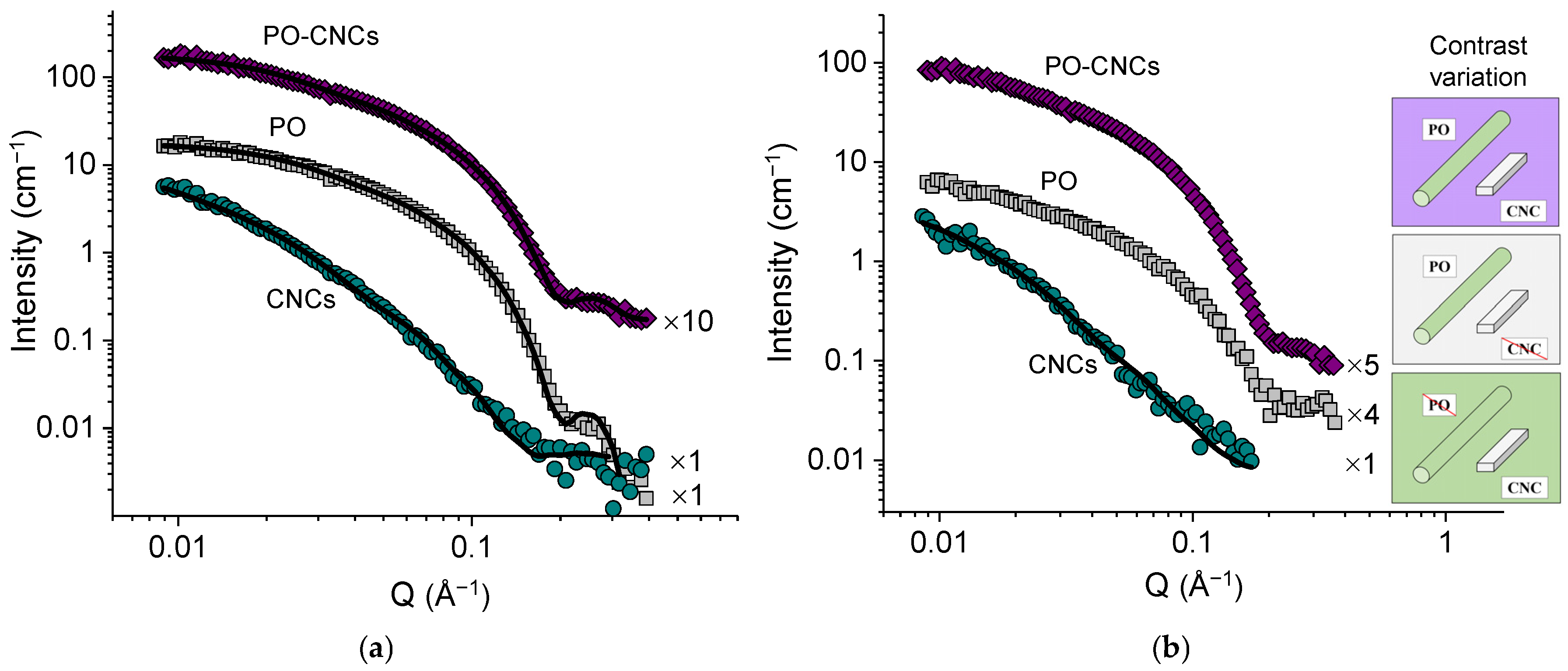
In order to analyze the impact of CNCs on the structure of micelles, the SANS profile of a PO-CNC mixture was compared to the profiles of its individual components: the PO solution and the CNC suspension (Figure 2a). The scattering curve of a 3 wt% PO solution in the presence of 2.6 wt% KCl can be fitted with a model of a solid cylinder with a radius of 1.9 nm, which is consistent with previously reported experimental data [10,24,37]. The CNC curve was modeled using a form factor of parallelepiped with dimensions 3.6 × 15.6 × 113 nm. The smallest size (3.6 nm) is close to the typical thickness of individual CNCs [44] and the largest size (113 nm) is comparable to their length. As to the width of the parallelepiped (15.6 nm), it is much larger than its thickness (3.6 nm), which can be explained by the side-by-side aggregation of a few individual crystals, as has been previously reported [54,55]. The SANS curve for a PO-CNCs suspension is similar to that of a PO solution. This is because the scattering from micelles is stronger due to the larger contrast between the surfactant and solvent, and it is therefore not possible to detect the contribution of CNCs. The curve of the PO-CNCs mixture can be well fitted with a cylinder model with the same radius (1.9 nm) as in a pure surfactant solution, indicating that upon addition of CNCs, the micelle structure remains intact on a nanoscale level.
To investigate the scattering from different components of the PO-CNCs mixture, the contrast variation was applied (Figure 2b). In the two-component PO-CNCs system, three different conditions for neutron contrasts were used: 100% D2O/0% H2O (both components are visible), 35% D2O/65% H2O (CNCs are matched, PO micelles are visible) and 10% D2O/90% H2O (PO micelles are matched, CNCs are visible). Since the scattering from CNCs is less intense than that from PO, the first two curves are similar and can be well-fitted with a form-factor of a cylinder with a cross-section radius of 1.9 nm. When the solvent matches the PO (Figure 2b), the SANS profile is close to that of a pure CNC suspension and can be fitted with a parallelepiped form factor with the same dimensions of 3.5 × 15.9 × 112 nm. This means that the crystals in the mixture are in the same state as in their own pure suspension, and do not additionally aggregate with each other. Also, they do not violate the structure of the WLMs at the nanoscale level.
Thus, the incorporation of a CNC-percolated network into the network of entangled WLMs leads to a significant enhancement of viscoelastic properties, while the local structure of each of the components is preserved within the mixed system PO-CNCs.

3.2. pH-Responsiveness

Both components of PO-CNC system are expected to be sensitive to pH, as they contain weak acid groups C O O . The pH-responsiveness of the mixed system and its components was investigated by gradually adding a 1 M HCl solution to an initial solution with a pH of 10.5.
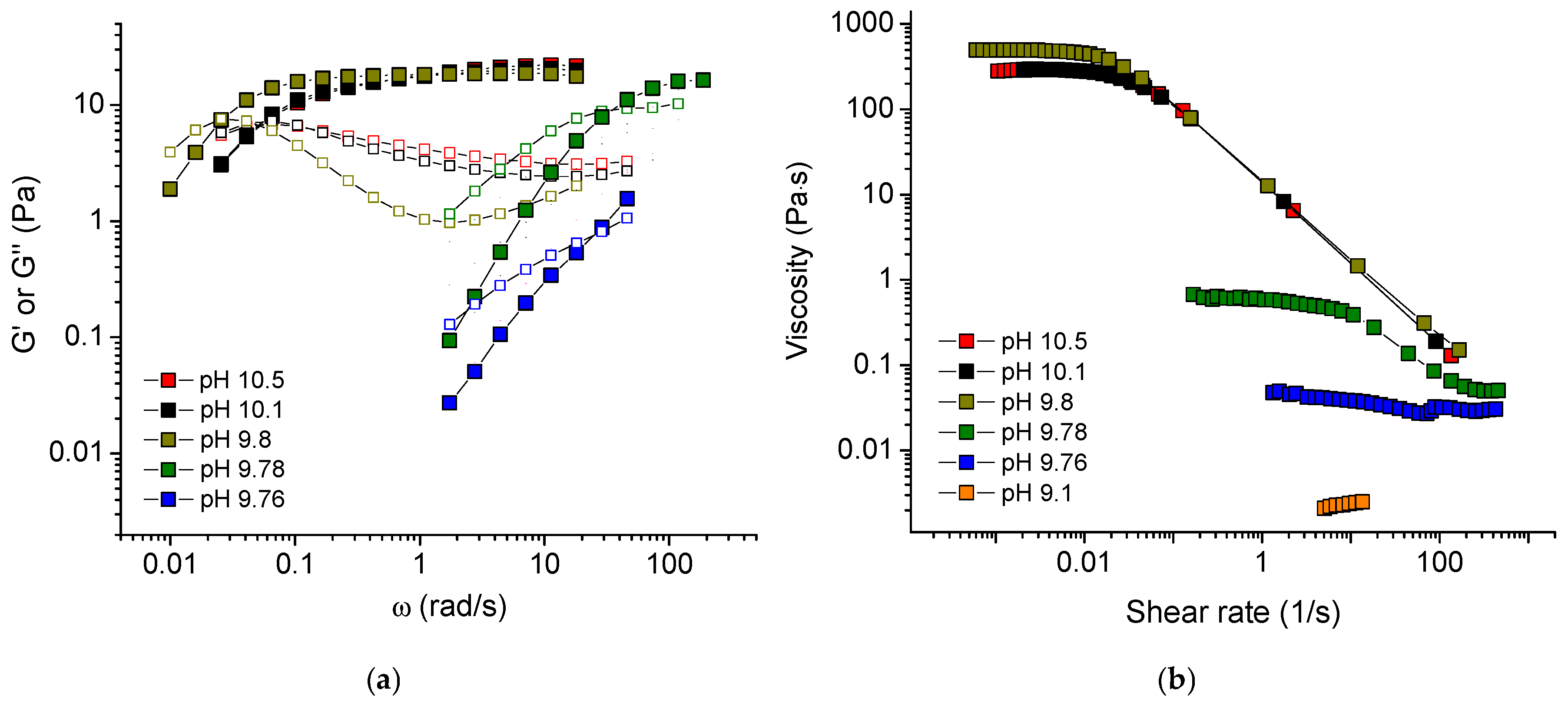
Figure 3a shows the frequency dependences of the storage G   and loss moduli G of PO solutions at different pH values. At pH > 9.8 , the storage modulus is higher than the loss modulus over a wide range of frequencies, and has a broad plateau, indicating the presence of a transient network of entangled WLMs [56,57,58,59]. The flow curves of the PO solutions at pH >   9.8 confirm the formation of WLMs. In the region of low shear rates, a Newtonian plateau is observed, while at rates around 0.03 s−1 shear thinning starts due to the alignment of micelles along the flow [58,59].
Figure 3a shows that the plateau modulus G0 remains constant over the whole pH range from 10.5 to 9.8. However, the crossover point of G ( ω ) and G ( ω ) being the same at pH 10.5 and 10.1 shifts to lower frequencies, when pH approaches 9.8. It corresponds to an increase in the longest relaxation time from 25 to 39 s when passing from pH 10.1 to 9.8. Simultaneously, the viscosity increases (Figure 3b). This behavior can be attributed to the increase in the length of WLMs. Indeed, the estimation of the contour length of WLMs using Equations (1) and (2) shows that the contour length of WLMs increases from 1.2 to 3.4 µm when pH decreases from 10.1 to 9.8. The growth of WLMs in length can be attributed to a decrease in their charge due to protonation of carboxylate groups. This reduces the repulsion between the head groups, thereby decreasing the equilibrium area occupied by each surfactant molecule at the surface of the aggregates ae and therefore, increasing the packing parameter P [60]:
P = v a e l
Here, v and l are the volume and the length of the hydrophobic tail. This makes the central, cylindrical fragments of the WLMs, with more tight packing of surfactant (⅓ < P ≤ ½), more favorable than the semi-spherical endcaps ( P ≤ ⅓). The selected ionic strength of the PO solutions is lower than the value corresponding to the highest elastic and viscous properties of these solutions [24]. This means that there is still the possibility of the micellar worm growth with the change in the effective area per surfactant head group.
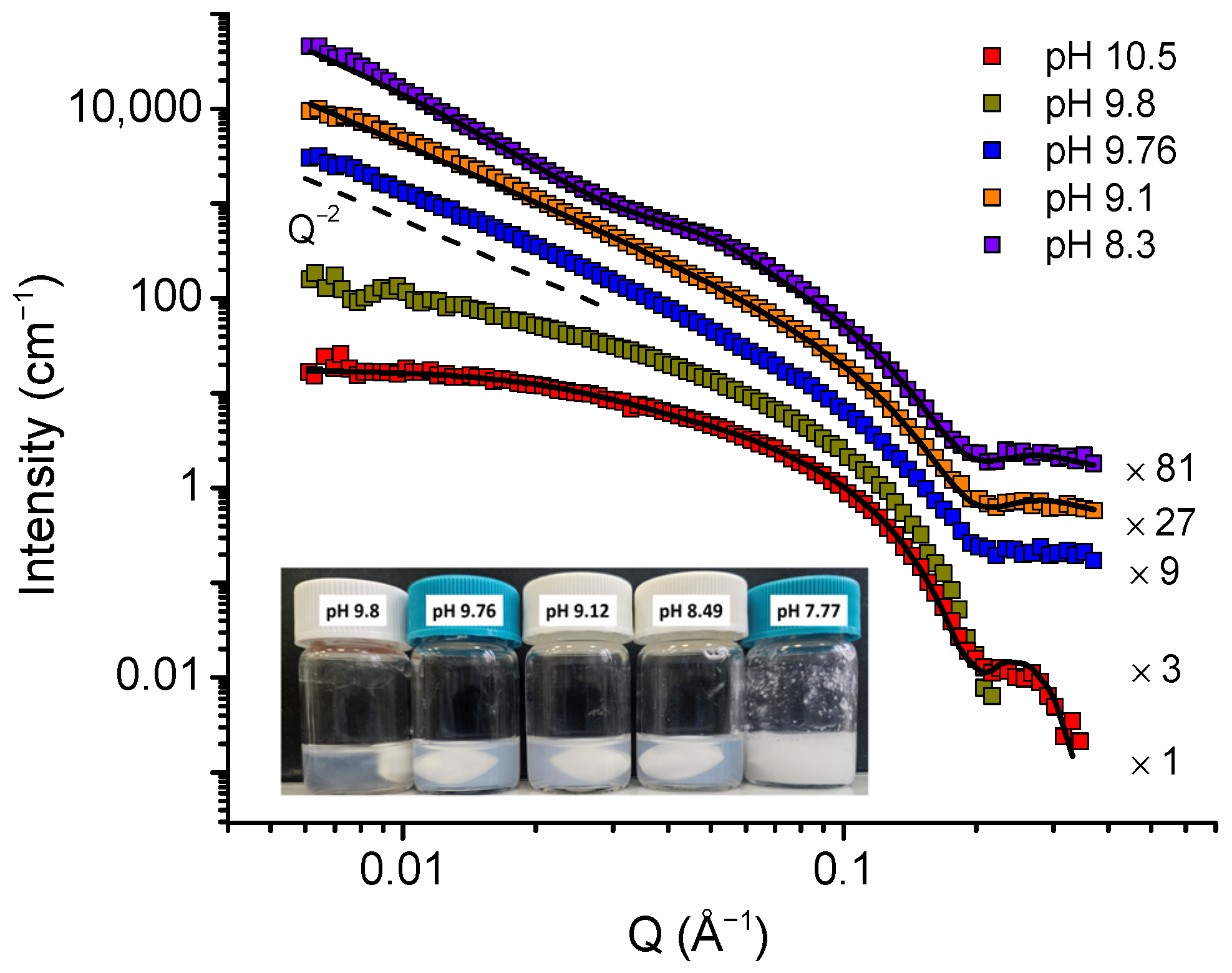
Between pH values of 9.8 and 9.78, the behavior of PO solutions changes drastically. The solutions become opalescent (Figure 4, inset) and significantly less viscous. The crossover point of G ( ω ) and G ( ω ) strongly shifts to higher frequencies, meaning a decrease in the longest relaxation time from 39 to 0.03 s, which suggests a significant shortening of surfactant aggregates. Simultaneously, the viscosity drops by 2.5 orders of magnitude (Figure 3b). Further lowering the pH from 9.78 to 9.76 does not affect the relaxation time, but significantly reduces the storage G and loss G moduli (Figure 3a) and the viscosity (Figure 3b). A subsequent decrease in pH results in a continuous reduction of G and G and, eventually, leads to the disappearance of elastic response at pH 9.1. At this pH, the viscosity reaches the values close to water (Figure 3b). The observed behavior is related to further protonation of the head groups of the surfactant [41,61]. According to the previous works [62], protonation, which reduces the charge on the surface of micelles and therefore the equilibrium area occupied by each surfactant molecule at the surface of the aggregates ae, leads to an increase in the packing parameter P (Equation (3)). This increase is so pronounced that the packing parameter P attains values typical for lamellar structures (½ < P ≤ 1), rather than cylindrical ones (⅓ < P ≤ ½). As a result, WLMs transform into vesicles.
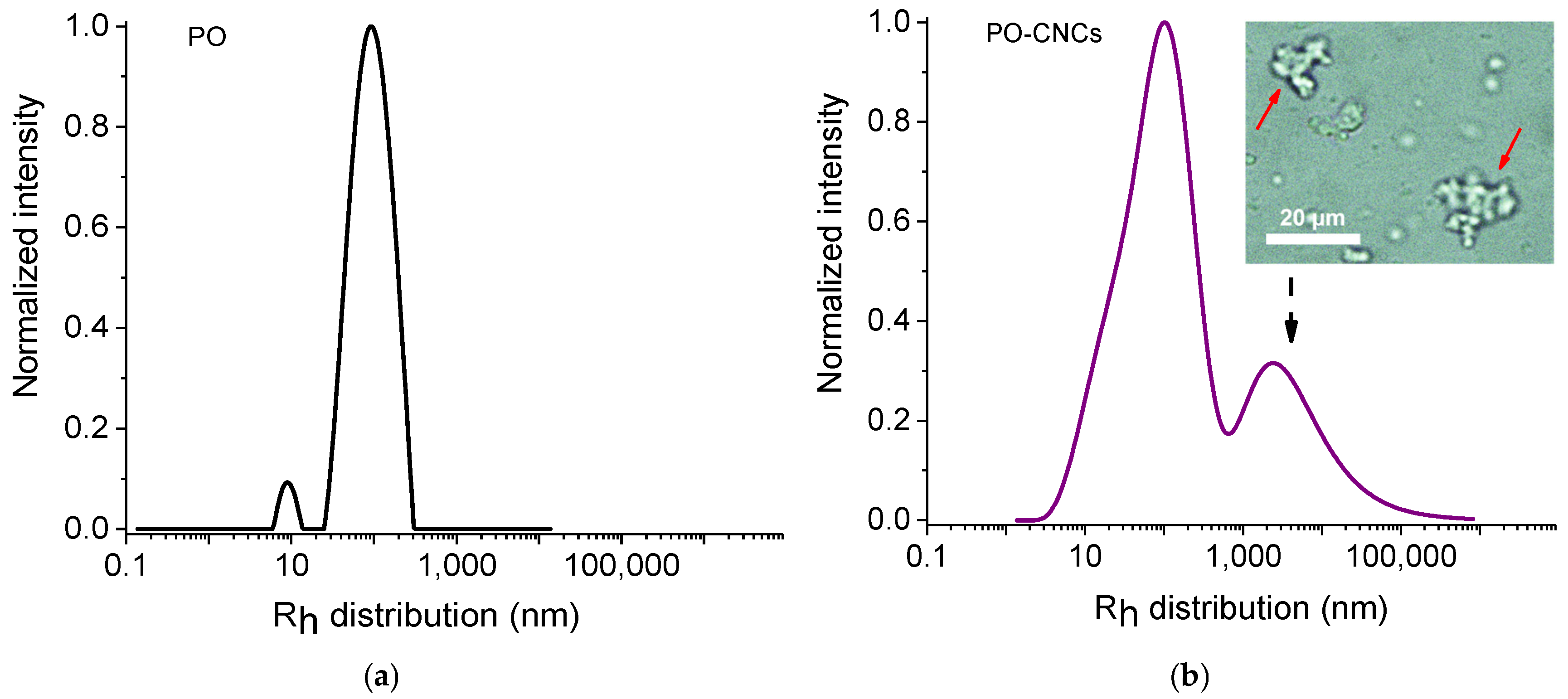
To check this suggestion, the structural studies were performed by SANS (Figure 4). At pH = 10.5, the scattering curve is well fitted with a form-factor of a cylinder with a radius of 1.9 nm, which corresponds to the cross-sectional radius of the PO WLMs [47]. The curves change significantly as pH decreases. At pH values of 9.76 and 9.1, one can observe a Q 2 scaling at low scattering vectors, which is characteristic of bilayer structures (Figure 4). At pH = 9.1, when the viscosity becomes close to that of pure water, the scattering form-factor corresponds to the model of unilamellar vesicles with a thickness of 3.0 nm, suggesting that the transition to vesicles is completed. The radius of these vesicles is too large to be determined using SANS data. Dynamic light scattering measurements indicate that it is of ca. 90 nm (Figure 5a). Under these conditions, approximately 20% of the surfactant molecules are protonated, according to the potentiometric titration results [43,63,64]. At pH = 8.3, when the degree of protonation reaches 30 mol% [43,63], oligolamellar vesicles begin to form, as indicated by the appearance of a scattering peak that corresponds to the average distance between the lamellae within a single vesicle [65]. The SANS profile of PO solution at pH = 8.3 was modeled with a paracrystal lamellar model [66], which yielded an average interlamellar distance of 10.7 nm, a number of bilayers within a single aggregate of 1.3, and an individual lamella thickness of 3.1 nm. The individual lamella thickness is smaller than twice the total extended length of the surfactant (2 × 1.9 nm = 3.8 nm). This may indicate that the hydrophobic tails in the bilayer are not fully stretched, thus gaining in their conformational entropy [66,67]. Similar behavior was previously observed for vesicles composed of the mixture of anionic surfactant sodium dodecyl sulfate and cationic surfactant dodecyltrimethylammonium bromide [67]. The formation of oligolamellar vesicles instead of unilamellar ones, at decreasing pH can be attributed to the reduced electrostatic charge of the head groups due to their protonation [68]. These results are consistent with literature data [62], which show that at pH = 8.5, oleate vesicles are polydisperse in size and lamellarity. At the same time, the low number of bilayers per vesicle (1.3) suggests that most vesicles are still unilamellar. Thus, the high pH-responsiveness of the PO solution is due to the transformation of WLMs into vesicles induced by a decrease in pH, which reduces the charge density of the surfactant aggregates as a result of the protonation of carboxylate groups.
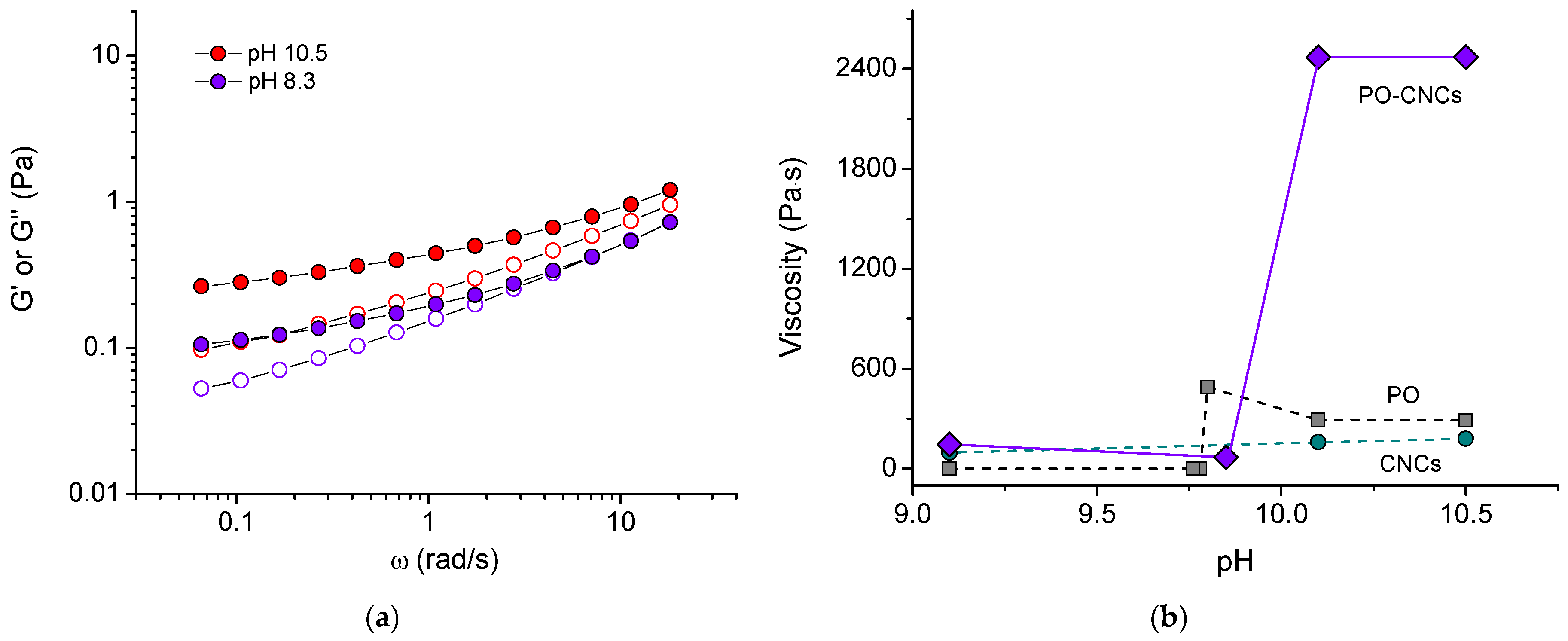
Carboxymethylated CNCs should also possess pH-responsive properties due to the protonation of carboxylate groups. But the p K a of these groups is 3.7 [44], which is much lower than the pH range under study. This indicates that, in our experiments, the CNC particles are always fully deprotonated, and therefore, their properties are expected to be resistant to the variation in pH within the range we studied. Indeed, the dynamic (Figure 6a) and steady-shear (Figure 6b) rheological data show very small changes in the behavior of the CNC suspension when the pH is varied in the alkaline region.
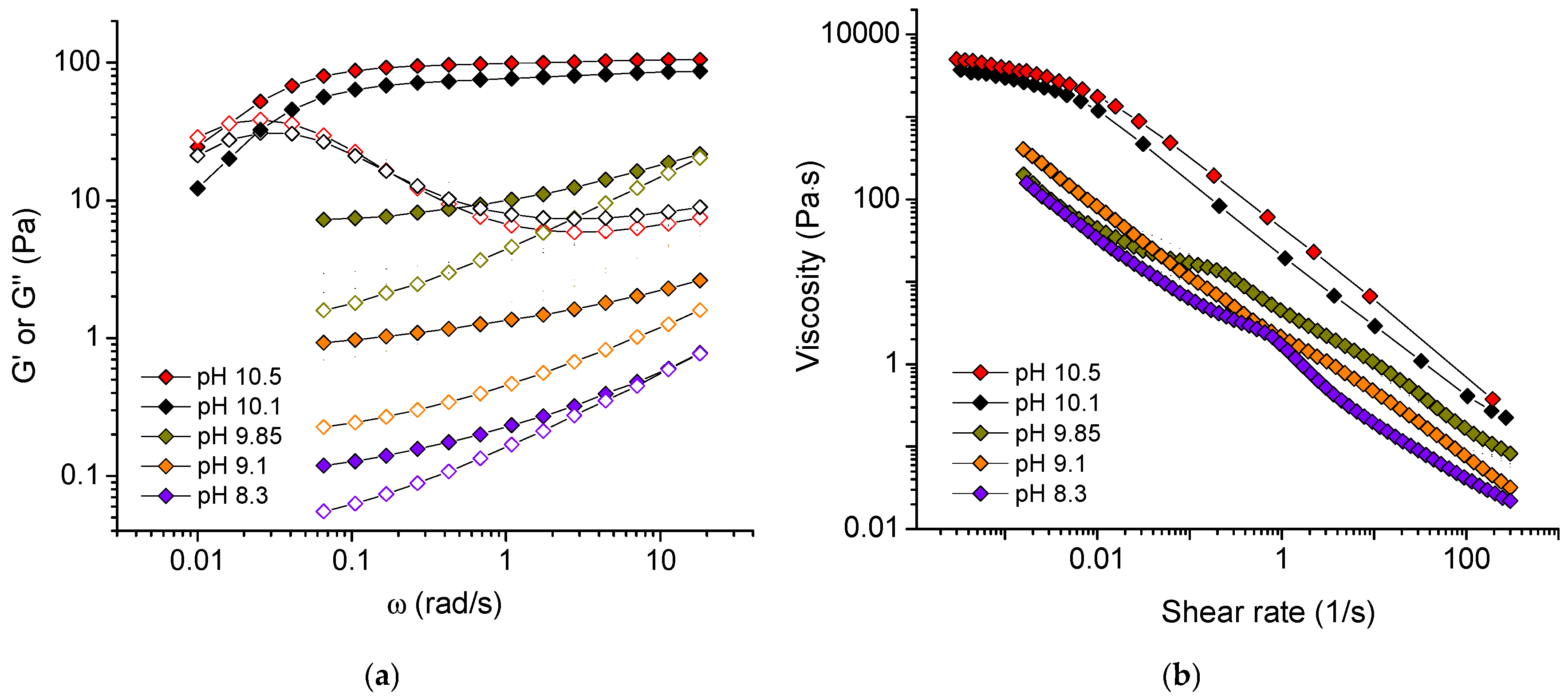
Figure 7a shows the frequency dependences of the storage G   and loss G moduli of the PO-CNC suspensions at different pH values. It is seen that at decreasing pH, the dynamic moduli decrease. At pH < 9.85, the dynamic spectra become similar to the spectra of pure CNCs, which means that at this point the viscoelastic response of nanocrystals prevails over the response from partially destructed micelles. In a way, the CNCs act as a supporting skeleton when the micellar network breaks down. At pH = 8.3, the frequency dependences G ( ω ) and G ( ω ) coincide with those of pure CNCs, indicating that the presence of vesicles has no effect on the rheological properties of the final PO-CNC mixture.
Figure 7b demonstrates that at pH values below 10.1, the plateau at low shear rates disappears and the shear-thinning behavior is observed in a whole range of shear rates studied. This is most likely due to the increasing contribution of CNCs to the viscosity of the mixture. Viscosity decreases with decreasing pH and at pH = 8.3, the flow curve for the PO-CNC suspension matches the flow curve of pure CNCs.
Overall, for the mixed PO-CNC suspension a small decrease in pH from 10.1 to 9.8 induces a very pronounced and sharp drop of viscosity with a much larger amplitude than for pure PO solution (Figure 6b). The threshold pH for PO-CNC suspension is slightly shifted to alkaline medium as compared to pure PO solution. It may indicate that CNCs promote the formation of vesicles by stabilizing them.
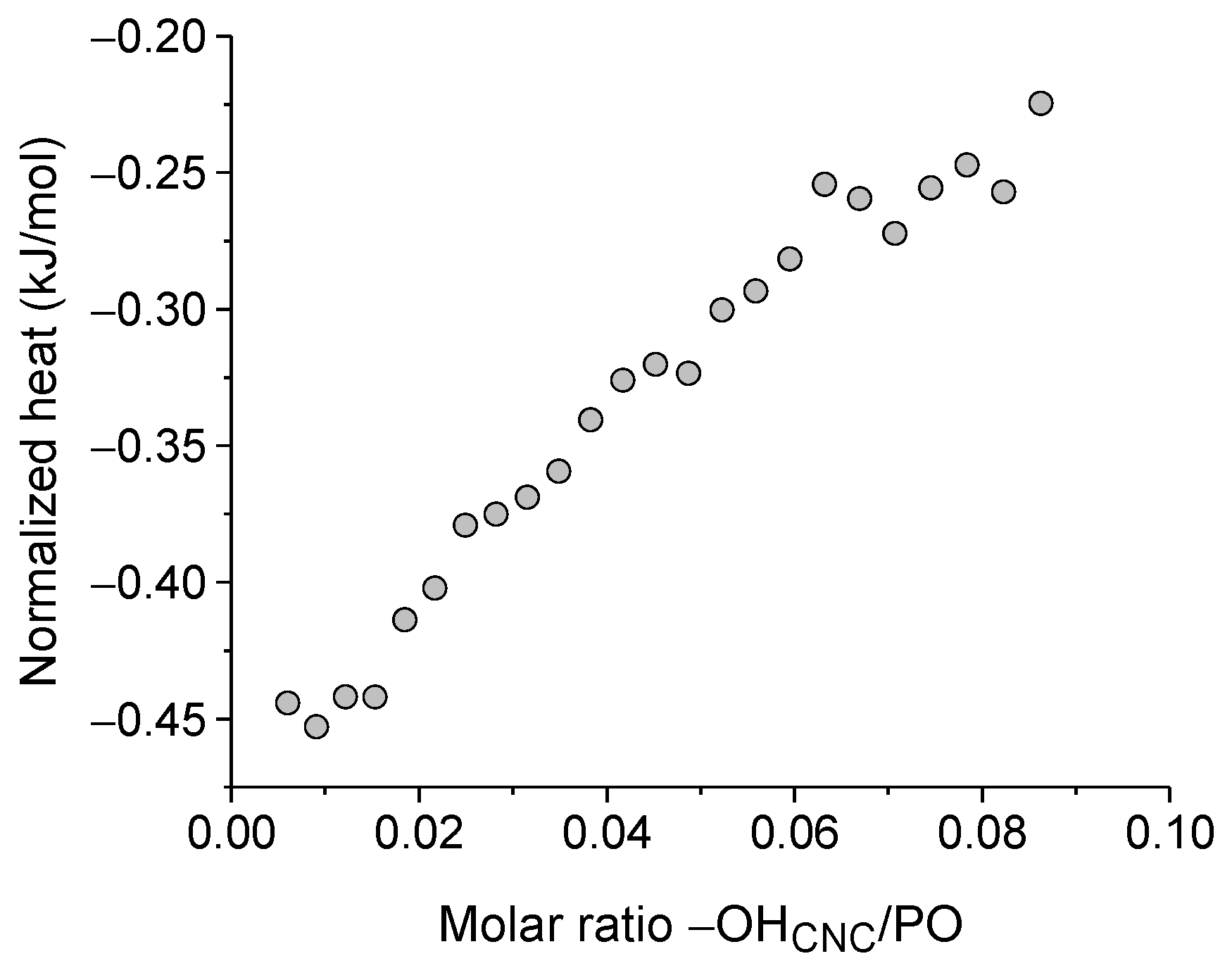
To reveal the driving forces behind the interaction between PO vesicles and CNCs and to estimate the thermodynamic characteristics of this interaction, ITC was used. Thermodynamic profile of isothermal titration of PO vesicles with CNCs corrected by subtracting the heat of dilution is presented in Figure 8. It shows that the interaction between PO vesicles and CNCs is exothermic. The thermodynamic parameters obtained from the fitting of the thermodynamic profile (Figure 8) with the independent binding site model are: the change in Gibbs free energy ΔG = −26 kJ/mol, the change in enthalpy ∆H = −0.45 kJ/mol, the change in entropy ∆S = 87 J/mol∙K, and the association constant Ka = 4 × 10⁴ M−1. The negative change in Gibbs free energy ΔG (ΔG < 0) means that the PO-CNC interaction proceeds spontaneously [69]. The negative values of enthalpy changes ΔH (ΔH < 0) and positive values of entropy changes ΔS (ΔS > 0) suggest that the PO-CNC interaction is governed by the gain of both enthalpy and entropy: ΔG = ΔH − TΔS. Similar behavior was observed for micelles of cationic surfactant cetyltrimethylammonium bromide interacting with similarly charged nanoparticles [70]. The negative enthalpy can be attributed to hydrogen bonding between PO and CNCs [71]. This is supported by FTIR data that evidence the participation of the -OH groups of cellulose nanofibrils and the -C=O groups of sodium oleate in hydrogen bonding [45]. Note that at pH 8.3, where 30% of the carboxylate groups are protonated [43,63], one can also expect the formation of hydrogen bonds between the -COOH groups of PO and the oxygen atoms of CNCs. As to the positive entropy, it can be due to the release of water molecules from the hydration shells of interacting species. This could be an indication of hydrophobic interactions [72]. Endcaps of CNCs can be involved in these interactions as they were shown [38,39] to possess hydrophobic surface ((200) plane edge) mainly composed of CH groups.
Thus, the ITC data suggest that the binding of CNCs to PO vesicles is governed by the gain of both enthalpy and entropy. This may be due to hydrogen bonding and hydrophobic interactions.
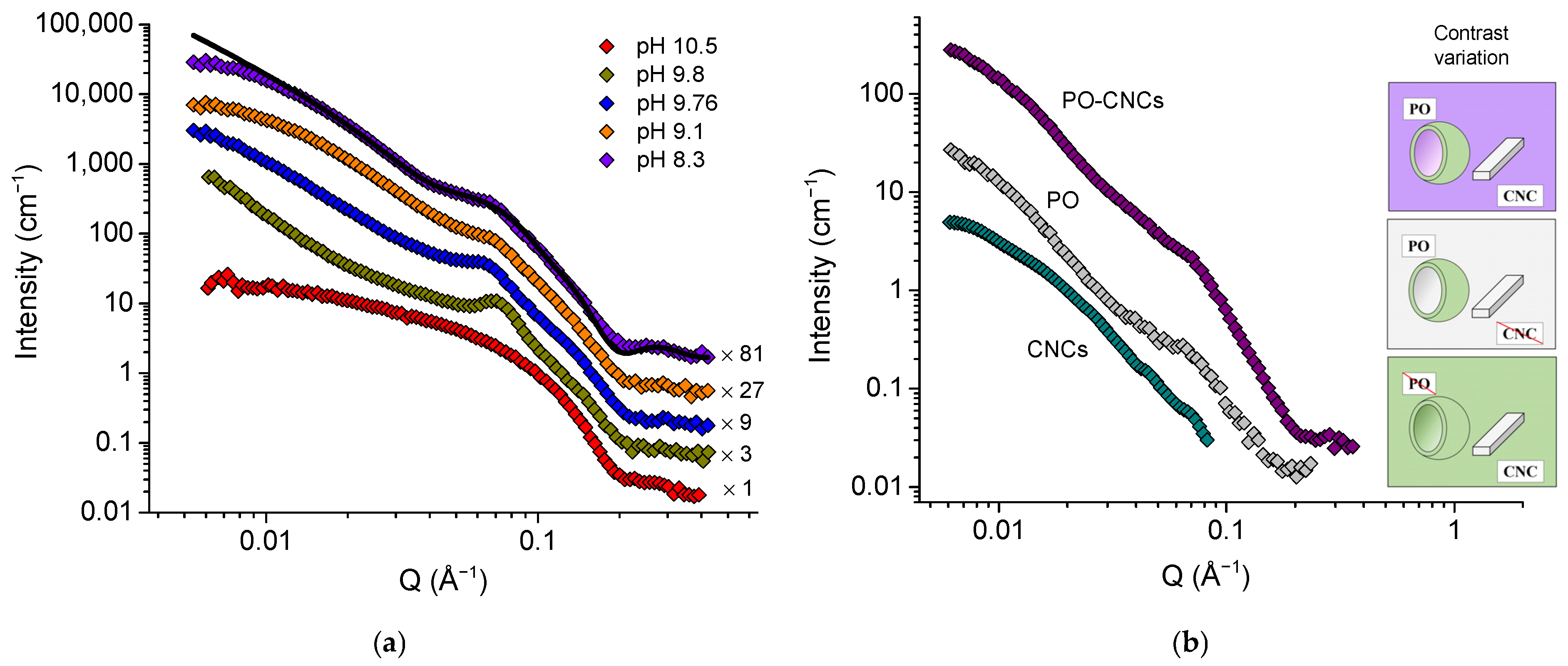
In order to analyze the structural changes in the PO-CNCs mixture at the decrease in pH, the SANS curves obtained at different pH were analyzed (Figure 9a). At pH = 10.5, the scattering pattern is the same as for pure PO solution (cf. Figure 4 and Figure 9a) indicating the presence of long WLMs. No pronounced effect of CNCs is observed because of their lower contrast as compared to micelles. At pH = 9.8, the SANS curves noticeably differ from those of individual components of the mixture. At pH = 9.8, a structure peak at Q   = 0.065 Å 1 appears, indicating the presence of oligolamellar vesicles. At large Q values ( Q > 0.01 Å 1 ) , the SANS curve is well fitted with form-factor of paracrystal lamella with an average interlamellar distance of 7.8 nm, a number of bilayers per vesicle of 1.3, and an individual lamella thickness of 2.9 nm. The left part of the curve is not fitted well within this model, since the sheets in the paracrystal lamella model have infinite size, which is not the case for vesicles being studied. At the same time, in a pure PO solution at this pH, the SANS curve indicates the presence of WLMs, rather than vesicles. This observation confirms the rheological data which show that WLM-to-vesicle transition in PO-CNC suspension occurs at higher pH values than for pure PO (Figure 6b). At pH = 8.3, when the WLM-to-vesicle transition is completed for both PO-CNC and PO systems, the SANS profiles in both systems become close to each other, indicating that the microstructure of vesicles is only slightly affected by the presence of CNCs. According to the best fits of SANS profiles, the shell thickness of the vesicles is almost the same with and without CNCs: 2.9 and 3.1 nm, respectively. At the same time, in the presence of CNCs, the average interlayer distance is somewhat shorter—7.8 nm instead of 10.7 nm for pure PO. Dynamic light scattering and optical microscopy data show that CNCs do not significantly affect the average diameter of the vesicles, but they do induce the aggregation of some vesicles (Figure 5b). This may be due to the interaction between CNCs and few adjacent vesicles simultaneously. The aggregates of vesicles, in which CNCs are located between the individual vesicles linking them together, were recently visualized by cryo-TEM for zwitterionic lipid 1,2-dioleoyl-sn-glycero-3-phosphatidylcholine and negatively charged CNCs [73]. The aggregates are formed at pH 3, when the vesicles and the nanocrystals have opposite charges, but they are not observed at pH 7, when the vesicles and nanocrystals are similarly charged. In contrast, in the PO-CNC system under study, CNCs promote the aggregates of vesicles even when they are likely charged. This may be due to the reduced charge of the vesicles because of partial protonation of PO, which weakens electrostatic repulsion and promotes hydrogen bonding and hydrophobic interactions.
The structure of CNCs within the PO-CNC suspension can only be evaluated by contrast variation, as they scatter much less than PO. The contrast variation was conducted for the sample at pH 9.1 (Figure 9b). When PO is matched, the SANS curve of the PO-CNC mixture is close to the pure CNC scattering curve, which means that the CNCs retain their local structure unchanged during the pH variation.
Thus, structural studies evidence that the drop of viscosity is due to the transformation of WLMs into vesicles, and the CNCs facilitate this process because it occurs at a higher pH than in a pure PO solution.

4. Conclusions

pH-Responsive surfactant-based soft nanocomposites with enhanced rheological properties were developed. They are formed by WLMs of a surfactant, PO, with pH-triggered charge of head groups and eco-friendly crystalline nanoparticles CNCs at the conditions when both WLMs and CNCs can form their own network in the mixed system. These soft nanocomposites undergo a drastic drop of viscosity by 2000 Pa·s in a narrow range of pH values, decreasing from 10.1 to 9.8. The magnitude of the viscosity reduction is much greater than in the absence of the CNC filler (490 Pa·s). This is due to the enhancement of the initial viscosity by CNCs, which can be attributed to the formation of additional elastically active elements as a result of the interaction between WLMs and the CNC surface or the entanglements of WLMs with percolated CNCs. SANS data evidenced that a sudden drop of viscosity at decreasing pH is caused by the transformation of WLMs into vesicles. This occurs because of the protonation of the carboxylate groups of surfactant, which reduces the electrostatic repulsion between the head groups on the surface of micelles. The elaborated nanocomposites with controlled, stimuli-responsive rheological properties have the potential for a variety of applications where the regulation of properties by pH is required. This also applies to currently widely used CO2-switchable systems, as the bubbling of CO2 lowers the pH [26].

Author Contributions

Conceptualization, V.S.M.; formal analysis, M.M.A., V.S.M. and O.E.P.; investigation, M.M.A. and A.I.K.; writing—original draft preparation, M.M.A. and O.E.P.; writing—review and editing, M.M.A. and O.E.P.; supervision, O.E.P. All authors have read and agreed to the published version of the manuscript.

Funding

The study was conducted under the state assignment of Lomonosov Moscow State University.

Institutional Review Board Statement

Not applicable.

Data Availability Statement

Data is contained within the article. Further inquiries can be directed to the corresponding author.

Acknowledgments

ITC measurements were performed using a Nano ITC microcalorimeter, which was purchased with support from M.V. Lomonosov Moscow State University Program of Development. The authors are grateful to A.S. Ospennikov for his help in optical microscopy measurements.

Conflicts of Interest

The authors declare no conflicts of interest.

Abbreviations

The following abbreviations are used in this manuscript:
CNCsCellulose nanocrystals
FTIRFourier transform infrared spectroscopy
ITCIsothermal titration calorimetry
POPotassium oleate
SANSSmall-angle neutron scattering
SLDScattering length density
WLMsWormlike micelles

References

  1. Thomas, B.; Raj, M.C.; Athira, K.B.; Rubiyah, M.H.; Joy, J.; Moores, A.; Drisko, G.L.; Sanchez, C. Nanocellulose, a versatile green platform: From biosources to materials and their applications. Chem. Rev. 2018, 118, 11575–11625. [Google Scholar] [CrossRef] [PubMed]
  2. Trache, D.; Tarchoun, A.F.; Derradji, M.; Hamidon, T.S.; Masruchin, N.; Brosse, N.; Hussin, M.H. Nanocellulose: From fundamentals to advanced applications. Front. Chem. 2020, 8, 392. [Google Scholar] [CrossRef]
  3. Aziz, T.; Rohullah; Ullah, T.; Zeb, U.; Hussain, M.; Ali, A.; Haq, F.; Kiran, M. Advancements in cellulose nanocrystals: A review of functionalization, applications, and challenges. Int. J. Biol. Macromol. 2025, 315, 144552. [Google Scholar] [CrossRef]
  4. Li, Z.; Soto, M.A.; Drummond, J.G.; Martinez, D.M.; Hamad, W.Y.; MacLachlan, M.J. Cellulose nanocrystal gels with tunable mechanical properties from hybrid thermal strategies. ACS Appl. Mater. Interfaces 2023, 15, 8406–8414. [Google Scholar] [CrossRef] [PubMed]
  5. Naz, S.; Ali, J.S.; Zia, M. Nanocellulose isolation characterization and applications: A journey from non-remedial to biomedical claims. Biodesign Manuf. 2019, 2, 187–212. [Google Scholar] [CrossRef]
  6. Veloso, S.R.S.; Azevedo, A.G.; Teixeira, P.F.; Fernandes, C.B.P. Cellulose nanocrystal (CNC) gels: A review. Gels 2023, 9, 574. [Google Scholar] [CrossRef]
  7. Shojaeiarani, J.; Bajwa, D.S.; Chanda, S. Cellulose nanocrystal based composites: A review. Compos. Part C. Open. Access 2021, 5, 100164. [Google Scholar] [CrossRef]
  8. Ospennikov, A.S.; Shibaev, A.V.; Chesnokov, Y.M.; Samokhin, A.S.; Leontiev, N.V.; Evdokimov, P.V.; Kuklin, A.I.; Philippova, O.E. 3D-printable bio-sourced nanocomposite hydrogels based on two polysaccharide components: Hydroxypropyl guar macromolecules and cellulose nanocrystals. J. Colloid Interface Sci. 2026, 702, 138836. [Google Scholar] [CrossRef]
  9. Yang, L.; Zhang, S.; Hu, Z.; Li, J.; Xie, G. Cellulose nanocrystal-reinforced thermally responsive dynamic hydrogel. New J. Chem. 2024, 48, 17865. [Google Scholar] [CrossRef]
  10. Ye, S.; Zhai, Z.; Song, Z.; Shang, S.; Song, B. Cellulose nanocrystals enhanced viscoelasticity and temperature resistance of rosin-based wormlike micelles: Inducing the formation of hydrogels. J. Mol. Liq. 2023, 377, 121527. [Google Scholar] [CrossRef]
  11. Zhang, C.P.; Chen, H.; Zhou, J.; Zhou, J.P.; Ranjith, P.G. Experimental study of the rheology of cellulose nanocrystals-enhanced C22-tailed zwitterionic wormlike micelles. J. Mol. Liq. 2023, 378, 121648. [Google Scholar] [CrossRef]
  12. Shibaev, A.V.; Osiptsov, A.A.; Philippova, O.E. Novel trends in the development of surfactant-based hydraulic fracturing fluids: A review. Gels 2021, 7, 258. [Google Scholar] [CrossRef]
  13. Chu, Z.; Dreiss, C.A.; Feng, Y. Smart wormlike micelles. Chem. Soc. Rev. 2013, 42, 7174. [Google Scholar] [CrossRef]
  14. Feng, Y.; Chu, Z.; Dreiss, C.A. pH-responsive wormlike micelles. In Smart Wormlike Micelles; SpringerBriefs in Molecular Science; Springer: Berlin/Heidelberg, Germany, 2015; p. 41. [Google Scholar] [CrossRef]
  15. Chu, Z.; Feng, Y. pH-switchable wormlike micelles. Chem. Commun. 2010, 46, 9028. [Google Scholar] [CrossRef] [PubMed]
  16. Zhang, Y.; Han, Y.; Chu, Z.; He, S.; Zhang, J.; Feng, Y. Thermally induced structural transitions from fluids to hydrogels with pH-switchable anionic wormlike micelles. J. Colloid Interface Sci. 2013, 394, 319–328. [Google Scholar] [CrossRef]
  17. Kang, W.; Zhao, Y.; Wang, P.; Li, Z.; Hou, X.; Huang, Z.; Yang, H. Rheological behavior and mechanism of pH-responsive wormlike micelle variations induced by isomers of phthalic acid. Soft Matter 2018, 14, 4445–4452. [Google Scholar] [CrossRef]
  18. Lv, D.; Liu, Q.; Wu, H.; Cheng, Y.; Wang, C.; Yin, B.; Wei, X.; Li, J. A pH, thermal and light triple-stimuli responsive micellar solution formed by a cationic surfactant and trans-o-hydroxycinnamic acid. Soft Matter 2021, 17, 9210. [Google Scholar] [CrossRef]
  19. Du, A.; Li, W.; Zeng, L.; Peng, Y.; Li, B.; Mao, J.; Wang, D. pH-responsive wormlike micelles formed by an anionic surfactant derived from erucic acid. J. Mol. Liq. 2023, 390, 123062. [Google Scholar] [CrossRef]
  20. Jora, M.Z.; de Souza, R.N.; Barbosa, M.S.; Speglich, C.; Sabadini, E. Rheological modulation of a pH-responsive wormlike micelle driven by charge and cosurfactant. J. Mol. Liq. 2024, 400, 124512. [Google Scholar] [CrossRef]
  21. Oh, H.; Ketner, A.M.; Heymann, R.; Kesselman, E.; Danino, D.; Falvey, D.E.; Raghavan, S.R. A simple route to fluids with photo-switchable viscosities based on a reversible transition between vesicles and wormlike micelles. Soft Matter 2013, 9, 5025. [Google Scholar] [CrossRef]
  22. Patel, T.; Jain, M.; Kumar, S.; Kasoju, N.; Kumar, S.; Aswal, V.K.; El Seoud, O.; Malek, N. Light responsive microstructural transitions in photo-responsive wormlike micelle mediated viscoelastic material based on cationic surfactant and photo-responsive organic acids. J. Mol. Liq. 2024, 394, 123798. [Google Scholar] [CrossRef]
  23. Molchanov, V.S.; Kuklin, A.I.; Orekhov, A.S.; Arkharova, N.A.; Philippova, O.E. Temporally persistent networks of long-lived mixed wormlike micelles of zwitterionic and anionic surfactants. J. Mol. Liq. 2021, 342, 116955. [Google Scholar] [CrossRef]
  24. Molchanov, V.S.; Philippova, O.E.; Khokhlov, A.R.; Kovalev, Y.A.; Kuklin, A.I. Self-assembled networks highly responsive to hydrocarbons. Langmuir 2007, 23, 105–111. [Google Scholar] [CrossRef]
  25. Shibaev, A.V.; Tamm, M.V.; Molchanov, V.S.; Rogachev, A.V.; Kuklin, A.I.; Dormidontova, E.E.; Philippova, O.E. How a viscoelastic solution of wormlike micelles transforms into a microemulsion upon absorption of hydrocarbon: New insight. Langmuir 2014, 30, 3705–3714. [Google Scholar] [CrossRef] [PubMed]
  26. Dowlati, S.; Mokhtari, R.; Hohl, L.; Miller, R.; Kraume, M. Advances in CO2-switchable surfactants towards the fabrication and application of responsive colloids. Adv. Colloid Interface Sci. 2023, 315, 102907. [Google Scholar] [CrossRef] [PubMed]
  27. Potassium Oleate: An Unknown Hero in Modern Industry. Available online: https://www.rboschco.com/industry-news/potassium-oleate-an-unknown-hero-in-modern-industry/ (accessed on 7 March 2026).
  28. Kuklin, A.I.; Ivankov, O.I.; Rogachev, A.V.; Soloviov, D.V.; Islamov, A.K.; Skoi, V.V.; Kovalev, Y.S.; Vlasov, A.V.; Ryzhykau, Y.L.; Soloviev, A.G.; et al. Small-angle neutron scattering at the pulsed reactor IBR-2: Current status and prospects. Crystallogr. Rep. 2021, 66, 231–241. [Google Scholar] [CrossRef]
  29. Soloviev, A.G.; Solovjeva, T.M.; Ivankov, O.I.; Soloviov, D.V.; Rogachev, A.V.; Kuklin, A.I. SAS program for two-detector system: Seamless curve from both detectors. J. Phys. Conf. Ser. 2017, 848, 012020. [Google Scholar] [CrossRef]
  30. Cherhal, F.; Cousin, F.; Capron, I. Structural description of the interface of Pickering emulsions stabilized by cellulose nanocrystals. Biomacromolecules 2016, 17, 496–502. [Google Scholar] [CrossRef] [PubMed]
  31. Kwiatkowski, A.L.; Molchanov, V.S.; Kuklin, A.I.; Orekhov, A.S.; Arkharova, N.A.; Philippova, O.E. Structural transformations of charged spherical surfactant micelles upon solubilization of water-insoluble polymer chains in salt-free aqueous solutions. J. Mol. Liq. 2022, 347, 118326. [Google Scholar] [CrossRef]
  32. Heise, K.; Koso, T.; King, A.W.T.; Nypelö, T.; Penttilä, P.; Tardy, B.L.; Beaumont, M. Spatioselective surface chemistry for the production of functional and chemically anisotropic nanocellulose colloids. J. Mater. Chem. A 2022, 10, 23413–23432. [Google Scholar] [CrossRef]
  33. Habibi, Y.; Chanzy, H.; Vignon, M.R. TEMPO-mediated surface oxidation of cellulose whiskers. Cellulose 2006, 13, 679–687. [Google Scholar] [CrossRef]
  34. Velazquez-Campoy, A. Geometric features of the Wiseman isotherm in isothermal titration calorimetry. J. Therm. Anal. Calorim. 2015, 122, 1477–1483. [Google Scholar] [CrossRef]
  35. Kwiatkowski, A.L.; Molchanov, V.S.; Kuklin, A.I.; Chesnokov, Y.M.; Philippova, O.E. Salt-induced transformations of hybrid micelles formed by anionic surfactant and poly(4-vinylpyridine). Polymers 2022, 14, 5086. [Google Scholar] [CrossRef] [PubMed]
  36. Cates, M.E.; Fielding, S.M. Rheology of giant micelles. Adv. Phys. 2006, 55, 799–879. [Google Scholar] [CrossRef]
  37. Flood, C.; Dreiss, C.A.; Croce, V.; Cosgrove, T.; Karlsson, G. Wormlike micelles mediated by polyelectrolyte. Langmuir 2005, 21, 7646–7652. [Google Scholar] [CrossRef]
  38. Kalashnikova, I.; Bizot, H.; Cathala, B.; Capron, I. Modulation of cellulose nanocrystals amphiphilic properties to stabilize oil/water interface. Biomacromolecules 2012, 13, 267–275. [Google Scholar] [CrossRef] [PubMed]
  39. Bruel, C.; Tavares, J.R.; Carreau, P.J.; Heuzey, M.-C. The structural amphiphilicity of cellulose nanocrystals characterized from their cohesion parameters. Carbohydr. Polym. 2019, 205, 184–191. [Google Scholar] [CrossRef]
  40. Hao, W.; Molchanov, V.S.; Chesnokov, Y.M.; Istomina, A.P.; Kharitonova, E.P.; Philippova, O.E. Self-assembled double networks of chitin nanocrystals and wormlike surfactant micelles exhibiting heat-induced viscosity and elasticity enhancement. J. Mol. Liq. 2025, 426, 127318. [Google Scholar] [CrossRef]
  41. Edwards, K.; Silvander, M.; Karlsson, G. Aggregate structure in dilute aqueous dispersions of oleic acid/sodium oleate and oleic acid/sodium oeate/egg phosphatidylcholine. Langmuir 1995, 11, 2429–2434. [Google Scholar] [CrossRef]
  42. Fukuda, H.; Goto, A.; Yoshioka, H.; Goto, R.; Morigaki, K.; Walde, P. Electron spin resonance study of the pH-induced transformation of micelles to vesicles in an aqueous oleic acid/oleate system. Langmuir 2001, 17, 4223–4231. [Google Scholar] [CrossRef]
  43. Kaibara, K.; Ogawa, T.; Kawasaki, H.; Suzuki, M.; Maeda, H. Hydrogen ion titration of oleic acid in aqueous media: Further examinations on sodium and potassium oleate systems. Colloid Polym. Sci. 2003, 281, 220–228. [Google Scholar] [CrossRef]
  44. Ospennikov, A.S.; Kwiatkowski, A.L.; Philippova, O.E. Cellulose nanofibrils vs nanocrystals: Rheology of suspensions and hydrogels. Gels 2025, 11, 926. [Google Scholar] [CrossRef] [PubMed]
  45. Yang, Y.; Zhang, H.; Wang, H.; Zhang, J.; Guo, Y.; Wei, B.; Wen, Y. Pseudo-interpenetrating network viscoelastic surfactant fracturing fluid formed by surface-modified cellulose nanofibril and wormlike micelles. J. Petrol. Sci. Eng. 2022, 208, 109608. [Google Scholar] [CrossRef]
  46. Koehler, R.D.; Raghavan, S.R.; Kaler, E.W. Microstructure and dynamics of wormlike micellar solutions formed by mixing cationic and anionic surfactants. J. Phys. Chem. B 2000, 104, 11035–11044. [Google Scholar] [CrossRef]
  47. Molchanov, V.S.; Rogachev, A.V.; Philippova, O.E. Determination of the local structure and the persistence length of wormlike micelles of potassium oleate by small-angle neutron scattering. J. Surf. Investig. X-Ray Synchrotron Neutron Tech. 2021, 15, 1015–1019. [Google Scholar] [CrossRef]
  48. Malkin, A.Y.; Derkach, S.R.; Kulichikhin, V.G. Rheology of gels and yielding liquids. Gels 2023, 9, 715. [Google Scholar] [CrossRef]
  49. Roland, S.; Miquelard-Garnier, G.; Shibaev, A.V.; Aleshina, A.L.; Chennevière, A.; Matsarskaia, O.; Sollogoub, C.; Philippova, O.E.; Iliopoulos, I. Dual transient networks of polymer and micellar chains: Structure and viscoelastic synergy. Polymers 2021, 13, 4255. [Google Scholar] [CrossRef]
  50. Croce, V.; Cosgrove, T.; Maitland, G.; Hughes, T.; Karlsson, G. Rheology, cryogenic transmission electron spectroscopy, and small-angle neutron scattering of highly viscoelastic wormlike micellar solutions. Langmuir 2003, 19, 8536–8541. [Google Scholar] [CrossRef]
  51. Takeda, M.; Kusano, T.; Matsunaga, T.; Endo, H.; Shibayama, M.; Shikata, T. Rheo-SANS studies on shear-thickening/thinning in aqueous rodlike micellar solutions. Langmuir 2011, 27, 1731–1738. [Google Scholar] [CrossRef]
  52. Shafiei-Sabet, S.; Hamad, W.Y.; Hatzikiriakos, S.G. Rheology of nanocrystalline cellulose aqueous suspensions. Langmuir 2012, 28, 17124–17133. [Google Scholar] [CrossRef]
  53. Oguzlu, H.; Danumah, C.; Boluk, Y. Colloidal behavior of aqueous cellulose nanocrystal suspensions. Curr. Opin. Colloid Interface Sci. 2017, 29, 46–56. [Google Scholar] [CrossRef]
  54. Elazzouzi-Hafraoui, S.; Nishiyama, Y.; Putaux, J.-L.; Heux, L.; Dubreuil, F.; Rochas, C. The shape and size distribution of crystalline nanoparticles prepared by acid hydrolysis of native cellulose. Biomacromolecules 2008, 9, 57–65. [Google Scholar] [CrossRef]
  55. Cherhal, F.; Cousin, F.; Capron, I. Influence of charge density and ionic strength on the aggregation process of cellulose nanocrystals in aqueous suspension, as revealed by small-angle neutron scattering. Langmuir 2015, 31, 5596–5602. [Google Scholar] [CrossRef] [PubMed]
  56. Cates, M.E.; Candau, S.J. Statics and dynamics of worm-like surfactant micelles. J. Phys. Condens. Matter 1990, 2, 6869–6892. [Google Scholar] [CrossRef]
  57. Raghavan, S.R.; Kaler, E.W. Highly viscoelastic wormlike micellar solutions formed by cationic surfactants with long unsaturated tails. Langmuir 2001, 17, 300–306. [Google Scholar] [CrossRef]
  58. Liberatore, M.; Nettesheim, F.; Vasquez, P.; Helgeson, M.; Wagner, N.; Kaler, E.; Cook, P.; Porcar, L.; Hu, T. Microstructure and shear rheology of entangled wormlike micelles in solution. J. Rheol. 2009, 53, 441–458. [Google Scholar] [CrossRef]
  59. Magid, L.J. The surfactant-polyelectrolyte analogy. J. Phys. Chem. B 1998, 102, 4064–4074. [Google Scholar] [CrossRef]
  60. Nagarajan, R. Molecular packing parameter and surfactant self-assembly: The neglected role of the surfactant tail. Langmuir 2002, 18, 31–38. [Google Scholar] [CrossRef]
  61. Ferreira, D.A.; Bentley, M.V.L.B.; Karlsson, G.; Edwards, K. Cryo-TEM investigation of phase behaviour and aggregate structure in dilute dispersions of monoolein and oleic acid. Inter. J. Pharm. 2006, 310, 203–212. [Google Scholar] [CrossRef]
  62. Suga, K.; Kondo, D.; Otsuka, Y.; Okamoto, Y.; Umakoshi, H. Characterization of aqueous oleic acid/oleate dispersions by fluorescent probes and Raman spectroscopy. Langmuir 2016, 32, 7606–7612. [Google Scholar] [CrossRef]
  63. Drzymala, J. Potentiometric titration of sodium oleate in dilute aqueous solutions. J. Colloid Interface Sci. 1985, 107, 442–445. [Google Scholar] [CrossRef]
  64. Morigaki, K.; Walde, P. Fatty acid vesicles. Curr. Opin. Colloid Interface Sci. 2007, 12, 75–80. [Google Scholar] [CrossRef]
  65. Bange, L.; Rahimzadeh, A.; Mukhina, T.; von Klitzing, R.; Hoffmann, I.; Schneck, E. Small-angle and quasi-elastic neutron scattering from polydisperse oligolamellar vesicles containing glycolipids. J. Phys. Chem. Lett. 2025, 16, 1327–1335. [Google Scholar] [CrossRef]
  66. Bergström, M.; Pedersen, J.S.; Schurtenberger, P.; Egelhaaf, S.U. Small-angle neutron scattering (SANS) study of vesicles and lamellar sheets formed from mixtures of an anionic and a cationic surfactant. J. Phys. Chem. B 1999, 103, 9888–9897. [Google Scholar] [CrossRef]
  67. Gruen, D.W.R. A model for the chains in amphiphilic aggregates. 2. Thermodynamic and experimental comparisons for aggregates of different shape and size. J. Phys. Chem. 1985, 89, 153–163. [Google Scholar] [CrossRef]
  68. Lasic, D.D. The spontaneous formation of unilamellar vesiscles. J. Colloid Interface Sci. 1988, 124, 428–435. [Google Scholar] [CrossRef]
  69. Callies, O.; Hernández Daranas, A. Application of isothermal titration calorimetry as a tool to study natural product interactions. Nat. Prod. Rep. 2016, 33, 881–904. [Google Scholar] [CrossRef] [PubMed]
  70. Helgeson, M.E.; Hodgdon, T.K.; Kaler, E.W.; Wagner, N.J.; Vethamuthu, M.; Ananthapadmanabhan, K.P. Formation and rheology of viscoelastic “double networks” in wormlike micelle-nanoparticle mixtures. Langmuir 2010, 26, 8049–8060. [Google Scholar] [CrossRef]
  71. Zhang, C.; Wang, W.; Zhang, P.; Yang, S. Thermodynamic analysis of hydrogen-bonded polymer complexation with isothermal titration calorimetry. Polymer 2022, 256, 125196. [Google Scholar] [CrossRef]
  72. Sun, Q. The hydrophobic effects: Our current understanding. Molecules 2022, 27, 7009. [Google Scholar] [CrossRef]
  73. Navon, Y.; Radavidson, H.; Putaux, J.-L.; Jean, B.; Heux, L. pH-sensitive interactions between cellulose nanocrystals and DOPC liposomes. Biomacromolecules 2017, 18, 2918–2927. [Google Scholar] [CrossRef]
Figure 1. (a) Frequency dependences of storage (filled symbols) and loss (open symbols) moduli and (b) steady-shear viscosity plots for suspension containing 3 wt% PO and 2 wt% CNCs (violet diamonds) and its components: 3 wt% solution of PO (gray squares) and 2 wt% suspension of CNCs (green circles) at pH 10.5 and 20 °C. Solvent: 2.6 wt% KCl in water.
Polysaccharides 07 00050 g001
Figure 2. (a) SANS profiles for suspension containing 3 wt% PO and 2 wt% CNCs (diamonds) and its components: 3 wt% solution of PO (squares) and 2 wt% suspension of CNCs (circles) at pH 10.5 and 20 °C. The data for 2 wt% suspension of CNCs and 3 wt% solution of PO are presented in absolute values. The curve for the mixture PO-CNCs is shifted by a factor of 10 for a better representation. Solvent: 2.6 wt% KCl in D2O. (b) SANS profiles with contrast variation for suspension containing 3 wt% potassium oleate and 2 wt% CNCs at pH 10.5 and 20 °C. Different contrasts were obtained by variation in D2O content in D2O/H2O mixture containing 2.6 wt% KCl:  100%/0% (diamonds, both components are visible), 35%/65% (squares, CNCs are matched), 10%/90% (circles, PO is matched). The data for suspension, where PO is matched, are in absolute values, and the other curves are shifted with factors denoted in the Figure for a better representation. In both Figures solid lines are best fits of the scattering data by a model of parallelepiped for CNCs and of cylinder for other curves.
Polysaccharides 07 00050 g002
Figure 3. (a) Frequency dependences of storage G (filled symbols) and loss G (open symbols) moduli and (b) steady-shear viscosity plots for 3 wt% PO solution at different pH values indicated in the Figure at 20 °C. Solvent: 2.6 wt% KCl in water.
Polysaccharides 07 00050 g003
Figure 4. SANS profiles for 3 wt% solutions of PO at different pH indicated in the Figure at 20 °C. The data for pH 10.5 are in absolute values, and the other curves are shifted with factors denoted in the Figure for a better representation. Solid lines are best fits of the scattering data by a model of cylinders for pH 10.5 value, vesicles for pH 9.1 and multi-layered vesicles for pH 8.3. Dash line shows Q−2 slope. Solvent: 2.6 wt% KCl in D2O. Inset: Photographs of 3 wt% solutions of PO at different pH values. Solvent: 2.6 wt% KCl in water.
Polysaccharides 07 00050 g004
Figure 5. DLS size distribution functions for 3 wt% PO solution (a) and for suspension containing 3 wt% PO and 2 wt% CNCs (b) at a scattering angle of 150° at pH = 9.1 and 20 °C. Inset: Optical microscopy image of the same suspension. Red arrows indicate the aggregates containing several vesicles. Solvent: 2.6 wt% KCl in water.
Polysaccharides 07 00050 g005
Figure 6. (a) Frequency dependences of storage G (filled symbols) and loss G (open symbols) moduli for 2 wt% suspensions of CNCs at different pH indicated in the Figure at 20 °C. (b) Dependences of viscosity on pH for suspension containing 3 wt% PO and 2 wt% CNCs (violet diamonds) and its components: 3 wt% solution of PO (gray squares) and 2 wt% suspension of CNCs (green circles) at 20 °C. Viscosity values at 0.005 s−1 were taken for CNC-containing suspensions and zero-shear viscosity values—for PO solutions. Solvent: 2.6 wt% KCl in water.
Polysaccharides 07 00050 g006
Figure 7. (a) Frequency dependences of storage G (filled symbols) and loss G (open symbols) moduli and (b) steady-shear viscosity plots for suspensions containing 3 wt% PO and 2 wt% CNCs at different pH values indicated in the Figure at 20 °C. Solvent: 2.6 wt% KCl in water.
Polysaccharides 07 00050 g007
Figure 8. Thermodynamic profile of isothermal titration (the normalized heat as a function of the molar ratio of primary -OH groups on the surface of nanocrystals to PO molecules) of 0.5 wt% suspension of PO vesicles with 1 wt% suspension of CNCs. Both suspensions were prepared in 2.6 wt% KCl in water at pH 8.3 and 20 °C.
Polysaccharides 07 00050 g008
Figure 9. (a) SANS profiles for suspension containing 3 wt% PO and 2 wt% CNCs at different pH indicated in the Figure at 20 °C. The data for pH 10.5 are in absolute values, and the other curves are shifted with factors denoted in the Figure for a better representation. Solid line is best fit of the scattering data by a model of oligolamellar vesicles. Solvent: 2.6 wt% KCl in D2O. (b) Contrast varied SANS profiles for the same suspension at pH 9.1 and 20 °C. Different contrasts were obtained by variation in D2O content in D2O/H2O mixture containing 2.6 wt% KCl:  100%/0% (purple, both components are visible), 35%/65% (gray, CNCs are matched), 10%/90% (green, PO is matched).
Polysaccharides 07 00050 g009
Disclaimer/Publisher’s Note: The statements, opinions and data contained in all publications are solely those of the individual author(s) and contributor(s) and not of MDPI and/or the editor(s). MDPI and/or the editor(s) disclaim responsibility for any injury to people or property resulting from any ideas, methods, instructions or products referred to in the content.