
Article

Optimal Efficiency Control of Photovoltaic–Energy Storage–Hydrogen Production System Considering Proton Exchange Membrane Electrolyzer Efficiency

Department of Electric Power Engineering, North China Electric Power University, Baoding 071003, China
*
Author to whom correspondence should be addressed.
Hydrogen 2026, 7(2), 54; https://doi.org/10.3390/hydrogen7020054
Submission received: 14 March 2026 / Revised: 17 April 2026 / Accepted: 19 April 2026 / Published: 22 April 2026
(This article belongs to the Special Issue Hydrogen Energy and Fuel Cell Technology)

Abstract

Hydrogen is a clean energy carrier with broad application potential. This study focuses on improving hydrogen production efficiency in a proton exchange membrane (PEM) electrolyzer system that integrates a photovoltaic (PV) array, a battery energy storage system, and the electrolyzer. The PV array is interfaced with the electrolyzer through a buck converter using a maximum power point tracking (MPPT) algorithm to ensure maximum energy harvesting. A key contribution of this work is the integration of a battery system through a dual-active-bridge (DAB) converter. The DAB converter employs a multilayer perceptron (MLP) model to dynamically regulate the electrolyzer current and maintain optimal operating efficiency. An adaptive energy management strategy is further proposed to address solar irradiance fluctuations and enhance long-term operational stability. The MLP model is developed in Python and embedded into a PLECS simulation environment. The simulation results verify the effectiveness of the proposed control approach and efficiency optimization scheme. Throughout the simulation period, the PEM electrolyzer sustains an optimal efficiency of 69.9% under maximum PV power output. A limitation of this study is that the efficiency model is derived from the literature and does not yet consider all operational factors, indicating the need for refinement in future work.

1. Introduction

The increasing demand for clean and sustainable energy has positioned hydrogen as a key energy carrier due to its high energy density and ease of storage and transport [1]. Among various production methods, Proton Exchange Membrane (PEM) electrolyzers are widely studied due to their high efficiency, rapid response, and suitability for renewable integration [2]. However, the intermittency of renewable energy affects the stability of traditional power systems [3]. On-site consumption by coupling solar, wind, and storage systems with PEM electrolyzers is considered a promising solution [4,5], enabling efficient utilization of intermittent energy.
Although photovoltaic (PV) systems, valued for their environmental benefits and cost-effectiveness, are among the most common renewable sources [6], their efficiency is limited by nonlinear behavior under varying radiation and temperature [7]. To address this, Maximum Power Point Tracking (MPPT) algorithms are employed to maximize power extraction [8].
Extensive research has also focused on PEM electrolyzer efficiency. Studies have examined the impacts of current density and hydrogen pressure on Faradaic efficiency [9], contributions of hydrogen permeation [10], and efficiency analysis based on voltage efficiency and Faradaic efficiency [11] or energy ratio definitions [2,12]. Furthermore, many works have explored PV–PEM integration to enhance energy utilization and hydrogen production efficiency, with the proposed topologies generally classified into three categories.

1.1. Directly Coupled PV System and PEM Electrolyzer

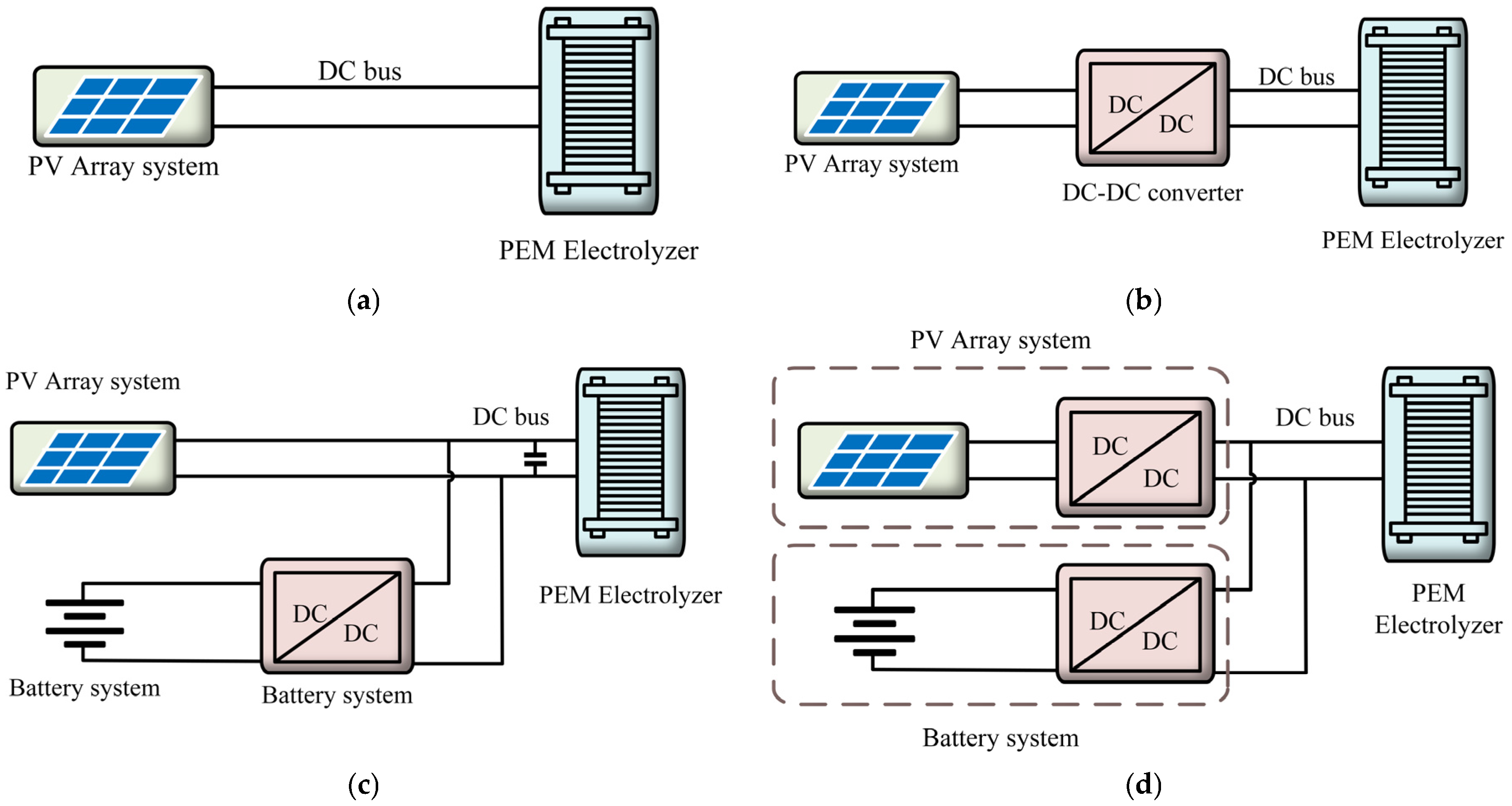
The first topology directly couples the PV system with the PEM electrolyzer [13], as illustrated in Figure 1a. Due to the inherent variability of the PV output, the operating point of the electrolyzer does not necessarily coincide with the maximum power point (MPP) of the PV system. In this configuration, the interaction between the PV voltage–power curve and the electrolyzer I–V characteristics must be carefully considered. To mitigate this mismatch, some studies have suggested employing multiple electrolyzers connected in series, thereby improving the alignment between the PV characteristic curve and the electrolyzer I–V profile [13,14].
This topology offers the advantages of simple structure, straightforward implementation, and potentially high efficiency [15]. However, it also presents notable limitations. Firstly, even with series-connected electrolyzers, the PV system cannot always operate exactly at its MPP, leaving a residual mismatch between the PV curve and the electrolyzer characteristics [16]. Secondly, the design and optimization of series electrolyzers are complex, requiring extensive parameter determination and V–I curve matching. Climatic conditions (e.g., temperature) and system operating parameters (e.g., pressure) further influence performance. In particular, the optimal number of electrolyzers depends on the PV system characteristics, while variations across different PEM stacks and PV modules necessitate case-specific design and matching.

1.2. PV System and PEM Electrolyzer Connected via a DC–DC Converter

The second topology connects the photovoltaic (PV) system to the PEM electrolyzer via a DC–DC converter [16], as shown in Figure 1b. Since electrolysis requires low voltage and high current, while PV arrays (composed of multiple series-parallel modules) typically produce higher voltage and current levels, a buck converter is employed to reduce the PV output voltage to the suitable operating range of the electrolyzer [17,18]. Moreover, the DC–DC converter enables the implementation of MPPT, which ensures that the PV system operates at its maximum power point and minimizes energy loss. Among the widely adopted MPPT techniques, the perturb and observe (P&O) and incremental conductance (IC) methods are the most commonly applied [19,20].
This configuration offers the advantage of enabling PV systems to operate at their MPP, thereby maximizing energy utilization in the electrolysis process. Additionally, the buck converter improves dynamic stability and reduces system power losses. Nevertheless, this topology has limitations: the DC–DC converter introduces additional power losses due to its non-ideal efficiency, increasing both complexity and cost. Furthermore, while the PV system is optimized, the intrinsic efficiency characteristics of the PEM electrolyzer are not explicitly addressed in this configuration.

1.3. PV–Battery–PEM Electrolyzer System

The third topology introduces a high-efficiency bidirectional DC–DC converter to couple the battery system with the DC bus [21], as shown in Figure 1c. This converter supports energy management strategies and can also be utilized for MPPT control. Integrating a battery system offers several benefits: it mitigates PV power fluctuations caused by variable solar radiation, prevents unexpected shutdowns of the PEM electrolyzer [5], and enables stable MPPT operation to ensure maximum energy extraction. As a result, the PV–battery–PEM electrolyzer configuration demonstrates improved stability, reliability, and efficiency.
However, this topology also presents drawbacks. The additional battery and bidirectional converter increase system cost, while the limited battery lifetime constrains long-term applicability [22]. Furthermore, relying on a single DC–DC converter restricts energy management flexibility, making it challenging to suppress power fluctuations and maintain PV maximum power point operation simultaneously. Similarly to the previous cases, the intrinsic efficiency of the PEM electrolyzer remains unaddressed. As shown in Table 1, the advantages and disadvantages of the three topologies are compared.
To address these limitations, this study proposes a novel system topology combined with an optimal efficiency control strategy, which enables simultaneous maximum PV power extraction and enhanced electrolyzer efficiency.
The key contributions of this study can be summarized as follows:
A novel PV–battery–PEM electrolyzer integration topology is proposed, in which the intrinsic efficiency characteristics of the electrolyzer are explicitly incorporated. This configuration not only enhances the electrolyzer’s energy conversion efficiency, but also improves the overall performance of the hybrid system.
An optimal control strategy is developed to maximize electrolyzer efficiency while ensuring daily energy balance under islanded microgrid operation. This approach significantly enhances system stability during long-term operation and guarantees continuous and reliable hydrogen production.
The remainder of this paper is organized as follows: Section 2 models the various components in the microgrid and the efficiency model of proton exchange membrane electrolyzer. Section 3 elaborates on the proposed control strategy. Section 4 explains how to train the model and discusses and compares the simulation results with those obtained using other methods. Section 5 summarizes the contributions and shortcomings of this study and suggests a future development direction.

2. System Model

Figure 1d presents the schematic configuration of the proposed PV–battery–PEM electrolyzer system, which includes a photovoltaic system, a battery system, two DC–DC converters, and a PEM electrolyzer.
In this configuration, the PV system is interfaced with the DC bus through a DC–DC converter, which serves to regulate and track the MPP of the PV array. Notably, the PEM water electrolyzer is also connected to the DC bus via a dedicated DC–DC converter, whose primary function is to control the electrolyzer’s current density; in other words, this converter ensures that the PEM electrolyzer operates at its optimal efficiency. The mathematical models describing each component of the system are presented in the following section.

2.1. Model of the Photovoltaic System

Firstly, it is necessary to understand the model of the photovoltaic system. One of the most widely used models is the single-diode model. In this model, the current–voltage (I–V) characteristic of the photovoltaic array is represented by the following equation [23]:
I = I pv I 0 e x p ( q ( V + I R s ) N s K T a ) 1 V + I R s R p
The parameters of the photovoltaic system are summarized in nomenclature.

2.2. Model of the PEM Electrolyzer

To date, various PEM electrolyzer models have been developed.
The actual cell voltage of a PEM electrolyzer is affected by various factors, including temperature, the pressure of each gas within the electrolyzer, the current density, and the flow rate. A typical expression for the actual cell voltage of a PEM electrolyzer can be written as follows [24]:
V c e l l = V 0 + η a c t + η o h m + η d i f f
The open circuit voltage of the PEM electrolyzer, which is given by the Nernst equation, can be deduced from the reversible voltage of the water electrolysis reaction. The reversible voltage of the PEM electrolyzer reaction is given by the following equation [25]:
E = Δ G 2 F
V 0 = E + R T p e m 2 F ln ( P H 2 P O 2 P H 2 O )
The energy that must be supplied during the start of the electrolysis process, in order to drive the reaction to the gas diffusion electrodes, is called the activation energy. Instead of using the activation energy, the activation overpotential is widely used to describe the magnitude of activation energy required for a reaction. Due to the Butler–Volmer equation, the current density at the electrode/electrolyte interface can be obtained as follows [26]:
i = i 0 exp α a F R T p e m η act exp α c F R T p e m η act
The activation overpotential of the anode and cathode can be expressed as follows:
η act anode = R T α a F ln i i 0 , a n
η act cathode = R T α c F ln i i 0 , c a t
η act = η act anode + η act cathode
The exchange current density is modeled using an Arrhenius-type relationship [27,28,29]:
i 0 = i 0 , ref exp E exc R 1 T 1 T ref
The activation energies are 28.92 kJ mol−1 for the anode and 17.00 kJ mol−1 for the cathode.
The ohmic overpotential arises from the resistance of the electrodes, the bipolar plates, the membrane, and the interface resistance between different layers of the electrolyzer. However, the ohmic resistance of the membrane is the main factor that affects the ohmic overpotential of the PEM electrolyzer. In this section, we focus on the ohmic resistance of the membrane. The ohmic overpotential of the PEM electrolyzer can be expressed as follows:
η ohm = δ m I p e m A σ m
When the reaction begins to work in the electrolyzer, energy is required to transport the reactants (hydrogen, oxygen, and water) through the catalyst layers, porous transport layers, and into the flow channels. This is why diffusion overpotential arises. The diffusion overpotential of the PEM electrolyzer can be expressed as follows [30]:
η diff = η diff , an + η diff , cat
η diff , an = R T 4 F ln C O 2 , m e C O 2 , m e , 0
η diff , cat = R T 2 F ln C H 2 , m e C H 2 , m e , 0
A detailed list of PEM electrolyzer parameters is provided in nomenclature.

2.3. Efficiency Model of the PEM Electrolyzer

The efficiency model of a PEM electrolyzer is determined by the voltage efficiency and the Faraday efficiency. The efficiency of a PEM electrolyzer can be expressed as follows:
η PEM = η v × η F
The voltage corresponding to the reaction enthalpy, under the assumption of no net heat exchange with the surroundings, is referred to as the thermal neutral voltage, denoted by V t h . This represents the cell voltage at which the electrochemical reaction proceeds without either heat absorption or heat release. For a PEM electrolyzer under standard conditions, the cell voltage can be determined from the following equation, yielding a value of approximately 1.48 V.
V th = Δ H n F = Δ G n F + T Δ S n F
where Δ S represents the change in the entropy of a system, describing the variation in energy dispersion or disorder during a thermodynamic process. This can be used to calculate the thermal neutral voltage.
Therefore, the voltage efficiency η V of the PEM electrolyzer can be calculated as follows:
η v = V th V c e l l
In the above equation, the voltage efficiency considers the energy loss caused by the overvoltage in the electrolyzer, including the ohmic overpotential, the activation overpotential, and the diffusion overpotential.
The Faraday efficiency is typically used to describe the ratio of the ideal charge for the production of hydrogen to the actual charge, and can be expressed as follows:
η F = Q i d Q a c t
When taking the PEM electrolyzer into consideration, the Faraday efficiency can be expressed as follows:
η F = 1 Φ H 2 Γ H 2 2 Φ O 2 Γ H 2
Based on Faraday’s law, the production rate densities of hydrogen and oxygen can be expressed as follows:
Γ H 2 = I p e m 2 F
Γ O 2 = I p e m 4 F
According to Fick’s law, the flux densities of hydrogen and oxygen can be expressed as follows:
Φ O 2 = ε O 2 dif p O 2 an δ m
Φ H 2 = ε dif p H 2 cat δ m + ε dp p H 2 cat p O 2 an δ m
The list of PEM electrolyzer efficiency model parameters is provided in nomenclature.
Numerous studies have investigated the efficiency of PEM electrolyzers, with many modeling the Faraday efficiency using fitted mathematical functions. Although this approach is computationally efficient, it neglects environmental influences, limiting its applicability across operating conditions. In contrast, the model employed in this work incorporates key environmental parameters, including hydrogen partial pressure, operating temperature, and membrane thickness, thereby improving adaptability, while the explicit effect of electrolyzer temperature is reserved for future studies.

2.4. Model of the Battery System

The battery system serves the following functions:
  • Mitigate the instability of photovoltaic power output and ensure that the power output can make the electrolyzer operate at optimal efficiency.
  • Battery storage can prevent energy from being discarded when the photovoltaic system generates high power.
  • Improve system stability and prevent the PEM water electrolyzer from shutting down.
The literature on Li-ion batteries is extensive, including models that accurately represents the dynamic behavior of such a battery. The discharge model for a Li-ion battery is as follows [31,32]:
V b a t t = E 0 K Q Q i t i t R b i b a t A e x p ( B i t ) K Q Q i t i
Meanwhile, the charge model for Li-ion batteries is as follows:
V b a t t = E 0 K Q i t 0.1 Q i R b i b a t A e x p ( B i t ) K Q Q i t i t
The battery system parameter list can be found in nomenclature.

3. System Control Strategy

Figure 1d illustrates the structure of the proposed system. The energy of the battery needs to flow in both directions (charge and discharge), which makes the energy distribution relationship between systems more complicated. The innovation of the proposed system is that it can achieve optimal efficiency control for hydrogen production in a specific PEM water electrolyzer. This control strategy comprises two parts: the energy distribution control strategy and the efficiency (current density) control strategy. Both of these are based on the control of the two DC–DC converters in the system, and will be discussed in detail in the following subsections.

3.1. Energy Distribution Control Strategy

A critical aspect of the system design is ensuring that the PEM water electrolyzer operates at its maximum efficiency point, effectively allowing it to behave as a constant-power load. This characteristic introduces potential power-matching challenges with the PV array and battery system, which motivates the design of an energy distribution control strategy. For the PV system, the conventional approach is to employ an MPPT algorithm to maintain operation at the array’s maximum power point. The MPPT algorithm dynamically adjusts the PV output voltage to maximize energy extraction. However, due to inherent fluctuations in PV power output, the electrolyzer cannot consistently operate at its optimal efficiency without the presence of a battery system to buffer energy and stabilize power flow.
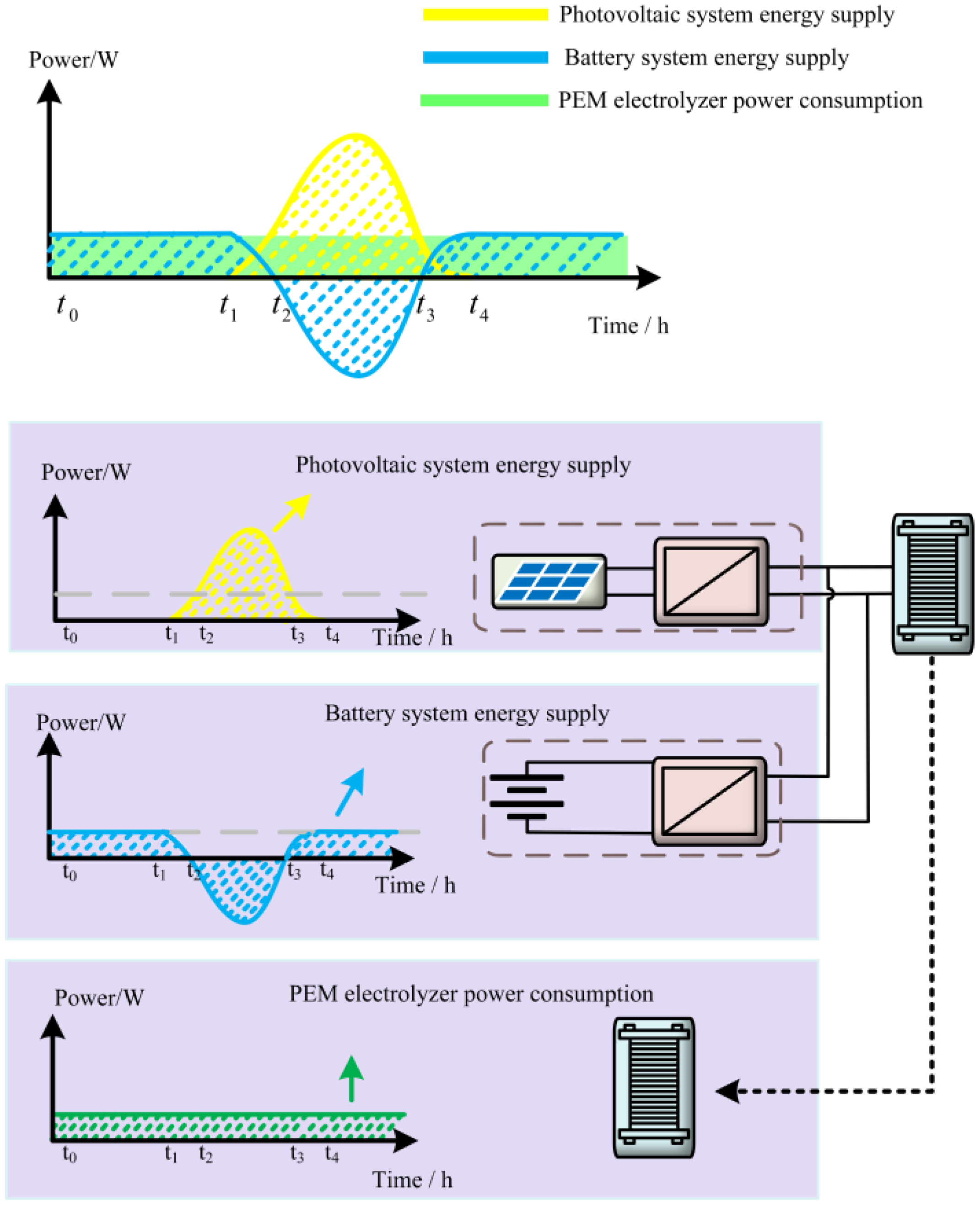
A schematic diagram of the energy allocation strategy is presented in Figure 2. To enable autonomous operation off the grid, the maximum power of the PEM electrolyzer is determined based on the average daily energy output of the PV array. This value is also constrained by the battery capacity to prevent overcharging or deep discharging of the energy storage system. Under conditions of sufficient solar irradiance, PV-generated energy is prioritized for the electrolyzer, with any surplus stored in the battery system. Conversely, when solar irradiance is insufficient, energy stored in the battery is dispatched to maintain the electrolyzer’s operation. Overall, the system maintains a dynamic equilibrium between generation, storage, and consumption. A 24 h power distribution relationship between the photovoltaic system, the battery system, and the PEM water electrolyzer was established, which includes the five following basic states.
  • t0–t1: The battery system releases energy to the electrolyzer, while the photovoltaic system does not generate power.
  • t1–t2: The battery system and photovoltaic system generate energy supplied to the electrolyzer.
  • t2–t3: The photovoltaic system powers the electrolyzer, and the battery system absorbs energy from the photovoltaic system.
  • t3–t4: The same condition as state t1–t2.
  • t4 onward: The same condition as state t0–t1.

3.2. PEM Electrolyzer Efficiency Control Strategy

The efficiency model of the PEM electrolyzer is presented in Section 2.2. It is clear that the efficiency of the PEM electrolyzer is affected by the current density, temperature, and pressure. Therefore, if the external environmental conditions and the internal parameters of the PEM electrolyzer are known, the optimal current can be determined. The efficiency optimal control can be understood as constant current control of the PEM electrolyzer. Specifically, the current flowing through the PEM electrolyzer is controlled at the current corresponding to the optimal efficiency point of the efficiency model, while the DC–DC converter connected to the photovoltaic system executes the MPPT algorithm. The topologies and control strategies of the two converters are described in detail later.

3.3. Control Strategy for Photovoltaic System Converter

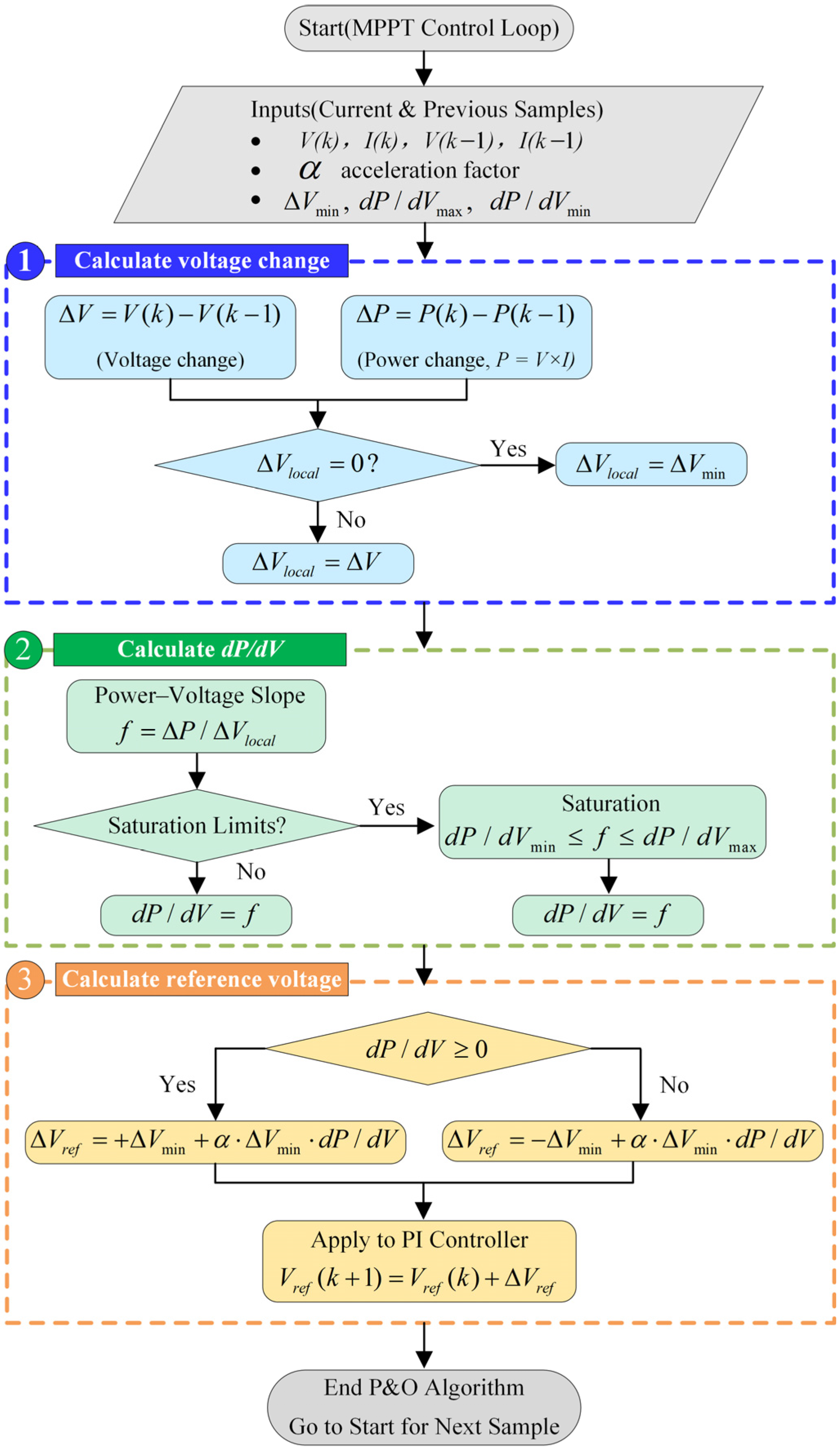
MPPT is a widely used method to modify the output power of the photovoltaic system to the maximum power point. The two common types of MPPT methods are the P&O method and the IC method. The P&O method is simple and easy to implement. It operates by comparing the power of the photovoltaic system at the current time with that at the previous time, when a perturbation in voltage or current was applied to the photovoltaic system. The IC method consists of measuring the voltage and current of the photovoltaic module and calculating their derivatives, then determining whether the system is at the maximum power point. The P&O method is simple and easy to implement, but it may cause large power fluctuations in the PV-PEM electrolyzer system. Although the IC method provides improved performance in terms of voltage and power fluctuations, it introduces higher computational complexity. In recent years, numerous algorithms have been proposed to address the limitations of conventional MPPT techniques. In this study, due to the complexity of the simulated system, the incremental conductance method was not suitable. Therefore, an accelerated P&O algorithm was implemented. Compared with the standard P&O method, the accelerated version incorporates a dynamic acceleration factor, which enhances the convergence speed toward the photovoltaic system’s maximum power point, thereby improving tracking efficiency under varying irradiance conditions.
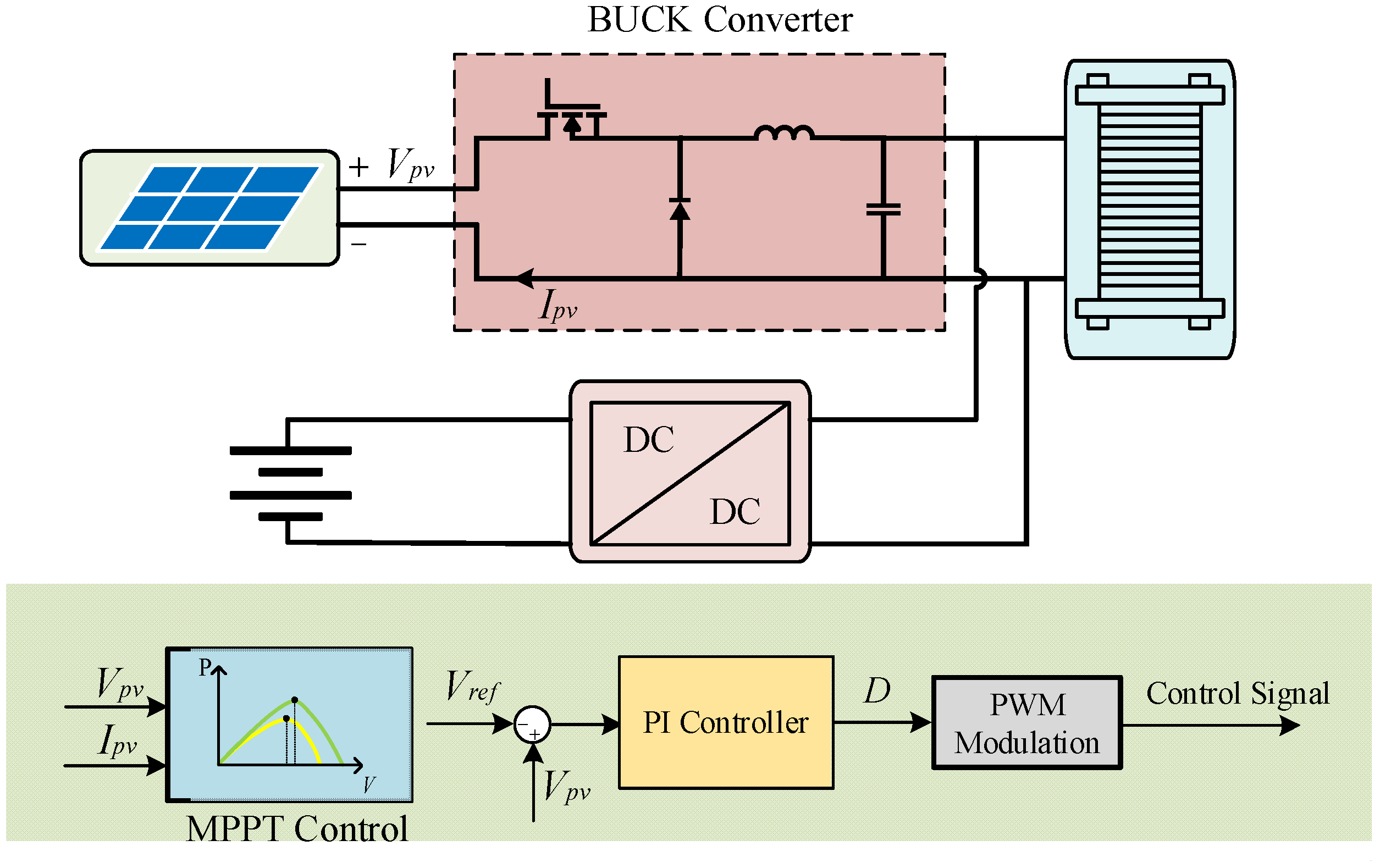
Since electrolysis requires low voltage and high current, while the PV system generates high voltage due to series and parallel connections, a buck converter is employed to step down the PV output voltage. Additionally, the buck converter implements an MPPT algorithm to maximize PV energy extraction and minimize losses. It also enhances the system’s dynamic stability. The buck converter’s structure and control strategy are illustrated in Figure 3.
Unlike the conventional P&O method with a fixed step size, the approach used here defines the reference voltage variation as a combination of a minimum perturbation step and a slope-dependent acceleration term. As a result, larger step sizes are applied when the operating point is far from the maximum power point (MPP), while smaller step sizes are used near the MPP, thereby achieving faster convergence and reduced steady-state oscillations. A flowchart is presented in Figure 4.

3.4. Control Strategy for Battery Converter

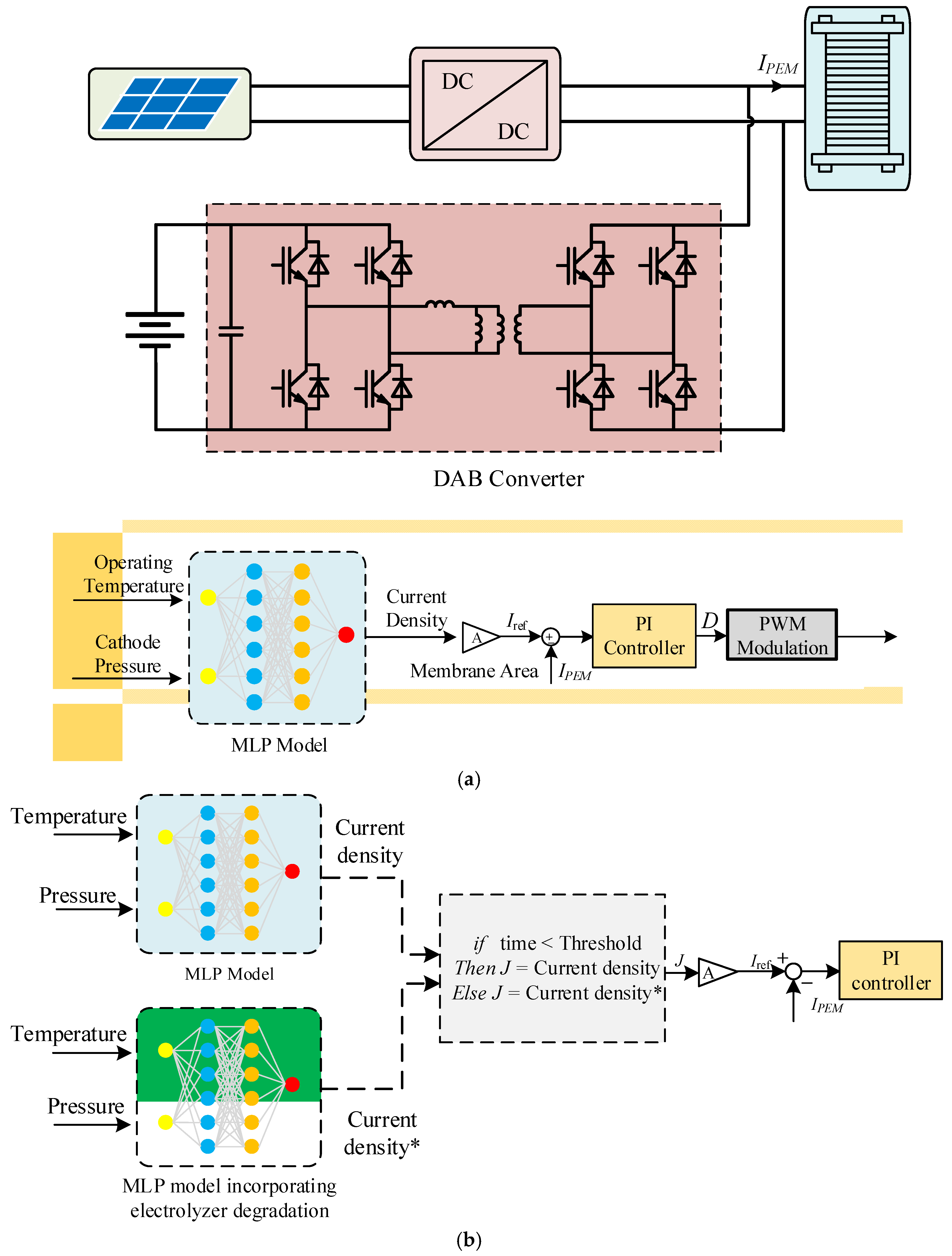
The battery system employs a dual-active-bridge (DAB) converter as its DC–DC interface. The DAB converter enables bidirectional energy flow, making it particularly suitable for energy storage applications. It is characterized by high energy transfer efficiency, a compact design with high power density, and a simple control scheme. Moreover, the DAB converter exhibits fast dynamic response and is capable of operating efficiently over a wide range of input and output voltages, providing flexibility and robustness in managing energy between the battery and the DC bus.
In actual working conditions, the current corresponding to the optimal efficiency point of the PEM electrolyzer often varies with changes in environmental factors. Similarly to the maximum power point tracking (MPPT) strategy in photovoltaic systems, which determines the optimal operating point by iteratively searching or evaluating the output power under varying conditions (e.g., temperature, irradiance), the proposed MLP-based control model directly predicts the optimal current density corresponding to the maximum electrolyzer efficiency under different operating conditions. This study proposes a maximum efficiency point tracking control algorithm applied to the battery system. This algorithm requires knowledge of the optimal current density of the electrolyzer. For any given set of environmental conditions, a current density exists that corresponds to the maximum efficiency of the electrolyzer. However, calculating this optimal current density in real time requires substantial computation and is therefore impractical. Specifically, the efficiency curve is determined by the environmental factor T, P in I e f f = f ( T ,   P H 2 ,   ) . It should be noted that the term temperature T refers to the operating temperature of the PEM electrolyzer stack. Similarly, pressure P denotes the hydrogen partial pressure within the electrolyzer system.
Although this relationship may exhibit a monotonic trend under limited operating conditions, its functional form becomes increasingly complex when multiple variables vary simultaneously. To address this challenge, a multilayer perceptron (MLP) model is employed to predict the optimal current density of the electrolyzer. The MLP model offers strong capability in capturing nonlinear mappings and benefits from its universal function approximation property, enabling it to generalize across a wide range of operating conditions. Polynomial fitting approaches, while computationally efficient for low-dimensional problems, generally require re-identification of model coefficients when the operating range is extended or additional inputs are introduced, and their approximation accuracy tends to degrade for strongly nonlinear relationships. In contrast, the MLP-based method avoids the need for an explicit analytical formulation and can be readily extended to higher-dimensional input spaces when additional operating variables are introduced. Moreover, lookup-table-based methods suffer from poor scalability, as the required data storage and interpolation complexity increase rapidly with the number of operating variables, making them impractical for high-dimensional mappings. In addition, significant redefinition of the lookup table is typically required when operating conditions change. The electrolyzer efficiency is typically influenced by multiple factors, such as temperature, pressure, current density, degradation factor, and hydration state. In contrast, the MLP provides a more flexible and scalable framework for capturing relationships in higher-dimensional input spaces. Furthermore, the MLP model is convenient to implement within simulation environments, making it well suited to efficiency-oriented control applications in dynamic energy systems.
In this model, the input layer consists of the environmental factors temperature T and pressure P, while the output layer provides the optimal current density for the electrolyzer. The structure and control strategy of the DAB converter used in the battery system are illustrated in Figure 5a.
Under degradation conditions (e.g., after 10,000 h of operation), the relationship between efficiency and current density is greatly altered. As a result, this relationship needs to be re-mapped, and the parameters of the MLP model can be retrained to accurately capture the updated characteristics. Based on the retrained model, a new control strategy for the degraded PEM electrolyzer can be derived. As shown in Figure 5b, prior to 10,000 h of operation, the electrolyzer parameters remain largely unchanged, allowing the use of the original MLP model for efficiency control. Beyond 10,000 h, as degradation effects become significant, the MLP model trained for the degraded PEM electrolyzer is used to predict current density* and implement the corresponding control strategy.
In practical operation, battery State of Charge (SOC) constraints play a crucial role in ensuring the safe and stable operation of the PV–battery–electrolyzer system. Therefore, upper and lower SOC limits are explicitly incorporated into the proposed energy management strategy. When the battery SOC remains within its allowable range, the control strategy prioritizes operating the electrolyzer near its maximum efficiency point to enhance overall system efficiency. However, once the SOC reaches either its upper or lower limit, the control objective is adaptively switched to maintain system stability. Specifically, under SOC saturation conditions, the energy storage system is decoupled from power regulation and the electrolyzer operating point is no longer governed by the efficiency optimization strategy but, instead, is directly determined by the instantaneous PV input power. In this case, the electrolyzer operates in a power-following mode to prevent battery overcharging or deep discharging. As a result, system stability is assigned higher priority than efficiency optimization, ensuring the practical feasibility of the proposed strategy for real systems with finite battery capacity.

4. Simulation and Results

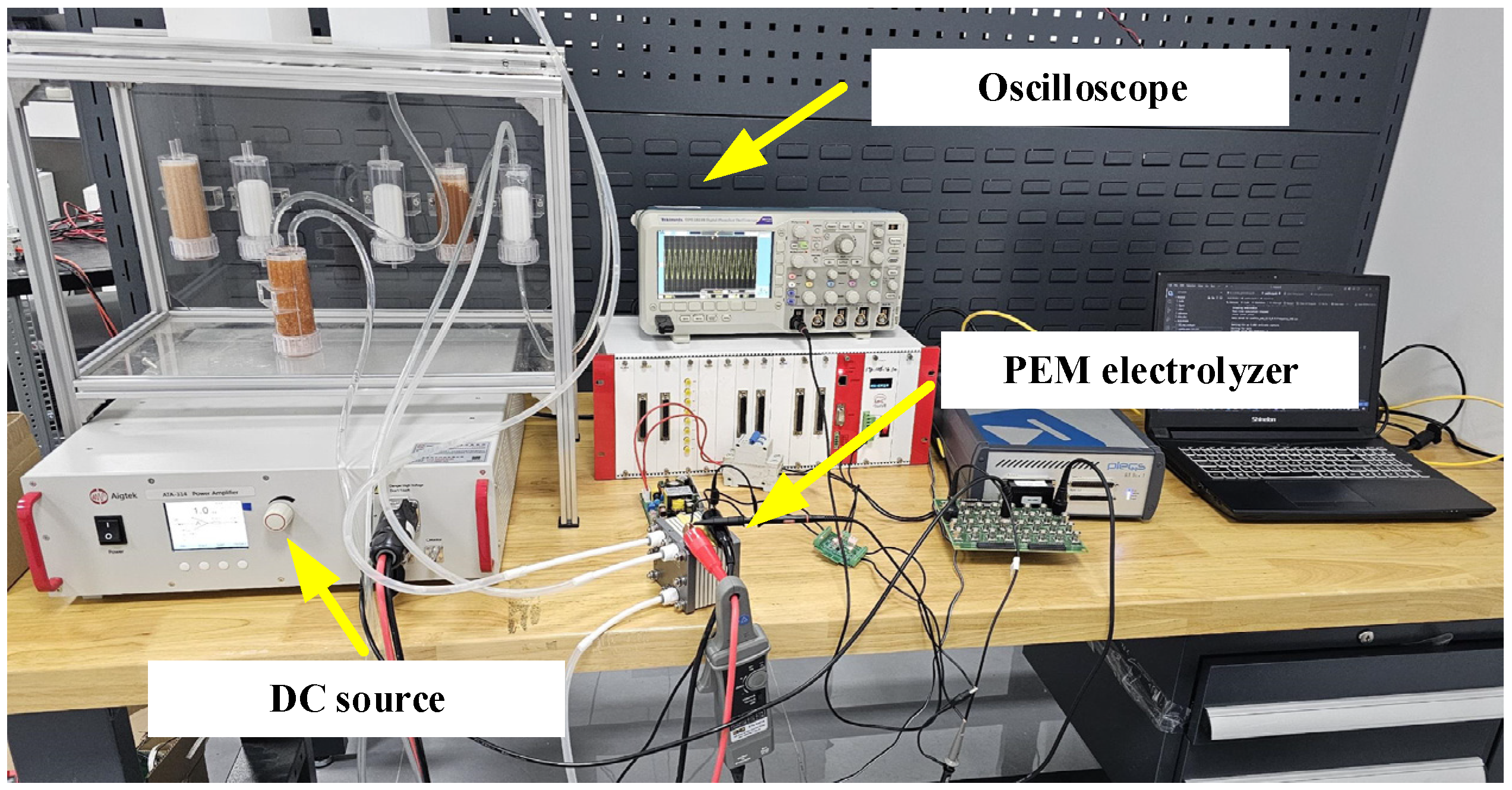
We constructed an experimental platform to measure the polarization characteristics of the PEM electrolyzer. The electrolyzer used in the experiments consisted of eight small cells connected in series, each with a membrane active area of approximately 20 cm2. The experimental platform is shown in Figure 6.
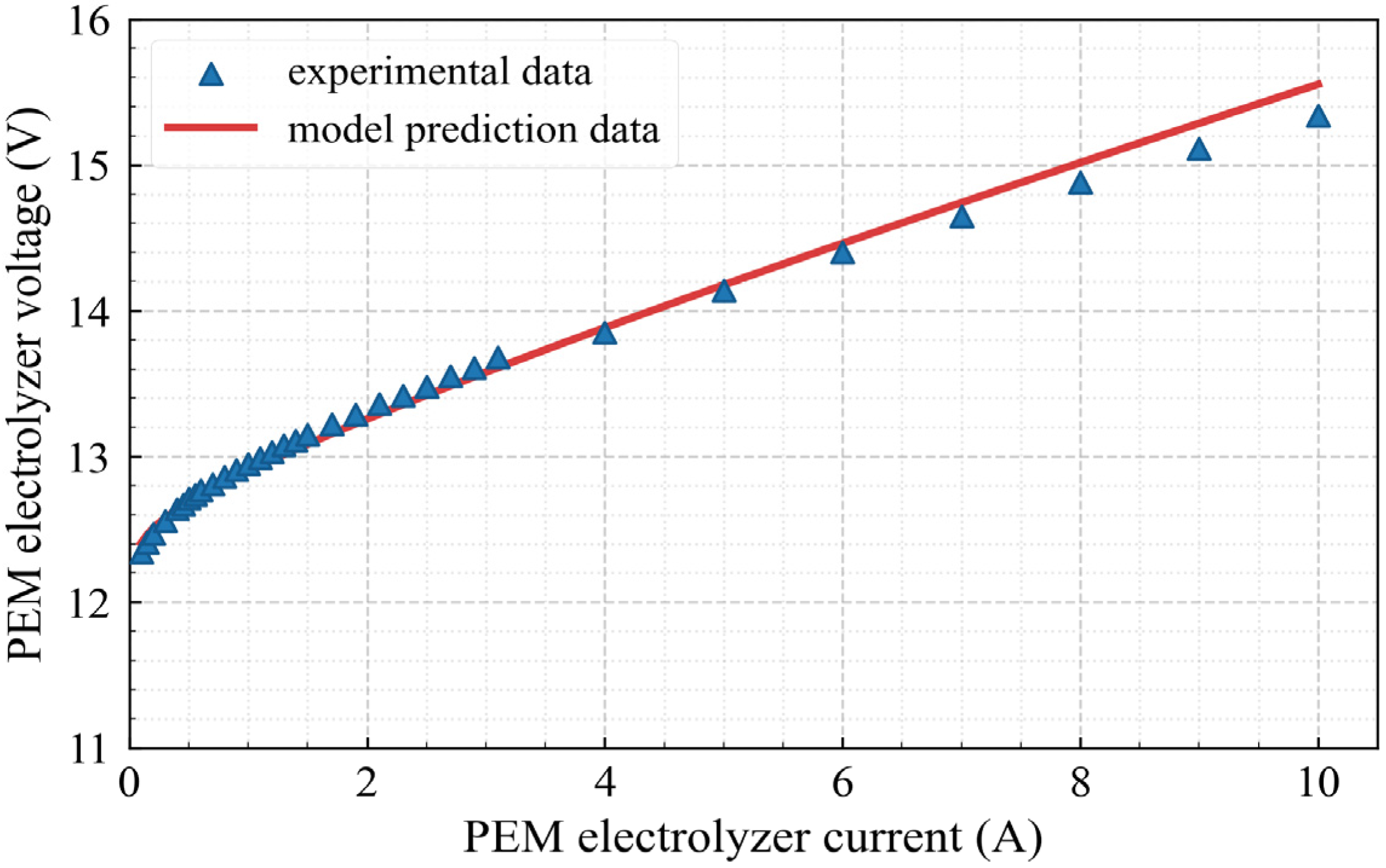
Figure 7 presents a comparison between the measured data and the electrolyzer parameter model. Good agreement can be observed between the experimentally measured and the model-predicted polarization curves of the PEM electrolyzer, validating the accuracy and effectiveness of the proposed polarization model.

4.1. Training of the MLP Model

To validate the proposed system and control strategy, a simulation was implemented using PLECS, a dedicated platform for power electronic system modeling. The simulation environment was based on Python 3.8.5, and the PyTorch version employed was 2.3.1. The MLP model was trained on a computer equipped with a 2.90 GHz Intel Core i5 processor and 16 GB of RAM.
The MLP model consists of five hidden layers, each containing 8 neurons. The activation function for hidden layers is the rectified linear unit (ReLU), while the output layer employs a linear activation function. Training data for the MLP model were generated from the PEM electrolyzer efficiency model presented in Section 2. Specifically, the working efficiency of the electrolyzer was computed for various current densities at a given temperature and pressure. For each condition, the current density corresponding to the maximum efficiency was recorded. Subsequently, multiple parameter sets were initialized via averaging over all feasible temperature and pressure ranges, and the corresponding optimal current densities were collected.
The MLP model uses temperature inputs from 20 °C to 80 °C and pressure inputs from 15 bar to 55 bar, both with a step of 2, yielding a dataset of 600 samples. The mean squared error (MSE) loss function was used in PyTorch to measure the difference between predicted and true values, which is defined as follows:
f MSE = 1 N i = 1 N ( y i y ^ i ) 2
where f M S E is the mean squared error, y i is the ground truth, y i ^ is the model prediction, and N is the number of samples.
Finally, the quantitative prediction error metric, expressed in terms of mean squared error (MSE), was 1.39 × 10⁻⁶, indicating that the proposed MLP model achieved satisfactory prediction accuracy within the considered operating range. An MSE of 8.38 × 10⁻⁷ was also obtained when using the polynomial fitting approach, and both methods achieved acceptable prediction accuracy under the considered operating conditions. In addition, the corresponding simulation results indicate nearly identical efficiency values over the considered operating range.
Leveraging this dataset, the trained MLP model can directly predict the optimal electrolyzer current density under varying environmental conditions. The model weights and biases were extracted and integrated into the PLECS simulation to implement the DAB converter control strategy.
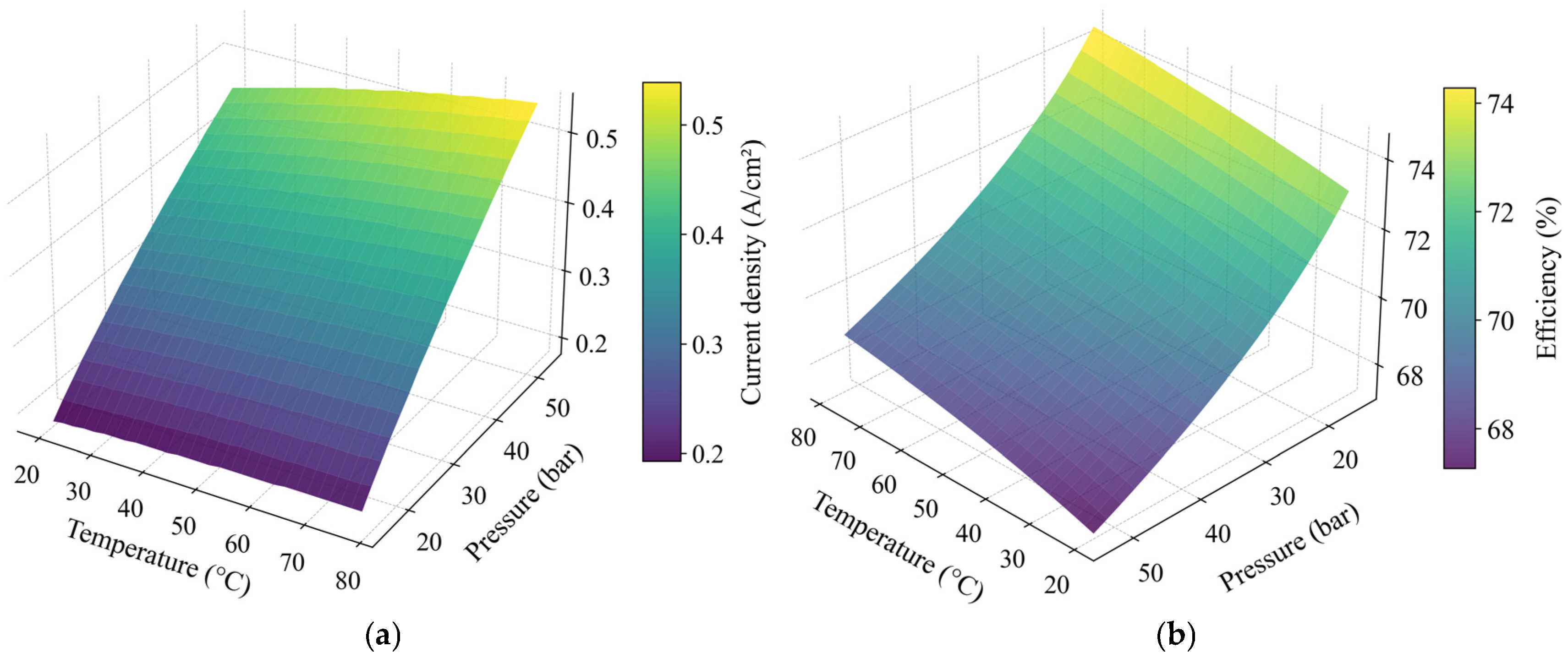
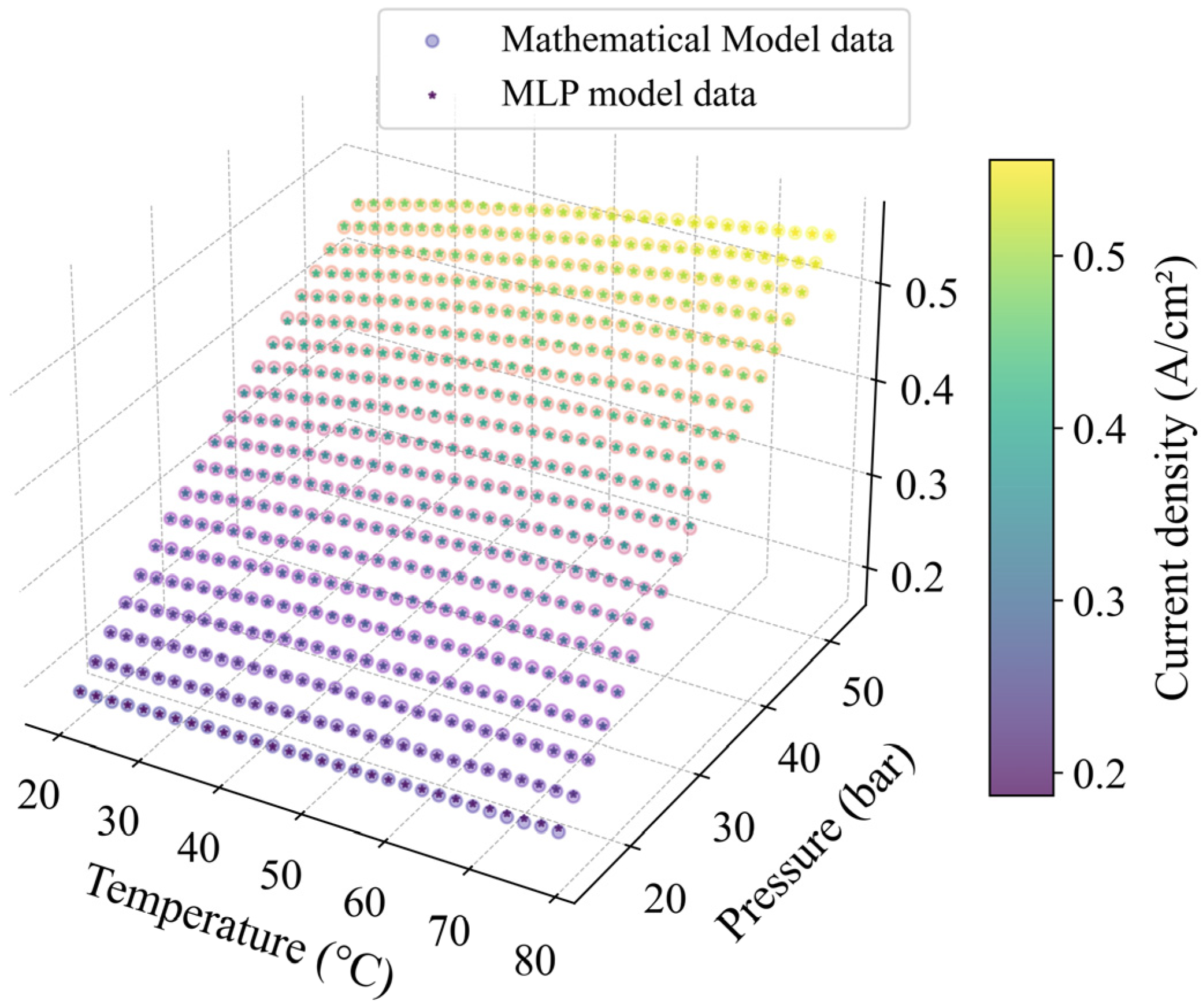
Figure 8 illustrates the PEM water electrolyzer model, capturing the relationships among temperature, pressure, current density, and efficiency. In this model, the temperature ranges from 20 °C to 80 °C, and the pressure ranges from 15 bar to 55 bar. As shown in Figure 8a, the optimal current density increases with both temperature and pressure. In contrast, Figure 8b indicates that the optimal efficiency increases with rising temperature and decreasing pressure, highlighting a trade-off between power output and energy conversion efficiency. This dataset serves as the foundation for constructing the MLP predictive model. Figure 9 shows that the optimal current density of the PEM electrolyzer varies systematically with temperature and pressure, with good agreement between the MLP-based predictions and the mathematical model.
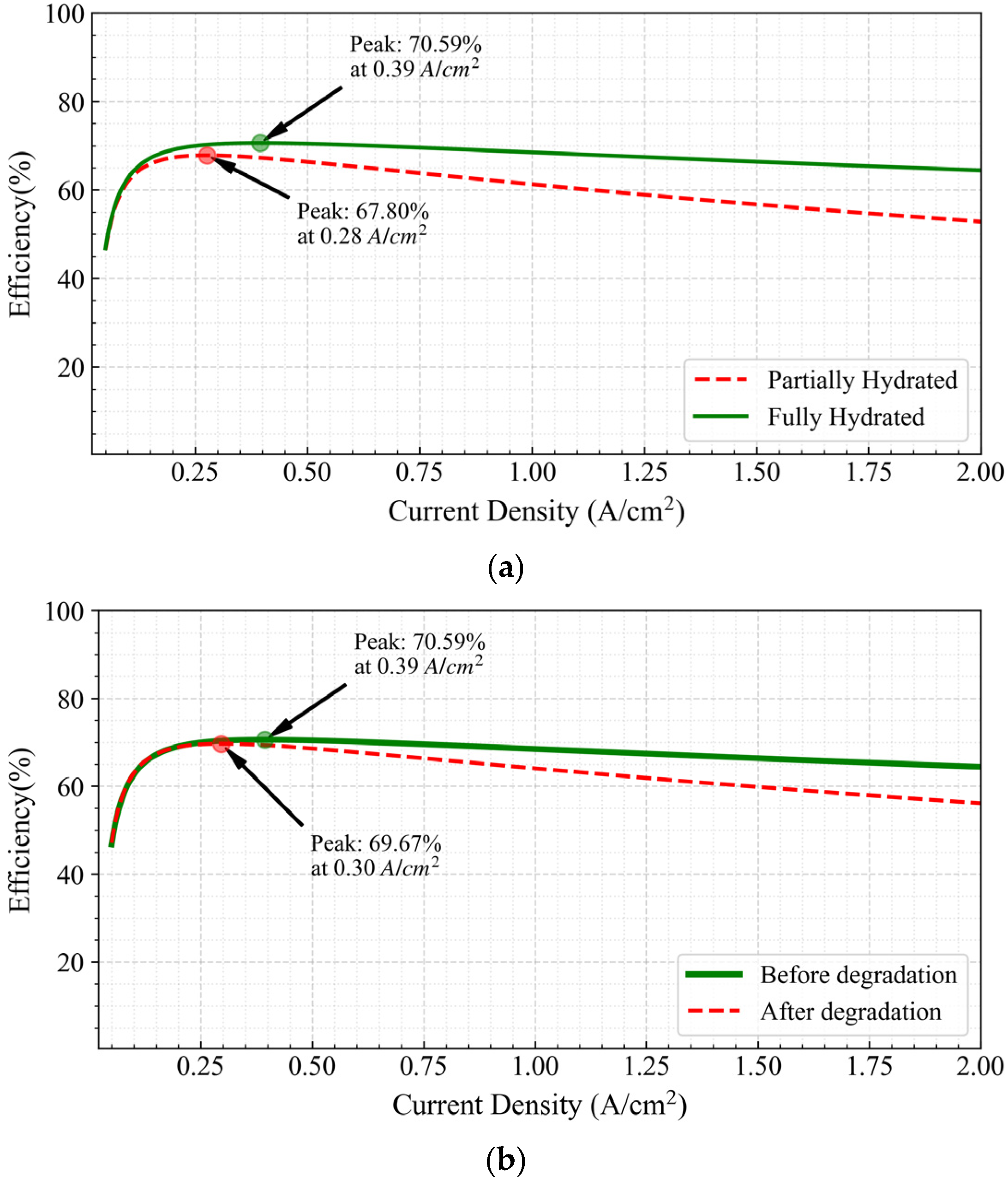
To better illustrate the impact of degradation and decreased membrane hydration on the PEM electrolyzer’s efficiency, a corresponding comparative analysis was conducted.
Figure 10a compares the efficiency–current density characteristics under fully and partially hydrated conditions. Reduced membrane hydration leads to a decrease in peak efficiency (from 70.59% to 67.80%) and shifts the optimal operating point from 0.39 A/cm2 to 0.28 A/cm2. Figure 10b compares the efficiency–current density characteristics before and after degradation. Degradation reduces the peak efficiency from 70.59% to 69.67% and shifts the optimal operating point from 0.39 A/cm2 to 0.30 A/cm2. The efficiency loss is more pronounced at higher current densities, indicating that aging degrades performance and shifts the optimal operating region to lower current densities.
These observed changes highlight the necessity of a control strategy for the degraded PEM electrolyzer under varying hydration and degradation conditions and further emphasize the necessity of employing an MLP-based model.

4.2. Simulation of Proposed System

Initially, a simulation model of the PV array was developed. This model represents a configuration consisting of five parallel-connected strings, each containing KC200GT solar modules in series. Each KC200GT module comprised 54 series-connected solar cells and had a rated maximum power of 200 W under standard test conditions (STC). It had a maximum power voltage (V) of 26.3 V and a maximum power current (Imp) of 7.61 A. The parameters used for the photovoltaic array in the simulation are given in Table 2 below.
Similarly, the parameters used for the simulation modeling of the PEM water electrolyzer are given in Table 3.
In this simulation, stepwise variations in solar irradiance were applied to emulate the actual operating conditions of photovoltaic panels throughout a typical day. To simplify the simulation, the time scale is represented in seconds rather than hours. This accelerated the variation in photovoltaic input while preserving its relative fluctuations, enabling efficient evaluation of the control strategy. The electrolyzer’s thermal and electrochemical dynamics were treated as quasi-static, focusing on fast electrical dynamics.
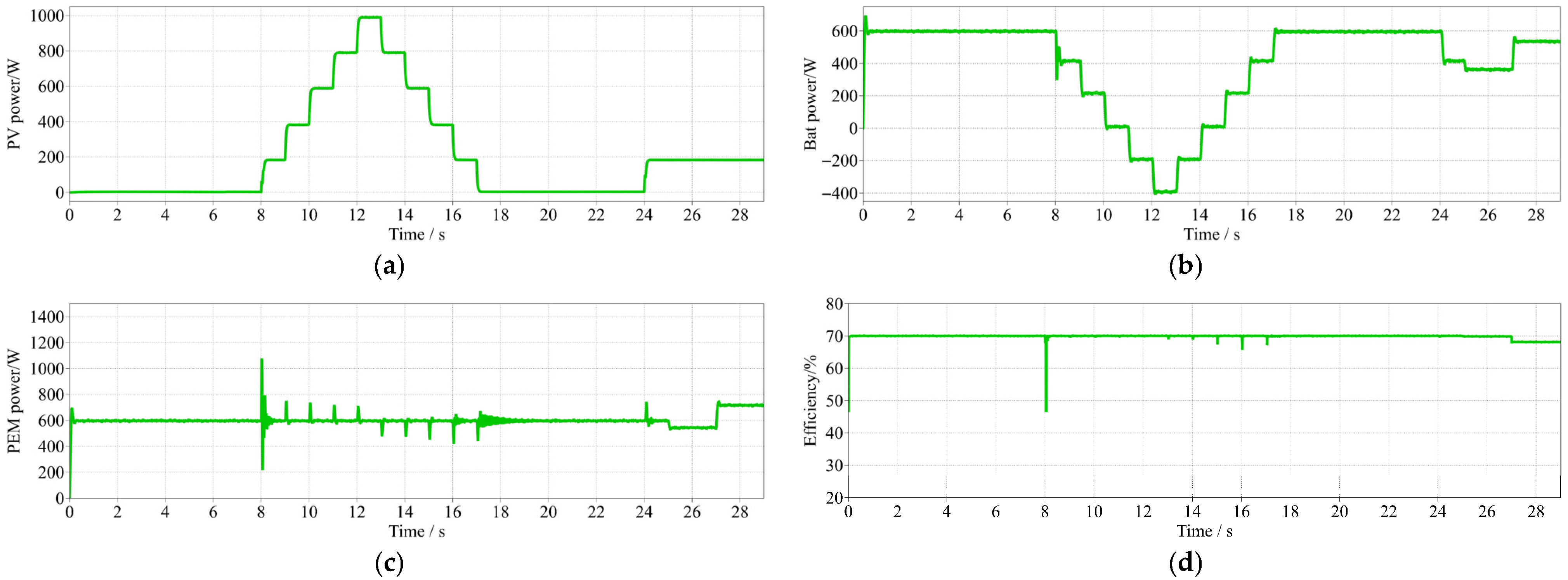
The corresponding simulation results are presented in Figure 11 below. During the simulation period from 0 s to 24 s, the solar irradiance of the photovoltaic system was varied to emulate the typical fluctuations in PV power output over the course of a day. After 24 s, the solar irradiance of the photovoltaic system remained at 0.2, simulating the impact of changes in environmental factors on the output power of the photovoltaic system. At 25 s and 27 s, the operating conditions of the PEM electrolyzer were altered, with the cell temperature decreasing from 65 °C to 35 °C and the hydrogen pressure at the cathode rising from 35 bar to 50 bar, respectively, to evaluate the system’s dynamic response under changing electrolysis conditions.
It is evident that variations in solar irradiance directly affect the maximum power output of a PV array system. As shown in Figure 11a, the proposed accelerated MPPT algorithm effectively enabled the PV array to operate near its instantaneous maximum power point under dynamic solar radiation conditions, demonstrating rapid tracking capability and improved response time compared to conventional methods. Figure 11b,c illustrate the performance of the energy control strategy. During the interval from 0 s to 24 s, the environmental conditions for the PEM electrolyzer remained relatively stable, and accordingly, its power consumption remained nearly constant. However, at 25 s and 27 s, fluctuations in operating conditions occurred, which, due to the characteristics of the PEM electrolyzer, resulted in corresponding variations in its power consumption. Figure 11b further confirms that while the electrolyzer’s power demand changed at these time points, the battery system power output was effectively regulated to maintain system stability, indicating proper coordination between the PV generation and the energy storage system. Finally, Figure 11d demonstrates the functionality of the PEM electrolyzer efficiency control algorithm, which adjusted operating parameters to optimize electrolyzer efficiency under varying environmental parameters. The optimal efficiency of the electrolyzer exhibits a decreasing trend with decreasing temperature and increasing pressure during the 25–29 s interval, in good agreement with the model results shown in Figure 8. Therefore, this algorithm ensures both stable operation and enhanced energy utilization. Since a mathematical efficiency model was employed, the calculated efficiency was sensitive to transient variations in operating current during rapid irradiance changes, which may have led to short-term efficiency fluctuations. To better highlight the steady-state characteristics of the system, the efficiency curves were calculated using filtered current signals, thereby reducing the influence of transient current fluctuations.
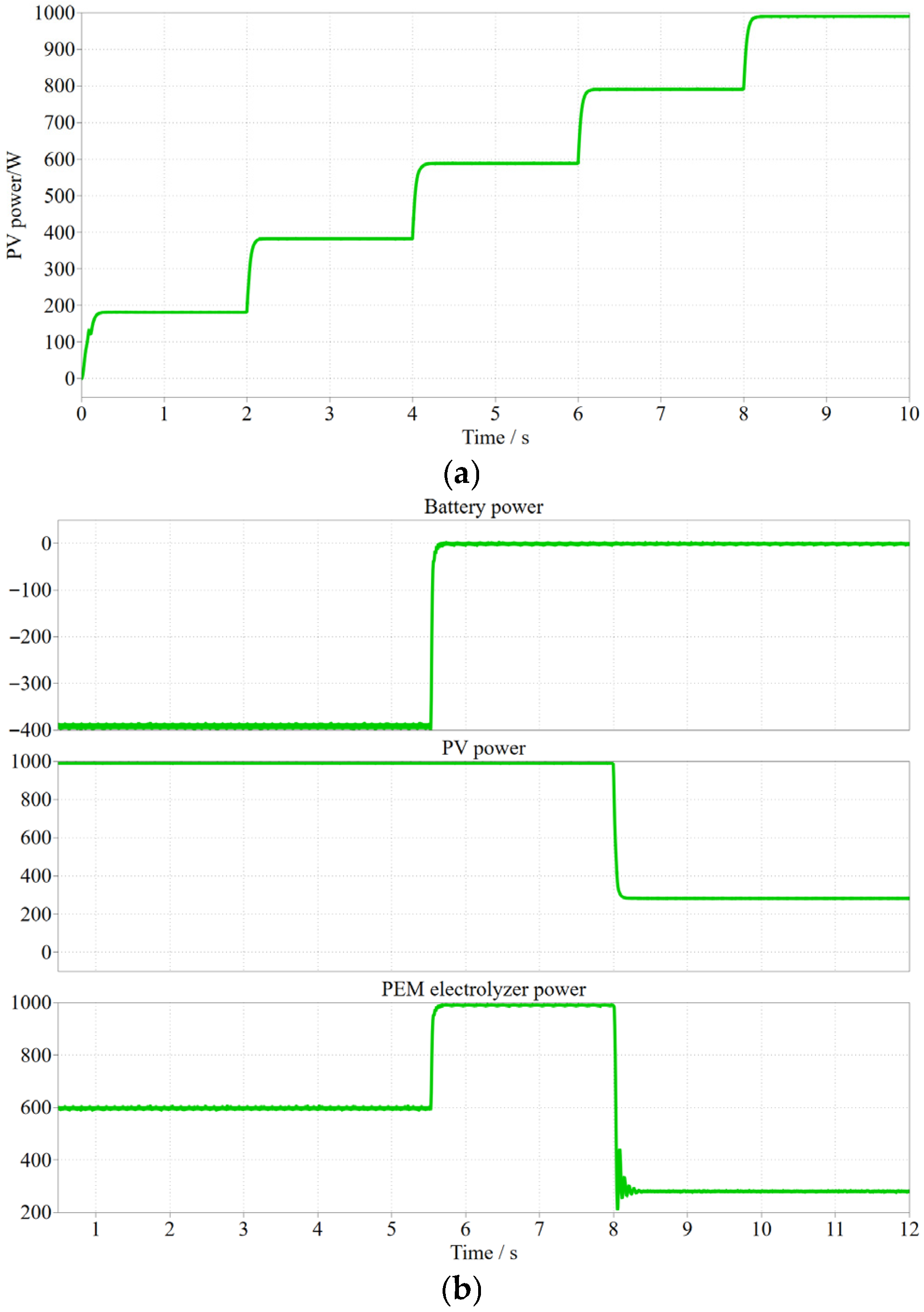
Figure 12a shows the system performance under stepwise variations in temperature and solar irradiance introduced over an actual 10 s physical time window to emulate the high-frequency power fluctuations encountered in practical photovoltaic systems. The solar irradiance levels were set to 200 W/m2, 400 W/m2, 600 W/m2, 800 W/m2, and 1000 W/m2. Simulations were also conducted under different temperature conditions of 5 °C and 45 °C, respectively. The simulation results demonstrate that the proposed system effectively handles high-frequency and severe power fluctuations caused by environmental variations, exhibiting robust dynamic performance while maintaining effective MPPT operation.
Figure 12b presents the considered scenario. When the battery SOC exceeded 95% at around 5.5 s, the energy storage system was decoupled to prevent overcharging, and the electrolyzer power followed the instantaneous PV output. With the battery’s buffering capability unavailable, the control objective shifted from efficiency optimization to system stability and power balance. Similar control logic was applied when the SOC dropped below 5% to avoid deep discharge, ensuring stable and safe system operation under battery saturation conditions.

4.3. Simulation of Directly Coupled System

In the Introduction, the authors presented three different topologies and discussed their respective advantages and disadvantages. To further demonstrate the effectiveness and novelty of the method proposed in this paper, our team simulated and reproduced several of these topologies under identical environmental conditions and conducted a comparative analysis.
For the PV system directly coupled with the PEM electrolyzer, the system remains inactive in the absence of solar irradiance; therefore, the efficiency under such conditions was not considered. The parameters of the photovoltaic array and the electrolyzer employed in the simulation correspond to those listed in Table 2 and Table 3, respectively. Furthermore, the same solar radiation profile was applied to ensure comparability of the results.
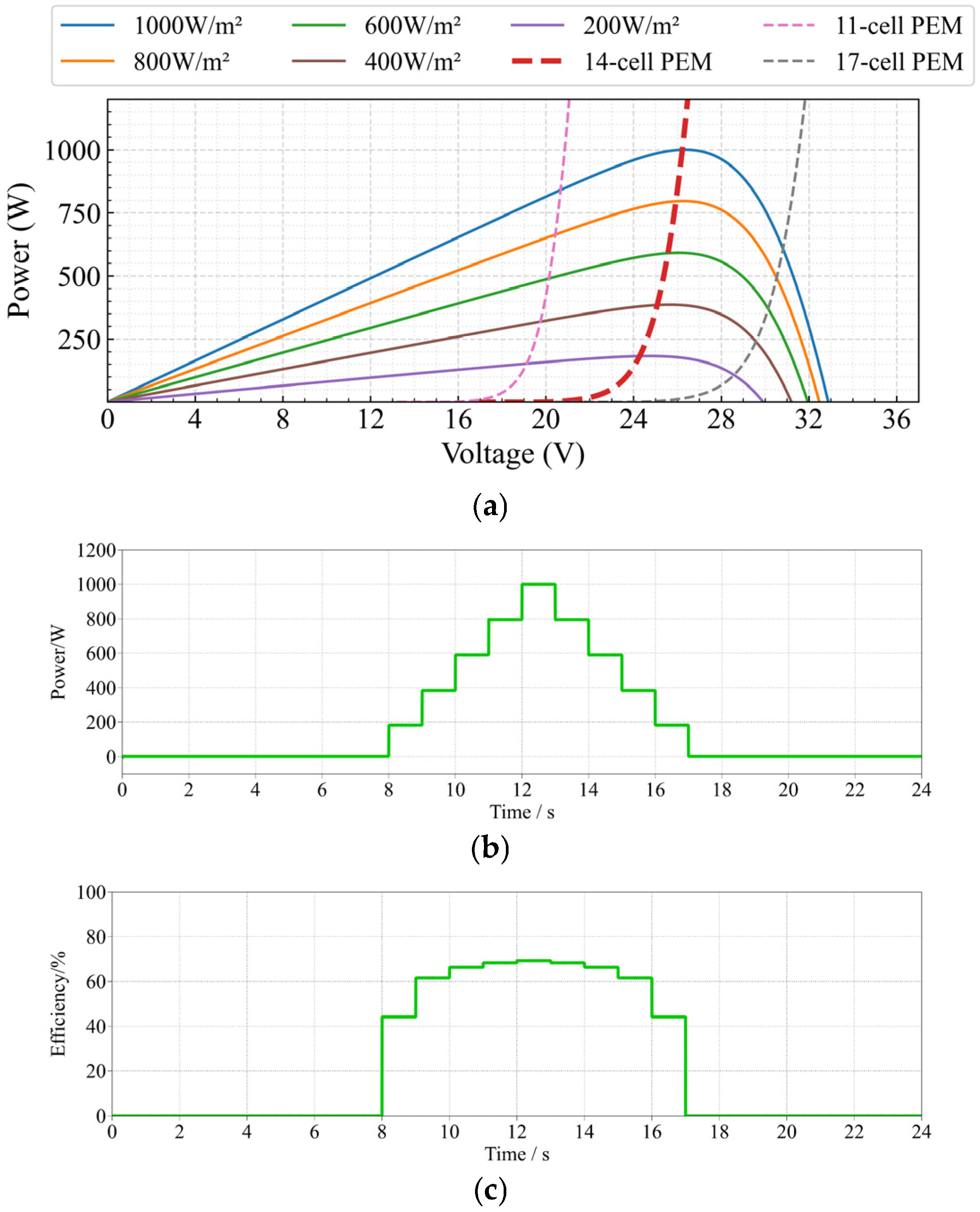
The corresponding simulation results are depicted in Figure 13a,b. Specifically, Figure 13b illustrates the output power characteristics of the PV system under MPPT control, while Figure 13c presents the efficiency performance of the PEM electrolyzer under the same operating conditions.
The number of electrolyzers connected in series plays a critical role in the performance of the directly coupled PV–PEM electrolyzer system. As illustrated in Figure 13a, when the series connection consisted of 11 or 17 electrolyzers, the photovoltaic system was unable to operate effectively, resulting in suboptimal power release. In contrast, with 14 series-connected electrolyzers, the PV system operated near its maximum power point, demonstrating optimal coordination between the PV array and the electrolyzers.
Moreover, considering the case with 14 electrolyzers, as the solar irradiance gradually decreased, the voltage corresponding to the maximum power point of the PV array varied accordingly, whereas the intersection voltage between the PV array and the electrolyzer gradually decreased. This indicates that the system achieves the true maximum power point only under the highest irradiance conditions shown in the Figure 13a and operates below the maximum power point at other times, which also impacts the electrolyzer’s efficiency. Since the system does not consistently operate at the maximum power point, the overall system efficiency is inherently lower compared to the other series configurations.

4.4. Simulation for PV System and PEM Electrolyzer Connected via a DC–DC Converter

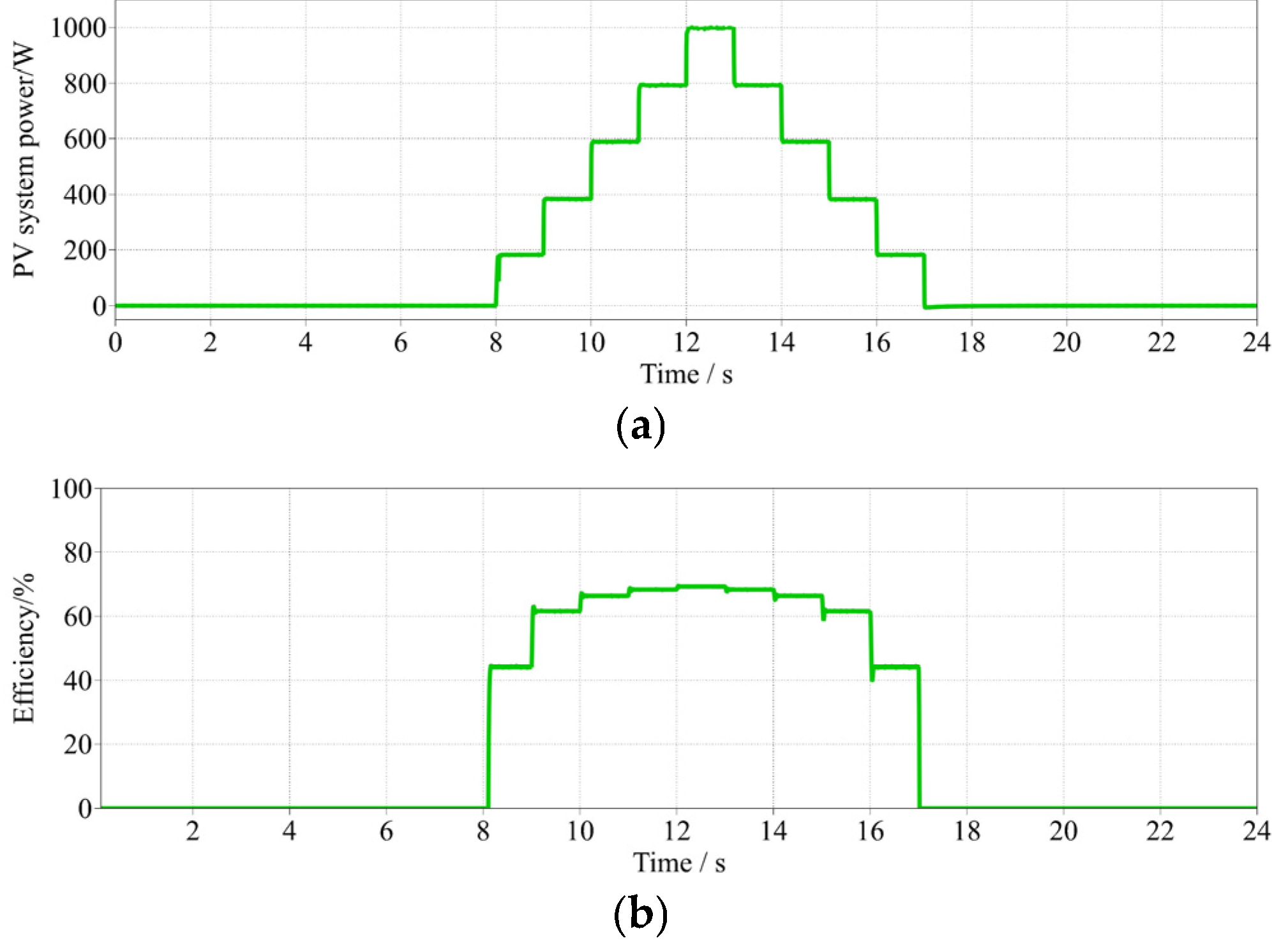
In this simulation, the parameters adopted for modeling both the PV array and the PEM electrolyzer remained consistent with those listed in the Table 2, Table 3 presented in the previous section. Furthermore, the same solar radiation profile was applied to ensure comparability of the results. The accelerated P&O control algorithm was employed to regulate the buck converter, thereby enabling maximum power point tracking of the PV system. The corresponding simulation results are depicted in Figure 14a,b. Specifically, Figure 14a illustrates the output power characteristics of the PV system under MPPT control, while Figure 14b presents the efficiency performance of the PEM electrolyzer under the same operating conditions.
The simulation results exhibit a performance trend similar to that of the directly coupled system, since the latter inherently allows the PV array to operate at its maximum power point without the need for additional regulation. As illustrated in Figure 14a, the proposed configuration still requires a certain adjustment period before reaching steady-state operation, during which minor power oscillations can be observed, even though the buck converter employs the accelerated P&O MPPT algorithm. Furthermore, Figure 14b demonstrates that slight fluctuations remain present in the efficiency profile of the PV–PEM electrolyzer system.
However, the proposed system presents a clear advantage over the directly coupled configuration. Specifically, it does not require additional parameter-matching calculations between the PV array and the electrolyzer stack. As demonstrated in the simulation, when the electrolyzers are connected in series with either 11 or 17 cells, the system is still capable of maintaining operation at the maximum power point and ensuring stable power delivery. By contrast, the directly coupled system lacks this flexibility, as its performance is highly dependent on the inherent voltage–current characteristics of both the PV array and the electrolyzers.
To further demonstrate the advantages of the proposed system, Table 4 summarizes the key characteristics of the three configurations, including the maximum PV array power, power stability, efficiency control capability, overall efficiency, and available running time. The reported efficiency is defined as the time-averaged system operating efficiency over the interval from 8 s to 17 s, during which the photovoltaic array operates under nonzero and continuously varying solar irradiance. Since variations in solar irradiance directly affect the available input power and lead to fluctuations in the instantaneous efficiency, the efficiency is statistically evaluated over this irradiance-active period to ensure a fair and representative comparison among different configurations. By averaging the efficiency over the same operating interval, the influence of transient effects is minimized, and the observed performance differences can be mainly attributed to the proposed control strategy.
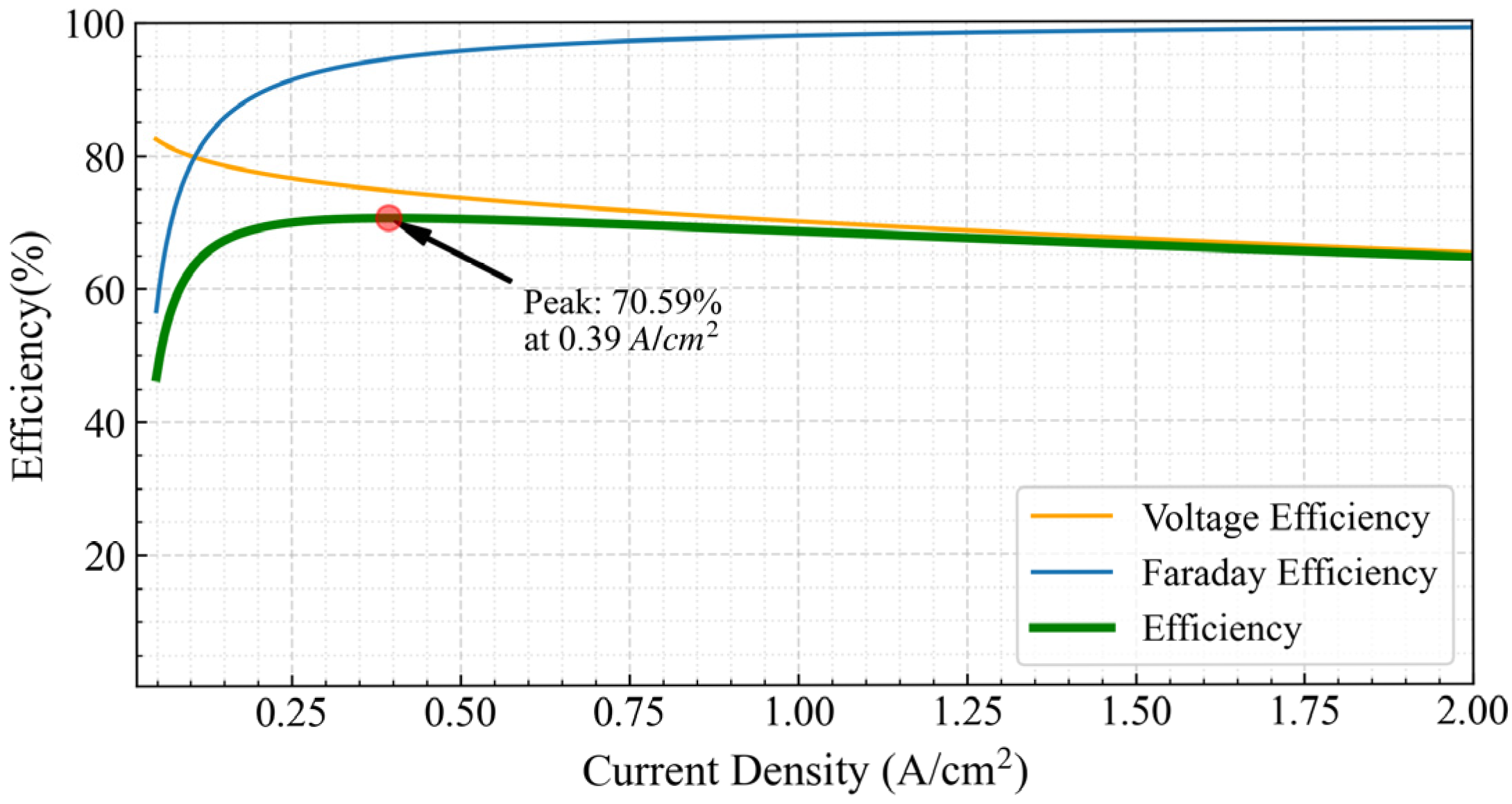
Figure 15 shows the efficiency–current density curve of the electrolyzer at 65 °C and a cathode pressure of 35 bar. The 69.9% efficiency listed in Table 4 closely matches the 70.59% indicated on the curve in the Figure 15. The proposed MLP model-based control strategy successfully controlled the current flowing through the electrolyzer to around 0.39 A/cm2, verifying the effectiveness of the proposed control strategy.
The specific energy yield (weight of H2 per kWh of input) and converter losses (a general 5% is assumed [33,34]) are presented in Table 4. The configuration achieving 16.73 g H2 per kWh of input energy demonstrated superior performance compared with other topologies (15.40 g/kWh and 14.73 g/kWh). Table 4 presents the LCOH estimation and specific energy yield, calculated based on input energy, operation hours, and estimated annualized costs. The LCOH values are calculated assuming a PV system cost of 4000 CNY/kw [34,35], a PEM electrolyzer cost of 5000 CNY/kW [36,37,38], a buck converter of 1000 CNY/kW, a DAB converter of 2000 CNY/kW, and a battery cost of 800 CNY/kWh, the three systems are assumed to operate for 15,000 h, 15,000 h, and 25,000 h over five years, respectively.
Despite its additional capital and maintenance costs, the proposed configuration achieved the highest specific energy yield, corresponding to the lowest LCOH among the three configurations.
The comparison results clearly validate the superior performance of the proposed system and the effectiveness of the associated control strategy under the conditions considered in this study.

5. Conclusions

This study investigated the integrated operation of a PV system and a PEM electrolyzer for sustainable hydrogen production. Both direct coupling and buck converter-based topologies were analyzed and compared in terms of energy conversion efficiency and system stability. An innovative energy distribution and electrolyzer efficiency optimization control strategy was proposed within a PV–battery–PEM electrolyzer hybrid framework. In the proposed configuration, the battery effectively mitigates the unstable output induced by PV fluctuations, while an MLP neural network is employed to establish the optimal efficiency model of the electrolyzer and regulate its operating current in real time. Although the efficiency model does not capture all real-world effects (unmodeled interactions), it reliably demonstrates the algorithm’s effectiveness and efficiency trends. The neural network model was trained in Python, and the complete system was modeled and simulated using the PLECS power electronics simulation platform to verify the feasibility and effectiveness of the proposed control strategy. Two configurations—direct coupling and buck converter-interfaced—were constructed for comparative analysis. The simulation results demonstrate that, in the directly coupled configuration, the PV array cannot consistently operate at the maximum power point, leading to energy losses, reduced dynamic stability, and a lack of electrolyzer efficiency consideration. In contrast, the buck converter topology with an MPPT algorithm ensures stable PV operation at the maximum power point; however, the electrolyzer’s efficiency remains suboptimal, as its input power is directly dictated by the PV output.
In conclusion, the proposed circuit topology and coordinated control strategy significantly enhance electrolyzer efficiency and overall system operational stability. However, the increased structural and control complexity raises implementation costs, and further investigations are required to refine the electrolyzer efficiency model under practical operating and environmental conditions.

Author Contributions

Conceptualization, C.F. and Z.C.; methodology, C.F. and Z.C.; software, Z.C.; validation, H.L., C.F., and Y.S.; formal analysis, Z.C. and H.L.; investigation, H.L.; resources, L.M.; data curation, Z.C.; writing—original draft preparation, Z.C.; writing—review and editing, C.F. and L.M.; visualization, Z.C.; supervision, L.M.; project administration, C.F. and Y.S.; funding acquisition, L.M. All authors have read and agreed to the published version of the manuscript.

Funding

This work was supported in part by the Fundamental Research Funds for the Central Universities, grant number 2024MS107.

Data Availability Statement

The original contributions presented in the study are included in the article; further inquiries can be directed to the corresponding author.

Acknowledgments

The authors acknowledge the Fundamental Research Funds for the Central Universities, grant number 2024MS107.

Conflicts of Interest

The authors declare no conflicts of interest.

Nomenclature

Photovoltaic System Parameter List
Vvoltage across the terminals of the photovoltaic system (V)
Icurrent flowing through the photovoltaic system (A)
Rsequivalent series resistance of the array ( Ω )
I p v current generated by incident light (A)
I 0 reverse saturation current (A)
qelectron charge constant (C)
Ttemperature of the p-n junction (K)
α diode idealist constant
Rpequivalent parallel resistance ( Ω )
N s number of series-connected cells in the module
KBoltzmann constant (J/K)
PEM Electrolyzer Parameter List
V c e l l PEM electrolyzer cell voltage (V)
V 0 open circuit voltage (V)
η a c t activation overpotential (V)
η o h m ohmic overpotential (V)
η d i f f diffusion overpotential (V)
G Gibbs free energy (J/mol)
FFaraday constant (C/mol)
Runiversal gas constant (J/(mol·K))
Tpemtemperature of the PEM electrolyzer (K)
P H 2 partial pressure of hydrogen (bar)
P O 2 partial pressure of oxygen (bar)
P H 2 O partial pressure of water vapor
α a anode charge transfer coefficient
α c cathode charge transfer coefficient
i 0 exchange current density (A/cm2)
i 0 , c a t cathode exchange current density (A/cm2)
i 0 , a n anode exchange current density (A/cm2)
T ref reference temperature (K)
E exc activation energy of the electrode (KJ)
η a c t a n o d e activation overpotential of the anode (V)
η a c t c a t h o d e activation overpotential of the cathode (V)
δ m thickness of the membrane (cm)
Ipemcurrent flowing through the electrolyzer (A)
Aarea of the membrane (cm2)
σ m conductivity of the membrane (S/cm)
η d i f f , a n diffusion overpotential of the anode (V)
η d i f f , c a t diffusion overpotential of the cathode (V)
C H 2 , m e , 0 hydrogen concentration at the membrane–electrode interface under standard conditions (mol/cm3)
C O 2 , m e , 0 oxygen concentration at the membrane–electrode interface under standard conditions (mol/cm3)
i current density at the electrode/electrolyte interface
i 0 , ref exchange current density at the electrode (A/cm2)
C O 2 , m e oxygen concentration at the membrane–electrode interface (mol/cm3)
C H 2 , m e hydrogen concentrations at the membrane–electrode interface (mol/cm3)
PEM Electrolyzer Efficiency Model Parameter List
η P E M efficiency of the PEM electrolyzer
η V voltage efficiency
η F Faraday efficiency
H enthalpy change (J/mol)
Δ S change in entropy of system (J/(mol·K))
Q a c t actual charge for the production of hydrogen (C)
Q i d ideal charge for the production of hydrogen (C)
ε H 2 d i f diffusion permeability of the hydrogen (mol/(cm·s·bar))
Φ H 2 flux density of hydrogen (mol/(cm2·s))
Φ O 2 flux density of oxygen (mol/(cm2·s))
Γ H 2 production rate density of hydrogen (mol/(cm2·s))
Γ O 2 production rate density of oxygen (mol/(cm2·s))
n number of electrons transferred per reaction
ε O 2 d i f diffusion permeability of the oxygen (mol/(cm·s·bar))
ε d p differential pressure permeability (mol/(cm·s·bar))
Ipemcurrent flowing through the electrolyzer (A)
Battery System Parameter List
V b a t t battery voltage (V)
K polarization constant ( Ω )
i filtered current (A)
Qbattery capacity (Ah)
R b internal resistance of the battery ( Ω )
i t actual battery charge (Ah)
A b a t exponential zone amplitude (V)
B exponential zone time constant inverse (Ah)−1
i b a t battery current (A)

References

  1. He, M.; Nie, G.; Yang, H.; Li, B.; Zhou, S.; Wang, X. A generic equivalent circuit model for PEM electrolyzer with multi-timescale and stages under multi-mode control. Appl. Energy 2024, 359, 122728. [Google Scholar] [CrossRef]
  2. Hernández-Gómez, Á.; Ramirez, V.; Guilbert, D. Investigation of PEM electrolyzer modeling: Electrical domain, efficiency, and specific energy consumption. Int. J. Hydrogen Energy 2020, 45, 14625–14639. [Google Scholar] [CrossRef]
  3. Yang, H.; Mo, J. Research on the Bidding Behavior of Generation-Side Enterprises Based on Stochastic Evolutionary Games. IEEE Trans. Power Syst. 2022, 37, 3693–3703. [Google Scholar] [CrossRef]
  4. Ye, A.; Guan, B.; Liu, X.; Zhang, T. Using solar energy to achieve near-zero energy buildings in Tibetan Plateau. Renew. Energy 2023, 218, 119347. [Google Scholar] [CrossRef]
  5. Sánchez-Squella, A.; Flores, R.; Burgos, R.; Morales, F.; Nader, A.; Valdivia-Lefort, P. 99.6% efficiency DC-DC coupling for green hydrogen production using PEM electrolyzer, photovoltaic generation and battery storage operating in an off-grid area. Renew. Energy 2024, 237, 121781. [Google Scholar] [CrossRef]
  6. Parida, B.; Iniyan, S.; Goic, R. A review of solar photovoltaic technologies. Renew. Sustain. Energy Rev. 2011, 15, 1625–1636. [Google Scholar] [CrossRef]
  7. Soler-Castillo, Y.; Sahni, M.; Leon-Castro, E. Performance predictability of photovoltaic systems: An approach to simulate the I–V curve dynamics. Energy Rep. 2023, 9, 234–269. [Google Scholar] [CrossRef]
  8. de Brito, M.A.G.; Galotto, L.; Sampaio, L.P.; Melo, G.d.A.e.; Canesin, C.A. Evaluation of the Main MPPT Techniques for Photovoltaic Applications. IEEE Trans. Ind. Electron. 2013, 60, 1156–1167. [Google Scholar] [CrossRef]
  9. Yodwong, B.; Guilbert, D.; Phattanasak, M.; Kaewmanee, W.; Hinaje, M.; Vitale, G. Faraday’s Efficiency Modeling of a Proton Exchange Membrane Electrolyzer Based on Experimental Data. Energies 2020, 13, 4792. [Google Scholar] [CrossRef]
  10. Scheepers, F.; Stähler, M.; Stähler, A.; Rauls, E.; Müller, M.; Carmo, M. Improving the Efficiency of PEM Electrolyzers through Membrane-Specific Pressure Optimization. Energies 2020, 13, 612. [Google Scholar] [CrossRef]
  11. Kang, Z.; Mo, J.; Yang, G.; Li, Y.; Talley, D.A.; Retterer, S.T.; Cullen, D.A.; Toops, T.J.; Brady, M.P.; Bender, G. Thin film surface modifications of thin/tunable liquid/gas diffusion layers for high-efficiency proton exchange membrane electrolyzer cells. Appl. Energy 2017, 206, 983–990. [Google Scholar] [CrossRef]
  12. Zhang, H.; Su, S.; Lin, G.; Chen, J. Efficiency Calculation and Configuration Design of a PEM Electrolyzer System for Hydrogen Production. Int. J. Electrochem. Sci. 2012, 7, 4143–4157. [Google Scholar] [CrossRef]
  13. Paul, B.; Andrews, J. Optimal coupling of PV arrays to PEM electrolysers in solar–hydrogen systems for remote area power supply. Int. J. Hydrogen Energy 2008, 33, 490–498. [Google Scholar] [CrossRef]
  14. Hüner, B. Mathematical modeling of an integrated photovoltaic-assisted PEM water electrolyzer system for hydrogen production. Int. J. Hydrogen Energy 2024, 79, 594–608. [Google Scholar] [CrossRef]
  15. Muhammad-Bashir, S.; Al-Oufi, M.; Al-Hakami, M.; Nadeem, M.; Mudiyanselage, K.; Idriss, H. Comparison between the performance of high concentrated and non-concentrated PV-cells for hydrogen production using PEM water electrolyzers. Sol. Energy 2020, 205, 461–464. [Google Scholar] [CrossRef]
  16. Omar, F.A. A new approach for improving the efficiency of the indirectly coupled photovoltaic-electrolyzer system. Int. J. Hydrogen Energy 2023, 48, 8768–8782. [Google Scholar] [CrossRef]
  17. Haque, A.; Zaheeruddin. A fast and reliable perturb and observe maximum power point tracker for solar PV system. Int. J. Syst. Assur. Eng. Manag. 2017, 8, 773–787. [Google Scholar] [CrossRef]
  18. Ebrahim, M.; Sharaf, A.M.; Atallah, A.; Emarah, A. Modified P&O Technique for Hybrid PV–Battery Smart Grid Integrated Scheme. Turk. J. Electromech. Energy 2018, 3, 1–7. [Google Scholar]
  19. Liu, F.; Duan, S.; Liu, F.; Liu, B.; Kang, Y. A Variable Step Size INC MPPT Method for PV Systems. IEEE Trans. Ind. Electron. 2008, 55, 2622–2628. [Google Scholar] [CrossRef]
  20. Abdelsalam, A.K.; Massoud, A.M.; Ahmed, S.; Enjeti, P.N. High-Performance Adaptive Perturb and Observe MPPT Technique for Photovoltaic-Based Microgrids. IEEE Trans. Power Electron. 2011, 26, 1010–1021. [Google Scholar] [CrossRef]
  21. Gu, X.; Ying, Z.; Zheng, X.; Dou, B.; Cui, G. Photovoltaic-based energy system coupled with energy storage for all-day stable PEM electrolytic hydrogen production. Renew. Energy 2023, 209, 53–62. [Google Scholar] [CrossRef]
  22. Shen, J.; Dusmez, S.; Khaligh, A. Optimization of Sizing and Battery Cycle Life in Battery/Ultracapacitor Hybrid Energy Storage Systems for Electric Vehicle Applications. IEEE Trans. Ind. Inform. 2014, 10, 2112–2121. [Google Scholar] [CrossRef]
  23. Villalva, M.G.; Gazoli, J.R.; Filho, E.R. Comprehensive Approach to Modeling and Simulation of Photovoltaic Arrays. IEEE Trans. Power Electron. 2009, 24, 1198–1208. [Google Scholar] [CrossRef]
  24. Tijani, A.S.; Rahim, A.H.A. Numerical Modeling the Effect of Operating Variables on Faraday Efficiency in PEM Electrolyzer. Procedia Technol. 2016, 26, 419–427. [Google Scholar] [CrossRef]
  25. Zhou, Z.; Zhang, S.; Zhong, Y.; Sun, Z.; Peng, Y. A predictive control method for multi-electrolyzer off-grid hybrid hydrogen production systems with photovoltaic power prediction. Int. J. Hydrogen Energy 2024, 84, 383–393. [Google Scholar] [CrossRef]
  26. Wang, B.; Xin, D.; Fu, Q.; Zhang, C. A control-oriented comprehensive model of PEM electrolyzer considering double-layer capacitance. Int. J. Hydrogen Energy 2024, 93, 866–877. [Google Scholar] [CrossRef]
  27. Liso, V.; Savoia, G.; Araya, S.S.; Cinti, G.; Kær, S.K. Modelling and Experimental Analysis of a Polymer Electrolyte Membrane Water Electrolysis Cell at Different Operating Temperatures. Energies 2018, 11, 3273. [Google Scholar] [CrossRef]
  28. Carmo, M.; Fritz, D.L.; Mergel, J.; Stolten, D. A Comprehensive Review on PEM Water Electrolysis. Int. J. Hydrogen Energy 2013, 38, 4901–4934. [Google Scholar] [CrossRef]
  29. García-Valverde, R.; Espinosa, N.; Urbina, A. Simple PEM Water Electrolyser Model and Experimental Validation. Int. J. Hydrogen Energy 2012, 37, 1927–1938. [Google Scholar] [CrossRef]
  30. Marangio, F.; Santarelli, M.; Cali, M. Theoretical model and experimental analysis of a high pressure PEM water electrolyser for hydrogen production. Int. J. Hydrogen Energy 2009, 34, 1143–1158. [Google Scholar] [CrossRef]
  31. Chen, M.; Rincon-Mora, G.A. Accurate electrical battery model capable of predicting runtime and I–V performance. IEEE Trans. Energy Convers. 2006, 21, 504–511. [Google Scholar] [CrossRef]
  32. Tremblay, O.; Dessaint, L.-A.; Dekkiche, A.-I. A Generic Battery Model for the Dynamic Simulation of Hybrid Electric Vehicles. In Proceedings of the IEEE Vehicle Power and Propulsion Conference (VPPC), Arlington, TX, USA, 9–12 September 2007; pp. 284–289. [Google Scholar]
  33. Guilbert, D.; Collura, S.M.; Scipioni, A. DC/DC converter topologies for electrolyzers: State-of-the-art and remaining key issues. Int. J. Hydrogen Energy 2017, 42, 23966–23985. [Google Scholar] [CrossRef]
  34. Vitale, G. Power Converters for Green Hydrogen: State of the Art and Perspectives. Electronics 2024, 13, 4565. [Google Scholar] [CrossRef]
  35. Huang, X.; Qu, Y.; Zhu, Z.; Wu, Q. Techno-Economic Analysis of Photovoltaic Hydrogen Production Considering Technological Progress Uncertainty. Sustainability 2023, 15, 3580. [Google Scholar] [CrossRef]
  36. Rezaei, M.; Akimov, A.; Gray, E.M.A. Levelised cost of dynamic green hydrogen production: A case study for Australia’s hydrogen hubs. Appl. Energy 2024, 370, 123645. [Google Scholar] [CrossRef]
  37. Moncada, J.; de Goeij, B.; van den Ham, J.; Buskens, P.; Meulendijks, N.; Detz, R.J. Evaluating the Costs of Integrated Solar Hydrogen Systems: Exploring the Effect of Scale, Intermittency, and Energy Storage. Energies 2025, 18, 6069. [Google Scholar] [CrossRef]
  38. Rezaei, M.; Akimov, A.; Gray, E.M.A. Economics of solar-based hydrogen production: Sensitivity to financial and technical factors. Int. J. Hydrogen Energy 2022, 47, 27930–27943. [Google Scholar] [CrossRef]
Figure 1. Hydrogen production system. (a) Directly coupled PV system and PEM electrolyzer. (b) PV system and PEM electrolyzer coupled via DC–DC converter. (c) Topology of PV–battery–PEM electrolyzer system. (d) Proposed PV–battery–PEM electrolyzer system.
Hydrogen 07 00054 g001
Figure 2. Power flow among PV array, battery, and PEM electrolyzer.
Hydrogen 07 00054 g002
Figure 3. Topology and control strategy of the buck converter.
Hydrogen 07 00054 g003
Figure 4. Flowchart of the accelerated perturb and observe (P&O) method.
Hydrogen 07 00054 g004
Figure 5. Topology and control strategy for the DAB converter. (a) Topology and control strategy for the DAB converter without considering degradation. (b) Control strategy for the electrolyzer under degradation conditions.
Hydrogen 07 00054 g005
Figure 6. Experimental platform.
Hydrogen 07 00054 g006
Figure 7. Comparison between experimental data and model results.
Hydrogen 07 00054 g007
Figure 8. Performance characteristics of the PEM electrolyzer under varying operating temperatures and hydrogen pressures. (a) Relationship between current density, operating temperature, and hydrogen pressure in the PEM electrolyzer. (b) Relationship between PEM electrolyzer efficiency, operating temperature, and hydrogen pressure.
Hydrogen 07 00054 g008
Figure 9. PEM electrolyzer optimal current density with MLP model and mathematical model.
Hydrogen 07 00054 g009
Figure 10. Comparison of efficiency characteristics under varying hydration states and degradation conditions: (a) peak efficiency and performance decay under varying hydration states; (b) efficiency–current density characteristics before and after degradation.
Hydrogen 07 00054 g010
Figure 11. Simulation results of the proposed PV–battery–PEM electrolyzer system: (a) Power output of the PV array in the proposed system. (b) Power output of the battery system in the proposed PV–battery–electrolyzer configuration. (c) Power consumption of the PEM electrolyzer in the proposed system. (d) Efficiency characteristics of the PEM electrolyzer in the proposed system.
Hydrogen 07 00054 g011
Figure 12. Power response of the PV–battery–PEM system under dynamic conditions. (a) Response of photovoltaic output power under stepwise variations in solar irradiance over an actual 10 s time window at 25 °C. (b) System power response under SOC-constrained energy management strategy.
Hydrogen 07 00054 g012
Figure 13. Simulation results of the directly coupled PV–PEM electrolyzer system: (a) Current–voltage characteristics of the PV array and PEM electrolyzers with varying numbers of series-connected cells. (b) Power output of the PV array in a directly coupled PV–PEM electrolyzer system. (c) Efficiency of the PEM electrolyzer in a directly coupled PV–PEM electrolyzer system.
Hydrogen 07 00054 g013
Figure 14. Simulation results of the buck converter-interfaced PV–PEM electrolyzer system: (a) Power output of the PV array in a buck converter-interfaced PV–PEM electrolyzer system. (b) Efficiency of the PV array in a buck converter-interfaced PV–PEM electrolyzer system.
Hydrogen 07 00054 g014
Figure 15. Efficiency–current density curve of the electrolyzer.
Hydrogen 07 00054 g015
Table 1. Comparison of the advantages and disadvantages of the three topologies.
Topology TypeAdvantagesDisadvantagesEfficiency of PEM Electrolyzer
Directly coupled PV system and PEM electrolyzer
  • Simple structure
  • High PV system efficiency
  • Complex parameter design
  • Poor robustness
Not considered
PV system and PEM electrolyzer coupled via DC–DC converter
  • MPPT algorithm
  • Voltage level matching
  • Rising costs
  • Energy loss still exists
Not considered
PV–battery–PEM
electrolyzer system
  • Strong robustness
  • Energy recycling
  • MPPT algorithm
  • Voltage level matching
  • Structure and control complex
  • High costs
Not considered
Table 2. Parameters used to model the photovoltaic array.
Parameter for Photovoltaic ArrayValue
I p v 8.21   A
I 0 9.825 × 10 8   A
R s 0.221   Ω
N s 54
N p 1
T 25   ° C
a 1.3
R p 415.405   Ω
Table 3. Parameters used to model the PEM electrolyzer.
Parameter for PEM ElectrolyzerValue
R 8.314   J / ( m o l · K )
F 96,485   C / m o l
a a 2
a c 0.5
i 0 , a n , r e f 10 8   A
i 0 , c a t , r e f 10 3   A
δ m 209   m m
A 160   c m 2
Table 4. A comprehensive comparison of three different photovoltaic electrolyzer systems.
Type of Simulation SystemDirectly Coupled SystemWith a Buck ConverterProposed System
Maximum power of PV systemNOYESYES
Stability of photovoltaic outputPoorCommonHigh
Efficiency controlNONOYES
Overall efficiencyMedium
61.1688%
Medium
61.5660%
Highest
69.9003%
Available running timeWith radiation intensityWith radiation intensity24 h (under normal circumstances)
Specific energy yield (weight of H2
produced per kWh of input energy)
15.40 g14.73 g
(5% converter loss)
16.73 g
(5% converter loss)
LCOH (CNY/kg H2)40.9147.5232.13
Disclaimer/Publisher’s Note: The statements, opinions and data contained in all publications are solely those of the individual author(s) and contributor(s) and not of MDPI and/or the editor(s). MDPI and/or the editor(s) disclaim responsibility for any injury to people or property resulting from any ideas, methods, instructions or products referred to in the content.