
What Determines the Distribution of Forest Flightless Bush Cricket Pholidoptera griseoaptera in the Eastern Part of Its Range (The Kaluga Region, Russia)?


Abstract
1. Introduction
2. Materials and Methods
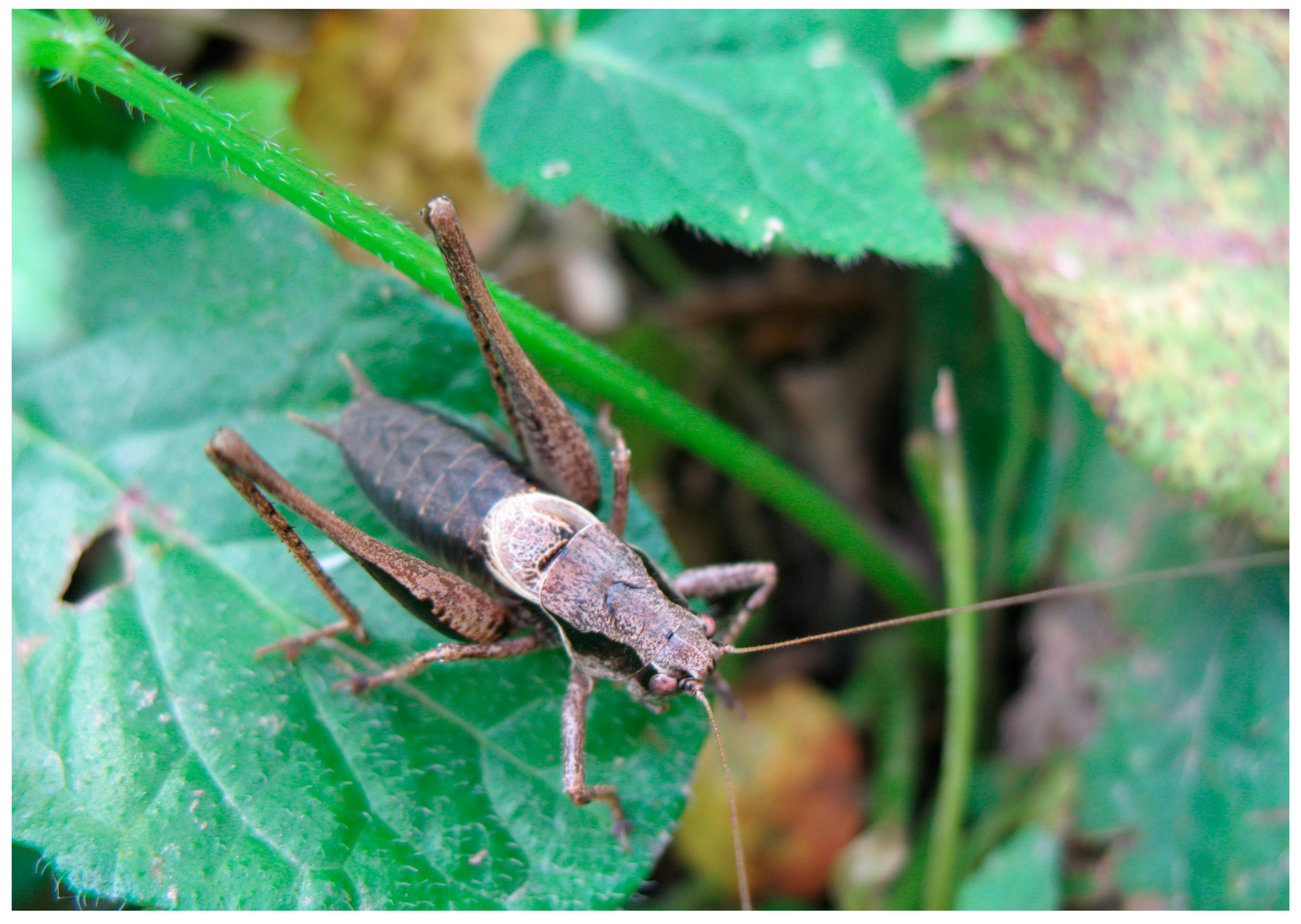
2.1. Study Species
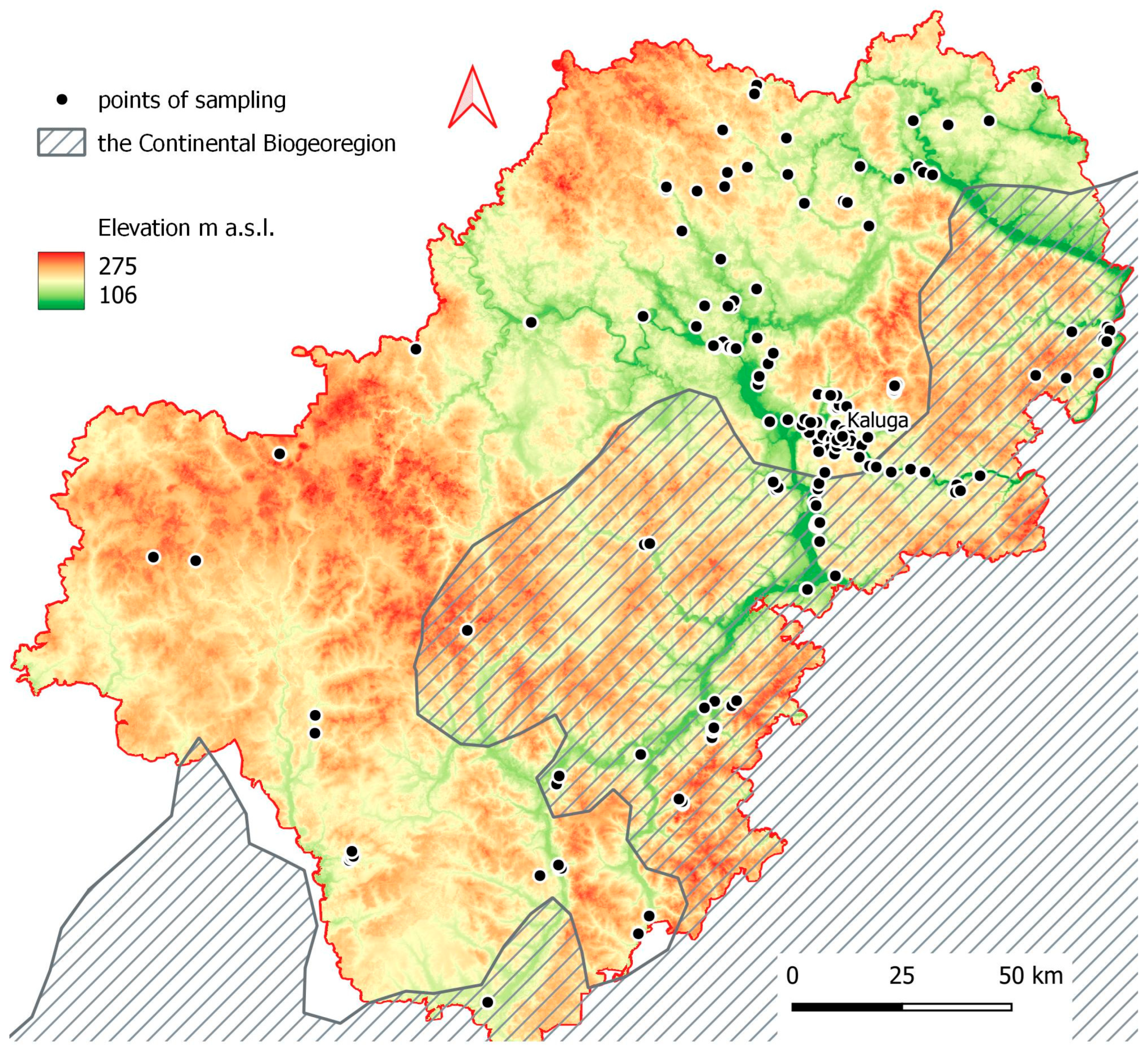
2.2. Study Area
2.3. Data Sampling
2.4. Properties of Sample Plots
2.5. Data Analysis
3. Results
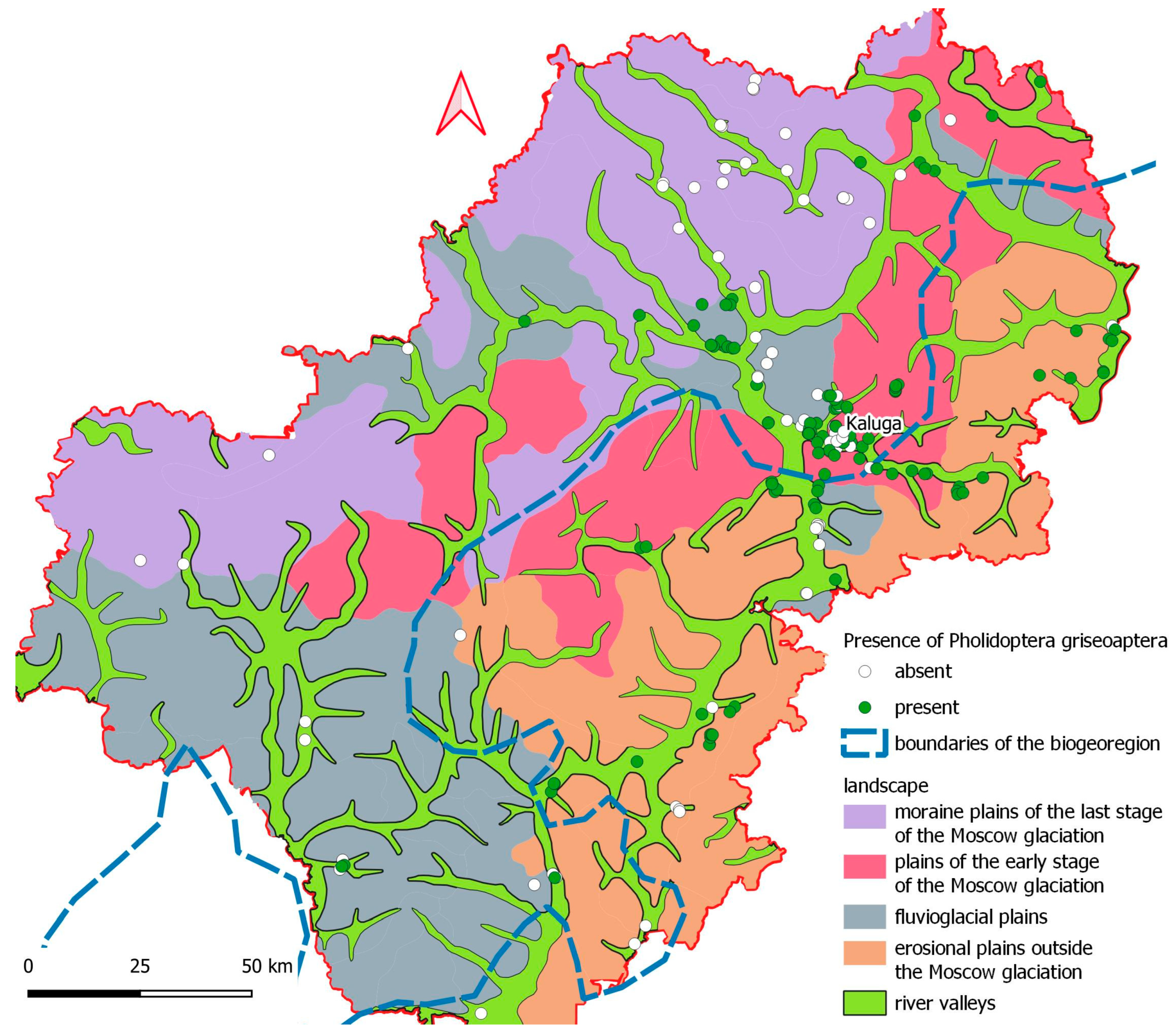
3.1. Distribution of Pholidoptera griseoaptera Across the Kaluga Region
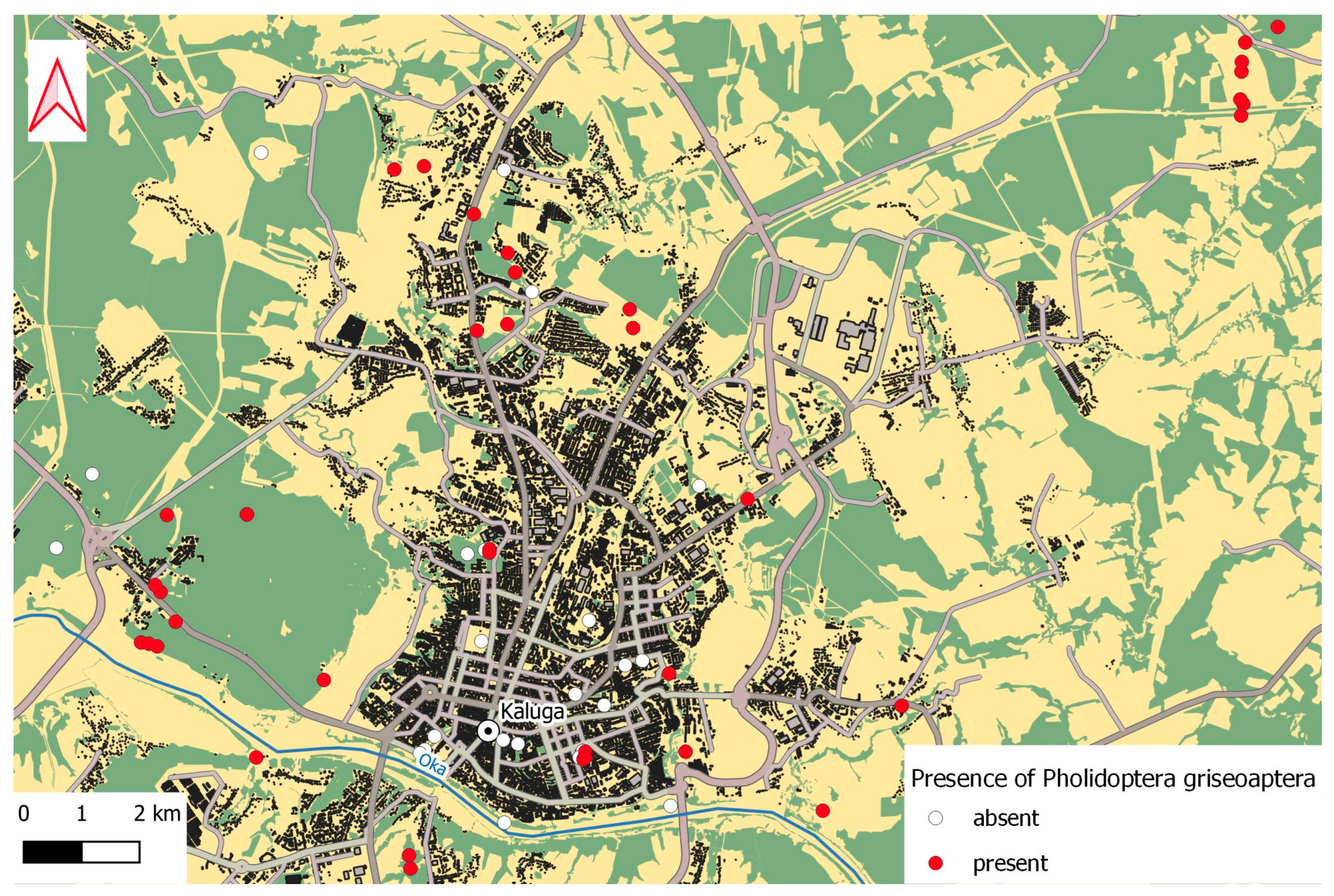
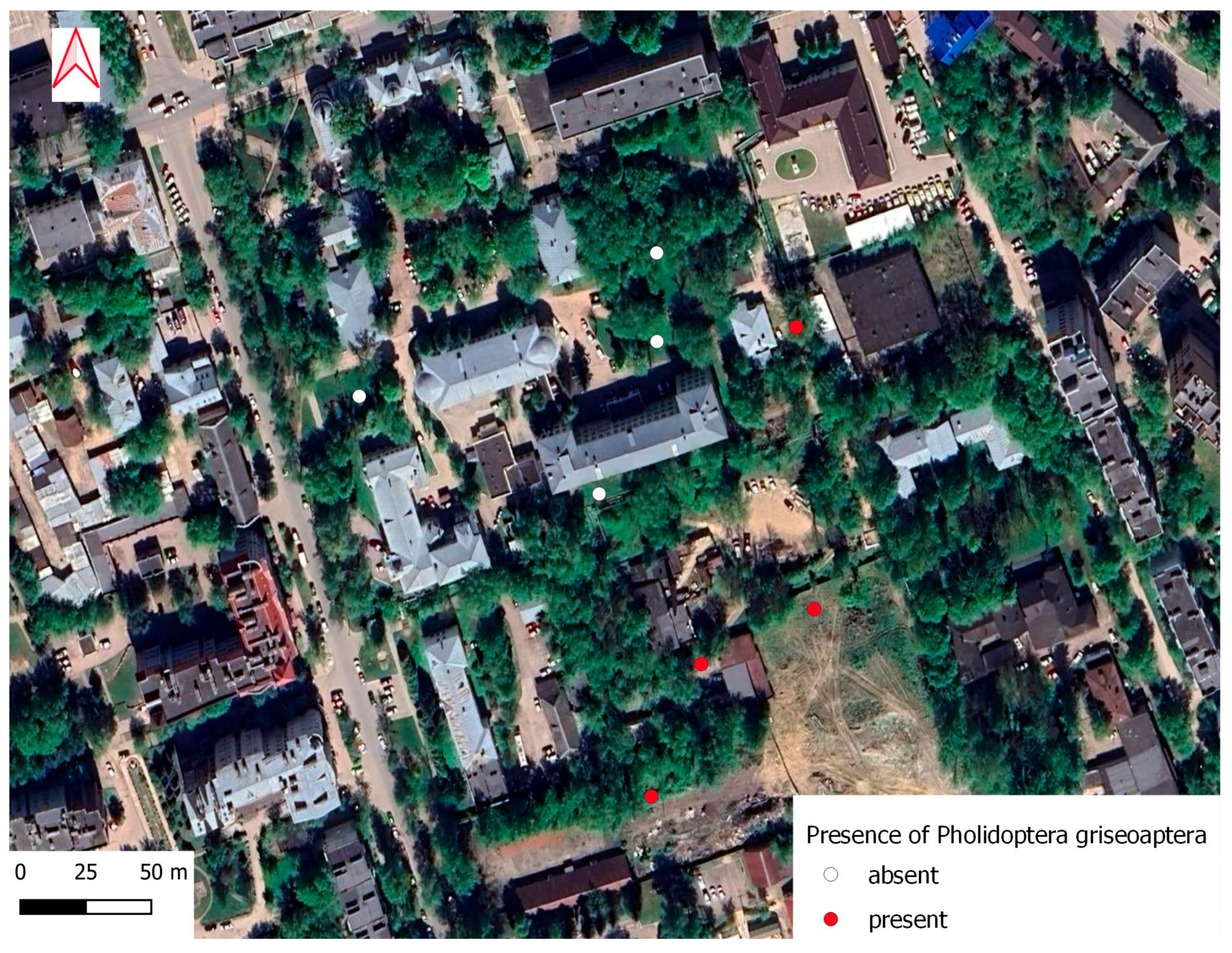
3.2. Distribution of Pholidoptera griseoaptera in Urban Areas
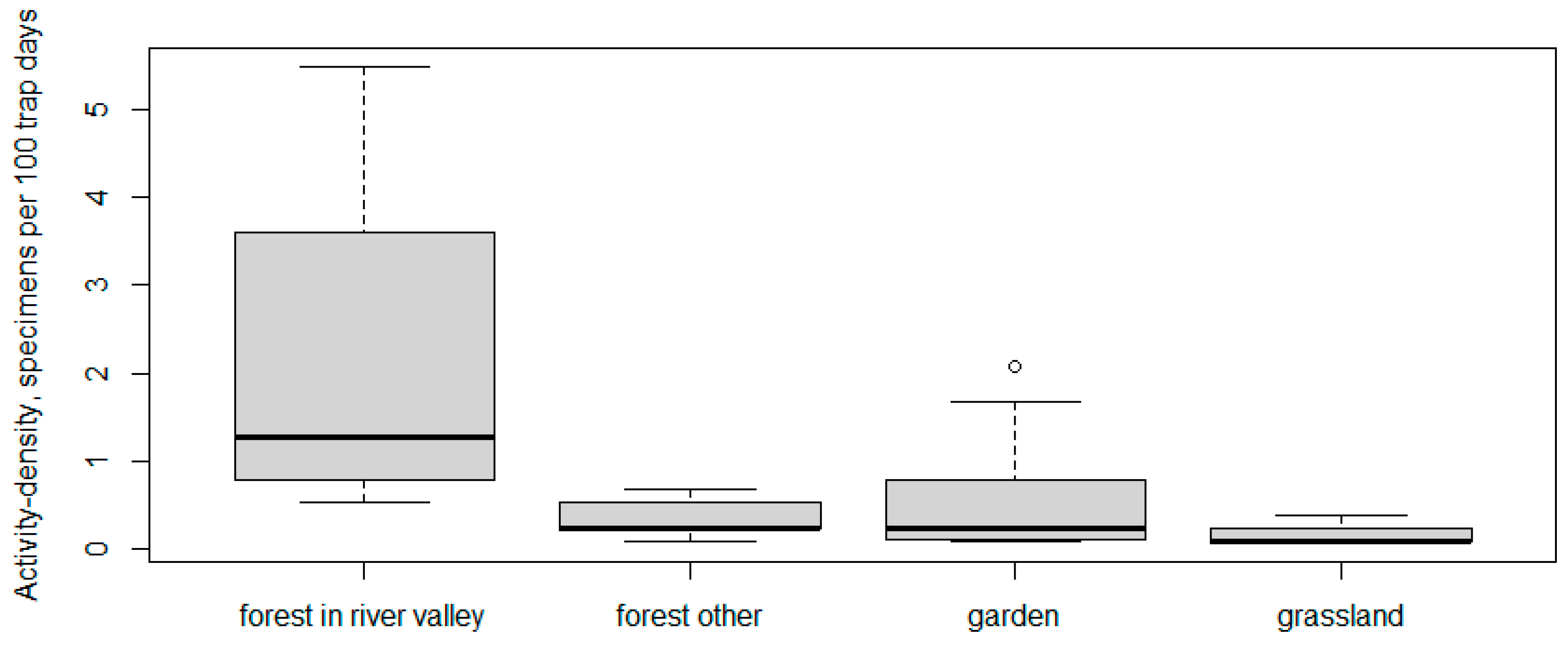
3.3. Abundance of Pholidoptera griseoaptera
4. Discussion
4.1. Current Habitat Characteristics Affect the Distribution of Pholidoptera griseoaptera
4.2. Modern History Affects the Distribution of Pholidoptera griseoaptera
4.3. Glacial and Postglacial History as a Probable Determinant of the Distribution of Pholidoptera griseoaptera
5. Conclusions
Supplementary Materials
Author Contributions
Funding
Institutional Review Board Statement
Informed Consent Statement
Data Availability Statement
Acknowledgments
Conflicts of Interest
Abbreviations
| BP | before present |
| kyr | Thousand years |
References
- MacFadyen, A. Animal Ecology. Aims and Methods, 2nd ed.; Sir Isaac Pitman and Sons, Ltd.: London, UK, 1963; p. XXIV+344. [Google Scholar]
- Molles, M.C.J. Ecology: Concepts and Applications, 4th ed.; McGraw Hill: New York, NY, USA, 2008; p. 588. [Google Scholar]
- Kindlmann, P.; Tsiftsis, S.; Buchbauerová, L.; Traxmandlová, I.; Štípková, Z. How Will Environmental Conditions Affect Species Distribution and Survival in the Coming Decades—A Review. Diversity 2025, 17, 793. [Google Scholar] [CrossRef]
- Peterken, G.F.; Game, M. Historical factors affecting the number and distribution of vascular plant species in the woodlands of central Lincolnshire. J. Ecol. 1984, 72, 155–182. [Google Scholar] [CrossRef]
- Ricketts, T.H. The matrix matters: Effective isolation in fragmented landscapes. Am. Nat. 2001, 158, 87–99. [Google Scholar] [CrossRef]
- Prevedello, J.A.; Vieira, M.V. Does the type of matrix matter? A quantitative review of the evidence. Biodivers. Conserv. 2010, 19, 1205–1223. [Google Scholar] [CrossRef]
- European Environment Agency. Europe’s Biodiversity—Biogeographical Regions and Seas Biogeographical Regions in Europe; EEA Report No 1/2002; European Environment Agency: Copenhagen, Denmark; Available online: https://www.eea.europa.eu/publications/report_2002_0524_154909 (accessed on 12 November 2024).
- Smirnova, O.V.; Bobrovsky, M.V.; Khanina, L.G. (Eds.) European Russian Forests. Their Current State and Features of Their History; Springer Nature: Dordrecht, The Netherlands, 2017; p. 566. [Google Scholar]
- Fartmann, T.; Krämer, B.; Stelzner, F.; Poniatowski, D. Orthoptera as ecological indicators for succession in steppe grassland. Ecol. Indic. 2012, 2, 337–344. [Google Scholar] [CrossRef]
- Samways, M.J.; Lockwood, J.A. Orthoptera conservation: Pests and paradoxes. J. Insect Conserv. 1998, 2, 143–149. [Google Scholar] [CrossRef]
- Guido, M.; Gianelle, D. Distribution patterns of four Orthoptera species in relation to microhabitat heterogeneity in an ecotonal area. Acta Oecol. 2001, 22, 175–185. [Google Scholar] [CrossRef]
- Kenyeres, Z.; Rácz, I.A.; Varga, Z. Endemism hot spots, core areas and disjunctions in European Orthoptera. Acta Zool. Cracoviensia-Ser. B Invertebr. 2009, 52, 189–211. [Google Scholar] [CrossRef]
- Sergeev, M.G. Distribution patterns of grasshoppers and their kin over the Eurasian Steppes. Insects 2021, 12, 77. [Google Scholar] [CrossRef] [PubMed]
- Poniatowski, D.; Fartmann, T. What determines the distribution of a flightless bush-cricket (Metrioptera brachyptera) in a fragmented landscape? J. Insect Conserv. 2010, 14, 637–645. [Google Scholar] [CrossRef]
- Dvořák, T.; Hadrava, J.; Knapp, M. The ecological niche and conservation value of Central European grassland orthopterans: A quantitative approach. Biol. Conserv. 2022, 265, 109406. [Google Scholar] [CrossRef]
- Iorgu, I.-Ș.; Tăușan, I.; Oloeriu, C.-R.; Popa, A.-F.; Iorgu, E.I. Conservation Significance of Forest Remnants for Urban Biodiversity: Parks as a Refuge for the Wood Cricket, Nemobius sylvestris (Insecta: Orthoptera: Trigonidiidae). Ecologies 2026, 7, 27. [Google Scholar] [CrossRef]
- Bey-Bienko, G.Y. Orthoptera and Dermaptera. In Animal Word of the USSR. Vol. IV. Forest Belt; Publishing House of the USSR Academy of Sciences: Moscow, Russia, 1953; pp. 527–552. [Google Scholar]
- Harz, K. Die Orthopteren Europas—The Orthoptera of Europe; Dr. W. Junk B.V.: The Hague, The Netherlands, 1969; Volume I, p. 749. [Google Scholar]
- Harz, K. Die Geradflügler Mitteleuropas; G. Fischer: Jena, Germany, 1957; p. 494. [Google Scholar]
- Heller, K.G.; Korsunovskaya, O.; Ragge, D.R.; Vedenina, V.; Willemse, F.; Zhantiev, R.D.; Frantsevich, L. Check-list of European orthoptera. Articulata 1998, 7, 1–61. [Google Scholar]
- Lucas, W.J. A Monograph of the British Orthoptera; The Ray Society: London, UK, 1919; p. 264. [Google Scholar]
- Chopard, L. Faune de France. 56, Orthoptéroïdes; Paul Lechevalier: Paris, France, 1951; p. 358. [Google Scholar]
- Oschmann, M. Faunistisch-ökologische Untersuchungen an Orthopteren im Raum von Gotha. Hercynia-ÖKologie Umw. Mitteleur. 1969, 6, 115–168. [Google Scholar]
- Chernyakhovsky, M.E. Fauna of orthopteroid insects of the Moscow region. In Nauchnye Osnovy Okhrany Zhivoy Prirody Podmoscowia; Nauka: Moscow, Russia, 1988; pp. 72–78. [Google Scholar]
- Kaňuch, P.; Jarčuška, B.; Schlosserová, D.; Sliacka, A.; Paule, L.; Krištín, A. Landscape configuration determines gene flow and phenotype in a flightless forest-edge ground-dwelling bush-cricket, Pholidoptera griseoaptera. Evol. Ecol. 2012, 26, 1331–1343. [Google Scholar] [CrossRef]
- Diekötter, T.; Csencsics, D.; Rothenbühler, C.; Billeter, R.; Edwards, P.J. Movement and dispersal patterns in the bush cricket Pholidoptera griseoaptera: The role of developmental stage and sex. Ecol. Entomol. 2005, 30, 419–427. [Google Scholar] [CrossRef]
- Diekötter, T.; Speelmans, M.; Dusoulier, F.; Van Wingerden, W.K.; Malfait, J.P.; Crist, T.O.; Edwards, P.J.; Dietz, H. Effects of landscape structure on movement patterns of the flightless bush cricket Pholidoptera griseoaptera. Environ. Entomol. 2007, 36, 90–98. [Google Scholar] [CrossRef] [PubMed]
- Diekötter, T.; Baveco, H.; Arens, P.; Rothenbühler, C.; Billeter, R.; Csencsics, D.; De Philippi, R.; Hendrickx, F.; Speelmans, V.; Opdam, P.; et al. Patterns of habitat occupancy, genetic variation and predicted movement of a flightless bush cricket, Pholidoptera griseoaptera, in an agricultural mosaic landscape. Landsc. Ecol. 2010, 25, 449–461. [Google Scholar] [CrossRef]
- Kaňuch, P.; Jarčuška, B.; Kovács, L.; Krištín, A. Environmentally driven variability in size-selective females’ mating frequency of bush-cricket Pholidoptera griseoaptera. Evol. Ecol. 2015, 29, 787–797. [Google Scholar] [CrossRef]
- Bey-Bienko, G.Y. Changes of Habitats by Terrestrial Organisms as a Biological Principle. Zhurnal Obshchei Biol. 1966, 20, 5–21. [Google Scholar]
- Sergeev, M.G. Patterns of Orthoptera Distribution in North Asia; Nauka: Novosibirsk, Russia, 1986; p. 236. [Google Scholar]
- Jacobson, G.G.; Bianki, V.L. Orthoptera and Pseudoneuroptera of the Russian Empire and Bordering Countries; Izdanie AF Devriena: St. Petersburg, Russia, 1905; p. 952. [Google Scholar]
- Aleksanov, V.; Karmazina, I.; Shulaev, N.; Ruchin, A.; Lukiyanov, S.; Lobachev, E.; Nikolaeva, A.; Volodchenko, A.; Anikin, V.; Esin, M. Orthoptera and Mantodea in the Continental Biogeographical Region and Adjacent Areas of European Russia. Version 1.15. Joint Directorate of the Mordovia State Nature Reserve and National Park “Smolny”. Occurrence Dataset. Available online: https://doi.org/10.15468/xtpy3y (accessed on 9 July 2024).
- Adakhovsky, D.A. Materials on the fauna, distribution and ecology of straight-winged insects (Orthoptera) Udmurtia. Bull. Udmurtia Univ. Biol. 2006, 10, 120–121. [Google Scholar]
- Chernykhovsky, M.E.; Mironov, M.Y.; Sobolev, N.A. Pholidoptera griseoaptera. In Red Book of the City of Moscow, 3rd ed.; Department of Nature Conservation of the City of Moscow: Moscow, Russia, 2022; pp. 311–312. [Google Scholar]
- Reinhardt, K.; Köhler, G.; Maas, S.; Detzel, P. Low dispersal ability and habitat specificity promote extinctions in rare but not in widespread species: The Orthoptera of Germany. Ecography 2005, 28, 593–602. [Google Scholar] [CrossRef]
- Huchler, K.; Pachinger, B.; Kropf, M. Management is more important than urban landscape parameters in shaping orthopteran assemblages across green infrastructure in a metropole. Urban Ecosyst. 2023, 26, 209–222. [Google Scholar] [CrossRef]
- Atlas of the Kaluga Region; Izd-vo N.Bochkarevoy: Kaluga, Russia, 2005; p. 48.
- Lavrenko, E.M. The principles and units of geobotanical regionalization. In Geobot. Raionirovaniye SSSR; Nauka: Moscow, Russia, 1947; pp. 9–13. [Google Scholar]
- Soloviyova, M.P.; Khomutova, M.S. A tentative division of the Kaluga Region into geobotanical districts. Bot. J. 1969, 54, 721–728. [Google Scholar]
- Ogureeva, G.N. (Ed.) The Biodiversity of Russian Biomes. The Biomes of Plains; Institute of Global Climate and Ecology: Moscow, Russia, 2020; p. 623. [Google Scholar]
- Barashkova, Z.K.; Lavrovich, O.N.; Shuleshkina, E.N. The Geological Maps of the Quaternary Sediments in Kaluga Region. Scale 1:500,000; Central Geological Center: Moscow, Russia, 1998; p. 1. [Google Scholar]
- Sheremetyeva, E.V. 2021. Map of Quaternary Sediments. Sheet 1. In: State Geological Map of Russian Federation 1: 200,000. 2nd ed. Moscow Series. Chart sheet N-37-XIII (Kaluga). Available online: https://webftp.vsegei.ru/GGK200/N-37-XIII/N-37-XIII_KQO_1.pdf (accessed on 4 April 2026).
- GBIF.org. GBIF Occurrence Download. Available online: https://doi.org/10.15468/dl.wnc4xz (accessed on 4 April 2026).
- Khanina, L.; Zaugolnova, L.; Smirnova, O.; Shovkun, M.; Glukhova, E. Flora of Vascular Plants in the Central European Russia. Available online: https://www.impb.ru/eco/ (accessed on 4 January 2026).
- “Shubert Map”. Fragment of Topographic Map of Kaluga Governorate Years. Printed in 1860–1860. 3 Versta in Inch (1260 m in 1 cm). Available online: http://www.etomesto.ru/shubert-map/13-14/ (accessed on 4 January 2026).
- Kaluga and Its Suburbs. Map of the Military Topographic Administration. Printed in 1919. Available online: http://www.etomesto.com/map-kaluga_1919/ (accessed on 1 March 2026).
- German Map of the Center of the Kaluga Region and the Environs of Vyazma, 1942. Available online: http://www.etomesto.com/map-kaluga_kozelsk-vyazma-medyn-1942/ (accessed on 3 March 2026).
- R Core Team. R: A Language and Environment for Statistical Computing; R Foundation for Statistical Computing: Vienna, Austria; Available online: https://www.R-project.org/ (accessed on 1 March 2026).
- Jackman, S. pscl: Classes and Methods for R Developed in the Political Science Computational Laboratory. R Package Version 1.5.9; Sydney, Australia, 2024. Available online: https://github.com/atahk/pscl/ (accessed on 1 March 2026).
- Fox, J.; Weisberg, S. An R Companion to Applied Regression, 3rd ed.; Sage: Thousand Oaks, CA, USA, 2019; Available online: https://www.john-fox.ca/Companion/ (accessed on 1 March 2026).
- Bivand, R.; Wong, D. Comparing implementations of global and local indicators of spatial association. Test 2018, 27, 716–748. [Google Scholar] [CrossRef]
- Sliacka, A.; Krištìn, A.; Naďo, L. Response of Orthoptera to clear-cuts in beech forests. Eur. J. Entomol. 2013, 110, 319–326. [Google Scholar] [CrossRef]
- Roesti, C.; Rutschmann, F. Orthoptera.ch. Der Heuschrecken-Plattform für die Schweiz und Europa. Available online: https://www.orthoptera.ch/ (accessed on 31 March 2026).
- Kleukers, R.M.J.C.; van Nieukerken, E.J.; Odé, B.; Willemse, L.P.M.; van Wingerden, W.K.R.E. De Sprinkhanen en Krekels Van Nederland (Orthoptera); Nederlandse Fauna; No. 1; Nationaal Natuurhistorisch Museum: Leiden, The Netherlands, 1997; p. 413. [Google Scholar]
- Knuff, A.K.; Staab, M.; Frey, J.; Dormann, C.F.; Asbeck, T.; Klein, A.M. Insect abundance in managed forests benefits from multi-layered vegetation. Basic Appl. Ecol. 2020, 48, 124–135. [Google Scholar] [CrossRef]
- Hahn, S.; Kunert, G. Short-term consequences of nutritional depression on foraging behaviour of dark bush-crickets Pholidoptera griseoaptera (Orthoptera: Ensifera). Eur. J. Entomol. 2006, 103, 249–253. [Google Scholar] [CrossRef]
- Chernov, Y.I. The Zonation of Nature and the Terrestrial Animals; Mysl: Moscow, Russia, 1975; p. 222. [Google Scholar]
- Hartley, J.C.; Warne, A.C. The distribution of Pholidoptera griseoaptera (DeGeer) (Orthoptera: Tettigoniidae) in England and Wales related to accumulated temperatures. J. Anim. Ecol. 1973, 42, 531–537. [Google Scholar] [CrossRef]
- Decamps, H.; Fortune, M.; Gazelle, F.; Pautou, G. Historical influence of man on the riparian dynamics of a fluvial landscape. Landsc. Ecol. 1988, 1, 163–173. [Google Scholar] [CrossRef]
- Romanova, E.N.; Gobarova, E.O.; Zhil’cova, E.L. Methods for Meso- and Micro-Climatic Zoning for the Purpose of Optimizing the Placement of Crops with the Use of Technology for Automated Calculation; Gidrometeoizdat: St-Petersburg, Russia, 2003; p. 104. [Google Scholar]
- Estevo, C.A.; Stralberg, D.; Nielsen, S.E.; Bayne, E. Topographic and vegetation drivers of thermal heterogeneity along the boreal–grassland transition zone in western Canada: Implications for climate change refugia. Ecol. Evol. 2022, 12, e9008. [Google Scholar] [CrossRef]
- Nagy, A.; Sólymos, P. Relationship between microclimate and Orthoptera assemblages in different exposures of a dolina. Articulata 2002, 17, 73–84. [Google Scholar]
- Köhler, G.; Gossner, M.M.; Gruppe, A.; Gerstmeier, R. Orthopterans from flight-interception trap samples in spruce and larch crowns of two commercial forests in Upper Bavaria, Germany. Entomol. Z. Mit Insekten-Börse 2009, 119, 243–248. [Google Scholar]
- Mashkovtsev, V.P. The One and Unique: Kaluga on Old Postcards; Faubourg: Vladimir, Russia, 2006; p. 287. [Google Scholar]
- Sergeev, M.G. Ecogeographical distribution of Orthoptera. In The Bionomics of Grasshoppers, Katydids and Their Kin; CAB International: Wallingford, UK; New York, NY, USA, 1997; pp. 129–146. [Google Scholar]
- Milyakin, S.R. Motorization: History, Factors and Patterns. Stud. Russ. Econ. Dev. 2023, 34, 254–262. [Google Scholar] [CrossRef]
- Varga, Z. Post-glacial dispersal strategies of Orthoptera and Lepidoptera in Europe and in the Carpathian basin. In Proceedings 13th International Colloquium European Invertebrate Survey, Leiden, 2–5 September 2001; European Invertebrate Survey: Leiden, The Netherlands, 2001; pp. 93–105. [Google Scholar]
- Petrov, V.G. Geological Structure and Mineral Resources of the Kaluga Region; Publishing House «Eydos»: Kaluga, Russia, 2003; pp. 1–440. [Google Scholar]
- Penev, L.D. Large-scale variation in carabid assemblages, with special reference to the local fauna concept. Ann. Zool. Fenn. 1996, 33, 49–64. [Google Scholar]
- Hewitt, G.M. Post-glacial re-colonization of European biota. Biol. J. Linn. Soc. 1999, 68, 87–112. [Google Scholar] [CrossRef]
- Lavrenko, E.M. History of the flora and the vegetation of the USSR according to data on the recent distribution of plants. In Vegetation of the USSR; Izd-vo AN SSSR, Moscow: Moscow, Russia, 1938; pp. 235–396. [Google Scholar]
- Soloviyova, M.P.; Khomutova, M.S. Main results of the studying of the vegetation of the Kaluga Region. In Second Conference of the Regional Studies of the Kaluga Region; Kaluga: Obninsk, Russia, 1970; pp. 52–56. [Google Scholar]
- Novenko, E.Y.; Tsyganov, A.N.; Mazei, N.G.; Kupriyanov, D.A.; Rudenko, O.V.; Bobrovsky, M.V.; Erman, N.M.; Nizovtsev, V.A. Palaeoecological evidence for climatic and human impacts on vegetation in the temperate deciduous forest zone of European Russia during the last 4200 years: A case study from the Kaluzhskiye Zaseki Nature Reserve. Quat. Int. 2019, 516, 58–69. [Google Scholar] [CrossRef]





| Type of Sample Plots | Total | Presence | Absence |
|---|---|---|---|
| Gardens | 15 | 11 | 4 |
| Grasslands | 23 | 11 | 12 |
| Wetlands | 9 | 0 | 9 |
| Forests and edges (mesic), incl. | 189 | 117 | 75 |
| deciduous (non-riparian) | 101 | 72 | 29 |
| Pine | 47 | 18 | 29 |
| Spruce | 11 | 3 | 8 |
| Riparian (willow or alder) | 30 | 17 | 13 |
| Label | Name | Levels | Description |
|---|---|---|---|
| Dec_Tree | Deciduous trees in tree layer | 0–1–2 | 0—adult deciduous trees are absent 1—sparse deciduous trees 2—dense tree layer dominated by deciduous species |
| Dec_shrubs_un | Deciduous shrubs or undergrowth | 0–1 | 0—deciduous shrubs (such as Corylus avellana L., Euonymus verrucosus Scop., Lonicera xylosteum L.) or undergrowth are not seen 1—deciduous shrubs or undergrowth are conspicuous |
| Nem_herbs | Nemoral herbs | 0–1 | 0—there are no nemoral species among dominants of the herb layer 1—there are any nemoral species among the dominants of the herb layer |
| Nitr_herb | Nitrophilous herbs | 0–1 | 0—there are no nitrophilous species among dominants of the herb layer 1—there are any nitrophilous species among the dominants of the herb layer |
| Con_Tree | Coniferous trees | 0–1 | 0—there are no coniferous trees in the tree stand. 1—there are any coniferous trees (Pinus sylvestris or Picea abies) in the tree stand. |
| Con_un | Coniferous undergrowth | 0–1 | 0—there is no coniferous undergrowth. 1—there is coniferous undergrowth. |
| Hight_herb | Herbage height | 0–3 | 0—there is no closed herb layer 1—low herb layer (to 20 cm) 2—moderate herb layer (20–60 cm) 3—tall herb layer (above 60 cm) |
| Cover_herb | Herbage coverage | 0–2 | 0—no closed herb layer 1—sparse herb layer (coverage 10–70%) 2—dense herb layer (70–100%) |
| Deadwood | Deadwood | 0–2 | 0—deadwood was not seen when we sampled the insects 1—moderate stock of deadwood (single stumps or trunks) 2—large stock of deadwood |
| Isolation | Isolation | 0–1 | 0—plot is not isolated by roads, buildings, bogs or other physical barriers from neighbouring forests 1—plot is isolated by roads, buildings, bogs or other physical barriers from neighbouring forests |
| Old_forest | Presence of old forest | 0–2 | 0—no forests within 5 km radius based on 1860 map 1—forests within 500 m to 5 km distance 2—forests on the same place or up to 500 m |
| Landscape | Landscapes | 5 levels | Mos_mor—moraine plains of the last stage of the Moscow glaciation Edg_mos—plains of the early stage (marginal zone) of the Moscow glaciation Ers—erosional plains outside the boundaries of the Moscow glaciation Flvg—fluvioglacial plains of both Moscow and Don glaciations Rip—landscapes of river valleys |
| Factor | Coeff. | Std. Error | z Value | Pr (>|z|) | LR_Chisq | Partial_R2 |
|---|---|---|---|---|---|---|
| (Intercept) | −0.4570 | 1.3352 | −0.3422 | 0.7322 | ||
| Landscape: | 25.0711 | 0.134 | ||||
| Flvg | −0.7789 | 1.2306 | −0.6330 | 0.5268 | ||
| Edg_mos | 0.2994 | 1.2858 | 0.2329 | 0.8159 | ||
| Mos_mor | −3.2771 | 1.3855 | −2.3653 | 0.0180 | ||
| Rip | −0.2310 | 1.1601 | −0.1991 | 0.8422 | ||
| Ers | 15.7300 | 1446.1421 | 0.0109 | 0.9913 | ||
| Con_Tree | −1.3725 | 0.4366 | −3.1434 | 0.0017 | 10.5609 | 0.061 |
| Old_forest | 0.2022 | 0.2999 | 0.6742 | 0.5002 | 0.4556 | 0.003 |
| Nem_herbs | 2.1991 | 0.4553 | 4.8296 | <0.0001 | 27.2026 | 0.144 |
| Isolation | −3.4308 | 0.7535 | −4.5533 | <0.0001 | 26.5071 | 0.141 |
| Autocovariation | 121.1268 | 49.6305 | 2.4406 | 0.0147 | 6.5204 | 0.039 |
| Factor | Estimate | Std. Error | z Value | Pr (>|z|) | LR_Chisq | Partial_R2 | Pr (>Chisq) |
|---|---|---|---|---|---|---|---|
| (Intercept) | −3.020 | 2.541 | −1.189 | 0.2346 | |||
| Con_Tree | −9.151 | 6.112 | −1.497 | 0.1343 | 6.106 | 0.308 | 0.0135 |
| Old_forest | 6.479 | 3.430 | 1.889 | 0.0589 | 22.408 | 0.620 | <0.0001 |
| Nem_herbs | 8.968 | 6.506 | 1.378 | 0.1681 | 6.716 | 0.329 | 0.0096 |
| Isolation | −7.504 | 3.792 | −1.979 | 0.0478 | 12.296 | 0.473 | 0.0005 |
| Autocovariation | −446.485 | 336.271 | −1.328 | 0.1843 | 4.344 | 0.241 | 0.0372 |
Disclaimer/Publisher’s Note: The statements, opinions and data contained in all publications are solely those of the individual author(s) and contributor(s) and not of MDPI and/or the editor(s). MDPI and/or the editor(s) disclaim responsibility for any injury to people or property resulting from any ideas, methods, instructions or products referred to in the content. |
© 2026 by the authors. Licensee MDPI, Basel, Switzerland. This article is an open access article distributed under the terms and conditions of the Creative Commons Attribution (CC BY) license.
Share and Cite
Aleksanov, V.V.; Garanin, C.E. What Determines the Distribution of Forest Flightless Bush Cricket Pholidoptera griseoaptera in the Eastern Part of Its Range (The Kaluga Region, Russia)? Ecologies 2026, 7, 44. https://doi.org/10.3390/ecologies7020044
Aleksanov VV, Garanin CE. What Determines the Distribution of Forest Flightless Bush Cricket Pholidoptera griseoaptera in the Eastern Part of Its Range (The Kaluga Region, Russia)? Ecologies. 2026; 7(2):44. https://doi.org/10.3390/ecologies7020044
Chicago/Turabian StyleAleksanov, Victor V., and Cyrill E. Garanin. 2026. "What Determines the Distribution of Forest Flightless Bush Cricket Pholidoptera griseoaptera in the Eastern Part of Its Range (The Kaluga Region, Russia)?" Ecologies 7, no. 2: 44. https://doi.org/10.3390/ecologies7020044
APA StyleAleksanov, V. V., & Garanin, C. E. (2026). What Determines the Distribution of Forest Flightless Bush Cricket Pholidoptera griseoaptera in the Eastern Part of Its Range (The Kaluga Region, Russia)? Ecologies, 7(2), 44. https://doi.org/10.3390/ecologies7020044