Article

Hidden Fish Assemblages in Mediterranean Posidonia oceanica Meadows Are Less Diverse and Abundant than in the Cryptic Spaces of Neighboring Habitats


1
Natural History Museum Rijeka, Lorenzov prolaz 1, 51000 Rijeka, Croatia
2
Department of Marine Studies, University of Split, Ruđera Boškovića 37, 21000 Split, Croatia
3
Department of Physiology, School of Medicine, University of Split, Šoltanska 2, 21000 Split, Croatia
4
Faculty for Tourism Studies–Turistica, University of Primorska, Obala 11a, 6320 Portorož, Slovenia
*
Author to whom correspondence should be addressed.
Ecologies 2026, 7(2), 40; https://doi.org/10.3390/ecologies7020040
Submission received: 17 March 2026 / Revised: 17 April 2026 / Accepted: 24 April 2026 / Published: 29 April 2026
(This article belongs to the Special Issue Advances in Community Ecology: Interactions, Dynamics, and Diversity)

Abstract

The present research provides the first quantitative comparison of the hidden fish assemblages in Posidonia meadows and neighboring non-Posidonia habitats. The data and samples were collected at sixty sampling points at three locations on the south side of Brač Island in the eastern Adriatic Sea from October 2023 to June 2025. The gradient of a significant increase in fish abundance and average fish species richness in cuboids and the increase in the frequency of occurrence of fish species were observed from habitats inside Posidonia meadows, over the Posidonia meadow edge, to the habitats outside Posidonia meadows. The primary influence on the abundance was the rarity of species from the family Gobiidae within Posidonia habitats. The markedly different species composition between the Posidonia and non-Posidonia habitats was driven by the high species richness of the family Labridae in the Posidonia habitat compared to the high species richness of the family Gobiidae in the non-Posidonia habitats. The Posidonia meadow edge showed overlap with the two other habitat types, sharing a number of species. The sampling protocol developed in this study is suitable for the quantitative assessment of fishes inhabiting hidden Posidonia microhabitats and provides a methodological basis for future research. The current knowledge of fish in Mediterranean Posidonia meadows, as well as the conservation consequences of still limited knowledge, are discussed.

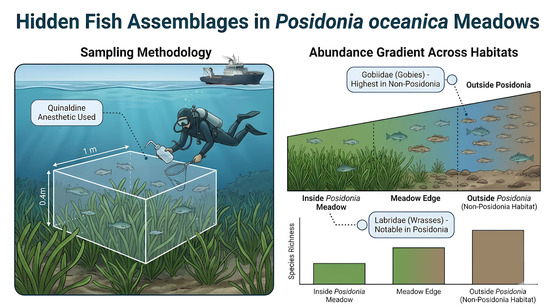
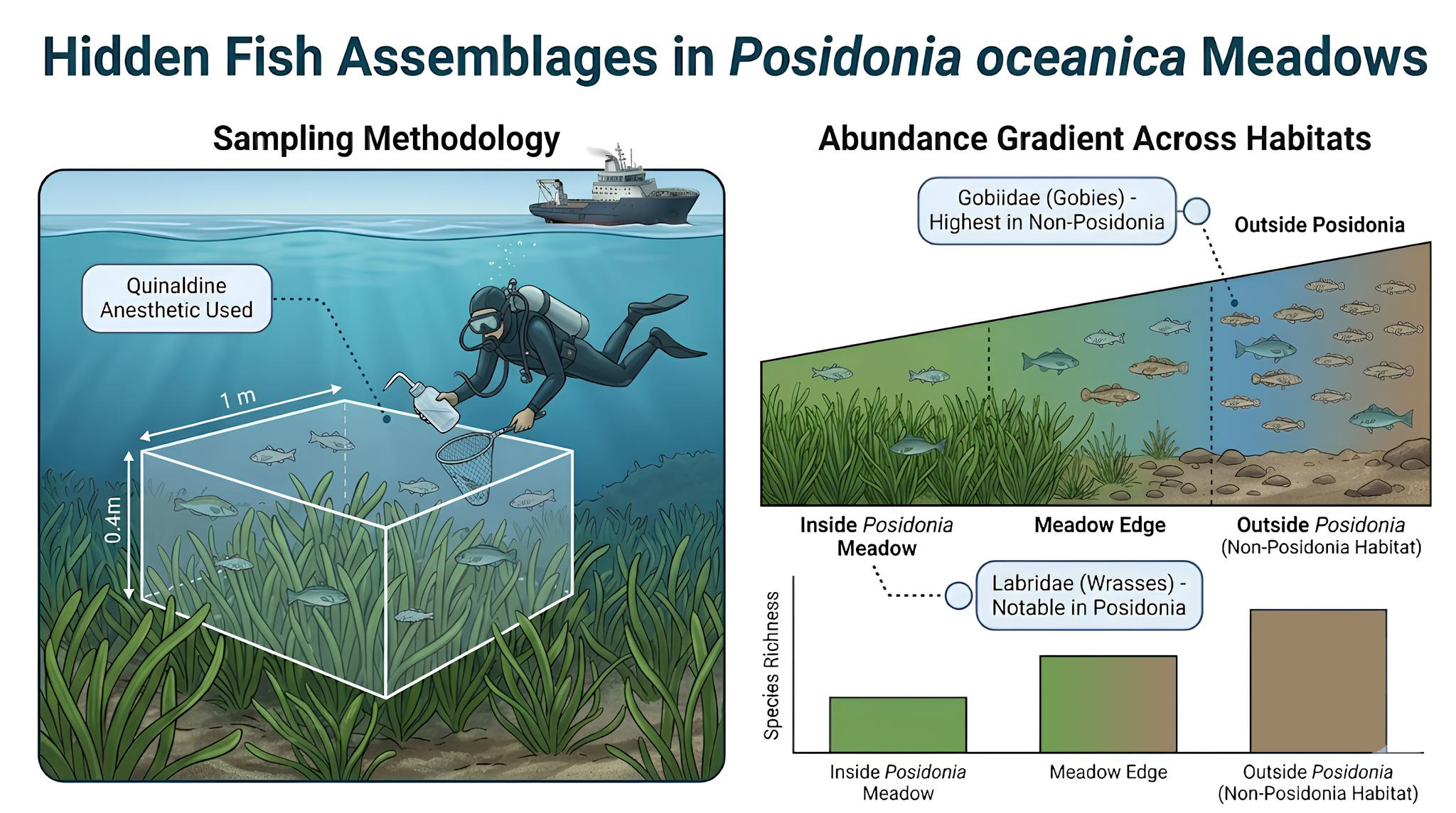
Graphical Abstract

1. Introduction

The ecological importance of Posidonia oceanica seagrass meadows as biodiversity hotspots in the Mediterranean is well established, particularly for fish communities, for which they provide shelter, food, and nursery grounds. A systematic review by Lattanzi et al. [1] reported 248 fish species associated with Mediterranean seagrass habitats, reinforcing the long-standing perception that seagrass meadows host exceptionally high fish species richness and are therefore of major importance for Mediterranean fish biodiversity. However, Lattanzi et al. [1] also found that only 23 of the 248 species were frequent, while most occurred rarely, suggesting that cumulative richness may overestimate ecological specificity. Recent studies have indicated that other habitats, such as coralligenous reefs, are more important habitats in terms of fish richness in the Mediterranean than Posidonia meadows [2]. The reported richness associated with Posidonia habitats varies considerably depending on sampling methods. The accumulated knowledge on the fish assemblages in the Mediterranean Posidonia meadows habitat is mostly based on the visual census studies conducted over the last several decades [3,4]. Another method used to sample a large portion of the fish community is a beam trawl [5,6,7]. Regarding other fishing-based methods, some analyses of the catches from the boat seine fisheries over Posidonia beds have reported high numbers of fish species [8,9], but the boat seine studies usually list only a limited number of common hyperbenthic and benthopelagic species. All other fishing-based methods are even more selective for providing a comprehensive census of fish species richness in Posidonia habitat, like trammel nets [10]. The visual census is able to successfully record fishes inhabiting the open water column above the Posidonia meadow, and allows estimation of their abundance. However, the visual census methods largely overlook species living inside Posidonia meadow. A direct comparison of visual census and beam trawl sampling demonstrated that visual census completely failed to detect species belonging to the families Scorpaenidae, Syngnathidae, Blenniidae, Gobiidae, and Bothidae, which were recorded by beam trawl sampling [11]. Even the long-term accumulated visual census data, such as those of [3,4], recorded or targeted primarily hyperbenthic fishes, mostly various species of Labridae, Serranidae, Sparidae, and Centracanthidae. Fishing-based studies often report higher species numbers, while underwater methods typically record fewer species. Soldo et al. [12] attributed this discrepancy to methodological bias, as underwater methods allow researchers to focus solely on Posidonia beds, while fishing gear samples adjacent habitats in addition to Posidonia, leading to the inclusion of non-associated species. Furthermore, contrary to the visual census, the beam trawl surveys have been able also to capture some diversity of small epibenthic and cryptobenthic fishes inside Posidonia meadows [5,6,7]. In any case, beam trawls cannot capture the full species richness within Posidonia meadows, provide fish abundance estimates, or determine the origin of collected fish. Consequently, quantitative studies targeting fishes within the meadow interior remain scarce, limiting understanding of Posidonia’s true contribution to fish biodiversity.
The Posidonia meadows represent a three-dimensional complex of microhabitats for animals, including (1) the open water column above the Posidonia meadow, (2) Posidonia leaves themselves, which serve as microhabitat for attached and crawling animals [13], (3) the hidden volume of water among Posidonia leaves, and (4) hidden spaces at the bottom and around rhizomes [14] (Figure 1). The open spaces above the meadows and the hidden spaces among the leaves may be inhabited by various sizes of hyperbenthic and benthopelagic fish. The hidden spaces at the bottom, around the rhizomes, and on the Posidonia leaves themselves can be occupied by fish that would otherwise be found in epibenthic and cryptobenthic microhabitats (microhabitat terminology follows [15]). The utilization of hidden Posidonia microhabitats by various fishes blurs the distinction between cryptobenthic fishes (following any definition, i.e., by [15] or by [16]) and other benthic fishes. Although the structure of the fish community in Posidonia meadows has been studied using different functional guilds [5,8,17], there are no published examples of analyses based on microhabitat utilization. To sample fishes in the “invisible” Posidonia microhabitats, Hofrichter [18] developed the cube method, delimiting the part of Posidonia meadow by four-sided metal frame with base 0.25 m2, applying the anesthetic quinaldine into the cube, and subsequently collecting organisms by suction sampling. The method was scarcely described and repeated only twice later [19,20]. Although quantitative studies of cryptobenthic fishes have addressed various Mediterranean bottom habitats in the last two decades [15,21,22,23,24], no published study has quantitatively assessed fish inhabiting the hidden microhabitats of the Mediterranean Posidonia meadows until today.
The aim of the present study was to provide the first quantitative comparison of the hidden fish assemblages in Posidonia meadows and neighboring non-Posidonia habitats. Therefore, the study was designed to (1) develop a protocol for quantitative sampling of fishes in the hidden Posidonia microhabitats; (2) analyze the qualitative and quantitative composition of the fish assemblages inhabiting those microhabitats; and (3) compare fish species richness, abundance, and assemblage structure between hidden Posidonia microhabitats and hidden microhabitats in non-Posidonia neighboring habitats.

2. Materials and Methods

2.1. Study Area, Pretesting, and Timeframe

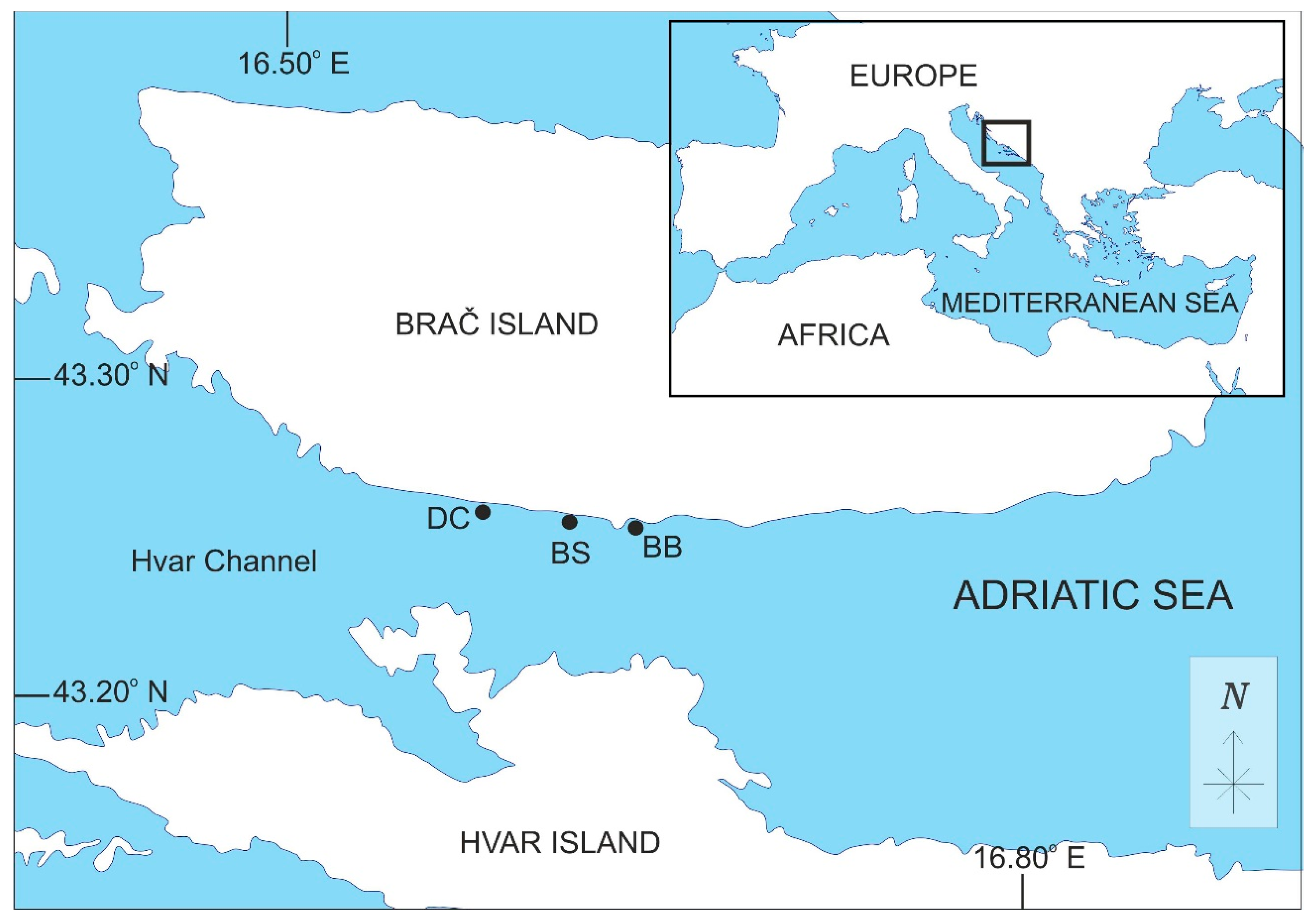
The study was carried out at three locations in the eastern Adriatic Sea in the Hvar Channel on Brač island, at the diving center “Big Blue” near Zlatni Rat [BB] (43°15′32″ N, 16°38′34″ E), at Dračeva cove near Murvica [DC] (43°15′54″ N, 16°35′08″ E), and at Babića stine [BS] (43°15′35″ N, 16°37′1″ E) (Figure 2).
The protocols [15,21,23,24] for sampling cryptobenthic fishes were modified to fit the Posidonia habitat by using a cube and a suction sampler (Figure 3) [18,22]. The pretesting to develop and optimize methods and equipment, as well as diver training on the procedure, was performed twice, from 8 to 12 October 2021 and on 10 October 2023. After the successful test of cuboid samplings with fish collected in both the Posidonia and non-Posidonia habitats, the fieldwork for sample and data collection was carried out from 11 to 16 October 2023, from 22 to 26 May 2024, from 6 to 9 October 2024, and from 25 to 29 May 2025. All dives were performed during the daytime between 10 a.m. and 4 p.m.

2.2. Sampling Design

Two divers participated in the visual census and cryptobenthic fish collection process (MK and IG), while additional divers (ZV and Dean Zagorec during the fieldwork in October 2023) assisted with photography and video recordings. Sampling was conducted at depths of 5–15 m over and near Posidonia meadows. The sampling was stratified such that the cuboid searches were performed in blocks of three at each position. These positions included the edge of the Posidonia distribution, covering roughly half of the surface inside the Posidonia and half of other habitat types; inside the Posidonia meadows, up to five metres from the edge; and on neighboring non-Posidonia bottoms, up to five metres from the edge of the Posidonia distribution. The sampling was conducted only where the neighboring habitats adjacent to the Posidonia meadows consisted of hard bottoms or mixed bottoms, while pure-sediment bottoms were not sampled because the study aimed to sample the fish assemblages hidden in cryptic benthic spaces. The bottom inclination was gentle (<20°) at all sampling sites. The bottom characteristics within the cuboids were recorded following [15] to control their range and frequency of occurrence. These characteristics were not included in the statistical analysis because they closely reflected the three main bottom habitat types and, therefore, did not provide additional independent information.
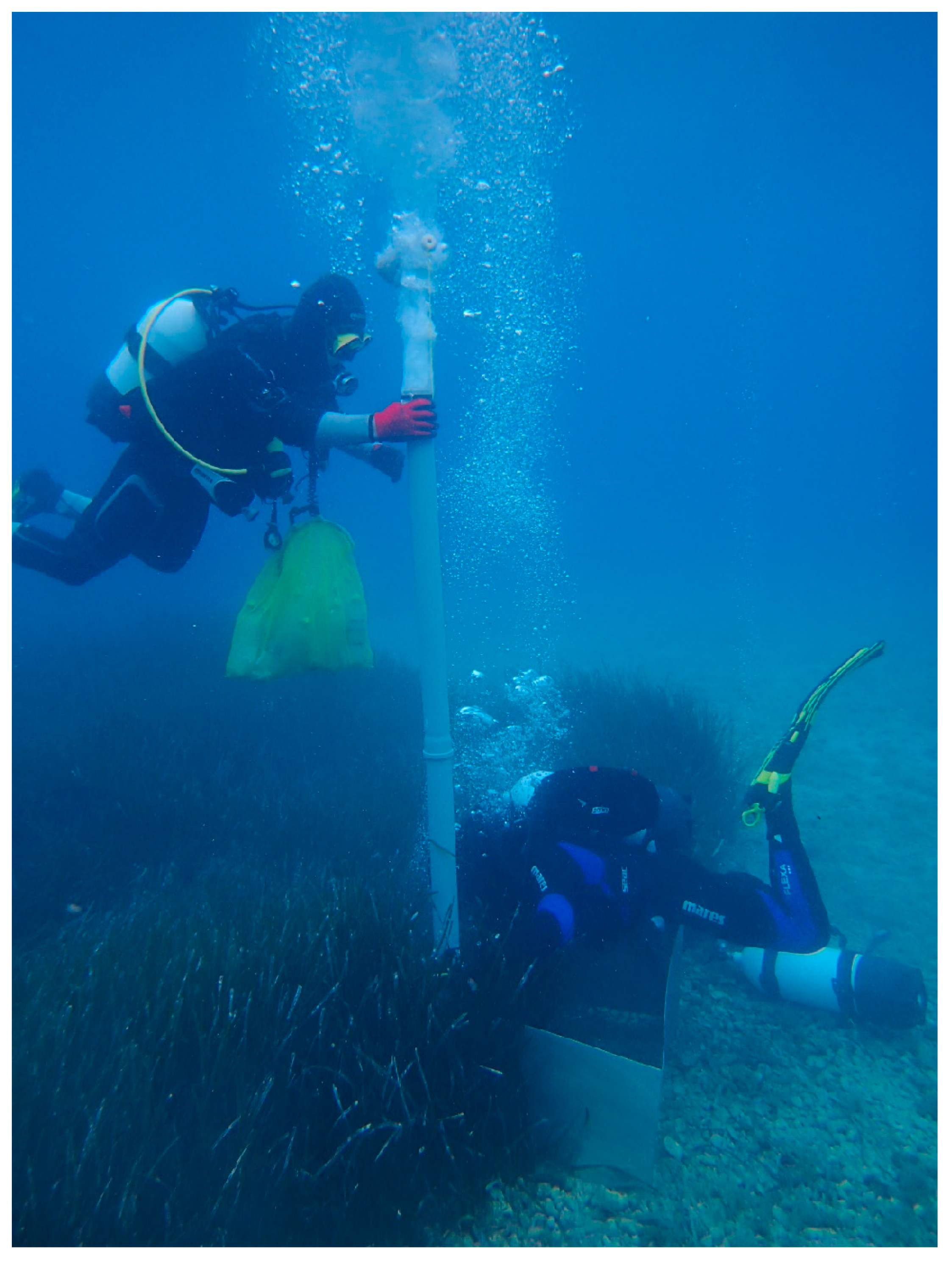
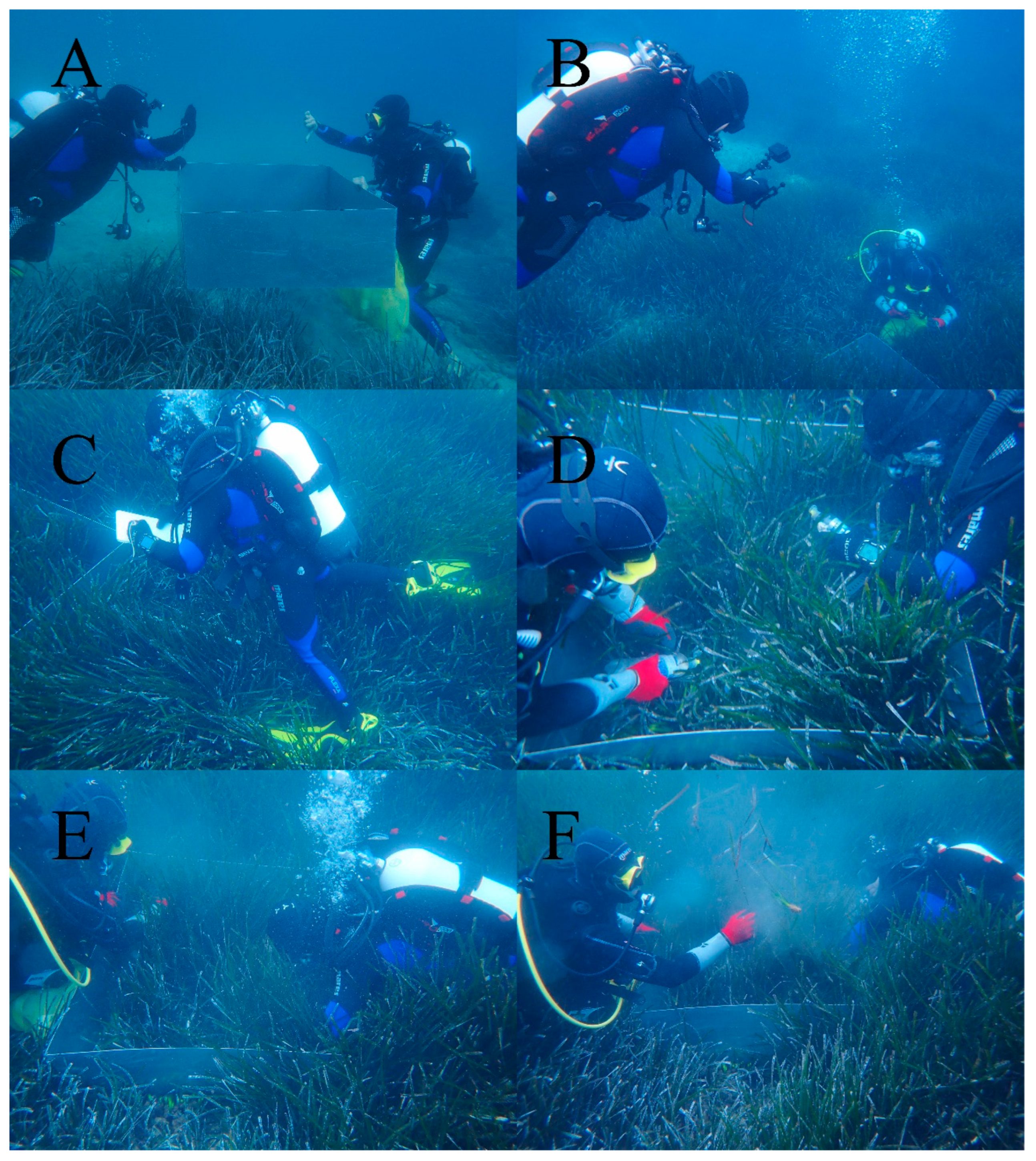
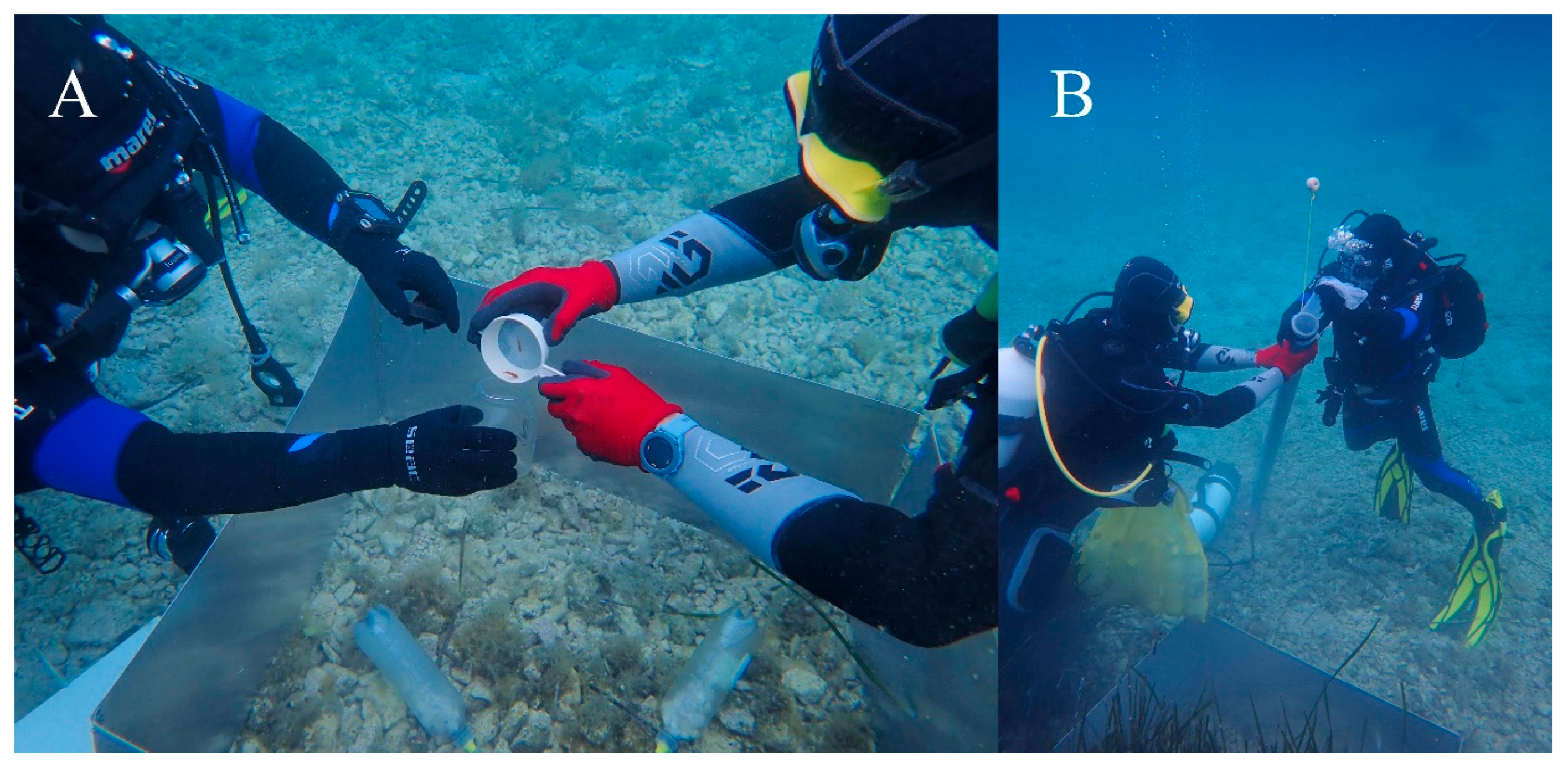
Each cuboid was sampled and documented according to the following protocol (modified from [15]), where steps 5 and 8 were not performed on other bottom types outside the Posidonia meadows: (1) fixing a cuboid (1 × 1 × 0.4 m) onto the bottom (Figure 4A; Supplementary Materials Video S1); (2) photographing the surface inside the cuboid (Figure 4B; Supplementary Materials Video S1); (3) recording habitat characteristics within 1 m2 area (Figure 4C; Supplementary Materials Video S2); (4) spraying the anesthetic quinaldine into the cuboid and capturing any escaping fishes with a hand net or strainer (Figure 4D; Supplementary Materials Video S3); (5) conducting a visual search inside the cuboid for fishes in the upper half of the Posidonia canopy space and collecting anesthetised fish with a hand net and strainer (Figure 4D; Supplementary Materials Video S4); (6) visually searching the bottom by pushing apart Posidonia leaves and collecting anesthetised fish at the bottom with a hand net and strainer (Figure 4E; Supplementary Materials Video S4); (7) performing upward hand movements among Posidonia leaves to create turbulence and lift water and suspended material among and above the Posidonia meadows, collecting any anesthetised fishes that were lifted by the turbulence (Figure 4F; Supplementary Materials Video S5); (8) applying suction sampling among Posidonia leaves and rhizomes to extract the anesthetised fish from the cuboid by using a suction sampler (Figure 3, Supplementary Materials Video S6). The anesthetic used was quinaldine, diluted 1:15 with 96% ethanol and then mixed with seawater 1:5 in 750 mL bottles. The total volume of quinaldine deployed was three 750 mL bottles per m2. The fishes collected directly within the cuboids were stored underwater in plastic jars (Figure 5A, Supplementary Materials Video S7). The nets with the material from suction sampling were examined and fish were extracted on the boat immediately after SCUBA dives (Figure 3 and Figure 5B). All collected fish specimens were euthanized after SCUBA dives by over-anesthetization with quinaldine and stored in a 65% ethanol solution in the field. Preliminary field species identifications of cryptobenthic specimens were later verified in the laboratory using preserved specimens and the dataset was accordingly revised.

2.3. Data Analysis

Abundance and species richness were expressed per square meter of bottom surface and were calculated based on the area of the bottom face of each cuboid.
To assess the effects of environmental variables on species richness and total abundance, we performed permutational analyses of variance using the function aovperm() in the R package permuco [25]. Each response variable was analyzed separately within a linear modeling framework, including bottom habitat type (habitats inside Posidonia meadows, hereafter referred to as Posidonia habitats, p), habitats at the edge of the Posidonia meadows, hereafter referred to as Posidonia meadow edge (p&n), habitats outside the Posidonia meadows, hereafter referred to as non-Posidonia habitats (n), depth category (5–9 m, 10–15 m), locality (diving center, Dračeva Cove, Babiće Stine), and season (spring, autumn) as fixed categorical predictors. In line with the approach described above, these predictors were selected a priori because they represent the main ecological gradients in the study area and capture the key differences among the sampling units.
Marginal (Type III) effects were evaluated, whereby each factor was tested after accounting for all other variables in the model. Statistical significance was assessed using the Freedman–Lane permutation procedure [26] with 9999 permutations. When significant main effects of bottom habitat type were detected, pairwise comparisons were conducted within the same permutation framework and p-values were adjusted using the Holm–Bonferroni correction to control for multiple testing.
In the 13 cuboids, no fish were recorded, and 95% of the samples contained fewer than 10 individuals. Such sparse data can reduce the precision of community estimates and cause erratic behavior of the Bray–Curtis dissimilarity matrix, particularly in samples with very low abundances or complete absences [27,28]. To stabilize the dissimilarity estimates and ensure that distances were defined for empty samples, we applied a zero-adjusted Bray–Curtis approach by adding a dummy species (abundance = 1) to all samples prior to multivariate analyses [28,29]. Data were also log(x + 1)-transformed prior to analysis.
Differences in fish assemblage composition were tested using permutational multivariate analysis of variance (PERMANOVA), which was implemented through the adonis2() function of the R package vegan 4.3.1 [30] using the same experimental design as that described for univariate analyses. Marginal (Type III-like) sums of squares with unrestricted permutations (9999) were used. The assumption of homogeneity of multivariate dispersion was evaluated using the betadisper() function followed by permutation tests. When appropriate, pairwise PERMANOVA comparisons were performed and p-values were adjusted using the Holm–Bonferroni correction.
Additionally, we conducted a constrained distance-based redundancy analysis (dbRDA) [31] based on Bray–Curtis dissimilarities of log(x + 1)-transformed abundance data to quantify variation in fish assemblage structure explained by environmental predictors. The same set of predictors used in the univariate analyses (bottom habitat type, depth category, locality, and season) was included in this analysis to ensure consistency in the evaluation of their effects. Multicollinearity among predictors was assessed using variance inflation factors (VIFs); all variables met the predefined threshold (VIF < 5), indicating no problematic collinearity. We fitted an additive model including all predictors and a partial dbRDA in which depth, season, and locality were included as conditioning variables to estimate the independent effect of bottom type, conceptually analogous to a marginal (Type III-like) test. Results were visualized using ordination plots of the constrained axes.
Finally, a similarity percentage (SIMPER) analysis was performed on the full dataset using bottom habitat type as the grouping factor to identify the species contributing the most to compositional differences among habitats.

3. Results

3.1. Diversity, Abundance, and Frequency of Fish Species

A total of 60 cuboids were sampled, 20 in each bottom habitat type; 18 samplings were conducted at the diving center “Big Blue” near Zlatni Rat, and 21 samplings were conducted at each of two other localities: Dračeva Cove near Murvica and Babića stine. Of the total samplings, 33 were conducted in spring and 27 in autumn. Across all cuboids, 166 individuals belonging to 26 species from nine fish families were collected (Table 1). The average abundance of fishes in the bottom cuboids was 2.77 ± 0.41 individuals/m2 (mean ± S.E.) and ranged from 0 to 15 individuals/m2. No fish were recorded in 13 out of 60 cuboids. The most abundant fish species was Odondebuenia balearica (Pellegrin & Fage 1907) with 59 individuals in total, and the four most abundant species (O. balearica, Zebrus zebrus (Risso, 1810), Corcyrogobius liechtensteini (Kolombatović, 1891), and Millerigobius macrocephalus (Kolombatović, 1891)) represented 65.6% of all individuals (Table 1). The most frequently recorded fish species was, again, O. balearica, with a frequency of occurrence of 31.7%, followed by the same three species that showed the highest abundance and by Gobius fallax Sarato, 1889 (Table 1). On average, the species richness was 1.65 species per cuboid, with a maximum species richness of six species recorded in a single cuboid. The family Gobiidae dominated both fish biodiversity and abundance with 10 recorded species, including the four most abundant species, and accounted for 78.9% of all individuals sampled. The remaining seven families, excluding Labridae with six species, were restricted to one or two species. Among non-gobiid fishes, Parablennius rouxi (Cocco, 1833) had the highest species frequency of occurrence (10.0%) and the highest abundance (nine individuals) (Table 1).

3.2. The Differences in Abundance, Diversity, and Fish Assemblage Structure Among Posidonia Habitats, Posidonia Meadow Edge, and Non-Posidonia Habitats

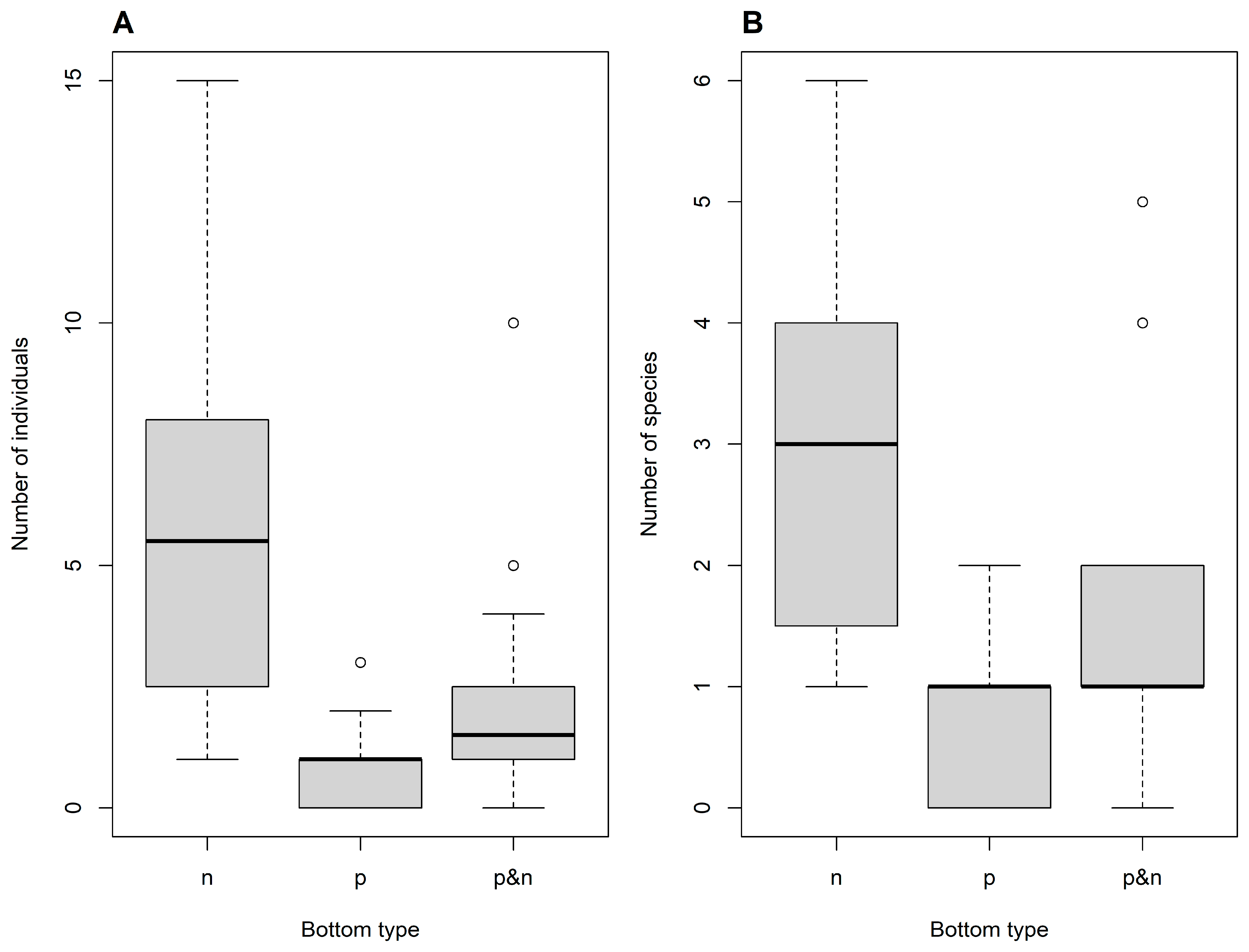
The PERMANOVA tests indicated a significant difference in the total fish abundance among bottom habitat types, while no significant differences were detected among depths, seasons, and localities (Table 2). Furthermore, in the pairwise comparison of bottom habitat types, each bottom habitat type had significantly different fish abundance values compared to the two other methods (Table 2, Figure 6). Among the three subsets, a striking difference was evident in the total number of collected individuals in favor of non-Posidonia habitats: 14 individuals in Posidonia habitats, 42 individuals at the edge of the Posidonia meadow, and 110 individuals on neighboring non-Posidonia habitats (Table 1). The total average abundance of fish in cuboids was 0.70 ± 0.18 individuals/m2 (mean ± S.E.), ranging from 0 to 3 individuals/m2, inside Posidonia meadows, 2.10 ± 0.52 individuals/m2 (mean ± S.E.), ranging from 0 to 10 individuals/m2, at the Posidonia meadow edge, and 5.50 ± 0.79 individuals/m2 (mean ± S.E.), ranging from 1 to 15 individuals/m2 (Table 1, Figure 6), in the habitats outside the Posidonia meadows. No fish were recorded or collected in nine cuboids inside the Posidonia meadows and in four cuboids at the Posidonia meadow edge, whereas no ‘empty’ cuboids were recorded in non-Posidonia habitats.
Contrary to the total number of collected individuals, the mixed habitats at the edge of the Posidonia meadows showed higher total fish species richness (14 species) than either Posidonia habitats (11 species) or non-Posidonia habitats (12 species) (Table 1, Figure 6). However, the average species richness of the neighboring habitats was 2.85 species per cuboid, the species richness at the edge of the Posidonia meadows was 1.45 species per cuboid, and the Posidonia meadow subset yielded an average species richness of only 0.65 species per cuboid (Table 1, Figure 6). The PERMANOVA tests indicated a significant difference in the average fish species richness per cuboid among bottom habitat types and between seasons, with no significant difference between depths categories and among localities (Table 3). Furthermore, in the pairwise comparison of bottom habitat types, each bottom habitat type exhibited a significantly different average species richness value compared to the other two methods (Table 3, Figure 6). The average species richness in autumn was significantly higher (2.04 species per cuboid) than that recorded during spring (1.33 species per cuboid).
The PERMANOVA conducted on transformed species abundance data revealed significant differences in fish assemblage structure among bottom habitat types and between depth categories, whereas no significant differences were detected between seasons or among localities (Table 4). Pairwise comparisons among bottom habitat types indicated that all habitat types differed significantly from one another. In particular, non-Posidonia habitats (n) differed strongly from Posidonia meadows (p) and from habitats at the edge of Posidonia meadows (p&n). Posidonia meadows (p) also differed significantly from the edge of Posidonia meadows (p&n), although the magnitude of this difference was comparatively smaller (Table 4).
Tests for homogeneity of multivariate dispersion revealed significant differences among habitat types (F = 5.223, p = 0.008), suggesting that the PERMANOVA results may reflect both differences in group centroids and variation in within-group dispersion. However, this result should be interpreted with caution, as the PERMDISP procedure [32], implemented through the betadisper() function, evaluates dispersion with respect to a single grouping factor and does not account for the multifactorial (Type II/III-like) partitioning of effects applied in the PERMANOVA.
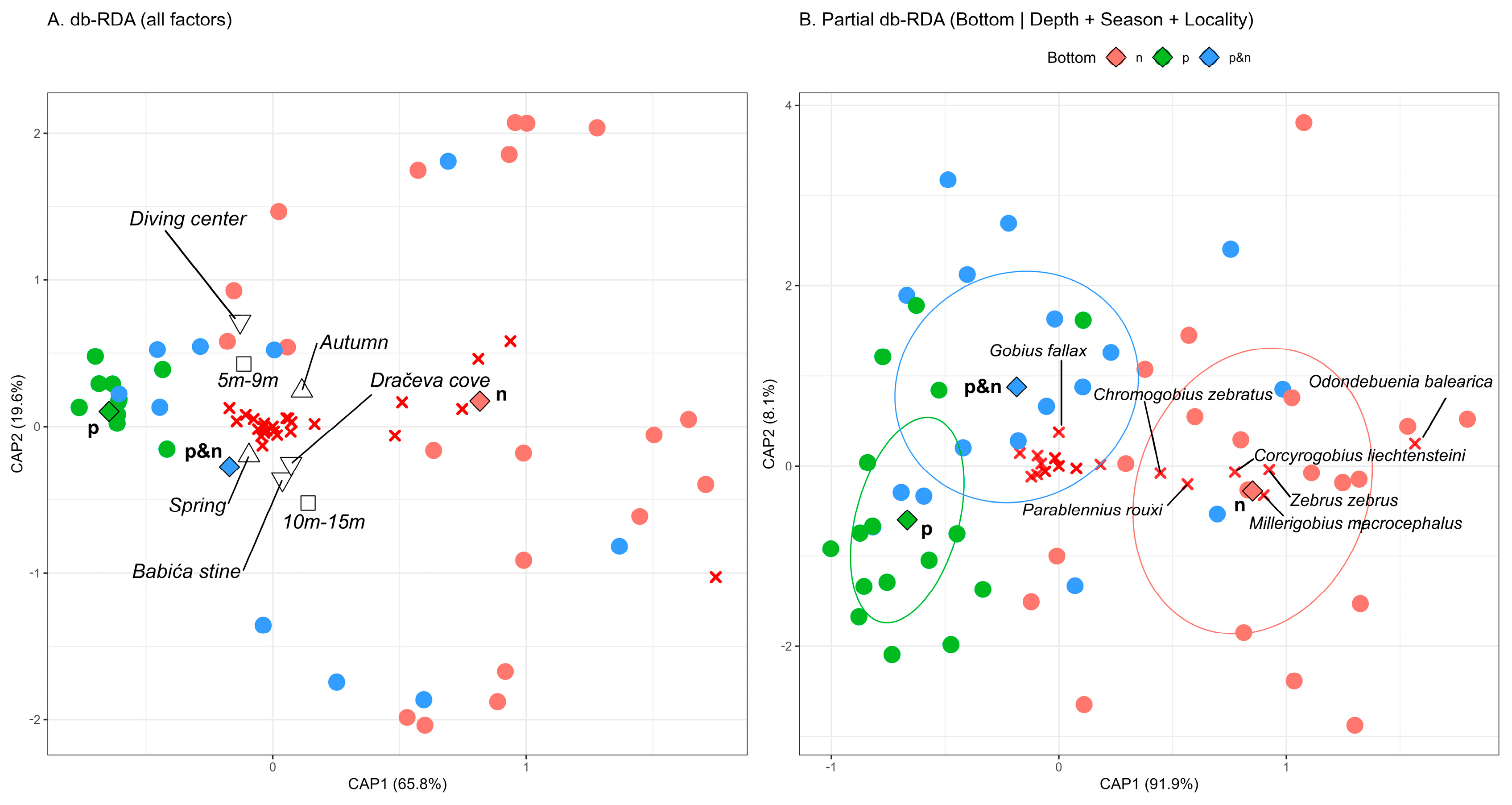
The dbRDA model, which included bottom habitat type, depth, season, and locality, explained 31.4% of the total variation in fish assemblage structure based on Bray–Curtis dissimilarities. The first two canonical axes were significant (CAP1: F = 15.9, p = 0.001; CAP2: F = 4.8, p = 0.001), whereas subsequent axes were not significant. CAP1 accounted for 20.6% of the total variation (65.8% of the constrained variation) and primarily represented differences associated with bottom habitat types, particularly separating Posidonia meadows (p) and habitats at the edge of Posidonia meadows (p&n) from the non-Posidonia habitats (n) (Figure 7A). Depth also contributed to this gradient, but its contribution was weaker compared to bottom habitat type. CAP2 explained an additional 6.2% of the total variation (19.6% of the constrained variation) and was mainly associated with seasonal differences, particularly distinguishing assemblages by season, with secondary contributions from locality and depth (Figure 7A). Together, the first two axes explained 26.8% of the total variation and 85.4% of the constrained variation in assemblage structure.
A subsequent partial dbRDA was performed to test the unique effect of bottom habitat type while controlling for depth, season, and locality. After removing the contribution of these conditioning variables (10.4% of total variation), bottom habitat type still explained a significant portion of the remaining assemblage variation (20.9% of total variation; F = 8.08, p = 0.0001). The first canonical axis (CAP1) was significant (F = 14.85, p = 0.001) and accounted for 21.5% of the total variation and 91.9% of the variation explained by bottom habitat type. This axis clearly separated habitats having complete or partial Posidonia cover (p and p&n) from the non-Posidonia habitats (n), confirming that habitat type is the dominant driver of compositional differences after accounting for depth, season, and locality (Figure 7B). The second canonical axis (CAP2) was not significant (F = 1.34, p = 0.190) and explained only 8.1% of the constrained variation (1.9% of total variation), indicating limited additional structure beyond the primary habitat gradient. Overall, these results demonstrate that bottom habitat type exerts a strong and independent effect on assemblage composition, even after controlling for depth, season, and locality.
To characterize the species-level contributions to the multivariate patterns described above, a SIMPER analysis was performed. The analysis indicated that differences among bottom habitat types were primarily driven by a small subset of species. The five most influential taxa were gobies Odondebuenia balearica (14.5%), Zebrus zebrus (7.1%), Corcyrogobius liechtensteini (5.9%), Millerigobius macrocephalus (5.3%), and Gobius fallax (4.4%). Together, these species accounted for approximately 37% of the total Bray–Curtis dissimilarity among habitat types. Notably, the same species consistently contributed to all pairwise habitat contrasts, indicating a stable and coherent habitat-driven assemblage pattern rather than contrast-specific species turnover (Table 5). Odondebuenia balearica further contributed the most to species composition dissimilarity in each of the three comparisons (Table 5). It was followed by the same three other cryptic gobiid species that strongly influenced dissimilarity among habitats outside Posidonia meadows and the other two habitat types (Table 5). However, among the habitats inside Posidonia meadows and at the edge of Posidonia meadows, the most influential species, in addition to cryptic gobiid species, were also hyperbenthic species that generally occur in Posidonia meadows (Scorpaena porcus Linnaeus, 1758, S. cabrilla, C. julis) (Table 5). There were just two species occurring in habitats both inside Posidonia meadows and in the non-Posidonia neighboring habitats, namely G. fallax and O. balearica. Contrary to the poor overlap in species composition between Posidonia and non-Posidonia habitats, the Posidonia habitats and the Posidonia meadow edge shared five species, while the Posidonia meadow edge and the neighboring non-Posidonia habitats shared six species (Table 1).
Overall, the results reveal a clear gradient of significant increase in fish abundance, average fish species richness in cuboids, and of increase in frequency of occurrence of fish species from Posidonia habitats, through the Posidonia meadow edge, to the habitats outside Posidonia meadows (Figure 6, Table 1).

4. Discussion

4.1. Fish Abundance and Species Richness in Mediterranean Posidonia Meadows

In the present study, fish abundance, fish species richness per area, and frequency of occurrence all increased from the interior of the Posidonia meadows to the Posidonia meadow edge and were highest in habitats outside the Posidonia meadows (Figure 5). The family Gobiidae dominated fish biodiversity in the habitats outside the Posidonia meadows and at the Posidonia meadow edge with eight and seven recorded species, respectively, whereas the family Labridae dominated fish biodiversity in habitats inside the Posidonia meadows with five recorded species (Table 1). Therefore, the primary driver of fish abundance and fish species richness was the rarity or near absence of species of the family Gobiidae in habitats inside Posidonia meadows (Table 1 and Table 5). The highly different species composition between the Posidonia and non-Posidonia habitats was, again, caused by the high species richness of the family Labridae in the Posidonia habitats against the high species richness of the family Gobiidae in the non-Posidonia habitats. However, the Posidonia meadow edge showed an overlapping character, sharing a number of species with both other habitat types but benefiting, among all fish community variables, only in terms of the total species richness from the overlap between the two communities.
The present method, covering the microhabitats hidden within Posidonia meadows, is complementary to the visual census, which successfully records the abundance and composition of fish assemblages inhabiting the open-water column above Posidonia meadows. Both methods, when combined, can provide better quantitative data on the totality of fish assemblages from all Posidonia meadow microhabitats compared to the limits of other data collection methods reviewed in the Introduction. Additionally, the combined methods have an advantage regarding conservation concerns because they are non-destructive (visual census) or very selective (present method) compared to fishing-based studies. The published papers on fishes from the same microhabitats were restricted only to data on the family Gobiesocidae in Posidonia meadows and reported highly variable densities of clingfish species [18,19,20]. The abundance of collected fish was reported to be low by [18,19], in accordance with the present study’s results, while [20] reported surprisingly high densities of two species of clingfish, with a single extreme density value of 40 individuals/m2. No previous studies have reported total fish abundance in assemblages inhabiting the hidden microhabitats of Posidonia meadows which could be compared with the present results. The present research took all necessary precautions to avoid the influence of the complex internal structure of seagrass beds on the sampling efficiency and to extract all fishes. The suite of careful steps was described in the Materials and Methods section and is well-illustrated. The strong concentration of anesthetic in an enclosed space should immobilize and detach any fish from the Posidonia leaves and other surfaces. The search and extraction of free-floating fish involved several approaches, which were applied sequentially and described in the protocol. These approaches were found to be efficient in earlier studies performed in hidden spaces with complex structures [15,21,24,33]. Finally, the entire cube volume was checked using suction sampling. Any other method, including the complete removal of the Posidonia canopy, is unlikely to be more efficient. However, the question of actual sampling efficiency will remain unanswered until more studies of these microhabitats are performed using similar methods under various geographic and ecological conditions.
To date, quantitative data on fish assemblages in Mediterranean Posidonia meadows from visual censuses have rarely been compared with other habitats to demonstrate the relative habitat importance of Posidonia meadows for fish species richness and abundance [34,35,36]. Only [34] found fish species richness to be significantly higher in Posidonia meadows than in rocky–algal reef habitats during the warm season, although total fish abundance did not differ significantly between habitats. In contrast, Gomis et al. [36] reported up to five-fold higher fish abundance and up to 18-fold higher biomass, as well as significantly higher species richness, at the rocky substrates and the escarpments located at the Posidonia meadow edge compared with Posidonia meadows themselves. Anecdotal evidence supports the results of [36], as among SCUBA divers, Mediterranean Posidonia seagrass meadows are considered to be a relatively monotonous and unexciting habitat type due to the lack of fish diversity and density over Posidonia fields [19]. Furthermore, Sánchez-Jerez et al. [37] reported a 10-fold increase in mean fish abundance following the deployment of artificial reefs within Posidonia meadows compared to the Posidonia meadow control habitat. Gomis et al. [36] concluded that the overall higher structural complexity of rocky substrates compared to that of seagrass fields caused the higher species richness, abundance, and biomass of fish. However, both habitats have been found to be superior with respect to these values to bare sand bottoms due to their structural complexity [34]. The total abundance values in the present study strikingly differed between cuboids collected in the Posidonia meadows (0.7 individuals/m2) and in the habitats outside the Posidonia field (5.5 individuals/m2). While fish abundance in the habitats outside the Posidonia meadows corresponded closely to values reported from other Mediterranean cryptobenthic quantitative studies [15,21,24,33], the abundance in Posidonia meadows was clearly below these published ranges.
The absolute data on fish density in Mediterranean Posidonia meadows obtained using other methods that sample primarily benthopelagic and hyperbenthic fishes above Posidonia meadows (visual census and boat seine: 0.05–0.88 individuals/m2) or attempt to sample the entire fish community (beam trawl: 0.09–0.16 individuals/m2) also showed low fish densities within or over Posidonia meadows [3,7,11,35,36,37,38,39,40]. The only fish species occasionally recorded in higher densities were benthopelagic fish occurring in shoals, such as Chromis chromis (Linnaeus, 1758) and Spicara spp. [34,41], which, in some cases, caused the total fish abundance to increase above one individual per square meter [41].

4.2. Knowledge of the Role of Fishes in Mediterranean Posidonia Ecosystem Trophodynamics and of Posidonia Meadows as Fish Shelter, Food Source, and Nursery Area

Trophic analyses of fishes in Mediterranean Posidonia meadows have been generally based on assigning a trophic category or trophic level to the recorded fish species and on subsequently analyzing the trophic structure of the fish community [3,39]. Although planktivorous fish feed in the water column rather than within Posidonia meadows, the extent to which other trophic groups recorded at Mediterranean Posidonia meadows (e.g., piscivorous, macroinvertivorous, microinvertivorous, omnivorous, herbivorous, and detritivorous sensu [39]) utilize and depend on Posidonia meadow resources for food remains unclear. Only Zupo et al. [42] directly linked certain fish species, such as Symphodus spp., to the organisms foraged in Mediterranean Posidonia meadows, linking the diet analyzed to the prey-species level. In the present study, among the eleven fish species found inside Posidonia meadows (Table 1), three species were macrophagic carnivores and eight species were mesophagic carnivores sensu [43]. Posidonia oceanica meadows are thought to provide refuge to prey species. However, the presence and abundance of piscivorous fishes may reduce the effectiveness of seagrass habitats as refuges for prey species [17]. The higher abundance in small trawl catches of small pelagic species such as Spicara spp. and Boops boops (Linneaues, 1758) at night were explained as utilization of Posidonia hidden spaces as night shelter by these fish species [5]. In the present study, no predominantly piscivorous species were recorded inside the Posidonia meadows, since all three macrophagic carnivores primarily feed on invertebrates rather than fishes [43].
The present study recorded three species with only juveniles collected inside or at the edge of the Posidonia meadows (Table 1), although with only one to three individuals for each species. The general importance of Posidonia meadows as Mediterranean nursery areas has been inferred only indirectly from the presence of juvenile individuals of various fish species and from the large spatial extent of shallow coastal habitats covered by Posidonia oceanica, e.g., [44]. It remains unknown what proportion of the annual recruitment of these species originates from juveniles sheltered within Posidonia meadows and what proportion originates from juveniles settled in other habitats. Determining this proportion is essential for evaluating the relative importance of Mediterranean Posidonia meadows as nursery grounds for individual fish species. For example, [34] found that for the two species with the highest recorded density of juveniles in that study, i.e., Chromis chromis (Linneaues, 1758) and C. julis, juveniles occurred either exclusively over rocky habitats (C. chromis) or more frequently over rocky habitats than in Posidonia meadows (C. julis).

4.3. The Mediterranean Posidonia Ecosystem Paradigm and Current Knowledge of Posidonia Meadow Fish Assemblages

The current Posidonia oceanica ecosystem paradigm in the Mediterranean can be summarized through several key points. Posidonia oceanica seagrass meadows are considered a uniquely complex biological community and an important biodiversity hotspot [45]. They are widely regarded as a nursery area for many marine organisms, a highly productive ecosystem, and an important oxygen producer [46]. Furthermore, this Mediterranean habitat is expected to protect coastlines from erosion and to be an effective carbon sink [47]. Posidonia oceanica seagrass meadows are also considered valuable bioindicators of marine environmental health [48].
However, despite this well-established Posidonia oceanica ecosystem paradigm, the ecological role of Mediterranean Posidonia meadows as a fish feeding area or as a shelter space for fishes was considered unknown only a few decades ago [5]. Fifteen years later, knowledge of this subject was still mainly based on qualitative and descriptive data [3]. Since then, studies based primarily on the visual census method or, less frequently, on beam trawling have provided some quantitative data on fish abundance, biomass, and species richness in Mediterranean Posidonia meadows (references in [4,6,17]). These studies have typically compared fish assemblages between distinct Posidonia localities, tested the data for different factors, or investigated temporal changes in the Posidonia fish assemblages. The effect of marine protected areas has been one of the most frequently studied factors [4,38,39,49]. Contrary to the collected visual census data on “visible” fishes, before the present study, no quantitative data had existed for the fish community of the hidden microhabitats within Mediterranean Posidonia meadows. The hidden or inner Posidonia meadow spaces shelter various fishes that occur elsewhere in epibenthic, cryptobenthic, hyperbenthic, and even benthopelagic habitat positions. In some respects, this habitat resembles another large concealed marine environment: marine caves. In addition to “cave-within-cave” fishes, marine caves host a variety of epibenthic, hyperbenthic, and benthopelagic fishes of various sizes as part of their fish assemblage [33]. Similarly to marine caves [33], it is hard to recognize Mediterranean fish species exclusively depending on Posidonia meadows during at least part of their life cycle or during seasonal or diel cycles. Based on current knowledge, the clingfish O. gracilis is the only Mediterranean fish species recorded exclusively attached to the leaves of marine phanerogams, although it also occurs on the leaves of Cymodocea nodosa and not exclusively on Posidonia oceanica [50]. In addition, two elusive Mediterranean gobiid species appear to be strongly associated with Posidonia meadows. All published findings regarding the habitat data of Gobius ater Bellotti, 1888, were recorded in Posidonia meadows or near them [51]. Didogobius schlieweni Miller, 1993, has been recorded in bottom substrates containing pebbles or sand within Posidonia oceanica beds or in association with Caulerpa racemosa [52]. None of these three fish species was found in the present study, as they are still rarely collected and considered elusive [51,52].

4.4. Present and Future Research on Fishes in Posidonia Hidden Spaces

The present study primarily highlights how much remains unknown about fish assemblages associated with Mediterranean Posidonia meadows. The widespread perception is that Posidonia meadows support high fish diversity in the Mediterranean. Therefore, the observed scarcity of fishes inhabiting hidden Posidonia microhabitats compared to the neighboring cryptobenthic habitats was surprising. However, similar observations on the scarcity of fishes in Mediterranean Posidonia meadows have been reported in previous scientific studies [36] and in general diving observations [18]. The quantitative sampling method and protocol developed in this study for hidden fishes in Mediterranean Posidonia meadows should complement widely used visual census techniques, thereby contributing to a more comprehensive understanding of Posidonia fish assemblages in their full complexity, as suggested for other habitats [2,21]. It is hoped that future studies will investigate the elusive portion of Posidonia fish communities within the hidden Posidonia microhabitats. Researchers will need to develop adequate methodologies to address this significant gap in the current understanding of Mediterranean Posidonia meadows. Any conservationist claim regarding the significance of the presence, absence, or degradation of Posidonia meadows for the entire fish population that supposedly depends on them can only be scientifically supported once these questions are addressed. Until such time, many assumptions regarding the ecological significance of Mediterranean Posidonia meadows for any particular fish species and for fish assemblages in general will remain largely speculative and insufficiently supported by empirical evidence.

5. Conclusions

The present study provides the first quantitative assessment of fish assemblages inhabiting the hidden microhabitats of Posidonia oceanica meadows in the Mediterranean using a modified cube and suction sampler method. By targeting fishes occurring within the concealed spaces among Posidonia leaves, rhizomes, and bottom structures, this method overcomes the main limitations of visual census and most fishing-based methods, which primarily record fishes occurring above the Posidonia canopy or which may include species from adjacent habitats. In this way, the study addresses an important knowledge gap in the understanding of fish assemblages inhabiting the inner spaces of Posidonia meadows.
The results revealed a clear gradient in fish abundance, average fish species richness in cuboids, and frequency of occurrence of fish species among bottom habitat types. The lowest values were recorded in habitats inside Posidonia meadows, intermediate values were recorded at the Posidonia meadow edge, and the highest values were documented in neighboring non-Posidonia habitats. The low abundance and species richness of fishes in habitats inside Posidonia meadows were mainly associated with the rarity or near absence of species of the family Gobiidae, which dominated both fish biodiversity and abundance in neighboring habitats. In contrast, the fish recorded within habitats inside Posidonia meadows were mostly hyperbenthic species occurring in low abundance and frequency, with some species being represented only by juvenile individuals.
The fish assemblage structure differed significantly among bottom habitat types, confirming bottom habitat type as the main driver of differences in fish assemblages within the studied system. The Posidonia meadow edge exhibited an overlap in species occurrence with both the interior of Posidonia meadows and neighboring habitats, consequently showing the highest cumulative species richness. While neighboring non-Posidonia habitats appear to support higher local diversity and abundance, the Posidonia meadow edge contributes to overall species diversity by facilitating the coexistence of species associated with both habitat types.
Taken together, the results suggest that the hidden microhabitats of Mediterranean Posidonia oceanica meadows support a relatively low abundance and diversity of fish compared with neighboring habitats containing cryptic benthic spaces. The contribution of the hidden microhabitats of Posidonia meadows to Mediterranean fish biodiversity, therefore, appears to be limited, at least for fish inhabiting epibenthic and cryptobenthic microhabitat positions.
Finally, the sampling protocol developed in this study proved suitable for the quantitative assessment of fishes inhabiting hidden Posidonia microhabitats and provides a methodological basis for future research. Further studies applying similar approaches across different regions, seasons, and Posidonia landscapes will be necessary to better understand the role of hidden Posidonia microhabitats in shaping fish assemblages in the Mediterranean Sea.

Supplementary Materials

The following supporting information can be downloaded at: https://zenodo.org/records/19065853 (accessed on 15 March 2026), Video S1: Fixing a cuboid (1 × 1 × 0.4 m) onto the bottom and photographing the surface inside the cuboid; Video S2: Recording habitat characteristics within 1 m2; Video S3: Spraying the anesthetic quinaldine into the cuboid and catching any escaping fishes with a hand net; Video S4: Visual search inside the cuboid for fishes in the upper half of Posidonia space, collecting anesthetised fish with a hand net and a strainer, and visual search of the bottom by pushing apart Posidonia leaves and collecting anesthetised fish with a hand net and a strainer; Video S5: Hand upward movements among bottom particles to lift water and suspended material above the bottom and collect the lifted anesthetised fish; Video S6: Suction sampling among Posidonia leaves and rhizomes to extract the anesthetised fish from the cuboid; Video S7: Storage of fishes collected directly from the cuboid into plastic jars.

Author Contributions

Conceptualization, M.K., I.G., D.P., A.S., and Z.V.; methodology, M.K. and I.G.; software, D.P.; validation, M.K. and A.S.; formal analysis, D.P.; investigation, M.K., I.G., and Z.V.; resources, M.K. and I.G.; data curation, M.K. and D.P.; writing—original draft preparation, M.K.; writing—review and editing, M.K., I.G., D.P., A.S., and Z.V.; visualization, M.K., D.P., A.S., and Z.V.; supervision, M.K. and A.S.; project administration, M.K.; funding acquisition, M.K., I.G., A.S., and Z.V. All authors have read and agreed to the published version of the manuscript.

Funding

M.K. was funded by the Croatian Science Foundation under the project IP-2022-10-7542.

Institutional Review Board Statement

This work does not contain any studies with human participants performed by any of the authors. This study was conducted at the Natural History Museum Rijeka, where researchers have a state permit to study fish (collecting licenses for 2021: KLASA: UP/I-324-03/21-01/44 URBROJ: 525-13/0797-21-2; 2023: KLASA: UP lI-324 -01 I 23 -0 I 127 URBROJ: 525-12 17 I 8-23-5, for 2024: KLASA: UP lI-324-03 124-0 I I 3 4 URBROJ: 525-1217 18-24-4, for 2025: KLASA: UP lI-324-0 1 125 -0 I I 37 URBROJ: 525-1217 18-25-2). All applicable international, national, and/or institutional guidelines for the care and use of animals were followed. The sampling scheme followed a standardized protocol approved by international authorities (EU/DG Mare, FAO/GFCM). No specimens of species subject to conservation measures were caught. The fish were euthanized by administering an overdose of anesthetic in compliance with the recommendation of the European Union Directive 2010/63/EU [53] on the protection of animals used for scientific purposes. All efforts were made to minimize fish suffering.

Informed Consent Statement

Not applicable.

Data Availability Statement

The raw data supporting the conclusions of this article will be made available by the authors on request.

Acknowledgments

We thank Dean Zagorec for the assistance provided with respect to diving, photography, and video recording during the fieldwork conducted in October 2023. We are grateful to Srđan Banfić for the language editing of the manuscript.

Conflicts of Interest

The authors declare no conflicts of interest.

Abbreviations

The following abbreviations are used in this manuscript:
nHabitats outside Posidonia meadows, also referred to as non-Posidonia habitats.
pHabitats inside Posidonia meadows, also referred to as Posidonia habitats.
p&n Habitats at the edge of Posidonia meadows, also referred to as Posidonia meadow edge.

References

  1. Lattanzi, A.; Bellisario, B.; Cimmaruta, R. A review of fish diversity in Mediterranean seagrass habitats, with a focus on functional traits. Rev. Fish Biol. Fish. 2024, 34, 1329–1349. [Google Scholar] [CrossRef]
  2. Soldo, A.; Glavičić, I.; Kovačić, M. Combining Methods to Better Estimate Total Fish Richness on Temperate Reefs: The Case of a Mediterranean Coralligenous Cliff. J. Mar. Sci. Eng. 2021, 9, 670. [Google Scholar] [CrossRef]
  3. Francour, P. Fish assemblages of Posidonia oceanica beds at Port-Cros (France, NW Mediterranean): Assessment of composition and long-term fluctuations by visual census. Mar. Ecol. 1997, 18, 157–173. [Google Scholar] [CrossRef]
  4. Seytre, C.; Francour, P. A long-term survey of Posidonia oceanica fish assemblages in a Mediterranean Marine Protected Area: Emphasis on stability and no-take area effectiveness. Mar. Freshw. Res. 2014, 65, 244–254. [Google Scholar] [CrossRef]
  5. Bell, J.D.; Harmelin-Vivien, M.L. Fish fauna of French Mediterranean Posidonia oceanica seagrass meadows. I. Community structure. Tethys 1982, 10, 337–347. [Google Scholar]
  6. Moranta, J.; Palmer, M.; Morey, G.; Ruiz, A.; Morales-Nin, B. Multi-scale spatial variability in fish assemblages associated with Posidonia oceanica meadows in the Western Mediterranean Sea. Estuar. Coast. Shelf Sci. 2006, 68, 579–592. [Google Scholar] [CrossRef]
  7. Deudero, S.; Morey, G.; Frau, A.; Moranta, J.; Moreno, I. Temporal trends of littoral fishes at deep Posidonia oceanica seagrass meadows in a temperate coastal zone. J. Mar. Syst. 2008, 70, 182–195. [Google Scholar] [CrossRef]
  8. Kalogirou, S.; Corsini-Foka, M.; Sioulas, A.; Wennhage, H.; Pihl, L. Diversity, structure and function of fish assemblages associated with Posidonia oceanica beds in an area of the eastern Mediterranean Sea and the role of non-indigenous species. J. Fish Biol. 2010, 77, 2338–2357. [Google Scholar] [CrossRef] [PubMed]
  9. Cetinić, P.; Škeljo, F.; Ferri, J. Discards of the commercial boat seine fisheries on Posidonia oceanica beds in the eastern Adriatic Sea. Sci. Mar. 2011, 75, 289–300. [Google Scholar] [CrossRef]
  10. Kondylatos, G.; Perdikaris, K.; Kaoukis, I.; Patatoukos, I.; Corsini-Foka, M.; Conides, A.; Klaoudatos, D. Small-scale fishery catch composition in Rhodes (Eastern Mediterranean Sea). Mediterr. Mar. Sci. 2022, 24, 586–600. [Google Scholar] [CrossRef]
  11. Harmelin-Vivien, M.L.; Francour, P. Trawling or visual censuses? Methodological bias in the assessment of fish populations in seagrass beds. Mar. Ecol. 1992, 13, 41–51. [Google Scholar] [CrossRef]
  12. Soldo, A.; Glavičić, I.; Kovačić, M. A development of the method for a precise assessment of fish assemblages inhabiting Posidonia oceanica meadows. In Rapports et Procès-Verbaux des Réunions de la Commission Internationale Pour l’Exploration Scientifique de la Mer Méditerranée; CIESM: Paris, France, 2024; Volume 43, p. 70. [Google Scholar]
  13. Lepoint, G.; Balancier, B.; Gobert, S. Seasonal and depth-related biodiversity of leaf epiphytic Cheilostome Bryozoa in a Mediterranean Posidonia oceanica meadow. Cah. Biol. Mar. 2014, 55, 57–67. [Google Scholar]
  14. Albano, P.G.; Stockinger, M. The rhizome layer of Posidonia oceanica: An important habitat for Mediterranean brachiopods. Mar. Biodivers. 2019, 49, 2467–2472. [Google Scholar] [CrossRef]
  15. Kovačić, M.; Patzner, R.A.; Schliewen, U.K. A first quantitative assessment of the ecology of cryptobenthic fishes in the Mediterranean Sea. Mar. Biol. 2012, 159, 2731–2742. [Google Scholar] [CrossRef]
  16. Brandl, S.J.; Goatley, C.H.R.; Bellwood, D.R.; Tornabene, L. The hidden half: Ecology and evolution of cryptobenthic fishes on coral reefs. Biol. Rev. 2018, 93, 1846–1873. [Google Scholar] [CrossRef]
  17. Zubak, I.; Kruschel, C.; Schultz, S.T. Predators structure fish communities in Posidonia oceanica meadows: Meta-analysis of available data across the Mediterranean basin. Mar. Ecol. Prog. Ser. 2017, 566, 145–157. [Google Scholar] [CrossRef]
  18. Hofrichter, R. Schildfishe in den Seegrasswiesen des Mittelmeres. BUFUS-Info 1993, 13, 45–51. [Google Scholar]
  19. Frank, J. TIERE DER SEEGRASWIESE Qualitative und Quantitative Untersuchung. BUFUS-Info 1994, 15, 45–47. [Google Scholar]
  20. Hofrichter, R.; Patzner, R.A. Habitat and microhabitat of Mediterranean clingfishes (Teleostei: Gobiesociformes: Gobie socidae). Mar. Ecol. 2000, 21, 41–53. [Google Scholar] [CrossRef]
  21. Kovačić, M.; Glavičić, I.; Paliska, D.; Soldo, A.; Valić, Z. A Comparison of Methods of Visual Census and Cryptobenthic Fish Collecting, an Integrative Approach to the Qualitative and Quantitative Composition of the Mediterranean Temperate Reef Fish Assemblages. J. Mar. Sci. Eng. 2024, 12, 644. [Google Scholar] [CrossRef]
  22. Thiriet, P.D.; Di Franco, A.; Cheminée, A.; Guidetti, P.; Bianchimani, O.; Basthard-Bogain, S.; Cottalorda, J.-M.; Arceo, H.; Moranta, J.; Lejeune, P.; et al. Abundance and Diversity of Crypto- and Necto-Benthic Coastal Fish Are Higher in Marine Forests than in Structurally Less Complex Macroalgal Assemblages. PLoS ONE 2016, 11, e0164121. [Google Scholar] [CrossRef]
  23. Jacquemont, J.; Claudet, J.; Kovačić, M.; Ochoa, G.; Bramanti, L. Mesophotic animal forests of the Aegean Sea represent fish diversity hotspots under high fishing pressure. Ecosphere, 2026; 17, in press.
  24. Glavičić, I.; Paliska, D.; Soldo, A.; Kovačić, M. A quantitative assessment of the cryptobenthic fish assemblage at deep littoral cliffs in the Mediterranean. Sci. Mar. 2016, 80, 329–337. [Google Scholar] [CrossRef]
  25. Frossard, J.; Renaud, O. Permutation tests for regression, ANOVA, and comparison of signals: The permuco package. J. Stat. Softw. 2021, 99, 1–32. [Google Scholar] [CrossRef]
  26. Freedman, D.; Lane, D. A nonstochastic interpretation of reported significance levels. J. Bus. Econ. Stat. 1983, 1, 292–298. [Google Scholar] [CrossRef]
  27. Beck, J.; Holloway, J.D.; Schwanghart, W. Undersampling and the measurement of beta diversity. Methods Ecol. Evol. 2013, 4, 370–382. [Google Scholar] [CrossRef]
  28. Clarke, K.R.; Somerfield, P.J.; Chapman, M.G. On resemblance measures for ecological studies, including taxonomic dissimilarities and a zero-adjusted Bray-Curtis coefficient for denuded assemblages. J. Exp. Mar. Biol. Ecol. 2006, 330, 55–80. [Google Scholar] [CrossRef]
  29. Borcard, D.; Gillet, F.; Legendre, P. Numerical Ecology with R; Springer: New York, NY, USA, 2011; Volume 2, pp. 1–688. [Google Scholar]
  30. Oksanen, J.; Kindt, R.; Legendre, P.; O’Hara, B.; Stevens, M.H.H.; Oksanen, M.J.; Suggests, M.A.S.S. The vegan package. Community Ecol. Package 2007, 10, 719. [Google Scholar]
  31. Legendre, P.; Anderson, M.J. Distance-based redundancy analysis: Testing multispecies responses in multifactorial ecological experiments. Ecol. Monogr. 1999, 69, 1–24. [Google Scholar] [CrossRef]
  32. Anderson, M.J. Distance-Based Tests for Homogeneity of Multivariate Dispersions. Biometrics 2006, 62, 245–253. [Google Scholar] [CrossRef] [PubMed]
  33. Kovačić, M.; Glavičić, I.; Paliska, D.; Valić, Z. A first qualitative and quantitative study of marine cave fish assemblages of intracave cavities. Estuar. Coast. Shelf Sci. 2021, 263, 107624. [Google Scholar] [CrossRef]
  34. Guidetti, P. Differences among fish assemblages associated with nearshore Posidonia oceanica seagrass beds, rocky-algal reefs and unvegetated sand habitats in the Adriatic Sea. Estuar. Coast. Shelf Sci. 2000, 50, 515–529. [Google Scholar] [CrossRef]
  35. Orlando-Bonaca, M.; Lipej, L. Factors affecting habitat occupancy of fish assemblage in the Gulf of Trieste (Northern Adriatic Sea). Mar. Ecol. 2005, 26, 42–53. [Google Scholar] [CrossRef]
  36. Gomis, E.; Ballesteros, E.; Bernabeu, I.; Inostroza, K.; Mateo, M.A.; Serrano, O. Escarpments within Mediterranean seagrass Posidonia oceanica meadows increase habitat heterogeneity and structural complexity enhancing fish diversity and biomass. Front. Mar. Sci. 2024, 11, 1373074. [Google Scholar] [CrossRef]
  37. Sánchez-Jerez, P.; Gillanders, B.M.; Rodríguez-Ruiz, S.; Ramos-Esplá, A.A. Effect of an artificial reef in Posidonia meadows on fish assemblage and diet of Diplodus annularis. ICES J. Mar. Sci. 2002, 59, S59–S68. [Google Scholar] [CrossRef]
  38. Valle, C.; Bayle-Sempere, J.T. Effects of a marine protected area on fish assemblage associated with Posidonia oceanica seagrass beds: Temporal and depth variations. J. Appl. Ichthyol. 2009, 25, 537–544. [Google Scholar] [CrossRef]
  39. Appolloni, L.; Pagliarani, A.; Cocozza di Montanara, A.; Rendina, F.; Donnarumma, L.; Ciorciaro, D.; Ferrigno, F.; Di Stefano, F.; Sandulli, R.; Russo, G.F. Benthic Fish Communities Associated with Posidonia oceanica Beds May Reveal the Fishing Impact and Effectiveness of Marine Protected Areas: Two Case Studies in the Southern Tyrrhenian Sea. Water 2023, 15, 1967. [Google Scholar] [CrossRef]
  40. Reñones, O.; Massuti, E.; Moranta, J.; Coll, J.; Moreno, I. Fish fauna of Posidonia oceanica seagrass meadows in Palma bay (Balearic Islands). Cybium 1995, 19, 201–206. [Google Scholar]
  41. Guidetti, P.; Bussotti, S.; Conti, M. Fish fauna of the Genoa-Quinto Posidonia oceanica bed (Ligurian Sea, North-Western Mediterranean). In Rapports et Procès-Verbaux des Réunions Commission Internationale Pour L’Exploration Scientifique de la Mer Méditerranée; CIESM: Paris, France, 1998; Volume 35, pp. 546–547. [Google Scholar]
  42. Zupo, V.; Stübing, D. Diet of fish populations in Posidonia oceanica meadows off the Island of Ischia (Gulf of Naples, Italy). Nat. Sci. 2010, 2, 1274–1286. [Google Scholar] [CrossRef]
  43. Bell, J.D.; Harmelin-Vivien, M.L. Fish fauna of French Mediterranean Posidonia oceanica seagrass meadows. 2. Feeding habits. Tethys 1983, 11, 1–14. [Google Scholar]
  44. Díaz-Gil, C.; Grau, A.; Grau, A.M.; Palmer, M.; Cabrera, R.; Jordà, G.; Catalán, I.A. Changes in the juvenile fish assemblage of a Mediterranean shallow Posidonia oceanica seagrass nursery area after half century. Mediterr. Mar. Sci. 2019, 20, 603–615. [Google Scholar] [CrossRef]
  45. Mari, L.; Melià, P.; Gatto, M.; Casagrandi, R. Identification of Ecological Hotspots for the Seagrass Posidonia oceanica via Metapopulation Modeling. Front. Mar. Sci. 2021, 8, 628976. [Google Scholar] [CrossRef]
  46. Vassallo, P.; Paoli, C.; Rovere, A.; Montefalcone, M.; Morri, C.; Bianchi, C.N. The value of the seagrass Posidonia oceanica: A natural capital assessment. Mar. Pollut. Bull. 2013, 75, 157–167. [Google Scholar] [CrossRef]
  47. Campagne, C.V.; Salles, J.-M.; Boissery, P.; Deter, J. The seagrass Posidonia oceanica: Ecosystem services identification and economic evaluation of goods and benefits. Mar. Pollut. Bull. 2015, 97, 391–400. [Google Scholar] [CrossRef]
  48. Pergent-Martini, C.; Pergent, G. Are marine phanerogams a valuable tool in the evaluation of marine trace-metal contam ination: Example of the Mediterranean sea? Int. J. Environ. Pollut. 2000, 13, 126–147. [Google Scholar] [CrossRef]
  49. Tunesi, L.; Molinari, A. Species richness and biogeographic outlines of the fish assemblages of the Portofino Marine Protected Area (Ligurian Sea). Biol. Mar. Mediterr. 2005, 12, 116–123. [Google Scholar]
  50. Gonçavles, E.J.; Beldade, R.; Henriques, M. Opeatogenys gracilis (Pisces: Gobiesocidae): An overlooked species or another ‘Mediterranean endemism’ found in Atlantic waters? J. Fish Biol. 2005, 67, 481–489. [Google Scholar] [CrossRef]
  51. Kovačić, M.; Pillon, R.; Renoult, J.P. Identification of enigmatic Mediterranean fish Gobius ater Bellotti, 1888 (Teleostei: Gobiidae) based on morphology from underwa ter photographs. J. Fish Biol. 2022, 101, 1381–1384. [Google Scholar] [CrossRef] [PubMed]
  52. Patzner, R.A. A recent finding of Didogobius schlieweni (Gobiidae) with some notes on its ecology and distribution. Acta Icthyologica Piscat. 2007, 37, 63–65. [Google Scholar] [CrossRef]
  53. European Parliament; Council of the European Union. Directive 2010/63/EU of the European Parliament and of the e375Legislative Decree on Experiments with Animals Council of 22 September 2010 on the Protection of Animals Used for Scientific Purposes. Off. J. Eur. Union 2010, L276, 33–79. [Google Scholar]
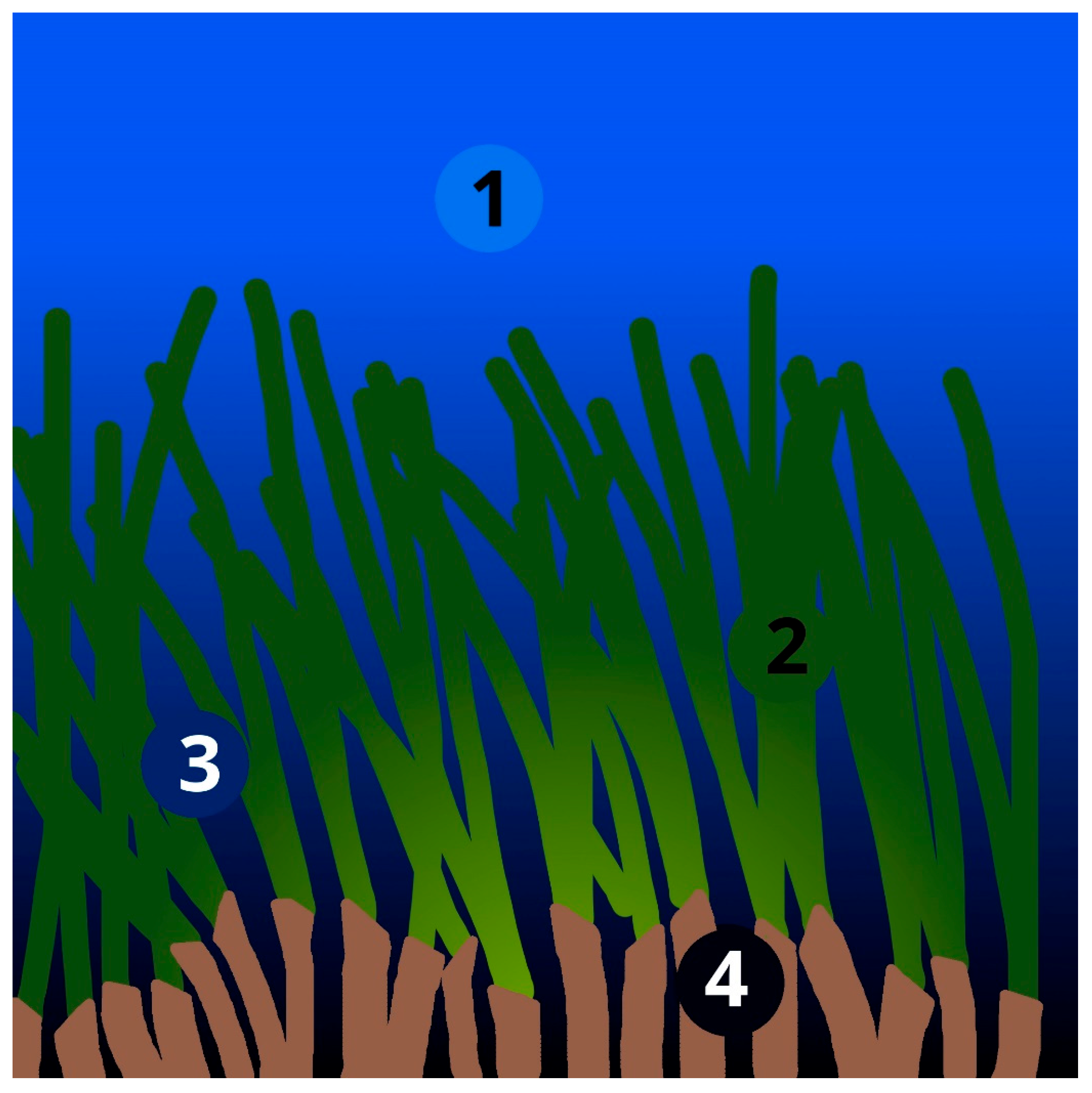
Figure 1. Posidonia meadow microhabitats: (1) open-water column above the Posidonia meadow; (2) Posidonia leaves; (3) hidden volume of water among Posidonia leaves; and (4) hidden spaces at the bottom of and around rhizomes.
Ecologies 07 00040 g001
Figure 2. Map showing the studied localities in the central Adriatic Sea: the diving center “Big Blue” near Zlatni Rat (BB), Dračeva cove near Murvica (DC), and Babića stine (BS).
Ecologies 07 00040 g002
Figure 3. Suction sampling among Posidonia leaves and rhizomes to extract the anesthetised fish from the cuboid using a suction sampler at the edge of Posidonia distribution. Photo by Z. Valić.
Ecologies 07 00040 g003
Figure 4. Steps of the sampling and documentation protocol in cuboids before the use of a suction sampler: (A) fixing a cuboid (1 × 1 × 0.4 m) onto the bottom; (B) photographing the surface inside the cuboid; (C) recording habitat characteristics in 1 m2; (D) spraying the anesthetic quinaldine into the cuboid and catching any escaping fishes with a hand net; (E) visual search of the bottom by pushing apart Posidonia leaves and collecting anesthetised fish at the bottom with a hand net and a strainer; (F) hand upward movements among bottom particles to lift water and suspended material above the bottom, collecting any lifted anesthetised fish. Photos by Z. Valić.
Ecologies 07 00040 g004
Figure 5. (A) Storage of fishes collected directly from the cuboid into plastic jars. (B) Mounting of the net on the suction sampler. Photos by Z. Valić.
Ecologies 07 00040 g005
Figure 6. (A) Mean abundance of fishes per cuboid; (B) average fish species richness per cuboid. Abbrevations for bottom habitat types: (n) outside Posidonia meadows on other types of bottoms, (p) inside Posidonia meadows, and (p&n) at the edge of Posidonia meadows.
Ecologies 07 00040 g006
Figure 7. Visual representation of (A) dbRDA (all factors) and (B) partial dbRDA analysis (bottom habitat type with controls for depth, season, and locality) using ordination plots. •—cuboid samples. Category centroid: ♦—categories of bottom habitat type; ■—categories of depth; ▲—categories of season;▼—categories of locality. Bottom habitat type: (n) outside Posidonia meadows on other types of bottoms; (p) inside Posidonia meadows; (p&n) at the edge of Posidonia meadows. x—fish species. Ellipses represent 95% confidence intervals around group centroids for Bottom habitat types.
Ecologies 07 00040 g007
Table 1. Fish species frequency of occurrence (FOC) and abundance data (AB) from all cuboids and from inside the Posidonia meadows (A), from the edge of the Posidonia meadows (B), and from outside the Posidonia meadows on other types of bottoms (C). Species where only juveniles were collected are marked with *.
Family Species Total FOCTotal ABFOC at AFOC at BFOC at CAB at AAB at BAB at C
GobiesocidaeApletodon incognitus1.7%10.0%5.0%0.0%010
GobiidaeChromogobius zebratus10.0%80.0%5.0%25.0%017
GobiidaeCorcyrogobius liechtensteini16.7%160.0%10.0%40.0%0313
LabridaeCoris julis * 5.0%35.0%10.0%0.0%120
GobiidaeDidogobius splechtnai1.7%10.0%0.0%5.0%001
SparidaeDiplodus annularis1.7%15.0%0.0%0.0%100
MurenidaeEnchelycore anatina * 1.7%10.0%5.0%0.0%010
GobiidaeGobius auratus1.7%10.0%0.0%5.0%001
GobiidaeGobius fallax13.3%95.0%25.0%10.0%162
GobiidaeGobius roulei1.7%10.0%5.0%0.0%010
GobiidaeGobius vittatus1.7%10.0%5.0%0.0%010
BythitidaeGrammonus ater1.7%10.0%0.0%5.0%001
GobiesocidaeLepadogaster candolii1.7%10.0%0.0%5.0%001
GobiidaeMillerigobius macrocephalus13.3%150.0%0.0%40.0%0015
GobiidaeOdondebuenia balearica31.7%595.0%35.0%55.0%11543
BlennidaeParablennius rouxi10.0%90.0%0.0%30.0%009
ScorpaenidaeScorpaena notata5.0%40.0%5.0%10.0%013
ScorpaenidaeScorpaena porcus8.3%510.0%15.0%0.0%230
SerranidaeSerranus cabrilla * 3.3%25.0%5.0%0.0%110
SerranidaeSerranus scriba1.7%15.0%0.0%0.0%100
LabridaeSymphodus cinereus1.7%10.0%5.0%0.0%010
LabridaeSymphodus melanocercus3.3%210.0%0.0%0.0%200
LabridaeSymphodus mediterraneus1.7%15.0%0.0%0.0%100
LabridaeSymphodus ocellaris1.7%25.0%0.0%0.0%200
LabridaeSymphodus rostratus1.7%15.0%0.0%0.0%100
GobiidaeZebrus zebrus21.7%190.0%10.0%55.0%0514
Table 2. Summary of PERMANOVA results to assess differences in the total fish abundance among bottom habitat type, depth, locality, and season: (a) one-way PERMANOVA (Type III sum of squares) and (b) post-hoc pairwise comparison for bottom habitat types. Abbrevations for bottom habitat types: (n) outside Posidonia meadows on other types of bottoms, (p) inside Posidonia meadows, and (p&n) at the edge of Posidonia meadows. Significant values are marked as follows: * p < 0.05; ** p < 0.01; *** p < 0.001.
Source of VariationSSDfFp-Value
(a)
Bottom habitat type243.7333220.288700.0001 ***
Depth10.390111.729780.1926
Locality0.666420.055470.9460
Season13.722212.284520.1337
(b) p-value (Holm–Bonferroni adjusted)
Bottom habitat type: n vs. p 34.9230750.0003 ***
Bottom habitat type: n vs. p&n 13.4440990.001 ***
Bottom habitat type: p vs. p&n 6.6315530.007 **
Table 3. Summary of PERMANOVA results to assess differences in the average fish species richness among bottom habitat type, depth, locality, and season: (a) PERMANOVA (Type III sum of squares) and (b) post-hoc pairwise comparison for bottom habitat types. Abbrevations for bottom habitat types: (n) outside Posidonia meadows on other types of bottoms, (p) inside Posidonia meadows, and (p&n) at the edge of Posidonia meadows. Significant values are marked as follows: * p < 0.05; ** p < 0.01; *** p < 0.001.
Source of VariationSSDfFp-Value
(a)
Bottom habitat type49.6215.999280.0001 ***
Depth0.421010.271630.6039
Locality0.1027 20.033140.9691
Season7.211914.652620.0341 *
(b) p-value (Holm–Bonferroni adjusted)
Bottom habitat type: n vs. p 36.6705740.0001 ***
Bottom habitat type: n vs. p&n 9.0866440.005 **
Bottom habitat type: p vs. p&n 5.33330300.0246 *
Table 4. Summary of PERMANOVA (Type III sum of squares) results for species abundance among bottom habitat type, depth, locality, and season: (a) PERMANOVA assessing differences across different factors and (b) post-hoc pairwise comparisons for bottom habitat types. Abbrevations for bottom habitat types: (n) outside Posidonia meadows on other types of bottoms, (p) inside Posidonia meadows, and (p&n) at the edge of Posidonia meadows. Significant values are marked as follows: * p < 0.05; ** p < 0.01; *** p < 0.001.
Source of VariationSSDfFp (Resampled)
(a)
Bottom habitat type2.351729.72190.0001 ***
Depth0.273312.25980.0478 *
Locality0.391121.61670.0973
Season0.228311.88720.0882
(b) p-value (Holm–Bonferroni adjusted)
Bottom habitat type: n vs. p29.682131.7040.0003 ***
Bottom habitat type: n vs. p&n14.843111.4490.0004 ***
Bottom habitat type: p vs. p&n4.05713.69070.0104 *
Table 5. Results of the similarity percentage procedure (SIMPER) analysis for bottom habitat type showing the cumulative contributions of the most influential fish species to dissimilarity among bottom habitat types. Abbrevations for bottom habitat types: (n) outside Posidonia meadows on other type of bottoms, (p) inside Posidonia meadows, and (p&n) at the edge of Posidonia meadows.
n vs.p n vs.p&n p vs.p&n
Species%Species%Species%
Odondebuenia balearica25.7Odondebuenia balearica25.2Odondebuenia balearica25.0
Zebrus zebrus40.4Zebrus zebrus39.9Gobius fallax40.0
Millerigobius macrocephalus53.5Millerigobius macrocephalus52.0Scorpaena porcus50.6
Corcyrogobius liechtensteini65.0Corcyrogobius liechtensteini63.8Corcyrogobius liechtensteini56.7
Parablenius rouxi72.3Gobius fallax70.9Zebrus zebrus62.4
Serranus cabrilla67.1
Coris julis71.5
Disclaimer/Publisher’s Note: The statements, opinions and data contained in all publications are solely those of the individual author(s) and contributor(s) and not of MDPI and/or the editor(s). MDPI and/or the editor(s) disclaim responsibility for any injury to people or property resulting from any ideas, methods, instructions or products referred to in the content.