1. Introduction
Electroencephalography (EEG) provides a noninvasive measurement of neural dynamics through electrical signals recorded at the scalp. These signals exhibit complex oscillatory patterns reflecting collective neuronal activity across multiple temporal scales. Although these signals offer direct experimental access to brain activity, they represent only a limited projection of the underlying neural processes [
1]. From a physics perspective, this situation resembles systems in which observable quantities arise from effective boundary descriptions while internal degrees of freedom remain hidden.
Examples of such boundary phenomena occur in gravitational systems, where observables accessible to external observers are determined by processes occurring near an event horizon while the internal structure remains inaccessible [
2,
3]. Similar ideas arise in statistical physics and complex systems, where macroscopic observables provide coarse-grained descriptions of systems composed of many microscopic degrees of freedom [
4,
5]. This analogy motivates the exploration of whether neural signals may admit an effective description in which EEG observables correspond to boundary-level projections of deeper neural dynamics. At the same time many complex systems are successfully described through scale-dependent effective theories governed by renormalization-group (RG) dynamics [
6].
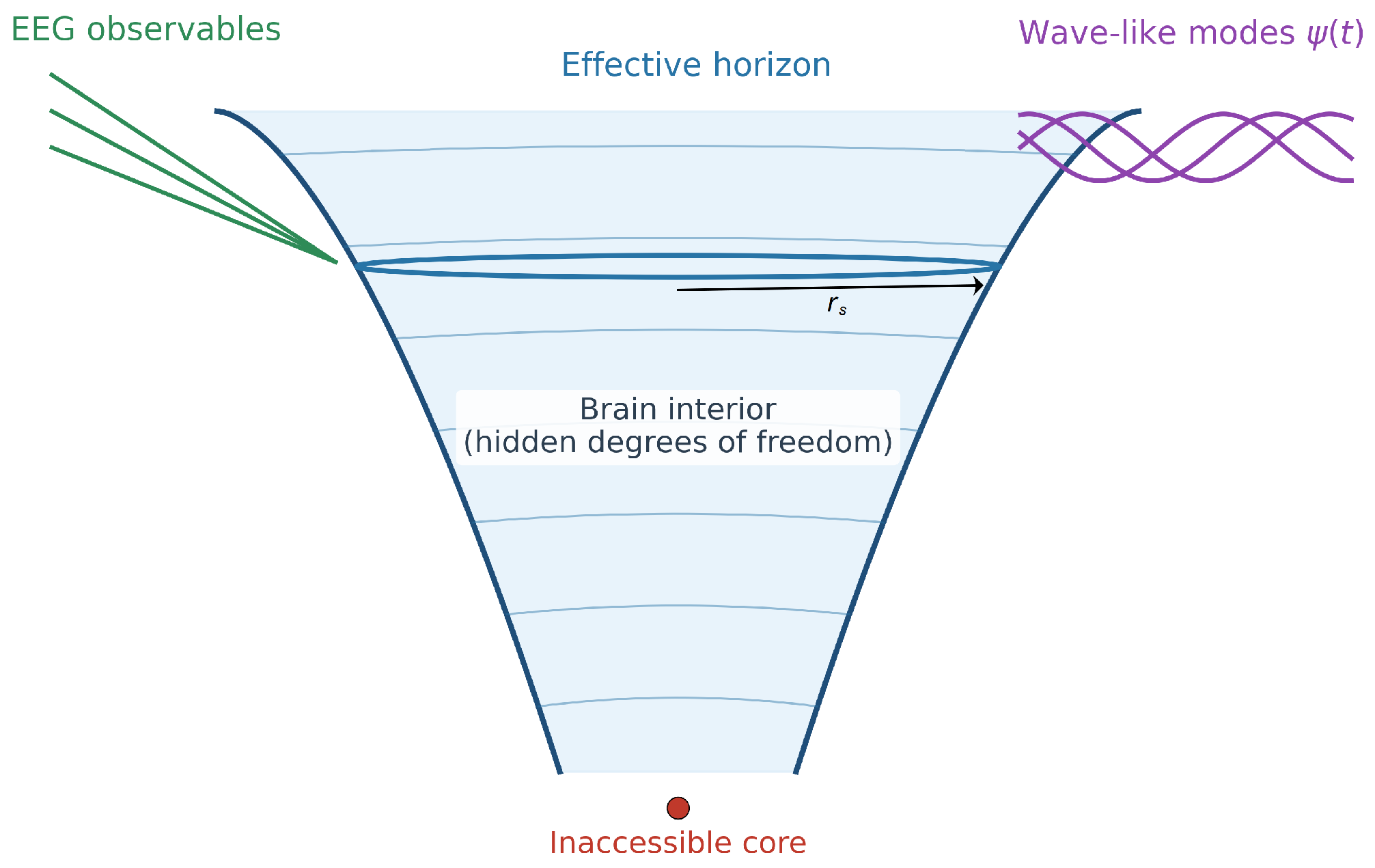
In this work we introduce a horizon-inspired representation of neural signals in which EEG observables emerge as wave-like modes governed by RG scaling and parameterized by spectral entropy. A schematic representation of the horizon-inspired model is shown in
Figure 1. The brain is modeled through an effective horizon-like boundary that provides a formal analogy for observer-limited access to internal dynamics. Within this framework, EEG features associated with distinct mental states—i.e., varying levels of awareness– are related to underlying brain wavefunctions. Real-valued EEG signals can then be rendered audible within the model.
2. Materials and Methods
The Model
We introduce a complex representation
describing neural activity as a function of an abstract radial coordinate
r. The amplitude is assumed to evolve according to a RG transformation of the form
where
and
are real coefficients describing scale-dependent behavior and
. To leading nonlinear order, the solution for the probability density
becomes
assuming
for stability. After normalization, the corresponding complex wavefunction in position space is then,
with an arbitrary phase factor represented by
. For
, the amplitude approaches a constant value
, analogous to RG fixed-point, scale-invariant behavior observed in critical systems.
To connect the model with neural observables we define an accessibility index
representing the effective distance from a horizon-like boundary
. Through this geometric construction, the quantity
can be interpreted as a dimensionless accessibility factor that quantifies how strongly internal dynamics are filtered before becoming observable signals. Near the horizon scale (
) the value
, indicating that observable quantities are strongly constrained by the boundary. Far from the horizon (
) the parameter approaches
, corresponding to a regime in which internal configurations are more fully accessible to external observation. In this sense
plays a role analogous to a “redshift” or transmission factor linking internal dynamics to observable signals.
In the analogy adopted, the value
represents an effective horizon scale analogous to the Schwarzschild horizon in gravitational systems. Inside
, Equation (
4) leads to a mathematical singularity characterized by divergent curvature. Motivated by this structure, we propose a speculative association between a Schwarzschild-like limit—representing irreversible spacetime transitions where information cannot return—and a model projection intended to capture aspects of mental thresholds. Using the accessibility parameter
and fixing the constants
and
, the wavefunction amplitude of Equation (
3) can be rewritten in the form
Using the Bekenstein–Hawking relation
for a Schwarzschild horizon with area
, and the definition of Equation (
4) for
and the radial coordinate
r, the entropy becomes
The Planck-like length
enters the description for a dimensionless analysis (see details in [
7]). This expression applies to regions with
. In statistical physics entropy measures the number of accessible configurations. Within the present framework, the accessibility parameter
increases with the effective distance from the horizon boundary. Therefore larger entropy corresponds to a larger number of accessible neural configurations and to a larger effective distance from the horizon scale.
The phase angle
of the wavefunction determines the oscillatory structure of the model and, in turn, the audible projections. In the present framework, the phase is taken to be
in terms of plane-wave contributions plus a function specific to the present system. This function is assumed to follow another simple RG-like equation
The radial solution up to
, using Equation (
5), yields
which introduces logarithmic phase modulation near the horizon scale. It is interesting to note that this assumption for
relates to the tortoise coordinate
, which removes the Schwarzschild-coordinate singularity at
and leads to plane-wave solutions
.
3. Results
Connection with EEG Observations
To map features of the wavefunction
to audible parameters—and to explore how it evolves– it is necessary to specify how the real (or imaginary) parts of
generate waveforms suitable for sound. First, to evaluate
, the theoretical Schwarzschild-like entropy is identified with empirical measures of spectral entropy
derived from spontaneous EEG measurements [
8]. Second, it is necessary to specify how time
t relates an analogous spatial coordinate in order to evaluate
within the present construction. This isomorphism is obtained by mapping
, where
is a scaling parameter linking the abstract coordinate to the temporal evolution of EEG measurements.
Substituting the time mapping yields the observable real part of the waveform
with
,
and
. Here
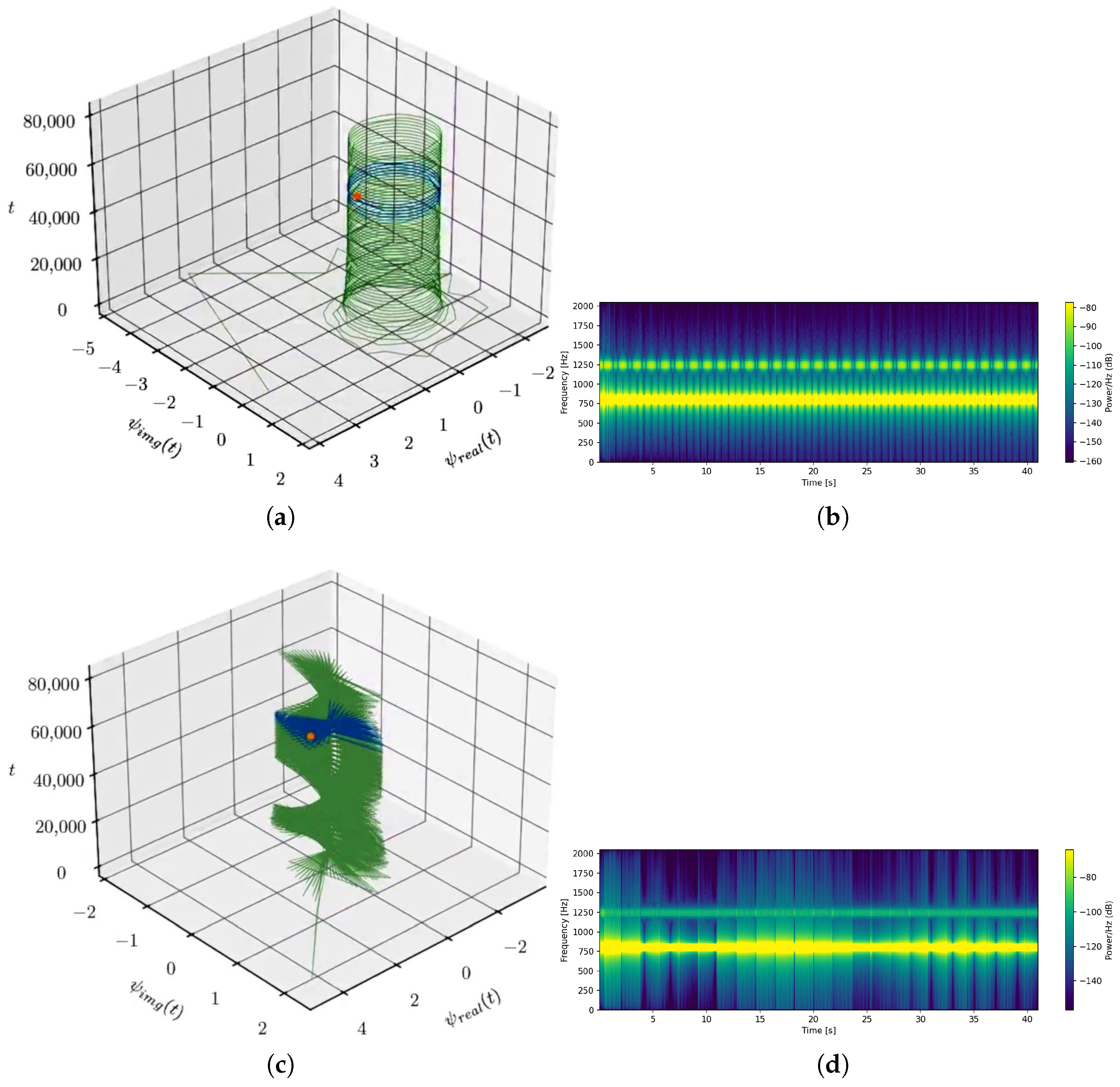
t is treated as the time coordinate used by the external observer, aligned with the measurement of EEG events. The complex representation provides a geometric interpretation of neural signals and forms a family of oscillatory modes whose spectral characteristics depend on entropy-derived parameters. The real and imaginary components define trajectories in phase space forming helical structures under time evolution whose projections correspond to observable oscillatory EEG signals as shown in
Figure 2.
The RG equation governs the amplitude of this wavefunction, yielding scale-invariant solutions whose observable structure can be parameterized by EEG spectral entropy. The resulting modes generate characteristic oscillatory patterns that can be rendered acoustically through sonification techniques [
9]. Because the real component of
corresponds to an oscillatory waveform, the representation naturally lends itself to sonification. Sonification converts data into sound in order to reveal temporal patterns that may not be immediately visible in standard plots.
An appealing feature of the wave-like representation is that its real component can be interpreted directly as an audio waveform. This allows neural dynamics to be explored through sonification, transforming EEG signals into audible structures that reveal temporal patterns in a different perceptual modality. To produce continuous signals from discrete EEG data it is necessary to reconstruct the time series using Gaussian smoothing. The reconstructed amplitudes are then normalized and converted into digital audio samples. Spectrogram analysis of the resulting signals reveals structures that depend on the parameters controlling the wavefunction representation. In particular, different parameter choices lead to distinct helical trajectories in complex phase space whose projections produce characteristic spectral patterns in the audio domain.
4. Discussion
The theoretical framework inspired by concepts from horizon physics does not assume that neural processes are quantum mechanical or that the brain behaves as a gravitational system. Instead, mathematical structures drawn from quantum theory and horizon physics are used as organizing tools for describing observable neural signals in terms of wave-like representations. Within this interpretation acts as an effective accessibility coordinate that links entropy, observable signal amplitude, and the distance from the horizon scale.
The horizon-inspired representation leads to several qualitative features that provide insight into the structure of neural signals. First, the RG equation governing the amplitude introduces a natural scale hierarchy in which the observable signal approaches a constant value far from the effective boundary. In the context of EEG dynamics, this behavior can be interpreted as the emergence of stable macroscopic oscillations from a large ensemble of interacting neural units. Second, the entropy dependence of the accessibility parameter suggests that variations in neural complexity directly influence the amplitude and phase structure of the observable modes. Higher spectral entropy corresponds to a broader distribution of frequencies and therefore to a richer set of accessible neural configurations. Within the present framework this corresponds to a larger effective distance from the horizon boundary of radius
and to a modification of the amplitude scaling of the wave-like modes. In fact, transitions between neural states, such as different sleep stages, could correspond to changes in the effective accessibility parameter. Third, the logarithmic phase term appearing in the model produces oscillatory patterns that can exhibit log-periodic modulation. Such structures are known to arise in systems governed by scale-invariant dynamics and RG flows [
10]. In the context of neural signals this suggests that certain EEG patterns may reflect underlying scale-dependent organization of neural activity.
The model also provides a geometric interpretation of neural signals in terms of trajectories in complex phase space. Depending on parameter values, these trajectories may form helical structures whose projections onto real observables correspond to oscillatory EEG waveforms. This representation offers an intuitive way to connect spectral properties of neural signals with geometric structures in the underlying complex representation. Finally, the possibility of sonifying the wavefunction modes offers a perceptual interface for exploring the structure of neural signals. Different parameter regimes produce distinct spectrogram patterns, which may provide an additional way to investigate the relationship between entropy measures and neural dynamics.
The framework generates testable predictions. If the entropy–horizon relation is meaningful, systematic variations in spectral entropy should modify both the amplitude and spectral structure of the predicted oscillatory modes. Neural state transitions, such as those occurring between sleep stages, may correspond to shifts in the effective accessibility parameter . Conversely, the absence of correlations between entropy variations and the predicted scaling behavior would falsify the model. The framework therefore provides clear criteria for empirical validation using large EEG datasets.
Although the present model is conceptual, it provides a physically motivated framework linking entropy measures, scale-dependent dynamics, and observable neural oscillations, suggesting new avenues for the quantitative analysis of complex neural signals.
Falsifiable Framework
The present work is intentionally conceptual and aims to introduce a physics-based framework. We do not claim a direct empirical validation at this stage. The horizon-based formalism is proposed as a unifying description that connects neural signal dynamics with established principles from statistical physics and information theory, using black hole–inspired analogies in a clearly delimited manner. Although exploratory, the model is formulated in terms of measurable quantities (e.g., spectral entropy and time-resolved neural signals) and yields concrete, testable predictions that can be evaluated against experimental data. In this sense, it provides a falsifiable and quantitatively defined framework intended to guide and stimulate future empirical investigations.
To make the hypothesis and its falsifiability explicit, we formulate the central hypothesis as follows: the horizon-inspired index , inferred from measurable neural signals, encodes an effective “distance” from an internal boundary that modulates observable dynamics. This hypothesis leads to specific, testable predictions. First, a systematic relationship between and spectral entropy S extracted from EEG recordings is expected, with reproducible variations across well-defined brain states (e.g., wakefulness, sleep stages, anesthesia). Second, the temporal signal is predicted to exhibit (or not exhibit) logarithmic phase corrections, which can be quantitatively discriminated from standard stochastic or oscillatory models using appropriate statistical tests and comparisons. Third, the framework predicts state-dependent scaling behavior consistent with an approach to a fixed-point–like regime under high-entropy conditions.
These predictions are directly testable using publicly available datasets (e.g., polysomnographic EEG recordings) and standard signal-processing pipelines, thereby placing, in principle, the framework within a clearly falsifiable and empirically testable setting.
5. Conclusions
We have introduced a conceptual framework for modeling EEG signals as boundary-level projections of underlying neural dynamics, drawing an analogy with constraints imposed by an event horizon. In a formulation inspired by quantum mechanics, neural activity is represented by a complex wavefunction governed by RG dynamics whose projections naturally generate oscillatory structures and, consequently, audible signals suitable for sonification. Although the model is intentionally conceptual, it is formulated in terms of measurable quantities commonly used in signal processing—and particularly in EEG analysis—so that its predictions can, in principle, be evaluated against experimental data. The proposed approach offers a novel and physically motivated perspective for interpreting and decoding EEG signals.
Future work may extend the formalism to other neural observables, such as magnetoencephalography (MEG), as well as to large-scale brain-network activity. More generally, the framework can be applied to any time series for which meaningful measures of complexity or information content can be defined, including spectral entropy, Kolmogorov entropy, and mutual information between pairs of signals. The sonification procedure is likewise independent of the specific recording modality and can be adapted to different sampling frequencies and signal characteristics.
Additional validation metrics that may be employed in future studies include goodness-of-fit measures such as root-mean-square error (RMSE), model-selection criteria such as the Akaike and Bayesian information criteria (AIC/BIC), and discrimination metrics such as receiver operating characteristic (ROC) curves and the area under the curve (AUC) for distinguishing different physiological states. Taken together, these measures will provide further rigorous and widely accepted quantitative indicators of the reliability and predictive power of the proposed framework.
The proposed framework is intentionally general and is designed to operate on modality-independent descriptors, such as spectral entropy, temporal correlations, and related information-theoretic measures. We emphasize that the horizon-inspired formalism can, in principle, be applied across a broad range of EEG scenarios and neural networks pipelines.